







Abstract
The present research investigated whether accommodation, typically formulated as the tendency to deliberately inhibit a destructive reaction in response to a partner’s destructive behavior, could also occur spontaneously. Supporting this notion, results of the first study revealed that participants respond to their partner’s angry face with a spontaneous smile, whereas strangers’ angry faces are mimicked and thus lead to a spontaneous frown. Importantly, the facial EMG data are moderated by participants’ daily interaction styles: People perceiving themselves in a communal relationship show spontaneous acts of accommodation, whereas this is not the case for people in exchange relationships. The moderation occurred in our first (spontaneous) and third (forced accommodation) studies. The results of the second study replicated the first study in that participants in communal relationships frowned less toward partner’s subliminally presented angry faces but more to their sad faces. The authors discuss their findings as spontaneous social emotion regulation.
Romantic relationships can sometimes be a hassle: agendas to be synchronized, compromises to be found, and one’s own and one’s partner’s emotions to be regulated. Even though such deliberate actions often require cognitive effort, motivation, and thorough negotiations, partners are often willing to undergo these exertions to maintain the relationship. When destructive behaviors occur, partners thus do not simply retaliate but instead absorb them—at least in committed, supportive relationships. In social psychology, such soothing behavior has been tagged as accommodation, a term that pertains to the ability and the willingness of an individual to inhibit one’s own initial destructive impulse in response to a partner’s destructive behavior (Rusbult, Verette, Whitney, Slovik, & Ipkus, 1991). In line with this definition, the bulk of research investigating accommodation departed from the assumption that accommodation is a fairly deliberate behavior (Finkel & Campbell, 2001; for a recent exception, see Perunovic & Holmes, 2008).
In the present research, we extend this idea by exploring whether such processes are grounded in spontaneous accommodative responses such as impulsive expressions of affection as a social emotion regulation process. In three studies, we investigated the intriguing possibility that partners spontaneously regulate their own and their partner’s emotions by spontaneously displaying a soothing facial expression. The theoretical component of this article consists of identifying and discussing measures that are predictive of spontaneous accommodation. In particular, we discuss the differences in predicting when people will accommodate one another on the basis of abstract measurements (i.e., commitment) relative to more concrete daily interaction styles of relationships (i.e., communal strength).
The majority of research on accommodation thus far has focused on how willing and prepared individuals are to accommodate their partner in times of relationship turmoil. The way such research has commonly framed accommodation is as the deliberate inhibition to respond destructively in relation to how one conceives of one’s partner and the relationship, thereby tapping into the cognitive representation of the relationship. Therefore, researchers have typically addressed partners’ representations of commitment and intimacy by relying on highly abstracted indicators such as self-reports (Wieselquist, Rusbult, Foster, & Agnew, 1999) or pronoun measures (Agnew, Van Lange, Rusbult, & Langston, 1998). In this vein, Rusbult et al. (1991) found support for the idea that the preparedness to accommodate to one’s partner is greater when one is more satisfied with and committed to (as tendencies to be dedicated to one’s partner, abstracted over numerous situations) one’s relationship.
Per definition, (deliberate) accommodation entails the inhibition—and therefore some form of conscious intent—of destructive behaviors (Finkel & Campbell, 2001; Rusbult et al. 1991). Yet from a functional perspective, one could raise the question whether accommodation cannot also take place at lower levels of control. The reason for investigating whether these processes also occur spontaneously, outside conscious control, is that such inquiry allows us to examine the very nature of interpersonal relations: Romantic relationships are primarily experienced in physical situations, triggering concrete experiences such as smiling or gazing in response to particular occurrences (Argyle & Dean, 1965).
Highly committed, supportive relationships are those in which partners have some sort of sense of shared, communal essence. This shared essence is formed through acts of consubstantial assimilation: embodied acts such as empathic sex, feeding, and sharing of bodily fluids (such as saliva or semen; cf. Fiske, 1992; see also IJzerman & Koole, 2011). In other words, rather than being grounded in deliberate appraisals, the essence of interpersonal relations often lies in the spontaneous experience of interpersonal interactions (Fiske & Haslam, 2005; Holmes, 2002; IJzerman et al., 2011; IJzerman & Semin, 2010; Kelly et al., 2002).
One notably effective source of experiential information about relational bonds is the excerption and the conveyance of emotions, particularly through bodily input. Bodily input, like facial expressions, provides a wealth of information to both the self and others (James, 1884; Stepper & Strack, 1993), on the basis of which spontaneous actions could take place quickly: Research has shown that people mimic others’ facial expressions spontaneously to hasten the bonding process (Chartrand & Bargh, 1999; Dimberg, Thunberg, & Elmehed, 2000; Hatfield, Cacioppo, & Rapson, 1994).
In light of these findings, it is fascinating to ponder what occurs once an already established bond is put in peril through a potentially destructive behavior of a partner. From a functional perspective, partners should not always strictly mimic destructive behavior but instead spontaneously accommodate, provided the response is given to a close and communal partner. Ultimately, this functional assumption leads to one of our main questions: Does such soothing behavior (i.e., a spontaneous smile in response to one’s partner’s angry face or strong mimicry of a sad face) in fact occur instantaneously (i.e., within the 1st s after the display of one’s partner’s angry facial expression), or does it require time to unfold over initial destructive responses (i.e., longer than 1 s after the display of one’s partner angry facial expression)? 1
Finally, the circumstances under which partners would spontaneously accommodate one another are of great interest. We have argued that the essence of romantic relationships is formed through partners’ shared essence and embodied acts. If this is the case, then spontaneous accommodation, in contrast to deliberate accommodation, should be based on concrete interactions relying on situated, daily experiences rather than on abstract cognitive representations of the relationship (for a similar reasoning, see IJzerman & Semin, 2010).
To predict how well a partner fares in spontaneously maintaining a relational bond, one should thus focus on the situated experiences typically relying on embodied acts, which relate most closely to close, communal bonds, rather than in (reflections of one’s) commitment. Embodied interactions (such as acts of touch, sharing of food; Fiske, 2004; but also, as we suggest here, the display of emotion) are central to people’s communal bonds, which are necessary for close, interpersonal interactions (see Fiske & Haslam, 2005). Consequently, measures that take into account the experience of typical interaction styles within relationships and lay at the heart of communal bonds might in fact more accurately predict spontaneous accommodation relative to more abstract measurements. Assessing daily interaction styles by, for instance, measuring experienced communal strength of the relationship could serve this purpose well (Clark, Dubash & Mills, 1998).
Those interacting on the basis of a special obligation to the other’s needs (i.e., communal orientation) should be more responsive in spontaneous facial expressions than those acting “tit-for-tat” (i.e., exchange orientation; Mills, Clark, Ford, & Johnson, 2004; cf. Fiske, 1992, 2000). We address this question in three studies by comparing the potential moderating roles of more abstract constructs (which have been demonstrated to moderate deliberate accommodation, such as relationship satisfaction and commitment) and such concrete styles of daily interactions (i.e., communal strength). On the basis of our presupposition, the extent to which spontaneous accommodation occurs should be strongly related to a relationship’s daily interaction style (i.e., the typical way in which partners interact with each other, also emotionally; Clark & Tarban, 1991).
Research Overview
In the present article, we set out to answer two questions: (a) Does accommodation to angry or sad partners’ faces occur spontaneously? (b) Does such spontaneous accommodation occur to a greater extent among people who experience a communal relationship as compared to people who experience an exchange relationship? Based on our argumentation, we predict that—at least in communal relationships—preserving the relational bond is facilitated by spontaneous acts of accommodation, such as spontaneously smiling at one’s partner’s angry face.
We tested this idea in three studies. In the first study, we let partners view each others’ angry and happy faces. We predicted that participants who experience their relationship as more communal would accommodate their partner spontaneously (i.e., within the 1st s), measured through Zygomaticus response in an electromyography (EMG) study.
In our second study, we let partners view each others’ angry or sad faces subliminally and measured Corrugator response. We predicted that people who experience their relationship as more communal would inhibit their Corrugator spontaneously after being (subliminally) presented with their partner’s angry face, whereas they would spontaneously disinhibit their Corrugator (displaying a sad face themselves) spontaneously in response to their partner’s sad face.
In the third study, we reversed the experimental logic and let participants view their partner’s angry face and requested them to mimic or to accommodate their partner’s angry face. We measured Zygomaticus and Corrogator responses with the expectation that partners who perceived themselves to be in a more communal relationship would have a harder time mimicking their partner’s angry face whereas the display of an accommodative smile would be comparatively easy (as reflected in a stronger Zygomaticus activity).
Study 1
First, we investigated the possibility that accommodation may also take place spontaneously. We hypothesized that one’s partner’s angry face would be accommodated by a spontaneous smile, whereas a stranger’s angry face would be met with mimicry (see also Epstude & Mussweiler, 2009; Van der Velde, Stapel, & Gordijn, 2010). Second, we investigated the relation between more abstracted and less abstracted, more experiential representations of relationships. Specifically, we were interested in how ratings of commitment and relationship satisfaction versus communal strength are related to the degree to which people accommodate spontaneously. As people in communal relationships habitually focus on the other’s needs and have learned to respond to these adequately, we predicted that the level of communal strength is positively related to the level of spontaneous accommodation, whereas no relation is predicted for commitment and relationship satisfaction.
Method
Participants and design
Twenty-three heterosexual couples (N = 46; Mage = 22.6, SDage = 3.36) 2 participated in exchange for €20. Facial muscle activity of the Musculus Zygomaticus major (smiling) and the Musculus Corrugator supercilii (frowning) in response to depictions of angry faces of one’s partner or a stranger were recorded. 3 As the timing of the response (1st vs. 2nd s) was controlled, the design consisted of a 2 (muscle: Zygomaticus vs. Currugator) × 2 (target: partner vs. stranger) × 2 (time: 1st vs. 2nd s) 4 within-participants design. All EMG-applications and measurements in the present and following studies followed guidelines set by Fridlund and Cacioppo (1986).
Procedure
Participants entered the lab with their partner and were informed that the research pertained to recognition and spontaneous information processing (ostensibly also the reason why pictures of both partners were necessary). Participants were requested to closely examine two pictures displaying prototypically happy and angry facial expressions and to mimic these expressions while photographed. Thereafter, participants were separated and escorted to cubicles for the first portion of the study, where commitment was measured, embedded in other measures. Upon completion, participants returned to the meeting room where they received information regarding the second portion of the study. To begin with, EMG electrodes were applied to participants. To disguise the recording of muscular activity, participants were informed that skin conductance would be measured while they were presented with different opposite-sex pictures (including their partner’s).
For the duration of the experiment, participants were presented with 500-ms warning tones followed by 1,000-ms fixation crosses, indicative of the photographs’ appearance, each presented for 2 s. A blank screen followed the stimulus presentation for random durations of between 13 and 15 s. In total, participants were presented with 32 pictures. Finally, participants completed the communal strength scale by Mills et al. (2004) and a scale to measure their degree of commitment to their relationship (Rusbult, Martz, & Agnew, 1998).
Pictures
Pictures of strangers were taken from the Averaged Karolinska Directed Emotional Faces set by Lundqvist and Litton (1998). Participants were presented with either an averaged opposite-sex face or the picture of their partner 5 expressing anger or happiness. Each face was presented eight times.
Facial EMG
Activity of the Zygomaticus and the Corrugator was recorded on the left side of the face using bipolar placements of 13/7 mm Ag/AgCl surface-electrodes. The impedances of all electrodes were reduced to less than 10 kOhm. The EMG raw signal was measured with a BIOPAC-EMG-100C module with a sampling frequency of 1000 Hz. Raw data were filtered online with a 10 Hz low cutoff filter, a 500 Hz high cutoff filter, and a 50 Hz notch filter. Reported EMG scores are expressed as change in activity from prestimulus levels, defined as mean activity during the last second before stimulus onset. Before statistical analysis, EMG data were collapsed over trials containing matching targets (e.g., angry partner vs. angry stranger) and averaged separately over the 1st and 2nd s of stimulus exposure.
Communal strength measure
Participants were asked to complete 10 items measuring the amount of daily sacrifices they make for their partner, indicative of unconditional relationship commitment (i.e., communal orientation strength; e.g., “How large a cost would you incur to meet a need of your partner?”) on a 10-point scale (1 = nothing at all to 10 = extremely large), Cronbach’s α = .71.
Commitment measure
To assess the level of commitment within the relationship, we uaws six items introduced by Rusbult et al. (1998). Specifically, participants were asked to answer six questions about how committed they were to their partner (e.g., “I feel very attached to our relationship – very strongly linked to my partner”) on 7-point-scales (1 = do not agree at all to 7 = completely agree), Cronbach’s α = .87.
Results
Overall analysis
The ANCOVA yielded a significant main effect for time, F(1, 40) = 8.96, p < .01, ηp2 = .18; Muscle × Time interaction, F(1, 40) = 5.01, p < .05, ηp2 = .11; and Target × Time interaction, F(1, 40) = 4.88, p < .05, ηp2 = .11; further characterized by a three-way Muscle × Target × Time interaction, F(1, 40) = 8.64, p < .01, ηp2 = .17. Importantly, these effects were qualified by the predicted four-way Muscle × Target × Time × Communal Orientation Strength interaction, F(1, 40) = 6.28, p < .05, ηp2 = .13. To further analyze this complex interaction pattern, we ran separate analyses for the Zygomaticus and the Currogator muscles.
Zygomaticus
To analyze the spontaneous smiling pattern more closely, we ran a 2 (target: stranger vs. partner) × 2 (time: 1st vs. 2nd s of recording) ANCOVA, controlling for communal orientation. 7 This analysis revealed significant main effects for target, F(1, 42) = 6.68, p < .05, ηp2 = .14; time, F(1, 42) = 8.45, p < .01, ηp2 = .17; Target × Communal Strength interaction, F(1, 42) = 5.73, p < .05, ηp2 = .12; Target × Time interaction, F(1, 42) = 8.84, p < .01, ηp2 = .17; and the predicted three-way Target × Time × Communal Strength interaction, F(1, 42) = 4.06, p < .05, ηp2 = .09.
Closer inspection of the latter interaction shows (Figure 1) that people scoring low (− 1 SD) on communal strength did not show any significant increase or decrease of Zygomaticus activity over time, both ts < 1; nor was Zygomaticus activation toward their partner greater than toward strangers at any time. Conversely, participants scoring high on communal strength (+1 SD) showed a significant increase in Zygomaticus activity toward their partner over time, t(42) = 3.40, p < .05, ηp2 = .22. Toward strangers’ angry faces, the latter participants also did not show such an increase in activity, t < 1. Moreover, participants high on communal strength showed greater Zygomaticus activity toward their partner than toward a stranger, both within the 1st s, t(42) = 2.59, p < .05, ηp2 = .14, and the 2nd s, t(42) = 3.67, p < .01, ηp2 = .24.
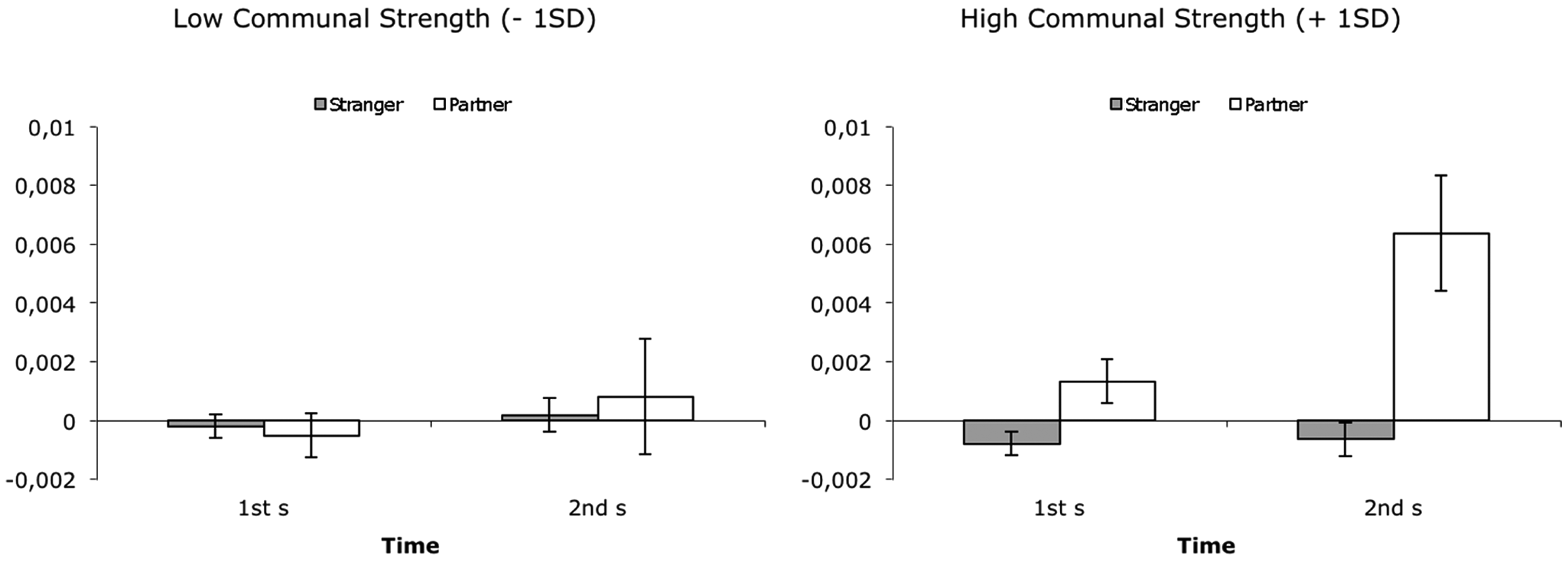
Mean residual Musculus Zygomaticus major activity (in mV) as a function of target, time, and communal strength (Study 1)
Finally, to verify whether the Zygomaticus activation observed in participants scoring high on communal strength was indeed spontaneous (i.e., differed significantly from the baseline already during the 1st s), we tested the untransformed Zygomaticus activation during the 1st s against the baseline measure. As we were interested in both partners’ faces and strangers’ faces, we ran a 2 (Zygomaticus activity: baseline vs. 1st s of stimulus presentation) × 2 (target: stranger vs. partner) within-participants ANCOVA controlling for communal strength. Besides a significant Target × Communal Strength interaction, F(1, 42) = 4.33, p < .05, ηp2 = .09, this analysis revealed the predicted Target × Zygomaticus Activity × Communal Strength interaction effect, F(1, 42) = 4.33, p < .05, ηp2 = .09. As simple comparisons show, this interaction is driven by participants scoring high on communal strength (+ 1 SD), who show marginally increased Zygomaticus activity already during the 1st s as compared to the baseline (i.e., a spontaneous smile), t(42) = 1.79, p < .08, ηp2 = .07, whereas this is not the case for participants scoring low (–1 SD) on communal strength, t < 1, ns. 8
Corrugator
Paralleling the methods for the analyses of the spontaneous smiles, we analyzed potential spontaneous frowning tendencies by analyzing Corrogator activity in a 2 (target: stranger vs. partner) × 2 (time: 1st vs. 2nd s of recording) ANCOVA controlling for communal orientation. This analysis did not yield any significant effects. Despite this null finding, we examined the data more carefully by running simple comparisons. These comparisons revealed one significant effect, namely, that participants showed increased Corrogator activity toward strangers’ angry faces over time, t(42) = 2.17, p < .05, ηp2 = .10, implying that strangers’ angry faces are eventually mimicked.
Discussion
In the first study, we set forth to test two predictions: (a) Does accommodation toward angry partner faces occur spontaneously? (b) Does such spontaneous accommodation occur to a greater extent among people who experience a communal relationship as compared to people who experience an exchange relationship?
Our data confirmed that participants scoring high on communal strength (communal relationships) show not only a significant increase in Zygomaticus activity toward their partner over time but also a reliable accommodative smile within the 1st s after stimulus onset. Both effects were absent for participants scoring low on communal strength (exchange relationships). Furthermore, we found that strangers’ angry faces were mimicked, consistent with other research on facial responses (e.g., Van der Velde et al., 2010).
Although these findings strongly support the notion that in relationships that are experienced as communal, accommodation can take place spontaneously, two viable alternative explanations of our results exist. In particular, the spontaneous smile that participants show in response to their angry partner could also mirror sheer amusement (e.g., Reisenzein, Bördgen, Holterbernd, & Matz, 2006) or implicit sociality (e.g., Fridlund, 1991). However, we do not consider these alternative explanations very likely in light of the results, as they reveal a moderation of communal strength for the spontaneous smile but not for commitment. Nevertheless, we are aware that the present data cannot ultimately exclude the alternative hypotheses. Furthermore, the analyses did not yield a very strong pattern for the Corrugator in the present experiment. Presumably, this was the case because there was not much reason to engage in frowning, especially not toward the partner, rendering it difficult to gain the desired effects.
To jointly address these problems, we designed a second study in which we presented the pictorial stimuli subliminally so that mere amusement and sociality would be very unlikely to drive the effects. Moreover, we used angry and sad faces to compare (and replicate) spontaneous frowning responses. In line with recent findings by Likowski, Mühlberger, Seibt, Pauli, and Weyers (2011), we hypothesized that people who perceive themselves to be in a communal relationship should spontaneously display decreased frowning activity toward their angry partner (i.e., accommodation by a soothing smile as in Study 1) whereas they should show an increased frowning activity toward their sad partner (i.e., accommodation or empathizing by mimicking the partner’s sad face; see also Likowski et al., 2011).
Study 2
In line with our reasoning in Study 1, we speculate that functional social emotion regulation occurs spontaneously. In the specific case of close relationships, this functionality should be predicted by the nature of the relationship. In Study 1 we indeed found that partners who perceive themselves in a communal relationship sooth each other by spontaneously “smiling away” and appeasing the other’s anger. Hence, in the case of anger, “countermimicry” seems most functional to prevent potential conflict. However, in certain instances it should be more functional to empathize with the partner by mimicking their emotion, for instance, by “feeling their pain.”
In other words, mimicry can be more functional in specific types of social emotion regulation, such as in the case of sadness. Cooperation or soothing in such a case might be better displayed by spontaneously mimicking the sad emotional expression (see also, Likowski et al., 2011). We thus wanted to compare the disinhibition of the Corrugator by comparing partner’s response to another negative emotion, namely, sadness. Therefore, we displayed angry and sad facial expressions of participants’ partners in Study 2.
Given that our first study could not fully rule out the possibility that facing the partner’s emotional expression might trigger amusement, we adopted the subliminal display procedure from Dimberg et al. (2000).
Method
Participants and design
Thirty couples participated in this and another, unrelated experiment in exchange for €20 (the other experiment followed the present). To rule out possible codependency of the data within couples, 9 we randomly chose only one of the partners as participant for the present research. Because of a failure to fill in the communal strength measure, two participants were excluded from the analyses (resulting in a net amount of N = 13; Mage = 24.20, SDage = 3.89).
Facial muscle activity of the Musculus Corrugator supercilii (frowning muscle) in response to subliminal depictions of angry or sad faces of one’s partner were recorded. The design consisted of a 2 (facial expression: anger vs. sadness) within-participants design in which we controlled for communal orientation strength.
Procedure
Participants entered the lab with their partner and were informed that the research investigated simple cognitive processes in a partnership. Immediately thereafter, participants were separated and escorted to cubicles for the first portion of the study. One of the participants then learned that he or she was going to be attached to some physiological measure whereas the other participant learned that he or she was going to stage two photographs. Specifically, these participants were asked to display an angry and a sad facial expression. In so doing, they were presented with appropriate photos from the Averaged Karolinska Directed Emotional Faces set to facilitate the staging of the emotions. Afterward, these participants took part in another, unrelated study while their partners received two EMG electrodes on their forehead, assessing Corrugator activity. To disguise the recording of muscular activity, participants were informed that skin conductance would be measured while they were presented with a set of different opposite-sex pictures. These opposite-sex pictures were used to hide the partner’s face and consisted of a random selection of pictures with neutral expressions taken from the Radboud Faces database (Langner et al., 2010).
After electrodes were applied, participants started the experiment by pressing the space bar. Subsequently, they were presented with 500-ms warning tones followed by 1,000-ms fixation crosses, which indicated the first neutral expression photograph’s appearance (5 s). This photo was followed by a 16-ms presentation of either an angry or sad facial expression of the partner and the second neutral expression photo (5 s). The subsequent pause took between 10 and 14 s. In total, participants were presented with 16 of these trials (8 angry and 8 sad facial expressions of the partner). Following the last trials, the experimenter received a sign and entered the cubicle to detach the electrodes. Before leaving the cubicle for the second part of the study, participants were handed a questionnaire containing some questions about their relationship (i.e., communal orientation strength).
Facial EMG
Activity of the Corrugator was recorded on the left side of the face using a bipolar placement of 13/7 mm Ag/AgCl surface-electrodes. The impedances of all electrodes were reduced to less than 10 kOhm. The EMG raw signal was measured with a BIOPAC-EMG-100C module with a sampling frequency of 1000 Hz. Raw data were filtered online with a 10 Hz low cutoff filter, a 500 Hz high cutoff filter, and a 50 Hz notch filter. Reported EMG scores are expressed as change in activity from prestimulus to poststimulus levels, defined as mean activity during the last second before stimulus onset as compared to the first second after stimulus onset (see also Dimberg et al., 2000). Before statistical analysis, EMG data were collapsed over trials containing matching targets (e.g., angry partner vs. sad partner) and averaged.
Communal strength
Participants were asked to complete the same measure used in Study 1. That is, they completed the 10-item questionnaire constructed by Mills et al. (2004), Cronbach’s α = .73.
Results
To test our main hypothesis—that people scoring low on communal orientation would not show differential Corrugator activity toward angry as compared to sad faces of their partner, whereas people scoring high on communal strength should show an inhibition of the Corrugator in response to angry faces and a disinhibition in response to sad faces of their partner—we first analyzed the residual EMG activity in a 2 (facial expression: accommodation vs. mimicry) within-participants ANCOVA, controlling for communal strength. This analysis revealed a marginal main effect for facial expression, F(1, 11) = 3.92, p = .07, ηp2 = .26, and the predicted (marginal) interaction effect of facial expression and communal strength, F(1, 11) = 3.61, p = .08, ηp2 = .25.
Closer inspection of the means (see Figure 2) revealed that, despite the marginal interaction effect, the data perfectly corroborate our expectations: On one hand, people scoring low on communal strength (–1 SD) show neither a differential reaction toward angry and sad faces, t(11) < 1, ns, nor a significant inhibition or disinhibition of their Corrugator activity with respect to the baseline, both ts < 1, ns.
On the other hand, however, people scoring high on communal strength (+1 SD) do show a weaker frown toward their partners’ angry faces as compared to sad faces, t(11) = 2.75, p < .05, ηp2 = .41. Moreover, the response to angry faces reflects a significant inhibition of the Corrugator with respect to baseline activity, t(11) = 2.21, p < .05, ηp2 = .31, and the response to sad faces reflects disinhibition, t(11) = 4.09, p < .01, ηp2 = .60.
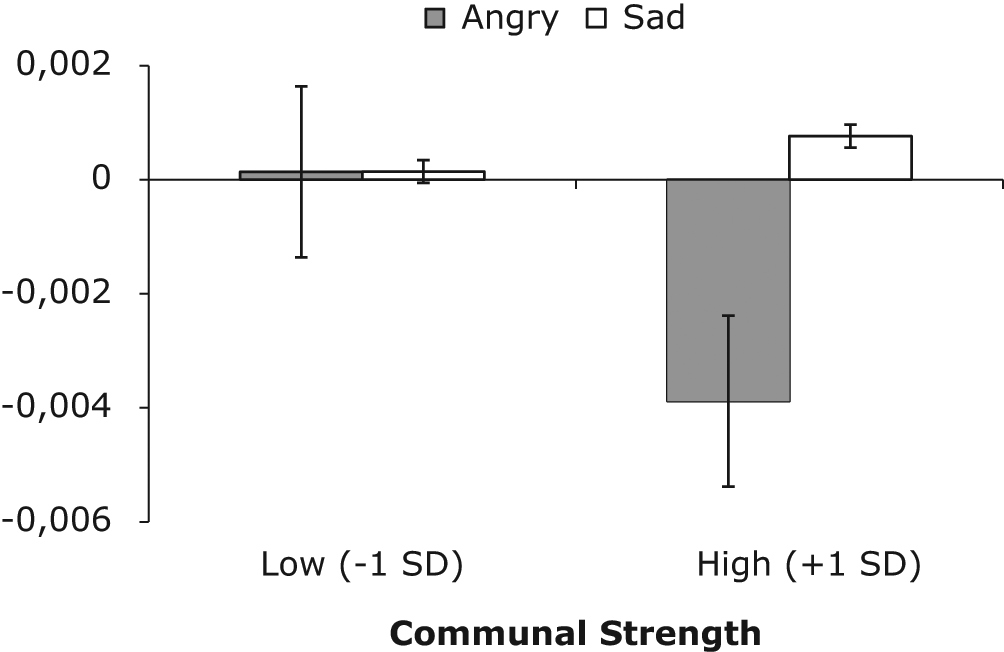
Mean residual Musculus Corrugator supercilii activity (in MV) as a function of facial expression, and communal strength (Study 2)
Discussion
In line with our expectations, data of Study 2 confirmed that participants scoring high on communal strength (communal relationships) show not only a significant inhibition in Corrugator activity toward their partner’s subliminally presented angry face but also a significant disinhibition in Corrugator activity toward their partner’s subliminally presented sad face. This effect did not occur for participants scoring low on communal strength. We thereby provided further support for the notion that (a) accommodation occurs spontaneously and (b) the results from Study 1 did not merely result from sheer amusement as a function of implicit sociality. Not only did our participants show countermimicry toward their partner’s angry face, they also showed mimicry of their partner’s sad face, but only if they perceive their relationship to be communal.
Study 3
Studies 1 and 2 provided strong initial support that participants do not merely accommodate as a function of implicit sociality or amusement. To fully rule out these potential alternative explanations, we studied the strength of intended accommodating and mimicking facial expressions. Specifically, for accommodation and mimicking to occur, we explicitly asked participants to either mimic or accommodate the happy or angry facial expression of either their partner or a stranger and subsequently measured the strength at which they performed the facial expression (and thereby reversing the experimental logic).
In line with results from Study 1, we hypothesized that the target (partner vs. stranger) should not matter for people scoring low on communal strength, whereas people scoring high on communal strength should show a differential pattern in a forced response toward their partner’s angry face. Namely, people scoring high on communal strength should experience greater ease in accommodating (i.e., a stronger Zygomaticus activation) and greater difficulty in mimicking (i.e., a weaker Corrugator activity) their partner’s angry face.
Method
Participants and design
Thirteen couples participated in exchange for €20. Because of a failure to fill in the communal strength measure, one participant had to be excluded from the analysis (resulting in a net amount of N = 25; Mage = 23.32, SDage = 4.39). Facial muscle activity of the Musculus Zygomaticus major (smiling) and the Musculus Corrugator supercilii (frowning) in response to depictions of angry or and happy faces of one’s partner or a stranger were recorded. The design consisted of a 2 (instruction: accommodation vs. mimicry) × 2 (muscle: Zygomaticus vs. Corrugator) × 2 (target: partner vs. stranger) × 2 (facial expression: happy vs. angry) within-participants design.
Procedure
In the current study, the procedures and materials were nearly identical to those in Study 1, with one major exception. This time, participants were instructed (blockwise) to either deliberately accommodate (“Please perform the exact opposite facial expression as compared to the one displayed on the photographs you are going to be presented with”) or to mimic (“Please perform the same facial expression as the one displayed on the photographs you are going to be presented with”) the displayed facial expression. To make ensure that participants fully understood what we meant by same and opposite facial expression, the experimenter showed them once the “correct” responses.
The order of the two instruction blocks was fixed, such that accommodation as the more central with respect to the present hypotheses (but also the more difficult one) was always first. We are aware of the fact that this may hamper the power of the data in the mimicry condition and, because of the omnibus tests we performed, the power of the accommodation data. We therefore also analyzed the accommodation data separately, yielding virtually the same results, which is why we present the full data analysis here without forgetting to note the potential weakness in the design.
Each block consisted of four happy and four angry pictures of the partner and a stranger, resulting in 16 responses per block. In total, participants had to perform 32 facial expressions. These expressions were recorded on the Corrugator and the Zygomaticus for 2 s and were introduced by a 500-ms warning beep and a 1,000-ms fixation cross. An 8-s black screen followed each trial. After the facial response task, participants were asked to complete several online questionnaires assessing the same communal strength and commitment scales as in Study 1. Moreover, this time we included a measure of relationship satisfaction (Rusbult et al., 1998).
Pictures
Pictures of strangers were taken from the Averaged Karolinska Directed Emotional Faces set by Lundqvist and Litton (1998). Participants were presented with either an averaged opposite-sex face or a picture of their partner 10 expressing anger or happiness. Each face was presented eight times.
Facial EMG
Facial EMG for the Zygomaticus and the Corrugator was recorded in exactly the same way as in Study 1. Before statistical analysis, EMG data were collapsed over trials containing matching targets (e.g., accommodation toward angry partner vs. angry stranger).
Results
Overall analysis
We analyzed the residual EMG activity in a 2 (instruction: accommodation vs. mimicry) × 2 (muscle: Zygomaticus vs. Corrugator) × 2 (target: partner vs. stranger) × 2 (facial expression: happy vs. angry) within-participants ANOVA, which basically served as a manipulation check analysis. Confirming that participants followed our instructions, this analysis yielded a strong interaction of instruction, muscle, and facial expression, F(1, 24) = 60.82, p < .001, ηp2 = .72. Importantly, this interaction was not qualified by the higher order interaction including target, F < 1, ns, essentially implying that participants followed instructions equally well for photos of their partner and a stranger. Furthermore, the analysis revealed an array of other effects, irrelevant to the present purpose because they did not include muscle as a moderator and therefore cannot be interpreted in a meaningful way. This is why we report these effects without further comment. Specifically, the analysis revealed a main effect for muscle, F(1, 24) = 21.03, p < .001, ηp2 = .47; an Instruction × Facial Expression interaction effect, F(1, 24) = 22.48, p < .001, ηp2 = .48; and an Instruction × Facial Expression × Target interaction effect, F(1, 24) = 6.22, p < .05, ηp2 = .21.
Reactions to angry faces
To further test our assumption that responses to angry faces would be moderated by communal strength, 11 and paralleling the analysis strategy of Study 1, we analyzed responses to the angry faces in a 2 (instruction: accommodation vs. mimicry) × 2 (muscle: Zygomaticus vs. Corrugator) × 2 (target: partner vs. stranger) ANCOVA controlling for communal strength. As predicted, communal strength moderated the effect of instruction on the different muscles with respect to the different targets: The analysis revealed the predicted four-way Instruction × Muscle × Target × Communal Strength interaction, F(1, 24) = 5.25, p < .05, ηp2 = .19.
As depicted in Figure 3, and corroborated by simple comparisons, this interaction effect is driven by the fact that participants scoring low on communal strength show no differential pattern for their partner or a stranger, all ts < 1.69, all ps > .11: Whereas they follow the instructions well when mimicking, these participants show no accommodative response as they show no increased Zygomaticus activity, with respect to both Corrugator activity and baseline, all Fs <1, ns. In contrast, people scoring high on communal strength show a differential pattern: Highly communally oriented people show stronger accommodative responses to their partner as compared to a stranger, t(23) = 2.33, p < .05, ηp2 = .19, whereas they show a decreased mimicking response to the angry face of their partner as compared to a stranger, t(23) = 2.04, p < .05, ηp2 = .15.

Mean residual electromyography (EMG) activity (in MV) in response to angry faces as a function of target, muscle, and instruction (Study 3)
Unexpectedly, people scoring high on communal strength also showed a significantly higher Corrugator response toward their partner as opposed to a stranger when they were instructed to accommodate the facial expression, implying that they did not completely relax the Corrugator even though they were smiling, t(23) = 2.70, p < .05, ηp2 = .24. Finally, when mimicking angry faces, the Zygomaticus was equally relaxed for photos of the partner and the stranger, t < 1, ns.
Reactions to happy faces
Paralleling the above analysis, the responses with respect to happy facial expressions were again analyzed in a 2 (instruction: accommodation vs. mimicry) × 2 (muscle: Zygomaticus vs. Corrugator) × 2 (target: partner vs. stranger) ANCOVA controlling for communal strength and the other potential covariates. In line with the hypotheses, however, neither communal strength nor any of the other covariates moderated our findings, as the equivalent four-way Instruction × Muscle × Target × Communal Strength interaction (and the other covariates, respectively) was not significant, F(1, 23) = 1.96, p > .17. The interaction between muscle and instruction yielded the strongest effect, F(1, 23) = 73.84, p < .001, ηp2 = .76. Therefore, these two analyses jointly support the idea that participants followed the instructions well, regardless of target.
Furthermore, the analysis revealed an array of significant results that are not of particular interest to the present purpose. These effects are thus be reported without further comment. Specifically, the analysis put forth main effects for muscle, F(1, 23) = 17.51, p < .001, ηp2 = .43, and instruction, F(1, 23) = 18.89, p < .001, ηp2 = .45; two-way interactions for Instruction × Target, F(1, 24) = 5.79, p < .05, ηp2 = .20, and Muscle × Target, F(1, 24) = 6.14, p < .05, ηp2 = .21; and, three-way interactions for Instruction × Target × Communal Strength, F(1, 23) = 4.65, p < .05, ηp2 = .17, and Muscle × Target × Communal Strength, F(1, 23) = 4.97, p < .05, ηp2 = .18.
Discussion
Results of Study 3 yielded a conceptual replication of the findings from the first study: We again found that communal orientation strength moderated the effects such that only those who perceive themselves to be in a communal relationship show a differential response pattern to their angry partner as opposed to an angry stranger. Specifically, those high on communal strength showed increased accommodation and decreased mimicry of the angry face of their partner. This pattern was not found for people scoring low on communal strength, or for responses to happy faces, or for other potential moderators such as commitment or relationship satisfaction. Taken together, Study 3 thus strongly corroborates the claim we put forth in Study 1: Accommodation to angry partner’s faces can take place spontaneously.
Moreover, Study 3 yielded results ruling out the potential alternative explanation that staged angry expressions of one’s partner elicit sheer amusement rather than accommodative smiles: If this was the case, one would expect participants to also laugh at these faces, especially in the mimicry instruction. Participants were clearly not just amused, as there was no indication of laughing under the mimicking instruction (as evidenced by a completely relaxed Zygomaticus for both the partner and the stranger). Furthermore, the overall analysis was not moderated by target, indicating that participants followed the instructions equally well for all targets. Only when communal orientation strength was added to the design did we observe a differential response pattern observable.
Last but not least, the unexpected finding that people scoring high on communal strength also showed some Corrugator activation when asked to accommodate the angry face of their partner makes it unlikely that such pictures amused participants. Rather, this effect might point to a fear response (Dimberg, 1986). Although partners show an accommodative smile to the partner to maintain the communal bond, the prospect of losing a communal bond might evoke fear in the individual at risk to lose it. Indeed, the activity in the Corrugator even provides further support to the hypothesis that participants were simply not amused when seeing the partner’s angry face.
General Discussion
We investigated whether partners spontaneously accommodated in response to another and to what extent these spontaneous accommodations relate to partner’s daily interaction styles versus more abstracted versions of the relationship (namely, commitment to each other and satisfaction with the relationship). Taken together, our results strongly suggest that accommodation takes place spontaneously, within 1 s of exposure to potentially destructive partner behavior. Importantly, our analyses showed that this holds true only for participants who perceive themselves to be in a communal relationship. Stated differently, those who live in a supportive relationship with their partner without consideration to personal gains impulsively accommodate their partner through spontaneously smiling in response to their partner’s angry facial expression. Conversely, those who live a tit-for-tat, exchange-based relationship do not seem to respond to their angry partner, or at least not in an accommodative fashion.
The fact that only communal strength moderated our results and not commitment or relationship satisfaction is interesting in at least two respects. We are confident that this moderation—together with the findings from our complementary analyses—aids in countering the potential alternative explanations that our findings might reflect amusement or sociality. Second, our findings seem to bolster our hypothesis that spontaneous acts of accommodation should be predicted by concrete, behaviorally grounded “evaluations” of relationships rather than by their abstract reflections (see also Rusbult et al.’s, 1991, seminal paper for suggestions on habituated responses). In the remainder of the article, we discuss these two important conclusions.
Three studies support our notion of spontaneous accommodation. To us, the exclusive moderation of communal orientation provides strong support for our hypothesis: Those who care for their partner out of a special obligation (i.e., empathically) have learned to do so especially efficiently, namely (among others) by expressing a spontaneous smile toward their angry partner and a disinhibited Corrugator toward their partner’s sad face. As such, this moderation could suggest that spontaneous accommodation can be learned and habituated, such that over time, the required effort to exert this behavior decreases (Karremans & Aarts, 2007; Perunovic & Holmes, 2008).
Alternatively, one could suggest that automatic accommodation specifically occurs when romantic partners lose themselves. Although one’s own self-control may be useful in more deliberate forgiving of the other (Pronk, Karremans, Overbeek, Vermulst, & Wigboldus, 2010) and to ward off relationship threats to stay faithful (Pronk, Karremans, & Wigboldus, 2011) while others’ perceived self-control may contribute to interpersonal trust (Righetti & Finkenauer, 2011), people might spontaneously rely on their close partner for emotion regulation processes. One may wonder to what degree controlling the self is actually functional in close, communal relationships. To what degree social emotion regulation relies on self-control or a loss of self plus its potential origins should thus be subject for future research.
Certainly, one could still argue that those scoring low on communal orientation do not smile at their angry partner because they find no amusement in seeing an angry partner, as their relationship is presumably not a satisfying one (also evidenced by a significant positive correlation between the two concepts in our first study; r = .55). However, this should also imply that participants unhappy in their relationship show less mimicry of their happy partner because they have lost interest and therefore treat their partner in a fashion similar to a random stranger. This is clearly not the case. Happy partners were mimicked spontaneously regardless of communal orientation strength, rendering it very unlikely that people scoring low on communal strength drive the moderation of the accommodative smile. Taken together, we are therefore confident that we found evidence for spontaneous accommodation in people scoring high on communal strength.
Our results complement prior research in interpersonal relationships by implementing ideas from grounded social cognition (Cohen, Leung, & IJzerman, 2009; for an overview, see IJzerman & Koole, 2011; Semin & Smith, 2008) and relational models theory (Fiske, 1992). Often relationships are analyzed through conscious control (Finkel & Campbell, 2001) or cognitive outcomes (Agnew et al., 1998). Though this approach has proven fruitful, the current research emphasizes the importance of nonverbal, embodied processes in the analysis of interpersonal relationships. Interpersonal relationships are often conceptualized through situated experiences with people’s attachment figures (cf. Bowlby, 1969). They should thus be grounded in physical experiences such as warmth (IJzerman & Semin, 2009, 2010; IJzerman et al., 2011), physical distance (Williams & Bargh, 2008), synchrony (Hove & Risen, 2009), or as we report here, specific emotions detailed to different situations.
Fiske (1992) argues for the importance of different relational models such as communal sharing. The current report contributes to Fiske’s idea in that people attempt to maintain relational bonds through emotions related to embodied acts. Furthermore, our research complements the idea that the (social) conceptual system runs continuously from humans to animals (cf. Barsalou, 2005); the display among partners parallels that of certain other social animals. A silent bared-teeth display (akin to the human smile) is often used in situations of reconciliation of interactants, replacing conflictive by affiliative behavior (such as among common chimpanzees and barbary macaques; for an overview, see Preuschooft & Van Hooff, 1997).
However, people develop different types of responses as a function of the nature of the relationship, scaffolding their emotion on the person and the specific situation. This corroborates Kelley et al.’s (2002) ideas that the interaction between Person A and Person B, in combination with the situation, defines the behavioral outcomes. Yet our research also emphasizes the nature of representation, mapping relational knowledge onto its social context. This poses some interesting questions: When are people likely to use spontaneous accommodative responses or controlled accommodative responses? And, what amount of information is consciously processed in different situations? These questions address the need to integrate deliberate and spontaneous processes, and to determine which spontaneous processes overlap with deliberate processes in interpersonal interaction (cf. Cunningham, Raye, & Johnson, 2004). Finally, although we agree that controlled accommodation can become habituated through different experiences over time, we believe that accommodation relies on certain evolutionarily prewired mechanisms grounded in people’s relational models.
Despite clear evidence for the interdependence between daily interaction styles within relationships and spontaneous acts of accommodation, the present data do not allow for a clear-cut causal analysis. First, it is important to investigate how spontaneous accommodation is related to acts that “connect the body”; in other words, future research should address to what degree interpersonal touch or food sharing may be related to spontaneous accommodation processes. Second, it seems equally plausible to assume that developing the skill to accommodate spontaneously takes time, or that the processes we investigated can be interpreted as the “experiential basis” of accommodation. Though we investigated one dynamic property of emotional interaction, explicating the context in which embodied acts and emotional interactions unfold is necessary in understanding how emotions may contribute to successful relationship maintenance (see Griffiths & Scarantino, 2009; for a discussion of context in embodiment, see IJzerman & Cohen, 2011). Taking a socially situated approach to emotions seriously will allow for a more dynamic model of the different relational bonds. We hope that the present work stimulates further research investigating this idea.
Interestingly, both the acquisition of deliberate and the spontaneous accommodation to anger imply different adaptations to malfunctioning relations. If spontaneous accommodation were important for the development of functionality, the present research implies that people should learn to attend to their bodily cues rather than to overanalyze the relationship in its entirety. Conversely, if spontaneous accommodation is a sign of functionality, malfunctioning can best be overcome by “training” accommodation in situations. Indeed, the grounded nature of relationships may provide important implications for how people come to care for another successfully.
Footnotes
Both authors contributed equally to the publication of this manuscript and share first authorship. We are grateful to Marleen Dudink, Ellen Harsma, Ben van Impelen, Else Lagerwij, Natalie Smit, Mark Snel, and Lonneke Vis for their help in collecting and preparing the data, and Catrin Finkenauer, Esther Kluwer, and Justin Saddlemyer for their invaluable comments on earlier versions of this manuscript.
The author(s) declared no potential conflicts of interest with respect to the research, authorship, and/or publication of this article.
The author(s) received no financial support for the research, authorship, and/or publication of this article.