







Abstract
Commonplace situations that are seemingly innocuous may nonetheless be emotionally harmful for racial minorities. In the current article the authors propose that despite their apparent insignificance, these situations can be harmful and experienced as subtle racism when they are believed to have occurred because of their race. In Study 1, Asian Americans reported greater negative emotion intensity when they believed that they encountered a situation because of their race, even after controlling for other potential social identity explanations. Study 2 replicated this finding and confirmed that the effect was significantly stronger among Asian Americans than among White participants. These findings clarify how perceptions of subtle racial discrimination that do not necessarily involve negative treatment may account for the “sting” of racial microaggressions, influencing the emotional well-being of racial minorities, even among Asian Americans, a group not often expected to experience racism.
In The New York Times, a Black professor detailed an ostensibly innocuous event: having an open seat next to him on a crowded train (Wideman, 2010). While noting the luxury of having an extra seat to himself, he deliberated the reasons for the open seat, citing possibilities like his projected social class. Ultimately, he could not help but speculate that the seat next to him was often empty because of his race.
Commonplace public experiences such as having an open seat on the train or being asked where one is from may occur for numerous reasons. But how would one feel when the treatment is thought to have occurred due to one’s race? Could these seemingly innocuous situations have a toll on the emotional well-being of racial minorities? Qualitative evidence suggests the answer is yes (Sue, Bucceri, Lin, Nadal, & Torino, 2007; Sue, Capodilupo, et al., 2007). However, there is debate about whether these situations can be distinguished from general interpersonal slights that all individuals sometimes experience, regardless of their race (Schacht, 2008; Thomas, 2008). We propose that these situations are in fact distinct, that their emotional “sting” comes from an interpretation that the behavior being directed toward an individual (e.g., “target”) is because of his or her race.
Emotional Consequences of Seemingly Innocuous but Differential Treatment
Racism has historically shifted from blatant forms of expressed prejudice to discrimination manifested in subtle and ambiguous ways (Dovidio & Gaertner, 2004). The present studies focus on a form of subtle discrimination—brief, everyday exchanges with minimally negative outcomes that nonetheless can inflict emotional pain to people of color because they belong to a racial minority group (Sue, Capodilupo, et al., 2007). These situations do not involve obvious negative treatment but rather differential treatment that is often viewed by perpetrators of these behaviors to be relatively harmless or negligible. In turn, targets are faced with the additional burden of not overreacting to the seemingly innocuous situation because the perpetrator likely had no awareness that the behavior was hurtful.
The emotional consequences of racial microaggressions may be distinct from situations characterized by clear, negative treatment that can be attributed to racial prejudice. Research on the latter examined situations in which the individual or group believes (a) they were treated unfairly and (b) the treatment was based on a social identity (Major, Quinton, & McCoy, 2002). Although these situations are unequivocally negative, such as receiving negative performance feedback, they are attributionally ambiguous. Thus, the target can attribute the behavior to the perpetrators’ racial prejudice (i.e., based on target’s racial identity) or to his or her personal deservingness (i.e., based on target’s shortcomings; e.g., Major, Kaiser, & McCoy, 2003; Major, Quinton, & Schmader, 2003; Schmitt & Branscombe, 2002a). Past studies using situations featuring unequivocally negative treatment have found that attributing the event to racial prejudice protected minority targets from internalizing emotions such as shame (Crocker, Voelkl, Testa, & Major, 1991; Major et al., 2003).
In the present studies, we asked: What if the treatment is not intrinsically negative, such as having an empty seat next to one on a bus? If people believed this occurred because of their race, how would they feel? We expected minority targets to feel more negatively toward the perpetrator of the behavior (i.e., externalizing emotion, such as anger) and toward themselves (i.e., internalizing emotion, such as shame) when they perceived that these seemingly innocuous behaviors were directed to them due to their race, compared to when they did not.
Although we predicted that both externalizing and internalizing emotions would increase when minority targets believed they were treated differently due to their race, we speculated that externalizing emotions would be more strongly associated with appraisals of the situation as being caused by race, compared to internalizing emotions. Differential treatment based on race is likely viewed as a transgression against individual autonomy (e.g., unfair harm of an individual), a central moral violation often evoking anger (Rozin, Lowery, Imada, & Haidt, 1999). Anger may be particularly characteristic of the reactions to situations examined in the present studies involving everyday interactions with strangers rather than familiar others. When differential treatment comes from a stranger, there are fewer reasons for minority targets to blame themselves (Tangney, Steuwig, & Mashek, 2007) and less social risk in experiencing externalizing emotions, which repel others (Marsh, Ambady, & Kleck, 2005).
Nevertheless, we predicted that internalizing emotions would also increase, rather than decrease or be unaffected, when the situations are believed to be due to race. This is in contrast to studies of clear negative treatment (e.g., receiving a poor grade on a performance), in which racial prejudice attributions typically provided participants with a less painful alternative appraisal than personal deservingness. The kinds of seemingly innocuous situations examined in the present studies (e.g., a stranger who got on the bus chose not to sit next to you), however, are not intrinsically negative, and thus thinking about one’s own race does not represent a less painful alternative appraisal. On the contrary, appraising that one is treated differently due to one’s race can make an otherwise seemingly innocuous situation painful. This is consistent with research by Branscombe and her colleagues suggesting that being reminded of one’s lower status in society may be responsible for negative emotions in general (e.g., Branscombe, Schmitt, & Harvey, 1999; Schmitt & Branscombe, 2002a, 2002b; Schmitt, Branscombe, Kobrynowicz, & Owen, 2002).
The Relevance of Multiple Social Identities in Subtle Discrimination Experiences
Individuals occupying low social status may be more likely to be treated differently based on multiple stigmatized identities (e.g., being a racial minority and a woman), as opposed to high-status individuals in experiences of subtle discrimination. For example, African Americans’ and Asian Americans’ public collective self-esteem have been found to be negatively correlated with belief in discrimination based not only on race but also on gender (Luhtanen & Crocker, 1992). Thus, multiple social identities may be relevant in the experiences of differential treatment, such as race and social class (Collins, 1993; King, 2003; Mahalingam & Leu, 2005; Purdie-Vaughns & Eibach, 2008). In the present studies, by investigating participants’ focus not only on race but also on age, gender, social class, and height/weight, which are common social identities relevant to discrimination (Williams, Yu, Jackson, & Anderson, 1997), we sought to isolate the effect of race relevance. This extends previous studies on attributional ambiguity that generally have not considered racial identity in the context of other relevant social identities.
In sum, past studies have focused on situations with clear negative treatment in which targets need to judge whether racial prejudice (or another social identity) or personal deservingness is to blame. In contrast, the present studies focused on situations in which the treatment of racial minorities by itself is not, or only minimally, negative. Additionally the present studies also asked: Is it appraising one’s race as relevant in these situations, or other social identities such as gender and social class, that influence emotional reactions? These are important distinctions in advancing the understanding of contemporary discrimination and its emotional consequences, particularly for situations that initially appear trivial.
Overview of Studies
Two studies examined the role of the belief that one is being treated differently, though not necessarily negatively, due to race. We predicted that the potential emotional “sting” of seemingly innocuous situations is proportional to the strength of such a belief (Hypothesis 1), even when controlling for the effect of other social identities, such as gender and social class (Hypothesis 2). We expected that appraisals of race would be associated with externalizing emotions. We also expected a similar effect on internalizing emotions because unlike past research in which racial prejudice attributions provide a less painful alternative to self-blame in explaining negative treatment, the present research examines race appraisals of situations that involve relatively innocuous treatment which may remind the target of his or her lower status in society.
We examined these hypotheses among Asian Americans, an understudied group often perceived as “model minorities” who are not often expected to experience racism yet nonetheless are viewed and treated ambivalently based on their race (Ho & Jackson, 2001; Maddux, Galinsky, Cuddy, & Polifroni, 2008). Investigating these situations among Asian Americans is particularly important in understanding how seemingly innocuous treatment can hurt even for a group that is not often expected to be harmed by discrimination. In addition, Study 2 tested our prediction that the negative impact of appraising the same treatment as due to one’s race would not be observed among White participants, consistent with their nonstigmatized racial status in the United States.
We used a highly repeated within-person (HRWP) approach (Shoda, 2004; Shoda & LeeTiernan, 2002; Zayas, Whitsett, Lee, Wilson, & Shoda, 2008) to avoid stimulus sampling problems prevalent in social psychology research (Wells & Windshitl, 1999) as well as to test for the variability of the effects across individuals (Fleeson, 2007a, 2007b). While quasi-naturalistic methods like the experience sampling method can also examine condition-to-condition variation within each participant, an advantage of our approach is examining affective consequences from standardized stimuli.
Study 1
Method
Development of potential racial microaggression situations
In a focus group, nine self-identified Asian American college students (78% women; ages 20 to 26) were prompted to discuss commonplace, subtle interpersonal encounters in which they felt mistreated based on their race. Twenty-four situations were identified. The situations were consistent with themes reported by other researchers, including feeling invisible, being perceived as a foreigner in one’s own land, and being treated like a second-class citizen (Chan & Mendoza-Denton, 2008; Cheryan & Monin, 2005; Sue, Bucceri, et al., 2007a; Sue, Capodilupo, et al., 2007b).
We then piloted these situations among 26 self-identified Asian American (65% women) and 24 self-identified White students (67% women). They rated whether each situation was relevant to their race, ethnicity, nationality, or cultural background. From these data, 12 situations were identified as potentially relevant to Asian American college students and also for members of other racial groups. Mentions of race were then eliminated from situation descriptions to create a set of stimuli (see the appendix) that allowed for the possibility that these situations were due to other social identities of the person to whom the behavior was directed. Furthermore, using 12 situations allowed natural variations in race relevance within each participant, an advantage over studies using only one situation.
Participants
Participants were 172 self-identified Asian Americans 1 (64% women; 59% U.S. born; M age = 20.05, SD = 1.36) enrolled in introductory psychology courses at University of Washington who participated for extra course credit. The median self-reported family income was between $60,000 and $90,000, on a 6-point scale that ranged from 1 ($10,000-20,000) to 6 ($110,000+).
Procedures
Twelve seemingly innocuous subtle discrimination situations were presented one at a time on a computer in a standardized order (see the appendix). Participants then explained why they thought the situation occurred by first writing in an open-ended format, and then by rating the likelihood that the situation was due to their gender; race, 2 age, height/weight, and social class. These social identities are identical to those used in the Everyday Discrimination Scale (Williams et al., 1997), a widely used scale in survey research. Specifically, participants responded to, “How likely do you think the experience was due to or the result of your race (gender, etc.)?” using a 9-point scale ranging from 0 (very unlikely) to 8 (very likely), with a midpoint of 4 (somewhat likely). Note that attributions to prejudice were not asked. Participants then rated emotion intensity on a 9-point scale ranging from 0 (not at all) to 8 (extremely), with a midpoint of 4 (somewhat) for anger, scorn/contempt, anxiety, sadness, disappointment, shame, frustration, and confusion (e.g., “How ____ would you feel in this situation?”). These negative emotions are relevant to discrimination (Chan & Mendoza-Denton, 2008; Major, Kaiser, et al., 2003; Sue, Capodilupo, et al., 2007).
Results
Descriptives
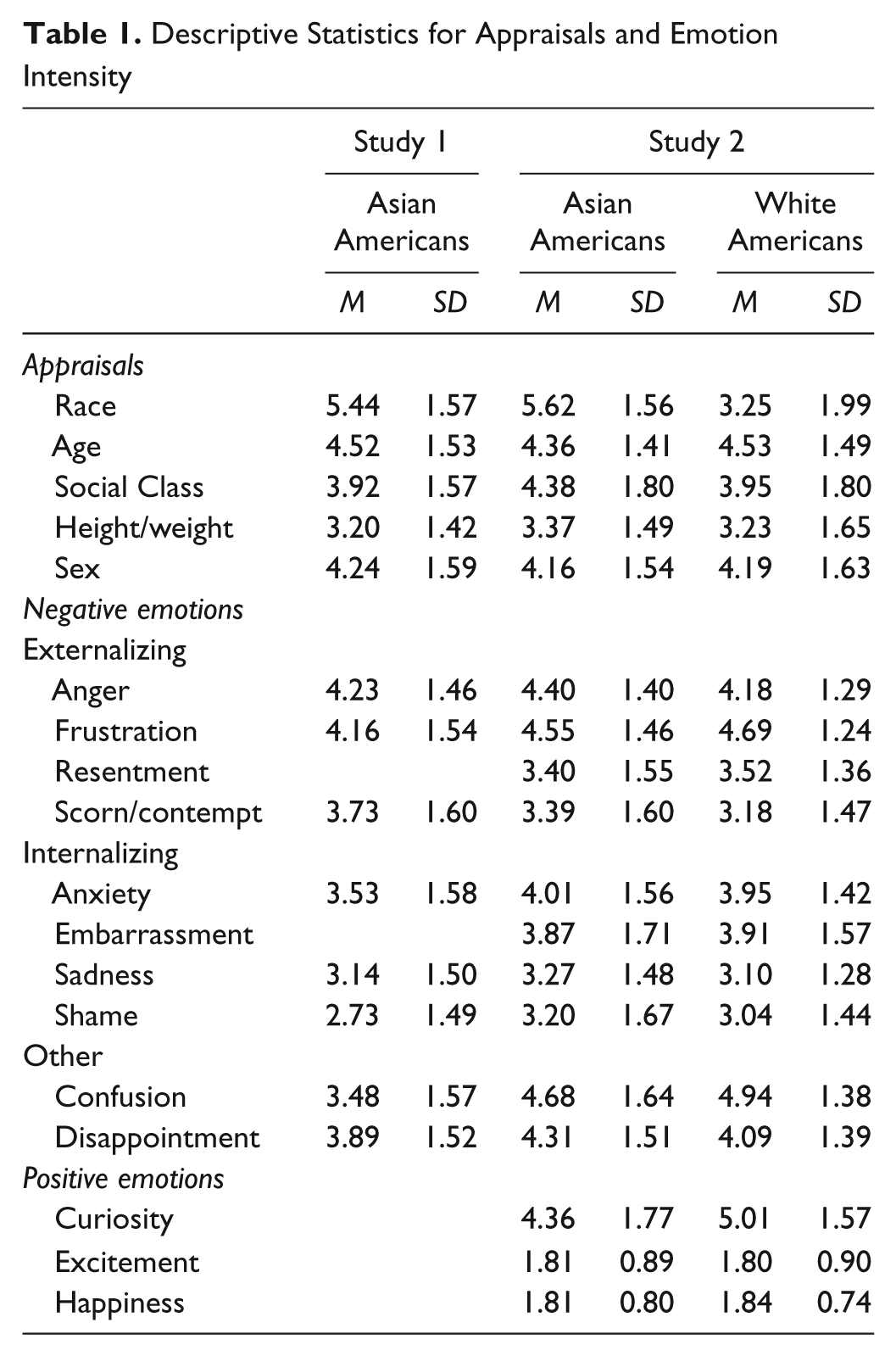
The means and standard deviations of the appraisals and emotions are reported in Table 1. Appraised relevance of social identities ranged from 3.2 to 5.6 on a scale of 0-8, where 4 was labeled somewhat likely, suggesting that participants reported their race, age, social class, height/weight, and gender as being relevant to the situation, on average. A repeated measures ANOVA revealed that participants were more likely to make race-relevance appraisals compared to each of the other social identity appraisals, F(4, 720) = 174.45, p < .001. Notably, however, when examining specific situations, race was not always the most salient appraisal. For example, in the situation where one is overlooked for assistance at a store, participants rated age and class higher than race relevance. Averaged across situations, participants also reported greater externalizing (M = 4.04, SD = 1.43) than internalizing emotions (M = 3.13, SD = 1.41), t(171) = 13.12, p < .001, on composite scales of externalizing (anger, frustration, scorn/contempt, α = .92) and internalizing (sadness, shame, anxiety; α = .91) emotions.
Descriptive Statistics for Appraisals and Emotion Intensity
Strategy for testing Hypothesis 1
To examine the association between race-relevance appraisals and emotion intensity, Hierarchical Linear Modeling (HLM; Raudenbush & Bryk, 2002) was used. HLM Level 1 model examines such associations within each individual, such that each person serves as his or her own control. Specifically, the Level 1 model predicts emotion intensity for each participant j (e.g., j = 1-172) for each situation i (i = 1-12) as a function of appraisal.
The first set of analyses examined emotion intensity as a function of race-relevance alone. For example, with anger as the outcome, the model for person j and situation i was:
[Anger ij ] = b0 j + b1 j [race-relevance appraisal ij ] + rij.
The outcome variable (i.e., anger intensity for each situation) and Level 1 predictors (i.e., race-relevance appraisal) were grand-mean centered. The variable rij is the residual error term, b 1 j is the regression coefficient (i.e., slope) predicting participant j’s anger intensity from the participant’s appraisal in each of the 12 situations. The slope characterizes the strength and direction of the association between anger and race-relevance appraisal. For example, if a participant felt greater anger when she appraised the situation as race relevant compared to when she did not, the slope coefficient for her would be positive.
Following this general model, we conducted separate multilevel analyses predicting each emotion from the relevance of each social identity (e.g., predicting anger from race relevance, predicting anger from gender relevance, . . . predicting confusion from social class relevance). These analyses examine the extent to which other social identity appraisals predict negative emotion intensity.
Strategy for testing Hypothesis 2
To isolate the effect of making a race-relevance appraisal on emotion intensity, the second set of analyses examined the within-person association of race-relevance appraisal and emotions while controlling for other appraisals (e.g., gender-relevance appraisal, etc.). Specifically, in the Level 1 (within-subject) analysis of the association between race-relevance appraisals and emotion intensity, we simultaneously entered other appraisals of the situations. For example, with anger as the outcome, the model for person j and situation i was:
[Anger ij ] = b0 j + b1 j [race-relevance appraisal ij ] + b2 j [gender-relevance appraisal ij ] + b3 j [age-relevance appraisal ij ] + b4 j [height/weight-relevance appraisal ij ] + b5 j [social class-relevance appraisal ij ] + rij.
Hypothesis 1 results
As predicted, race-relevance appraisals were associated with emotion intensity for all negative emotions, shown in the far left column of Table 2. For example, for every one unit increase in race-relevance appraisal on a 9-point scale, on average there was a 0.42 increase in anger intensity measured using a 9-point scale.
Study 1: Within-Person Associations Between Race-Relevance Appraisals and Emotion Intensity Among Asian Americans
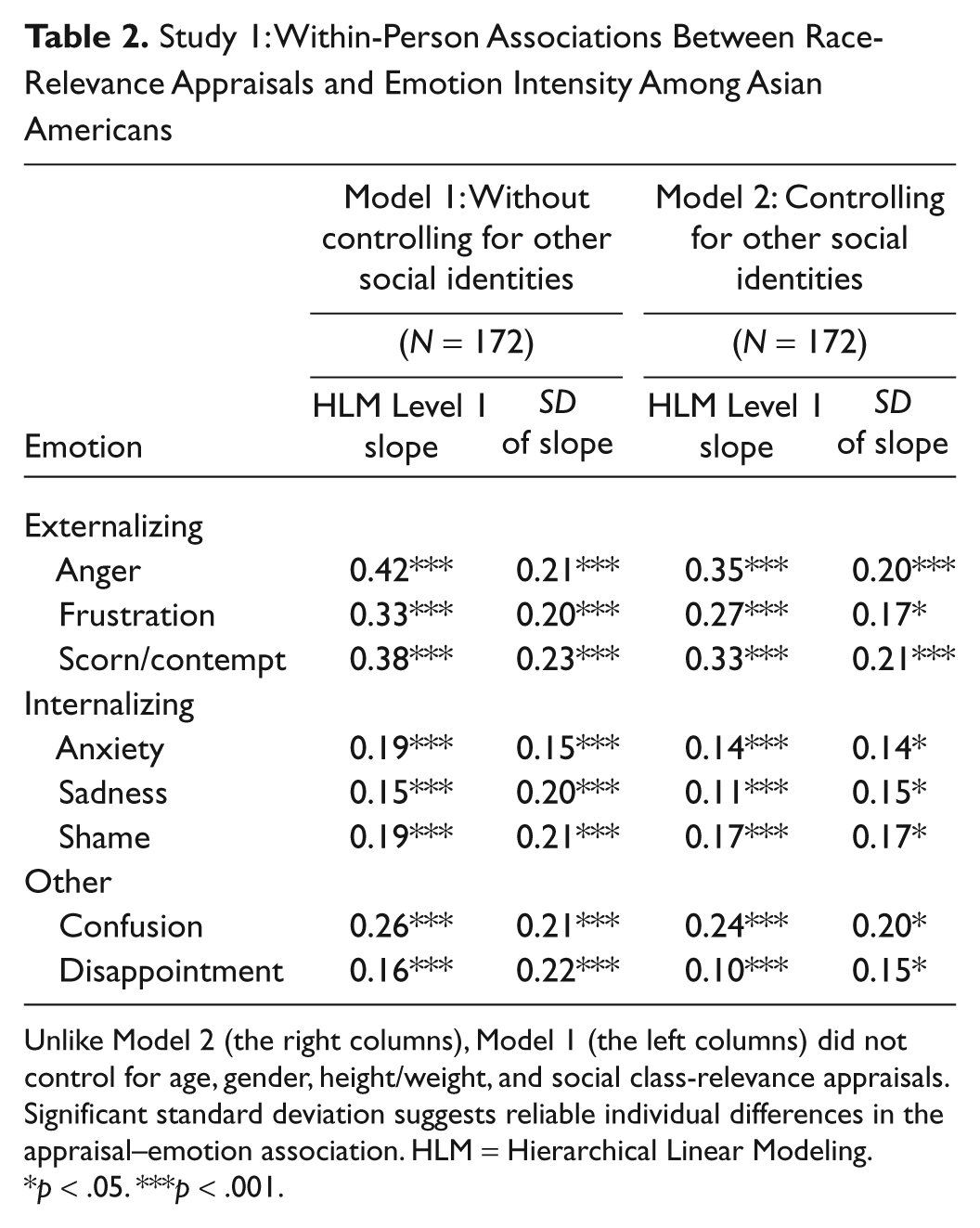
Unlike Model 2 (the right columns), Model 1 (the left columns) did not control for age, gender, height/weight, and social class-relevance appraisals. Significant standard deviation suggests reliable individual differences in the appraisal–emotion association. HLM = Hierarchical Linear Modeling.
p < .05. ***p < .001.
The focus of the HLM analysis so far has been on group averages of the slope coefficients. Such average slopes address the question: On average, do Asian Americans have positive slope coefficients, indicating that negative emotions increase as a function of the perceived race relevance? Our highly repeated within-subject design also affords the opportunity to ask another question: Do the findings differ significantly among participants? The random effects model of HLM can test the null hypothesis that all participants have the same within-subject slope coefficient (Fleeson, 2007a, 2007b). If this null hypothesis is rejected, that is, if the standard deviation significantly differs from zero, it suggests significant individual variability in the association between race-relevance appraisal and emotion intensity. Our main goal for introducing the test of individual variability is to provide an empirical basis for caution against overgeneralizing the finding to all Asian Americans.
As predicted and seen in the second from left column of Table 2, the standard deviations of the slopes predicting negative emotion intensity from race-relevance appraisals were also significantly larger than 0, suggesting individual variability in the appraisal–emotion association. 3 For example, there was significant individual variability in the race-relevance and anger association, SD = 0.21, p < .001 (Figure 1). This is consistent with the fact that while the overall pattern for the group clearly was a positive association between race-relevance appraisal and anger intensity, some individuals demonstrated a negative association.
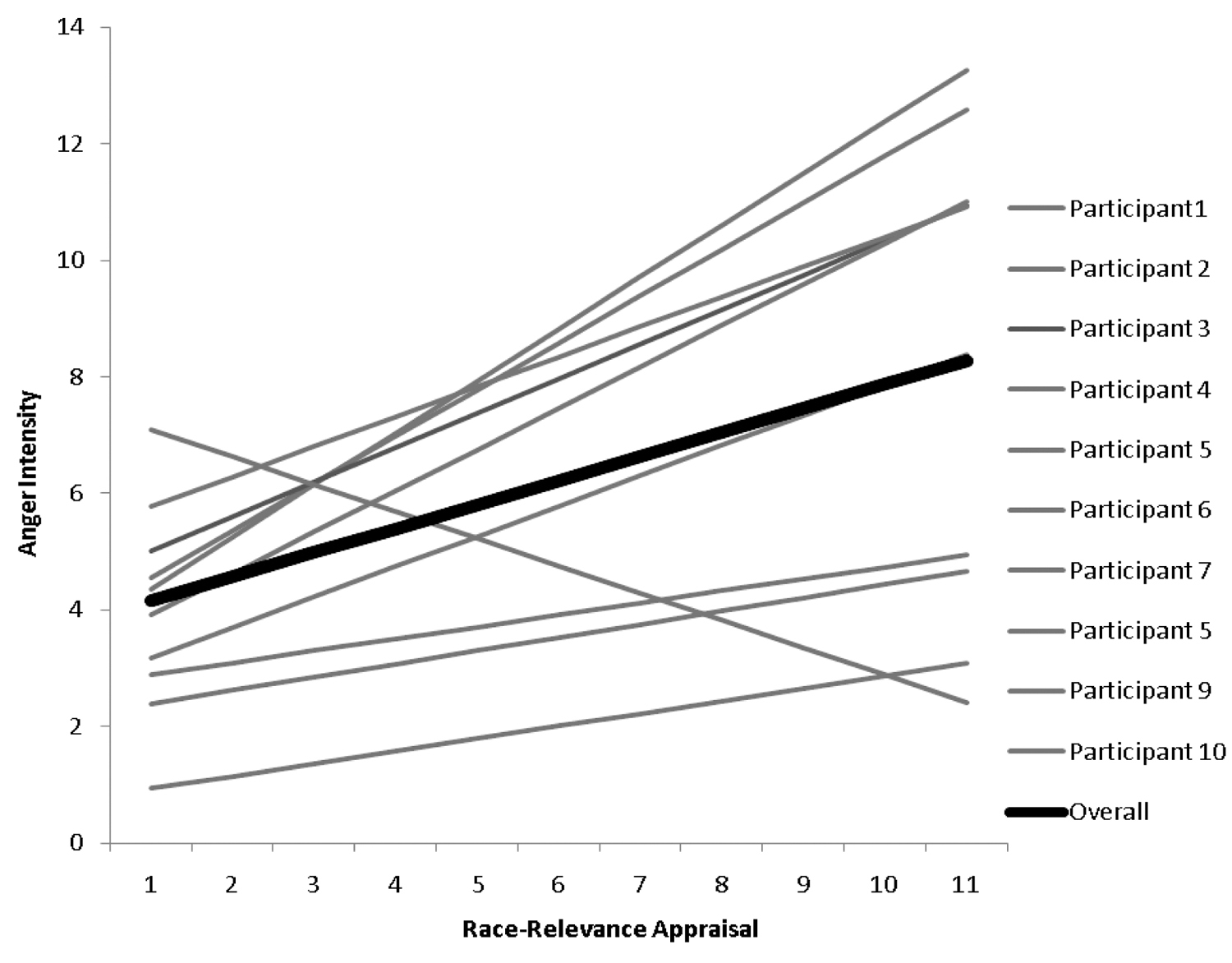
Examples of individual differences in how race-relevance appraisals are associated with anger intensity among Asian Americans
Hypothesis 2 results
Race-relevance appraisal and negative emotion associations were reestimated by controlling for other appraisals, as shown in the two right columns of Table 2. Race-relevance appraisals still significantly predicted increased intensity for each of the negative emotions among Asian Americans. Strong associations with race relevance were observed with externalizing emotions, such as anger (b = 0.35, p < .001; SD = 0.20, p < .001) and scorn/contempt (b = 0.33, p < .001; SD = 0.21, p < .001), even after controlling for other social identities. Internalizing emotions like anxiety and shame were also significantly associated with race-relevance appraisals. Similar to the first model, the standard deviations of the slopes predicting negative emotion intensity from race-relevance appraisals were also significant, suggesting individual variability in the appraisal–emotion association.
Externalizing versus internalizing emotions
To examine whether externalizing emotions were more strongly associated with race-relevance appraisals than internalizing emotions, we predicted race-relevance appraisals from externalizing (i.e., averaged across anger, frustration, and scorn/contempt) and internalizing emotions (i.e., averaged across shame, sadness, and anxiety), entered simultaneously in HLM Level 1. We found that externalizing emotions significantly predicted race-relevance appraisals (b = 0.38, SD = 0.11; p<.01) even controlling for internalizing emotions. The internalizing emotions, on the other hand, did not predict race-relevant appraisals significantly (b = −0.02, SD = 0.19; ns) once we controlled for externalizing emotions.
Open-ended responses
We also examined the race-relevance appraisal associations with emotions using the open-ended data. As closed-ended ratings have the potential to remind participants of certain social categories, open-ended responses collected before these ratings provide some evidence of whether participants generated race-relevance appraisals on their own. Each participant’s appraisals of the 12 situations were coded as mentioning race (1) or not (0). For example, if a participant wrote that the situation occurred “because I’m Asian” or “it was related to my race,” the response was coded as 1. The following was an actual response coded as mentioning race: “I would think that because I’m Asian, therefore, the woman does not choose to sit next to me.” Three raters blind to the hypothesis reliably coded the responses (α = .95). Consistent with the closed-ended responses, open-ended race- relevance appraisals were significant within-subject predictors of all negative emotions (p < .05), except for sadness.
One potential concern is that participants’ open-ended responses may be influenced by the closed-ended measures. To address this concern, we conducted a between-subject regression analysis for the open-ended response in the first situation, which preceded closed-ended ratings to examine whether spontaneous generation of race relevance was associated with greater negative emotion intensity. As shown in Table 3, mentions of race were significantly associated with increased negative emotion intensity overall. The results were highly consistent with the findings based on all open-ended responses, as well as the closed-ended responses, suggesting that race was not necessarily being primed by the closed-ended scales.
Study 1. Regression Predicting Negative Emotion Intensity From Open-Ended Mention of Race
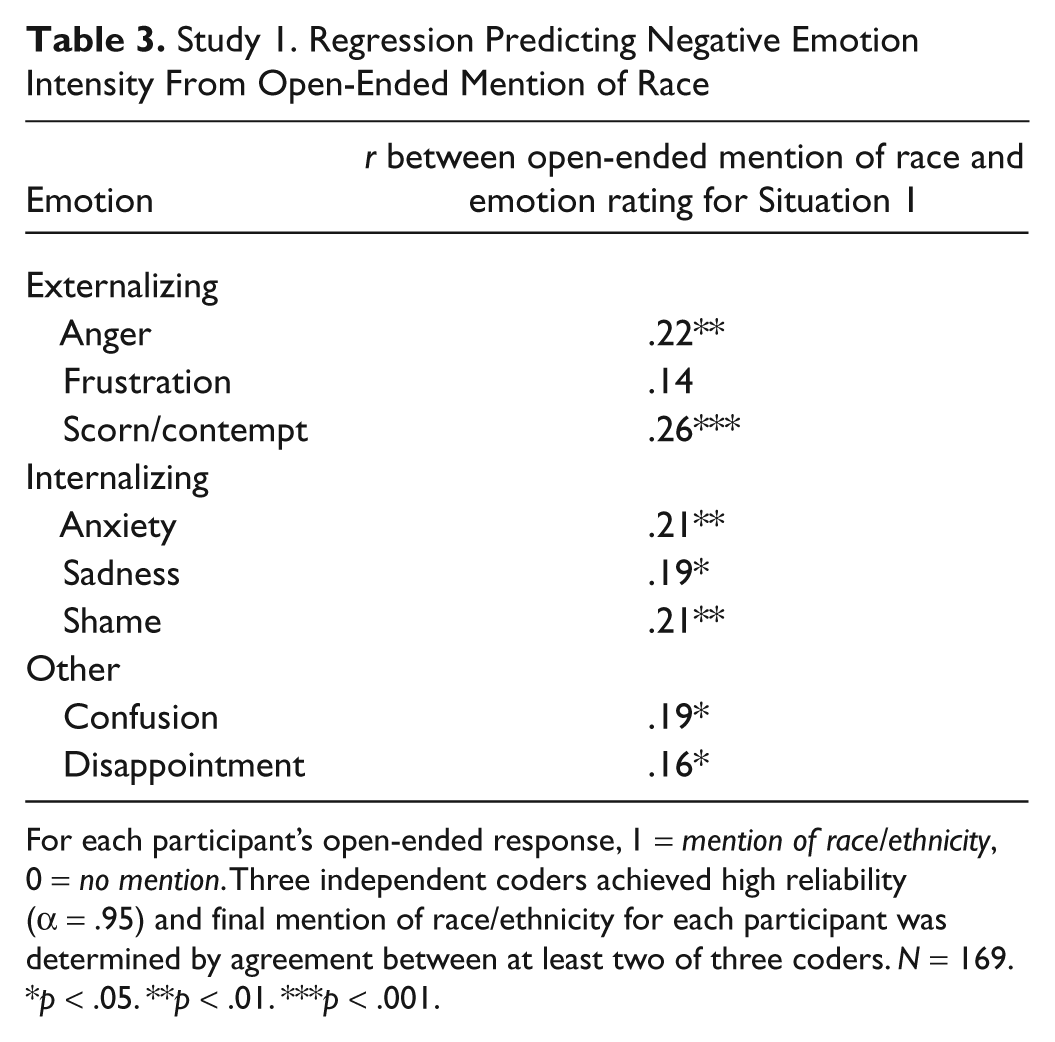
For each participant’s open-ended response, 1 = mention of race/ethnicity, 0 = no mention. Three independent coders achieved high reliability (α = .95) and final mention of race/ethnicity for each participant was determined by agreement between at least two of three coders. N = 169.
p < .05. **p < .01. ***p < .001.
Discussion
As predicted, the degree to which seemingly innocuous situations were rated as emotionally negative was associated with the degree to which a participant believed that the treatment was relevant to his or her race. Both externalizing emotions and internalizing emotions were associated with race-relevance appraisals, as predicted. These associations remained significant when controlling for the perceived relevance of age, social class, gender, and height/weight, suggesting that race-relevance appraisals were emotionally hurtful among Asian Americans even after taking into account other types of appraisals. In addition, suggesting caution against overgeneralizing this finding to all Asian Americans, we found reliable individual differences among our participants in the strength of these associations. However, our overall findings suggest that race-relevance appraisals are more likely to be detrimental to emotional well-being, as opposed to being self-protective, for most Asian Americans in these situations.
Note that although race was the most salient appraisal for Asian Americans on average, race was not necessarily the most salient social identity across many of the situations. This is an important point because it suggests that the situations did not all solely prime race; other social identity appraisals were sometimes as likely as or more likely than race-relevance appraisals in seemingly innocuous situations. Even in these cases, the identity most strongly associated with greater negative emotion intensity was race. This underscores the importance of our findings about the role of race relevance, which remained significant even after controlling for other social identity appraisals.
Study 2
Study 2 sought to replicate the findings of Study 1. In addition, Study 2 compared Asian Americans with White Americans in their reactions to the situations examined in Study 1. Based on median family income, low incarceration rates, and enrollment at elite universities, some have perceived Asian Americans to be “outwhiting the Whites” in terms of status (Omi & Takagi, 1996). However, psychological and historical evidence suggest that Asian Americans are still perceived as a lower status group than Whites and that their experiences of discrimination may be related to an increased risk of mental health problems (Gee, Ro, Shariff-Marco, & Chae, 2009; Leu, Walton, & Takeuchi, 2010). Thus, if our hypothesis is correct that appraising the situations as due to one’s race underlies the “sting” of these situations, we predicted the effects of subtle discrimination experiences to be stronger among Asian Americans than among White Americans. That is, we expected to find race-relevance appraisals to be more emotionally harmful for Asian Americans than for Whites.
Method
Participants
One hundred forty-nine self-identified Asian American (66% women; 57% U.S. born; M age = 19.22, SD = 1.55) and 178 self-identified White (73% women; M age = 19.27, SD = 1.96) students from University of Washington participated for extra course credit. Among Asian Americans, the median family income was between $60,000 and $90,000, on a 6-point scale that ranged from 1 ($10,000-20,000) to 6 ($110,000+). Among Whites, the median family income was between $90,000 to $110,000.
Procedures
The procedure was identical to Study 1 with the following exceptions. More emotions were assessed and the presentation order of the situations was randomized. The emotions embarrassment, resentment, curiosity, excitement, and happiness were added because they were frequently mentioned in the open-ended responses in Study 1. To avoid participant fatigue, we only measured the relevance of race, age, gender, social class, and height/weight using scales instead of also asking for open-ended responses. Lastly, for each situation, we asked participants if they had experienced a similar event before (yes = 1, no = 0).
Results
Descriptives
The means and standard deviations of appraisals and emotions are reported in Table 1. On average, although the situations were originally generated for being relevant for Asian Americans, White participants rated race-relevance appraisals as greater than “unlikely,” indicating that race was at least minimally relevant across situations. This allowed us to test appraisal–emotion associations for White participants. A mixed model ANOVA revealed that for White Americans, age and sex appraisals were rated to be more likely compared to the other three appraisals, F(4, 708) = 61.43, p < .001. In contrast, Asian Americans rated race as more likely than other social identity appraisals, F(4, 592) = 134.25, p < .001. The interaction between participant race and appraisal type was significant, F(4, 1300) = 103.01, p < .001.
On composite indices of externalizing (anger, frustration, scorn/contempt, resentment; α = 0.93) and internalizing (sadness, anxiety, shame, embarrassment; α = 0.93) emotions, averaged across situations, Asian Americans and White Americans did not differ in externalizing emotions, F(1, 325) = .08, ns, or internalizing emotions, F(1, 325) = .32, ns. However, both Asian Americans and White Americans reported greater externalizing emotions (M AA = 3.93, SD = 1.37; M W = 3.89, SD =1.20) than internalizing emotions (M AA = 3.59, SD = 1.47; M W = 3.50, SD = 1.29), F(1, 325) = 22.57, p < .001 and F(1, 325) = 34.61, p < .001, respectively.
Hypothesis 1 Results
Asian American participants
Race-relevance appraisals were significantly associated with greater emotion intensity for all negative emotions (ps < .05). Specifically, race-relevance appraisals were generally associated with externalizing emotions such as anger (b = 0.22, SD = 0.17), scorn/contempt (b = 0.15, SD = 0.16), and resentment (b = 0.13, SD = 0.14). Race-relevance appraisals were also associated with greater intensity of almost all internalizing emotions, such as anxiety (b = 0.17, SD = 0.15), shame (b = 0.14, SD = 0.18), and embarrassment (b = 0.17, SD = 0.16) but not sadness (b = 0.04, SD = 0.17). There was no evidence that race-relevance appraisals were associated with any of the positive emotions: curiosity (b = 0.06, SD = 0.22), excitement (b = 0.03, SD = 0.05), and happiness (b = 0.01, SD = 0.08). The standard deviations of the slopes predicting emotion intensity from race relevance were also statistically significant for many of the emotions, suggesting individual variability in multiple appraisal–emotion associations.
White participants
Race-relevance appraisals were associated with anger (b = 0.08, SD = 0.23), anxiety (b = 0.07, SD = 0.05), and embarrassment (b = 0.10, SD = 0.18). While statistically significant (ps < .05), the magnitudes of these associations were much weaker than among Asian Americans, or were self-protective, in the case of less disappointment (b = −0.14, SD = 0.15). For positive emotions, race-relevance appraisals predicted greater excitement (b = 0.11, SD = 0.15) and happiness (b = 0.07, SD = 0.15), but less curiosity (b = −0.05, SD = 0.15). The standard deviations of the slopes predicting negative intensity from race-relevance were also significant for anger, scorn/contempt, resentment, sadness, and shame, suggesting individual variability in some of the appraisal–emotion associations.
Hypothesis 2 Results
Asian American participants
As seen in the far left column of Table 4, even when controlling for other appraisals, appraising the situations as race relevant remained significantly associated with emotion intensity for most negative emotions, except for disappointment and sadness. For externalizing emotions, anger, resentment, frustration, and scorn/contempt were all positively associated with race-relevance appraisals (b range = 0.09 to 0.15, SD range = 0.11 to 0.15). For internalizing emotions, anxiety, embarrassment, and shame were positively associated (b range = 0.14 to 0.16, SD = 0.14) except for sadness (b = 0.02, SD = 0.14). Race-relevance appraisals were not associated with any of the positive emotions among Asian Americans (b range = 0.01 to 0.04, SD range = 0.05 to 0.22) after controlling for other appraisals. As seen in Table 4, for Asian Americans, there was significant individual variability in many of the appraisal–emotion associations (SD range = 0.10 to 0.22).
Study 2: Within-Person Associations Between Race-Relevance Appraisals and Emotion Intensity, Controlling for Other Social Identities
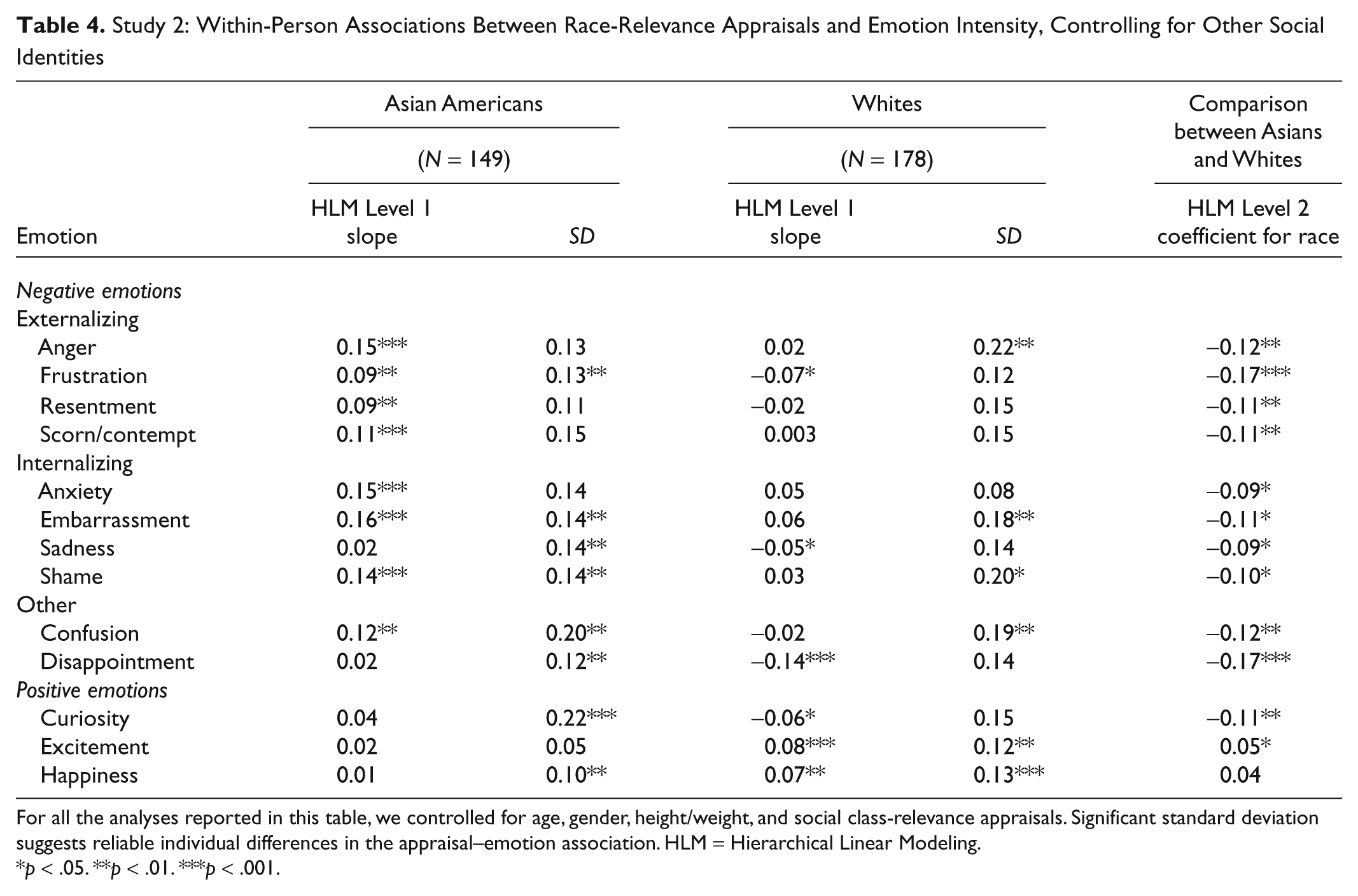
For all the analyses reported in this table, we controlled for age, gender, height/weight, and social class-relevance appraisals. Significant standard deviation suggests reliable individual differences in the appraisal–emotion association. HLM = Hierarchical Linear Modeling.
p < .05. **p < .01. ***p < .001.
Other social identity appraisals simultaneously included in the model were associated with increases in some, but not all, negative emotions. Height/weight appraisals were significantly associated with most of the negative emotions (b range = 0.05 to 0.13, SD range = 0.05 to 0.19). Gender appraisals were associated with the least emotions, specifically with only greater anxiety (b = 0.09, SD = 0.19) and confusion (b = 0.09, SD = 0.20).
White participants
As seen in the middle column of Table 4, when controlling for the other appraisals, race-relevance appraisals were no longer associated with most negative emotions for White participants. The likelihood of race-relevance appraisals notably predicted significantly less disappointment (b = −0.14, SD = 0.14), frustration (b = −0.07, SD = 0.12), and sadness (b = −0.05, SD = 0.14). Controlling for other appraisals, race-relevance appraisals for White participants still predicted greater excitement (b = 0.08, SD = 0.12) and happiness (b = 0.07, SD = 0.13) but less curiosity (b = −0.06, SD = 0.15). There was also significant individual variability for associations between race-relevance appraisals and anger, confusion, embarrassment, and shame (SD range = 0.12 to 0.22).
For White participants, other social identity appraisals were generally more strongly associated with negative emotional intensity when included in the same model. For instance, height/weight appraisals (b range = 0.05 to 0.18, SD range = 0.04 to 0.15) and social class appraisals (b range = 0.06 to 0.17, SD range = 0.12 to 0.18) were associated with greater negative emotional intensity for most of the negative emotions. Age and gender appraisals were associated with only some of the negative emotions.
Externalizing versus internalizing emotions among Asian Americans
Unlike Study 1, there was no evidence of a greater association between race and externalizing emotions than internalizing emotions. Both externalizing (b = 0.10, SD = 0.21; p < .01) and internalizing (b = 0.08, SD = 0.22; p < .05) emotions significantly predicted race-relevance appraisals while controlling for the other.
Comparison between Asian American and White participants
To examine whether Asian American and White participants differed in the association between race-relevance appraisal and negative emotion, we entered the self-identified race of the participant as a Level 2 (i.e., between subjects) predictor in our HLM model. As predicted and shown in the right column in Table 4, Asian Americans were characterized by significantly greater associations between race-relevance appraisal and both internalizing and externalizing negative emotions, compared to White participants. Importantly, there were no group differences in familiarity with the 12 situations (M AA = 5.47, SD = 2.28; M W = 5.33, SD = 2.47), t(325) = 0.54, ns, suggesting that familiarity of the situations did not underlie the differences between Asian American and White participants. This is not surprising because the situations that served as stimuli in the present studies, such as people not sitting next to one on the bus or having a stranger asking where they are from, are commonplace interactions that do not necessarily reflect negative outcomes.
Discussion
Replicating Study 1 results, as Asian Americans’ race-relevance appraisals increased, so did negative emotion intensity. The finding remained significant even after controlling for the target’s beliefs that other social identities were relevant to their experience of these seemingly innocuous situations. We observed associations between race-relevance appraisals and all externalizing emotions, and all but one internalizing emotion.
White participants also appraised the situations as being relevant to their race (i.e., more than “very unlikely”), allowing us to examine the association between race relevance and emotion intensity among a high-status group. There were fewer significant associations between race-relevance appraisals and negative emotions among White participants than among Asian Americans. Among the significant associations in White participants, they were also weaker in strength than those found among Asian American participants. Interestingly, the greater the race-relevance appraisal among White participants, the weaker the intensity of disappointment, frustration, and sadness, suggesting that appraising these situations as race relevant may serve a protective function for this group. These differences between Asian American and White participants were not likely due to differences in familiarity with the situations, because both groups were equally familiar with them.
The overall emotional reactions averaged across the situations were similar between Asian Americans and White Americans; both groups responded to these situations more strongly with externalizing emotions than internalizing emotions. However, the HLM analyses revealed that race appraisals significantly predicted emotion outcomes for Asian Americans, whereas other appraisals predicted emotion outcomes for White Americans. Thus, even though both groups experienced similar types of emotions on the whole, the reasons for their reactions were different: Asian Americans’ reactions appear to be a function of appraising the situations as due to their race, whereas White Americans’ reactions were a function of other types of appraisals, such as height/weight.
General Discussion
Using an HRWP approach, two studies assessed the emotional impact of the belief that one is being treated differently, though not necessarily negatively, due to race. As predicted, for most Asian Americans, the intensity of their negative emotions was related to the belief that another person treated them the way he or she did because of their race (Hypothesis 1). Also as predicted, race-relevance appraisal was related to negative emotion intensity over and above the effects of the perceived relevance of other social identities such as gender, height/weight, age, and social class (Hypothesis 2). It is notable that in the present studies, race-relevance appraisals were associated with both externalizing and internalizing emotions. These findings contribute to understanding individuals’ reactions to seemingly innocuous situations that are attributionally ambiguous. They suggest a possible boundary condition for the finding that in situations with clearly negative treatment, attributions to racial prejudice can protect individuals against internalizing emotions such as shame (e.g., Major, Kaiser, et al., 2003).
Our findings also demonstrated that subtle discrimination experiences may be relevant to multiple social identities, which are sometimes correlated with each other (e.g., race and social class). However, even though other social identity appraisals were sometimes rated as likely as or more likely than race to be the cause of the treatment, the most consistent and strongest associations for Asian Americans were observed with race-relevance appraisal and negative emotions, across both studies. Controlling for other social identities resulted in only small reductions in the contribution of race-relevance appraisals in predicting emotional reactions, even though each appraisal on its own (i.e., not controlling for other social identities) predicted negative emotion intensity across the situations (Wang, 2008). In contrast, when controlling for race-relevance appraisals, many other social identity appraisals were no longer significant predictors of negative emotions in Study 1. Taken together, these findings are important because they suggest that thinking that one is treated differently because of one’s own race is more strongly associated with greater negative emotional consequences, even though other social identities are relevant in experiences of subtle racial discrimination.
Racial Microaggressions and Other Contemporary Subtle Biases
Our findings are consistent with qualitative research in counseling and clinical psychology identifying these situations as racial microaggressions (Sue, Bucceri, et al., 2007; Sue, Capodilupo, et al., 2007). As predicted and consistent with past research (e.g., Branscombe et al., 1999; Schmitt & Branscombe, 2002b), among White participants, thinking that a behavior toward them was due to their race was not associated with negative emotions once the relevance of other social identities were controlled, despite the fact that both Asian Americans and White participants were equally familiar with the situations. Had we found that greater race-relevance appraisal was related to negative emotions among Whites just as strongly as among Asian Americans, our conclusion that participants’ emotional reactions to these situations reflect their experience of being racial minorities would have had to be revised. We believe that our findings of much weaker and less consistent role of race-relevance appraisals among Whites provide support that these are indeed racial microaggressions experienced by racial minorities, as opposed to general interpersonal slights experienced by all (Sue, 2008).
Although a few of our situations may appear to be similar to some race rejection sensitivity items (e.g., Mendoza-Denton, Downey, Purdie, Davis, & Pietrzak, 2002), there are at least three important differences between race rejection sensitivity and our studies. First, whereas research on race rejection sensitivity examines individual differences in the expectation that one’s race will cause rejection, our focus is on the situational effect of when Asian Americans make race-relevance appraisals versus when they do not. Second, whereas race rejection sensitivity situations focus on the anticipation of being negatively rejected, we focus on minimally negative situations. Finally, our situations focused on public interactions with strangers or acquaintances, whereas research on race rejection sensitivity among Asian Americans has examined anticipated rejection from more familiar others (e.g., calling or asking for a date from someone you know fairly well; Chan & Mendoza-Denton, 2008), which might lead to greater evaluations of personal deservingness.
The present studies extend research on contemporary subtle biases, such as aversive racism, benevolent sexism, and the dynamics of interracial contact (e.g., Dovidio & Gaertner, 2004; Glick & Fiske, 1996). Research on aversive racism and benevolent sexism focuses on seemingly ambiguous or positive treatment from the perpetrator’s perspective. In contrast, the present studies are distinctive in their focus on the target’s experiences in potentially discriminatory situations, in the form of seemingly innocuous treatment. In addition, research on interracial contact has focused on how expectations of racial prejudice can impair the cognitive functioning of both racial minority and majority members (e.g., Richeson & Shelton, 2007), whereas the present studies investigate the emotional reactions of racial minorities for situations that may be potentially related to race.
Advantages of the HRWP Approach to Study Subtle Discrimination
Our HRWP approach (Shoda, 2004; Shoda & LeeTiernan, 2002; Zayas et al., 2008) had distinct advantages over more traditional approaches. Traditional between-subject experiments, in which participants are randomly assigned to one of a relatively small number of conditions, by definition, cannot determine how a given participant would have responded in the condition to which he or she was not assigned. Thus, the effect of the situational manipulation for each person individually is unknown. For example, in one study focusing on positive feedback on a performance task, Hoyt, Aguilar, Kaiser, Blascovich, and Lee (2007) found that attributions to discrimination had a negative impact on well-being (i.e., depressed emotion and self-esteem) of people on average. This, however, may occur if the feedback had a highly negative impact on a few individuals while not affecting, or having a small positive impact on, the majority of individuals. In contrast, as illustrated in Figure 1, the HRWP design used in the present studies can examine the situation effects for each person individually, arriving at the conclusion that race-relevance appraisal was associated with negative emotions in the majority of Asian Americans.
In addition, the HRWP approach makes it possible to arrive at an empirically based caveat. In fact, the present studies found that even though a majority of Asian Americans felt worse when they made race-relevance appraisals (vs. when they did not), there were statistically reliable differences from one Asian American participant to another in the strength and direction of this effect. In fact, some Asian Americans felt better when they made these appraisals, indicating a self-protective function for some. That is, the HRWP approach can address the question of whether the effects are moderated by individual differences, even if the specific individual difference variable has not been identified or measured.
Furthermore, because we focused on within-person associations, the difference between Asian American and White participants is unlikely to be due to differences in global response bias. For example, suppose Asian Americans are more likely than Whites to overreport negative emotions. This would result in intercept difference in HLM, with Asian Americans having higher intercepts than Whites when predicting negative emotions. However, the present focus was on the difference in the slopes, reflecting the within-person association between race-relevance appraisal and emotions as they varied across situations. In effect, each individual serves as his or her control, with regard to response biases such as social desirability and acquiescence. For self- presentation concerns and other self-report biases to affect slopes, it would require much more complex response biases than simple tendencies toward socially desirable responding. Such biases must apply differentially across situations to produce spurious covariations. Given that people are notoriously poor at detecting covariations (Nisbett & Ross, 1980), we believe it is unlikely that participants’ response biases affected the within-person associations we observed.
Implications for Emotions and Health
Reviews of epidemiological and large survey studies have mostly found a positive correlation between perceived discrimination and mental illness among racial minorities (Gee et al., 2009). Consistent with this evidence, some studies on attributional ambiguity examining disadvantaged group members (e.g., African Americans) have found attributions to discrimination to be associated with poor psychological adjustment (Branscombe et al., 1999; Schmitt & Branscombe, 2002a, 2002b).
Investigating the potential effects of seemingly innocuous situations on discrete emotions adds to this literature by specifying, in the long run, the impact of racial discrimination on health (Brondolo, Gallo, & Myers, 2009; Gee et al., 2009; Williams & Mohammad, 2009; Williams, Neighbors, & Jackson, 2003). Because internalizing emotions are likely to arise when targets appraise subtle discrimination as due to something about themselves, Asian Americans who experience internalizing emotions may be at heightened risk for depression and anxiety (Chan & Mendoza-Denton, 2008; Okazaki, 1997). Our findings further suggest that they may also be at increased risk for cardiovascular disease, which is associated with frequent experience of externalizing emotions such as anger and scorn/contempt, resulting from appraisals of subtle discrimination as reflective of the perpetrator’s racial prejudice (Clark, Anderson, Clark, & Williams, 1999; Kubzansky & Kuwachi, 2000). Understanding the specific negative emotional effects of discrimination will be important in reducing health disparities as the populations of Asian Americans and other racial minorities steadily increase in the United States.
Subtle Discrimination Versus General Insults: The Role of Social Status
Finally, an important contribution of our findings is potentially distinguishing the subtle discrimination situations we examined from general interpersonal slights. As noted earlier, some have argued that these experiences are not very different from everyday situations experienced by all people, regardless of their racial status (Schacht, 2008; Thomas, 2008). Echoing Sellers and Shelton’s (2003) recommendation, the present studies allowed the target to indicate what is and is not considered racial discrimination by incorporating their subjective experiences. Our results show that the seemingly innocuous situations we examined can be harmful but only to the extent that they are believed to be generated because of the target’s social status, race in particular, and only for racial minority targets. The role of race-relevance appraisals and the target’s racial minority status that underlie the emotional sting in turn serve to distinguish these situations from other types of everyday situations. These characteristics may also apply to the experiences for other racial groups such as African Americans and Latinos, and provide a starting point for investigating if similar associations exist with regard to stigmatized social identities in general, such as sexual orientation and disabilities.
Footnotes
Appendix
We would like to thank Kelly Koo for her contributions at an earlier phase of this research, faculty and graduate students in the social/personality area for their comments on earlier versions of this article, Nilanjana Dasgupta and two anonymous reviewers for their insightful feedback, and research assistants for their help with data collection.
The author(s) declared no potential conflicts of interest with respect to the research, authorship, and/or publication of this article.
The author(s) disclosed receipt of the following financial support for the research, authorship, and/or publication of this article: National Science Foundation Graduate Fellowship and the U.S. Department of Education Jacob K. Javits Graduate Fellowship to Jennifer Wang.