







Abstract
In many Western countries, the proportion of the population that is White will drop below 50% within the next century. Two experiments examined how anticipation of these future ethnic demographics affects current intergroup processes. In Study 1, White Americans who viewed actual demographic projections for a time when Whites are no longer a numerical majority felt more angry toward and fearful of ethnic minorities than Whites who did not view future projections. Whites who viewed the future projections also felt more sympathy for their ingroup than Whites in the control condition. In Study 2, the authors replicated the effects for intergroup emotions with a sample of White Canadians. White Canadians who thought about a future in which Whites were a numerical minority appraised the ingroup as more threatened, which mediated the effect of condition on intergroup emotions. The authors discuss the implications of these findings for race relations in increasingly diverse societies.
Census projections suggest that the United States, Canada, and countries in the European Union will be considerably more ethnically diverse by the middle of the 21st century than they are today (Eurostat, 2010; Statistics Canada, 2010; U.S. Census Bureau, 2008). The Canadian Broadcasting Corporation (CBC) recently ran a report stating that “about one-third of Canada’s population—up to 14.4 million people—will be a visible minority by 2031” (CBC, 2010). In the United States, CNN recently ran the story “Minorities Expected to Be Majority,” which highlighted that “by 2050, 54% of the population will be minorities” (CNN, 2008). Conservative Pat Buchanan (2004) laments that “the America of our grandchildren will be another country altogether, a nation unrecognizable to our parents. . . . White Americans will be a minority, 49 percent, and falling. When we all belong to ‘minorities,’ what will hold us together?” Do Buchanan’s expressions of alarm reflect a wider sense of threat that White Americans experience when considering growing ethnic diversity? Given that people are being made aware of impending demographic changes, it is important for social psychologists to examine how knowledge of these changes might affect current intergroup relations. In two studies—one in the United States and one in Canada—we look at the issue of growing ethnic diversity in terms of how expecting these changes might affect Whites’ feelings toward ethnic minorities.
Demographic Changes and Whites’ Appraisals of Threat
A number of sociological perspectives have argued that people often make inferences about the relative power of a group based on the group’s size (Blalock, 1967; Blumer, 1999; Bobo, 1983; Frankenberg, 2001). In contexts “where the size of a minority group is large or increasing” members of dominant group are likely to believe that their ingroup’s power is threatened (Allport, 1954, p. 221). In actuality, group size is often not so well correlated with group power. In former British colonies, like Singapore, the dominant group was a considerable numerical minority. Thus, although the relationship between size and power is not so clear at the social level, at the psychological level size and power appear to be linked (Kamans, Otten, & Gordijn, 2011). People use group size to make inferences about the economic, social, and political power available to different groups (Blumer, 1999; Frankenberg, 2001).
Thus, for many Whites in North America, impending demographic changes might signal the end of the relatively advantaged position currently afforded to Whites. Indeed, research in North America and Europe has found that when the non-White percentage of the population increases in a given geographical area, Whites believe that their interests are threatened by ethnic outgroups (e.g., Oliver & Wong, 2003; Quillian, 1995; Schlueter & Scheepers, 2010; Taylor, 1998). Studies of White Americans (Gallagher, 2003; Nadeau, Niemi, & Levine, 1993) and Germans (Semyonov, Raijman, Yom Tov, & Schmidt, 2004) have found that the smaller people believed their ingroup to be as a percentage of the population, the more they reported being economically, politically, and culturally threatened by outgroups.
In sum, existing research has demonstrated that both actual increases in the relative size of the non-White population and Whites’ perceptions of relative group size are related to appraisals of threat. However the correlational nature of these studies makes it difficult to be certain of the direction of causality. For example, in studies that have found an association between Whites’ perceptions of relative group size and threat, it could be that feeling threatened leads Whites to see ethnic minority groups as larger than they actually are, rather than the reverse. Furthermore, this research has examined only the relationship between Whites’ present relative group size and perceived threat, not how anticipated changes in relative group size affect perceived threat. Our research moves beyond prior studies by experimentally manipulating anticipated future ethnic demographics in an effort to examine the effect that thinking about these changes has on Whites’ appraisals of threat and relevant intergroup emotions.
Appraisals of Threat and Intergroup Emotions
Because decreasing relative group size can threaten a majority group’s sense of power, decreasing group size should, in turn, affect emotional responses toward minority groups. Intergroup emotions theory (IET; E. R. Smith, 1993) emerged from the social identity theory (SIT) tradition. In particular, IET builds on one of SIT’s major contributions, later elaborated by self-categorization theory (Turner, Hogg, Oakes, Reicher, & Wetherell, 1987), that identity is not limited to people’s sense of themselves as unique individuals but includes collective identities. Indeed, in some contexts people define themselves primarily at the collective level, in terms of a group membership shared with other people. In such contexts individuals take on the interests of the collective as their own, and, as argued by IET, people will experience emotions on behalf of the collective based on their assessment of the security of the collective identity. According to IET (E. R. Smith, 1993; Mackie & Smith, 2002), intergroup events that are appraised as threatening for one’s ingroup produce negative emotions toward threatening outgroups. Therefore, IET suggests that to understand how people respond to demographic changes we need to consider how appraisals of intergroup threat stemming those changes affect intergroup emotions.
According to IET, anger and fear are two negative emotions that members of an advantaged majority group might feel toward ethnic minority outgroups if they appraise that their groups’ relative power is threatened (E. R. Smith, 1993; Leach, Snider, & Iyer, 2002). Anger is felt when people appraise that an outgroup is obstructing valuable goals or taking valuable resources from them. Fear occurs when intergroup events signal uncertainty about the ingroup’s future well-being (Cottrell & Neuberg, 1995). Thus, both emotions are likely responses to threats to ingroup power. For example, a recent experiment by Kamans et al. (2011) found that participants who were told that their ingroup was low in power felt more angry and fearful of the outgroup than did participants who were told that their group was powerful. Similarly, H. J. Smith, Cronin, and Kessler (2008) found that the more university faculty believed that faculty at their school were going to be economically disadvantaged in the future compared to faculty at other universities the more anger and fear they reported feeling. Thus, anger and fear are likely to be felt by Whites when thinking about themselves becoming a numerical minority in the future because it creates uncertainty about the ingroup’s power in the future.
Like outgroup-directed emotions (e.g., anger and fear), ingroup-directed emotions can shape how people choose to respond to intergroup events (e.g., Harth, Kessler, & Leach, 2008; Maitner, Mackie, & Smith, 2007). However, with the exception of the literature on collective guilt (e.g., Doosje, Branscombe, Spears, & Manstead, 1998), most research on intergroup emotions has ignored ingroup-directed emotions (for exceptions, see Seger, Smith, Kinias, & Mackie, 2009; E. R. Smith, Seger, & Mackie, 2007). Even fewer studies have directly examined how appraisals of an intergroup context might affect ingroup-directed emotions other than collective guilt (for exceptions see Iyer & Ryan, 2009; Maitner, Mackie, & Smith, 2006). To address this gap, we considered how anticipating future demographic changes might increase Whites’ sympathy toward the ingroup. Sympathy is typically directed toward others who are suffering, particularly if they are perceived to be undeserving of their misfortune (Weiner, 1995). We predict that sympathy toward Whites might increase when White people consider a future in which they are no longer a numerical majority. This perceived shift in power is likely to be appraised as threatening, which should heighten sympathetic feelings toward the ingroup.
Overview of Studies
In two experiments we examined how Whites in North America respond to anticipating a future in which their racial ingroup is no longer a numerical majority. Based on IET (E. R. Smith, 1993) and SIT (Tajfel & Turner, 1979), we predicted that for Whites in North America, considering a future where they are no longer a numerical majority should lead them to feel more anger toward and fear of ethnic minorities and more sympathy toward Whites. In Study 1, White American participants were randomly assigned either to receive ethnic demographic projections for 2060 indicating that Whites would then be less than half of the U.S. population or to a condition in which they were not exposed to such projections. Participants completed measures of their feelings toward ethnic minorities as well as their feelings toward their ingroup. In Study 2, White Canadians in Vancouver were presented with either real projections that show that Whites will be a numerical minority in Vancouver in 2058 or bogus projections suggesting that Whites will still be a majority in 2058. In Study 2 we also measured appraisals of intergroup threat to examine whether appraisals of threat mediate the effect of condition on intergroup emotions.
Study 1
In Study 1, we randomly assigned White American participants to a condition in which they were presented with U.S. ethnic demographic projections for 2060 or a condition in which they received no such information. We predicted that White Americans who thought about ethnic demographic projections for 2060 would report feeling more anger and fear toward ethnic minorities than White Americans who were not exposed to these projections. In addition, we expected Whites presented with projections for 2060 to feel greater sympathy toward their ingroup than Whites who did not.
Method
Participants
White American psychology students (125 women, 84 men) at Purdue University participated in exchange for course credit. The mean age of participants was 20.3 years.
Manipulation of demographic information
Participants were randomly assigned to either a control condition—where participants viewed a graph of ethnic demographic figures for 2003—or a future White minority condition—where participants viewed the 2003 figures as well as ethnic demographic projections for 2060. Instead of presenting ethnic minorities as separate groups in the figures (e.g., Latin Americans, Blacks), we opted to present all minority groups together, as “other ethnic groups.” This presentation is consistent with media portrayals of demographic projections, where the growth of the non-White populations as a whole is emphasized (Buchanan, 2004; CNN, 2008). The 2003 pie chart was labeled “Whites 70.1%” and “Other Ethnic Groups 29.9%,” whereas the 2060 pie chart was labeled “Whites 49.6%” and “Other Ethnic Groups 50.4%” (U.S. Census Bureau, 2000). 1
Assessment of intergroup emotions
After the manipulation participants responded to questions assessing intergroup emotions toward both ethnic minorities and the White ingroup. The questionnaire asked participants how they felt toward ethnic minorities (Whites) when thinking about the demographic information they just read. Specifically, we asked participants, “To what extent does the information make you feel . . .” anger (angry, annoyed, resentful; α = .91), fear (fearful, scared, frightened; α = .93), and sympathy (pity, sympathetic, compassionate; α = .87) toward both ethnic minorities and Whites (anger, α = .83; fear, α = .93; sympathy, α = .82). In Studies 1 and 2, intergroup emotion scales were constructed by averaging the scores of the individual items. Responses to all intergroup emotion items ranged from 1 (not at all) to 11 (completely). After participants completed these items, they were debriefed and thanked for their participation.
Results and Discussion
We first examined whether the experimental manipulation had different effects on emotions toward minorities and emotions toward Whites by conducting mixed-model ANOVAs with condition as the between-subjects factor and target group (minorities or Whites) as the within-subjects factor. For each emotion variable, condition significantly interacted with target group, anger, F(1, 207) = 4.44, p = .02; fear, F(1, 207) = 4.83, p = .01; sympathy, F(1, 207) = 15.50, p < .001. Therefore, we examined the effects of condition on emotions separately for ethnic minority and White target groups (see Table 1).
Means and Standard Deviations for Emotional Responses Toward Ethnic Minorities and White Americans by Demographic Condition (Study 1)
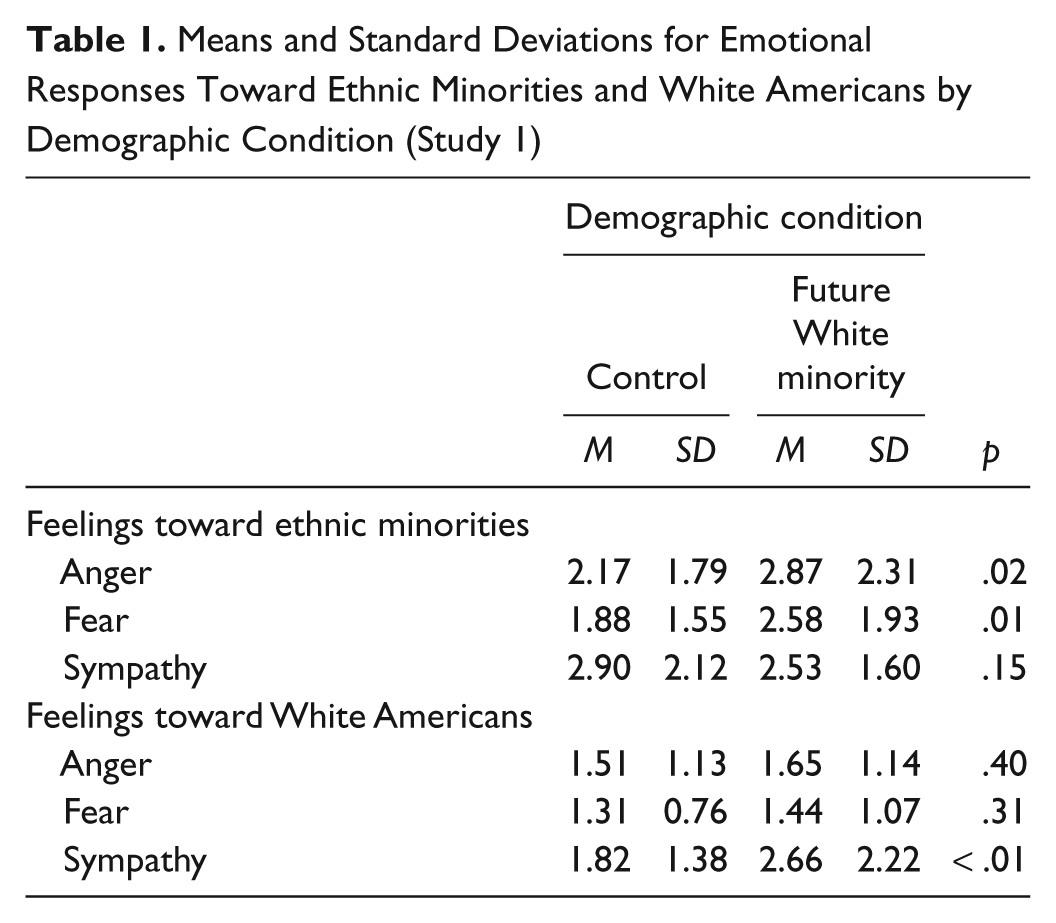
As predicted, participants in the future White minority condition reported feeling significantly more anger toward, F (1, 207) = 5.95, p = .02, and fear of, F(1, 207) = 7.62, p = .01, ethnic minorities than participants exposed only to current figures. There was no significant difference in the amount of sympathy White Americans felt toward ethnic minorities in the White minority condition and the control condition, F(1, 207) = 2.06, p = .15. We also found support for our hypotheses regarding sympathy for the ingroup. As predicted, Whites in the White minority condition felt greater sympathy toward their ingroup than Whites in the control condition, F(1, 207) = 10.88, p < .01. Participants who had to consider a future in which Whites would no longer be a numerical majority did not significantly differ from participants who had to consider only current demographic figures in terms of how angry, F(1, 207) = 0.72, p = .40, or fearful they felt toward their ingroup, F(1, 207) = 1.30, p = .31.
To summarize, Whites who had to consider a future in which they are no longer the numerical majority reported feeling more angry and fearful of ethnic minorities. Also as expected, Whites reported feeling greater sympathy toward their ingroup when they considered future demographic projections. Although the results are consistent with the idea that Whites appraise becoming a minority as a threat to the ingroup, we did not measure threat appraisals in Study 1. In Study 2 we directly tested whether Whites’ appraisals of threat mediate the relationship between anticipated demographic changes and intergroup emotions.
Study 2
Rapidly growing ethnic minority populations are especially evident in urban areas (Roberts, 2008; Statistics Canada, 2008). The second study took place in one such area of rapid diversification—Vancouver, British Columbia. Vancouver has one of largest non-White populations of any city in North America; currently, Whites account for less than 60% of the population. East Asians, the largest ethnic minority group in Vancouver, make up roughly one fourth of the population, and most population projections suggest that by the middle of the 21st century they will become the new numerical majority (Bélanger, Malenfant, Martel, & Gélinas, 2007; Statistics Canada, 2008). One purpose of Study 2 is to see whether the effects of anticipating becoming a numerical minority that we found for White Americans would generalize to a White Canadian sample considering future ethnic demographics in Vancouver.
Study 2 also relied on a different manipulation of future demographic projections. All participants had to read information about expected ethnic demographics in the future. In one condition participants considered a realistic future in which Whites become a numerical minority; in the other condition participants considered a future in which Whites remain a majority and the relative sizes of ethnic minority groups remain similar to their current sizes. As for Study 1, we expected White Canadians who had to think about a future in which they are no longer a numerical majority to report feeling more angry and fearful of ethnic minorities than Whites who thought about a future where they remained a numerical majority. We also anticipated that Whites would express more sympathy toward their ingroup if they thought about a future where their ingroup is no longer a numerical majority.
In Study 2 we also examined the effect that expectations of demographic change have on Whites’ ethnic group identification. According to SIT, people can respond to threats to the ingroup in multiple ways. At the most basic level, they can distance themselves from the ingroup and attempt to protect and enhance their status as an individual, or they may increase their identification with the ingroup and attempt to protect the group’s relative status and power. One factor that is critical to whether or not people close ranks and increase identification in response to threat is the perceived legitimacy of intergroup relations. According to SIT, people are unlikely to respond collectively to group threats that they perceive as legitimate, but threats to the ingroup that are seen as illegitimate are more likely to elicit a collective response (Jetten, Schmitt, Branscombe, Garza, & Mewse, 2011; Tajfel & Turner, 1979).
Indeed a number of studies have found that threats to the ingroup that are appraised as illegitimate do heighten group identification (Schmitt & Branscombe, 2002). This effect has been demonstrated mostly with members of disadvantaged groups, who increase their group identification in response to the perception of illegitimate threat in the form of discrimination (e.g., Jetten, Branscombe, Schmitt, & Spears, 2001). More relevant to the current studies, high status groups also respond to threats to their group that they see as illegitimate with high group identification (Turner & Brown, 1978). For example, Spoor and Schmitt (2011) found that men increased their gender group identification after being asked to consider the gains in status that women have made over time.
We expect a similar increase in White Canadian’s identification with their ingroup in response to thinking about future declines in the relative size of their ingroup. We made this prediction based on prior research suggesting that Whites will perceive a loss to their ingroup’s power as illegitimate, thus encouraging a collective response. Research suggests that most Whites tend to think race relations are fair now and that racism is a thing of the past (Eibach & Ehrlinger, 2006). Because Whites see current race relations as relatively legitimate, they are likely to see a future loss of ingroup power as illegitimate (Eibach & Keegan, 2006).
Thus, we predicted that White Canadians who consider a future in which they are no longer a numerical majority will identify more strongly with their ingroup than Whites who consider a future in which they are still a numerical majority.
In an effort to examine the effect that Whites’ consideration of anticipated demographic changes has on reactions to specific groups, we measured Whites’ liking of different ethnic minority groups in Vancouver. Unlike in Study 1, demographic projections were presented separately for each ethnic minority group, rather than collapsed into a single category. We anticipated that Whites exposed to a future in which they will be a numerical minority would have more negative evaluations of ethnic outgroups than Whites exposed to a future in which Whites will still compose the majority of the population. However, we expected this effect to be strongest for attitudes toward of East Asians, given that East Asians are projected to increase in relative size more quickly than other ethnic groups and are projected to become the largest ethnic group in Vancouver by 2058. This prediction is consistent with SIT’s assumption that outgroup derogation is directed most strongly at outgroups that are the primary source of threats (e.g., Branscombe & Wann, 1994; Cinnirella, 1996).
Perhaps most importantly, we build on the prior study by more directly examining our assumptions about the role of appraisals of intergroup threat. In Study 1 we assumed that differences in appraisals of threat accounted for the differences in emotional responses between experimental conditions. In Study 2 we directly tested if appraisals of intergroup threat varied by condition. We expected that Whites who considered a future where Whites are a numerical minority would appraise their group’s relative power as more threatened. Furthermore, we tested whether intergroup threat appraisals mediated the relationship between condition and intergroup emotions. Specifically, we hypothesized that demographic condition would influence outgroup-directed anger, outgroup-directed fear, and ingroup-directed sympathy via intergroup threat appraisals. We also examined whether intergroup threat appraisals mediated the predicted effects of condition on group identification and feelings toward East Asians.
Method
Participants
White Canadian students (113 women, 47 men) at Simon Fraser University participated in exchange for course credit. The mean age of participants was 19.9 years.
Procedure
Participants arrived at the lab either individually or in groups of up to three and were greeted by a White female research assistant. They were informed that they were partaking in a study of “the effects of the presentation of information on recall.” Participants were presented with one of two sets of pie charts, which served as our manipulation of demographic information. The assistant informed them that they were going to have 2 minutes to study the information and at the end of the session they were going to complete a recall test. After 2 minutes the assistant took away the graphs and gave participants an “opinion survey” containing our dependent measures. Prior to completing the survey participants were told, “Completing a survey between studying the information and taking the recall test will further challenge your recall abilities.” On finishing the dependent measures participants were given a recall test that served as our manipulation check.
Manipulation of demographic information
Participants were randomly assigned to either a White majority condition or a White minority condition. Participants in both conditions were presented with two pie charts on a single sheet of paper. Across conditions, the first graph displayed current ethnic demographic figures for the greater Vancouver area in 2008: Whites 58%, East Asians 22%, South Asians 10%, South East Asians 5%, Middle Easterners 2%, and other groups 3% (Statistics Canada, 2008). The second graph in the White majority condition consisted of bogus ethnic demographic projections for the year 2058. In this graph the share of all ethnic minority groups increased slightly or stayed the same relative to the figures for 2008: Whites 53%, East Asians 24%, South Asians 11%, South East Asians 6%, Middle Easterners 3%, and other groups 3%. The second graph in the White minority condition consisted of ethnic demographic projections for 2058 consistent with expected demographic changes (Bélanger et al., 2007): Whites 27%, East Asians 39%, South Asians 16%, South East Asians 8%, Middle Easterners 7%, and other groups 3%. 2
Dependent Measures
Assessment of intergroup emotions
Participants responded to the same measures of intergroup emotions as in the previous study. The emotions toward ethnic minorities (anger, α = .93; fear, α = .90; sympathy, α = .85) and the emotions toward Whites (anger, α = .83; fear, α = .93; sympathy, α = .84) had good internal consistency.
Intergroup threat appraisals
We measured appraisals of intergroup threat with four items. Two items assessed the degree to which participants perceived that White Canadians are threatened by changing ethnic demographic patterns (i.e., “My ethnic group should be threatened by growing ethnic diversity” and “My ethnic group will benefit from increasing diversity in Canada,” reverse scored). Response scales for these statements ranged from 1 (strongly disagree) to 7 (strongly agree). Two additional questions assessed the amount of influence that participants perceived that ethnic minorities and White Canadians will have over Canadian society in the future (i.e., “How much influence will ethnic minorities have over Canadian society in the future?” and “How much influence will White Canadians have over Canadian society in the future?” reverse scored). The scales for these items ranged from 1 (very little) to 7 (very much). In a factor analysis of these four items, only one factor emerged with an Eigen value greater than 1, accounting for 53% of the variance in the items. After reverse coding two of the items, we created a single future intergroup threat appraisal measure (α = .70).
Ethnic group identification
Ethnic group identification was assessed using Cameron’s (2004) 12-item measure of group identification (α = .82). The scale was modified so that each statement referred to “my ethnic group” (e.g., “I feel strong ties to other members of my ethnic group”). Participants indicated their level of agreement with each statement using a 7-point scale ranging from 1 (strongly disagree) to 7 (strongly agree).
Liking of ethnic outgroups
Participants were asked to indicate how warm or cold they felt toward the following ethnic groups: Middle Eastern Canadians (e.g., Persian, Arab), South East Asian Canadians (e.g., Filipino, Vietnamese), South Asian Canadians (e.g., Indian, Pakistani), and East Asian Canadians (e.g., Chinese, Korean
Manipulation check
After completing the questionnaire participants were asked to recall the percentage of Vancouver’s total population that each of ethnic groups is expected to compose in 2058. After completing the recall test, participants were debriefed and thanked for their participation.
Results
Manipulation check
A one-way ANOVA showed that participants’ responses on the recall test for the 2058 projections differed significantly by condition in the anticipated directions. Participants in the White minority condition (M = 30.3%) reported that Whites will make up a smaller share of the population than participants in the White majority condition (M = 52.3%), F(1, 158) = 364.4, p < .001. Participants in the White minority condition reported that East Asians (32.8% vs. 23.9%), South Asians (14.5% vs. 10.7%), South East Asians (10.5% vs. 6.6%), and Middle Easterners (8.3% vs. 3.8%) will each compose a greater proportion of the population than participants in the White majority condition, ps < .001. Responses on the recall test for “other groups”—which comprised 3% of the future population in both conditions—did not significantly differ by condition (3.5% vs. 3.3%, p = .4).
Effect of condition on intergroup emotions
As in Study 1, we first tested whether the experimental manipulation had different effects on emotions toward minorities and emotions toward the majority by conducting mixed-model ANOVAs with experimental condition as the between-subjects factor and target group (ethnic minorities or Whites) as the within-subjects factor. For each emotion, experimental condition significantly interacted with target group, anger, F(1, 158) = 21.16, p < .001; fear, F(1, 158) = 8.00, p < .01; sympathy, F(1, 158) = 15.79, p < .001. Therefore, we next examined the effects of condition on emotions separately for ethnic minority and White target groups. The means and standard deviations for emotions and the other variables are presented in Table 2.
Means and Standard Deviations for Dependent Variables by Demographic Condition (Study 2)
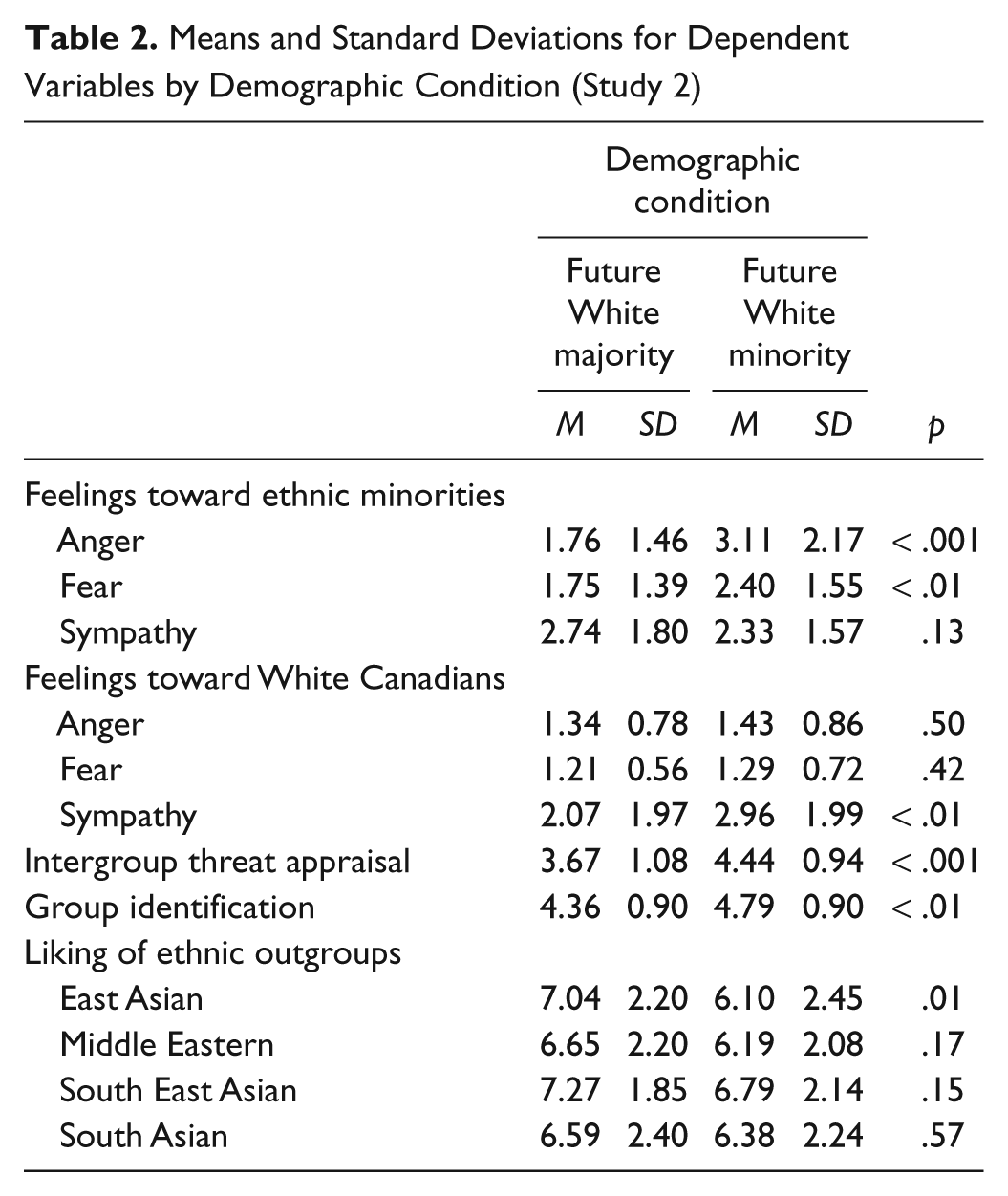
As predicted, participants in the White minority condition felt significantly more angry toward, F(1, 158) = 20.65, p < .001, and fearful of ethnic minorities, F(1, 158) = 7.83, p < .01, than participants in the White majority condition. There was no significant difference in the amount of sympathy White Canadians felt toward ethnic minorities between conditions F(1, 158) = 2.32, p = .13. We also found support for our hypothesized effect on sympathy for the ingroup. Participants in the White minority condition felt more sympathetic toward Whites than participants in the White majority condition, F(1, 158) = 7.93 p < .01. There was no significant difference between conditions in the amount of anger, F(1, 158) = 0.45, p = .50, or fear, F(1, 158) = 0.65, p = .42, that participants felt toward White Canadians.
Effect of condition on ethnic identification and liking of ethnic outgroups
We found support for our hypothesis that ethnic group identification would be affected by experimental condition. Participants in the White minority condition identified more strongly with their ethnic ingroup compared to Whites in the White majority condition, F(1, 158) = 8.88, p < .01.
Hypotheses regarding feelings toward ethnic minority outgroups were examined using a mixed-model ANOVA with demographic condition (White minority vs. White majority) as between-subjects factors and target group (Middle Eastern vs. South East Asian vs. South Asian vs. East Asian) as within-subjects factors. There was a significant main effect of condition, F(1, 158) = 6.31, p < .01. Overall, participants felt less warm toward ethnic outgroups in the White minority condition than in the White majority condition. However, this main effect was qualified by an interaction between condition and target group, F(1, 158) = 3.01, p = .04. As expected, the effect of the manipulation was stronger for attitudes toward East Asians than for other ethnic groups. East Asians were liked significantly less by participants in the White minority condition than participants in the White majority condition, F(1, 158) = 6.31, p = .01. There was no significant difference between the White minority condition and the White majority condition for feelings toward Middle Easterners, South East Asians, or South Asians, ps < .14.
Mediation by future intergroup threat appraisals
Results supported our hypothesis regarding the effect of anticipating future demographic changes on appraisals of intergroup threat; participants in the White minority condition were significantly more likely to appraise their group’s standing in the future as threatened than participants in the White majority condition F(1, 158) = 22.90, p < .001. We next tested our prediction that appraisals of intergroup threat would mediate the effects of the demographics manipulation (White majority = 0, White minority = 1) on outgroup-directed anger, outgroup-directed fear, ingroup-directed sympathy, ethnic group identification, and feelings toward East Asian Canadians. To test for mediation we conducted Sobel (1982) tests based on multiple regression analyses.
Controlling for the effect of experimental condition, appraisals of future intergroup threat predicted anger toward minorities (β = .50, p < .001) and, according to a Sobel test, significantly mediated the effect of the manipulation on anger (z = 4.93, p < .001; see Figure 1a). When the intergroup threat appraisal was added as a simultaneous predictor of anger toward ethnic minorities, the effect of condition was reduced, but still significant. Similarly, threat appraisals significantly predicted feeling fearful of ethnic minorities (β = .52, p < .001), and a Sobel test indicated that threat appraisals significantly mediated the effect of condition on fear of ethnic minorities (z = 4.93, p < .001; see Figure 1b). When the intergroup threat appraisal was added as a simultaneous predictor of fear, condition no longer predicted fear, β = .03, ns, suggesting threat appraisals fully mediated the effect of condition on fear. Finally, the intergroup threat appraisal predicted feeling sympathy for the ingroup (β = .47, p < .001), and a Sobel test revealed that it significantly mediated the effect of the manipulation on sympathy (z = 4.64, p < .001; see Figure 1c). When the intergroup threat appraisal was added as a simultaneous predictor of ingroup sympathy condition no longer predicted sympathy, β = .05, ns, suggesting full mediation. These results offer support for our prediction that the future intergroup threat appraisals mediate the relationship between demographic condition and all three emotions. 4
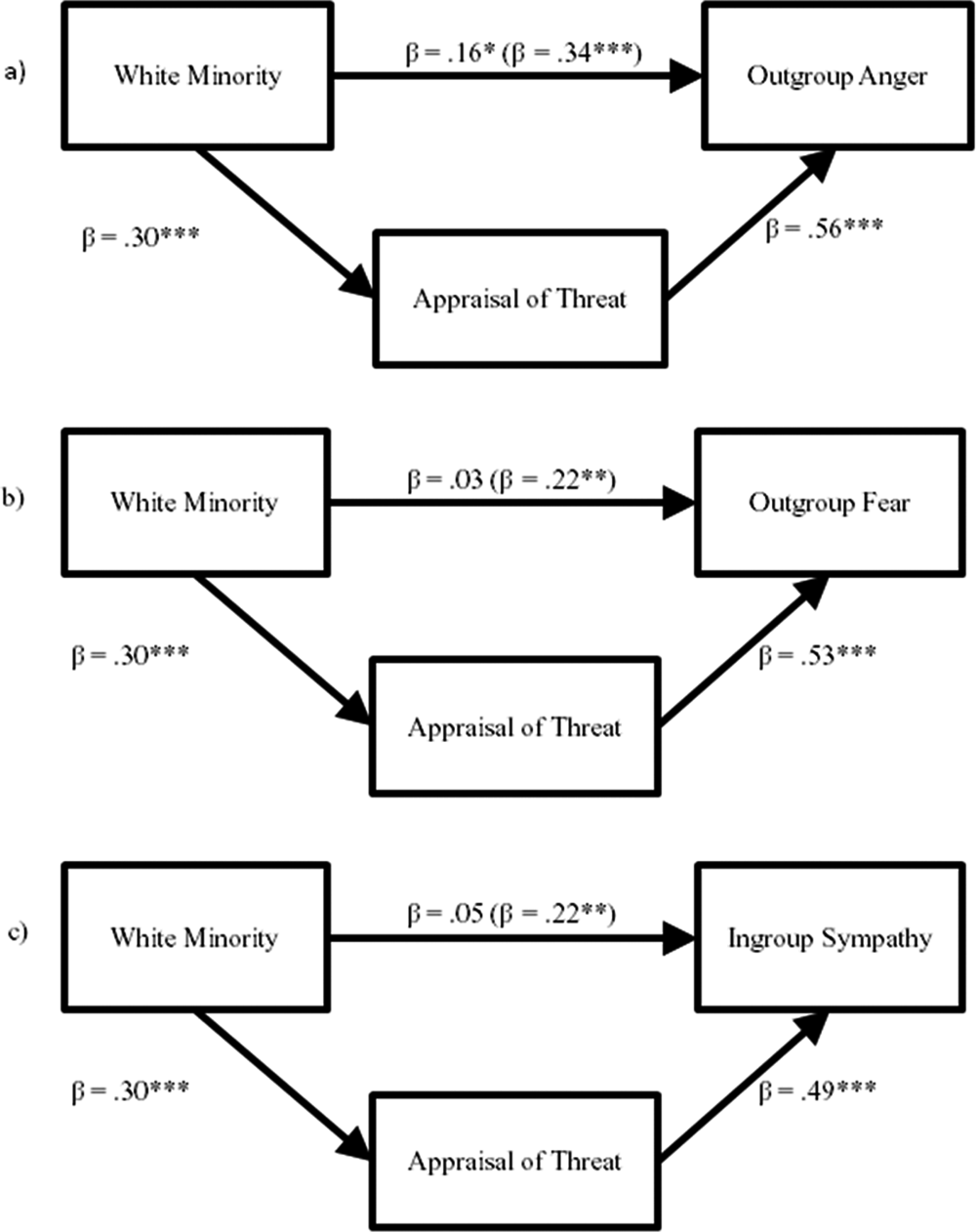
The effect of condition on intergroup emotions as mediated by appraisals of threat
We found similar findings for group identification and feelings toward East Asian Canadians. Intergroup threat appraisals predicted group identification (β = .32, p < .001) and mediated the effect of demographic condition on group identification (Sobel’s z = 3.52, p < .001). When intergroup threat appraisal was added as a simultaneous predictor of group identification, demographic, condition was no longer predicted group identification, β = .12, p = .15. Similarly, intergroup threat appraisal predicted liking East Asians less (β = -.51, p < .001) and mediated the effect of condition on liking East Asians (Sobel’s z = 3.98, p < .001). When the intergroup threat appraisal was added as a simultaneous predictor of liking East Asians, condition no longer predicted liking East Asians, β = -.02, ns, suggesting that threat fully mediated the effect of condition on liking of East Asians.
Discussion
Using a sample of White Canadians, we were able to replicate our effects for outgroup-directed and ingroup-directed emotions from Study 1. When Whites considered a future in which they were a numerical minority, they reported feeling more angry toward and fearful of ethnic minorities, while feeling more sympathy toward their ingroup. More importantly, we were able to demonstrate that appraisals of intergroup threat mediated the effects of demographic condition on how Whites feel toward ethnic minorities and their ingroup.
Supporting SIT’s (Tajfel & Turner, 1979) claim that threats to the ingroup, if appraised as illegitimate, can heighten group identification, we found that considering a future when Whites become a numerical minority led Whites to increase identification with their racial ingroup. We also found that thinking about Whites becoming a numerical minority in the future led Whites to report less liking of minority groups. This effect was especially strong for feelings toward East Asians. This is consistent with SIT, in that derogating outgroups that are most relevant to a perceived threat can serve as a means to protect threatened group identity (Branscombe & Wann, 1994; Tajfel, 1982). Finally, as for the effects on intergroup emotions, the effects of condition on ingroup identification and liking of East Asians were mediated by intergroup threat appraisals.
General Discussion
In this research we investigated how anticipating a future in which Whites become a numerical minority affects Whites’ emotions toward ethnic outgroups. In two studies we found support for the hypotheses that Whites would respond to the increasing relative size of ethnic minority populations with anger toward and fear of ethnic minorities and sympathy for their ingroup. In line with IET, we found in Study 2 that appraisals of threat to the ingroup mediated the effects of anticipating a future White minority on emotional responses. Consistent with SIT and prior research on how high status group members respond to threats to their power (Spoor & Schmitt, 2011), in Study 2 we found that White Canadians exposed to a future in which Whites had become a numerical minority increased the degree to which they identified with their ingroup and led to less favorable evaluations of East Asians.
Anticipated Demographic Change and Intergroup Emotions
Although the experimental manipulations differed slightly across the two studies, Whites who had to think about a future where their group would no longer constitute a numerical majority felt more angry and fearful of ethnic minorities. Together, the two studies provide solid evidence that for Whites in North America, considering a future as a numerical minority is appraised as threatening for the ingroup, which leads to heightened feelings of anger and fear directed toward minorities. These findings are consistent with recent research that has shown that when people believe they are going to be disadvantaged in comparison to relevant outgroups they report feeling more angry and fearful (Miller, Cronin, Garcia, & Branscombe, 2009; H. J. Smith et al., 2008). Furthermore, Study 2 is one of the first studies to provide experimental evidence that appraisals of intergroup threat affect fear of outgroups (also see Kamans et al., 2011).
A number of studies have examined the conditions under which members of advantaged groups feel sympathetic toward disadvantaged groups (e.g., Harth et al., 2008; Leach, Snider, & Iyer, 2002; Thomas, McGarty, & Mavor, 2009). However, relatively few have examined how ingroup sympathy might be affected by thinking about the relative position of one’s group in society (for an exception see Iyer & Ryan, 2009). Our research addressed this gap by showing that appraisals of threat that led White Canadians—a relatively powerful group in society—to increase feelings of sympathy toward their ingroup after thinking about a future as a numerical minority.
Group Identification
According to Tajfel and Turner (1979), threats to an ingroup’s position that are appraised as illegitimate can foster group identification. Supporting this idea, the loss of Whites’ numerical majority in the future heightened Whites’ ingroup identification in Study 2. In addition, our mediation analyses demonstrate that this heightened identification occurs because the growth of ethnic minorities is appraised as threatening to Whites’ advantaged position. A number of studies have shown that threats to a disadvantaged ingroup (e.g., discrimination) can increase group identification (e.g., Branscombe, Schmitt, & Harvey, 1999; Jetten et al., 2001). However, Study 2 is one of the few studies to demonstrate that members of advantaged social groups can respond to group-based threats by increasing the degree to which they identify with their advantaged ingroup (for an exception see Spoor & Schmitt, 2011).
These findings have important implications for the future of race relations because the more that members of advantaged groups identify with their ingroup, the more likely they are to act in ways that protect their relative advantage (e.g., Morrison, Plaut, & Ybarra, 2010). It is important to point out that our prediction regarding group identification was based on empirical evidence suggesting that Whites would perceive losses to ingroup power as illegitimate (e.g., Eibach & Keegan, 2006). To be clear, SIT does not predict that high status groups will inevitably respond to ingroup threats with heightened identification. In particular, members of high status groups who perceive future losses of ingroup power as legitimate are less likely to identify with the ingroup or work to protect its interests (Jetten et al., 2011; Powell, Branscombe, & Schmitt, 2005).
Liking of Ethnic Minority Groups
Overall, ethnic outgroups were liked less by White Canadians who thought about a future in which Whites had become a numerical minority than Whites who thought about a future where Whites were still a numerical majority. However, we found that the greatest disparity between conditions was for liking of East Asians (Study 2). This is consistent with SIT (Tajfel, 1982) in that when one’s social identity is threatened with a negative social comparison, the outgroup most relevant to the threat is likely to be derogated more than other outgroups as a means of protecting the ingroup identity (Branscombe & Wann, 1994; Stephan, Renfro, Esses, Stephan, & Martin, 2005). In the White minority condition of Study 2, all ethnic minority groups were presented as growing in size, but only East Asians were presented as becoming larger than the White population (consistent with actual demographic projections). Given that appraisals of intergroup threat mediated the relationship between condition and evaluations of East Asians, it seems likely that participants reporting higher levels of threat were thinking about threat from East Asians in particular. By extension, it also seems reasonable to assume that the fear and anger participants expressed were directed at East Asians especially, rather than ethnic outgroups more generally. As discussed more below, these are interesting possibilities to explore in future research.
Limitations and Future Directions
To examine the effect that Whites’ consideration of anticipated demographic changes has on emotional reactions to specific groups, we measured Whites’ liking for different ethnic minority groups in Study 2 using a general affective measure rather than measures of discrete emotions that are more typical of IET. We chose this approach because it was more practical than having each participant complete intergroup emotion measures for all ethnic minority groups. However, future research in this area would benefit from an examination of discrete intergroup emotions directed at specific groups. Similarly, to examine the possibility that different groups evoke degrees of threat proportional to the degree of changes in group size, future studies could also include group-specific measures of threat appraisals (for similar ideas see Cottrell & Neuberg, 2005).
The meditational analyses from Study 2 provide convincing evidence that future demographic changes are appraised by Whites as generally threatening to their group, and these appraisals of threat have implications for how they feel about their group as well as ethnic minorities. However, threat appraisals could also be examined within specific domains (e.g., threats to group economic resources, threats to cultural identity) that might have different consequences for the specific intergroup emotions people experience (see Cottrell & Neuberg, 2005; Iyer & Leach, 2008). Future research should examine other types of appraisals that can affect how Whites respond to thinking about being a numerical minority in the future. For example, Whites who believe that increases in the relative power of ethnic minority groups are legitimate are likely to respond to demographic changes with less anger and fear than Whites who believe that increasing power of ethnic minorities is an illegitimate threat.
Finally, future work might explore the sociocultural boundary conditions of the psychological link between relative group size and perceived group power. In the United States and Canada, Whites have been the numerical majority since colonization while being politically and economically advantaged relative to minority groups. Moreover, in the past 40 years ethnic minorities have made some substantial gains in power while growing substantially in size. As a result, Whites in North America are likely to perceive their relative power as unstable, which in turn heightens their sense of threat as well as certain emotional responses when thinking about future ethnic demographic changes (for similar ideas see Doanne, 1997; Gallagher, 2003). In societies where ethnic minority populations have historically been large and the relative power of the dominant group is perhaps greater (e.g., South Africa), power differentials should be perceived as relatively stable. In such societies anticipated decreases in the relative size of dominant group might not heighten threat or the emotional responses of the dominant group to the same extent because dominant group members feel secure in their group’s position. In short, the size of the group is not the only indicator of the insecurity of intergroup power relationships, and when power differentials are extreme or are highly legitimized, even a large outgroup may not be seen as so threatening.
Implications for Race Relations Now and in the Future
Our research suggests that Whites could respond to growing ethnic diversity in ways that are not conducive to intergroup harmony. Negative feelings toward outgroups and heightened ingroup identification are likely to encourage members of advantaged groups to try to maintain existing power differences between groups. One has to wonder what the implications for current and future race relations are if growing ethnic diversity can lead Whites to feel threatened.
One concern is that because people use group size to make inferences about group power, increased ethnic diversity might lead Whites to erroneously believe that ethnic inequality and racial discrimination are decreasing. In fact, the size of a population is a poor indicator of the status of that population. Indeed, although ethnic minority populations have increased in relative size, they have not always increased in relative power. Thus, even with no objective changes in the power of groups, growth in minority populations might lead Whites to perceive that racial equality has been achieved, or even that Whites now constitute a disadvantaged group. Certainly some Whites already see themselves as disadvantaged relative to other groups, and increasing ethnic diversity is likely to strengthen and encourage that belief in others. If Whites subscribe to the notion that we have achieved racial equality, then structural initiatives aimed at reducing racial inequality such as social welfare and affirmative action could be increasingly viewed as dated policies that are no longer needed (Gallagher, 2003). Even more troubling is the possibility that people in positions of power could strategically amplify the perceived threat of demographic changes to undermine support for policies that promote racial equality.
Not all Whites in North America are likely to respond negatively to these impending changes. Indeed, even if Whites perceive that their relative power is declining, they might not respond so defensively if they view themselves as illegitimately privileged now. When members of powerful groups appraise their power as illegitimate, they support reductions in power to restore moral legitimacy to the ingroup (Powell et al., 2005). In other words, if Whites recognize their relative power as illegitimate, they are not so likely to respond to increasing diversity with anger and fear.
On the other hand, even Whites who highly value racial equality have understandable reasons for feeling threatened by demographic change. Indeed, Whites facing the possibility of becoming a numerical minority might reasonably ask many of the same questions that currently disadvantaged groups face on a daily basis: Will people accept me, or will I be excluded from some contexts? Will I feel like I fit in? Will people speak my language? Will my opportunities be limited because of my race? Such uncertainties could lead to intergroup hostility if Whites respond by trying to reinforce White dominance in society. However, these uncertainties might also lend themselves to more positive social change. It is possible that Whites may begin to see the benefits of building a truly multicultural society that constructs a common identity around difference and secures a place in society for all groups, including Whites. More generally, our findings point to the urgency of building pluralistic societies and communities now, to ease our transition into a more diverse future.
Finally, in no way are we trying to make claims about how future intergroup relations will play out. It is quite possible that over the next 50 years in both Canada and the United States the increase in intergroup contact will reduce the degree to which Whites perceive threats to their status. Recent research in Germany suggests that an increase in the percentage of ethnic minority members can allow majority group members to have more opportunities for intergroup contact and thus reduce majority group members’ prejudice (Wagner, Christ, Pettigrew, Stellmacher, & Wolf, 2006). Conversely, it might also be the case the threat from growing ethnic minority populations might undermine the efficacy of intergroup contact at reducing prejudicial responses among Whites (for related ideas, see Perry, 2007). More generally, the extent to which increases in the size of disadvantaged ethnic groups lead to their collective empowerment depends on their ability to make use of their numbers by coordinating individual behaviors into a collective effort toward a more just society. Understanding how these changes influence relations between Whites and ethnic minorities in the future is certainly important work for social psychologists. More importantly, the future of race relations depends on how societies in general, and Whites in particular, choose to prepare for and accommodate the reality of increasing diversity.
Conclusion
In sum, the results of these two studies provide convincing evidence that merely thinking about impending ethnic demographic changes can have important psychological consequences for Whites in North America. Consistent with predictions derived from SIT and IET, growing ethnic diversity is experienced as threatening to Whites, and this heightened sense of threat can increase negative feelings toward ethnic minorities and increase the degree to which Whites identify with their race and feel sympathy toward their ingroup. In some North American and European countries we are decades away from a time when Whites will no longer be a numerical majority. However, as this research shows, expectations about the future can shape current attitudes and feelings about race relations. Given the inevitability surrounding demographic change, it is important for social psychologists to continue to examine how anticipating intergroup futures can affect current intergroup realities.
Footnotes
Acknowledgements
We thank Jenna-Lynn Anderson, Jennifer Blattler, and Judit Bognár for their assistance in collecting the data. We are appreciative of Kris Walters’s help with the development of some of the ideas we tested in this article. We are also grateful to Steve Wright and Eliot Smith for their encouragement and feedback on earlier versions of this article.
The author(s) declared no potential conflicts of interest with respect to the research, authorship, and/or publication of this article.
The author(s) received no financial support for the research, authorship, and/or publication of this article.