







Abstract
In two studies the authors examined whether self-concealment from one’s partner is associated with lower relationship well-being. In Study 1, participants who were in a romantic relationship (N = 165) completed an online survey. Self-concealment from one’s partner was associated with lower relationship satisfaction and commitment. Furthermore, results were consistent with this relationship being mediated by autonomy and relatedness needs. In Study 2, couples (N = 50) completed daily records for 14 consecutive days. Multilevel analyses indicated that daily self-concealment from one’s partner was associated with daily relationship satisfaction, commitment, and conflict. Lagged analyses also showed that self-concealment from one’s partner predicted lower relationship well-being on the following day. Moreover, results supported that thwarted basic needs mediated the association between daily self-concealment and relationship well-being. Finally, actor-partner interdependence model over time analyses indicated that, apart from one’s own self-concealment, one’s partner’s self-concealment was associated negatively with one’s own relationship well-being.
Self-concealment is the predisposition to hide negative or distressing personal information from others (Larson & Chastain, 1990). According to Larson and Chastain (1990), the concealed personal information has three characteristics—it is private and personal, consciously accessible, and actively kept hidden. Research has shown consistently that self-concealment is detrimental to psychological and physical well-being (e.g., Cepeda-Benito & Short, 1998; Kelly & Achter, 1995; Larson & Chastain, 1990).
Past studies have examined the link between trait self-concealment and psychological well-being, but research in the context of romantic relationships is lacking. Self-concealment is an interpersonal process by nature; hence, it is both relevant and important to investigate the consequences of self-concealment in romantic relationships. In the present research, we suggest that self-concealment in romantic relationships (i.e., concealing negative personal information from one’s partner) is associated with lower relationship well-being. From a self-determination theory perspective (Deci & Ryan, 1985, 2000), we also suggest that this process is mediated by the fulfillment of three basic needs in the relationship. That is, self-concealment from one’s partner would thwart the satisfaction of basic needs in the relationship (autonomy, competence, and relatedness), which would then predict lower relationship well-being.
Self-Concealment and Relationship Well-Being
Self-concealment has been studied in interpersonal contexts such as counseling (Kelly, 1998) and adolescent–parent relationships (Frijns, Finkenauer, Vermulst, & Engels, 2005), but only a couple of studies have looked at its consequences in romantic relationships. In a cross-sectional study with married couples, researchers found that trait self-concealment did not contribute to marital satisfaction, but contextual secrecy (such as topic avoidance) did (Finkenauer & Hazam, 2000). However, it is important to note that this study investigated the role of trait self-concealment rather than self-concealment from one’s partner. More recently, Finkenauer, Kerkhof, Righetti, and Branje (2009) examined the effect of perceived partner concealment on marital quality. They found that individuals who perceived their spouses as self-concealing reported lower marital well-being over time. Furthermore, this effect was mediated by the feeling that one was being excluded by one’s partner. Finally, they also reported that one’s own concealment from one’s partner was correlated negatively with relationship quality.
Although we are not aware of any other studies that examined the link between self-concealment and romantic relationship well-being, researchers have investigated the effect of similar constructs or processes on relationship well-being. For instance, past research shows that topic avoidance is related negatively to relationship satisfaction (Caughlin & Golish, 2002; Dailey & Palomares, 2004). However, topic avoidance is different from self-concealment in romantic relationships because avoided topics are not necessarily about the self or kept secret. For instance, commonly avoided topics, such as the status of the relationship, conflict-inducing topics, or relationship norms (Baxter & Wilmot, 1985), are neither secrets nor personal.
Another related construct is authenticity, which is defined as behaving in accordance with one’s true self in one’s daily life (Kernis & Goldman, 2006). The relational aspect of authenticity involves being honest and sincere in one’s close relationships. Authenticity in romantic relationships is associated negatively with self-concealment (Brunell et al., 2010; Lopez & Rice, 2006). A few studies have also examined the consequences of authenticity in romantic relationships. It was found that authenticity in romantic relationships is associated with higher relationship satisfaction (Lopez & Rice, 2006) and better relationship functioning and quality (Brunell et al., 2010).
Finally, self-disclosure has been a topic of interest in romantic relationships. Researchers have suggested that self-disclosure is beneficial for relationship well-being (Laurenceau, Barrett, & Pietromonaco, 1998; Reis & Shaver, 1988). Although self-concealment is related negatively to self-disclosure, self-concealment is not simply a lack of self-disclosure. Self-concealment is an active process that involves hiding negative personal information. Several studies have controlled for self-disclosure and found unique associations between self-concealment and various outcomes (e.g., Finkenauer et al., 2009; Larson & Chastain, 1990; Uysal, Lin, & Knee, 2010).
In sum, based on these findings from related areas of research, it can be suggested that self-concealment from one’s partner will be detrimental to relationship well-being. However, self-concealment from one’s partner can also be conceptualized as a process that may fluctuate from day to day within a relationship. Consequently, it is important to investigate whether individuals have lower relationship well-being on the days they self-conceal more from their partners. Moreover, based on past research (Uysal et al., 2010), we also suggest that self-concealment from one’s partner is detrimental to relationship well-being because it thwarts the satisfaction of basic needs for autonomy, competence, and relatedness in romantic relationships.
Self-Concealment and Need Fulfillment in Close Relationships
According to self-determination theory (Deci & Ryan, 1985, 2000), individuals have three basic needs, namely, autonomy, competence, and relatedness, which are essential for personal growth and well-being. Autonomy refers to fully endorsing one’s actions and engaging in volitional activities that are not controlling or imposed. Competence refers to feeling self-efficacious and optimally challenged, and relatedness refers to feeling genuinely connected to others and having a sense of belongingness (Ryan & Deci, 2002). Several studies have shown that satisfaction of these needs is essential for personal well-being (Deci & Ryan, 2000).
Researchers have also investigated the role of need fulfillment in the context of close relationships. For instance, fulfillment of autonomy, competence, and relatedness needs was associated positively with secure attachment (La Guardia, Ryan, Couchman, & Deci, 2000) and emotional reliance on close others (Ryan, La Guardia, Solky-Butzel, Chirkov, & Kim, 2005). In another set of studies with participants in romantic relationships, results showed that need satisfaction in relationships was associated with more secure attachment, higher relationship satisfaction and commitment after disagreements, and less perceived conflict and defensiveness (Patrick, Knee, Canevello, & Lonsbary, 2007). In sum, fulfillment of three basic needs also plays an important role in relationship well-being. As researchers may have different definitions for “relationship needs,” we would like to clarify that when we use the terms basic needs and relationship needs in the remainder of the article, we are referring to the three basic needs as defined by self-determination theory (i.e., autonomy, competence, and relatedness).
We suggest that self-concealment from one’s partner would be detrimental to the satisfaction of basic needs in one’s relationship, which would then predict lower relationship well-being. Self-concealment from one’s partner would be detrimental to autonomy needs in relationships because concealment requires constant monitoring and suppression of the thoughts that are being kept secret (Lane & Wegner, 1995). People who are keeping a secret from their partner would actively suppress their thoughts and behaviors while with the partner to not reveal the secret inadvertently. This would eventually lead the person to feel controlled and restrained during interactions with the partner, thwarting autonomy needs in the relationship. For instance, Jack may hide from Jill the fact that his business is not doing well. When he is with Jill, he would try to avoid the topic or try to act in ways that would not make her suspicious. Consequently, he would feel controlled and pressured in his thoughts, speech, and behaviors while with Jill, which would lead to unfulfilled autonomy needs in his relationship.
Similarly, self-concealment from one’s partner would also make a person feel less genuinely related to his or her partner. The concealing individual is likely to feel insincere or less authentic in the relationship. In other words, concealment from one’s partner would also result in unfulfilled relatedness needs in the relationship. For example, Jill may try to conceal from Jack that she was sexually abused when she was younger. Eventually, she may begin to think that Jack does not know her well and start to feel distant and less intimate, impeding the fulfillment of her relatedness needs.
Finally, self-concealers would be less likely to feel validated and accepted for their negative self-aspects by their partners as their partners are not aware of those concealed aspects. Moreover, suppressing these negative self-aspects would make them more salient, negatively influencing one’s self-view.Furthermore, self-concealment might also lead to evaluating the concealed aspects more negatively than they actually are as a result of self-perception processes (“If I cannot disclose it, it must be really bad”; Derlega, Metts, Petronio, & Margulis, 1993). In sum, these processes would hinder competence needs. For instance, after quitting smoking, Jack hides that he began smoking again. He thinks that if Jill learns about it, she will be disappointed in him. He may also evaluate the problem more negatively because he cannot disclose it (i.e., self-perception process). By concealing this information, he forgoes the opportunity to receive support and validation from Jill. Furthermore, hiding this issue makes it more salient, and negative thoughts about his self-concept (“I am not a good partner”) keep intruding into his mind. As a result, he starts to feel inadequate around Jill, thwarting his competence needs.
The Current Research
The first goal of the present study was to investigate the association between self-concealment from one’s partner and relationship well-being. We predicted that concealment from one’s partner would be associated with lower relationship well-being, which was defined as less relationship satisfaction and commitment to one’s relationship. Moreover, we also predicted that this association would be independent of self-disclosure (Hypothesis 1 [H1]).
The second goal of the study was to examine why self-concealment would be detrimental to relationship well-being. We hypothesized that self-concealment from one’s partner would thwart satisfaction of autonomy, competence, and relatedness needs in the relationship. These unfulfilled needs, in turn, would predict lower relationship quality (Hypothesis 2 [H2]).
The third goal of the study was to investigate the within-person associations among self-concealment from one’s partner, satisfaction of the three needs in the relationship, and relationship outcomes. As self-concealment from one’s partner may fluctuate over time, we tested whether the associations between self-concealment from one’s partner and relationship well-being would be replicated at the day level. We hypothesized that individuals would report lower relationship well-being on the days they self-concealed more from their partners (Hypothesis 3 [H3]). Similarly, we also tested whether the association between daily self-concealment from one’s partner and daily relationship well-being would be mediated by daily need satisfaction (Hypothesis 4 [H4]).
A final goal of this research was to study actor and partner effects of self-concealment in romantic relationships. One’s own relationship well-being is influenced not only by one’s own actions but also by one’s partner’s behavior. Consequently, apart from one’s own concealment, one’s partner’s concealment may also contribute to one’s relationship well-being. For instance, perceived partner concealment was found to be associated with lower relationship quality (Finkenauer et al., 2009). Hence, we explored whether one’s daily relationship well-being would be predicted not only by one’s own daily concealment but also by one’s partner’s daily concealment.
We tested these hypotheses in two studies. In Study 1 we used a cross-sectional design; participants in a romantic relationship completed an online survey. In Study 2 we gathered dyadic diary data (i.e., couples completed daily records for 14 days) to investigate the daily associations between variables of interest.
Study 1
Participants and Procedure
We collected data from 172 participants (146 female) who were in a heterosexual relationship. Participants were recruited from the university’s participant pool and the Society of Personality and Social Psychology Listserv. Data from four participants with extreme low scores on basic needs and relationship satisfaction (Z < −3) and data from three participants who were in very long-term relationships (25, 26, and 42 years; Z > 3) were dropped from the analyses. The final sample consisted of 165 participants.
Participants’ ages ranged from 18 to 40 (M = 23, SD = 4.74). The sample was ethnically diverse with participants identifying as Caucasian (48%), Hispanic (18%), Asian (16%), and African American (12%) and the remaining 6% identifying as Other. Average relationship length was 3.33 years (SD = 3.44), with a minimum of 2 months and a maximum of 18 years and 4 months. Regarding relationship status, 19% were married, 6% were engaged, 16% were living together, 55% were exclusively dating, and 4% were occasionally dating. Participants completed the questionnaire packets online.
Measures
Self-concealment from one’s partner
Self-concealment from one’s partner was measured by adapting the Self-Concealment Scale (Larson & Chastain, 1990) items to refer to a romantic partner. Participants rated 10 items, such as “There are lots of things about me that I keep from my romantic partner” and “I’m often afraid I’ll reveal something to my romantic partner that I don’t want to,” on a 1 (strongly disagree) to 5 (strongly agree) scale. Internal reliability was .89.
Self-disclosure
Self-disclosure to one’s partner was measured by the Self-Disclosure Index (Miller, Berg, & Archer, 1983). Participants rated 10 items on the extent to which they were willing to discuss their thoughts and feelings with their romantic partner using a 1 (not at all) to 5 (fully and completely) scale. Internal reliability was .88.
Need satisfaction
The Basic Need Satisfaction in Relationships Scale (La Guardia et al., 2000) was used to assess need satisfaction in relationships. The scale consists of nine items that participants rated from 1 (strongly disagree) to 7 (strongly agree). It has three subscales: Autonomy (e.g., “When I am with my partner, I feel free to be who I am”), Competence (e.g., “When I am with my partner, I feel like a competent person”), and Relatedness (e.g., “When I am with my partner, I feel loved and cared about”). Each subscale can be scored separately, or an overall score can also be calculated by averaging the nine items. Internal reliabilities for the Autonomy, Competence, and Relatedness subscales were .67, .73, and .84, respectively. Reliability for the overall scale was .87.
Relationship satisfaction
Relationship satisfaction was measured by the seven-item Relationship Assessment Scale (RAS; Hendrick, 1988). In addition to general relationship satisfaction (e.g., “In general, how satisfied are you with your relationship?”), RAS also taps other relationship dimensions, such as expectations (“To what extent has your relationship met your original expectations?”), problems (“How many problems are there in your relationship?”), and love (“How much do you love your partner?”). The items were rated on a 1 to 5 scale, and higher scores indicated higher satisfaction. Internal reliability was .88.
Commitment
Commitment was measured by seven items from the Investment Model Scale (Rusbult, Martz, & Agnew, 1998). Participants rated items (e.g., “I am committed to maintaining my relationship with my partner”) on a 0 (do not agree at all) to 8 (agree completely) scale. Internal reliability was .88.
Results
Means, standard deviations, and correlations are presented in Table 1. Initially, we tested whether self-concealment from one’s partner was associated with relationship well-being, independent of self-disclosure (H1). Partial correlation analysis showed that self-concealment from one’s partner was associated negatively with relationship satisfaction and commitment, independent of self-disclosure (Table 1). These findings supported H1.
Means, Standard Deviations, and Correlations for Study 1
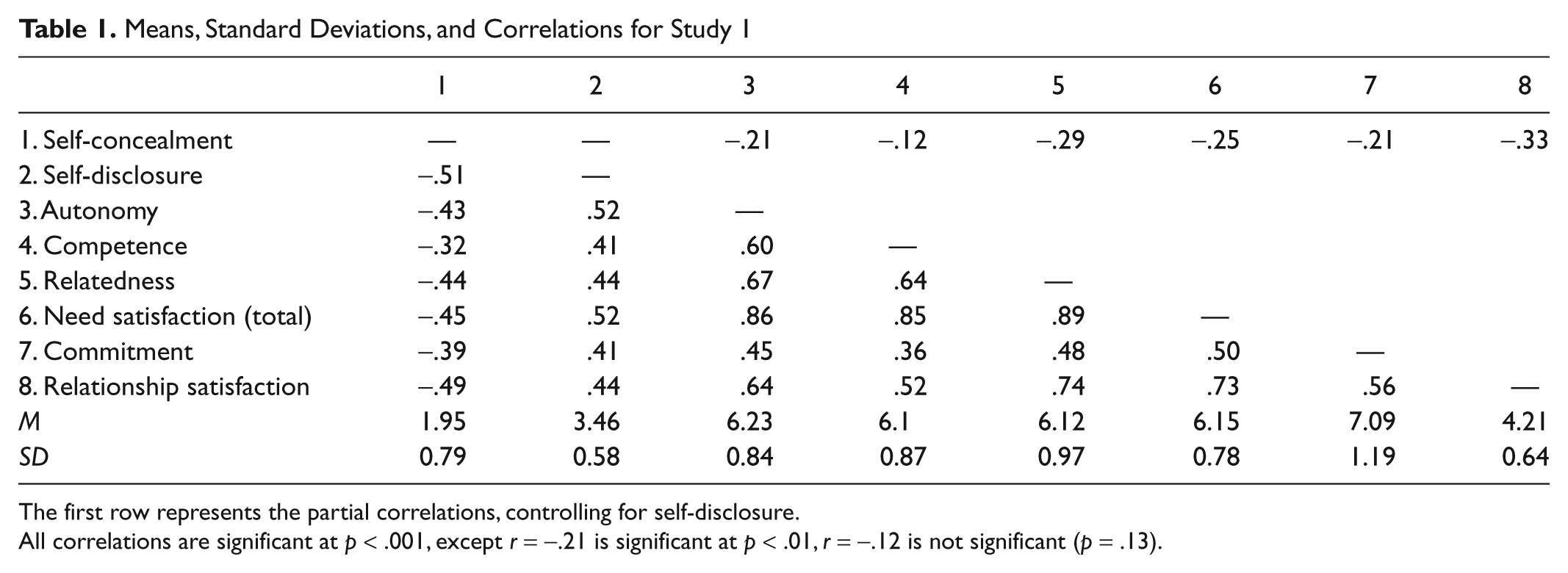
The first row represents the partial correlations, controlling for self-disclosure.
All correlations are significant at p < .001, except r = −.21 is significant at p < .01, r = −.12 is not significant (p = .13).
Next, we tested whether the association between self-concealment from one’s partner and relationship well-being was mediated by basic needs in romantic relationships (H2). Initially, we conducted two separate mediation analyses. In the first model, self-concealment from one’s partner was the predictor, basic need satisfaction was the mediator, and relationship satisfaction was the outcome. In the second model, commitment was the outcome. Finally, we tested a path model that included each need separately, as well as both outcomes.
Results showed that self-concealment had a moderate negative association with basic needs (β = −.45, p < .001) and relationship satisfaction (β = −.49, p < .001). When both self-concealment and basic needs predicted relationship satisfaction, the association between self-concealment and relationship satisfaction showed a significant drop (β = −.19, p < .05; Sobel Z = −4.21, p < .001) and basic needs significantly predicted relationship satisfaction (β = −.65, p < .001). These findings provide support for the idea that the link between self-concealment and relationship satisfaction is mediated by basic needs. Similarly, self-concealment also had a moderate negative association with commitment, and the findings supported the mediation model (Sobel Z = −5.83, p < .001). These findings are summarized in Figure 1 and Figure 2.
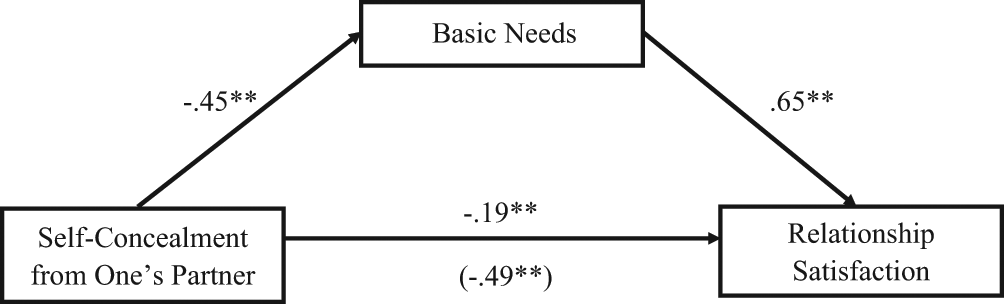
Basic need satisfaction as a mediator of self-concealment from one’s partner and relationship satisfaction
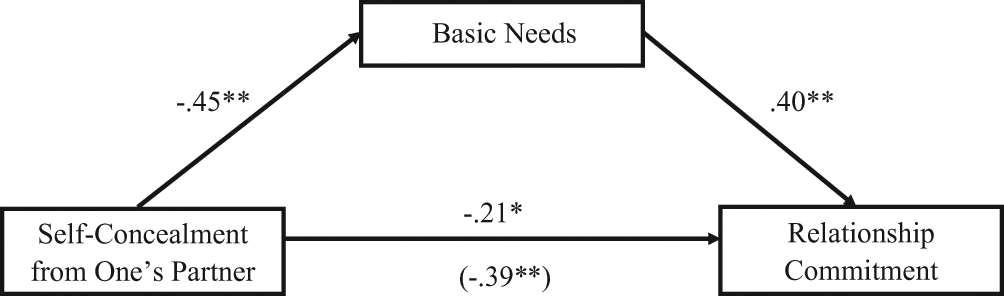
Basic need satisfaction as a mediator of self-concealment from one’s partner and relationship commitment
To further investigate the mediating role of each need, and also both relationship outcomes together, we conducted a path analysis. In the model, self-concealment from partner was the predictor, whereas autonomy, competence, and relatedness needs were the mediators. The outcomes were relationship satisfaction and commitment. Residual correlations were allowed between the three needs, as they were part of the same construct and also between the two relationship well-being outcomes.
The model was tested using Mplus software (Muthén & Muthén, 2010). Results showed that self-concealment had a unique negative association with each need, whereas autonomy and relatedness needs were associated with both relationship well-being outcomes. Competence needs, on the other hand, had no significant association with relationship well-being, independent of autonomy and relatedness needs. Furthermore, the direct associations between self-concealment and the outcome variables were not significant. In sum, there was support for the association between self-concealment and relationship well-being (i.e., commitment and satisfaction) being mediated by autonomy and relatedness needs. The final model (Figure 3) had a good fit, χ2(4) = 4.72, p = .32, root mean square error of approximation (RMSEA) = .03. 1 These findings supported H2, except that there was no support for the mediating role of competence needs, independent of autonomy and relatedness needs.
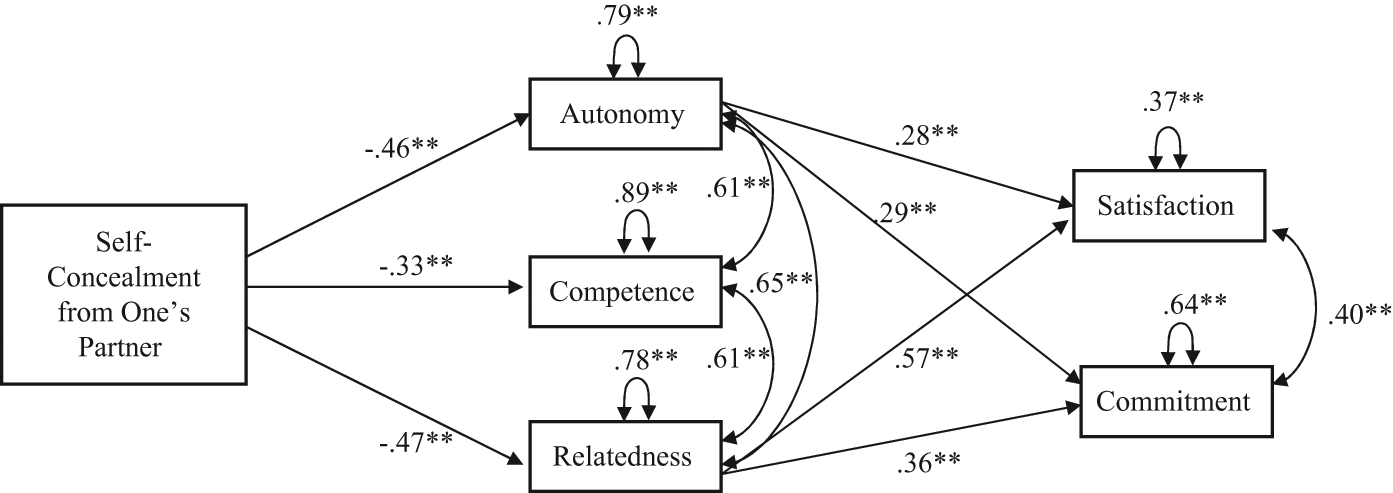
Path analysis for Study 1
Finally, we tested two alternative models. In the first model, relationship satisfaction and commitment predicted self-concealment, which in turn predicted the three basic needs. All the paths (except commitment to self-concealment) were significant; however, this model did not show an acceptable fit, χ2(6) = 133.40, p < .001, RMSEA = .36. In the second model, relationship satisfaction and commitment predicted the three basic needs, which in turn predicted self-concealment. This model provided an acceptable fit, χ2(2) = 3.80, p = .15, RMSEA = .07. The findings suggest that commitment significantly predicted only autonomy needs, whereas relationship satisfaction significantly predicted all three needs. Both autonomy and relatedness, but not competence, significantly predicted self-concealment from one’s partner.
The findings of Study 1 were in line with our prediction that self-concealment from partner would thwart basic needs in the relationship, which would then result in lower relationship well-being. Although self-concealment from one’s partner was negatively related to all three needs, competence did not have unique associations with commitment and satisfaction, beyond autonomy and relatedness needs. Consequently, competence did not mediate the link between self-concealment from one’s partner and relationship well-being. There was also support for the reverse model, which suggests that the association between self-concealment from one’s partner and relationship well-being could be a cyclical process.
Study 2
Study 1 used a cross-sectional design, in which the data were collected from only one member of the dyad. In Study 2, we tested whether the associations among self-concealment from one’s partner, basic needs, and relationship well-being would be replicated within couples, using a diary method. Diary studies allow the testing of within-person associations between variables, such as whether individuals report lower relationship satisfaction on the days they engage in more self-concealment in their relationships. In addition, the predictors can also be lagged to provide a more stringent test of the hypotheses.
We hypothesized that individuals would report lower relationship well-being on the days they self-concealed more from their partners (H3) and that this association would be mediated by daily need satisfaction (H4). In Study 2, we also measured daily conflict with one’s partner as an additional outcome. Conflict can be considered a negative indicator of relationship well-being, which would then be associated positively with self-concealment from one’s partner. On the other hand, self-concealment from one’s partner may also reduce conflict, as people sometimes avoid topics to prevent conflict (Caughlin & Afifi, 2004). Therefore, we did not have a specific hypothesis about conflict.
Finally, we collected the data from both partners of the couples, allowing us to investigate actor and partner effects. That is, in addition to one’s own concealment, we also looked at whether one’s partner’s concealment is uniquely associated with one’s own relationship well-being. Past research suggests that perceived partner concealment is associated with lower relationship well-being (Finkenauer et al., 2009). Thus, we expect that on the days one’s partner conceals more, one would be more likely to perceive concealment and report lower relationship well-being. However, these analyses were exploratory, and we did not measure perceived concealment or hypothesize specifically about the potential mechanisms of the link between one’s partner’s concealment and the relationship’s well-being.
Method
Participants
Both partners of 71 heterosexual couples who were not cohabiting and who had been dating for at least one month participated in this study. To acquire the most authentic and natural records, it was critical that records were completed individually. Ensuring individual record privacy was expected to be substantially more difficult with married couples and other partners who reside together. Of the 71 couples who signed up for the study, 21 were removed from analyses because they dropped out before the end of the study (n = 10 couples), did not follow instructions (n = 9 couples), or broke up during the study (n = 2 couples). Included couples (n = 50) did not differ from nonincluded couples (n = 21) in relationship length or relationship status. Participants were relatively young (M = 21.93 years, SD = 6.30 years) and ethnically diverse, with 32% Hispanic or Latino, 30% Asian, 19% Caucasian, and 10% African American, and 9% marked Other. Average relationship length was 1.66 years (SD = 1.56 years), and both members of most couples (90%) reported that they were exclusively dating. Four couples (8%) reported they were casually dating, and one couple disagreed about their level of involvement, with one partner stating they were exclusively dating and the other reporting they were only casually dating. In exchange for participation, students received course credit and nonstudents received entries into lottery drawings. Because of the slow pace of data collection, after the first 6 weeks of data collection, all couples (n = 41; 82%) were offered $25 for participating in the study.
Procedure
Both members of each couple completed an initial written questionnaire assessing basic individual and relational demographic information and baseline (person-level) self-concealment from one’s partner. On completion of this questionnaire, participants attended a 1-hour orientation session, in which they received detailed instructions and examples on how to complete the daily online record. Participants completed an online record each night for 14 consecutive days, beginning the evening following the orientation. If participants had not completed a day’s record by 12 p.m. the following day, they were unable to submit a record that day. Participants who failed to complete a record were contacted to remind them of the study, address any concerns, and facilitate completion of daily records. Couples’ time-stamped data were inspected prior to all analyses to make certain that records were completed on the proper day and to ensure that the days matched for both members of a couple. The mean number of records was 13.12 (SD = 1.02) for males and 13.32 (SD = 1.08) for females. Some participants (2 females) completed an extra day of records. These extra data were included in the analyses.
Measures
The diary records included abbreviated versions of the measures to reduce participant burden and to keep the length of the records manageable. Daily self-concealment items were adapted from past research (Uysal et al., 2010), whereas face-valid items were chosen to measure the three basic needs and relationship outcomes.
Self-concealment from one’s partner
Self-concealment from one’s partner was measured with five items (i.e., “I felt that I had to hide information about myself from my partner,” “I was afraid I would reveal something to my partner that I didn’t want to reveal,” “I was often hiding a part of who I am from my partner,” “I was pretending to be someone I’m not while with my partner,” “I felt that my partner didn’t know what I’m really like”) that participants were instructed to rate from 1 (strongly disagree) to 7 (strongly agree) while “considering today only.” Daily alphas ranged from .89 to .95, and the mean alpha across the 14-day period was .92.
Self-disclosure to partner
Self-disclosure to partner was measured with three items assessing the extent to which participants disclosed facts and information, their thoughts, and their feelings to their partner. Participants rated the items on a 1 (very little) to 7 (a great deal) scale. Daily alphas ranged from .92 to .97, and the mean alpha across the 14-day period was .95.
Need satisfaction
Daily need satisfaction in romantic relationships was assessed with three items from the Basic Need Satisfaction in Relationships Scale (La Guardia et al., 2000). We calculated a mean basic need satisfaction score by averaging the three items. One item measured autonomy (“When with my partner, I feel free to share and pursue my own ideas”), one item measured competence (“When with my partner, I feel like a competent person”), and one item measured relatedness (“When with my partner, I feel understood and supported”). Participants rated the items on a 1 (strongly disagree) to 5 (strongly agree) scale. Daily alphas ranged from .84 to .99, and the mean alpha across the 14-day period was .90.
Relationship satisfaction
Daily relationship satisfaction was assessed with two items (“My relationship is close to ideal” and “Our relationship makes me very happy”) from the Investment Model Scale (Rusbult et al., 1998) that participants rated from 1 (strongly disagree) to 5 (strongly agree). Daily alphas ranged from .72 to .95, and the mean alpha across the 14-day period was .79.
Relationship commitment
Daily commitment was assessed with one item (“I am committed to maintaining my relationship with my partner”) from the Investment Model Scale that participants rated from 1 (strongly disagree) to 5 (strongly agree).
Relationship conflict
Daily conflict was assessed with one item (“How much conflict did you and your romantic partner have today?”) that participants rated from 1 (very little/no conflict) to 5 (a lot of conflict).
Data Analytic Strategy
The data structure was hierarchically nested because daily assessments from both members of romantic couples were used. Two individuals were nested within 50 couples that were then crossed with 14 days. A complex pattern of interdependent data emerged, as day-to-day scores within individuals were dependent (e.g., an individual’s daily relationship satisfaction was related to his or her daily relationship satisfaction on other days), day-to-day scores across individuals (within any given couple) were dependent (e.g., an individual’s daily relationship satisfaction on Day 1 was related to his or her partner’s daily relationship satisfaction on Day 1), and individual-level scores (within any given couple) were dependent (e.g., an individual’s average relationship satisfaction was related to his or her partner’s average relationship satisfaction). Multilevel modeling was used to manage any missing data and to adjust for the possible bias in standard errors and statistical tests that may result from dependent data (Bolger & Shrout, 2007).
Independence could be assumed to exist only between couples. We employed the over-time actor-partner interdependence model (APIM; Campbell & Kashy, 2002; Kashy & Kenny, 2000) to model the nonindependence. Coefficients were estimated using the PROC MIXED routine in SAS with maximum likelihood estimation (Kenny, Kashy, & Cook, 2006). PROC MIXED estimates coefficients for a single criterion at a time, and thus relationship well-being (i.e., relationship satisfaction, commitment, and conflict) constructs were examined separately. The structure of the dyadic data consisted of distinguishable dyads; hence, we employed two-intercept models with separate male and female intercepts (Bolger & Shrout, 2007). The two-intercept model approach allows male and female intercepts to be different and correlated. The male dummy-coded variable (1 for males and 0 for females) and the female dummy-coded variable (0 for males and 1 for females) were also multiplied by self-concealment to estimate two separate coefficients for self-concealment. Thus, we had separate estimates for females and males because of the dyadic structure of the data; however, we had no specific hypotheses about gender effects.
The first-order autoregressive covariance structure type was specified to model the correlation between one’s daily outcome (e.g., relationship satisfaction) and the outcome that immediately preceded it (one’s satisfaction from the day before). This structure allowed the errors to be autocorrelated to model the correlation from one day to the next (Kenny et al., 2006). A sample SAS syntax used for the analyses is included in the appendix.
Results
It is important to note that in all of the analyses, there were two estimates for the intercepts and the predictor (i.e., self-concealment) as the two-intercept model was used (Bolger & Shrout, 2007). Thus, in the following sections we report the regression coefficients using the notation bf for females and bm for males. In addition, all of the estimates reported in multilevel analyses are unstandardized.
Initially, we examined whether one’s daily self-concealment from one’s partner was associated with one’s daily relationship well-being (H3). Self-concealment was grand-mean centered. The intercepts were defined as random, and self-concealment from one’s partner was defined as a fixed variable. Results showed that daily self-concealment was associated negatively with relationship satisfaction (bf = −.19, p < .001; bm = −.13, p < .001) and commitment (bf = −.19, p < .001; bm = −.08, p < .001) and associated positively with conflict (bf = .20, p < .001; bm = .22, p < .001). That is, on the days when participants self-concealed more, they also reported lower relationship satisfaction, lower commitment, and higher conflict. As an index of effect size, we calculated the change in residual variance of the outcomes after including daily self-concealment in the model. Results showed that daily self-concealment from one’s partner accounted for 9% to 12% of the within-person variance in relationship well-being outcomes. The regression coefficients and the random variances are presented in Table 2. These findings supported H3.
Fixed Effects, Variance, and Covariance Estimates for Self-Concealment
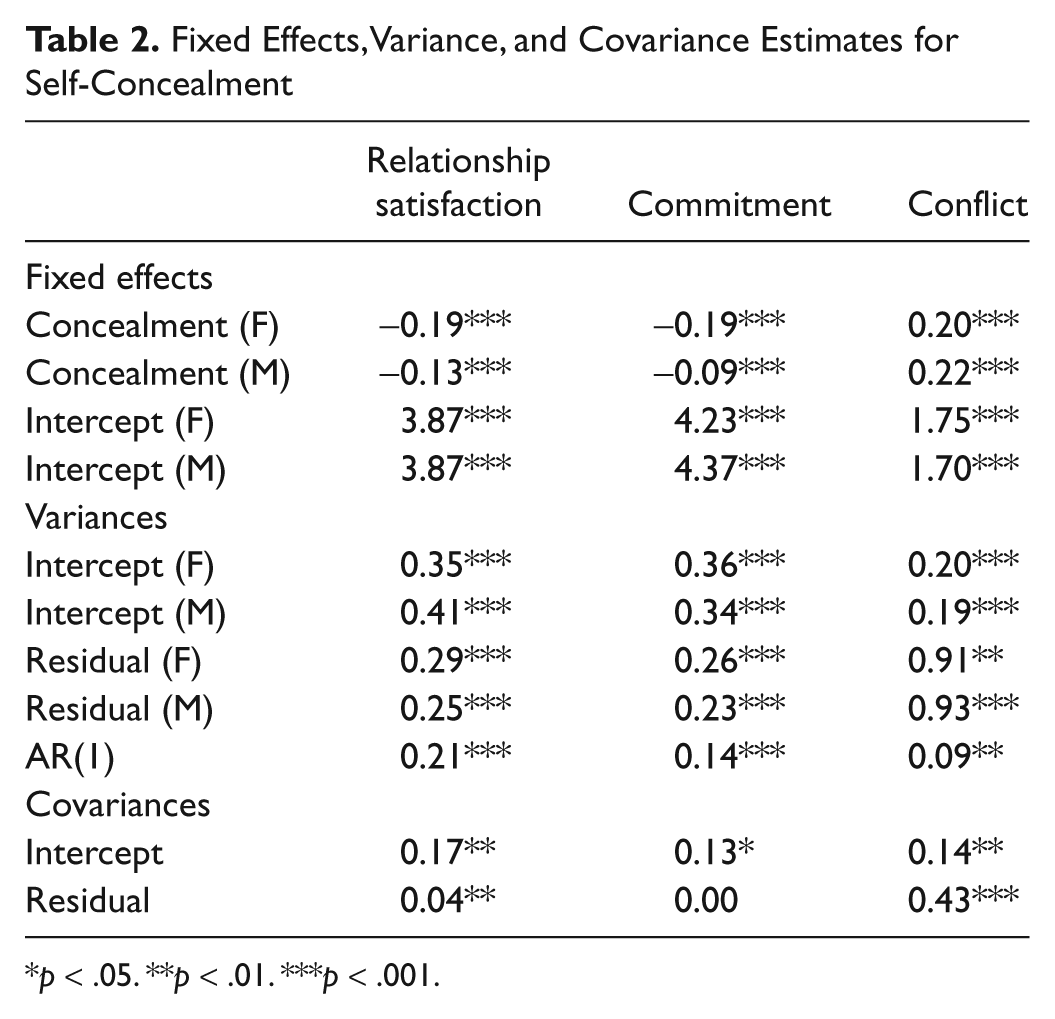
p < .05. **p < .01. ***p < .001.
Next, we conducted a more rigorous test of the hypothesis using a lagged design. First, instead of using the same day’s self-concealment, we used the previous day’s self-concealment as the predictor. Also, the correlation between the previous day’s outcome and the current day’s outcome was modeled using lag 1 autoregressive structure (note that this structure was also used for the previous analyses). Second, we centered self-concealment within persons so that the variable represented deviation from one’s average level of self-concealment. Finally, we included lagged daily self-disclosure to partner and baseline (person-level) self-concealment from one’s partner as the control variables. These findings showed that lagged self-concealment had a unique negative association with relationship satisfaction (bf = −.09, p = .001; bm = −.05, p = .05). On the other hand, lagged self-concealment predicted commitment only for females (bf = −.09, p < .001; bm = −.02, p = .42), but it did not significantly predict conflict (bf = .06, p = .16; bm = .04, p = .40) independent of lagged self-disclosure and baseline self-concealment. The findings are summarized in Table 3. These analyses also supported the association between self-concealment from one’s partner and relationship well-being (H3), except for the conflict outcome.
Fixed Effects, Variance, and Covariance Estimates for Lagged Self-Concealment and Control Variables
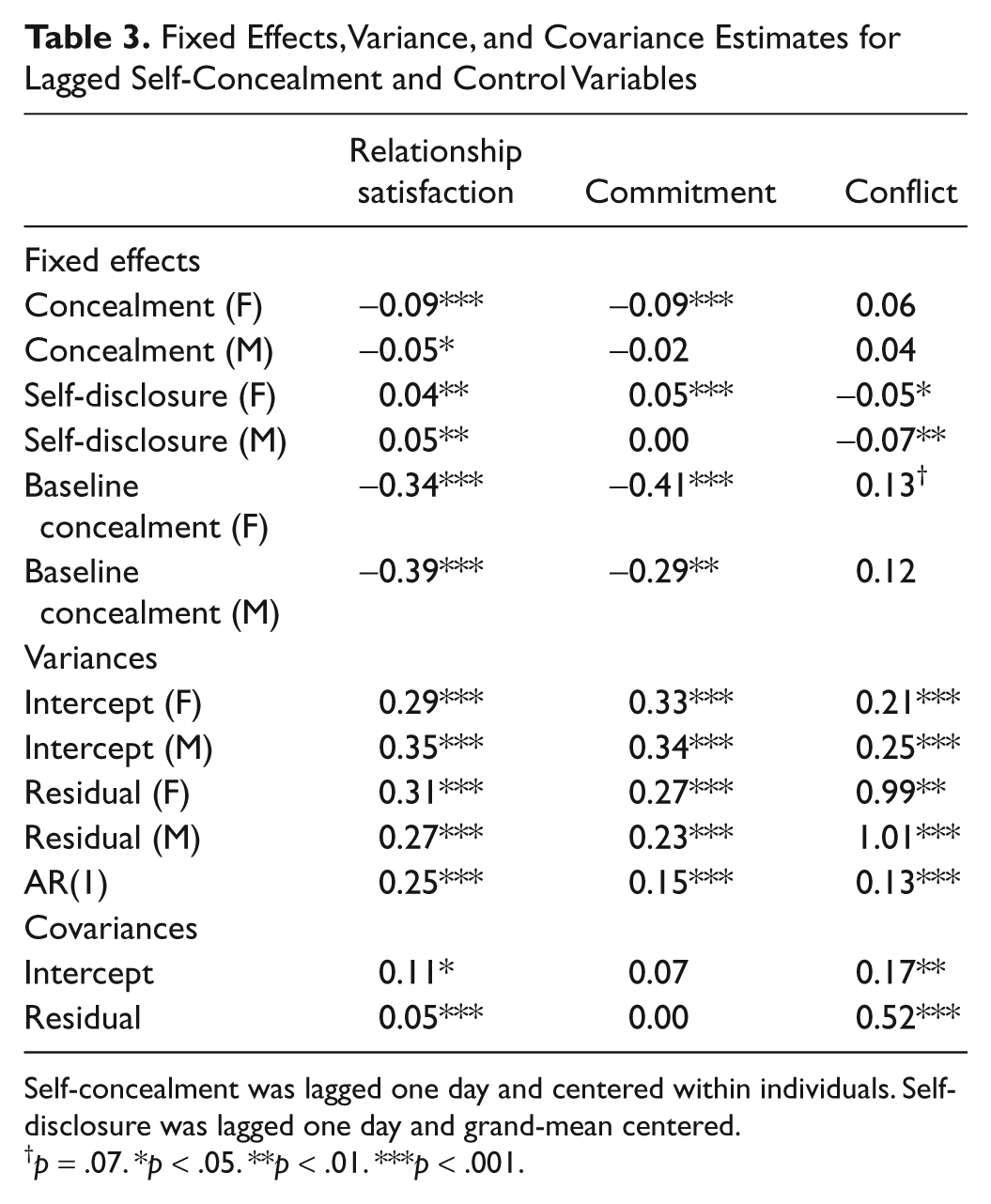
Self-concealment was lagged one day and centered within individuals. Self-disclosure was lagged one day and grand-mean centered.
p = .07. *p < .05. **p < .01. ***p < .001.
Mediation Analyses
Next, we examined whether daily need satisfaction mediated the association between daily self-concealment and daily relationship satisfaction and commitment (H4). For the mediation analyses, the predictors were grand-mean centered. Also, the three need satisfaction items were combined into a total need satisfaction score in order to run the analyses within the multilevel regression framework. The mediation model involved all lower-level variables (1 → 1 → 1 structure) with only random intercepts; hence, the standard three-step mediation method was applicable by using the estimates from multilevel equations (Krull & MacKinnon, 2001).
First, daily self-concealment from one’s partner significantly predicted daily relationship satisfaction (bf = −.19, p < .001; bm = −.13, p < .001). Next, daily self-concealment from one’s partner also significantly predicted daily need satisfaction (bf = −.20, p < .001; bm = −.20, p < .001). Finally, when both self-concealment from one’s partner and need satisfaction were entered as the predictors, need satisfaction significantly predicted relationship satisfaction (bf = .50, p < .001; bm = .30, p < .001), and the effect of self-concealment was reduced (bf = −.10, p = .02; bm = −.08, p = .02). This reduction was significant (Sobel Zf = −7.21, p < .001; Sobel Zm = −5.95, p < .001).
Similarly, daily self-concealment from one’s partner significantly predicted daily commitment (bf = −.19, p < .001; bm = −.08, p < .001). When both self-concealment from one’s partner and need satisfaction were entered as the predictors, need satisfaction significantly predicted commitment (bf = .39, p < .001; bm = .18, p < .001), and the effect of self-concealment was reduced (bf = −.12, p < .001; bm = −.04, p = .05). This reduction was significant (Sobel Zf = −6.62, p < .001; Sobel Zm = −4.81, p < .001). In sum, the findings were consistent with the hypothesis that daily self-concealment from one’s partner and daily relationship satisfaction and commitment would be mediated by daily need satisfaction (H4).
In addition, we also explored whether each need was associated uniquely with relationship satisfaction and commitment. We ran two separate multilevel regression analyses for the two outcomes. In these analyses, we used two intercepts but one slope for each predictor (six estimated parameters) to keep the number of estimated parameters reasonable. These analyses suggested that autonomy (b = .08, p = .001), competence (b = .08, p = .006), and relatedness (b = .25, p < .001) as well as self-concealment from one’s partner (b = −.08, p = .001) significantly predicted relationship satisfaction. Similarly, autonomy (b = .09, p < .001), competence (b = .08, p = .008), and relatedness (b = .12, p < .001) as well as self-concealment from one’s partner (b = −.08, p = .001) significantly predicted relationship commitment. However, one should be cautious before drawing conclusions about the mediating role of each need, as in these analyses it was not possible to test self-concealment from one’s partner as a predictor of multiple mediators.
APIM Analyses
Finally, we explored whether one’s own and one’s partner’s self-concealment are uniquely associated with one’s own relationship well-being. In analyzing the partner effects, we estimated actor and partner effects in the same step to examine the unique effects of each in predicting the criterion. An actor effect implies that one’s own concealment predicted one’s own relationship well-being, independent of one’s partner’s concealment. A partner effect means that one’s partner’s concealment predicted one’s own relationship well-being, independent of one’s own concealment. Both effects were grand-mean centered. We conducted separate multilevel regression analyses for each outcome.
Results showed that actor concealment was associated negatively with relationship satisfaction (bf = −.19, p < .001; bm = −.14, p < .001), and partner concealment was also associated negatively with relationship satisfaction (bf = −.07, p = .006; bm = −.06, p = .01). On the other hand, actor concealment was associated negatively with commitment (bf = −.19, p < .001; bm = −.08, p < .001), but partner concealment was not associated significantly with commitment. Furthermore, actor concealment was associated positively with conflict (bf = .30, p < .001; bm = .29, p < .001), and partner concealment was also associated positively with conflict (bf = .29, p < .001; bm = .25, p < .001). Finally, actor concealment was associated negatively with need satisfaction (bf = −.20, p < .001; bm = −.20, p < .001), and partner concealment was associated negatively with need satisfaction (bf = −.05, p = .07; bm = −.08, p = .008). In brief, actor concealment uniquely predicted lower relationship satisfaction, lower commitment, higher conflict, and lower need satisfaction for both women and men, whereas partner concealment uniquely predicted lower relationship satisfaction, higher conflict, and lower need satisfaction for both genders. These findings are summarized in Table 4.
Fixed Effects, Variance, and Covariance Estimates for Actor-Partner Self-Concealment
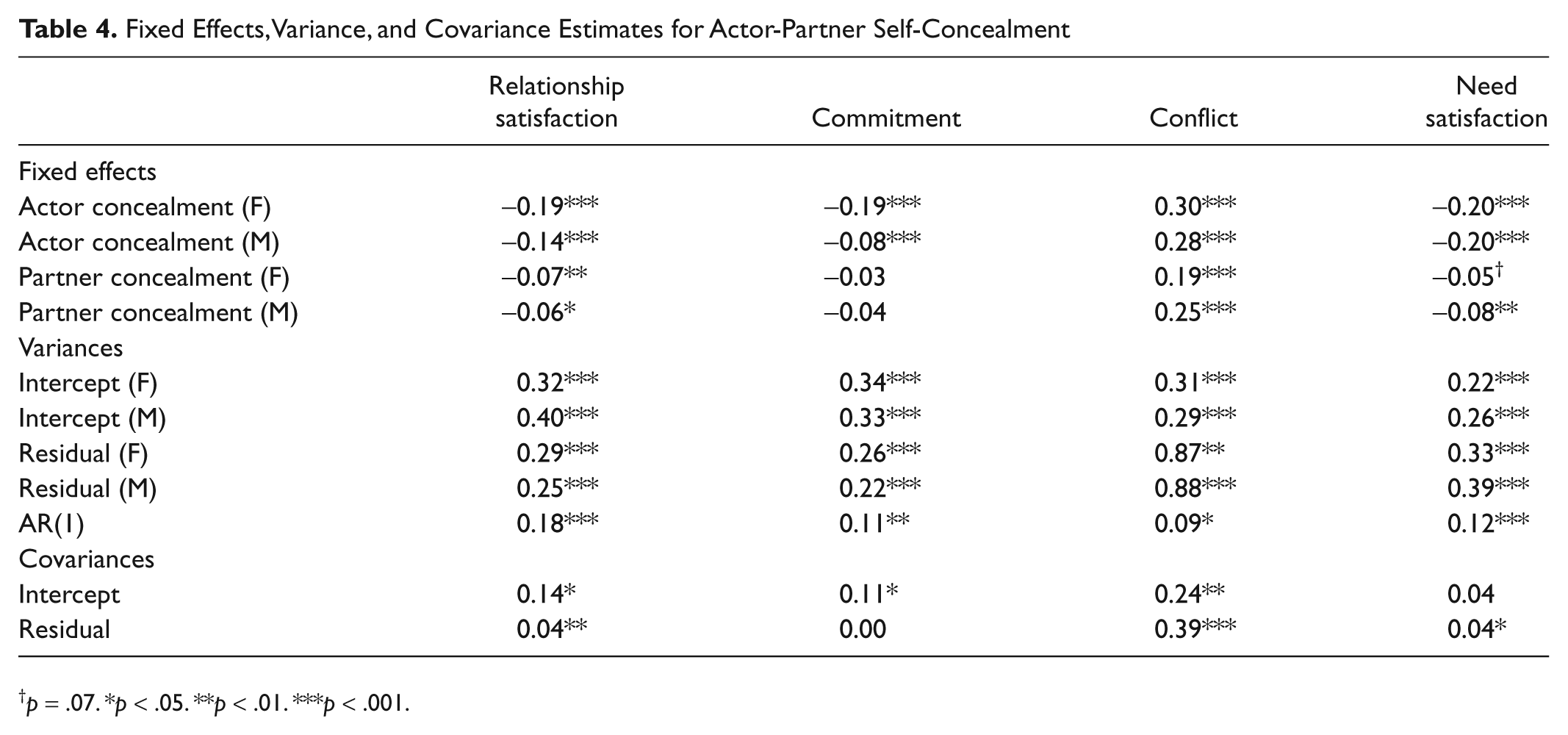
p = .07. *p < .05. **p < .01. ***p < .001.
Discussion
The findings of the two studies suggest that self-concealment in romantic relationships is associated with lower relationship well-being, and this association is mediated by need satisfaction in relationships. In Study 1, cross-sectional data showed that concealment from one’s partner was associated negatively with relationship satisfaction and commitment, and the findings provided support for unfulfilled autonomy and relatedness needs as mediators of this link. Study 2 replicated these findings using diary data from couples and also found unique associations of one’s own and one’s partner’s concealment with one’s relationship well-being.
The current research makes several contributions to the literature. First, it shows that self-concealment in romantic relationships is associated negatively with relationship well-being. Although these findings fit well with prior literature, they also integrate self-concealment in relationships with self-determination theory, offering support for a unique explanatory mechanism for why self-concealment from one’s partner predicts poorer relational well-being. Furthermore, the findings also suggest that self-concealment from one’s partner is different from self-disclosure to partner (or lack thereof), and it is associated uniquely with relationship well-being.
Second, the present research also examines these associations within couples across 14 days. Diary studies provide insight about the daily processes rather than the trait-level associations between the constructs. Accordingly, each member of the couple reported lower relationship well-being on the days they concealed more. These findings suggest that the daily process of concealment is linked with negative relationship outcomes, independent of one’s person-level self-concealment. Moreover, the results of Study 2 also suggest that apart from one’s own concealment, one’s partner’s concealment negatively influences one’s relationship well-being. To our knowledge, this is the first study to test the daily consequences of self-concealment from one’s partner as well as one’s partner’s self-concealment.
Finally, we also examined the association between daily relationship need satisfaction and relationship well-being. Researchers have called for studies that examine the link between satisfaction of three basic needs in relationships and relationship well-being in daily life (Patrick et al., 2007). The findings of Study 2 provide empirical evidence for the relationship between these constructs. We found that participants reported lower relationship well-being on the days their basic relationship needs (i.e., autonomy, competence, and relatedness) were not met.
In Study 1, we examined the role of each need, and the findings supported the hypothesis that autonomy and relatedness needs mediate the association between self-concealment from one’s partner and relationship well-being. Although self-concealment was associated negatively with each need as expected, competence was not associated uniquely with relationship satisfaction and commitment, independent of autonomy and relatedness. Previously, researchers have argued that competence may involve more self-focus and be more relevant to maintaining a healthy self-concept, whereas relatedness need fulfillment may be particularly important in the context of relationships (Patrick et al., 2007). The findings of Study 1 support this idea, as competence was not a significant mediator. On the other hand, in Study 2 each need was associated uniquely with relationship satisfaction and commitment. However, each need was measured using one item in Study 2, and considering that the three basic needs are correlated moderately with each other, the findings regarding their unique associations may not be stable. Thus, more research is needed before drawing conclusions about the unique role of each need.
In Study 2, apart from the basic analyses, we also conducted a stringent test of the hypotheses by removing the between-person variance from self-concealment and also by lagging the predictors one day. The results of these analyses were in line with the hypothesized causal effect of self-concealment from one’s partner. When individuals self-concealed more than their average level of self-concealment, they reported lower relationship satisfaction and lower commitment on the following day, independent of self-disclosure. Similarly, these findings also suggest that self-concealment from one’s partner is associated with lower relationship well-being, independent of one’s general level of self-concealment (i.e., person level) from one’s partner. On the other hand, person-level self-concealment also predicted one’s daily relationship satisfaction and commitment. However, daily conflict was associated only with previous day’s self-disclosure. Considering the positive association between daily conflict and self-concealment in our basic analyses, it can be suggested that conflict may lead to self-concealment from one’s partner rather than vice versa.
There were a few significant gender differences in Study 2; more specifically, the previous day’s (i.e., lagged) self-concealment and self-disclosure did not significantly predict commitment for males. As the gender differences were found in lagged analyses, it can be speculated that women might be ruminating more (Nolen-Hoeksema & Girgus, 1994), and as a result, the consequences of concealment might last longer. Similarly, research also suggests that relationship-oriented behaviors such as relationship talk and conflict resolution are more strongly related to women’s relationship satisfaction and well-being than men’s (Acitelli, 1988, 1992; Acitelli & Antonucci, 1994), and women might base their self-worth more on the quality of their relationships (Cambron, Acitelli, & Pettit, 2009). Consequently, self-concealment from one’s partner, a relationship-oriented behavior, might have resulted in more negative consequences for women.
We also found significant partner effects in Study 2. One’s partner’s self-concealment was associated negatively with one’s own need satisfaction and relationship satisfaction, and it was associated positively with conflict. In other words, participants reported lower need satisfaction, relationship satisfaction, and higher conflict on the days their partners reported higher concealment. Furthermore, these associations were independent from one’s own concealment. We did not propose or test a model for how one’s partner’s concealment is linked to one’s relationship well-being, as the partner analyses were more exploratory. However, this finding suggests that there are also interpersonal processes involved. Self-concealment is likely to involve verbal and nonverbal behaviors, apart from the cognitive (thought suppression) aspect. For instance, the partner may act suspiciously by trying to avoid topics, and in some cases by lying outright. These behaviors would be perceived by the actor to some extent. It is likely that individuals perceive more partner concealment on the days that their partners conceal more, which would then result in lower trust in the partner and lower relationship well-being (Finkenauer et al., 2009). In fact, Finkenauer and colleagues (2009) found that compared to one’s own concealment, perceived partner concealment showed stronger associations with relationship well-being. Consequently, they argued that it is the perception of concealment that matters and that perceived partner concealment leads to feeling excluded, which then predicts lower relationship well-being. Unfortunately, we did not measure perceived concealment, as the focus of our studies was on one’s own concealment. According to our reasoning, one’s own concealment plays an important role because it thwarts one’s basic needs in the relationship, which then predicts lower relationship well-being. In sum, our model deals with the intrapersonal aspect of self-concealment from one’s partner; however, the partner effects suggest that interpersonal processes also play a significant role. Future diary studies including perceived partner concealment along with one’s own concealment can potentially provide more insight about the partner effects and the role of perceived partner concealment in this process.
Work on empathic accuracy suggests that when the partner’s thoughts and feelings are relationship threatening, empathic accuracy would be detrimental to relationship quality, whereas if the partner’s thoughts are about mundane events, empathic accuracy would be beneficial to relationship quality (Ickes & Simpson, 2004). Similarly, the relationship threat level of the concealed information might be a moderator of the association between self-concealment and relationship quality. That is, concealing mundane events might have less severe, and in some cases even beneficial, consequences than concealing relationship-threatening events. Furthermore, empathic accuracy might also be important in the actor’s perception of the partner’s concealment. Actors who are high on empathic accuracy might perceive their partner’s concealment as behavioral evidence for their empathic inferences of a relationship-threatening event and feel less satisfied with their relationship (Simpson, Oriña, & Ickes, 2003).
The findings of this research do not suggest that individuals in romantic relationships should disclose everything to their partners. Under some circumstances, disclosing may have a more negative effect on basic needs or relationship well-being than concealing. For instance, it was argued that topic avoidance can serve a beneficial function for some topics (Baxter & Wilmot, 1985) or under certain conditions (Caughlin & Afifi, 2004). In fact, under some circumstances, individuals might be motivated to infer others’ thoughts and feelings inaccurately to protect the relationship (Simpson, Ickes, & Blackstone, 1995). Similarly, contextual factors such as the partner’s characteristics (e.g., responsive vs. critical) or the content of the concealed information can have different consequences for disclosure. For example, with a judgmental partner, disclosing might lead to lower fulfillment of relatedness and competence needs than concealing. In brief, the model presented in this research lays the groundwork for research on self-concealment in romantic relationships. Future studies can investigate the factors that moderate the hypothesized associations.
One might wonder how this research fits with models based on self-disclosure such as Reis and Shaver’s (1988) popular self-disclosure model of intimacy. We think these findings are in line with the intimacy model, but they also go beyond it. Intimacy is said to derive from feeling understood, validated, and cared for in the context of mutual reciprocal self-disclosure between partners over time. Feeling understood and cared for can be conceptualized as relatedness needs within self-determination theory, and feeling validated by one’s partner might involve both relatedness and competence. However, the associations we observed between concealment and relationship outcomes were also mediated by autonomy needs. In other words, apart from relatedness and competence, self-concealment from one’s partner also had a negative association with autonomy needs in the relationship. Furthermore, the intimacy model focuses on the interpersonal process of mutual self-disclosure and partner responses. On the other hand, our theorizing focuses more on the consequences of the intrapersonal processes (e.g., cognitive and behavioral suppression) related to self-concealment. In sum, we think that these findings capture some aspects of the intimacy model, but they also suggest that there are other processes involved.
In both studies, self-concealment from one’s partner was assessed using self-report measures. Individuals can score low on self-concealment from one’s partner for two possible reasons. First, the person may not have potential things to hide; second, the person may have potential things to hide but share them with the partner. Although these appear to be different cases, in both cases there is no self-concealment from the partner (although for different reasons). According to our reasoning, in both situations individuals would be more satisfied because their basic needs in the relationship would be less likely to be thwarted as there is no concealment process, regardless of the reason. Furthermore, Study 2 used a within-person design, and the effects reported in Table 3 were purely within-person effects. In these analyses, we controlled for baseline (person-level) self-concealment from one’s partner, in addition to centering daily self-concealment within the individual. The findings of Study 2 suggest that when these individuals self-concealed more than their average level of self-concealment over 14 days, they reported lower relationship satisfaction on the following day. That is, even if they did not conceal things from their partners normally, on the days they concealed something, they reported lower relationship satisfaction. On the other hand, disclosing potential secrets might have additional benefits for relationship well-being, such as increased closeness and intimacy, rather than merely not having anything to hide or share. These dynamics can be investigated in future studies.
There are also some caveats of the studies that we need to mention. First, both studies have correlational designs; hence, causal associations are theoretical. Other causal models also are plausible. For instance, it can be suggested that unfulfilled relationship needs lead to more self-concealment, instead of vice versa. Similarly, people who are unsatisfied with their relationships may be more likely to self-conceal from their partners. These processes could also form a cycle of concealment, need satisfaction, and relationship well-being. In fact, our path analysis for a reversed path model using Study 1 data also showed a good fit, which provided some evidence for this idea. Although our hypotheses’ directions were based on past research and our theoretical framework, studies using experimental designs are needed to address this issue.
Second, some of the measures in the diary study consisted of only one item to keep the records brief. This somewhat limits the content validity of these constructs; thus, diary studies using multiple items to assess these constructs are desirable. However, it is important to note that the associations between self-concealment and various relationship outcomes, all of which can be considered indicators of overall relationship well-being, were consistent across these outcomes.
Last, both of our samples consisted mostly of young adults, and the average relationship length was 2 to 3 years, restricting the external validity of the findings. For instance, self-concealment from one’s partner might be considered normal in the early stages of a relationship, due to self-presentational concerns, but it might not be acceptable in the later stages of a relationship. As a result it might have different consequences at different stages of a relationship. Similarly, other demographic factors such as culture and education level of participants might also be moderating factors. Future studies might investigate the consequences of self-concealment using different types of samples. Despite these shortcomings, the present research replicates findings across two studies using different methods and provides empirical evidence for the idea that self-concealment from one’s partner is associated negatively with satisfaction of autonomy, competence, and relatedness needs in the relationship, which then predicts lower relationship well-being.
Footnotes
Appendix
Acknowledgements
We would like to thank the Interpersonal Relations and Motivation Research Group Lab for their comments on the earlier versions of this article. Dr. Bush is affiliated with the Health Services Research and Development Center of Excellence, Michael E. DeBakey VA Medical Center.
Dr. Margaret Clark served as guest action editor for this article.
The author(s) declared no potential conflicts of interest with respect to the research, authorship, and/or publication of this article.
The author(s) disclosed receipt of the following financial support for the research, authorship, and/or publication of this article: Study 2 was supported in part by the Houston VA HSR&D Center of Excellence (HFP90-20). The views expressed in this article are those of the author(s) and do not necessarily represent the views of the Department of Veterans Affairs.