







Abstract
The authors extend previous research on the effects of metastereotype activation on outgroup helping by examining in more detail the role of group impression management motives and by studying direct helping (i.e., helping the outgroup believed to hold a negative view of the ingroup). Data from three experiments provided full support for the communicative nature of direct outgroup helping by demonstrating that outgroup helping in response to a negative metastereotype was predicted by participants’ concern for the image of their ingroup, but not by their self-image concerns. Moreover, group image concerns predicted outgroup helping but not ingroup helping and predicted outgroup helping only when a negative metastereotype was activated, compared with a positive metastereotype, or a (negative or positive) autostereotype. The results also ruled out an alternative explanation in terms of denying the self-relevance of the metastereotype.
Keywords
People have an ongoing concern with how others perceive and evaluate them. Because most people want to be liked and respected by others (Baumeister, 1982), they use their social behavior as a means of communicating this type of information about themselves to others (Bergsieker, Shelton, & Richeson, 2010). Within groups, individual members adjust their behavior to seek acceptance from other ingroup members and avoid rejection (Leary, Tambor, Terdal, & Downs, 1995). Between groups, individuals seek to refute negative stereotypic perceptions and create positive intergroup comparisons by presenting their group in a more favorable light (Brewer & Weber, 1994; von Hippel et al., 2005). One way of creating a positive impression is by helping others. In the current article, we present three studies investigating the degree to which outgroup helping is used as a tool to communicate ingroup warmth. As we will explain in the following, these studies complement and extend existing research on strategic outgroup helping (e.g., Hopkins et al., 2007; van Leeuwen & Täuber, 2011) by directly studying the role of group impression management motives.
Helping is generally perceived as an act of kindness, but can also portray important qualities such as knowledge or skills. Because helping others can communicate warmth as well as competence, and warmth and competence are the primary dimensions for evaluating others (Fiske, Cuddy, & Glick, 2007), helping can be a very effective impression management tool. The importance of impression management motives in helping behavior is illustrated by the fact that public donations are typically higher than private donations (Campbell & Slack, 2006; Gabriel, Banse, & Hug, 2007; Riordan, James, & Dunaway, 1985), and that people high in need for approval tend to donate more than those low in need for approval (Satow, 1975).
By helping members of another group, people may attempt to alter the way they believe they are perceived by this group. People’s beliefs about how their ingroup is perceived by outgroup members are labeled metastereotypes (Vorauer, Hunter, Main, & Roy, 2000; Vorauer, Main, & O’Connell, 1998). Metastereotypes are different from autostereotypes in the sense that they refer to how people believe that they, as a member of their ingroup, are viewed by others. Autostereotypes, in contrast, refer to how the ingroup is viewed by fellow ingroup members (Taylor, Ruggiero, & Louis, 1996). Metastereotypes can be activated by thinking about how the outgroup views the ingroup, for example, through informing people that they can be evaluated by the outgroup (Vorauer et al., 2000). Once activated, metastereotypes automatically trigger self-presentation concerns (Klein & Azzi, 2001).
The role of metastereotypes in outgroup helping was recently investigated across three studies by Hopkins and colleagues (2007). They found that Scottish participants believed that they were perceived as mean by the English and believed that outgroup helping was the most effective way to refute this (Study 1). Moreover, when this mean metastereotype was salient, they described Scottish people as more generous (Study 2) and expressed higher levels of helping of the Welsh (another outgroup), but not of the Scots (the ingroup, Study 3). This latter finding is important because outgroup helping is more diagnostic of generosity as an ingroup quality than helping fellow ingroup members (i.e., ingroup support is to be expected within groups; Hopkins et al., 2007).
The Hopkins et al. (2007) article is highly influential because it is among the first to demonstrate the existence of strategic motives in intergroup helping. However, there are a few key questions that remain unanswered, and the goal of the current research was to fill these gaps. The authors concluded in their article that the findings support the explanation that some behaviors are “acts of communication intended to ameliorate the position of the ingroup in an intergroup context” (Hopkins et al., 2007, p. 787; italics added). However, it is unclear whether Scottish participants in the salient metastereotype conditions became more generous because they wanted to communicate generosity as a quality of the Scots, or because they wanted to deny the self-relevance of the stereotype. Von Hippel and colleagues (2005) demonstrated that people who are concerned with impression management often cope with negative stereotyping through denying the accuracy of the stereotype insofar as it describes themselves. One could argue that such an individual strategy is more often expected from people who do not strongly identify with their group (Ellemers, Spears, & Doosje, 1997), whereas the results by Hopkins and colleagues were obtained by controlling for Scottish identification (Study 2), or by selecting only high identifiers (Study 3). Identification, however, may not be the best indicator of a collective or individual strategy when it comes to responding to negative metastereotypes. For instance, Klein and Azzi (2001) found that high and low identifiers were equally likely to refute negative metastereotypes. It is possible that high identifiers become more generous when confronted with a negative metastereotype because they are more threatened by the metastereotype itself and not because they are engaged in a collective strategy to refute the metastereotype. As yet, it is not clear whether metastereotype activation results in more helping because group members want to collectively refute the metastereotype or because they are denying that the metastereotype applies to them individually.
A second issue that requires further exploration pertains to the target of help. In the research by Hopkins and colleagues (2007), non-ingroup helping was either directed at “foreigners” (Study 1), the Welsh (Study 3), or general donations to charity (Study 2)—but not at the source of threat (i.e., the English). An English experimenter was present in all studies, and as such, participants could still refute the negative metastereotype by displaying prosocial behavior in front of a member of the source of threat. However, to our knowledge, no research has yet investigated to what extent the desire to refute a negative metastereotype translates into direct helping, that is, helping the group that is believed to hold the negative stereotype of the ingroup. This investigation of direct helping is important because there may be more impediments to helping the source of threat than to helping a third party. Vorauer and colleagues (1998) argued that the behavioral implications of feeling stereotyped could include hostile reactions and avoidance of contact with outgroup members. In fact, the usual positive effect of empathy on intergroup attitudes can be blocked by negative metastereotypes that are automatically activated in the contact situation (Vorauer & Sasaki, 2009). Van Leeuwen, Täuber, and Sassenberg (2011) found that participants who felt negatively stereotyped by another group were more reluctant to seek help from that group. If negative metastereotypes result in avoidance of seeking help, they could also result in a reluctance to provide help. However, when the goal is to refute a negative ingroup stereotype, it might be more effective if people did help the source of threat and demonstrate their generous qualities directly to them, as opposed to helping a neutral group in the hopes of being watched by the threatening outgroup. It is therefore crucial to investigate whether negative metastereotypes also promote direct outgroup helping (i.e., helping the source of threat) as opposed to only indirect helping (cf., Hopkins et al., 2007).
To sum up, we aimed to extend previous research on the effects of metastereotype activation on helping (Hopkins et al., 2007) by examining the role of group impression management motives in direct outgroup helping, as well as to test an alternative explanation in terms of group members’ desire to demonstrate that the metastereotype does not apply to them personally. To this end, we included measures in all three studies to investigate directly to what extent participants were communicating a positive impression of their ingroup to the outgroup. The possibility that outgroup helping is used to deny the self-relevance of the metastereotype was further explored in Study 2 by comparing concerns about the image of the ingroup with concerns about self-image, and in Study 3 by comparing responses to activated metastereotypes with responses to activated autostereotypes.
Study 1
In Study 1, we manipulated the presence or absence of a negative metastereotype and assessed the degree to which participants viewed “warmth” as an ingroup trait. We reasoned in the general introduction of this article that negative, antisocial metastereotypes can trigger outgroup helping because group members want to communicate that their group, in contrast to the metastereotype, is actually warm, kind, and helpful. Therefore, the degree to which participants view their group as warm should predict outgroup helping in response to a negative metastereotype.
Dutch participants in this study were confronted with the Belgians’ view of the Dutch as unfriendly, individualistic, and cold. If outgroup helping is a tool to communicate ingroup warmth, then participants who are confronted with this negative metastereotype should be more likely to help Belgian people compared with participants in a neutral control condition (Hypothesis 1). Moreover, if participants are indeed engaged in a collective strategy of refuting the negative metastereotype (as opposed to demonstrating that the metastereotype does not apply to them personally), then the degree to which participants viewed “warmth” as a Dutch quality should be positively related to helping in the metastereotype condition, but not in the control condition (Hypothesis 2).
Method
Participants and design
Forty Dutch students from the VU University Amsterdam (16 men, 24 women, M age = 20, SD = 1.97) participated in this study for which they received monetary compensation. Participants were randomly distributed across two conditions: metastereotype and control.
Procedure
On entering the experimental laboratory, participants were received by an experimenter who explained that they would participate in three unrelated studies and who seated them in separate cubicles in front of a computer, which was used to provide instructions and questions and register their responses. Unless otherwise indicated, all answers were assessed on 7-point scales (1 = not at all, 7 = very much).
The first part was introduced as a study on text comprehension of Internet articles. Participants were asked to read three articles that had ostensibly appeared on the Internet and subsequently answer a series of questions about each regarding language use, structure, and clarity of content. The first two articles were neutral articles presented in both conditions, but the third article constituted the manipulation. In the metastereotype condition, the third article described how many Belgians view the Dutch as somewhat self-centered, individualistic, stingy, and with little attention for the needs of others. In the control condition, the article described how companies in the IT sector have become less attractive in the last 10 years for higher educated Dutch and Belgian professionals as sources of employment, as business partners, or for investments. Both articles thus activate Dutch and Belgian nationalities, but only the article in the metastereotype condition contains information about how the Dutch are viewed by the Belgians. Participants were asked to summarize each article in three sentences. All summaries correctly reflected the message of the article, indicating that the manipulation was successful. 1
Introduced as a second, unrelated study, participants read an introduction to an international buddy system. The introduction explained that, in this buddy system, students within the EU who are planning to do (part of) their bachelor’s or master’s abroad would be supported by local students in their search for accommodation and be introduced to the host university, city, and country. We then gave participants a brief profile of one of these students, a 22-year-old Belgian bachelor student named Bart, who was planning to do his master’s at the VU University. Participants were asked to indicate to what extent they would be willing to “show him around their university,” “introduce him to the Amsterdam nightlife,” “help him find a place to live,” and “introduce him to their friends.” These items were later averaged into one scale indicating participant’s willingness to help the Belgian student (α = .87).
The third part consisted of a brief questionnaire. Embedded between several filler items was a measure of perceived Dutch warmth, 2 in which participants were asked to indicate to what extent the following traits applied to Dutch people in general: friendly, social, generous, warm, and helpful (α = .77). At the end of the questionnaire, participants were probed for suspicion. None of the participants were aware of the true purpose of the experiment. They were subsequently paid, thanked, and debriefed.
Results
Helping
The participants’ willingness to help the Belgian student was analyzed in a regression analysis with perceived Dutch warmth (transformed to z scores), condition (coded 0 for metastereotype and 1 for control), and the interaction term as predictors. The equation was significant, F(3, 36) = 5.71, p < .01,
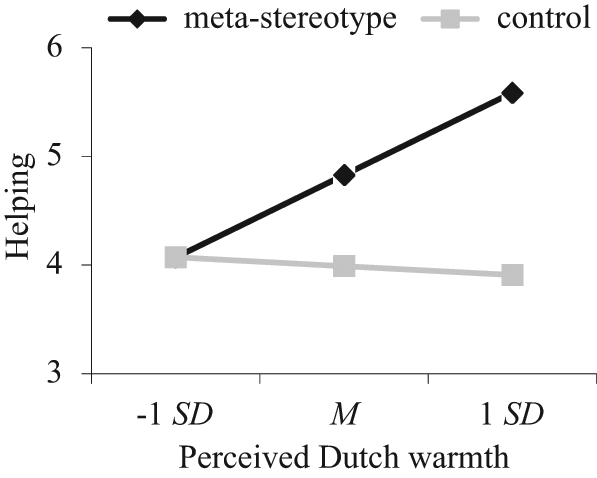
Relationship between perceived Dutch warmth and outgroup helping, Study 1
We repeated the analysis with gender included as a predictor variable, as well as all possible interaction terms. Results showed that gender did not affect helping—neither as a main effect (t = 0.03, p = .97) nor in conjunction with any of the other variables (all ps > .17).
Discussion
As predicted, the willingness to help was greater in the metastereotype condition compared with the control condition. Moreover, helping in the metastereotype condition (but not in the control condition) was positively related to the degree to which participants viewed warmth as a quality of the Dutch. These findings replicate those reported by Hopkins et al. (2007) in a context where helping is directed at the source of threat, and extend them by demonstrating that helping in the metastereotype condition served to communicate a group quality to the outgroup.
Although the data demonstrated that helping in the metastereotype condition served to communicate a group quality to the outgroup, the absence of a measure of the degree to which participants wanted to communicate a positive quality of themselves means that the alternative explanation in terms of denying the self-relevance of the metastereotype cannot be completely ruled out. That is, it is possible that both motives played a role in outgroup helping. Study 2 was designed to examine this in more detail.
Study 2
The goal of Study 2 was to provide a more conclusive test of the hypothesis that outgroup helping is used as a tool to make a good impression of the ingroup as a whole, as opposed to demonstrating how the self deviates from the negative metastereotype. We therefore included a measure of concern for group impression (CGI) as well as a measure of concern for personal impression (CPI). If participants, in response to an activated metastereotype, help outgroup members because they want to create a more favorable impression of their ingroup, then the degree to which they are concerned about the impression others have of their ingroup should be a positive predictor of outgroup helping. However, if participants are attempting to show that they, as individuals, are unlike the metastereotype, then the degree to which they are concerned about the personal impression others have of them should predict outgroup helping.
The concern people have about the impression others have of their group is theoretically linked with social identification. High identifiers, more than low identifiers, care about their group’s image (Branscombe & Wann, 1994). However, as argued in the general introduction of this article, social identification itself is less suited as a moderator to separate personal and group impression management motives, because high identifiers are also more likely to feel threatened by the metastereotype itself. By assessing concerns for group impression and concerns for personal impression as potential moderators, as opposed to social identification, we are better able to examine the hypothesis that outgroup helping in response to metastereotype activation is used as a tool to create a more favorable impression of the ingroup.
In addition to comparing responses to an activated metastereotype with those in a control condition in which no metastereotype was activated, the study also included a comparison between a condition in which participants could help an outgroup member and a condition in which they could help a member of the ingroup. We expected that, if helping is used to communicate a more favorable impression of the ingroup to a specific outgroup, metastereotype activation should promote helping of that outgroup, but not of the ingroup (Hypothesis 1). We further expected that CGI, but not CPI, would predict outgroup helping, but not ingroup helping, in response to an activated metastereotype (Hypothesis 2).
An additional aim of the study was to investigate the possibility that helping is not limited to those situations where a specific trait (e.g., generosity) is challenged but can also be used to challenge negative metastereotypes in general. Metastereotypes in the current study were activated by asking participants to list five traits that they consider the outgroup views as descriptive of their ingroup (cf., Branscombe, 1998). While activating the metastereotype itself, this manipulation does not activate a specific, predetermined stereotypic content. However, because metastereotypes are generally more negative than autostereotypes (Krueger, 1996; Vorauer et al., 1998), the manipulation could still trigger outgroup helping as a means of creating a more positive impression of the ingroup.
Method
Participants and design
A total of 83 students from the VU University Amsterdam (26 men, 57 women, M age = 21, SD = 3.66) participated in this study for which they received monetary compensation. Participants were randomly distributed across the four cells of a 2 (metastereotype activation: metastereotype vs. control) × 2 (target group: ingroup vs. outgroup) between-participants experimental design.
Procedure
An experimenter received participants in the experimental laboratory and seated them in separate cubicles in front of a computer, which was used to provide instructions and register responses. Participants were first asked to indicate in which region of the Netherlands they currently studied: North, East, South, or West. Region was used as a means of categorization; Amsterdam is located in the West (=ingroup). Participants were then informed that they were participating in a program called “Students for Students,” in which Dutch students could appeal to other Dutch students to help them out with small study-related tasks. Participants’ task was to complete one of these requests. In the ingroup condition, participants would be helping a student from the West, whereas students in the outgroup condition would be helping a student from the North of the Netherlands. Before proceeding to the task, participants in the metastereotype condition were asked to list five traits that they believed that students from the North see as typical for students in the West. 3 This part was skipped in the control condition.
The task, consisting of a large questionnaire spanning various topics, was introduced in a message from a student from the West/North. The student had a gender-neutral name (“Ilja,” which is a common name for both men and women in the Netherlands). The student introduced himself or herself, explained his or her request, and thanked participants in advance for their help. After completing the questionnaire, participants unexpectedly received a message from the same student, asking them to volunteer for a second questionnaire. The student explained that completing the second questionnaire would take up extra time (approximately 10 min), for which the participant would not be compensated. Participation was therefore strictly voluntary, and participants’ willingness to volunteer constitutes the dependent variable. Because the questionnaires contained mostly measures of attitudes or opinions on various topics, they are not a suitable tool for participants to demonstrate ability or competence. Volunteering for a second questionnaire is therefore primarily an indicator of warmth or kindness. Participants could click on a “yes” or “no” button—Those who clicked “yes” continued to the second questionnaire.
On completion of the questionnaire(s), participants were asked to complete a series of questions related to the study. These included a measure of CGI (“To what extent do the following items apply to you?”: “I care about what others think of students in the West”; “It is important for me that others have a positive view of students in the West”; “When I feel that someone has a negative view of students in the West, I can get quite upset”; 1 = not at all, 7 = very much;α = .84). The same items (replacing “students in the West” with “me”) were used to assess CPI (α = .87). 4 On completion, participants were probed for suspicion (none of them indicated being aware of the true purpose of the study), paid, thanked, and debriefed.
Results
Participants’ willingness to volunteer completing a second questionnaire was analyzed in a binary logistic regression analysis. Because CGI and CPI were highly correlated, r = .52, p < .001, they were simultaneously included (after z-transformation) in the analysis to establish their unique effects. Metastereotype activation and target group (both dummy coded) were also included in the analysis, as well as all possible interaction terms. The equation was significant, R2 = .37,χ2 = 26.53, p < .01. The analysis revealed an unexpected main effect of metastereotype activation, χ2 = 5.96, B = 2.67, p < .05, indicating that, overall, participants in the control condition were more willing to complete a second questionnaire (55%) than those in the metastereotype condition (30%). The interaction between metastereotype activation and target group was marginally significant, but in the expected direction, χ2 = 3.36, B = −2.57, p = .06. In the metastereotype condition, 42% of participants who responded to a request from an outgroup member were willing to complete the second questionnaire, compared with only 19% of participants who responded to a request from an ingroup member. In the control condition, this pattern was reversed (43% outgroup helping vs. 67% ingroup helping).
The analysis further revealed a significant two-way interaction between target group and CGI, χ2 = 4.23, B = 2.34, p < .05, which was fully qualified by the expected three-way interaction between target group, CGI, and metastereotype activation, χ2 = 5.17, B = −3.37, p < .05. No other effects were found. The regression slopes are depicted in Figures 2a and 2b. Simple slope analysis revealed that CGI was positively related to volunteering in the outgroup, metastereotype condition, χ2 = 4.52, B = 1.56, p < .05, but not in any of the other conditions, ps > .30. In other words, being concerned about making a good impression of the ingroup resulted in more outgroup helping (but not ingroup helping) after activation of the metastereotype (but not in the control condition). Of equal importance is the observation that CPI did not affect helping. Together, these findings lend support to Hypothesis 2.
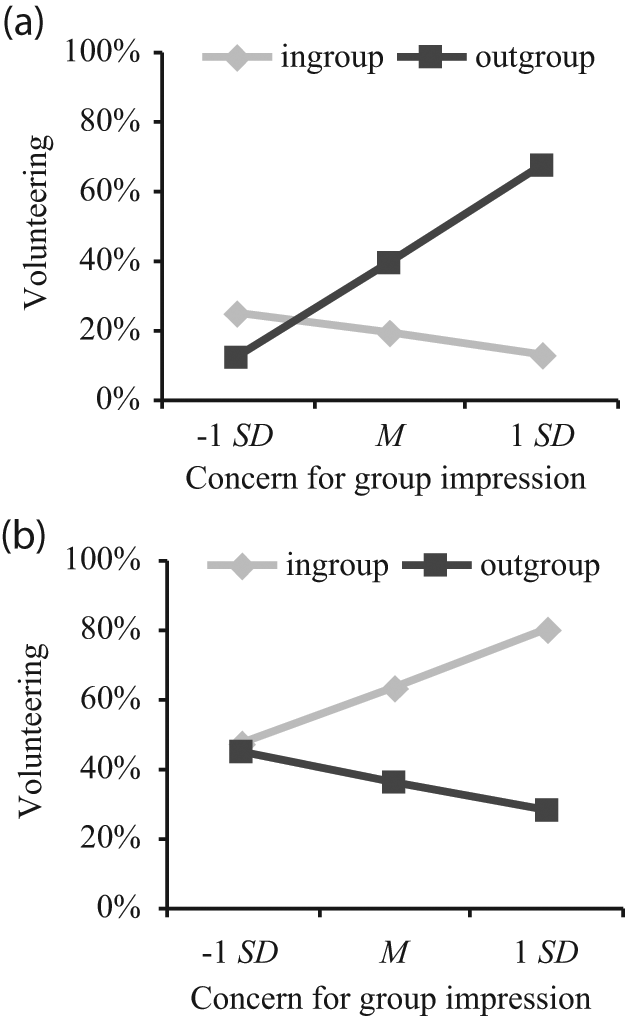
(a) Relationship between concern for group impression (CGI) and helping in the metastereotype condition, Study 2, (b) Relationship between concern for group impression (CGI) and helping in the control condition, Study 2
Discussion
The results from this second study provide unequivocal support for the conclusion that metastereotype refutation through outgroup helping was driven by the motivation to make a good impression of the ingroup, rather than of the self. Participants’ concerns about what others think of them personally did not affect helping in any of the conditions, but their concerns about what others think of their ingroup did. Importantly, CGI was a positive predictor of helping only when the metastereotype was activated and only when the target of help was an outgroup member. Hopkins and colleagues (2007) found that a salient metastereotype promoted outgroup helping but not ingroup helping. The results from the current study replicate this finding and extend it by demonstrating that this effect was driven by concerns about the image of the ingroup.
The study further revealed that participants in the metastereotype condition were more willing to help an outgroup member compared with an ingroup member, whereas participants in the control condition were more willing to help an ingroup member than an outgroup member. Although the interaction was only marginally significant, this may be attributed to low statistical power as a result of the many predictors in the analysis. When CGI and CPI are left out of the analysis, the interaction between metastereotype activation and target group did reach traditional levels of significance, χ2 = 4.42, B = −2.02, p < .05. What is interesting about the observed interaction pattern is the fact that the control condition showed evidence of an ingroup favoring bias, which is in line with existing research (e.g., Bilewicz, 2009; Gaertner, Dovidio, & Johnson, 1982; Hendren & Blank, 2009; Levine, Prosser, Evans, & Reicher, 2005). However, when the metastereotype was activated, the pattern reversed in favor of the outgroup. This suggests that impression management motives may be a powerful tool to fight ingroup favoritism in helping.
Unexpectedly, participants in the metastereotype condition were, overall, less willing to volunteer for a second questionnaire than participants in the control condition. It is possible that the way in which the metastereotype was manipulated in this study suppressed the overall tendency to help, regardless of the target of help (ingroup or outgroup). When confronted with a specific image of the ingroup, as in Study 1, participants do not need to think too much about this stereotype—All they need to do is decide whether the image is accurate and whether refutation is feasible and desirable. However, participants in the second study were asked to think actively about how students in their part of the country were viewed by students from the North. This could have activated the stereotyping process as much as the content of the stereotype itself. That is, actively thinking about how one’s group is viewed by another group may have lead participants to feel stereotyped. Feeling stereotyped can cause a depletion of self-control resources, that is, ego depletion (Inzlicht, McKay, & Aronson, 2006). Indeed, Carr and Steele (2010) found that women who felt stereotyped reported higher levels of ego depletion, and this in turn affected their decision making. Baumeister, Vohs, and Tice (2007) argued that ego depletion results in a reduction of behaviors that require self-regulatory resources and cause exhaustion. As a result, participants in the metastereotype condition in our study may simply have had less energy and motivation to volunteer for a second, lengthy and uninteresting, questionnaire. This study did not contain direct measures that allow us to test this explanation. However, research has shown that the effects of ego depletion can be overcome given sufficient motivation to achieve a certain goal (Muraven & Slessareva, 2003). In our study, the degree to which participants were concerned about the impression that others have of their ingroup can be construed as such a motivation. This concern about the ingroup’s image was positively related to outgroup helping in the metastereotype condition, suggesting that, when motivated enough, participants can regain control over their self-regulatory resources and engage in behaviors that are required to create a more positive group impression.
It is also possible that the active production of metastereotypic traits led participants to simultaneously consider how they themselves view other ingroup members. That is, thinking about how another group views the ingroup can focus group members on existing ingroup flaws—negative traits that are part of the autostereotype. This could reduce their liking for fellow ingroup members, which might explain why ingroup helping was significantly attenuated in comparison to the control condition when participants thought about the metastereotype. Indeed, metastereotypes are closely linked with autostereotypes, and previous research has shown that activation of one of these can activate the other (Gordijn, 2010). In the next study, we compared activated autostereotypes with activated metastereotypes to investigate their separate effects on outgroup helping.
Study 3
Thus far, results from two studies side with existing research (Hopkins et al., 2007) in demonstrating that the confrontation with, or activation of, a negative metastereotype caused participants to become increasingly helpful toward a member of the outgroup. Central to our hypothesis and that of Hopkins et al. (2007) is the notion that group members are refuting a negative metastereotype—In other words, the negative valence of the metastereotype is assumed to drive the effect. Because this assumption has never been empirically tested, the current study was designed to examine the role of metastereotype valence on outgroup helping in more detail. We need to consider the alternative that it is not the negative valence of the metastereotype per se but the activation of a metastereotype in and of itself that promotes outgroup helping, simply because it stimulates group members to think about how their group is perceived by others. Merely thinking about how the ingroup is viewed by others can be sufficient to trigger image concerns (Branscombe, 1998; Klein & Azzi, 2001). If not valence but activation itself is driving the effect of metastereotypes on outgroup helping, then positive metastereotypes may be equally likely to promote outgroup helping—possibly even more so because they should not evoke hostility and avoidance as negative metastereotypes could (Vorauer et al., 1998). We therefore compared helping in response to a negative metastereotype with helping in response to a positive metastereotype, to test the prediction that metastereotypes trigger outgroup helping not in spite of but exactly because of their negative valence. We expected that participants would be more willing to help an outgroup member after confrontation with a negative metastereotype than after confrontation with a positive metastereotype (Hypothesis 1).
As in the second study, a measure of CGI was included as a possible moderator. If group members are indeed trying to refute a negative metastereotype, as opposed to making a good impression in general, then CGI should predict outgroup helping in response to a negative metastereotype, but not in response to a positive metastereotype. Participants’ concern about the impression others have of their ingroup was therefore expected to be positively related to outgroup helping in the negative metastereotype condition, but not in any of the other conditions (Hypothesis 2).
The study also included a comparison with an activated (positive or negative) autostereotype—that is, the stereotype people believe other ingroup members have of the ingroup. This comparison allows for a further examination of the hypothesis that outgroup helping is used as a tool to refute a negative metastereotype, as opposed to a means of denying that the negative stereotype applies to participants as individuals. If denial of the self-relevance of a stereotype plays a role in outgroup helping, then this role should also be evident when people are confronted with a negative stereotype that other ingroup members have of their ingroup. That is, people who are trying to demonstrate that a negative stereotype does not apply to them personally may respond in a similar way to a negative autostereotype as to a negative metastereotype. However, we reasoned that negative metastereotypes increase outgroup helping mainly because people are refuting the negative metastereotype, as opposed to denying its self-relevance. We therefore predicted that more outgroup helping should be observed in the negative metastereotype condition compared with the negative autostereotype condition (Hypothesis 3).
Method
Participants and design
A total of 87 students from the VU University Amsterdam (26 men, 61 women, M age = 21, SD = 4.77) participated in this study for which they received monetary compensation. Participants were randomly distributed across the four cells of a 2 (stereotype: metastereotype vs. autostereotype)× 2 (valence: positive vs. negative) between-participants experimental design.
Procedure
The procedure was similar to that of the second study, with a few exceptions. Instead of listing traits, all participants were presented with an article on cultural differences between students from different regions in the country, which had ostensibly appeared in a student newspaper. The article described the results of a survey among 2,000 students in different parts of the country, in which they were asked to rate other students on various traits. In the metastereotype conditions, the article described how students from different parts of the country viewed each other. The article concluded that the West was viewed most positively/negatively, compared with other regions of the country (depending on valence). More importantly, these positive/negative judgments of students in the West were especially pronounced among students in the East. Students from the East of the Netherlands apparently viewed students in the West as most “kind/unkind,” very “easy/difficult to get along with” and “open-/narrow minded” (depending on valence). In the autostereotype conditions, the article described how students viewed other students in the same part of the country. The article concluded that students in the West, compared with other regions, viewed each other most positively/negatively (depending on valence), using the same positive or negative descriptions as in the metastereotype conditions.
After reading the article, participants received instructions about the students-for-students platform. The request to complete a second questionnaire ostensibly came from a student from the East (=outgroup). After completion of the questionnaire(s), participants were asked to answer a number of questions. CGI was assessed with the same three items as in the second study, plus two additional items (“I can’t stand it when others speak negatively about students in the West” and “It doesn’t interest me at all what others think about students in the West” (reverse coded); α = .87). 5 On completion, participants were probed for suspicion (none of them was aware of the true nature of the experiment), paid, thanked, and debriefed.
Results
Participants’ willingness to volunteer completing a second questionnaire was analyzed in a binary logistic regression analysis with CGI (transformed to z scores), stereotype, group (both dummy coded), and all interaction effects as predictors. The equation was significant, R2 = .32, χ2(7) = 23.78, p < .01. The analysis revealed a main effect of valence, χ2 = 6.20, B = 2.15, p < .05, which was qualified by the interaction between valence and stereotype, χ2 = 3.94, B = −2.25, p < .05. Simple slope analysis showed that, as expected in Hypothesis 1, participants in the negative metastereotype condition helped the outgroup student more (65%) than participants in the positive metastereotype condition (24%; χ2 = 6.20, B = 2.15, p < .05). Also as predicted (in Hypothesis 3), participants in the negative metastereotype condition helped the outgroup student more than participants in the negative autostereotype condition (32%; χ2 = 4.36, B = −1.55, p < .05). The positive autostereotype condition (33%) did not differ from the negative autostereotype condition or the positive metastereotype condition (χ2s < 1).
The analysis further revealed an interaction between CGI and valence, χ2 = 8.63, B = 3.25, p < .01, which was qualified by the three-way interaction, χ2 = 4.82, B = −1.44, p < .05. The slopes are presented in Figures 3a and 3b. CGI was positively related to volunteering in the negative metastereotype condition, χ2 = 5.38, B = 1.63, p < .05, marginally significantly negatively related to volunteering in the positive metastereotype condition, χ2 = 3.59, B = −1.62, p = .06, and unrelated to volunteering in either of the autostereotype conditions, χ2s < 1. These findings confirm Hypothesis 2 in demonstrating that participants’ concern about the impression others have of their ingroup leads to more outgroup helping in response to an activated negative metastereotype, but not in response to a positive metastereotype or a positive or negative autostereotype.
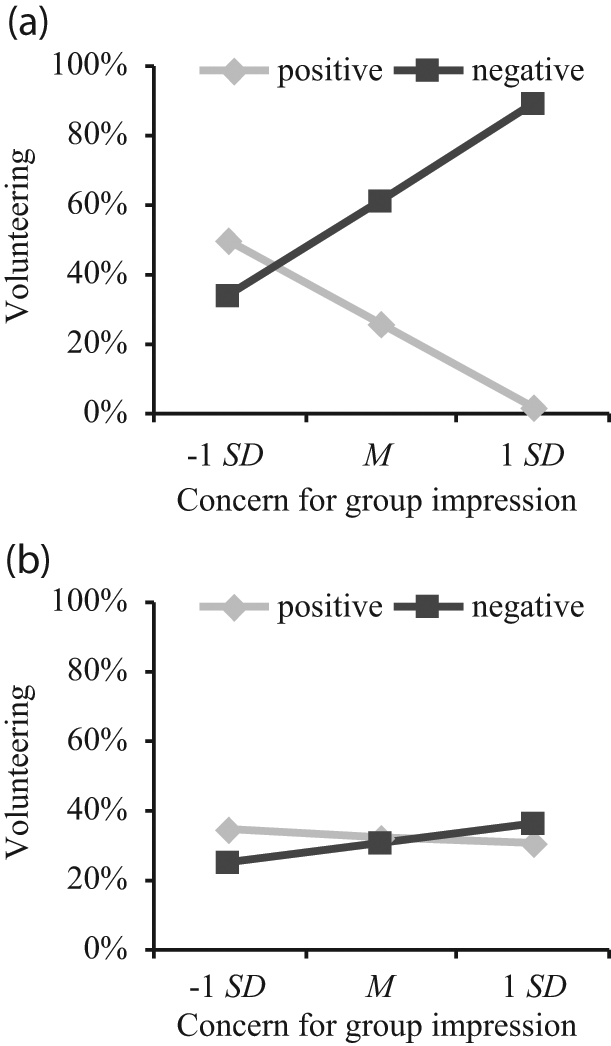
(a) Relationship between concern for group impression (CGI) and helping in the metastereotype condition, Study 3, (b) Relationship between concern for group impression (CGI) and helping in the autostereotype condition, Study 3
Discussion
As expected, participants in the negative metastereotype condition were more willing to help an outgroup member than participants in the positive metastereotype condition, and this effect was stronger among those who were highly concerned about the impression others have of their ingroup. The negative relationship between CGI and volunteering in the positive metastereotype condition, although unpredicted and only marginally significant, is nonetheless in line with our reasoning that outgroup helping is used as a tool to refute a negative group image: When this image is positive, people high in CGI, compared with people low in CGI, lose their motivation to help the outgroup. Together, these results show that it is not metastereotype activation in and of itself but specifically the negative undertone of the metastereotype that triggers outgroup helping.
The data from this study also demonstrated that outgroup helping was triggered by the negative metastereotype, but not by the negative autostereotype. This observation is important because it provides further experimental evidence that participants were not merely denying that the negative stereotype applied to them personally, through behaving in a stereotype-inconsistent manner. von Hippel and colleagues (2005) found that people who were concerned with impression management coped with negative stereotyping through denying the self-relevance of the stereotype. If our participants were engaged in a similar strategy, the negative autostereotype would have triggered a similar behavioral response as the negative metastereotype. The fact that it did not provides clear evidence in favor of outgroup helping as a tool to refute negative metastereotypes and communicate a more positive impression of the ingroup.
General Discussion
As noted by Stürmer and Snyder (2010) in their introduction to The Psychology of Prosocial Behavior, there is a surprising lack of research in the domain of helping that takes into account the intergroup nature of helping relationships. This is particularly noteworthy because many helping interactions do contain an intergroup component, for example, international aid, poverty reduction programs, or instrumental support to members of another department in an organization. Recent attempts to fill this void have demonstrated that the motives for outgroup helping are often very different from ingroup helping. Outgroup helping in particular tends to be driven by various strategic motives (Hopkins et al., 2007; Nadler & Halabi, 2006; van Leeuwen & Täuber, 2010), aimed at preserving or restoring positive intergroup distinctiveness. One such strategic motive is the wish to refute negative metastereotypes by presenting the ingroup, through helping, in a more positive light.
This notion was first investigated by Hopkins and colleagues (2007), who demonstrated that negative metastereotypes increase helping. The current article builds on this research by investigating the hypothesis that outgroup helping in response to a negative metastereotype is used as a means of communication, with the aim of informing the outgroup that their negative view of the ingroup is incorrect. We argued in the general introduction of this article that it was important to demonstrate the communicative nature of outgroup helping with respect to direct helping—that is, helping directed toward members of the outgroup believed to hold the negative stereotypic view of the ingroup. Data from three studies provided unequivocal support for the communicative nature of direct outgroup helping by demonstrating that an activated negative metastereotype resulted in a greater willingness to help members of the threatening outgroup. More importantly, outgroup helping in response to a negative metastereotype was predicted by participants’ concern for the image of the group (Studies 2 and 3), or the degree to which “warmth” was viewed as a quality of the ingroup (Study 1). Of equal importance are the observations that participants’ concern about their personal image was unrelated to outgroup helping (Study 2), that neither metastereotype activation nor CGI predicted ingroup helping (Study 2), and that outgroup helping was not affected by the activation of a negative autostereotype (Study 3). This demonstrates that the observed increase in outgroup helping after metastereotype activation cannot be attributed to a motivation to deny the self-relevance of the metastereotype (cf., von Hippel et al., 2003).
The current research is the first to demonstrate that the confrontation with another group’s negative view of the ingroup results in a greater willingness to help that particular outgroup. This observation is important because previous research has shown that feeling stereotyped can depress the willingness to seek outgroup help (van Leeuwen et al., 2011). At first glance, this seems at odds with the current finding that negative stereotyping promotes the willingness to provide outgroup help. However, these responses are in fact demonstrations of the motivation to make a good impression of the ingroup. The provision of help can serve to portray the ingroup as warm and competent (Hopkins et al., 2007; van Leeuwen & Täuber, 2011). Seeking help, however, is often associated with dependency and incompetence (Nadler & Halabi, 2006). In the context of help seeking, the motivation to make a good impression may thus be translated into help avoidance to prevent creating or confirming a negative impression of the ingroup as incompetent or dependent.
When confronted with another group’s negative view of the ingroup, people may feel criticized by this group. Research on the intergroup sensitivity effect has shown that people generally respond more defensively to criticism made by outsiders than criticism made by an ingroup source (Hornsey, 2005; Hornsey & Imani, 2004). An important reason behind this effect is the fact that outgroup critics are seen to have different motives than ingroup critics (Hornsey & Imani, 2004). Whereas the motives of ingroup critics are often interpreted as constructive, outgroup critics are more often attributed destructive motives such as attempts to assert intergroup superiority. However, recent research has demonstrated that outgroup criticism, too, can result in actions intended to reform the group. These actions are driven by concerns for the group’s public image. Rabinovich and Morton (2010) showed that outgroup criticism can stimulate positive behavior (i.e., recycling) when people believe their responses will be witnessed by an outgroup audience. This finding is consistent with the data presented in the current article (in particular Study 1 and Study 3) in demonstrating that the strategic motive to protect the public image of the ingroup can help overcome possible defensive reactions to outgroup criticism.
The collective motivation to refute negative metastereotypes through outgroup helping can, in fact, be driven by two processes. First, group members may be refuting the negative valence of the stereotype—This is commonly referred to as collective self-enhancement and is the process that underlies our hypothesis regarding the effect of metastereotype activation on outgroup helping. Second, group members may try to correct what they perceive as an inaccurate view of their ingroup—be it positive or negative. These collective self-verification motives (Chen, Chen, & Shaw, 2004) often yield similar outcomes, as people generally have a more positive view of their ingroup than (they believe that) others have of their group. However, future research might explore the distinct operation of these two processes in more detail. For example, one might investigate to what extent the confrontation with an inaccurate positive metastereotype (i.e., a stereotype depicting the ingroup as extremely helpful) could cause group members to become less helpful to paint a more accurate picture of their ingroup. In the third study of our article, we confronted participants with either a positive or a negative metastereotype and observed that outgroup helping was higher in the latter condition than in the former. This finding in fact is in line with both a collective self-enhancement motivation (i.e., participants in the metastereotype condition tried to refute the negative image) and a collective self-verification motivation (i.e., participants in the metastereotype condition became more helpful, and those in the positive metastereotype condition became less helpful, to create a more accurate image). Future research should therefore attempt to disentangle these two motives and their effects on outgroup helping.
Future research should also investigate conditions under which negative metastereotypes do not result in collective refutation through increased helpfulness or generosity. The notion that negative metastereotypes promote direct outgroup helping seems counterintuitive, as people are essentially bestowing favors on a group that has a negative view of their ingroup. And yet, the current studies have shown that this is exactly what people do. However, we do believe that there are limits to this behavior. Direct outgroup helping to refute a negative metastereotype may be more likely to occur in situations where the metastereotype is only moderately negative, and subject to change. That is, people should still believe it is possible to modify the (presumed) negative stereotype that the outgroup has of the ingroup through acts of kindness directed toward the outgroup. The existing relation with the outgroup likely also plays an important role. When groups have a long history of intergroup conflict, outgroup helping may not be interpreted as an act of kindness, but instead as a means of asserting social dominance (cf., Nadler, Harpaz-Gorodeisky, & Ben-David, 2009). Moreover, in times of conflict, groups may want to present themselves as competent rather than friendly to their enemies. Because warmth and competence tend to be negatively correlated in group perceptions (Fiske et al., 2007), they should avoid behavior that can be interpreted as friendly. The strategic use of helping to communicate ingroup warmth may therefore be limited to intergroup settings that are not extremely negative or hostile (although future research should test this assumption).
Footnotes
The author(s) declared no potential conflicts of interest with respect to the research, authorship, and/or publication of this article.
The author(s) disclosed receipt of the following financial support for the research, authorship, and/or publication of this article: Part of this research was facilitated by an innovation grant VENI (Grant 451-02-030) from the Netherlands Organization for Scientific Research.