







Abstract
Because of the increased cognitive resources required to process negations, past research has shown that explicit attitude measures are more sensitive to negations than implicit attitude measures. The current work demonstrated that the differential impact of negations on implicit and explicit attitude measures was moderated by (a) the extent to which the negation was made salient and (b) the amount of cognitive resources available during attitude formation. When negations were less visually salient, explicit but not implicit attitude measures reflected the intended valence of the negations. When negations were more visually salient, both explicit and implicit attitude measures reflected the intended valence of the negations, but only when perceivers had ample cognitive resources during encoding. Competing models of negation processing, schema-plus-tag and fusion, were examined to determine how negation salience impacts the processing of negations.
Negating information is a common occurrence in our communications with others (Clark & Clark, 1977). We often describe a target person to others in negated terms (e.g., Nancy is not a warm person), and we expect our conversation partners to understand what we mean by such a statement (Nancy is cold). Experientially, it may seem that people are equally efficient at understanding negations (e.g., Nancy is not a warm person) as they are affirmations (e.g., Nancy is a cold person.). However, this does not seem to be the way that people’s mental systems operate (Gilbert, 1991). Past research has repeatedly demonstrated that people have difficulty processing negations as efficiently as affirmations (e.g., Mayo, Schul, & Burnstein, 2004).
When negations are not successfully encoded into or retrieved from memory, erroneous beliefs in the opposite direction of the negation can be held and expressed (e.g., Clark & Chase, 1972; Gilbert, 1991; MacDonald & Just, 1989; Mayo et al., 2004). For instance, if the negation “not warm” or the opposing trait “cold” does not become associated with Nancy in memory such that one of these representations is retrieved when thinking about her, people will likely erroneously come to believe that Nancy is a warm person. This ironic consequence of negation failure may occur for several reasons: The core of the message may not become associated with the negation (instead of “Nancy” and “not warm” or “cold” becoming linked in memory, only “Nancy” and “warm” are linked) or the constructs presented with the negation are only weakly linked to the negation (“warm” is more accessible in memory when “Nancy” is presented than “not warm” or “cold”).
Two Models of Negation Processing
Negation encoding difficulties have been explained in terms of two models that propose different ways in which negations are processed and stored in memory: the schema-plus-tag model and the fusion model. The schema-plus-tag model of negation assumes that core concepts (e.g., “warm”) and their negations (e.g., “not”) are represented separately in memory (e.g., the representation of a person described as “not warm” would consist of three separate concepts: the person, “warm,” and “not”); therefore, they can become dissociated from one another. This model also presupposes that the core concept, not the negation, is the focus of attention during processing and may even be the first piece of information to be processed (Carpenter & Just, 1975). This model, therefore, posits that the association between the target and the core concept is activated first, leading to a stronger association between the target and the core concept than between the target and the negation. Conversely, in the fusion model of negation, the negation and its core concept are successfully fused such that the correct meaning of the negation (e.g., “cold”) is stored in memory during encoding, and the core concept and its negation, therefore, are unlikely to become dissociated over time (e.g., Mayo et al., 2004). This model further suggests that negation processing can inhibit the activation of constructs involved with the core concept (e.g., “warm”) and increase the activation of constructs consistent with the outcome of the fusion process (i.e., the transformed representation that correctly reflects the negation [e.g., “cold”]; MacDonald & Just, 1989).
Recent research has explored the circumstances under which negation processing is explained by each model (e.g., Mayo et al., 2004). This past research demonstrates that a schema-plus-tag model provides a better explanation for negation processing when a negation-congruent schema does not already exist, while a fusion model can best explain how negations are processed when a negation-congruent schema does exist in memory. More specifically, when to-be-negated information did not have an obvious opposite (e.g., “adventurous” or “honest”; unipolar descriptions) or when this information was uninformative when negated (e.g., when the meaning of an obscure word is negated; “a tica is not a fox”), the negation was less likely to be integrated into and more likely to be tagged to the representation of the core concept in memory (e.g., Gilbert, Trafarodi, & Malone, 1993; Mayo et al., 2004). Evidence in favor of a schema-plus-tag model under these circumstances was found with reaction time data because response latencies were shorter for negation-incongruent associations than negation-congruent associations and with memory data as the negation tags were more likely to become dissociated from unipolar descriptions, thereby leading to negation failures (Mayo et al., 2004).
However, when the to-be-negated information had an obvious opposite (e.g., “warm” and “cold”; bipolar descriptions) or when this information was still meaningful when negated (e.g., describing a person as cold is informative), the negation was more likely to be integrated into the representation of the core concept in memory (i.e., becomes “fused” together; Hasson, Simmons, & Todorov, 2005; Mayo et al., 2004). Mayo et al. (2004) found evidence for this integration with reaction time data showing longer response latencies for negation-incongruent associations and shorter response latencies for negation-congruent associations. They also found greater recall of the correctly negated information (i.e., recalling the opposite of a negated description) when bipolar descriptions were used.
Negation Processing and Salience
Negation processing models have almost exclusively examined how the content of the presented information determines how negations are processed and whether this processing is successful in reflecting the true meaning of the presented information. However, there are likely other dimensions that lead to differences in how negations are processed. One such dimension could be how the to-be-negated information is visually presented. Specifically, the salience of the negation during the encoding of information could impact whether the negation is processed following the schema-plus-tag or fusion model. To the extent that negations are made highly salient (i.e., especially visually noticeable), they should more likely be encoded and be more likely to affect perceptions of individuals or attitude objects. Highly salient negations could lead the core concept (e.g., “warm” in the negation “not warm”) to be quickly transformed into its intended meaning by processing the negation (“cold”), while less salient negations are less likely to be encoded into memory in this fused form. Thus, we expect that highly salient negations will prompt the processing of negations in line with the fusion model, and less salient negations will prompt the processing of negations in line with the schema-plus-tag model.
Several studies provide suggestive evidence for these predictions. First, manipulations that decrease attention allocated to the core concept and the negation reduce the likelihood of successful negation. For example, Gilbert et al. (1993) had participants form a positive or negative evaluation of a target person and later presented participants with differing amounts of false-positive and false-negative behavioral information about the target; participants were asked either to assess the validity of this information (assessment trials) or to read this information as quickly as possible (comprehension trials). For the assessment trials, the valence of the false information did not impact attitudes toward the target person; however, the valence of the false information presented on comprehension trials did impact attitudes toward the target. Thus, careful consideration of the information presented in the assessment trials led to greater encoding and successful negation of false information, while promoting reading speed on the comprehension trials reduced encoding and led to difficulty negating false information.
Second, although there is usually no explicit rationale given for when or how negations are presented in past work, many studies of negation processing present the negation either with or immediately after the presentation of the core concept. Delaying the presentation of the negation should inhibit the integration of the negation and the core concept during encoding and thus increase the likelihood of negation failure. Peters and Gawronski (2011, Experiment 3) included a long-delay condition (in addition to a more typical short-delay condition) and found that a long delay between the to-be-negated information and the negation reduced the impact of the negation on an implicit attitude measure, although explicit evaluations did correctly reflect the presented negation. Presumably, this difference between implicit and explicit attitude measures reflects a stronger association in memory between the attitude object and the valence of the core concept than the attitude object and the negation, which is captured on the implicit measure; however, the correct utilization of the subsequently presented negation (i.e., the negation is accessed from memory and applied) is better reflected on the explicit measure (Petty, Briñol, & DeMarree, 2007). Thus, a long delay likely leads to negation processing in line with the schema-plus-tag model. Combining these findings with those of the studies that vary the attention paid to the negation, it seems quite possible that visual salience could impact the level of encoding and, thereby, the model that best exemplifies the way that negations are processed.
Negation Processing and Implicit Attitude Measures
As this past research suggests, adequately encoded negations impact explicit measures regardless of how they were originally processed and are stored in memory. Specifically, responses on explicit attitude measures may always be explained by either the successful fusion of a negation and the core concept during encoding or the application of the negation to the core concept during responding (e.g., DeCoster, Banner, Smith, & Semin, 2006; Deutsch, Gawronski, & Strack, 2006; Peters & Gawronski, 2011; Petty et al., 2007). Therefore, providing evidence consistent with using one of these two negation processing models can be difficult when using only explicit attitude measures; our ability to distinguish between these two models should be greater when using implicit attitude measures.
Although several experiments have shown that implicit attitude measures are insensitive to negation (DeCoster et al., 2006; Deutsch et al., 2006), there is evidence that implicit attitude measures can be sensitive to negations when ample cognitive resources are available (Deutsch, Kordts-Freudinger, Gawronski, & Strack, 2009) and when negations are consistently repeated (Deutsch et al., 2006). Thus, this latter finding suggests that how negations are processed and the extent to which they affect evaluations on implicit attitude measures may depend on how salient the negations are during the encoding of evaluation-relevant information. Highly salient negations may be more likely to lead to fusion of the negation and the core concept, whereas less salient negation may be more likely to lead to the negation and the core concept being stored separately in memory; these differences should be better captured on implicit than explicit attitude measures.
Overview of the Current Work
In four experiments, we examined how the salience of negations at encoding determines how negations are represented in memory and associated with an attitude object, thereby affecting implicit and explicit attitude measures. Specifically, we investigated the role of negation salience during the encoding of information about a novel individual during attitude formation. We expected that highly salient negations would be more likely than less salient negations to lead to evaluations that correctly reflect the intended meaning of negations on implicit attitude measures, whereas the intended meaning of negations should be reflected on explicit attitude measures regardless of the salience of the negation.
Considering that past research has shown that people’s ability to successfully use negations on implicit and explicit attitude measures is resource dependent (e.g., Deutsch et al., 2009; Gilbert et al., 1993), Experiment 2 examined whether ample resources were necessary to obtain evaluations on an implicit measure that reflected the intended meaning of highly salient negations. Consistent with past research, we predicted that increasing the salience of negations would impact evaluations assessed by an implicit attitude measure only when people were not experiencing cognitive load. Presumably, transformation or fusion of the presented information and its storage into memory requires some level of cognitive resources. Although a highly salient negation may lead to more efficient processing of the negation, the operation of negation itself (e.g., mentally reversing the meaning of “not warm” to “cold”) may still be dependent on cognitive resources.
A third goal of this work was to examine the processes that underlie how mental representations are stored in memory when negations differ in salience. More specifically, in Experiments 3 and 4, we were interested in comparing the two models’ predictions for the associations made more or less accessible during the negation of presented information. Highly salient negations could increase the amount of attention paid to both the negation and its core concept and, consistent with a fusion model, may facilitate the integration of the core concept and the negation. As for less salient negations, we expected attention to be paid more to the core concept, and as a consequence, negations would more likely be just associated with the core concept instead of fused with it, in line with the schema-plus-tag model. Thus, in Experiments 3 and 4, we tested whether varying negation salience could provide evidence consistent with different models of negation on reaction time tasks.
Experiment 1
In Experiment 1, we wanted to provide initial evidence that negation salience can impact how attitude-relevant information is stored in memory. We had participants form attitudes toward a novel target individual (Bob) by receiving behavioral information about him and then receiving feedback about whether the behavioral information was valid or invalid (Rydell & McConnell, 2006). During attitude formation, we varied three factors between-subjects: the valence of the behavioral information (positive or negative), the negation of the information (feedback indicating that the behavioral information was true [i.e., it should be accepted] or false [i.e., it should be negated]), and the salience of the feedback (feedback was presented in smaller font [less salient] or larger font [highly salient]). After the attitude formation task, participants completed implicit and explicit measures assessing their attitudes toward Bob.
We predicted that highly salient negations would lead to a fusion of the negation and the core concept during encoding and to the storage of this fused information in memory, whereas less salient negations would lead to the negation and the core concept being stored separately in memory. Therefore, we expected that less salient negations would lead to evaluations on implicit attitude measures that are consistent with the valence of the behavioral information presented, whereas highly salient negations should lead to evaluations of implicit attitude measures that are opposite in valence to the behavioral information presented (i.e., negative, negated behaviors should lead to positive implicit evaluations, but positive, negated information should lead to negative implicit evaluations). When the behavioral information is affirmed (i.e., feedback indicates it should be accepted), we expected that evaluations on implicit attitude measures would be consistent with the valence of the behavioral information presented regardless of salience.
In addition, we expected that explicit attitude measures would be sensitive to negation (e.g., Deutsch et al., 2006). Thus, we predicted that the explicit attitude measures should correctly reflect the valence of the information and the feedback about the validity of that information, regardless of the salience of the feedback. Specifically, when behaviors related to Bob are affirmed, the explicit attitude measure should reflect the valence of the behavioral information presented; however, when behaviors related to Bob are negated, the explicit attitude measure should incorporate the negation and reflect the opposite valence of the behavioral information presented.
Method
Participants and Design
A total of 184 undergraduates participated to fulfill a course requirement. Participants were randomly assigned to a 2 (valence of behavior: positive, negative) × 2 (negation: affirmation, negation) × 2 (feedback salience: less salient, highly salient) between-subjects factorial design. Due to a programming error, the first 20 participants were assigned to the less salient condition, with random assignment thereafter. Due to this error, there were 102 participants in the less salient condition and 82 participants in the highly salient condition.
Procedure
Participants completed the learning task on a computer; they were told that they would be receiving information about and should form an impression of a person named Bob (see Rydell & McConnell, 2006). Participants read 50 behaviors that Bob might have performed while his picture was presented onscreen directly above each behavior. After reading each behavior, participants indicated whether they believed that the behavior was characteristic or uncharacteristic of Bob by pressing the “c” (characteristic) or the “u” (uncharacteristic) key. After they responded, participants were given feedback for 5 s; this feedback consisted of two components: whether their judgment was correct and whether the behavior statement about Bob was affirmed or should be negated.
Manipulation of valence of behavior
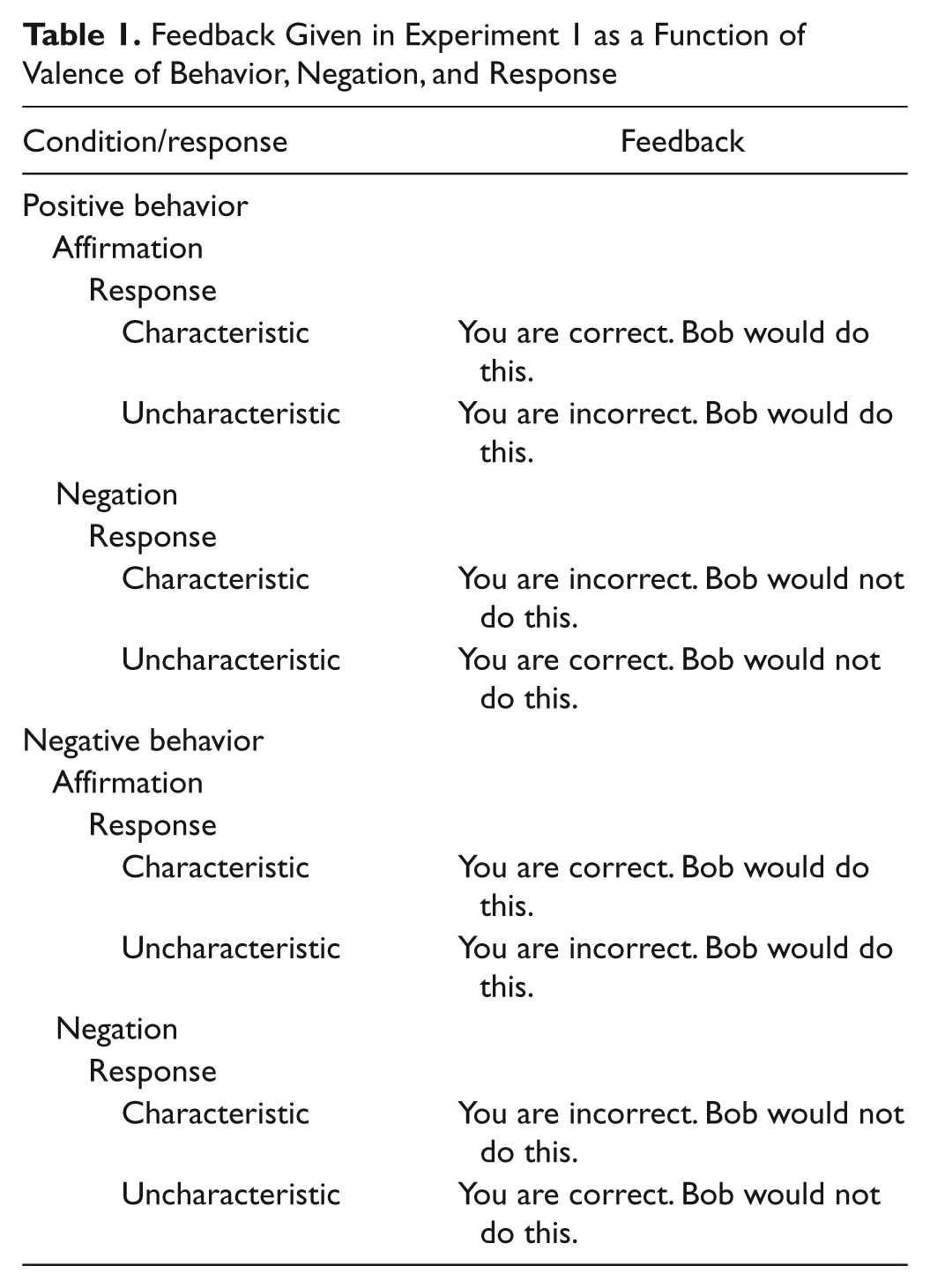
Participants either received 50 positive or 50 negative behaviors ostensibly performed by Bob (Rydell & McConnell, 2006). Regardless of condition, participants had to respond to each behavior by indicating whether it was characteristic or uncharacteristic of Bob. Immediately after making this judgment, participants were told either that “You are correct” or “You are incorrect.” This feedback was presented so that participants learned whether Bob was positive (positive behaviors characteristic or negative behaviors uncharacteristic) or negative (positive behaviors uncharacteristic or negative behaviors characteristic).
Manipulation of negation
The feedback given to participants after making uncharacteristic/characteristic judgments also contained the negation manipulation. Participants were randomly assigned to receive only affirmations about the behaviors presented (i.e., “Bob would do this!”) or only negations of the behaviors presented (i.e., “Bob would not do this!”). Affirmations and negations were presented after the behavioral statements (instead of simultaneously) because we wanted to ensure that participants in all conditions encoded the behavioral statements to the same extent. With this procedure, any differences on our attitude measures can be attributed to the differential processing of the feedback instead of how the behavioral statements were initially processed. The feedback given, as a function of valence of behavior, negation, and uncharacteristic/characteristic response, is presented in Table 1.
Feedback Given in Experiment 1 as a Function of Valence of Behavior, Negation, and Response
Manipulation of negation salience
Salience of affirmations and negations was manipulated by the size of the feedback text. Participants in the less salient condition received feedback in 24pt. Arial font, and those in the highly salient condition received feedback in 48pt. Arial font. Thus, as the font became larger, it was considered to be relatively more salient. A 24pt. font size is a typical font size presented on computers during experiments and is easy to read, so feedback presented in this font size can be understood by participants. However, a 48pt. font size is an unusually large size that should attract more attention when presented. Therefore, our manipulation of negation salience aimed to make the highly salient negations big enough to place participants’ focus on this information and not to make the less salient negations too small to notice or understand. If both levels of negation salience are noticed and understood, any differences on our attitude measures can be attributed to differential processing of the feedback (i.e., more extensive processing or encoding for the highly salient negations). 1 Although less salient negations should be easily read and encoded, their integration with the behavior statements should be less likely than with highly salient negations.
Explicit attitude measure
Participants then completed explicit and implicit attitude measures assessing their attitudes of Bob in randomized order. To measure explicit attitudes, participants judged how likable Bob was on a scale ranging from 1 (very unlikable) to 9 (very likable). In addition, they completed five semantic differential scales, each using a 9-point scale to describe Bob (e.g., good–bad, pleasant–mean), with greater scores indicating more positive explicit attitudes toward Bob (α = .97).
Implicit attitude measure
The affect misattribution procedure (AMP; Payne, Cheng, Govorun, & Stewart, 2005) was used to measure implicit evaluations of Bob. On each trial, participants were presented with a face prime for 75 ms. The face was then replaced by a blank screen for 125 ms, followed by a Chinese character for 100 ms. Immediately after seeing the Chinese character, a black-and-white pattern mask was presented, and participants indicated whether they considered the Chinese character as more pleasant or less pleasant than the average Chinese character. Participants were repeatedly instructed not to let the faces bias their judgments of the Chinese characters. The AMP consisted of 50 trials. Half of the trials used an image of Bob as the prime stimulus; the remaining half used images of four unknown males as primes. Because we were interested in attitudes toward Bob, implicit attitudes were indexed by the proportion of trials when Bob served as the prime where the presented Chinese character was judged to be more pleasant than the average Chinese character. Greater scores indicated more positive evaluations of Bob.
Results
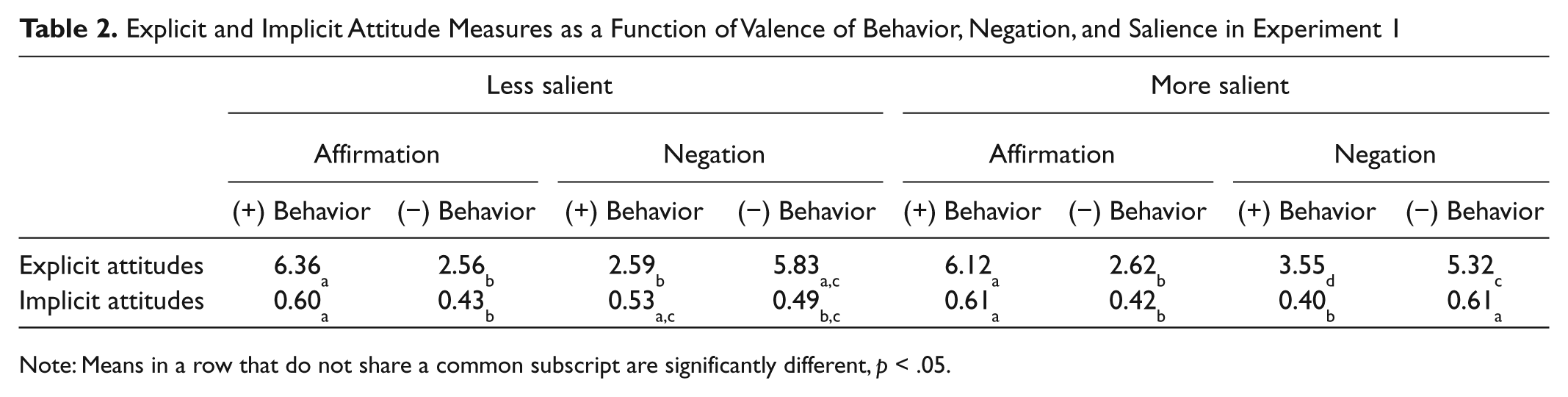
The attitude measures were examined in separate valence of behavior × negation × negation salience ANOVAs. For the explicit attitude measure, there was a significant effect of valence of behavior, F(1, 176) = 4.51, p < .04,
Explicit and Implicit Attitude Measures as a Function of Valence of Behavior, Negation, and Salience in Experiment 1
Note: Means in a row that do not share a common subscript are significantly different, p < .05.
For the implicit attitude measure, there was a significant valence of behavior by negation interaction, F(1, 176) = 19.49, p < .001,
Discussion
Experiment 1 provided initial evidence that negation salience moderates how negated information is encoded. In line with a schema-plus-tag model, when negations were less salient, an implicit attitude measure only reflected the valence of the behavioral information presented about Bob and was unaffected by feedback indicating that this information was invalid. Together with the results showing that an explicit attitude measure about Bob was highly sensitive to the presence of negations regardless of negation salience, this suggests that the negation and the valence extracted from the behavioral information were stored separately in memory. However, in line with a fusion model, when negations were highly salient, the correct valence of the information presented about Bob was detected by both explicit and implicit measures. This suggests that high negation salience led to the transformation of the behavioral information in response to the negation during encoding and the storage of this output of the fusion process in memory.
Experiment 2
In Experiment 1, highly salient negations led to evaluations on an implicit measure that were inconsistent with the valence of the behavioral information presented. We propose that this was due to the successful fusion of the negation and the core concept during encoding. However, we assume that the fusion process is resource dependent. Although Experiment 1 did not directly assess this assertion, participants likely had the time and ability to fuse the negation and the core concept when attitude-relevant information was negated with visually salient feedback. In Experiment 2, we tested this prediction by examining whether diverting cognitive resources needed to quickly reverse the meaning of the behavioral information by completing a secondary task (i.e., increasing cognitive load) would eliminate the impact of highly salient negations on implicit measures. Considering that Deutsch et al. (2009) found that participants under cognitive load were not able to change the meaning of negated primes (e.g., “not happy”) into the correct valence intended by the negation (e.g., negative) on an implicit attitude measure, the process of negation could require ample cognitive resources to be effective, even when negations are highly salient. Therefore, we sought to examine whether the successful negation of behavioral information about Bob, as reflected on an implicit attitude measure, was resource dependent.
Accordingly, we manipulated the valence of Bob’s behavior, the salience of negations, and the amount of cognitive resources available to participants in a between-subjects design. We expected to replicate the negation condition of Experiment 1 when cognitive resources were not taxed. When participants had ample cognitive resources, we expected that highly salient negations would lead to fusion of the negation and the core concept, and implicit evaluations reflecting the intended meaning of the negation, while less salient negations would lead to the separate storage of the negation and the core concept, and implicit evaluations that reflected the valence of the behavioral information. Conversely, when people had reduced cognitive resources, we expected that negations, even when highly salient, would not affect implicit evaluations. In addition, we expected an explicit attitude measure to correctly reflect the valence of the negation regardless of negation salience or cognitive resources.
Method
Participants and Design
A total of 221 undergraduates participated to fulfill a course requirement. Participants were randomly assigned to a 2 (valence of behavior: positive, negative) × 2 (feedback salience: less salient, highly salient) × 2 (distraction: no distraction, distraction) between-subjects factorial.
Procedure
Three aspects of the attitude learning paradigm from Experiment 1 were modified in Experiment 2. First, only the negation condition was used. This change was implemented because we were interested in whether the processing of negations when they were highly salient required cognitive resources. Second, no characteristic/uncharacteristic judgment was made about the behaviors presented. Participants were simply told that all of the behaviors could have been performed by Bob, but they were informed after reading each behavior that Bob would not engage in the preceding behavior. This change was made because participants in the distraction condition had to complete a secondary task.
Finally, half of the participants were randomly assigned to complete a color-naming distraction task while learning about Bob; the other half of the participants did not complete the color-naming task while learning about Bob. In the color-naming distraction task, participants were asked to indicate whether a blue or green square was randomly presented in the upper right or upper left part of the computer monitor (ensuring that participants could not predict where the square would appear) by pressing a key on the keyboard. Importantly, the colored square never obstructed Bob’s picture, the behavioral information presented about Bob, or the feedback given about Bob’s behavior (i.e., the negation information). Participants were told to indicate whether a green or blue square was presented by pressing the “g” key when a green square was present and pressing the “b” when the blue square was presented. The colored square appeared on the screen until participants made a response, but was removed if participants did not make a response in 3,000 ms. Within 1,000 ms after the colored square was removed from the screen, the next colored square was presented to participants. The colored squares appeared throughout the learning session. After the learning task, all participants completed the explicit and implicit attitude measures from Experiment 1.
Results
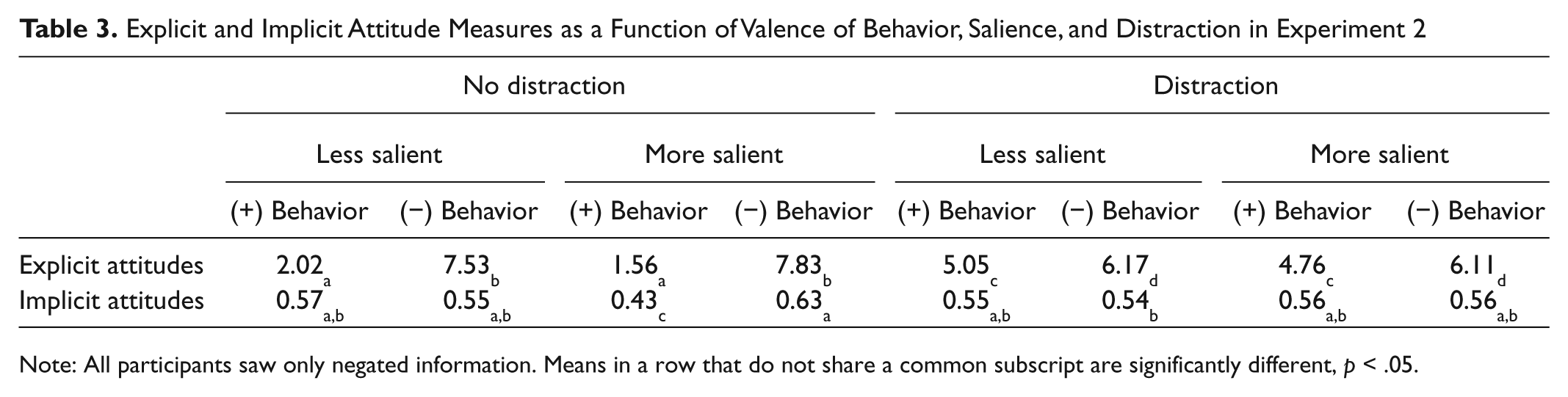
The attitude measures were examined in separate valence of behavior × negation salience × distraction ANOVAs. For the explicit attitude measure, there were significant effects of valence of behavior, F(1, 213) = 226.42, p < .001,
Explicit and Implicit Attitude Measures as a Function of Valence of Behavior, Salience, and Distraction in Experiment 2
Note: All participants saw only negated information. Means in a row that do not share a common subscript are significantly different, p < .05.
For the implicit attitude measure, the three-way interaction obtained significance, F(1, 213) = 3.80, p = .05,
Discussion
Experiment 2 showed that the effect of highly salient negations on implicit evaluations depended on the amount of cognitive resources available during encoding. When participants had ample cognitive resources and the negations were highly salient, an implicit attitude measure was sensitive to negations. When participants were distracted, there was no evidence that negation salience impacted evaluations on an implicit attitude measure. These results provide initial evidence that the fusion of the negation and the core concept when negations are highly salient require cognitive resources. The explicit attitude measure showed evidence of the negation in the no distraction and distraction conditions, even though the impact of the negation was greater in the former condition. 2 Nonetheless, showing that distraction eliminated the impact of highly salient negations on implicit attitude measures suggests that a resource-dependent process was used to integrate and later retrieve representations in Experiments 1 and 2.
Experiment 3
In Experiments 1 and 2, we demonstrated that highly salient negations increase the sensitivity of implicit measures to reflect the utilization of a negation when participants have ample cognitive resources. However, these experiments do not speak to exactly how negations impacted implicit attitude measures when they were highly salient and cognitive resources were available. Therefore, Experiment 3 sought to examine more clearly the processes through which the successful and efficient negation of behavioral information occurred in the highly salient conditions of Experiments 1 and 2 (i.e., whether highly salient negations were processed in line with the schema-plus-tag or fusion model). The two models of negation processing would make different predictions as to why highly salient negations are more likely to be incorporated in mental representations of the attitude object, and thus impact responding on an implicit attitude measure.
The schema-plus-tag model (i.e., the negation [invalidating feedback] and the core concept [behavioral information] are stored separately in memory) suggests that highly salient negations are more strongly associated with their core concepts. This may increase the coactivation of the negation and the core concept when presented with the attitude object, and perhaps this coactivation is strong enough to influence responding on an implicit measure. However, highly salient negations could, to the extent that both pieces of information capture attention during encoding, facilitate the integration of the core concept and the negation when people have the cognitive resources necessary to derive the intended meaning of the negation. This would predict, consistent with a fusion model, that highly salient negations are more likely to be fused into the mental representations themselves. We predict that highly salient negations will attract more intensive processing of the negation, and with greater consideration of the negation, we expect that the negation and the core concept will be integrated during encoding and stored in memory in this fused form. That is, we expect that attitude formation when negation salience is high is best explained by a fusion model.
In Experiment 3, we tested the models’ predictions by measuring the accessibility of negation-incongruent associations and negation-congruent associations with a lexical decision task. If highly salient negations are fused with the core of the negation and the outcome of this process is stored in memory, the negation-congruent valence should be more accessible than the negation-incongruent valence when negations are highly salient. If highly salient negations are stored separately from the core of the negation, the negation-incongruent valence should be more accessible than the negation-congruent valence. Furthermore, in this task, we sought to provide more convincing evidence for one model over the other by utilizing behaviors that implied traits without a clearly opposite schema (i.e., honest and dishonest; Mayo et al., 2004), a condition that has been shown to induce negation consistent with a schema-plus-tag model. If the negation-congruent valence is more accessible than the negation-incongruent valence when negations are highly salient and the implied traits are unipolar, this would provide stronger evidence for the fusion model of negation.
Method
Participants and Design
A total of 69 undergraduates participated to fulfill a course requirement. Participants were randomly assigned to a 2 (trait: honest, dishonest) × 2 (negation: affirmation, negation) between-subjects factorial design. We only included conditions in which feedback was highly salient because we wanted to understand how this feedback impacts evaluations on an implicit attitude measure.
Procedure
We used a modified version of the attitude learning paradigm from Experiment 1. Instead of receiving 50 behaviors, all participants received 25 behavioral statements about Bob. Participants were presented with Bob’s behaviors that implied that he was either honest (a positive trait; for example, “Bob told potential buyers all of the problems with his car.”) or dishonest (a negative trait; for example, “Bob cheated during a poker game.”), and they judged whether each behavior was characteristic or uncharacteristic of him.
Manipulation of the trait implied by the behavior
Participants received either 25 pieces of information that implied Bob was honest or 25 pieces of information that implied Bob was dishonest.
Manipulation of negation
The same negation and affirmation information used in Experiment 1 was used in Experiment 3. However, all participants received highly salient feedback.
Explicit trait rating measures
To assess explicit trait ratings, participants were asked to assess how honest and dishonest Bob was on six separate 9-point scales ranging from 1 (not at all) to 9 (extremely). The scores were averaged to give a measure of honesty (α = .95). Greater scores indicated that Bob was perceived as more honest.
Attitude measures
The implicit attitude measure from Experiment 1 was used in this experiment; explicit attitudes were indexed by a single item, the 9-point liking scale from Experiment 1.
Lexical decision task
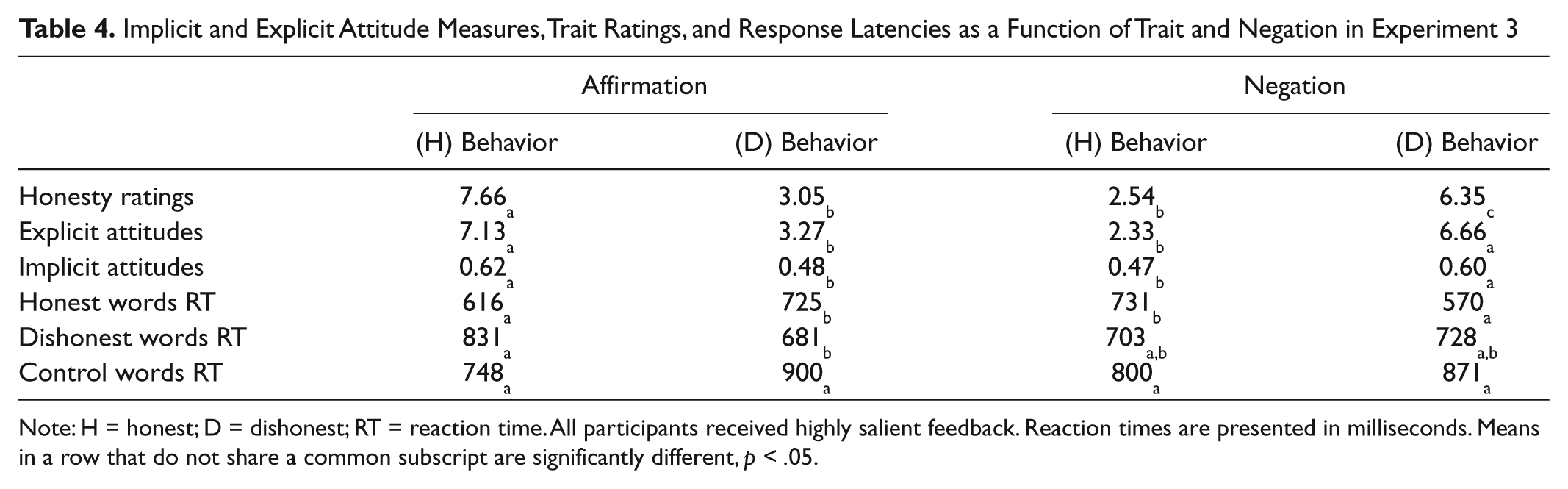
To assess the accessibility of honesty and dishonesty, participants completed a lexical decision task. In this task, after a fixation cross appeared for 1,000 ms, a letter string was presented at the center of the computer monitor. The participant indicated whether this letter string was a word or a non-word by pressing the “w” key if the string was a word or pressing the “n” key if the string was not a word. Participants were presented with 120 trials. In all, 60 of these trials contained pronounceable non-words, and 60 trials contained words. Three groups of words were presented during the task: honesty (e.g., truthful, sincere), dishonesty (e.g., deceitful, fraud), and control (e.g., grip, feather); each of these words were presented 4 times each. The response latencies for making word/non-word judgments were recorded, and the latencies for honest, dishonest, and control words were averaged separately. The response latencies were log transformed to reduce skew before being averaged and analyzed (e.g., Fazio, 1990); the untransformed mean latencies are presented in Table 4 for ease of interpretation. Shorter response latencies indicated greater accessibility of these words.
Implicit and Explicit Attitude Measures, Trait Ratings, and Response Latencies as a Function of Trait and Negation in Experiment 3
Note: H = honest; D = dishonest; RT = reaction time. All participants received highly salient feedback. Reaction times are presented in milliseconds. Means in a row that do not share a common subscript are significantly different, p < .05.
Results
Attitudes and Trait Ratings
The explicit trait ratings, explicit attitude measure, and implicit attitude measure were examined in trait by negation ANOVAs. For the explicit trait ratings, there was a significant effect of valence of behavior, F(1, 65) = 5.27, p < .03,
For the explicit attitude measure, there was only a significant two-way interaction, F(1, 65) = 64.76, p < .001,
For the implicit attitude measure, only a significant two-way interaction obtained significance, F(1, 65) = 4.99, p < .03,
Lexical Decision Task
We examined trait by negation ANOVAs for the honest, dishonest, and control words separately (see Table 4). The results for the honest words only showed a trait and negation interaction, F(1, 65) = 26.75, p < .001,
Discussion
The results from Experiment 3 show that when honest and dishonest behaviors were negated with highly salient negations, an implicit attitude measure reflected the valence intended by the negation. As in Experiments 1 and 2, we argue that this reflects the integration of the negation and the core concept during encoding. The reaction time data from this experiment offer important support for a fusion model of negation when negations are highly salient. Words that shared the same trait implied by the successful negation of the core concept (e.g., deceitful when honest statements were negated; truthful when dishonest statements were negated) were more accessible than words that did not share the same valence as implied by the correct fusion of the negation and the core concept (e.g., truthful when honest statements were negated; deceitful when dishonest statements were negated). Finding faster response latencies to words that were negation congruent than were negation incongruent for both honest and dishonest words provides support for the fusion model of negation but not the schema-plus-tag model of negation.
Experiment 4
In Experiment 4, we aimed to provide additional evidence in support of a fusion model when negations are highly salient. To do this, we introduced a memory task that gauged participants’ ability to recall the traits implied by behavioral statements about several individuals as well as the amount of time taken for correct recall. On this task, behavioral descriptions of one individual were negated with highly salient negations, and behavioral descriptions of another individual were negated with less salient negations; behavioral descriptions of two other individuals were also included in the learning phase, and this information was always affirmed. After a delay, participants were presented with pictures of the targets and several trait words that, in the case of negated information, were implied by the behavioral information (untransformed) or implied by the combination of the behavioral information and the negation (transformed). Participants were asked to determine whether the trait word did or did not describe the person.
Multiple individuals were included so that each participant would have information about a target person negated at both salience levels. Because participants learned about only four targets, we predicted that the impact of negation salience would be more noticeable on the amount of time taken to make a correct response (i.e., ease of recall of the implied trait) than on the recall of the implied traits. Consistent with a fusion model, we expected that correct responses for the information negated in a highly salient form would be made faster when the transformed trait was presented (i.e., “cold” when “warm” behavioral statements were negated) than when the untransformed trait was presented (i.e., “warm” when “warm” behavioral statements were negated). Consistent with a schema-plus-tag model, the opposite reaction time pattern was expected for when information was negated with less salient negations.
Method
Participants and Design
A total of 102 undergraduates participated to fulfill a course requirement. Participants were randomly assigned to a 2 (negation feedback salience: highly salient negated behaviors by Bob, less salient negated behaviors by John; less salient negated behaviors by Bob, highly salient negated behaviors by John) × 2 (memory task version: transformed implied trait for Bob, original implied trait for John; original implied trait for Bob, transformed implied trait for John) between-subjects factorial design.
Procedure
The learning paradigm used in the previous experiments was modified to include four individuals. Participants were told that they would be receiving information about several people and that they should try to form impressions of them. Participants were presented with two target people whose behaviors were relatively positive in valence (i.e., Pete who was smart and Bob who was caring) and two target people whose behaviors were relatively negative in valence (i.e., Chris who was shy and John who was dishonest). Six different behavioral statements were presented for each of the four targets while the representative picture was presented directly above the behavioral statement, and the order of the learning trials was randomized.
Manipulation of negation salience
After reading each behavior, participants were given feedback about whether the behavior was characteristic of the target person for 5 s. For all participants, behavioral statements pertaining to Pete and Chris were always followed by affirmations about the behaviors presented (i.e., “Pete/Chris would do this!”), and the affirmations were in the same font as the behavioral statements. For all participants, behavioral statements pertaining to Bob and John were always followed by negations about the behaviors presented (i.e., “Bob/John would not do this!”), but the salience of these negations was manipulated between-subjects. Half of the participants received highly salient feedback about Bob and less salient feedback about John, while the other half of participants received less salient feedback about Bob and highly salient feedback about John; the same font sizes used in Experiments 1 to 3 were used to manipulate feedback salience. As in Experiment 2, there were no characteristic/uncharacteristic judgments made in this experiment.
Next, participants completed a 5 min filler task before being introduced to the memory task.
Memory task
Participants were told that they would view pictures of novel individuals (i.e., two people not presented in the learning phase) and pictures of people they had learned about earlier (i.e., the four people in the learning phase). For each person, a trait was listed below their picture, and participants were instructed to decide whether the person has been characterized by this trait (e.g., Is Pete smart?); this judgment was made 4 times for each person. There were two versions of the memory task. Half of the participants were presented with transformed traits for Bob and Chris (i.e., “mean” and “outgoing” instead of “caring” and “shy”) and untransformed traits for Pete and John (i.e., “smart” and “dishonest”); the other half of participants were presented with untransformed traits for Bob and Chris and transformed traits for Pete and John (i.e., “dumb” and “honest”). Participants’ responses and the response latencies were recorded. The two novel individuals were added as fillers, and responses for these trials were not analyzed. Greater recall was indexed by more correct responses. The response latencies to correct responses were log transformed to reduce skew before being averaged and analyzed; for ease of interpretation, the non-log transformed latencies are presented in Figure 1. Shorter response latencies indicated stronger associations of the traits with the target person.
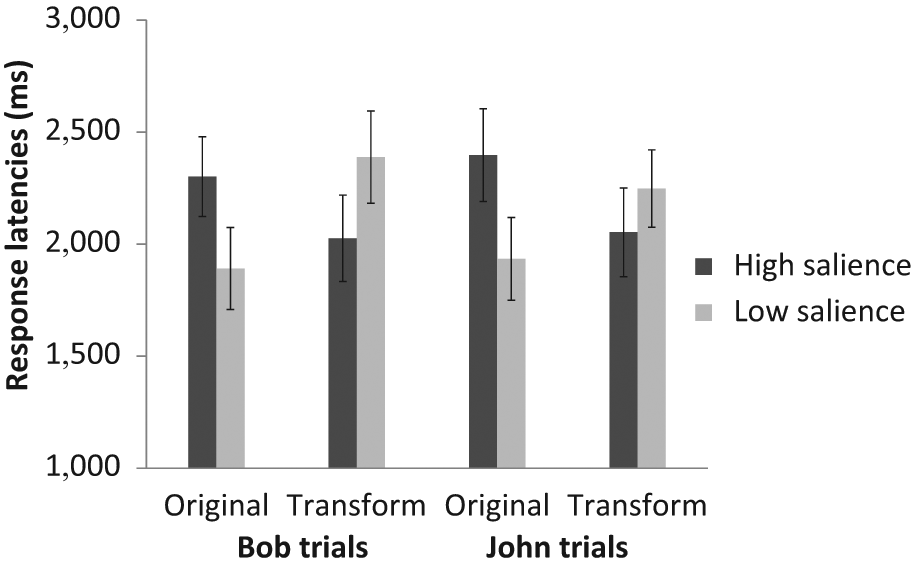
Response latencies as a function of target, negation salience, and memory task version in Experiment 4
After the memory task, all participants completed another 5 min filler task. Then, participants completed explicit and implicit attitude measures for Bob and John; the order of the presentation of the explicit attitude measure (involving both Bob and John) and the implicit attitude measure (involving both Bob and John) was randomized. We only assessed participants’ attitudes of Bob and John because we were particularly interested in how the attitude measures were influenced by the manipulation of negation salience.
Explicit attitude measure
Participants judged how likable Bob and John were on a scale ranging from 1 (very unlikable) to 9 (very likable). In addition, they completed eight semantic differential scales (e.g., good–bad; caring–uncaring), each using a 9-point scale to describe Bob and John, with greater mean scores across all items indicating more positive explicit attitudes toward Bob (α = .96) and John (α = .95).
Implicit attitude measure
The AMP used in the previous experiments was modified for this experiment. Images of Bob and John were each used as the prime stimulus for 16 of the 50 trials. For the remaining 18 images, there was no prime; these trials served as control trials. Greater scores indicated more positive implicit evaluations of Bob and John.
Results
Memory Task: Correct Responses
We examined negation salience by memory task version ANOVAs for the number of correct responses for Bob and John separately. For the correct responses on Bob trials, only a marginal main effect of memory task version was obtained, F(1, 98) = 3.52, p = .07,
Memory Task: Response Latencies for Correct Responses
We examined negation salience by memory task version ANOVAs for the response latencies for correct responses for Bob and John separately. For Bob, only the interaction obtained significance, F(1, 67) = 3.90, p = .05,
Attitudes
The explicit attitude measure and implicit attitude measure were examined in separate 2 (target: Bob, John) × 2 (negation salience) repeated measures ANOVAs. For the explicit attitude measure, John (M = 5.35) was rated as significantly more positive than Bob (M = 4.65), F(1, 98) = 4.10, p = .05,
Discussion
In this experiment, we partially replicated the results of Experiments 1 through 3 for our attitude measures. The explicit attitude measure reflected the utilization of the negation regardless of its salience. The implicit attitude measure was sensitive to highly salient negations for one of the two targets; therefore, across four experiments, we found consistent evidence for the sensitivity of implicit attitudes to highly salient negations. For the memory task, results for response latencies provided evidence that highly salient negations can lead to the fusion of the negation and core concept during encoding, but that less salient negations can lead the core concept and the negation to be stored separately in memory. Our findings suggest that highly salient negations led to shorter response latencies for the transformed implied traits, in line with a fusion model, while less salient negations led to shorter response latencies for the untransformed implied traits, which suggests processing in line with the schema-plus-tag model.
General Discussion
Across four experiments, we showed the impact of negation salience during attitude formation for how negated information is stored in memory during encoding, and thus how negated information can differentially affect implicit and explicit attitude measures. The main findings from these experiments are threefold. First, highly salient negations (vs. less salient negations) are more likely to lead to the fusion of the negation and the core concept during encoding and, therefore, to the intended meaning of the negation being reflected on an implicit attitude measure. Experiment 3 shows that even when the core of a negation has no direct opposite, an implicit attitude measure reflected the valence inferred from the fusion of the negation and the core concept. However, there is little impact of the negation on implicit attitude measures when it is less salient, suggesting that the negation and the core concept were stored separately in memory during encoding. Second, this dissociation between attitude measures is accounted for by the quick but resource-dependent utilization of the negation to reverse the meaning of the core of the negation during encoding. Experiment 2 showed that distraction disrupted this process and eliminated the impact of highly salient negation on implicit attitude measures.
Third, we provided evidence that the fusion model of negation can better explain the effects of increased negation salience on attitude formation than the schema-plus-tag model by examining the differential accessibility of negation-incongruent and negation-congruent concepts in memory. In Experiment 3, negation-congruent words were more accessible than negation-incongruent words when negations were highly salient, even when clear, direct opposites did not exist. In Experiment 4, transformations of the traits implied by negated behavioral statements were more accessible than the original, non-negated traits when negations were highly salient; when negations were less salient, the original, non-negated traits were more accessible than the transformations of the traits implied by the negated behavioral statements. These studies suggest that negation salience can determine how negations are processed and, thus, can influence the success with which to-be-negated information is stored in memory in its negated form. Specifically, highly salient negations are more likely processed within a fusion model and less likely to become dissociated from their core concepts over time, while less salient negations are more likely processed within a schema-plus-tag model and can become dissociated from their core concepts over time.
Although these findings add to the evidence that fusion and schema-plus-tag models can be differentiated (e.g., Mayo et al., 2004), additional research will be needed to more definitively show that the fusion model best explains salience’s role in processing negations. For instance, examining retrieval processes in addition to encoding processes could help further illuminate which model is most likely involved in processing and utilizing negations based on different levels of salience. Future work should also explore how manipulating cognitive load during the retrieval of evaluations from memory impacts the accessibility of information related to stored representations and how these findings may differ from the results of this work, which manipulated cognitive load during the encoding of behavioral information.
More generally, our findings offer insight into the conditions under which dissociations can be captured on explicit and implicit attitude measures, thereby extending past attitudes research in several ways. First, our results suggest that highly salient negations are processed more intensely and efficiently than less salient negations and thereby lead to negation-congruent explicit and implicit evaluations toward novel individuals. This evidence is interesting in light of past work that has somewhat inconsistently shown implicit measures to be sensitive to negation (e.g., DeCoster et al., 2006; Deutsch et al., 2009; Peters & Gawronski, 2011). Our work suggests that for the influence of negations to be captured on implicit measures, they must be made salient in some manner during encoding. Thus, past studies that show sensitivity or insensitivity of implicit measures to capture negations may do so because the to-be-negated information and the negation itself are more or less salient during encoding.
Second, consistently finding no evidence of successful negation on implicit measures when the negation information was less salient is interesting considering that participants were given a relatively large number of behavioral statements that were negated during learning. Finally, we demonstrated that negations presented in the context of an attitude formation paradigm can impact an implicit attitude measure presented after the learning session. Thus, it is not just that negation can impact implicit attitude measures in a very short period of time (less than 1 s) but can impact evaluations expressed after information is encoded for later use (several minutes). This difference in focus probably also explains why we showed that less salient negations did not have an impact on implicit attitude measures in the current work, whereas Deutsch et al. (2009) showed that negations presented within the implicit measure led to evaluations of the opposite valence. In our work, the less salient negations seemed to eliminate the difference between positive and negative information on implicit attitude measures, but it did not lead to evaluations consistent with the intended meaning of the negation. Increasing the salience of the negation, it seems, was necessary to impact implicit attitude measures in an attitude formation paradigm. This, however, may not be necessary when the negation is part of the implicit attitude measure itself.
The quick processing of highly salient negations found in our experiments makes sense functionally. It would seem important that a particularly attention grabbing or important negation would be more highly related to the information that it negates because this would facilitate appropriate behavior toward an attitude object. The extremely accessible negation affords perceivers a way to make decisions more efficiently by serving as a signal that information to be stored in memory needs to be modified to be useful. In this case, it is likely more efficient to store the opposite of the core of the negation. However, as Gilbert (1991) noted, our higher order cognitive capacities likely were built upon our perceptual system (where it makes much more sense to believe the output of that system). Thus, the utilization of on-line negation may have evolved in humans because of how perceptual systems operate, but this process can be aided by increasing the visual salience of negating information during encoding. While the system is not perfect, it enables us to do most tasks well.
Footnotes
Declaration of Conflicting Interests
The author(s) declared no potential conflicts of interest with respect to the research, authorship, and/or publication of this article.
Funding
The author(s) received no financial support for the research, authorship, and/or publication of this article.