







Abstract
People not only dehumanize others, they also dehumanize the self in response to their own harmful behavior. We examine this self-dehumanization effect across four studies. Studies 1 and 2 show that when participants are perpetrators of social ostracism, they view themselves as less human compared with when they engage in nonaversive interpersonal interactions. Perceived immorality of their behavior mediated this effect. Studies 3 and 4 highlight the behavioral consequences of self-dehumanization. The extent to which participants saw themselves as less human after perpetrating social ostracism predicted subsequent prosocial behavior. Studies 2 to 4 also demonstrate that consequences of self-dehumanization occur independently of any effects of self-esteem or mood. The findings are discussed in relation to previous work on dehumanization and self-perception. We conclude that in the context of immoral actions (self) dehumanization may be functional.
Ubuntu: “It is about the essence of being human . . . my humanity is caught up, bound up, inextricably, with yours. When I dehumanize you, I inexorably dehumanize myself.”
The word “Ubuntu” from the Bantu language of South Africa literally means “I am because we are.” It highlights the fact that we cannot exist independent of our relationships with others. Not only do we need others, but we need to feel that they are human so that we can feel human too. As such, “Ubuntu” highlights one implication of harming others, that one’s own humanity is reduced when others are treated without dignity and respect. From this perspective, inhuman behavior not only reflects the ways in which victims are treated but also the qualities of those who perpetrate against them.
Previous research supports the notion that when people hurt or harm others they are seen as less human (e.g., Bastian & Haslam, 2010). In these cases, dehumanization of perpetrators is associated with endorsement of harsher punishments and a perception that they are less suitable for rehabilitation (Goff, Eberhardt, Williams, & Jackson, 2008; Kelman, 1976). From the perspective of the observer, dehumanization indicates that perpetrators are dangerous, irrevocable, and worthy of retribution.
The concept of “Ubuntu” is not, however, limited only to the perceptions of others. As highlighted in the quote by Tutu, causing harm to another person may also affect perceptions of the self. In fact, we argue that from the perspective of the perpetrator, viewing the self as less human in response to interpersonal transgressions may be an appropriate and normal response. It reflects the understanding that one’s humanity is dependent on the humanity of those around us. Indeed, it may be a failure to engage with the self-dehumanizing consequences of one’s own actions—a failure to apply the concept of “Ubuntu”—that is most concerning when we consider the actions of those that harm others.
In the present research, we focus on how perpetrators view themselves as a result of their actions, and specifically the process of self-dehumanization. Little work has focused on the self-concept of perpetrators, and no previous work has investigated the consequences of seeing the self as less human. We argue that self-dehumanization following mistreatment of others is a normal response. We also argue that self-dehumanization reflects a functional response: When people feel that they have lost their humanity, they may be motivated to engage in a prosocial way with others thereby reconnecting them back into their human community and reestablishing their moral status. Self-dehumanization is therefore an adaptive response to cope with one’s own transgressions and the immoral treatment of others. We explore this process by examining the consequences of engaging in a particular form of maltreatment: ostracism. Ostracism frustrates the victim’s fundamental need to belong (Baumeister & Leary, 1995; Williams, 2001) and is a clear example of an interpersonal transgression. We examine the ways in which perpetrating social ostracism affects self-perception. More specifically, we focus on whether ostracizing others leads perpetrators to see themselves as less human.
Why Would Perpetrators Dehumanize the Self?
People may respond to their own harmful behavior in a variety of ways. There is ample evidence to show that when people engage in violent and aggressive behavior, they tend to go on to perpetrate more violent and aggressive behavior in the future (Berkowitz, Parke, Leyens, & West, 1974; Leyens, & Picus, 1973; Martens, Kosloff, Greenberg, Landau, & Schmader, 2007; Milgram, 1974). One predictor of this downward spiral of violence is a failure to engage with the self-relevant consequences of one’s own actions (Bandura, Underwood, & Fromson, 1975; Baumeister, Smart, & Boden, 1996; Hare, 1996; Meir, Sellbom, & Wygant, 2007). People often prefer to engage in self-serving or ego-protective responses when they have done wrong (e.g., Baumeister et al., 1996), finding ways to obfuscate personal responsibility or to minimize the significance of their behavior (Baumeister, Stillwell, & Wotman, 1990; Kowalski, 2000). This is consistent with a large body of work suggesting that people wish to hold maximally positive views of themselves and so seek to enhance their self-appraisals whenever possible (e.g., Alicke, Klotz, Breitenbecher, Yurak, & Vredenburg, 1995; Sedikides & Gregg, 2008; Taylor & Brown, 1988). Although “scapegoating” strategies may serve an ego-protective function, a refusal to engage with the self-relevant consequences of one’s actions facilitates future problematic behavior.
Reflecting the understanding that one’s own humanity is dependent on the humanity of those around them, we argue that self-dehumanization arises from the recognition that one’s actions have caused harm to others that cannot be justified. That is, we argue that when people act in ways that they perceive to be immoral, it will affect how they view their own humanity. Conceptions of morality and humanness are tightly bound (Bastian, Laham, Wilson, Haslam, & Koval, 2011; Brandt & Reyna, 2011; Haslam, Bastian, Laham, & Loughnan, 2011) and the processes of dehumanization are typically rooted in moral judgments. For example, out-groups that violate moral values are often viewed as demonic (Pargament, Trevino, Mahoney, & Silberman, 2007; Raiya, Pargament, Mahoney, & Trevino, 2008; the devil also being a target of extreme dehumanization: Demoulin, Saroglou, & Van Pachterbeke, 2008), and this dehumanization appears to extend to in-group members when they behave immorally (Brandt & Reyna, 2011). We argue that recognizing that one’s own actions have caused unjustified harm to another person is likely to lead to a perception of the self as possessing fewer human attributes. Specifically, this occurs because the act of causing unjustified harm to others is immoral and acting in immoral ways diminishes the extent to which a person feels they possess human qualities. That is, consistent with work on self-perception processes (e.g., Self-Perception Theory; Bem, 1972), we argue that people infer a lack of humanity from observations of their own inhumane and immoral behavior.
When Do Perpetrators Dehumanize the Self?
Our focus on self-perceived immorality of one’s own behavior is important for two reasons. First, harmful behavior that is viewed as legitimate (i.e., in the context of self-defense) would not be expected to have self-dehumanizing implications. That is because, although harmful, such behavior is viewed as warranted and therefore not immoral. Second, it is immorality as perceived by the harm-doer, rather than by others, which leads to self-dehumanization. Indeed it is the recognition that one has acted immorally and that there is no justification for ones actions that allows harmful behavior to undermine one’s self-perceived humanity.
In line with this reasoning, we would not expect self-dehumanization to arise when perpetrators can easily justify their behavior. For example, perpetrators may believe that they have legitimate power over others and, therefore, harmful behavior as a result of coercion or abuse of power may be less likely to be seen as immoral and illegitimate (e.g., Turner, 2005). The perception of victims as lacking humanity (e.g., Bandura, Barbaranelli, Caprara, & Pastorelli, 1996; McAlister, Bandura, & Owen, 2006; Osofsky, Bandura, & Zimbardo, 2005) may also serve to justify harmful behavior. In short, we argue that perpetrators will engage in self-dehumanization when victims are viewed as thinking, feeling, humans whose dignity, respect, and rights have been illegitimately undermined (e.g., Honneth, 1992), a consequence which may be evident within even subtle forms of interpersonal maltreatment (e.g., Sue et al., 2007).
In exploring this process, we focus on a form of interpersonal behavior that tends to have a clearly defined role for perpetrators and victims. Social ostracism is the social exclusion of another individual, and unlike conflict, may occur in the absence of provocation (Williams, 2007). In that sense, ostracism involves harmful behavior that cannot easily be justified. It is perhaps for this reason that studies have demonstrated that ostracizing others has negative consequences for the self: depleting resources required for self-regulation (Ciarocco, Sommer, & Baumeister, 2001) and increasing dissonance related to interpersonal relations (Zhou, Zheng, Zhou, & Guo, 2009). Social ostracism therefore provides a convenient interpersonal transgression for exploring the process of self-dehumanization. We predict that perpetrators of unjustified ostracism are more likely to see their behavior as immoral (see Bastian, Jetten, & Fasoli, 2011), which in turn will affect their perceptions of their own human qualities.
Perpetrator Responses to Self-Dehumanization
Feeling human is a desired and valuable resource; people like to see themselves as human (Haslam, Bain, Douge, Lee, & Bastian, 2005), are threatened by associations with nonhumans (Goldenberg et al., 2001), and tend to bolster their humanity to protect against existential threat (Vaes, Heflick, & Goldenberg, 2010). Therefore, we argue that when people feel that they have reduced their own humanity, they may be motivated to engage in prosocial behavior, self-sacrifice, or demonstrations of repentance. This is because there is evidence that acting in ways that reflect positively on ones moral character serves to reassert one’s human status (Bastian & Haslam, 2010; Brandt & Reyna, 2011). This is consistent with previous research on moral cleansing, which demonstrates that reminders of immoral behavior often motivate attempts to re-establish moral status through acts of altruism (Jordon, Mullen, & Murnighan, 2011; Sachdeva, Iliev, & Medin, 2009; Tetlock, Kristel, Elson, Green, & Lerner, 2000; Zhong & Liljenquist, 2006). We argue that perceptions of the self as having lost humanity may, in some cases, be an important motivator of such attempts. To this end, self-dehumanization may serve to reconnect perpetrators back into their human community. Thus, recognizing that one has lost his or her humanity may be an important step toward ending (rather than perpetuating) cycles of inhumane behavior.
Measuring Self-Dehumanization
In exploring the self-dehumanizing effects of social ostracism, we draw on previous theorizing within the field of dehumanization. Two dimensions of humanness have been identified that may be denied to targets (Haslam, 2006; Haslam et al., 2005; Leyens et al., 2000; Leyens et al., 2001). Human Nature refers to features that are seen as fundamental to our humanity and Human Uniqueness to attributes that distinguish people from animals. Perceiving a lack of Human Nature in a target is akin to likening people to objects or machines: cold, rigid, inert, and lacking emotion. On the other hand, perceiving a lack of Human Uniqueness is akin to likening people to animals: immature, coarse, irrational, or backward. This framework implies that people can be viewed as lacking humanness in two ways. Previous research suggests that both dimensions may be implicated in self and other perception in contexts of interpersonal maltreatment (Bastian & Haslam, 2010, 2011). In selecting a measure of dehumanization, we used a relatively explicit measure validated in previous research (Bastian & Haslam, 2010; Bastian, Jetten, & Radke, 2012). Whereas dehumanization measures commonly involve the attribution of traits (Bain, Park, Kwok, & Haslam, 2009; Haslam et al., 2005; Loughnan & Haslam, 2007) or emotions (Leyens et al., 2000; Leyens et al., 2001; Vaes, Paladino, Castelli, Leyens, & Giovanazzi, 2003) that have been independently established as representative of humanity, our approach allowed us to directly tap people’s perceptions of their self-humanity.
The Present Research
Across four studies, we focus on the self-dehumanizing consequences of socially ostracizing others. We explore three hypotheses. First, we expect that perpetrators will see themselves as less human after engaging in harmful behavior. That is, ostracism, compared with nonaversive interpersonal interactions, should enhance self-dehumanization among perpetrators. Second, we predict that perceived immorality of one’s actions mediates the relationship between ostracism and self-dehumanization: engaging in ostracism should enhance perceptions that one’s own actions are immoral, and it is this perception that underlies self-dehumanization. We also compare this prediction to another possible mediator: social belonging needs (Baumeister & Leary, 1995; Manner, DeWall, Baumeister, & Schaller, 2007; Pickett, Gardner, & Knowles, 2004). Ostracizing others may not only threaten the need to belong for victims of ostracism but may also threaten these same needs for perpetrators, leading to self-dehumanization (Bastian & Haslam, 2010). Third, in line with our argument that self-dehumanization motivates attempts to reestablish moral status, we predict that self-dehumanization will motivate prosocial behavior and self-sacrifice. Finally, we expect that the effects of self-dehumanization cannot be accounted for by changes in global evaluations of the self or mood. That is, self-dehumanization should be independent of a general negativity toward the self or negative feelings arising from engaging in negative behavior.
Ostracism Leads to Self-Dehumanization: Studies 1 and 2
Our first two studies aimed to explore the basic self-dehumanization effect. We aimed to demonstrate that the act of ostracizing others has self-dehumanizing consequences for perpetrators (Hypothesis 1). We also aimed to highlight the role of perceived immorality in driving self-dehumanization (Hypothesis 2) compared with feelings of social isolation. In addition, in Study 2, we aimed to demonstrate that self-dehumanization is independent of any general reduction of positivity toward the self (global-self-esteem) or any changes in mood resulting from the ill-treatment of others. In Study 1, we used a well-established recall paradigm (Bastian & Haslam, 2010; Pickett et al., 2004) to examine interactions involving social ostracism and compared effects to an everyday interaction. In Study 2, we extended these findings using a behavioral paradigm where participants engaged in the act of ostracizing another student.
Study 1
Participants were 53 undergraduates (36 women, M age = 18.43) who received course credit. They were asked to spend 10 to 15 min writing about an experience when they either “rejected or socially excluded another person” (exclusion condition; n = 27), or “an everyday interaction [they] had with another person yesterday” (control condition; n = 26), with random assignment to each condition.
Participants next indicated how immoral they felt their actions were (three items: “I felt like what I did was very immoral,” “I felt my actions were unethical,” “I felt like I was immoral”; α = .82). This allowed us to test our second hypothesis that perceived immorality of one’s behavior underlies self-dehumanization. We also assessed if the act of ostracism may have threatened participants’ need to belong (one item: “I felt very alone at the time”) and whether threatened belongingness needs mediated the relationship between ostracism and dehumanization. Participants then rated themselves on eight items adapted from Bastian and Haslam (2010) assessing the attribution of Human Nature (four items; for example, “I felt like I was open minded, like I could think clearly about things”; “I felt that I was emotional, like I was responsive and warm”; “I felt superficial like I had no depth” [reversed]; “I felt like I was mechanical and cold, like a robot” [reversed]) and Human Uniqueness (four items; for example, “I felt like I was refined and cultured”; “I felt like I was rational and logical, like I was intelligent”; “I felt like I lacked self-restraint, like an animal” [reversed]; “I felt like I was unsophisticated” [reversed]). Responses were made from 1 (not at all) to 7 (very much so).
An ANOVA, with condition as the between-subjects variable, revealed that condition had an effect on perceived immorality, F(1, 51) = 39.77, p < .001, η2 = .44, indicating that participants felt the act of ostracizing another person was more immoral (M = 3.83, SD = 1.80) compared with having an everyday interaction (M = 1.37, SD = 0.81). The same ANOVA revealed that there was a significant effect of condition on how socially disconnected participants felt, F(1, 51) = 5.36, p = .025, η2 = .10, indicating that participants felt the act of ostracizing made them feel more alone (M = 3.33, SD = 2.02) compared with having an everyday interaction (M = 2.16, SD = 1.67).
Principal axis analysis of the self-humanness ratings revealed a single-factor solution explaining 34.22% of the variance. All items loaded above .41. On this basis we constructed a self-humanity index (α = .80). 1 The same ANOVA revealed a significant effect of condition on self-humanity, F(1, 51) = 18.85, p < .001, η2 = .27. That is, an episode of ostracism was viewed as more dehumanizing for the self (M = 3.70, SD = 0.99) compared with an everyday interaction (M = 4.85, SD = 0.94; see Figure 1).
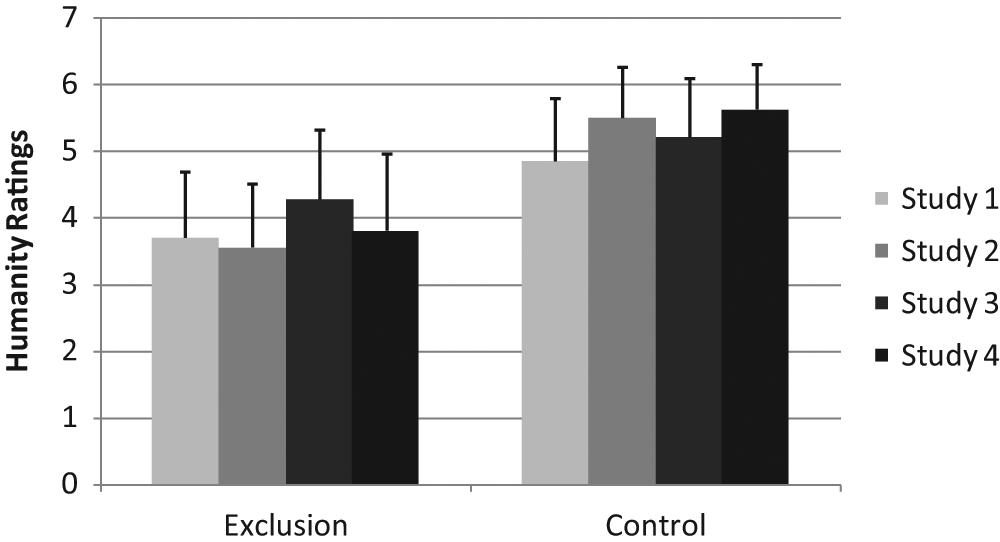
Mean scores and standard deviations for self-humanity across conditions, Studies 1 to 4
Mediation Analyses
To examine whether immorality or social disconnection explained the relation between condition (coded: control = 0; ostracism = 1) and self-dehumanization, we used Preacher and Hayes’ (2008) bootstrap test of multiple mediators (see Figure 2). This also allowed us to explore whether there was any independent mediating effects of social disconnection. This revealed a significant model, F(3, 49) = 9.73, p < .001, R2 = .33. Condition predicted immorality, B = 2.43 (SE = .38), p < .001, and also predicted social disconnection, B = 1.18 (SE = .51), p = .025. Immorality also negatively predicted self-humanity, B = −.21 (SE = .09), p = .029; however, social disconnection did not, B = −.08 (SE = .07), p = .263. When controlling for immorality and social disconnection, the effect of condition on self-humanity was nonsignificant, B = −.54 (SE = .34), p = .112, suggesting mediation. The bootstrapped estimate of the mediation effect confirmed that immorality was a significant mediator (IE = −.50 confidence interval [CI] 95% between −.96 and −.10); however, social disconnection was not (IE = −.11, CI 95% between −.37 and .04) (see Figure 2). 2
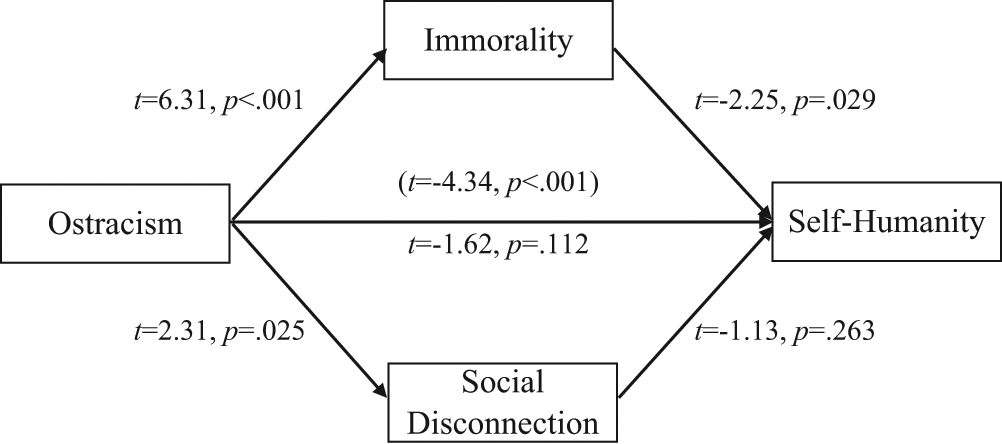
Mediation effects of perceived immorality on self-humanity, Study 1
Study 2
The results of Study1 provide initial support to the notion that perpetrators are sensitive to the self-dehumanizing consequences of engaging in the ostracism of others. However, there are a number of shortcomings. First, relying only on recall manipulations makes it impossible to control for other factors (e.g., who was ostracized and for what reason?). Second, if these experiences are viewed as dehumanizing for the self, then we would want to see that this change in self-perception is not simply a function of reduced self-esteem or changes in mood. To overcome these limitations in Study 2, we used a behavioral paradigm, allowing us to observe how actual instances of ostracism may affect self-perception of the individual perpetrators. We also examined whether these effects are independent of how ostracizing others may affect global self-evaluation and mood.
Method
Participants
Forty participants (19 females; M age = 20.23 years) participated for course credit or $10. Each session was conducted with two participants.
Ostracism manipulation
Our methodology attempted to replicate the popular Cyberball paradigm (Williams, Cheung, & Choi, 2000) in a real-life setting (see Williams, 2001). To this end, participants arrived in groups of two and were led to believe that there was another participant (actually a confederate) completing questionnaires in another room in the building. They were told that one of the aims of the experiment was to measure the effects of ostracism on the other person and that they would be assisting the experimenter. Participants were given the illusion of choice for both conditions to ensure that participants felt personally responsible for their actions, and did not simply blame the experimenter for forcing them to engage in ostracism (see Ciarroco, Sommer, & Baumeister, 2001). The experimenter would then leave the room and let the participants discuss which condition they wanted to be in between themselves. In all cases, participants agreed to participate in the condition indicated by the experimenter.
In the inclusion condition, participants were instructed to throw a ball to each other while also conversing about whatever they felt like. In the exclusion condition, they were instructed not to throw the ball to the other participant and to avoid making any conversation with them. The confederate was then brought into the room and was introduced to the participants. The experimenter then left the room for 3 min while the ball was tossed. Afterward, participants were taken to separate rooms where the main questionnaires were administered. The questionnaire contained the following measures.
Perceived immorality
Participants completed the same measure of perceived immorality as in Study 1 (α = .97).
Social disconnection
Participants completed the same item regarding social disconnection as in Study 1.
Self-dehumanization
Participants rated themselves on the same eight items used in the previous studies. Again these were combined to form a measure of self-humanity. Consistent with Study 1, principal axis analysis of the self-humanness ratings revealed a single-factor solution explaining 54.16% of the variance. Seven items loaded above .54 (one lower at .29). On this basis, we constructed a self-humanity index using all items (α = .90).
Self-esteem
Participants also completed the State Self-Esteem Scale (SSES; Heatherton & Polivy, 1991) to assess global self-evaluation. Participants are required to respond to a range of statements in relation to what they “feel is true of themselves at this moment” on a scale from 1 (not at all) to 5 (extremely). Three subscales tap a range of self-aspects including performance (e.g., “I feel confident about my abilities”), appearance (e.g., “I feel that others respect and admire me”), and social (e.g., “I feel displeased with myself” reverse) (α = .80). 3
Affect
Participants completed the positive and negative affect schedule (PANAS; Watson, Clark, & Tellegen, 1998; positive: α = .85, negative: α = .86).
Results
As we collected the data within dyads, we assessed the assumption of independence for self-humanity ratings (Kenny, Kashy, & Cook, 2006). To this end, we computed the intraclass correlations (controlling for experimental condition) for ratings of self-humanity at the level of the dyad to test for nonindependence. This revealed that self-ratings (Z = 0.21, p = .834) were not significantly related (i.e., independent), and therefore we focused on the individual, rather than the dyad, as the unit of analysis.
An ANOVA revealed a marginal effect of condition on the SSES, F(1, 38) = 2.80, p = .102, η2 = .07. Participants viewed themselves more negatively in the ostracism condition (M = 3.40, SD = 0.40) than the inclusion condition (M = 3.64, SD = 0.51). The same ANOVA revealed an effect of condition on negative affect, F(1, 38) = 24.64, p < .001, η2 = .39, such that participants felt more negative affect in the ostracism condition (M = 2.00, SD = 0.67) than the inclusion condition (M = 1.22, SD = 0.23). There was also a marginal effect for positive affect, F(1, 38) = 3.81, p = .058, η2 = .09. Participants felt less positive affect in the ostracism condition (M = 2.48, SD = 0.72) than in the inclusion condition (M = 2.86, SD = 0.51).
To take account for any effect of global self-evaluation and mood, we controlled for SSES, positive affect, and negative affect as covariates in an ANOVA on perceived immorality. The analysis revealed a significant main effect of condition, F(4, 35) = 13.88, p = .001, η2 = .28: Participants felt their behavior was more immoral in the ostracism condition (M = 4.55, SD = 1.81) than the inclusion condition (M = 1.38, SD = 0.78) after controlling for self-evaluation, F(4, 35) = 0.76, p = .492, η2 = .01; positive affect, F(4, 35) = 1.27, p = .267, η2 = .04; and negative affect, F(4, 35) = 7.61, p = .009, η2 = .18. This same ANOVA on social disconnection also revealed a significant main effect of condition, F(4, 35) = 13.88, p = .001, η2 = .28: Participants felt more alone in the ostracism condition (M = 3.65, SD = 1.66) than the inclusion condition (M = 1.50, SD = 0.94) after controlling for self-evaluation, F(4, 35) = 0.69, p = .412, η2 = .02; positive affect, F(4, 35) = 2.79, p = .104, η2 = .07; and negative affect, F(4, 35) = 2.77, p = .105, η2 = .07.
The same analysis revealed a main effect of condition on self-humanity, F(4, 35) = 12.68, p = .001, η2 = .27, such that participants saw themselves as less human in the ostracism condition (M = 3.56, SD = 0.95) than the inclusion condition (M = 5.50, SD = 0.76; see Figure 1) after controlling for self-evaluation, F(4, 35) = 0.51, p = .479, η2 = .01; positive mood, F(4, 35) = 7.41, p = .010, η2 = .18; and negative mood, F(4, 35) = 9.97, p = .003, η2 = .22.
Mediation Analyses
We next examined the extent to which self-dehumanization could be explained by perceived immorality of the behavior and/or social disconnectedness. Given the small sample size, we first examined immorality and social disconnection as potential mediators and then later tested whether any mediating effects found remained when controlling for self-evaluation and mood. To this end, we first investigated whether perceived immorality and social disconnection mediated the effects of condition (coded: 0 = control; 1 = ostracism) on self-dehumanization using Preacher and Hayes’ (2008) bootstrap test of multiple mediators. This revealed a significant model, F(3, 36) = 27.39, p < .001, R2 = .67. Condition predicted immorality, B = 3.17 (SE = .44), p < .001, and also predicted social disconnection, B = 2.15 (SE = .43), p < .001. Immorality also negatively predicted self-humanity, B = −.27 (SE = .09), p = .005; however, social disconnection did not, B = −.14 (SE = .09), p = .150. When controlling for immorality and social disconnection, the effect of condition on self-humanity remained significant although reduced in magnitude, B = −.79 (SE = .38), p = .044, suggesting mediation. The bootstrapped estimate of the mediation effect confirmed that immorality was a significant mediator (IE = −.87 CI 95% between −1.53 and −.35); however, social disconnection was not (IE = −.32, CI 95% between −.79 and .12; see Figure 3). Focusing just on immorality, we tested the same model controlling for self-evaluation and mood. Immorality remained a significant mediator in the model when controlling for self-evaluation and mood (IE = −.43, CI 95% between −1.02 and −.06). Positive, B = .47 (SE = .20), p = .022, and negative, B = −.58 (SE = .28), p = .043, mood also predicted self-humanity, although self-esteem did not, B = −.28 (SE = .28), p = .327.
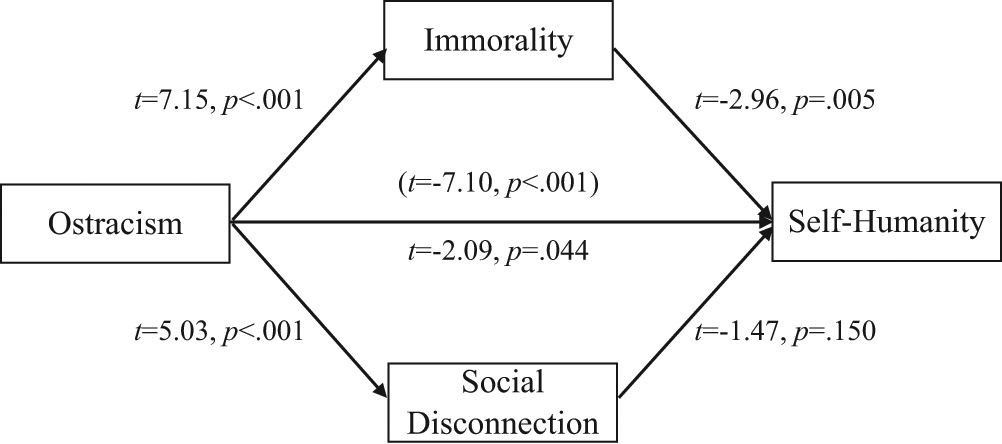
Mediation effects of perceived immorality on self-humanity, Study 2
The findings of Study 2 supported those of Studies 1, providing further evidence that acts of ostracism are viewed as self-dehumanizing by perpetrators and that this is in part explained by how immoral their actions are perceived to be. In addition, Study 2 demonstrated that this perception could not be accounted for by global self-evaluation or mood. Both studies also considered the possibility that self-dehumanization arises because people feel socially isolated after perpetrating an act of ostracism. We found no evidence, however, for social isolation as a mediator of the ostracism–dehumanization relationship independent of the effects of the perceived immorality of ostracizing others. In the next two studies, we examined whether reductions in self-perceived humanity mediates the extent to which behavioral responses are oriented toward reparation for one’s deeds through self-sacrifice and prosocial behavior (Hypothesis 3).
Self-Dehumanization Promotes Prosocial Behavior: Studies 3 to 4
Across two studies, we have provided evidence that perpetrators self-dehumanize in response to the act of ostracizing others. Furthermore, we demonstrate that this self-dehumanization is driven by the perceived immorality of one’s actions. In addition, we have shown that this self-dehumanization occurs independent of overall global self-evaluation and mood, suggesting it is not limited to simply seeing the self more negatively or feeling bad. In Studies 3 and 4, we aimed to extend these findings by focusing on the consequences of self-dehumanization. Specifically, we explored whether viewing one’s actions as self-dehumanizing may motivate prosocial behaviors. We argue that self-dehumanization may be functional to the extent that it motivates interpersonal reconnection and prosocial behavior. If self-dehumanization after ostracism was related to increased helping behavior, this would provide support for our third hypothesis.
Study 3
In Study 3, we aimed to demonstrate that recalling an episode of ostracism would motivate people to volunteer their time to help another experimenter in a different study. Volunteering behavior has been used extensively in previous research as a measure of prosocial orientation (Twenge, Baumeister, DeWall, Ciarrocco, & Bartels, 2007). Specifically, we expected that people’s willingness to volunteer their time would be explained by their self-dehumanization.
Method
Participants were 84 undergraduates (54 women, M age = 23.04) who were reimbursed $10 for their time. Sessions were run in small groups with participants randomly assigned to conditions. They were asked to spend 10 to 15 min writing about “an everyday interaction [they] had with another person yesterday” (control condition; n = 42), or a time when they “rejected or socially excluded another person” (exclusion condition; n = 42) with random assignment to each condition.
Self-dehumanization
Participants rated themselves on the same eight items used in the previous studies. Consistent with the first two studies, evidence was found for a single-factor solution explaining 36.97% of the variance (all items > .44), and all items were combined to form single measure of self-humanity (α = .92).
Control measures
Participants again completed SSES (Heatherton & Polivy, 1991) to assess global self-evaluation (α = .92) and the PANAS (Watson et al., 1998; positive: α = .89, negative: α = .82).
Prosocial behavior measure
At the end of the study, participants were informed that there was another experiment run by another experimenter in a different building that would be starting immediately and that they could volunteer for it if they wished, but that they would not receive any reward for doing so. Participants either indicated that they were willing (yes) or were not willing (no) to participate in the experiment.
Results and Discussion
Seven participants indicated that they could not volunteer due to specific prior commitments (details provided) and were therefore removed from further analysis. Inspection of the ratings of self-humanness and volunteering revealed one participant was a multivariate outlier with a Cook’s distance value of Di = .37 (more than twice the size of any other case). 4 Excluding this case from further analyses left 40 participants in the control condition and 36 in the exclusion condition. Overall, 29 participants declined to volunteer for the next experiment, and 47 participants agreed to participate (coded 0 and 1, respectively).
Using an ANOVA model, we tested the effects of condition on self-esteem. This revealed no significant differences between conditions, F(1, 74) = .12, p = .735, η2 = .002. There was also no difference in positive affect between conditions, F(1, 74) = 1.51, p = .223, η2 = .02; however, people in the ostracism condition experienced more negative affect (M = 1.65, SD = 0.57) than those in the control condition (M = 1.37, SD = 0.52), F(1, 74) = 5.11, p = .027, η2 = .07. Controlling for these three variables, the model revealed an effect of condition on self-humanity, F(4, 71) = 11.90, p = .001, η2 = .14. Participants who recalled an episode of ostracism rated themselves as less human (M = 4.30, SD = 1.04), compared with those who recalled an everyday interaction (M = 5.21, SD = 0.88), independent of any effects associated with global self-evaluation, F(4, 71) = 1.59, p = .211, η2 = .02; or positive affect, F(4, 75) = 0.23, p = .633, η2 = .01; or negative affect, F(4, 75) = 3.05, p = .085, η2 = .04 (see Figure 1).
Mediation Analyses
We next sought to determine whether viewing one’s behavior as self-dehumanizing might be associated with increased prosocial responding. We first investigated the effects of condition on prosocial behavior using binary logistic regression. This revealed that condition (coded: 0 = control; 1 = ostracism) predicted volunteering (B = 1.10, OR = 3.0, Wald χ2 = 4.86, p = .027), such that participants in the ostracism condition were more likely to volunteer than those in the control condition.
We next investigated whether self-humanity mediated the effects of condition on volunteering while controlling for self-evaluation and mood using Preacher and Hayes’ (2008) bootstrap test of multiple mediators. This revealed that condition predicted self-humanity, B = −.77 (SE = .23), p < .001. Self-humanity also negatively predicted volunteering, B = −.70 (SE = .33), p = .032, Wald χ2 = 4.62. There was no effect of mood (positive: B = .45 (SE = .34), p = .182, Wald χ2 = 1.78; negative: B = −.39 (SE = .53), p = .466, Wald χ2 = .53) or self-esteem, B = −.39 (SE = .47), p = .400, Wald χ2 = .71. When controlling for self-humanity (and mood and self-esteem), the effect of condition on volunteering was reduced and became nonsignificant, B = .80 (SE = .58), p = .168, Wald χ2 = 1.70, suggesting mediation. This was confirmed by the bootstrapped estimate of the mediation effect, which was significantly different from zero (IE = .61, CI 95% between .01 and 1.38; see Figure 4). 5 In short, this indicates that after thinking about the act of ostracizing another person (compared with having an everyday interaction with them) people were more likely to volunteer to help the experimenter and this was due to a perception that their behavior had self-dehumanizing consequences.
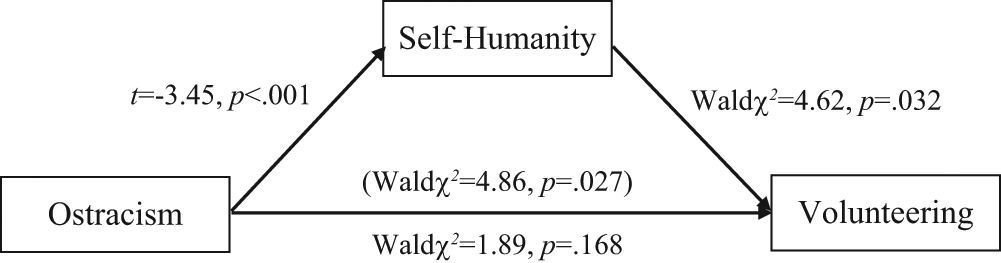
Mediation effects of self-humanity on volunteering (controlling for self-esteem and mood), Study 3
The findings of Study 3 support our expectations and the findings of Studies 1 and 2 by demonstrating that engaging in the act of ostracizing another person, compared with having an everyday interaction, is a self-dehumanizing experience for perpetrators. Study 3 extends this analysis by demonstrating that when people feel that their actions have diminished their own humanity, they are more likely to volunteer for a different study, demonstrating a motivation to engage in prosocial behavior. Moreover, this prosocial behavior was specifically associated with self-dehumanization and could not be explained by changes in mood or global self-evaluation.
Study 4
Even though Study 3 shows that self-dehumanization might motivate prosocial behavior, evidence for this reparation motivation was found only in the context of a recall induction of ostracism. In Study 4, we attempted to replicate the findings of Study 3 using an actual behavioral induction of ostracism. In line with our third hypotheses and the findings of Study 3, we predicted that engaging in the ostracism of another person would be a self-dehumanizing experience and this would in turn predict their motivation to volunteer to assist another experimenter in a different study.
Method
Participants were 33 6 undergraduates (18 women, M age = 22.27) who were reimbursed $10 for their time. Sessions were run with single participants who were randomly assigned to one of two conditions.
Ostracism manipulation
Our methodology closely replicated that used by Ciarroco et al. (2001). This “silent treatment” paradigm requires participants to either interact or give the silent treatment to another participant (confederate). Specifically, participants were told they would be asked to participate in three independent tasks and were randomly assigned to one of the two conditions. Participants were asked to engage in an interaction with another participant (a female 4th year psychology student confederate) for 3 min, with the ostensible purpose of forming a first impression. After the interaction, both the participant and confederate were told they would be asked to provide “first impression” ratings of each other. The experimenter then took the confederate into a separate room, ostensibly to complete their evaluation.
Participants were then told that the next part of the study was concerned with the effects of the silent treatment, and they were asked to engage in a second 3-min interaction with the confederate. Consistent with Ciarroco et al. (2001), participants were randomly asked to either speak freely as they did in the first interaction (conversation condition) or to ignore the confederate completely and avoid all conversation (silence condition). As in Study 2, participants were given the illusion of choice for both conditions. The experimenter explained that the confederate would think that this interaction was another get-acquainted session. In the conversation condition, participants were instructed to talk about anything except the experiment itself. In the silence condition, they were told they needed to remain as silent as possible for the entire 3-min period. During the 3 min, the confederate attempted to ask four questions about the participant. Segments from the previous conversation were used as a starting point for these questions. After 3 min, the confederate and participant were separated. As a manipulation check, the confederate was asked how the participant had responded during the interaction period.
Self-dehumanization
Participants rated themselves on the same eight items used in Study 1. Consistent with all other studies, evidence was found for a single-factor solution explaining 48.82% of the variance (seven items >.57, one lower at .32), and all items were combined to form a single measure of self-humanity (α = .87).
Control measures
Participants again completed the SSES (Heatherton & Polivy, 1991) to assess global self-evaluation (α = .92) and the PANAS (Watson et al., 1998; positive: α = .90; negative: α = .91).
Prosocial behavior measure
At the end of the study, participants were informed that there was another experiment run by another experimenter in a different building that would be starting immediately and that they could volunteer for it if they wished. They were invited to volunteer for either, 15, 30, 45, or 60 min. After they had made their choice, they were debriefed and allowed to leave. Responses were coded as 0 (for not volunteering) or 1, 2, 3, and 4 depending on how much of their time they volunteered.
Results and Discussion
To determine whether any of the condition effects impacted on our measure of SSE, we conducted a one-way (Interaction: ostracism vs. inclusion) ANOVA. This revealed a significant effect of interaction type, F(1, 31) = 6.13, p = .019, η2 = .17 (ostracism: M = 3.33, SD = 0.67; inclusion: M = 3.86, SD = 0.57), demonstrating that when people were asked to ostracize the confederate, they experienced a reduction in their global self-evaluation. We used the same analysis to determine any changes in mood as a function of experimental condition. This revealed that both positive mood, F(1, 31) = 5.00, p = .033, η2 = .14 (ostracism: M = 2.67, SD = 0.74; inclusion: M = 3.31, SD = 0.89), and negative mood, F(1, 31) = 15.72, p < .001, η2 = .34 (ostracism: M = 2.39, SD = 0.87; inclusion: M = 1.41, SD = 0.47), varied by interaction type.
Using the same ANOVA model, we tested the effects of condition on self-humanity, controlling for SSES and mood as covariates in the model. This revealed an effect of interaction type on self-humanity, F(4, 28) = 14.83, p < .001, η2 = .35 (ostracism: M = 3.81, SD = 1.15; inclusion: M = 5.63, SD = 0.67): When asked to ostracize the confederate, participants saw themselves as having reduced humanity, and this was independent of negative global self-evaluation, F(4, 28) = 5.05, p = .033, η2 = .15; positive mood, F(4, 28) = 0.10, p = .753, η2 = .01; or negative mood, F(4, 28) = 0.10, p = .761, η2 = .01 (see Figure 1).
Mediation Analyses
We next sought to determine whether viewing one’s behavior as self-dehumanizing might be associated with increased prosocial responding. We first investigated the effects of condition on prosocial behavior using a similar ANOVA as above. This revealed that participants were more likely to help the experimenter in the ostracism condition (M = 0.71, SD = 0.85) than in the inclusion condition (M = 0.19, SD = 0.40), F(1, 31) = 4.92, p = .034, η2 = .14.
We next investigated whether self-humanity mediated the effects of condition (coded: 0 = control; 1 = ostracism) on volunteering while controlling for self-evaluation and mood using Preacher and Hayes’ (2008) bootstrap test of multiple mediators. This revealed a significant model, F(5, 27) = 7.15, p < .001, R2 = .57. Condition predicted self-humanity, B = −1.42 (SE = .37), p < .001. Self-humanity also negatively predicted volunteering, B = −.32 (SE = .11), p = .009. Positive emotions, B = .34 (SE = .14), p = .019, and negative emotions, B = .41 (SE = .17), p = .021, positively predicted volunteering; however, there was no effect of self-esteem, B = −.10 (SE = .25), p = .683. When controlling for self-humanity (and mood and self-esteem), the effect of condition on volunteering became nonsignificant, B = −.31 (SE = .27), p = .275, suggesting mediation. This was confirmed by the bootstrapped estimate of the mediation effect, which was significantly different from zero (IE = .46, CI 95% between .10 and .98; see Figure 5).
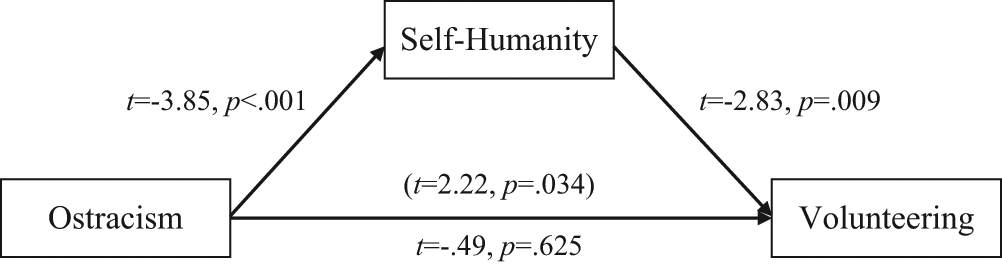
Mediation effects of self-humanity on volunteering (controlling for self-esteem and mood), Study 4
The findings of Study 4 support those of Study 3, demonstrating that feeling dehumanized motivates people to engage in prosocial behavior. Moreover, it also further supports the finding that when people feel dehumanized, their willingness to engage in prosocial behavior cannot be explained by a loss of self-esteem or mood. Study 4 lends strength to our claims by demonstrating that these effects occur within real-time interactions with others.
General Discussion
Many prominent thinkers have pointed to the self-dehumanizing consequences of the inhumane treatment of others. Across four studies, we provided empirical evidence that people see themselves as less human when engaging in the social ostracism of others. This self-dehumanization is supported with medium effect sizes evident after controlling for self-esteem and mood. We show that viewing one’s behavior as immoral in part explains the tendency to self-dehumanize. In turn, this self-dehumanization appears to drive prosocial behavior and self-sacrifice. This finding supports the notion that self-dehumanization motivates people to reestablish their moral status and reengage with others through prosocial behavior, and provides for a novel perspective from which to view the consequences of a loss of humanity.
Specifically, Study1 provides evidence that perpetrators of social ostracism see themselves as less human compared with when they engage in a more positive interpersonal interaction. Study 2 replicates these findings using a behavioral manipulation of social ostracism and, along with Study 1, provides evidence that perceived immorality of one’s behavior helps to explain the self-dehumanization process. Moreover, although both Studies 1 and 2 show that acts of ostracism do affect how socially connected people feel, compared with the perceived immorality of one’s own behavior, this is not a primary predictor of self-dehumanization. Studies 3 and 4 extend on this evidence to demonstrate the behavioral implications of self-dehumanization, specifically, that self-dehumanization motivates self-sacrifice and prosocial behavior. Critically, in three studies, we find these effects are independent of global self-evaluation or mood, indicating that the effects of self-dehumanization cannot be reduced to negative self-perception or feeling bad.
Implications for Dehumanization Research
Even though dehumanization has traditionally been studied in relation to the perception of others (e.g., Bandura, 1999), recent work has demonstrated that this phenomenon can also be located in the self-concept of victims (Bastian & Haslam, 2010). Other research has demonstrated that engaging in gratuitous video game violence serves to reduce perceptions of one’s own humanity (Bastian et al., 2012). The current studies extend this work, highlighting that people self-dehumanize in response to their own interpersonal transgressions. Moreover, it also suggests that when people transgress against others, it is the perceived immorality of this behavior that is a primary factor in explaining self-dehumanization rather than feelings of social isolation (e.g., Manner et al., 2007), which have also been linked to processes of self-dehumanization (Bastian & Haslam, 2010; see also Waytz & Epley, 2012).
Our work provides important insights into the link between dehumanization and moral disengagement. Previous research and theorizing has demonstrated that dehumanizing others serves to reduce the affective and moral consequences of one’s actions (e.g., Castano & Giner-Sorolla, 2006), a process that is evident in the use of military force (McAlister et al., 2006), execution practices (Osofsky et al., 2005), and delinquent behavior (Bandura et al., 1996). In contrast, our findings highlight that self-dehumanization also arises from engaging with, rather than disengaging from, the moral consequences of behavior.
By highlighting this link between self-dehumanization and moral engagement, the findings also shed new light on downward spirals of aggressive and antisocial behavior. Self-serving or ego-protective responses to wrongdoing, which serve to minimize personal responsibility and enhance self-appraisals (e.g., Baumeister et al., 1996), are likely to predict future problematic behavior. In contrast, engaging with the self-dehumanizing consequences of one’s own behavior, even though potentially damaging to the self-concept, may be an important pathway toward ending violence and aggression.
Linking self-dehumanization to moral engagement also suggests important and novel relationships between dehumanization and self-focused emotions such as guilt, shame, and embarrassment. These emotions tend to arise in response to immoral behavior and indicate perceived responsibility for adverse outcomes (Tangney, Stuewig, & Mashek, 2007). It is likely that these emotional responses would co-occur with, and perhaps even lead to, self-dehumanization. That is, just as disgust is associated with the dehumanization of others (Harris & Fiske, 2006; Hodson & Costello, 2007), shame and guilt may be associated with the dehumanization of the self.
It is important to note that our findings consistently supported a unidimensional structure for our measure of dehumanization. This is in contrast to the two-dimensional structure observed in previous work on group (Bain, Park, Kwok, & Haslam, 2009; Koval, Laham, Haslam, Bastian, & Whelan, 2012; Loughnan & Haslam, 2007) and self and other perception (Haslam & Bain, 2007; Haslam et al., 2005). One possible reason for this is that in contexts of interpersonal harm, both dimensions of dehumanization may be simultaneously implicated (see Bastian et al., 2012; Bastian & Haslam, 2010, 2011 for similar reasoning and findings). That is, perpetrators of harm may not only see themselves as lacking qualities that distinguish humans from animals but also those associated with empathy and emotional responsiveness; leaving them feeling unsophisticated and unrefined as well as cold, superficial, and machine-like. It is, of course, conceivable that under certain conditions people may feel that their behavior reflects their cold, superficial, and machine-like qualities (mechanistic dehumanization), while leaving their cultured, rational, and self-control-related qualities in tack (animalistic dehumanization).
Dehumanization and Responses to Immoral Behavior
We find that perpetrator self-dehumanization is associated with a desire to reestablish moral status and reconnect with others through prosocial behavior. This stands in contrast to the traditional understanding that dehumanized perpetrators lose their capacity to act as moral beings (Kelman, 1976). Although this may be true from the observer’s perspective, self-dehumanization appears to motivate attempts to reintegrate into one’s human community through self-sacrifice and prosocial action, rather than a callous perpetuation of harmful behavior.
This finding is consistent with previous research showing that reminders of immoral behavior motivate attempts to reestablish moral status through acts of altruism (e.g., Jordon et al., 2011; Sachdeva et al., 2009). Moreover, work on moral emotional responses such as guilt and shame have been linked to reparation behavior (De Hooge, Zeelenberg, & Breugelmans, 2007; Frank, 1988; Ketelaar & Au, 2003; Nelissen, Dijker, & De Vries, 2007; Trivers, 1971). Our findings provide a novel and important extension on this previous research, highlighting self-dehumanization as an important factor in determining prosocial responses to immoral actions.
The research also highlights an important role for self-dehumanization in reconnecting perpetrators back into their human communities. Self-dehumanizing in response to interpersonal transgression appears to allow for and facilitate repentance, reconnection, and rehabilitation. One implication of this insight is that a failure to engage with the self-dehumanizing consequences of one’s own behavior may be an important component to psychopathy and may underpin some patterns observed in personality disorders such as narcissism (e.g., Baumeister et al., 1996). A self-protective bias may shield the self from unfavorable evaluation; however, left unchecked, these same biases may lead to poor self-insight and disrupt supportive interpersonal relations.
There are two caveats to this link between self-dehumanization and prosocial responding. The first relates to whether repeated or more extreme acts of harm, particularly those that are difficult to make amends for, may lead perpetrators to act in line with their self-views. That is, when perpetrators not only lose their ability to employ ego-protective strategies but also do not have the opportunity to atone for their actions, self-dehumanization may lead to more inhumane behavior. The second is the motivation underlying prosocial behavior. Previous work has linked immoral behavior (and feelings of guilt) to self-punishment (Bastian, Jetten, et al., 2011; Nelissen & Zeelenberg, 2009). Prosocial behavior indeed requires self-sacrifice and as such may be motivated primarily by self-punishment concerns rather than a desire to benefit others. We do not see these two possibilities as inconsistent. Prosocial behavior may serve a dual purpose for offenders by reconnecting them back into their communities while serving to reduce feelings of guilt. Indeed, this is consistent with other work on the interpersonal functions of self-punishment as a sign of remorse (Nelissen, 2012).
Limitations and Future Directions
The current work has a number of limitations that also provide for promising future research directions. First, our work focuses exclusively on social ostracism; however, we do not wish to limit our analysis solely to this form of aversive interpersonal behavior, and rather situate it within the context of commonplace (and perhaps not so commonplace) interpersonal maltreatment. Second, we argue that self-dehumanization motivates prosocial behavior; however, we only measure this as a tendency to volunteer to help another experimenter in a different study. It is not clear that this prosocial orientation would extend to all parties. For example, whether feeling dehumanized motivates these same responses toward victims is unclear. Third, we focus on a common moral context—harm doing—however, morality has been conceptualized by some as extending beyond harm to other dimensions such as purity, authority, and loyalty (Graham, Haidt, & Nosek, 2009). For example, dehumanization has been linked to purity concerns in previous research (Brandt & Reyna, 2011; Harris & Fiske, 2006; Hodson & Costello, 2007) suggesting that acting impurely, or committing acts that arouse personal disgust, may also be a source of self-dehumanization. These possibilities would make particularly intriguing future research questions. Fourth, our measure of dehumanization allowed us to directly tap people’s perceptions of their self-humanity. This was important to demonstrate that our effects are the result of changes in self-perception. It is, of course, also possible that these same processes may be evident within the implicit self-concept and this would represent an important and interesting direction for future research.
Final Thoughts
Our research is the first to empirically demonstrate the intuitively appealing idea of “Ubuntu” described by Desmond Tutu. By uncovering the self-dehumanizing effects of aversive behavior within everyday contexts, our work demonstrates the inextricable link between our own and other’s humanity. Moreover, we demonstrate that just as observers are sensitive to the self-dehumanizing consequences of causing harm to others, so too are perpetrators, and that self-dehumanization has positive consequences. Rather than motivating further downward spirals of violence and inhumane behavior, self-dehumanization motivates prosocial behavior and self-sacrifice. Maintaining a sense of ourselves as human is indeed important; however, when we have harmed others, recognizing that we have lost some of that humanity is an important process in motivating reparation.
Footnotes
Declaration of Conflicting Interests
The author(s) declared no potential conflicts of interest with respect to the research, authorship, and/or publication of this article.
Funding
The author(s) disclosed receipt of the following financial support for the research, authorship, and/or publication of this article: This research was supported by the Australian Research Council’s Discovery Projects funding scheme provided to Brock Bastian (DP110102632).