







Abstract
A low ability to self-regulate emotions (state orientation) is associated with reduced well-being—especially under stress. Until now, research has approached this topic from an asocial perspective that views the self as devoid from relatedness concerns. However, people are social creatures who benefit from their relationships with others. As such, we expected that personally valuing (Study 1) and experimentally priming (Study 2) a sense of relatedness with others would act as a buffer against stress-related impairments in state-oriented individuals. In Study 1, high (vs. low) benevolence values removed the adverse effect of state orientation on well-being found under stressful life circumstances. In Study 2, focusing on similarities (vs. differences) while comparing oneself with a friend removed the adverse effect of state orientation on recovery from a negative mood induction. Our findings suggest that individuals with low self-regulatory competencies may profit from valuing and directing their attention toward their relatedness with others.
Imagine that you have put all your effort into doing a good job only to learn that your hard work was done in vain. How would you react? Would you push away your negative thoughts and begin a different task? Or would you find it difficult to do anything at all for the foreseeable future? Whereas the first response is typical of individuals who are effective at self-regulating their emotions (i.e., action-oriented individuals), the second response is typical of individuals who have trouble coping with negative emotions (i.e., state- oriented individuals). However, there may be a way for the latter group to reduce the risk of losing themselves in their negative emotions. Namely, state-oriented individuals could draw upon a feeling that they are (at least hypothetically) not alone to buffer themselves from the negative effects of dealing with a trying situation.
Emotional self-regulation is the ability to increase, maintain, or decrease positive and negative emotions by oneself and constitutes a major building block for many aspects of psychological functioning (Koole, 2009). Research on the adverse consequences of low self-regulation (i.e., state orientation) has viewed the self primarily as an entity detached from the social world. Research on social cognition, however, suggests that individuals often perceive themselves as being inseparably connected to their immediate social environment (Brewer & Gardner, 1996; Markus & Kitayama, 1991, 2010; Oyserman, Coon, & Kemmelmeier, 2002; Trafimow, Triandis, & Goto, 1991). In recent years, research has started to unpack the profound implications that feeling connected with others has on the self-regulation of one’s emotions (e.g., Fitzsimons & Finkel, 2010; Koole, Kuhl, Jostmann, & Vohs, 2005).
The present article seeks to integrate and extend these lines of research by examining the interaction between self-regulation and feeling connected with close others (i.e., feelings of relatedness). In the following paragraphs, we will elaborate on individual differences in self-regulation, discuss factors that influence an orientation toward relatedness, and state our hypotheses concerning their interactive effect on well-being.
State and Action Orientation
State versus action orientation describes individual differences in the ability to self-regulate emotions. Action orientation after failure (AOF) captures people’s ability to (a) effortlessly (and intuitively) down-regulate negative emotions, (b) disengage from ruminations about failure, and (c) retain the capability to act even when faced with obstacles. By contrast, state orientation after failure (i.e., low AOF) describes people’s inability to exert volitional control over aversive affective states. Given that “up to 50 % of the normal, non-clinical population in Western countries may be predisposed towards state orientation” (Koole et al., 2005, p. 218), state orientation is a common psychological condition. While not all of these 50% suffer from psychological impairments, the downside of state orientation becomes evident as soon as people are exposed to stressful life events.
More than 30 years of research demonstrate the multiple psychological impairments state-oriented individuals experience when confronted with stressful life events: They suffer from alienation, rumination, procrastination, a tendency to strive for unwanted goals, performance decrements, psychosomatic symptoms, and impaired well-being (Baumann, Kaschel, & Kuhl, 2005, 2007; Koole & Jostmann, 2004; Kuhl, 1981, 2000, 2001). Because of the widespread prevalence and limited malleability of both state orientation and stressful life events, it is important to examine the factors that can provide a buffer against the negative effects of their co-occurrence. In contrast to other emotion regulation strategies such as suppression and reappraisal (Butler, Lee, & Gross, 2007; Mascolo & Bhatia, 2002; Matsumoto, Yoo, & Nakagawa, 2008), action orientation refers to people’s ability to actively cope with negative emotions in a self-reliant (rather than avoidant) manner (Koole, 2009; Koole & Jostmann, 2004; Kuhl, 2001; Kuhl & Koole, 2008).
It is possible, however, that self-regulation represents a path toward well-being that is more important in independent contexts than in contexts that emphasize relatedness (Koole et al., 2005; Kuhl & Keller, 2008). If this were the case, then low competencies in self-regulation (state orientation) should be followed by more severe psychological consequences when the uniqueness of a person is highly valued than when the focus is on a person’s relatedness with others. In line with this reasoning, research suggests that contextual factors have a substantial impact on self-regulatory outcomes. For example, emotional support under relatively undemanding conditions has been shown to reduce the adverse effects associated with state orientation (e.g., Baumann et al., 2005; Koole et al., 2005; Koole & Fockenberg, 2011; Koole & Jostmann, 2004; Koole, Jostmann, & Baumann, 2012; Kuhl & Keller, 2008; Nolen-Hoeksema & Davis, 1999). The representation of contextual factors within the individual, however, has rarely been investigated in the context of self-regulation.
Relatedness
Individuals differ in the degree to which they value relationships with others and/or their social groups (Brewer & Gardner, 1996; Markus & Kitayama, 1991, 2010; Trafimow et al., 1991). Personal values are particularly important in shaping how individuals arrange their interpersonal relationships, as well as determining the amount of effort they put into becoming close with others. According to Schwartz’ value theory (1992, 1994), values represent affect-laden beliefs that guide the selection and evaluation of actions, people, and events. Although values are profoundly shaped by culture, people within a given culture hold a range of values that vary in their strength and importance (e.g., Bardi & Schwartz, 2003; Bilsky & Schwartz, 1994; Schwartz, 2011). That is, value orientations are rooted in rather specific cultural socialization experiences which, in turn, contribute to large within-culture value differences (Schwartz, 2011; Schwartz & Bardi, 2001).
Most relevant for our purposes is the value of benevolence. Specifically, benevolence represents the importance that people place on caring for the welfare of close others, as well as valuing loyalty, honesty, and helpfulness. Referring to Maslow’s theory of needs (1955), Bilsky and Schwartz (1994) suggested that growth needs such as benevolence are associated with well-being because benevolent-related attitudes and behaviors support the realization of personal and interpersonal goals. Furthermore, benevolence may be conceived of as an internal representation of supportive socialization experiences (Schwartz, 2011). Therefore, it is likely that placing high importance on benevolence could, at least to some extent, counteract the negative effects that self-regulation deficits have on various outcomes.
Beyond socialization experiences, situational (i.e., contextual) cues can affect which aspects of one’s self-cognitions are likely to be activated in a specific moment. In other words, individuals can switch between focusing on attributes that either separate them from, or connect them with, others. Indeed, experimental priming studies demonstrate that situational circumstances can facilitate (or impede) a person’s orientation toward relatedness (e.g., Hannover & Kühnen, 2002; Kühnen, Hannover, & Schubert, 2001; Kühnen & Oyserman, 2002; Na & Choi, 2009; Oyserman, Sorensen, Reber, & Chen, 2009; Pöhlmann & Hannover, 2006; Trafimow et al., 1991). However, priming procedures have rarely been systematically used to investigate the effect that differing social orientations have on self-regulation outcomes (for a notable exception, see Kühnen & Hannover, 2010).
State Orientation and Relatedness
Several approaches have been used to study how the activation of representations of close relationships interacts with self-regulation (e.g., Fitzsimons & Bargh, 2003; Iyengar & Lepper, 1999). For example, Shah (2003) found that priming representations of significant others can influence the evaluation of goals and goal-directed actions. Specifically, participants primed to think of others who were confident in their abilities felt more capable of solving a difficult task than did participants in a control condition.
Other investigations have directly scrutinized the differential impact of supportive contexts on self-regulation for state- versus action orientation (Jostmann & Koole, 2006; Koole & Fockenberg, 2011; Koole & Jostmann, 2004; Nolen-Hoeksema & Davis, 1999). For instance, Koole and Fockenberg (2011) demonstrated that, after visualizing a relaxing period of life, state-oriented participants showed better self-regulation of aversive feelings than did similar participants who visualized a demanding period of life. Moreover, in comparison with state-oriented participants, action-oriented participants were more effective at self-regulating aversive feelings when thinking about a demanding period in their life.
To summarize, although previous approaches have found that contextual factors affect self-regulation abilities, the direct impact of relatedness on well-being among state- and action-oriented individuals has never been studied. Nevertheless, previous research strongly suggests that valuing (or priming thoughts of) one’s relatedness with others may help state-oriented individuals buffer the negative psychological outcomes that emerge when they are placed under stress (Cross, Bacon, & Morris, 2000; Koole et al., 2005).
We designed two studies to investigate the effect that variations in relatedness have on the relationship between state orientation and well-being. In Study 1, we concentrated on natural variations in benevolence (i.e., a value associated with relatedness) and perceived stress. In Study 2, we experimentally manipulated an orientation toward relatedness via a standard priming technique and tested its effects on recovery from a subsequent negative (vs. neutral) mood induction. In both studies, we predicted a moderating effect of relatedness: Under conditions of low relatedness, we expected to replicate the disadvantageous effect of state (relative to action) orientation on well-being observed when people are under stress. Under conditions of high relatedness, in contrast, we expected the adverse effect of state orientation on well-being under conditions of stress to be substantially muted. When stress levels are low, however, the differential effects of self-regulation competencies (i.e., state- vs. action orientation) on well-being were expected to be less profound (or even absent).
Study 1
In Study 1, we investigated the effects of natural variations in benevolence among a sample of psychology undergraduates in the United States. Benevolence represents a desire to achieve closeness and relatedness. As such, we predicted that placing high importance on benevolence would help state-oriented individuals cope with their stressful life circumstances and, therefore, experience relatively high levels of well-being. In contrast, we predicted to replicate the adverse effects of stress on well-being among state-oriented individuals who place little importance on benevolence.
Participants
One hundred and fifty-one psychology undergraduates (118 women and 33 men) from the University of California, Los Angeles, voluntarily participated in an online survey comprising a series of questionnaires. 1 Twenty-seven participants were born outside the USA (5 China, 1 Hong Kong, 2 India, 5 Iran, 1 Japan, 1 Korea, 4 Mexico, 1 Philippines, 2 Russia, 2 South Korea, 3 Taiwan), but all grew up in the United States. Participants received course credit in return for their participation.
Materials
Action Orientation
From the Action Control Scale (ACS; Kuhl, 1994), the failure-related dimension of action orientation (AOF) was used to assess the ability to down-regulate negative affect following a failure. The AOF dimension of the scale consists of 12 items. An example item is “When I am told that my work has been completely unsatisfactory (a) I don’t let it bother me for too long, or (b) I feel paralyzed.” In this example, option “a” reflects the action-oriented response alternative and option “b” reflects the state-oriented response alternative. All action-oriented response alternatives were summed so that the scale ranged from 0 to 12, with lower scores indicating lower action orientation (i.e., state orientation) and higher scores indicating higher action orientation. In the present sample, the internal consistency (Cronbach’s α) of the AOF scale was α = .71.
Value Orientation
The Portrait Value Questionnaire (PVQ; Schwartz et al., 2001) was used to assess individual value orientation. The PVQ consists of 40 items with short descriptions of a person that point implicitly to the importance of 1 of 10 basic values. Participants are asked to indicate how much the (gender-matched) person depicted in each description resembles himself or herself on a 6-point scale (1 = very much like me; 6 = not like me at all). Benevolence (α = .82) was calculated by averaging the basic values of loyalty (e.g., “It is important to her to be loyal to her friends”; “She wants to devote herself to people close to her”), helpfulness (e.g., “It is very important to help the people around her”; “She wants to care for their well-being”), and forgivingness (e.g., “Forgiving people who have hurt her is important to her”).
Perceived Stress
The perception of stressful life circumstances was assessed with the Threats subscale from the short version of the Self-Regulation-Inventory (SRI-K3; Kuhl & Fuhrmann, 1998). Participants were asked to indicate how much each statement applies to them on a 4-point scale (1 = not at all; 4 = completely). The four threat items (“There have been many changes in my life, which I need to cope with”; “I must deal with big changes in my life”; “Recently, I have had a lot of trouble”; and “I must adjust to completely new life circumstances”) were summed to form a single measure of perceived stress (α = .89).
Well-Being
Subjective well-being was measured with the World Health Organization (WHO) Five Well-Being Index (WHO: Regional office for Europe, 1998). Participants were asked to rate their well-being over the last 2 weeks on a 6-point scale (1 = at no time; 6 = all of the time). The five items (During the last 2 week, “I have felt cheerful and in good spirits”; “I have felt calm and relaxed”; “I have felt active and vigorous”; “I woke up feeling fresh and rested”; and “My daily life has been filled with things that interest me”) were summed to form a single measure of well-being (α = .89).
Results
Descriptives and Correlations
Table 1 gives an overview of the descriptive results and correlations among our study variables. There was a marginally significant positive correlation between action orientation and age. In addition, there was a significant negative correlation between gender and benevolence indicating that men expressed lower levels of benevolence than women. Therefore, we controlled for age and gender in our subsequent analyses.
Descriptives and Bivariate Correlations (Spearman) Between Variables in Study 1 (N = 151).
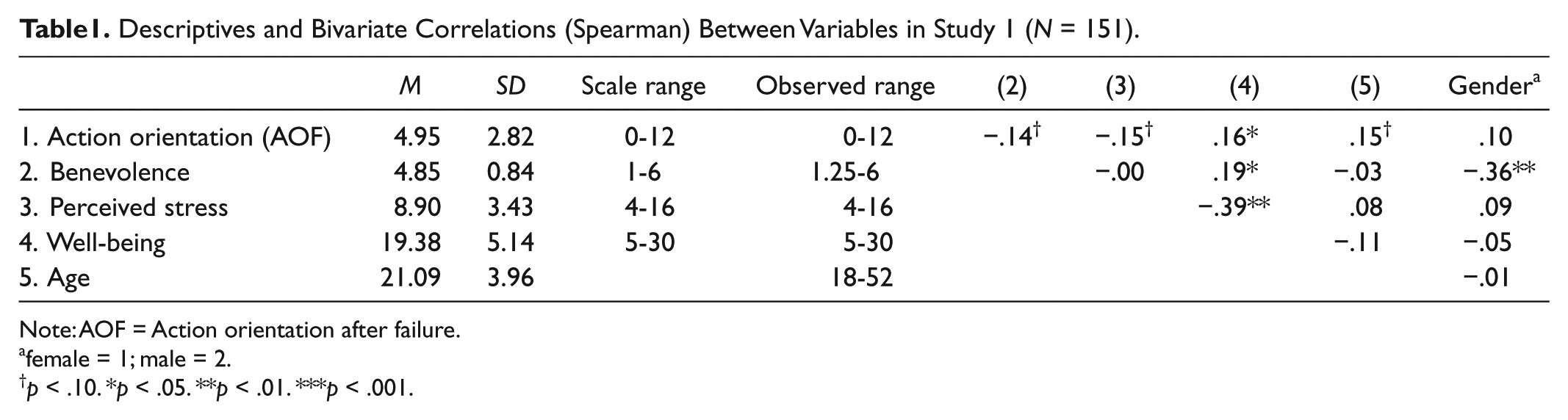
Note: AOF = Action orientation after failure.
female = 1; male = 2.
p < .10. *p < .05. **p < .01. ***p < .001.
Regression Analysis on Well-Being
To test our prediction, a hierarchical regression analysis was conducted on subjective well-being. Age and gender were entered in Step 1; AOF, benevolence, and stress in Step 2; the two-way interactions in Step 3, and the three-way interaction in Step 4. Following Aiken and West’s (1991) recommendations, we centered our predictor variables before calculating their interaction terms. The results are summarized in Table 2.
Hierarchical Regression Analyses Predicting Well-Being (Study 1) and Changes in Negative Affect (Study 2).
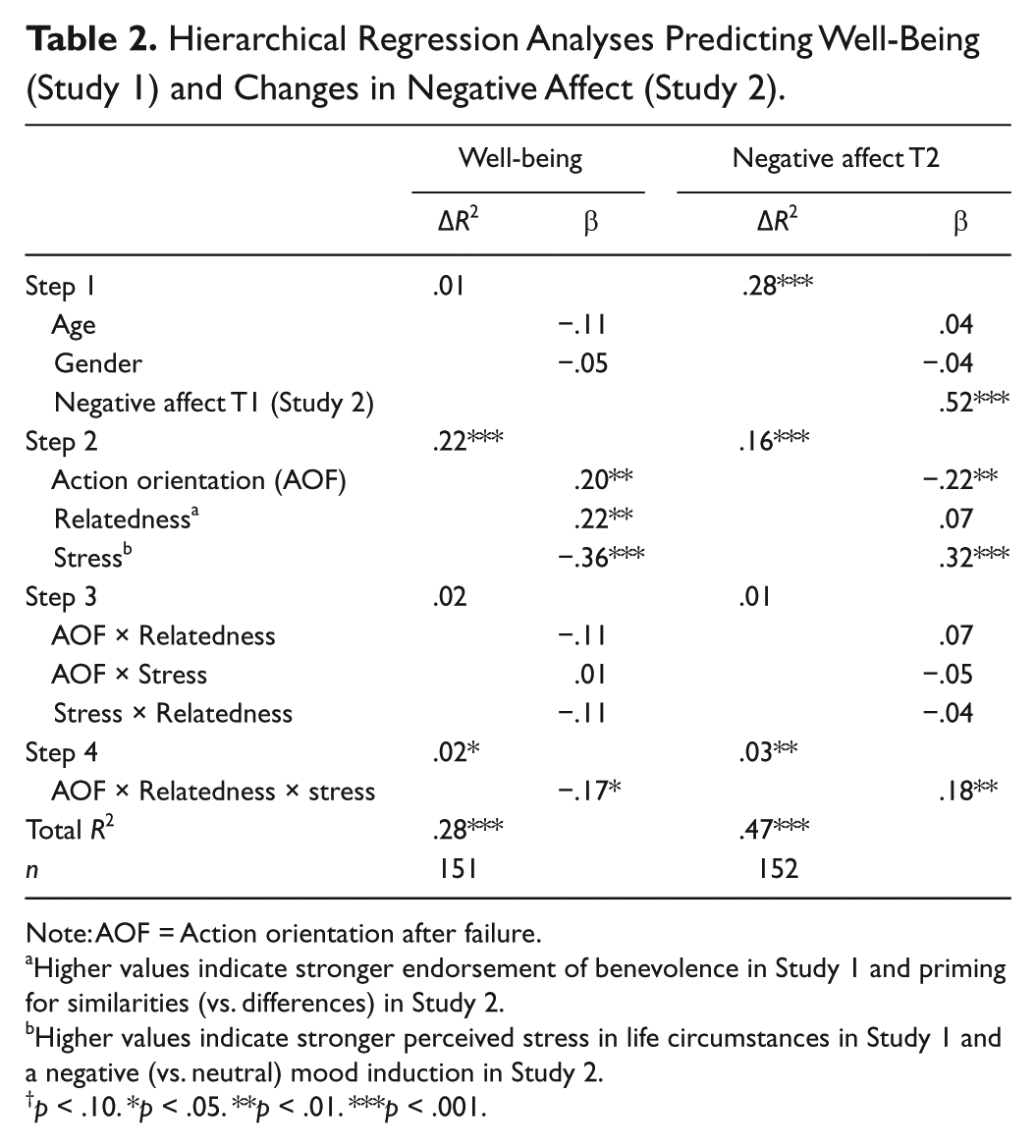
Note: AOF = Action orientation after failure.
Higher values indicate stronger endorsement of benevolence in Study 1 and priming for similarities (vs. differences) in Study 2.
Higher values indicate stronger perceived stress in life circumstances in Study 1 and a negative (vs. neutral) mood induction in Study 2.
p < .10. *p < .05. **p < .01. ***p < .001.
Results indicated that there were significant main effects of AOF, β = .20, t(145) = 2.87, p < .01; benevolence, β = .22, t(145) = 2.85, p < .01; and stress, β = −.36, t(145) = −4.92, p < .001. Higher action orientation, stronger valuation of benevolence, and lower perceived stress were associated with higher well-being. More importantly, there was a significant AOF × Benevolence × Stress interaction, β = .17, t(141) = 2.05, p < .05. Figure 1 illustrates this three-way interaction effect.
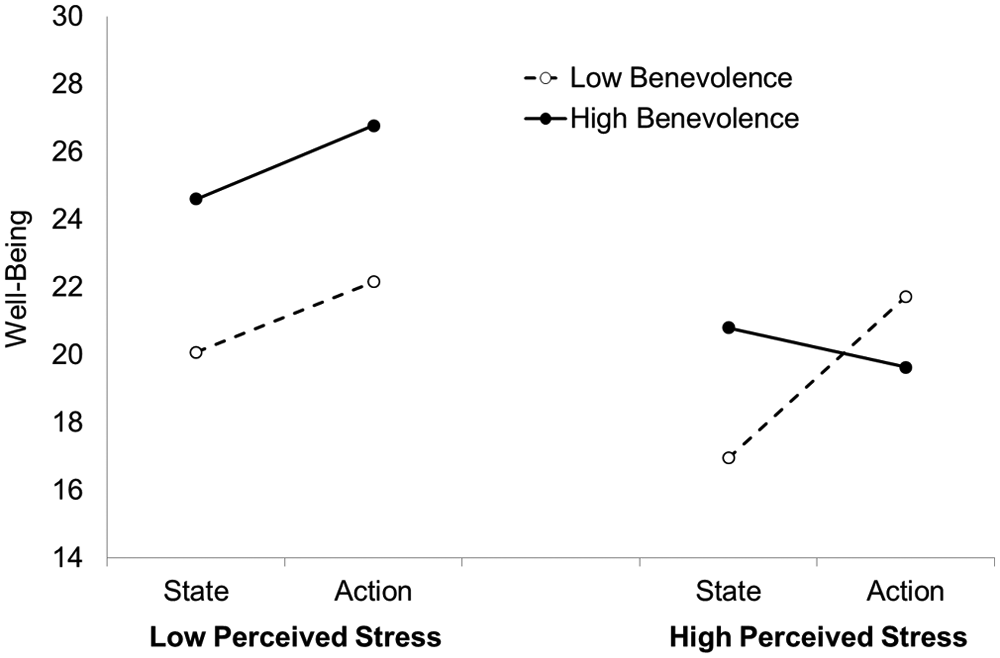
Subjective well-being as a function of benevolence values and self-regulation in Study 1.
When perceived stress was low, there was no significant relationship between AOF and well-being. Simple slope analyses yielded no significant effects of AOF for participants low in benevolence (β = 1.04, t = 1.18, ns), nor among participants who were high in benevolence (β = 1.09, t = 1.53, ns). In contrast, when perceived stress was high, simple slope analyses yielded a significant effect of AOF on well-being for participants low in benevolence, β = 2.39, t = 2.86, p < .005. However, there was no significant effect of AOF on well-being for participants high in benevolence, β = −.59, t = −.99, ns. The slope difference test between these latter two conditions was highly significant, t = −3.04, p < .003. These findings are consistent with our hypothesis that benevolence buffers state-oriented individuals from the negative effects of stress on well-being.
Discussion
In Study 1, we assessed participants’ endorsement of benevolence to capture their natural orientation toward relatedness. Consistent with our hypothesis, higher stress was associated with reduced well-being for state-oriented individuals who devalued benevolence. In contrast, state-oriented individuals who highly valued benevolence reported levels of well-being that were comparable with their action-oriented counterparts, despite both groups reporting high levels of stress. Thus, the results of Study 1 provide preliminary support for our hypothesis that an orientation toward relatedness may reduce the adverse effects of stress in state-oriented individuals. However, because these findings are based on correlational data, inferences about the causal direction of our results must be made with caution. It is possible, for example, that higher levels of well-being lead people to feel more closely connected with others. In this case, benevolence would be the result—rather than the cause—of well-being. Therefore, Study 2 utilizes an experimental approach to examine the causal effect of relatedness on state-oriented individuals’ ability to recover from a negative mood induction.
Study 2
Whereas values grasp longer lasting orientations, situational contexts can also influence the accessibility of specific orientations (e.g., Brewer & Gardner, 1996; Hannover & Kühnen, 2002; Higgins & Bargh, 1987). In Study 2, we experimentally primed relatedness in a sample of psychology undergraduates in Germany by asking participants to write about similarities (vs. differences) between themselves and a friend (Trafimow et al., 1991). The similarity condition has been repeatedly shown to be very effective at priming collective self-cognitions (Oyserman & Lee, 2008; Trafimow et al., 1991). The label “collectivistic” is ambiguous, however, because it confounds high relatedness with low autonomy (Kagitcibasi, 2005). According to Kagitcibasi (2005), a collectivistic orientation is indeed associated with high relatedness but can vary on the dimension of autonomy. Thus, priming for similarities can be better conceived of as increasing the accessibility of relatedness (rather than collectivism).
Because a state orientation is only disadvantageous under stressful and negative conditions, we also experimentally induced a negative (vs. neutral) mood. We expected that state-oriented (compared with action-oriented) participants would show impaired recovery from a negative mood induction after priming for differences (i.e., low relatedness). In contrast, we expected that state-oriented participants would show a mood recovery effect similar to their action-oriented counterpart after priming for similarities (i.e., high relatedness). No differential effects of priming were expected to emerge for state- versus action-oriented participants in the neutral mood condition.
Participants
One hundred and fifty-two psychology undergraduates (117 women and 35 men) from the University Trier, Germany, voluntarily participated in the experiment and received course credit in return for their participation. Their mean age was 22.17 years (range = 18-30 years).
Materials
Momentary Mood
To assess participants’ mood during the experiment, we used a Mood Adjective Checklist similar to the Positive and Negative Affect Schedule (PANAS) (Watson, Clark, & Tellegen, 1988). Participants were asked to rate their momentary mood (“Right now, I feel . . . ”) on a 4-point scale (1 = not at all; 4 = very strongly). Negative affect was assessed by nine items (helpless, puzzled, inhibited, listless, sad, anxious, tense, worried, and distressed). In the present sample, the internal consistency of the mood scale was α = .78.
Action Orientation
As in Study 1, the AOF of the ACS (Kuhl, 1994) was used. In the present sample, the AOF scale had an internal consistency of α = .78.
Priming
An orientation toward relatedness was primed using the Similarities and Differences With Family and Friends Task (SDFF) developed by Trafimow et al. (1991). Specifically, participants were asked to write down either everything that makes them different from their friend (difference priming) or everything they have in common with their friend (similarity priming). Our study differed from the original task developed by Trafimow et al., however, in that participants did not come to the experiment alone. Rather, participants were asked to arrive at the study with a good friend. Furthermore, they were specifically told to compare themselves with their accompanying friend (instead of between themselves and the amorphous statement of “friends and family”). In this way, the concept of relatedness was expected to be particularly salient for participants in this study.
Mood Induction
To induce different mood states, one of two 7-min film sequences were presented. In the negative mood condition, the film contained a report about the terrible living conditions of orphaned children living in a Romanian orphanage (Aust, 1995). This film sequence has been used as an effective mood induction in prior research (e.g., Baumann & Kuhl, 2003). In the neutral mood condition, the film contained a report and interviews with experts about the use of solar energy (Farenski, 2010). Thus, both film sequences are comparable in regard to social interactions that are shown and the style of reporting.
Procedure
The experiment was conducted in group sessions with two to eight participants simultaneously. Before arriving for the study, participants were asked to bring a good friend with them to the experiment. In all cases, participants brought friends who were fellow students. As such, course credit was equally relevant for all participants. Once they arrived, participants were seated in separate, nonadjacent, cubicles and asked to work on their own. Thus, pairs of friends did not interact with each other during the study.
Participants first completed an initial mood rating (T1), followed by the AOF scale and the SDFF priming procedure. For the SDFF, participants were instructed to refer to their accompanying friend after being randomly assigned to one of two priming conditions. Specifically, participants were asked to enter either all of the differences, or all of the similarities, between themselves and their accompanying friend. Participants were instructed to list everything that came to mind and were able to enter this information in a textbox displayed on their computer screen.
After completing the SDFF, participants were randomly assigned to one of two (negative vs. neutral) mood conditions. Priming and mood conditions were balanced across participants. After watching the film sequences, participants rated their momentary mood a second time (T2). They were then asked if they had any assumptions about the purpose of the experiment. Finally, participants were debriefed and received course credits in return for their participation.
The experimental session lasted between 30 and 40 min. Because the main purpose of this study was to investigate the differential effects of the relatedness prime on mood recovery for state- and action-oriented participants, we did not consider the effects of pairs of friends.
Results
Initial Group Differences
The four experimental groups did not differ in their initial mood, F(1, 148) = 0.43, ns; AOF, F(1, 148) = 1.01, ns; age, F(1, 148) = 0.97, ns; or gender, χ2(3, N = 152) = 0.67, ns. To further test for baseline differences in initial mood, a hierarchical regression analysis was conducted on mood at T1. Centered AOF scores, priming (−1 = differences, 1 = similarities), and mood induction (−1 = neutral, 1 = negative) were entered in Step 1, all two-way interactions in Step 2, and the AOF × Priming × Mood Induction interaction in Step 3. Results indicated only a marginally significant main effect of AOF on initial mood, β = –.16, t(148) = −1.97, p < .055. There were no main or interaction effects for priming and mood induction, which indicates that there were no initial differences between experimental conditions for these baseline measures.
Regression Analyses on Negative Affect
To test our hypothesis, a hierarchical regression analysis was conducted on mood at T2. Age, gender, and initial mood (T1) were entered in Step 1; centered AOF scores, priming (−1 = differences, 1 = similarities), and mood induction (−1 = neutral, 1 = negative) in Step 2, all two-way interactions in Step 3, and the AOF × Priming × Mood Induction interaction in Step 4. Results are listed in Table 2.
Results indicated that there were significant main effects of initial mood, β = .52, t(148) = 7.43, p < .001; AOF, β = −.22, t(147) = −3.12, p < .01; and mood induction, β = .33, t(147) = 5.16, p < .001. More importantly, there was a significant AOF × Priming × Mood Induction interaction, β = .18, t(141) = −2.69, p < .01. This three-way interaction effect is illustrated in Figure 2. The AOF × Priming × Mood Induction interaction remained significant when removing baseline mood, age, and gender from our regression model, β = .21, t(144) = 2.64, p < .01.
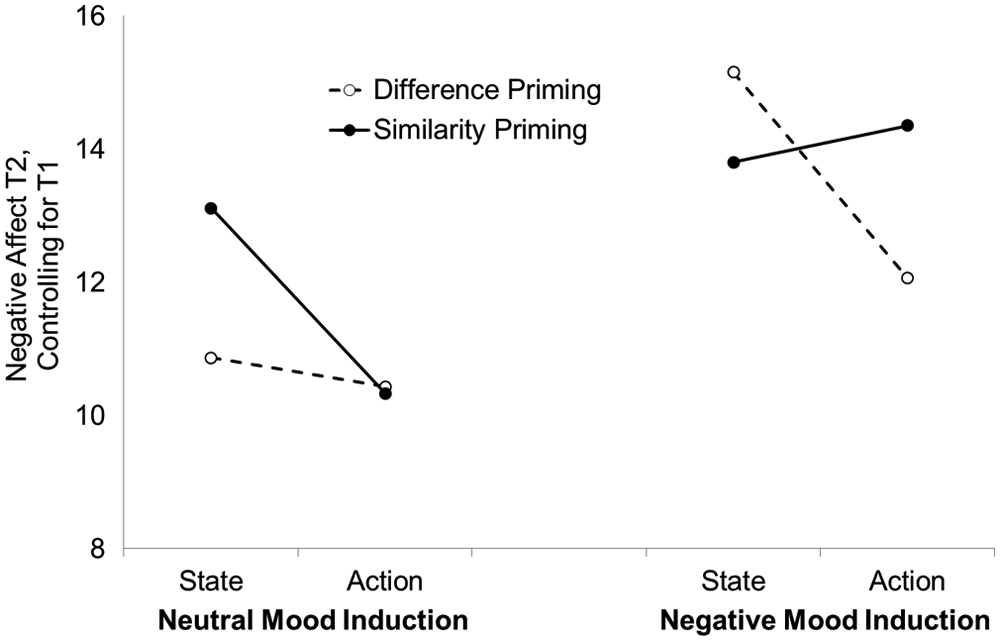
Changes in negative affect as a function of priming, self-regulation, and mood induction condition in Study 2.
In the neutral mood induction condition, there was no significant relationship between AOF and mood recovery. Simple slope analyses yielded no significant effects of AOF for participants primed for differences (β = –.07, t = −.45, ns), nor among participants primed for similarities (β = −.45, t = −1.90, ns). In contrast, in the negative mood induction condition, simple slope analyses yielded a highly significant effect of AOF on mood recovery for participants primed for differences, β = −.50, t = −3.95, p < .001. However, there was no significant effect of AOF on mood recovery for participants primed for similarities, β = .09, t = .50, ns. The slope difference test between these latter two conditions was significant, t = 2.76, p < .01. These findings are consistent with our hypothesis that priming for similarities helps state- oriented participants recover from a negative mood.
Discussion
In Study 2, we induced an orientation toward relatedness by priming for similarities (vs. differences) and investigated its effects on recovery from a negative (vs. neutral) mood induction. In the difference condition, we replicated earlier work showing that action-oriented participants can down-regulate negative emotions better than state-oriented individuals (e.g., Baumann et al., 2005, 2007; Baumann & Kuhl, 2002; Koole & Jostmann, 2004). As expected, however, state- and action-oriented participants did not differ in their ability to recover from a negative mood induction when asked to think about the similarities between themselves and a close friend. Thus, focusing on aspects of relatedness helped state-oriented participants regulate the negative affect elicited by a sad movie.
Study 2 replicated and extended the findings in Study 1 in three important ways. First, we experimentally manipulated an orientation toward relatedness via a priming procedure. Thus, we were able to demonstrate the causal role of relatedness on well-being. Second, we temporarily changed the focus of people’s orientations. Thus, relatedness does not merely produce buffering effects via chronic value orientations, but rather, can be temporarily activated by cues in the environment. Third, we manipulated stress experimentally. Thus, feeling related and connected with others is not just the outcome of relaxed life circumstances, but rather, can serve as a real buffer for state-oriented participants who experience acute stress (e.g., negative mood inductions and/or feelings of helplessness).
General Discussion
In two studies, we investigated the moderating role of relatedness on the relationship between self-regulation and stress-contingent differences in subjective well-being. We expected that an orientation toward relatedness would buffer individuals from the adverse effects that having a state orientation has on well-being under conditions of stress. Our results from Study 1 confirmed that state orientation, in conjunction with endorsement of benevolent values (e.g., responding to the needs of others and support those one knows), was associated with elevated levels of well-being within the context of stressful life circumstances. In a similar vein, our results from Study 2 showed that priming for similarities buffered state-oriented participants from the negative effects that watching a sad film sequence had on their moods. Taken together, the results of Studies 1 and 2 confirm our hypothesis that state-oriented individuals profit from contexts that foster relatedness.
A particular strength of the present research is that we obtained converging results with two different ways of operationalizing relatedness (personal values of benevolence and priming for similarities between self and a close friend) that varied by duration (stable values vs. short-lived priming effects) and scope (content vs. accessibility of self-cognitions). In addition, our results are consistent across two different study designs (correlational and experimental), two different cultures (USA and Germany), and two different self-regulatory outcomes (subjective well-being and affective response to an experimentally induced stressor). This methodological convergence increases confidence in the robustness of our results.
Until now, the impact that feeling interconnected with one’s social environment has on the relationship between state (vs. action) orientation and well-being has only been briefly discussed in the literature (for a notable exception, see Koole et al., 2005). Moreover, to the best of our knowledge, this topic has never been subjected to empirical scrutiny. Thus, our studies are the first to empirically demonstrate the buffering effect of relatedness for individuals with self-regulatory deficits. Moreover, our findings suggest that relatedness can buffer individuals from the adverse effects a state orientation has on multiple self-regulatory outcomes. Furthermore, contexts promoting relatedness do not necessarily have to change one’s core set of personal values. Rather, Study 2 demonstrated that simply reminding someone of his or her similarities with others (“you’re not alone”) can sufficiently compensate for low self-regulatory competencies.
Limitations and Future Perspectives
Because this research represents the early stages of a broad program of research, there are many questions open for future research. First, in the investigation of variation in the importance of relatedness, we included only WEIRD (Western, Educated, Industrialized, Rich, and Democratic) samples. Nonstudent samples and a broader range of cultural contexts are needed to draw conclusions about the generalizability of our findings. It is conceivable that, in more collectivistic cultures, a higher tendency toward state orientation will be found—albeit without the impairments observed in individualistic cultures under stressful conditions (Kuhl & Keller, 2008). Moreover, such cultural contexts may not only compensate for self-regulatory deficits, but they could also show that a state orientation is better suited (relative to an action orientation) to embed the individual in his or her social context.
Second, experimentally varying the accessibility of different self-cognitions can mirror cross-cultural differences in the content of these thoughts, as well as the processes underlying them (Oyserman et al., 2009; Oyserman & Lee, 2008). At the same time, priming offers the advantage of reducing potential confounds that tend to limit the utility of cross-cultural comparisons (for a review, see Hofstede & Hofstede, 2006; Oyserman & Lee, 2008). Indeed, priming effects can be demonstrated across many different parts of the world (Gardner, Gabriel, & Lee, 1999; Oyserman et al., 2002; Oyserman et al., 2009; Oyserman & Lee, 2008). Nevertheless, our present data cannot rule out the possibility that a chronic cultural orientation could interfere with the priming of specific attributes of the self that are incongruent with a given chronic orientation (e.g., Pöhlmann & Hannover, 2006). Moreover, the Western conception of relatedness might be slightly different from the collectivistic idea of relatedness (Cross et al., 2000; Markus & Kitayama, 2010).
Third, asking participants to produce a list of differences (vs. similarities) between themselves and close others alludes to explicit cognitions about oneself. That is, the individual consciously retrieves information that seems relevant in the moment. However, we do not know the extent to which unconscious, automatic, and intuitive parts of the self (i.e., the implicit self) are involved when explicit self-cognitions are measured. Priming methods that do not directly aim to emphasize differences or similarities (e.g., the letter identification task, Pöhlmann & Hannover, 2006; the pronoun-circling task, Brewer & Gardner, 1996; Gardner et al., 1999; Oyserman et al., 2009; or the cultural scenery technique; Goto, Ando, Huang, Yee, & Lewis, 2010; Miyamoto, Nisbett, & Masuda, 2006) could bring forward implicit aspects of the relational self. Thus, including implicit measures could complement findings on the relationship between independent versus interdependent self and self-regulation competencies.
Conclusion
The present research takes a closer look at the interplay between striving for relatedness and self-regulation. Our findings show that relatedness can buffer individuals from the adverse effects of low self-regulation competencies under stress. State-oriented individuals are not always defenseless against negative emotions, nor are action-oriented individuals always better at overcoming emotional distress. Even in individualistic cultures such as the United States and Germany, the concern for relatedness and closeness (i.e., knowing that “you are not alone”) provides a context in which state orientation is not disadvantageous and may even have a bright side.
Footnotes
Declaration of Conflicting Interests
The author(s) declared no potential conflicts of interest with respect to the research, authorship, and/or publication of this article.
Funding
The author(s) received no financial support for the research, authorship, and/or publication of this article.