






Abstract
Four studies tested the hypothesis that a weaker belief in free will would be related to feeling less gratitude. In Studies 1a and 1b, a trait measure of free will belief was positively correlated with a measure of dispositional gratitude. In Study 2, participants whose free will belief was weakened (vs. unchanged or bolstered) reported feeling less grateful for events in their past. Study 3 used a laboratory induction of gratitude. Participants with an experimentally reduced (vs. increased) belief in free will reported feeling less grateful for the favor. In Study 4, a reduced (vs. increased) belief in free will led to less gratitude in a hypothetical favor scenario. This effect was serially mediated by perceiving the benefactor as having less free will and therefore as being less sincerely motivated. These findings suggest that belief in free will is an important part of being able to feel gratitude.
Many everyday situations offer the potential for one to experience gratitude. Although there are individual differences in the frequency and magnitude of feeling grateful, most people experience gratitude at least sometimes (McCullough, Kilpatrick, Emmons, & Larson, 2001). Over the centuries, philosophers and researchers have emphasized the benefits and importance of gratitude for social life. Cicero (1851) referred to gratitude as the greatest of all virtues. Adam Smith (1790/1976) posited that feelings of gratitude are vital for promoting a society involving benevolence and goodwill. Modern theorizing has suggested that gratitude evolved because it promoted altruistic behavior, thereby encouraging further actions to benefit the grateful person (e.g., McCullough, Kimeldorf, & Cohen, 2008; Trivers, 1971). Empirical research has shed light on other beneficial aspects of gratitude. It has been found that feelings of gratitude increase pro-social behavior (e.g., Bartlett & DeSteno, 2006; Grant & Gino, 2010; Tsang, 2006b), strengthen intimate relationships (e.g., Gordon, Impett, Kogan, Oveis, & Keltner, 2012; Lambert, Clark, Durtschi, Fincham, & Graham, 2010), and enhance personal well-being (e.g., Emmons & McCullough, 2003; Wood, Froh, & Geraghty, 2010). In short, gratitude is a common aspect of human life, and research has shown that experiencing gratitude has beneficial effects at the personal and interpersonal levels.
What makes gratitude possible? Gratitude is a positive emotion felt by the recipient of a favor toward the person who bestowed it. We reasoned that the positive emotion is based on recognizing that the favor might well not have been provided. The recognition that the benefactor chose to perform the favor when he or she might have done otherwise may therefore be one important factor in feeling grateful—in other words, that in an important sense, the benefactor freely chose and intended to help. Insofar as one perceives the favor as something the person had no choice but to perform, there is less impetus to feel grateful. The present research tested the hypothesis that belief in a benefactor’s free will would be linked to gratitude.
Scholars and philosophers have discussed the topic of free will for centuries. Philosophical discussions about free will are quite intricate, but laypersons generally view free will as the ability (their own and others’) to act based on personal choices, thoughts, and feelings without internal or external constraints (Monroe & Malle, 2010). Whether or in what sense free will exists is not an issue this research sought to explore. Rather, the present research hypothesized that feelings of gratitude would decrease as belief in free will decreased.
Beliefs About Free Will and Determinism
The present research focused on gratitude as being influenced by the question of whether the benefactor did not have to provide the favor. In principle, either free will or determinism could affect that. Free will generally refers to the ability of the individual to act in different ways in the same situation. Determinism is a metaphysical doctrine that asserts the causal inevitability of every event. Although the two beliefs seem incompatible, many philosophers have found ways of reconciling the two in a position known as compatibilism (e.g., Holton, 2010). Perhaps ironically, few philosophers regard determinism as correct, although they continue to debate its compatibility with freedom of action. The compatibilist considers the free actions of the individual to be essential steps in the causal chain producing the outcome.
The present article focused primarily on belief in free will rather than determinism for a few reasons. First, the idea of free will is easily understood by most participants whereas the concept of determinism is less readily understood (Nahmias, Morris, Nadelhoffer, & Turner, 2005). Therefore, free will belief is likely to be more directly associated with the behaviors of the self and others and more amenable to experimental manipulation than belief in some type of determinism. Second, there is an existing literature (reviewed below) containing effective procedures for manipulating and measuring belief in free will. Beliefs in determinism have not been successfully manipulated to our knowledge.
Measures of belief in determinism do exist, and these have differentiated several different forms of that belief. (Moreover, beliefs in determinism are largely orthogonal to beliefs about free will, consistent with the compatibilist position.) Stroessner and Green (1990) showed that belief in two variants of determinism (psychosocial and religious–philosophical) and free will belief can exist independently. Similarly, Paulhus and Carey (2011) distinguished belief in scientific determinism from belief in fatalistic determinism and found that both exist independently from belief in free will. The two variants of determinism discovered by these researchers are conceptually similar: Psychosocial and scientific determinism refer to belief that biology/genes, environmental influences, and the laws of nature determine behavior. Religious–philosophical and fatalistic determinism refer to belief in fate, destiny, or some divine plan for life.
Meanwhile, beliefs about free will have been both measured and manipulated successfully. Vohs and Schooler (2008) found that those with a reduced belief in free will were more likely to cheat than those who did not have their free will beliefs reduced. Baumeister, Masicampo, and DeWall (2009) found that relative disbelief in free will increased aggression and reduced helpfulness. Alquist, Ainsworth, and Baumeister (2013) found evidence that a disbelief in free will increased conformity. All this work has been agnostic about the reality of free will and merely examined variations in belief. The social reality of such beliefs is well documented. For example, some degree of belief in free will was found across a range of cultures examined by Sarkissian et al. (2010). Even incarcerated adults report a strong belief in free will that is statistically equivalent to that of other adults (Laurene, Rakos, Tisak, Robichaud, & Horvath, 2011).
Given that belief in free will is such a widespread phenomenon, what do non-philosophers think having free will means? Monroe and Malle (2010) asked participants in the United States to explain their understanding of free will. The majority response, made by nearly two thirds of the participants, was “the ability to make choices” (65%). The next most common responses were “doing what you want” (33%) and “acting without internal or external constraints” (29%). Only 2% of the participants indicated that they did not believe free will existed. That proportion is obviously too small to furnish a meaningful basis for behavioral comparisons in smallish samples, but beliefs in free will can be conceptualized as existing on a continuum with varying degrees of certainty and conviction (e.g., Paulhus & Carey, 2011). Like much previous work, the present investigation examined relative differences in degree of belief in free will.
Gratitude
Gratitude has been defined as a positive emotion one experiences from the perception that one has benefitted from a costly, intentional, and voluntary action by another person (Bartlett & DeSteno, 2006; McCullough et al., 2008; Tesser, Gatewood, & Driver, 1968). Several gratitude researchers have used this person-to-person benefit triggered definition of gratitude in their experimental research (reviewed below). Although most research has focused on interpersonal gratitude, there are other possibilities, including transpersonal and theistic variants (Emmons & McCullough, 2004). That is, people may feel grateful to God for life and health, or they might feel grateful for pleasant weather or nature in a non-theistic way. The present research, in line with most experimental research on gratitude, is focused on gratitude as an emotion brought on by perceiving the receipt of a benefit from another person.
Models of gratitude developed by Tesser et al. (1968), and Wood, Maltby, Stewart, Linley, and Joseph (2008) suggest that the intensity of gratitude one experiences after receiving a benefit depends on three factors: (a) how costly it was for the benefactor (e.g., in time, effort, money); (b) how valuable the help was to the beneficiary; and, most relevant to free will beliefs, (c) how sincere the benefactor’s motivations were in providing the help.
Empirical findings have confirmed that gratitude is influenced by perceived motivational sincerity. Tsang (2006a) asked participants to imagine themselves in a scenario in which a friend did them a favor. In the benevolent condition, it was clear that the friend had benevolent intentions (the friend genuinely cared). In the ulterior motive condition, it was made clear that the friend was just doing the favor because he expected a favor in return. Participants in the benevolent favor condition expressed significantly more gratitude than those in the ulterior motive condition. Similar effects have been found when people consider favors from strangers. They feel more grateful when imagining that they had been helped by a stranger who had a benevolent motivation (i.e., the stranger really cared) compared with a self-serving ulterior motivation (i.e., the stranger wanted to feel like a good person for helping; Weinstein, DeHaan, & Ryan, 2010). Tsang (2006b) showed that participants who received a $9 benefit by random distribution reported significantly less gratitude than those who received the same $9 benefit ostensibly due to the voluntary action of a partner. Thus, people are most grateful when they perceive that a volitional agent intended to help them without having ulterior selfish motives. The more benevolent and volitional an action is perceived to be, the greater will be the perception of motivational sincerity. In this article, we focus on the aspect of motivational sincerity related to volition with the assumption that, without information suggesting otherwise, kind acts are perceived as having benevolent intentions.
The role of volition brings up the issue of free will—hence our hypothesis that gratitude will decrease insofar as people perceive that the benefactor’s actions were not the result of his or her free will. We reasoned that the intensity of gratitude would be related to perceiving that the benefactor had voluntarily acted to give the benefit—that is, had freely chosen to perform the favor based on wanting the recipient to benefit. Voluntarily doing what one wants is a factor that laypersons commonly associate with having free will (Monroe & Malle, 2010). If one’s belief in free will is reduced (vs. unchanged or increased), one would consequently view others (including benefactors) as acting less voluntarily and thusly be less sincerely motivated. On that basis, we predicted that people with a relatively weak belief in free will (be it dispositional or experimentally manipulated) would tend to experience less gratitude compared with those with a stronger belief in free will.
Present Research
We proposed that belief in free will influences how one perceives the behavior of others and that experiencing gratitude is based, in part, on a belief in free will. Specifically, we predicted that trait levels of free will belief would be positively associated with dispositional gratitude and that a manipulation that weakened belief in free will would lead to decreased feelings of gratitude triggered by receiving a benefit. We report four studies testing these hypotheses. The first study examined the prediction that trait free will belief would be positively correlated with trait levels of gratitude. The second study manipulated belief in free will and then measured self-reported gratitude from a recall task in which participants recalled a time in which they felt grateful for something. Study 3 manipulated belief in free will and measured feelings of gratitude after participants received a favor during the experiment. Study 4 manipulated belief in free will and measured self-reported gratitude using a scenario procedure. Studies 2 through 4 were experimental tests of the prediction that a reduced belief in free will would lead to a decrease in gratitude. We theorized that by reducing belief in free will, one would perceive the benefactor as having less free will and therefore view the benefactor’s actions as being less voluntary and thus less sincerely motivated. This in turn would lead to a reduction in feeling grateful.
Study 1a
Study 1a used trait measures of gratitude and belief in free will to test the hypothesis that a reduced belief in free will would be linked to a general pattern of not being grateful. Insofar as gratitude depends on perceiving that a benefactor acted voluntarily and could have done otherwise, we predicted that people with stronger belief in free will would have a more grateful disposition than people whose belief is weaker. We used a trait free will belief measure with four subscales, only one of which (Free Will subscale) directly measures belief in free will (pertaining to people generally). Therefore, we predicted that trait gratitude would be positively related to the Free Will subscale and not the other three.
Method
Participants
One-hundred and two participants located in the United States were recruited from Amazon’s Mechanical Turk website and paid 10 cents for participating. Mechanical Turk aids researchers in collecting reliable and representative data on the internet (Buhrmester, Kwang, & Gosling, 2011). Attention-check questions were included to detect random responding, and 11 participants who failed these checks were excluded from analyses. The pattern of results was the same when dropped participants were included in the analysis. The final sample consisted of 91 participants (37 females; M age = 31.8, SD = 13.6).
Materials
The Gratitude Questionnaire (GQ-6)
The GQ-6 (McCullough, Emmons, & Tsang, 2002) is a six-item measure assessing the tendency to experience gratitude in daily life. The scale has good psychometric properties, is correlated with peer reports of gratitude, and is unconfounded with social desirability (McCullough et al., 2002). Sample items include, “I am grateful to a wide variety of people,” and “When I look at the world, I don’t see much to be grateful for” (reverse-coded) on a scale of 1 (strongly disagree) to 7 (strongly agree). The current sample yielded an alpha of .86.
Thus, the GQ-6 measures one’s gratefulness in a larger, more global sense than gratitude in reaction to a specific singular benefit. We believe that participants scoring higher (vs. lower) on this broad conceptualization of gratitude will also tend to experience higher gratitude in response to a specific benefit from another person (i.e., how gratitude is operationalized in the upcoming experimental studies).
The Free Will and Determinism Plus Scale (FAD-Plus)
The FAD-Plus (Paulhus & Carey, 2011) is a 27-item measure of belief in free will that factors into four subscales: Free Will (seven items, α = .74), Scientific Determinism (seven items, α = .51), Fatalistic Determinism (five items, α = .82), and Unpredictability (eight items, α = .63) answered on a 1 (strongly disagree) to 5 (strongly agree) scale. The Free Will subscale consists of items such as “People have complete free will” and “People have complete control over the decisions they make.”
Procedure
Participants completed the GQ-6, the FAD-Plus, and demographic questions online through Mechanical Turk. The presentation order of the two scales was randomized.
Results and Discussion
We tested the prediction that free will beliefs and dispositional gratitude would be positively related, which was supported by a significant positive correlation between scores on the Free Will subscale of the FAD-Plus (M = 3.64, SD = 0.59) and scores on the GQ-6 (M = 5.47, SD = 1.06), r(91) = .22, p = .03, 95% confidence interval (CI) = [0.02, 0.41]. Participants with a stronger belief in free will reported experiencing gratitude on a more regular basis and toward more people than participants with weaker belief in free will.
As predicted, the correlations between the GQ-6 and the other three FAD-Plus subscales were not significant: Scientific Determinism (M = 2.99, SD = 0.50), r(91) = −.15, p = .17, 95% CI = [−0.35, 0.06]; Fatalistic Determinism (M = 2.46, SD = 0.79), r(91) = .04, p = .69, 95% CI = [−0.17, 0.24]; and Unpredictability (M = 3.46, SD = 0.49), r(91) = .15, p = .15, 95% CI = [−0.06, 0.35]. This pattern fits the view that gratitude specifically depends on believing that the benefactor freely possessed the capacity to provide or withhold aid.
Both means were significantly above the scale midpoint—FAD-Plus: t(90) = 10.2, p < .001, d = 2.15; GQ-6: t(90) = 13.2, p < .001, d = 2.78. That indicates that on average, people do tend to believe in free will and feel grateful for life outcomes.
Trait gratitude was only significantly correlated with the Free Will Belief subscale. However, the strength of the correlations among trait gratitude and other subscales were not significantly different from the trait gratitude/free will belief correlation. Study 1b aimed to replicate the significant correlation between trait gratitude and free will belief and to test whether the correlations among trait gratitude and the other subscales of the FAD-Plus remained as not significantly different from the gratitude/free will belief correlation.
Study 1b
The data for Study 1b were collected approximately 1.5 years after the collection of data for Study 1a. As in Study 1a, we predicted that there would be a significant positive correlation between trait gratitude and the Free Will subscale of FAD-Plus and no significant relationships between the GQ-6 and the other three subscales of the FAD-Plus.
Method
Participants
Sixty-three participants located in the United States were recruited from Mechanical Turk and were paid 10 cents for participating. Four participants were dropped due to failing multiple attention-check questions. The final sample consisted of 59 participants (43 females; M age = 36.7, SD = 12.9).
Materials and procedure
As in Study 1a, participants completed the GQ-6 and FAD-Plus. Order of scales was randomized. The sample for this study had an alpha of .92 on the GQ-6, .72 on the Free Will subscale of the FAD-Plus, .70 on Scientific Determinism subscale, .82 on the Fatalistic Determinism subscale, and .73 on the Unpredictability subscale.
Results and Discussion
We again predicted that there would be a positive relationship between the GQ-6 and the Free Will subscale, and again found support. There was a significant positive correlation between scores on the Free Will subscale of the FAD-Plus (M = 3.78, SD = 0.63) and the GQ-6 (M = 5.89, SD = 1.26), r(59) = .39, p = .002, 95% CI = [0.15, 0.59].
As expected, there was not a significant relationship between the GQ-6 and the other three scales on the FAD-Plus: Scientific Determinism (M = 2.91, SD = 0.68), r(59) = −.10, p = .43, 95% CI = [−0.35, 0.16]; Fatalistic Determinism (M = 2.66, SD = 0.95), r(59) = .08, p = .56, 95% CI = [−0.18, 0.33]; and Unpredictability (M = 3.27, SD = 0.64), r(59) = −.11, p = .39, 95% CI = [−0.36, 0.15].
Unlike Study 1a, the strength of the trait gratitude and free will belief correlation was significantly greater than the correlations with the other three subscales (see 95% CIs). This finding increases our confidence in claiming that dispositional gratitude is specifically associated with belief in free will and not other belief constructs related to determinism.
As in Study 1a, the mean score of the GQ-6 was significantly higher than the midpoint, t(58) = 11.5, p < .001, d = 3.02, as was the Free Will subscale, t(58) = 9.52, p < .001, d = 2.50. This suggests that, on average, people tend to believe in free will and generally feel grateful for life events.
Two correlational studies found support for the prediction that gratitude and free will beliefs are linked. People who habitually were more grateful reported stronger belief in free will. Belief in two varieties of determinism as well as perceptions that the world is simply unpredictable did not correlate with gratitude.
Study 2
Study 2 used an experimental design to test the hypothesis that disbelief in free will would cause a decrease in gratitude. The use of experimental design will allow us to move beyond Studies 1a and 1b as we will be able to make causal claims. Study 2 manipulated participants’ belief in free will and then measured participants’ level of gratitude concerning specific events.
To measure gratitude, participants wrote about actual prior experiences from their lives for which they felt grateful. Then, participants rated how grateful they currently felt about that outcome. The prediction was that gratitude would be lower among participants who were induced to disbelieve in free will compared with those whose belief in free will was bolstered or unaltered. Mood was also measured (in the present and subsequent studies) to test the possibility that being induced to disbelieve in free will could be threatening to participants and thus induce a negative mood state or decrease positive mood. Because gratitude is a positive emotion, potential differences in negative or positive affect (compared with changes in free will belief) could account for any differences in gratitude. We predicted that mood would not be a relevant factor.
Method
Participants
Fifty undergraduate students (28 females; M age = 19.6, SD = 1.14) participated in exchange for course credit. Participants were run individually and randomly assigned to one of three conditions: anti-free will sentences, neutral sentences, or pro-free will sentences.
Procedure
Free will belief manipulation
Participants were shown a sentence on a computer screen and instructed to carefully read and think about it. Participants were then asked to type a restatement of the sentence in their own words. There were 10 items and the task was self-paced.
The sentences for all conditions were those originally used by Vohs and Schooler (2008). Examples of anti-free will sentences include “Science has demonstrated that free will is an illusion” and “Everything a person does is a direct consequence of their environment and genetic makeup.” Examples of pro-free will sentences include “I demonstrate my free will every day when I make decisions” and “Ultimately people cannot blame their own actions on anything other than themselves.” In the control condition, participants were asked to rewrite sentences stating facts irrelevant to free will, such as “Oceans cover 71% of the Earth’s surface.”
Gratitude ratings
After completing the manipulation, participants wrote about three events in their life for which they felt grateful to someone else. After writing about each event, participants rated how grateful they currently felt about the event on a scale from 1 (grateful) to 11 (extremely grateful).
Mood measure
Participants completed the Positive and Negative Affect Schedule (PANAS; Watson, Clark, & Tellegan, 1988) to check the possibility that differences in mood account for observed effects. The PANAS is a 20-item self-report measure with a 10-item Positive Affect subscale (e.g., excited, active; α = .92) and a 10-item Negative Affect subscale (e.g., upset, irritable; α = .80). The PANAS was administered after the free will belief manipulation (prior to the gratitude measure).
Results and Discussion
Gratitude
We tested the prediction that participants who rewrote anti-free will sentences would report feeling less grateful than those in the pro-free will and neutral conditions. There was significant variation among conditions in gratitude for the first recalled event, F(2, 47) = 3.27, p < .05, η2 = .12. The pattern was similar but the difference dropped below significance for the second event measure, F(2, 47) = 1.97, p = .15. η2 = .08, and it disappeared entirely on the third measure, F(2, 47) = 0.01, p = .99 (Figure 1). It is common to find that a manipulation’s effects are strongest immediately after its induction (perhaps especially a mind-set manipulation such as we used) and diminish on subsequent measures. Our results conform to that pattern, and so we emphasize the findings from the first measure.
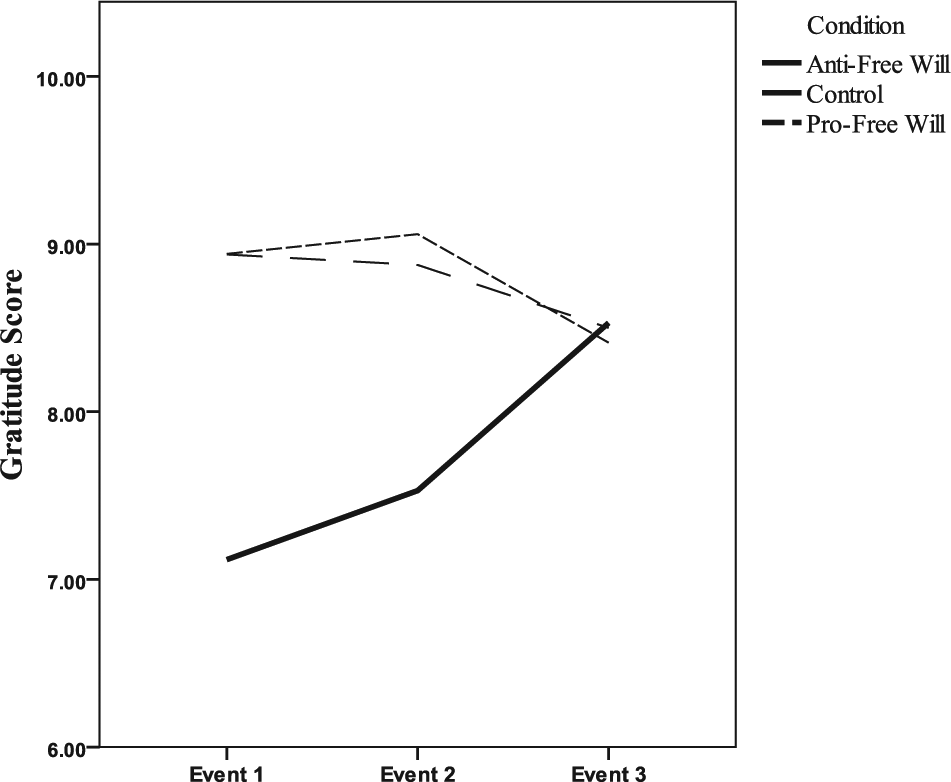
Mean gratitude scores by condition; Study 2.
Planned comparisons were made between the anti-free will condition and pro-free will condition as well as between the anti-free will and neutral conditions across the three events that participants furnished. For the first event, anti-free will participants (M = 7.12, SD = 2.76) were significantly less grateful than pro-free will participants, (M = 8.94, SD = 2.01), t(47) = 2.23, p = .03, d = .75, 95% CI = [0.04, 1.43]. Participants in the anti-free will condition also reported significantly less gratitude than those in the neutral control condition (M = 8.94, SD = 2.32), t(47) = 2.19, p = .03, d = .71, 95% CI = [0.01, 1.40].
On the two subsequent event reports, the differences grew weaker. On the second measure, the difference in gratitude between participants in the anti-free will (M = 7.53, SD = 2.83) and pro-free will conditions (M = 9.06, SD = 2.05) was marginal, t(47) = 1.82, p = .07, d = .62, 95% CI = [−0.08, 1.29]. Participants in the anti-free will condition were marginally less grateful than those in the neutral control (M = 8.89, SD = 2.40), t(47) = 1.58, p = .12, d = .52, 95% CI = [−0.19, 1.20]. No pairwise differences approached significance on the third and final event report.
Mood
We wanted to check whether the manipulation affected mood states, and so we tested PANAS scores as a function of condition. As expected (and in line with past research manipulating free will belief; e.g., Alquist et al., 2013; Baumeister et al., 2009; Vohs & Schooler, 2008), there were no significant differences among the anti-free will (M = 2.59, SD = 0.89), pro-free will (M = 2.78, SD = 0.86), or neutral conditions (M = 2.64, SD = 0.81) on the Positive Affect subscale, or the Negative Affect subscale (anti-free will: M = 1.51, SD = 0.51; pro-free will: M = 1.37, SD = 0.38; neutral: M = 1.43, SD = 0.46), Fs < 1. Direct comparisons between the anti-free will and pro-free will groups likewise did not reveal significant differences in positive or negative affect, ts < 1. Thus, the findings cannot be explained on the basis that the manipulations altered mood.
In line with our hypotheses, participants whose belief in free will had been reduced reported feeling less grateful than participants in either the pro-free will condition or the neutral condition. The difference was statistically significant for the first recalled event. For the second recalled event, the differences dropped just outside the significant range. By the third recalled event, there were no statistically significant differences among conditions.
Study 3
The aim of Study 3 was to examine the effects of free will belief on gratitude about the same beneficial act. In Study 2, participants selected events from their own lives to write about, so each event was necessarily unique. To rectify this potential drawback, Study 3 participants reported their gratitude toward the same event. Another goal was to measure the effects of belief in free will on gratitude for a real event that occurred during the experiment.
We assumed that most participants would prefer to be done with their research obligation and leave the laboratory sooner than later. Therefore, the present study incorporated a favor such that participants were relieved from a tedious task and thus released from part of their obligation. We anticipated that this favor would engender varying degrees of gratitude among participants.
Another aim of Study 3 was to examine variables that are related to the degree of gratitude one feels after receiving a benefit (based on Tesser et al., 1968; Wood et al., 2008). Participants answered questions about their perception of the value of the favor, the cost of the favor to the benefactor, and the motivation of the benefactor.
We predicted that participants in the anti-free will condition (vs. pro-free will) would report feeling less grateful and that this effect would be mediated by perceptions of motivational sincerity. Perceptions of value, perceptions of cost, and feelings about the tedious task they avoided were also measured. This was done in an exploratory fashion to help rule out potential alternative explanations and also to help attain a more complete picture of potential underlying processes.
Method
Participants
Forty-two undergraduate students (34 females; M age = 19.7, SD = 2.81) participated in exchange for course credit. Participants were run in individual sessions. They were randomly assigned to read one of two essays: an anti-free will essay or a pro-free will essay. Both experimenters were blind to condition.
Procedure
Free will belief manipulation
Participants were told the study was about reading comprehension and were randomly assigned to read an essay that argued for or against the existence of free will. The anti-free will essay was a modified version of a passage written by Francis Crick (1994). The anti-free will essay contained lines such as “Everything people are and do is the product of simple, physical processes in their brains” and “There is no need for the existence of free will to explain how we behave.” The pro-free will essay was created by rewording phrases in the anti-free will essay and contained lines such as “Everything people are and do is mostly a product of the decisions they make and their free will” and “There is a strong need to consider free will when trying to explain human behavior.” The two essays were similar in length (314 and 325 words). Participants wrote a summary of the essay (while the essay was still on screen) to ensure that they comprehended the main point. Participants completed the PANAS (Watson et al., 1988) after the manipulation (Positive Affect subscale α = .93; Negative Affect subscale α = .83).
Gratitude induction
Participants were told that they would participate in an unrelated task. The task required participants to write two pages about their day yesterday but with the stipulation that they cannot use words containing the letters “A” or “N.” Participants were then directed to another room to work on the task. When the participants entered the room, the second experimenter said that they did not have to do the task as she could find other people to do it instead.
Participants returned to the first experimenter and were told that the lab was actually interested in person perception. The participant then answered one question about the experimenters’ motivational sincerity in giving the favor, one question about the value of the favor, one question about the cost of the favor to the experimenter, and one question about how grateful they felt. Participants also rated how much they had wanted to do the writing task, and how happy they were that they did not have to do the task. All questions were on a 1 (not at all) to 9 (very much) scale. Finally, participants answered how much they believed in free will on a 1 (not at all) to 9 (entirely) scale.
Results
A review of participant essay summaries by two raters (with 100% agreement) indicated that all participants understood the main point of the essay. A manipulation check revealed that those in the anti-free will condition (M = 6.30, SD = 1.78) reported weaker belief in free will than those in the pro-free will condition (M = 7.50, SD = 1.34), t(40) = 2.49, p = .02, d = .76, 95% CI = [0.13, 1.38].
It was predicted that participants who read the anti-free will essay, compared with those who read the pro-free will essay, would report less gratitude and that this effect would be mediated by perceptions of motivational sincerity. No differences were expected on perceptions of value or cost. An independent sample t test confirmed that participants in the anti-free will condition (M = 5.95, SD = 2.37) reported feeling significantly less grateful than those in the pro-free will essay condition (M = 7.36, SD = 2.06), t(40) = 2.07, p = .045, d = .64, 95% CI = [0.01, 1.25]. Also as predicted, participants in the anti-free will essay condition (M = 2.80, SD = 1.94) perceived the benefactor as being less sincerely motivated to help them than those in the pro-free will essay condition (M = 4.27, SD = 1.91), t(40) = 2.48, p = .017, d = .76, 95% CI = [0.12, 1.38]. There were not significant differences between people in the anti- (M = 5.00, SD = 2.97) and pro- (M = 4.91, SD = 2.76) free will conditions on how valuable the favor was, t(40) = 0.10, p = .92, d = .03, 95% CI = [−0.58, 0.64]. Nor were there differences between those in the anti- (M = 4.10, SD = 2.36) and pro- (M = 3.86, SD = 2.12) free will conditions on perception of how costly the favor was to the benefactor, t(40) = 0.34, p = .73, d = .11, 95% CI = [−0.50, 0.71].
Additional t tests showed that participants in the anti-free will (M = 6.75, SD = 2.12) and pro-free will (M = 6.86, SD = 1.52) conditions were equally happy that they did not have to do the task, t(40) = 0.20, p = .84, d = .06, 95% CI = [−0.55, 0.67], and that the anti-free will (M = 2.60, SD = 2.14) and pro-free will (M = 2.27, SD = 1.64) groups did not differ in the extent to which they wanted to do the writing task, t(40) = 0.56, p = .58, d = .17, 95% CI = [−0.44, 0.78]. There were no significant differences between those in the anti-free will condition (M = 2.84, SD = 0.97) and the pro-free will condition (M = 2.46, SD = 0.89) on the Positive Affect subscale of the PANAS, t(40) = 1.33, p = .19, d = .41, 95% CI = [−0.21, 1.01], nor between those in the anti-free will (M = 1.38, SD = 0.49) and pro-free will conditions (M = 1.24, SD = 0.29) on the Negative Affect subscale, t(40) = 1.18, p = .24, d = .35, 95% CI = [−0.27, 0.96].
Participants in the anti-free will condition (vs. pro-free will) perceived the benefactor to be less motivated by a sincere desire to help and reported feeling less grateful. There were no significant differences between conditions on how valuable the favor was, how costly the favor appeared to be to the benefactor, mood, desire to do the task, or happiness about not having to do the task.
Mediation
Our focus was on motivational sincerity as a potential mechanism. When both motivational sincerity and free will belief condition were used to predict gratitude, the effect of the anti- vs. pro-free will condition was reduced to non-significance (β = .18, t = 1.20, p = .24, sr = .17), whereas the effect of motivation sincerity remained significant (β = .35, t = 2.25, p = .03, sr = .32). A bootstrapping analysis (Preacher & Hayes, 2008) based on 5,000 resamples tested whether the indirect effect of the free will belief manipulation on gratitude ratings through perception of motivation sincerity was significantly different from zero. The 95% CI for the indirect effect did not contain zero [0.07, 1.72], indicating that the indirect effect of the free will belief manipulation on gratitude through perceptions of motivational sincerity was significant (p < .05). Hence, the difference in gratitude between the pro-free will and anti-free will conditions was statistically mediated by a corresponding difference in the perception of motivational sincerity.
Discussion
Study 3 used a novel gratitude induction based on an actual favor done for the participant during the laboratory session. Participants in the anti-free will condition reported feeling less grateful than participants in the pro-free will condition. Furthermore, this effect was statistically mediated by perceptions of motivational sincerity. Hence, results from this study support the hypothesis that there is a positive relationship between free will belief and gratitude and that this relationship is mediated by the perception of the motivational sincerity of the benefactor.
Study 4
The aim of Study 4 was to extend the findings from Study 3 and address potential drawbacks from previous studies. Studies 2 and 3 relied on single items measures for the key dependent variables. Study 4 sought to address this issue by including multiple items for each construct measured. Another aim of Study 4 was to replicate and expand on the mediation found in Study 3.
In Study 4, participants read a vignette recounting a small favor and answered several questions about their perception of the value of the favor, the cost of the favor to the benefactor, and the motivation of the benefactor. This study added a new process variable measuring how much free will participants believed the benefactor had. Because belief in free will involves beliefs about whether others generally (the self included) have free will, we expected that experimentally reducing belief in free will would influence perceptions of the benefactor’s volition and therefore decrease reported gratitude. A double mediation model was predicted in which participants whose belief in free will had been weakened (vs. bolstered) would perceive the benefactor as having less free will and therefore perceive the benefactor as being less sincerely motivated (by virtue of behaving less voluntarily) in providing the favor, and therefore report feeling less grateful.
Method
Participants
Seventy participants from Mechanical Turk volunteered to participate in exchange for a 25 cent payment. All participants were located within the United States. One participant failed multiple attention checks and was dropped from analyses. Five participants expressed suspicion and were dropped. Participants were dropped if they explicitly mentioned the connection between the free will manipulation and the dependent variable, that is, how free will belief may influence perceptions of the benefactor. The final sample consisted of 64 participants (32 females; M age = 37.7, SD = 13.3).
Procedure
Free will belief manipulation
The free will belief manipulation was the same as Study 3. In this study, participants were informed that they would receive a small bonus payment (5 cents) if their summary of the essay indicated that they actually read and understood the essay.
Mood measure
After the free will belief manipulation, participants completed the Brief Mood Introspection Scale (BMIS; Mayer & Gaschke, 1988), which contains eight pleasant mood items (e.g., lively, happy; α = .82) and eight unpleasant mood items (e.g., sad, gloomy; α = 80) that were answered on a 1 (definitely do not feel) to 4 (definitely feel) scale (16-item α = .85).
Dependent measures
After the essay task, participants began an ostensibly unrelated task on imagination. Participants read a brief vignette (adapted from Wood et al., 2008) written from a second-person perspective and imagined they were the one being helped. The vignette involved a consumer realizing that he or she did not have enough money to buy something and a stranger helping by giving the change needed. Participants then answered questions related to feelings of gratitude, free will of the benefactor, motivation of the benefactor, perceptions of how valuable the help was, and perceptions of cost to the benefactor.
To analyze gratitude, two items were averaged: “I feel extremely appreciative for the help” and “I feel an overwhelming sense of gratitude toward the person” (α = .72).
Participants answered four questions to measure perceptions of the benefactor’s free will: “The person felt like they had no choice but to help” (reverse-scored), “The person freely decided to help,” “The person was influenced by factors outside of their control” (reverse-scored), and “The person had complete free will when deciding to help.” Questions were answered on a slider scale (0-100) with endpoints labeled “very strongly disagree” and “very strongly agree.” These four items were averaged to create a benefactor free-will composite (α = .70) that was used in the analyses.
A three-item index (α = .86) of the average rating was created to assess differences in perceptions of motivational sincerity: “The person just genuinely wanted to help,” “The person helped me out of the kindness of their heart,” and “Overall, the person was motivated by a sincere desire to help.”
Four items (α = .86) were averaged to analyze perceptions of how much participants valued the help (e.g., “The help provided was a very big favor to me”; “Overall, the help was very valuable to me”). A five-item index (α = .91) of the average rating was computed to analyze perceptions of how costly participants viewed the help to cost the benefactor (e.g., “It cost the person a great deal of effort to help me”; “Overall, it was very costly for the person to help me”).
The items measuring motivational sincerity, value, cost, and gratitude were presented on a slider scale (0-100) with endpoints labeled “agree a little” and “very strongly agree.” Thus, a “disagree” option was not offered. We reasoned that because it was explicit that a benefit was received, participants would report at least a small amount of agreement on these variables. By not offering a disagree option, we aimed to increase the variability in responses and avoid potential ceiling effects.
After the main dependent measures, participants answered a manipulation check item: “To what extent do you believe in free will” on a 1 (not at all) to 9 (entirely) Likert-type scale.
Results and Discussion
Two raters reviewed the essay summaries and determined with 100% agreement that all participants understood the main point of the essay (either that science supports the idea that free will does not exist, or that science supports the idea that free will does exist). Therefore, all participants received a small bonus payment. A manipulation check at the end of the study revealed that those who read the anti-free will essay (M = 6.85, SD = 1.99) reported a weaker belief in free will than those who read the pro-free will essay (M = 8.29, SD = 0.90), t(62) = 3.70, p < .001, d = .93, 95% CI = [0.40, 1.43]. There were no significant differences in the pleasant–unpleasant mood score on the BMIS between the anti-free will (M = 43.5, SD = 5.1) and the pro-free will (M = 44.9, SD = 5.4) conditions, t(62) = 1.06, p = .29, d = .27, 95% CI = [−0.23, 0.76].
We predicted that participants in the anti-free will condition would view the benefactor as having less free will, perceive the benefactor as being less sincerely motivated, and feel less gratitude toward the benefactor. Differences were not expected on perceptions of value or cost.
Participants in the anti-free will condition (M = 64.9, SD = 27.2) reported feeling less grateful than those in the pro-free will condition (M = 78.4, SD = 19.1), t(62) = 2.27, p = .027, d = .57, 95% CI = [0.06, 1.06].
An independent samples t test on the benefactor free will index revealed that participants in the anti-free will group (M = 77.4, SD = 19.7) perceived the benefactor as having less free will than those in the pro-free will group (M = 87.4, SD = 13.2), t(62) = 2.37, p = .021, d = .60, 95% CI = [0.09, 1.09].
An independent samples t test was conducted on the three-item index assessing benefactor motivation. Participants in the anti-free will condition (M = 53.2, SD = 18.4) perceived the benefactor as being less sincerely motivated than participants in the pro-free will condition (M = 63.6, SD = 10.4), t(62) = 2.77, p = .007, d = .70, 95% CI = [0.18, 1.19], which confirms our prediction.
T tests did not show significant differences between conditions on perceptions of value (anti-free will: M = 56.0, SD = 29.1; pro-free will: M = 65.8, SD = 23.7), t(62) = 1.47, p = .147, d = .37, 95% CI = [−0.13, 0.86] or perceptions of cost (anti-free will: M = 3.9, SD = 5.4; pro-free will: M = 9.4, SD = 15.9), t(62) = 1.89, p = .062, d = .46, 95% CI = [−0.03, 0.96]. Thus, consistent with our reasoning, the manipulation of free will beliefs altered perceptions of motivational sincerity but not of the other two determinants of gratitude (cost to benefactor and value to recipient). However, unlike in Study 3, perceptions of value and of cost between conditions were nearly significantly different and had a close to moderate effect size.
In summary, participants in the anti-free will condition (vs. the pro-free will condition) perceived the benefactor in a hypothetical scenario as having less free will. In addition, participants in the anti-free will condition perceived the benefactor as being less sincerely motivated and reported less gratitude compared with those in the pro-free will condition.
Mediation
Our proposed serial multiple mediator model was that participants in the anti-free will belief (vs. pro-free will belief) condition would perceive the benefactor as having less free will, which in turn would reduce perceptions of motivational sincerity, and therefore lead to less gratitude toward the benefactor. To test this model, we ran a mediation analysis using the PROCESS bootstrapping macro (Model 6, Hayes, 2013) for SPSS with 5,000 resamples and 95% bias-corrected standardized bootstrap CI. The anti-free will condition was coded as 0 and the pro-free will condition was coded as 1. These analyses are depicted in Figure 2.
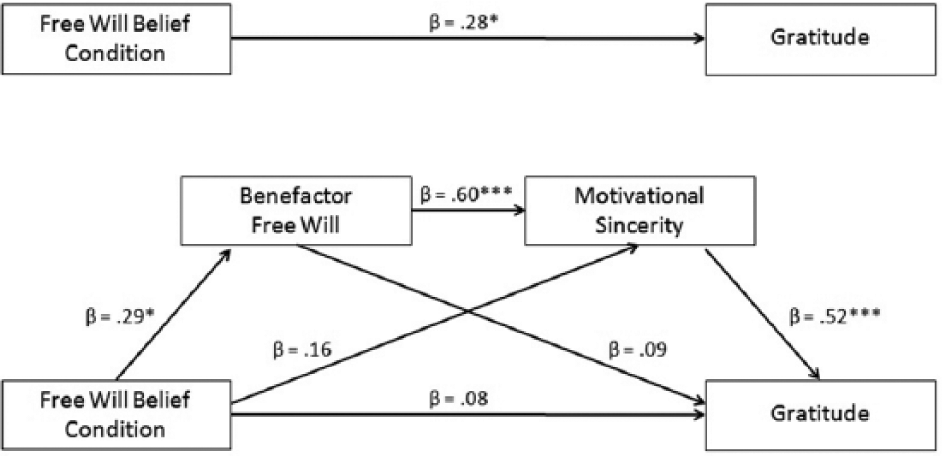
Serial mediation model; Study 4.
The effect of the free will belief condition on gratitude was significant without including any mediators, β = .28, t(62) = 2.27, p = .027, sr = .28; however, the direct effect was not significant when perceptions of benefactor free will and perceptions of motivational sincerity were respectively added as serial mediators, β = .08, t(62) = 0.72, p = .472, sr = .07. The specific indirect effect through both mediators (i.e., free will condition predicts free will of benefactor, which predicts perceptions of motivational sincerity, which predicts gratitude) was significant, as the 95% CI did not contain zero [0.019, 0.226]. The 95% CI of the total indirect effect also did not contain zero [0.061, 0.371] indicating a significant total indirect effect. Tests of alternate specific indirect effects whereby only one of the variables served as the mediator within the double mediator model were not significant, indicating additional support for the serial–multiple–mediator framework. The specific indirect effect of free will condition on gratitude through beliefs about benefactor free will was not significant, 95% CI = [−0.032, 0.133]. The specific indirect effect of free will condition on gratitude through beliefs about the benefactor motivation was not significant either, 95% CI = [−0.006, 0.217].
Thus, the free will belief condition indirectly influenced reported gratitude through its serial effect on beliefs about the benefactor’s free will and perceptions of the benefactor’s motivation. Specifically, those with a reduced belief in free will perceived the benefactor as having less free will and as a result perceived the benefactor as being less sincerely motivated, leading to weaker feelings of gratitude toward benefactor.
General Discussion
Beliefs about free will contribute to gratitude. Four studies with different methods found consistent, convergent support for that hypothesis. A personality trait measure of broad tendencies to feel grateful for things was positively correlated with a trait measure of belief in free will (Studies 1a and 1b). A reduced belief in free will induced by a laboratory manipulation caused people to report feeling less gratitude for an event from their lives in which they had reason to be grateful (Study 2). A different manipulation of free will belief likewise caused those with a reduced belief to report less gratitude for an actual favor performed to benefit the participant in the context of the laboratory session (Study 3). Another study showed that a reduced belief in free will led to less gratitude in response to a hypothetical favor in a vignette (Study 4).
How is free will involved in gratitude? We reasoned that gratitude is associated with perceiving that the benefactor did not have to give the benefit and thus freely chose to give the benefit. Hence, one is more grateful to the extent that one perceives that the other freely and voluntarily chose to provide the benefit. We predicted and found that perception of benefactor free will was positively related to a pre-existing construct in the gratitude literature called motivational sincerity. We found consistently that free will beliefs altered perceptions of motivational sincerity and that these changes mediated the effects on gratitude. That is, people who were induced to disbelieve in free will reported a weaker perception that the benefactor had genuinely wanted to benefit them, and those perceptions mediated the tepid feelings of gratitude they reported (Studies 3-4). The most thorough evidence came in Study 4, which found that the manipulated reduced belief in free will caused a reduction in the perception of the benefactor as acting freely, which in turn caused a reduction in perception of the benefactor’s motivational sincerity, which then caused a reduction in gratitude.
Thus, in this case, the relevance of free will applies to the other person’s free will rather than one’s own. Although free will belief is belief about people in general (the self and others), most previous work with free will belief has focused on how changes in free will beliefs produce effects by changing people’s sense of their own freedom to act: thus with cheating and stealing (Vohs & Schooler, 2008), helping and aggressing (Baumeister et al., 2009), conformity (Alquist et al., 2013), and volunteering (Stillman & Baumeister, 2010). Some work has shown that people are less prone to punish criminals and other wrongdoers insofar as they disbelieve in free will (Shariff et al., 2014). This package of studies may be the first to show that beliefs about free will have an impact on how one responds to positive behaviors by others.
Study 2 included a neutral control group. The pro-free will manipulation did not produce an increase in gratitude above the baseline indicated by the neutral control group. The anti-free will group did cause a drop in gratitude. The pattern that manipulations that reduce free will belief depart from the norm more than manipulations that seek to enhance or increase it has been found in multiple studies (e.g., Alquist et al., 2013; Baumeister et al., 2009; Vohs & Schooler, 2008) and may reflect a ceiling effect, insofar as baseline levels of belief in free will are generally high.
We noted that gratitude theories (e.g., Tesser et al., 1968; Wood et al., 2008) have emphasized three determinants of gratitude, one of which is most relevant to beliefs about free will. The current studies show that perceptions of the benefactor’s motivational sincerity is positively related to free will belief, whereas the other two (benefactor’s perceived cost and recipient’s value gained) do not to the same extent. Some research (e.g., Tsang, 2006b; Weinstein et al., 2010) has portrayed the benefactor’s helping motivation as having selfish ulterior motives (e.g., wanting a favor in return) or as sincere (e.g., being genuinely concerned). Free will belief is related to a different aspect of perceiving others’ motivations, namely the volition of the benefactor. For participants with a reduced (vs. increased) belief in free will, benefactor motivation was perceived as less sincere because it was seen as less voluntary, as opposed to being seen as having (intentional) selfish motives.
The current findings have relevance to the concept of counterfactual thinking. Counterfactual thinking involves “what might have been” thoughts, which means realizing that an outcome might have gone another way. They have been most frequently associated with negative outcomes (Epstude & Roese, 2008; Roese, 1997; Smallman & Roese, 2009), although they contribute to some positive feelings about positive outcomes too such as relief (Sweeny & Vohs, 2012). Free will is widely understood as the possibility to act differently, and some evidence indicates that belief in free will contributes to engaging in counterfactual thinking (Alquist, Ainsworth, Baumeister, Stillman, & Daly, 2012). It is plausible that belief in free will helps people appreciate that the benefactor might well not have done the favor, which would increase gratitude. Future work may benefit by elucidating the potential contribution of counterfactual analysis to gratitude and its relation to beliefs about free will.
The present work has some limitations that should be mentioned. First, some of the studies had a small to medium sample size, which may call the reliability of the findings into question. However, concern about reliability should be somewhat alleviated because multiple studies yielded similar findings. Second, gratitude in all the experimental studies was operationalized as self-reported reactions to a specific benefit from another person. As discussed previously, gratitude can be conceptualized in alternative ways as well (e.g., in a transpersonal or theistic sense). This article also focused specifically on experimentally altering free will belief and not beliefs about various types of determinism. Therefore, it would be beneficial for future research to explore how belief in free will is related to alternative conceptualizations of gratitude and also the role that beliefs about different types of determinism and their interaction with belief in free will may play. Finally, the process measures involved in how free will belief influences gratitude merit more attention. We found that perceptions of benefactor free will and benefactor motivation were important mediating variables in multiple studies, whereas perception of value and cost were not. However, perceptions of value and cost approached being significantly different (anti-free will condition perceiving less of both) in Study 4 (a monetary benefit) but not Study 3 (a favor saving the participant time and energy). Hence, it is possible that the nature of the benefit (e.g., a monetary vs. non-monetary benefit, or a small vs. large favor) could be a factor that implicates additional mediating variables (such as cost or value) and therefore could be a variable worth manipulating in future work.
Conclusion
Four studies provided evidence that belief in free will contributes to feelings of gratitude. Weaker dispositional and experimentally reduced free will belief was consistently associated with less gratitude. A reduced personal belief in free will led people to downgrade their perception of a benefactor as having free will and as having performed the favor as a voluntary choice based on a sincere desire to help. This significantly reduced gratitude. This work showcases the importance of belief in free will as facilitating the experience of the socially beneficial emotion of gratitude.
Grand questions about free will have prompted experts to engage in complex metaphysical, semantic, and even theological debates. Our work has nothing to say about these. In the social lives of ordinary people, however, freedom to choose and voluntary action are important categories of person perception that shape how people treat each other. Gratitude is one important positive lubricant of social interaction. Our findings suggest that the feeling and expression of gratitude are tied to the perception of whether the benefactor might indeed have done otherwise and instead freely choose to confer a benefit.
Footnotes
Declaration of Conflicting Interests
The author(s) declared no potential conflicts of interest with respect to the research, authorship, and/or publication of this article.
Funding
The author(s) disclosed receipt of the following financial support for the research, authorship, and/or publication of this article: This research was supported in part by a grant from the Templeton Foundation #23043.

References
Supplementary Material
Please find the following supplemental material available below.
For Open Access articles published under a Creative Commons License, all supplemental material carries the same license as the article it is associated with.
For non-Open Access articles published, all supplemental material carries a non-exclusive license, and permission requests for re-use of supplemental material or any part of supplemental material shall be sent directly to the copyright owner as specified in the copyright notice associated with the article.
