







Abstract
After committing an offense, transgressors can optimize their chances of reconciling with the victim by accepting responsibility. However, transgressors may be motivated to avoid admitting fault because it can feel threatening to accept blame for harmful behavior. Who, then, is likely to accept responsibility for a transgression? We examined how implicit theories of personality—whether people see personality as malleable (incremental theory) or fixed (entity theory)—influence transgressors’ likelihood of accepting responsibility. We argue that incremental theorists may feel less threatened by accepting responsibility because they are more likely to view the situation as an opportunity for them to grow as a person and develop their relationship with the victim. We found support for our predictions across four studies using a combination of real-world and hypothetical offenses, and correlational and experimental methods. These studies therefore identify an important individual difference factor that can lead to more effective responses from transgressors.
One of our good fortunes in life is that we can often say and do things to heal our relationships after we have damaged them. This reconciliation process typically begins with the realization that we have committed an offense, which might come immediately, upon reflection of the situation, or upon seeing the victim’s reaction to our behavior. The realization that we have acted inappropriately can create feelings of guilt, shame, rumination, or a simple desire to repair the relationship, all of which can influence how we will choose to respond to the victim (Baumeister, Stillwell, & Heatherton, 1994; Riek, Root Luna, & Schnabelrauch, 2014; Woodyatt & Wenzel, 2014). Although we might often feel motivated to deny the offense, justify our actions, or avoid discussion of the event, research on conflict management suggests that apologizing is one of the most effective actions that transgressors can take to encourage reconciliation with victim (Fehr, Gelfand, & Nag, 2010; McCullough et al., 1998; Ohbuchi, Kameda, & Agarie, 1989; Schumann, 2012).
But not all apologies are created equal, and past research has pinpointed the qualities of an apology that make it effective. It is widely agreed that a core element of a good apology is an admission of responsibility for the offense (Darby & Schlenker, 1982; Exline, DeShea, & Holeman, 2007; Lazare, 2004; Scher & Darley, 1997; Schumann & Ross, 2010; Tavuchis, 1991). By accepting responsibility for the offense, transgressors transfer the blame from the victim to themselves, validate the victims’ perceptions of their behavior, and convey that they are aware their behavior was wrong.
Research examining the consequences of accepting responsibility for one’s offense suggests that this element is pivotal in promoting forgiveness and resolution of the conflict (Kirchhoff, Wagner, & Strack, 2012; Pace, Fediuk, & Botero, 2010; Scher & Darley, 1997). One striking example of the importance of admitting responsibility comes from a study in which participants imagined they had been hit by a bicyclist and injured in the accident. Compared with participants who received no apology or imagined receiving a sympathy-oriented apology from the transgressor (“I am so sorry that you were hurt. I really hope that you feel better soon”), those who imagined receiving a responsibility-accepting apology (“I am so sorry that you were hurt. The accident was all my fault. I was going too fast and not watching where I was going until it was too late”) evaluated the transgressor more positively, felt more sympathy and less anger toward the transgressor, were more willing to forgive the transgressor, and were substantially more likely to accept a settlement offered by the transgressor (Robbennolt, 2003).
Transgressors may therefore optimize their chances of reconciling with the victim if they accept responsibility for the offense in their apologies. Why, then, might some transgressors choose not to take responsibility for their actions? Decades of research have demonstrated that people are highly motivated to maintain their identity as a good and worthy person (Sherman & Cohen, 2006; Steele, 1988). Committing an interpersonal offense can threaten this important identity, as an offense implies that one has broken social rules, acted inappropriately, and possibly harmed another person (E. Aronson, 1999; Goffman, 1971; Schlenker & Darby, 1981). For this reason, transgressors may be motivated to avoid taking responsibility for wrongful actions. Because explicitly accepting responsibility for an offense confirms to oneself and to others that one has violated moral norms of behavior, this aspect of an apology might be the most threatening and challenging to offer. However, we argue that some people feel less threatened by accepting responsibility for their offenses than others. Who is likely to accept responsibility for their offenses and who is likely to avoid accepting responsibility for their offenses? In the present research, we examine how transgressors’ implicit theories of personality—whether they view personality as fixed or malleable—influence their likelihood of admitting fault.
The Power of People’s Implicit Theories
People differ in their beliefs regarding the malleability of key attributes, such as personality and intelligence (Chiu, Hong, & Dweck, 1997; Dweck, 1996). These beliefs lie along a continuum, anchored at one end by an entity theory and at the other by an incremental theory. People who hold more of an entity theory of personality (entity theorists) tend to regard traits as fixed and unchangeable; people who hold more of an incremental theory of personality (incremental theorists) tend to believe that traits are malleable, and that even the most basic qualities that characterize a person can be changed. Although these beliefs can be experimentally induced or situationally activated, in the absence of such cues there are clear individual differences in the implicit theory people bring to bear.
Past research suggests that people’s implicit theories are powerful meaning systems that influence a variety of motivation and behavior. Because people with an incremental theory believe they can develop attributes by expending effort, they tend to focus on learning and engage in behaviors that will help them learn, such as approaching or persisting at challenging tasks and taking remedial action after failure (Beer, 2002; Blackwell, Trzesniewski, & Dweck, 2007; Carr, Dweck, & Pauker, 2012; Dweck & Leggett, 1988; Heine et al., 2001; Hong, Chiu, Dweck, Lin, & Wan, 1999; Mueller & Dweck, 1998; Nussbaum & Dweck, 2008). They are more willing to invest effort to learn and confront anxiety-provoking situations (such as personal failures or evidence that one lacks a desired attribute) because they believe in the feasibility of change and growth (Carr et al., 2012; Schumann, Zaki, & Dweck, 2014).
By contrast, because entity theorists doubt the feasibility of change and growth, they tend to focus more on demonstrating the qualities and abilities they already possess. They are more likely to avoid challenging tasks and situations that carry the potential for failure, decline learning and improvement opportunities, and experience anxiety when confronted with situations that might call into question their qualities or abilities (Carr et al., 2012; Cury, Da Fonseca, Zahn, & Elliot, 2008; Dweck & Leggett, 1988; Heine et al., 2001; Nussbaum & Dweck, 2008; Schumann et al., 2014).
People’s implicit theories also influence how they respond when they see the need for change in others or in their relationships. Whereas incremental theorists are more likely to adopt active strategies that might bring about positive change, such as constructively voicing their dissatisfaction after a transgression (Kammrath & Dweck, 2006) or confronting people who express prejudice (Rattan & Dweck, 2010), entity theorists tend to choose more passive or avoidant strategies, such as remaining silently loyal in the face of a transgression or withdrawing from future interactions with a prejudiced person.
Thus, people’s implicit theories systematically influence how they respond to situations that call for some form of change and growth. Because they believe in the possibility of change, incremental theorists are oriented toward learning and are more willing to expend effort to achieve self-improvement, other-improvement, and relationship-improvement (Dweck & Leggett, 1988; Kammrath & Dweck, 2006; Rattan & Dweck, 2010; Schumann et al., 2014). This growth-orientation enables them to feel less threatened when confronted with evidence of their limitations, allowing them to actively seek to improve upon these limitations rather than avoid or disengage from the situation (Carr et al., 2012; Cury et al., 2008; Heine et al., 2001; Henderson & Dweck, 1990; Nussbaum & Dweck, 2008).
Implicit Theories of Personality and Acceptance of Responsibility
Based on these differences between incremental and entity theorists, we propose that people’s implicit theories of personality play an important role in their willingness to accept responsibility for offensive behavior. It is not easy to admit that one has acted inappropriately, as recognizing one’s wrongful behavior can threaten one’s self-identity as a good and moral person (E. Aronson, 1999; Goffman, 1971; Schlenker & Darby, 1981; Schumann, 2014). We argue, however, that incremental theorists feel less threatened by accepting responsibility, because they are more likely to view the situation as an opportunity for learning—a chance for them to grow as a person and develop their relationship with the person they harmed. Because of this opportunity for improvement, accepting responsibility for a negative behavior may have fewer threatening implications for their self-identities. For incremental theorists, accepting responsibility does not confirm that they possess unchangeable character flaws; instead, it allows people to talk openly and honestly about their mistakes so they can attempt to learn from them. We therefore predict that when faced with the choice of how to respond after committing an offense, incremental theorists will be more likely than entity theorists to accept responsibility for their negative behavior because they see it as a pathway to self- and relationship-improvement.
Will incremental theorists also be more likely to offer a statement of apology (e.g., “I’m sorry)? On the one hand, in some situations and for some people, offering a simple expression of regret might feel like one is inherently admitting responsibility. We would therefore expect incremental theorists to be more willing to offer such statements. On the other hand, in our society, apology statements are used in a variety of ways, such as a simple gesture of politeness, an expression of sympathy, an obligatory way to acknowledge that something regrettable has occurred, or a way to express remorse over one’s actions (Brown & Levinson, 1987; Risen & Gilovich, 2007; Tannen, 1999). Thus, the expression “I’m sorry” (or similar expressions of remorse), can be followed by a host of statements that do not imply acceptance of responsibility (e.g., “ . . . that your feelings are hurt”; “ . . . but it’s not my fault”). Because of this ambiguity regarding the responsibility-accepting nature of apology statements, in this article we focus our prediction on clear admissions of responsibility, and explore whether implicit theories also influence apology statements.
Research Overview
In four studies, we tested whether people’s implicit theories of personality influence their likelihood of accepting responsibility after committing an offense. In Study 1, we examined whether, in the context of close relationships, transgressors’ theories of personality predicted their willingness to accept responsibility for offenses in their everyday lives. Married or cohabiting couples individually completed daily diaries, reporting any transgressions they committed against their partners and the content of any apologies they offered. We then coded the content of the apologies to determine whether incremental theorists were more likely to take responsibility for their offenses. In Study 2, we experimentally varied theories of personality to obtain causal evidence for our prediction that people in an incremental mindset would accept more responsibility. In this study, we also used hypothetical scenarios to optimize our control over possible confounding variables. Next, in Studies 3 and 4, we tested predictions about our proposed processes. In Study 3, we tested the prediction that participants in an incremental mindset would be less likely than those in an entity mindset to experience threat after taking responsibility for an offense. Finally, in Study 4, we tested our prediction that incremental theorists are more likely to accept responsibility for their offenses because they are more motivated to respond in ways that will promote personal and relational growth.
Study 1
In an initial phase of Study 1, participants completed a measure of their implicit theories of personality. Several days later, they began completing 7 days of daily diaries, reporting any offenses they committed against their romantic partners each day, whether they apologized for their offenses, and, if so, the content of their apologies. For each offense reported, participants also rated its severity and how guilty and responsible they felt. We assessed whether transgressors who held a more incremental (versus entity) theory of personality were more likely to accept responsibility in their apologies to their partners. We also assessed whether this association between implicit theories of personality and acceptance of responsibility could be explained by relationship factors such as their relationship length or quality, as well as their ratings of offense severity or how guilty or responsible they felt for the offense.
Method
Participants
We recruited 60 married or cohabiting heterosexual couples (Mage = 27.06, SD = 4.07) using a graduate student listserv at a Canadian university. 1 The mean relationship length was 4.93 years (SD = 2.89 years), with a range of 9 months to 14 years. Each participant received a $25 certificate to Amazon.ca for his or her participation.
Materials and procedure
Participants initially completed an online survey that included various individual difference measures, the first one being the implicit theories of personality scale (Levy, Stroessner, & Dweck, 1998). On a 6-point scale (1 = strongly disagree, 6 = strongly agree), participants indicated their agreement with three items representing an entity theory of personality (“Someone’s personality is a part of them that they can’t change very much”; “People can’t really change what kind of personality they have. Some people have a good personality and some don’t and they can’t change much”; “A person can do things to get people to like them, but they can’t change their real personality”), and three items representing an incremental theory of personality (e.g., “Anybody can change their personality a lot”; “No matter who somebody is and how they act, they can always change their ways”; “People can always change their personality”). The three incremental items were averaged with the three entity items (reverse-coded) to create a measure of theories of personality, with higher scores on this measure indicating a more incremental theory of personality (α = .88 2 ; M = 3.60, SD = .96). In this pre-diary questionnaire, participants also completed a relationship quality scale (e.g., “I am extremely happy with my current romantic relationship”), α = .93; M = 6.09, SD = .74 (Marigold, Holmes, & Ross, 2007).
Three days after finishing the pre-diary questionnaire, participants began completing an online diary entry every evening for seven consecutive nights. They were instructed to complete their entries in private and sign in to the diary even if they had no events to report. Upon signing in to their diary, participants were instructed to report any incidents from that day in which they did something to their partner that might have been considered “negative.” For each event, participants described what happened. Next, on 7-point scales (1 = not at all, 7 = extremely), they rated the severity of the offense (“How severe were the consequences of your actions for your partner?”), how guilty they felt (“How guilty did you feel about this incident?”), and how responsible they felt (“How responsible did you feel for this incident?”), among several other questions less relevant to the hypothesis being tested here. They then reported whether or not they had apologized to their partner, and described any apologies verbatim. After their seventh evening of completing a diary entry, participants answered demographics questions (e.g., age, relationship status), and received a feedback letter along with their compensation.
Following data collection, two independent observers, blind to participants’ theories, coded the apologies for the presence of an acceptance of responsibility. A response was coded as including an acceptance of responsibility if it explicitly accepted responsibility for the offense (e.g., “It’s my fault”; “I made a mistake”), or if it stated the offense using responsibility-accepting language (e.g., “I’m sorry I snapped at you, honey”; “My behavior was very aggressive”; I’m sorry for being so emotional”; italics indicate responsibility component). Some examples of responses not containing an acceptance of responsibility include a simple apology statement (e.g., “I’m sorry”), or a statement that directly avoided responsibility (e.g., “Sorry, it wasn’t my fault”; “I didn’t really have a choice”). Inter-observer reliability was good (K = .70); discrepancies between coders were resolved through discussion.
Results
Participants signed on to complete a diary entry an average of 6.67 of the 7 possible days (SD = .95). Six participants did not report committing any offenses against their partner. The remaining 114 participants (58 women; 56 men) reported an average of 2.59 (SD = 1.58, range = 1-8) offenses each, for a total sample of 295 offenses. For the analyses reported below, we used linear mixed modeling (LMM) analyses, which adjust for non-independence in the data by taking into account that apologies were nested within and unbalanced across participants, which were nested within dyads.
On average, participants rated the offenses they committed against their partner as being low-moderate severity (M = 2.86, SD = 1.42), and rated themselves as feeling moderately guilty (M = 3.56, SD = 1.53) and responsible (M = 4.26, SD = 1.75) for the incident. They reported apologizing for 45.42% of all the offenses they described. Implicit theories of personality did not predict whether or not they offered an apology statement to their partner, t < 1. However, the presence of an apology was predicted by transgressors’ ratings of offense severity, feelings of guilt, and feelings of responsibility, all ps < .002. This is consistent with past research demonstrating that the severity of the offense strongly influences transgressors’ decisions to apologize (Itoi, Ohbuchi, & Fukuno, 1996; Schlenker & Darby, 1981).
Next, we tested whether participants’ implicit theories predicted their acceptance of responsibility. An acceptance of responsibility was present in 50.75% of transgressors’ apologies. As hypothesized, people with a more incremental theory of personality were more likely to accept responsibility, parameter estimate = .16 (SE = .05), t(51.94) = 3.30, p = .002, 95% confidence interval (CI) = [0.06, 0.26]. As depicted in Figure 1, incremental theorists (+1 SD) were nearly twice as likely as entity theorists (−1 SD) to include an acceptance of responsibility in their apology.
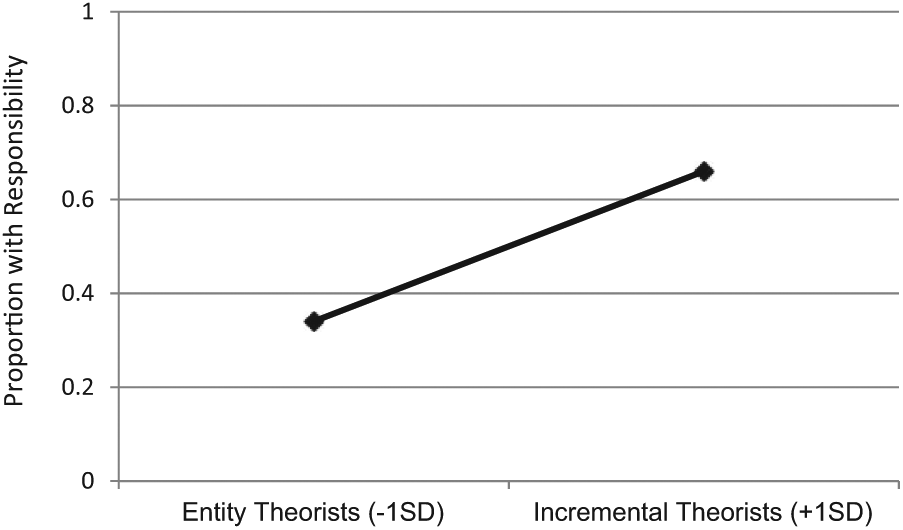
Proportion of apologies including an admission of responsibility at one standard deviation below (entity theorists) and above (incremental theorists) the mean on the theories of personality scale, Study 1.
Although participants’ implicit theories of personality were not associated with their ratings of offense severity—parameter estimate = .14 (SE = .10), t(90.06) = 1.40, p = .17, 95% CI = [−0.06, 0.33]—or feelings of responsibility—parameter estimate = .07 (SE = .13), t(79.84) = 0.50, p = .62, 95% CI = [−0.20, 0.33]—they were marginally associated with their feelings of guilt, with incremental theorists feeling somewhat more guilty, parameter estimate = .21 (SE = .11), t(95.73) = 1.84, p = .068, 95% CI = [−0.02, 0.44]). Nonetheless, the association between theories of personality and admissions of responsibility remained significant while controlling for ratings of severity, guilt, and responsibility, all ps < .004. No interactions between transgressors’ theories of personality and their ratings of severity, guilt, or responsibility emerged, all ps > .45.
Participants’ implicit theories of personality were not associated with the length of their relationship or their perceived relationship quality, ps > .64. The association between theories of personality and admissions of responsibility remained significant while controlling for relationship length and relationship quality, ps < .003, and no interactions between these predictors emerged, ps > .71.
Discussion
In Study 1, we found support for an association between transgressors’ implicit theories of personality and their willingness to accept responsibility after a real offense committed against a romantic partner. Transgressors with a more incremental theory of personality were more likely to accept responsibility in their apologies, and this association could not be explained by transgressors’ feelings of responsibility. This suggests that even though incremental and entity theorists recognized a similar level of responsibility for their offenses, incremental theorists were more likely to publicly admit responsibility to their partners.
The association between implicit theories and acceptance of responsibility also could not be explained by important relationship factors, such as relationship length or quality, or offense severity. Although transgressors’ feelings of guilt also did not explain the association between implicit theories and admissions of responsibility, incremental theorists did report feeling marginally more guilt than did entity theorists. This finding is worth exploring further in future research, as past work has demonstrated that feelings of guilt can promote forgiveness-seeking behavior (e.g., Riek et al., 2014).
By testing our hypothesis in the context of naturally occurring offenses and apologies, this first study provides compelling, real-world evidence for our predictions. A disadvantage of this diary study, however, is that we sacrificed control over possible confounding variables, such as the nature of the offenses reported or characteristics of the romantic relationship other than perceived quality or length. In Study 2, we used an experimental design with hypothetical scenarios to rule out such confounds and further test our predictions.
Study 2
In Study 2, we induced an incremental or entity theory of personality and examined whether participants in the incremental theory condition would take more responsibility than those in the entity condition as they responded to three different offenses. We induced the two theories of personality to optimize control over possible confounding variables and to speak to the causal role of implicit theories in the acceptance of responsibility.
Method
Participants
We recruited 46 American participants (29 female, 17 male; Mage = 36.11, SD = 13.81) through Amazon Mechanical Turk (see Buhrmester, Kwang, & Gosling, 2011; Paolacci & Chandler, 2014; Paolacci, Chandler, & Ipeirotis, 2010). Participants received 50 cents compensation. One participant was excluded from the analyses for failing an open-ended manipulation check, leaving a final sample of 45 participants (29 female, 16 male; Mage = 36.30, SD = 13.91).
Materials and procedure
To experimentally induce either an incremental or entity theory of personality, participants first read an article that was ostensibly being pilot tested for a future study with high school students. Following the methods of past researchers (e.g., Chiu et al., 1997; Rattan & Dweck, 2010), participants read an article that presented either an incremental theory (n = 22) or entity theory (n = 23) of personality. For example, the incremental theory article included quotations from experts arguing that personality can be developed (e.g., “Personality characteristics are changeable and can be influenced over time. In fact, personality characteristics are basically a bundle of possibilities that wait to be developed and cultivated.”). By contrast, experts in the entity theory article argued that personality is stable (e.g., “Personality characteristics seem to be rather fixed and to develop consistently along the same path over time. Personality characteristics might start out as a bundle of possibilities, but in the early years, the possibilities appear to solidify into a cohesive personality profile.”). To uphold the cover story, participants rated the article’s grade-level appropriateness and difficulty for high school students. As a manipulation check, they described the main idea of the article in one sentence.
Participants then moved on to the “main” part of the study, in which they imagined themselves in three different conflict situations. They were asked to read each scenario carefully and think about how they would act if the event were taking place right now. In one scenario, participants imagined that, during a bad day at work, they were abrupt and unhelpful toward a new colleague who asked them questions. In a second scenario, participants imagined that they offended an acquaintance at the gym by teasing him about not working out hard enough. In a third scenario, participants imagined that they had neglected to water their neighbor’s plants (which they had agreed to do), causing most of the plants to wilt and turn brown.
In response to each scenario, participants indicated what they would say to the victim (if anything) the next time they saw him. They then rated how angry they thought the victim would be with them (1 = not at all angry, 7 = extremely angry), how severe the consequences of their actions were for the victim (1 = not at all severe, 7 = extremely severe), and how much they would blame themselves for the incident (1 = not at all, 7 = very much). 3
Following data collection, two independent observers (blind to condition) coded the apologies for the presence of admissions of responsibility using the same criteria as in Study 1. Inter-observer reliability was good (K = .72); discrepancies were resolved through discussion.
Results
Participants, overall, rated the imagined victims as being quite angry with them (M = 5.12, SD = 1.07), the offenses as being moderately severe (M = 4.63, SD = 1.06), and themselves as being quite blameworthy (M = 6.11, SD = 0.99). To examine whether effects were consistent across scenarios, we tested for interactions between theory of personality condition and scenario type on observer-coded admissions of responsibility and ratings of victim anger, offense severity, and self-blame. No interactions between theory of personality condition and scenario type emerged, all ps > .33. All dependent measures were therefore averaged across the three scenarios in the analyses reported below.
As predicted, we found a main effect of theory condition on admissions of responsibility, t(43) = 2.26, p = .03, d = .62, 95% CI = [0.02, 0.33]. Participants in the incremental condition were more likely to accept responsibility in their responses to victims (M = .64, SD = .33) compared with participants in the entity condition (M = .46, SD = .25). We found no effects of condition on the presence of an apology statement, or ratings of victim anger, offense severity, or self-blame, all ps > .24. Moreover, the effect of condition on admissions of responsibility remained significant when controlling for these ratings, all ps < .03. No interactions between theories of personality and ratings of victim anger, offense severity, or self-blame emerged, all ps > .31.
Discussion
Study 2 extends our findings in important ways. By experimentally inducing either an incremental or entity theory of personality, this study provides evidence for a causal pathway between transgressors’ theories of personality and their willingness to accept responsibility for offenses. Further, by using hypothetical offense scenarios, this study helps rule out possible confounding variables (e.g., differences in the offenses reported, characteristics of the relationship between transgressor and victim). Compared with participants in the entity theory condition, those in the incremental theory condition were more likely to accept responsibility in their responses to identical offense scenarios, and this effect was present across naturally varying levels of perceived victim anger, self-blame, and offense severity. 4
In the next study, we tested a prediction concerning our proposed process by examining whether participants with an incremental theory of personality are less likely than those with an entity theory to experience threat when taking responsibility for an offense.
Study 3
It is not easy for any of us to admit that we have committed an offense against another person. This admission signifies that we acted in a hurtful manner, which, as we have noted, can be threatening to our identities as good, worthy individuals. However, we propose that admitting responsibility for offensive behavior is less threatening to people who believe that personality is malleable. Specifically, we propose that incremental theorists perceive an offense situation as an opportunity to learn and grow, both as a person and in their relationship with the victim. Because of this opportunity for learning, accepting responsibility for an offense may feel less threatening to one’s self-identity and might even be perceived as an important pathway to achieving personal and relational growth.
In the present study, we examined whether incremental theorists experienced less psychological threat after imagining that they accepted responsibility for an interpersonal offense. Participants induced to hold an incremental or entity theory of personality imagined committing an offense against a friend, and responding to their friend with either an admission of responsibility or a justification—a strategy in which transgressors defend their behavior and minimize the negativity of their offenses (McLaughlin, Cody, & O’Hair, 1983). Participants then completed a measure of threat accessibility. We predicted that after imagining that they had accepted responsibility for the offense (but not after imagining justifying their behavior), transgressors led to have an incremental theory would experience less threat accessibility relative to transgressors led to have an entity theory.
We also tested whether theories of personality would affect participants’ intellectual understanding of the importance of admissions of responsibility. We reasoned that, just as incremental and entity theorists are equally likely to recognize their responsibility for an offense (Study 1), they would also be equally likely to recognize that an admission of responsibility is an appropriate response following an offense. This would suggest that the observed difference between incremental and entity theorists in accepting responsibility is not explained by different assessments of this response.
Method
Participants
We recruited 109 American participants (60 female, 48 male, 1 unspecified; Mage = 37.05, SD = 13.57) through Amazon Mechanical Turk to complete an online study in exchange for 50 cents compensation. Six participants were excluded because they failed the manipulation check, two because they reported being unable to see the questions on multiple pages, and one because he reported suspicion about the negative words in the word fragment completion task (see Materials and Procedure). These exclusions left a final sample of 100 participants (56 female, 44 male; Mage = 37.71, SD = 13.76).
Materials and procedure
Participants first completed the same theory of personality manipulation as in Study 2, in which they were randomly assigned to either an incremental (n = 53) or entity (n = 47) theory of personality article condition, followed by the open-ended manipulation check and questions designed to uphold the cover story.
They then read an “offense” scenario, in which they imagined that their boss gave them a last minute assignment at the end of the workday. In the scenario, the boss states that the sooner they can get it done the better, but he understands he is springing it on them at the last minute. They then imagine choosing to complete the assignment even though they are supposed to pick up their friend (who doesn’t have a cell phone) for a dinner date, knowing that doing so will make them late. It takes them longer than expected to finish, and, when they finally leave the office, they see that it is pouring rain outside. They arrive at the meeting spot 30 minutes late to find their friend soaking wet and shivering in the rain.
Participants were then randomly assigned to two response conditions. In the admission of responsibility condition (n = 50), they imagined saying to their friend: “It’s my fault. My boss dropped a project on my desk just as I was about to leave, and I stayed late to finish it. I’m so sorry for being late to pick you up.” In the justification condition (n = 50), participants imagined saying: “It’s not my fault. My boss dropped a project on my desk just as I was about to leave, and I stayed late to finish it because I thought it was the appropriate thing to do.”
Next, participants completed the dependent measure of threat accessibility, which we adopted directly from Vandello, Bosson, Cohen, Burnaford, and Weaver (2008). Participants saw a page with 24 word fragments and were given 3 min to complete as many words as possible. Of the 24 fragments, 7 could be completed with either anxiety-related or anxiety-unrelated words (THREA _ [e.g., threat vs. thread]; STRE _ [e.g., stress vs. streak]; _ _ SET [e.g., upset vs. onset]; _ OTHER [bother vs. mother]; SHA _ E [e.g., shame vs. shape]; LO _ ER [e.g., loser vs. lover]; _ EAK [e.g., weak vs. peak]. Our dependent measure was the number of these word fragments that participants completed with an anxiety-related word (see Figure 2).
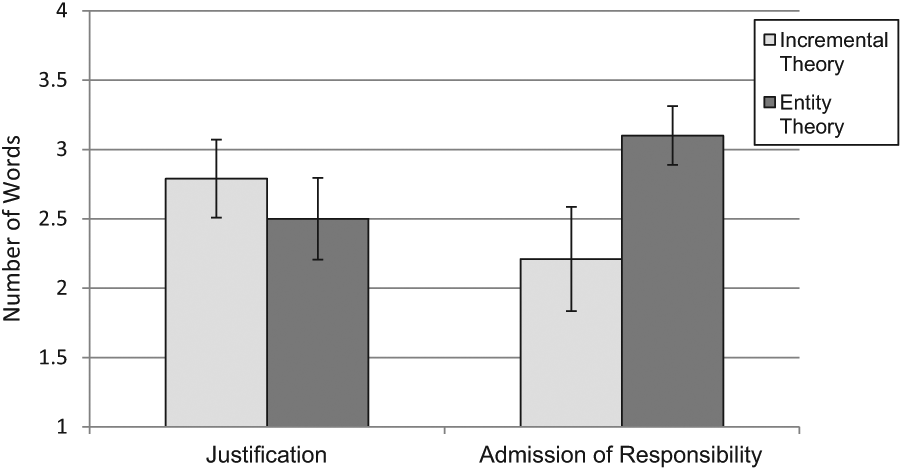
Number of word fragments completed with anxiety-related words as a function of theory of personality condition and justification versus admission of responsibility response, Study 3.
Finally, participants were reminded of their response to their friend (responsibility vs. justification), and then responded to nine items (α = .93) assessing their evaluation of the response (e.g., “This response was just right”; “This response would help my friend forgive me”) on 7-point scales (1 = strongly disagree, 7 = strongly agree).
Results
A 2 (incremental theory of personality vs. entity theory of personality) × 2 (admission of responsibility vs. justification) ANOVA on the number of anxiety-related words participants completed revealed a significant interaction, F(1, 96) = 3.79, p = .05,
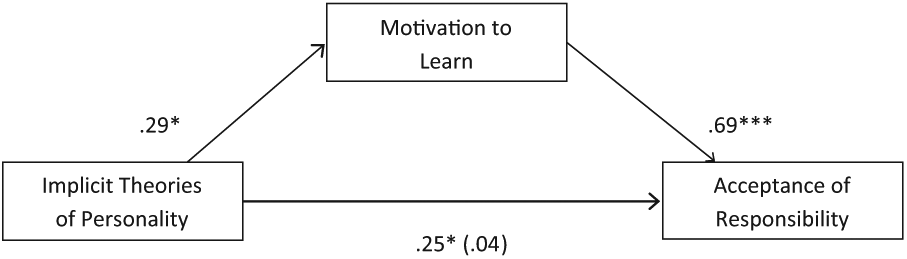
Mediation of the association between implicit theories of personality and acceptance of responsibility by motivation to learn, Study 4.
We also conducted a 2 (incremental theory of personality vs. entity theory of personality) × 2 (admission of responsibility vs. justification) ANOVA on participants’ evaluations of the response. Only a significant main effect emerged, F(1, 94) = 36.15, p < .001,
Discussion
In Study 3 we found that, relative to participants in the entity theory of personality condition, those in the incremental theory of personality condition were less likely to experience threat after imagining accepting responsibility for an offense. This study may help explain why incremental theorists are more likely than entity theorists to admit responsibility for their offenses: They find it less threatening to accept responsibility for negative behavior. We argue that incremental theorists might feel less threatened by admitting fault because they believe that doing so can help them grow as a person and develop their relationship with the victim—outcomes that render the prospect of accepting blame for an error less threatening to one’s self-identity. In Study 4, we explore whether incremental theorists indeed exhibit greater motivation to learn when responding to the victim, and whether this motivation to learn mediates the association between implicit theories of personality and admissions of responsibility.
Unlike the observed effect on threat accessibility, we did not find similar effects of condition on the items assessing participants’ explicit evaluations of the admission of responsibility. Although participants only evaluated one response to a single offense, these findings provide initial evidence that differences between incremental and entity theorists may only emerge on motivated behaviors, such as whether or not they publicly accept responsibility, rather than on the cooler cognitive evaluations of the merits of different responses.
Study 4
Several decades of research have demonstrated that incremental and entity theorists exhibit different orientations toward learning. Incremental theorists are consistently more eager to learn, even when learning risks a display of their deficiencies (Blackwell et al., 2007; Hong et al., 1999; Mueller & Dweck, 1998; Schumann et al., 2014). They are also more willing to adopt active, effortful strategies that can help them improve themselves or a situation (Kammrath & Dweck, 2006; Rattan & Dweck, 2010). This heightened motivation to learn orients incremental theorists toward confronting challenges that promote growth and investing the effort required to create positive change.
We propose that incremental theorists are more likely to accept responsibility for their offenses because they are more motivated to learn something valuable from the offense situation. By accepting responsibility (an active, effortful response to the victim), transgressors have an opportunity to confront and talk openly about their mistakes so they can attempt to learn from them and improve their relationship with the victim. We therefore predicted that incremental theorists would be more willing to invest effort to learn something about themselves and their relationship with the victim (because they perceive this effort as feasibly leading to personal and relational growth), and that this motivation to learn would, in turn, increase their likelihood of accepting responsibility for the offense.
Method
Participants
We recruited 79 American participants (30 female, 49 male; Mage = 34.13, SD = 11.38) through Amazon Mechanical Turk. Participants received 40 cents compensation. One participant was excluded because he failed an attention check (“For this question, please click ‘strongly disagree’”). This exclusion left a final sample of 78 participants (30 female, 48 male; Mage = 34.03, SD = 11.41).
Materials and procedure
Participants first completed a section that included various individual difference measures, the first one being the implicit theories of personality scale used in Study 1, except on a 7-point scale (α = .94; M = 4.37, SD = 1.40). Next, participants imagined themselves in two scenarios. In one scenario, participants imagined that they only watered their neighbor’s plants once while he was away (even though he had agreed to water them at least every other day), causing much of the foliage to burn and many of the plants to die. In the other scenario, participants imagined ignoring a colleague’s email about a time-sensitive issue, then sending away the colleague when he seeks help in person. In response to each scenario, participants rated how angry they thought the victim would be with them (1 = not at all angry, 7 = extremely angry), and how severe the consequences of their actions were for the victim (1 = not at all severe, 7 = extremely severe).
They then responded to six statements on 7-point scales (1 = strongly disagree, 7 = strongly agree) assessing their willingness to expend effort to learn something when responding to the victim. Three items measured effort to learn something about oneself (“I would work hard to learn something about myself from this situation”; “I would work hard to use this situation to grow as a person”; “I would work hard to use this situation to understand myself better”), and three items measured effort to learn something about their relationship with the victim (“I would work hard to learn something about my relationship with my neighbor [colleague] from this situation”; “I would work hard to use this situation to grow my relationship with my neighbor [colleague]”; “I would work hard to use this situation to understand my relationship with my neighbor [colleague] better”). For each scenario, all six items loaded onto a single factor and were therefore treated as a single dimension of motivation to learn.
Finally, participants imagined that the victim was there with them right now, and indicated how likely they would be to say each of five statements (or something similar to them) to the victim on 7-point scales (1 = not at all likely, 7 = extremely likely), two of which were admissions of responsibility (e.g., “I didn’t help you with what you needed and I was unkind to you”; “It was wrong of me to treat you that way”). These two statements were significantly correlated (r = .62, p < .001) and therefore averaged to create one index of willingness to accept responsibility. In addition to the two responsibility statements, transgressors also indicated how likely they would be to offer an apology statement (“I’m sorry”), a justification (e.g., “I had my own work to do and you came at a bad time”), and no action (e.g., “I wouldn’t say anything to my colleague”).
Results
Overall, participants rated the imagined victims as being quite angry with them (M = 5.72, SD = 1.06) and the offenses as being moderately severe (M = 4.74, SD = 1.19). Participants’ implicit theories of personality were marginally associated with their ratings of victim anger, r = −.20, p = .089, such that participants with a more incremental theory of personality rated the victims as being less angry with them. Because ratings of victim anger were associated with likelihood of accepting responsibility (r = .36, p = .001), we controlled for ratings of victim anger in all the analyses reported below. Participants’ implicit theories of personality were not associated with their ratings of offense severity, r = −.03, p = .77.
As predicted, a more incremental theory of personality was associated with reporting greater likelihood of accepting responsibility, B = .25 (SE = .12), t(74) = 2.03, p = .05, β = .22, 95% CI = [0.01, 0.45]. A more incremental theory of personality was also associated with reporting greater willingness to expend effort to learn something about oneself and one’s relationship with the victim, B = .29 (SE = .12), t(74) = 2.50, p = .02, β = .28, 95% CI = [0.06, 0.52], and this motivation to learn was associated with greater likelihood of accepting responsibility when controlling for implicit theories, B = .69 (SE = .09), t(74) = 7.70, p < .001, β = .64, 95% CI = [0.51, 0.87] (see Figure 3). 5
Our main goal in Study 4 was to determine whether the association between implicit theories of personality and accepting responsibility was mediated by participants’ motivation to learn. Results indicated that the association between implicit theories of personality and acceptance of responsibility was meaningfully reduced when statistically controlling for participants’ motivation to learn, B = .04 (SE = .09), t(74) = 0.46, p = .64, β = .04, 95% CI = [−0.14, 0.23]. To assess the significance of the indirect effect, we used a bias-corrected bootstrap mediation model (MacKinnon, Lockwood, & Williams, 2004; Preacher & Hayes, 2004), and specified a conventional number of 5000 bootstrap re-samples with a confidence interval of 95% (Preacher & Hayes, 2008). This analysis supported the mediating role of participants’ motivation to learn in the relation between implicit theories of personality and acceptance of responsibility, B = .20; CI = [0.02, 0.46].
Additional analyses revealed that a more incremental theory of personality was also associated with greater likelihood of offering an apology statement, B = .25 (SE = .09), t(74) = 2.74, p = .008, β = .28, 95% CI = [0.07, 0.43], and that participants’ motivation to learn mediated this association, B = .14; CI = [0.01, 0.33]. Implicit theories of personality did not significantly predict justifications, B = −.10 (SE = .10), t(74) = −0.88, p = .38, β = −.10, 95% CI = [−0.31, 0.12], or the likelihood of saying nothing to the victim, B = −.14 (SE = .13), t(74) = −1.08, p = .29, β = −.12, 95% CI = [−0.39, 0.12].
Discussion
Study 4 provided support for our prediction that incremental theorists accept more responsibility for their offenses because they seek to improve themselves and their relationships with the people they have harmed. This finding is consistent with the different orientations toward learning frequently exhibited by incremental and entity theorists, particularly in situations where learning requires effort or puts people at added risk of revealing their shortcomings (e.g., Blackwell et al., 2007; Hong et al., 1999; Mueller & Dweck, 1998; Schumann et al., 2014).
Unlike in Studies 1 and 2, people’s implicit theories significantly predicted their willingness to offer an apology statement in Study 4, and motivation to learn also mediated this association. As noted earlier, saying “I’m sorry” might sometimes feel like one is accepting responsibility. In this study, participants’ likelihood of offering an apology statement was highly associated with their likelihood of accepting responsibility (r = .70, p < .001), suggesting that they evaluated these elements in a psychologically similar way. However, given the inconsistent findings on apology statements across studies in this article, future work should explore whether and when implicit theories of personality reliably predict apology statements.
General Discussion
After committing an offense, transgressors can perform actions that influence the reconciliation process. Past work has revealed that admitting responsibility for an offense can increase forgiveness and promote conflict resolution (e.g., Robbennolt, 2003). Our studies suggest that people who believe personality is malleable (incremental theorists) accept more responsibility when responding to their victims, and therefore might experience more of the associated relationship-enhancing benefits. In Study 1, we collected a sample of real-world apologies and offenses occurring between romantic partners and found that participants with a more incremental theory of personality were more likely to accept responsibility in their apologies to their partners. In Study 2, we experimentally induced either an incremental or entity theory of personality and found that those induced to have an incremental theory were more likely to accept responsibility in their responses to hypothetical offenses. In Study 3, we experimentally induced either an entity or incremental theory of personality and found that those induced to have an incremental theory exhibited less cognitive activation of threat concepts after imagining accepting responsibility for an offense. Finally, in Study 4, we found that participants with a more incremental theory of personality reported greater motivation to learn something about themselves and their relationship with the victim when responding to the victim, and that this motivation to learn, in turn, predicted greater willingness to accept responsibility.
These studies tell a cohesive story about how theories of personality affect transgressors’ willingness to accept responsibility for their offenses. We demonstrated our effects using a combination of measured and manipulated theories of personality, real-world and imagined offenses and responses, and self-reported (e.g., imagined responses) and non-self-reported (e.g., threat accessibility) outcomes. We also demonstrated our effects within a variety of relationship types, including romantic partners, neighbors, colleagues, acquaintances, and friends. This research thus reveals a robust predictor of transgressors’ responsibility-accepting behavior.
One limitation of this research, however, concerns the somewhat restricted level of offense severity tested in these studies. In Study 1, transgressors reported offenses they actually committed against their partners over a 7-day period. This resulted in a sample of low-moderately severe offenses. In the remaining studies, we opted to use offenses that were of moderate severity, with the reasoning that these would reflect the types of offenses people commit in their everyday lives, making it easier for them to place themselves in the transgressor’s shoes. It therefore remains a possibility that for extremely severe offenses (e.g., physically abusing someone or being unfaithful to one’s partner), the threat of admitting responsibility might overpower even incremental theorists’ motivation to learn. Future research might better explore this possibility, perhaps by examining whether implicit theories of personality predict admissions of responsibility among criminals who have committed high severity transgressions.
A second limitation of this research is that Studies 2 and 3 were slightly underpowered. However, in conjunction with the other studies reported here, the observed effects appear to represent robust, replicable findings, particularly the central association between implicit theories and admissions of responsibility. An additional limitation is that we did not run an in-person study and record participants’ real responses to victims as they were occurring. We did, however, use a combination of methods that tapped both real-world transgressions (the daily diary method in Study 1) and immediate responses to standardized transgressions (the scenario method in Studies 2 and 4). Although both methods have their limitations, together they provide converging evidence for the influence of implicit theories of responsibility on admissions of responsibility.
This research has important theoretical implications. To our knowledge, the current studies are the first to explore how implicit theories affect transgressors’ responses following an offense. Past work examining the effects of implicit theories in the domain of interpersonal conflict resolution has focused on how beliefs about the malleability of personality influence victims’ responses to offenses, demonstrating that victims who hold an incremental theory exhibit less desire for revenge against the transgressor (Yeager, Trzesniewski, Tirri, Nokelainen, & Dweck, 2011), are more likely to constructively voice their dissatisfaction with the transgressor (Kammrath & Dweck, 2006), and are more likely to retain trust in the transgressor (Haselhuhn, Schweitzer, & Wood, 2010). Because the reconciliation process between transgressors and victims is complementary, understanding factors that influence transgressors’ behavior is an important piece of the conflict resolution puzzle.
This research is also some of the first to identify a factor that leads to more effective responses from transgressors. Recent research suggests that transgressors who receive a values affirmation offer more comprehensive apologies and fewer defensive strategies, presumably because self-affirmation can help buffer transgressors from the threat associated with committing an offense (Schumann, 2014). The current research adds to this body of work by revealing an individual difference factor that can promote more responsibility-taking, in part by reducing the threat associated with admitting fault. Moreover, it identifies a completely new process variable that can promote positive reconciliation behavior: motivation to learn something about oneself and one’s relationship with the victim. Future research might explore whether greater motivation to learn predicts other important conflict resolution behaviors, such as attempting to take the perspective of or empathize with one’s conflict partner.
The present research also highlights the fact that people’s beliefs about personality—their theories about whether or not personality can change and be developed—play a role in their responsibility-accepting behavior beyond factors relevant to the conflict itself, such as the quality of their relationship with the victim, the severity of the offense, or even how responsible they feel for the offense. This research therefore points to a potentially effective target for intervention, as it might be possible to promote responsibility-accepting behavior by fostering an incremental theory of personality. In Studies 2 and 3, we exposed participants to either an incremental or entity theory of personality by presenting them with an article describing scientific evidence for one theory or the other. We found that these articles were successful at inducing the two theories at least temporarily, as they yielded the predicted effects on our outcomes of interest. To create lasting changes in people’s theories, an intervention could be modeled after more in-depth interventions designed to change people’s theories of intelligence (e.g., J. Aronson, Fried, & Good, 2002; Blackwell et al., 2007). Future work using a more extensive intervention and a longitudinal design might more fully explore whether fostering an incremental theory of personality can produce enduring effects on transgressors’ willingness to accept responsibility, and, consequently, create positive changes in their relationships.
Another question for future examination concerns the potential disadvantages associated with holding an incremental theory of personality in the domain of conflict resolution. For example, the current studies only assessed responsibility-accepting behavior in situations where the transgressor was at least partially responsible for the negative outcome. However, it is important to determine whether some incremental theorists might accept responsibility for actions they are not actually responsible for, which could be problematic in situations where they are vulnerable (e.g., abusive relationships) or low-status (e.g., work settings where women are underrepresented). More work is therefore needed to understand how implicit theories influence responsibility-accepting behavior in situations where the responsibility for the offense is ambiguous or shared with the conflict partner.
Finally, future work might examine whether encouraging an incremental theory of personality promotes other important, theoretically related relationship behaviors. For example, an incremental mindset might cause people to view marriage counseling as less threatening and more beneficial because they see it as an opportunity to improve their relationship with their spouse and grow as a person. Promoting an incremental mindset could potentially increase people’s willingness to seek out counseling or other forms of support. Given the importance of conflict management to relationship and personal well-being (Gottman & Krokoff, 1989; Lawler et al., 2005), discovering ways to promote constructive responses from both transgressors and victims could lead to large and long-lasting positive outcomes for both parties.
Footnotes
Declaration of Conflicting Interests
The author(s) declared no potential conflicts of interest with respect to the research, authorship, and/or publication of this article.
Funding
The author(s) disclosed receipt of the following financial support for the research, authorship, and/or publication of this article: This article was prepared with the support of a Social Sciences and Humanities Research Council of Canada Postdoctoral Fellowship awarded to Karina Schumann.

Notes
References
Supplementary Material
Please find the following supplemental material available below.
For Open Access articles published under a Creative Commons License, all supplemental material carries the same license as the article it is associated with.
For non-Open Access articles published, all supplemental material carries a non-exclusive license, and permission requests for re-use of supplemental material or any part of supplemental material shall be sent directly to the copyright owner as specified in the copyright notice associated with the article.
