







Abstract
We investigated the long-standing—yet previously untested—idea that an abundance of desirable life experiences may undermine people’s ability to savor simpler pleasures. In Study 1, we found that the more countries individuals had visited, the less inclined they were to savor a future trip to a pleasant but ordinary destination. In Study 2, we conducted a field experiment at a popular tourist attraction, where we manipulated participants’ perceptions of their own experiential backgrounds; when participants were led to feel well-traveled, they devoted significantly less time to their visit compared with individuals who were led to feel less worldly. We replicate these findings in Study 3 and found evidence that the observed effect could not be easily explained by other mechanisms. Being a world traveler—or just feeling like one—may undermine the proclivity to savor visits to enjoyable but unextraordinary destinations by endowing individuals with a sense of abundance.
Imagine how you would feel if you frequently traveled the world, dined at the best restaurants, and tasted the finest bottles of Château Pétrus. Visions of fulfillment may come to mind, and you would probably predict feeling quite content at having access to so many great life experiences. Indeed, research suggests that investing in pleasurable life experiences is one of the most effective ways to buy happiness, far beyond investing in material goods (e.g., Howell & Hill, 2009; Millar & Thomas, 2009; Rosenzweig & Gilovich, 2012; Van Boven, 2005; Van Boven & Gilovich, 2003). But might accumulating pleasurable life experiences come with a hidden cost? Building on recent research on the psychology of scarcity, we propose that an abundance of great life experiences may undermine people’s ability to savor life’s more ordinary pleasures.
Savoring can be defined as a form of emotion regulation used to prolong and enhance positive emotional experiences (Bryant, 1989; Bryant, Chadwick, & Kluwe, 2011). Such up-regulation typically requires focusing attention on positive experiences in the present moment but can also entail looking forward to upcoming pleasures or reflecting on past pleasures (Bryant, 1989, 2003; Quoidbach, Mikolajczak, & Gross, in press; Tugade & Fredrickson, 2007; see also Elster & Loewenstein, 1992; Loewenstein, 1987). For example, before leaving for Paris, one might savor the upcoming trip by reading guidebooks and looking at tantalizing photos of French food. During the trip, one might linger at the Eiffel Tower, taking the time to breathe in the sights and smells of the city. Afterward, posting favorite photos of the trip on Facebook could extend the pleasure of the trip, promoting positive reminiscence. We propose that individuals may be less likely to engage in such savoring behavior if they possess a rich experiential background—a wealth of experiences in the relevant domain.
The most obvious way in which rich experiential backgrounds could diminish savoring is that wonderful life events might provide high comparison standards to which people could specifically contrast their more mundane present experiences. Indeed, from the mere perception of the size and weight of an object (e.g., K. T. Brown, 1953; Helson, 1964) to complex evaluations of the gratitude one should feel toward a helpful friend (Wood, Brown, & Maltby, 2011), most—if not all—of our judgments depend on whether the pertinent context consists of a set of high or low comparison standards (see Mussweiler, 2003, for a review). Importantly, past research shows that such comparison standards can influence people’s evaluation of their own happiness (Dermer, Cohen, Jacobsen, & Anderson, 1979; Smith, Diener, & Wedell, 1989; Strack, Schwarz, & Gschneidinger, 1985). For example, Strack et al. (1985) found that writing brief descriptions of negative past personal events prior to evaluating their lives led participants to express greater levels of subjective well-being, whereas they reported lower levels of present well-being when they had to recall positive personal events in the past. Along with other research, this study shows that past experiences can affect people’s present satisfaction judgments in some circumstances (but see Morewedge, Gilbert, Myrseth, Kassam, & Wilson, 2010).
Although people almost surely compare experiences from time to time, we propose that a less obvious but potentially pervasive mechanism might also reduce savoring among individuals with rich experiential backgrounds. According to recent theorizing, seemingly disparate phenomena can be explained by the cognitive consequences of perceived scarcity and abundance. Putting it succinctly, Shah, Mullainathan, and Shafir (2012) proposed that across domains, “having less elicits greater focus” (p. 682). For example, in one study, Shah et al. manipulated wealth by varying how many bullets participants received in a shooting game. “Poor” participants, who received relatively few bullets, spent more time aiming each shot compared with “rich” participants, who took less care in firing their plentiful supply of bullets. Mullainathan and Shafir (2013) argue that parallel effects occur in the domain of time; when people have limited time to accomplish a task, they are more likely to focus on it, blocking out distractions. Likewise, when food feels scarce due to hunger, people exhibit an enhanced ability to detect food-related words, such as “cake,” that are flashed for just a 30th of a second (Radel & Clément-Guillotin, 2012). Drawing together these and other diverse lines of evidence, Mullainathan and Shafir postulate that scarcity, relative to abundance, produces two core cognitive consequences: (a) focusing, in the form of enhanced attention to the scarce resource; and (b) tunneling, in the form of reduced attention toward everything else.
The twin processes of focusing and tunneling are critical for savoring, as the abilities to direct attention to a positive event and to block out potential distractions have been found to be the most effective ways to increase positive emotion (for review, see Quoidbach et al., in press). Therefore, perceived scarcity should promote savoring, while perceived abundance should undermine it. Consistent with this reasoning, one study showed that college seniors savored their college experience more when they were led to see that they had little time (vs. lots of time) left to enjoy it (Kurtz, 2008). Building on this theorizing, we propose that relatively impoverished experiential backgrounds may promote savoring in part by facilitating focusing and tunneling, whereas rich experiential backgrounds may undermine savoring by promoting a sense of abundance.
Importantly, Mullainathan and Shafir (2013) argue that the deployment of attention is driven by perceived scarcity or abundance within a particular domain. Thus, simply manipulating individuals’ perceptions of their own experiential background might be sufficient to shape their inclination to devote attentional resources to savoring an experience in the present. For example, if Tim is led to feel like he rarely gets to travel, then this perceived scarcity may prompt him to spend more time relishing thoughts of an upcoming weekend getaway, immersing himself in the experience during the trip, and talking about it later. In contrast, because perceived abundance reduces the impetus to make the most of something, his wife Daisy may be less motivated to savor the same trip if she sees herself as well-traveled.
This theorizing is particularly pertinent for understanding when and why people savor relatively ordinary experiences. In contrast, truly extraordinary experiences may capture attention regardless of the perceived abundance of one’s experiential background. Within the domain of food, for example, a simple yellow sheet cake may capture the attention of individuals who have experienced food scarcity, whereas a prize-winning, three-tiered chocolate cake coated in hazelnut frosting, drizzled with caramel, and topped with a tower of praline may capture attention even when individuals perceive food as abundant.
In line with this idea, we observed several intriguing correlations in pilot studies, whereby individuals with richer experiential backgrounds reported being less inclined to savor ordinary pleasures but not extraordinary pleasures. For example, in one pilot survey (N = 92, 68% women; Mage = 38.3; SD = 13.5; age range = 18-78 years), 1 we found that the more times Belgian participants went to different restaurants, the less likely they were to say they would savor eating the most common and popular dish in Belgium—spaghetti Bolognese—for dinner that night (r = −.27, 95% confidence interval [CI] = [−0.45, −0.07]); in contrast, dining history was unrelated to savoring lobster, a very popular but much fancier delicacy (r = .02, 95% CI = [−0.19, 0.22]). In another survey (N = 105, 70% women; Mage = 38.3; SD = 13.5; age range = 18-78 years), we found that the more countries American participants had visited, the less likely they were to say they would savor going on vacation to the three most common vacation destinations for Americans (namely, Florida, California, and New York; r = −.28, 95% CI = [−0.45, −0.09]), whereas travel history was unrelated to savoring reports for vacations to Americans’ top three “dream” vacation destinations (namely, Italy, Australia, and Ireland; r = −.01, 95% CI = [−0.20, 0.18]).
These initial findings are consistent with the idea that rich experiential backgrounds are associated with a reduced proclivity to savor relatively ordinary pleasures. However, it is also possible that rich experiential backgrounds simply alter individuals’ tastes and preferences. For example, an ordinary chocolate bar (e.g., Hershey’s milk chocolate with almonds) that many people view as simple but enjoyable might be defined as substandard by the foodie. Thus, experiential wealth may not reduce savoring for simple pleasures but rather may alter how people define simple pleasures. Our pilot studies do not enable us to rule out this possibility because we presented participants with a fixed set of experiences (e.g., visiting Florida) that individuals with rich experiential backgrounds might not have even considered desirable. Moreover, a wide range of individual difference variables (e.g., age) could potentially account for the observed relationships.
Therefore, in Study 1, we asked individuals to think of vacation destinations that they personally wanted to visit and that they considered either (a) ordinary or (b) extraordinary. We examined whether individuals with richer experiential backgrounds were less inclined to savor a vacation to an ordinary destination (while controlling for a wide range of individual difference variables). After establishing the existence of this relationship, we turned toward experimental methodology to examine causality and test our proposed mechanism; in Studies 2 and 3, we manipulated the perceived scarcity of participants’ past travel experiences and examined how this affected their behavior during a visit to a popular real-world tourist attraction. To maintain consistency across studies, we tested our hypotheses within the domain of travel. Although our hypotheses can be applied to other types of experiences as well (e.g., dining), a recent study showed that when people are asked to recall something they recently bought to make them happy, travel was the most frequently cited type of experiential purchase (Guevarra & Howell, 2014).
Study 1
Method
Participants
We recruited 415 francophone adult volunteers (87% women; Mage = 35.7, SD = 11.8, age range = 18-74 years) as part of a large online survey on emotions and well-being. The opportunity to participate in this survey was advertised during the France 2 television series “Leurs Secrets du Bonheur” (“Their Secrets of Happiness”)—a French television program aired in the winter of 2012. A link to the online survey was placed on the program website. Participants were given no financial compensation but were told before participating that they would receive feedback about their levels of well-being when the study was complete.
Procedure
As part of a larger study on well-being, interested participants clicked the link on the program website. From there, they were randomly assigned to participate in one of several possible studies (see Croft, Dunn, & Quoidbach, 2014; Gruber, Kogan, Quoidbach, & Mauss, 2013; Quoidbach, Gilbert, & Wilson, 2013); during this phase, participants completed measures of well-being, personality traits, and personal values. After this initial phase, participants were thanked and told that they could continue taking more surveys if they wished. The primary measures reported in the present study were included in one of these subsequent surveys and can be found in the Methodological Details Appendix (MDA). Demographic details, including age, gender, and subjective socio-economical status, were collected at the end of the survey. Finally, participants indicated their monthly income after taxes on a 41-point scale ranging from less than 500 euros to more than 20,000 euros (with 500 euros increments). Mean levels of income in our sample were between 1,500 and 2,000 euros (M = 4.0, SD = 2.8), which was representative of the mean French salary in 2012 (Renou, 2013).
Measures
Travel history
Participants were first asked to indicate where they had traveled on a list of the top 50 most visited countries according to the United Nations World Tourism Organization (UNWTO; 2008). The number of visited countries was used as an index of experiential wealth in the domain of travel (Mcountries = 9.2, SD = 5.3, range = 0-33 countries).
Savoring
Next, participants were asked, in randomized order, to sequentially indicate an ordinary (in French: “courant”) vacation destination that they would like to visit and an extraordinary (in French: “exceptionnel”) vacation destination that they would like to visit. Interestingly, although individuals were allowed to choose whatever destinations they personally considered ordinary or extraordinary, we found notable similarities in participants’ choices. In our sample of French people, Italy was the most frequent ordinary destination (cited 65 times) and was only cited once as an extraordinary destination. In contrast, the most frequent extraordinary destination was Australia (cited 27 times) and was only cited 4 times as an ordinary destination. For each destination they selected, participants were asked to imagine that they had won a free trip to that location and to report how much they would savor it on three items that capture the full-time course of savoring 2 (i.e., anticipation, savoring the present, and reminiscence; Bryant, 1989, 2003; Quoidbach et al., in press). Specifically, participants were asked to rate on a 7-point scale ranging from not at all to a great deal, how much they would (a) se réjouir the week before leaving (a French word meaning looking forward to something in ways that give pleasure in the present, which effectively captures anticipatory savoring), (b) try to mindfully savor the present moment during the trip, and (c) tell others or think positively about the trip afterward. We aggregated these three items into an overall measure of savoring (α = .70 and α = .69 for ordinary and extraordinary destinations, respectively). 3
Covariates
In addition to our primary measures, participants completed measures of personality, values, self-esteem, life satisfaction, social status, and income. It is likely that travel history and/or savoring might be related to these individual differences, potentially accounting for any observed relationship. Thus, we tested whether the relationship between travel history and savoring would remain robust even after controlling for these individual differences (see Table 1 for a description of covariates).
Description of Covariates in Study 1.
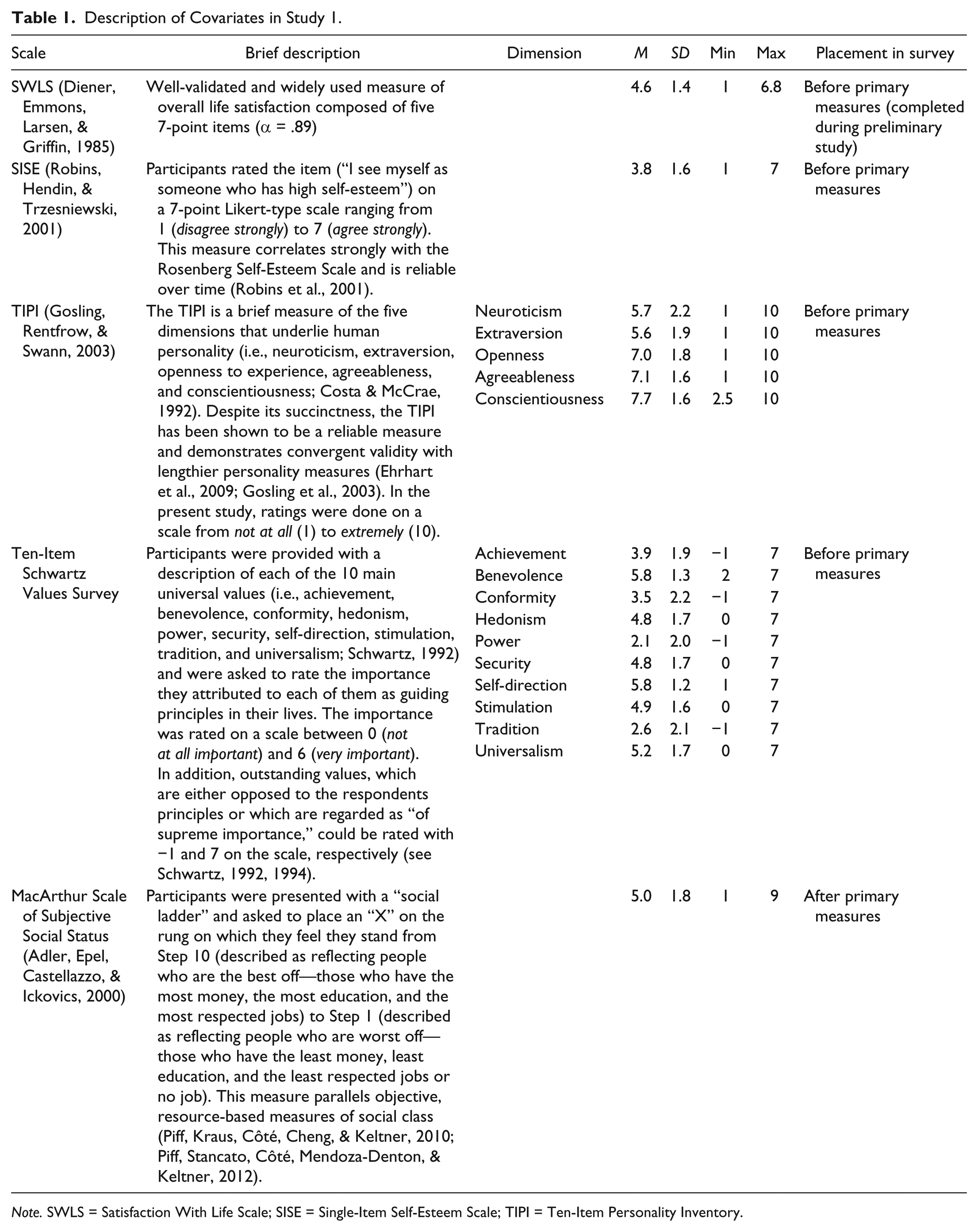
Note. SWLS = Satisfaction With Life Scale; SISE = Single-Item Self-Esteem Scale; TIPI = Ten-Item Personality Inventory.
Results
To examine whether people with richer experiential backgrounds were less inclined to savor, we first entered the number of countries participants had visited into a regression predicting self-reported savoring for the ordinary destination. Consistent with our prediction, the more participants had traveled, the less they said they would savor a vacation trip to a pleasant but ordinary destination of their choice, β = −.17, r = −.17, 95% CI = [−0.26, −0.07]. In line with the pilot data described in the introduction, however, the association between having a rich experiential background and self-reported savoring for extraordinary destinations was smaller, β = −.08, r = −.08, 95% CI = [−0.18, 0.02].
Of course, well-traveled individuals may differ from less worldly individuals in terms of wealth, age, personal values, and a host of other characteristics, which might account for the observed relationship between travel history and savoring. Therefore, we repeated the two regression analyses above, adding our full set of covariates to the model (income, social status, age, gender, life satisfaction, self-esteem, extraversion, neuroticism, conscientiousness, agreeableness, openness, achievement, benevolence, conformity, hedonism, power, security, self-direction, stimulation, tradition, and universalism). Our key results remained substantively unchanged with these potential confounds included in the regression; travel history was negatively related to savoring for ordinary destinations, β = −.14, rpartial = −.13, 95% CI = [−0.23, −0.02], but effectively unrelated to savoring for extraordinary destinations, β = −.03, rpartial = −.03, 95% CI = [−0.15, 0.09].
Finally, it is possible that the negative effect of travel history on savoring emerges only when people have traveled extensively, suggesting that there might be a curvilinear relationship between travel history and savoring. Results, however, revealed no evidence of a quadratic effect of travel history for ordinary or extraordinary destinations, rpartial = .05, 95% CI = [−0.09, 0.19] and rpartial = .02, 95% CI = [−0.11, 0.16], respectively. Adding the full set of covariates in the regressions yielded similar results, rpartial = .06, 95% CI = [−0.08, 0.21] and rpartial = .04, 95% CI = [−0.11, 0.20] for ordinary and extraordinary destinations, respectively.
Discussion
The present study provides initial evidence that individuals who have traveled extensively are less inclined to savor a trip to a pleasant but ordinary vacation destination. This negative effect of travel history was largely eliminated, however, when participants contemplated a vacation destination they considered extraordinary. These results suggest that the richness of one’s experiential background is specifically related to diminished savoring for ordinary pleasures, rather than a pervasive anhedonia. Interestingly, the fact that more well-traveled individuals did not report enhanced savoring for extraordinary destinations relative to less worldly individuals suggests that the reduction in savoring for ordinary destinations is not offset by an increase in savoring for extraordinary destinations.
Of course, although the present findings are consistent with the idea that an abundance of life experiences could get in the way of savoring, the correlational nature of the design precludes causal conclusions. The fact that the observed relationships between travel history and savoring remained largely unchanged after controlling for a host of covariates provides some reassurance about the robustness of this relationship, but it is always possible to generate additional confounds that might explain this relationship. Thus, in Study 2, we utilized experimental methodology to circumvent this inevitable limitation of correlational designs.
A strength of Study 1 is that the data came from a large sample that was diverse in terms of age and income, but a potential limitation is that the participants were recruited through an advertisement presented during a television show about happiness. It is conceivable that this show attracted people who were particularly dissatisfied with their lives or were unusual in some other way. Still, given that our key results remained robust after controlling for a wide range of individual differences, including life satisfaction, it seems likely that the observed results are not limited to an unusual sliver of the population. Moreover, as shown in Table 1, our large sample captured the full range of possible scores on most of our psychological variables (e.g., neuroticism and agreeableness). That said, in Study 2, we eliminated this issue by recruiting participants without mentioning that our study was in any way related to well-being.
Most importantly, in Study 2, we examined whether simply altering the perceived abundance of individuals’ past travel history would affect savoring. According to our theoretical perspective, simply feeling well-traveled should be sufficient to reduce individuals’ proclivity to savor their present experience as a tourist. Moving beyond self-report measures of savoring, we collected a behavioral measure of savoring at a popular tourist destination. Because our correlational findings suggest that rich experiential backgrounds should be most likely to affect savoring for relatively ordinary tourist experiences, we chose a pleasant but not especially spectacular historic landmark: Boston’s Old North Church (which ranks No. 11 out of 202 attractions in Boston on Trip Advisor and which one reviewer on Trip Advisor aptly describes as “a small quaint church”). We expected that participants who were led to feel more (vs. less) well-traveled would spend less time savoring their visit to this historic landmark.
Study 2
Method
Participants
We recruited 80 American participants (56% women; Mage = 43.1; SD = 14.8; age range = 17-70 years) visiting Boston’s Old North Church—a popular tourist attraction—to participate in a brief survey on travel experiences. Because our experimental manipulation was tailored to Americans specifically, foreign tourists were not included in the study. We also did not recruit Old North Church visitors who were part of an organized tour group, as this might have biased our measure of time spent in the church (see below). The sample consisted of 93% Caucasians, 3% Asian American, 1% African Americans, 1% Native American, with the remainder choosing “Other” or not answering.
Procedure
In the summer of 2011, two research assistants standing at the entrance of Boston’s Old North Church offered visitors the opportunity to complete a brief survey on travel habits in exchange for a soda (see MDA for details). The survey required participants to provide demographic information and to report which places they had visited out of a list of 12 travel destinations, as well as rating their current mood (in that order). Depending on their randomly assigned condition, participants were presented with a list of 12 common destinations (e.g., New York, Chicago, Las Vegas, Orlando) or a list of 12 exotic destinations (e.g., Tokyo, New Delhi, Sydney, Bruges). We assumed that, on average, participants would have visited many of the common destinations but relatively few of the exotic destinations; therefore, we expected that participants would perceive their travel experiences as more abundant after completing the checklist of common destinations versus the checklist of exotic destinations (see Caruso, 2008; Schwarz et al., 1991; Wänke, Schwarz, & Bless, 1995, for conceptually similar use of experienced ease of recall to alter judgment and frequency estimates). 4 Upon completing the questionnaires, participants were given a free soda coupon to redeem at the end of their visit; as well as rewarding participants, these coupons allowed us to track their savoring behavior.
Measures
Mood
Participants rated their current mood by making a mark on a 120-mm line scale anchored at its ends by “very unhappy” and “very happy” (Morewedge, Gilbert, & Wilson, 2005).
Behavioral measure of savoring
Because savoring entails taking the time to fully appreciate an experience in the moment (Bryant, 2003; Bryant, Smart, & King, 2005; Quoidbach, Berry, Hansenne, & Mikolajczak, 2010), we measured how long participants stayed in the Old North Church (see Quoidbach, Dunn, Petrides, & Mikolajczak, 2010; Vohs, Wang, Gino, & Norton, 2013, for similar use of time a behavioral measure of savoring). 5 Specifically, time in the church was measured from the moment participants entered the church to the time they redeemed their free soda coupons at the exit. Note that we were missing time stamp data for three participants.
Results
Manipulation checks and mood effect
As expected, participants who were presented with the list of common destinations reported that they had visited many more places (M = 7.7; SD = 3.0; 95% CI = [6.8, 8.6]) than participants presented with the list of exotic destinations (M = 1.6; SD = 2.1; 95% CI = [0.9, 2.3]), d = 2.37, 95% CI = [1.79, 2.94]. The exotic destination group reported being in a slightly better mood (M = 102.3; SD = 13.7; 95% CI = [97.6, 107.0]) than the common destination group (M = 96.7; SD = 14.9; 95% CI = [92.2, 101.2]), d = 0.38, 95% CI = [−0.06, 0.83].
Perceived abundance and savoring
Consistent with our hypothesis, participants who completed the common destination checklist spent less time visiting the Old North Church (M = 7.1 min; SD = 4.5; 95% CI = [5.7, 8.5]) than participants who completed the exotic destination checklist (M = 10.1 min; SD = 7.0; 95% CI = [7.7, 12.5]), d = 0.50, 95% CI = [0.04, 0.96].
Because participants in the exotic destination group were slightly happier than participants in the common destination group, we ran additional analyses including mood as a covariate. The difference in time spent in the church between the two conditions remained virtually unchanged (Mdiff = 3.3 min, 95% CI = [0.07, 5.95]), d = 0.57, 95% CI = [0.11, 1.02], suggesting that our results could not be explained by the small between-group differences in mood.
Discussion
In sum, we found that participants spent 30% less time visiting a popular tourist attraction after completing a checklist designed to increase (vs. decrease) the perceived abundance of their past travel experiences. According to our theoretical perspective, people in the common destination condition spent less time savoring their visit to the Old North Church because completing the checklist led them to feel well-traveled, reducing their motivation to make the most of their experience at the church.
An alternative, social comparison explanation is that our manipulation worked by providing participants in the exotic condition with negative feedback; by checking off very few places on our list, they may have felt that they “underperformed” relative to the expectations for survey respondents, leading them to engage in mood repair by savoring their visit to the church. Casting doubt on this explanation, we found that people in the exotic destination condition actually felt slightly better than those in the common destination condition after completing the checklist, and that the between-group difference in savoring remained just as strong after controlling for mood. Still, it would be worthwhile to address this potential confound experimentally. In addition, it is possible that simply seeing the list of exotic (vs. common) destinations primed people to savor their own tourist experience more by activating their associations with these international destinations. We designed Study 3 to address these potential confounds, while replicating our critical effect with a larger sample.
Study 3
Method
Participants
We recruited 277 American participants (50% women; Mage = 45.0; SD = 15.4; age range = 17-77 years) visiting the Old North Church in Boston. Consistent with Study 2, we excluded foreign tourists and members of organized tour groups from participating. The sample consisted of 94% Caucasians, 1% Asian American, 1% African Americans, 1% Hispanic Americans, with the remainder choosing “Other” or not responding.
Procedure
Study 3, which we ran in the summer of 2012, was designed as a replication of Study 2, with one important addition (see MDA for details). Although all participants were exposed to the same exotic or common destination checklists used in Study 2, only half of them were asked to make travel-relevant judgments, reporting which places they had visited. The other half were randomly assigned to a control condition in which they saw the same checklists (exotic or common), but were asked whether they were familiar with any sports teams from each city. Thus, this study used a 2 (cities: exotic vs. common) × 2 (relevance: travel-relevant vs. control) design. The addition of the travel-irrelevant (i.e., sports team) condition allowed us to control for the effects of exposure to the lists of exotic (vs. common) cities, while also controlling for the experience of failing to check off many of the cities presented in the exotic condition. The only other change to our procedure was that we replaced the 120-mm line scale of mood used in Study 2 with a 7-point Likert-type scale to facilitate data entry.
Results
Manipulation checks and mood effect
As expected, participants in the travel-relevant condition who were presented with the list of common cities reported that they had visited many more places (M = 7.9; SD = 3.1; 95% CI = [7.1, 8.6]) than participants presented with the list of exotic cities (M = 2.5; SD = 2.5; 95% CI = [1.9, 3.0]), d = 1.92, 95% CI = [1.52, 2.33]. Likewise, participants in the travel-irrelevant control condition who were presented with the list of common cities reported that they had heard of many more sports teams (M = 9.9; SD = 2.4; 95% CI = [9.3, 10.4]) than participants presented with the list of exotic cities (M = 2.2; SD = 2.8; 95% CI = [1.5, 2.8]), d = 2.95, 95% CI = [2.48, 3.45]. There were no differences in mood between the common cities group and the exotic cities group, in either the travel-relevant or control conditions, Mdiff = 0.26, 95% CI = [−0.10, 0.62]), d = 0.24, 95% CI = [−0.09, 0.58], and Mdiff = 0.20, 95% CI = [−0.53, 0.13]), d = 0.20, 95% CI = [−0.13, 0.54], respectively. We did find a small unpredicted main effect, whereby participants in the control condition reported slightly better mood (M = 6.3; SD = 1.0; 95% CI = [6.1, 6.5]) than participants in the travel-relevant condition (M = 6.0; SD = 1.1; 95% CI = [5.8, 6.2]), Mdiff = 0.29, 95% CI = [0.05, 0.53]), d = 0.29, 95% CI = [0.04, 0.52].
Perceived abundance and savoring
A 2 (cities: exotic vs. common) × 2 (relevance: travel-relevant vs. control) ANOVA with time spent visiting the Old North Church as the dependent variable revealed an interaction, depicted in Figure 1,
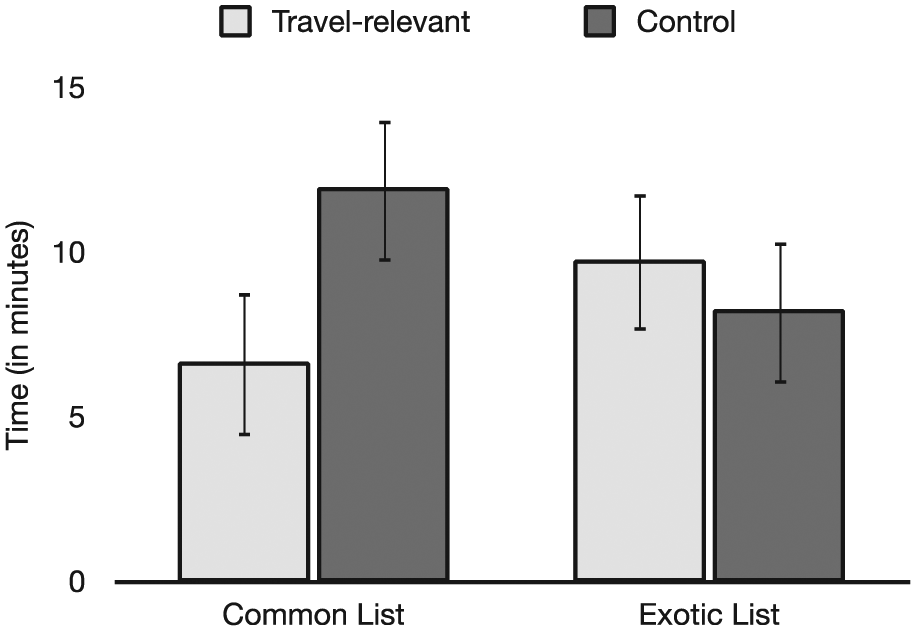
Mean time spent visiting the Old North Church and 95% confidence intervals in the different experimental conditions.
Discussion
Confirming the results of Study 2 with a larger sample, we found that participants spent about 30% less time visiting a popular tourist attraction after completing a checklist designed to make them feel well-traveled (vs. less worldly). In contrast, simply exposing participants to the same sets of cities and asking them to complete travel-irrelevant reports of their familiarity with the cities produced an effect in the opposite direction. Thus, it seems unlikely that priming or social comparison explanations can easily account for our central finding.
Comparing the results for the travel-relevant condition with the control condition suggests that our findings in Study 2 may have been driven by reduced savoring among participants in the common cities condition rather than by increased savoring in the exotic cities condition. This finding implies that abundance might undermine savoring more than scarcity promotes it.
General Discussion
The present research provides the first direct evidence for the—commonly held but previously untested—notion that a wealth of pleasurable life experiences may impoverish people’s ability to savor more ordinary pleasures. In Study 1, we found that individuals who had traveled extensively were less inclined to savor a trip to a pleasant but ordinary vacation destination, while their ability to savor an extraordinary trip was relatively preserved. These effects remained robust even after controlling for a wide range of individual differences, from personality and values to age and income. Building on this correlational evidence, Study 2 illuminates one of the underlying causal processes that may help to explain how richer experiential backgrounds lead to reduced savoring; simply manipulating participants’ perceptions of their own experiential background altered their proclivity to savor. That is, participants led to feel well-traveled spent 30% less time enjoying a visit to a popular, pleasant (but not particularly spectacular) tourist attraction compared with people led to feel not-so-worldly. Finally, Study 3 replicated this effect with a larger sample, while casting doubt on the possibility that it could be easily explained by social comparison or priming effects. Taken together, these studies suggest that abundance may have a price: Being a world traveler—or just feeling like one—may undermine our proclivity to savor visits to enjoyable but unextraordinary destinations.
Going beyond previous research on hedonic adaptation, which has examined how the emotional impact of a stimulus can be reduced with repeated or constant exposure to the same stimulus (for reviews, see Frederick & Loewenstein, 1999; Lyubomirsky, 2011), the present research demonstrates that adaptation can take a more pervasive form: A rich experiential background may impair our ability to savor a new experience. These findings provide valuable insight in explaining one of the most puzzling findings uncovered by well-being research: that income and objective life circumstances exert a surprisingly modest impact on happiness (see, for example, Aknin, Norton, & Dunn, 2009; Diener, Sandvik, Seidlitz, & Diener, 1993). Although hedonic treadmill effects are well documented (Diener, Lucas, & Scollon, 2006; Kahneman, 1999), very few studies have addressed the specific processes through which people’s happiness levels remain constant despite bigger houses, world travel, and fancier lifestyles. Our findings suggest that one underlying source of hedonic treadmill effects may be a failure to up-regulate positive emotional experiences due to shifts in the perception of abundance that these outstanding life experiences trigger.
These findings cast light on an important and controversial question that has plagued hedonic adaptation research for decades: Is adaptation “real” or just a matter of scale relabeling (Frederick & Loewenstein, 1999)? For example, if your enjoyment ratings for Hershey’s bars dive considerably after eating Belgian chocolate truffles, it might simply reflect a change in your use of the enjoyment scale (i.e., you can no longer attribute a perfect 10 to Hershey’s) rather than a true loss of pleasure from your favorite childhood delicacy. In fact, in most previous research on hedonic adaptation, answers to questions about well-being inherently confound participants’ “true” happiness with their interpretation of the response scale (Frederick & Loewenstein, 1999). By focusing on savoring (including a behavioral measure of minutes spent visiting a tourist attraction), the present research suggests not only that adaptation can be real and not merely a matter of scale relabeling but that people might even play an active role in it, by neglecting to make the most of ordinary positive emotional experiences.
Of course, the distinction between “ordinary” and “extraordinary” experiences is inherently subjective. Recent research, however, specifically demonstrates that people intuitively understand this distinction and can easily classify their own experiences as ordinary or extraordinary, categorizing their experiences consistently with the categorizations made by others (Bhattacharjee & Mogilner, 2014). Interestingly, this research also shows that young and old people alike report deriving happiness from extraordinary experiences, but that older people may be more adept than younger people at deriving happiness from ordinary experiences. This finding is consistent with our theoretical perspective in suggesting that perceived scarcity (vs. abundance) may promote savoring; when people perceive their time left on earth as limited, they are more inclined to appreciate life’s ordinary pleasures.
That said, our findings in Study 3 point to the possibility that abundance may undermine savoring more readily than scarcity promotes it. Theoretically speaking, however, scarcity and abundance should be viewed as existing along a continuum, with no true neutral point. As Mullainathan and Shafir (2013) put it, “It seems that to understand the psychology of scarcity, we must also appreciate the psychology of abundance. If scarcity can engage us too much, abundance might engage us too little” (p. 683). Within any one experimental context, the relative impact of manipulations of scarcity versus abundance would presumably depend on participants’ initial self-views. For example, although we found that visitors to the Old North Church appeared to be more affected by a manipulation that led them to feel well-traveled, we might find that visitors to a highly exclusive destination such as the Galapagos would be more affected by a manipulation that undermined their (presumably dominant) self-views by implying that they were not well-traveled.
The present research provides the first evidence that without changing the richness of people’s actual past experiences, simply altering their perceptions by making their past experiences feel abundant may undermine savoring. We do not wish to argue, of course, that this is the only pathway through which rich experiential backgrounds may influence savoring. First, people may at times contrast experiences in the present and future with specific, superior ones in the past; most of us can probably recall having engaged in such depressing comparisons, and past research suggests that contrast effects can emerge under some conditions (Dermer et al., 1979; Strack et al., 1985). We suspect that such direct comparisons may underlie reduced savoring when past and present experiences are relatively similar, facilitating comparison. For example, visiting a five-star all-inclusive resort in Mexico may undermine the propensity to savor a subsequent visit to a three-star Mexican resort due to the pernicious effects of direct comparison. Second, it is also possible that people deliberately increase or decrease their levels of appreciation for everyday experiences to distinguish themselves from others. This idea is in line with Bourdieu’s (1984) classical work on taste and preferences, showing that people often evaluate and enjoy various goods and experiences—from wine and pâtés to concerts and museums—in the service of social positioning. According to Bourdieu, our tastes are “social weapons” that define and distinguish the “legitimate” from the “illegitimate,” the high from the low. Consequently, people who perceive themselves as very experienced in a given domain may avoid savoring commonplace pleasures in that domain because doing so would threaten their symbolic hierarchical position in society. Given that the reasons that lead the experientially wealthy to savor everyday pleasures less are probably manifold, it would be worthwhile for future research to (a) examine the relative importance and pervasiveness of these potentially complementary mechanisms and (b) to investigate what types of experiences are most likely to be influenced by each.
In addition, more work is needed to delineate how the dynamics of consumption and savoring shape happiness over time. A number of recent studies suggest that buying experiences can provide a better route to happiness than buying material things (e.g., Dunn & Weidman, 2014; Howell & Hill, 2009; Kumar, Killingsworth, & Gilovich, 2014; Millar & Thomas, 2009; Rosenzweig & Gilovich, 2012; Van Boven, 2005; Van Boven & Gilovich, 2003). Although our research does not call this overall recommendation into question, our findings do point to a potential limiting factor on the hedonic benefits from buying experiences. To the extent that buying lots of experiences leads people to feel that they possess a rich experiential background, the marginal utility of each new experiential purchase may diminish over time. That said, even if someone who has visited Sydney savors a visit to San Diego less than someone who has never been Down Under, the person who visits both of these beachside cities probably still experiences more total pleasure than the individual who only visits one.
Moreover, although we did not find evidence that rich experiential backgrounds enhanced individuals’ proclivity to savor trips to extraordinary destinations, it is still possible that experiential wealth might promote savoring for certain types of high-end experiences (e.g., one might need a very “experienced” palate to fully appreciate the subtleties of moldy French cheeses). This sort of enhancement could result in a “conservation of savoring,” whereby the intensity and frequency of savoring remain relatively constant with experiential wealth but the specific experiences that are savored change. We hope that the present research provides a springboard for new studies examining whether, how, and when experiential wealth can get in way of overall happiness (perhaps using experience sampling or longitudinal designs).
Future work on the price of abundance might also lead to the development of novel well-being interventions (e.g., K. W. Brown & Ryan, 2003; Fredrickson, Cohn, Coffey, Pek, & Finkel, 2008; Lyubomirsky, Sheldon, & Schkade, 2005; Sin & Lyubomirsky, 2009; see also Quoidbach et al., in press, for a review). Our research suggests that making individuals aware of the limits of their experiential background may propel them to savor their present experiences. As a participant in one of our travel studies spontaneously wrote, “Seeing all of these countries, I felt like I traveled so little. It made me want to go on any vacation right away.” Exercises and activities aimed at decreasing feelings of abundance could help people maintain their capacity to savor small pleasures even after experiencing the best life has to offer—thereby allowing them to have their cake and savor it too. Note, however, that although perceived scarcity may promote savoring, a decline in savoring might be functional for individuals with rich experiential backgrounds. For example, a business woman who frequently travels to exotic cities around the world may benefit, on the whole, from spending less time and energy exploring these cities and more time getting her work done and keeping in touch with her family back home.
An important limitation of the present research is that we focused primarily on travel. Although past research suggests that travel ranks among the most common experiences that people buy to increase their own happiness (Guevarra & Howell, 2014; Van Boven, 2005), it would be interesting to examine whether other kinds of past experiences—from concerts to spa treatments—undermine savoring in the relevant domains. It would also be worthwhile to extend the present work by using more complex and nuanced measures to capture the full richness of individuals’ experiential backgrounds. By measuring the number of countries participants had visited, we were able to create a brief index of experiential wealth that was feasible to administer—with the trade-off that this quantitative measure provides only a rough reflection of the true richness of participants’ experiential backgrounds, which might include the vision of perfect sunrises over volcanoes in Bali and the taste of just-picked peaches in the orchards of Italy. The imprecision of our simple quantitative measure should have worked against our ability to detect the observed relationship with savoring, and thus this relationship might be even stronger if more extensive measures were used.
Whereas traveling the world and dining in fine restaurants may add color and spice to life and can undoubtedly contribute to happiness, the present research suggests that accumulating these fabulous life experiences could also have the paradoxical power of undermining their hedonic benefits. In short, abundance may often come with a hidden price, by impairing our ability to savor simple, everyday joys; probably a good thing to keep in mind before going on that luxury Nile cruise or having another glass of that marvelous champagne.
Footnotes
Acknowledgements
We would like to thank Dan Gilbert for his helpful feedback on a previous version of this article.
Declaration of Conflicting Interests
The author(s) declared no potential conflicts of interest with respect to the research, authorship, and/or publication of this article.
Funding
The author(s) received no financial support for the research, authorship, and/or publication of this article.

Notes
References
Supplementary Material
Please find the following supplemental material available below.
For Open Access articles published under a Creative Commons License, all supplemental material carries the same license as the article it is associated with.
For non-Open Access articles published, all supplemental material carries a non-exclusive license, and permission requests for re-use of supplemental material or any part of supplemental material shall be sent directly to the copyright owner as specified in the copyright notice associated with the article.
