







Abstract
Accessibility is one of the most basic structural properties of an attitude and an important factor to consider in attitude strength. Despite its importance, relatively little work has examined the role of attitude accessibility in an inter-attitudinal context, particularly as it relates to the strength of related attitudes in the network. The present research examines accessibility as a property of one attitude (toward an abstract goal or end-state, that is, a value) that might influence the strength of a different but related attitude (toward a social policy conceptually related to the value). In Study 1, a highly accessible evaluative component of a value increased resistance to change of attitudes and behavioral intentions toward a social policy related to that value. Similarly, a manipulation of value accessibility (Studies 2 and 3) led to increased resistance of attitudes and behavioral intentions toward a social policy related to that value. Implications for the role of accessibility in inter-attitudinal strength are discussed.
Students of attitude theory have come to understand the importance of attitude strength. Some attitudes have more lasting impact than others (i.e., they persist longer over time, better resist change when attacked, and have greater influence on future thinking and behavior; Krosnick & Petty, 1995). In attempting to predict which attitudes will demonstrate strength, structural aspects of the attitude, such as the attitude’s accessibility in memory or the extent to which the attitude is associated with ambivalence (i.e., both positive and negative attributes of the attitude object), have received a good deal of attention over the last 40+ years (see Eagly & Chaiken, 1995; Fabrigar, MacDonald, & Wegener, 2005, for reviews). Within this literature, however, most of the research has focused on the structural elements associated with a single attitude (i.e., intra-attitudinal structure; Fabrigar et al., 2005) rather than the network or system of attitudes linked together in memory (i.e., inter-attitudinal structure; cf. Abelson & Rosenberg, 1958; Converse, 1964; Scott, 1969). Unfortunately, there has been relatively little examination of key features of intra-attitudinal structure within the inter-attitudinal context.
Early research on inter-attitudinal structure discussed the importance of understanding an attitude’s connection to a multi-attitude system, especially regarding issues of cognitive consistency among the linked attitudes (e.g., see Abelson & Rosenberg, 1958; Rokeach, 1968). The attitudes in this system can vary in the level of abstraction of the objects of those evaluations. Perhaps the most abstract attitude objects in this system would represent values. Values are “desirable, transsituational goals, varying in importance, that serve as guiding principles in people’s lives” (Schwartz, 1996, p. 122; see also Rokeach, 1968). Thus, at the heart of a value is a positive evaluation of an abstract goal or end-state (Eagly & Chaiken, 1993). The abstract nature of the goal and the centrality of the value as a guiding principle in the person’s life may place the value at the heart of a larger inter-attitudinal structure. Over the years, various researchers have examined relations between abstract values and more specific attitudes or behaviors. For example, research has examined how value activation can enhance value-consistent actions (e.g., Hertel & Kerr, 2001; Maio, Pakizeh, Cheung, & Rees, 2009), especially when the values are central to the self-concept (Verplanken & Holland, 2002). Moreover, research has suggested that increasing the cognitive support for a value can enhance its effects on judgments and behavior associated with the value (e.g., Bernard, Maio, & Olson, 2003; Karremans, 2007; see Maio, 2010, for a review).
In a more direct attempt to understand inter-attitudinal consistency, Lavine, Thomsen, and Gonzales (1997) examined processes associated with the hypothesized links between values and political attitudes. In this shared-consequences model of inter-attitude structure, the strength of the relation between attitude-relevant policies is partly contingent upon the policies having an influence on a similar set of consequences (e.g., value-based goals). That is, attitudes are related to the extent that they share a common higher order value or goal (see also Judd & Krosnick, 1989). For example, attitudes toward civil rights and immigration reform policies may be related to the extent that they are guided by the value of equality.
In the current research, we examine how a strength-related property of a value can influence the strength of an attitude related to the value. Specifically, we examine how the accessibility of a value’s evaluative component can influence the strength of an attitude associated with the value (i.e., within the attitude system). We use the term value accessibility to refer to the accessibility of the evaluation of the abstract goal or end-state that is the focus of the value. This focus on the evaluative component of the value follows from the emphasis on inter-attitudinal structure and from the previous research on accessibility of single attitudes. In research on single attitudes, of the various strength-related attitude properties, perhaps the most studied to date has been attitude accessibility. Accessible attitudes have been shown to influence information processing (Fabrigar, Priester, Petty, & Wegener, 1998; cf. Clark, Wegener, & Fabrigar, 2008), to persist over time (Zanna, Fazio, & Ross, 1994), to resist persuasion (Bassili & Fletcher, 1991), and to guide future judgment (Fazio, Blascovich, & Driscoll, 1992) and behavior (Fazio, Chen, McDonel, & Sherman, 1982) to a greater extent than less accessible attitudes. That is, accessible attitudes are strong attitudes (Fazio, 1995). Thus, if one were looking for a property of values that might determine the extent of their reach to influence related policy attitudes, accessibility of the value’s evaluation seems like a plausible candidate. Against the backdrop of research on accessibility of single attitudes, it might seem surprising that little research has examined the role accessibility might play as a potential conduit for strengthening attitudes within an inter-attitudinal context. However, compared with research examining single attitudes, there is much less research addressing attitude systems (for exceptions, see Judd & Krosnick, 1982; McGuire, 1981; McGuire & McGuire, 1991).
If a value’s evaluative component is accessible rather than inaccessible in memory, consideration of a related attitude object (such as a social policy) should be more likely to result in consideration of the evaluative implications of the value for that policy attitude. The evaluation of the abstract goal and the policy should have previously become linked in memory (Pakizeh, Gebauer, & Maio, 2007), along with their implicational relations (Judd & Krosnick, 1989). Thus, when an accessible evaluation of the abstract goal (the value) comes to mind, it would enhance pressures toward structural consistency (Lavine et al., 1997) across related attitudes (including values and the related policy attitudes; Thomsen, Lavine, & Kounios, 1996). If so, when a policy attitude is attacked, a supporting value whose evaluative component is highly accessible should be more likely to provide strength to the policy attitude than when the value’s evaluative component is less accessible at the time of the attacking message.
The Present Research
The overall goal of the current research is to examine the strength-related consequences of prior activation of attitudes within an existing inter-attitudinal structure. Specifically, we examined how the accessibility of one’s evaluation of an abstract goal in a value can influence the strength (e.g., resistance) of attitudes related to the value. Rokeach (1968) suggested that an attitude’s association with one’s values is an important consideration in the strength and impact of that attitude. In other words, having an attitude connected to a belief system or a cognitive structure such as a value may influence the extent to which the attitude persists over time, resists change when attacked, and influences future thinking and behavior (cf. Petty & Krosnick, 1995). We argue that values may especially provide support for an existing attitude when the evaluative component of the value is highly accessible (either through repeated activation over time—chronic accessibility—or recent activation—priming). Previously published studies on attitude accessibility and persuasion were used to approximate sample sizes that would be sufficient for the current research. Across three studies, we examine the possibility that policy attitudes will resist change when attacked to a greater extent when accessibility of a related value’s evaluation is relatively accessible rather than inaccessible.
Study 1
Participants and Design
Forty-six introductory psychology students participated in exchange for course credit in a correlational design with accessibility of value favorability as a continuous predictor variable.
Procedure
Participants were brought into a lab and seated at a computer where all materials were administered. Participants were told that they would be participating in two separate studies. For the first study, participants completed a survey of their opinions toward a number of values (e.g., freedom, loyalty, etc.) including equality—the value of interest. Accessibility of value favorability (i.e., value accessibility) was measured such that the response latencies in participants’ attitude toward equality were assessed on three 7-point scales embedded within the survey of opinions.
1
Participants then completed a 2-min filler task involving numerical estimation to separate the accessibility measure from the rest of the materials. Following the filler task, participants read a proposal favoring the elimination of affirmative action policies on campus. This topic was chosen because affirmative action is related to the value of equality (Bernard et al., 2003; Blankenship, Wegener, & Murray, 2012; Thomsen et al., 1996). The message provided fictional examples of affirmative action policies and their detriments to student motivation, perpetuation of the negative perceptions of protected groups, and over-emphasis on physical characteristics. For example, one argument described the negative effects of such polices on student motivation: If a student from an underprivileged group can get into college with a 3.2 grade-point average, why should she push herself to get a 4.0? Although some students or employees are self-motivated, most people need an extra push or incentive to do their very best. By setting lower standards for admission or hiring, we are lowering the level of accountability.
After reading the message, participants reported their attitudes toward affirmative action and their voting intentions toward the proposal. Afterward, all participants were debriefed and thanked for their participation.
Predictor Variables
Value accessibility
To help control for potential confounds between value extremity and accessibility, the first step in creating an accessibility score was to perform a reciprocal transformation on the response latencies on the three value evaluation items, such that larger values now indicated faster responses (cf. Fazio, 1990). Because of the relation between attitude extremity and accessibility found in previous research (see Fabrigar et al., 2005, for a review), we then centered each person’s transformed response latency at each scale point of each measure by subtracting the average transformed latency across all participants who responded with the same value evaluation on that scale. We did this separately for each of the three 7-point scales (1 = foolish, harmful, bad; 7 = wise, beneficial, good; for a similar method when indexing accessibility from scaled rather than dichotomous responses, see Fazio & Williams, 1986). The three resulting transformed latency scores were averaged. Because participants also reported their attitudes toward other values unrelated to equality (i.e., freedom, intelligence, loyalty), an overall index of value accessibility was calculated by subtracting the average latency of participants’ attitudes toward all the other values (also transformed and centered) from the average transformed latency of participants’ attitudes toward equality (as suggested by Fazio, 1990, see also Fabrigar et al., 1998).
Attitudes toward equality
To calculate participants’ attitudes toward equality, we averaged the evaluative responses on the three 7-point scales (1 = harmful, foolish, bad; 7 = beneficial, wise, good; α = .92).
Dependent Variables
Attitudes toward the policy of affirmative action
After reading the proposal attacking affirmative action, participants reported their attitudes toward affirmative action on six 9-point semantic differential scales (1 = harmful, foolish, bad, unfavorable, definitely disapprove, strongly disagree; 9 = beneficial, wise, good, favorable, definitely approve, strongly agree). Scores were combined to create a single index of favorability of attitudes toward affirmative action (α = .94).
Behavioral intentions
After reporting their attitudes, participants were asked to imagine that the university proposed a bill to eliminate all affirmative action policies on campus. Then, they rated the extent they would agree with the following actions: voting against the bill, voting “no” for the bill, and voting to support the bill (reverse coded) on 9-point scales (1 = strongly disagree; 9 = strongly agree; see Tormala & Petty, 2002, for a similar measure). Scores were combined to create a single index of behavioral intentions, with higher scores indicating intentions toward voting against the proposal (α = .64). 2
Results
Attitudes toward equality
As constructed, the measure of value accessibility was not related to the overall favorability of participants’ attitudes toward equality (r = −.03, p = .86) or to the extremity of participants’ attitude (r = .09, p = .52). Therefore, any influence of value accessibility on policy attitude resistance cannot be attributed to differences in the favorability of attitudes toward equality or extremity of attitudes toward equality across levels of measured value accessibility.
Attitudes toward the policy of affirmative action
We expected that attitudes toward affirmative action would be more resistant to influence by the anti-affirmative-action message when value accessibility was relatively high rather than low. This would provide initial evidence that heightened chronic value accessibility may, in turn, heighten the strength of attitudes toward policies related to the value. When regressing participants’ postattack attitudes toward the policy of affirmative action on the value accessibility measure, value accessibility significantly predicted attitudes toward affirmative action, b = 3,007.04, t(44) = 2.38, p = .02, r = .34, 95% confidence interval (CI) [459.51, 5554.58]. 3 That is, increased value accessibility led to more positive attitudes toward affirmative action following the attacking message. In other words, participants with relatively accessible values held policy attitudes following the attacking message that were less consistent with the attacking message.
Behavioral intentions
We should see a similar pattern for participants’ voting intentions, such that increased value accessibility should lead to a greater likelihood of voting against the proposal eliminating affirmative action. Consistent with this idea, value accessibility significantly predicted voting intentions, b = 2,780.94, t(44) = 2.26, p = .03, r = .32, 95% CI [295.0, 5266.89], with increased accessibility leading to greater likelihood of voting against the proposal.
Mediational analyses
If value accessibility led policy attitudes to be more resistant to the attacking message (the a path in a mediational model), and this resistance to the anti-affirmative-action message set the stage for greater likelihood of voting against a proposal to eliminate affirmative action at the participants’ university (the b path in the mediational model), then policy attitudes should serve as a mediator between value accessibility and voting intentions. We conducted a mediational analysis using bootstrapping procedures outlined by Shrout and Bolger (2002; using the syntax presented by Preacher & Hayes, 2004). The bootstrapping analyses randomly drew cases from the sample data (with replacement) and created 5,000 bootstrap data sets of equal size to the original sample. Each data set supplied an estimate of the indirect (mediational) effect of policy attitudes (i.e., ab). The 95% CI on the indirect effect suggested that attitudes toward affirmative action did mediate the effect of the Value Accessibility measure on voting intentions (ab = 2,014.84, 95% CI [269.8, 4385.04]). With the mediator in the model, the direct effect (c’) of the Value Accessibility measure was no longer significant, c’ = 766.1, t(42) = .8, p = .43, 95% CI [−1177.37, 2709.58]. In other words, high levels of value accessibility were associated with more favorable postattack attitudes toward affirmative action, which then increased voting intentions.
Discussion
As expected, relatively accessible attitudes toward equality led to more positive attitudes toward affirmative action following an attack on the policy. Thus, Study 1 is consistent with the idea that a strength property of the value, such as accessibility of the evaluation of the abstract goal in memory, can influence the resistance of a different but related attitude. However, without having a measure of policy attitudes prior to the attacking message, we cannot conclusively determine that value accessibility was primarily responsible for the differing postattack policy attitudes. The policy attitudes might have differed prior to the anti-affirmative-action message. Therefore, in Study 2, we obtained preattack measures of affirmative action attitudes to help to isolate the effects of value accessibility per se.
In addition, Study 1 used a measure of value accessibility that controlled for extremity of the evaluation of the value, but it is possible that other features of the value (or of the preattack policy attitude) might have covaried with value accessibility. Therefore, in Study 2, we used a manipulation of accessibility used in previous research (e.g., Fabrigar et al., 1998; Fazio et al., 1982). Because the level of value accessibility was randomly assigned across people who varied in the prestudy qualities of their values and policy attitudes, the other properties associated with values and preattack policy attitudes should be equated across value accessibility conditions. Similar to Study 1, we should see attitudes toward affirmative action that are more favorable following an attack when attitudes toward equality were made relatively high versus low in accessibility.
Study 2
Method
One-hundred seventeen introductory psychology students (65 female, 52 male; Mage = 19.64, SDage = 1.41) participated in exchange for course credit in a 2 (Value Accessibility: low vs. high) × 2 (Time: preattack vs. postattack) mixed design with Time as a within-participants variable.
Procedure
Participants were brought into a lab and seated at a computer where all manipulations and measures were administered. Similar to Study 1, participants were told that they would be participating in two separate studies. For the first study, participants completed a survey of their opinions toward 35 topics (nuclear power, capital punishment, etc.). Embedded within the survey were items critical to the hypothesis. Near the beginning of the survey, participants reported their attitude toward the policy of affirmative action. Within this survey, Value Accessibility was manipulated such that half of participants reported their attitude toward equality once, whereas the other half of the participants reported their attitude toward equality six times. Participants then completed the same filler task described in Study 1. Following the filler task, participants read a proposal to eliminate affirmative action policies on campus. After reading the message, participants reported their attitudes toward affirmative action and their voting intentions toward the proposal. Afterwards, all participants were debriefed and thanked for their participation.
Independent and predictor variables
Preattack attitudes toward the policy of affirmative action
Embedded in the survey prior to the value accessibility manipulation was a single item assessing participants’ premessage attitudes toward affirmative action on a 7-point scale (1 = definitely opposed; 7 = definitely in favor). Because attitude accessibility has been linked previously to resistance to change (e.g., Bassili & Fletcher, 1991), we used a single item so as to not heighten accessibility of preattack attitudes.
Value accessibility
Similar to Fabrigar et al. (1998; Fazio et al., 1982), Value Accessibility was manipulated such that participants reported their attitudes toward equality either once or six times. That is, embedded in the survey completed at the beginning of the session, participants reported their attitudes toward equality on a 7-point scale. In the low value accessibility condition, participants reported their attitudes toward equality once (1 = definitely opposed; 7 = definitely in favor). As in Fabrigar et al. (1998), this item was the second to last item on the survey. In the high value accessibility conditions, participants reported their attitude toward equality on six 7-point scales at different points throughout the survey (1 = disapprove, bad, unnecessary, foolish, inappropriate; definitely opposed; 7 = approve, good, necessary, wise, appropriate, definitely in favor). As in the low accessibility conditions, the item assessing the extent to which participants favored the value was the second to last item in the survey. This was done to provide a direct comparison of attitudes toward equality to ensure that reporting attitudes toward equality six times versus one time did not influence the extremity of participants’ attitudes toward equality and also to equate for recency of activation across accessibility conditions.
Attitudes toward equality
To index participants’ initial attitudes toward equality, we used the single item in the low accessibility conditions and the last of the six items assessing attitudes toward equality in the high accessibility conditions. Both items used the same 7-point scale and endpoints (i.e., definitely opposed/in favor).
Dependent variables
Postattack attitudes toward the policy of affirmative action
After reading the proposal attacking affirmative action, participants reported their attitudes toward affirmative action on six 9-point semantic differential scales (1 = harmful, foolish, bad, unfavorable, definitely disapprove, strongly disagree; 9 = beneficial, wise, good, favorable, definitely approve, strongly agree). The measures differed from the preattack items to prompt participants to reconsider their current opinion and to reduce the likelihood that participants would simply remember and report the same response from the preattack measure. Scores were averaged to create a single index of postattack favorability toward affirmative action (α = .96). Because of our emphasis on differential resistance to change, it seemed reasonable to use a multi-item postmessage attitude scale to increase reliability.
Behavioral intentions
Participants completed the same intention measures as in Study 1 (α = .66).
Results
Attitudes toward equality
As expected, there was no difference in attitudes toward equality (i.e., the oppose/favor item) across the low (M = 5.94, SD = 1.29) and high (M = 5.82, SD = 1.47) accessibility conditions, F(1, 115) = 0.26, p = .61. Thus, any differences in attitudes toward the policy of affirmative action appear unlikely to be due to differences in attitudes toward equality.
Response latencies of equality evaluations
Consistent with previous research (Fazio & Williams, 1986), we expected participants’ attitudes toward equality to be more accessible in the high rather than low accessibility conditions. We used the same reciprocal transformation and centering procedures on the oppose/favor item and responses to the same unrelated values as reported in Study 1 as a baseline measure of accessibility. We then subtracted the transformed response times of the unrelated values from the transformed response time to the oppose/favor item. As expected, response times were faster in the high (M = .00015, SD = .0003) than low (M = −.00006, SD = .0006) accessibility conditions, F(1, 115) = 6.38, p = .01. 4
Attitudes toward the policy of affirmative action
We expected that participants in the high value accessibility conditions would have attitudes toward affirmative action that are more resistant to change than participants in the low value accessibility conditions. This would provide the first experimental evidence that heightened value accessibility may lead to stronger attitudes when those attitudes are related to the value.
We first examined this hypothesis by conducting an analysis of covariance (ANCOVA) in which postattack attitudes toward affirmative action were predicted by the Value Accessibility manipulation, with preattack attitudes as the covariate (so effects on postattack policy attitudes represent change, residualized on the preattack attitudes). In this ANCOVA, Value Accessibility influenced postattack policy attitudes, F(1, 114) = 5.72, p = .02, r = .22, above and beyond the significant influence of the preattack attitudes as a covariate, b = .45, t = 4.1, p < .001. 5 Based on the ANCOVA alone, one might have been concerned that value accessibility created a form of reactance against the policy-attacking message (such that policy attitudes would become more positive—more value-consistent—after the policy-attacking message). However, the relative placement of the means on the scales (relative to the midpoints and endpoints of the scales) argues against this possibility. To examine this more directly, we conducted an alternative analysis in which preattack and postattack policy attitudes were examined as a repeated-measures factor.
Because preattack policy attitudes were completed using 7-point scales and postattack attitudes were completed using 9-point scales, we transformed each scale such that the scores for both scales ranged between −1 and 1 prior to analysis. That is, the 7-point scale was recoded such that 1 = −1, 2 = −.67, 3 = −.33, 4 = 0, 5 = .33, 6 = .67, and 7 = 1 and the 9-point scale was recoded such that 1 = −1, 2 = −.75, 3 = −.5, 4 = −.25, 5 = 0, 6 = .25, 7 = .5, 8 = .75, and 9 = 1. This transformation maintained interpretable reference points across scales (i.e., responses at either endpoint or at the midpoint on each scale related directly to the same endpoint or midpoint responses on the other scales). Also, the transformation helped to equalize the variability in responses across the scales. 6 A 2 (Value Accessibility: low vs. high) × 2 (Time: preattack vs. postattack) mixed-design analysis of variance (ANOVA) on the transformed measures revealed the predicted interaction, F(1, 115) = 4.06, p = .04, r = .18. That is, the shift in policy attitudes from preattack (M = .08, SD = .5) to postattack (M = −.28, SD = .47) was significant when value accessibility was low, F(1, 115) = 6.98, p = .009. However, the shift in policy attitudes from preattack (M = .12, SD = .45) to postattack (M = −.06, SD = .41) was not significant when value accessibility was high, F(1, 115) = 1.84, p = .18. 7
Behavioral intentions
We should see a similar pattern for participants’ voting intentions, with participants in the high accessibility conditions being more likely to report voting against the proposal than participants in the low accessibility conditions. The results were consistent with our expectations, such that participants in the low value accessibility condition were less likely to vote against the proposal (M = 4.15, SD = 1.61) than participants in the high value accessibility conditions (M = 4.86, SD = 1.79), F(1, 115) = 4.98, p = .028, r = .20.
Mediational analyses
Similar to Study 1, if value accessibility led policy attitudes to be more resistant to the attacking message, and this resistance to the anti-affirmative-action message set the stage for greater likelihood of voting against a proposal to eliminate affirmative action at the participants’ university, then policy attitudes should serve as a mediator between value accessibility and voting intentions. Using the same bootstrapping procedures outlined in Study 1, the 95% CI on the indirect effect suggested that postattack attitudes toward affirmative action did mediate the effect of the Value Accessibility manipulation on voting intentions (ab = .21, 95% CI [.06, .44]). With the mediator in the model, the direct effect of the Value Accessibility manipulation was no longer significant, c’ = .14, t(114) = 1.0, p = .32, 95% CI [−.14, .43]. In other words, high levels of value accessibility were associated with more favorable postattack attitudes toward affirmative action, which then increased intentions to vote against the proposal.
Discussion
As expected, making a related value more accessible helped to shield the policy attitude from a message attacking the policy. Thus, Study 2 is consistent with the idea that a strength property of the value, such as accessibility in memory of the evaluation of the abstract goal, can influence the resistance of a different but related attitude. However, one limitation in this conclusion is that this study did not have a preattack measure of policy attitudes following the accessibility manipulation. Past research by Rokeach (1968) made values salient (likely more accessible) and found that perceived discrepancies between the value and the policy attitude forced changes in the policy attitudes (presumably because of a motive to reduce the cognitive inconsistency). Based on our Study 2, we cannot say whether research participants viewed their affirmative action attitudes as relatively consistent or inconsistent with their attitudes toward equality. Therefore, it is possible that at least part of the observed difference in postattack policy attitudes across levels of value accessibility was present prior to the policy-attacking message (but after the value accessibility manipulation). That is, making attitudes toward equality more accessible might have created more favorable preattack attitudes toward affirmative action. Therefore, in Study 3, we obtained preattack measures of affirmative action attitudes after the value accessibility manipulation. Moreover, the results of Studies 1 and 2 are unclear with regard to what type of resistance occurred. In other words, it is difficult to determine whether, for example, the resistance found in these studies was a result of relatively effortful counterarguing of the policy-attacking message or some less effortful process. This is important because resistance can come about through relatively thoughtful counterarguing of a message or through less thoughtful means, such as source derogation or using one’s existing attitude as a cue to reject the message (Wegener, Petty, Smoak, & Fabrigar, 2004). Although both types of resistance could lead to postattack policy attitudes that are more similar to preattack policy attitudes, more thoughtful resistance (based on counterarguing) may be more likely to last longer and guide future use of the attitude and behaviors related to the attitude (Wegener et al., 2004). To examine the potential role of counterarguing in the resistance, we added a measure of thoughts generated during the attacking message.
Study 3
Method
Participants and design
One-hundred forty-one introductory psychology students (89 female, 52 male; Mage = 19.09, SDage = 1.37) participated in exchange for course credit in a 2 (Value Accessibility: low vs. high) × 2 (Time: preattack vs. postattack) mixed design with Time as a within-participants variable.
Procedure
Participants were brought into a lab where the same cover story and Value Accessibility manipulation from Study 2 was used. The remaining procedures were similar to Study 2 with one exception. After reporting their attitude toward equality for the last time, participants then reported their attitude toward the policy of affirmative action. This was done to examine whether the value accessibility manipulation influenced preattack favorability of affirmative action policy attitudes. Participants then completed the same filler task used in Study 2 and read the same proposal used in Studies 1 and 2. Participants then reported their attitudes toward affirmative action, thoughts about the proposal, and their voting intentions toward the proposal. Afterward, all participants were debriefed and thanked for their participation.
Independent variable
Value accessibility
Value accessibility was manipulated in the same manner as in Study 2.
Dependent variables
Attitudes toward equality
Initial attitudes toward equality were assessed using the same 7-point scale and endpoints as in Study 2.
Preattack attitudes toward the policy of affirmative action
Initial attitudes toward affirmative action were assessed using the same 7-point scale and endpoints as in Study 2. Importantly, this item followed measures of attitudes toward equality for both low and high accessibility conditions (to examine whether the value accessibility manipulation influenced preattack favorability of affirmative action).
Postattack attitudes toward the policy of affirmative action
After reading the proposal attacking affirmative action, participants reported their attitudes toward affirmative action on the six 9-point semantic differential scales used in Studies 1 and 2 (α = .97).
Thoughts about the attacking proposal
After reading the attacking proposal and completing the attitude measures, participants completed a thought listing task. Participants were given 3 min to write down any thoughts they had while reading the message (see Wegener, Downing, Krosnick, & Petty, 1995, for specific instructions). Two judges, unaware of condition, categorized participants’ thoughts as positive, negative, or neutral toward the proposal opposing affirmative action. Thought favorability was computed by subtracting the number of negative thoughts from the number of positive thoughts and dividing by the total number of thoughts related to the topic. Primarily favorable thoughts would indicate that participants favored the proposal, whereas primarily negative thoughts would indicate opposition to the proposal. Thought favorability indices for the two judges were highly correlated (r = .87), so they were averaged to form a single measure of thought favorability.
Behavioral intentions
Participants completed the same intention measures as in Studies 1 and 2 (α = .71).
Results and Discussion
Attitudes toward equality
As expected, attitudes toward equality did not differ between the low (M = 5.53, SD = 1.14) and high (M = 5.78, SD = 1.40) value accessibility conditions, F(1, 139) = 1.66, p = .26. Thus, any differences in attitudes toward the policy of affirmative action cannot be attributed to differences in attitudes toward equality.
Response latencies of equality evaluations
Using the same methods as in Study 2, we examined the speed of equality evaluations across value accessibility conditions. Response times were faster in the high (M = .00008, SD = .0002) than low (M = −.000006, SD = .0003) accessibility conditions, F(1, 139) = 4.74, p = .03. 8
Attitudes toward the policy of affirmative action
An ANCOVA in which postattack attitudes toward affirmative action were predicted by the Value Accessibility manipulation, with preattack policy attitudes as the covariate, showed significant influences of Value Accessibility, F(1, 138) = 4.96, p = .03, r = .19, and marginal influences of the preattack policy attitudes, b = .13, t = 1.61, p < .11. 9 We also conducted the alternative analysis treating preattack and postattack policy attitudes as a within-participants factor (transforming the attitude scores at both time points the same way as in Study 2). A 2 (Value Accessibility: low vs. high) × 2(Time: preattack vs. postattack) mixed-design ANOVA on the rescaled measures revealed the predicted interaction, F(1, 139) = 4.31, p = .04, r = .17. That is, consistent with Study 2, the shift in policy attitudes from preattack (M = .1, SD = .5) to postattack (M = −.16, SD = .45) was significant when value accessibility was low, F(1, 139) = 5.62, p = .02. In contrast, the shift from preattack (M = .06, SD = .43) to postattack (M = .02, SD = .52) policy attitudes was not significant when value accessibility was high, F(1, 139) = .13, p = .72. 10 Thus, consistent with Studies 1 and 2, value accessibility led to greater resistance to change for the related policy attitude. 11 Moreover, preattack policy attitudes did not differ across value accessibility conditions when measured after the value accessibility manipulation. This suggests that the value accessibility manipulation was unlikely to produce different preattack policy attitudes (in either study) and that differences in postattack policy attitudes instead represented the hypothesized differences in resistance to the attacking message.
Postattack thoughts about the proposal
We expected the pattern of participants’ thoughts to parallel their attitudes following the message such that participants in the high accessibility conditions would have more negative (less positive) thoughts toward the proposal than participants in the low accessibility conditions. As expected, participants in the low value accessibility condition had more favorable thoughts (M = .35, SD = .64) toward the proposal than participants in the high accessibility condition (M = .05, SD = .63), F(1, 139) = 7.65, p = .006, r = .23. This result is consistent with the attitude data, suggesting that participants in the high value accessibility conditions generated thoughts that were less consistent with (more resistant to) the attacking proposal when compared with participants in the low value accessibility conditions. In addition, correlations between thoughts and postattack attitudes differed as a function of value accessibility (Z = 4.75, p < .001). Specifically, thoughts were not significantly related to attitudes in the low accessibility conditions (r = −.2, p = .11). However, in the high accessibility conditions, thoughts were negatively related to attitudes (r = −.55, p < .001), with more negative thoughts regarding the proposal predicting more positive attitudes toward affirmative action following the attack. Overall, these results suggest that participants’ greater resistance to change in when values were high in accessibility may have been driven by the greater preponderance of counterarguments to the attacking message when related values were accessible.
Behavioral intentions
Similar to the postattack attitudes and thoughts, we should see a pattern with high value accessibility conditions leading to stronger intentions to vote against the proposal than low value accessibility conditions. The results were generally consistent with Studies 1 and 2, such that participants in the low value accessibility condition were less likely to vote against the proposal (M = 5.23, SD = 1.79) than participants in the high value accessibility conditions (M = 5.84, SD = 2.67), F(1, 139) = 3.42, p = .06, r = .15.
Mediation analyses
Overall path from accessibility to intentions
As noted in the previous sections, the value accessibility manipulation led to more resistant attitudes, less favorable thoughts toward the proposal, and intentions to vote against the proposal. Because thoughts often mediate effects of distal variables such as premessage attitude accessibility on postmessage attitudes (Clark et al., 2008) and attitudes often mediate effects of distal variables on intentions (Ajzen, 2012), it may be that thoughts and attitudes represent sequential points in the causal progression from value accessibility → thoughts → postattack attitudes → intentions. To test this, we conducted a multiple step mediation model using bootstrapping procedures outlined by Hayes, Preacher, and Myers (2011; using the PROCESS macro for SPSS).
As in Studies 1 and 2, the bootstrapping analyses randomly drew cases from the sample data (with replacement) and created 5,000 bootstrap data sets of equal size to the original sample. Each data set supplied an estimate of the indirect (mediational) effect of value accessibility (coded as low = −1; high = +1) on thoughts (the a1 path), thought effects on policy attitudes (the d21 path) and effects of policy attitudes on intentions (the b2 path). This analysis examined thoughts and policy attitudes as potential separate mediators and with thoughts as the first mediator (M1) and policy attitudes as the second mediator (M2). The indirect effect of value accessibility on voting intentions via the thought and postattack policy attitude mediators was significant (a1d21b2 = −.05, 95% CI [−.14, −.01]; see Figure 1). With the mediators in the model, the direct effect of the value accessibility manipulation was no longer significant, c’ = .3, t(133) = 1.78, p = .08, 95% CI [−.03, .63]. The mediation suggests that high levels of value accessibility were associated with less favorable thoughts about the attacking message, which were associated with more favorable postattack attitudes toward affirmative action, which then increased intentions to vote against the proposal removing affirmative action policies. The significant relation between thoughts and postmessage attitudes suggest that the resistance was relatively thoughtful (i.e., based in counterarguments; Petty, Haugvedt, & Smith, 1995; Wegener et al., 2004).
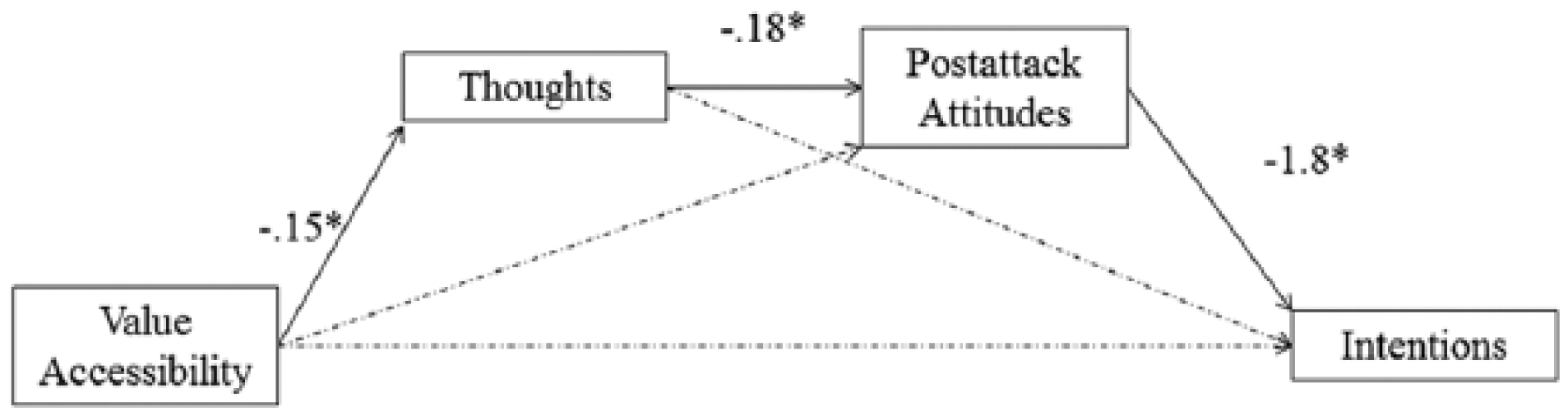
Multiple mediation of value accessibility on intentions model with counterarguments and postattack attitudes as mediators in Study 3.
General Discussion
An evaluation’s accessibility is an important construct in understanding attitude structure (Fabrigar et al., 2005; Fazio, 1995, 2007). Despite its potential utility in explaining strength-related outcomes of single attitudes, little research has examined ways in which attitude accessibility can be a powerful construct in inter-attitudinal structure, especially when one broad attitude in the structure (a value) imparts strength to other attitudes in that structure. Past discussions have addressed accessibility as integral in intra-attitude structure and strength (Tourangeau, Rasinski, & D’Andrade, 1991), but no empirical work has directly addressed the role of accessibility in strength effects that extend across related attitudes in a larger cognitive structure. As noted earlier, making a value salient (likely more accessible) that conflicts with a policy attitude can also lead to changes in the policy attitude (to reduce that inconsistency; Rokeach, 1968). Here, however, making the evaluative component of a value accessible can lend strength to a related policy attitude when it is attacked.
The three studies presented here demonstrated that related policy attitudes become stronger—more resistant to change—as a result of an increase in the accessibility of an evaluation of an abstract goal (a value) that provides directional implications for the policy attitude. Therefore, it seems clear that value accessibility can play an important role in inter-attitudinal structure. Of course, increased resistance should occur only to the extent that the value is associated with the challenged attitude. As expected, preattack attitudes toward equality and affirmation action were significantly related in Study 2 (r = .29, p = .001) and Study 3 (r = .36, p < .001). An attitude that is weakly related to a value or even completely unrelated should see no benefit from a value made salient or accessible (Rokeach, 1968).
One of the advantages of using the accessibility manipulation in Studies 2 and 3 is the experimental nature of the data to argue for causal effects of value accessibility. However, additional support could be gained by documenting relations between natural variation in value accessibility and shifts from preattack to postattack attitudes toward affirmative action (because we did not have preattack policy attitude measures in Study 1). To do so, we combined the data from Studies 2 and 3 and then examined the conditions in which we had multiple measures of value accessibility (similar to Study 1). We then created an average of the reaction times for all six value favorability items using the same procedures as described for measured value accessibility in Study 1. Despite the fact that participants in the high value accessibility conditions generally responded quickly to the value evaluations (see Studies 2 and 3), analyses were consistent with those of Study 1. Regressing participants’ postattack affirmative action attitudes on the measured value accessibility index with preattack attitudes as a covariate resulted in a marginal relation between the value accessibility measure and the postattack policy attitudes, t(132) = 1.76, p = .08. The magnitude of this relation was not moderated by whether the data came from Study 2 or Study 3 (p = .77). Thus, consistent with Study 1, measured value accessibility tended to predict resistance to change. 12
The present studies also lay a foundation for some intriguing possibilities for future work. For example, one interesting direction may be to examine moderators of when increased value accessibility might lead to decreased resistance (i.e., greater change; cf. Rokeach, 1968) of the related attitude rather than increased resistance (as in the current research). One potential moderator is the extent to which the value is consistent rather than inconsistent with the policy attitude. In early structural theories of attitudes and attitude change, inter-attitudinal consistency (i.e., the extent to which an attitude is consonant with other, linked attitudes or knowledge structures; Converse, 1964; Heider, 1946) was one of the most commonly studied characteristics of inter-attitudinal structure. Over the decades, proponents of cognitive dissonance theory (Festinger, 1957) and balance theory (Heider, 1958) hypothesized that inconsistency among related cognitions creates a motivation that drives opinions and behavior to reduce that inconsistency (e.g., Zanna & Cooper, 1974). When values are inconsistent with policy attitudes, activating the value can force change in the policy attitudes (e.g., Rokeach, 1968) instead of imparting strength to those attitudes (as in the current value accessibility conditions).
Future work could also address additional mediational mechanisms potentially responsible for the current effects. For example, it could be that the accessibility of the value might influence the accessibility of the policy attitude. Using a value accessibility manipulation similar to the current Studies 2 and 3, Blankenship, Wegener, and Murray (2010) found that increased accessibility of the evaluative component of a value (i.e., equality) led to increased accessibility of attitudes related to equality (e.g., civil rights, affirmative action) but not attitudes unrelated to equality (e.g., nuclear power).
In one type of combination of the mediation and moderation questions, it could also be that strength-related properties of the value other than accessibility might moderate the accessibility effects on resistance. Using attitude ambivalence as an example, when evaluations of the value are primarily univalent (i.e., strong), we could see the pattern of results reflected in the present studies. However, if the evaluation of the value were more ambivalent (i.e., weak), making that ambivalent evaluation more accessible might actually decrease resistance of the related policy attitude to the attacking message. This might be especially likely if the ambivalence-producing beliefs about the value include elements that are consistent with the message attacking the policy (in addition to beliefs that support the policy). Although ambivalence and accessibility share a small negative relation (Bargh, Chaiken, Govender, & Pratto, 1992), making an object’s positive and negative evaluations simultaneously accessible may lead to an accessible yet ambivalent attitude (Newby-Clark, McGregor, & Zanna, 2002). Therefore, accessibility may function as a conduit through which various properties of a value might be transmitted to related policy attitudes.
To our minds, the current research addresses a relatively understudied component of attitude strength. Despite the potential importance of inter-attitudinal structure in attitude strength (Eagly & Chaiken, 1998; Scott, 1969), there are surprisingly few investigations of how structural properties of attitudes function in an inter-attitudinal context. This is unfortunate, given that many models of attitude formation and change posit that attitudes are interconnected. Indeed, attitude theorists have long been interested in how belief systems such as values and ideologies could influence attitude formation and change (Converse, 1964; McGuire, 1960, 1989; Rokeach, 1968), such that the evaluations we hold toward objects can be connected to and organized into relatively consistent superstructures. The present research highlights that properties of values within this structure (such as the accessibility in memory of the evaluation of the abstract goal) can influence the extent to which related attitudes demonstrate the kinds of strength-related consequences that are hypothesized to result from attitudes being embedded in inter-attitudinal structure (Eagly & Chaiken, 1995, 1998; Holbrook, Berent, Krosnick, Visser, & Boninger, 2005; Newcomb, 1968). We hope that the current research helps to ignite additional research on values and their role in inter-attitudinal structure.
Footnotes
Declaration of Conflicting Interests
The author(s) declared no potential conflicts of interest with respect to the research, authorship, and/or publication of this article.
Funding
The author(s) received no financial support for the research, authorship, and/or publication of this article.

Notes
References
Supplementary Material
Please find the following supplemental material available below.
For Open Access articles published under a Creative Commons License, all supplemental material carries the same license as the article it is associated with.
For non-Open Access articles published, all supplemental material carries a non-exclusive license, and permission requests for re-use of supplemental material or any part of supplemental material shall be sent directly to the copyright owner as specified in the copyright notice associated with the article.
