






Abstract
Previous studies show that close friends improve at lie detection over time. However, is this improvement due to an increase in the ability to decode the feelings of close friends or a change in how close friends communicate their true and deceptive emotions? In a study of 45 pairs of friends, one friend from each pair (the “sender”) was videotaped showing truthful and faked affect in response to pleasant and unpleasant movie clips. The other friend from each pair (the “judge”) guessed the true emotions of both the friend and a stranger 1 month and 6 months into the friendship. Judges were better at guessing the true emotions of friends than strangers, and this advantage in judging friends increased among close friends over time. Surprisingly, improvement over time was due mostly to a change in the sender’s communication, rather than an increase in judges’ ability to decode their friends’ feelings.
People are notoriously poor at detecting the deception of strangers (Bond & DePaulo, 2008). Whether this ability improves within the context of close relationships is less clear. Although we might expect that accuracy would be higher between people who know each other well, surprisingly there is no unqualified support for the notion that friends or romantic partners detect each other’s lies better than strangers can (Anderson, Ansfield, & DePaulo, 1999; Ickes & Simpson, 1997; McCornack & Levine, 1990; McCornack & Parks, 1986; Sternglanz & DePaulo, 2004).
Why Friends Might Not Be Superior to Strangers at Detecting Deception
Ironically, knowing someone well may actually impair our deception detection ability by imparting a false sense of confidence in the ability to read that particular person. McCornack and Parks (1986) theorized that being in a close relationship leads to increased truth bias (the tendency to judge most communications as truthful), which in turn leads to diminished deception detection accuracy. Although this theory has not been tested in friendships, it was supported in a study of romantic couples in which increased confidence in one’s ability to “read” one’s relationship partner led to greater truth bias and lower deception detection accuracy (Levine & McCornack, 1992).
Perhaps one of the most important obstacles to detecting the lies of friends is that those are exactly the types of lies people most want to believe. While people typically tell strangers self-centered lies to make themselves look good, 44% of lies told to friends are altruistic lies told to protect them from negative feelings or make them feel good. Another 19% of lies told to friends are told to avoid conflict and maintain the friendship (DePaulo & Kashy, 1998). These are the types of lies that are in people’s best interest and in the best interest of their friendship to accept as true. Murray and colleagues (Murray & Holmes, 1999; Murray, Holmes, & Griffin, 1996) have shown that positive illusions can contribute to stability and satisfaction in romantic relationships and it is likely that the same is true of friendships.
Ickes and Simpson (1997) developed a model to predict when close relationship partners should be motivated (consciously or unconsciously) not to read each other’s affective states accurately. They theorized that motivated inaccuracy is most prone to occur when the perceiver’s close relationship partner experiences thoughts and feelings that are threatening to the perceiver or to the relationship, and when the partner’s verbal and nonverbal cues are ambiguous. In this model, the main cause of motivated inaccuracy is the perceiver’s own feelings. In a study by Anderson (1999), people attempted to detect deception when their romantic partner and a stranger stated honestly or deceptively that they found another person attractive. Romantic partners were less accurate than strangers and had a stronger truth bias, particularly when the hidden truth was threatening to their relationships—that is, when their partners pretended that they did not find someone else attractive.
An alternative possibility is that threatening cues become ambiguous to a close relationship partner precisely because the person expressing those cues wants them to be. In one of the earliest studies on motivated inaccuracy, Rosenthal and DePaulo (1979) showed that women are more likely than men to perform poorly at interpreting nonverbal cues that senders are trying to hide. They theorized that perceivers who read cues that senders deliberately try to disguise may be committing a particularly destructive violation of polite behavior—perceiving the emotions people would like to disguise—and that women are more concerned about this violation than are men. There is evidence that close friends in particular have a need to respect each other’s emotional privacy by not detecting unpleasant emotional truths that are hidden. Sternglanz and DePaulo (2004) found that close friends were worse than less close friends at reading unpleasant emotions but only when those unpleasant emotions were intended to be hidden. Interestingly, the hidden information that close friends failed to detect in that study was not even threatening to the relationship. While past researchers of empathic accuracy have argued that friends should be accurate at recognizing emotions that are nonthreatening to the relationship, most of those studies have not explicitly explored deception detection, which is a more challenging form of empathic accuracy because the senders are intentionally concealing their true emotions. Therefore, it may be the case that motivated inaccuracy in deception detection can occur with very little motivation; the conscious or unconscious respect for a friend’s emotional privacy may be sufficient.
When and Why Friends Might Be Superior to Strangers at Detecting Deception
Intuitively, we would expect that friends should be better at discerning information about each others’ thoughts, feelings, and traits than strangers—and this is generally the case (Stinson & Ickes, 1992). Friends show superior accuracy in understanding each other’s personality traits, as compared with strangers (Funder & Colvin, 1988; Paulhus & Bruce, 1992), and friends’ advantage in this domain is not merely based on assumed similarity (Funder, Kolar, & Blackman, 1995). Friends are also better than strangers at decoding each other’s thoughts and feelings (e.g., Ansfield, DePaulo, & Bell, 1995; Thomas & Fletcher, 2003).
Friends may also be more accurate in detecting deception than strangers due to the advantages of familiarity. Friends’ experiences with each other allow them to read the subtext of each other’s communications intuitively and automatically (Colvin, Vogt, & Ickes, 1997). People often spot lies by targeting behaviors or phrases that seem different from the norm (Brandt, Miller, & Hocking, 1982). Because friends know each other’s baseline behaviors and manner of speech, deviations from those baseline norms may enable friends to detect behavioral anomalies with superior accuracy. Indeed, people believe that their friends are more likely to detect their lies than are acquaintances (DePaulo & Kashy, 1998).
Friends who feel particularly close to each other might have an advantage in detecting deception over friends who feel less close to each other. In a daily diary study of everyday lies, DePaulo and Kashy (1998) included measures of self-reported relationship closeness, how long participants had known the relationship partner, and how frequently participants interacted with the relationship partner. Only relationship closeness was correlated with the likelihood that the lies were eventually discovered. Thus, it appears likely that emotional closeness, rather than merely spending time together, is the key component in successful lie detection. This is exactly what Anderson, DePaulo, and Ansfield (2002) found in their study of friends’ ability to detect deception at two points in time; only the close friends became more accurate over time.
Can Friends Detect Lies Indirectly?
Whether or not friends are better than strangers at detecting deception, it is possible that friends can indirectly sense when their friends are lying even if they cannot quite make the correct judgment call. Although the accuracy of judges is typically only slightly better than chance when they are asked to decide whether a sender is lying or being truthful, certain studies have shown that judges can detect deception indirectly even when their explicit choices are inaccurate (see DePaulo & Morris, 2004, for a review). For example, when judges rate a sender who is lying, they perceive that sender as being more ambivalent, less comfortable, and exhibiting more cognitive effort than a sender who is being truthful (DePaulo, Rosenthal, Green, & Rosenkrantz, 1982; Hurd & Noller, 1988; Vrij, Edward, & Bull, 2001). Furthermore, judges feel more suspicious, less comfortable, and less confident when they are watching someone who is lying rather than being truthful (Anderson, 1999; Anderson et al., 2002; DePaulo, Charlton, Cooper, Lindsay, & Muhlenbruck, 1997). Judges’ ratings of these indirect variables are correlated with whether the sender is lying, even when the judges make inaccurate guesses as to whether the sender is lying or being truthful (ten Brinke, Stimson, & Carney, 2014). While the existence of various indirect cues to deception has been found across many studies, there is debate as to whether indirect cues are actually more accurate than explicit cues (see Levine & Bond, 2014).
Notably, most explicit and indirect deception detection studies take place with strangers or brief acquaintances, rather than close relationship partners. In the few deception detection studies with relationship partners, the pattern of indirect lie detection was stronger among friends (Anderson et al., 2002) and romantic partners (Anderson et al., 1999) than among strangers. Therefore, the question of whether friends are more accurate than strangers in detecting deception should explore both explicit and indirect measures of deception detection.
The Importance of the Sender in Close Friends’ Deception Detection Accuracy
Most studies of deception detection focus on the role of the “judge,” the person who is judging whether someone else is behaving truthfully or deceptively, rather than the “sender,” the person sending verbal and nonverbal cues while being truthful or deceptive (Levine, 2010). This focus on the judge is understandable given that judges’ decisions are the markers used to gauge accuracy. However, it is possible that judges are accurate not because of their own deception detection skills but because the senders are behaving in a way that makes them especially readable to the judge. In studies examining accuracy in guessing people’s emotions when no deception is involved, interpersonal sensitivity is related more to the sender’s expressivity than to the judge’s perceptivity (Snodgrass, Hecht, & Ploutz-Snyder, 1998). Although one would expect that judges who are high in trait empathy would demonstrate more empathic accuracy, empathy only improves accuracy when the target is highly expressive (Zaki, Bolger, & Ochsner, 2008).
Examining both the role of the judge’s capabilities to detect deception and the sender’s abilities to deceive is particularly important in the context of friendships. When friends are more accurate than strangers, is their decoding advantage due to the fact that the judges are particularly knowledgeable about their friends’ normal behavior and idiosyncrasies, or is their decoding advantage due to the fact that the senders express emotions that are specifically readable to their friends? In other words, is friends’ decoding advantage due to superior judges or superior senders?
There is evidence for both possibilities. Buller and Aune (1987) found that deceptive senders leaked differing amounts of affect-related nonverbal cues to strangers than to friends or romantic partners, indicating that senders’ behavior plays an important role in deception among friends versus strangers. Fleming, Darley, Hilton, and Kojetin (1990) asked senders to convey, via a videotaped message, which of four songs the judge should choose. They were told that the same video would be shown to their close friends as well as strangers, and their goal was to get their friends to pick the correct song while the strangers pick the incorrect song. The strategy that most of the senders spontaneously used was to insert falsified personal information that only their friends would notice. However, a small group of senders used nonverbal cues—characteristic facial expressions which would be recognized only by their friends due to the past usage of those expression within the friendship. Close friends were able to detect these subtle hints and decode the senders’ true meaning while strangers could not. Thus, senders can communicate lies that are unseen by strangers but visible to friends (Fleming et al., 1990) when their intention is to convey the truth only to their friends.
Some have argued, though, that it is the judges’ knowledge about their friends that causes them to be more accurate than strangers who lack that knowledge (Ickes & Simpson, 1997; Stinson & Ickes, 1992). However, most studies showing that friends are more accurate than strangers at judging a sender’s true thoughts and feelings are based upon videotapes of the senders made at a single point in time. These types of studies cannot rule out the possibility that the sender has already become more readable to the friend over the course of the friendship prior to the study, and that this increased readability is responsible for the higher accuracy between friends.
To answer the question of whether the advantage in deception detection accuracy of friends over strangers is due to the judge or the sender, a longitudinal study of newly developing friendships is necessary. The best time to explore this question is as the relationship is first developing to see who is becoming more accurate or more readable over time. Anderson et al. (2002) found that emotionally close friends improve at detecting each other’s lies during the first 6 months of friendship. However, their study was not designed to test whether the judge or the sender was driving that improved accuracy. The current study directly tested whether the improved accuracy is due to an improvement in the ability of the judges or whether the senders communicate their truths and lies differently as their friendship develops over time.
Research Questions
In the present research, we recruited 45 pairs of same-sex friends who had known each other for no more than 1 month, but who still considered themselves “friends.” One friend from each pair was randomly assigned the role of “sender”; each sender was videotaped expressing both truthful and faked emotional responses to pleasant and unpleasant video clips. For half of these emotional displays, senders were told that the intended audience was their friend while the other half were intended for a stranger. The other friend from each pair was assigned as “judge” and watched a video of the senders’ emotional responses, attempted to detect whether senders’ emotional responses were truthful or faked, and attempted to guess whether the video clips senders watched were pleasant or unpleasant. Judges also completed two potential indirect measures of deception detection, including ratings of senders’ expressivity and intensity. Each judge watched eight videos of his or her friend and eight videos of a same-sex stranger. This procedure occurred at Time 1 (1 month into the friendship) and Time 2 (6 months into the friendship). In addition, judges at Time 2 rejudged the senders’ videos from Time 1; this was called the Re-do condition. Using this procedure, we were able to address the following five research questions:
Although it may seem intuitive that friends would be superior to strangers on these tasks, past studies do not provide unqualified evidence that this is the case (Anderson et al., 1999; Ickes & Simpson, 1997; McCornack & Levine, 1990; McCornack & Parks, 1986; Sternglanz & DePaulo, 2004).
To test whether improvement over time is actually due to the friendship rather than just being due to judging the same person twice, the key dependent variable will be a difference score representing the advantage in judging friends more accurately than strangers. Based on the results of Anderson et al. (2002), we anticipated that only close friends, but not less close friends, would show a greater advantage in judging their friends more accurately than strangers over time.
If, as shown by Anderson et al. (2002), judges are more accurate at decoding their close friends at Time 2 (6 months into the friendship) than at Time 1 (1 month into the friendship), this could mean either that judges were improving or that senders were becoming more readable to their close friends. Intuitively, one might attribute such improvements to the judges; however, the potential role of the sender should not be overlooked (Levine, 2010; Levine et al., 2011).
Our experimental design was intended to tease apart the roles of the senders versus the judges in any improvements over time. To test whether the improvement is driven by the judge, the sender, or both, we also asked judges to rejudge the senders’ clips from Time 1 at Time 2 (called the Re-do condition). If judges were more accurate at judging senders in the Re-do condition than at Time 1, this would indicate that the improvements were due to changes in judges’ aptitude over time (because the sender clips are identical in these two conditions). On the contrary, if judges were more accurate at Time 2 than in the Re-do condition, this would indicate that senders’ encoding ability has improved over time (because the judges made both of these judgments at Time 2). It should be noted that these two possibilities are not mutually exclusive. A third possibility is that accuracy was greatest at Time 2, followed by the Re-do condition, which in turn had greater accuracy than Time 1; this would indicate improvements over time in both judges’ aptitude and senders’ encoding.
Consistent with the findings of Sternglanz and DePaulo (2004) and the concept of motivated inaccuracy presented by Ickes and Simpson (1997), we predicted that friends would do particularly poorly detecting the unpleasant emotions of their friends specifically when their friends were attempting to disguise those unpleasant emotions by feigning pleasant emotions.
Previous research (see Anderson et al., 2002; DePaulo, 1994; DePaulo & Morris, 2004) indicates that people can often distinguish between truthful and deceptive communications on indirect or implicit measures, sometimes even when they cannot do so explicitly. Because the judges in this study rated facial expressions, we chose indirect measures appropriate for nonverbal communication. We examined whether judges could detect deception indirectly by asking judges to rate senders’ expressivity and intensity across all conditions. We also compared these two indirect measures of deception detection for friends versus strangers.
Method
Participants
Experimenters contacted students enrolled in an introductory psychology course within 2 weeks after the beginning of the semester at a university in the Southeastern United States. Students were told that they would be eligible to participate in the study if they and a same-sex friend whom they had not known before the beginning of the semester completed separate applications for the study. Pairs in which each person indicated on the application forms that they were indeed friends and had known each other for less than a month were invited to participate in the study. The first session was scheduled approximately a month into their friendship, and a second session was scheduled 5 months later. A total of 45 pairs (19 male pairs and 26 female pairs) completed both sessions. The sample included 71 Caucasians, six African Americans, five Asians, two Latinos, three biracial participants, and three who did not provide ethnic information.
At the beginning of each of the two sessions, each friend completed the Subjective Closeness Index for the friendship (see Aron, Aron, & Smollan, 1992). This index included two questions: “Relative to all of your other relationships, how would you characterize your relationship with this person?” and “Relative to what you know about other people’s close relationships, how would you characterize your relationship to this person?” Answers ranged from 1 (much less close than others) to 9 (much closer than others). Friendships were classified as close if both friends gave a mean response on these questions of 6 or greater during both the first and second sessions; thus, friends were considered close if they both felt close to each other 1 month into the friendship and remained close 5 months later. Twenty-five pairs of friends were classified as close and 20 pairs as not especially close. The mean closeness ratings for the close friends were 6.81 and 7.10 at 1 month and 6 months, respectively; the mean closeness ratings for the less close friends were 5.38 and 4.50 at 1 month and 6 months, respectively. At the same time, when participants rated how close they felt to their friend, they also rated their amount of self-disclosure in that friendship, as measured by how many topics they discussed with their friends (answers ranged from 0 to 18 topics, and the topics included movies, personal crises, clothes, dating, family conflict, sex life, grades, etc.). The relational self-disclosure measure was used to confirm the closeness categorizations. A three-way ANOVA (Relationship Closeness × Dyad Gender × Time) found that the close friendships included more self-disclosure (M = 10.60) than the less close friendships (M = 7.41), F(1, 41) = 16.01, p < .001 (self-disclosure was averaged between the two friends). This difference in self-disclosure between close and less close friends was equally true of men and women and did not change significantly from 1 month to 6 months into the friendship.
Design
This repeated-measures study utilized a seven-way mixed design. The two between-participant variables included the closeness of the friendships (close vs. less close) and the sex of the same-sex pairs (male vs. female). The five within-participant independent variables included the type of movie clips the judges watched (pleasant vs. unpleasant), the instructions senders were given (show their true emotional reactions to the clips vs. fake the opposite reaction), whom the senders were instructed to convey expressions to (their friend vs. a stranger), whose facial reactions the judges rated (their friend vs. a stranger), and which time the ratings were made (Session 1, Session 2, or the rerating of Session 1 facial expressions completed during Session 2 which was called the Re-do condition). The statistical power of this design was enhanced due to the many within-participant variables. Each participant provided data in every condition of the study. Because most statistical comparisons were made within individuals as opposed to between individuals (with the exception of relationship closeness and gender), individual differences between participants were removed as a source of variability. For this reason, effect sizes and power tend to be higher in within-participant designs than between-participant designs, even with fewer participants (Aron, Coups, & Aron, 2013).
Dependent variables included direct and indirect measures of the judges’ accuracy in detecting the senders’ truths and lies. The direct measures included the judges’ guesses about whether the senders were showing their true emotion or the opposite, whether the senders were actually watching a pleasant or unpleasant movie clip, ratings of how genuine the senders’ facial reactions were, and ratings of how pleasant the sender was feeling. These ratings were considered “direct” because they explicitly required that participants make guesses about the independent variables manipulated in the experiment (whether the senders were being genuine and whether they were responding to pleasant or unpleasant stimuli). Indirect measures included judges’ ratings of how intense the senders were feeling and how expressive the senders’ facial reactions were. These two ratings were considered potential “indirect” measures of deception because it is possible that the judges’ intensity or expressivity ratings could reliably distinguish between senders’ truthful versus deceptive communications despite the fact that the items did not explicitly ask participants about deception.
Materials and Procedure
Film clips
Each pair of friends watched a set of eight film clips during each session. These clips were selected from among approximately 50 clips pretested by students from an introductory social psychology class. The clips were pretested for the primary emotional reaction elicited by the clip, as well as the extent to which the clip was humorous, sad, distressing, pleasant, or disgusting. The 24 clips that had the highest ratings for pleasantness/humor or the highest ratings for unpleasantness/sadness, without any gender differences in the pretested sample, were included in the pool of clips for this study. Pleasant clips included funny scenes from comedic films (e.g., When Harry Met Sally) and television programs such as Saturday Night Live. Unpleasant clips depicted traumatic events such as someone dying from cancer, a couple fighting, parents finding a child dead, and someone saying goodbye to loved ones. Three sets of eight clips were created (four pleasant and four unpleasant clips in each set presented in a counterbalanced order). Each dyad watched one of the sets of clips during Session 1 and a different set during Session 2. Ratings of the video clips from Session 1 were used as a manipulation check of the pleasantness of the clips. A within-participant t test confirmed that the pleasant clips were indeed rated as being substantially more pleasant than the unpleasant clips (M = 6.24 vs. M = 2.01, respectively, on a 0-8 scale), t(88) = 20.73, p < .001.
First session
Before the first session, one friend from each pair was randomly assigned to the role of judge and the other friend was assigned to the role of sender. While the judge was out of the room, the sender was given an instruction sheet describing how to respond while watching the eight movie clips (four amusing/pleasant clips and four sad/unpleasant clips). The senders were instructed to show how they felt during half of the clips and to show the opposite of how they felt during the other clips (to “fool” the person who would be watching the videotape of them). In addition, senders were given instructions about the target audience for their emotional expressions. Senders were instructed to convey how they felt (or the opposite) to their friend or to a stranger. The order of these instructions was counterbalanced across the eight clips. Senders were aware that they would be videotaped while watching the movie clips.
The experimenter then brought the judge into the room and placed a 6-foot high partition between the participants so that they could not see each other’s facial expressions while viewing the movie clips. The two friends were instructed not to talk while watching the clips and the judge listened to the movie clips using noise-canceling headphones so that any noises (e.g., laughter) from the sender would not be heard. While they watched the movie clips, both the sender and the judge rated on 0- to 8-point scales their true emotional reactions to the clips (pleasant, intense, amused, distressed, and sad). The experimenter went to a video control room and recorded the sender as he or she watched the eight clips. The experimenter only taped the sender while each movie clip was running and covered the video camera lens between clips.
Upon completion of this portion of the study, the participants were informed that they would view the videotape made of the sender’s facial expressions as well as a tape of a sender they did not know from another pair of friends (referred to as the “yoked” pair of strangers). The order of whom they watched first was counterbalanced. Because the judges had already watched the same movie clips as their friends in the same order, the experimenter began by showing the third facial expression segment through the eighth segment and then showed the first two segments at the end. The judges were only told that the persons they were viewing would be showing their true responses to the clips some of the time and opposite emotions at other times; they were not told that exactly half of the expressions would be faked.
As the judge and sender watched the videotapes of facial expressions, they were given a facial ratings booklet. The dependent variables measured in this booklet included four direct measures of accuracy—two dichotomous and two continuous. Participants were asked to guess whether the senders were watching a pleasant or unpleasant movie clip and guess whether the senders were trying to show what they were feeling or the opposite of what they were feeling during each clip. Correct guesses were coded as 1, and incorrect guesses were coded as 0. Therefore, means on these dichotomous variables ranged from 0 to 1 and can be interpreted as the percentage of guesses senders made correctly (50% is considered as accurate as chance). 1 Accuracy was also measured using continuous 9-point scales along which participants rated how pleasant the senders’ feelings were and how genuine/sincere the senders’ facial reactions were. The booklet also included two dependent variables that did not measure accuracy but were included as potential indirect measures of lie detection. Along 9-point scales, participants rated how intense the senders’ feelings were and how expressive the senders’ facial expressions were. The facial ratings booklet included ratings for the above six dependent variables in response to watching each of the eight facial expressions of the friend sender and the eight facial expressions of the sender from the yoked pair. Although both the judges and the senders completed the facial ratings booklet, the focus of this article was the judges’ ratings of the senders rather than the senders’ ratings of themselves. The senders’ ratings of themselves were not included in the data analysis.
Second session
Approximately 5 months later, each pair of friends returned for their second session. The friends maintained their previously assigned roles of sender and judge, and they were yoked with the same pair they had seen on tape during the first session. The same procedure from the first session was followed; once again, the sender was videotaped watching a different selection of eight movie clips, and then the judge and sender used the facial ratings booklet to rate the sender’s expressions as well as the videotapes of the sender from the yoked pair. Again, because the judge had watched the same movie clips as his or her friend, the experimenter began by showing the third facial expression segment through the eighth segment and then showed the first two segments at the end.
In addition to creating and rating the new videotapes of the senders’ facial expressions filmed during the second session, the participants also rewatched and rerated the original videotapes of both senders’ facial expressions from the first session. Instead of viewing the videotapes in the same order as they were viewed during the first session (beginning with the third segment), this time participants began with the first segment and watched them in the order in which they were originally filmed.
Results
Overview of Analysis
The six dependent variables included the dichotomous and continuous measures of lie detection/genuineness, the dichotomous and continuous measures of accuracy detecting pleasant/unpleasant emotion, and the two potential indirect cues of lie detection—expressivity and intensity. For each of the six dependent variables, a separate seven-way repeated-measures ANOVA was conducted. These seven-way repeated-measures ANOVAs included the following within-participant variables: type of movie clips the judges watched (pleasant vs. unpleasant), the instructions senders were given (show their true emotional reactions to the clips vs. fake the opposite reaction), whom the senders were instructed to convey expressions to (their friend vs. a stranger), whose facial reactions the judges rated (their friend vs. a stranger), and at which time the ratings were made (Session 1, Session 2, or the rerating of Session 1 facial expressions completed during Session 2). The two between-participant variables were the closeness of the friendships (close vs. less close) and the sex of the same-sex pairs (male vs. female).
Higher Accuracy Judging Friends Than Strangers
On the dichotomous measure of accuracy in lie detection, judges were more accurate at guessing whether senders were showing or faking emotion when judging friends (M = 61%, 95% confidence interval [CI] = [57%, 65%]) than strangers (M = 48%, 95% CI = [45%, 51%]), F(1, 41) = 33.96, p < .001, η2 = .45. Similarly, on the continuous measure of perceived genuineness, judges thought their friend’s facial expressions were more genuine when their friends were being truthful rather than lying but they thought that the stranger’s facial expression was more genuine when the stranger was lying rather than being truthful, indicating a pattern of accuracy for friends but inaccuracy for strangers, F(1, 41) = 48.93, p < .001, η2 = .54 (see Table 1). For both the dichotomous measure of accuracy in lie detection and the continuous measure of perceived genuineness, the pattern that judges were more accurate when judging friends than strangers remained consistent regardless of whether the senders were being truthful or lying.
Accuracy of Perceived Genuineness and Perceived Pleasantness When Judging Friends Versus Strangers.

Note. Higher difference scores indicate greater accuracy, and negative difference scores indicate inaccuracy. CI = confidence interval.
p < .05. **p < .001.
Similarly, on the continuous measure of perceived pleasantness, judges were only significantly accurate when judging friends but not when judging strangers. When judging friends, the judges thought the sender’s feelings were more pleasant when the clip actually was pleasant than unpleasant, F(1, 41) = 8.00, p = .007, η2 = .16 (see Table 1). Although this pattern of accuracy for friends was greater when the senders were being genuine, the accuracy for friends still remained significant even when the friends were faking their emotion, F(1, 41) = 41.80, p < .001, η2 = .51. On the dichotomous measure of accuracy in guessing emotion, judges were also more accurate at guessing whether the movie clip was pleasant or unpleasant when they were judging a friend (M = 62%, 95% CI = [58%, 65%]) than when judging a stranger (M = 51%, 95% CI = [47%, 54%]), F(1, 41) = 14.89, p < .001, η2 = .27. All four of the dependent variables measuring accuracy showed that people were more accurate judging their friends than strangers. While this pattern did not vary depending upon whether the sender was being genuine or deceptive for three of those four variables, it did vary on the dichotomous measure of emotion detection. When it came to guessing the senders’ actual emotions, judges were more accurate judging the emotions of friends than strangers when the senders were being truthful but not when the sender was being deceptive, F(1, 41) = 15.77, p < .001, η2 = .28.
There was some evidence of motivated inaccuracy when judges attempted to guess their friend’s disguised unpleasant emotions. When the senders were displaying their true emotions, judges were consistently more accurate guessing the emotions of their friends than strangers. However, when the senders were faking their emotions, the advantage in judging friends more accurately than strangers was no longer significant, and the most dramatic decrease occurred when the senders were disguising unpleasant emotions, F(1, 41) = 5.96, p = .019, η2 = .13 (see Figure 1). Interestingly, judges became even less accurate judging their friends than strangers when the senders were trying to disguise their unpleasant emotions (although this difference was not statistically significant).

The advantage in judging friends more accurately than strangers as a function of the pleasantness of the clip and whether the sender is showing or hiding emotion.
The Advantage in Judging Friends More Accurately Than Strangers Increases Over Time Among Close Friends
For close friends, the advantage in judging friends more accurately than strangers on the dichotomous measure of lie detection was larger at Time 2 than at Time 1 or the Re-do. However, for less close friends, the advantage in judging friends more accurately than strangers decreased, and was smaller at Time 2 than at Time 1 or the Re-do, F(2, 82) = 5.71, p = .005, η2 = .12. The same pattern was found for the dichotomous measure of guessing emotion. The advantage in guessing the emotions of friends more accurately than strangers was strongest for close friends at Time 2 but weakest for less close friends at Time 2, F(2, 81) = 3.67, p = .03, η2 = .08. Similarly, for close friends, the advantage in perceiving genuineness more accurately for friends than strangers was greater at Time 2 than at Time 1 or the Re-do. For less close friends, the advantage was smallest at Time 2, F(2, 82) = 3.74, p = .028, η2 = .08 (see Table 2).
Percent Accuracy of Close Friends and Less Close Friends at Time 1, the Re-Do, and Time 2.
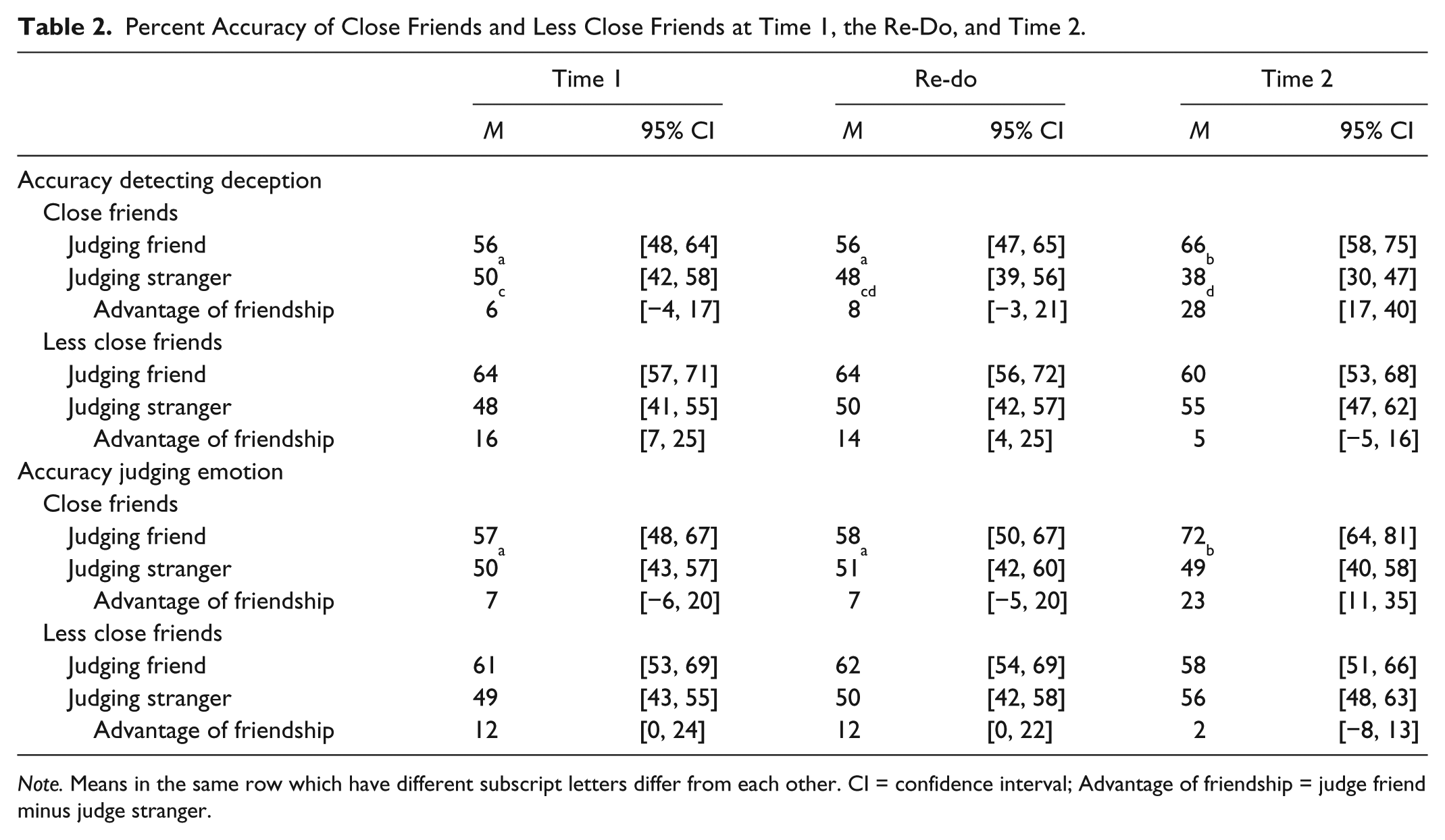
Note. Means in the same row which have different subscript letters differ from each other. CI = confidence interval; Advantage of friendship = judge friend minus judge stranger.
Simple effects tests were conducted to determine what was driving the changes over time. For the dichotomous measure of lie detection, close friends became marginally significantly more accurate judging their friends at Time 2 than at Time 1 (p = .09) or the Re-do (p = .09; and Time 1 and the Re-do did not differ from each other). Close friends also became significantly less accurate judging strangers at Time 2 than at Time 1 (p = .045). For the dichotomous measure of guessing emotion, close friends became significantly more accurate judging their friends at Time 2 than at Time 1 (p = .024) or the Re-do (p = .022; and Time 1 and the Re-do did not differ from each other; see Table 2). For both of these dependent variables, the accuracy of less close friends did not change at all.
Ratings of Expressivity
Judges thought that senders appeared significantly less expressive at Time 2 (M = 5.24, 95% CI = [5.01, 5.48]) than at Time 1 (M = 5.68, 95% CI = [5.40, 5.96], p = .009), with the Re-do falling in the middle (M = 5.46, 95% CI = [5.15, 5.77]), F(2, 82) = 4.02, p = .022, η2 = .09. The perception that the senders became less expressive over time was held by friends and strangers alike, regardless of relationship closeness.
When judges rated a stranger, they found the stranger to be more expressive if the sender had been instructed to communicate to his or her friend (M = 5.58, 95% CI = [5.24, 5.90]) than to a stranger (M = 5.22, 95% CI = [4.85, 5.59], p = .019). However, when judges rated their friend, they did not perceive any significant differences in their friend’s expressivity regardless of whether their friend was communicating to them (M = 5.49, 95% CI = [5.19, 5.79]) or to a stranger (M = 5.55, 95% CI = [5.29, 5.82], p = .68), F(1, 41) = 4.65, p = .037, η2 = .10.
Ratings of Expressivity as an Indirect Measure of Lie Detection Among Friends
For the following set of analyses, the same seven-way ANOVA was conducted except that the pleasant/unpleasant variable indicated whether the sender was attempting to display pleasant or unpleasant reactions to the film rather than whether the films themselves were pleasant or unpleasant.
Among friends only, ratings of expressivity appear to be an indirect measure of whether the sender was showing genuine or fake pleasant and unpleasant emotions. Among friends, pleasant displays of emotion were rated as more expressive when they were genuine than when they were faked, and unpleasant displays of emotion were rated as less expressive when they were genuine than when they were faked. Essentially, judges view any attempt at sending pleasantness as more expressive than any attempt at sending unpleasantness—but judges still rate genuine pleasantness as more expressive—and genuine unpleasantness as less expressive—than the faked attempts at these emotions. This pattern was found among friends but not strangers, F(1, 41) = 59.81, p < .001, η2 = .59. Figure 2 displays these results on a spectrum from genuine pleasantness to genuine unpleasantness. While perceived expressivity appears to be an indirect cue to deception among friends, perceived intensity was not found to be a significant indirect cue.

Expressivity ratings of friends and strangers arranged on a spectrum from genuinely pleasant to genuinely unpleasant displays of emotion.
Discussion
This study tested whether people are more accurate detecting the deception and genuine emotion of their friends than strangers over the course of early friendship development. More specifically, this longitudinal study was designed to determine which person in the close friendship is responsible for the improved accuracy over time—the judge or the sender. In addition, data were collected to explore whether there might be evidence of both motivated inaccuracy between friends and indirect deception detection.
Friends Were More Accurate Than Strangers (Research Question 1)
In general, judges were more accurate detecting deception and guessing emotions of their friends than of strangers. These findings were consistent regardless of whether the judges made their decisions based on dichotomous choices or continuous ratings and, for most of the dependent variables, regardless of whether the senders were being truthful or deceptive.
The Advantage in Judging Friends More Accurately Than Strangers Increases Over Time in Close Friendships (Research Question 2)
Close friends became more accurate judging their friends at Time 2 than they had originally been at Time 1. This improvement over time was marginally significant for deception detection and statistically significant for emotion detection. Less close friends showed no changes in accuracy over time, and people also did not become more accurate judging the same stranger over time. This is a conceptual replication of the key finding of the study by Anderson et al. (2002) that close friends became more accurate over time but less close friends did not.
In past studies in which judges have had to guess whether a life story told by the sender is true or false (e.g., Anderson et al., 2002), the expected advantage that close friends have could be attributed to the fact that people have more knowledge about their close friend’s life and therefore more information upon which to evaluate those life stories. However, in the current study, the senders merely conveyed nonverbal expressions of emotion in reaction to film clips which would give no special advantage to close friends based on their knowledge of each other’s lives. Therefore, the advantage in judging close friends more accurately than less close friends or strangers does not rely upon having specific factual knowledge about the sender’s life.
Interestingly, accuracy at detecting the deception of strangers decreased from Time 1 to Time 2 but only for close friends. When these close friendships were fairly new at Time 1, the judges were almost as accurate judging strangers as they were judging their close friends (only 6% difference). Five months later at Time 2, close friends became more accurate detecting the deception of their friends, and also less accurate detecting the deception of strangers, making the advantage in judging friends more accurately than strangers a 28% difference. Because this pattern only occurred among close friends, it may be due to an assumption that close friends should be able to read each other easily after being friends for many months. People intuitively believe that their friends can detect their lies more accurately than acquaintances (DePaulo & Kashy, 1998), and as people become closer, they become more confident in detecting each other’s lies (Levine & McCornack, 1992). It is possible that close friends in particular experienced high self-efficacy when judging their close friends at Time 2 and a relative lack of self-efficacy judging strangers in comparison. Consistent with past research on self-efficacy (Bandura & Wood, 1989), if these close friends assumed that they would do better judging their friends than strangers at Time 2, the relative lack of self-efficacy for judging strangers could have led to a self-fulfilling prophecy in which they did not try as hard to detect the deception of strangers. Or similarly, feelings of self-efficacy may have caused judges to feel more anxiety during the task and they may have done poorly because they focused more intently on unhelpful cues. These explanations are only speculative, as ratings of self-efficacy were not collected. Furthermore, because this pattern of results was unpredicted and only occurred for deception detection but not emotion detection, it is important to replicate this pattern in future research.
Improvement in the Accuracy of Close Friends Over Time Is Due to the Sender in Close Friendships (Research Question 3)
One important question not addressed by the design of the study by Anderson et al. (2002) is whether the development of close friends’ superior deception detection ability is due to changes over time in judges’ perceptive abilities regarding their close friends or to changes over time in senders’ expressive behavior within close friendships. We suspect that most people would intuit that both our findings and the findings of Anderson et al. are due largely to judges’ improvement at decoding their close friends’ nonverbal cues over time. However, as personality researchers have discussed at length (e.g., Funder, 2012; Human & Biesanz, 2011), interpersonal accuracy depends not only on judges’ detection ability but also on senders’ ability to communicate interpersonal phenomena effectively. The inclusion of the Re-do condition in our study provides an effective way to tease apart improvements in judges’ detection ability from changes in senders’ communication.
If judges in close friendships become more skilled over time at detecting their close friends’ deceptions and true emotions, these judges should be more accurate in the Re-do condition than the “Time 1” condition because in the Re-do condition they are viewing the same Time 1 clips (in a different order) but with the advantage of having 5 more months of close friendship. However, our data found that accuracy in the Time 1 and Re-do conditions was nearly identical indicating that judges had no special advantage when they rerated the Time 1 clips 5 months later in their relationship.
On the contrary, if judges in close friendships are more accurate due to some change in their friends’ behavior over time, then these judges should be more accurate in the “Time 2” condition than the Re-do condition because the Time 2 condition shows their close friend conveying emotions 6 months into the friendship, while the Re-do condition shows their close friend only 1 month into the friendship. Surprisingly, our findings largely support this less intuitive theory, namely, that senders’ communicative behaviors (rather than the judges’ detection skills) change over time in a way that improves accuracy within a close friendship. At the second testing session, close friends were more accurate at detecting deception and guessing emotion when they viewed the nonverbal behaviors of their friend conveyed 6 months into the friendship than when they viewed the previous nonverbal behaviors of their friend conveyed 5 months earlier. In sum, judges’ accuracy in detecting their close friends’ deception improves over time, but this improvement appears to be due to some change in the way their close friends express themselves, rather than an improvement in their own decoding ability.
Although it is not clear exactly how the close friends are acting differently 6 months into the friendship in a way that enables their friends to judge their emotions more accurately, it must include subtle nonverbal behaviors which strangers and less close friends cannot pick up on. A potential explanation is that the nonverbal behaviors of the senders become more subtle and idiosyncratic later in the friendship, and this subtlety makes it more difficult for strangers and less close friends to distinguish between the genuine and faked displays of emotions, whereas the close friends can. In support of this explanation, the data indicate that judges perceived senders as less expressive at Time 2 than at Time 1. It is possible that senders were perceived as more expressive at Time 1 because they utilized general display rules of emotion or exaggerated their expressions. This could have increased accuracy detecting deception if genuine but exaggerated expressions were seen as more real (e.g., Duchenne-like smiles), while the deceptive exaggerated expressions may have appeared more forced and disingenuous. The fact that senders became less expressive at Time 2 may be an indication that they used more idiosyncratic, subtle expressions at Time 2 possibly because they were more familiar and comfortable with the task. Perhaps close friends at Time 2 guessed that an expression was genuine because it looked more natural and idiosyncratic, in contrast to which the faked emotions might have looked awkward and uncharacteristic of their friend. The differences between these less expressive displays of genuine and faked emotion at Time 2 must have been quite subtle, however, because only close friends were able to distinguish between the two, while less close friends and strangers were not.
According to self-report data from the senders in a different study (Fleming et al., 1990), senders intentionally use characteristic facial expressions that are more likely to be recognized by their friends. However, in our study, close friends were more accurate at Time 2 regardless of whether the senders were intentionally sending to their friend or to a stranger, and regardless of whether the senders were attempting to convey or fake their emotions. Therefore, whatever nonverbal cues the senders emitted were unlikely to be conscious in this case. Although it may seem surprising that close friends were just as accurate at Time 2 if their friend was sending to them or to a stranger, strangers did in fact perceive a significant difference in expressivity depending upon whom the intended audience was. In both sessions of the study, strangers found senders more expressive if the sender was sending to a friend than to a stranger. In contrast, participants found their friends to be equally expressive regardless of their intended audience, perhaps because they were more familiar with their friends’ idiosyncratic expressions and could recognize them even if they were more subtle. The surprising finding that the accuracy of friends was unaffected by whether the senders were sending to them or to strangers may have occurred precisely because friends did not notice any differences in expressivity depending upon the intended audience. Although less close friends also failed to notice the differences in expressivity, only close friends were able to distinguish between those less expressive genuine and faked emotions at Time 2.
Friends Were Not More Accurate Than Strangers in Detecting Disguised Unpleasant Emotions (Research Question 4)
The most dramatic decrease in the accuracy advantage for friendship occurred when friends attempted to deceive judges about their unpleasant emotions by feigning pleasant emotions. This was the only condition in which friends were even less accurate than strangers (although not significantly so). These results support past findings of motivated inaccuracy among close friends (Sternglanz & DePaulo, 2004). When friends attempt to disguise their unpleasant emotions, they may do so to protect their friendship. For example, friends may disguise interpersonal feelings of envy, anger, or sadness if they feel socially excluded to maintain positive feelings within the friendship. Therefore, it may be in the best interest of our friendships to take our friends’ faked positive emotions at face value.
However, given the stimuli used in this study, it is unlikely that friends’ diminished accuracy detecting disguised unpleasant emotion was due to any real threat to the friendship. The judges knew that the senders’ facial expressions were in response to film clips which were irrelevant to their friendship. Our study is not the first to find that friends are inaccurate detecting hidden unpleasant emotions even when those emotions pose no threat to the friendship (see Sternglanz & DePaulo, 2004). One possible explanation is that friends fail to detect disguised unpleasant emotions regardless of whether they are harmful to the relationship due to an overgeneralization of a process that is adaptive in situations where the recognition of concealed negative emotions has negative consequences. Another possible explanation is that inaccuracy is not self-motivated but is instead a result of being polite and respecting someone’s emotional privacy when they wish to keep their negative emotions hidden (DePaulo, Wetzel, Sternglanz, & Walker Wilson, 2003; Rosenthal & DePaulo, 1979). While the expression of genuine unpleasant emotion may be a call to action which friends need to recognize and be responsive to (Clark, Fitness, & Brissette, 2000), when friends disguise their negative emotions, it may be because they do not wish to be helped. When people fail to detect their friends’ disguised unpleasant emotions, they may, in effect, make a challenging situation go more smoothly by allowing their friends to deal with their emotions privately. Surprisingly, in our study and another study (Sternglanz & DePaulo, 2004), friends’ inaccuracy detecting disguised or concealed unpleasant emotion occurred even when the senders were not sending to their friends. Thus, it may be that when people put on a happy face to conceal their negative emotions from their friends or from strangers, their friends unconsciously respect the sender’s desire for emotional privacy by failing to detect the hidden unpleasant emotion.
It is important for a friendship, however, that friends detect genuine displays of unpleasant emotion which may be expressed for the purpose of receiving support, empathy, or help without having to ask (Clark et al., 2000). Not surprisingly, the advantage in guessing the emotions of friends more accurately than strangers was largest in our study when senders conveyed truthful unpleasant emotions (76% accuracy). It may be especially important to correctly identify friends’ intentionally conveyed unpleasant emotions so that we can be responsive to their needs. In a study of helping behavior between partners, people were particularly responsive to their partner’s nonverbal need cues if their partner had just provided them an appropriate form of help (DePaulo, Brittingham, & Kaiser, 1983). The reciprocal helping that is common in friendships may improve people’s ability to detect their friends’ genuine unpleasant emotions and recognize when their friends are in need of help.
Expressivity Is an Indirect Deception Detection Cue for Friends Only (Research Question 5)
Judges in our study perceived their friends as more expressive when their friends attempted to express pleasantness than when they attempted to express unpleasantness. However, their friends always appeared more expressive when they had actually viewed a pleasant clip than when they were pretending to have viewed a pleasant clip. In other words, truthfully shown pleasantness appears more expressive than an attempt at faked pleasantness; likewise, truthfully shown unpleasantness appears less expressive than an attempt at faking unpleasantness. In sum, judges see any attempt at sending pleasantness as more expressive than any attempt at sending unpleasantness, but judges still rate senders’ genuine pleasantness as more expressive—and senders’ genuine unpleasantness as more unexpressive—than the “faked” attempts at either of these emotions. Thus, the degree of perceived expressivity is an indirect cue of deceptive emotional displays, and this pattern was only found between friends. Ratings of expressivity for strangers remained fairly consistent regardless of what type of emotion they were attempting to express truthfully or deceptively.
Expressivity may be an indirect cue to deception between friends. It is possible that this is due to a lack of awareness among senders that they tend to be more expressive when experiencing pleasant than unpleasant emotion. If they are unaware of that pattern, then their faked pleasant and unpleasant emotions may not be as different from each other in terms of expressivity as their genuine pleasant and unpleasant emotions, as our results indicated. This would make their faked pleasant emotions not quite expressive enough and their faked unpleasant emotions too expressive. These differences in expressivity may be too subtle to recognize in strangers but friends may notice the differences because they have experience witnessing their friend’s range of expressivity.
The pattern found in our study, that senders were more expressive when attempting to convey pleasant emotions than unpleasant emotions, may be due to the particular emotions elicited by the video clips which the senders were reacting to. Among the six basic emotions, happiness, anger, and disgust are the easiest to recognize (Wagner, MacDonald, & Manstead, 1986). If the unpleasant clips in our study had evoked anger or disgust as opposed to sadness, then perhaps judges would have perceived those unpleasant displays of emotion as equally expressive as the responses to the happy/humorous clips. Although our study found that perceived expressivity was an indirect cue to deception, future research should test this using a broader array of emotions.
Potential Alternative Explanations and Methodological Issues
In this study, both the senders and judges watched the same film clips before the judges guessed whether the senders’ reactions were genuine or faked. Because the judges were familiar with the stimuli that the senders were responding to, the types of judgments made in this study were similar to judgments commonly made in everyday life. Friends or strangers may be in the same place, experiencing the same set of events, and be unsure how the other person feels about what just occurred. In this type of interpersonal perception task, the judge is aware of the context and thus knows what the possible range of emotions might be.
While this methodological choice may have increased external validity, it also allows for a potential alternative explanation of the results. Because the judges in this study had also watched the pleasant and unpleasant film clips, the possibility that the judges’ accuracy was influenced by their familiarity with the stimuli needs to be addressed. While the judges were aware that half of the film clips were pleasant and half were unpleasant, they were not told that the senders would be showing their genuine emotion exactly half of the time and their faked emotion exactly half of the time. Because the judges did not know how many genuine or faked emotions they would observe, it is unlikely that they would have been able to improve their accuracy by using process of elimination on the last few video clips. Given how difficult it is to detect deception according to meta-analytic estimates of only 54% (Bond & DePaulo, 2006), and how difficult it was to detect deception in this study (the overall accuracy rate was 55%), judges would have to be improbably accurate for process of elimination to significantly improve their accuracy. For example, a judge would have to guess correctly on the first six facial expressions to have a distinct advantage in figuring out the last two facial expressions. Nonetheless, if it were possible to improve accuracy by using process of elimination on the later clips, the fact that the order of all of the conditions was counterbalanced means that any advantage judges might have had would have affected all conditions of the study equally, rather than causing a confound.
Another alternative explanation is the possibility that the accuracy rates for close friends at Time 1 and the Re-do condition were so similar because the judges consciously or unconsciously wanted to remain consistent with their earlier judgments about their friends’ facial expressions. While this explanation is possible, it seems unlikely for two reasons. First of all, the judges may not have remembered how they rated the eight clips of their friends 5 months earlier. Most importantly though, even if they had remembered their earlier ratings, it would have been difficult to make their second set of ratings consistent with their first set of ratings given that the facial expressions were shown in a different order in the Re-do condition than they had been shown originally at Time 1.
People can deceive each other using different methods and it is possible that the results of this study would have been different if different methods had been used. In our study, senders were instructed to show the opposite emotion than the one they were feeling and this instruction was meant to represent a common form of deception in everyday life. People who do not want their friends or strangers to know their true (sad or angry) emotions might “put on a happy face” (DePaulo, Kashy, Kirkendol, Wyer, & Epstein, 1996). People may also sometimes fake negative emotions to seem empathic or to gain attention (DePaulo, 2004). An alternative methodological option is to instruct senders simply to conceal their true emotion, which might lead to a neutral, blank, or stone-faced expression. Given that a blank expression might be highly suspicious in certain social situations, we suspect that people are more likely to display false emotions than to appear utterly expressionless when trying to hide their true emotions. However, the issue of whether alternative methods of disguising one’s emotions might affect detectability is an empirical question, one that we hope will be addressed in future research.
Conclusions and Future Directions
Our study extended earlier research by Anderson et al. (2002) about the development of emotional deception detection accuracy in friendships over time in three important ways. First of all, by incorporating the Re-do condition, our study was able to show that improvement in the accuracy of close friends over time is due to some change in the senders within close friendships rather than the judges. What exactly the senders in close friendships are doing differently later into the friendship is still unknown and is an important question for future research. However, based on our data, we suspect it is related to the senders becoming less expressive later in the friendship in a way that gives only their close friends an advantage in detecting their deception and true emotions.
Second, the judges in our study had to detect nonverbal forms of deception, whereas the judges in the study by Anderson et al. (2002) made judgments about truthful and fabricated life stories. An alternative explanation of their results is that the close friends were more accurate because they had more information about their friends’ lives and could interpret the plausibility of their stories more knowledgeably. However, in our study, information about friends’ lives could not have been responsible for the improved accuracy because judgments were based on facial expressions alone. Therefore, friends are more accurate than strangers even when the advantage of knowing more about the lives of friends than strangers is irrelevant.
Finally, our study is the first to find an indirect cue to deception that is unique to friendships: perceptions of expressivity. Future research could explore whether there are other indirect cues to deception within the context of friendships or romantic relationships.
Although our study found that friends lost their accuracy advantage over strangers when their friends were trying to disguise unpleasant reactions to film clips, we suspect that motivated inaccuracy within friendships would be even greater if those unpleasant emotions were threatening to the friendship. Motivated inaccuracy is especially likely to occur when there is a real motivation and benefit to that inaccuracy (Anderson et al., 1999). Future research could look specifically at altruistic and relationship-maintaining lies longitudinally. As a friendship develops over time, particularly a close friendship in which personal secrets are shared and friends depend on each other, the importance of maintaining that friendship may increase. Therefore, it is possible that accuracy for altruistic and relationship-maintaining lies will decrease over time as those lies become even more important to believe.
Footnotes
Declaration of Conflicting Interests
The author(s) declared no potential conflicts of interest with respect to the research, authorship, and/or publication of this article.
Funding
The author(s) disclosed receipt of the following financial support for the research, authorship, and/or publication of this article: This project was supported in part by grants from the National Science Foundation and the National Institute of Mental Health to the sixth author.

Notes
References
Supplementary Material
Please find the following supplemental material available below.
For Open Access articles published under a Creative Commons License, all supplemental material carries the same license as the article it is associated with.
For non-Open Access articles published, all supplemental material carries a non-exclusive license, and permission requests for re-use of supplemental material or any part of supplemental material shall be sent directly to the copyright owner as specified in the copyright notice associated with the article.
