







Abstract
Recent research has demonstrated that conservatives perceive greater similarity to political ingroup members than do liberals. In two studies, we draw from a framework of “anchoring and adjustment” to understand why liberals and conservatives differ in their perceptions of ingroup similarity. Results indicate that when participants made judgments under time pressure, liberals and conservatives did not differ in assuming ingroup similarity. However, when participants were given sufficient time to make judgments, liberals assumed less similarity than conservatives did, suggesting that liberals adjusted their judgments to a greater extent than conservatives did (Studies 1 and 2). In examining an underlying motivational process, we found that when conservatives’ desire to affiliate with others was attenuated, they adjusted their initial judgments of ingroup similarity to a similar extent as liberals did (Study 2). We discuss implications for research on ideology and social judgment.
In 1979, Jerry Falwell founded the “Moral Majority,” a political organization that sought to promote conservative values in the United States. Although Falwell held stances and supported politicians who were not always embraced throughout the organization’s membership, he frequently discussed his beliefs in a manner suggesting that they were widely held (Bruce, 1988). How did Falwell come to infer that like-minded others within his organization shared his beliefs? Did he use his own beliefs as an “anchor” when generating estimates about others’ attitudes?
In the present research, we examine how and why liberals and conservatives employ the self as a source of information when estimating the beliefs of politically like-minded others. Our research is guided by recent evidence that conservatives perceive greater similarity with political ingroup members than do liberals in part because of their stronger motivation to affiliate and “share reality” with like-minded others (Stern, West, Jost, & Rule, 2014; Stern, West, & Schmitt, 2014). While there are clear motivational factors that predict ideological differences in perceptions of ingroup similarity, it is currently unknown exactly how motivation shapes these judgment processes.
In the present research, our theoretical approach draws from a model of “anchoring and adjustment” (Epley, Keysar, Van Boven, & Gilovich, 2004), which distinguishes between the initial anchored judgments that participants make about others’ attitudes, and the adjusted judgments that participants make when they have time to think about their judgments. Specifically, the model outlines a process in which perceivers use the self as an initial starting point or “anchor” when making inferences about others’ beliefs, and then adjust these initial inferences away from the self in an effort to avoid perceiving too much similarity between the self and others. We propose that when applied to the context of political ideology and person perception, this model provides unique insight into how ideological differences in motivation guide basic judgment processes. In the present research, we address two central questions that shed light on exactly how liberals and conservative make social judgments.
First, we examine whether conservatives perceive greater similarity with fellow ideologues than liberals do either because they more strongly anchor on the self or because they less strongly adjust their initial judgments away from the self. Second, we examine the question of what underlying motivational factors explain why liberals and conservatives assume different amounts of similarity to political ingroup members. Specifically, we examine whether ideological differences in judgment processes are attributable to differences in the strength of the motivation to affiliate with like-minded others.
Anchoring and Adjustment in Social Inferences
How do people make inferences about what other people think? People use a variety of information to generate estimates of other people’s attitudes, including cultural stereotypes, information from relevant sources (e.g., other people), and their own attitudes (e.g., Ames, 2004; Ross, Greene, & House, 1977). Researchers using both correlational and experimental paradigms have demonstrated that people tend to use their own attitudes to make inferences about ingroup members’ attitudes (Ames, 2004; Cho & Knowles, 2013; Krueger & Zeiger, 1993). In doing so, people perceive similarity with ingroup members, in that they view their own attitudes as being highly representative of ingroup members’ attitudes (e.g., Krueger, Acevedo, & Robbins, 2006; Krueger & Zeiger, 1993).
Importantly, there is variability in the extent to which people perceive similarity with others (e.g., Krueger & Clement, 1994). In describing the process of how people come to perceive varying levels of similarity with others, researchers drawing from models of anchoring and adjustment have proposed that people initially anchor on their own beliefs to create an inference about the beliefs that others hold (Epley et al., 2004; Krueger, 2000; Simmons, LeBoeuf, & Nelson, 2010; Tamir & Mitchell, 2013). Put another way, anchoring refers to how consistently and strongly people use the self to make an initial inference about others’ attitudes.
As many scholars have pointed out (e.g., Dawes, 1989; Hoch, 1987; Krueger & Clement, 1994), there is some commonality in how all people think about and experience reality, and so it is reasonable to initially perceive high levels of similarity and use one’s own attitudes as a reliable basis for inferring others’ attitudes. However, attitudes are formed on the basis of past experiences and motivations that differ across people, and so there will naturally be heterogeneity in the beliefs that people hold, even when they share the same group membership. To account for differences that exist between the self and others, people engage in a subsequent stage of adjustment during which they change their initial estimates of others’ attitudes to be less strongly and reliably derived from their own attitudes (Epley et al., 2004). The basis for adjustment concerns people’s recognition that their own attitudes are unlikely to be entirely representative and predictive of ingroup members’ attitudes, and in turn change their judgments until they reach a value that they believe reflects other people’s beliefs (Epley et al., 2004; Krueger, 2000).
The Role of Ideology and Relational Motives in Perceiving Similarity
What factors might affect the process of anchoring and adjustment? Motivations play a central role in the process of estimating others’ attitudes (e.g., Bramel, 1963; Holmes, 1968; Ross et al., 1977). One core motive that leads people to assume that others’ attitudes are similar to their own is the motivation to satisfy relational needs for affiliation, rapport, and social support (Festinger, Back, & Schachter, 1950; Marks & Miller, 1987). An important characteristic of a perceiver that is systematically related to the strength of his or her relational needs is political ideology. Conservatives, relative to liberals, possess stronger motivations to affiliate and connect with like-minded others (i.e., their ingroup) than do liberals (Cavazza & Mucchi-Faina, 2008; Feldman, 2003; Graham, Haidt, & Nosek, 2009; Jost, Ledgerwood, & Hardin, 2008). In part because of ideological differences in these relational motives, conservatives are more likely than liberals to assume that politically like-minded others share their beliefs and preferences (Stern, West, Jost, & Rule, 2014; Stern, West, & Schmitt, 2014).
While these findings indicate that liberals and conservatives diverge in their similarity estimates in part because of differences in the strength of relational motives, it is currently unknown how these motivational factors shape the underlying judgment processes involved when estimating others’ attitudes. We next elaborate on how a model of anchoring and adjustment provides unique insight into the way that liberals’ and conservatives’ motivations shape the processes at play when estimating ingroup members’ beliefs.
Integrating Ideology Into a Model of Anchoring and Adjustment
Integrating research on ideological differences in motivation with the model of anchoring and adjustment generates an understanding of how motivational factors shape the judgment processes that ultimately lead conservatives to perceive greater ingroup similarity than liberals do. Specifically, from a perspective of anchoring and adjustment, there are two distinct possibilities for why ideological differences in perceiving ingroup similarity might occur.
The first possibility is that liberals and conservatives differ in the extent to which they anchor on their own attitudes to generate an initial estimate of ingroup members’ attitudes. We propose, however, that this possibility is unlikely given that anchoring on one’s own attitudes tends to be an automatic process (e.g., Clement & Krueger, 2000; Gilovich, Savitsky, & Medvec, 1998), and prior research has found that liberals and conservatives do not differ in other automatic processes related to generating social inferences (e.g., making dispositional attributions, stereotyping; Skitka, Mullen, Griffin, Hutchinson, & Chamberlin, 2002; Stern, West, Jost, & Rule, 2013).
The second possibility is that ideological differences emerge in a stage of adjustment. Adjusting judgments of ingroup members’ attitudes away from one’s own attitudes reduces perceptions of self–ingroup similarity and so attenuates the ability to satisfy relational needs for affiliation and connection (Marks & Miller, 1987; Stern, West, Jost, & Rule, 2014). Because conservatives possess stronger motivations to affiliate with like-minded others than do liberals, we propose that ideological differences may be more likely to emerge in this stage of the judgment process. Specifically, we predicted that (a) when making inferences about ingroup members’ attitudes, liberals and conservatives would anchor on their own attitudes to a similar extent to make initial inferences; (b) when given the opportunity to deliberate on their judgments, liberals would adjust their judgments away from their own opinions to a greater extent than conservatives would; and (c) this ideological distinction would in part be attributable to liberal–conservative differences in motivations to affiliate with like-minded others.
The Role of Ideological Direction Versus Ideological Extremity
In the present research, we focus on how the direction of a person’s ideology (i.e., whether they are liberal or conservative) influences perceptions of ingroup similarity. However, some researchers have argued that people who hold extreme ideologies (regardless of whether they are liberal or conservative) possess similar psychological profiles in their motivations and goals, such as cognitive rigidity and intolerance of ambiguity (Greenberg & Jonas, 2003). Consistent with this perspective, the extremity of a person’s beliefs can shape his or her perceptions of others’ attitudes (Van Boven, Judd, & Sherman, 2012; Westfall, Van Boven, Chambers, & Judd, 2015). We test our prediction that conservatives (vs. liberals) will perceive greater ingroup similarity against an alternative perspective that extremists (vs. moderates) might perceive greater similarity by examining the role of both ideological direction and extremity in the present research.
Overview of Studies
In Study 1, we examined whether having participants make judgments under conditions that inhibit effortful thought (i.e., time pressure) would prevent liberals from engaging in the adjustment process, and so lead them to assume equal amounts of ingroup similarity as conservatives do. In Study 2, we investigated whether reducing conservatives’ motivation to affiliate with like-minded others would lead them to engage in adjustment to a similar extent as liberals do. In all studies, we employed a well-validated methodology for assessing perceptions of ingroup similarity (Krueger & Zeiger, 1993). Participants provide their beliefs and preferences for a series of items and then estimate the beliefs and preferences of political ingroup members. We are then able to assess the extent to which perceivers assume that ingroup members hold similar beliefs and preferences as they personally do.
Study 1
In Study 1, we tested the predictions that (a) liberals and conservatives do not differ in the extent to which they anchor on their own attitudes to generate initial estimates of ingroup members’ attitudes, and (b) when provided the opportunity to engage in effortful thought, liberals will adjust their initial estimates away from assuming self–ingroup similarity to a greater extent than conservatives. To examine these predictions, participants provided estimates of ingroup members’ attitudes either with an unlimited or limited amount of time. Making judgments under time pressure prevents adjustment from occurring because participants have less time to deliberate on and change their initial judgments (De Dreu, 2003; Epley et al., 2004; Stuhlmacher & Champagne, 2000). We expected that when given an unlimited amount of time, conservatives would perceive greater ingroup similarity than liberals (consistent with Stern, West, Jost, & Rule, 2014) because liberals would more strongly adjust their judgments. When under time pressure, however, we predicted that liberals and conservatives would assume similar amounts of ingroup similarity because liberals would be unable to strongly adjust their initial judgments.
Method
Participants
Two hundred fifty-nine participants (122 women; Mage = 36.28 years, range = 19-79) were recruited from the Mechanical Turk website (see Buhrmester, Kwang, & Gosling, 2011, for a discussion of this platform as a research tool). Nine additional participants completed the study but were excluded from analyses for failing an attention check. We obtained our sample size with the expectation that the predicted effect would be small to medium in size (r ~ .20). A power analysis indicated that the present sample size would provide, approximately, 90% power to detect an effect size of r = .20. All power analyses were conducted using G*Power 3 (Faul, Erdfelder, Lang, & Buchner, 2007).
Procedure
Attitudes
Participants were provided with a link on Mechanical Turk’s website that took them to the study, which was programmed using Qualtrics online survey software. Participants read 20 statements and indicated dichotomously whether they agreed or disagreed with each statement. Drawing from previous research on perceptions of similarity (e.g., Krueger & Clement, 1994), we obtained nine of the statements from the Minnesota Multiphasic Personality Inventory (MMPI; Butcher, Dahlstrom, Graham, Tellegen, & Kaemmer, 1989). All MMPI items are nonpolitical in nature (e.g., “I like poetry”). We obtained the remaining 11 statements from previous research (Carter, Ferguson, & Hassin, 2011; Stern, West, & Schmitt, 2014). These statements were mainly political in nature (e.g., “America should strive to strengthen its military”). Of the political items, half were worded so that endorsing the item indicated a liberal opinion, and half were worded so that endorsing the item indicated a conservative opinion. All statements are listed in Appendix A.
Perceived ingroup attitudes
After providing their attitudes, participants were informed that they would next see the same items that they had provided their attitudes on and would estimate the percentage of people sharing their political beliefs who agreed with each item. To measure perceptions of ingroup members’ attitudes, participants read the same 20 statements on which they had provided their attitudes in random order on separate pages. For each item, participants were asked to “estimate the percentage of people who share your political beliefs who would agree with this item.” As in previous research (Arndt, Greenberg, Solomon, Pyszczynski, & Schimel, 1999), participants made their estimate in reference to other participants completing the study using a sliding scale that ranged from 0% to 100%. Time taken to make each judgment was recorded in seconds with Qualtrics’ timing function.
Time pressure manipulation
To manipulate the amount of time participants had to make their judgments, participants were randomly assigned to either the time pressure (n = 132) or no time pressure (n = 127) condition. In the time pressure condition, participants received 6 s to make each judgment. This amount of time is similar to amounts used in previous research to prevent participants from engaging in effortful thought while making judgment (e.g., Smith & Windschitl, 2011; Zur & Breznitz, 1981). Participants in the no time pressure condition received an unlimited amount of time to make their judgments.
Political ideology
To measure political ideology, participants were asked “Where on the following scale of political orientation would you place yourself?” from 1 (extremely liberal) to 9 (extremely conservative; M = 4.10, SD = 2.16). This single-item measure of ideology is commonly used and exhibits strong reliability and predictive validity (e.g., Graham et al., 2009; Jost, 2006). We counterbalanced whether participants reported their ideology at the beginning or end of all studies. Reporting order did not moderate any effects, suggesting that the mental representation of ingroup members that participants used to estimate others’ attitudes was not affected by whether participants had recently reported on their own ideology.
Results
Analytic strategy
To examine perceptions of similarity to political ingroup members, we created a single score for each participant assessing perceived ingroup similarity. To create this score, we calculated within-subject assumed similarity scores that assess the covariation between people’s own attitudes and their estimates of ingroup members’ attitudes (see Appendix B; for a detailed discussion, see also Krueger & Zeiger, 1993). Calculating idiographic correlations that assess how strongly a person’s own attitudes covary with his or her perceptions of ingroup members’ agreement with issues captures the extent to which people view their own attitudes as representative of others’ attitudes (Krueger & Zeiger, 1993). Positive scores indicate that people’s own attitudes consistently predict their estimates of others’ attitudes (i.e., assumed similarity), and negative scores indicate that people’s own attitudes consistently contrast away from their estimates of others’ attitudes (i.e., assumed dissimilarity). Higher positive scores indicate greater assumed similarity. Consistent with previous research (e.g., Krueger & Clement, 1994; Stern, West, & Schmitt, 2014), we converted the within-subject assumed similarity scores to Fisher’s z scores that can be used as dependent variables in analyses.
Effect size estimates for predictors in multiple regression models in the present studies are reported as semipartial correlations (rsp; Aloe & Becker, 2012). In addition, all confidence intervals (CIs) reported for regression models in the present research are 95% CIs for the unstandardized regression coefficient (B).
Time pressure manipulation check
We first examined whether participants in the time pressure condition were prevented from deliberating about their estimates of ingroup members’ attitudes, relative to participants in the control condition. We averaged response latencies across trials to create a composite response time score for each participant. We conducted a multiple regression analysis in which ideology (grand-mean centered), experimental condition (1 = control, −1 = time pressure), and their interaction effect predicted the average time taken to estimate ingroup members’ attitudes. Confirming the validity of the manipulation, there was a significant main effect of experimental condition, B = 1.18, SE = .16, t(255) = 7.50, p < .001, rsp = .42, 95% CI = [0.87, 1.49]. Participants in the time pressure condition made judgments in a shorter amount of time than did participants in the control condition. Neither the main effect of ideology nor the Ideology × Condition interaction were significant (ps ≥ .53), suggesting that liberals and conservatives did not differ in the extent to which they deliberated on their judgments.
Assumed similarity
We conducted a multiple regression analysis in which ideology (grand-mean centered), experimental condition (1 = control, −1 = time pressure), and their interaction effect predicted assumed similarity z scores. 1 There was a significant main effect of ideology (p < .001). Overall, conservatives perceived more similarity to ingroup members than did liberals. There was also a significant main effect of experimental condition (p = .002). Participants who made judgments under time pressure assumed more similarity than did those who had unlimited time. These main effects were qualified by the predicted Ideology × Condition two-way interaction, B = .03, SE = .01, t(255) = 2.80, p = .006, rsp = .17, 95% CI = [0.007, 0.05] (Figure 1). We decomposed this interaction by first examining the simple slope of ideology in each experimental condition.
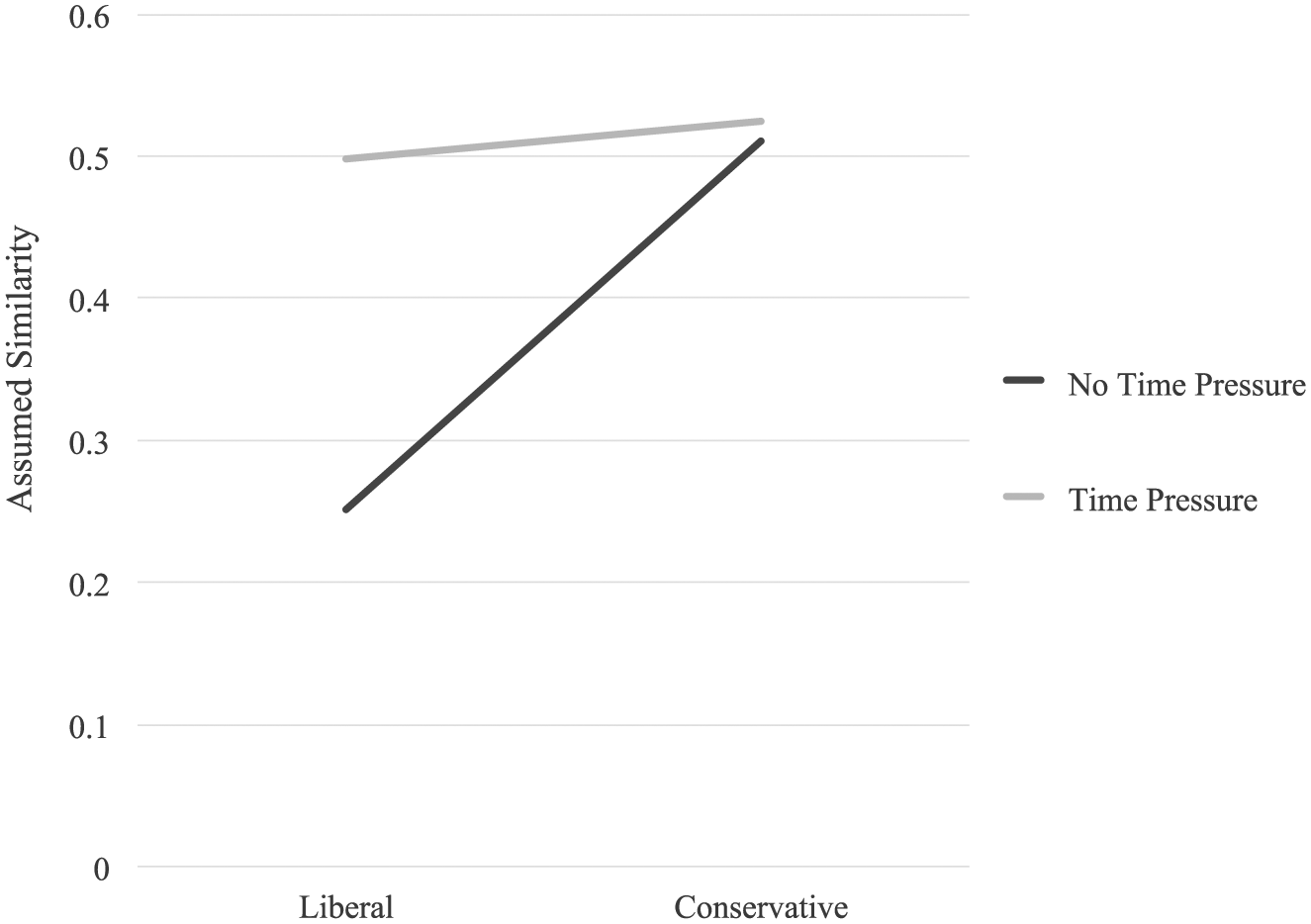
Assumed similarity to ingroup members plotted as a function of time pressure condition and ideology (1 SD below and above the M).
When participants had an unlimited amount of time to make judgments, the simple main effect of ideology was significant, B = .06, SE = .01, t(255) = 4.56, p < .001, rsp = .27, 95% CI = [0.03, 0.09]. Conservatives assumed more ingroup similarity than did liberals. This finding replicates previous research (Stern, West, Jost, & Rule, 2014). However, in the time pressure condition, liberals and conservatives did not significantly differ in the extent to which they assumed ingroup similarity, B = .01, SE = .01, t(255) = .47, p = .64, rsp = .03, 95% CI = [−0.02, 0.03].
To examine whether the time pressure manipulation eliminated ideological differences in assumed similarity because liberals were less able to adjust their judgments, we additionally decomposed the interaction by examining the simple main effect of experimental condition separately for liberals (1 SD below the ideology mean) and conservatives (1 SD above the ideology mean; Aiken & West, 1991). Among liberals, the effect of condition was significant, B = −.12, SE = .03, t(255) = −4.19, p < .001, rsp = .25, 95% CI = [−0.18, −0.07]. Liberals assumed less similarity when they had an unlimited (vs. limited) amount of time to render judgments, suggesting that liberals adjusted their judgments. Among conservatives, the effect of condition was not significant, B = −.01, SE = .03, t(255) = −.22, p = .82, rsp = .01, 95% CI = [−0.06, 0.05], indicating that conservatives assumed similar levels of similarity regardless of whether they had a limited or unlimited amount of time to make judgments.
Assessing the role of ideological extremity
We next examined whether ideological extremity affected perceptions of ingroup similarity. Consistent with previous research (e.g., Brandt, Evans, & Crawford, 2015), we created a measure of extremity by calculating the absolute deviation of each participant’s ideology from the scale midpoint (5). The extremity scale ranged from 0 to 4, with higher numbers indicating greater ideological extremity. Extremity scores did not differ across the experimental conditions (p = .73).
We conducted a multiple regression analysis in which ideology (grand-mean centered), ideological extremity (grand-mean centered), experimental condition (1 = control, −1 = time pressure), the Ideology × Condition interaction, and the Extremity × Condition interaction predicted assumed similarity z scores. Including both ideology and ideological extremity in the model allowed us to examine their effects above and beyond one another (see Brandt et al., 2015 for a similar analytic strategy). 2 See Table 1 for all predictors in the model.
Effect of Directional Ideology on Assumed Similarity While Adjusting for Extremity in Study 1.
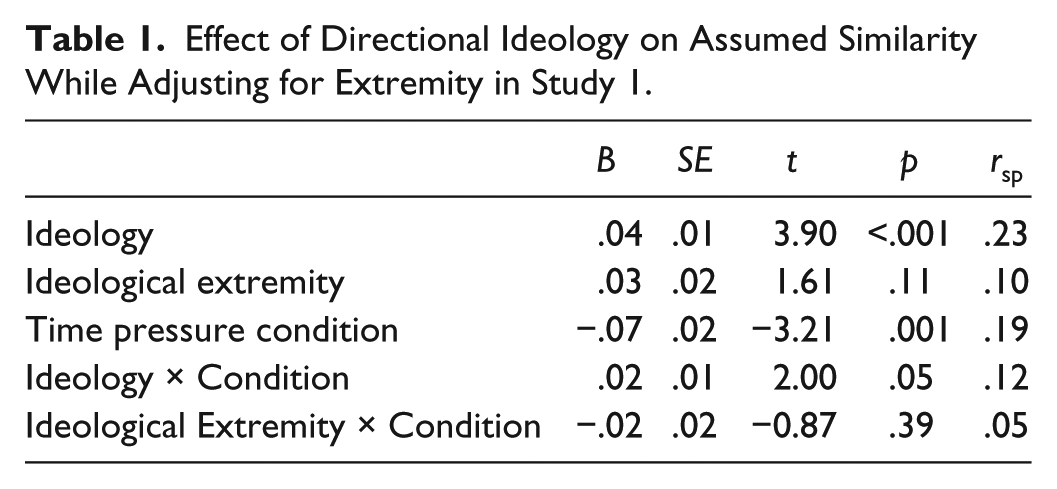
All results reported in the previous analysis remained significant when adjusting for ideological extremity (ps ≤ .05). In addition, neither the main effect of extremity nor the Extremity × Condition interaction were significant, indicating that extremity did not play a significant role in predicting ingroup similarity above and beyond the role of ideology.
Summary
The results of Study 1 indicate that liberals and conservatives did not differ in the extent to which they anchored on their own attitudes to generate initial estimates of ingroup members’ attitudes. In addition, these results suggest that ideological differences in perceptions of ingroup similarity emerged in the adjustment stage of rendering judgments. When participants were given the opportunity to deliberate on their judgments (i.e., when there was no time pressure), conservatives perceived greater ingroup similarity than did liberals. However, when participants were unable to deliberate on and adjust their judgments (i.e., when there was time pressure), liberals and conservatives assumed similar amounts of ingroup similarity. Furthermore, when liberals were able to deliberate on their judgments, they assumed less similarity relative to when they made judgments under time pressure. These findings suggest that when participants have the time to deliberate, liberals adjust their initial judgments away from assuming similarity to a greater extent than conservatives do, which ultimately leads liberals to assume less ingroup similarity than conservatives.
Study 2
In Study 2, we examined whether liberals and conservatives diverge in the adjustment process because they differ in the strength of their motivation to affiliate with like-minded others (Graham et al., 2009; Stern, West, Jost, & Rule, 2014). If conservatives less strongly adjust their judgments because it undermines the ability to connect with like-minded others, then reducing conservatives’ motivation to affiliate with fellow ideologues should lead them to adjust their judgments to a similar extent as liberals do.
To examine this question, we experimentally manipulated participants’ ability to deliberate on their judgments (as in Study 1) and their motivation to affiliate. We predicted that when participants completed a control task unrelated to their motivation to affiliate, we would replicate Study 1: Liberals (vs. conservatives) would more strongly adjust their initial judgments when they are able (vs. unable) to deliberate on their judgments. When participants’ completed a task that attenuated their motivation to affiliate, however, we predicted that both liberals and conservatives would adjust their initial inferences (i.e., assume less similarity) to a similar extent when they are able (vs. unable) to deliberate on their judgments.
In Study 2, we adapted a manipulation from Sinclair, Huntsinger, Skorinko, and Hardin (2005) to attenuate the strength of participants’ relational motivation to affiliate with close others. The content of this manipulation is orthogonal to the attitudes and beliefs involved in the task. In turn, there is not a strong conceptual reason to believe that the manipulation would alter additional factors that could shape perceptions of similarity (e.g., subjective evaluations of what constitutes “agreement”).
To ensure that the manipulation altered the strength of relational motives and not the strength of related motivations that could affect perceptions of similarity (e.g., epistemic motivations), we first report the results of a manipulation check study in which we examined the effect of the manipulation on several different motivations. Manipulations of a motivation differentially affect people depending on their chronic strength of the motive (e.g., Banfield, Kay, Cutright, Wu, & Fitzsimons, 2011). Our theoretical premise is that conservatives possess a stronger goal to affiliate with like-minded others, and so we anticipated that a manipulation to attenuate affiliative goals would only affect conservatives. We predicted that completing a task that attenuated affiliative goals would lead conservatives (vs. liberals) to report a weaker desire to affiliate with like-minded others but would not affect their level of epistemic motivation or concern for others in general.
Manipulation Validity Study
Method
Participants
Five hundred eighty-six participants (323 women; Mage = 35.62 years, range = 18-77) were recruited from the Mechanical Turk website. Thirteen additional participants completed the experiment but were excluded from analyses for failing an attention check. We obtained our sample size in order to possess 80% power to detect an effect size of r ≈ .20.
Procedure
Relational motivation manipulation
Participants were randomly assigned to one of two relational motive conditions. In the attenuate motive condition (n = 290), participants read a passage adapted from Sinclair et al. (2005) to reduce their motivation to affiliate with close others. The passage asked participants to imagine returning from a weekend trip with friends feeling overwhelmed from the amount of social contact and then receiving a phone call from a friend asking to see a movie together. Participants wrote several sentences explaining how they would tell their friend that they needed time alone “to unwind and stop feeling socially overburdened.” In the control condition (n = 296), participants wrote several sentences about their morning.
Motivation measures
Participants next completed measures of motivation. Participants were randomly assigned to complete three of nine possible measures to reduce the possibility of mental fatigue and response bias.
Affiliative motivation measures
We used three measures to assess the motivation to affiliate and connect with like-minded others. To assess the desire to share reality, participants responded to a question from Stern, West, Jost, and Rule (2014): “It is important that I see the world in a similar way as people who generally share my beliefs do” using a 1 (strongly disagree) to 7 (strongly agree) scale. To assess the need to belong, we adapted Leary, Kelly, Cottrell, and Schreindorfer’s (2013) need to belong scale to reference affiliation with like-minded others (e.g., “I have a strong ‘need to belong’ with people who share my beliefs”; α = .88). Participants provided responses using a 1 (not at all) to 7 (very much so) scale. To assess ingroup importance, participants responded to five prompts from Graham et al. (2009) concerning whether they consider their group when determining whether an action is right or wrong (e.g., considering “whether or not the action affected your group”; α = .85). Participants provided responses using a 1 (never relevant) to 7 (always relevant) scale.
Conceptually distinct measures.
To assess the discriminant validity of the manipulation, we included five measures that assessed motivations conceptually distinct from the motivation to affiliate with like-minded others but that could affect perceptions of similarity. Specifically, three measures were included that assessed epistemic motivations: need for structure (α = .90; Neuberg & Newsom, 1993), need for consistency (α = .92; Cialdini, Trost, & Newsom, 1995), and need for cognition (α = .92; Cacioppo & Petty, 1982). In addition, we measured respect for authority (α = .72; Feldman, 2003) and social justice motivation (α = .89; Janoff-Bulman, Sheikh, & Baldacci, 2008) to assess relational motivations toward leaders and others in general, respectively.
Political ideology
Participants reported their political ideology in the same way as in Study 1 (M = 4.27, SD = 2.13).
Results
Analytic strategy
We conducted a separate multiple regression analysis for each of the measures of motivation. Analyses included ideology (grand-mean centered), condition (1 = attenuate motive condition, −1 = control condition), and their interaction as predictors.
We additionally examined whether adjusting for the main effect of ideological extremity and the Extremity × Condition interaction would influence the results. All significant results reported below remain significant when adjusting for these effects, and so we report results without these adjustment variables.
Affiliative motivation measures
There was a marginally significant main effect of ideology predicting the desire to share reality (p = .08) and a significant main effect of ideology predicting ingroup importance (p = .001). Overall, conservatives reported that they possessed a stronger desire to share reality and indicated their ingroup as having greater importance to them than did liberals. No other main effects were significant for any of the relational motives (ps ≥ .20). Importantly, the predicted Ideology × Condition interaction was significant for the desire to share reality, need to belong, and ingroup importance. Statistics for all interaction and simple effects are shown in Table 2.
Effect of Ideology and Experimental Condition on Measures of Affiliative Motivation.
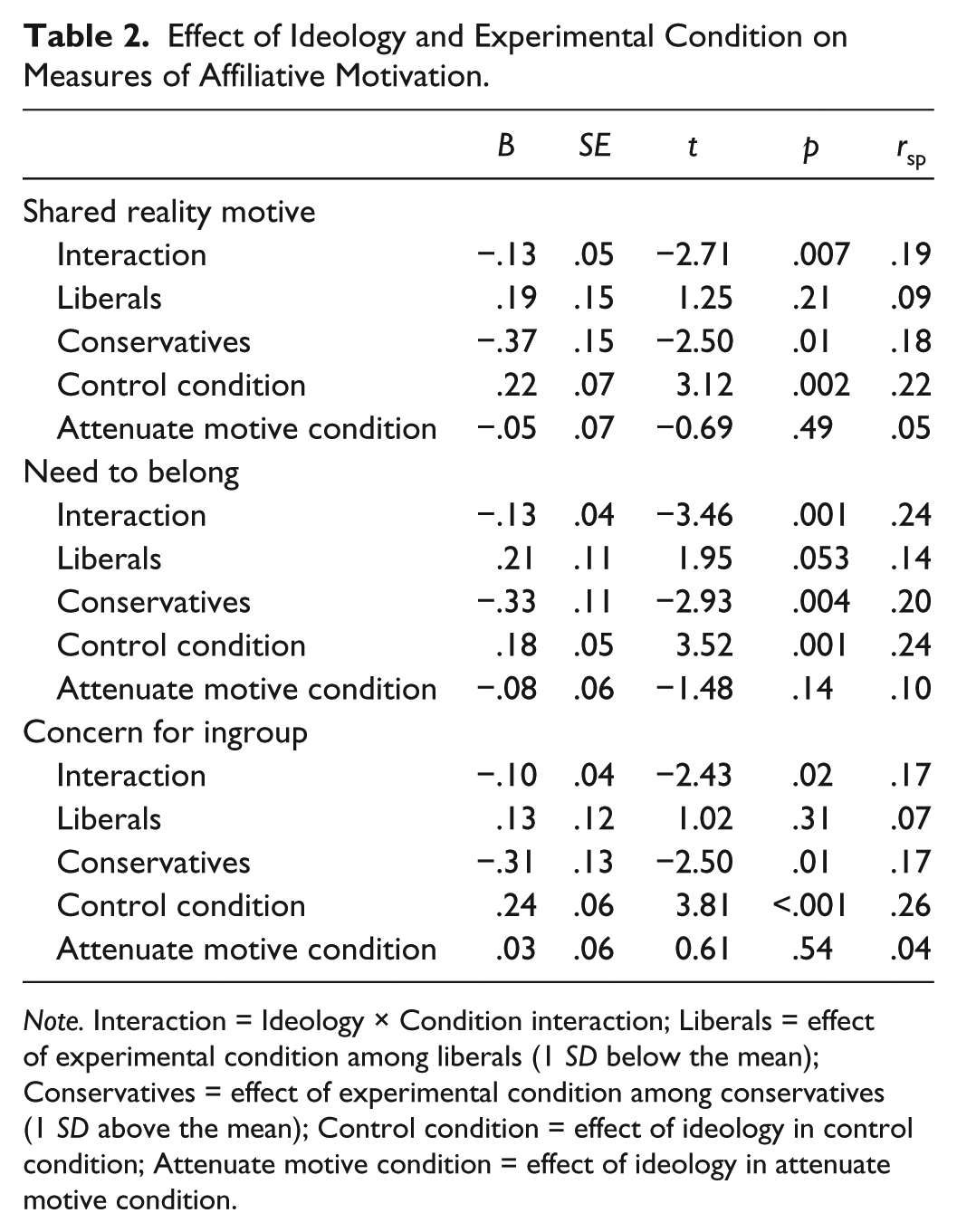
Note. Interaction = Ideology × Condition interaction; Liberals = effect of experimental condition among liberals (1 SD below the mean); Conservatives = effect of experimental condition among conservatives (1 SD above the mean); Control condition = effect of ideology in control condition; Attenuate motive condition = effect of ideology in attenuate motive condition.
We first decomposed the interaction for each variable by examining the simple effect of ideology in the control and attenuate motive conditions. In the control condition, conservatives reported a stronger desire to share reality with like-minded others, a stronger need to belong with like-minded others, and rated their ingroup as more important than did liberals. These findings replicate previous research (Graham et al., 2009; Stern, West, Jost, & Rule, 2014). Ideology did not predict the strength of relational motivations in the attenuate motive condition.
We next examined whether liberals and conservatives had similar levels of relational motivation in the attenuate motive condition because the manipulation reduced conservatives’ (but not liberals’) desire to affiliate with like-minded others. Consistent with predictions, conservatives in the attenuate motive (vs. control) condition reported a weaker desire to share reality and need to belong, and rated the ingroup as less important. Interestingly, the manipulation significantly increased liberals’ need to belong with like-minded others. However, the manipulation did not affect the strength of liberals’ desire to share reality or concern for the ingroup. These findings indicate that the manipulation adapted from Sinclair et al. (2005) successfully reduced conservatives’ motivation to affiliate and connect with like-minded others.
Distinct motivations
Conservatives reported a stronger need for structure (r = .23, p = .001), need for consistency (r = .21, p = .003), and respect for authority (r = .46, p < .001), whereas liberals reported a stronger need for cognition (r = −.20, p = .006) and social justice motivation (r = −.34, p < .001). These findings replicate previous research (Feldman, 2003; Janoff-Bulman et al., 2008; Jost, Glaser, Kruglanski, & Sulloway, 2003). Importantly, there were no significant main effects of condition or ideology × condition interactions (ps ≥ .34), indicating that the manipulation did not affect motivations that are distinct from the desire to affiliate with like-minded others.
Main Study
Method
Participants
Four hundred thirteen participants (195 women; Mage = 35.27 years, range = 18-75) were recruited from the Mechanical Turk website. Ten additional participants completed the experiment but were excluded from analyses for failing an attention check (nine participants) or not providing estimates of ingroup members’ attitudes (one participant). We obtained our sample size to possess at least 80% power to detect the smallest effect size (of the predicted effects) from Study 1 (r = .17).
Procedure
Attitudes
Participants provided their attitudes to the same 20 items as in Study 1.
Relational motivation manipulation
Participants were randomly assigned to either the attenuate motive condition (n = 207) or the control condition (n = 206) and completed the same task for their respective condition as in the manipulation validity study.
Perceived ingroup attitudes
Participants estimated ingroup members’ attitudes in the same manner as in Study 1. Time taken to make each judgment was recorded in seconds with Qualtrics’ timing function.
Time pressure manipulation
Participants were randomly assigned to either the time pressure (n = 203) or no time pressure (n = 210) condition. Consistent with Study 1, participants in the time pressure condition received 6 s to make judgments about ingroup members’ attitudes and participants in the no time pressure condition received an unlimited amount of time.
Political ideology
Participants provided their ideology in the same way as in Study 1 (M = 4.58, SD = 2.10).
Results
Time pressure manipulation check
We conducted a multiple regression analysis in which ideology (grand-mean centered), time pressure condition (1 = time pressure, −1 = no time pressure), relational motive condition (1 = attenuate motive condition, −1 = control condition), and all interactions predicted the average time taken to estimate ingroup members’ attitudes. Confirming the validity of the manipulation, there was a significant main effect of experimental condition, B = −.88, SE = .13, t(405) = −6.99, p < .001, rsp = .33, 95% CI = [−1.13, −0.63]. Participants under time pressure made judgments in a shorter amount of time than did participants who were not under time pressure. No other main or interaction effects were significant (ps≥.16), suggesting that liberals and conservatives did not differ in the extent to which they deliberated on their judgments.
Assumed similarity
Within-subject assumed similarity scores were calculated in the same way as in Study 1. We converted the assumed similarity scores to Fisher’s z scores that can be used as dependent variables in analyses.
We conducted a multiple regression analysis in which ideology (grand-mean centered), time pressure condition (1 = time pressure, −1 = no time pressure), relational motive condition (1 = attenuate motive condition, −1 = control condition), and all interactions predicted assumed similarity z scores. The main effect of ideology was significant (p = .03). Overall, conservatives perceived more ingroup similarity than did liberals. The main effect of time pressure was significant (p < .001). Participants who made judgments under time pressure assumed more ingroup similarity than did participants who were not under time pressure. The Ideology × Time Pressure Condition interaction (p = .04) and Ideology × Relational Motive Condition interaction (p = .008) were also significant. Importantly, these lower order effects were qualified by the predicted Ideology × Time Pressure Condition × Relational Motive Condition three-way interaction, B = .03, SE = .01, t(405) = 3.65, p < .001, rsp = .17, 95% CI = [0.01, 0.05] (Figure 2). No other main or interaction effects were significant (ps ≥ .12). We decomposed the three-way interaction by examining the Ideology × Time Pressure Condition simple two-way interaction separately within each relational motive condition.
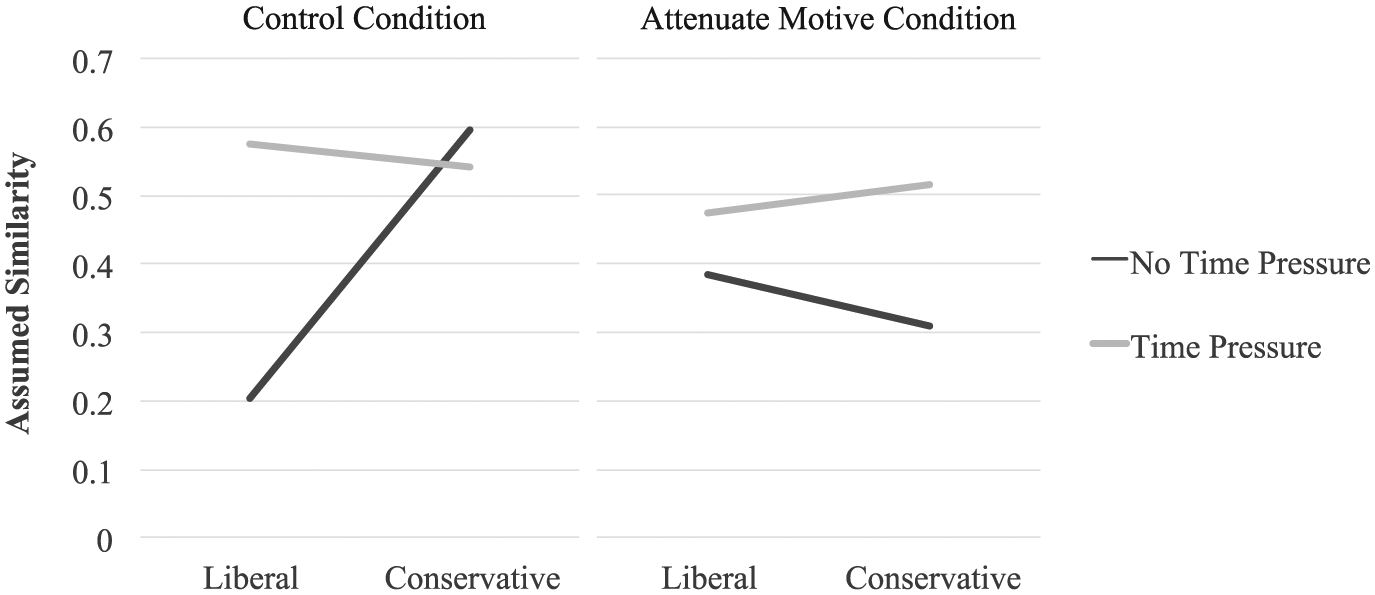
Assumed similarity to ingroup members plotted as a function of motive condition, time pressure condition, and ideology (1 SD below and above the M).
Control condition
Examining the effect of the time pressure manipulation on liberals’ and conservatives’ estimates of ingroup similarity in the control condition allowed us to test for a replication of Study 1. Among participants assigned to the control condition, the Ideology × Time Pressure Condition interaction was significant, B = −.05, SE = .01, t(405) = −4.06, p < .001, rsp = .19, 95% CI = [−0.07, −0.03]. When participants had unlimited time to make their judgments, the effect of ideology was significant, B = .09, SE = .02, t(405) = 5.32, p < .001, rsp = .25, 95% CI = [0.06, 0.13]. Conservatives assumed more ingroup similarity than did liberals. However, when participants made judgments under time pressure, liberals and conservatives did not significantly differ in the extent to which they assumed ingroup similarity, B = −.008, SE = .02, t(405) = −.43, p = .67, rsp = .02, 95% CI = [−0.04, 0.03]. These findings replicate those of Study 1.
To examine whether the time pressure manipulation eliminated ideological differences in assumed similarity because liberals were less able to adjust their judgments, we additionally decomposed the interaction by examining the simple main effect of experimental condition separately for liberals (1 SD below the ideology mean) and conservatives (1 SD above the ideology mean). Among liberals, the effect of time pressure condition was significant, B = .19, SE = .04, t(405) = 4.89, p < .001, rsp = .23, 95% CI = [0.11, 0.26]. Liberals assumed less similarity when they had an unlimited (vs. limited) amount of time to render judgments, suggesting that liberals adjusted their judgments. Among conservatives, the effect of condition was not significant, B = −.03, SE = .04, t(405) = −.76, p = .45, rsp = .04, 95% CI = [−0.10, 0.04], indicating that conservatives assumed a similar amount of similarity regardless of whether they made judgments under time pressure or not.
Attenuate motive condition
Among participants assigned to the attenuate motive condition, the simple main effect of time pressure was significant, B = .07, SE = .03, t(405) = 2.84, p = .005, rsp = .13, 95% CI = [0.02, 0.13]. Participants assumed less similarity when they had an unlimited (vs. limited) amount of time to make their judgments. In addition, the Ideology × Time Pressure Condition interaction was not significant, B = .01, SE = .01, t(405) = 1.10, p = .27, rsp = .05, 95% CI = [−0.01, 0.04], indicating that both liberals and conservatives whose motivation to affiliate had been attenuated assumed less similarity when they were able (vs. unable) to deliberate on their judgments. In other words, both liberals and conservatives more strongly adjusted their judgments when they had time to deliberate.
Assessing the role of ideological extremity
We calculated an ideological extremity score for each person in the same way as in Study 1. Extremity scores did not differ across the experimental conditions (ps ≥ .23). We conducted a multiple regression analysis in which assumed similarity z scores were regressed onto ideology (grand-mean centered), extremity (grand-mean centered), time pressure condition (1 = control, −1 = time pressure), relational needs condition (1 = attenuate relational needs, −1 = control), and all interactions (excluding those between ideology and extremity; see Note 2). See Table 3 for all predictors in the model.
Effect of Directional Ideology on Assumed Similarity While Adjusting for Extremity in Study 2.
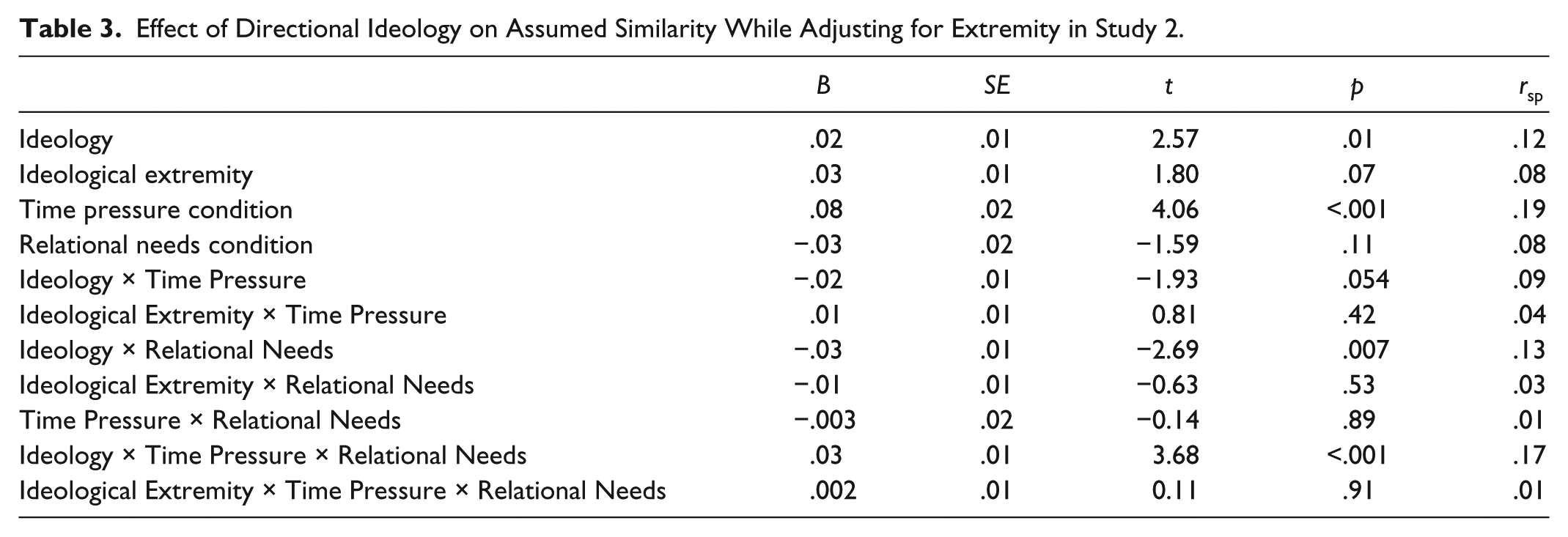
All significant results reported in the previous analysis remained significant when adjusting for ideological extremity (ps ≤ .05). The main effect of extremity was marginally significant, such that extremity was associated with perceiving more ingroup similarity. Importantly, however, no interaction effects including extremity were significant.
Summary
The results of Study 2 revealed that ideological differences in the adjustment phase of the judgment process are attributable in part to conservatives’ (vs. liberals’) stronger motivation to affiliate with like-minded others. When participants’ relational motives were not altered, liberals were more likely than conservatives to adjust their initial judgments of ingroup members’ attitudes when they were able (vs. unable) to deliberate on their judgments. When participants’ relational motives were attenuated, however, liberals and conservatives adjusted their initial inferences to a similar extent and assumed less ingroup similarity when they were able (vs. unable) to deliberate on their judgments. These results suggest that liberals and conservatives differ in the judgment processes involved in estimating ingroup members’ attitudes in part because conservatives possess stronger motives to affiliate with like-minded others than do liberals.
General Discussion
In two studies, we examined whether liberals and conservatives differ in the extent to which they anchor on their own beliefs to generate an initial inference of ingroup members’ attitudes, or whether they differentially adjust their initial judgments away from the self. Our findings support the perspective that ideological differences emerge in the adjustment stage of rendering judgments. We additionally found that ideological differences in the motivation to affiliate with like-minded others explain in part why liberals and conservatives diverge in the extent to which they adjust their initial inferences away from the self.
Implications for Research on Ideology, Relationship Development, and Political Mobilization
Understanding exactly how liberals and conservatives estimate similarity to political ingroup members helps to generate unique predictions concerning whether and why ideological differences might emerge on a range of outcomes. On the level of the individual, perceiving similarity to others greases the wheels of everyday social interactions (Marks & Miller, 1987) and facilitates the development and maintenance of both platonic and romantic relationships (Lemay, Clark, & Feeney, 2007; Murray, Holmes, & Griffin, 1996). It is possible that conservatives’ stronger perceptions of similarity to like-minded others allow them to cultivate more interconnected relationships than do liberals. In addition, ideological differences in relational motivation could be important for understanding why liberals and conservatives differ on epistemic outcomes. For example, thinking other people share one’s attitudes increases attitude confidence and certainty (Marks & Miller, 1987). As such, conservatives’ greater perceptions of similarity to like-minded others could help explain, in part, why conservatives feel more certain in their attitudes (Jost & Krochik, 2014).
On the level of the group, perceiving similarity with like-minded others facilitates the development of group cohesion and mobilizes people into political action (van Zomeren, Spears, Fischer, & Leach, 2004). Building on this idea, Stern, West, Jost, and Rule (2014) found that conservatives perceived greater ingroup similarity than liberals did, which in turn predicted stronger feelings that their political party would achieve its goals and greater intentions to vote in a national election. Considered within the present research, it may be that liberals (vs. conservatives) deflate a sense of collective efficacy and action through adjusting their initial judgments of ingroup similarity away from the self and in turn perceiving that their attitudes are less widely shared. As such, ideological differences in judgment adjustment might hold implications for the ultimate success of political movements.
The Role of Motivational Factors in Liberals’ and Conservatives’ Social Inferences
In the present research, we demonstrated that ideological differences in the motivation to affiliate with like-minded others affected the extent to which liberals and conservatives adjusted their judgments when they were given time to think. It is important to note, however, that under certain conditions the strength of initial judgments can also be influenced by contextual and motivational factors (Gawronski & Cesario, 2013). Future research could examine the motivations that also shape liberals’ and conservatives’ initial inferences of similarity to others. The degree to which an accessible thought (e.g., one’s own beliefs) influences judgments depends on the motivational relevance of the thought for the judgment (Eitam & Higgins, 2010). Because ingroup members are better able to satisfy relational needs for affiliation than are outgroup members (Correll & Park, 2005), it is possible that conservatives’ own accessible beliefs would play a larger role in determining initial inferences about ingroup members’ beliefs than of outgroup members’ beliefs. In turn, conservatives (vs. liberals) might display larger differences in initial assumptions of similarity to ingroup and outgroup members because they are more motivated to affiliate with ingroup members.
In the present research, we examined one psychological motivation (i.e., the desire to affiliate) that shapes judgment processes. An interesting avenue for future research would be to examine additional motivations that affect social judgments. For example, conservatives hold dispositionally stronger epistemic motivations (e.g., needs for closure; Chirumbolo & Leone, 2008) and existential motivations (e.g., concerns over threat and fear of death; Jost et al., 2003) than do liberals. It is possible that conservatives’ stronger epistemic and existential motivations might similarly affect the extent to which they adjust their judgments about ingroup members’ attitudes away from the self. In addition, future research could develop a more comprehensive picture of how liberals and conservatives make social inferences through examining motivational factors that lead liberals to strongly adjust their judgments away from assuming high amounts of similarity (e.g., need for uniqueness; Stern, West, & Schmitt, 2014).
Clarifying the Relationship Between Ideology and Relational Motivations
An interesting question that emerges from the present research concerns whether conservatism will be associated with stronger motivations to connect and affiliate with like-minded others, regardless of the cultural or historical context. Our theoretical perspective is that it would be. A central aspect of conservatism is resistance to change (i.e., support for the status quo; Jost et al., 2003). Attitudes that reflect and reinforce the status quo are typically more simple, structured, and easier to communicate than are those that propose change (Jost et al., 2008). For example, advocating that Wall Street reform should not occur is easier to communicate and socially share with others than is proposing the multiple possibilities of how regulation could occur and the complex manner of how it would unfold in the economic system. Thus, independent of historical context, we expect that people who are motivated to connect and “share reality” with others will be more likely to gravitate toward conservative attitudes and belief systems.
The present findings contribute to a growing literature demonstrating that conservatives (vs. liberals) exhibit a stronger motivation to affiliate with their ingroup (Graham et al., 2009; Stern, West, Jost, & Rule, 2014). However, an important question arises of exactly who liberals and conservatives will express greater interest in connecting and affiliating with. Historically, the ideological basis of liberal and left-wing social movements (e.g., socialism, labor organizing) and communities (e.g., kibbutzim) has been oriented toward building collective ties and ensuring that the basic needs of all people (rather than simply one’s ingroup) are met. Past empirical research also provides support for the idea that liberals are more open to affiliating and developing relationships with, as well as providing assistance to, people who are outside of their immediate group memberships (e.g., Janoff-Bulman & Carnes, 2013; Sidanius, Pratto, & Bobo, 1996). Consistent with this idea, we found in the manipulation check study that conservatives reported a greater motivation to affiliate with the ingroup and a greater concern for their ingroup, whereas liberals reported a greater concern for people in general. This ideological divergence in motivations to connect with people inside and outside of one’s group could shape how liberals and conservatives perceive similarity with others when the group in reference is not one’s own (e.g., liberals in Pennsylvania might perceive more similarity with people in Ohio than conservatives in Pennsylvania do). We believe that this would be an interesting question for future research.
The Role of Objective and Subjective Accuracy
Are conservatives less likely to adjust their inferences about ingroup members because their initial judgments were simply accurate? To address this possibility, we examined the accuracy of liberals’ and conservatives’ perceptions of similarity. All methods and results concerning objective accuracy are reported in the online supplemental materials. Consistent with previous research (Dvir-Gvirsman, 2015; Stern, West, & Schmitt, 2014), we found in both studies that liberals and conservatives made inaccurate judgments. Liberals underestimated similarity to other liberals, and conservatives overestimated similarity to other conservatives. These results suggest that conservatives’ weaker inclination to adjust their initial judgments of ingroup members’ attitudes is likely not driven by the accuracy of their judgments.
Despite not being objectively accurate, a similarly interesting question concerns whether liberals and conservatives subjectively construed their judgments as accurate. Scholars have previously argued that motivations can shape the strategies that people perceive as fostering accurate judgments (e.g., Kruglanski, 1989). While we did not assess people’s feelings of how accurate their judgments were, it is possible that liberals and conservatives diverge in the judgment processes that they view as leading to accurate perceptions of like-minded others’ attitudes because they possess different motivational profiles. Specifically, conservatives’ stronger motivation to affiliate with like-minded others might lead them to view assuming similarity as a viable means for making accurate inferences about like-minded others’ attitudes. In turn, when conservatives’ motivation to affiliate is weakened (as in Study 2), their lay theory of how to make accurate inferences might shift to perceiving adjustment as necessary for being accurate. Directly examining the role of subjective accuracy would be an informative step for future research and theorizing on (a) liberal–conservative differences in social perception and (b) how people estimate others’ attitudes.
Reconciling the Role of Directional Ideology Versus Ideological Extremity
In the present research, we found that the direction of a person’s ideology (i.e., whether he or she is liberal or conservative), rather than the extremity of his or her ideology, predicted the extent to which he or she adjusted his or her judgments of ingroup similarity. Given that recent research has found that ideological extremity can play an important role in how people make judgments (Brandt et al., 2015; Van Boven et al., 2012; Westfall et al., 2015), one might wonder how our findings dovetail with this work. We believe that there are two important factors that help to explain when ideological extremity versus direction more strongly influences judgment processes.
The first factor concerns the source of the judgment anchor. Brandt et al. (2015) recently demonstrated that extremists were more likely than moderates to reject experimenter-provided anchors in judgment tasks but were not more rejecting of self-generated anchors. Consistent with this finding, in the present research, ideological extremity did not significantly predict the extent to which participants adjusted away from self-generated anchors (i.e., participants’ initial estimates of ingroup members’ attitudes that were derived from their own attitudes). The second factor concerns the target group. Attitude extremity is associated with perceiving the political landscape as more polarized (Van Boven et al., 2012), and this effect is primarily driven by extremists perceiving outgroup members as more polarized than they actually are (Westfall et al., 2015). In the present research, however, we assessed perceptions of ingroup members and found that extremity did not significantly shape perceptions.
It is possible to integrate the present and past findings to make predictions about when extremity and directional ideology will affect judgment processes. We expect that directional ideology will predict (a) judgment adjustment when the anchor is self-generated and (b) perceptions of ingroup members’ attitudes. However, we expect that extremity will predict (a) judgment adjustment when the anchor is experimenter-generated and (b) perceptions of outgroup members’ attitudes. Future research could systematically manipulate these factors in a single experiment and examine how directional ideology and extremity each predict judgment outcomes. Future research could also more fully examine how motivational factors affect exactly when ideology (vs. extremity) guides perceptions, and whether such motivations might differentially affect perceptions of ingroup and outgroup members.
Concluding Remarks
In the present research, we examined how liberals and conservatives estimate similarity to like-minded others. The present research further contributes to understanding the important role of political ideology in shaping everyday judgments. Our research also demonstrates that integrating motivational factors within models of judgment can help to generate novel and exciting predictions about how people construct perceptions of the social world.
Footnotes
Appendix A
Appendix B
To illustrate the calculation of within-subject perceived similarity scores, we will use data for five items from a hypothetical participant, as shown in the table below. A participant’s opinion on an issue was coded as 1 if he or she agreed with the item and as −1 if he or she disagreed with the item. To calculate the within-subject perceived similarity score, we then correlated the participant’s own opinions (column A) with his or her estimates of the percentage of political ingroup members who agreed with each item (column B). This method results in a single perceived similarity score for each participant (see also Krueger & Zeiger, 1993, for further discussion of this analytic strategy).
Declaration of Conflicting Interests
The author(s) declared no potential conflicts of interest with respect to the research, authorship, and/or publication of this article.
Funding
The author(s) disclosed receipt of the following financial support for the research, authorship, and/or publication of this article: This research was supported by funding from New York University to Tessa V. West.

Notes
References
Supplementary Material
Please find the following supplemental material available below.
For Open Access articles published under a Creative Commons License, all supplemental material carries the same license as the article it is associated with.
For non-Open Access articles published, all supplemental material carries a non-exclusive license, and permission requests for re-use of supplemental material or any part of supplemental material shall be sent directly to the copyright owner as specified in the copyright notice associated with the article.
