







Abstract
Emerging research documents the self-control consequences of individuals’ theories regarding the limited nature of willpower, such that unlimited theorists consistently demonstrate greater self-control than limited theorists. The purpose of the present research was to build upon prior work on self-validation and perceptions of mental fatigue to demonstrate when self-control is actually impaired by endorsing an unlimited theory and—conversely—enhanced by endorsing a limited theory. Four experiments show that fluency reinforces the documented effects of individuals’ willpower theories on self-control, while disfluency reverses the documented effects of individuals’ willpower theories on self-control. Moreover, these effects are driven by differential perceptions of mental fatigue—perceptions altered by individuals’ level of confidence in their willpower theory—and are bound by conditions that promote effortful thought. Collectively, these findings point to the malleable efficacy of willpower theories and the importance of belief confidence in dictating this malleability and in modulating subsequent self-control behavior.
In the context of self-control, willpower is often defined as the ability to regulate impulses (Burnette, O’Boyle, VanEpps, Pollack, & Finkel, 2013; Carver & Scheier, 1981; Mischel, Shoda, & Rodriguez, 1989; Vohs & Baumeister, 2011). Indeed, this ability has proven instrumental in predicting individuals’ self-control performance (see Vohs & Baumeister, 2011). Yet, emerging research suggests that these critical differences in self-control behavior may predominantly stem from different theories or beliefs concerning the limits of one’s willpower (Job, Dweck, & Walton, 2010; see also Mukhopadhyay & Johar, 2005).
In their seminal piece on the prominence of willpower theories to self-control, Job and colleagues (2010) demonstrated that individuals vary in the extent to which they believe their willpower capacity is relatively limited or unlimited. Specifically, they distinguish between a belief that self-control resources are relatively exhaustible (limited theory) and a belief that self-control resources are relatively inexhaustible (unlimited theory). 1 Using this distinction, they show that those who endorse an unlimited theory exhibit greater self-control performance following an initial exertion of self-control than do those who endorse a limited theory. Moreover, this performance difference has been documented across a variety of self-control indices, such as cognitive performance (Job et al., 2010; Job, Walton, Bernecker, & Dweck, 2013), procrastination (Job et al., 2010; Job et al., 2013), and term grade point average (GPA; Job, Walton, Bernecker, & Dweck, 2015).
A substantial and growing body of research, then, strongly supports the proposition that endorsement of an unlimited theory results in a distinct and robust self-control advantage over endorsement of a limited theory. Yet, despite the repeated demonstration of the self-control benefits of endorsing an unlimited willpower theory, might there be situations in which self-control is not enhanced by endorsing an unlimited theory and—conversely—not undermined by endorsing a limited theory?
In this article, we explore one such situation—namely one based on the fluency associated with individuals’ willpower theory. Research on the self-validation hypothesis (Briñol, Petty, & Tormala, 2004; Petty, Briñol, & Tormala, 2002) explicitly demonstrates that when individuals experience disfluency in their beliefs, they report greater doubt that subsequently undermines their beliefs (see Briñol, Tormala, & Petty, 2013). As such, associating these willpower theories with disfluency (rather than fluency) might provide a context that elevates limited theorists’ performance while undermining unlimited theorists’ performance.
The Self-Validating Role of Fluency
Fluency is defined as a subjective feeling of ease associated with the retrieval or processing of information (Schwarz et al., 1991). The construct has received considerable interest due in part to the impact of fluency in shaping people’s inferences (Alter & Oppenheimer, 2009; Schwarz, 2004). To illustrate, Schwarz et al. (1991) had participants indicate their perceived assertiveness. Prior to asking this question, however, participants recalled either six (fluency condition) or 12 (disfluency condition) instances of assertive behavior in their own life. The logic underlying this manipulation is that six instances are presumably easier to retrieve than are 12 instances, and this feeling of ease bolsters individuals’ inferences of assertiveness. In line with expectations, those asked to recall six instances rated themselves as more assertive than did those asked to recall 12 instances; that is, those who listed fewer reasons reported themselves as more assertive than did those who listed more reasons. The subjective feeling of fluency associated with information retrieval, then, altered individuals’ inferences above and beyond the actual content generated.
While fluency may impact individuals’ inferences through multiple means (see Briñol et al., 2013), one rather robust mechanism is by altering their confidence in the information retrieved or processed; specifically, individuals associate the experience of ease with confidence and the experience of difficulty with doubt (Clarkson, Tormala, & Leone, 2011; Clarkson, Valente, Leone, & Tormala, 2013; Haddock, Rothman, Reber, & Schwarz, 1999; Tormala, Petty, & Briñol, 2002). The common rationale for this effect is that feelings of ease signal correctness and feelings of difficulty signal inaccuracies in one’s thoughts, beliefs, and judgments (see Petty, Briñol, Tormala, & Wegener, 2007).
In support of this self-validating process, Tormala et al. (2002) informed participants that their university was ostensibly considering the implementation of a senior comprehensive exam policy as a requirement for graduation. They then had participants generate either two (easy) or eight (difficult) arguments against the policy. They found that participants held greater confidence in the arguments they retrieved when those counterarguments were easy to generate (i.e., associated with fluency) and greater doubt in the arguments they retrieved when those counterarguments were difficult to generate (i.e., associated with disfluency). More importantly, however, these changes in confidence altered participants’ evaluations of the exam policy. In particular, those confident in their counterarguments (i.e., participants in the easy condition) were more unfavorable toward the exam policy, whereas those doubtful of their counterarguments (i.e., participants in the difficult condition) were more favorable toward the exam policy. In short, feelings of fluency reinforced—and feelings of disfluency undermined—individuals’ confidence in their arguments against the comprehensive exam policy which, consequently, shifted their resulting evaluation.
Given the effect of fluency on individuals’ confidence in their thoughts, beliefs, and inferences, we predict that fluency will alter the consequences of individuals’ willpower theories in a similar manner. In particular, we predict that feelings of fluency or ease will reinforce the documented effects of individuals’ willpower theories on self-control. Conversely, we predict that feelings of disfluency or difficulty will undermine and reverse the documented effects of individuals’ willpower theories on self-control.
The Importance of Perceived Mental Fatigue to Willpower Theories
We argue that, by altering individuals’ confidence in their theories of willpower capacity, the feeling of fluency can impact the efficacy of those theories on self-control. This issue is critical to the developing body of research on willpower theories, as it would demonstrate when the performance of unlimited theorists is undermined while the performance of limited theorists is elevated. Though we predict that fluency should impact individuals’ confidence in their willpower theories, why would individuals’ confidence or doubt in their willpower theories impact subsequent self-control performance?
In response, we posit that individuals’ confidence in their willpower theories affects their subjective assessment of mental fatigue. This argument is noteworthy given that prior work demonstrates the extent to which individuals perceive themselves to be mentally unable to focus or concentrate can dramatically impact self-control (e.g., Clarkson, Hirt, Chapman, & Jia, 2011; Clarkson, Hirt, Jia, & Alexander, 2010; Egan, Clarkson, & Hirt, 2015; Egan & Hirt, 2015; Muraven, Gagné, & Rosman, 2008; Ryan & Deci, 2008). For instance, Clarkson and colleagues (2010) presented participants with a standard depletion paradigm before offering an attribution for any feelings of mental exhaustion—an attribution that altered perceptions of mental fatigue. They found that individuals’ perceived—rather than their actual—level of resource availability predicted their self-control performance (for a review, see Clarkson, Otto, Hassey, & Hirt, in press).
In light of these findings, individuals’ perceptions of mental fatigue may play a critical role in understanding the differences in self-control performance of limited and unlimited willpower theorists. In particular, we propose that unlimited theorists perceive themselves as less mentally fatigued than limited theorists. This difference could stem from a variety of reasons; for instance, unlimited theorists may perceive that they deplete their resources at a slower rate, pay less attention to their resource limitations, are less likely to feel the need to rest following depletion (see Job, Bernecker, Miketta, & Friese, 2015), or naturally hold a lower baseline level of perceived fatigue than limited theorists. In turn, we argue that this decreased perception of their level of mental fatigue underlies their documented self-control advantage.
Importantly, however, we expect unlimited theorists to perceive themselves as less mentally fatigued than limited theorists only when these theories are held with confidence; when held with doubt, we actually predict limited theorists to perceive themselves as less mentally fatigued than unlimited theorists. In other words, doubt might lead unlimited theorists to question the unlimited nature of their willpower and thus report greater mental fatigue than when confident. Conversely, doubt might lead limited theorists to question the necessity of existing limits on their willpower and paradoxically report less mental fatigue than when confident.
This prediction stems from research showing that altering individuals’ metacognitive assessments of their beliefs can impact specific judgments and evaluations (see Petty et al., 2007). For instance, research shows that individuals who “doubt their doubts” toward an issue paradoxically become more certain of their judgments (Wichman et al., 2010). Relatedly, individuals who doubt thoughts that are inconsistent with their attitude become more extreme in that initial evaluation (Clarkson et al., 2013). Thus, the confidence with which individuals endorse their willpower theories should have significant impact on their perceptions of mental fatigue and, consequently, their self-control performance.
Overview
If willpower theories indeed alter individuals’ perceptions of mental fatigue, then feelings of fluency and disfluency—by reinforcing or undermining individuals’ confidence in their willpower theories—should impact individuals’ self-control performance by systematically altering these perceptions. That is, we argue that unlimited theorists should exhibit less self-control when their theory is associated with disfluency rather than fluency, as disfluency should lead individuals to doubt the unlimited nature of their willpower and, subsequently, increase their perceptions of mental fatigue. Conversely, limited theorists should exhibit more self-control when their theory is associated with disfluency rather than fluency, as disfluency should lead individuals to doubt the limited nature of their willpower and, subsequently, decrease their perceptions of mental fatigue. As a result, unlimited theorists should demonstrate greater self-control when their theory is associated with fluency (vs. disfluency), whereas limited theorists should demonstrate greater self-control performance when their theory is associated with disfluency (vs. fluency; see Figure 1 for our proposed conceptual model).
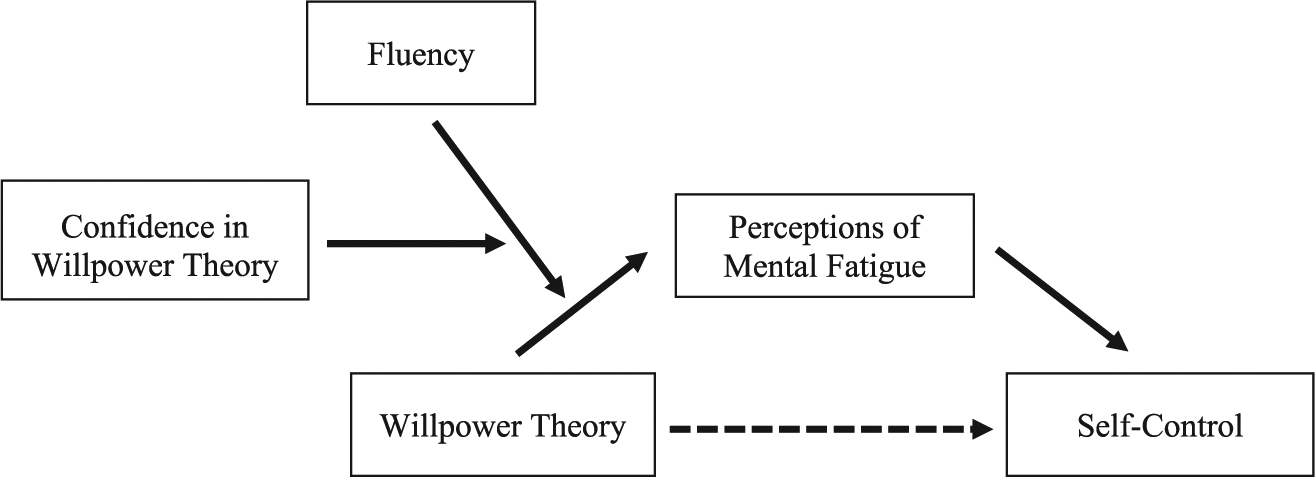
Proposed conceptual model.
We tested this model across four experiments. In particular, we investigated the extent to which fluency alters the efficacy of individuals’ willpower theories (Experiment 1), whether any impact of fluency and willpower theories on self-control performance is driven by varying perceptions of mental fatigue (Experiment 2), and to what extent individuals’ confidence in their willpower theory impacts the effect of fluency and willpower theories on perceptions of mental fatigue (Experiment 3). Finally, we tested whether these effects are most pronounced under conditions that promote individuals to reflect on the confidence underlying their willpower theory (Experiment 4).
Sample size estimates were based on recommendations of 20 participants per cell (Simmons, Nelson, & Simonsohn, 2011). This recommendation was increased when necessary to account for the estimated effect sizes of the meditational analyses (Experiments 2b and 3; Fritz & MacKinnon, 2007), the addition of covariates (Experiment 2a; Tosteson, Buzas, Demidenko, & Karagas, 2003), and the inclusion of continuous measures in a stepwise regression (Experiment 4; Tabachnick & Fidell, 1996). In addition, Experiments 1 and 2a (i.e., data collected in the behavioral lab) were subject to lab demand. Finally, participants were excluded if they failed to complete the study (Experiment 2a: two participants, Experiment 3: eight participants).
Experiment 1
We conducted an initial experiment to assess the extent to which the fluency associated with individuals’ willpower theories impacts self-control performance. Although it is possible that unlimited theorists will exhibit higher levels of self-control than limited theorists regardless of external influences (e.g., experience of fluency), we anticipated that the documented effects of willpower theories on self-control performance vary as a function of the level of fluency associated with that theory. In particular, we expected unlimited theorists to exhibit greater self-control when their theory was associated with ease (vs. difficulty), whereas we expected limited theorists to exhibit greater self-control when their theory was associated with difficulty (vs. ease). We tested these predictions by manipulating individuals’ willpower theories as well as the fluency associated with that theory before assessing self-control performance—here, performance on a series of multiple solution anagrams (Vohs, Baumeister, & Schmeichel, 2012).
Method
Participants and design
One hundred twenty undergraduates (Mage = 19.84; 63% male), completing a survey on their personal beliefs in exchange for course credit, were randomly assigned to conditions in a 2 (Willpower Theory: Limited or Unlimited) × 3 (Reasons: Zero, Two, or Eight) between-participants factorial design.
Procedure
At the outset of the study, participants were informed of our interests in understanding their beliefs about willpower and were subsequently presented with a biased version of the Strenuous Mental Activity subscale of the Implicit Theories About Willpower Scale (Job et al., 2010). While all participants responded to the same series of scale items, the scale anchors were intentionally biased to manipulate participants’ willpower theories. In the unlimited theory condition, participants responded to items on a 6-point scale labeled somewhat agree to completely agree. Conversely, in the limited theory condition, participants responded to the same series of items on a 6-point scale anchored somewhat disagree to completely disagree. This biased-scale manipulation has been used in prior research to alter participants’ beliefs (Job et al., 2013; see Petrocelli, Martin, & Li, 2010).
Following our theory manipulation, participants were asked to recall either two (easy condition) or eight (difficult condition) thoughts in support of their willpower theory. Examples of participants’ recalled responses include “I believe you should keep repeating your goals in order to stay focused” (unlimited theory condition) and “When a friend asks me to get together, I can say no the first time they ask, but the more and more they ask, the more likely I am to agree” (limited theory condition). Importantly, this manipulation was used to vary feelings of ease, such that a greater number of instances to recall would be experienced as more difficult (Haddock et al., 1999; Schwarz et al., 1991; Tormala et al., 2002). We also included a control condition in which participants were not asked to recall any supportive thoughts (i.e., the zero thought condition) to provide a baseline of participants’ performance for comparison.
Finally, participants completed five multiple solution anagrams, given the documented importance of self-control abilities for successful performance on this task (Vohs et al., 2012). For each anagram, participants were instructed to unscramble them to form real English words. In addition, each word had to have at least three letters, no letters could be used more than once, and no letters outside of the letters provided could be used. Importantly, participants were told to take as much time as needed, and therefore persisted on the task until they were unwilling or unable to produce additional responses. Here, self-control performance was indexed by the number of correct solutions to the anagrams.
Upon completing the anagram task, participants responded to several demographic items before being thanked for their participation.
Results
We analyzed the performance data using a three-pronged approach. First, to ensure the efficacy of the manipulation, analysis of the controls (i.e., those not instructed to list any reasons) revealed a significant main effect of willpower theory, t(32) = 2.06, p = .047, ηp2 = .117. Conceptually consistent with Job et al. (2010), those in the unlimited willpower condition (M = 8.52, SD = 5.91) generated a greater number of correct solutions than did participants in the limited willpower condition (M = 4.69, SD = 3.95).
Second, to offer an initial test of the effect of fluency, we excluded the control condition and submitted the performance data to a two-way ANOVA, with willpower theory and reasons as independent variables. The analysis revealed the predicted Willpower Theory × Reasons interaction, F(1, 82) = 12.51, p = .001, ηp2 = .132. For those in the unlimited theory condition, anagram performance was greater in the two (vs. eight) reasons condition, F(1, 82) = 5.82, p = .018. Conversely, for those in the limited theory condition, anagram performance was greater in the eight (vs. two) reasons condition, F(1, 82) = 6.96, p = .010. Neither main effect was significant (Fs < 1).
Third, to explore the direction of the fluency effect, we inserted the control condition and submitted the performance data to the same two-way ANOVA. The analysis revealed a significant main effect of willpower theory, F(1, 114) = 3.97, p = .049, that was qualified by the predicted Willpower Theory × Reasons interaction, F(2, 114) = 7.20, p = .001,ηp2 = .112 (see Figure 2). For participants in the unlimited theory condition, orthogonal contrasts revealed that those who recalled eight reasons generated a fewer number of correct solutions than those who recalled either two or no reasons, F(2, 50) = 4.64, p = .036, both of which did not differ from one another (F < 1). For participants in the limited theory condition, orthogonal contrasts revealed that those who recalled eight reasons generated a greater number of correct solutions than those who recalled either two or no reasons, F(2, 61) = 10.92, p = .002, both of which did not differ from one another (F < 1). The main effect of reasons was not significant (F < 1).
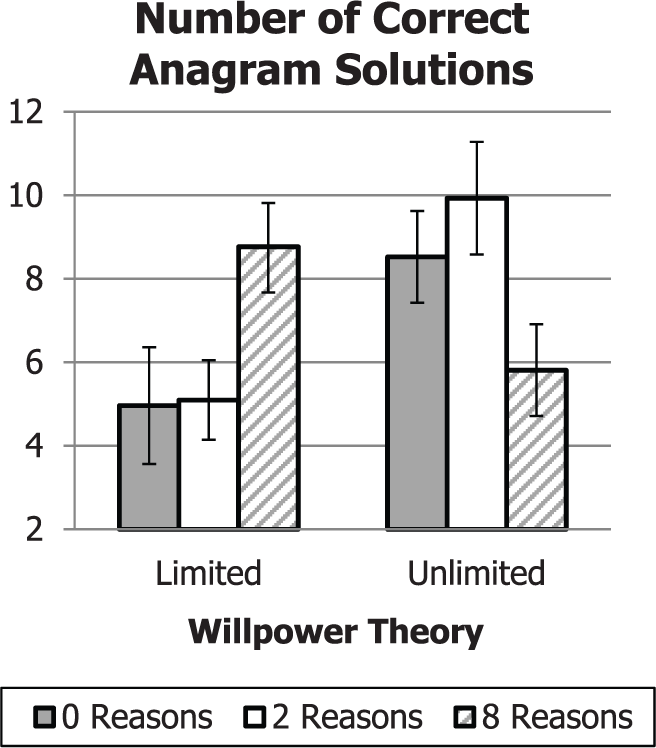
Number of correct anagrams in Experiment 1.
Discussion
Experiment 1 demonstrated that manipulating the fluency associated with individuals’ willpower theory can influence subsequent self-control. Specifically, those led to endorse an unlimited willpower theory demonstrated greater self-control when that theory was associated with fluency as opposed to disfluency. Conversely, those led to endorse a limited willpower theory demonstrated greater self-control when that theory was associated with disfluency as opposed to fluency. Moreover, the performance of those in the control condition aligned with the fluency condition, suggesting that individuals implicitly endorse their willpower theory with confidence but that associating willpower theories with disfluency can reverse their documented effect on self-control performance.
Experiment 2
Experiment 1 showed that the consequences of individuals’ willpower theories for self-control performance are dependent upon the experience of fluency associated with the theory. Yet, recall that our hypothesis states that this influence is driven by changes in individuals’ perceptions of mental fatigue. That is, unlimited theorists should generally perceive themselves as less mentally fatigued than do limited theorists.
However, we posit that fluency influences this perception, such that unlimited theorists will perceive themselves as less mentally fatigued when their theory is associated with fluency (or confidence) and limited theorists will perceive themselves as less mentally fatigued when their theory is associated with disfluency (or doubt). Moreover, as previously noted, less perceived mental fatigue should increase subsequent self-control performance (Clarkson et al., 2010; Clarkson, Hirt, et al., 2011; Egan et al., 2015; Egan & Hirt, 2015).
To offer support for this possibility, we conducted two experiments to test if, in fact, (a) individuals who endorse different willpower theories do indeed vary in their level of mental fatigue (Experiment 2a) and (b) the experience of fluency biases the impact of individuals’ willpower theories on self-control performance by altering perceptions of mental fatigue (Experiment 2b).
Experiment 2a
We first examined whether unlimited and limited theorists do indeed vary with respect to their baseline level of perceived mental fatigue (i.e., their ability to focus and concentrate). As such, we asked participants to report their current level of mental fatigue prior to indicating their willpower capacity theory. We expected that lower levels of mental fatigue (i.e., greater ability to focus and concentrate) would be associated with greater values on the willpower capacity index (i.e., greater endorsement of willpower capacity as unlimited).
Procedure
One hundred sixty-two undergraduates (Mage = 20.01; 63% male) were recruited in exchange for course credit. Upon being welcomed to the study, participants indicated their current level of mental fatigue on the Mental Fatigue subscale of the Multidimensional Fatigue Inventory (MFI; Smets, Garssen, Bonke, & De Haes, 1995). Sample items from the subscale include “My thoughts easily wander right now” and “I can concentrate well right now” (reverse scored). Responses were obtained on 7-point scales anchored from strongly disagree to strongly agree and averaged across items (α = .84), such that higher values indicated greater subjective mental fatigue (i.e., lower levels of perceived concentration and focus).
Upon completion of the MFI, participants completed a brief filler task before responding to an unbiased version of the Job et al. (2010) measure used in Experiment 1 as our index of individuals’ willpower theory. Sample items include “Your mental stamina fuels itself”; “Even after strenuous mental exertion, you can continue doing more of it”; and “Strenuous mental activity exhausts your resources, which you need to refuel afterwards” (reverse scored). Responses were obtained on 6-point scales anchored from completely disagree to completely agree and averaged (α = .80) such that higher values indicated greater endorsement of an unlimited willpower capacity.
Participants then responded to several demographics before being thanked for their participation.
Results/discussion
Analyses revealed a significant correlation between the MFI and individuals’ willpower theories, b = −.49 (95% confidence interval [CI] = [−0.803, −0.180]), t(161) = −3.12, p = .002, R2 = .057. Specifically, as participants’ scores on the MFI decreased, their endorsement of willpower capacity as unlimited increased. That is, the greater participants’ perceived mental concentration and focus (i.e., the lower their perceived mental fatigue), the more likely they were to believe that willpower is an unlimited resource. Consistent with our hypothesis, then, perceptions of mental fatigue appear to decrease as individuals’ willpower theory becomes more unlimited.
Experiment 2b
Given this documented association between individuals’ willpower theory and their perceptions of mental fatigue, we conducted a second experiment to explore the extent to which fluency biases the efficacy of individuals’ willpower theories by altering these perceptions. That is, we hypothesize that feelings of fluency (vs. disfluency) associated with individuals’ willpower theory will lead unlimited theorists to perceive themselves as less fatigued. Alternatively, we contend that feelings of disfluency (vs. fluency) associated with individuals’ willpower theory will lead limited theorists to perceive themselves as less fatigued. Furthermore, given prior research on the relationship between perceived depletion and self-control (see Clarkson et al., 2010), we anticipated that these altered perceptions would then drive subsequent differences in self-control performance (as in Experiment 1).
Experiment 2b tested this hypothesis using an alternative task of self-control—here, individuals’ intent to engage in impulsive decisions (e.g., Vohs & Faber, 2007). We also obtained an assessment of participants’ perceptions of mental fatigue to directly test (a) the extent to which the performance effects demonstrated in Experiment 1 are driven by differential perceptions of mental fatigue, and (b) that fluency affects perceptions in the hypothesized manner. Finally, to rule out the possibility that theories of willpower differentially impact participants’ engagement in the task and thus their desire to successfully regulate their behavior (see Muraven & Slessareva, 2003), we also included measures of motivation toward the self-control task.
Participants and design
One hundred sixty individuals (Mage = 32.99; 69% female) were recruited through Amazon Mechanical Turk to complete a study on the clarity of presentation in academic writing. Participants were randomly assigned to conditions in a 2 (Willpower Theory: Limited or Unlimited) × 2 (Time Exposure: 10 s or 20 s) between-participants factorial design.
Procedure
After a brief introduction to the study, participants were informed of our interest in obtaining their insights into the presentation of research findings. We then provided participants with an abstract from research ostensibly published in a highly prestigious journal and asked them to read the information carefully before answering several questions related to the clarity of the information. The abstract described willpower capacity as either relatively limited or unlimited, and thus constituted our manipulation of willpower theory (adapted from Park & John, 2012). In the unlimited theory condition, participants were informed that a supposed analysis of 50 years of research on willpower and self-control reliably demonstrates that one’s ability to engage in self-control (i.e., willpower) is rather unlimited. Conversely, in the limited theory condition, participants were informed that one’s ability to engage in self-control (i.e., willpower) is rather limited. 2
After reading the abstracts, participants were then asked to recall five personal experiences that reflected their own personal theory in the limited nature of willpower. Importantly, participants were further told that—to keep the study progressing in a timely manner—the computer would automatically move them on to the next screen based on the average time taken by nearly 2,000 previous participants. In actuality, the time was varied intentionally to manipulate feelings of fluency. Specifically, participants were given either 10 s or 20 s to complete the recall task. The time exposure manipulation has been reliably shown to vary feelings of fluency in this task (e.g., Reber, Winkielman, & Schwarz, 1998), such that 20 s elicit feelings of ease and fluency, whereas 10 s elicit feelings of difficulty and disfluency.
Participants then indicated their current level of mental fatigue and motivation. To assess mental fatigue, participants completed the same measure described in Experiment 2a (α = .83). Recall that higher values indicate greater perceived mental fatigue (i.e., lower levels of perceived focus and concentration). To assess motivation, participants responded to the following items (adapted from Muraven & Slessareva, 2003): How motivated are you to do well on the remainder of this survey? How interested are you in doing well on the remainder of this survey? How much effort will you put into the remainder of this survey? How much energy will you put into the remainder of this survey? Responses were given on a 9-point scale anchored at not at all to very much. Responses across all items were averaged (α = .95), such that higher scores indicated greater motivation toward the remainder of the experiment.
Last, participants read a series of scenarios designed to assess impulsivity, which served as our index of self-control. These scenarios, adapted from Rook and Fisher (1995), described several instances in which participants were asked their likelihood to engage in an impulse purchase. For instance, participants were asked to imagine that, while waiting in line to check out at the grocery store, they noticed some candy on sale that fit their budget. As a measure of impulsivity, participants indicated the likelihood that they would engage in the more impulsive option presented in each scenario. Across all scenarios, participants indicated their purchase intentions on a scale anchored 1 (very unlikely) to 9 (very likely). Responses were averaged (α = .61), such that higher values indicated greater impulsivity and thus lower self-control performance.
Upon completing the impulsivity task, participants responded to several demographics before being thanked for their participation.
Results
All analyses were submitted to a two-way ANOVA, with willpower theory and time exposure as the independent variables. Results are listed in Table 1.
Results From Experiment 2b.
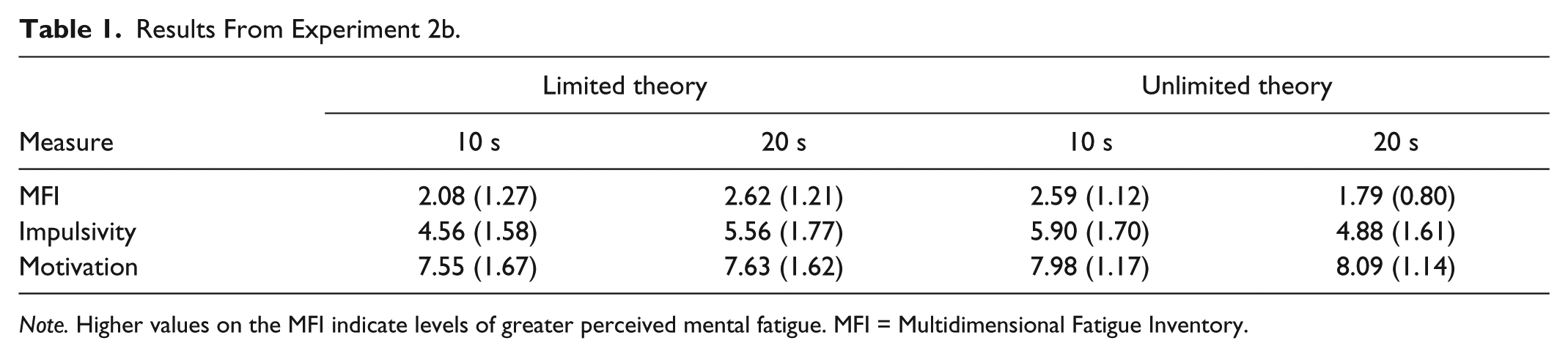
Note. Higher values on the MFI indicate levels of greater perceived mental fatigue. MFI = Multidimensional Fatigue Inventory.
Motivation
The motivation index revealed an unexpected effect of willpower theory, F(1, 156) = 3.86, p = .051, ηp2 = .024, such that unlimited theorists (M = 8.04, SD = 1.15) reported greater motivation than did limited theorists (M = 7.60, SD = 1.63). More important for our concerns, however, the Willpower Theory × Time Exposure interaction was not significant (F < 1). The main effect of time exposure was also not significant (F < 1). Given the main effect of willpower theory, we controlled for motivation in all subsequent analyses. 3
Mental fatigue
The mental fatigue data revealed the predicted Willpower Theory × Time Exposure interaction, F(1, 155) = 14.42, p < .001, ηp2 = .094. For those in the unlimited theory condition, greater mental fatigue was exhibited in the 10 s (vs. 20 s) condition, F(1, 155) = 9.73, p = .002. Conversely, for those in the limited theory condition, greater mental fatigue was exhibited in the 20 s (vs. 10 s) condition, F(1, 155) = 4.98, p = .027. Neither main effect was significant (Fs < 1).
Impulsivity
Responses to the impulsivity scenarios also revealed a Willpower Theory × Time Exposure interaction, F(1, 155) = 14.51, p < .001, ηp2 = .085. For those in the unlimited theory condition, greater impulsivity was exhibited in the 10 s (vs. 20 s) condition, F(1, 155) = 6.99, p = .009. Conversely, for those in the limited theory condition, greater impulsivity was exhibited in the 20 s (vs. 10 s) condition, F(1, 155) = 7.54, p = .007. Neither main effect was significant (ps > .21).
Mediation analysis
Following the statistical procedures provided by Preacher, Rucker, and Hayes (2007), we assessed the mediating role of perceived mental fatigue in impulsivity by constructing a 95% CI around the indirect effect (see Hayes, 2013). Specifically, this approach involves bootstrapping procedures that compute a 95% CI around the effect of the Willpower Theory × Time Exposure interaction on impulsivity through mental fatigue (controlling for the main effect terms and participants’ motivation scores), and mediation is indicated by a CI that does not include 0. The results of this analysis revealed a significant mediating pathway through mental fatigue (95% CI = [−0.76, −0.06]; see Figure 3 for standardized betas of individual analyses). This result offers evidence that participants’ perceived mental fatigue mediates the interaction between willpower theory and time exposure on impulsivity.
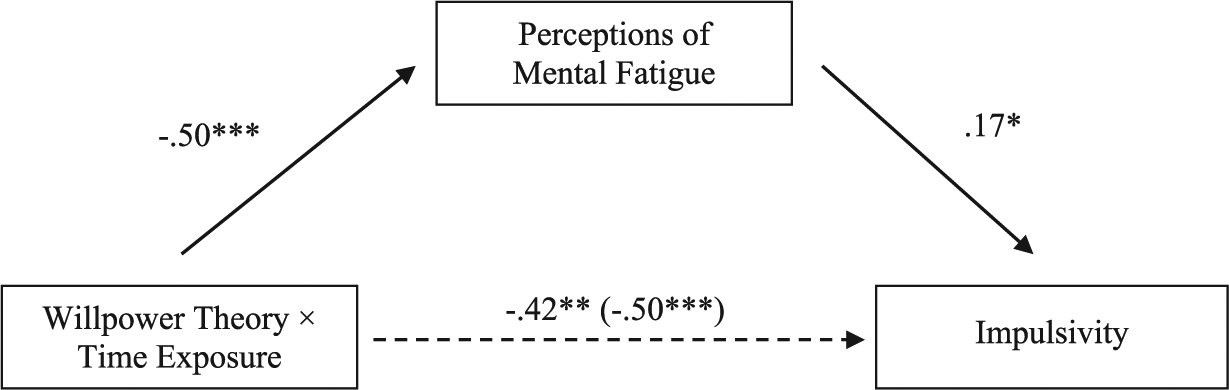
Path analysis in Experiment 2b.
Discussion
The intent of Experiment 2 was to provide direct insight into the process by which feelings of fluency alter the impact of willpower theories on self-control performance. In support of our hypothesis, endorsing an unlimited (vs. limited) theory does appear to be associated with lower baseline levels of mental fatigue (Experiment 2a). However, this pattern only emerged when individuals’ willpower theories were associated with fluency; when associated with disfluency, unlimited theorists reported greater mental fatigue while limited theorists reported lower mental fatigue (Experiment 2b). Moreover, these differences in perceived mental fatigue were shown to mediate the effect of fluency associated with individuals’ willpower theories on self-control performance—here, reduced impulsivity. Furthermore, the effects of fluency on individuals’ willpower theories could not be attributed to differences in individuals’ motivation. The lack of motivational differences is especially interesting as it suggests that participants are not simply less engaged with the task but rather not performing as a function of their perceptions of mental fatigue. Fluency, then, appears to alter the impact of willpower theories on self-control performance by impacting individuals’ perceptions of mental fatigue.
It is worth acknowledging the main effect of willpower theory on participant motivation. Specifically, unlimited theorists reported being more motivated than did limited theorists. Though we find this main effect worthy of future study, of most relevance to the present research, the effect of willpower theory on participant motivation did not interact with fluency. Thus, while limited and unlimited theorists appear to vary with respect to their motivation to engage in self-control, this motivation is not affected by fluency and does not account for the observed pattern of self-control performance.
Experiment 3
The first two experiments demonstrate the impact of fluency on the self-control performance of unlimited and limited willpower theorists as well as the importance of individuals’ perceptions of mental fatigue in driving this effect. Yet, these findings rest on an assumption derived from prior research on self-validation that fluency alters individuals’ confidence in their willpower theory. Thus, we conducted a third experiment to directly test this assumption, with the expectation that the effect of fluency and willpower theories on perceptions of mental fatigue demonstrated in Experiment 2b is in fact driven by individuals’ confidence in their willpower theory.
Method
Participants and design
One hundred twelve individuals (Mage = 35.74; 51% male) were recruited through Amazon Mechanical Turk and randomly assigned to conditions in a 2 (Willpower Theory: Unlimited or Limited) × 2 (Font Type: Easy or Difficult) between-participants factorial design.
Procedure
Participants were informed at the beginning of the study of our interest in obtaining their insights into the presentation of research findings. We then provided participants with the manipulation used in Experiment 2b to vary willpower theories. This manipulation presented participants with information about a supposed research review demonstrating that one’s ability to engage in self-control (i.e., willpower) is either limited or unlimited. Importantly, to manipulate feelings of fluency associated with the theory, the paragraph was presented in either an easy or difficult-to-read font (Novemsky, Dhar, Schwarz, & Simonson, 2007; Simmons & Nelson, 2006). Thus, participants read an abstract describing willpower as either limited or unlimited in either an easy or difficult-to-read font.
Participants then indicated their current level of mental fatigue on the same scale as in Experiments 2a and 2b (α = .88). Again, higher values indicate greater perceived mental fatigue (i.e., lower levels of perceived focus and concentration). Afterward, participants were asked to complete the Job et al. (2010) Implicit Theories About Willpower Scale (α = .94) before then indicating their confidence in willpower as an unlimited resource on the following items (adapted from Briñol et al., 2004): How certain are you that your willpower capacity is unlimited? How sure are you that your willpower capacity is overly abundant? Overall how confident are you that willpower capacity is limited? (reverse scored). Items were presented in random order, responses were given on 9-point scales anchored at not certain at all—very certain, not sure at all—very sure, and not confident at all—very confident, and responses were averaged (α = .93), such that higher scores indicated greater confidence that willpower is unlimited.
Finally, participants completed several demographic items before being compensated and thanked for their participation.
Results
Dependent measures were submitted to a two-way ANOVA, with willpower theory and font type as independent variables. Results are listed in Table 2.
Results From Experiment 3.
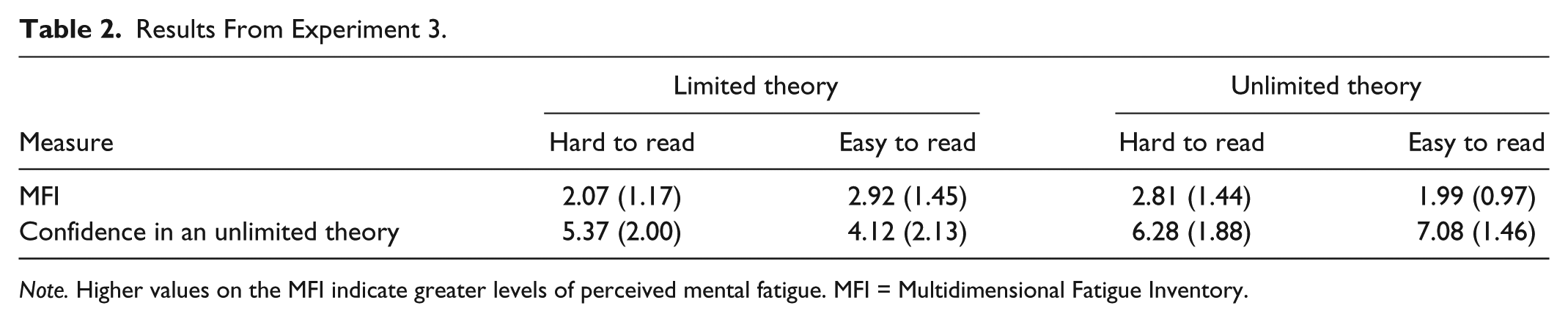
Note. Higher values on the MFI indicate greater levels of perceived mental fatigue. MFI = Multidimensional Fatigue Inventory.
Mental fatigue
The mental fatigue data revealed the Willpower Theory × Font Type interaction, F(1, 108) = 12.13,p = .001, ηp2 = .101, in a pattern consistent with Experiment 2b. For those in the unlimited theory condition, greater mental fatigue was exhibited in the difficult (vs. easy) font type condition, F(1, 108) = 5.61, p = .020. Conversely, for those in the limited theory condition, greater mental fatigue was exhibited in the easy (vs. difficult) font type condition, F(1, 108) = 6.57, p = .012. Neither main effect was significant (Fs < 1).
Confidence in willpower capacity as unlimited
Analysis of participants’ confidence in willpower capacity as an unlimited resource revealed a significant effect of willpower theory, F(1, 108) = 29.47, p < .001, that was qualified by a significant Willpower Theory × Font Type interaction, F(1, 108) = 8.23, p = .005, ηp2 = .071. Those in the unlimited theory condition tended to report greater confidence in willpower as an unlimited capacity when the belief was described in font that was easy (rather than difficult) to read, F(1, 108) = 2.42, p = .122. Conversely, those in the limited theory condition reported greater confidence in willpower as an unlimited capacity when the belief was described in font that was difficult (rather than easy) to read, F(1, 108) = 6.35, p = .013. The main effect of font type was not significant (F < 1). 4
Mediation analysis
Last, we assessed the mediating role of confidence in perceived mental fatigue by constructing a 95% CI around the indirect effect (Hayes, 2013; Preacher et al., 2007). The result of this analysis revealed a significant mediating pathway through confidence (95% CI = [−1.06, −0.14]; see Figure 4 for standardized betas of individual analyses). This result offers evidence that participants’ confidence in the unlimited nature of willpower mediates the interaction between willpower theory and font type on perceived mental fatigue.
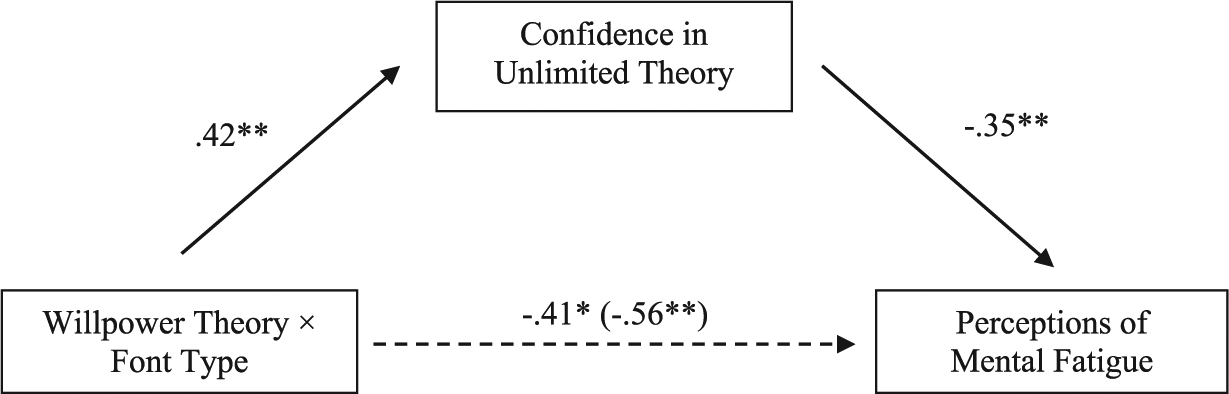
Path analysis in Experiment 3.
Discussion
Experiment 3 offered insight into the means by which fluency impacts limited and unlimited theorists’ perceptions of mental fatigue. Specifically, we explored the premise that feelings of fluency influence individuals’ confidence in beliefs about unlimited willpower capacity, and that this change in confidence in turn impacts individuals’ perceptions of mental fatigue. The findings were consistent with this premise, as feelings of fluency not only impacted individuals’ confidence but also showed that individuals’ confidence mediated the effect of fluency and willpower theories on perceptions of mental fatigue.
Experiment 4
The prior experiments offer support for the process by which feelings of fluency interact with individuals’ willpower theories to determine self-control performance—specifically, by altering individuals’ confidence in their willpower theory which subsequently impacts their perceptions of mental fatigue (see Figure 1). Yet, while fluency can exert an influence on judgments in a variety of ways (Briñol et al., 2013; Schwarz, 2004), the metacognitive effect of fluency on confidence is most pronounced under conditions of effortful thought (i.e., high elaboration; Briñol, Petty, & Tormala, 2006; Clarkson, Tormala, & Leone, 2011; Tormala et al., 2002). The rationale for this robust finding is that people pay more attention to metacognitive information (e.g., the feeling of fluency associated with the focal belief, judgment, evaluation, or theory) when they are highly motivated and able to engage in reflection (see Petty et al., 2007).
In a similar vein, we anticipate that the effect of fluency on the self-control consequences of individuals’ willpower theories should be most pronounced under conditions of high elaboration. That is, under conditions of effortful thought, individuals should be more likely to reflect on the confidence of their willpower theory as a function of the ease or difficulty associated with the theory. If true, then high elaboration should moderate the effect of thought confidence on individuals’ mental fatigue perceptions and subsequent self-control, and the effects demonstrated in the prior three experiments should be most pronounced under conditions of high elaboration.
To test this possibility, Experiment 4 manipulated participants’ investment in the study to vary the extent to which individuals engage in effortful thought about the information presented. We predicted that fluency should bias the influence of willpower theories on individuals’ self-control under high investment; under low investment, we predicted no influence of fluency and thus only a main effect of willpower theories. Experiment 4 also used a different task of self-control—here, delayed gratification. Preference for delayed versus immediate rewards has long served as a proxy for self-control, given that selecting the delayed reward over the more immediate reward requires a greater amount of willpower (e.g., Mischel, Ebbesen, & Zeiss, 1972; Vohs et al., 2012). Furthermore, Experiment 4 tested these predictions using participants’ dispositional theories in willpower capacity to assess the extent to which the documented effect of fluency on willpower theories holds even for individuals’ existing theory.
Method
Participants and design
One hundred ninety individuals (Mage = 36.25; 55% female) were recruited through Amazon Mechanical Turk to complete a study on personal beliefs. Participants were randomly assigned to conditions in a 2 (Investment: High or Low) × 2 (Reasons: Two or Eight) between-participants design. We measured participants’ willpower theories as a continuous predictor variable.
Procedure
Following an introduction to the study, participants were immediately exposed to our investment manipulation, which served to alter their motivation to elaborate on the information presented within the study. All participants were ostensibly instructed that we oftentimes randomly give survey takers an additional US$0.10 payment as a thank you for their time. In the high investment condition, participants were further informed that they would be receiving an additional US$0.10 for their participation in the study. In the low investment condition, participants were further informed that they would not be receiving an additional US$0.10 for their participation in the study. Importantly, the intent of this manipulation was to alter participants’ engagement with and thus investment in the self-control task, such that those in the high investment condition would be more likely to engage and those in the low investment condition would be more likely to disengage. 5
Participants next completed the Job et al. (2010) Strenuous Mental Activity subscale of the Implicit Theories About Willpower Capacity Scale (see Experiment 2a). Items were recoded and averaged (α = .85), such that higher values correspond to the belief that willpower is relatively unlimited. As in Experiment 1, we then manipulated the fluency associated with these theories by altering the number of reasons participants were asked to recall in support of their theory, such that participants recalled either 2 (easy condition) or 8 (difficult condition) supportive reasons for their willpower theory.
Last, we assessed participants’ ability to delay gratification by presenting them with several scenarios that pitted their desire for an immediate reward against a better—albeit delayed—reward (adapted from Vohs et al., 2012). For instance, participants were asked to choose between taking a midday flight or a red-eye flight at a 10% discount. The presentation of scenarios was randomized, and responses to each scenario were averaged such that higher numbers indicated greater self-control (i.e., preference for delayed over immediate rewards).
Upon completing the scenarios, participants responded to several demographic items before being compensated and thanked for their participation.
Results
The delayed gratification data were submitted to a hierarchical regression, with investment (0 = low, 1 = high), reasons (0 = eight, 1 = two), and willpower theories (continuous, mean-centered) as predictors in the first step, all two-way interactions in the second step, and the three-way interaction in the third step (Cohen, Cohen, West, & Aiken, 2003). Neither the main effects (ts < 1) nor the two-way interactions (ps > .08) were significant. However, consistent with expectations, the analysis revealed a significant Investment × Reasons × Willpower Theory interaction, b = .278 (95% CI = [0.090, 0.467]), t(182) = 2.91, p = .004, R2 = .051 (see Figure 5).
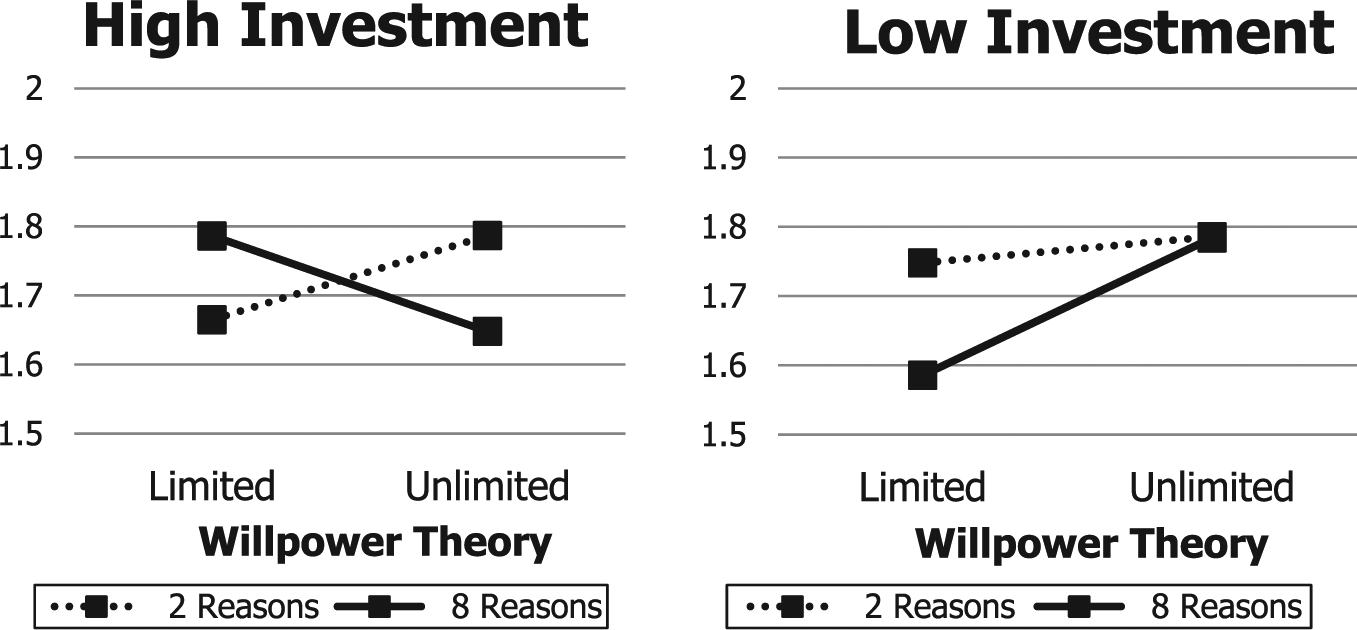
Delayed gratification findings in Experiment 4.
For those in the high investment condition, we observed a significant Willpower Theory × Reasons interaction, b = .172 (95% CI = [0.059, 0.285]), t(107) = 3.02, p = .003, R2 = .054, in a pattern consistent with the results in Experiments 1 and 2. Specifically, unlimited theorists (+1 SD) exhibited greater delayed gratification after listing two (vs. eight) reasons (β = .29), t(107) = 2.15, p = .034. Conversely, limited theorists (−1 SD) exhibited greater delayed gratification after listing eight (vs. two) reasons (β = −.25), t(107) = −2.01, p = .047. Neither main effect was significant (ts < 1).
For those in the low investment condition, we observed only a significant main effect of willpower theory, b = .076 (95% CI = [0.00, 0.15]), t(76) = 1.99, p = .050, R2 = .071; unlimited theorists exhibited greater delayed gratification than did limited theorists. Neither the main effect of reasons nor the Willpower Theory × Reasons interaction was significant (ps > .15).
Discussion
The findings from Experiment 4 further clarify the relationship between feelings of fluency and willpower theories on self-control performance. Only when participants were motivated to elaborate on the effect of fluency on their beliefs (i.e., the high investment condition) did fluency influence the documented relationship between willpower theories and their subsequent self-control. Absent such motivation (i.e., in the low investment condition), self-control was driven solely by individuals’ willpower theories. This pattern of findings is consistent with prior research demonstrating that the metacognitive impact of fluency on confidence is most prevalent under conditions of high elaboration (Petty et al., 2007; Schwarz, 2004).
It should also be noted that these findings demonstrate the robustness of the metacognitive influence of fluency across both situational and dispositional differences in willpower theories. That is, while Experiments 1 to 3 manipulated participants’ willpower theories to demonstrate the malleable effect of these theories on self-control performance, Experiment 4 elicited the same pattern of effects by measuring dispositional theories. Even the consequences of individuals’ preexisting willpower theories, then, are susceptible to differential feelings of fluency.
Finally, we find it important to distinguish our investment manipulation from similar incentive manipulations used to vary participants’ self-control (Buehler, Griffin, & MacDonald, 1997; Muraven & Slessareva, 2003). For instance, Muraven and Slessareva (2003) demonstrated that, when offered a monetary incentive for high performance, individuals initially depleted of their self-control resources performed equally well as those who were not depleted of their regulatory resources on a subsequent task of self-control. In that work, the financial compensation was contingent upon effective task performance. In the present experiment, however, the financial compensation was intentionally provided irrespective of task performance as a means of increasing participants’ elaboration. 5
General Discussion
Despite the robust and consistent evidence in support of a self-control advantage for unlimited theorists (Job et al., 2010; Job et al., 2013; Job, Walton, et al., 2015; see also Mukhopadhyay & Johar, 2005), the purpose of the present research was to build upon prior work on self-validation processes by using fluency to demonstrate the importance of confidence in understanding the malleable efficacy of both unlimited and limited willpower theories. Consistent with this possibility, four experiments demonstrate that the self-control consequences of individuals’ willpower theories do indeed vary as a function of the fluency associated with these theories. Thus, it is not that disfluency merely impairs self-control; on the contrary, disfluency can either elevate or impair self-control performance as a function of individuals’ willpower theory. Moreover, these differences emerged irrespective of whether individuals’ willpower theories were manipulated or measured and occurred across a variety of self-control measures (cognitive performance, impulsivity, delayed gratification). Regarding the latter point, these measures assessed both actual and self-reported performances and, while the self-reported measures did not tap into actual performance, they did allow us to assess a wide array of diverse hypothetical outcomes that—when coupled with the actual performance data—provide convergent support for the malleable efficacy of willpower theories.
In addition, this interactive effect of fluency and willpower theories on self-control performance was driven by individuals’ subjective perceptions of mental fatigue. Indeed, willpower theories elicit different perceptions of mental fatigue, such that unlimited theorists exhibited lower levels of mental fatigue than did limited theorists. However, feelings of fluency altered these perceptions. In particular, unlimited theorists exhibited lower levels of mental fatigue when their theory was associated with fluency (rather than disfluency), whereas limited theorists exhibited lower levels of mental fatigue when their theory was associated with disfluency (rather than fluency). Moreover, these differences in perceived mental fatigue mediated the interactive effect of fluency and willpower theories on self-control performance.
Importantly, this research also offers insight into the means by which fluency impacts individuals’ perceptions of mental fatigue. Specifically, feelings of fluency were shown to alter the confidence with which individuals endorse their willpower theory. As a result, disfluency led individuals to doubt the nature of their willpower theory and, consequently, increased perceptions of mental fatigue in those who view willpower as unlimited but decreased perceptions of mental fatigue in those who view willpower as limited.
Finally, along with exploring the process by which fluency alters the self-control consequences of willpower theories, we explored the conditions under which fluency was most likely to alter the efficacy of individuals’ willpower theories. We found that the effect of fluency on individuals’ willpower theories was most prominent under conditions that promote effortful thought and thus reflection on the validity of one’s willpower belief. Specifically, feelings of fluency impact the efficacy of individuals’ willpower theories only when individuals were sufficiently engaged in the experimental procedure; when individuals were not engaged, fluency had no impact on the relationship between willpower theories and self-control performance, and we instead replicated the standard performance advantage for unlimited (vs. limited) theorists.
Theoretical Contributions
The purpose of this research was to explore the malleable efficacy of willpower theories. In doing so, these findings not only demonstrate the importance of fluency in impacting the performance of both limited and unlimited theorists but also provide novel insight into (a) the manner in which individuals express their willpower theories, (b) the mechanism by which those theories affect self-control performance, and (c) the factors that alter the consequences of those theories.
In addition, the present research offers a novel mechanism to account for the differences in self-control performance of limited and unlimited theorists (i.e., perceptions of mental fatigue). That is, these findings not only demonstrate the presence of initial differences in perceptions of mental fatigue for unlimited and limited theorists (Experiment 2a) but also outline the role of these perceptions in driving self-control performance (Experiment 2b). This finding is consistent with prior research on the importance of mental fatigue as a mechanism for self-control performance (Clarkson et al., 2010; Muraven et al., 2008; Ryan & Deci, 2008), while providing insight into the role of willpower theories—and the confidence with which these theories are held—as a novel antecedent to individuals’ perceptions of mental fatigue. Indeed, this work speaks directly to the importance of not only the willpower theory individuals endorse (see Job et al., 2010) but also the confidence with which this theory is held.
It is worth nothing that, by outlining the role of mental perceptions in driving self-control performance, this work speaks to an important distinction in the specific perceptions of limited and unlimited theorists that impact their self-control performance. Specifically, Job et al. (2010) found that unlimited and limited theorists perceived the same task as equally demanding, but this perception only impacted the performance of limited theorists. Here, however, we observed a difference in both unlimited and limited theorists’ perceptions of mental fatigue and their subsequent performance. Consequently, this work makes a distinction between individuals’ perceptions of subsequent task demands and perceptions of their available willpower resources. This distinction is critical because, while we would not expect unlimited and limited theorists to respond equally to external “threats” to willpower, we would expect both to respond similarly to their self-perceptions of willpower availability.
Finally, these findings offer a novel bridge between the areas of self-control and persuasion. Though considerable research has outlined the importance of belief confidence for attitudes (Briñol et al., 2004), judgments (Petty et al., 2007), and even social perception (Clark, Wegener, Briñol, & Petty, 2009), we are aware of only indirect evidence that self-validation can impact self-control in the form of enhanced goal pursuit (DeMarree et al., 2012). Indeed, while most research on the interplay between persuasion and self-control has focused on the means by which processes dominant to self-control can affect persuasion (Burkley, 2008; Clarkson et al., 2010; Petrocelli, Williams, & Clarkson, 2015; Wheeler, Briñol, & Hermann, 2007), the present research outlines the novel means by which processes dominant to persuasion can affect self-control.
Future Directions
We believe that these findings—and the contributions they elicit—present an opportunity to explore several questions in future research. We outline several here.
Clarifying the perception–performance link
The present work demonstrates that endorsement of a limited versus unlimited willpower theory differentially impacts perceptions of mental fatigue, and that these perceptions subsequently alter self-control performance. However, the latter effect is independent of motivation, which begs the question of why mental fatigue impacts self-control performance. While research demonstrates that mental fatigue can directly alter executive functioning in the form of working memory capacity (Clarkson, Hirt, et al., 2011; Egan et al., 2015; Egan & Hirt, 2015; see Jia, Hirt, & Fishbach, 2016, for further discussion of mental fatigue as a cue to resource allocation), other factors could be at play (see Clarkson et al., in press). As one example, mental fatigue could increase or decrease individuals’ confidence in their ability to successfully perform a task of self-control (i.e., self-efficacy; Bandura, 1977). This proposition is not only consistent with recent work showing that resource depletion can impair individuals’ self-efficacy (Chow, Hui, & Lau, 2015) but also offers an alternative cue by which to signal the conservation of resources (e.g., when doubtful of one’s ability to succeed). Thus, we look to future research to clarify the factors and thus processes that facilitate this perception–performance link.
Multiple roles of fluency
The premise of this manuscript is that the fluency associated with individuals’ willpower theory can impact the efficacy of that theory. Implicit in this premise is that individuals possess an existing willpower theory prior to the effect of fluency, as research shows that people have preexisting beliefs concerning their willpower capacity (see Job et al., 2010). However, these theories can be situationally induced and, as such, fluency could impact individuals’ willpower theories in multiple ways depending on when the induction occurs (for further discussion on this issue, see Briñol et al., 2013). Specifically, in the present set of studies, the fluency manipulation occurred after the induction of willpower theories. Yet if the fluency manipulation occurred prior to the induction of willpower theories, then the effect of fluency on willpower theories is less clear. For instance, feelings of ease (vs. difficulty) can reduce information processing (Alter, Oppenheimer, Epley, & Eyre, 2007), which could reduce the veracity of situational inductions by decreasing the attention given to the manipulation. Alternatively, feelings of ease (vs. difficulty) evoke positive affect (Winkielman & Cacioppo, 2001), which could strengthen the veracity of situational inductions by heightening the generation of favorable thoughts toward the willpower theory. In short, then, the present set of findings focused on the role of fluency in instances where individuals possess a willpower theory, and future research is needed to clarify the impact of fluency when ease is induced prior to inducing or heightening the salience of a limited or unlimited willpower theory.
Willpower theory resiliency?
Though this article focuses on factors that alter one’s willpower theory, it is equally interesting to consider potential factors that might lead individuals to be more crystallized or resilient in their theory. We know, for instance, that judgments, beliefs, and evaluations held with greater strength are more resistant to change (Petty & Krosnick, 1995) and that individuals do vary with respect to their resiliency with certain expectations about mental restoration (see Egan & Hirt, 2015). Might individuals systematically vary in the strength with which they endorse their willpower theories? If so, then future research should identify the factors that heighten the strength of individuals’ willpower theory (e.g., increased accessibility; Fazio, Chen, McDonel, & Sherman, 1982) and thus the resiliency of that theory in guiding self-control performance.
Concluding Remarks
Due to emerging interest in willpower theories (Job et al., 2010; Mukhopadhyay & Johar, 2005) and the robust self-control benefits of endorsing an unlimited willpower theory, the present research provides four experiments that document the importance of fluency (and thus confidence) in understanding the means by which willpower theories alter self-control, the factors that alter the efficacy of these theories, and the conditions most likely to promote this malleability. Given the developing body of research on theories of self-control (Clarkson et al., 2015; Egan et al., 2015; Job et al., 2010), we hope that these findings encourage researchers to further elucidate the factors that impact our self-control beliefs and as a result offer clearer insight into when, why, and how these theories differentially impact self-control performance.
Footnotes
Declaration of Conflicting Interests
The author(s) declared no potential conflicts of interest with respect to the research, authorship, and/or publication of this article.
Funding
The author(s) received no financial support for the research, authorship, and/or publication of this article.

Notes
References
Supplementary Material
Please find the following supplemental material available below.
For Open Access articles published under a Creative Commons License, all supplemental material carries the same license as the article it is associated with.
For non-Open Access articles published, all supplemental material carries a non-exclusive license, and permission requests for re-use of supplemental material or any part of supplemental material shall be sent directly to the copyright owner as specified in the copyright notice associated with the article.
