







Abstract
Although the effects of personality traits on social environments are regularly thought to mirror the effects of social environments on personality traits, the causal dynamics existing between personality traits and social power may represent an important exception. Using a sample of 181 fraternity and sorority members surveyed over a year, we show that agentic traits are more likely to show cross-sectional associations with social power, and may increase from the experience of social power. However, increases in social power over a year are predicted better by communal characteristics. The findings are consistent with the understanding that social power acts as a disinhibitor allowing people to enact their desires with less risk and greater efficacy, but is differentially afforded to individuals perceived as likely to promote the goals of others. We discuss the conditions that may need to exist for personality traits and environments to show corresponsive relationships more generally.
What personality characteristics are associated with having power in social groups? Lay theories of leadership often associate leaders with being more assertive, competent, and intelligent (Gerstner & Day, 1994; Lord, de Vader, & Alliger, 1986; Stogdill, 1948). For the most part, these findings seem to be substantiated by studies which examine how personality traits are associated with power, influence, and leadership in groups and organizations (Harms, Roberts, & Wood, 2007; Judge, Bono, Ilies, & Gerhardt, 2002; Keltner, Gruenfeld, & Anderson, 2003).
However, most of the investigations into the dispositional correlates of power seem to be of two major types: (a) cross-sectional studies, in which power and personality traits are associated concurrently (Anderson, John, Keltner, & Kring, 2001; Anderson, Spataro, & Flynn, 2008; Harms et al., 2007), and (b) laboratory studies, in which power is manipulated to examine the psychological or behavioral effects of power (e.g., Galinsky, Gruenfeld, & Magee, 2003; Ronay & von Hippel, 2010), or where the acquisition of power among unacquainted individuals is predicted by personality traits (Brunell et al., 2008; Cheng, Tracy, Foulsham, Kingstone, & Henrich, 2013; Dobbins, Long, Dedrick, & Clemons, 1990). A limitation of cross-sectional studies is that they will necessarily conflate the characteristics that predict the acquisition of power with the characteristics that change in response to having power. This may not be a problem if these traits are the same—that is, if the causal effects linking personality traits and social power are corresponsive. However, as reflected in popular sayings such as “the cream rises to the top” and “power corrupts, and absolute power corrupts absolutely,” there seems to be an implicit sense that the characteristics which predict the acquisition of power and the characteristics affected by having power might show important differences. Similarly, laboratory studies of power are useful for detailing in more controlled settings the effects of power and personality on one another, but such studies are almost necessarily short in duration. These and other differences may limit their ecological validity. For instance, the acquisition of power in some lab studies has been associated with trait dominance (Fleischer & Chertkoff, 1986; Megargee, 1969; Stogdill, 1948). However, this may be due in part to the fact that dominant individuals behave in ways that can result in others having an erroneously positive view of their personalities (Anderson & Kilduff, 2009). As individuals are highly concerned with diagnosing the qualities of people they might give power to (Van Vugt, Hogan, & Kaiser, 2008), groups existing over longer time spans may become less likely to afford power to dominant individuals as they come to know one another’s traits more accurately. A study by Paulhus (1998), for instance, indicated that narcissism was positively associated with peer perceptions of warmth upon first meeting individuals, but over several weeks of acquaintance, this association became increasingly negative.
Here, we will examine how personality characteristics and social power can predict changes in one another over time. In contrast to one’s own subjective sense of having power (Anderson, John, & Keltner, 2012), we will regard social power as ultimately a reputational characteristic: It can be regarded as an individual’s ability to influence outcomes within an interpersonal or group context (Dahl, 1957; Van Vugt et al., 2008). We will explore these relationships using data from a 1-year longitudinal study of students involved in college fraternities and sororities. We will conclude by considering how the relations between personality characteristics and social power may help us understand the causal relations existing between personality characteristics and environments more generally.
Personality Predictors of Social Power Attainment
As detailed by Henrich and colleagues (Cheng et al., 2013; Henrich & Gil-White, 2001), an actor’s characteristics might facilitate the acquisition of social power through two major routes. The dominance route involves the acquisition of social power through the use of force and threats, whereas the prestige route involves others affording power to the actor more voluntarily on account of the actor’s competence and other virtues. In large and relatively enduring social groups, it is increasingly thought that the prestige route serves as the more effective path to power, in part because in such groups, the group may be collectively strong enough to neutralize threats from a single domineering individual (Boehm, 2009; Van Vugt, 2006). The result of this dynamic is that the group can preferentially give power to those individuals who group members perceive as likely to promote their particular goals (Hogan & Kaiser, 2005; Hogan & Roberts, 2000; Keltner, Gruenfeld, Galinsky, & Kraus, 2010). As we have outlined in the top half of Figure 1, it is this theoretical quantity—the perceived likelihood that the actor will advance group members’ goals—which should mediate the relationship between actor’s traits and their attainment of social power. Consequently, the interests of individuals within groups should generally be best served by selecting leaders with characteristics associated with the facilitation of group cohesion (Hogan & Kaiser, 2005; Van Vugt et al., 2008), and the advancement of group goals more generally (Van Vugt et al., 2008).

Depiction of the expected relations between personality and social power.
The Effects of Social Power on Personality
Research has indicated that having power may often facilitate behaviors and psychological states generally regarded as negative. For example, the experience of power has been associated with the increased tendency to stereotype, demean, and create distance from subordinates (Fast, Halevy, & Galinsky, 2012; Magee & Galinsky, 2008). That said, there is also evidence that attaining power can increase prosocial behaviors for certain people or in certain situations (e.g., Harms, 2008; Schmid Mast, Jonas, & Hall, 2009). Consequently, there is evidence that attaining power can be associated with increases both in prosocial and antisocial behaviors.
One way to reconcile these seemingly contradictory findings is to understand power as a disinhibitor, granting greater opportunity to pursue one’s own goals, whatever these might be (Guinote, 2010; Keltner et al., 2003; Kipnis, 1972; McClelland, 1975). The experience of power has been associated with increased positive affect, attention to rewards, automatic information processing, disinhibited behavior, and an approach orientation toward addressing challenges and interpreting situations (Galinsky et al., 2003; Keltner et al., 2003). As noted by Keltner and colleagues (2010), this may indicate that “power does not necessarily corrupt; rather, it amplifies the expression of the individual’s preexisting tendencies” (p. 189). In this vein, greater power appears to result in greater pursuit of behaviors that promote the values of the individual or the norms of the group, depending on which goals are active in the individual at the time (Chen, Lee-Chai, & Bargh, 2001; Guinote, Weick, & Cai, 2012; Harms, 2008; Kraus, Chen, & Keltner, 2011).
Are the Relationships Between Power and Personality Corresponsive?
As outlined above, recent research and theory indicate there may be fairly dramatic departures in how one’s personality characteristics influence power acquisition and are influenced by the experience of power. Keltner and colleagues (2010) described this as “an interesting power paradox.” Specifically,
on one hand, individuals acquire power through their capacity to build relationships that enable more cooperative groups . . . [however] once in positions of power, individuals often act in an approach-oriented, impulsive fashion, often seeing others through the lens of their own goals and desires. (Keltner et al., 2010, p. 196)
Whereas relatively other-serving characteristics may lead one to acquire power, having power may result first and foremost in agentic, disinhibited behavior.
However, this departs from a common understanding of how personality traits tend to be associated with environmental variables. As suggested first by Roberts, Caspi, and Moffitt (2003), a good general expectation of how environments affect personality traits may be “to deepen the characteristics that lead people to those experiences in the first place” (Roberts, Wood, & Caspi, 2008). This has come to be known as the corresponsive principle, and is sometimes described as the phenomenon of reciprocal causation (Jeronimus, Riese, Sanderman, & Ormel, 2014). Stated most generally, this suggests that if a particular trait affects the likelihood of entering a particular environment, then we can generally expect this environment to affect the development of this trait in the same direction (Caspi, Roberts, & Shiner, 2005).
As originally suggested by Roberts and colleagues (2003), corresponsive relationships between personality traits and environmental variables have been documented in a range of studies. For example, Roberts and Robins (2004) found that the same traits that predicted the participant’s level of fit at a competitive university tended to increase among those who showed greater initial fit (see also Harms, Roberts, & Winter, 2006, p. 376). More recently, a longitudinal study of workers in eastern Germany showed that more proactive individuals tended to gain more autonomy in their workplace, while gains in workplace autonomy were associated with increases in proactive personality (Li, Fay, Frese, Harms, & Gao, 2014). In addition, Jeronimus and colleagues (2014; Lüdtke, Roberts, Trautwein, & Nagy, 2011) found evidence that the same life events that were more encountered by individuals with certain personality traits showed greater impact on the development of these traits over time. Interestingly, the first conceptual example Roberts et al. (2003) present for the corresponsive principle concerns power. They suggest “if people assume high-status work, in part because they are socially dominant, then social dominance will be most likely to change in response to experiencing high-status work” (Roberts et al., 2003, p. 583). In their investigation, workplace-related occupational attainment and resource power seemed to show fairly corresponsive relationships with personality traits.
Study Outline
Despite the continuing interest in the dispositional causes and consequences of social power, to our knowledge, no studies have directly examined both the personality causes and consequences of having informal social power over an extended period of time within a single investigation. The relationships we will explore are represented in Figure 2. We will show evidence that the personality correlates of social power differ to a considerable extent on the basis of whether we are considering the concurrent associations of social power (Paths C1 and C2 in Figure 2), how personality traits forecast changes in social power (Path A), or how social power forecasts changes in personality traits (Path B). We will focus on examining the cross-sectional and longitudinal associations between personality and social power within college fraternities and sororities over the period of a year. Given that group processes can differ as a function of the length of time since group formation or group membership (e.g., Tuckman, 1965), and given that group members in the current study had generally known each other for many months or years, our analyses may be considered to be most relevant to how personality and social power relate to one another after the stage of initial group formation.
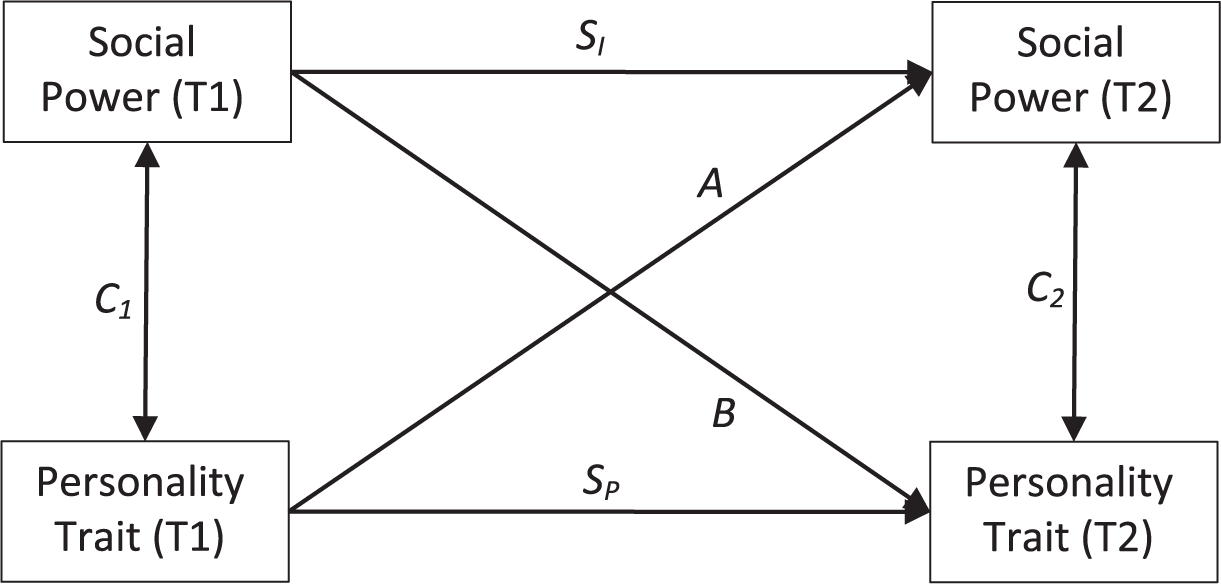
Basic model linking personality characteristics and social influence.
We particularly examined how agentic and communal characteristics were associated with the acquisition of social power. Agency and communion are useful trait properties within the current context due to corresponding roughly to the distinction of traits which promote one’s own valued outcomes and traits which promote others’ valued outcomes (Abele & Wojciszke, 2007), which we expect to be a critical determinant of relationships existing between personality and social power (Figure 1). Specifically, having communal characteristics may be predictive of subsequent increases in social power, whereas social power may be more predictive with subsequent increases in an individual’s agentic characteristics. We will focus our results on an individual’s overall level of agency and communion. However, given that results at the level of fairly broad trait dimensions can miss meaningful associations that may exist with narrower dimensions (McCrae, 2015; Mõttus, in press; Wood, Gardner, & Harms, 2015), we also conduct more exploratory analyses linking social power to item-level ratings of personality traits. Given that a broad range of traits can be regarded as serving the interests of others (e.g., tendencies to be responsible, emotionally stable, helpful), the item-level results can help to illuminate what more specific trait content might be driving broader trends, or conversely whether there are traits that show associations missed by these broader trends.
Finally, we also examined how personality and social power were related using three different types of personality ratings. Specifically, we examined generalized or decontextualized self-ratings (“How I see myself in general”), role identity or organization-contextualized self-ratings (“How I see myself in this organization”), and peer-reports of personality from other organization members. Role-identities may be expected to be somewhat more sensitive to organization-specific experiences, such as the acquisition of power within the organization, due to the fact that organization-related thoughts, feelings, and behaviors comprise a much greater percentage of the information individuals use to form these identities (Bing, Whanger, Davison, & VanHook, 2004; Dunlop, 2015; Wood & Roberts, 2006). Peer reports may be associated with social power for different reasons than self-ratings: Given that social power is to a considerable extent socially afforded, the shared perception of an individual’s personality—that is, their reputation—is very likely a major determinant of why power is afforded to the individual in the first place (Hogan, 1982; Van Vugt et al., 2008; Wood, 2015). More generally, the three sets of trait ratings allow us to examine whether the types of traits that are associated with social power are consistent across meaningfully different ways of assessing personality.
Method
Participants and Procedure
A total of 364 participants from four fraternities and three sororities at the University of Illinois (Mage = 19.6; 201 female) completed the initial materials used in the present study as part of a broader longitudinal study. Approximately 1 year later, 297 (82%) were still members of these organizations. A total of 181 of these 297 participants (61%; 108 female) completed the follow-up survey. See Harms et al. (2007) and Wood, Harms, and Vazire (2010) for further details.
Materials
Adjective person-descriptors
In both time periods, participants completed a 53-item subset of Goldberg’s (1992) adjective markers of the Big Five dimensions (see Walton & Roberts, 2004), and six additional adjective markers of dominance; all were rated on a 1 (strongly disagree) to 5 (strongly agree) scale. Participants first rated the items for the extent to which it described them generally, then for how much it described them “as a member of this organization,” which we will refer to as their role identity (Wood & Roberts, 2006). Finally, participants were asked to rate three other members of their organization, which were randomly specified, by having participants rate targets whose names had been drawn from shuffled piles, separated by grade level, with the constraint that they were more likely to rate members of their own year (e.g., sophomores were more likely to rate sophomores). Ratings others made of the participant were aggregated to estimate peer-reported personality characteristics. The average participant was described by 2.3 peers at Time 1, and 2.4 at Time 2. The means, standard deviations, and estimated 1-year stabilities of the general, role identity, and peer ratings for each adjective are provided in Supplementary Table S1.
Social power
Participants rated the extent to which they perceived each member of the organization as having influence. Influence ratings were completed by asking participants to “rate the extent to which you believe each member has influence among others in the organization” using a scale ranging from 1 = weak to 4 = moderate to 7 = strong. Participants were told not to rate any individuals they did not know. In the first year, participants in the four organizations with the largest number of members rated only half of the organization members. In the second year, all participants rated all members of their organization.
All influence ratings made of a particular target were aggregated to estimate the target’s social power; any self-ratings were excluded. In the first year, participants were rated by between seven and 74 other members of their organization, M (SD) = 33.9 (15.9), Mdn = 33. In the second year, participants were rated by between 13 and 64 members, M (SD) = 42.7 (13.2), Mdn = 42. The intraclass correlation which provides the average agreement in the influence ratings made of participants by two different raters was .341 at Time 1 and .313 at Time 2. Using the Spearman–Brown prophecy formula, this indicates that the level of reliability of social power estimates was approximately .78 for the participant with the lowest number of seven influence ratings, and were considerably higher for participants rated by the median number of members (α = .95 at both Times 1 and 2); a total of 86% of Time 1 participants and 92% of Time 2 participants were expected to have social power estimates expected to have reliabilities exceeding .90.
The test–retest stability in the ordering of social power estimates from Time 1 to Time 2 (Path SI in Figure 2) was estimated as r = .58. Given the very high reliability of the social power estimates, this correlation is not appreciably depressed by measurement error, consequently indicating there is both considerable consistency and also non-trivial changes in the rank-ordering of which organization members were consensually rated as having the most and least social influence in their organizations.
Agency and communion ratings
To estimate the extent to which each item was agentic or communal, we used ratings of these characteristics for these items collected and described in Wortman and Wood (2011); we provide an abbreviated description of the instructions used to measure these variables below.
Communion and agentic ratings of the dimensions were collected using an instruction largely paralleling instructions provided by Abele and Wojciszke (2007). Raters were instructed that communal traits were those indicating “an orientation to people, focus on interpersonal contacts and relationships, striving for being included in a community, and for remaining a member of this community,” whereas agentic traits were “those that arise from strivings to individuate and expand the self, to attain one’s goals, and to grow personally.”
Ratings were collected from nine research assistants on a 1 (very [non-agentic/non-communal]) to 4 (neutral) to 7 (very [agentic/communal]) scale. The reliability of the ordering of these 59 items, as estimated by coefficient alpha, was α = .93 for both communal and agentic dimensions, which can be interpreted as the expected correlation between these averages with averages collected from a new set of nine research assistants.
Mean communion and agency ratings are given in Supplementary Table S1. The three most communal items were cooperative, trustful, and kind, and the three least were jealous, moody, and distrustful. The three most agentic items were energetic, creative, and assertive, and the three least were disorganized, unintelligent, and inefficient. These ratings clarify that multiple distinct types of trait content were perceived as communal, or agentic. Furthermore, across the 59 items included in the analysis, the agency and communion profiles were highly correlated with one another (q = .66); this demonstrates that many of the same traits were perceived by raters as promoting or inhibiting both agentic and communal ends.
Individual-level estimates of profile agency and communion
We computed profile (within-person) correlations estimating the association between ratings of the participant’s personality with the rated communion and agency of the items. As individuals could have general, role-contextualized, and peer ratings both at Time 1 and Time 2, this resulted in six profile correlations of each trait property for participants who completed both waves of the study (i.e., 3 rating type × 2 time points). Means and standard deviations of the items for the three types of ratings are shown in Supplementary Table S1. Note that due to the considerable associations between the agency and communion ratings at the between-item level of analysis, the profile agency and communion estimates were in turn very highly correlated at the between-person level of analysis. The association between profile agency and communion was .78, .83, and .80 for general, role identity, and peer ratings at Time 1, and .83, .86, and .76 at Time 2.
Attrition analyses
Given the sizable rate of attrition, we explored the characteristics assessed on participants at Time 1 that differentiated those who were members at Time 2 from those who were not, and which differentiated those who chose to participate at Time 2 from those that did not.
Sensibly, the most important characteristic predicting Time 2 participation was whether the individual was still a member of the organization at Time 2 (r = .46). This, in turn, was strongly predicted by whether the individual was a senior at Time 1 (r = −.44): 32 of the 57 (56%) Time 1 participants who were no longer members at Time 2 described themselves as seniors at Time 1, indicating that the majority of organizational turnover was due to graduating from the university. However, after excluding participants who described themselves as seniors at Time 1, organization membership at Time 2 remained a strong predictor of participation at Time 2 (r = .41). The overall estimated communality of the individual’s role identity at Time 1 showed a small but significant association with organization membership at Time 2 (r = .13, p = .04), indicating that individuals who acted in an uncommunal fashion within their organization at Time 1 were somewhat more likely to leave their organizations. When additionally removing individuals who were not in the organization at Time 2, Time 2 participation was predicted by overall estimated communality of the individual’s peer ratings at Time 1 (r = .16).
Analyses
The critical relationships tested are the A, B, and C1 and C2 paths depicted in Figure 2, and the results of these analyses are given in Table 1. For all tests of the model displayed in Figure 2, the participant’s length of time in the organization was controlled, and their organization was controlled using dummy-coded variables. As all of the organizations examined in this study were single-sex, controlling for organization simultaneously controls for gender. Given the control variables, the partial correlations we report can be considered to estimate the average association between social power and personality within a given organization and among individuals who have been members for the same amount of time. When prospective relationships between personality characteristics and power (Paths A and B in Figure 2) are explored, these are tested by correlating the Time 1 personality characteristic with Time 2 social power while controlling for Time 1 social power, or correlating Time 1 social power with Time 2 personality characteristic controlling for Time 1 personality, in addition to the other control variables described above.
Associations Linking Estimates of Overall Profile Agency and Communion to Social Power.
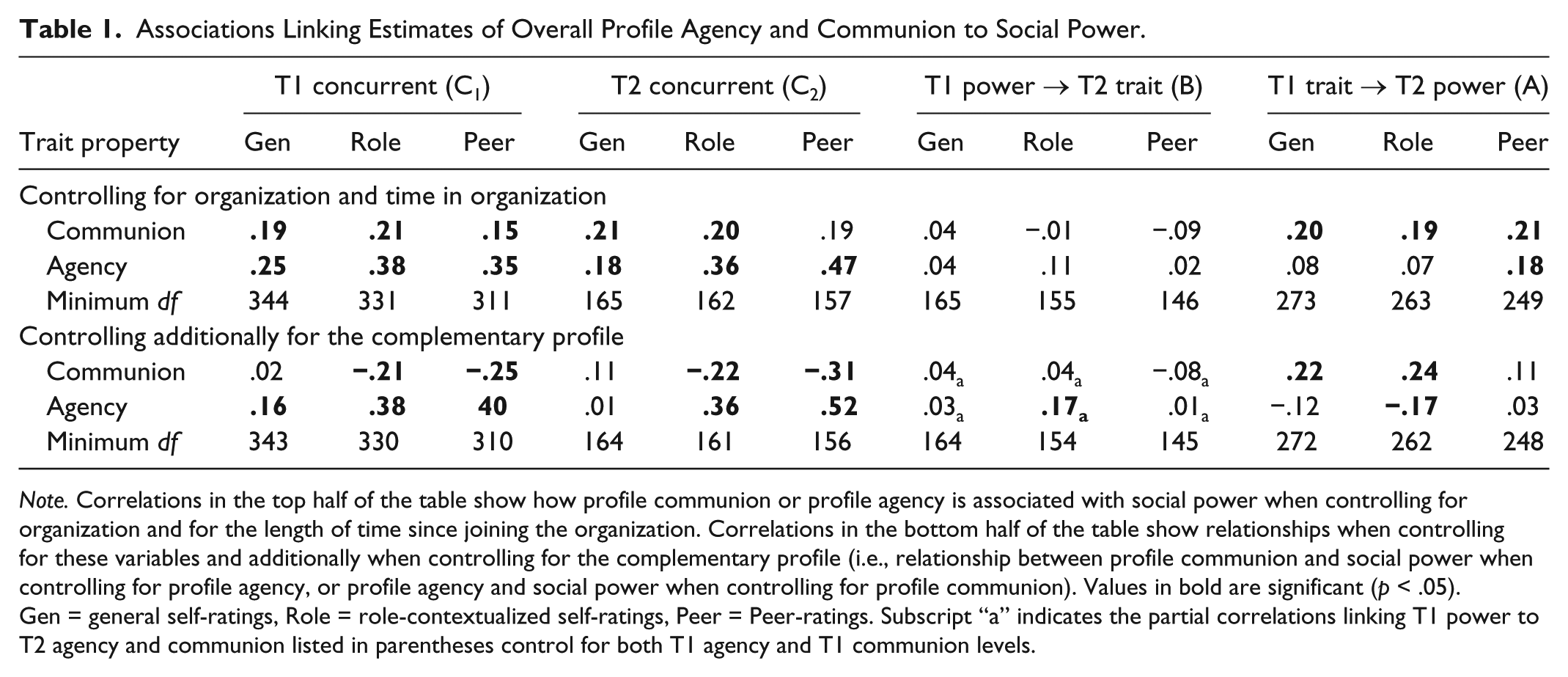
Note. Correlations in the top half of the table show how profile communion or profile agency is associated with social power when controlling for organization and for the length of time since joining the organization. Correlations in the bottom half of the table show relationships when controlling for these variables and additionally when controlling for the complementary profile (i.e., relationship between profile communion and social power when controlling for profile agency, or profile agency and social power when controlling for profile communion). Values in bold are significant (p < .05). Gen = general self-ratings, Role = role-contextualized self-ratings, Peer = Peer-ratings. Subscript “a” indicates the partial correlations linking T1 power to T2 agency and communion listed in parentheses control for both T1 agency and T1 communion levels.
We focus especially on the associations between personality and social power primarily at the level of profile agency and communion, as these are roughly representative of traits which indicate a tendency to promote one’s own valued outcomes versus the outcomes valued by others, respectively. Profile correlations linking an individual’s ratings on a set of traits to ratings of a given trait property (e.g., desirability, observability, mean endorsement, communion, agency) are useful ways to summarize whether that property plays an important role in trait-related phenomena (e.g., Bem & Funder, 1978; Bem & Lord, 1979; Luo & Snider, 2009; Wood & Furr, 2015). Given that estimates of an individual’s profile agency and profile communion were highly correlated, we also report analyses in which the relationships between a given profile and social power are examined additionally controlling for the other to better separate the communion-relevant and agency-relevant relationships of a given trait with social power. The top half of Table 1 reports partial correlations linking profile communion or agency to social power controlling only for organization and length of time in the organization. In the bottom half of Table 1, profile communion or agency are linked to power when controlling for the other profile (i.e., profile communion and social power are examined when controlling for profile agency, and vice versa). 1
Given that results at the level of fairly broad trait dimensions can miss meaningful associations that may exist with narrower dimensions (e.g., McCrae, 2015; Mõttus, in press), we also conduct more exploratory analyses linking social power to item-level ratings of personality traits. A complete list of associations between personality characteristics and social power at the item level are given in Supplementary Table S2.
Results
Relations Between Person Descriptors and Social Power
The relationships between social power and personality descriptions are given in Table 1, which is organized to show how the overall communal and agentic profiles from an individual’s general self-ratings, and role-contextualized self-ratings, and peer ratings are associated with consensually rated power concurrently and prospectively.
Cross-sectional associations between social power and traits
As shown in Table 1, in both the Time 1 and Time 2 assessments, the overall agency and communion of an individual’s personality profile showed significant positive cross-sectional associations with social power. As shown in the bottom half of Table 1, results indicated that the significant associations were carried by profile agency, which continued to show significant positive cross-sectional associations linking role-identity ratings and peer ratings to social power at both time points when controlling for profile communion. In contrast, profile communion did not show a significant positive association with power in any type of ratings after controlling for profile agency. The results indicate that individuals who tended to describe themselves or be described by others as possessing agentic characteristics are more likely to have high levels of social power.
The nature of these cross-sectional associations may be further clarified by inspecting the item-level results shown in Supplementary Table S2. By correlating the vectors in Supplementary Table S2 linking particular traits to social power (the C1 and C2 paths), it can be seen that the traits that were most and least associated with social power cross-sectionally were similar at both time points (qs = .69, .91, and .88 for general, role identity, and peer ratings), indicating that the cross-sectional associations of social power were highly stationary over time. At both Time 1 and Time 2, social power and personality traits showed the strongest contemporaneous associations with characteristics related to extraversion (extraverted, talkative, not shy, reserved) and to dominant or assertive tendencies (dominant, assertive, influential, strong-willed) across all three instruction sets.
How initial social power forecast changes in traits
As shown in Table 1, social power was not significantly associated with changes in the individual’s overall level of profile agency and communion, as explored by correlating Time 1 social power with Time 2 profile agency or communion while controlling for agency or communion at Time 1. There were indications that if both Time 1 profile agency and communion were controlled, that social power could forecast increases in how agentic individuals saw themselves within their organization from Time 1 to Time 2 (partial r = .17, p < .05), but these results were not paralleled in general self-ratings or peer reports.
There were more indications of prospective effects at the item level, as shown in Supplementary Table S2. The item-level results suggest that individuals with greater social power increased in their tendencies to be described as persuasive, powerful, intellectual, influential, assertive, dominant, talkative, and decreased in the extent to which they saw themselves as shy, untalkative, reserved, both by others and in their own contextualized self-perceptions.
We expect the greater number of prospective associations linking social power to changes in trait ratings at the item level (Supplementary Table S2) than the profile level (Table 1) are likely due in part to the lower reliability of single items. For instance, the estimated stabilities of the profile agency and profile communion estimates over a year (the SP paths from Figure 2, as shown in Supplementary Table S1) were .60 and .60, .58 and .66, and .34 and 36, for general, role identity, and peer ratings, respectively. In contrast, the estimated average stability for single items over a year was .40, .38, and .19 for self, role identity, and peer ratings. Low reliability in the measurement of Time 1 trait ratings results in estimates of the indirect path linking Time 1 social power to Time 2 personality through Time 1 trait levels—that is, the C1 × SP path, using notation from Figure 2—being artificially low. The failure to remove sufficient variance accountable to this indirect C1 × SP path will in turn make estimates of the magnitude of the residual B path artificially strong (Hoyle & Kenny, 1999; MacKinnon, Coxe, & Baraldi, 2012).
How initial trait levels forecast changes in social power
As shown in Table 1, there were clear indications that the extent to which an individual had communal attributes at Time 1 was able to forecast whether they increased in social power from Time 1 to Time 2. Across all three sets of ratings (general, role identity, and peer), individuals with more communal personality attributes were significantly more likely to increase in power over time (rs ≥ .19, ps < .05). Furthermore, associations for general and role-identity ratings remained significant after controlling for profile agency. However, only peer-reported profile agency at Time 1 was significantly associated with changes in power from Time 1 to Time 2 (r = .18, p < .05), and this association became insignificant after controlling for profile communion (r = .03). The item-level results shown in Supplementary Table S2 indicate more specifically that individuals who described themselves or were described by others as sympathetic, and not moody, temperamental, and cold, and irritable tended to increase in social power from Time 1 to Time 2.
Discussion
The results generally indicate that agentic characteristics are consistently better predictors of social power cross-sectionally (Paths C1 and C2 in Figure 2), and perhaps also are more affected by one’s level of social power (Path B), whereas communal characteristics are better predictors of whether the individual will increase in social power over time. This study can be viewed as a follow-up to Harms et al. (2007), which was an examination of how personality characteristics and power were associated in this sample cross-sectionally during the first wave of data collection. In that study, social power was found to be positively associated with extraversion, dominance, and conscientiousness. By examining the associations between social power and personality traits longitudinally, we are now able to say more about the causal relationships existing between personality and power in this sample. Although the contemporaneous associations of the earlier investigation were interpreted tentatively as indicating how personality drives the attainment of social power, many of those associations did not seem to be paralleled by prospective associations of traits on changes in power in this investigation. For instance, conscientiousness-related self-perceptions (e.g., organized, thorough) showed fairly regular concurrent relationships with social power, but there was little indication that these predicted increases in power over time. Interestingly, this study found communal tendencies (e.g., being sympathetic, warm, and not temperamental) to predict increases in social power over time despite showing negligible concurrent relationships.
The findings of the current study thus remind us that the causal implications of cross-sectional correlations between personality traits and environmental variables need to be taken with several grains of salt. They also underscore earlier suggestions that social power may represent a feature of the environment which has particularly non-corresponsive relationships with psychological tendencies (Keltner et al., 2010; Keltner, Van Kleef, Chen, & Kraus, 2008).
There are several unique aspects of the way in which analyses were conducted in the present study which warrant mention. The first concerns the nature of the social power estimates. For the vast majority of participants, social power estimates were based on the aggregation of a large number of peer ratings, resulting in power estimates that were extremely reliable. Consequently, the fact that the retest stability of these estimates over a year was approximately .60 in magnitude cannot be attributed to low measurement reliability. Rather, this level of stability indicates that although the power structure shows an impressive level of stability, it also shows a considerable level of fluidity over time. The fact that social power estimates were based on the aggregation of peer reports also removes the possibility that effects between social power and self-reported personality were based on method artifacts. Second, personality was measured by self-reports, contextualized self-reports, and peer reports, and these different types of ratings were examined separately. The use of contextualized self-reports in particular is uncommon and revealed interesting information. For instance, Table 1 and Supplementary Table S2 indicate that an individual’s current level of social power may forecast increases in role-contextualized agency more than context-general agency. This is consistent with predictions from the Personality and Role Identity Structural Model (PRISM; Wood, 2007; Wood & Roberts, 2006) which suggests that role experiences should most strongly influence the development of an individual’s role-contextualized behavioral and psychological tendencies, and may translate both more slowly and more weakly to changes in the individual’s general identity. Although theoretically sensible, this finding is quite tenuous in the current data (only emerging after additionally controlling for profile communion) and warrants being examined further in future investigations.
An additional phenomenon to explore in future research concerned the large number of traits which were consistently associated with social power cross-sectionally but which showed no prospective associations with power in either direction over time, which can be seen in Table S2. The time scale of the two waves—a 1-year longitudinal study—may also have influenced this result in important ways. First, it may be the case that the estimated effects of social power on general identity could get stronger over longer assessment periods, which may be the case if power has small effects on personality traits which accumulate over time, or if it takes more time for these contextual changes to filter upward into the individual’s more general self-perception (Wood, 2007; Wood & Roberts, 2006). Alternatively, many traits which did not show prospective associations with social power over a year may have shown prospective associations over shorter test–retest periods (e.g., 6 months, 1 month, 1 week).
We conclude by considering two issues. First, we consider the extent to which the current results might be expected to generalize to personality and power relationships in other contexts. Second, we consider how the current findings may help to illuminate the conditions necessary to produce corresponsive relationships between personality and environmental features.
Considering the Generality of the Estimated Relationships Between Personality and Power
There are many different types of power individuals can have. These range from being elected to public office, to being a manager in a company, being rich, popular, or even possessing arms (“firepower”). We expect communal characteristics may regularly be important to the long-term acquisition of power within circles of friends, in democratically elected governments, and in relatively egalitarian groups more generally (Boehm, 2009; Van Vugt et al., 2008). As one’s peers have a central role in affording power to individuals in these contexts, perceptions that one prioritizes the goals of others may be particularly important. However, dominance-related characteristics have been implicated in power acquisition elsewhere, and are likely to often serve as a viable route to power (e.g., Cheng et al., 2013; Henrich & Gil-White, 2001). We consider contextual factors that may cause associations between personality and power to vary.
First, we suspect the present findings may show limited generality to power dynamics in the workplace. As noted earlier, the first study to propose the corresponsive principle suggested the existence of quite corresponsive relationships between personality traits and resource power in employment contexts (Roberts et al., 2003). There may be stronger mechanisms to ensure that individuals continue to act in line with the expectations of the job they were hired for. For instance, people may tend to be hired for sales positions for being industrious and extraverted, and these jobs may continue to have heightened press for these characteristics in the form of bonuses and raises relative to other jobs. Furthermore, most organizations are characterized by a vertical structure where feedback, rewards, and punishments typically come from higher levels of the hierarchy. Upper level managers appear to underutilize information concerning antisocial tendencies when selecting lower level managers because they themselves will not bear the consequences of such behaviors (Hogan & Kaiser, 2005). Consequently, individuals with agentic traits may tend to rise in organizational hierarchies despite not being more likely to possess traits that will benefit others around them (Grijalva, Harms, Newman, Gaddis, & Fraley, 2015; Hogan, 2007).
Prior research also suggests that agentic traits such as assertiveness and dominance may have larger roles in determining who initially acquires power within the context of newly formed groups, where the power hierarchy is essentially unestablished and group cohesion and performance is not a central focus (Tuckman, 1965). Some lab studies have indicated that agentic behaviors are associated with the acquisition of status in groups of unacquainted individuals (Paulhus, 1998; Stogdill, 1948), in part through behaviors such as agenda setting and talking more frequently (Grijalva et al., 2015; Harms, 2008; Mast & Hall, 2003). Such behaviors can facilitate the early acquisition of power through somewhat erroneously signaling one’s ability to contribute to the group, or by simply occupying the leadership space first (Anderson & Kilduff, 2009). The positive concurrent associations between social power and agentic personality traits observed in this study (Tables 1 and S2) may reflect the residue by such dynamics. In contrast, this study examined groups of individuals who had already known each other for some time, and explored how their traits forecasted changes in social power over the subsequent year.
After the dust has settled and the initial power hierarchy has been established, the personality predictors of further changes to the power hierarchy could shift (see Tuckman, 1965). Group perceptions of members’ likelihood of promoting group goals may both play a larger role in subsequent changes in power and become more accurate, which would serve to decrease the impact of agentic characteristics on the subsequent acquisition of social power. If correct, this would suggest that measuring personality levels prior to group entrance (e.g., before the start of college) may result in documenting more corresponsive relationships between personality traits and social power than found here, oriented around agentic characteristics. Incidentally, this also corresponds more closely to the design of the Roberts et al. (2003) study and other investigations (Le, Donnellan, & Conger, 2014) which have found more corresponsive personality-environment associations.
There are also indications that the personality predictors of power attainment may differ considerably as a function of the goals that are important to group members. DesJardins, Srivastava, Küfner, and Back (2015) recently found that status attainment was less associated with agreeableness in groups given competitive goals (e.g., to beat other groups). This is not necessarily incompatible with our broader theoretical model, which suggests that power is largely socially afforded—that is, attained by fitting the desires and goals of group members (Figure 1). It may be that when members of the group perceive their major goal as succeeding against others groups (e.g., rival sports teams or nations, business competitors), communal characteristics may be seen as less valuable means to members’ valued outcomes.
When Should We Expect Traits and Environments to Show Corresponsive Relationships More Generally?
We believe that the corresponsive principle discussed by Roberts et al. (2003, Roberts et al., 2008) is likely a good general expectation of how we should expect personality traits and environmental features to influence each other over time. However, many personality-environment associations are clearly non-corresponsive. For instance, Schaller and Murray (2008) found that environments with greater prevalence of communicable diseases had decreased levels of extraversion and openness to experience, despite the fact that extraverted and open behaviors increase the likelihood of contracting such diseases. Similarly, neurotic tendencies positively predict entrance into psychotherapy (Fikretoglu, Guay, Pedlar, & Brunet, 2008; Tyrer, Mitchard, Methuen, & Ranger, 2003), but participation in psychotherapy is expected to result in more rapid decreases in these tendencies (Roberts, Chow, Su, & Hill, 2016; Smith, Glass, & Miller, 1980; but see Lüdtke et al., 2011). More generally, self-regulatory approaches to behavior regularly predict negative feedback loops such as these between personality traits and environments (Carver & Scheier, 1998), and any negative feedback loop is not just non-corresponsive (as was the case with personality and social power here) but directly anti-corresponsive.
The conceptual model that has been described here, summarized in Figure 1, for understanding the causal associations between personality and social power may be generalized slightly to help understand such exceptions. As argued by Roberts et al. (2008), the corresponsive principle is assumed to generally apply to personality-environment associations because “if there is a press to change [one’s personality in an environment], the press will be in the direction of the personality qualities that drew the person to that environment in the first place” (p. 390). However, this assumption concerning the direction of environmental presses on personality traits seems tenuous. Instead, corresponsiveness should occur if this condition is true. Everything depends on the direction of “environmental press” on personality.
There may be a whiff of circularity in saying that effects of personality traits and environments will be corresponsive if the environmental press on personality traits is the same sign as the effects of personality traits on the environment. It is not circular, but requires understanding that the ultimate effect of an environment is distinct from the environment’s “press,” and that both can be estimated independently. The environmental press which drives trait development can be understood as the nature of the environment’s rewards or punishments for trait-related behaviors, or the individual’s more internalized desire to perform such behaviors (Roberts, Wood, & Smith, 2005).
The environment’s press, represented as the mediator of Path B in Figure 1, is not generally estimated formally, and indeed was not explicitly examined here; however, it can be estimated in a relatively straightforward manner through a number of avenues. We can correlate environmental variables such as the actor’s level of social power with self-report measures of the extent to which actor feels it is useful, important, desirable, or acceptable to enact certain trait-related behaviors (e.g., Ajzen, 1991; Wortman & Wood, 2016). Alternatively, we can estimate whether trait levels show greater associations with well-being, peer acceptance, goal attainment, or other desirable outcomes as levels of the environmental feature increase or decrease (Bleidorn et al., 2016; Wood, Gosling, & Potter, 2007). Doing this will allow the common theoretical expectation that environmental effects on personality traits are mediated by modifying their expected functionality to be more explicitly tested.
Returning to the present context, we imagine members of social groups might desire the relationships between personality and social power to be more corresponsive than they are—or more specifically, for social power to further fuel the development of the communal, other-serving characteristics that facilitate the initial acquisition of social power. However, the formal control mechanisms that tend to exist in job contexts may not exist in the same way for more informal social power. As a consequence, increasing in social power may unfortunately not tend to increase the overall value of acting in a communal fashion from the actor’s perspective. Instead, power is often precisely about having the ability to do and say what one wants in ways that lead to fewer sanctions or other punishments (McClelland, 1975; Padilla, Hogan, & Kaiser, 2007). As it may be easier to punish low status members for violations of group norms, the expected value to the actor of performing communal actions may regularly be decreased by the acquisition of power in many circumstances (de Mesquita & Smith, 2011).
Conclusion
The current study examined how personality traits could forecast changes in social power and how social power could forecast changes in personality traits over the course of a year in social fraternities and sororities, and found the traits affecting and affecting social power to be non-corresponsive in ways consistent with recent theory (Keltner et al., 2010; Keltner et al., 2008). Specifically, communal, other-serving characteristics predicted increases in power over time, but did not seem to increase in response to having power. This matches the understanding of social power as being differentially afforded to individuals that seem likely to promote group goals (Boehm, 2009; Van Vugt, 2006). In contrast, agentic characteristics (e.g., tendencies to be persuasive, influential, assertive, dominant, and talkative) showed consistent cross-sectional associations with social power, and showed some indications of changing in response to having social power, but by and large did not seem to increase the likelihood of gaining power. This matches more generally the understanding of social power as acting as a disinhibitor that promotes the pursuit of one’s goals (Guinote, 2010; Guinote et al., 2012; Keltner et al., 2003).
We have also discussed how these findings may help to understand relations between personality traits and environments more generally. We may continue to understand personality traits and environmental characteristics as generally having corresponsive causal relationships with one another over time (Roberts et al., 2008). Social power may represent an exception to this rule; however, given the importance of relative power in human transactions (Bugental, 2000; Hogan, 1982; Kenrick, Griskevicius, Neuberg, & Schaller, 2010), it also represents a particularly important one.
Supplemental Material
Supplementary_Documents_-_Power___Personality_Wood___Harms_(15-Feb-16) – Supplemental material for Evidence of Non-Corresponsive Causal Relationships Between Personality Traits and Social Power Over Time
Supplemental material, Supplementary_Documents_-_Power___Personality_Wood___Harms_(15-Feb-16) for Evidence of Non-Corresponsive Causal Relationships Between Personality Traits and Social Power Over Time by Dustin Wood and P. D. Harms in Personality and Social Psychology Bulletin
Supplemental Material
wood_online_appendix – Supplemental material for Evidence of Non-Corresponsive Causal Relationships Between Personality Traits and Social Power Over Time
Supplemental material, wood_online_appendix for Evidence of Non-Corresponsive Causal Relationships Between Personality Traits and Social Power Over Time by Dustin Wood and P. D. Harms in Personality and Social Psychology Bulletin
Footnotes
Declaration of Conflicting Interests
The author(s) declared no potential conflicts of interest with respect to the research, authorship, and/or publication of this article.
Funding
The author(s) received no financial support for the research, authorship, and/or publication of this article.

Notes
References
Supplementary Material
Please find the following supplemental material available below.
For Open Access articles published under a Creative Commons License, all supplemental material carries the same license as the article it is associated with.
For non-Open Access articles published, all supplemental material carries a non-exclusive license, and permission requests for re-use of supplemental material or any part of supplemental material shall be sent directly to the copyright owner as specified in the copyright notice associated with the article.
