







Abstract
Despite evidence that large professional networks afford a host of financial and professional benefits, people vary in how motivated they are to build such networks. To help explain this variance, the present article moves beyond a rational self-interest account to examine the possibility that identity shapes individuals’ intentions to network. Study 1 established a positive association between viewing professional networking as identity-congruent and the tendency to prioritize strengthening and expanding one’s professional network. Study 2 revealed that manipulating the salience of the self affects networking intentions, but only among those high in networking identity-congruence. Study 3 further established causality by experimentally manipulating identity-congruence to increase networking intentions. Study 4 examined whether identity or self-interest is a better predictor of networking intentions, providing support for the former. These findings indicate that identity influences the networks people develop. Implications for research on the self, identity-based motivation, and professional networking are discussed.
Social network scholars have generated compelling evidence of the benefits of large professional networks, lending credence to the popular phrase, “It’s not what you know, it’s who you know.” Professional networking refers to the process by which individuals attempt “to develop and maintain relationships that have the potential to assist them in their work or career” (Forret & Dougherty, 2004, p. 420). In fact, the benefits of a strong network are so clear that professional networking is often considered a central activity for those who wish to achieve superior professional outcomes (Arthur, Claman, & DeFillippi, 1995; Arthur, Inkson, & Pringle, 1999; Uzzi & Dunlap, 2005). Large networks can play a critical role in professional advancement because they provide access to key contacts and support, novel and valuable information (Burt, 1997; de Janasz, Sullivan, & Whiting, 2003; Whiting & de Janasz, 2004), as well as new professional opportunities (Granovetter, 1995, 2005; Lin & Dumin, 1986).
Given the many benefits of having a large professional network, many theorists assume that people are generally motivated to expand their networks to improve their overall professional success (e.g., Arthur et al., 1999). If this assumption were true, the best way to motivate people to engage in professional networking would be to highlight the benefits associated with having a strong professional network and then outline approaches for expanding and strengthening one’s network. This approach, incidentally, is the dominant approach used in many training and educational programs (e.g., Uzzi & Dunlap, 2005). However, given that individuals often shy away from building larger networks, even when they are well aware of the benefits of doing so (Misner, 2011), it may not be the most effective method of motivating the majority of people to network. This aversion to networking highlights the need to better understand when and why people choose to actively pursue or avoid professional networking.
One possibility is that people who build expansive professional networks are motivated to do so not only to achieve professional success but also because they find the actual process of connecting with others personally validating or enjoyable. Indeed, “superconnectors”—highly connected individuals—often report experiencing a high degree of satisfaction from relating with and helping others, over and above the power or material wealth they achieve from doing so (Snow, 2013). In contrast, some individuals seem to avoid professional networking because it makes them feel uncomfortable (Misner, 2011). Consistent with these ideas, recent research has examined peoples’ reactions to different types of networking, showing that people feel morally dirty when engaging in instrumental—as opposed to spontaneous—networking (Casciaro, Gino, & Kouchaki, 2014).
To examine what factors motivate individuals to network, we turn to research on self, identity, and motivation. We suggest that active networkers engage in networking because doing so feels identity-congruent to them in the moment—that is, professional networking is viewed as consistent with who they are as individuals. In contrast, those who generally avoid professional networking might do so because networking feels incongruent and inconsistent with who they are as individuals. We draw support for this claim from the Identity-Based Motivation (IBM) model (Oyserman, 2007, 2009a, 2009b) to suggest that the extent to which an individual views professional networking as either identity-congruent or identity-incongruent will be an important determinant of an individual’s motivation to expand his or her network. Importantly, we argue that identity will influence behavior above-and-beyond self-interest (i.e., the desire to obtain the material and professional benefits one can accrue through professional networking).
These findings, if supported, would offer a number of theoretical contributions to the existing literature. First, they would provide new insight into the factors that lead people to network, moving beyond existing models which rely on the notion that people are motivated to network to pursue material self-interest. In addition, they would contribute to IBM theory, not only by extending it to the domain of professional networking but also by demonstrating that identity-congruence can be manipulated to motivate individuals to network. The latter highlights the dynamic and fluid nature of identity, paving the way for new research on IBM more broadly. Finally, the relationship between identity and networking intentions not only contributes to our psychological understanding of identity and its effect on networking behaviors but also suggests that prevailing assumptions about how to best motivate people to network may be a particularly ineffective strategy for those who actively avoid networking. Instead of encouraging individuals to consider all the material benefits of professional networking (i.e., “How can having a large professional network benefit me?”), perhaps educators and leaders should instead encourage individuals to focus on the ways in which professional networking is congruent with their identities (i.e., “How is the act of networking an expression of who I am?”).
The Self and Networking
We propose that identity is an important, yet largely overlooked determinant of professional networking and that it may represent a central route to motivate individuals to engage in (or avoid) professional networking activities. Insights from the IBM model and literature suggest that a person’s held identities can influence how they interpret the situation they are in and consequently, what they are motivated to do (e.g., Oyserman, 2007). We use the term identity to refer to the traits and characteristics, social relationships, roles, and group memberships that define who a person is or might become—the combination of which defines their sense of self (Oyserman, Elmore, & Smith, 2012). Identities are important because they provide individuals with a lens through which they can understand themselves. Consequently, one’s identity plays a critical role in guiding intentions and behavior (e.g., E. T. Higgins, 1987, 1989).
According to the IBM model, the extent to which a behavior is interpreted as identity-congruent can influence the likelihood of engaging in that behavior (Oyserman, 2007). In general, identity-congruent behaviors are preferred over those that are identity-incongruent. When a behavior is perceived as identity-congruent, it feels natural and may be interpreted as more important and worthwhile (Oyserman & Destin, 2010). In contrast, when a behavior is viewed as identity-incongruent, it may be interpreted as “not for people like me” (Oyserman et al., 2012, p. 88) and therefore, not worth pursuing.
While identities are largely perceived and experienced as stable (Quoidbach, Gilbert, & Wilson, 2013), they are actually highly malleable and sensitive to the context which triggers the identity (Oyserman & Destin, 2010). That is, identity is dynamically constructed (e.g., Oyserman, 2009a), which means that the extent to which identities come to mind and what they are interpreted to mean is dependent on the context. For example, the perceived relationship between gender and success is a function of the information that comes to mind and what it is interpreted to mean. Being male can be associated with achievement (e.g., men earn more than women) or failure (e.g., women are more likely to graduate high school than are men). Guiding students to think of their gender in terms of success (or failure) can lead them to think of themselves in that way, which can result in better (or worse) academic performance (Elmore & Oyserman, 2012). The dynamic nature of identity is important for our purposes as it suggests that the extent to which networking is perceived to be identity-congruent is sensitive to the context and can therefore be changed, consequently affecting intentions and behaviors. If reinforced, this behavior may become an important part of one’s self-concept and identity over time (Cross & Markus, 1990; Gore & Cross, 2014), thus increasing the extent to which networking comes to mind and feels congruent. This may ultimately increase individual motivation to engage in networking.
In line with the IBM model, we propose that the likelihood that individuals will engage in professional networking behaviors depends on the degree to which they perceive such actions as identity-congruent. Professional networking consists of a variety of behaviors including: maintaining contacts, socializing, engaging in work-related activities, participating in one’s professional community, and increasing one’s visibility within a professional environment. These behaviors allow individuals the opportunity to create, build, and maintain relationships with others who may have the potential to help them progress their professional careers (M. C. Higgins & Kram, 2001; M. C. Higgins & Thomas, 2001). We therefore posit the following:
It could be the case, however, that individuals who prioritize their professional networks do so for instrumental reasons (e.g., to achieve professional success) and only later come to view professional networking as consistent with their identities as a way to rationalize their past behavior. Thus, the presence of correlational support for Hypothesis 1 cannot differentiate between our theory and a rational self-interest account. One initial step to test whether identity is a driving mechanism behind networking intentions is to manipulate the salience of one’s self-concept. Doing so should moderate the effect of networking identity-congruence on networking intentions, which would be consistent with research suggesting that in contexts where an individual’s self is salient, one’s relevant identities become active and influential (e.g., Schwarz, 2002, 2007, 2012). Put differently, the more (or less) salient the self is in a given context, the more (or less) salient relevant identities will be. For example, if being a student is central to one’s identity, then making the self-salient is likely to emphasize values and motivate behaviors that are congruent with a “student” identity (i.e., doing well on an exam, studying for a class). Consistent with these ideas, we theorize that those who view professional networking as identity-congruent will be more motivated to engage in networking behaviors when the self is salient. However, if professional networking is not central to one’s identity, then a self-salience manipulation would be unlikely to have an impact on one’s motivation to network. Accordingly, we propose the following:
If we find support for our first two hypotheses, the next step would be to further establish causality. One way in which to do so would be to manipulate the extent to which networking feel identity-congruent or identity-incongruent. We suggest that identifying the ways in which an individual’s identity is consistent with professional networking (i.e., identity-congruent) can induce individuals to be more likely to engage in professional networking behaviors. Thus, we posit the following:
The theory of rational self-interest states that individuals think and act in a manner that leads to optimal or maximum personal benefits (Miller, 1999). Given the many benefits associated with professional networking (e.g., Burt, 2000, 2004; Granovetter, 1995; Lankau & Scandura, 2002; Whiting & de Janasz, 2004), one might presume that individuals would be motivated to build a large professional network solely to maximize their career and professional success when made aware of, or when focusing on, the instrumental benefits of networking. Indeed, this underlying assumption often guides attempts to encourage others to engage in professional networking activities (Uzzi & Dunlap, 2005).
In the present research, we test whether this underlying assumption holds true by simultaneously examining self-interest and identity as possible motivators of professional networking intentions. If self-interest is a stronger predictor of networking than identity, we would expect that focusing one’s attention on the personal benefits of networking will increase networking intentions above and beyond one’s identity. In other words, those who are aware of the fact that professional networking is personally beneficial should be motivated to network regardless of whether they find networking identity-congruent or identity-incongruent. We suggest, however, that identity is a stronger predictor than self-interest when it comes to motivating people to engage in networking. In particular, we theorize that individuals who view networking as identity-congruent should be open to the motivating nature of an appeal to self-interest that highlights the potential benefits of engaging in professional networking. In contrast, we argue that those who perceive professional networking as identity-incongruent will not be influenced by self-interested reasons to engage in professional networking. We theorize that the belief among those low on networking identity-congruence that professional networking is not an integral part of their identity will supersede concerns about the material benefits they could accrue from professional networking. We therefore propose the following:
Overview of the Present Research
We tested our predictions by conducting four studies. In Study 1, we tested Hypothesis 1 and explored the correlational relationship between one’s networking identity and prioritization of networking. In Study 2, we tested Hypothesis 2 and examined the idea that the networking intentions of individuals who perceive networking as identity-congruent will be more influenced than others by whether or not the self is salient. In Study 3, we tested Hypothesis 3. We also examined the mediating role of perceived identity-congruence, and tested one way to motivate individuals low on networking identity-congruence to network. In Study 4, we tested Hypothesis 4 and whether identity (i.e., the extent to which networking feels identity-congruent) is a better predictor of networking intentions than self-interest.
It is worth noting that the differences between online and offline networking. Online networking refers to the process of building one’s network through social network websites (e.g., LinkedIn) and other electronic resources, whereas offline networking is the process of expanding one’s network through traditional networking events and in-person interactions. Given that much of contemporary social networking takes place online (Subrahmanyam, Reich, Waechter, & Espinoza, 2008), it is important to point out that we allowed participants to construe networking as either an online or offline activity in our studies. In this work, we aim to understand the broader phenomenon of networking and, therefore, rather than examining how people feel about and respond to different types of networking (e.g., online vs. offline), sought to understand how one’s identity shapes professional networking intentions. We return to this theme in “General Discussion” section.
We set target sample sizes and exclusion criteria before data collection for each of our studies. We established sample sizes such that we had at least 70 participants per cell to ensure sufficient power based on effect sizes in past IBM work (e.g., Oyserman, Fryberg, & Yoder, 2007). 1 We report all measures, manipulations, and exclusions.
Study 1
In our first study, we tested Hypothesis 1 by examining business undergraduates’ networking identities and the degree to which they perceived networking to be a priority. We predicted a positive correlational relationship between the belief that networking is congruent with one’s identity and the extent to which professional networking is seen as a priority. Given that networking is clearly in the self-interest of students majoring in business, we believe this to be a conservative test of our prediction, as one might expect most students to report being highly motivated to network.
Method
Participants
Seven hundred fourteen undergraduates (48.3% female; Mage = 20.61, SD = 2.05) at a private university on the West Coast of the United States participated in the study as part of a larger questionnaire collected at the beginning of the semester consisting of unrelated surveys from over 10 different researchers. Participants received course credit for their participation.
Materials and procedure
Networking identity-congruence
We developed a four-item measure assessing the extent to which participants viewed professional networking as a part of their identity. 2 The items included the following: “Networking with others is an important part of my identity”; “To build my professional network, I would have to behave in inauthentic ways” (reverse-scored); “I feel like I am not my true self when engaging in professional networking” (reverse-scored); and “When I network, I feel like I am pretending to be someone I’m not” (reverse-scored). Responses to these items ranged from 1 (strongly disagree) to 7 (strongly agree). Responses were averaged to create a composite measure of networking identity-congruence (α = .77).
Networking prioritization
Participants then completed measures of the extent to which they viewed professional networking to be a priority using a 7-point Likert-type scale (1 = not at all a priority, 7 = very much a priority). They completed two items: “How much of a priority is it to strengthen your professional network?” and “How much of a priority is it to expand your professional network?” Responses to these two items were averaged to create a composite measure of networking prioritization, r(714) = .83, p < .001.
Extraversion
We also assessed extraversion to include it as a covariate, as previous research has shown that extraversion correlates positively with networking (e.g., Wanberg & Kammeyer-Mueller, 2000). Participants completed a measure of extraversion using an eight-item scale developed by John, Donahue, and Kentle (1991). Participants rated the extent to which they viewed themselves as someone who is extraverted using a 7-point Likert-type scale (1 = strongly disagree, 7 = strongly agree). These items were averaged to create a composite measure of extraversion (α = .86).
Results
We report the means, standard deviations, and correlations for Study 1 in Table 1. We tested the relationship between networking identity-congruence and the extent to which one’s professional network is a priority. We regressed the rated importance of prioritizing one’s network on networking identity-congruence, while controlling for extraversion. 3 The model explained a small but significant proportion of variance in prioritization of networking, R 2 = .10, F(1, 711) = 39.54, p < .001. The main effect of extraversion was significant, β = .13, b = 0.19, 95% confidence interval (CI) = [0.07, 0.31], t(711) = 3.14, p = .002. Furthermore, as predicted, there was a main effect of identity-congruence whereby those who indicated that professional networking is congruent with their identity were more likely to state that strengthening and expanding their existing professional network was a priority after controlling for extraversion, β = .24, b = 0.25, 95% CI = [0.17, 0.33], t(711) = 5.93, p < .001.
Means, Standard Deviations, and Correlation of Variables (Study 1, N = 714).
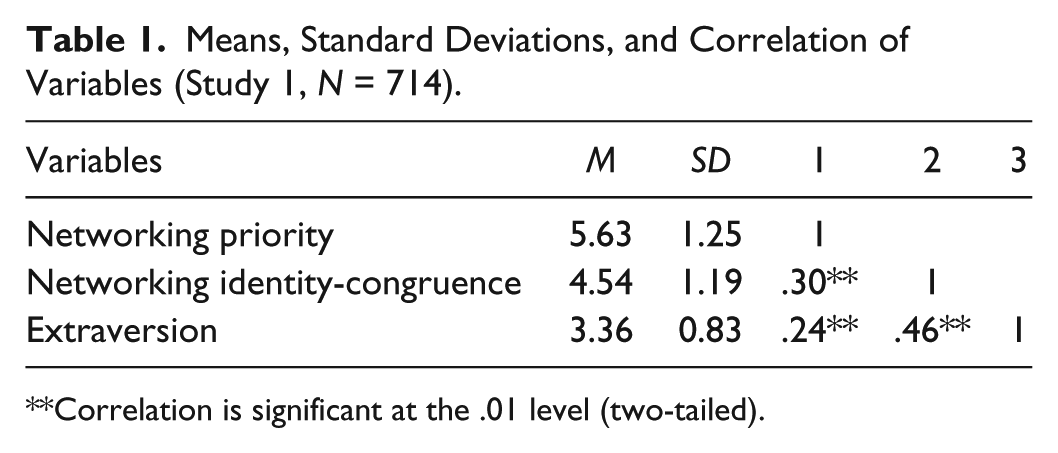
Correlation is significant at the .01 level (two-tailed).
Discussion
Study 1 tested the hypothesis that those who believe professional networking is congruent with their identity are more likely than others to prioritize professional networking. These results provide initial evidence that those who endorse the belief that professional networking is identity-congruent are more motivated than others to strengthen and expand their professional networks. We also note that identity-congruence only explained a small proportion of the variance in participants’ desires to strengthen and expand their existing professional network, indicating that other factors may also be in play. Given that the relationship observed in this study was correlational, we conducted Study 2 to take an initial step toward establishing causality.
Study 2
In this study, we tested Hypothesis 2, which suggests that the relationship between networking identity and professional networking intentions is most likely to emerge when the self is salient, but only among those who view networking as identity-congruent. This prediction is based on the premise that when the self is salient, the various identities associated with the self will be activated and, as a result, will influence behavior (e.g., Oyserman, 2007). In contrast, when the self is not salient, identities central to the self will have little impact on behavior. Thus, by manipulating the salience of the self, we sought to establish that the presence of networking identity-congruence—rather than mere rationalization for past networking behaviors—explains the relationship between networking identity-congruence and intentions observed in Study 1.
Method
Participants
Two hundred seventy-one college undergraduates at a private university on the West Coast of the United States participated in exchange for class credit. Prior to analyses, we excluded 52 participants who failed an attention check. 4 Our final sample therefore consisted of 219 participants (53.0% female, Mage = 20.58, SD = 2.76).
Materials and procedure
Networking identity-congruence
Participants were asked to indicate the extent to which they believed that professional networking was congruent with their identity using the same four items as in Study 1 (α = .77). These items were assessed 4 weeks prior to the rest of the data collection.
Self-salience manipulation
Participants were asked to write a short story about the typical day in the life of a student in either the first person or third person, a method used in previous studies to manipulate the salience of the self (Utz, 2004). In the self-salience condition, participants described the typical day of a student in the first-person singular (i.e., using “I”). In contrast, those in the non-self-salience condition described the typical day of a student in the third-person singular (i.e., using “he” or “she”).
Networking intentions
After completing the short writing task, participants answered a series of questions about their intention to engage in professional networking in the near future. Specifically, participants indicated the extent to which they believed they would seek to expand their professional network in the next month. Items included the following: “To what degree will you try to strategically build your professional network in the next month?” “In the next month, how likely are you to voluntarily engage in behaviors that expand your professional network?” “To what degree do you plan to establish new professional connections in the next month?” and “In the next month, to what degree is having a strong professional network a goal that you plan to pursue?” Participants indicated their intention to network in the next month using a 7-point Likert-type scale (1 = not at all, 7 = very much). These items were averaged to create a composite measure of networking intentions (α = .93).
Extraversion
Finally, participants completed the same extraversion items as in Study 1. The items were averaged to create a composite measure of extraversion (α = .87).
Results
We report the means, standard deviations, and correlations for Study 2 in Table 2. We regressed networking intentions on a dummy variable for condition (1 = self-salience, 0 = non-self-salience), networking identity-congruence, and an interaction between condition and networking identity-congruence, while controlling for extraversion. We mean-centered all predictors and covariates for the analyses. There were no main effects of condition, β = .07, b = 0.17, 95% CI = [−0.18, 0.53], t(213) = 0.96, p = .340; extraversion, β = .11, b = 0.19, 95% CI = [−0.05, 0.43], t(213) = 1.55, p = .122; or networking identity-congruence, β = −.14, b = −0.16, 95% CI = [−0.38, 0.07], t(213) = −1.36, p = .175. The Condition × Networking Identity-Congruence interaction, however, was significant, β = .20, b = 0.31, 95% CI = [0.01, 0.62], t(213) = 2.03, p = .044 (see Figure 1).
Means, Standard Deviations, and Correlation of Variables (Study 2, n = 218).
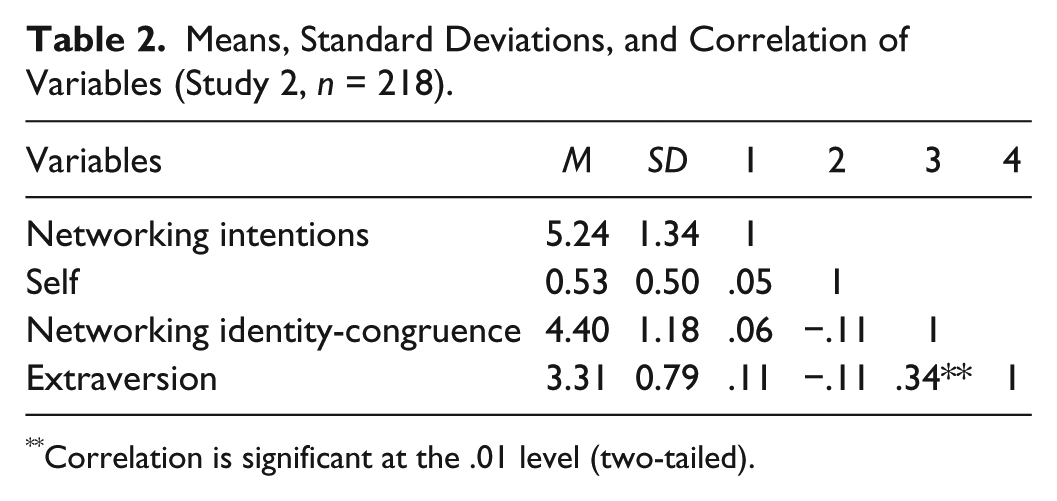
Correlation is significant at the .01 level (two-tailed).
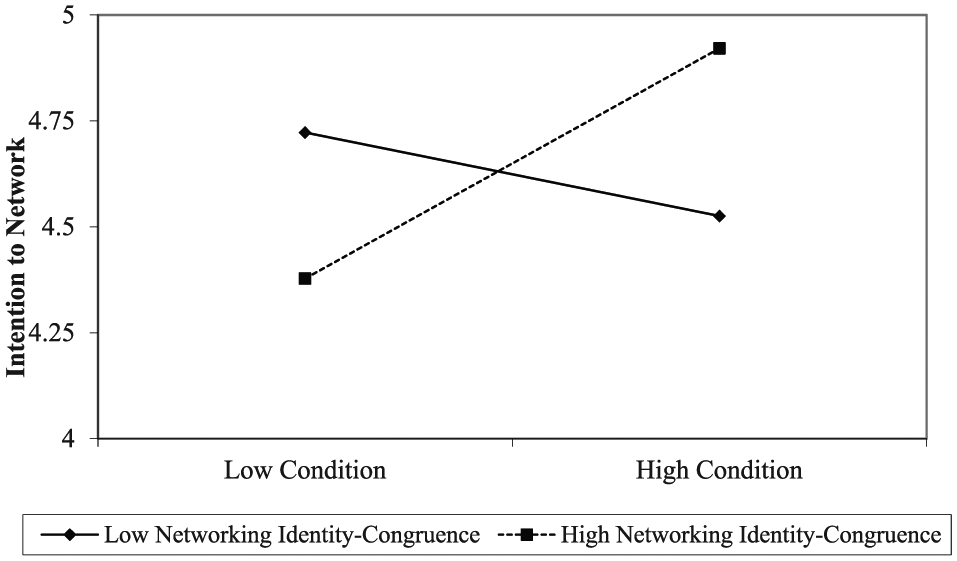
Effect of identity-congruence and salience of the self on networking intentions (Study 2).
Simple slopes for the association between the self-salience condition and networking intentions were tested at low (−1 SD below the mean) and high (+1 SD above the mean) levels of networking identity-congruence (e.g., Aiken, West, & Reno, 1991). There was a nonsignificant negative association between the self-salience manipulation and networking intentions among those at lower levels of networking identity-congruence, β = −.07, b = −0.20, 95% CI = [−0.71, 0.32], t(213) = −0.76, p = .449. As predicted, a significant positive association between the self-salience manipulation and networking intentions emerged only at higher levels of networking identity-congruence, β = .20, b = 0.54, 95% CI = [0.04, 1.04], t(213) = 2.14, p = .034. That is, individuals high on networking identity-congruence were more likely to intend to network when their self, and consequently, their context dependent identity, was salient.
Discussion
The results of Study 2 further demonstrate that identity plays an important causal role in motivating professional networking intentions. Specifically, we found support for the hypothesis that viewing professional networking as identity-congruent enhances motivation to network in contexts where the self is salient and fails to motivate networking when the self is not salient.
Study 3
Next, we tested Hypothesis 3. In particular, we predicted that when guided to view networking as identity-congruent, individuals would be more likely to engage in networking behaviors. Furthermore, we theorized that this relationship would be mediated by the extent to which networking is seen as identity-congruent. In Studies 1 and 2, we found that networking identity-congruence influences individuals’ perceptions of and intentions to engage in professional networking. That is, we found that those with greater networking identity-congruence were more likely to show an interest in professional networking and were more likely to intend to network in the near future when the self was salient. However, in the previous studies we did not examine how manipulating identity-congruence in the moment can affect networking intentions among those who typically do not see themselves as professional networkers. Furthermore, we did not use a behavioral measure of networking intentions. In the present study, we sought to overcome these limitations.
Method
Participants
One hundred fifty-seven individuals recruited via Amazon’s Mechanical Turk (MTurk) participated in the study in exchange for monetary compensation. Prior to the analyses, we excluded participants who either failed to follow the directions or were outliers 5 from the analyses. Our final sample therefore consisted of 148 participants (56.8% female; Mage = 37.42, SD = 12.82).
Materials and procedure
Networking congruence
Participants first completed a brief writing task. We randomly assigned participants to one of two conditions: the networking identity-congruence condition or the networking identity-incongruence condition. In the networking identity-congruence condition, participants were instructed to identify the ways in which professional networking was consistent with who they are and how they typically choose to interact with others. Specifically, participants read the following: We are interested in professional networking. Networking is the process by which people develop and maintain relationships that have the potential to assist them in their work or career. Research shows that everyone has professional relationships and, furthermore, that people tend to be much more natural, true to themselves, and comfortable when building and using strategic connections than they typically think. In other words, most people are generally wired to be “networkers,” and can network in unique ways. In the space provided, please write about the ways in which networking is consistent with who you are and/or a natural outcome of how you like to interact with others.
Participants in the networking identity-incongruence condition, in contrast, were instructed to identify the ways in which professional networking was inconsistent with who they are and how they typically choose to interact with others. They read the following: We are interested in professional networking. Networking is the process by which people develop and maintain relationships that have the potential to assist them in their work or career. Research shows that, in spite of the fact that everyone has professional relationships, very few people feel natural, true to themselves, and comfortable when systematically building and using strategic connections to their advantage. In other words, most people who identify as true “networkers” are quite rare. In the space provided, please write about the ways in which networking is not consistent with who you are and/or contradicts how you like to interact with others.
Networking identity-congruence
Participants then indicated the extent to which they believed that professional networking was congruent with their identity using the same four-item measure used in the previous studies. These items were averaged to create a composite measure of networking identity-congruence (α = .85).
Desire to network with others
Next, participants completed a behavioral measure of their intentions to network. Specifically, we informed participants that they could choose to be connected with three other participants who had taken one of our previous studies. They were told that potential contacts would be selected based on how relevant they would be given their professional backgrounds and stated professional goals. Participants then indicated their interest in connecting with the other participants. Responses to this item ranged from 1 (yes) to 0 (no).
Desire to develop networking skills
Participants then viewed a series of professional networking tips, which served as an additional behavioral measure of networking intentions—that is, the extent to which participants were interested in developing their professional networking skills. Specifically, participants read up to 31 professional networking tips (e.g., Organize and plan your own networking events. Gain valuable experience on how to effectively reach out to others while also creating a networking event catered to your own professional needs). Participants read as many or as few tips as they would like. Those who were no longer interested in reading the tips could skip to the end of the survey. We recorded the number of tips participants viewed as a measure of their interest in professional networking.
Extraversion
Finally, participants completed the same extraversion measures in the previous studies (α = .91).
Results
We report the means, standard deviations, and corrections for Study 3 in Table 3.
Means, Standard Deviations, and Correlations of Variables (Study 3, N = 148).
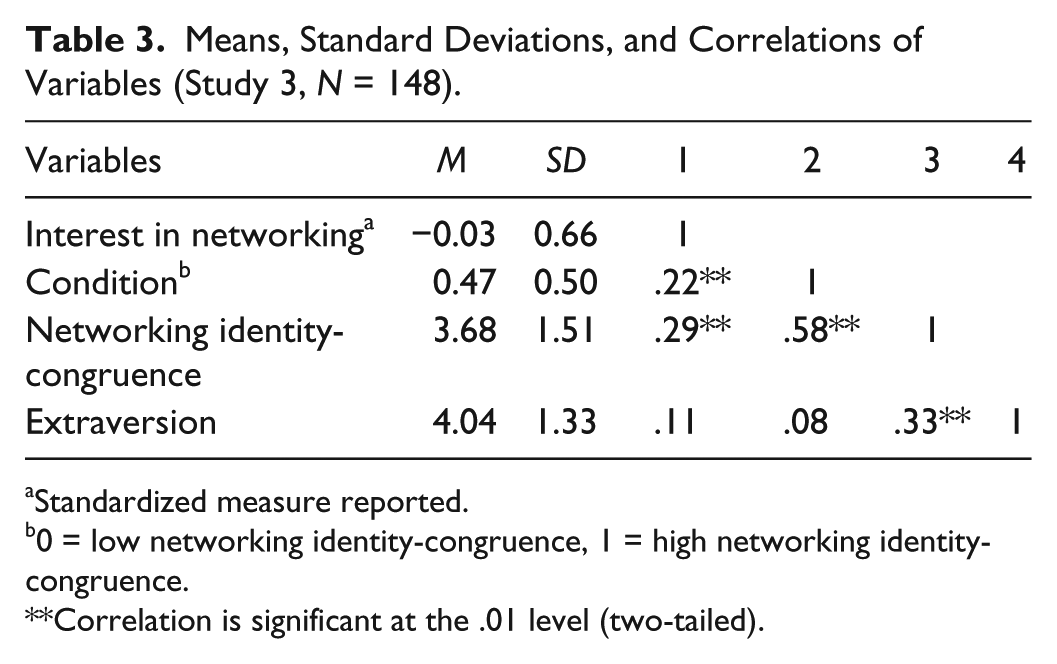
Standardized measure reported.
0 = low networking identity-congruence, 1 = high networking identity-congruence.
Correlation is significant at the .01 level (two-tailed).
Interest in professional networking
We created a composite measure from our behavioral measures—participants’ desire to network with others and the number of professional networking tips participants viewed, r(148) = .26, p < .001. We standardized these measures to create the composite measure, which served as a measure of participants’ interest in professional networking.
We then ran regression analyses, in which we regressed the effect of the networking congruence manipulation on interest in professional networking. We controlled for extraversion in these analyses. The main effect of extraversion was not significant, β = .09, b = 0.05, 95% CI = [−0.04, 0.12], t(145) = 1.11, p = .267, whereas the main effect of condition was significant, β = .22, b = 0.28, 95% CI = [0.07, 0.49], t(145) = 2.66, p = .009. That is, individuals who wrote about the many ways in which professional networking was identity-congruent and consistent with themselves and how they choose to interact with others were more likely than those who wrote about the ways in which professional networking was identity-incongruent to indicate their desire to engage in professional networking.
Mediation
We then conducted mediational analyses using the PROCESS macro (Model 4) developed by Hayes (2013). We tested whether networking identity-congruence (induced after the manipulation) mediated the effect of condition on participants’ likelihood of networking with others. We used 5,000 bootstrapped samples in our analyses. The networking identity-congruence measure met the criteria for mediation. The 95% CI for the indirect effect ranged from 0.01 to 0.32, which does not include zero. That is, among participants assigned to the networking identity-congruence condition, there was a significant positive effect of the networking congruence manipulation on the likelihood of networking with others (see Figure 2).
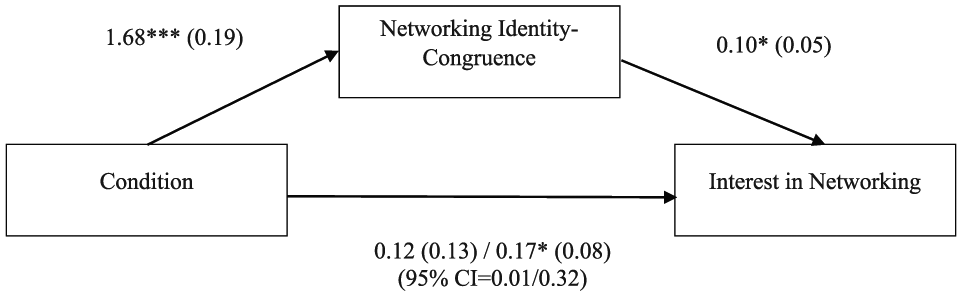
Networking identity-congruence mediates the relationship between condition (i.e., identity-congruence manipulation) and interest in networking (Study 3).
Discussion
The results of Study 3 demonstrate causal evidence for our proposed mechanism and indicate one way by which to motivate individuals to engage in professional networking. We found that guiding individuals to consider the ways in which professional networking is congruent with who they are increases individuals’ tendency to engage in networking behaviors. Furthermore, perceptions that networking was (now) identity-congruent mediated this effect.
Study 4
Finally, we tested Hypothesis 4, the prediction that viewing networking through the lens of self-interest would increase networking behaviors only among those who are already high in networking identity-congruence. The previous studies illustrated that the degree to which people view networking as identity-congruent predicts their intentions to network. However, most economists would propose an alternative possibility—that material self-interest dominates identity, rendering it meaningless as an explanatory variable. Thus, in Study 4 we manipulated self-interest to pit these two constructs against each other. We predicted a main effect of networking identity-congruence on networking intentions. In contrast to the idea that self-interest serves as a stronger motivator of networking than identity, we did not expect a main effect of self-interest. This is because a focus on how networking benefits the self also increases the salience of the self, which, as we demonstrate in Study 2, primarily motivates those who are already high on networking identity-congruence to engage in professional networking.
Method
Participants
One hundred forty individuals recruited via Amazon’s MTurk participated in exchange for monetary compensation. Prior to the analyses, we excluded nine participants who failed an attention check, resulting in a final sample of 131 participants (45.8% female; Mage = 37.65, SD = 11.45).
Materials and procedure
Networking identity-congruence
Participants indicated the extent to which they believed that professional networking is congruent with their identity using the same four-item measure as in the previous studies. These items were averaged to create a composite measure of networking identity-congruence (α = .85). After completing these items, participants completed a short word search task. We used this distractor task to conceal the true purpose of the study.
Benefits to the self versus other
After completing the distractor task, participants were instructed that they would be completing a brief writing task. We randomly assigned participants to one of three conditions: a benefits-to-self condition, a benefits-to-others condition, and a control condition. In the benefits-to-self condition, participants reflected on the benefits they could personally gain from engaging in professional networking. In the benefits-to-others condition, participants reflected on the benefits others could gain from them (i.e., the participants) as a result of engaging in professional networking. Finally, participants in the control condition reflected on the process of building a large professional network, without an explicit mention of the benefits associated with professional networking. 6
Networking intentions
After completing the writing task, participants indicated their intention to engage in professional networking in the near future (i.e., in the next month) using the same items used in Study 2. The items were averaged to create a composite measure of networking intentions (α = .96).
Extraversion
Participants then completed the same extraversion measures as in the previous studies (α = .94).
Results
We report the means, standard deviations, and correlations for Study 4 in Table 4. We conducted a regression analysis with networking identity-congruence, a dummy variable for the benefits-to-self condition, a dummy variable for the benefits-to-others condition, an interaction of the benefits-to-self dummy with networking identity-congruence, an interaction of the benefit-to-others dummy with networking identity-congruence, while controlling for extraversion. There was a main effect of extraversion, β = .22, b = 0.25, 95% CI = [0.06, 0.45], t(124) = 2.57, p = .011. In contrast to a self-interest account, there was no main effect for the benefits-to-self dummy variable, β = −.03, b = −0.11, 95% CI = [−0.78, 0.57], t(124) = −0.31, p = .754, nor was there a main effect for the benefits-to-others dummy variable, β = −.05, b = −0.17, 95% CI = [−0.82, 0.47], t(124) = −0.53, p = .597. However, the predicted main effect of networking identity-congruence emerged, β = .55, b = 0.60, 95% CI = [0.23, 0.98], t(124) = 3.16, p = .002, providing further support for identity as a predictor of networking. The interaction between the benefits-to-self dummy and networking identity-congruence was not significant, β = −.07, b = −0.13, 95% CI = [−0.61, 0.34], t(124) = −0.56, p = .579, but the interaction between the benefits-to-others dummy and networking identity-congruence was significant, β = −.29, b = −0.48, 95% CI = [−0.93, −0.03], t(124) = −2.13, p = .036. We therefore conducted follow-up analyses to examine the interaction further. Split by the benefits-to-others dummy variable, we found that networking identity-congruence had no significant effect on networking intentions in the benefits-to-others condition, β = .13, b = 0.14, 95% CI = [−0.16, 0.43], t(47) = 0.92, p = .361. In contrast, networking identity-congruence had a positive and significant effect on networking intentions in the other two conditions, β = .48, b = 0.57, 95% CI = [0.20, 0.93], t(76) = 3.11, p = .003. Further tests confirmed that networking identity-congruence predicted networking intentions in both the control condition, β = .38, b = 0.47, 95% CI = [0.12, 0.82], t(36) = 2.73, p = .010, and benefits-to-self condition, β = .45, b = 0.51, 95% CI = [0.17, 0.86], t(39) = 2.98, p = .005.
Means, Standard Deviations, and Correlations of Variables (Study 4, N = 131).
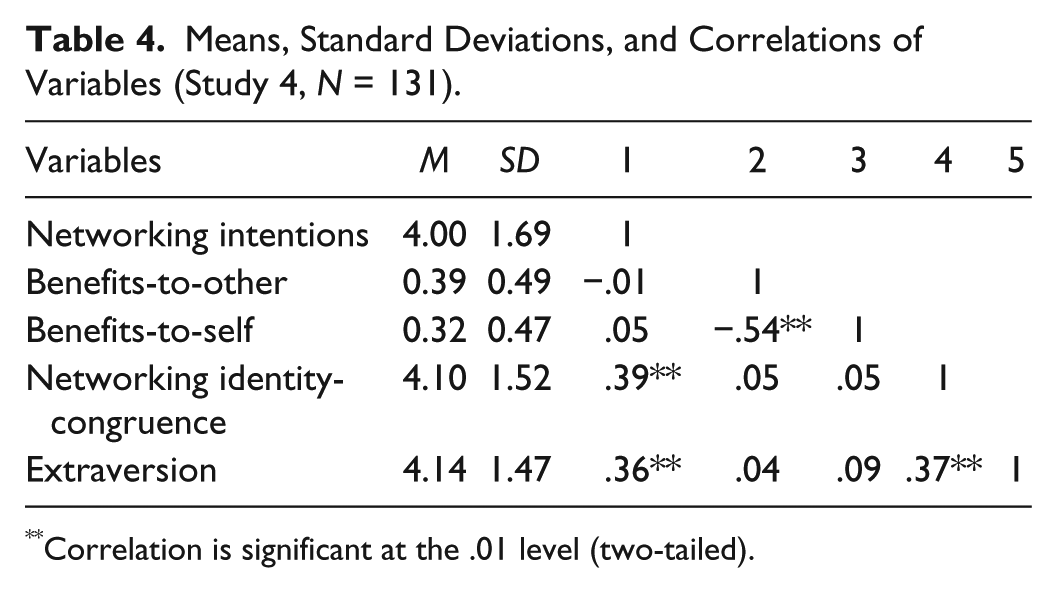
Correlation is significant at the .01 level (two-tailed).
We conducted additional analyses to identify why networking identity-congruence predicted networking intentions in both the benefits-to-self condition and the control condition. We presumed that participants in the control condition, when asked to reflect on the process of professional networking, were more likely to consider the benefits of professional networking for themselves than those in the benefits-to-others condition, and were therefore more likely to consider self-interested motivations to engage in professional networking. To examine this possibility, an independent coder, blind to condition, coded each response to identify whether participants’ written responses included benefits-to-self (1 = yes, 0 = no) and benefits-to-others (1 = yes, 0 = no). The benefits-to-others value was then subtracted from the benefits-to-self, producing a value of −1, 0, or 1 for each participant’s response. Values of 1 indicate that benefits to self were mentioned with no benefits to others; values of 0 indicate that both benefits to self and others were mentioned (or neither), and values of −1 indicate that benefits to others were mentioned with no benefits to self.
Analyses revealed that participants in the benefits-to-self condition listed benefits to the self (M = 0.90, SD = 0.30) more often than those in the benefits-to-others condition (M = −0.82, SD = 0.39); t(89.28) 7 = 24.12, p < .001, d = 4.94. Furthermore, participants in the control condition also listed benefits to the self (M = 0.59, SD = 0.50) more often than participants in the benefits-to-others condition, t(70.27) = 14.56, p < .001, d = 3.14, well above the midpoint of 0, though less than those in the benefits-to-self condition, t(61.06) = −3.42, p = .001, d = 0.75. The results of these additional analyses suggest that participants in the benefits-to-self and control conditions were more self-focused, whereas participants in the benefits-to-others condition were more other-focused. Consistent with the results of Study 2, which demonstrated that the effects of networking identity-congruence on networking intentions is strongest when the self is salient, a comparison between the benefits-to-other condition relative to the other two conditions led to significant differences among those who did, versus did not, identify with networking.
Discussion
The results of Study 4 highlight the importance of identity, above-and-beyond self-interest. Specifically, we found a main effect of identity, but not self-interest, on networking intentions. Moreover, the results illustrated that, among those who view networking as congruent with their identities, focusing on how networking benefits the self or simply networking in general (which tended to elicit an emphasis on benefits to the self) has a positive impact on the likelihood of engaging in networking in the near future. Furthermore, these results suggest that highlighting the benefits of professional networking for the self may not be an effective way to motivate all individuals to network. Rather, highlighting the personal benefits of professional networking appears to be effective only for those who already endorse the belief that networking is congruent with their identity.
General Discussion
Across four studies, we demonstrate that identity can be an important motivator of professional networking intentions. The results of our studies revealed that those who view professional networking as congruent with their identity are more motivated to prioritize their professional networks, whether examined through correlational or experimental data. In Study 1, we provided correlational evidence that those high on networking identity-congruence are more likely to prioritize strengthening and expanding their professional networks. In Study 2, we illustrated that the salience of the self induces networking intentions among those who view professional networking as identity-congruent. In Study 3, we manipulated the extent to which individuals view professional networking as either identity-congruent or identity-incongruent, and found that those guided to view networking as identity-congruent were more likely to engage in networking behaviors. Finally, in Study 4, we demonstrated that identity-congruence is a stronger predictor of networking intentions than self-interest. In particular, our analyses indicate that providing people with information about how professional networking is personally beneficial only motivates those who are already high on networking identity-congruence to network.
Theoretical Contributions
These findings offer a number of important theoretical and practical contributions. First, our work contributes to emerging research on the psychology of networking which seeks to identify the factors that influence professional networking intentions and behaviors. In our studies, we provide a novel demonstration that identity is a key facilitator of professional networking, in contrast to the common assumption that people are simply motivated to network as a means of material gain. In addition, our findings contribute to IBM theory by demonstrating that a short and effective manipulation of identity-congruence can influence individuals’ motivation to engage in a particular behavior (i.e., networking). Our work builds on existing IBM research that has demonstrated the effects of manipulating identity-congruence on intentions and behavior (Elmore & Oyserman, 2012), while also providing a novel method of shifting identity-congruence. Our methods may be applicable across domains such as health (Oyserman et al., 2007) or academics (Elmore & Oyserman, 2012) to test the impact of brief interventions aimed at influencing identity-congruence on both short-term and long-term achievement outcomes.
Our findings also contribute to the identity literature by highlighting how one’s identity plays an important role within the networking domain. In doing so, we incorporate work on IBM (Oyserman, Destin, & Novin, 2015; Oyserman et al., 2007; Smith & Oyserman, 2015). Consistent with the IBM model, we demonstrate that when individuals believe that professional networking is consistent with their identity they are more likely to engage in professional networking behaviors. Moreover, our research demonstrates that identity is a more effective motivator in increasing networking intentions than self-interest. This illustrates the power of identity to motivate action and provides some early evidence comparing IBM to other motivational accounts.
In demonstrating the importance of identity in influencing professional networking intentions, we extend the theoretical applications of IBM. To date, research on IBM has demonstrated effects on academics (Oyserman & Destin, 2010; Smith & Oyserman, 2015) and health outcomes (Gomez & Torelli, 2015; Oyserman et al., 2007). The present research extends this work by expanding the implications of IBM to the social domain to examine networking behaviors.
Our findings, which highlight the importance of identity, suggest that identity might interact with other experiences people may have when networking to influence behavior, specifically metacognitive experiences of difficulty. According to IBM, when a behavior or action feels identity-congruent, difficulties are likely to be interpreted as signaling that engaging with that behavior is important, “for me,” and worth the time and effort. In contrast, if the behavior feels identity-incongruent then difficulty engaging in the behavior is likely to be interpreted as meaning impossibility, “not for me,” and not worth the time and effort (Smith & Oyserman, 2015). Similarly, when students reflected on their academic possible selves and how these possible selves relate to their current selves, difficulty in academics was more likely to be interpreted by students as signaling that academics were important rather than interpreted as impossibility if the possible self was perceived as desirable and identity-congruent (Oyserman et al., 2015). This suggests that people’s perceptions of networking could interact with identity-congruence to affect their decision to network and reap the benefits of professional networking. By making networking feel identity-congruent, one is likely to interpret experienced difficulty with networking as important and thus persevere in networking behaviors.
Practical Implications
The present findings also have a number of organizational and practical implications. First, they provide insight into the types of individuals that are most likely to build the largest professional networks. Our findings demonstrate that individuals who perceive professional networking to be consistent with their identities are the individuals most likely to prioritize and engage in professional networking behaviors, and are most likely to be motivated by self-interested appeals to network.
Our findings also demonstrate that one important barrier to networking is whether networking feels congruent with the self. The results of our studies suggest that one way that professionals can overcome the challenges associated with their perceived identity-incongruence with networking is to find ways that professional networking may actually be consistent with their already held identities. Based on the results of Study 3, individuals can identify ways that the behaviors that they already engage in—perhaps the hobbies and activities one enjoys (that feel identity-congruent)—can help them build their professional networks.
The present findings have important implications for leaders, educators, and organizations that seek to motivate individuals to engage in professional networking behaviors. One of the most commonly used methods to motivate individuals to expand their networks is to articulate the benefits associated with doing so. However, the results of Study 4 indicate that this approach to motivating individuals to network is only effective among those who already find networking identity-congruent. Thus, instead of—or in addition to—motivating individuals to engage in networking by highlighting the many benefits of having a large professional network, leaders, educators, and organizations should encourage individuals to find ways to make professional networking a part of their identities.
Directions for Future Research
Our research suggests a number of interesting directions for future research. First, our studies largely examine individuals’ motivations to network as opposed to their actual networking behaviors. In Study 3, we do include a behavioral measure (i.e., choosing to connect with other participants to expand one’s network), but do not measure offline-networking behaviors. While these findings speak to individuals’ networking intentions and online behavior, the degree to which these intentions shape further action warrants future research. Second, although our studies did make use of a variety of different samples (i.e., university students who have yet to obtain jobs all the way up to adults who have held one or more jobs), generalizing our findings to other populations is important, and offers an opportunity for future research.
Related to the above point, we do not make a strong distinction between online- and offline-networking behaviors in this work. It is possible that the medium through which an individual networks affects the perceived ease (difficulty) of networking, and consequently, the extent to which networking feels identity-congruent (identity-incongruent). For example, individuals might find networking with others online easier, and may therefore find that online networking feels more identity-congruent than offline networking. These individuals may be motivated to network online, even though they may not be motivated to do so offline. If online networking acts as a way of introducing one to networking, then it can begin to make networking feel identity-congruent, eventually making offline networking feel congruent. This unexplored possibility merits further investigation.
Third, future research should focus on identifying how individuals come to perceive professional networking as identity-congruent or identity-incongruent. Identifying the determinants of such beliefs is a natural next step. In addition, future research could examine other ways to frame professional networking as readily identity-congruent for those who currently perceive professional networking as identity-incongruent. Consistent with prior work that suggests that people are more likely to engage in behavior that is represented as an expression of the self (Bryan, Walton, Rogers, & Dweck, 2011), framing networking as an identity as opposed to a behavior (i.e., “I am a networker” as opposed to “I am networking”) could motivate individuals to engage in professional networking.
Fourth, the literature on the psychology of networking is a nascent and growing literature. As such, more research is needed to confirm the degree to which the present findings generalize to populations in various career types and stages. Although our studies indicate that the effects persist across participants in different career stages, future work should be done to confirm this. Future research could also examine the various situational factors that might affect an individual’s willingness to engage in professional networking. The presence of third parties, for example, who are competent in professional networking is likely to affect an individual’s networking comfort in that the presence of these individuals may be threatening to some, but encouraging to others. Finally, while research has begun to identify the antecedents and consequences of networking behaviors (e.g., Forret & Dougherty, 2001) prior work has largely examined these factors independently of one another. Future research could therefore enrich the existing literature by examining how multiple factors (individual, dispositional, and situational factors) might interact to predict whether an individual is likely to engage in professional networking.
Conclusion
The results of four studies demonstrate the role of identity as a motivator of professional networking. Across the studies, we found that those who view professional networking to be congruent with their identity are more likely than others to intend to network. In addition, our results suggest that encouraging individuals to consider the benefits of engaging in professional networking behaviors might seem like an effective motivator, but that this approach only motivates those who already perceive professional networking as congruent with their identity. In short, the results of the studies reported here indicate that “who you know” may ultimately be determined by “who you think you are.”
Footnotes
Declaration of Conflicting Interests
The author(s) declared no potential conflicts of interest with respect to the research, authorship, and/or publication of this article.
Funding
The author(s) received no financial support for the research, authorship, and/or publication of this article.
Supplemental Material
The supplemental material is available online.
Notes
References
Supplementary Material
Please find the following supplemental material available below.
For Open Access articles published under a Creative Commons License, all supplemental material carries the same license as the article it is associated with.
For non-Open Access articles published, all supplemental material carries a non-exclusive license, and permission requests for re-use of supplemental material or any part of supplemental material shall be sent directly to the copyright owner as specified in the copyright notice associated with the article.
