







Abstract
This study tests whether liberals and conservatives within the same society think as if they were from different cultures. I tested this by measuring the cultural thought style of social liberals and conservatives in Hong Kong (Study 1). Liberals tended to think more analytically (more “WEIRD”), and conservatives tended to think more holistically (more common in East Asia). In Study 2, I trained people to think analytically or holistically before they read articles on political issues. Analytic thought caused people to form more liberal opinions, and holistic thought caused people to form more conservative opinions. The thought training affected participants’ responses to a social issue, but not an economic issue or whether they identified as liberal or conservative. This study replicates a previous U.S. finding in an East Asian culture and a different political environment, suggesting that the link between politics and thought style extends beyond the United States.
There is a modern research tradition that shows people from North America and Western Europe tend to think analytically, and people from East Asian cultures tend to think holistically (Nisbett, Peng, Choi, & Norenzayan, 2001). Yet recent research has been finding evidence that the split is not so neat, with meaningful differences between groups in the same nations (Na et al., 2010; Talhelm et al., 2015; Talhelm et al., 2014) This study tests whether liberals and conservatives in the same country process information about the world as if they were from different cultures. Then it tests whether temporarily changing people’s cultural thought style changes their attitudes about political issues.
Why Liberals Are WEIRD
This study is based on the construct of cultural thought style that most cultural psychologists have used over the last 20 years: holistic versus analytic thought (Nisbett et al., 2001). Analytic thinkers tend to think abstractly, focus more on central objects divorced from context, and use logical rules of noncontradiction. Holistic thinkers pay more attention to the context, emphasize the relationships between objects, and use associative thinking.
At first, researchers used analytic versus holistic thought to understand differences between East and West (Nisbett et al., 2001). But more recently, researchers have found that people in other cultures also tend to think holistically (Henrich, Heine, & Norenzayan, 2010). Instead of an East versus West difference, the new data suggest that it is really a “West versus rest” difference.
To highlight how much of an outlier Western respondents are, Henrich, Heine, and Norenzayan called them “WEIRD.” They pointed out that most of psychology is based on populations that are Western, educated, industrialized, rich, and democratic. Even though these WEIRD cultures hold just 15% of the world’s population, they account for a large portion of samples in psychology.
This article argues that liberals are even WEIRDer. Or looking in the other direction, conservative culture is less WEIRD. Why would liberals be WEIRDer? At least in the United States, social liberalism is associated the “E,” “I,” and “R” of WEIRD communities:
Education: States with more college graduates are more likely to be liberal (Drutman, 2011).
Industrialized: Social liberals are concentrated in large cities; conservatives are concentrated in rural areas (Kron, 2012).
Rich: Liberalism is centered in wealthy states (such as California and Connecticut) and cities (e.g., San Francisco; Census, 2005).
Thus, if liberalism is more common in WEIRD communities, liberals may also be more likely to have WEIRD cultural traits like analytic thought.
The Social Orientation Hypothesis
There is a step in the logic above that is implied but not named. WEIRD cultures think analytically, and their WEIRD characteristics are mostly social. In the same way, studies of cultural differences often say Western culture is individualistic and analytic, whereas Eastern culture is interdependent and holistic. But sometimes the reasoning for why individualism should be linked to analytic thought remains fuzzy.
The fundamental step of logic is the social orientation hypothesis (Varnum, Grossman, Kitayama, & Nisbett, 2010). The social orientation hypothesis argues that social style differences cause thought style differences. Many studies have tested this idea by temporarily making people more individualistic or collectivistic. For example, researchers have asked participants to write about how they are different from other people (or similar to other people) or read stories about people who make decisions independently or people who take other people into account (Trafimow, Triandis, & Goto, 1991). A meta-analysis found that temporarily making people more individualistic makes them think more analytically and vice versa (Cohen’s d = .54, Oyserman & Lee, 2008).
The social orientation hypothesis is the foundation for two hypotheses of this study. First, compared with economic politics, people’s social politics should be a better predictor of people’s cultural thought style. The fact that most studies ask a single political orientation question (without splitting social and economic politics) could explain why cross-cultural psychologists have often not reported political differences.
Second, the social orientation hypothesis could explain why changing people’s cultural thought style affects their attitudes toward social issues but not economic issues. It is hard to understand this if thought style is abstract. Psychologists’ measures of thought style often ask people to multiply numbers or calculate the number of widgets a factory can produce in X number of days. But it would be difficult to understand the pattern of the results of this study if we do not understand that cultural thought style is closely linked to people’s social style.
A Prior Study on Liberal Cultural Thought Style
A recent study found that social conservatives think more holistically than liberals in the United States and China (Talhelm et al., 2015, Studies 1-3). This relationship was not due to confounding variables, such as socioeconomic status (SES), gender, education, personality, or IQ. Furthermore, all three prior studies found that people’s economic politics was worse predictor than social politics. More surprising was the finding that training people to think analytically caused them to form more liberal opinions (Studies 4-5). The current study addresses several questions the earlier study left open.
Testing in a Collectivistic Culture
In the earlier study, the effect of inducing thought style was tested only in the United States (Talhelm et al., 2015). This could be important because the United States is a relatively analytic culture. Several studies have shown that analytic thought is more common in the United States than other cultures (Chiu, 1972; Ji, Zhang, & Nisbett, 2004; Norenzayan, Smith, Kim, & Nisbett, 2002; Talhelm et al., 2014, Table S2).
Testing in one culture cannot allow us to rule out important confounds. For example, analytic thought might have a different effect in cultures where it is less common. Priming analytic thought might feel more fluent to American participants because it is a relatively analytic culture to begin with. In contrast, priming holistic thought might feel taxing or unexpected in an analytic culture.
Some studies have found that cognitive depletion can affect the political attitudes that people form (Fischer, Greitemeyer, & Frey, 2008). If depletion is driving the results, we should find different effects in cultures with less of a tradition of abstract, analytic thought. If the effect is the same in different cultures, it can rule out the fluency explanation.
The Need for Replication
It is controversial to claim that cultural thought style changes people’s political opinions, and it is important to replicate new, controversial claims. Furthermore, the recent replication debate in psychology has underscored the importance of replications with large samples (Open Science Collaboration, 2015). This study uses samples with 98% a priori statistical power.
Does Baseline Thought Style Matter?
Although cultures have mean-level differences in thought style, there is still a lot of variation in thought style between people in a single culture (e.g., Na et al., 2010; Talhelm et al., 2015; Talhelm et al., 2014). In this study, participants complete measures of cultural thought style 2 to 3 days before the experimental manipulation. That means this study can test whether the effect of introducing analytic thought is different for people who think analytically to begin with.
How Long Does the Thought Effect Last?
The prior study did not test how long the effect lasts (Talhelm et al., 2015). The current study tests this question by having participants read two political articles in a randomized order after the thought induction. This will show whether the effect remains as strong when the target article is presented second.
Economic Versus Social Attitudes
The previous study found that having participants think analytically changed their attitudes toward an article about a social issue, but not an article about an economic issue. I theorize that this is because thought style is more closely linked to social politics than economic politics (Talhelm et al., 2015, Studies 1-3). If so, this would fit the social orientation hypothesis—the theory that social styles are the root cause of differences in cultural thought styles (Varnum et al., 2010). Yet, a single null finding could also be random. This study tests a social issue (drug offenses) and an economic issue (free trade) to see whether the distinction between social and economic issues remains.
Why Hong Kong Is an Interesting Test Case
Hong Kong is a mix of Chinese and British culture. Some researchers have argued that Hong Kongers are an interesting test case because they have readily accessible Western and Eastern mindsets that can be primed in different situations (Hong, Morris, Chiu, & Benet-Martínez, 2000). Hong Kong might be an ideal place to ask people to temporarily try on different thought styles.
Hong Kong is also interesting because it is important to test in different political cultures. Are liberals always the analytic ones? Different cultural contexts can fundamentally change what it means to be liberal or conservative. In the modern United States, being conservative usually means supporting free market enterprise. In the Soviet Union, being conservative meant supporting state-controlled enterprise. Rather than being tied to specific political issues, conservatism is most broadly about preserving the status quo.
Despite its Western influence, Hong Kong was a colony after all. It has far less of a history with representative democracy than the United States. Testing in this different political environment lets us know whether the connection between thought style and political attitudes is particular to the United States and its long history of active democracy.
Finally, on a pragmatic level, Hong Kong is an interesting test case because it uses the English language. That allows us to directly replicate the prior study without the danger of mistranslation. Of course, using the same materials comes at the cost of creating materials sourced from local issues.
Study Overview
Study 1 tests the basic relationship between cultural thought style and politics in Hong Kong. Do social conservatives in Hong Kong think more holistically than social liberals? In Study 2, participants in Hong Kong complete a thought task to temporarily induce analytic or holistic thought and then read political articles. This tests whether changing people’s thought style changes their political attitudes.
Study 1
Method
A total of 438 participants in Hong Kong completed this study as a part of a new online survey platform. Because English is the language of education in Hong Kong, all measures were in English. As a part of a website test, participants were paid between HK$5 and HK$40 (US$0.64-US$5.16). The payment amount was randomly assigned, and it was unrelated to thought style, r = −.03, p = .58, and social politics, r = −.04, p = .46.
Statistical power
To calculate power, I took the average correlation between social politics and thought style from three prior studies, r = .24 (Talhelm et al., 2015; Studies 1-3). Given that effect size, this study had 99.9% statistical power to detect a similar effect.
Cultural thought style
Participants took the triad task, a measure of cultural thought style (Figure 1; Ji et al., 2004). Participants see three items and choose “which two of the three are most closely related.” Studies have found that people in East Asia choose more relational pairings than participants in the West (Chiu, 1972; Ji et al., 2004; Talhelm et al., 2014, Table S2).
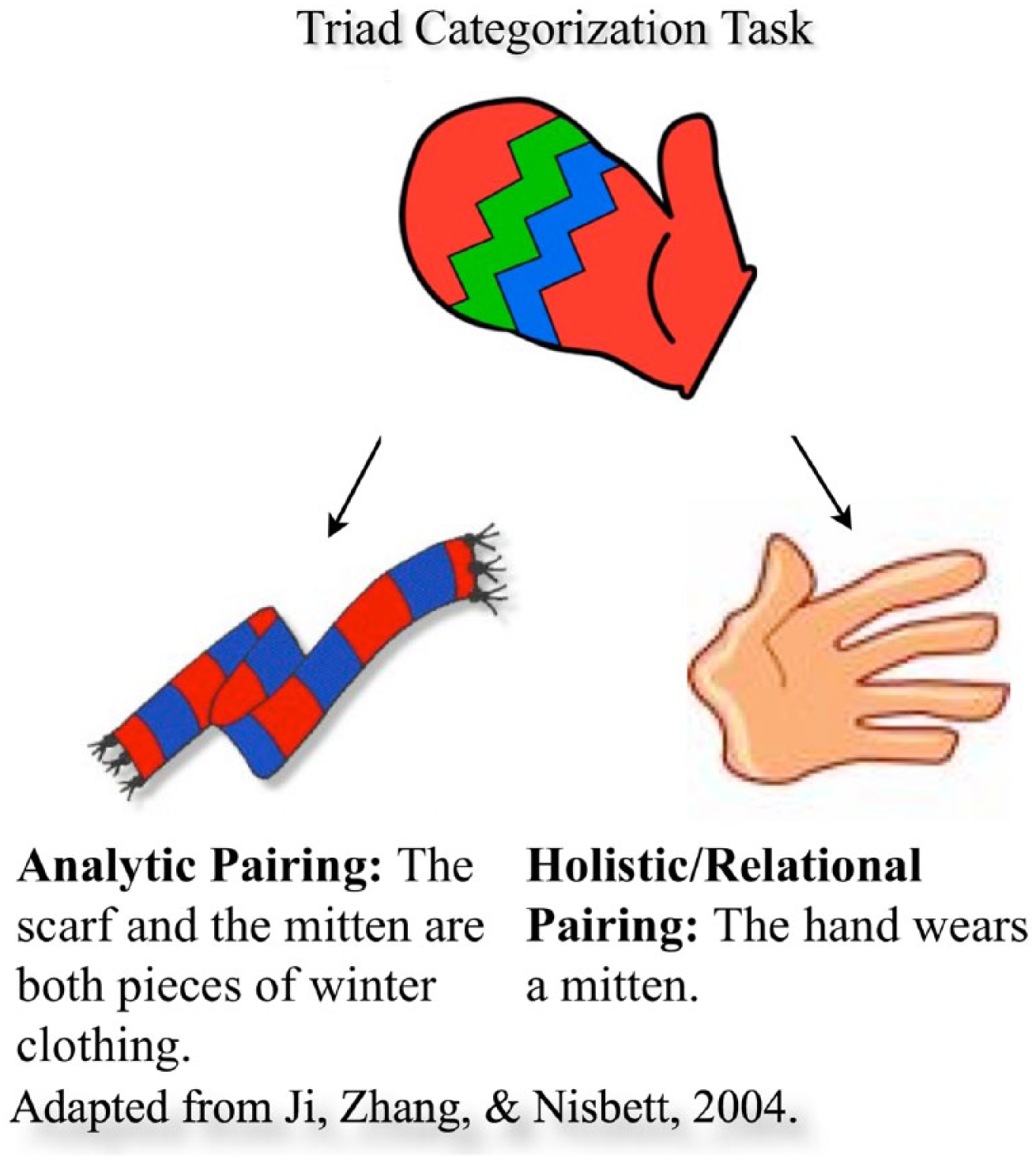
The triad categorization task (Study 1) is a measure of cultural thought style frequently used to measure differences between East and West. In the triad task, participants see a series of three items and choose two to categorize together.
The task includes eight key items and 12 distracter items. Because the triad task is essentially a series of binary choices (relational versus categorical), I analyzed it using a generalized linear model (GLM) with a binomial link in the program R. I used Nagelkerke R2 (the R2 equivalent for GLMs) to calculate effect size.
Demographics
Participants reported demographic, such as gender, ethnicity, and age. Participants rated their SES from 0 to 10 using the MacArthur Scale of Subjective Social Status (Adler, Epel, Castellazzo, & Ickovics, 2000).
I measured social and economic politics separately. The two items read, “How would you describe your political outlook with regard to social [economic] issues?” Participants responded on a scale from 1 (very liberal) to 7 (very conservative), with 4 representing “moderate.”
Many studies measure people’s political identity with a single item. However, I specifically separate social and economic policy to test the social orientation hypothesis (Varnum et al., 2010). Our prior studies have found that thought style is more closely related to social politics than economic politics.
Sample
Most participants (97%) were Han Chinese. Forty participants were born in Mainland China. Results were similar excluding Mainland participants (see Supplemental Materials). The sample leaned female (77%), with a mean age of 22.3 years (SD = 5.50). The oldest participant was 56 years old, and 10% of participants were above age 24. A majority of participants (58.0%) identified as socially “very liberal” to “slightly liberal,” 32.4% as “moderate,” and 9.6% as “slightly conservative” to “very conservative.”
People’s social politics were strongly correlated with their economic politics, although they were far from identical, r(435) = .55, p < .001. This is similar to previous results (Jost, Federico, & Napier, 2009; Talhelm et al., 2015).
Most participants were currently in school (84%). Of current students, 86% were undergraduates, and 10% were in master’s, MBA, or PhD programs. Most participants identified as “agnostic/I do not identify with a religion” (65%). Protestants made up 14% of the sample, Catholics made up 4%, and 8% identified as atheist.
Results
Social conservatives thought more holistically than liberals, B = 0.07, p = .015, r = .12 (Figure 2). Economic politics was actually marginally negatively correlated with holistic thought, B = −0.05, p = .08, r = −.09.
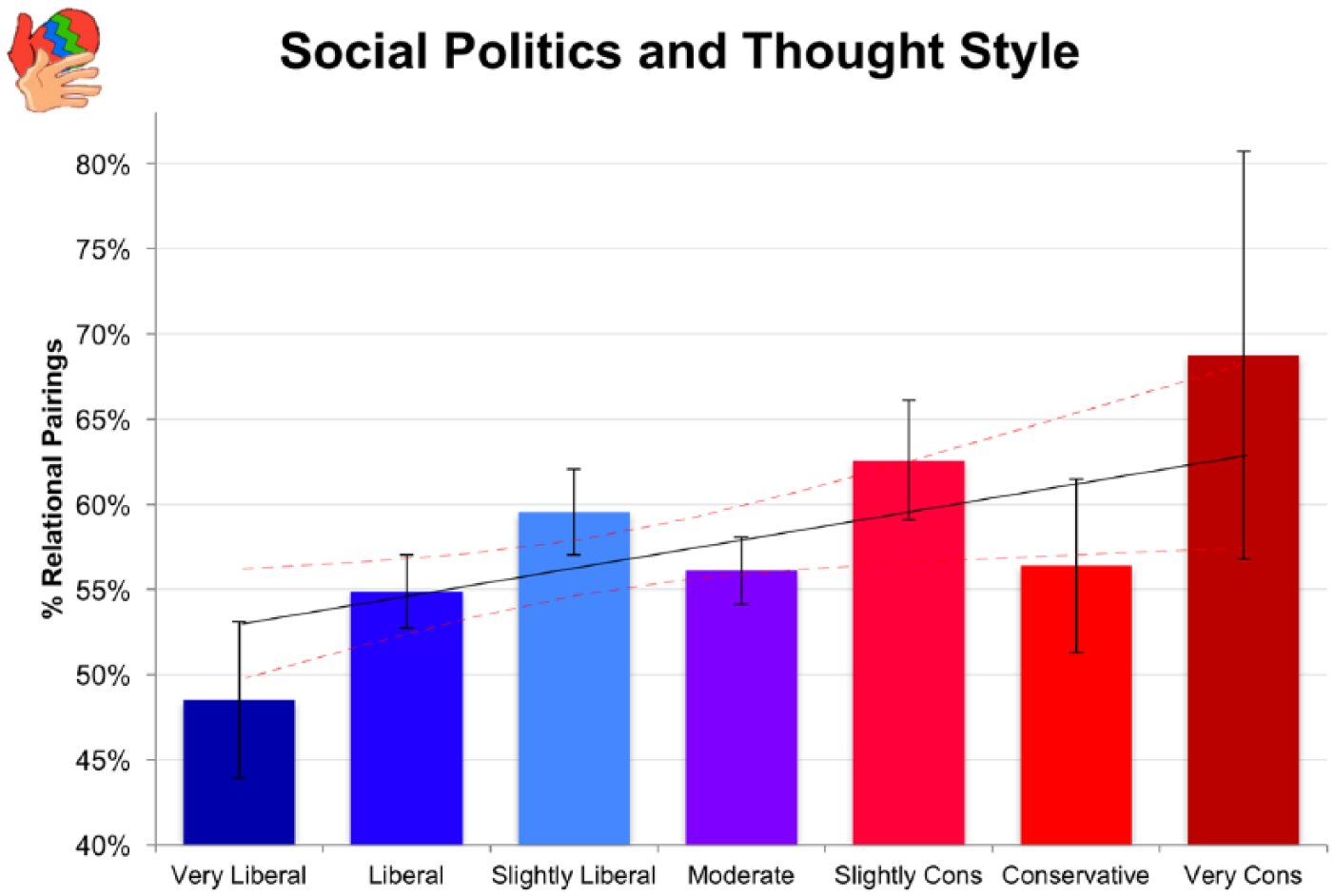
Social conservatives in Hong Kong chose a higher percentage of relational (holistic) pairings (Study 1).
Education
People with more education tend to think less holistically (Talhelm et al., 2015). Graduate students did think less holistically than undergraduates, B = −0.42, p = .001, r = .19. If graduate students are less conservative than undergraduates, this could confound the relationship between politics and thought style. However, graduate students were marginally more socially conservative than undergraduates, r(328) = .10, p = .07. After controlling for graduate versus undergraduate student status, the relationship between social politics and holistic thought strengthened, B = 0.11, p < .001, r = .19.
Age
According to Pew Research polls in the United States, older Americans are more likely to identify as steadfast social conservatives: 4% of 18- to 29-year-olds versus 21% of people 65 years and older (DeSilver, 2014; also in the United Kingdom: Tilley, 2015). In our sample, older Hong Kongers were more likely to be socially conservative, r(436) = .12, p = .01. If older Hong Kongers also think more holistically, this could confound the relationship between politics and thought style. In a model with social politics and graduate student status, older people thought marginally more holistically, B = .03, p = .068, r = .11. However, the relationship between social politics and thought style remained, p < .001.
Gender, SES, and religion
Supplemental analyses replicate the finding controlling for gender, SES, and religion.
IQ
Some researchers have found that conservatives have lower IQ than liberals (Lapsley & Enright, 1979). If IQ is the same as cultural analytic thought, the differences I found might be general IQ differences, rather than differences in cultural thought style per se. In the supplemental materials, I report a separate Chinese sample (N = 103) that took tests of logical syllogisms and the Cognitive Reflection Test, which is correlated with IQ (Frederick, 2005). Controlling for these four measures, there was still a significant relationship between social politics and cultural thought.
Discussion
Social conservatives in Hong Kong thought more holistically than social liberals. As in the United States, social politics was a better predictor of cultural thought style than economic politics. This relationship held after controlling for demographic confounds.
Study 2
Study 2 tests whether training people to think analytically causes them to form more liberal opinions. Participants read two in-depth political articles and rated simple political statements. This in-depth processing may give participants more of an opportunity to use the newly induced thought style. In contrast, the simple attitude statements (e.g., “Flag burning should be illegal”) and political identity responses (e.g., “strongly liberal”) require less processing than the full articles. This could mean they are less influenced by temporary changes in thought style.
Method
Participants
A total of 467 Hong Kong participants completed the study on the same online platform as Study 1 for between HK$5 and HK$40. Compensation did not interact with the thought induction on either of the political articles (ps > .60).
The sample was 78% female, 95% Han Chinese, with an average age of 22.48 years (SD = 5.59). The oldest participant was 56 years old, and 10% of participants were above age 25. Thirty-six participants were born in Mainland China. The main finding was similar excluding Mainland participants (see Supplemental Materials). Of the 361 participants currently in school, 86% were undergraduates, and 14% were graduate students. A majority of participants (57.7%) identified as “very liberal” to “slightly liberal,” 31.7% as “moderate,” and 10.7% as “slightly conservative” to “very conservative.”
Statistical power
Based on the average effect size of thought training on responses to social politics articles from the two prior studies, β = .19 (Talhelm et al., 2015; Studies 4-5), this study had 98.6% statistical power.
Thought training
In Study 2, instead of allowing people to categorize items freely, I randomly assigned them to categorize items based on their abstract category (analytic), functional relationship (holistic), or freely (control condition). For example, in the analytic condition, participants read the following: Your task is to categorize the following objects based on their abstract categories. You’ll see groups of items. For example, Janitor, Mop, Jackhammer In every group, one pairing will be because one uses the other. For example, janitors use mops. But you should pair mop with jackhammer because both belong to the category tools.
In the holistic condition, participants were instructed to choose the items that “share a relationship or because one of them uses the other.”
Political articles
After the thought training, participants read two fictionalized news articles. Article order was random. One article was about a social issue (drug offenders), and one was about an economic issue (free trade). Both articles were the same as in the previous study (Talhelm et al., 2015).
Drug offenders
One article described a proposed law that would send first-time drug offenders to college rather than prison. Supporters argued that the program saves the state money and reduces rates of repeat offense. Opponents argued it is unfair to reward people who have broken the law with something that law-abiding citizens have to pay for.
Free trade
One article described a proposal that would expand free trade. Supporters argued that free trade benefits people of all nations. Opponents argued it hurts local jobs.
Then participants reacted from 1 (I strongly oppose the bill) to 7 (I strongly support the bill), with 4 representing neutral (I don’t have a preference). Participants also answered two comprehension questions about the articles. I excluded participants who answered any of the comprehension questions incorrectly (drug N = 58; trade N = 19; both N = 31).
Stable political attitudes
After the articles, participants rated 11 simple political statements from 1 (strongly disagree) to 7 (strongly agree). I used items from the Anson-Motyl Political Orientation Scale but modified them to remove references to the United States (Anson, Motyl, & Coolidge, under review). I added the scores to create a sum conservatism score. Participants also rated their social and economic politics as in Study 1.
Analysis
Because I had a directional hypothesis for both the holistic and analytic conditions relative to the control condition, I coded the thought training as −1 (analytic), 0 (control), and 1 (holistic; identical to the original study, Talhelm et al., 2015).
Results
Social issue
The thought training significantly affected people’s attitudes to the drug offender law, B = −0.29, p = .006, β = −.17 (Figure 3). To give an idea of effect size, I analyzed participants’ responses to the drug offender law as if it were a vote. I counted any “support” responses as yes votes, any “oppose” responses as no votes, and “I don’t have a preference” as abstentions. Among people who read the drug offender article first, the thought training was enough to turn the vote from a large defeat (31% yes) to a victory (66% yes).
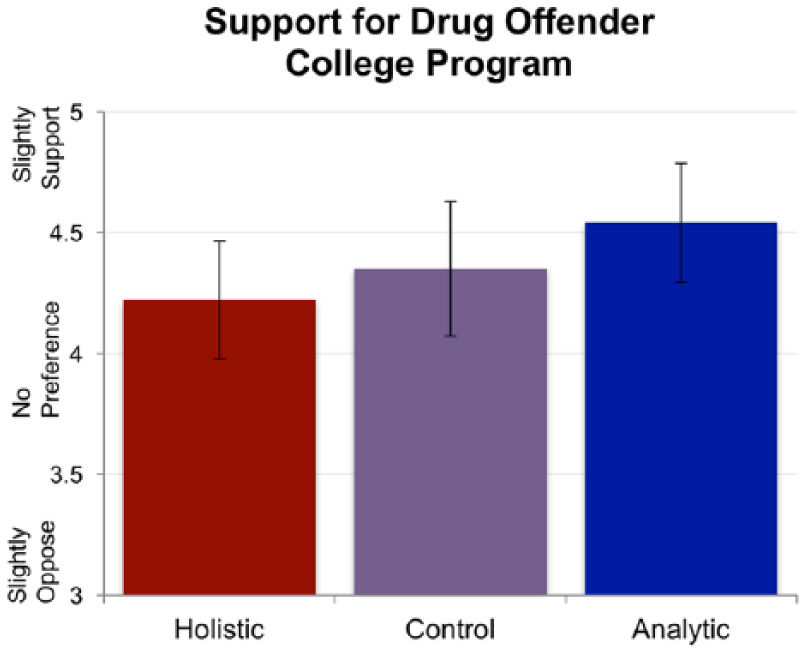
Training holistic thought (left) decreased support for a program to send drug offenders to college rather than prison among people who read the drug offender directly after the thought training (Study 2). Training analytic thought (right) increased support.
Education
There was an interaction between thought training and undergraduate versus graduate student status, B = 0.72, p = .035, β = .13 (Table 1). The interaction revealed that thought training had a stronger effect on undergraduate students than graduate students (Figure 4). Among undergraduates, the thought training had a significant effect, B = −0.29, p = .006, β = −.17. Among graduate students, the training did not have a significant effect, B = 0.43, p = .195, β = .26. However, the graduate sample was small (N = 27).
Thought Training Affects Attitudes on Social (Top) but Not Economic Politics (Bottom).
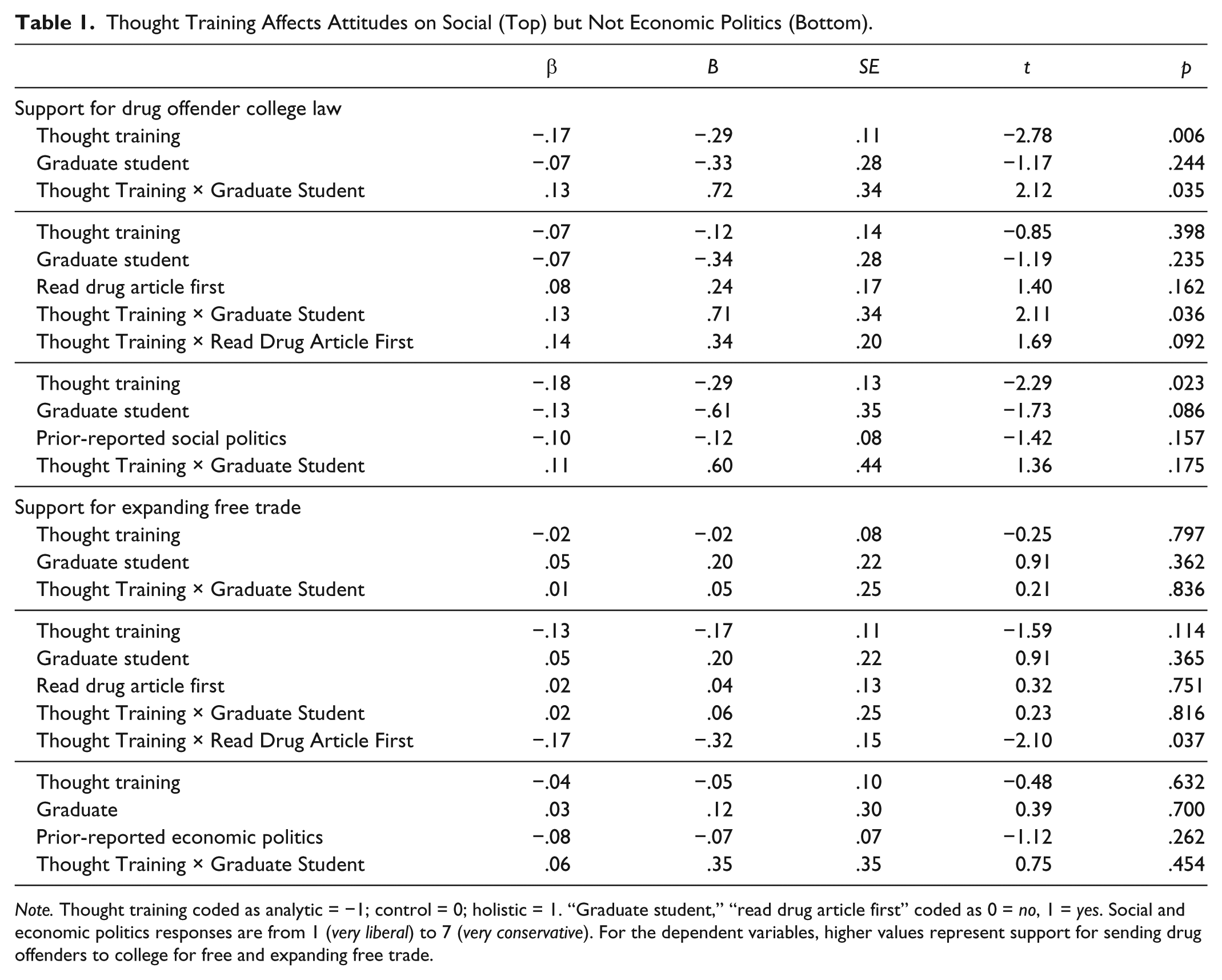
Note. Thought training coded as analytic = −1; control = 0; holistic = 1. “Graduate student,” “read drug article first” coded as 0 = no, 1 = yes. Social and economic politics responses are from 1 (very liberal) to 7 (very conservative). For the dependent variables, higher values represent support for sending drug offenders to college for free and expanding free trade.
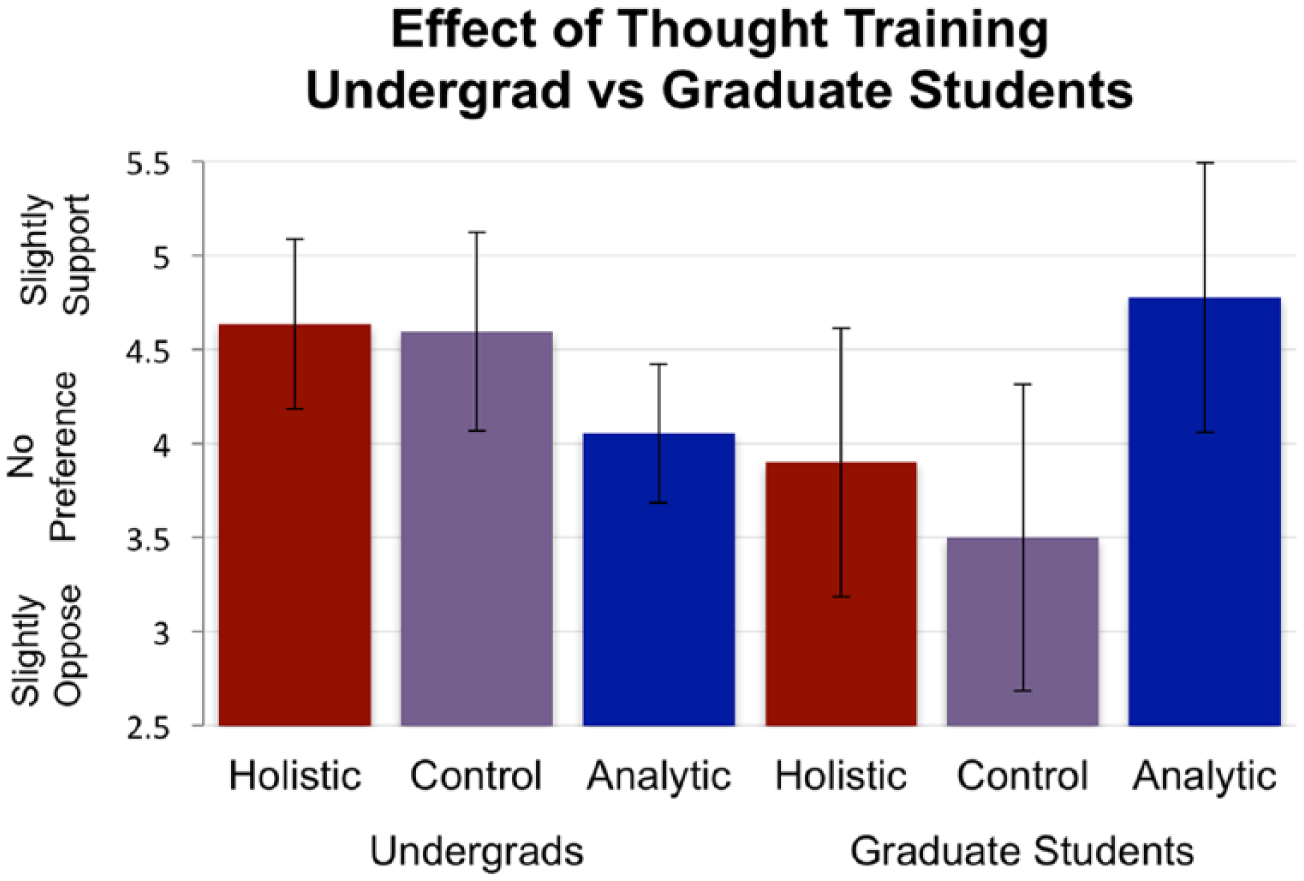
The thought training had a stronger effect on undergraduates (left) than graduate students (right). Although the graduate student sample was small, results were similar when comparing younger versus older participants. These results suggest that older, more educated participants have more stable political attitudes and are thus harder to change.
The difference between undergraduates and graduate students could be because graduate students are older and have more stable political attitudes. This fits with the finding that the effect of thought training was weaker among older participants (more details in supplemental materials, Table S2). The idea that older people have more stable attitudes also fits with a finding in the prior study, which found a larger effect size in an undergraduate sample (Study 3, β = .24) than a combined sample of undergraduates and an older Internet sample (Study 4, β = .13; Talhelm et al., 2015).
Effect on liberals and conservatives
I tested the possibility that the effect was only being driven by liberals or conservatives; however, there was no interaction between people’s prior-reported social political identity and the thought training, B = −0.04, p = .58, β = −.08. This suggests that the effect worked on both liberals and conservatives.
Economic issue
The thought training did not affect attitudes toward the free trade article, B = −0.02, p = .80, β = −.02. The thought training did not interact with graduate student status, B = 0.05, p = .84, β = .01, or age, B = −0.16, p = .26, β = −.07. In sum, the thought training did not affect participants’ attitudes toward the economic article.
Controlling for prior-reported politics
A total of 304 participants had reported their social and economic politics as a party of Study 1 before participating in Study 2. Controlling for prior-reported social politics, thought training still significantly affected people’s attitudes toward the social policy article (p = .02). Controlling for prior-reported economic politics, thought training still had no effect on attitudes toward economic policy (p = .63).
Having prior-reported political identity also allows us to compare the effect sizes of political identity and the thought training. For the social issue, the effect size of thought training (β = −.18) was larger than the effect of prior-reported social politics (β = −.10), although the difference between these two effect sizes was not significant (p = .27).
Stable attitudes
The thought training had no effect on people’s sum scores to the political statements, B = −0.24, p = .55, β = −.03. The thought training did not significantly alter whether people identified as socially liberal or socially conservative (B = −0.11, p = .17, β = −.07) or economically liberal or conservative (B = −0.07, p = .39, β = −.04). If anything, these effects trended in the opposite direction from the effect on the articles. These relationships weakened after adding graduate student status and age to the analysis (ps > .38).
Exploring new moderators of the effect
Article order
For the drug offender article, there was a marginal interaction between article order and thought training, B = −0.34, p = .09, β = .14. Among people who read the drug offender article directly after the thought training, the effect of thought training was significant, B = −0.34, p = .01, β = −.19. Among people who read the drug offender article second, the effect of thought training was not significant, B = 0.01, p = .97, β = .003. This interaction was moderately robust in models without control variables or after adding age to the model (ps = .03-.10). In sum, the thought training had a stronger effect on the drug offender article when participants read it directly after the thought training.
For the free trade article, there was a significant interaction between thought training and article order, B = −0.32, p = .04, β = −.17. However, the interaction was not robust after adding control variables (p = .48).
Does the effect depend on people’s baseline thought style?
A total of 408 participants in this study had previously completed the triad task as a part of Study 1 and/or another unrelated study. Having seen the task before did not change the effect of the thought training (see Supplemental Materials).
I tested whether the effect of thought training depended on people’s baseline cultural thought style (measured prior to this study). Baseline thought style had a significant interaction with thought training for the drug offender article, but not free trade (Table 2). For holistic participants (>50% holistic pairings), the effect was similar to the main pattern, B = −.31, p = .018, β = −.18. But for participants who thought analytically to begin with (<50% holistic pairings), the effect was a slight trend in the reverse direction (Figure 5; B = .12, p = .40, β = .12). One way to interpret this pattern is that holistic thinkers are more responsive to the thought induction than analytic thinkers. This is an intriguing possibility worth exploring in future studies.
The Effect of Thought Training Differs Based on People’s Baseline Thought Style.
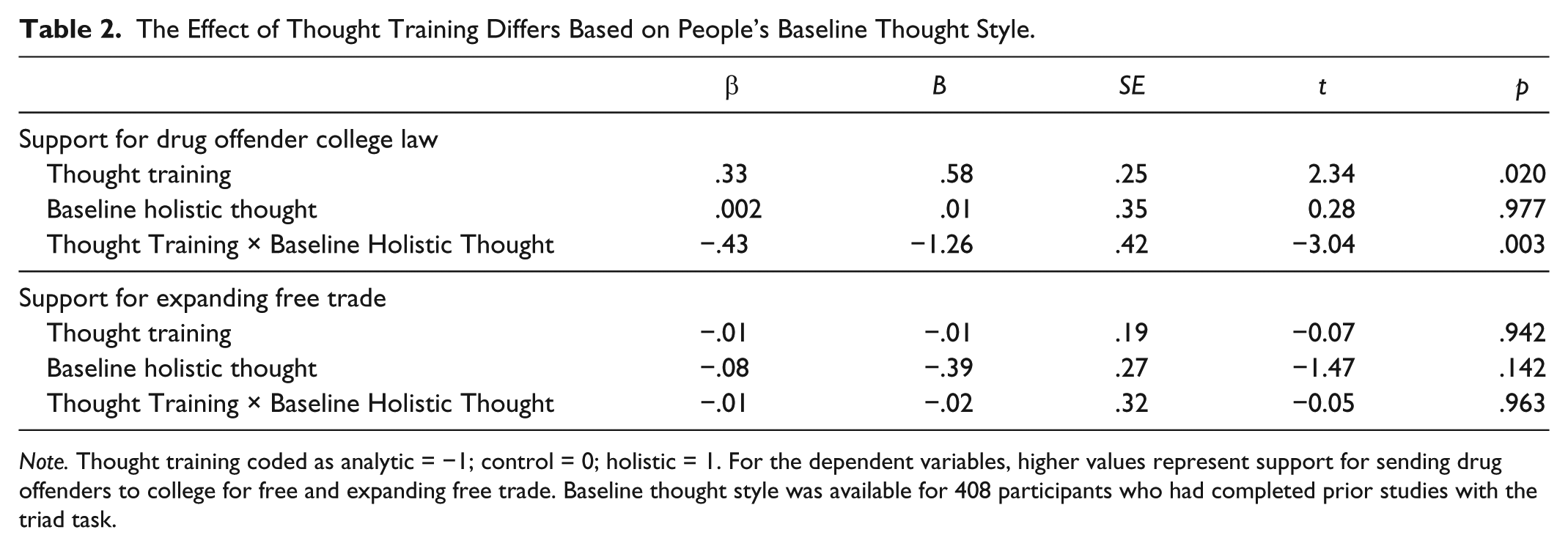
Note. Thought training coded as analytic = −1; control = 0; holistic = 1. For the dependent variables, higher values represent support for sending drug offenders to college for free and expanding free trade. Baseline thought style was available for 408 participants who had completed prior studies with the triad task.
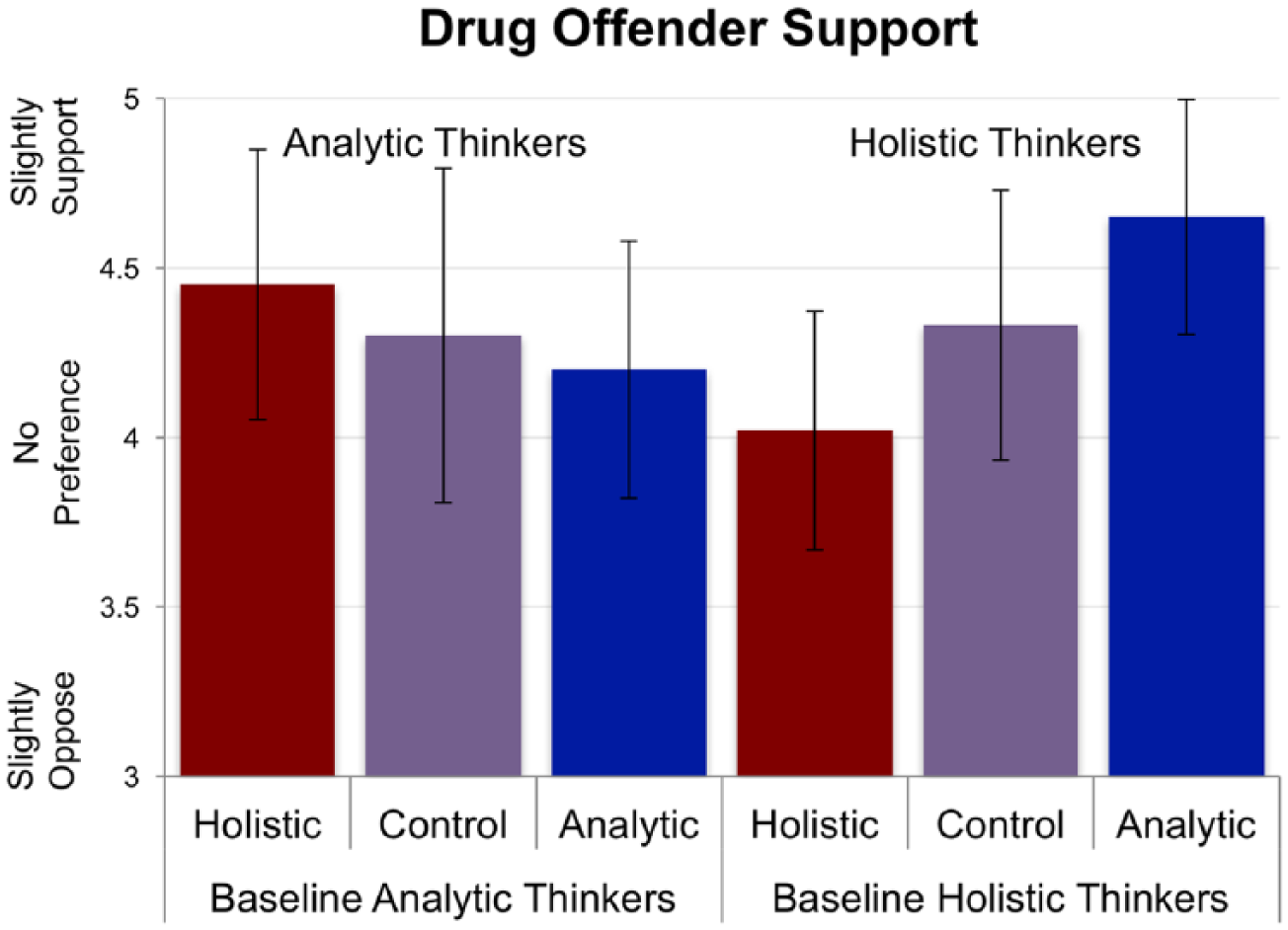
The thought training had a stronger effect on participants who thought holistically to begin with (right). Participants who thought analytically before the study showed a slight trend of an effect in the opposite direction (left).
Are these political items valid in Hong Kong?
In replicating a prior study, this study used the same political items and articles as in the United States (Talhelm et al., 2015). Do Hong Kong participants see these issues along the same liberal-conservative fault lines? Furthermore, are the self-report political questions valid in Hong Kong?
I tested these questions by seeing whether self-reported social politics correlated with political attitudes. First, people’s self-reported social politics correlated with sum conservatism scores on the Anson-Motyl Political Orientation Scale, r(362) = .31, p < .001. This is similar to the correlation in a sample of U.S. undergraduates, r(180) = .40, p < .001 (data from Talhelm et al., 2014, Study 4 combined with an unpublished study on the party-over-policy effect). The scale items cover mostly social issues, so it makes sense that the scores on the scale correlated less with people’s self-reported economic politics, r(362) = .14, p = .009.
Second, support for the drug offender program was negatively correlated with social conservatism, r(362) = −.11, p = .041, and economic conservatism, r(362) = −.15, p = .003. The correlation between social conservatism and drug offender support was similar among U.S. undergraduates, r(290) = −.23, p < .001 (Talhelm et al., 2014, Study 5). Hong Kongers’ support for free trade was correlated with economic politics, r(362) = −.12, p = .018, but not social politics, r(362) = −.01, p = .902. In sum, Hong Kongers’ self-reported politics were meaningfully correlated with their political attitudes and were similar to correlations in American samples.
Discussion
This study found that social liberals think more analytically than conservatives in Hong Kong, and inducing cultural analytic thought increases support for liberal social policies. In contrast, inducing holistic thought style decreases support for liberal social policies. The effect was large enough to flip from 31% supporting the policy in the holistic thought condition to 66% support in the analytic condition.
The effect was larger when people read the political article directly after the thought induction and weaker if they read the key article after reading another article. The effect was also stronger for younger people and undergraduate students, who presumably have less-well-formed beliefs than older people and graduate students. Social politics was a better predictor of people’s baseline thought style than economic politics, which fits with the emerging theory that social styles cause differences in cultural thought style (Varnum et al., 2010).
Both studies had over 90% a priori power to detect these effects. Combined with findings in the United States, the results here add confidence that cultural thought style is linked to social politics (Talhelm et al., 2015). The results also echoed the previous finding that changing people’s thought style only changes people’s attitudes toward social issues they process in depth. The thought style training had no effect on short political attitude statements, attitudes toward economic policy, or whether people identify as liberal or conservative.
Constraints on generality
Stimulus generalizability
The finding that temporarily changing people’s thought style has appeared with articles on the social issues of drug policy in two samples and welfare in one sample. Two studies have found null findings for political issues that are not correlated with people’s social politics: articles on free trade in two samples and an article on special education in one sample (Talhelm et al., 2015).
Thus, there appears to be some consistency of the findings across different stimuli. I would expect this finding to generalize to other political issues. However, all of the political articles used so far have presented two sides to each issue. It is not clear whether this would also work with articles that are completely one-sided. Researchers can also create articles with arguments that are specifically designed to tap into logical/analytic thinking versus intuitive/relational thinking, regardless of whether that thought style represents the liberal or conservative side of the argument.
By testing more articles, we can figure out what aspect of the liberal positions is important for the effect. Does analytic thought broaden people’s social concern, leading them to support policies that benefit strangers and out-group members? Does analytic thought allow people to get past their intuitive reactions (drug offenders should be punished) to more calculated cost-benefits (sending drug offenders to college reduces crime in the long run)? Future research can test these mechanisms and test with articles that pull apart intuitive reactions and social relationships.
Conditions for replication
Researchers attempting to replicate the findings should ensure that participants pass comprehension checks to verify that they are actively reading the articles. Researchers should also prevent participants from moving past the thought induction questions if they answer incorrectly.
Using local political issues
The political questions used in this study were not designed specifically for Hong Kong (although people’s ratings of the items correlated with their self-reported politics similar to a U.S. sample). The benefit of using the same articles as in earlier research is that it makes this study a closer replication of early research. However, using articles about local issues would make the study more relevant to Hong Kong. One possibility is that people have more strongly formed attitudes about localized issues, but are more open to change on more general issues such as free trade and drug policy.
Testing people with well-formed attitudes
It may be hard to change the attitudes of people who have strong beliefs. The findings from Study 2 suggest that people with more stable political attitudes are more resistant to the thought induction. However, I did not directly measure the strength of people’s political attitudes. Future studies could test this directly by asking about people’s interest in politics and how strongly they hold their opinions.
The prior study in Mainland China found that people’s political style was only related to their thought style among people from urban areas, not rural areas. One way to interpret this is that people in areas with little experience or knowledge about politics might not show these differences. Would the thought style induction work among hunter gatherers who do not have newspapers and do not participate in organized politics? I would not be surprised if this effect does not replicate in a population that is different from college students.
Extending across cultures
The results of this study extend the thought induction findings to an East Asian culture. Thus, the relationship between thought style and politics is not specific to the West. This finding helps rule out potential confounds. For example, as holistic thought is less common in the United States than East Asia, Americans may have found that holistic thought style training was strange or unfamiliar. Or perhaps Americans found it difficult to use the nonnormative cultural thought style. The fact that analytic thought had the same effect in an East Asian culture suggests the previous findings were not due to these potential confounds.
New evidence of moderators
As researchers complete more studies on a psychological phenomenon, we get finer detail on the conditions that make the phenomenon more or less likely. The findings of this study suggest two important variables: age and advanced education. The effect of thought training was weaker among older people and people with graduate school education.
I hypothesize that this difference is because older people have stronger political attitudes, particularly comparing people before and after college (Guimond, 1997; Newcomb, 1943). However, I did not measure attitude strength directly. Based on this finding, I propose that future studies (a) measure age and education, (b) report the distribution of age and education in the sample, and (c) measure how strongly people hold their political beliefs. This study was not able to test the effect of education strongly because the sample included undergraduates and graduate students at a top university. A study with greater range of education, including people with no college, would give a broader test of education.
How long does the effect last?
The effect of thought training seems to wear off quickly. The effect on the drug offender article was weaker when participants read that article second. This wearing off introduces uncertainty about the null finding for simple political statements and people’s political identities. Because these items came after the political articles, we cannot be sure if thought training has no effect on these items or if the thought training effect wore off by the time participants completed these items. Future studies can pull apart these two possibilities by presenting the political statements directly after the thought training.
Does the effect depend on people’s baseline thought style?
This study extends prior studies because it had a measure of many participants’ baseline thought style days before the experiment. For people who thought holistically to begin with, analytic thought increased support for the liberal policy. But for people who thought analytically to begin with, thinking holistically increased support for the liberal policy (although it was not significant). If this pattern replicates in future research, it might suggest that people who think holistically are more responsive to changing thought style.
What do we know about political thought style?
Psychologists have studied differences in how liberals and conservatives think for decades (meta-analyses: Jost, Glaser, Kruglanski, & Sulloway, 2003; Van Hiel, Onraet, & De Pauw, 2010). However, the most recent meta-analysis concluded that there were too few studies to determine whether there are differences in cultural thought style (Van Hiel et al., 2010, p. 1785). Combining this study with the earlier studies (Talhelm et al., 2015), we now have evidence from 5,039 participants in three cultures and four sampling platforms showing that social conservatives think more holistically than liberals.
Social psychologists are overwhelmingly liberal (roughly 93%: Duarte et al., 2015). That might explain why we social psychologists have a long history of explaining conservatism as a cognitive flaw. Published research has called conservative thought dogmatic (Pettigrew, 1958), inflexible (Kirton, 1978), low on integrative complexity (Tetlock, 1983, 1984), or simply stupid (low IQ: Lapsley & Enright, 1979).
Yet, I am hopeful that scientists can research people who have opposing political views without explaining their difference as a flaw. This study provides one perspective that can do exactly that. The cultural perspective offers tests and theory that describe differences as legitimate style differences, not as a defect.
Footnotes
Acknowledgements
The author thanks Luxi Shen, Liuqing Wei, Yuxin Wang, and Jesse Kluver for help with the research and comments on earlier drafts.
Author’s Note

Declaration of Conflicting Interests
The author(s) declared no potential conflicts of interest with respect to the research, authorship, and/or publication of this article.
Funding
The author(s) disclosed receipt of the following financial support for the research, authorship, and/or publication of this article: This research was supported by a William Ladany fellowship.
Supplemental Material
Supplementary material is available online with this article.
References
Supplementary Material
Please find the following supplemental material available below.
For Open Access articles published under a Creative Commons License, all supplemental material carries the same license as the article it is associated with.
For non-Open Access articles published, all supplemental material carries a non-exclusive license, and permission requests for re-use of supplemental material or any part of supplemental material shall be sent directly to the copyright owner as specified in the copyright notice associated with the article.
