







Abstract
Although prior work has examined secret keeping, no prior work has examined who gets told secrets. Five studies find compassion and assertiveness predict having secrets confided in oneself (as determined by both self- and peer reports), whereas enthusiasm and politeness were associated with having fewer secrets confided. These results bolster suggestions that interpersonal aspects of personality (which can fit a circumplex structure) are driven by distinct causal forces. While both related to agreeableness, compassion (empathy and desire to help) predicts being confided in more, whereas politeness (concern with social norms and social rules) predicts being confided in less. Likewise, while both related to extraversion, assertiveness (having the agency and drive to help) predicts being confided in more, whereas enthusiasm (positive sociality) predicts being confided in less.
Keywords
Nearly everyone keeps secrets. Secret keeping is associated with a host of negative well-being outcomes (Larson & Chastain, 1990; Larson, Chastain, Hoyt, & Ayzenberg, 2015; Quinn & Chaudoir, 2009; Slepian, Chun, & Mason, 2017), whereas revealing a secret to the right person seems to be beneficial (Frijns, Finkenauer, & Keijsers, 2013; Kelly, Klusas, von Weiss, & Kenny, 2001; Slepian & Moulton-Tetlock, 2018). Critically, revealing a secret to the wrong person could prove worse than keeping the secret in the first place (Kelly & McKillop, 1996; Kelly & Yip, 2006; Slepian & Moulton-Tetlock, 2018), which begs the question: To whom do we tell our secrets? Prior work has examined secret keeping, who keeps secrets, and the effects of secrecy in interpersonal contexts. In contrast, we examine which interpersonal traits predict being told secrets.
Interpersonal Aspects of Personality
People keep secrets, but also commonly confide a subset of them in others (Slepian et al., 2017; Slepian & Greenaway, 2018). But to whom do people confide? In examining which traits are associated with desired confidants and actual confidants, we build from hierarchical models of personality. That is, research recognizes that domains of personality (e.g., the Big Five) are composed of distinct lower level aspects (e.g., Lee & Ashton, 2004; Soto & John, 2016). One such scale that we utilize in the current work is the Big Five Aspect Scales (BFAS) measure (DeYoung, Quilty, & Peterson, 2007). We utilize this scale rather than others because one aspect that it measures is compassion, which as we describe more fully below, we predict to have a relationship with having secrets confided in oneself. The BFAS reveals two distinct, but correlated, aspects per each of the five domains of the Big Five (DeYoung et al., 2007). At a coarse level of domain, people might prefer to reveal secrets to agreeable people. Yet the BFAS recognizes that agreeableness is composed of two distinct aspects (compassion and politeness). Likewise, people might confide in extraverted people (composed of enthusiasm and assertiveness), but enthusiasm and assertiveness may be valued to different extents.
We focus our predictions on the above four mentioned aspects (compassion, politeness, enthusiasm, assertiveness) given that the majority of variation in interpersonal experience and behavior is reflected in their two higher level domains, agreeableness and extraversion (Barford, Zhao, & Smillie, 2015; DeYoung, Weisberg, Quilty, & Peterson, 2013).
Our theoretical perspective is that secret keepers evaluate potential confidants on interpersonal qualities rather than intrapersonal qualities (e.g., working memory resources of openness/intellect, preferring orderliness in conscientiousness). It is the interpersonal interaction that is critical to gaining help from a potential confidant, and thus we focus on personality aspects that are interpersonal in nature. Critically, the aspects we examine map onto the interpersonal circumplex (DeYoung et al., 2013; see also Hofstee, de Raad, & Goldberg, 1992), which describes the rich dimensions of nearly any social behavior (McCrae & Costa, 1989). Thus, we focus our predictions on traits that are truly social and interpersonal in nature. Two of our studies, however, do measure intrapersonal aspects of personality to test whether the effects of interpersonal traits hold when including these controls.
One might predict that people will tell secrets to others who are polite or kind. We propose, however, that people seek out compassionate people in whom to confide their secrets, independent of other desirable traits like kindness and politeness. This hypothesis is driven by recent advancements in the understanding of compassion, whereby compassion has been theorized as not simply being kind or nice, but rather being aware and sensitive to others’ suffering, paired with a motivation to help and alleviate those worries, personal difficulties, and struggles (Gilbert, 2014). Indeed, compassion is associated with improved social connection, emotion regulation, and conflict resolution (Finlay-Jones, Rees, & Kane, 2015; Jazaieri et al., 2013; Keltner, Kogan, Piff, & Saturn, 2014; Yarnell & Neff, 2013).
People often keep secrets to avoid others’ disapproval or rejection (Slepian & Bastian, 2017). Yet, secrecy can prove to be challenging and burdensome (Critcher & Ferguson, 2014; Lane & Wegner, 1995; Slepian, Camp, & Masicampo, 2015; Slepian et al., 2017; Slepian, Masicampo, & Galinsky, 2016). To alleviate this burden, ideally, one would reveal a secret to someone who would be nonjudgmental, caring, sensitive to one’s struggles, and motivated to help, that is, compassionate.
The Current Work
Drawing from recent empirical and theoretical work on compassion and personality, we predicted that people will prefer to reveal secrets to compassionate people (i.e., people most motivated to help), and that trait compassion, independent of other personality aspects will predict having secrets confided in oneself. We find support for these predictions. While our original predictions centered around compassion, as will become clear, we find reliable results when it comes to each of the four major interpersonal aspects of personality (compassion, politeness, enthusiasm, and assertiveness). Accordingly, our discussion centers around the implications for the consistent findings for each of these interpersonal aspects of personality. Specifically, we discuss (a) implications for secrecy, when and to whom to confide in; (b) implications for each of the four major interpersonal aspects of personality as well as affiliation and helping; (c) implications for personality theory, including distinguishing between factor and circumplex models of personality; and (d) limitations of the current work as well as future directions for this research.
Study 1: Which Interpersonal Traits Do People Desire in Confidants?
The current work does not examine confiding in college students, but instead a more diverse sample (from Mechanical Turk), which yields more generalizable results. For short questionnaire-based research, Mechanical Turk yields data quality equivalent to university undergraduate populations (Paolacci & Chandler, 2014; Paolacci, Chandler, & Ipeirotis, 2010) and participants who are more representative of the U.S. population (Berinsky, Huber, & Lenz, 2012; Buhrmester et al., 2011; Gosling, Sandy, John, & Potter, 2010; Mason & Suri, 2012).
In a first study, we asked participants to think about a current secret they have, and what qualities a person would need in order to reveal their secret to that person. Critically, the online medium we use allows for complete anonymity when asking participants to recall their secrets, which should lead to greater comfort in dealing with the sensitive topic of secrets. In all studies, we recruited at least 200 participants (with 80% power, this sample size can detect an r effect size = .1966, at α = .05; see Fritz, Morris, & Richler, 2012).
Method
In an initial study, participants were recruited on Mechanical Turk to allow for anonymous recall of secrets (N = 200; 62% female, Mage = 35.78 years; SD = 12.54).
Participants were asked to think about a personal secret that was important, that not many people knew about, and that they were purposefully hiding from others (chosen to parallel secrets examined in the later studies). Next, we asked what qualities participants would look for in a person to share their secret with, completing 40 randomly ordered items—10 per compassion, politeness, enthusiasm, and assertiveness (the four aspects that make up agreeableness and extraversion from the BFAS: the interpersonal aspects of personality; DeYoung et al., 2007). Participants chose from 1 (not at all likely to tell my secret to someone with this trait) to 7 (very likely to tell my secret to someone with this trait). An average was taken per each aspect. 1
Given that we were interested in what kind of person participants would want to confide their actual (not imagined) secret, we a priori decided to exclude participants who indicated that they did not have a secret to recall (n = 16, 8%), or who indicated they fabricated a secret when asked directly at the end of the study (n = 7, 3.5%).
Results and discussion
A repeated-measures ANOVA demonstrated significant variation among the four aspects, F(3, 528) = 162.96, p < .0001,
We predicted participants would rate compassion as more important than the other aspects. A paired t test demonstrated that compassion was valued more than the average of the other interpersonal traits (Table 1). A series of paired t tests demonstrated compassion was rated as marginally more important for a confidant than politeness, and significantly more important than enthusiasm and assertiveness (Table 1).
Personality Aspect Desirability in Potential Confidants in Study 1.
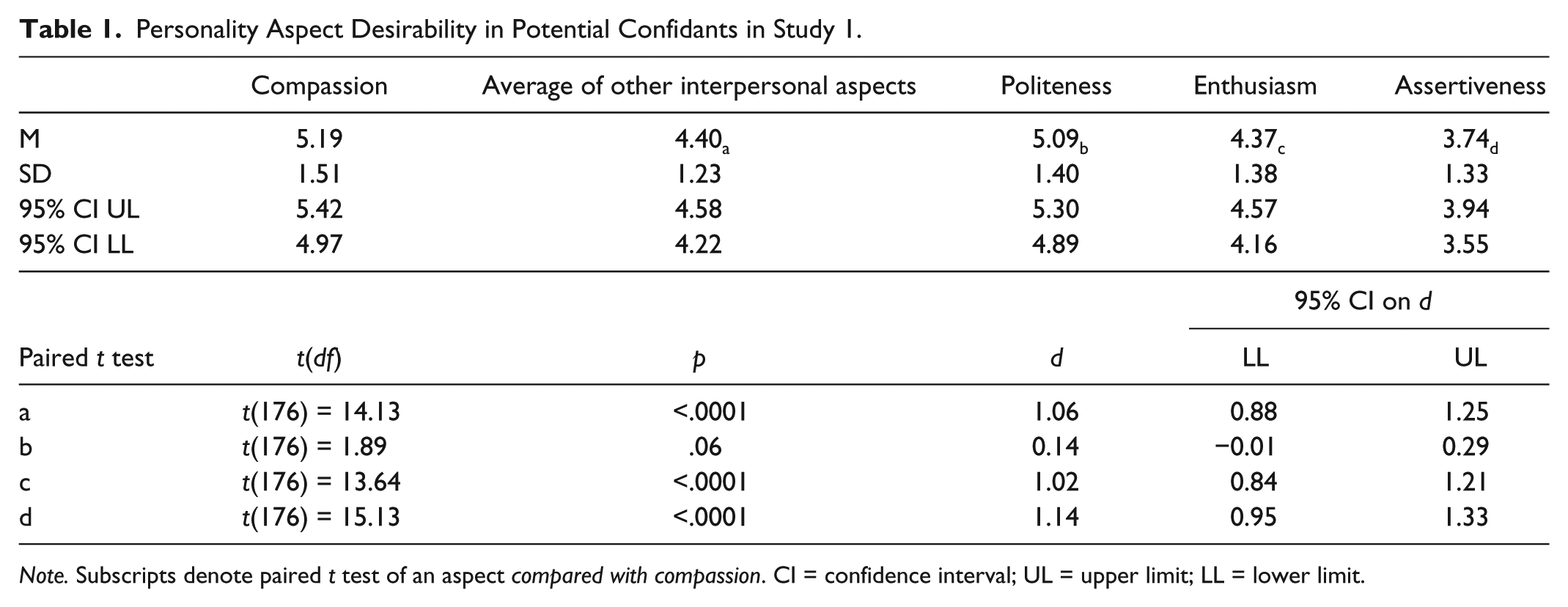
Note. Subscripts denote paired t test of an aspect compared with compassion. CI = confidence interval; UL = upper limit; LL = lower limit.
Although not related to our predictions, politeness was rated as more important than enthusiasm, t(176) = 10.76, p < .0001, d = 0.81, 95% confidence interval (CI) = [0.64, 0.98], which was more important than assertiveness, t(176) = 9.42, p < .0001, d = 0.71, 95% CI = [0.54, 0.87]. An exact replication of this study found that each trait was rated as significantly more important than the one that follows, in the order of compassion, politeness, enthusiasm, and assertiveness (see Supplemental Material).
Study 2: Which Interpersonal Traits Predict Being Confided In?
Compassion was rated as the most important personality aspect of the interpersonal aspects (compassion, politeness, enthusiasm, assertiveness) for a confidant to have (Study 1 and replication of Study 1 in Supplemental Material). This suggests that trait compassion predicts having secrets confided in oneself. Study 2 tested this hypothesis, measuring the four interpersonal aspects from the BFAS (compassion, politeness, assertiveness, and enthusiasm), as well as how many secrets (across a variety of categories) have been confided in them.
Method
Participants (N = 200 from MTurk; 56% female; Mage = 33.53 years, SD = 11.12) first indicated their agreement with 40 randomly ordered items from the BFAS, capturing all interpersonal aspects of personality (10 per trait, compassion, politeness, assertiveness, and enthusiasm). Participants then completed a retrospective measure capturing the number of secrets participants had confided in them. Participants responded to 14 categories of secrets, (a) infidelity, (b) sexual orientation, (c) abortion, (d) victim of sexual assault, (e) engaged in physical abuse, (f) dealt with mental illness, (g) having a sexually transmitted disease (STD), (h) cheated at work, school, or finances, (i) lost a large sum of money, (j) having a drinking problem, (k) drug abuse, (l) addiction (other than alcohol or drugs), (m) committed a crime, and (n) religious beliefs.
For each secret, participants were asked, “Do you know anyone personally, who has told you in confidence that they have a secret about . . .” Furthermore, we stated that the secret in question should have been shared directly from the person who has that secret, and that it should have been something only selectively shared with certain people (i.e., the person specifically told the participant in confidence). This measure was reliable (α = .71) and composed of one factor, according to the acceleration factor (which determines the location of the scree by measuring the gradient associated with the eigenvalues, and examines where the slope of the curve changes most abruptly; Ruscio & Roche, 2012). In other words, the more people hear about one kind of secret, generally the more likely they are to learn of other kinds of secrets.
This measure represents a continuous measure of being confided in, across a diversity of secrets. To see frequencies of being confided per category of secret, see Figure 1.
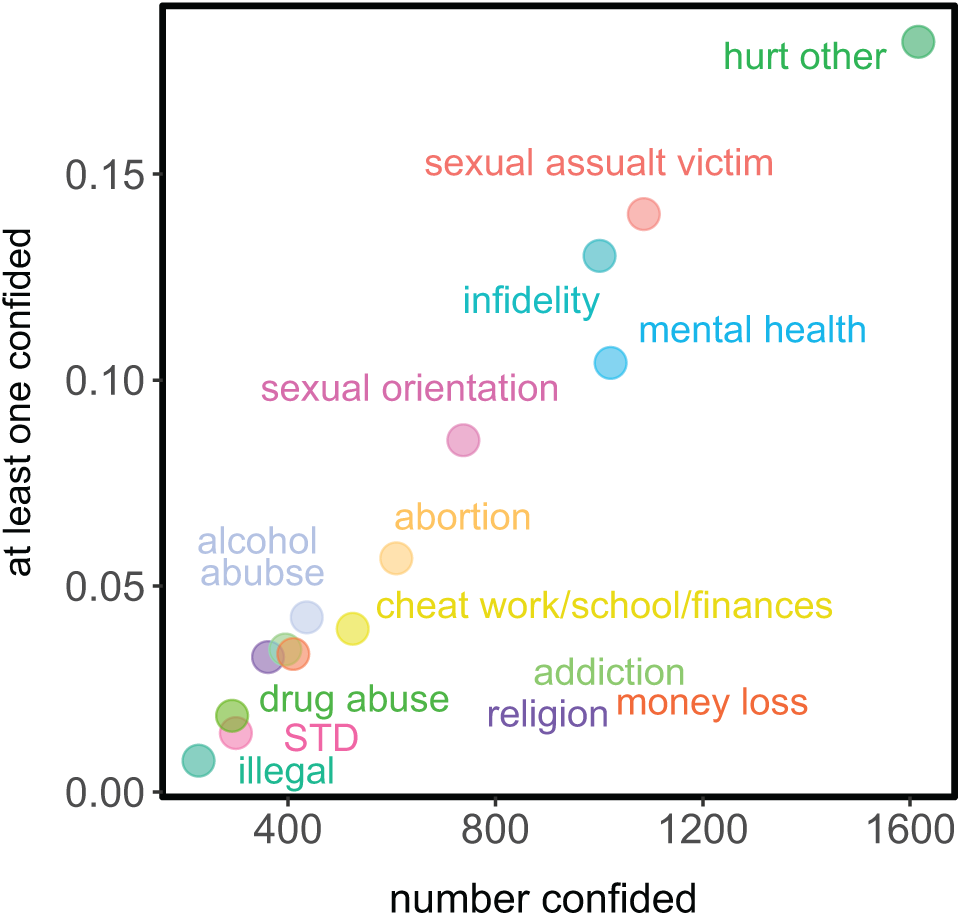
Secrets confided in participants, by category of secret (across Studies 2-4). These categories of secrets predated the more comprehensive set of categories provided by the Common Secrets Questionnaire (Slepian et al., 2017).
Participants indicated if and how many people confided such a secret (i.e., allowing participants to indicate multiple people having confided the same category of secret). We took a count of the total number of secrets participants had confided in them. As this measure is unbounded, we first examined the data for outliers. Our analysis plan was to analyze only secrets confided within three standard deviations from the mean. Here, and in every study with this unbounded measure, we thus excluded data points that were outside three standard deviations (SD = 9.37) from the mean (M = 8.48). Responses outside this range (n = 4) fell outside the normal range of the distribution. These count outcomes were then modeled in all studies using Poisson regression.
Results and discussion
After exclusions, participants had M = 7.65 secrets confided in them across the 14 categories, which includes when people had multiple instances of the same category of secret confided in them from different people (SD = 7.22, 95% CI = [6.64, 8.67]). We entered participants’ measured trait compassion, politeness, assertiveness, and enthusiasm as simultaneous predictors of the number of secrets confided in participants. Compassion and assertiveness positively predicted the number of secrets participants were told. Enthusiasm and politeness negatively predicted having secrets confided in oneself (Table 2 presents zero-order correlations and descriptives; Table 3 presents Poisson regression results).
Zero-Order Correlations of Variables in Study 2.
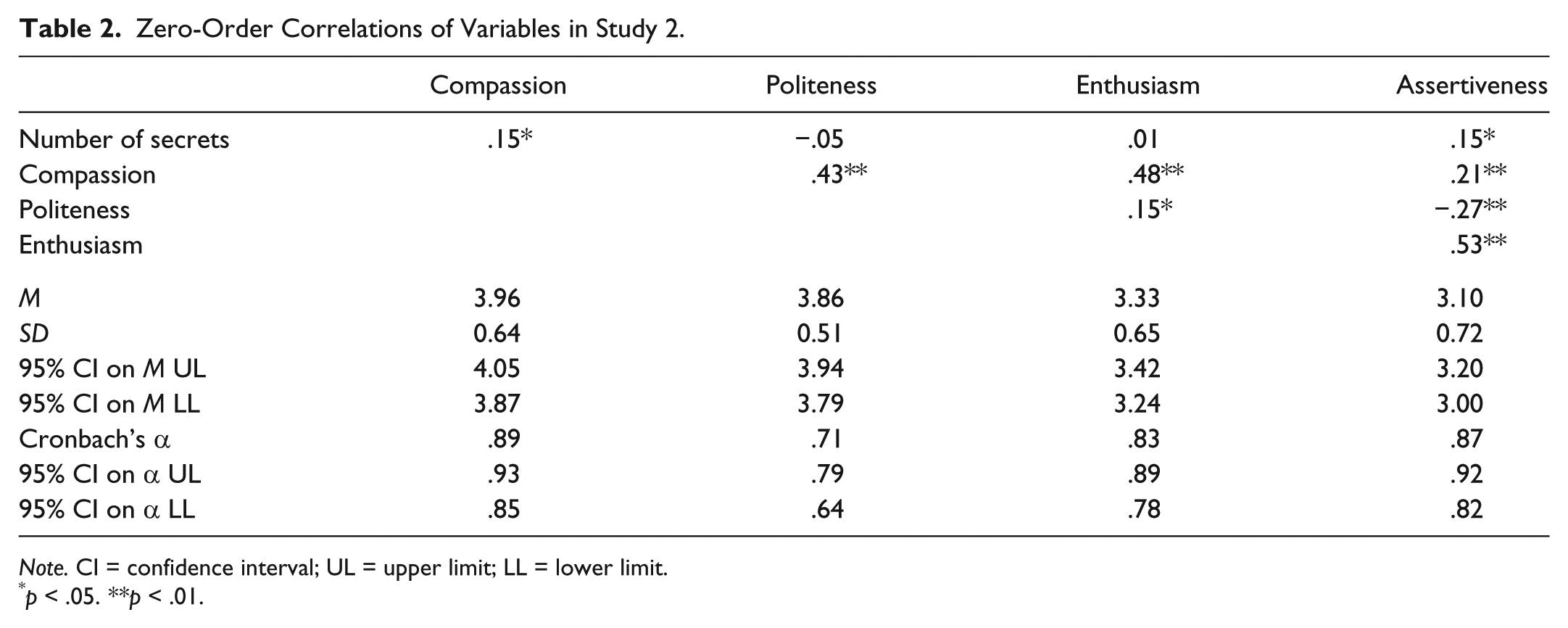
Note. CI = confidence interval; UL = upper limit; LL = lower limit.
p < .05. **p < .01.
Independent Effects of Interpersonal Aspects in Predicting Number of Secrets Confided.
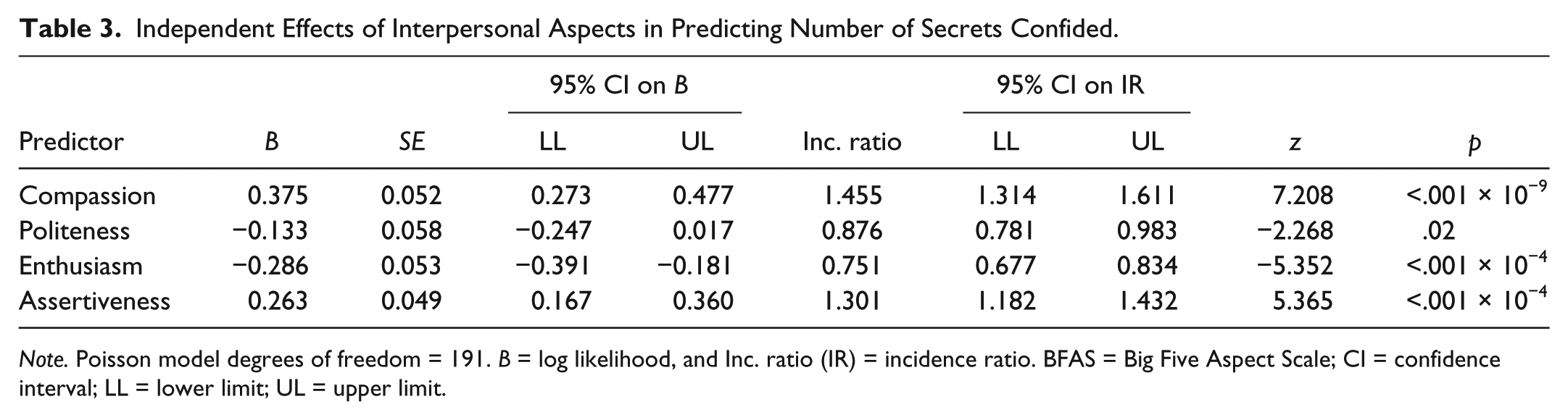
Note. Poisson model degrees of freedom = 191. B = log likelihood, and Inc. ratio (IR) = incidence ratio. BFAS = Big Five Aspect Scale; CI = confidence interval; LL = lower limit; UL = upper limit.
The aspects that make up agreeableness diverged from each other in predicting having secrets confided in oneself. Independent of the other aspects, compassion predicted having more confided secrets, and politeness predicted having fewer confided secrets. Perhaps people think compassionate people may care and feel for them (e.g., “feels others’ emotions,” “sympathize with others’ feelings”), and that polite people may be more concerned with social norms and social rules than the secret keeper’s emotions (e.g., items “respects authority,” “hates to seem pushy”).
The aspects that make up extraversion also diverged from each other in predicting having secrets confided in oneself. Independent of the other aspects, assertiveness predicted having more confided secrets, and enthusiasm predicted having fewer confided secrets. Perhaps people think assertive people may go out of their way to help the revealer (e.g., “can talk others into doing things,” “takes charge”), and that enthusiastic people may not be serious enough for a confidant (e.g., items “laughs a lot,” “has a lot of fun”).
Recall that our initial prediction was regarding compassion. Indeed, we found that trait compassion predicted having more secrets confided in oneself. Given that we did not make predictions about aspects other than compassion, the relationships with other aspects warrant replication.
Study 3: Interpersonal Aspects After Intrapersonal Controls
Study 3 was a replication of Study 2, but with the addition of measuring the remaining six intrapersonal aspects measured by the BFAS, and thus Study 3 measured all aspects captured by the BFAS.
Method
Participants (N = 500 from MTurk; 59% female; Mage = 34.51 years, SD = 11.40), completed the 10 aspects from the BFAS [larger domain in brackets], (a) compassion and (b) politeness [agreeableness], (c) assertiveness and (d) enthusiasm [extraversion], (e) volatility and (f) withdrawal [neuroticism], (g) industriousness and (h) orderliness [conscientiousness], and (i) intellect and (j) openness [openness/intellect], 100 randomly ordered items, 10 per trait (1 = strongly disagree to 5 = strongly agree). Given the multiple independent variables, we felt it important to increase the sample size from the prior studies for more robust results. Subsequently, participants completed the same retrospective measure of the number of secrets confided in them from Study 2 (α = .72).
As in Study 2, our focus is on interpersonal personality aspects; we did not have specific predictions regarding the intrapersonal aspects. That is, we predicted that when controlling for intrapersonal aspects of personality, each of the interpersonal aspects would again predict the number of secrets confided in participants: compassion and assertiveness predicting increased instances of being confided in, and politeness and enthusiasm predicting decreased instances of being confided in. Again, we analyzed only secrets confided within three standard deviations (SD = 15.65) from the mean (M = 8.73; responses outside this range, n = 8, fell outside the normal range of the distribution).
Results
After exclusions, participants had M = 7.28 secrets confided in them (SD = 8.34, 95% CI = [6.54, 8.02]). We next entered all 10 aspects measured by the BFAS as simultaneous predictors of having a secret confided in oneself (Table 4 presents zero-order correlations and descriptives; Table 5 presents regression results).
Zero-Order Correlations of Variables in Study 3.
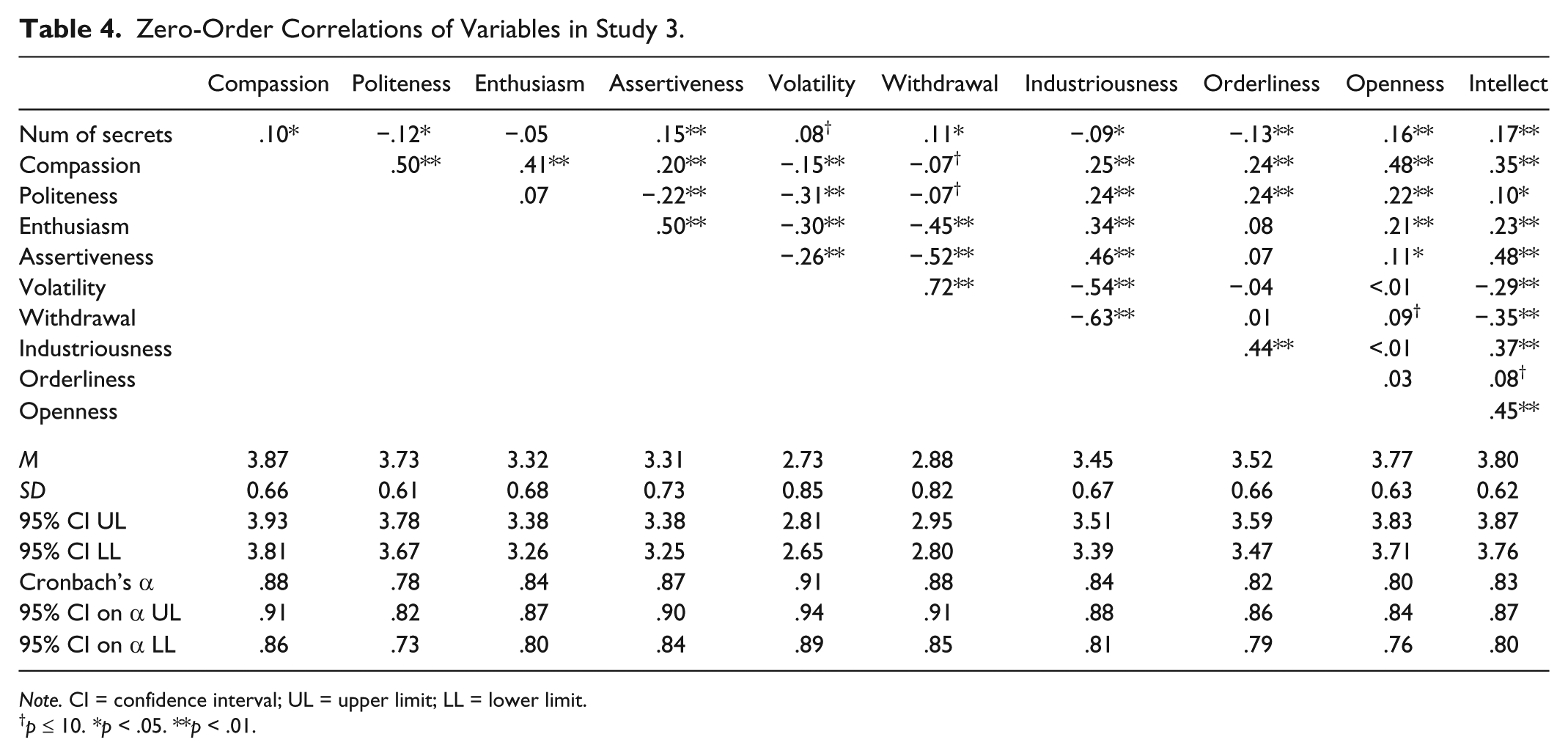
Note. CI = confidence interval; UL = upper limit; LL = lower limit.
p ≤ 10. *p < .05. **p < .01.
Independent Effects of Personality Aspects in Predicting Number of Secrets Confided in Oneself.
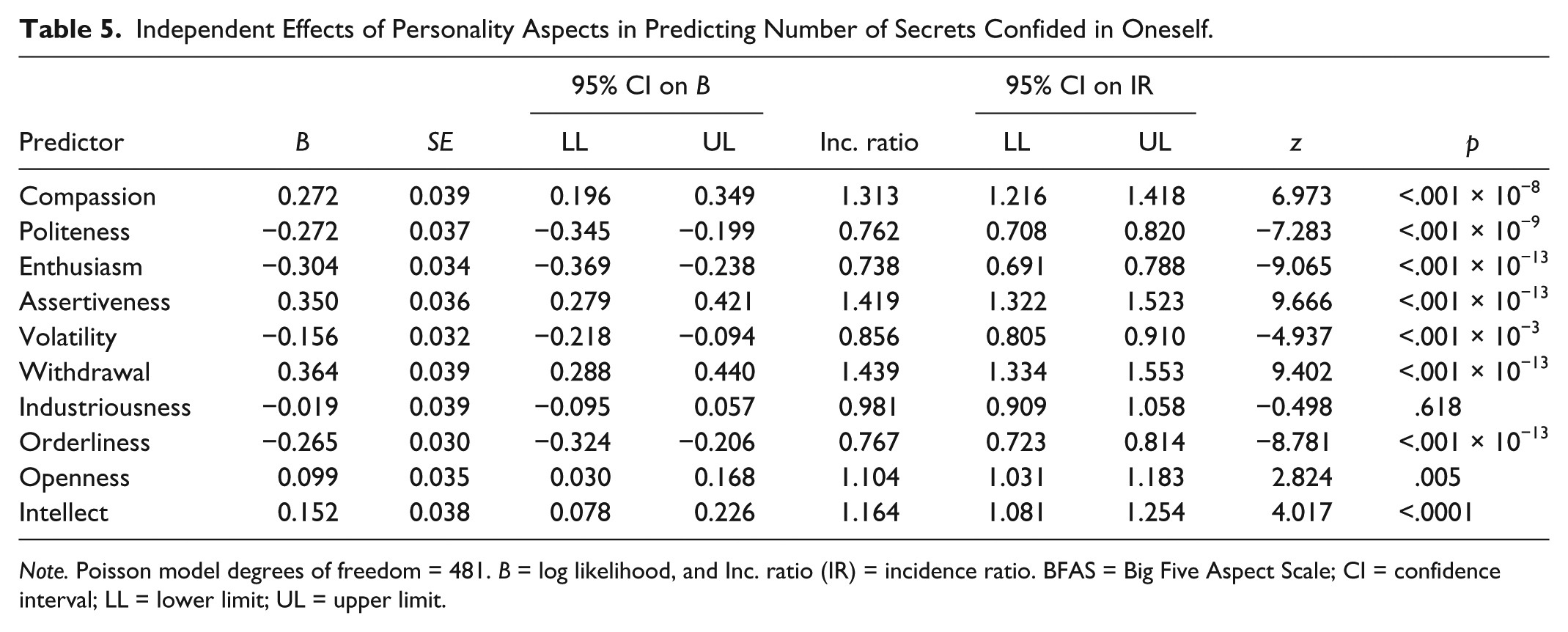
Note. Poisson model degrees of freedom = 481. B = log likelihood, and Inc. ratio (IR) = incidence ratio. BFAS = Big Five Aspect Scale; CI = confidence interval; LL = lower limit; UL = upper limit.
Interpersonal aspects
With 500 participants and now also controlling for intrapersonal aspects of personality, each of Study 2’s effects replicated. Compassion and assertiveness predicted being confided in more, whereas politeness and enthusiasm predicted being confided in less. Thus, people were more likely to reveal secrets to people who are empathic and caring (compassionate) and agentic (assertive) in social interactions. But people are less likely to confide in people who merely enjoy social interactions (enthusiasm) or focus on respecting social rules and norms (politeness).
Control variables (intrapersonal aspects)
Recall that the goal of Study 3 was to examine the effects of interpersonal aspects (from Study 2), after controlling for the set of variables that are intrapersonal in nature. That said, it may be of interest to discuss how these control variables relate to being confided in (see Table 5).
Independent of other aspects, for the larger domain of neuroticism, people who are susceptible to negative affect and have their own emotional struggles (withdrawal) were more likely to have others’ secret struggles confided in them, whereas being irritable (volatility) was associated with being confided in less.
Independent of other aspects, for the larger domain of conscientiousness, people who want everything to be “just right” (orderliness) were less likely to have secrets confided in them, whereas there was no relationship with being a hard worker (industriousness). The effect of orderliness calls to mind the social rule-following nature of politeness. That is, for people who want things to be “just right” (i.e., the rule-following nature of the conscientious), they are less likely to be confided in. And for those concerned with social rules and norms (the polite), they too, are confided in less.
Independent of other aspects, for the larger domain of openness/intellect, both openness and intellect were associated with having more secrets confided in oneself.
Discussion
In Study 2, we found that compassion and assertiveness predicted being confided in more, whereas politeness and enthusiasm predict being confided in less. Study 3 replicated each of these effects, while also including a set of control variables (i.e., intrapersonal aspects of personality).
Thus, even independent of intrapersonal qualities of a person, we see consistent patterns of effects with respect to how they act toward other people (i.e., interpersonal aspects of personality). The more people express empathy, caring tendencies, and a desire to help others (compassion), the more other people, in turn, confide secrets in them. Thus, we confide in those who we expect to be nonjudgmental, caring, and motivated to help. Yet, we also see consistent evidence that another interpersonal trait is important to confiding, and that is assertiveness. A goal of confiding is likely to obtain some help from the confidant. Those who are assertive will help and act even in the face of obstacles (Hirsh & Peterson, 2009). Thus, people do not just confide in those who are motivated to help, but confide in those who are more likely to have the drive to actually take action when it is needed.
The other two interpersonal traits were consistently linked to reduced confiding. Enthusiasm was consistently linked with less instances of being confided in. Enthusiastic people enjoy social interactions, express positive affect, and are gregarious (Barford et al., 2015; DeYoung et al., 2013). Although there is a clear positive element to such sociality, it seems to not be favorable for eliciting disclosure of secrets; we seem to not confide in people who are the life of the party and who love to have fun (Barford et al., 2015; DeYoung et al., 2013). While a somewhat outdated term, “happy-go-lucky,” well describes the enthusiasm aspect (Grant & Holmes, 1981; Noller, Law, & Comrey, 1987; Smith & Nelson, 1975). Such positive sociality independent of empathy and compassion predicted being confided in less.
Finally, whereas participants in Study 1 predicted that they would confide in someone who was merely polite, Studies 2 and 3 consistently show that when it comes to actual confiding, people are less likely to confide in those who are polite. On the face of it, it would seem politeness would be desirable (indeed our participants thought so in the abstract). Yet, the value of using the BFAS is that it measures politeness, separate from compassion. That is, politeness here is not caring for others, but rather another flavor of agreeableness, one centered around being respectful toward others, being unassuming, and following norms (Barford et al., 2015; DeYoung et al., 2013; Zhao, Ferguson, & Smillie, 2017a, 2017b, 2017c). This sort of agreeableness does not have an empathic or agentic component, and thus turns out to be something that discourages confiding, as demonstrated by Studies 2 and 3.
Study 4: Interpersonal Aspects After Intrapersonal and Network Size Controls
Study 4 was a replication of Study 3, but with the addition of a new measure. For instance, the more compassionate the participant is, the more easily the participant might make close social connections, yielding a larger social network. Those with larger social networks may then have more secrets confided in them due to an increased frequency of intimate social interactions (see also Cowan, 2014). Study 4 tested for this possibility.
Method
The current participant sample was a convenience sample, whereby we grouped the current study into a series of studies that were run in one session. This multisession study collected 600 participants (from MTurk; 60% female; Mage = 33.83 years, SD = 11.23). Critical to the current work, participants first took part in the current study (before completing other studies). The procedure was identical to Study 3, except that along with demographics questions, we asked “How many very good friends would you say you have?” (M = 4.50, SD = 3.44, 95% CI = [4.23, 4.78]), “How many family members are you very close to?” (M = 4.41, SD = 5.61, 95% CI = [3.96, 4.86]), and “How many coworkers are you very close to?” (M = 2.29, SD = 2.96, 95% CI = [2.05, 2.52]). We took the sum of these three counts as an index of close social network ties (M = 11.21, SD = 8.67, 95% CI = [10.45, 11.97]).
Study 4 asked participants at the end of the study, whether they provided honest responses in the study (wherein honesty was encouraged to help the researchers). Additionally, given that the study was conducted close in time to other studies on secrecy conducted by the first author, we also asked participants if they recently participated in a study on secrecy. The 66 participants (11%) who had recently participated in a study on secrecy were excluded from analysis. In addition, the 19 participants (3%) who admitted to providing dishonest responses were also excluded. Finally, as with each of the other studies, we analyzed only secrets confided within three standard deviations (SD = 9.75) from the mean (M = 8.98; responses outside this range, n = 12, fell outside the normal range of the distribution). This yielded a final sample of 503 participants.
Results
After exclusions, participants had M = 7.94 secrets confided in them (SD = 6.80, 95% CI = [7.34, 8.54]). We entered all 10 aspects measured by the BFAS and the measure of participants’ number of close social network ties as simultaneous predictors of having a secret confided in oneself (α = .67; Table 6 presents zero-order correlations and descriptives; Table 7 presents regression results).
Zero-Order Correlations of Variables in Study 4.
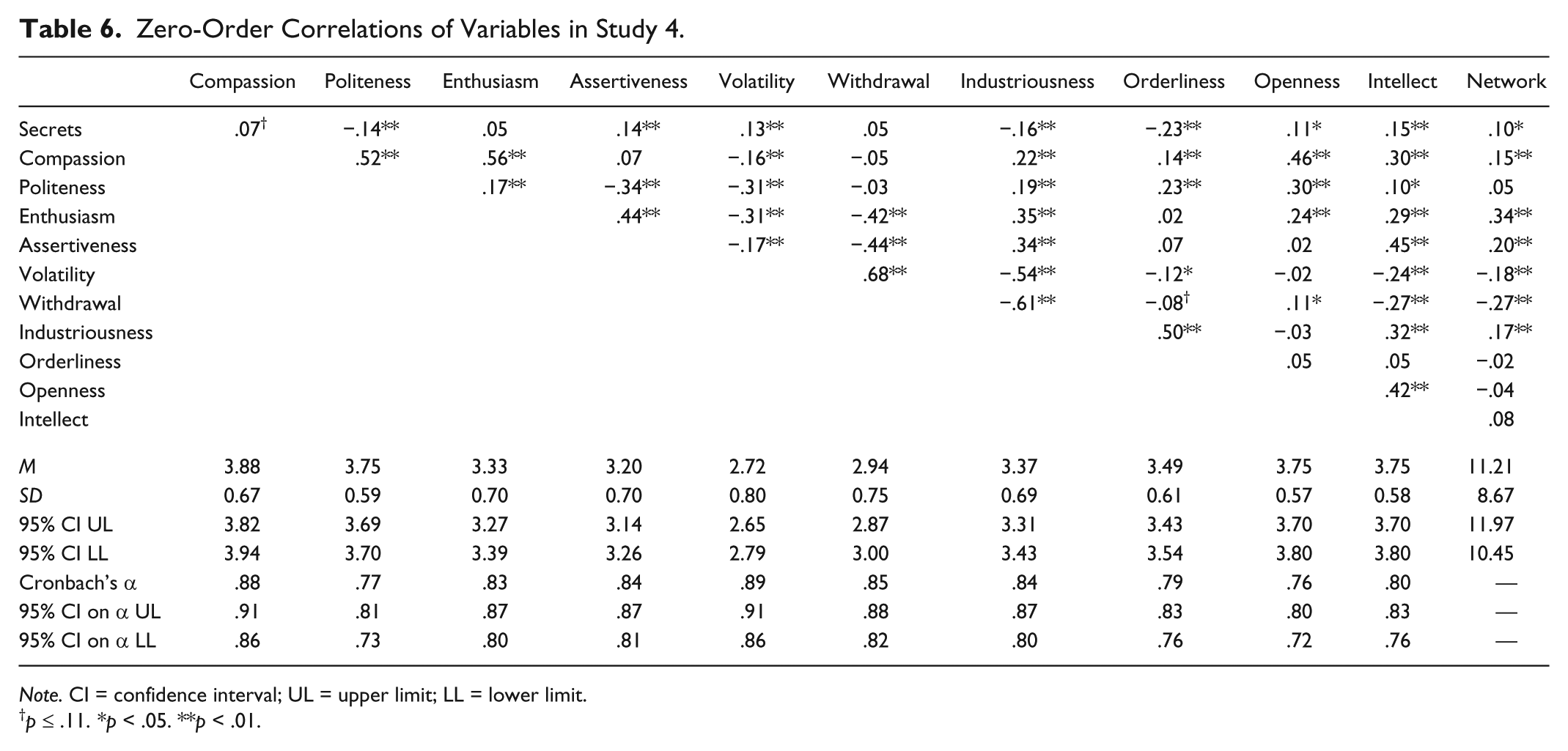
Note. CI = confidence interval; UL = upper limit; LL = lower limit.
p ≤ .11. *p < .05. **p < .01.
Independent Effects of Number of Close Social Network Ties and Personality in Predicting Number of Secrets Confided in Oneself.
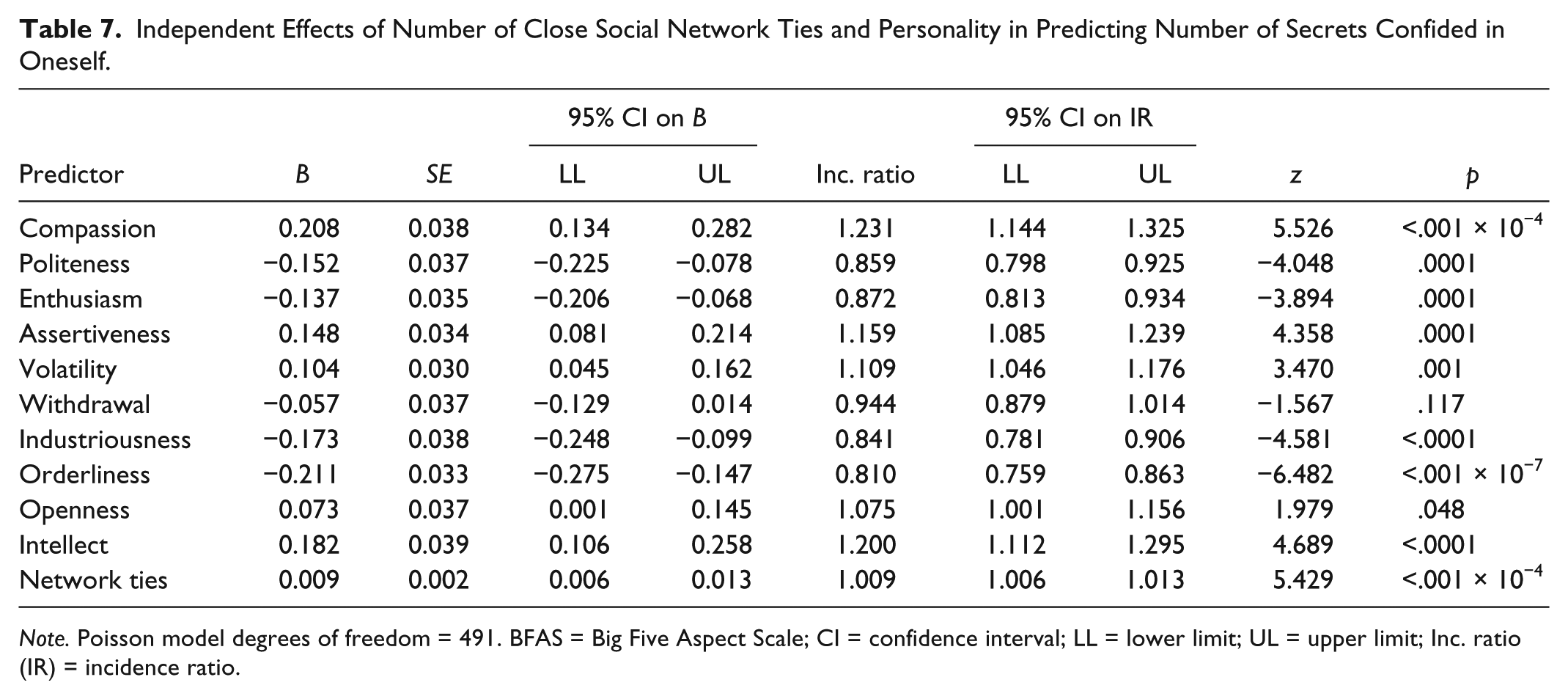
Note. Poisson model degrees of freedom = 491. BFAS = Big Five Aspect Scale; CI = confidence interval; LL = lower limit; UL = upper limit; Inc. ratio (IR) = incidence ratio.
Interpersonal aspects
Independent of other (intrapersonal) aspects of personality and participants’ number of close others, compassion and assertiveness again predicted having more secrets confided in oneself, whereas enthusiasm and politeness again predicted having fewer secrets confided in oneself.
Control variables (network ties and intrapersonal aspects of personality)
Close social network ties
Independent of aspects of personality, the more close social network ties participants have, the more secrets were confided in them. In other words, having more close others increased the likelihood that participants learned others’ secrets.
Intrapersonal aspects
Again, for the interested reader, we review the relationships between our control variables (i.e., the intrapersonal aspects of personality) and being confided in.
With respect to the larger domain of neuroticism, volatility (but not withdrawal) predicted having more secrets confided in oneself (whereas withdrawal predicted having more secrets confided, and volatility less secrets confided, in Study 3).
With respect to the larger domain of conscientiousness, both industriousness and orderliness predicted having fewer secrets confided in oneself (whereas this negative relationship was only found with orderliness in Study 3).
With respect to the larger domain of openness/intellect, openness (i.e., appreciating esthetics, imagination) and intellect both predicted increases in being confided in (both relationships were also found in Study 3).
Discussion
With respect to our control intrapersonal variables, across Studies 2 and 3, there was not overwhelming consistency for how intrapersonal aspects of personality predict being confided in. Orderliness (wanting everything to be “just right”) was consistently related to having fewer secrets confided in oneself, and both openness and intellect were consistently associated with having more secrets confided in oneself. The other intrapersonal traits (volatility, withdrawal, and industriousness) did not show consistent relationships with being confided in. Thus, it seems that qualities of a person that are not interpersonal in nature are not consistently related to being confided in. This is in contrast to our findings on interpersonal aspects of personality, whereby we find reliable and consistent effects per each interpersonal aspect of personality: Compassion and assertiveness predicted being confided in more, whereas enthusiasm and politeness predicted being confided in less.
One limitation of Studies 2 and 3 is the use of self-report. Research examining personality aspects using the BFAS commonly relies on self-report methods (e.g., DeYoung, Grazioplene, & Peterson, 2012; Hirsh, DeYoung, Xu, & Peterson, 2010; Zhao et al., 2017a, 2017c), but it could be subject to bias. There are several reasons why the use of self-report, however, should not cast doubt on our conclusions. For instance, self-reported compassion is a well-known predictor of compassionate behavior (e.g., helping behavior; Leaviss & Uttley, 2014; Leiberg, Klimecki, & Singer, 2011; McCullough, Kilpatrick, Emmons, & Larson, 2001; see also Graziano, Habashi, Sheese, & Tobin, 2007). Likewise, enthusiasm does indeed predict positive affect (Smillie, DeYoung, & Hall, 2015), assertive people are indeed more approach motivated and less distressed by potential obstacles of their pursuits (Hirsh & Peterson, 2009), and politeness does indeed predict adherence to norms (Zhao et al., 2017a, 2017b, 2017c).
Alternately, perhaps participants do not recall with perfect accuracy the secrets that have been confided in them. That is, perhaps these retrospective reports are biased. We suggest that such instances of confided significant secrets (e.g., abortion, infidelity) are fairly salient, and thus hard to forget. To the extent participants misjudge the number of secrets confided in them, this should only serve as noise working against the current hypotheses.
Yet, if there were systematic misjudgments by self-reported personality, this would cause concern for validity. Specifically, if a self-perception process (Bem, 1972) were weighing into these judgments, this would be problematic.Our results speak against this alternative explanation, however. In Study 1 (as well as an exact replication in Supplemental Material), participants rated interpersonal aspects on how much they think they would matter for confiding in another. Assertiveness was rated as the least desirable interpersonal personality aspect in a confidant. By a self-perception account, assertive people would think, “People do not prefer to tell secrets to assertive people. I am assertive, and so very few people must have confided secrets in me.” Yet for zero-order associations, and when controlling for other aspects, the more assertive our participants, the more secrets they had confided in them (Studies 2, 3, and 4).
Likewise, when it comes to what people predict will matter for a confidant, participants suggested that they think politeness would be more important in a confidant than enthusiasm and assertiveness. Correspondingly, when it comes to rating one’s own personality, polite people would think, “People prefer to tell secrets to polite people. I am polite, and so many people must have confided secrets in me.” Yet, we did not find this pattern of results either. In zero-order associations, politeness was either unrelated to the number of secrets confided (Study 2), or inversely related to the number of secrets confided in oneself (Studies 3 and 4). And in Studies 2, 3, and 4, when controlling for other aspects, politeness was associated with having fewer secrets confided in oneself.
In other words, the personality portfolios of predicted confidants do not match those reported of actual confidants, and thus a self-perception process whereby people draw from self-perceived personality to guide their judgments of the number of secrets confided in them would not yield the current patterns of results. We also feel these patterns of results rule out an account driven entirely by social desirability. While it may be socially desirable to claim one is compassionate, it should also be socially desirable to claim politeness and enthusiasm; yet these latter traits predicted having fewer secrets confided in oneself. Moreover, with respect to the larger domain of agreeableness, self-reports of agreeableness are not reducible to a social desirability bias (Graziano & Tobin, 2002).
Study 5: Do Peer-Ratings of Interpersonal Traits Predict Confiding?
By utilizing the BFAS, we find reliable patterns of results with the interpersonal aspects of personality that would have been confounded with a higher level domain approach. That is, a combination of compassion and politeness makes up agreeableness, but these two aspects diverge from each other in predicting being confided in. Likewise, assertiveness and enthusiasm make up extraversion, but they diverge in predicting being confided in.
Study 5 builds upon the prior studies by avoiding any issue with the participant rating both their own personality and the number of secrets confided in them. That is, we have participants think of people whom they know, and rate those individuals’ personalities, and asked participants to report whether they had ever revealed a secret (told to no one else) to each of those targets.
Method
Four hundred participants (from MTurk; 61% female; Mage = 35.98 years, SD = −12.01) were asked to think of five good friends, and per each, list the person’s first name and last initial. In one block, participants rated per each randomly ordered target, a peer-report of compassion, politeness, enthusiasm, and assertiveness from the BFAS (1 = strongly disagree to 5 strongly agree). In another block, they reported if they had ever revealed a secret to each of the five targets (told to no one else), and if so, how many. The order of personality and secret report blocks was randomized.
Results and discussion
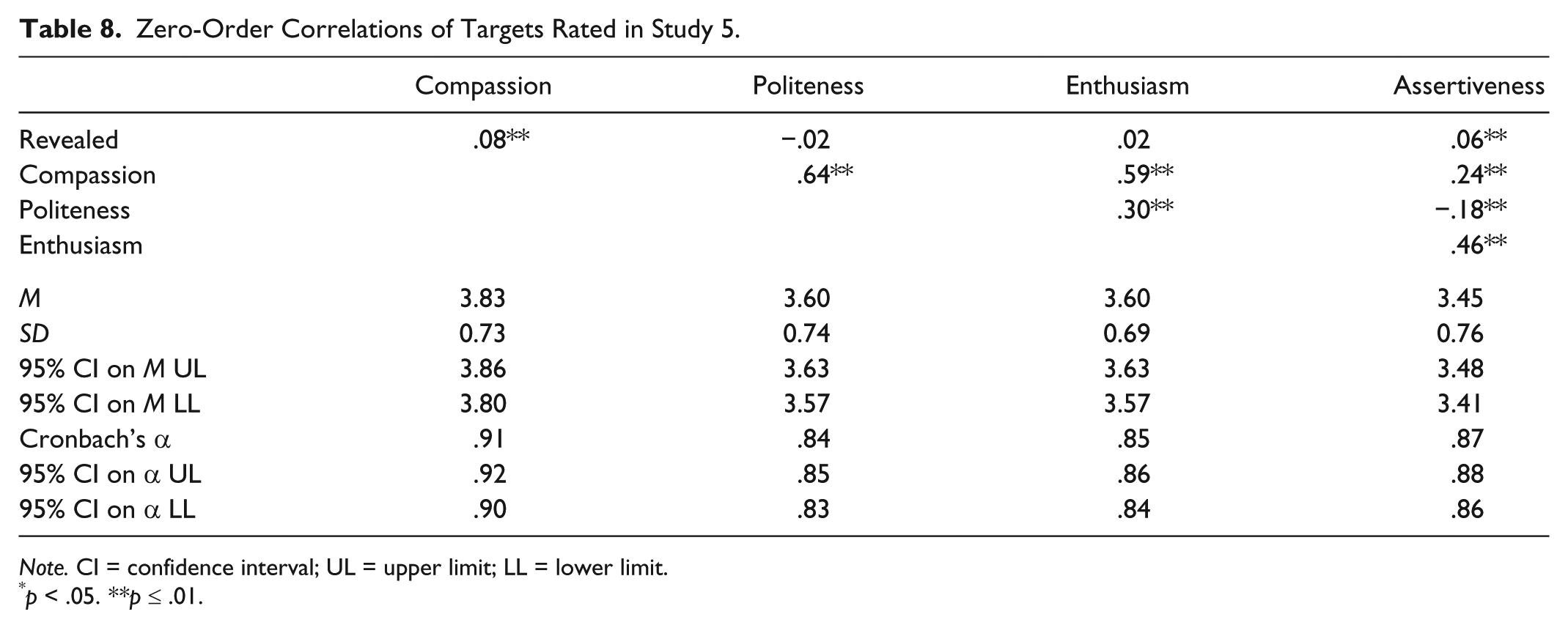
We present the zero-order associations in Table 8 (but caution the reader such descriptives fail to account for the nested nature of the data). To account for the nested nature of the data, whereby we have 5 scores per each interpersonal aspect, per then each participant, we analyzed data with multilevel modeling. We used the R package linear mixed-effects model (lme4) to implement Poisson multilevel models for count outcomes (Bates, Maechler, Bolker, & Walker, 2015), and R package lmerTest ran lme4 models through Satterthwaite approximation tests to estimate the degrees of freedom (scaling the model estimates to best approximate the F distribution, and thus are fractional and differ across tests; Kuznetsova, Brockhoff, & Christensen, 2013). As in the other studies, we analyzed only secrets confided within three standard deviations (SD = 15.71) from the mean (M = 6.63; as responses outside this range, n = 16, fell outside the normal range of the distribution). 2
Zero-Order Correlations of Targets Rated in Study 5.
Note. CI = confidence interval; UL = upper limit; LL = lower limit.
p < .05. **p ≤ .01.
We entered each interpersonal aspect as a fixed factor, and participant as a random factor, predicting the amount of past secret revelation to targets; participants had revealed M = 4.63 secrets to each of the good friends, SD = 6.68, 95% CI = [4.15, 15.12]. See Table 8 for descriptives, but note that correlations do not account for the nested nature of the data.
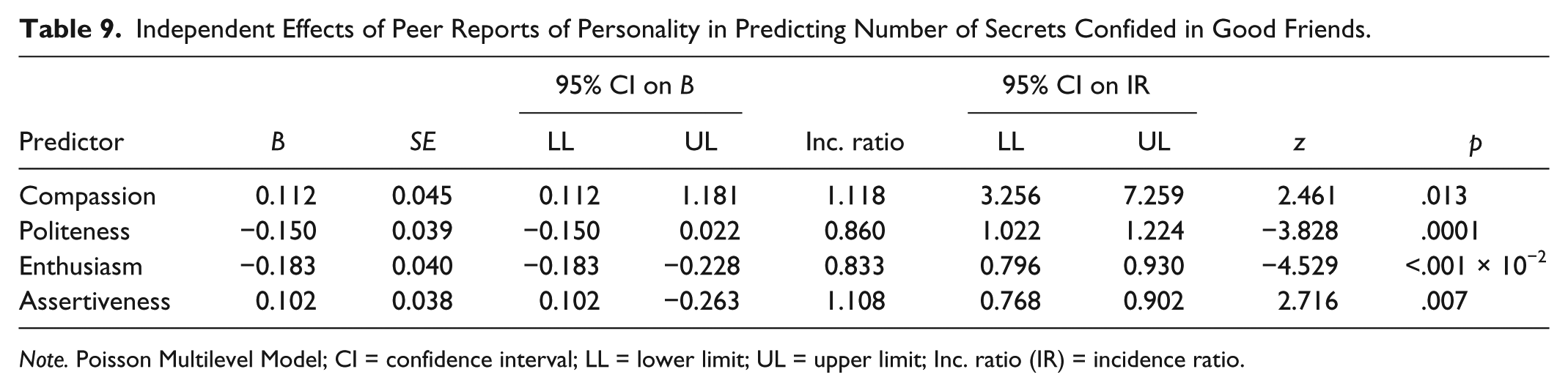
Independent of other aspects, the more compassionate and assertive participants rated their friends, the more secrets they had confided in them, and the more polite and enthusiastic participants rated their friends, the less secrets they had confided in them (Table 9).
Independent Effects of Peer Reports of Personality in Predicting Number of Secrets Confided in Good Friends.
Note. Poisson Multilevel Model; CI = confidence interval; LL = lower limit; UL = upper limit; Inc. ratio (IR) = incidence ratio.
General Discussion
Who gets told secrets? The more compassionate and assertive someone is, the more likely it is that secrets get confided in them. Yet, the more enthusiastic and polite someone is, the less likely it is that secrets are confided in them. These findings offer novel theoretical implications for research on secrecy, personality theory, interpersonal traits, and affiliation, of which we discuss each in turn.
Implications for Secrecy
Secrecy is associated with negative well-being outcomes (Larson & Chastain, 1990; Slepian et al., 2017). Yet, by keeping something shameful or stigmatizing a secret, people protect their self-image, their reputations, and their relationships with close others. Secret keeping thus presents a social bind. On one hand, keeping a secret could be isolating and bring negative well-being outcomes (Larson & Chastain, 1990; Larson et al., 2015; Slepian et al., 2017). On the other hand, revealing a shameful secret could yield social rejection (Kelly & McKillop, 1996). People might communicate the learned negative information to other people, tarnishing one’s reputation, which can lead to ostracism. Thus, there is an inherent challenge to secrecy: Should the secret keeper tell someone, and if so, whom should they tell?
If the secret keeper has no one to confide in, the secret keeper could obtain some relief from revealing the secret anonymously (Slepian, Masicampo, & Ambady, 2014). Otherwise, expressive writing about the secret in a private journal or online could lead to well-being benefits by allowing the secret keeper to obtain new insights into the personal event or detail (Pennebaker, 1989; Sheese, Brown, & Graziano, 2004). Interestingly, it seems that expressive writing yields increased health benefits for those who are highly social and have large social networks (Sheese et al., 2004). This suggests that highly social people who engage in such exercises might go on to talk to others about their trauma, and that discussion with a live person might yield more benefits. For secrecy, however, revealing a secret to the wrong person could prove to be deleterious (Kelly & McKillop, 1996; Kelly & Yip, 2006; Macready, Cheung, Kelly, & Wang, 2011). Revealing negative information about oneself to other people can sometimes lead to negative responses from others and unhelpful comments; thus, if a secret is to be revealed, it is crucial to reveal the secret to the right person (Kelly & McKillop, 1996). Indeed, recent work reveals that when confiding is met with adequate social support, one has higher well-being from such confiding; yet, when confiding is not met with social support, confiding can backfire, with lower well-being as a result (Slepian & Moulton-Tetlock, 2018).
Prior work has examined who is more likely to conceal information from other people (Larson et al., 2015). Yet no prior work has examined to whom people reveal secrets. We find that trait compassion and assertiveness predict being confided in, whereas trait politeness and enthusiasm predict being confided in less. We find these results when asking participants to self-report their personalities and how many secrets have been confided in them as well as when asking participants to provide reports of their friends’ personalities and how many secrets participants have confided in them. Intriguingly, as discussed in the following section on politeness, our participants predicted they would confide in polite individuals, but mere politeness (respect for social rules irrespective of empathy) actually predicted being confided in less.
Future work should examine not just the qualities of the person who is confided in, but also how they feel about having been confided in. One recent set of studies finds that being confided in can be both a burden, but also a relational boost (Slepian & Greenaway, 2018). That is, one must now keep the secret on the other’s behalf, which can prove burdensome. Yet, as disclosure is an act of intimacy, being confided in can also make one feel closer to the person who confided. Future work could examine how these effects change with the personality of the confidant. For instance, those who are more confided in (i.e., the compassionate, the assertive) might experience more of the benefit of being a confidant (feelings of intimacy), whereas those who are less confided in (i.e., the polite, the enthusiastic), might experience more of the burden from being a confidant. Or, perhaps it is the reverse. Does experience with being a confidant change what it is like to be confided in? Future work should examine downstream consequences of being confied in.
Implications for Personality Theory
The current work speaks to the two major models of interpersonal aspects of personality. In one model, the interpersonal circumplex model (Gurtman, 2009; Wiggins, 1979), personality can be described as a combination of two major “causal forces” (e.g., agency and communion) and different blends of these social forces yield all social behavior. For example, high agency and high communion is akin to extraversion, whereas low agency and low communion is akin to introversion. Moreover, these different combinations can be plotted along a circle, representing the degree to which the two traits combine.
A second, and distinct, model of personality is the factor model, whereby there is a need to measure more “casual forces” to explain how people act around others (see DeYoung et al., 2012; Hirsh et al., 2010; Zhao et al., 2017a, 2017b, 2017c). The BFAS identifies four such factors (compassion, politeness, assertiveness, and enthusiasm). Compassion and politeness are highly related in the circumplex model (both making up agreeableness), but we find they diverge from each other in predicting being confided in. Likewise, assertiveness and enthusiasm are highly related in the circumplex model (both making up extraversion), but we find they diverge from each other in predicting being confided in. Thus, while the four interpersonal aspects can fit around a circle as predicted by the circumplex model (DeYoung et al., 2013), in the context of the current work, these four aspects do not seem reducible to agency and communion.
In other words, our results suggest that compassion, politeness, assertiveness, and enthusiasm are not each some blend of agency and communion, but rather that each represents distinct social causal forces. Enthusiasm propels people to find social interactions enjoyable, politeness propels people to follow social rules and social norms, assertiveness propels people toward taking action, and compassion propels people to be caring and empathic toward other people. Our results support this theoretical perspective given that we find that for each larger interpersonal domain, its two interpersonal aspects diverge from each other in predicting who gets told secrets.
These findings underscore the importance of recognizing that the Big Five domains are composed of distinct aspects (e.g., Hirsh et al., 2010; see also DeYoung et al., 2012; Hofstee et al., 1992; Zhao et al., 2017a, 2017b, 2017c), but also extend this thinking. That is, rather than demonstrate how these aspects of personality predict individuals’ behaviors, we used these aspects to predict how people elicit behaviors from other people.
Future work would benefit from other measures of confiding. One could envision a laboratory paradigm that might encourage the revelation of personal information, and see if people are more or less disclosing when interacting with someone depending on the other person’s personality. However, such an experimental paradigm would be fairly artificial, and test a different research question (i.e., disclosing to strangers in the lab), which also would rely on participants feeling they have a good sense of the other’s personality. It would be unlikely to capture the disclosure of significant secrets to known others that the current work is interested in (e.g., engaging in infidelity, having had an abortion, being a victim of sexual assault, and disclosing this to a close other). Nonetheless, such a paradigm would be informative, and thus an area for future research.
While prior work has theorized about the situational factors that may determine confiding, to date individual differences have only been suggested to moderate such situational factors (Omarzu, 2000) rather than predict confiding across the diversity of situations that confiding occurs in. Personality aspects should be one of many factors that influence whether a secret is confided, and thus should perhaps explain only a small portion of variance, relative to the large number of situational factors that determine whether someone confides a secret.
The current work has much scope for future research. With respect to confiding secrets and personality, future work should examine not just the amount of secrets that are confided in someone, but also the kinds of secrets that get confided in others and how this might relate to personality. Moreover, as discussed earlier, future work could examine how people react to being confided in, and how people feel after confiding as moderated by the personality of the confidant. Perhaps instances of confiding are more helpful to both parties when fitting with whom is typically confided in (compassionate and assertive), whereas instances of confiding might go less well when choosing less typical targets of confiding (polite and enthusiastic). The merely polite and merely enthusiastic should have less experience and practice with helping people with their secrets, relative to the compassionate and assertive who are confided in more.
Implications for Interpersonal Aspects of Personality
Compassion
If people experience an episode or have a personal detail that is shameful or stigmatizing, secrecy is a strategy one might use to avoid potential harm to one’s reputation. Keeping secrets is thus a self-protection strategy to prevent potential harm, but it can have the inadvertent cost of perpetuating one’s own suffering (Kelly & McKillop, 1996; Slepian & Bastian, 2017). Compassion, however, helps alleviate others’ suffering. Compassion has been conceptualized as a set of interrelated attributes and behaviors that help cultivate interpersonal exchanges, down-regulating threat, creating a safe space for differing perspectives, and promoting empathic understanding (Gilbert, 2014). The current work presents the first evidence that compassion is associated with being confided in.
Compassion helps promote connectedness and a feeling of safety, which should provide an opportunity to share, reveal, and disclose secrets to validate, better understand, and gain new insights into the secret itself. In a clinical context, patients wish to be viewed positively by health care providers, and thus they fear disclosing negative information (Leary & Kowalski, 1990). There are many system-based pressures that health care providers encounter that impact their ability to be attentive to their patients (Seppala, Hutcherson, Nguyen, Doty, & Gross, 2014). Therefore, implementing compassion-based interventions as a way to help train health care professionals could increase compassion, and thus increase the likelihood of patients being open and self-disclosing to their health care professionals, yielding more effective and targeted treatment.
Indeed, there are a number of compassion-based interventions, such as Compassion-Focused Therapy (Gilbert, 2014), Mindful Self-Compassion (Neff & Germer, 2013), or Compassion Cultivation Training (Jazaieri et al., 2013) programs that all aim to increase compassion. A meta-analysis of compassion-based interventions that included 21 randomized controlled studies found that these interventions have a significant moderate effect size on cultivating compassion (as well as reducing stress, depression, and anxiety; Kirby, Tellegen, & Steindl, 2017; see also Kirby, 2017).
Politeness
A few past studies have distinguished between compassion and politeness (the traits that make up agreeableness). For instance, in the domain of politics, the egalitarianism that is associated with liberal political ideology is associated with compassion (empathy, sympathy), whereas the traditionalism that is associated with conservative ideology is associated with politeness (adherence to norms and traditions). Relatedly, when it comes to laboratory economic games, politeness was associated with striving for fair allocations of resources in the abstract, whereas compassion also promoted allocations when the resource allocation was contextualized by real-world attributions of either merit or need (Zhao et al., 2017a, 2017c). Moreover, compassion, but not politeness, was associated with suffering for the benefit of another person (i.e., giving up monetary resources to recompense someone who was exploited by a third party; Zhao et al., 2017b). In the present work, people were more likely to confide in compassionate others, whereas they were less likely to confide in polite others. Overall, the present research, combined with past work, validates the theoretical assumptions underlying the distinction between compassion and politeness. Irrespective of concern with following social rules, the compassionate feel others’ emotions, are sensitive to others’ struggles, and seek to alleviate others’ suffering. Conversely, irrespective of empathic tendencies, the polite want to be fair, balanced, and respect authority, standards, and tradition.
Future work could compare measured compassion and politeness on downstream outcomes, relative to people’s lay theories of personality traits. We found that people predicted they would prefer a confidant to be polite, but when push comes to shove, mere respect toward social rules and social norms is not only not enough, but it is actually something that discourages confiding of secrets. Conversely, people predict they would confide in someone who is compassionate, and indeed this was the case.
Assertiveness
There has been comparatively less research distinguishing assertiveness from enthusiasm (the traits that make up extraversion). One paper found that assertiveness is positively related to urgency, whereas enthusiasm is negatively related to urgency (Quilty, DeYoung, Oakman, & Bagby, 2014). Specifically, urgency is characterized not by an impulsive lack of premeditation nor an experience of extreme emotions, but rather the tendency to act upon emotions that are tied toward intentions or goals (Cyders & Coskunpinar, 2010). This may explain why assertive individuals’ personal narratives are characterized as more approach-oriented, and not being distressed about obstacles that may arise in their goal pursuits (Hirsh & Peterson, 2009). Although in the abstract it might seem that someone who is “pushy” would not be a confidant of choice (Study 1), it turns out that the drive that underlies this kind of behavior is desirable in this domain. Our work adds to the literature on assertiveness by showing that someone who is approach-oriented and who will take action even in the face of obstacles is someone whom people are more likely to confide in. When people have a secret, it is often something that is difficult and challenging to cope with (Slepian & Bastian, 2017; Slepian et al., 2017). Just as we find that people are likely to confide in someone who is compassionate (and thus motivated to help), we find that people are likely to confide in someone who is assertive (and thus is more likely to help when faced with a call to arms).
Enthusiasm
Unlike assertiveness, enthusiasm is specifically characterized by the experience of positive emotions (Smillie, Geaney, Wilt, Cooper, & Revelle, 2013). This tendency to experience positive emotion is not derived from low arousing satisfaction, but rather more arousing feelings of energy and excitement (Smillie, Cooper, Wilt, & Revelle, 2012; Smillie et al., 2013). This enthusiasm is associated with happiness, stemming from a chronic experience of positive emotion, rather than momentary increases in positive emotion in response to specific positive or rewarding situations (Smillie et al., 2013).
The person who seems invariably happy, bubbly, and excited (i.e., enthusiastic) is the kind of person people are less likely to confide in. Thus, whereas prior work paints a positive picture of the enthusiastic, we find consistent evidence for an undesired aspect of being enthusiastic; people seem not ready, or unwilling, to have serious or potentially upsetting conversations with them. Future work should examine whether people avoid confiding in enthusiastic others because they do not want to “bring them down,” or rather because they feel that such a bubbly person would be less well equipped to help with something potentially serious and upsetting.
Implications for Trait Affiliation and Helping Behavior
Trait affiliation, or warmth, has historically not neatly fit as an aspect of the Big Five (for a review, see Graziano & Tobin, 2017). That is, should affiliation/warmth be an aspect of extraversion, or agreeableness? Costa and McCrae (1995) placed warmth as an aspect of extraversion, but in so doing, this underestimates the role of emotional processes in agreeableness (see Tobin & Graziano, 2011; Tobin, Graziano, Vanman, & Tassinary, 2000). In support of warmth/affiliation straddling the border of extraversion and agreeableness, the BFAS interpersonal aspects have recently been found to fit the interpersonal circumplex with affiliation falling in between enthusiasm and compassion (DeYoung et al., 2013). In other words, the reason that affiliation (or warmth) could be placed as an aspect of extraversion or agreeableness is that it relates to both, but specifically one aspect of each. This finding provides an interesting lens for the current findings. That is, our results give support to the suggestion that enthusiasm cannot be a simple blend of assertiveness and compassion as a circumplex structure would predict. If enthusiasm were a blend of assertiveness and compassion, it would be related to an increased frequency of being confided in given that both assertiveness and compassion were associated with increased instances of being confided in. Instead, enthusiasm was associated with having fewer secrets confided in oneself. Our results thus suggest that compassion is not simply affiliation, but rather is more specific to making others feel comfortable (to disclose their secrets), given that other traits related to affiliation (such as enthusiasm, politeness) were either unrelated to confiding or even inversely related to having secrets confided in oneself.
One alternative possibility that emerges from unifying the circumplex structure of interpersonal traits with a hierarchical factor model of personality is that enthusiasm and compassion could be considered two aspects of a domain that could be called “affiliation” (DeYoung et al., 2013). Our results do not preclude this possibility. Within this framework, it would suggest that it is not trait affiliation that largely leads people to confide secrets in us, but rather a specific component of it, that is, compassion. Indeed, this is consistent with work that shows agreeableness predicts prosocial behavior, specifically through increased empathic concern (Graziano et al., 2007).
Thus, another possibility for the present results is that when people confide in another person, this is a call for help. As such, when people decide whom to confide in, they seek to confide in the helpful. Such an interpretation of the present results is compatible with recent research on the personality traits of prosocial individuals (Graziano et al., 2007; Habashi, Graziano, & Hoover, 2016). For instance, agreeableness has been associated with two components of prosocial behavior, empathic concern and perspective taking (Graziano et al., 2007; see also Graziano & Tobin, 2013). Moreover, agreeable people demonstrate more prosocial behavior, but specifically through having more empathic concern (Habashi et al., 2016). This is consistent with the finding that compassion (but not politeness) was associated with having more secrets confided in oneself. From this perspective, people might seek helpers who will have the resources to help (i.e., assertiveness), but not those who might let the information slip to others in their excitement to help (i.e., enthusiasm) or those who are concerned with social graces and etiquette and thus are perhaps less accepting of social norm violations (i.e., the polite). Future work would benefit from capturing specific measures of empathy that relate to helping behavior, such as empathic concern for others, perspective taking, and the amount of distress experienced when seeing someone in need of help. In addition, future work could measure—in addition to the aspects of personality captured here—trait affiliation and warmth to further understand the relations among these variables. Finally, future work might consider the specific goals people have when confiding secrets; the kinds of people whom one seeks as a confidant might differ depending on the reason for confiding (e.g., asking for help, asking for support, simply wanting catharsis; for a related discussion, see Slepian & Moulton-Tetlock, 2018).
Conclusion
The present work represents the first test of who gets told secrets. We focused our predictions on four aspects that have been argued to make up nearly any social behavior, compassion and politeness (which make up agreeableness), and assertiveness and enthusiasm (which make up extraversion). While compassion and politeness are both related to agreeableness, empathic caring (compassion) predicts being confided in more, whereas concern with social norms and social rules (politeness) predicts being confided in less. Likewise, while assertiveness and enthusiasm are both related to extraversion, the drive to take action (assertiveness) predicts being confided in more, whereas positive sociality (enthusiasm) predicts being confided in less. Measuring aspects of personality can help us not only predict how people will act, but also how other people will act around us (i.e., the extent to which they confide secrets in us). Distinct aspects of personality may explain distinct behaviors we elicit from other people.
Supplemental Material
Secrecy_and_Compassion_PSPB_Revision_Supplemental_Material_Final_clean – Supplemental material for To Whom Do We Confide Our Secrets?
Supplemental material, Secrecy_and_Compassion_PSPB_Revision_Supplemental_Material_Final_clean for To Whom Do We Confide Our Secrets? by Michael L. Slepian and James N. Kirby in Personality and Social Psychology Bulletin
Supplemental Material
slepian_online_appendix – Supplemental material for To Whom Do We Confide Our Secrets?
Supplemental material, slepian_online_appendix for To Whom Do We Confide Our Secrets? by Michael L. Slepian and James N. Kirby in Personality and Social Psychology Bulletin
Footnotes
Declaration of Conflicting Interests
The author(s) declared no potential conflicts of interest with respect to the research, authorship, and/or publication of this article.
Funding
The author(s) received no financial support for the research, authorship, and/or publication of this article.
Notes
Supplemental Material
Supplementary material is available online with this article.
References
Supplementary Material
Please find the following supplemental material available below.
For Open Access articles published under a Creative Commons License, all supplemental material carries the same license as the article it is associated with.
For non-Open Access articles published, all supplemental material carries a non-exclusive license, and permission requests for re-use of supplemental material or any part of supplemental material shall be sent directly to the copyright owner as specified in the copyright notice associated with the article.
