







Abstract
Research has neglected the utility of pro-social goals within achievement situations. In this article, four studies demonstrate that amity goal orientation, promoting mutual success of oneself together with others, enhances the utility of mastery goal orientation. We demonstrate this in longitudinally predicting performance (Studies 1 and 2) and in maintaining motivation after a disappointing performance (Studies 3 and 4). The studies demonstrate the same interaction effect in academic and in work achievement contexts. Specifically, whereas amity goal orientation did not predict achievement on its own, it enhanced the positive effect of mastery goal orientation. Together, these studies establish the importance of amity goal orientation while also advancing our understanding of the effects of other achievement goal orientations. We suggest future directions in examining the utility of amity goals in other contexts.
Keywords
The topic of achievement goal orientations has received a great deal of research attention in the last few decades, with recent meta-analyses covering over 300 studies (Huang, 2011, 2012; Hulleman, Schrager, Bodmann, & Harackiewicz, 2010; Payne, Youngcourt, & Beaubien, 2007). Indeed, the types of orientations included in current taxonomies have led to both theoretical advancements and practical implications in the quest to better understand achievement motivation and its influence on performance (Elliot & McGregor, 2001; Pintrich, 2000). Still, the current achievement goal orientations may not be exhaustive. Although research suggests that cooperation with peers is often a key factor for success in achievement situations (e.g., Mesmer-Magnus & DeChurch, 2009; Owens, Baker, Sumpter, & Cameron, 2015), it is not represented by any achievement goal orientation. Rather, most of the achievement goal literature treats other people as either irrelevant (in mastery goals) or solely as an audience for impression management (in performance goals).
In this article, we propose that amity goal orientation is an important goal orientation in achievement situations and we demonstrate the utility of amity goal orientation in enhancing achievement and motivation through its interaction with mastery goal orientation.
Achievement Goal Orientation Theory
Achievement goal orientations describe people’s goals in achievement situations, that is, the end toward which effort is directed, or the reasons why individuals engage in activities in achievement situations (Elliott & Dweck, 1988). The most popular conception of achievement goal orientations distinguishes between mastery and performance goal orientations as well as between approach and avoidance orientations (Pintrich, 2000). Mastery goal orientation (also known as learning or task goals) is defined as an individual’s focus on developing competence, whereas performance goal orientation is defined as an individual’s focus on the demonstration of competence relative to others (Ames, 1992; Dweck, 1986; Nicholls, 1984). Approach orientation describes a focus on approaching success whereas avoidance orientation describes a focus on avoiding failure (Elliot & Church, 1997; Elliot & Harackiewicz, 1996).
The most popular achievement goals model is the 2 (performance, mastery) × 2 (approach, avoidance) model (Elliot, 1999) that includes mastery-approach goal (to develop competence; in this article, we use the term mastery goal orientation to relate to mastery-approach goals), performance-approach goal (to demonstrate competence; also named ability-approach, proving), mastery-avoidance goal (to avoid deterioration in competence), and performance-avoidance goal (to avoid demonstrating lack of competence; also named ability-avoid). Alongside this model, other goal orientations have been presented showing that the reasons individuals engage in activities in achievement situations are not only competence based. For example, in research of teachers’ goal orientations, work-avoidance goal orientation, in which teachers strive to get through the day with little effort, and relational goal orientation, in which teachers strive to create close and caring relationships with students (Butler, 2007, 2012), have also been studied.
Amity Goal orientation: A Pro-Social Goal Orientation Within Achievement Situations
The pro-social aspect of behavior is largely unrepresented in achievement goal orientation research. This may be because pro-social motivation, cooperation with others and helping others, is simply not relevant or important in achievement situations. However, past research suggests that this may not be the case.
First, pro-social motivation was found to be associated with better performance in achievement situations, for example, in creative tasks (Grant & Berry, 2011) and even in physics (Hanze & Berger, 2007). Recent research revealed that being motivated by pro-social motives in addition to other motives is associated with greater meaning in schoolwork and that it promoted academic self-regulation as students took on tedious learning tasks (Yeager et al., 2014).
The importance of pro-social, cooperation-based goals in explaining achievement was also noted in research of adolescence achievements. For example, higher achievement of adolescents at school was found to be associated with cooperative rather than competitive or individualistic goals (Ames & Ames, 1984; Roseth, Johnson, & Johnson, 2008). Wentzel and colleagues (Wentzel, 1998, 1999; Wentzel & Caldwell, 1997; Wentzel & Watkins, 2002) provide insights into ways in which students’ multiple social and academic goals might influence their academic accomplishments. Urdan and colleagues (Urdan, 1997; Urdan & Maehr, 1995; Urdan & Schoenfelder, 2006) suggested that mastery and performance goals are insufficient to explain student behavior and that a consideration of social goals is necessary for a full understanding of motivation and achievement in school settings. Recently, Butler (2012) recognized that teaching is an interpersonal endeavor, not just personal endeavor, and introduced relational goals within the teaching environment, conveying an aspiration of teachers to create close and caring relationships with students.
Indeed, according to social exchange theory, social relations are formed and maintained because actors provide reciprocal benefits to one another over time (Emerson, 1976; Gouldner, 1960; Lawler, Thye, & Yoon, 2000). This ongoing mutual help may give people advantage in their chances of success over others who help each other less frequently (see also Flynn, 2003). Hence, a pro-social goal of cooperation and mutual help may enhance achievement.
Taken together, these findings suggest that a pro-social motivation may be important in achievement situations. We therefore propose to bring such a cooperation and helping-based motivation into the limelight.
We introduce amity goal orientation—the goal of promoting mutual success of oneself together with others (e.g., classmates, colleagues). Amity goal orientation involves cooperation with others and assisting others to succeed which eventually lead to one’s own success. Importantly, amity goal orientation is not a social goal per se like the goal to have “cool friends” (Ryan & Shim, 2006) but rather is a pro-social achievement goal orientation.
Promoting one’s own success is inherent in any achievement situation, but there is more than one route to success. One possible route is to work toward the end state of success by competing with others and trying to outperform them, thereby pursuing performance-approach goals. However, people who are pro-socially motivated are likely to feel that promoting their own success at the expense of others conflicts with their basic motivations. By striving for joint success of themselves as well as others, cooperating with others, using the help of others, and helping others succeed as well, they can pursue an achievement goal which can promote their success without giving up on who they are. However, simply cooperating with others is not sufficient for success, as cooperation can also be by engaging together in actions that impede success, such as avoiding classes together to have fun, or helping colleagues with their personal difficulties instead of working. We therefore do not suggest that amity goal orientation can promote success on its own, but rather when paired with other goal orientations that promote success. In such cases, we propose that amity goal orientation can enhance the positive effect of other achievement goal orientations.
The two achievement goal orientations that have been primarily found to predict success are performance-approach and mastery (Hulleman et al., 2010; Payne et al., 2007). However, performance-approach goal orientation is related to competitiveness (Midgley, Kaplan, & Middleton, 2001; Murayama & Elliot, 2012) which conflicts with being cooperative; hence, it cannot be successfully combined with being cooperative. In contrast, there is no inherent contradiction between mastery goal orientation and being cooperative and pro-social, and it is therefore possible to pursue both mastery and amity goal orientations with the same act. We suggest that this combination can promote success.
The Combined Effect of Amity and Mastery Goal Orientations on Performance
We suggest that amity goal orientation may enhance the positive effects of mastery goal orientation in academic and work achievement situations because the wish to help others and to cooperate would be channeled into activities of learning and understanding in academic achievement situations and in activities of improving performance in work tasks partly through cooperation and mutual help.
In academic achievement situations, students can work together on ongoing tasks and in preparing for exams. For example, by explaining the materials to one another, students are likely to absorb and understand it better themselves. By sharing with their fellow students their ideas for an individual project, they are likely to benefit from feedback that they can use to improve their project or replace it with a new idea. Furthermore, ideas of other students may inspire their own ideas. In group tasks, there are obvious benefits of amity goal orientation as group tasks require cooperation and mutual help. Indeed, the results of a meta-analysis examining over 600 research studies and covering all age groups and subject matter found that students working together cooperatively learned much more, with an effect size (d) of over 0.60 when compared with competitive and individualistic learning (Johnson & Johnson, 1989).
In work situations, there are similar benefits. When the work task is achieved in a group, cooperation and mutual help are essential for the task. When the work is more individual in nature, employees can benefit from discussing work issues with their colleagues, such as their strategies in work procedures and solving problems, thereby inspiring each other with new ideas and getting feedback for their own ideas. Emotional support for difficulties is also likely to help employees bounce back from setbacks. Some indirect evidence for the interaction between mastery and amity goal orientations in predicting performance was found. Specifically, when the manager of employees with a more incremental mind-set (i.e., believing that human attributes can be changed through effort and hard work) has a strong mastery goal orientation, they have a higher quality relationship with him or her, which, in turn, positively relates to their job performance (Zingoni & Corey, 2017).
In contrast, if individuals with mastery goal orientation additionally have a performance-approach goal orientation, they not only use the opportunity to learn in achievement situations but also want to do better than others (Darnon, Dompnier, Delmas, Pulfrey, & Butera, 2009). During a semester, the performance-approach goal orientation of doing better than others may hamper the deep processes needed for mastering class material. This is a case in which wanting to look successful (i.e., pursuing performance-approach goal orientation) does not lead to success. Overall, this should lead to a pattern of interaction such that mastery goals would positively influence achievement only for individuals who are not motivated by performance-approach goals. In contrast, mastery goal orientation would positively influence achievement for those individuals who are also motivated by amity goal orientation.
Indeed, in a study that measured work mastery and performance goals, those who endorsed performance goals tended to have a more suspicious attitude toward others (thereby probably not allowing for the possibility of cooperation and helpfulness), while those who endorsed mastery goals or no goal showed more reciprocity orientation, and a collaborative mind-set (Poortvliet, Janssen, Van Yperen, & Van de Vliert, 2007). Past research also found negative or non-significant interaction effects of mastery and performance-approach goal orientations on performance and interest (Harackiewicz, Barron, Pintrich, Elliot, & Thrash, 2002).
The Combined Effect of Amity and Mastery Goal Orientations on Motivation After a Disappointing Performance
Disappointments such as failures are common on the route to success, and the way people react to such disappointments and failures is a pre-requisite for future success—when people abandon their goals after failure, success is no longer possible. Indeed, studies have shown that readily bouncing back from failure is an important predictor of future success (Dweck, 1986).
One of the most important differential consequences of goal orientations is reactions to disappointments in level of performance, including failure (e.g., Butler, 1987; Senko & Harackiewicz, 2005). Performance-avoidance goal orientation leads to avoiding challenge and to reduced performance in the face of obstacles whereas mastery goal orientation leads to continuing seeking of challenging tasks and maintaining effective striving and interest after failure (Dweck & Leggett, 1988; Senko & Harackiewicz, 2005). However, it is plausible that other goal orientations people hold hamper or enhance the positive effects of mastery goal orientation in response to failure.
We therefore test the combined effect of mastery and amity goal orientations and compare it with the effect of mastery goal orientation alone and with the combined effect of mastery and performance-approach goal orientations on motivation following a disappointing level of performance (including failure). Following a disappointing performance, the performance-approach goal orientation of high achievement and doing better than others seems less plausible; thus, there is no point to invest effort anymore, although mastering the material can still be important. However, following disappointment or failure, one can still pursue both amity and mastery goal orientations. In fact, holding an amity goal orientation may even enhance motivation and effort as the motivation to help others succeed can be added to the motivation for investing effort toward one’s own success. Therefore, we suggest that individuals who hold both mastery and amity goal orientations will have increased motivation after a disappointing performance such as a failure compared with other goal orientations’ combinations. Overall, we suggest that when people hold both mastery goal orientation and performance-approach goal orientation, motivation after disappointment or failure will be lower than when people hold both mastery goal orientation and amity goal orientation.
More formally we test the following two hypotheses:
The following four studies provide a test of the utility of amity goal orientation, by testing its enhancement of the effect of mastery goal orientation on performance and motivation following failure. In Study 1, we measured achievement goal orientations at the beginning of a semester and predicted academic performance measured at the end of the semester. In Study 2, we measured employees’ achievement goal orientations and predicted their performance-appraisal scores, rated by their managers. In Studies 3 and 4, goal orientations were manipulated and we test their causal effect on motivation following a disappointing performance that was described in a scenario.
Taken together, these four studies shed light on an important goal orientation, amity goal orientation, and its moderation effects of central achievement consequences.
Study 1
The purpose of this study was to establish the utility of amity goal orientation and to test the interaction effect of mastery and amity goal orientations on academic performance. Specifically, we suggest that during a semester, one can be motivated by both amity goal orientation and mastery goal orientation without one orientation hampering the influence of the other. The cooperation with peers can be used to learn and understand better by studying together, discussing the material, and thereby reaching deeper and more complex understanding. Hence, we suggest that holding amity goal orientation may enhance the positive effect of mastery goal orientation.
Method
Participants and procedure
A total of 268 university students (Mage = 25.26 years, 39.2% woman) who were enrolled in one of three classes (marketing management, N = 103; research methods, N = 83; organizational psychology, N = 82) participated in the study in return for course credit. Participants reported their achievement goal orientations at the beginning of the semester and agreed that the class teacher report their final class grade at the end of the semester, using their student ID number.
Achievement goal orientations were measured using The Achievement Goal Questionnaire (AGQ; Elliot & McGregor, 2001). Participants indicated on a scale ranging from 1 (not at all true of me) to 7 (very true of me) the extent to which they are motivated by three achievement goal orientations, including performance-approach (three items, α = .85, for example, “It is important for me to do better than other students”), mastery (three items, α = .78, for example, “I desire to completely master the material presented in this class”), and performance-avoidance (three items, α = .72, for example, “My goal for this class is to avoid performing poorly”). Amity goal orientation was measured with four items that capture the motivation for cooperation with others in an academic achievement situation, the willingness to help others to succeed, and the willingness to develop and improve non-competitive relations with others. These items were developed to maximize similarity to the other goal orientation items regarding style, wording, length, and so on (Levontin & Bardi, 2017). Items were “My goal is that my classmates will perform as well as I do,” “It is important for me to help other students do well in this class,” “I am striving to cooperate with other students,” “My aim is to assist other students to succeed with their assignments,” α = .84.
For each class, an average class grade was calculated. Then, we computed for each student a relative grade by subtracting the average class grade from each student’s final grade. This relative grade was used as the dependent variable. Using students’ class grade as a performance measure allowed us to avoid common method bias but more importantly to test the influence of goal orientations on actual performance outcomes.
Results and Discussion
Performance-approach goal orientation and performance-avoidance goal orientation were positively correlated (r = .52, p < .01). Also, mastery goal orientation was positively related to amity goal orientation (r = .35, p < .01), and performance-approach goal orientation was positively related to amity goal orientation (r = .15, p < .05). Students reported that amity goal orientation is important to them (M = 5.09, SD =1.08), more than performance-avoidance goal orientation (M = 3.54, SD = 1.28), t(267) = 16.19, p = .000, and performance-approach goal orientation (M = 4.41, SD = 1.35), t(267) = 6.92, p = .000, but less than mastery goal orientation (M = 5.56, SD = 1.01), t(267) = −6.55, p = .000.
To test our hypothesis that the effect of mastery goal orientation on academic performance is enhanced by amity goal orientation, we used Hayes’s (2013) PROCESS method (Model 1, 5,000 Bootstrap samples). We tested the effect of mastery goal orientation (X) on class performance (Y) with amity goal orientation as a moderator (M) controlling for age, gender, and class type. Results of this analysis are presented in Table 1 and the results of a floodlight analysis defining Johnson–Neyman significance region (Spiller, Fitzsimons, Lynch, & McClelland, 2013) are presented in Figure 1. Age did not predict academic performance; however, gender and type of class did. The main effects of mastery goal orientation and amity goal orientation on performance did not reach significance. Importantly, and as hypothesized, the interaction between mastery goal orientation and amity goal orientation significantly predicted academic performance. Specifically, the effect of mastery goal orientation on academic performance was only significant when amity goal orientation was higher than 6.19. In all, only 16.48% of the students reported amity goal orientation higher than 6.19, meaning their mastery goal orientation had a positive effect on their grades.
Regression Predicting Academic Performance, Study 1 (N = 268).
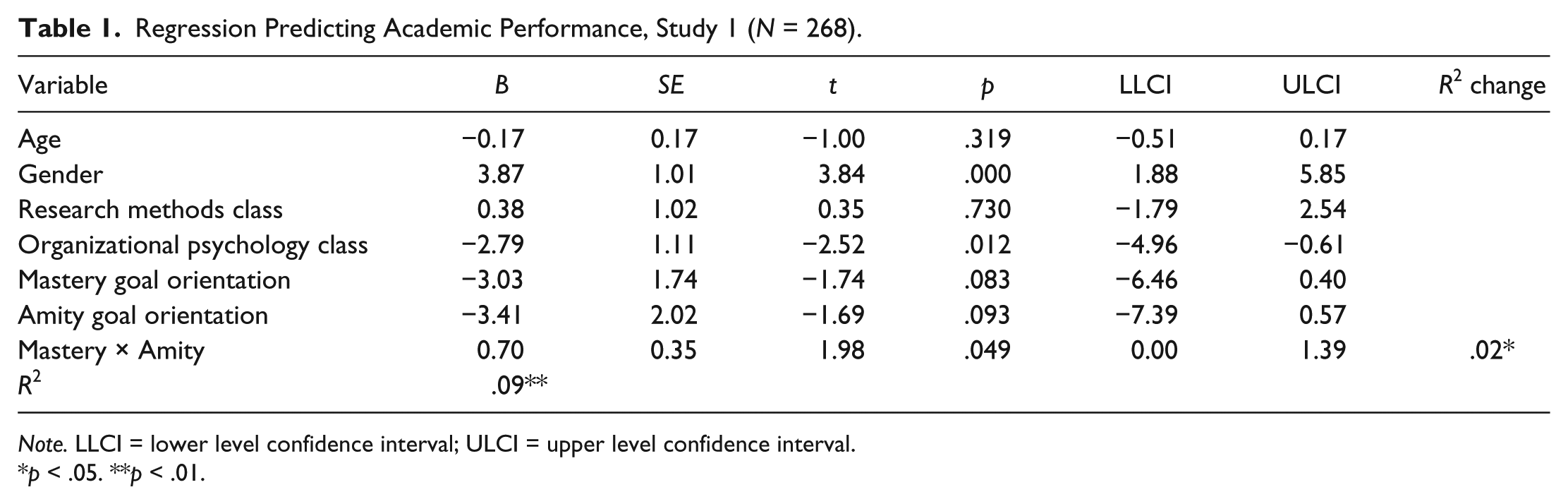
Note. LLCI = lower level confidence interval; ULCI = upper level confidence interval.
p < .05. **p < .01.
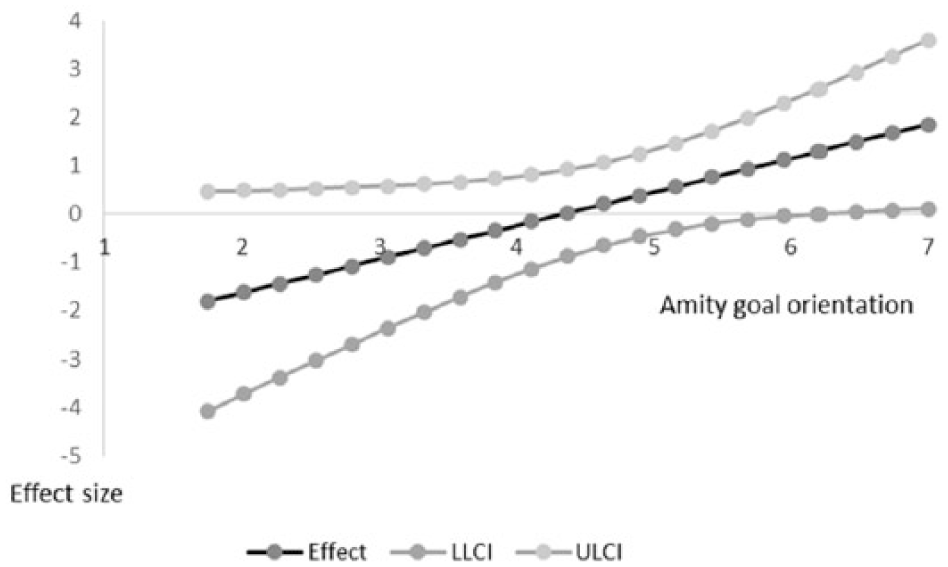
The conditional effect of mastery goal orientation on school grades at values of amity goal orientation, Study 1.
Adding to past research (Elliot & Church, 1997; Harackiewicz, Barron, Pintrich, et al. 2002) that showed that the interaction between mastery goal orientation and performance-approach goal orientation was negatively related or not related to academic performance, our results show that the interaction between mastery goal orientation and amity goal orientation is positively related to academic performance. Specifically, the positive relation between mastery goal orientation and academic performance is enhanced when amity goal orientation is high. Moderation of effects of mastery goal orientation by amity goal orientation may help researchers understand when mastery goal orientation is most versus least likely to influence academic performance (cf. Harackiewicz, Barron, Pintrich, et al. 2002).
Study 2
The goal of this study was to test our hypothesis that the effect of mastery goal orientation on performance is enhanced by amity goal orientation in a different achievement situation—work.
Method
Participants and procedure
A total of 311 employees of a multinational organization volunteered to participate in the study (Mage = 36.60 years, 24.4% woman). In terms of tenure, both relatively new employees (minimum = 1.08 years) and senior employees (maximum = 18.92 years; M = 5.89, SD = 3.68) participated in the study, from all levels of organizational hierarchy (N = 100 Level 1 employees, N = 92 Level 2 employees, N = 84 Level 3 employees, and N = 35 Level 4 employees).
Goal orientations
Goal orientations were measured using VandeWalle’s (1997) multi-item scales of work goal orientations. Respondents were asked to indicate the extent to which they were motivated by mastery, performance-approach, and performance-avoidance goal orientations at work on a 7-point Likert-type scale ranging from 1 (not at all true of me) to 7 (very true of me). We calculated performance-approach goal orientation by averaging respondents’ ratings for the four performance-approach items (e.g., “I try to figure out what it takes to prove my ability to others at work,” α = .83), performance-avoidance goal orientation by averaging the ratings for the four performance-avoidance items (e.g., “I would avoid taking on a new task if there was a chance that I would appear rather incompetent to others,” α = .86), and mastery goal orientation by averaging the ratings for the four mastery items (e.g., “I am willing to select a challenging work assignment that I can learn a lot from,” α = .83). To these items, we added the following six amity goal orientation items taken from Levontin and Bardi (2017): “It is important to me to cooperate with my coworkers,” “I think it is important to cooperate with others at work,” “It is important to me to assist my coworkers to succeed with their assignments,” “I prefer working with others than working alone,” “It is important to me that my team members will do as well as I do,” and “I enjoy work assignments that require cooperation with others” (α = .79).
Performance rating
Supervisors’ performance ratings constitute a crucial aspect of employee job performance evaluations. Supervisory ratings such as those used in the present research remain among the most common ways of evaluating individual job performance (Borman, 1991). Performance ratings in the organization from which data were collected were designed to distinguish among employees, and were specifically used by human resources and management for decisions concerning hiring and firing, promotions, and the distribution of bonuses. Performance ratings allowed us to examine whether employees’ goal orientations were consequential to their evaluations by their managers and to avoid common method bias. Employees’ job performance was rated on a 1 to 4 scale (1 = far below par [very poor performance], 2 = below par [poor performance], 3 = on par [adequate performance], 4 = above par [excellent performance]). The predicted variable was the mean score of performance appraisals for each employee during the last 3 years. The lowest score in our dataset was 1.67 (one employee), the highest was 4 (11 employees), and the most frequent scores were 3 (149 employees) and 3.33 (57 employees, M = 3.06, SD = 0.40).
Results and Discussion
As in Study 1, performance-approach goal orientation and performance-avoidance goal orientation were positively correlated (r = .28, p < .01), mastery goal orientation was positively related to amity goal orientation (r = .29, p < .01), and performance-approach goal orientation was positively related to amity goal orientation (r = .24, p < .01). In this employees’ sample, we further found a negative relation between mastery and performance-avoidance goal orientations (r = –.34, p < .01). As in the academic context in Study 1, the employees reported that amity goal orientation is important to them (M = 5.82, SD = 0.80), more than performance-avoidance goal orientation (M = 3.06, SD = 1.40), t(311) = 29.72, p = .000, and performance-approach goal orientation (M = 4.47, SD = 1.35), t(311) = 17.19, p = .000, but less than mastery goal orientation (M = 6.01, SD = 0.83), t(311) = −3.39, p = .001.
To test our hypothesis that the effect of mastery goal orientation on work performance as evaluated by managers’ performance appraisals is enhanced by amity goal orientation, we used Hayes’s (2013) PROCESS method (Model 1, 5,000 Bootstrap samples). We tested the effect of mastery goal orientation (X) on performance appraisals (Y) with amity goal orientation as a moderator (M) controlling for age, gender, and level in the organizational hierarchy. Results of this analysis are presented in Table 2 and the results of a floodlight analysis defining Johnson–Neyman significance region (Spiller et al., 2013) are presented in Figure 2. Gender did not predict performance appraisals; however, age and level in the organizational hierarchy did. The main effects of mastery goal orientation and amity goal orientation on performance did not reach significance. Importantly, and as hypothesized, the interaction between mastery goal orientation and amity goal orientation significantly predicted performance appraisals. Specifically, the effect of mastery goal orientation on work performance was only significant when amity goal orientation was higher than 5.76. In total, 42.76% of the employees reported amity goal orientation lower than 5.76, and their mastery goal orientation had no effect on their performance appraisals. And, 57.23% of the employees reported amity goal orientation higher than 5.76, and their mastery goal orientation had a positive effect on their performance appraisals.
Regression Predicting Work Performance, Study 2 (N = 311).
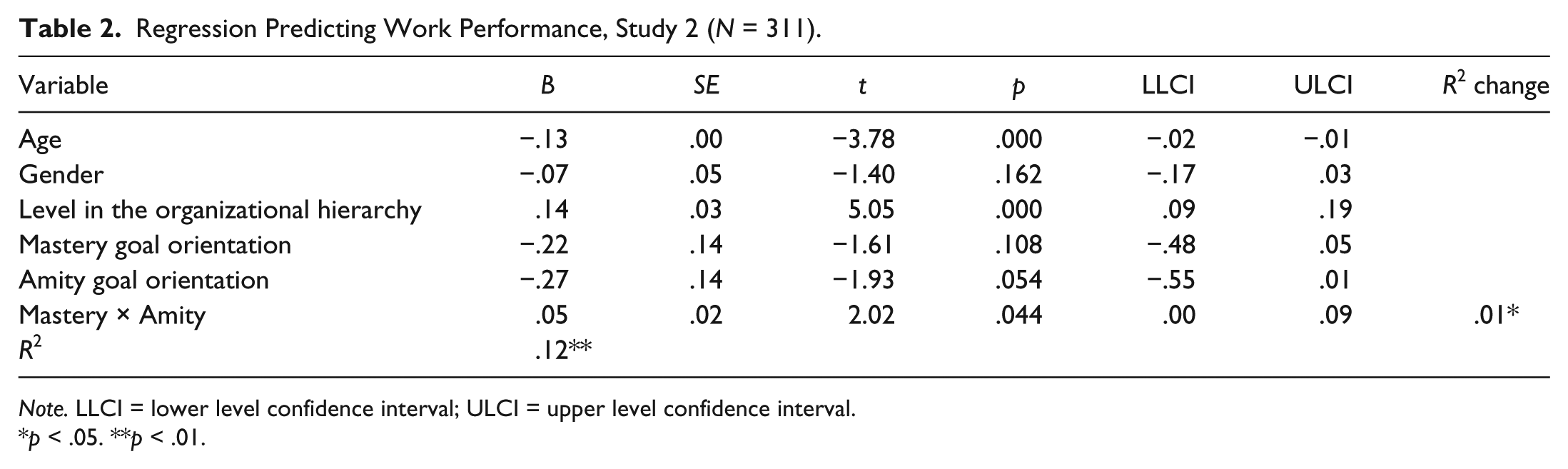
Note. LLCI = lower level confidence interval; ULCI = upper level confidence interval.
p < .05. **p < .01.
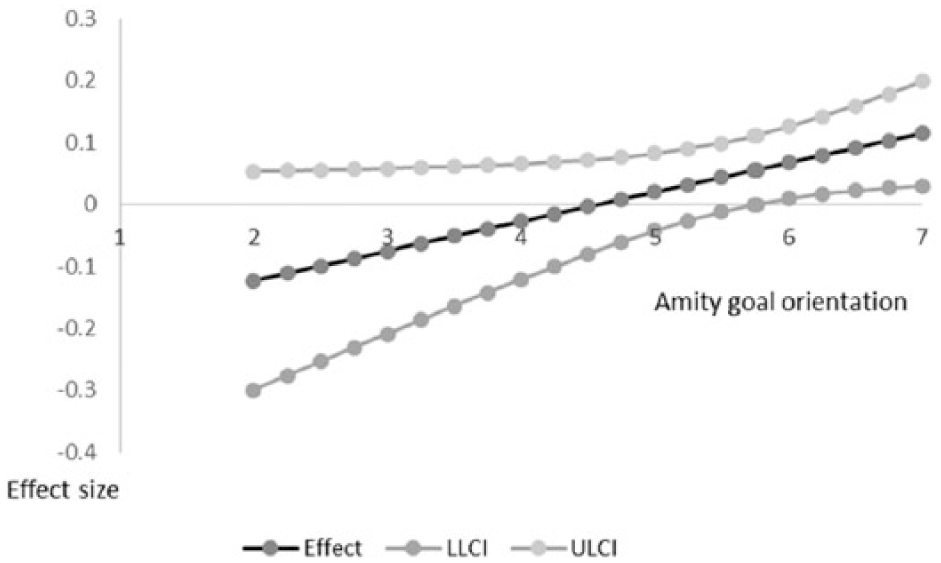
The conditional effect of mastery goal orientation on performance appraisals at values of amity goal orientation, Study 2.
The results of a meta-analysis on the effects of goal orientations on job performance (Payne et al., 2007) revealed relatively weak positive correlation between mastery goal orientation and job performance. The results of the current study suggest that among those with high amity goal orientation, the correlation between mastery goal orientation and job performance is enhanced.
Studies 1 and 2 showed the interaction effect of mastery and amity goal orientations on performance in school (Study 1) and at work (Study 2). The goal of the next two studies was to establish the causal effect of the interaction between mastery and amity goal orientations on yet another consequence of goal orientations—motivation following negative feedback.
Study 3
The purpose of this study was to further establish the utility of amity goal orientation, by testing its combined effects on students’ motivation following failure. We were interested in the combined effect of mastery and amity goal orientations in comparison with other combinations of goal orientations. As mastery and performance-avoidance goal orientations are often negatively correlated (as was the case in the results of Study 2), we chose not to include them in the same condition to keep the scenarios plausible. In addition, as we have specified above, there is an inherent contradiction between the competitive nature of performance-approach goals and the cooperative nature of amity goals, rendering them implausible to pursue at the same time. This leads to four combinations of goal orientations in a 2 (mastery, performance-avoidance) × 2 (performance-approach, amity) design.
Method
Participants and procedure
A total of 182 university students (Mage = 25.8 years, 36.3% woman) were randomly assigned to one of four conditions in a 2 (mastery, performance-avoidance) × 2 (performance-approach, amity) experimental between subject design. In each of the conditions, participants read a scenario that described failing an academic class. They were asked to imagine themselves in the place of the person described in the scenario and to answer two questions about their motivation. Each scenario activated one goal orientation (mastery or performance-avoidance) followed by another goal orientation (performance-approach or amity). Scenarios were created by joining goal orientation items from the goal orientation questionnaires used in Study 1 with some minor changes aimed at ensuring the scenarios’ coherence. The mastery–amity condition was the focus of this study with other three conditions serving as comparisons.
All four scenarios manipulated failure and had the same general structure: “Imagine you enrolled to a class. . . (Goal orientation manipulations). . . you have failed in the midterm exam that counts for 40% of the final grade.” The mastery manipulation was as follows: “Imagine you enrolled to a challenging class that enables you to learn a lot. You desire to completely master the material presented in this class.” The performance-avoidance manipulation was as follows: “Imagine you enrolled to a class you felt you have a good chance to succeed in. Your goal for this class is to avoid performing poorly compared with the rest of the class.” The amity manipulation was as follows: “It is important to you to assist your fellow students to succeed in this class.” The performance-approach manipulation was as follows: “It is important to you to do better than other students in this class.”
Measures
Motivation
We used a single-item measure of motivation (Van-Dijk & Kluger, 2004) that measures willingness to invest effort in one’s work following failure and added to it another item such that the current measure reflects the motivational process of expectancy and value (Vroom, 1964). The two items were as follows: “Relative to the expectations you had to succeed in this class, what is your current expectation to succeed?” and “Relative to the value this class had for you when you enrolled in it, what is the current value of the class for you?” (α = .66). Participants were provided with 11-point scales ranging from –5 (much less) through 0 (about the same) to 5 (much more).
Results and Discussion
We conducted a 2 (mastery, performance-avoidance) × 2 (performance-approach, amity) ANOVA with participants’ ratings of their motivation following failure as the dependent variable. As expected and as documented is past research (e.g., Dweck & Leggett, 1988), there was a main effect of mastery versus performance-avoidance goal orientations. Namely, participants reported higher levels of motivation following failure in the scenarios that emphasized mastery goal orientation (M = −0.07, SD = 1.58) over performance-avoidance goal orientation (M = −0.73, SD = 1.94), F(1, 179) = 6.07, p = .015. The main effect of performance-approach versus amity goal orientations did not reach significance, F(1, 179) = 2.45, p = .120. Most importantly and as expected, the two-way interaction was significant, F(1, 179) = 4.57, p = .034 (see Figure 3). Simple effects analyses revealed that following a mastery goal orientation manipulation, participants reported having more motivation when amity goal orientation was activated (M = 0.39, SD = 1.82) than when performance-approach goal orientation was activated (M = −0.57, SD = 1.08), F(1, 179) = 6.88, p = .009. However, following a performance-avoidance manipulation, there was no difference in levels of motivation reported by those who had amity goal orientation (M = −0.80, SD =1.86) and those who had performance-approach goal orientation (M = −0.65, SD = 2.03), F(1, 179) = 0.16, p = .686. Overall, whereas performance-approach goal orientation wiped out the beneficial effect of mastery goal orientation, amity goal orientation enabled and perhaps even enhanced the beneficial effect of mastery goal orientation.
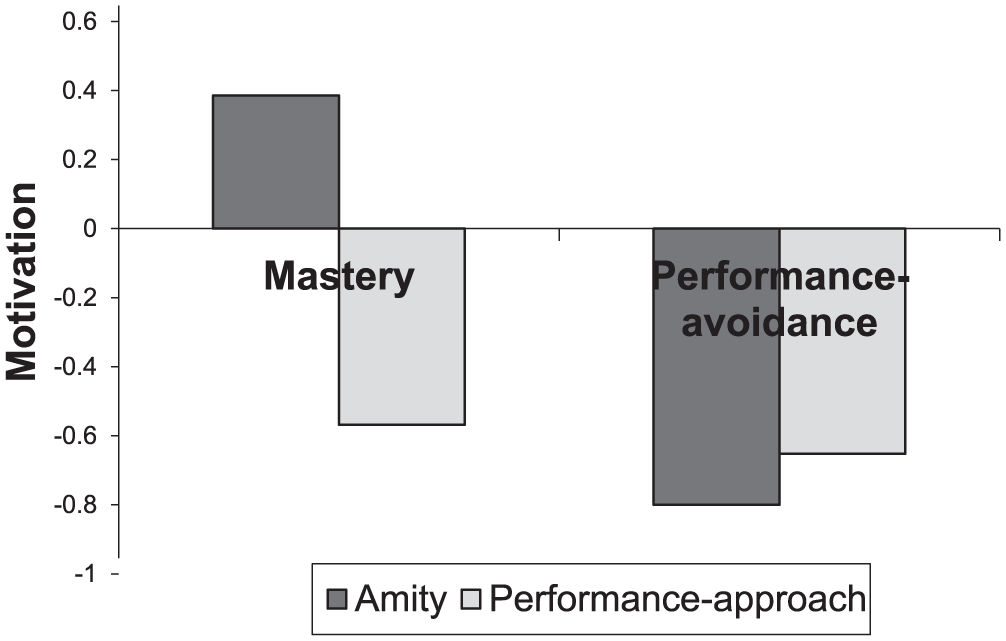
The effect of combinations of goal orientations on motivation following failure, Study 3.
The results of this study are consistent with previous research which showed that motivation is higher following failure when mastery goal orientation is more dominant than performance-avoidance goal orientation (e.g., Ames & Archer, 1988; Cron, Slocum, VandeWalle, & Fu, 2005; Senko & Harackiewicz, 2002). However, in this study, the beneficial effect of mastery goal orientation on motivation following failure, relative to performance-avoidance goal orientation, was not significant when both goals were combined with performance-approach goal orientation. Rather, following failure, it was the combination of mastery goal orientation and amity goal orientation that yielded the highest level of motivation and may relate to the mastery-oriented pattern documented by Dweck (1999). In addition, the combination of performance-avoidance and performance-approach goal orientations yielded the lowest level of motivation and may relate to a pattern of helplessness (Dweck, 1999). The mastery/amity combination produced higher motivation than the mastery/performance-approach combinations. This result supports our suggestion that amity goal orientation may be beneficial for performance when combined with a mastery goal orientation. One might wonder whether amity goal orientation is always beneficial for performance or only when combined with mastery goal orientation. The results suggest that amity goal orientation is not always beneficial for performance. Rather, when combined with performance-avoidance goals, amity goal orientation does not increase (and might slightly decrease) motivation in comparison with performance-approach goals. This study demonstrated a beneficial effect of amity goal orientation on response to failure beyond the known effect of mastery goal orientation and provided a preliminary indication that amity goal orientation may be especially helpful when paired with mastery goal orientation.
Although the results were in the expected direction, this study suffers from some limitations. First, a control condition was not included in this study. Although the combination of mastery and amity goal orientations led to higher motivation than the combination of mastery and performance-approach goal orientations, it may be that a mastery alone condition would lead to the best results. Hence, we included this condition in the next study. Second, the scenario used in this study was hypothetical, and it may be that participants did not effectively place themselves in the scenario and experienced it as a failure experience. One could conceptualize self-disappointment as an indication that the participants indeed treated the scenario as a failure experience. Hence, in Study 4, we included a measure of how disappointed of themselves students feel and how they expect this failure to affect their final class grade.
Study 4
The purpose of this study was to further establish the utility of amity goal orientation, by testing its combined effects on students’ expected grades and self-disappointment following failure. We were interested in the combined effect of mastery and amity goal orientations in comparison with other combinations of mastery goal orientation. As mastery and performance-avoidance goal orientations are often negatively correlated (as was the case in the results of Study 2), we chose not to include this combination. This led to a three scenarios design (mastery only, mastery and performance-approach, mastery and amity).
Method
Participants and procedure
A total of 134 university students (Mage = 23.8 years, 38.1% woman) were randomly assigned to one of three conditions (mastery only, mastery and performance-approach, mastery and amity). As in Study 3, in each of the conditions, participants read a scenario that described failing an academic class. They were asked to imagine themselves in the place of the person described in the scenario and to answer questions about their self-disappointment and their expected final class grade. Each scenario activated a mastery goal orientation followed by another goal orientation (performance-approach or amity or nothing). The mastery–amity condition was the focus of this study with the other two conditions serving as comparisons.
As in Study 3, all three scenarios manipulated failure by stating, “You have failed in the midterm exam that counts for 40% of the final grade.” Goal orientation manipulations were the same as in Study 3.
Measures
Self-disappointment
Participants reported how disappointed they are of themselves using a 7-point scale ranging from 1 (not at all) to 7 (very much).
Expected grades
We used two items to evaluate participants’ expected grades: “What will be your target grade for this class?” and “What do you evaluate will be your final class grade?” (α = .61). Participants were provided with scales ranging from 0 to 100.
Results and Discussion
There were no differences between groups in levels of self-disappointment, F(2, 131) = 1.05, p = .352.
An ANOVA with participants’ ratings of their expected grades as the dependent variable was used to test the hypothesized beneficial effect of amity goal orientation on response to failure. Although differences between groups did not reach significance, F(2, 131) = 2.25, p = .109, they were in line with our theorizing as participants in the mastery with amity condition reported higher expected grades (M = 85.65, SD = 6.43) compared with those in the mastery with performance-approach condition (M = 82.46, SD = 7.89; mean difference = 3.10, p = .064) and compared with those in the mastery alone condition (M = 82.51, SD = 8.92; mean difference = 3.05, p = .070).
Next, we used Hayes’s (2013) PROCESS method (Model 1, 5,000 Bootstrap samples) and tested the effect of experimental conditions (multi categorical X) on expected grades (Y) with self-disappointment as a moderator (M). Results of this analysis are presented in Table 3 and in Figure 4. The conditional effect of experimental conditions on expected grades was not significant and neither was the effect of self-disappointment. The interaction effect between the mastery performance–approach and the mastery–amity conditions and self-disappointment was not significant. Importantly, the interaction effect between the mastery only and the mastery–amity conditions and self-disappointment significantly predicted expected grades. Specifically, when self-disappointment was low, there was no difference between the mastery alone and mastery–amity conditions in their expected final class grades. However, when self-disappointment was high, those in the mastery–amity condition expected higher class grades than those in the mastery only condition.
Regression Predicting Expected Grades, Study 4 (N = 134).
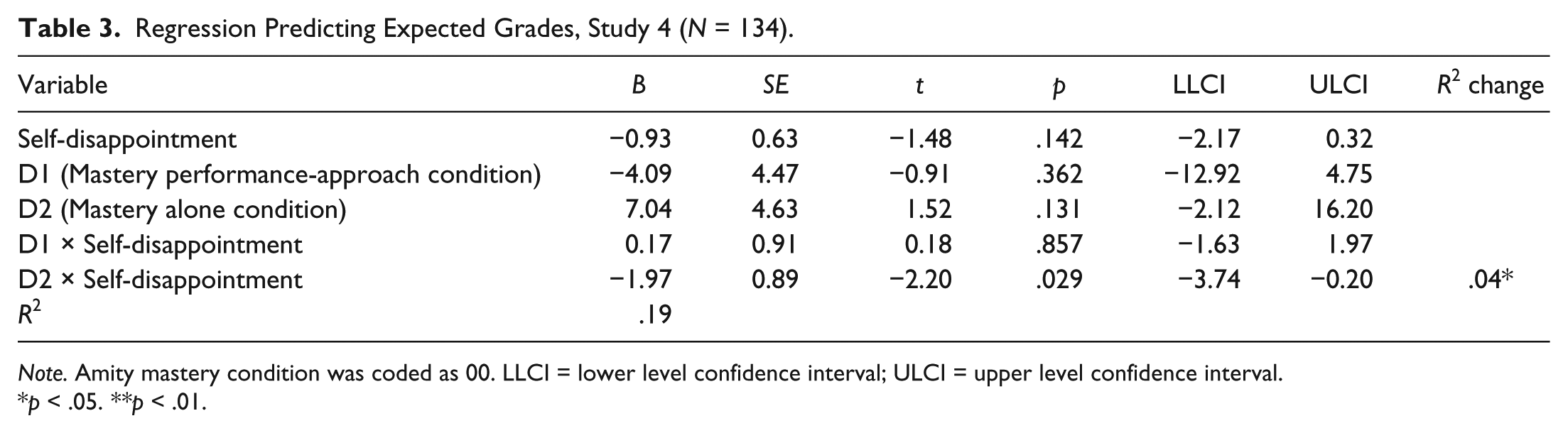
Note. Amity mastery condition was coded as 00. LLCI = lower level confidence interval; ULCI = upper level confidence interval.
p < .05. **p < .01.
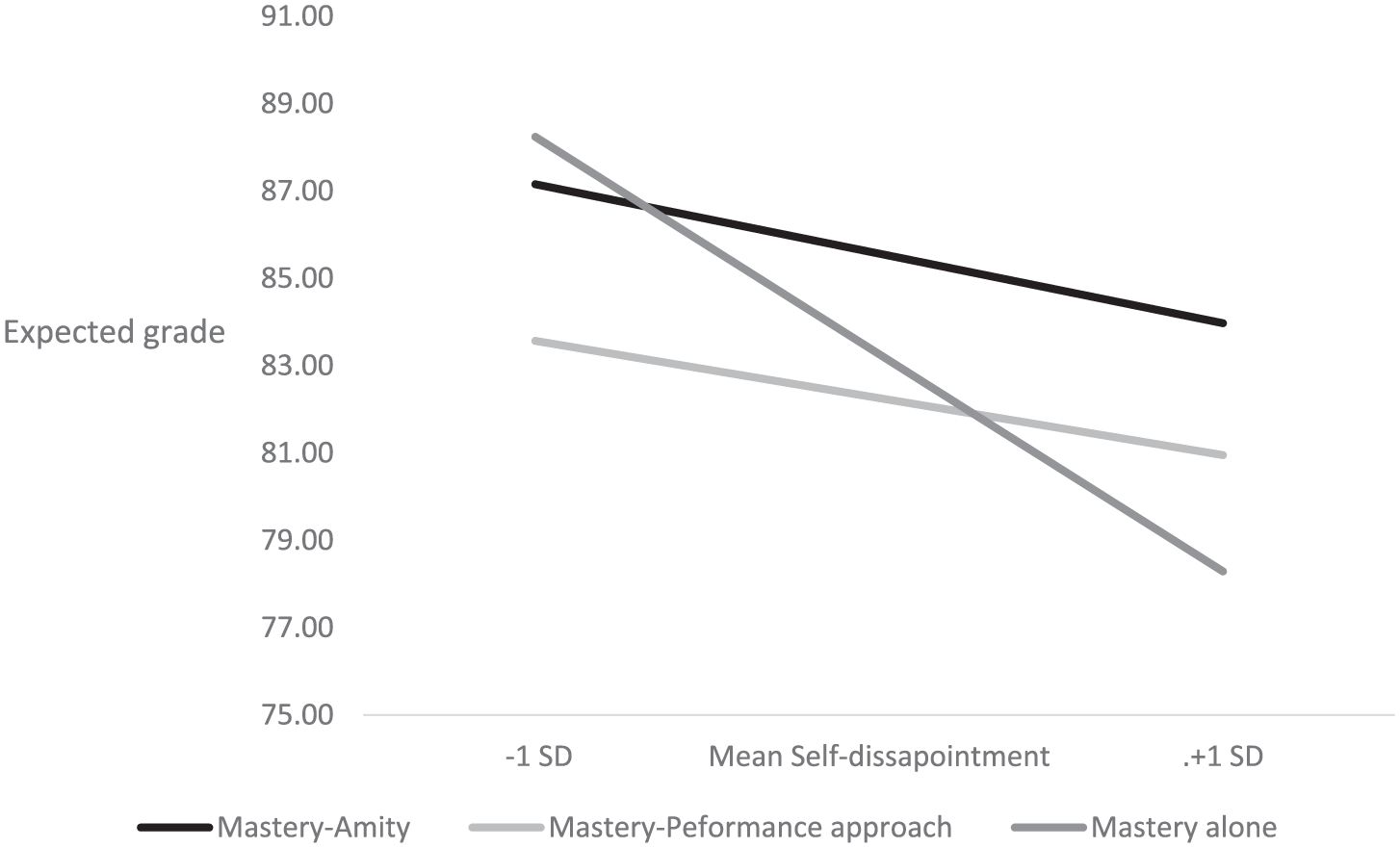
The interaction effect of goal orientations and self-disappointment on expected class grades following failure, Study 4.
The results of this study further show the effect of the combination of mastery and amity goal orientations on self-perceptions such as self-disappointment and on expectations in academic achievement situations. They suggest that amity goal orientation serves as a buffer to the negative consequences of disappointment from oneself following failure.
General Discussion
The present research focused on an overlooked goal orientation, namely, amity goal orientation, which involves a pro-social motivation, cooperation with others, and succeeding by assisting others to succeed. We found that people view amity goal orientation as important in achievement situations and we demonstrated the utility of amity goal orientation in predicting success and motivation after failure.
In the current research, we adopted a multiple goal orientations perspective and showed the positive effects of the combination of mastery and amity goal orientations. The results of four studies showed positive outcomes when mastery goal orientation is combined with amity goal orientation. This effect was replicated on academic achievement (Study 1), work performance (Study 2), motivation following failure (Study 3), and expectations of success following a disappointing performance (Study 4). Whereas in achievement situations holding a mastery goal orientation is almost always an advantage in comparison with performance-avoidance goal orientation, it is not always more advantageous than holding performance-approach goal orientation. For example, in a longitudinal study from freshman year through graduation, mastery goal orientation was found to be positively related to interest, however not to academic performance, whereas performance-approach goal orientation predicted performance (Harackiewicz, Barron, Tauer, & Elliot, 2002).
On the contrary, the results of our studies support previous research (Elliot & Church, 1997) in suggesting that the combination of mastery and performance-approach goal orientations is relatively less beneficial. The positive correlations often found in the literature between performance-approach and mastery goal orientations imply that people often hold them simultaneously (e.g., Darnon, Dompnier, Gilliéron, & Butera, 2010). Furthermore, academic institutions tend to encourage both mastery and performance-approach goal orientations (Darnon et al., 2009; Darnon, Harackiewicz, Butera, Mugny, & Quiamzade, 2007) and while mastery goal orientation seems to decline during the college years, performance-approach goals do not (Corker, Donnellan, & Bowles, 2013). As our research results suggest, those who hold performance-approach goal orientation may not enjoy the benefits of their mastery goal orientation. However, those who hold amity goal orientation may enjoy the benefits of their mastery goal orientation. Hence, examining combinations of goals, including amity goal orientation, has proved important and should be developed further in future research.
There are three major routes to success in achievement situations. Students or employees can compete with each other trying to do better than the others; they can work individually toward some golden standard; or they can work cooperatively taking responsibility for each other’s success as well as their own. While traditional schools and working places tend to encourage their students or employees to work alone, or to compete with each other, the current research suggests that success may increase by shifting the emphasis to encouraging cooperation in addition to mastery goals.
The interactive effect found in this article opens up a multitude of avenues for future research: It would be important to test the utility of amity goal orientation in additional contexts, such as in sports, as well as to test additional outcomes, such as well-being. The generalizability of this interaction would also be important to establish. For example, would this interaction occur in any culture or mainly in cultures where being pro-social is normative, or perhaps would it prove particularly successful in cultures in which being pro-social is more rare? The same question could be asked in examining gender differences and seniority at work. These are only a few of the many possibilities that can stem from this initial finding.
To conclude, this article has shown that amity goal orientation is important in achievement situations, and that it has important consequences. We hope that this article will stimulate further research that combines amity goal orientation to enhance our understanding of motivation and performance in achievement situations.
Supplementary Material
Supplementary Material, levontin_online_appendix – Pro-Social Goals in Achievement Situations: Amity Goal Orientation Enhances the Positive Effects of Mastery Goal Orientation
Supplementary Material, levontin_online_appendix for Pro-Social Goals in Achievement Situations: Amity Goal Orientation Enhances the Positive Effects of Mastery Goal Orientation by Liat Levontin and Anat Bardi in Personality and Social Psychology Bulletin
Footnotes
Declaration of Conflicting Interests
The author(s) declared no potential conflicts of interest with respect to the research, authorship, and/or publication of this article.
Funding
The author(s) received no financial support for the research, authorship, and/or publication of this article.
Supplemental Material
Supplementary material is available online with this article.
References
Supplementary Material
Please find the following supplemental material available below.
For Open Access articles published under a Creative Commons License, all supplemental material carries the same license as the article it is associated with.
For non-Open Access articles published, all supplemental material carries a non-exclusive license, and permission requests for re-use of supplemental material or any part of supplemental material shall be sent directly to the copyright owner as specified in the copyright notice associated with the article.
