







Abstract
In a seminal theory piece, Weisz and colleagues argued that control over one’s environment was less attainable and desirable in Japan than in America. Subsequently, many scholars have extrapolated from this argument to claim broad-based cultural differences in control: that Western/individualist cultures perceive and desire more personal control over their environment than do Eastern/collectivist cultures. Yet surprisingly little empirical research has put this claim to the test. To test this notion, in Study 1 we examined perceived control over one’s life in 38 nationally representative samples (N = 48,951). In Study 2, we measured desire for control in community samples across 27 nations (N = 4,726). Together, the studies show lower levels of perceived and desired control in Japan than in any other nation. Over and above the Japan effect, there was no evidence for differences in perceived or desired control between individualist and collectivist nations, or between holistic and nonholistic nations.
Keywords
It is considered functional and healthy to have control. Perceived control is associated with better mental and physical health (Gitlin, Hauck, Winter, Dennis, & Schulz, 2006; Greenaway et al., 2015; Wrosch & Schulz, 2008), positive affect (Helzer & Jayawickreme, 2015), and goal achievement (Haase, Heckhausen, & Köller, 2009). Providing opportunities for control helps people psychologically buffer against the negative impact of threatening events (Averill, 1973; Bandura, 1997; Glass & Singer, 1972; Greenaway, Louis, Hornsey, & Jones, 2014; Warburton, Williams, & Cairns, 2006). In contrast, having one’s control taken away is aversive (Seligman, 1975) and leads people to compensate by seeking order in other ways (Kay, Gaucher, McGregor, & Nash, 2010; Whitson & Galinsky, 2008). Theorists have long maintained that people have a fundamental motivation to achieve control (Bandura, 1989; Brehm, 1966; Kelley, 1971) and this desire for control is so great that people frequently imagine they have influence over events that are ostensibly random (Fast, Gruenfeld, Sivanathan, & Galinsky, 2009; Greenaway, Louis, & Hornsey, 2013; Langer, 1975; Taylor & Brown, 1988; Whitson & Galinsky, 2008).
Tellingly, all the empirical work reviewed above uses samples from Western, educated, industrialized, rich, developed nations; the so-called WEIRD nations that Henrich, Heine, and Norenzayan (2010) argue are “among the least representative populations one could find for generalizing about humans” (p. 61; see also Fiske, Kitayama, Markus, & Nisbett, 1998). This oversampling problem raises a fundamental question: “Are there cultural differences in the extent to which people perceive and desire control?” Despite the fundamental role that control is presumed to play in psychological and physical health, this question has received more theoretical than empirical attention.
In the current article, we explore this question using two large, multinational samples (38 nations in Study 1; 27 nations in Study 2). Study 1 examines the relationship between culture and perceptions of how much control people have in their life. We call this perceived control, but note that it is conceptually indistinguishable from what others have called “personal control” (Gurin, Gurin, & Morrison, 1978) or “subjective control” (Skinner, 1985). Study 2 focuses on people’s desire for control (participants’ desire to maintain control, make their own decisions, and be in charge of activities; Burger & Cooper, 1979). As will be elaborated below, both studies focus on primary control, not secondary control.
The Theoretical Case for Cultural Differences in Perceived and Desired Control
Some theorists have emphasized the evolutionary adaptiveness of control, implying that the desire to change the environment to suit one’s needs is universally prepotent. In their influential life-span theory of control, Heckhausen and Schulz (1995; see also Heckhausen, Wrosch, & Schulz, 2010) draw on a distinction between primary control—the direct exertion of influence over the environment—and secondary control, which involves changing the self in the face of existing realities (Rothbaum, Weisz, & Snyder, 1982). They argue that forms of control that do not imply direct management of the external world do not have the same functional and adaptive value as primary control, and that a deficit in primary control implies a compromised ability to fulfill one’s developmental potential. As a result, the authors argue, primary control “is both preferred and has greater adaptive value to the individual. Furthermore . . . the primacy of primary control is invariant across cultures and historical time” (Heckhausen & Schulz, 1995, p. 286).
Other theorists, however, have argued that culture fundamentally shapes people’s orientations toward control (Gould, 1999; Morling, Kitayama, & Miyamoto, 2002; Weisz, Rothbaum, & Blackburn, 1984). In making the case for the moderating role of culture, researchers point to the difference between individualist and collectivist cultures. Individualist cultures tend to focus on independent selves: The individual self is the primary conception of selfhood, and assertiveness, competitiveness, and differentiation are prioritized. In contrast, collectivist cultures tend to promote an interdependent view of self, focusing on principles of cooperation, harmony, and the “fundamental connectedness of human beings to each other” (Markus & Kitayama, 1991, p. 227). From this theorizing, it is a short conceptual leap to argue that members of individualist cultures would be more focused on influencing their environments than would members of collectivist cultures, who place a cultural priority on fitting in and adapting to environments. Furthermore, it is argued that the Western-centric nature of the field has led to a distorted emphasis on primary control in the literature, one that overestimates the value of primary control in collectivist nations (Gould, 1999; Weisz et al., 1984).
The Empirical Case for Cultural Differences in Perceived and Desired Control
Given the importance of this research question, the debate rests on a surprisingly thin empirical base. The most frequently cited paper for the cultural moderation argument is a classic article by Weisz et al. (1984), which makes the case that primary control is perceived as “less attainable . . . and less desirable” in Japan than in America (p.958). The authors attributed this difference partly to the religious and philosophical legacy of Zen Buddhism—which emphasizes the need to suppress our attachment to desires—and partly to the especially strong culture of interdependence that exists in Japan, which emphasizes fitting in and adjusting to others rather than imposing individual will. The authors argued that these influences manifested itself in a culture that de-emphasizes primary control and emphasizes the importance of adaptation. Evidence of this cultural orientation is threaded through Japanese attitudes toward child rearing (an emphasis on close alignment with family members, and discipline practices designed to blur the boundaries between mother and child), socialization (and in particular the cultivation of skills and moral values that maintain “goodness of fit” with others), work (with an emphasis on single-organization loyalty and consensus-building in business decisions), and psychotherapy (which emphasizes understanding and accepting symptoms via reinterpretation). However, the authors also acknowledged that their review was “. . . frankly exploratory and speculative . . . the bulk of what we report comes from anecdotal, ethnographic, and historical accounts of Japanese and American cultural patterns” (p.957). The only empirical research reviewed in the article is evidence that Japanese have a more external locus of control than Americans (e.g., Bond & Tornatzky, 1973; Evans, 1981; Parsons & Schneider, 1974).
Since then, it has been reported that Americans are more likely than Japanese people to remember recent events that involve influence (Morling et al., 2002), to change moves in aerobics classes that are too difficult (Morling, 2000), and to attribute athletes’ success to individual agency (as compared with features of their background and social experience; Markus, Uchida, Omoregie, Townsend, & Kitayama, 2006). More recently, it was established that Japanese reported less of a desire for control than Germans and North Americans, and through this mechanism were less likely to choose a workplace that emphasizes individual achievements, and more likely to prioritize family opinions over their individual career aspirations when choosing a workplace (Eisen, Ishii, Miyamoto, Ma, & Hitokoto, 2016; for further discussion of the role of culture in shaping attitudes toward choice, see Iyengar & Lepper, 1999; Savani, Markus, & Conner, 2008).
However, attempts to generalize this pattern have led to mixed results. Tsai, Miao, Seppala, Fung, and Yeung (2007) found that European Americans endorsed influence-related interpersonal goals more so than Hong Kong Chinese, but (contrary to a cultural moderation hypothesis) there was no difference between European Americans and Asian Americans on this measure. Furthermore, no difference was observed between Iranians (a relatively collectivist society) and Americans on a measure of desire for control (Ghorbani, Krauss, Watson, & LeBreton, 2008).
In sum, the argument that control over one’s environment is both more possible and desirable for members of individualist cultures than collectivist cultures has been repeated so frequently in the literature that it has assumed the status of a “received wisdom.” But in many cases, the conclusions appear to have raced ahead of the data: The empirical evidence is patchy, rarely measuring the perception of or desire for control directly, and relying on small-scale comparisons of 2 or 3 cultures. In short, there has been no large-scale empirical examination of the extent to which people across cultures perceive or desire primary control. The aim of this article is to fill this gap.
The Current Studies
This article provides a systematic test of the nation-level characteristics that influence people’s perceived control over their lives (Study 1) and desire for control in their lives (Study 2). In Study 1, we compared 38 national samples in which participants rated their levels of life control in the sixth wave of the World Values Survey (WVS). In Study 2, we administered a well-established scale measuring desire for control in 27 nations.
We modeled three possibilities for how culture might moderate perceptions of, and desire for, control. First, we examined the notion that differences in control can be predicted from broad-based, culture-level differences such as individualism (vs. collectivism). According to this prediction, the highly interdependent and contextualized notion of self that emerges in collectivist cultures would make individual control over the environment both less plausible and less desirable. Thus, one would expect control ratings to be relatively low in countries that are relatively high in collectivism; for example, countries in South East Asia, South America, and the Middle East.
Second, we examined the possibility that differences in control would best be explained by comparing holistic cultures with other cultures. Traditionally, cultures have been regarded as holistic if they are predominantly influenced by Buddhism, Confucianism, Hinduism, Jainism, or Taoism (e.g., Grossmann, Huynh, & Ellsworth, 2016; Hornsey et al., in press). 1 Holistic cultures are theorized to have distinctive systems of thought that emphasize principles of context (the fundamental interrelatedness of all things), change (the notion that the world is in a constant state of flux), and contradiction (that each experience implies its opposite, and that seemingly opposing views can be held simultaneously and without tension; Nisbett, Peng, Choi, & Norenzayan, 2001; Spencer-Rodgers, Boucher, Mori, Wang, & Peng, 2009). To the extent that these principles are internalized, holistic systems of thought suggest that it might not be desirable or even feasible to exert a high level of individualized control over events. The presumed role of context mirrors the argument for collectivism above: If one has a sense of self that is intimately intertwined with context and the fates of others, then the notion of individualized control over the environment might seem naive and immature. In addition, if one feels as though the world is in constant flux, there may be less of a perceived need to control one’s environment, given that features of the environment are ever-changing. Finally, an emphasis on contradiction implies that members of holistic cultures will feel less of a need to downregulate negative emotions such as frustration and anger, and are more able to flexibly use emotion regulation strategies such as acceptance, suppression, and self-distancing (see De Vaus, Hornsey, Kuppens, & Bastian, 2017, for a review). This prediction implies that cultures that are highly collectivistic but do not share the same “Eastern” religious and philosophical traditions—for example, South America, the Middle East, and Asian nations that are predominantly Christian or Muslim—might report control ratings that are comparable to those found in individualistic cultures such as North America, Western Europe, and Australia.
Third, we examined the possibility that differences in control would best be explained by comparing Japan with other cultures. This “Japanese exceptionalism” hypothesis presumes that Buddhist principles of detachment and acceptance are overlayed with a distinctively Japanese emphasis on interdependence, that together produce a particularly strong de-emphasis of the notion that the individual can (or should try to) directly control life events. This hypothesis is consistent with the fact that the bulk of the empirical work that has found cultural variation in control has done so by comparing Japanese with non-Japanese samples (Eisen et al., 2016; Morling, 2000; Morling et al., 2002; Weisz et al., 1984). It would also dovetail with evidence of Japanese exceptionalism in self-ratings in other domains, such as the self-enhancement bias (Heine, Lehman, Markus, & Kitayama, 1999).
Study 1
Method
We sourced data for Study 1 from the sixth wave of the WVS (Inglehart et al., 2015) conducted from 2010 to 2014. One item in the WVS measured perceived life control: Some people feel they have completely free choice and control over their lives, while other people feel that what they do has no real effect on what happens to them. Please use this scale to indicate how much freedom of choice and control you feel you have over the way your life turns out.
The item was scored on a scale that ranged from 1 (no choice at all) to 10 (a great deal of choice).
The WVS—which relies largely on face-to-face interviewing—uses a combination of probability sampling and stratified sampling to ensure that the sample is representative of the population. Data on the core variables of interest were available from 48,951 participants across 38 countries (the WVS includes data from additional countries, but only countries with information on all the demographic control variables were included in analyses). Sample size was constrained by the data available, but the fact that the WVS samples >1,000 participants in each nation gave us confidence that it is adequately powered to detect an effect. To ensure that the multilevel models would converge, we restricted our analyses to participants who recorded scores on all relevant variables. See Table 1 for individual country sample sizes.
Country-Level Means of Control and Cultural Variables for Studies 1 and 2.
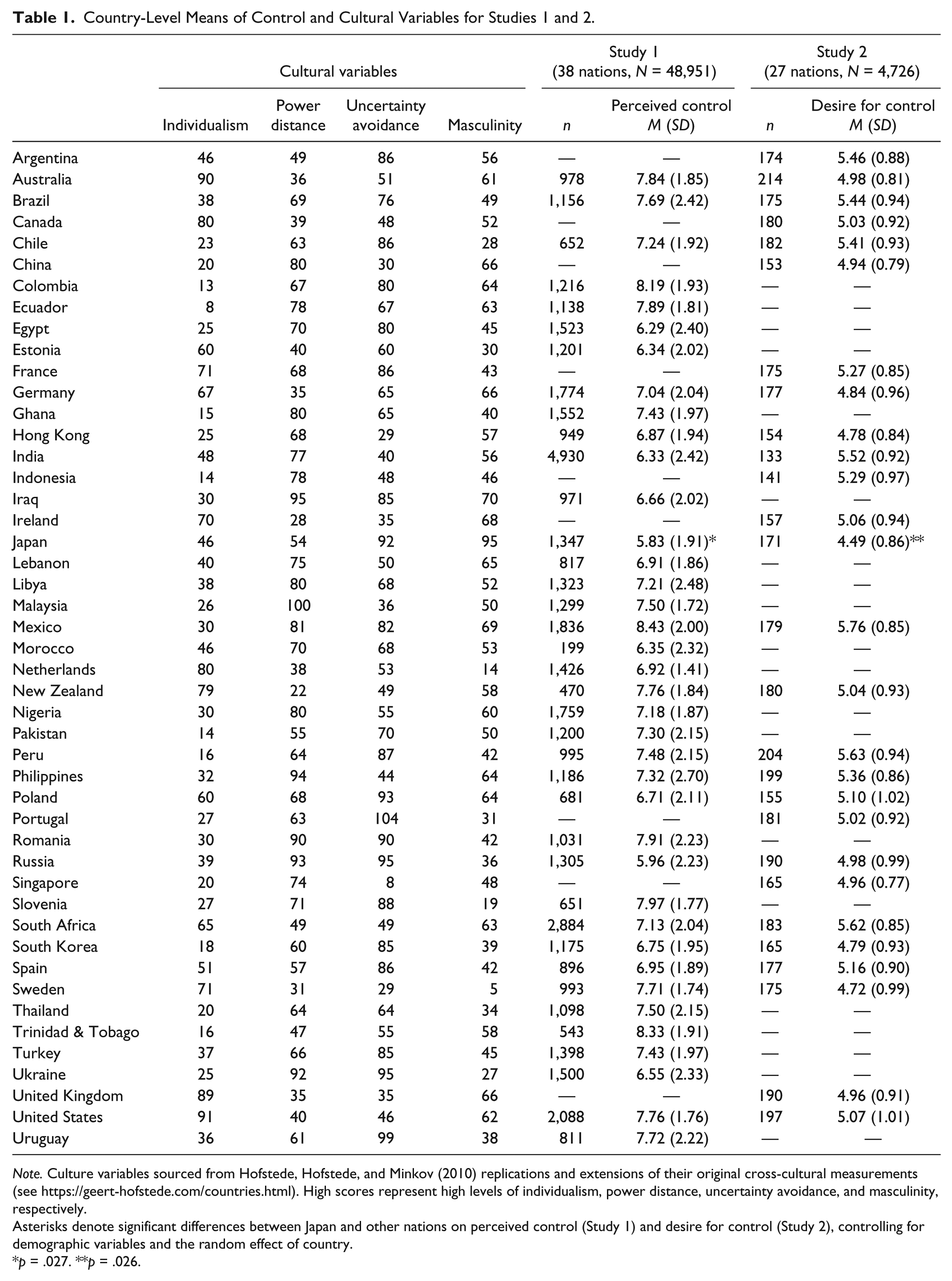
Note. Culture variables sourced from Hofstede, Hofstede, and Minkov (2010) replications and extensions of their original cross-cultural measurements (see https://geert-hofstede.com/countries.html). High scores represent high levels of individualism, power distance, uncertainty avoidance, and masculinity, respectively.
Asterisks denote significant differences between Japan and other nations on perceived control (Study 1) and desire for control (Study 2), controlling for demographic variables and the random effect of country.
p = .027. **p = .026.
For each nation, scores on the cultural dimensions were drawn from Hofstede, Hofstede, and Minkov’s (2010) replications and extensions of his original cross-cultural measurements. The key cultural dimension we examined was individualism versus collectivism. But for the sake of thoroughness, we also examined the cultural dimensions of uncertainty avoidance (a society’s tolerance for ambiguity), power distance (the extent to which less powerful members of a society accept and expect that power is distributed unevenly in that society), and masculinity versus femininity (a society’s preference for achievement, assertiveness, and material rewards vs. cooperation, caring, and modesty).
Validation of the single-item measure of control
Given that our key construct is measured with a single-item scale, it is important that the validity of that measure be interrogated. In terms of convergent validity, the best criterion variable is contained in Wave 2 of the WVS: “How free are you to make decisions in your job?” (1 not at all, 10 a great deal). This is conceptually similar to the control item used in Study 1, with the obvious exception that it is constrained to refer to the workplace context only. Reassuringly, the control item measured in Wave 2 shares a reliable positive correlation with this item, as one would expect: r = .26, p < .001.
In terms of predictive validity, we are able to draw on Wave 6 to test whether the control item predicts happiness and satisfaction with life. Happiness is measured with the single item: “Taking all things together, would you say you are” (this item was reverse scored such that 1 = not at all happy, 4 = very happy). Satisfaction with life was measured with the single item: “All things considered, how satisfied are you with your life as a whole these days?” (1 = completely dissatisfied, 10 = completely satisfied). As one would expect based on the previous literature, the control item correlated with both happiness, r = .24, p < .001, and satisfaction with life, r = .38, p < .001.
Note that correlations among related measures are typically smaller in the WVS than in surveys among WEIRD samples. This is due to the error variance introduced by (a) translation, (b) single-item scales, and (c) a commitment to representativeness, which means preliterate and survey-inexperienced respondents are interviewed. Despite this, the predictive value of the control item on satisfaction with life and happiness is comparable to that achieved in samples using multi-item scales. For example, a meta-analysis of 19 studies with 3,685 participants found that perceived control correlated, r = .29, with subjective well-being (measured via life satisfaction and happiness; DeNeve & Cooper, 1998).
In terms of discriminant validity, we correlated the control item with 11 items adapted from Schwartz’s portrait values questionnaire (we reversed the items such that high scores represented stronger endorsement of the value). Correlations were generally small, ranging from –.026 (“it is important . . . to be rich; to have a lot of money and expensive things”) to .126 (“it is important . . . to do something for the good of society”). The average correlation between the control item and the 11 values items was .08.
In sum, the single-item control measure showed acceptable psychometric properties: It correlated well with constructs that, theoretically, it should correlate with, and did not correlate well with conceptually orthogonal constructs.
Results and Discussion
We analyzed the multilevel data (i.e., participants nested within countries) using the “lme4” package in the R statistics program (Bates, Maechler, Bolker, & Walker, 2015). The multilevel model estimated the fixed effects of culture variables and other variables of interest after accounting for the random effect of country. For each analysis, p values were calculated using the “lmerTest” package in R (Kuznetsova, Brockhoff, & Christensen, 2017), which runs the lme4 models through a Satterthwaite approximation test to calculate degrees of freedom. All variables were standardized.
We followed the same analysis strategy in both studies. First, we calculated an empty model that included only a random effect of country. This model revealed that 8.7% of variance in perceived control was accounted for at the country level. This provided a hint that there is relatively little explanatory value to be gained by investigating large-scale country-level differences in perceived control.
Next, we calculated a demographic model that included, in addition to the random effect of country, fixed effects for a range of demographic characteristics that could plausibly account for variance in perceived control: age, gender, political orientation, subjective income, education level, employment status, marital status, and number of children. Comparing the demographic model to the empty model revealed that adding these controls significantly improved the amount of variance that was accounted for in perceived control, χ2(8) = 2115.40, p < .001.
We then calculated a cultural model that included fixed effects for the four cultural variables (individualism, power distance, masculinity, and uncertainty avoidance), in addition to the random effect of country and demographic variables. Comparing the cultural model with the demographic model did not significantly increase the amount of variance accounted for, χ2(4) = 3.94, p = .415. Moreover, there was no reliable relationship between individuals’ scores on perceived control and their country’s position on the four cultural dimensions. Specifically, perceived control was not predicted by individualism (β = –.11, p = .087, 95% confidence interval [CI]: [–.219, .017]; see Figure 1), power distance (β = –.09, p = .164, 95% CI: [–.197, .033]), masculinity (β = –.01, p = .854, 95% CI: [–.096, .083]), or uncertainty avoidance (β = –.03, p = .521, 95% CI: [–.139, .068]). Note that there is a marginally significant standardized regression coefficient for individualism, but that the effect goes in the opposite direction to that hypothesized: Countries with higher individualism scores report lower perceived control.
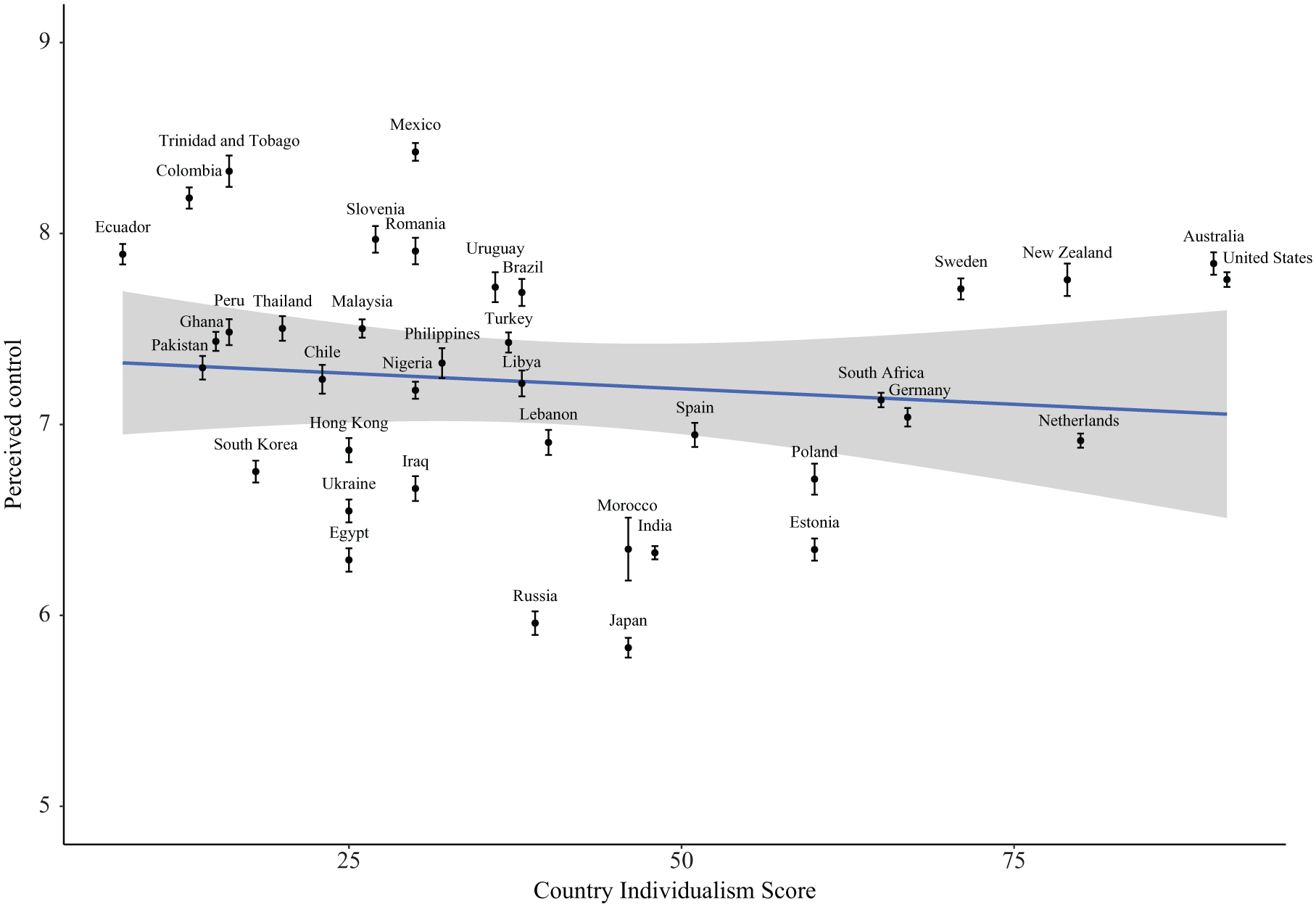
Null zero-order association between country individualism score (x-axis) and perceived control in that country (with standard error bars; y-axis) in Study 1.
In addition, we calculated a holistic model that included a variable that dummy coded the national samples into holistic (0) and nonholistic (1) countries. Samples that were categorized as holistic were Hong Kong, India, Japan, South Korea, and Thailand. This model also included the demographic variables and the random effect of country. Comparing the holistic model to the demographic model did significantly increase the amount of variance accounted for, χ2(1) = 4.41, p = .036, and there were significant differences between holistic and nonholistic countries in perceived control (β = .11, p = .042, 95% CI: [.014, .214]). However, we then reran the analyses to see if the effect was reliable after removing Japan from the sample. This time the effect was nonsignificant (β = .07, p = .210, 95% CI: [–.046, .175]). This suggests that the effect of holism was largely “carried” by the particularly low score on perceived control in Japan.
We finally calculated a Japanese exceptionalism model that included a dummy coded variable comparing all nations (0) against Japan specifically (1). This model also included the demographic variables and the random effect of country. Comparing the Japanese exceptionalism model to the demographic model did significantly increase the amount of variance accounted for in perceived control, χ2(1) = 5.23, p = .022. There was a significant difference between Japan and the other countries (β = –.10, p = .027, 95% CI: [–.190, –.012]). Further confirming this prediction, a univariate ANOVA revealed a reliable cross-national difference, F(37, 48913) = 128.79, p < .001, η2 = .09, with Japan’s perceived control score significantly lower than every other nation (all ps < .001) except Russia (p = .112; see Table 1 for a summary of means).
In sum, Japan was indeed lower in perceived control than other countries. But there was no other observable cross-cultural difference that explained the pattern of means across countries. In a follow-up study, we assessed a different indicator of control in a 27-nation survey: desire for control rather than perceptions of control.
Study 2
Method
Sampling
Participants were community members recruited through the online data collection company Social Sampling International (SSI). SSI recruits participants via partnerships and advertising. To be included in SSI’s proprietary panel, participants are required to pass a number of quality control questions, and response quality is continually monitored across studies. Each participant is allocated a digital fingerprint that ensures the same person cannot take a single survey more than once. SSI paid participants for their time. The exact payment varied according to region to provide equivalent and appropriate compensation across countries.
We initially sampled 6,874 participants from 27 nations across six continents. A screening question asked participants where they lived: Participants who did not report living in the country being sampled were screened out before starting the survey (n = 442; 6.4% of the initial sample). This left 6,432 participants who completed the questionnaire (50.3% women; Mage = 41.20 years). We included three attention checks in the survey: one in a set of premeasures unrelated to control, one immediately before the control measures, and one in a set of measures toward the end of the survey. Of the sample who survived prescreening, 25.1% failed at least one of the attention checks. Consequently, we adopted the most conservative approach and deleted from analysis participants who failed any one of the three attention checks (final N = 4,761; ns for each nation ranged from 133 to 214). It should be noted, though, that the conclusions were the same regardless of whether or not the inattentive participants were included.
Measures
Our key measure was six items from Burger and Cooper’s (1979) well-validated desire for control scale: “I try to avoid situations where someone else tells me what to do”; “I would prefer to be a leader than a follower”; “I enjoy being able to influence the actions of others”; “I prefer a job where I have a lot of control over what I do and when I do it”; “I enjoy making my own decisions”; and “When it comes to orders, I would rather give them than receive them” (1 = strongly disagree; 7 = strongly agree). Five demographic variables were included as control variables: age, sex (0 = male, 1 = female; participants who responded 3 = other was treated as missing data in analyses involving gender), subjective relative income (1 = much lower than the average national income, 5 = much higher than the average national income), political ideology (1 = Left; 9 = Right and 1 = Liberal; 9 = Conservative; both items averaged to form a reliable scale, r = .36, p < .001), and education (1 = less than high school; 5 = postgraduate degree). 2
Tests of sample representativeness and cross-cultural validity of measures
SSI was chosen due to their emphasis on representativeness of panel respondents, whereby their global panel comprises relatively representative distributions of gender and age. The gender breakdown reflects this (50.3% female). Furthermore, subjective personal income was precisely on the midpoint (M = 3.00) and political ideology only very slightly below it (M = 4.89). Given that participants needed to be 18 years or over to complete the survey, one would expect that our sample would be somewhat older than the population of the respective countries. Even so, the median ages of our samples were, on average, only 3.90 years older than the median age of the respective national populations. One limitation of online samples is that they tend to be more educated than the general population, and this was true of our sample as well (53.2% reported a tertiary education). To address the potential issues associated with our sampling, we included demographic factors such as education, age, and gender as control variables in our analyses.
Questionnaires were translated by the authors into the native language of non-English speaking samples using translation/back-translation procedures. Reassuringly, the scale proved reliable in all national samples, with αs ranging from .71 to .83. To further confirm the cross-cultural validity of this scale, we conducted measurement invariance analyses to assess metric, scalar, and full invariance. We tested for measurement invariance in AMOS using maximum likelihood estimation. We first note that χ2 is sensitive to sample size and is highly likely to be rejected in large samples, as was the case here (all ps < .001), so it is not used for interpretation. The remaining indicators suggested metric invariance was obtained to a reasonable degree. A common measure of absolute fit, root mean square error of approximation (RMSEA), requires values of less than .08 for good fit, preferably less than .05. In our case, the value (.020) and its confidence interval (.019, .022) indicated excellent fit. Measures of comparative fit, (comparative fit index [CFI] and Tucker–Lewis index [TLI]) indicate reasonable fit when greater than .90, and there was a reasonable fit for metric invariance (CFI = 0.91; TLI = 0.90).
The indicators gave mixed results for stronger forms of measurement invariance. RMSEA indicated full measurement invariance (.028 for the scalar model; .027 for the full model). The comparative fit measures (CFI and TLI) were low (< .82); however, there is reason to discount the comparative fit indices, as they assess fit compared with an independence (null) model. In this case, the independence (null) model had a low RMSEA (.063), and comparative fit indices (CFI, TLI) “. . . should not be computed if the RMSEA of the null model is less than 0.158” (http://davidakenny.net/cm/fit.htm#null) as this imposes an upper bound on these indices that constrain them to be below acceptable levels of fit. Therefore, we placed most emphasis on the absolute levels of fit (RMSEA), and thus determined that there was evidence of full measurement invariance for this scale.
Results and Discussion
As in Study 1, we restricted our analyses to participants who recorded scores on all relevant variables, which resulted in a final sample size of 4,726. Following the same analysis strategy as Study 1, we calculated the empty model representing the random effect of country, which revealed that 10% of variance in desire for control was accounted for at the country level. We next calculated the demographic model, which added fixed effects for age, gender, political orientation, income, and education level in addition to the random effect of country. Comparing the demographic model to the empty model revealed that adding these controls significantly improved the amount of variance that was accounted for in desire for control, χ2(5) = 135.93, p < .001.
We then calculated a cultural model that included fixed effects for the four cultural variables (individualism, power distance, masculinity, and uncertainty avoidance), in addition to the random effect of country and demographic variables. Comparing the cultural model to the demographic model did not significantly increase the amount of variance accounted for, χ2(4) = 2.20, p = .700. Moreover, desire for control was not predicted by individualism (β = .04, p = .690, 95% CI: [–.167, .260]; see Figure 2), power distance (β = .08, p = .389, 95% CI: [–.116, .267]), masculinity (β = –.02, p = .798, 95% CI: [–.132, .110]), or uncertainty avoidance (β = .05, p = .454, 95% CI: [–.074, .168]).
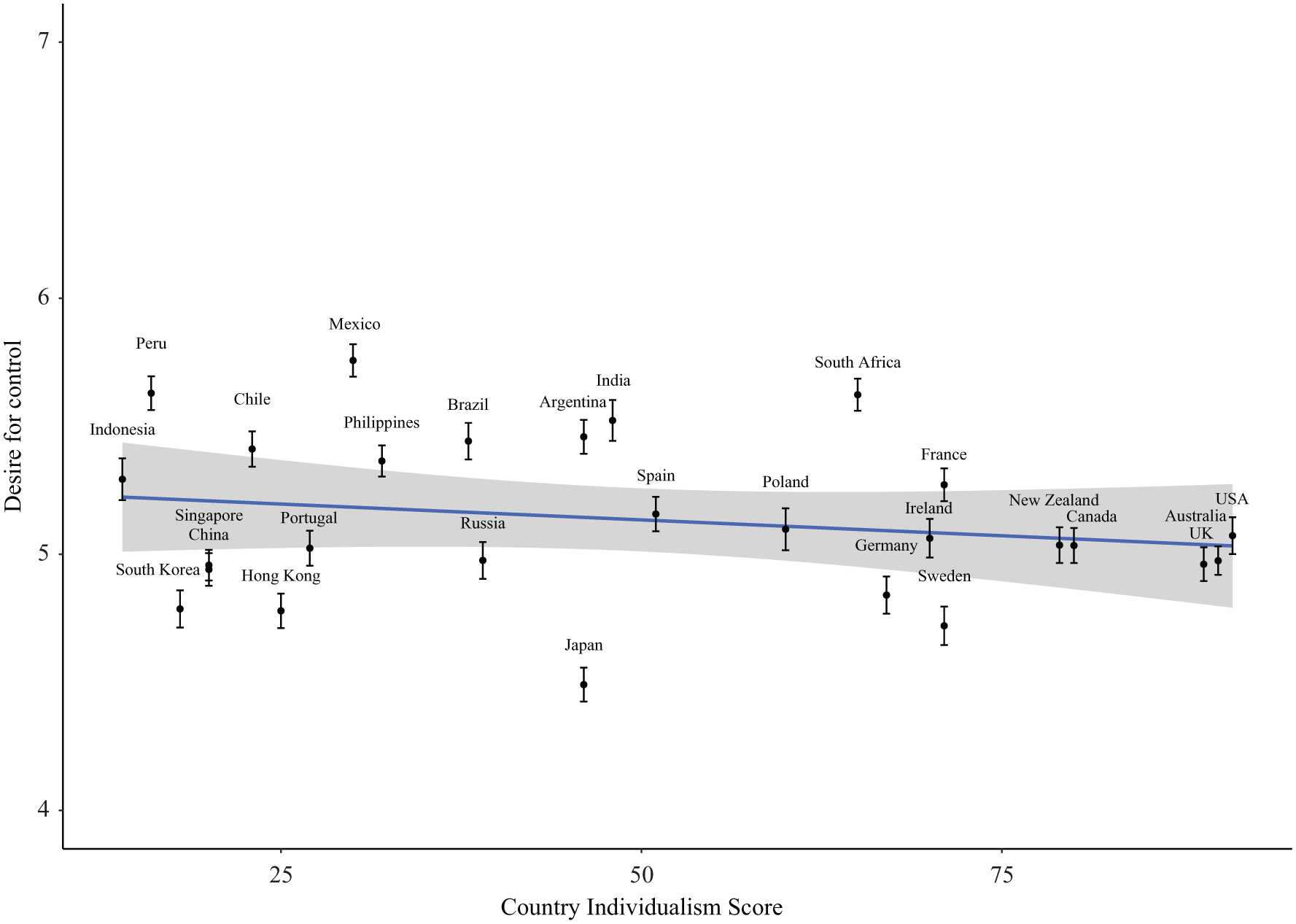
Null zero-order association between country individualism score (x-axis) and desire for control in that country (with standard error bars; y-axis) in Study 2.
In addition, we calculated a holistic model that included a variable that dummy coded the national samples into holistic (0) and nonholistic (1) countries. Samples that were categorized as holistic were China, Hong Kong, India, Japan, Singapore, and South Korea. This model also included the demographic variables and the random effect of country. Comparing the holistic model to the demographic model did significantly increase the amount of variance accounted for, χ2(1) = 6.90, p = .009, and there were significant differences between holistic and nonholistic countries in desire for control (β = .14, p = .012, 95% CI: [.038, .243]). However, we then reran the analyses to see if the effect was reliable after removing Japan from the sample. This time the effect was nonsignificant (β = .10, p = .055, 95% CI: [.002, .205]). This suggests that the effect of holism was largely “carried” by the particularly low score on desire for control registered in Japan.
We finally calculated a Japanese exceptionalism model that included a dummy coded variable comparing all nations (0) against Japan specifically (1). This model also included the demographic variables and the random effect of country. Comparing the Japanese exceptionalism model to the demographic model did significantly increase the amount of variance accounted for in desire for control, χ2(1) = 5.48, p = .019. There was a significant difference between Japan and other countries in desire for control (β = –.13, p = .026, 95% CI: [–.235, –.019]). As can be seen in Table 1, this replicated the effect found in Study 1: Japan was lower on desire for control than the other countries. A univariate ANOVA further confirmed the pattern of cross-national difference, F(26, 4734) = 20.18, p < .001, η2 = .10, with Japan reporting a significantly lower desire for control score than every other nation (ps < .019).
General Discussion
Across two studies, we found no evidence that there were broad-based cultural differences in the extent to which people perceive they have control over their lives (Study 1) or the extent to which they desire control (Study 2). One could not reliably predict a national sample’s control scores by knowing where that nation lay in terms of individualism-collectivism. Nor could it be reliably predicted by knowing where the nation lay in terms of its culturally defined tolerance for ambiguity (uncertainty avoidance), its acceptance of power inequalities (power distance), or its preference for achievement and assertiveness (masculinity vs. femininity). Finally, we could not detect reliable differences between holistic and nonholistic countries in control ratings (when excluding Japan from the analysis).
It is important to highlight that the current data do not imply that culture has no effect on whether people have or want control, or that proponents of cross-cultural perspectives on primary control are wrong. Indeed, the data provide a striking endorsement of the seminal work by Weisz et al. (1984) and of others who have theorized differences between Japan and North America in terms of orientations toward control (e.g., Eisen et al., 2016; Gould, 1999; Morling et al., 2002). In both studies, our Japanese samples had the lowest control scores of all nations, significantly below the next lowest score in desired control, and significantly below all but one country on perceived control. However, as tempting as it is to generalize from this to make a broader statement about the effects of individualism and collectivism—or the effects of holistic and nonholistic cultures—our data do not bear out this hypothesis.
Of course, this raises the question, “If it is not about holism or collectivism, what is it about Japan that makes it such an outlier in terms of its orientations to primary control?” One possibility—outlined by Weisz and colleagues (1984)—is that of all the nations in our sample, Japan is the one that is most influenced by Buddhism. Approximately a third of Japanese self-identify their religion as Buddhist (NHK Culture Research Institute, 2009), but this is likely an underestimate of its influence, given that the term religion in Japan is used in a narrow way, referring only to religions with specific doctrines and required membership (Bestor, Bestor, & Yamagata, 2011). Indeed, Weisz and colleagues estimated that approximately 74% of Japanese are nominal adherents of Buddhism (but also made the point that the “influence of Zen is more visible in the history and evolution of Japanese culture than in the everyday behaviour of modern, mainstream Japanese”; p.961). Perhaps more so than other Eastern philosophies and traditions, Buddhism places a particularly strong emphasis on accepting things as they are and surrendering to the moment. Indeed, the second noble truth of Buddhism is that desire is the root of all suffering; the corollary of which is that happiness comes when people stop trying to control the universe and instead observe its natural flow. Given Buddhism’s particularly strong influence in Japan, it is perhaps unsurprising that Japanese should desire less primary control than others and instead focus on adaptation and accommodation.
Another possibility is that Japanese culture is a unique instantiation of collectivist values, one that places an unusually strong emphasis on interdependence and relational selves. Compared with other cultures, scholars have argued that Japanese place a particularly strong emphasis on values that imply interconnectedness. Examples include omoiyari (“an individual’s sensitivity to imagine another’s feelings and personal affairs, including his or her circumstances”; Shinmura, 1991, p. 387; see also Hara, 2006); ittaikan (“a feeling of merger or oneness with persons other than the self”; Weisz et al., 1984, p. 959); and taijin-kyofusho (a culturally specific version of social phobia that focuses on causing offense or embarrassment to others). Combined with the influence of Buddhism, this unique network of culturally specific values around fitting in and respecting others’ wishes might make the notion of individualized personal control over the environment seem both naive (in the sense of being unrealistic) and immature (or, in the language of Weisz et al., 1984, “pushy [and] selfish,” p. 957).
As an aside, we notice that our Mexican sample reported the highest scores of all nations in terms of both perceived control (Study 1) and desired control (Study 2). This was an unexpected finding, and we can point to no literature that might help explain this trend. Previously, scholars have made an elaborated case for the religious and cultural heritages that might make North Americans and Western Europeans relatively high in perceived and desired control. However, we are not aware of theory or research that makes a case for the unique cultural factors that might influence orientations to control in other parts of the world such as Central and South America. Doing so might be a useful priority for future research and one we hope will facilitate a more expansive discussion of the nation-level factors that impact on the tendency to crave control, including the role of education, life span, and national wealth.
As with most cross-cultural research, caution is required in extrapolating from these results. A perennial caveat of research in this field is that the samples may not adequately reflect the cultural matrix of a nation, and the current studies are no exception. In our defense, however, the WVS in Study 1 used nationally representative samples, thus making it as reliable a proxy for the broader cultural landscape as can be reasonably expected. The 27-nation data set in Study 2 was a self-selected sample, but it drew on community members (rather than college students) in a way that was broadly representative of the wider population in terms of age, sex, and subjective income. Furthermore, the conclusions drawn from the data in both studies were reached after controlling for a wide range of demographic covariates. This does not rule out the possibility that the samples are skewed in some subtle but important way. But there is no obvious a priori reason to think that the null results were an artifact of sampling problems, particularly because the predicted effects in Japan emerged reliably.
We also acknowledge that the conclusions are restricted by the operationalization of our key constructs. The representativeness and size of the samples used in Study 1 came at the cost of psychometric sophistication: One can critique the diffuse, unspecified nature of the single item used in the WVS. Study 2, perhaps, is vulnerable to the opposite criticism: that the measures for desired control are overly restrictive, with an emphasis on interpersonal influence. Future research may benefit from more diverse operationalizations of control, incorporating both primary and secondary control.
Because our research question required us to assess a genuinely polycultural sample, we were restricted to using self-report measures as opposed to behavior as our outcome measure. This approach carries strengths, in that it allows us to examine whether there are broad-based cultural differences in perceived and desired control, in a way that goes beyond the two- and three-sample comparisons that are typically used in lab-based studies of cultural effects. However, our approach also carries inherent limitations. Some of these limitations could be anticipated and defused prior to analysis. For example, potential problems with translation were reduced by the fact that both studies drew on professional translation/back-translation procedures. Furthermore, measurement invariance analyses confirmed that the scale used in Study 2 was psychometrically equivalent across samples. This provides some reassurance that the measures represented the same thing to participants across the various cultures.
Another potential limitation with self-report approaches is that responses can be subject to reference-group effects. It has been argued that on some traits people evaluate themselves not on an objective internal benchmark—and not with reference to a global benchmark—but rather with respect to other people within their country or culture (Heine, Buchtel, & Norenzayan, 2008; Heine, Lehman, Peng, & Greenholtz, 2002). Through the process of comparison and contrast, the reference-group effects may have the consequence of muting between-culture differences.
The question of whether or not reference-group effects are in operation in the current studies rests on the extent to which participants are making their judgments about control on the basis of implicit comparisons with culturally bound standards, or on the basis of introspection about internal standards. We would argue that certain traits are more subject to reference-group effects than others: For traits that are externally witnessed (e.g., extraversion, conscientiousness, maths performance at school), one may expect that people’s judgments are subject to being influenced by the frames of reference around them. For traits that are more internal and private, however, social comparisons are less salient and less possible. This may help explain why there is little evidence for reference-group effects on internal, private traits such as well-being and self-esteem (Heine et al., 2002), and one might argue that perceived and desired control fall into that category of variable. It is also notable that we do find systematic differences between our Japanese sample and other participants, despite the fact that Japanese respondents are presumably subject to the same reference-group effects. However, we accept the possibility that methods that do not rely on self-report may uncover cross-cultural differences that our surveys could not.
Despite these caveats, we believe that the current data provide a counterpoint to the tendency in the literature to simply presume that differences in attitudes toward control identified by Weisz and colleagues (1984) extend beyond the Japanese and American contexts that defined their review. Of the roughly 400 papers that have cited the original review by Weisz and colleagues to date, over 100 of them have (mis)cited it to make the case that there are broad-based cultural differences in control; that “Western,” “individualist,” and/or “independent” cultures differ from “Eastern,” “Asian,” “East Asian,” “collectivist” and/or “interdependent” cultures in their orientation to primary control or their willingness to engage in it. We hope that the current article serves as a correction to this interpretational overreach and facilitates a more focused assessment of the role of culture in determining people’s orientation to control.
Supplemental Material
hornsey_online_appendix – Supplemental material for Exploring Cultural Differences in the Extent to Which People Perceive and Desire Control
Supplemental material, hornsey_online_appendix for Exploring Cultural Differences in the Extent to Which People Perceive and Desire Control by Matthew J. Hornsey, Katharine H. Greenaway, Emily A. Harris and Paul G. Bain in Personality and Social Psychology Bulletin
Footnotes
Acknowledgements
We thank Roy Baumeister for his comments on an earlier version of this article.
Declaration of Conflicting Interests
The author(s) declared no potential conflicts of interest with respect to the research, authorship, and/or publication of this article.
Funding
The author(s) disclosed receipt of the following financial support for the research, authorship, and/or publication of this article: Work reported in the current article was supported by funding from the Australian Research Council (DE160100761).
Notes
Supplemental Material
Supplementary material is available online with this article.

References
Supplementary Material
Please find the following supplemental material available below.
For Open Access articles published under a Creative Commons License, all supplemental material carries the same license as the article it is associated with.
For non-Open Access articles published, all supplemental material carries a non-exclusive license, and permission requests for re-use of supplemental material or any part of supplemental material shall be sent directly to the copyright owner as specified in the copyright notice associated with the article.
