







Abstract
We examine how relational needs underlie sexism by conducting a meta-analysis (k = 22; N = 4,860) on the links between adults’ romantic attachment and endorsement of ambivalent sexism. Results across two random-effects meta-analytic methods supported that men’s and women’s attachment anxiety predicted stronger endorsement of both benevolent sexism and hostile sexism. Simultaneously, men’s attachment avoidance predicted lower endorsement of benevolent sexism, and for men in relationships (vs. single men), stronger endorsement of hostile sexism. Thus, the way that people fulfil their relational goals lead people to adopt particular attitudes about gender, supporting that relationships are one key source of people’s adoption of sexism. These results bridge attachment theory and ambivalent sexism theory by illustrating how individual differences in the amplification or suppression of needs for relational security fuel adoption of beliefs that function to maintain gender inequality across the world.
Attachment theory describes how people have a cognitive system that is shaped by experiences of the availability and quality of support they receive when threatened or stressed (Bowlby, 1969; Fraley & Shaver, 2000; Hazan & Shaver, 1987). This system guides people’s behavioral, cognitive, and affective responses to obtain, or suppress the need for, interpersonal support (Fraley & Shaver, 2000). Individual differences in attachment orientation occur along two dimensions: attachment anxiety, the extent to which people view themselves as reliant on others for support and fear being abandoned (Fraley, Waller, & Brennan, 2000; Simpson & Rholes, 2012), and attachment avoidance, the extent to which people view others as unreliable support providers and shun dependence (Fraley et al., 2000; Simpson & Rholes, 2012). One focus of the attachment literature is how romantic attachment produces patterns of interpersonal behavior and cognition that shape relationship dynamics and well-being (Li & Chan, 2012; Simpson & Rholes, 2012). However, attachment orientations also shape people’s social beliefs beyond their immediate relationships. For example, higher attachment anxiety and attachment avoidance are predictive of holding more prejudicial attitudes toward outgroups (e.g., Boag & Carnelley, 2012; Hofstra, van Oudenhoven, & Buunk, 2005; Mikulincer & Shaver, 2001).
The link between attachment orientations and prejudice is particularly important for understanding people’s endorsement of sexist attitudes because sexism intersects both intergroup domains and romantic domains (Glick & Fiske, 1996; Hammond & Overall, 2017). A fundamental principle of ambivalent sexism theory (Glick & Fiske, 1996) is that romantic desires and fears should fuel higher endorsement of sexist attitudes toward women. However, only three studies have reported associations between attachment orientations and sexist attitudes (i.e., Hart, Glick, & Dinero, 2013; Hart, Hung, Glick, & Dinero, 2012; Yakushko, 2005), and have provided inconsistent results. In the current paper, we go beyond the published literature to draw together 22 datasets on the links between romantic attachment and sexist attitudes. We report meta-analytic models to examine the evidence that differences in men’s and women’s understanding of romantic relationships is one foundation of their endorsement, or rejection, of sexist attitudes.
Attachment in Romantic Relationships and in Intergroup Contexts
John Bowlby (1969, 1973, 1980) theorized that humans evolved an attachment system that directs cognition, affect, and behavior toward their support figures when distressed. The attachment system encapsulates experiential knowledge of the accessibility and responsiveness of other people when in need of support, ultimately directing how people form and maintain their relationships (Hazan & Shaver, 1987). Individual variation in attachment systems occurs along two dimensions—attachment anxiety and attachment avoidance (Fraley et al., 2000; Simpson & Rholes, 2012). Higher attachment anxiety is defined by a heightened need for closeness and an idealized view of romantic love, paired with negative views about the self and expectations of abandonment (Fraley et al., 2000; Simpson & Rholes, 2012). In contrast, higher attachment avoidance is defined by a need for self-reliance, along with negative views of others’ reliability as support providers (Fraley et al., 2000; Simpson & Rholes, 2012). Individuals low on both dimensions are characterized as more secure; they are comfortable with interdependence and have positive views about their ability to rely on others and for others to rely on them (Fraley et al., 2000; Simpson & Rholes, 2012).
Most research on attachment anxiety illustrates how people’s heightened motives for intimacy (and accompanying fears about being rejected or abandoned) tend to undermine relationship quality (Li & Chan, 2012). Although goals for intimacy are characteristic of felt security in well-functioning relationships, people higher in attachment anxiety pair intimacy goals with relatively lower trust of their partner (Mikulincer, 1998). Mistrust and concerns for relational security often come at the expense of relationship quality. For instance, people higher in attachment anxiety tend to engage in excessive reassurance seeking behaviors that irritate partners by asking whether they “really care” (Shaver, Schachner, & Mikulincer, 2005). Similarly, people higher in attachment anxiety tend to exaggerate their hurt feelings when facing relationship conflicts, guilting their romantic partners into providing the reassurance they need as a signal of relationship security (Overall, Girme, Lemay, & Hammond, 2014).
By contrast, research on attachment avoidance demonstrates how stress-activated suppression of needs for support, affection, and interdependence undermines relationship quality (Li & Chan, 2012; Simpson & Rholes, 2012). At times when people higher in attachment avoidance desire closeness and support, they tend to suppress these needs by distancing themselves from their partners (Rholes, Simpson, & Oriña, 1999; Simpson, Rholes, & Nelligan, 1992). For instance, people higher in attachment avoidance expect their partners to be less effective support providers and are more critical when partners fail to provide sufficient levels of support (Girme, Overall, Simpson, & Fletcher, 2015; Rholes et al., 1999; Simpson et al., 1992). Thus, for people higher in attachment avoidance, relationship needs are a perceived vulnerability because they cannot trust others to be reliable and effective in times of need. Instead, people higher in attachment avoidance prize independence and self-reliance.
The drives for felt security and inclusion inherent to attachment orientations extend beyond patterns of relationship behavior and have been linked to prejudice. Experiments that prime people’s trust in their support providers decrease those people’s negative evaluations and behavior toward people who belong to outgroups (Mikulincer & Shaver, 2001, 2007). People higher in attachment anxiety or attachment avoidance tend to be relatively less accepting of immigrants (Hofstra et al., 2005; Van Oudenhoven & Hofstra, 2006), more negative toward outgroup Muslims (Boag & Carnelly, 2012), and more strongly endorse ideologies about the world that underlie prejudices (Weber & Frederico, 2007). These studies have focused on prejudice as primarily antagonistic attitudes toward outgroups. However, sexism is a prejudice that exists in subjectively positive forms, is directed toward the self (and romantic partners), and overlaps traditional romantic ideals (Glick & Fiske, 1996). Thus, investigations into the links between attachment orientations and sexism is particularly relevant because of the ways that people’s endorsement of sexism shapes their adoption or rejection of traditional relationship roles.
Ambivalent Sexism and Its Sources
Ambivalent sexism theory (Glick & Fiske, 1996) describes how sexist attitudes comprise two ideologies. Hostile sexism encompasses aggressive attitudes that characterize women as seeking power in malicious ways, such as humiliating men in relationships. However, hostile sexism is antagonistic and sparks resistance toward men’s power at a societal level and, when expressed at an interpersonal level, undermines heterosexual men’s fulfilment of needs for intimacy, sex, and support (Glick & Fiske, 1996; Hammond & Overall, 2016; Hammond & Overall, 2017). The second ideology, benevolent sexism, functions to counterbalance these costs. Benevolent sexism encompasses patronizing, romantic-sounding attitudes that characterize women as pure, fragile, and needing the protection of men (Glick & Fiske, 1996). This ideology romanticizes traditional relationship roles in which men pursue careers as the primary provider while women invest in caregiving, domestic roles (Chen, Fiske, & Lee, 2009; Lee, Fiske, Glick, & Chen, 2010), and accordingly, men’s and women’s endorsement of benevolent sexism tends to promote support of men’s career pursuits and men’s relationship security (Hammond & Overall, 2016; Hammond & Overall, 2017). The complementary functions of hostile sexism and benevolent sexism mean that endorsement of sexist attitudes typically entails endorsing both ideologies: Men’s and women’s adherence to the prescriptions and proscriptions of sexist attitudes function to maintain men’s societal advantages (for reviews, see Connor, Glick, & Fiske, 2016; Glick & Fiske, 2001).
The sources of sexism are less understood than the consequences of sexism. Research on the precursors of sexism has primarily focused on the sequence of legitimizing ideologies that lead to gender prejudices. For example, people who view the world as competitive and dangerous are more likely to endorse broad ideologies about social groups such as social dominance orientation and right-wing authoritarianism, which have been shown to underlie prejudice (Duckitt, 2001; Sibley, Wilson, & Duckitt, 2007a). According to this model, endorsement of benevolent sexism follows from general beliefs about upholding traditional norms and ingroup security (Sibley, Wilson, & Duckitt, 2007b). In contrast, endorsement of hostile sexism follows from beliefs that groups in society generally belong in “dog-eat-dog” hierarchies (Sibley et al., 2007b). Another pathway concerning societal perceptions shows one reason that women endorse benevolent sexism. Women’s perceptions of being vulnerable to harm and discrimination in society fosters endorsement of traditional, paternalistic ideologies, which rationalize gender inequalities via beliefs that violence only occurs to women who step outside of traditional norms and that “good women” are protected against danger (Fischer, 2006; Radke, Hornsey, Sibley, & Barlow, 2018).
Another pathway underlying people’s adoption of sexist ideologies is the need to establish and maintain social ties. According to shared reality theory, people’s attitudes about the world tend to converge with the attitudes that are held by close others (Hardin & Higgins, 1996). Convergence of attitudes fulfils two fundamental needs—people feel accepted, loved, and supported by close others (relational needs) and feel mutual assurance in their understanding of the world (epistemic needs; Hardin & Higgins, 1996; Jost, Nosek, & Gosling, 2008). Indeed, longitudinal research has shown how women’s endorsement of benevolent sexism can be fostered by their intimate relationships: When women perceived that their intimate partner more strongly endorsed benevolent sexism, they maintained a relatively higher endorsement of benevolent sexism over time (Hammond, Overall, & Cross, 2016). The alignment of women’s benevolent sexism toward their (perceived) partners’ beliefs occurred partly as a function of the relationship benefits that benevolent sexism promises women, such as continued devotion and care from partners (Hammond et al., 2016; also see Cross & Overall, 2018). Thus, the romanticism of benevolent sexism fulfils relational needs for love and security by promising that women’s investment in a traditional, family-focused role will be matched by male partners’ role as the primary provider.
The relational motives that underpin people’s adoption of sexist attitudes toward women have been largely unexplored. As we discuss in the following section, only three studies have reported correlations between attachment orientations and endorsement of sexism. In the current research we use a meta-analytic approach to comprehensively test the extent to which individual differences in the ways people build and maintain ties with close others—people’s attachment anxiety and attachment avoidance—predict their endorsement of benevolent sexism and hostile sexism. Given the evidence available in prior research, the following predictions concern how attachment orientations should foster heterosexual men’s endorsement of sexism toward women. However, after these predictions, we make exploratory predictions for how heterosexual women’s attachment orientations may be linked to endorsement of sexism toward women.
The Expected Links Between Attachment and Sexism
Hypothesis 1: Men’s Attachment Anxiety Predicts Higher Benevolent Sexism
We expected higher attachment anxiety to predict stronger endorsement of benevolent sexism because of the ways in which the ideology is congruent with their relational motives for heightened relationship security. People higher in attachment anxiety tend to crave closeness, affection, and reassurance from their romantic partners (Hazan & Shaver, 1987; Shaver et al., 2005), goals that benevolent sexism justifies via romanticized beliefs that men are completed and fulfilled by the love of a woman (Glick & Fiske, 1996). Beyond justification of security needs, men’s endorsement of benevolent sexism serves motives for closeness via idealization of relationships. Men’s benevolent sexism is linked with more positive interactions with partners, more positive perceptions of partners’ daily behavior, and higher relationship satisfaction (Hammond & Overall, 2013b; Overall, Sibley, & Tan, 2011). Consistent with these expectations, prior cross-sectional research by Hart et al. (2012) and Yakushko (2005) found evidence for a positive association between men’s attachment anxiety and benevolent sexism.
Hypothesis 2: Men’s Attachment Anxiety Predicts Higher Hostile Sexism
There is mixed evidence for the association between attachment anxiety and hostile sexism: Hart et al. (2012) showed evidence of a positive association between men’s attachment anxiety and hostile sexism, but no evidence was found by Yakushko (2005). We expected a positive association because attachment anxiety prompts heightened concerns about being rejected by romantic partners, concerns that are often linked with hostility directed toward partners (Feeney, Noller, & Callan, 1994; Hazan & Shaver, 1987; Levy & Davis, 1988). Men higher in attachment anxiety are likely more attracted to hostile sexism because their fears about partners’ lack of genuine love, and associated negativity, are rationalized by hostile sexism. For example, hostile sexism warns that women are motivated to play with men’s affections but prescribes that women who do shame men ought to be punished (e.g., Chen et al., 2009; Glick & Fiske, 1996). Accordingly, men higher in attachment anxiety may relieve relationship insecurities via beliefs that women will be castigated for leaving the relationship. Indeed, men’s attachment anxiety has previously been linked with heightened pressure to live up to masculine norms, argued to reflect a need for protection against relational vulnerability (McDermott & Lopez, 2013).
Hypothesis 3: Men’s Attachment Avoidance Predicts Lower Benevolent Sexism
The same qualities that make benevolent sexism desirable for men higher in attachment anxiety should make it unappealing for men higher in attachment avoidance. Men higher in attachment avoidance prize independence, display disproportionate self-reliance, and seek to maintain “safe” psychological distance in their romantic relationships (Mikulincer & Shaver, 2003, 2015). Benevolent sexism emphasizes mutual reliance and interdependence between men and women, such as via expressions that men are incomplete without providing and protecting for a partner and idealizing women’s capacity to fulfil men (Glick & Fiske, 1996). Thus, benevolent sexism is antithetical to the relational motives of men higher in attachment avoidance. The two published studies examining attachment orientations and sexist attitudes found evidence consistent with our expectations: Hart et al. (2012) and Yakushko (2005) both found a negative association between men’s attachment avoidance and benevolent sexism.
Hypothesis 4: Men’s Attachment Avoidance Predicts Higher Hostile Sexism
Existing correlational evidence for the association between men’s attachment avoidance and hostile sexism relationship is mixed: Yakushko (2005) found a positive association, while Hart et al. (2012) hypothesized this positive association but found no evidence for it. We expected higher attachment avoidance to predict stronger endorsement of hostile sexism because attachment avoidance encompasses negative models of relationship partners as unsupportive and untrustworthy in times of need (Mikulincer & Shaver, 2003, 2015) as well as relational goals to suppress the perceived vulnerabilities of being close with others (Crittenden & Ainsworth, 1989; Simpson & Rholes, 2012). Hostile sexism expresses views of women as manipulative and seeking to exploit men’s need for intimacy (Glick & Fiske, 1996), beliefs that likely serve to rationalize more avoidant men’s models of others as untrustworthy sources of support and love.
Research Question 1: Women’s Attachment Orientations and Endorsement of Sexism
We had tentative expectations for the links between women’s attachment orientations and endorsement of sexist attitudes. Women’s attachment anxiety may be related to higher endorsement of both benevolent sexism and hostile sexism because of the ways that sexist attitudes regulate fears of abandonment: Benevolent sexism promises women relationship security and the devotion of a cherishing partner (Cross & Overall, 2018; Hammond & Overall, 2013a; Hammond et al., 2016), whereas hostile sexism vilifies and threatens women who could be potential competitors (Glick & Fiske, 1996). Indeed, in the one study that has previously examined these associations, Yakushko (2005) found that women’s attachment anxiety was positively related to benevolent sexism and hostile sexism. However, these were bivariate associations that did not account for the typically moderate associations between attachment orientations or between sexist ideologies. In sum, we tentatively expected that women’s attachment anxiety would predict higher endorsement of benevolent sexism and hostile sexism (toward women), and did not make hypotheses for women’s attachment avoidance.
Research Question 2: A Boundary Condition for the Links Between Attachment Orientations and Sexist Attitudes
The majority of available datasets included in our meta-analysis did not aim to test the links between attachment orientation and endorsement of sexism so there were no viable measures for mediation analyses. However, we had people’s relationship status consistently across datasets and so were able to conduct exploratory moderation tests to identify the extent to which the hypothesized links were dependent on relational context. The romantic attachment system functions in ways to regulate distress, fear, and uncertainty by either relying on versus withdrawing from support providers (Simpson & Rholes, 2012). Thus, the heightened relational needs of attachment anxiety may be more salient for people who are single (and have no support provider) while the heightened independence needs of attachment avoidance may be more salient for people in relationships (and face more difficulties withdrawing from others). In the current study, we tested whether the associations between men’s attachment anxiety and greater endorsement of (a) hostile sexism and (b) benevolent sexism were magnified for men who were single and therefore experienced heighted desires and frustrations regarding women in romantic relationships. We also tested whether men’s attachment avoidance and (a) greater endorsement of hostile sexism and (b) greater rejection of benevolent sexism were magnified in committed relationships in which threats to independence are more salient than for men who were single.
Current Research
We collected 22 datasets to conduct a meta-analysis of the links between attachment anxiety, attachment avoidance, benevolent sexism, and hostile sexism. Two existing studies (Hart et al., 2012; Yakushko, 2005) have shown mixed evidence for these associations, but several studies have measured these variables without the goal of testing these specific associations. A meta-analysis on these links establishes robust evidence of the links between attachment orientations and sexist attitudes. Bridging attachment theory with ambivalent sexism theory makes substantial advances for both theories—developing breadth of understanding for the ways that people’s attachment orientations may have societal-level impact on gender inequality and, vice versa, develops knowledge on the particular relational motivators of endorsement of sexism.
We hypothesized the following:
In contrast,
Finally,
Method
Literature Search
The literature search for this study was conducted using the online databases: PsychINFO, ProQuest, and the Google Scholar Internet search engine, and was concluded in May 2017. Relevant articles were located using a combination of terms relating to sexism (such as ambivalent sexism, benevolent sexism, hostile sexism, sexism, and attitudes toward women) and attachment orientations (such as anxious attachment, ambivalent attachment, preoccupied attachment, attachment avoidance, insecure attachment, and attachment security). We also searched the Open Science Framework for upcoming studies measuring both adult attachment and ambivalent sexism. After screening and eligibility criteria were applied, this search identified seven studies of interest (including two theses). Four of the seven authors responded and were willing to share their data. Effect sizes for one of the three remaining studies were obtained from the reported correlations (Yakushko, 2005). We also used five datasets personally available to the second author, and we contacted researchers who would potentially own datasets containing both adult attachment and ambivalent sexism, obtaining 11 further datasets (see Figure 1 for description of our review process).
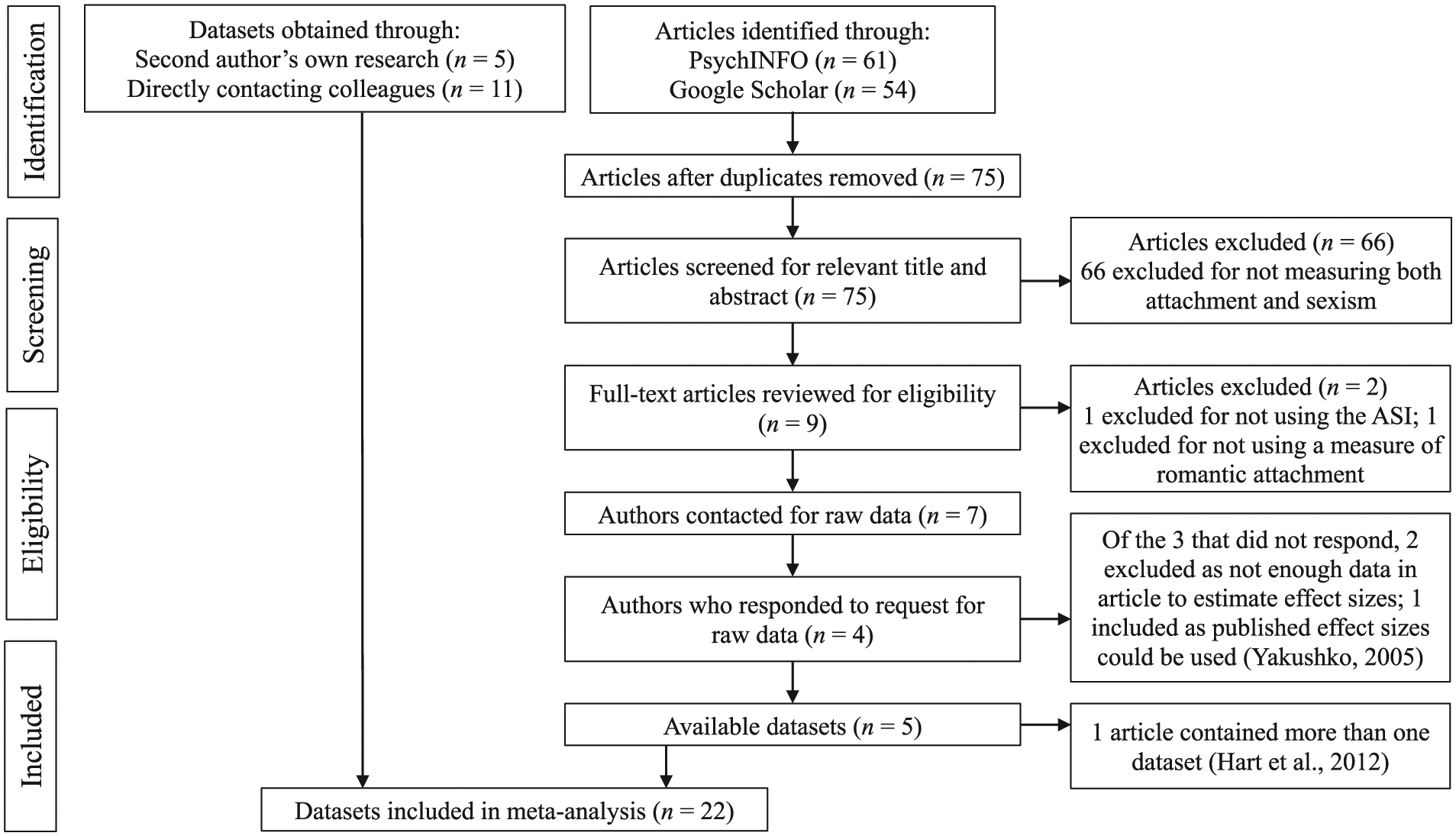
Flowchart depicting the systematic review process including reasons for exclusion.
Inclusion Criteria and Missingness
For a study to be incorporated in our meta-analysis, the study needed to include a measure of adult attachment using the Experiences in Close Relationships scale (Fraley et al., 2000), the Adult Attachment Questionnaire (AAQ; Simpson, Rholes, & Phillips, 1996), or the Adult Attachment Scale (Collins & Read, 1990), and measure sexism with the Ambivalent Sexism Inventory (Glick & Fiske, 1996). Of 10 studies identified in the initial literature search, four were excluded because they did not measure sexism using the Ambivalent Sexism Inventory. Our operationalization of ambivalent sexism toward women, and accompanying predictions, were based on heterosexual populations, and so we excluded 111 participants who did not identify as heterosexual. Data from two studies (Don & Hammond, 2017; Shinne, 2016) were rescaled to 7-point scales to be equivalent to other studies. Finally, 18 participants were excluded due to complete missingness.
Results
Table 1 displays the dataset characteristics and bivariate correlations between variables, split by gender. The final dataset comprised 22 studies with a total of 4,860 participants. Twenty studies included both men and women, while two exclusively tested men. Of the total participants, 44.6% were men (N = 2,169) and 55.4% were women (N = 2,691). Participants’ average age was 28.11 (SD = 11.80; range = 16 to 84 years old). Where relationship status was known (N = 2,796), more participants were in committed romantic relationships (N = 1,914) than were single (N = 882). See online supplementary materials (Supplementary Table 1) for sample-size weighted correlations between study variables.
Characteristics of Datasets Used in the Meta-Analyses and Effect Sizes (Pearson’s r) for the Links Between BS, HS, ANX, and AVD for Men and for Women.
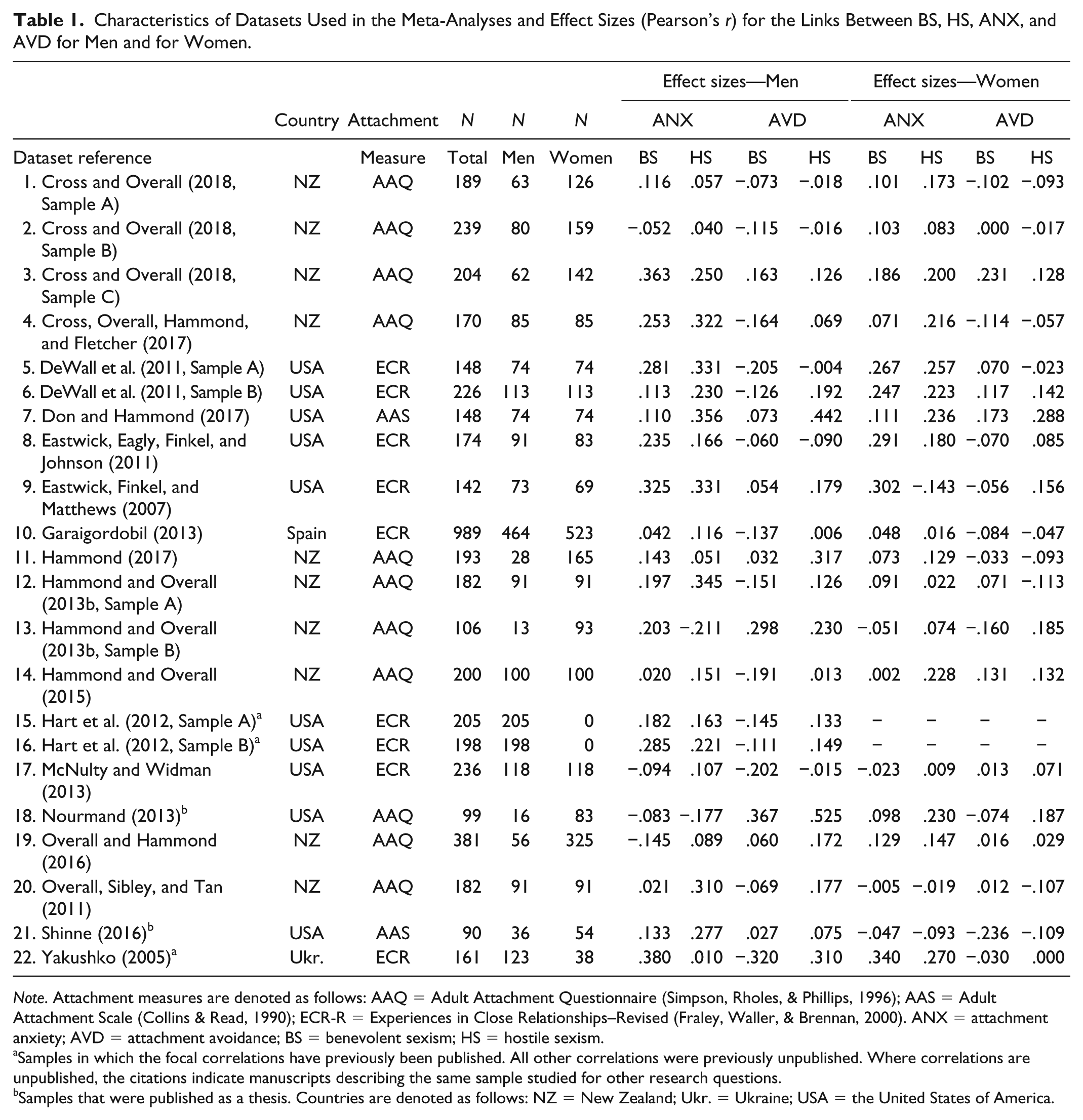
Note. Attachment measures are denoted as follows: AAQ = Adult Attachment Questionnaire (Simpson, Rholes, & Phillips, 1996); AAS = Adult Attachment Scale (Collins & Read, 1990); ECR-R = Experiences in Close Relationships–Revised (Fraley, Waller, & Brennan, 2000). ANX = attachment anxiety; AVD = attachment avoidance; BS = benevolent sexism; HS = hostile sexism.
Samples in which the focal correlations have previously been published. All other correlations were previously unpublished. Where correlations are unpublished, the citations indicate manuscripts describing the same sample studied for other research questions.
Samples that were published as a thesis. Countries are denoted as follows: NZ = New Zealand; Ukr. = Ukraine; USA = the United States of America.
We tested our predictions using two meta-analytic approaches. First, we conducted a meta-analysis of the bivariate correlations using Comprehensive Meta-Analysis (CMA; Borenstein, Hedges, Higgins, & Rothstein, 2005). Second, because we had access to the primary data from 21 studies, we used multilevel structural equation modelling to simultaneously estimate the links between romantic attachment and sexist attitudes. Multilevel modeling appropriately weights estimates of the slopes according to the relative reliability of that slope (i.e., the number of participants within a given sample; Card, 2012; Nezlek, 2011). We conducted models separately for men and for women, and tested for gender effects with interactions in pooled-effects models (see Hammond & Overall, 2013b; Hammond et al., 2016), because endorsement of sexist attitudes toward women carry different meanings for men (in which attitudes are toward an outgroup) than for women (in which attitudes encompass the ingroup).
Approach 1: Meta-Analysis of Bivariate Correlations
Model
We first estimated the bivariate links between attachment orientations and sexist attitudes using CMA. Effect sizes from three samples (two from Hart et al., 2012; one from Yakushko, 2005) had been previously reported (Pearson r). The remaining effect sizes were calculated from datasets that were shared by the respective owners. CMA transforms parameters to Fisher z-scores for analysis and then converts parameters back to Pearson r to interpret the results because the variance of correlations is dependent on their magnitude (see Borenstein, Hedges, Higgins, & Rothstein, 2009; Lipsey & Wilson, 2001).
We estimated our effects using random effects meta-analysis (i.e., we allowed population parameters to vary; Hunter & Schmidt, 2004) and tested for heterogeneity across samples using Cochran’s Q statistic (Borenstein et al., 2009). We then employed subgroup analyses (Borenstein et al., 2009) to test whether effects varied across (a) gender, (b) the measurement of attachment orientations (i.e., AAQ vs. the Experiences in Close Relationships Revised Scale), or (c) the sampled country (i.e., New Zealand vs. the United States; see Table 1).
Results
Results from the random-effects meta-analysis including overall effect sizes are presented in Table 2. First, reviewing the weighted effects for men, there was a small and significant positive weighted effect for the links between attachment anxiety and both benevolent sexism and hostile sexism. These results indicated that men’s attachment anxiety was related to stronger endorsement of both benevolent sexism and hostile sexism, supporting Hypotheses 1 and 2. Also as expected, there was a significant negative weighted effect for the link between attachment avoidance and benevolent sexism, and a significant positive weighted effect for the link between attachment avoidance and hostile sexism. Thus, men higher in attachment avoidance tended to reject benevolent sexism more strongly but more strongly endorse hostile sexism, supporting Hypotheses 3 and 4 (see online supplementary materials [Supplementary Figures 1 to 4] for forest plots of these results).
Results of the Mixed-Effects Meta-Analysis and Associated Effect Sizes for the Bivariate Links Between BS and HS, and ANX and AVD Across Samples for Men (N = 2,169) and Women (N = 2,691).
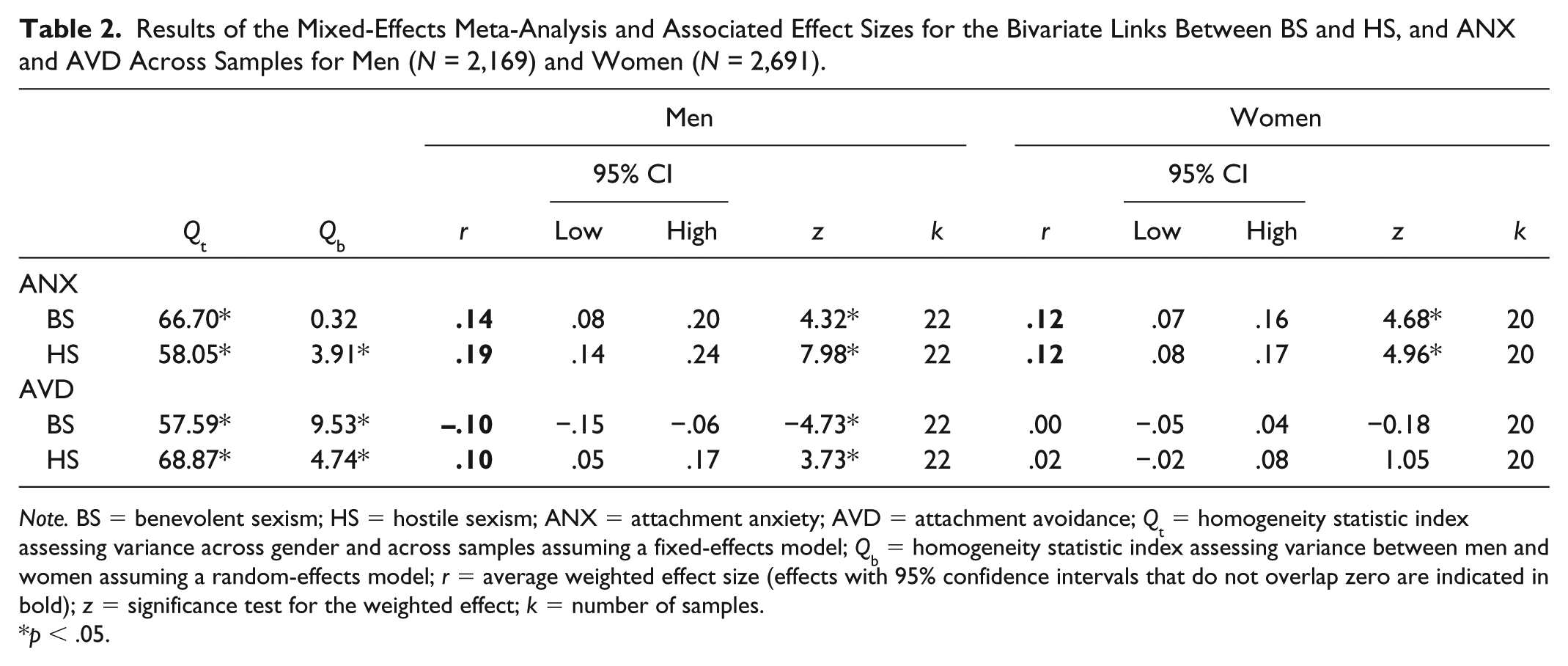
Note. BS = benevolent sexism; HS = hostile sexism; ANX = attachment anxiety; AVD = attachment avoidance; Qt = homogeneity statistic index assessing variance across gender and across samples assuming a fixed-effects model; Qb = homogeneity statistic index assessing variance between men and women assuming a random-effects model; r = average weighted effect size (effects with 95% confidence intervals that do not overlap zero are indicated in bold); z = significance test for the weighted effect; k = number of samples.
p < .05.
For women (Research Question 1), significant positive weighted effects emerged for the links between attachment anxiety and both endorsement of benevolent sexism and endorsement of hostile sexism. These results indicated that women higher in attachment anxiety, like men, tended to more strongly endorse ambivalent sexism. No significant weighted effects were found for women’s attachment avoidance. Forest plots of these results are available in the online supplementary materials (Supplementary Figures 5 to 8). As displayed in Table 2, heterogeneity tests (Qt) in a fixed-effects model that pooled gender revealed significant variance across all samples for all of the hypothesized associations. The between-samples homogeneity tests (Qb) in a random-effects model indicated significant variance in the weighted effects between men and women for all of the associations except for that of attachment anxiety and benevolent sexism.
Next, we performed subgroup moderation analyses to examine whether the weighted effects in Table 2 differed according to (a) the type of attachment scale used and (b) the country sampled (see Table 1). No significant variation was found in any of the weighted effects when comparing samples using the AAQ and samples using the Experiences in Close Relationships (ECR; Qb ranged from 0.00 to 2.92, ps > .088). Similarly, no significant variation was found in any of the weighted effects when testing samples from New Zealand versus the United States (Qb ranged from 0.00 to 3.23, ps > .072). In sum, none of the observed associations between attachment and sexism were moderated by study-level characteristics, for both men and women.
Approach 2: Multilevel Structural Equation Model
Model
Next, we tested our predictions in a random-effects multilevel structural equation model that allowed us to identify the unique associations between attachment orientations and sexist ideologies while accounting for inherent dependence in the data (i.e., that people’s responses within one sample will be more similar relative to people in different samples; Hox, 2002). All analyses were conducted using MPlus Version 7.3 (Muthén & Muthén, 1998-2012). The dataset was structured so that people (Level 1) were nested within Studies (Level 2). Intercepts and slopes were allowed to vary across studies (i.e., were estimated as random effects). We used maximum likelihood estimation (robust standard errors) in all analyses except for the first model for men, which did not converge. In this case, we used full-information maximum likelihood (i.e., MLF) estimation, which is equivalent given large sample sizes (see Asparouhov & Muthén, 2012).
Results
Results from the multilevel structural equation model for men are displayed in Figure 2. Men’s attachment anxiety was related to stronger endorsement of both benevolent sexism and hostile sexism, again supporting Hypotheses 1 and 2. Also supporting Hypothesis 3, men’s attachment avoidance was related to greater disagreement with benevolent sexism. However, contrary to our expectation (Hypothesis 4), attachment avoidance was not significantly related to hostile sexism when simultaneously modelling all of the links.
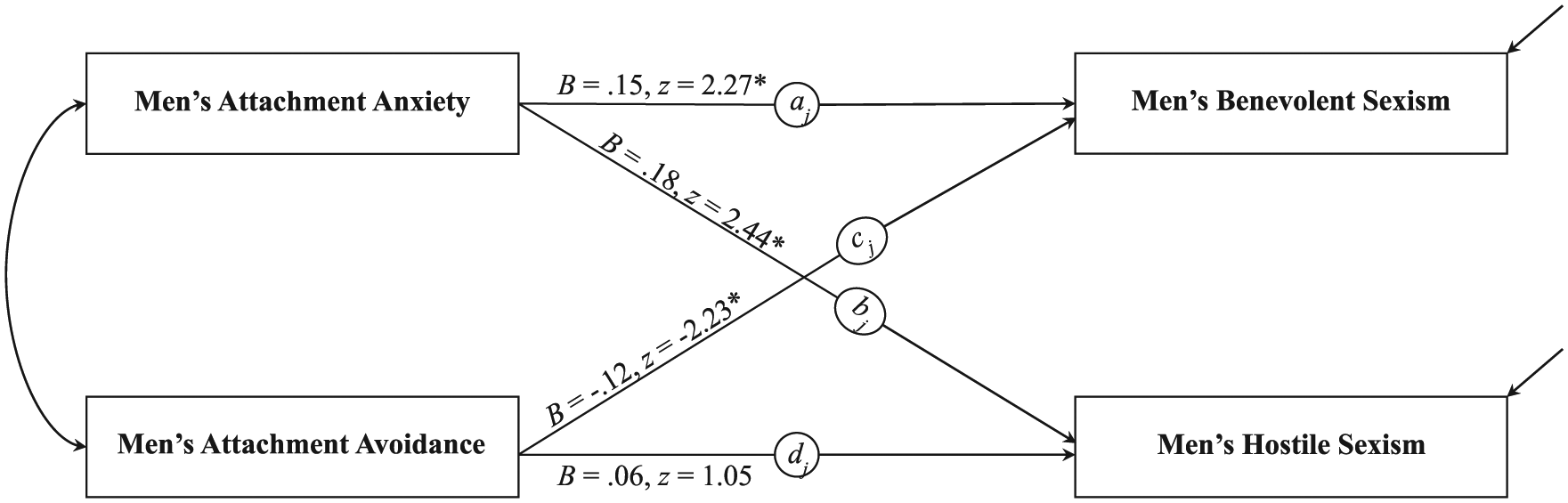
A multilevel model of the links between men’s attachment anxiety, attachment avoidance, benevolent sexism, and hostile sexism.
Figure 3 presents the results from the multilevel structural equation model for women (Research Question 1). Women’s attachment anxiety was related to stronger endorsement of both benevolent sexism and hostile sexism, supporting our expectation and mirroring the results for men. Women’s attachment avoidance was not significantly related to either benevolent sexism or hostile sexism.
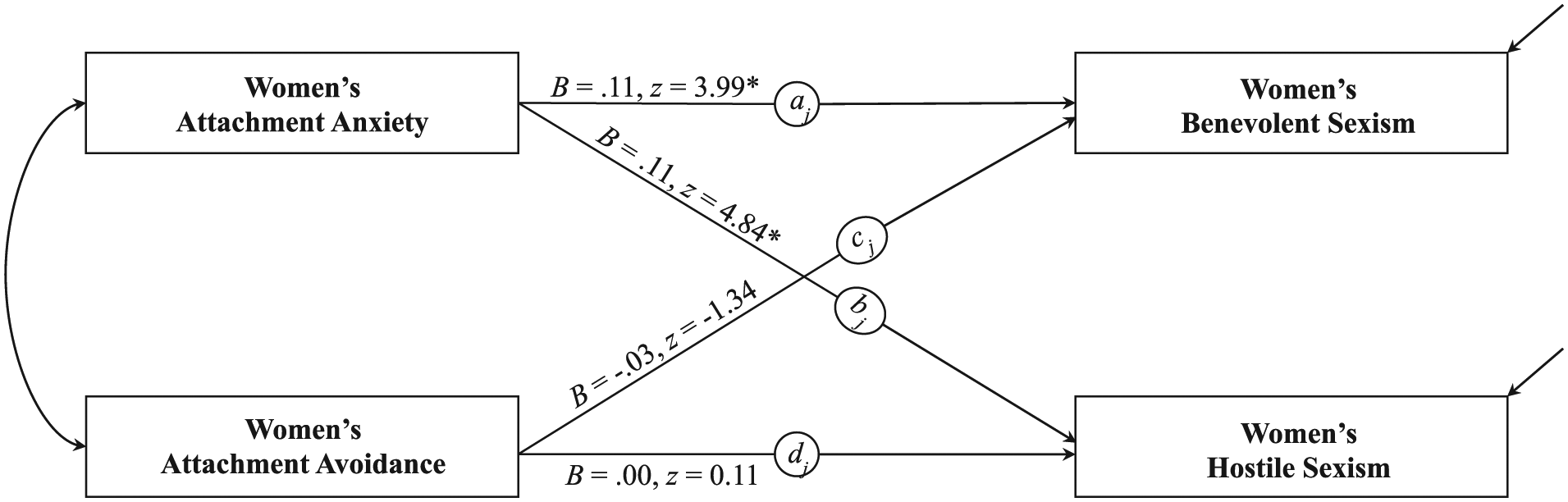
A multilevel model of the links between women’s attachment anxiety, attachment avoidance, benevolent sexism, and hostile sexism.
Tests of moderation
We conducted exploratory moderation tests using person-level information to test whether the associations differed by participants’ (a) gender, (b) relationship status—single versus partnered/married, or (c) age. Due to parameter limitations at the sample level, we could not model slopes as random effects or test for higher-order interactions between gender, relationship status, and/or age. Thus, these exploratory models only modelled intercepts as random and were conducted independently for men and for women when testing moderation by relationship status and age.
Gender
Gender significantly moderated the relationship between attachment avoidance and endorsement of benevolent sexism (B = −.050, SE = .021, 95% confidence interval [CI] [−.091, −.009], z = 2.37, p = .018). Simple slopes analysis indicated that the link between attachment avoidance and endorsement of benevolent sexism was significant for men (B = −.130, SE = .023, 95% CI [−.175, −.085], z = −5.69, p < .001) but not for women (B = −.030, SE = .025, 95% CI [−.079, .019], z = −1.20, p = .229). Gender also significantly moderated the link between attachment anxiety and hostile sexism (B = .029, SE = .014, 95% CI [.002, .057], z = 2.08, p = .038). Attachment anxiety was more strongly related to hostile sexism for men (B = .166, SE = .025, 95% CI [.118, .214], z = 6.76, p < .001) than for women (B = .107, SE = .025, 95% CI [.059, .155], z = 4.36, p < .001). The positive relationship between attachment anxiety and endorsement of benevolent sexism did not significantly differ for men and women (B = .004, SE = .017, 95% CI [−.030, .037], z = .213, p = .831). The nonsignificant relationship between attachment avoidance and hostile sexism also did not significantly differ for men and women (B = .006, SE = .017, 95% CI [−.028, .039], z = .327, p = .744).
Relationship status (Research Question 2)
First, examining the model for men (N = 1,046), a main effect indicated that men in committed relationships endorsed benevolent sexism more strongly than single men (B = .241, SE = .062, 95% CI [.012, .362], z = 3.90, p < .001) but were not significantly different in endorsement of hostile sexism (B = .042, SE = .070, 95% CI [−.095, .180], z = 0.60, p = .55). Relationship status significantly moderated the association between attachment avoidance and hostile sexism (B = .130, SE = .042, 95% CI [.048, .212], z = 3.10, p = .002). The simple slopes are displayed in Figure 4: Higher attachment avoidance was associated with stronger endorsement of hostile sexism but only for men who were in relationships (B = .148, SE = .030, 95% CI [.082, .214], z = 4.40, p < .001) but not for men who were single (B = .019, SE = .030, 95% CI [−.041, .078], z = 0.61, p = .543). No other significant moderating effects of relationship status emerged for the associations between attachment anxiety and hostile sexism (B = .074, SE = .044, 95% CI [−.012, .160], z = 1.68, p = .093), attachment avoidance and benevolent sexism (B = −.102, SE = .056, 95% CI [−.212, .007], z = −1.83, p = .067), or attachment anxiety and benevolent sexism (B = −.062, SE = .075, 95% CI [−.210, .086], z = 0.82, p = .413). In the model conducted for women (N = 1,748), there were no significant moderating effects of relationship status (Bs = −.086 to .069, zs = −0.91 to 0.80, ps > .36).
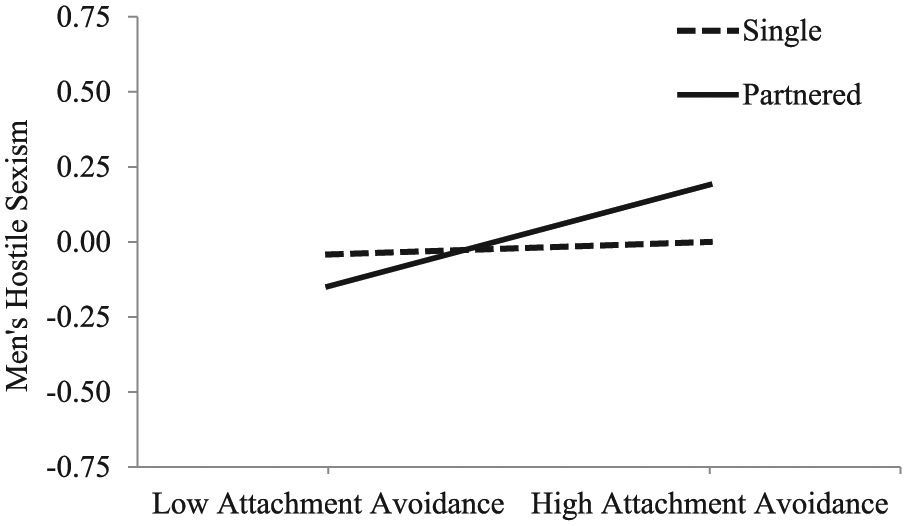
The moderating effect of men’s relationship status (single vs. partnered) on the association between attachment avoidance and hostile sexism.
Age
Finally, we conducted a discriminant test to examine whether participant age moderated the associations between attachment orientations and sexist attitudes. No significant moderating effects emerged in the model conducted for men (N = 2,119; Bs = −.002 to .001, zs = −0.99 to 0.46, ps > .32) or the model for women (N = 2,564; Bs = −.001 to −.000, zs = −0.86 to −0.46, ps > .39). These results did not identify any evidence that the links between attachment orientations and sexist attitudes differed across age. Thus, it is unlikely that any differences across relationship status were accounted for by normative age-related variation across participants.
Discussion
This research conducted a meta-analysis of 22 datasets to test the extent to which differences in people’s attachment orientations were related to differences in their endorsement of sexist ideologies. By bridging adult attachment theory (Hazan & Shaver, 1987) and ambivalent sexism theory (Glick & Fiske, 1996), we examined (a) how variation in people’s relational needs have broader consequences for their adoption of traditional roles and acceptance of gender inequality, and (b) the plausibility that relational needs are one factor motivating people’s endorsement (vs. disagreement) with sexism toward women. For men, we hypothesized that higher attachment anxiety would lead to stronger endorsement of both benevolent sexism (Hypothesis 1) and hostile sexism (Hypothesis 2). In contrast, we posited that higher attachment avoidance would lead men to disagree more with benevolent sexism (Hypothesis 3), but more strongly endorse hostile sexism (Hypothesis 4). We also made tentative predictions for women that attachment anxiety would be linked to higher endorsement of hostile sexism and benevolent sexism (Research Question 1). Finally, we tested the relationship-based reasoning underlying our predictions by examining the extent to which people’s current relationship status (i.e., single vs. partnered) moderated these associations (Research Question 2).
Attachment Anxiety and Sexism
Results from two meta-analytic approaches (weighted random effects of bivariate correlations and random-effects multilevel modelling) indicated weak-to-moderate effects in which both men and women higher in attachment anxiety more strongly endorsed both benevolent sexism and hostile sexism. Endorsement of both ideologies is consistent with the heightened desires for and fears about relationships characteristic of attachment anxiety. Benevolent sexism asserts that men and women have “chivalrous” and “cherished” relationship roles that “complete” one another (Glick & Fiske, 2001; also see Hammond & Overall, 2017), beliefs that are congruent with the heightened intimacy goals expressed by more anxious individuals. Hostile sexism, derogatory expressions toward women who are viewed as manipulative, is also consistent with the expectations of abandonment inherent to attachment anxiety. In addition, hostile sexism may be appealing because it, to some extent, regulates fears of abandonment by expressing punitive attitudes toward unfaithful women (see McDermott & Lopez, 2013; Mikulincer & Shaver, 2007). Indeed, this indirect, internalized strategy is likely to be preferred by people higher in attachment anxiety because direct strategies, such as accusing partners, can generate unwanted conflict (Sharpsteen & Kirkpatrick, 1997).
Test of moderation did not identify evidence that the links between attachment anxiety and endorsement of sexist attitudes were dependent on relationship context (i.e., differed for people in committed relationships vs. single people). Accordingly, it is possible that the links we found do not reflect differences in relational needs but differences in the need to establish certainty in the knowledge and stability of the social world (i.e., heightened epistemic or existential needs; see Jost et al., 2008). Thus, the higher sexism we found would therefore be explained by insecurity-reduction processes found in research on attachment anxiety and prejudice toward threatening outgroups (e.g., Boag & Carnelley, 2012; Hofstra et al., 2005; Mikulincer & Shaver, 2001). That is, people higher in attachment anxiety may be more sensitive to the prescriptions (and proscriptions) of traditional relationship roles and are therefore motivated to endorse sexist attitudes more rigidly in order to defend the status quo. However, we consider this explanation to be relatively less plausible given evidence by Hart et al. (2012) that the link between men’s attachment anxiety and benevolent sexism was statistically mediated by highly romanticized beliefs about relationships (e.g., “The relationship I will have with my ‘true love’ will be nearly perfect”), and was not mediated by trait-level motives to uphold tradition and maintain social order (i.e., right-wing authoritarianism). Thus, existing evidence is consistent with our explanation that the overlap between attachment anxiety and benevolent sexism reflects people’s relational needs rather than their epistemic or existential needs.
Men’s Attachment Avoidance and Sexism
We found that men’s attachment avoidance predicted stronger rejection of benevolent sexism. This finding is consistent with the characteristic relationship goals of more avoidant individuals, such as sustaining psychological and emotional independence (Fraley et al., 2000; Simpson & Rholes, 2012), goals that are incongruent with idealization of heterosexual interdependence (e.g., that men need to be completed by women). Superficially, it would appear that attachment avoidance was linked with lower prejudice; however, exploratory moderation analyses illustrated that men higher in attachment avoidance were in fact not more egalitarian. Instead, for men in committed relationships (vs. single men), attachment avoidance was linked with stronger endorsement of hostile sexism. One reason for this pattern of findings is that men high in attachment avoidance who are in relationships encounter greater challenges to their autonomy (e.g., needing support from their partner; feeling rejected by their partner). Hostile sexism may be relatively appealing in this context because hostile beliefs toward women in general can function to regulate negative affect, such as felt vulnerability, by redirecting that negativity toward “manipulative” women in society (see Mikulincer & Shaver, 2007). Thus, discomfort with dependency within a relationship becomes generalized aggression toward women as a group.
Implications for Ambivalent Sexism Theory and Romantic Attachment
Most prior research of the sources of sexist attitudes has examined how people’s motives for fairness and stability in the world prompt the adoption of beliefs that rationalize, rather than redress, societal inequalities (Duckitt, 2001; Sibley et al., 2007a, 2007b). However, people also endorse ideologies as a function of relational needs to attain and maintain closeness with others (Jost et al., 2008). Indeed, the relational pathways underlying sexism are particularly relevant because the theorized sources of ambivalent sexism include heterosexual interdependence between men and women and the complementarity of men’s and women’s traditional relationship roles (Glick & Fiske, 1996). Unlike prior research that shows uniformly positive links between the foundations of prejudice and sexist attitudes (e.g., Sibley et al., 2007a), we identified a divergent pattern for men’s attachment avoidance and sexism. Men’s attachment avoidance was related to greater rejection of benevolent sexism, and for those in committed relationships, stronger endorsement of hostile sexism. This divergent pattern of endorsement was shown in Sibley and Becker’s (2012) latent profile analysis: 2% to 5% of people were univalent in their endorsement of sexism. Our results provide a novel reason for this departure from the norm of ambivalence. One factor underlying univalent sexism in men may be differences in goals for maintaining relational independence. Partnered men who are high in attachment avoidance reject benevolent sexism but not hostile sexism. In contrast, partnered men who are comfortable relying on others are also comfortable with benevolent sexism but tend to reject hostile sexism more strongly.
Our results also have implications for theory on romantic attachment. A large literature has shown how people’s attachment orientations shape their behaviors, perceptions, and emotions when experiencing distress (e.g., Simpson & Rholes, 2012), including shaping people’s negative attitudes toward outgroups (e.g., Boag & Carnelley, 2012; Hofstra et al., 2005; Mikulincer & Shaver, 2001). Ambivalent sexism theory expands this literature by highlighting that people’s prejudicial attitudes also encompass endorsement of beliefs about themselves, romantic partners, and their own relationships, and in particular, beliefs that carry a subjectively positive tone (e.g., “cherishing” a partner). Thus, these prejudices have implications for the way that people structure their relationships. For instance, people’s endorsement of benevolent sexism and hostile sexism predicts stronger beliefs that men and women should adopt traditional relationship roles in which there is a gendered division of effort into men’s career roles and women’s domestic responsibilities (e.g., Chen et al., 2009; Lee et al., 2010; Viki, Abrams, & Hutchison, 2003). Thus, not only do differences in people’s attachment orientations influence their experiences in romantic relationships, but they also shape the appeal of attitudes that constrain people’s expectations of how relationships ought to be.
A key implication of our findings is that people’s fulfilment of attachment-specific needs for closeness, love, and security occurs in the context of their internalization (vs. rejection) of traditional roles and sexist prescriptions. For instance, people who are higher in attachment anxiety should be relatively more likely to adopt the subjectively chivalrous dating behaviors (e.g., that men should insist to pay on a date) that are linked with benevolent sexism and function to justify men’s career advantages (see Viki et al., 2003). Accordingly, people higher in attachment anxiety may adopt more traditional criteria when evaluating potential partners and the success of initial romantic experiences. Consistent with this perspective, one study has shown that women higher in attachment anxiety are relatively more attracted to hypothetical relationship partners who are described as endorsing benevolent sexism because, to those women, these attitudes signal relationship devotion (Cross & Overall, 2017). In contrast, men higher in attachment avoidance are likely to reject benevolent sexism, and its associated traditional scripts for dating (see Viki et al., 2003). Instead, when men higher in attachment avoidance experience feelings of insecurity or mistrust in their relationships, they may be more prone to hostile sexist scripts involving aggression or derogation of women (see Cross, Overall, Hammond, & Fletcher, 2017; Hammond & Overall, 2013b). In sum, differences in attachment orientations shape the appeal of traditional relationship roles and traditional romantic ideals; the choices that people make within their relationships ultimately have consequences for gender inequality at a societal level.
Constraints on Generality and Caveats
A primary caveat of our meta-analysis was that our datasets were from New Zealand, the United States, and two studies from Europe, predominantly individualistic and relatively egalitarian cultures. Compared to other countries, therefore, normative levels of attachment anxiety and attachment avoidance would be relatively low (see Schmitt et al., 2004), as would normative endorsement of benevolent sexism and hostile sexism (see Glick et al., 2000). The links between attachment orientations and ambivalent sexism are also likely to be relatively low in individualistic, egalitarian contexts because normative societal intolerance of sexist attitudes curbs the extent to which sexist attitudes can be congruent with relational needs. For example, in egalitarian contexts, chivalrous dating behaviors may be rejected because they appear inauthentic or abnormal, making them incongruent with the goals of men high in attachment anxiety. In contrast, in more collectivist cultures such as Eastern Asia, cultural expectations emphasize the internalization of traditional, relationship-focused roles in which men are primary financial providers for their families (e.g., Chen et al., 2009; Lee et al., 2010; Zhang, Lin, Nonaka, & Boem, 2005). In countries where traditional gender roles are normatively accepted, people likely have greater scope to fulfil their relational needs by pursuing benevolently sexist ideals of “chivalrous” men and “wonderful” women (also see Glick & Fiske, 2001; Glick et al., 2000). Accordingly, attachment orientations should be more strongly associated with sexist attitudes in less egalitarian contexts, but the current data cannot speak to this expectation.
Our data were exclusively cross-sectional measurements, and we do not claim these associations are causal. Our expectation that interpersonal attachment is an antecedent to endorsement of sexism followed from our theoretical basis that attachment orientations organize people’s understanding of the social world (e.g., Fraley et al., 2000; Simpson & Rholes, 2012) and that people’s relational needs are one motivator of the endorsement of sexism (e.g., Glick & Fiske, 1996; Hammond & Overall, 2017). The expected directions in our model are also consistent with prior research showing that adolescents’ early romantic relationship experiences (e.g., being “in love”) are predictive of their current endorsement of sexist attitudes (De et al., 2010). Nonetheless, future experimental and longitudinal research is required to establish evidence that attachment orientations are a precursor to endorsement of sexism.
We also highlight three unknowns regarding generalizability. First, we were limited by the small number of studies that have explicitly studied attachment orientations and sexist attitudes. We primarily addressed this problem by personally contacting known researchers in this area (see Figure 1) rather than relying on wide-scale efforts that require researcher self-selection (e.g., listserv advertising within research disciplines). The “file-drawers” owned by researchers who have never published research on attachment orientations and sexist attitudes would not be included in this approach. Second, we do not know how our findings generalize beyond heterosexual populations due to the lack of validated measures to study ambivalent sexism in nonheterosexual populations. In particular, one subfactor of sexist attitudes, idealization of heterosexual intimacy, inherently overlaps with the prejudicial assumption that romantic relationships are heterosexual (e.g., that men are incomplete without women’s love; Glick & Fiske, 1996). Nonheterosexual populations are likely to disagree with this subfactor regardless of their endorsement of sexist ideologies in general. Finally, we do not know the extent to which our findings generalize to adolescent populations. During adolescence, there are substantial and nonlinear changes in both attachment orientations (Fraley, 2002) and sexist attitudes (De, Lemus, Moya, & Glick, 2010), which are likely to complicate the pattern of associations between attachment orientations and sexism. Filling these gaps are good directions for future research.
Conclusion
We tested evidence that different patterns in people’s attachment orientations are one source of their adoption of sexist attitudes toward women, bridging the literatures on romantic attachment (Hazan & Shaver, 1987) and ambivalent sexism (Glick & Fiske, 1996). Meta-analytic results of 22 datasets supported that men’s and women’s attachment anxiety predicted stronger endorsement of both benevolent sexism and hostile sexism. Simultaneously, men’s attachment avoidance predicted lower endorsement of benevolent sexism, and for men in relationships (vs. single men), stronger endorsement of hostile sexism. These findings indicate that the way people understand romantic relationships is wrapped up in the appeal of beliefs about how men and women should and should not behave in society. The ways that individuals fulfill or suppress their needs for closeness have consequences that reach beyond their own well-being and the well-being of their relationships—Attachment orientations shape the extent to which people endorse or reject attitudes that ultimately function to maintain gender inequality across societies.
Supplemental Material
Hammond_OnlineAppendix – Supplemental material for Personal Ties and Prejudice: A Meta-Analysis of Romantic Attachment and Ambivalent Sexism
Supplemental material, Hammond_OnlineAppendix for Personal Ties and Prejudice: A Meta-Analysis of Romantic Attachment and Ambivalent Sexism by Molly I. Fisher and Matthew D. Hammond in Personality and Social Psychology Bulletin
Footnotes
Acknowledgements
Our sincere thanks to the researchers who generously shared their data with us for this study: Libby Blume, Emily Cross, Brian Don, Paul Eastwick, Eli Finkel, Maite Garaigordobil, Joshua Hart, Laura Luchies, Jim McNulty, Raymond Nourmand, Nickola Overall, and Emilia Shinne. Thanks also to Garth Fletcher and the Victoria University of Wellington Romantic Relationships Lab for their feedback on this manuscript.
Declaration of Conflicting Interests
The author(s) declared no potential conflicts of interest with respect to the research, authorship, and/or publication of this article.
Funding
The author(s) received no financial support for the research, authorship, and/or publication of this article.
Supplemental Material
Supplementary material is available online with this article.

References
Supplementary Material
Please find the following supplemental material available below.
For Open Access articles published under a Creative Commons License, all supplemental material carries the same license as the article it is associated with.
For non-Open Access articles published, all supplemental material carries a non-exclusive license, and permission requests for re-use of supplemental material or any part of supplemental material shall be sent directly to the copyright owner as specified in the copyright notice associated with the article.
