







Abstract
A growing body of research has documented positive outcomes of gratitude in personal and interpersonal domains. To uncover the dynamic process of gratitude and relational well-being, we examined the interplay of grateful disposition, grateful mood, and grateful expression in ongoing close relationships. Hong Kong Chinese couples (n = 100) participated in a three-wave study across three consecutive weeks. Adopting the Actor–Partner Interdependence Model, we found that at Time 1, grateful disposition not only predicted one’s own grateful mood but also the perceived grateful mood of one’s spouse, both of which predicted marital satisfaction. At Time 2, the couples were randomly assigned to two conditions over 2 weeks: having one spouse keeping a private gratitude journal or overtly expressing gratitude to the other. Couples’ grateful mood increased at Time 3, indicating the effectiveness of both interventions. However, the resulting changes in marital satisfaction differed for the beneficiaries (enactors) and benefactors (targets), such that husbands who perceived their wife’s expressed gratitude as less sincere declined in their marital satisfaction. The results reveal the boundary conditions in evaluating expressions of gratitude and improvement of relationships and provide implications for social exchange and couple therapy.
The study of gratitude has a long history in philosophy and theology (Harpham, 2004), and the theme of gratitude still prevails in major religious traditions around the world, including Judaism, Christianity, Islam, Hinduism, and Buddhism (Emmons & Crumpler, 2000; Emmons & McCullough, 2003). Despite the widespread interest in gratitude by the general public, seen in self-help books (e.g., Hay, 1996), it is described as “one of the most neglected emotions” (Solomon, 2004, p. v) and “one of the neglected virtues in psychology” (Watkins, Woodward, Stone, & Kolts, 2003, p. 431). Psychologists’ oversight (McCullough, Kilpatrick, Emmons, & Larson, 2001, p. 249) of this construct has provoked researchers’ attention in recent years, leading to growing interest in research on gratitude (Wood, Joseph, & Linley, 2007).
A large body of research has examined gratitude from an intrapersonal perspective, typically that of beneficiaries who receive favor or appreciation from others. The focus is often directed toward his or her subjective experiences of gratitude about events in general or other people. As a result, the construct validity of gratitude and its psychometric properties are well established, along with its nomological network involving the intrapsychic consequences of feeling grateful (e.g., Forster, Pedersen, Smith, McCullough, & Lieberman, 2017; Rotkirch, Lyons, David-Barrett, & Jokela, 2014; Tsang, 2007; Watkins, Scheer, Ovnicek, & Kolts, 2006). In recent years, more empirical work has been invested in understanding and testing the interactional aspect of this inherently dyadic concept, and researchers study gratitude in established, ongoing relationships (e.g., C. L. Gordon, Arnette, & Smith, 2011; Kubacka, Finkenauer, Rusbult, & Keijsers, 2011; Lambert, Clark, Durtschi, Fincham, & Graham, 2010). As many studies have investigated gratitude from different perspectives, as a positive emotion, or dispositional gratitude, or grateful motivation, we attempt to examine the role of grateful disposition, grateful mood, and grateful expression in dyadic interactions within the same study. We also aim to compare the causal effects of grateful expression versus grateful outlook (no expression) and the boundary condition of sincerity for benefactors on relational outcomes over time. The present research consists of two parts: The first is understanding gratitude in close relationships, by testing the effects of two gratitude constructs—grateful disposition and grateful mood—as well as the dyadic influences of spouses on marital satisfaction; the second is enacting gratitude in experimental manipulations, by testing the effect of sincerity for benefactors on marital satisfaction in grateful expression.
A Relational Model of Gratitude
The conceptualization of gratitude can be understood from a functionalist approach to emotions (Bartlett, Condon, Cruz, Baumann, & Desteno, 2012), which posits that emotions have evolved to help human beings solve problems and adapt to the environment (Keltner & Haidt, 1999). Emotions function to draw attention to situations (e.g., opportunities or threats) and coordinate responses to situations. As social species, human beings’ emotional states motivate them to produce actions to negotiate interpersonal relationships and navigate social interactions. Taking this functional approach to emotions, Algoe (2012) proposed the find-remind-and-bind theory of gratitude that emphasizes its evolutionary function of strengthening a relationship with a high-quality interaction partner. Early work on gratitude adopted a relatively economic account, which focuses on the benefit to the beneficiary in gratitude-inducing situations and the social exchange through repayment or reciprocation (e.g., Bartlett & DeSteno, 2006; McCullough et al., 2001, 2008). This view is based on the norm of reciprocity to restore social balance between the beneficiary and the benefactor. In contrast, the find-remind-and-bind theory adopts a relational account based on communal norms in close relationships. The experience of gratitude helps individuals find good relationship partners or remind them of current ones in their lives and then bind the beneficiary and benefactor closer together. This relational model has received empirical support from cross-sectional, experimental, and longitudinal studies (e.g., Algoe, Fredrickson, & Gable, 2013; Algoe, Gable, & Maisel, 2010; Algoe & Zhaoyang, 2016). Expressed gratitude is found to elicit both personal and relational benefits, such as prosocial behavior (Tsang & Martin, 2017) and relationship maintenance behavior (Lambert & Fincham, 2011). As the present research investigates dyadic interdependence of married couples and interactive effects of grateful expression, the relational account of gratitude constitutes the underpinning conceptual framework.
Effects of Grateful Disposition and Grateful Mood
As pointed out by Emmons (2004), gratitude is a multilayered construct that can be studied at different levels. McCullough, Emmons, and Tsang (2002) have contended that gratitude can be meaningfully conceptualized as an affective trait. The authors argue that affective traits function to lower the threshold of a person to experience certain emotions. As such, a grateful disposition is defined as a generalized tendency to recognize and respond with grateful emotion to people from whom one benefits. A trait measure of gratitude (The Gratitude Questionnaire; McCullough et al., 2002) was found to have significant but moderate-to-low correlations with some well-established psychological constructs, including religiosity/spirituality, social desirability, self-transcendence, agreeableness, neuroticism, and conscientiousness. Grateful individuals tend to have greater life satisfaction; experience more positive affect but less depression, anxiety, and envy; express higher levels of empathic concern about their peers; and exhibit more helping behaviors.
In close relationships, grateful disposition was associated with relational well-being among married individuals (Mikulincer, Shaver, & Slave, 2006). Longitudinal studies corroborated that dispositional gratitude could lead to higher levels of perceived social support and lower levels of stress and depression (Wood, Maltby, Gillett, Linley, & Joseph, 2008). Using a different measure of grateful disposition, Watkins and colleagues (2003) also showed that gratitude was positively related to various measures of subjective well-being, such as mood improvement and positive affect. Another experiment by Watkins, Cruz, Holben, and Kolts (2008) further suggested that by facilitating closures of unpleasant memories, gratitude could lessen the intrusiveness of their emotional impact. Taken together, these findings indicate that a grateful disposition is a protective factor helping to buffer individuals from negative emotions arising from the vicissitudes of life.
Gratitude may also be conceived as an episodic experience, which is differentiated from grateful disposition (Emmons & McCullough, 2003). McCullough, Tsang, and Emmons (2004) argued that grateful emotions refer to the affective responses to specific incidents in which an individual perceives himself or herself to be the beneficiary of an intentional act that is costly to the benefactor and valuable to the beneficiary. This contrasts with grateful moods, which are relatively more long-lived but subject to fluctuation as a function of people’s daily encounters and are less accessible to conscious awareness.
Grateful moods constitute an intermediate affective terrain, subordinate to gratefulness as an affective trait but superordinate to discrete episodes of grateful emotions (McCullough et al., 2004). The authors posit that both grateful moods and disposition can exert influence, either additively or jointly, to lower the threshold for experiencing grateful emotions. Empirically, using diary records for 14 days, they found that grateful moods were associated with more frequent reports of grateful episodes, but a strong disposition toward gratitude could weaken this linkage between grateful moods and grateful emotions.
Theoretically, Wood and colleagues (2007) likened gratitude to a “rose-colored lens” (p. 20) through which grateful people see their social world as more valuable and benign. They argue that such a positive worldview is, in turn, conducive to a more favorable appraisal of one’s relationships. As people varying in their grateful disposition are likely to have different thresholds for experiencing grateful mood, married couples with higher dispositional gratitude more readily have grateful mood and tend to be more satisfied with their relationships. Thus, we hypothesize the following:
Importance of Perceived Grateful Mood
In this research, we take an interpersonal perspective and use a dyadic interdependence approach by adopting the Actor–Partner Interdependence Model (APIM; Kenny, 1996; Kenny, Kashy, & Cook, 2006) to study mutual influence in married couples. The APIM is a common framework applied to the study of evaluating both partners in dyadic relationships, simultaneously estimating the effect of one’s own variable (i.e., actor effect) and that of the partner’s same variable (i.e., partner effect). Thus, this model stipulates that for every outcome variable in a dyad, there can be four potential effects of an independent variable (IV)—an actor and a partner effect of one member of the dyad, plus an actor and a partner effect of the other member. By the same token, there are two ways to conceptualize the effects of gratitude on dyadic relationships. First, grateful mood can have both an actor effect and a partner effect. The second way is perception of spouse’s grateful mood. Using this model, we examine the actor and partner effects for different aspects of gratitude, namely, grateful disposition and grateful mood, on marital satisfaction.
Gratitude is not only a positively valenced emotion arising from situations of benefit provision but also an enduring trait resulting in lowered threshold for the experience of the emotion (McCullough et al., 2002). Individuals who have greater dispositional gratitude are more likely to notice the costliness of others’ positive behaviors and perceive such behaviors as intentionally beneficial (Murray & Hazelwood, 2011). Hence, they are more likely to experience gratitude in everyday events and close relationships. Due to mutual influence, attributes or behaviors of a relationship partner can often affect the other’s outcomes (Kenny et al., 2006). Longitudinal research has shown that gratitude promotes appreciation of one’s partner and relationship maintenance behaviors (e.g., A. M. Gordon, Impett, Kogan, Oveis, & Keltner, 2012). Those who felt appreciated by their partner reported appreciating their partner more, and appreciated partners were, in turn, more responsive and committed in dyadic interactions. Therefore, an individual who is dispositionally grateful can be expected to have a lower threshold for perceiving grateful moods from his or her spouse, which, in turn, can enhance his or her own relational well-being. We thus hypothesize the following:
Manipulating Grateful Expression
The construct of gratitude is inherently social because by definition it involves two parties in exchange, benefactors benefiting beneficiaries. On the part of beneficiaries, empirical evidence has accrued to show that gratitude facilitates prosocial behaviors, as manifested by returning favors to their benefactors or extending help to other people in their immediate social environment. The findings are consistent, whether gathered through the use of more conventional research methods, such as self-report data and scenarios (e.g., McCullough et al., 2002; McCullough et al., 2004; Watkins et al., 2003), or through a laboratory-induced approach generating grateful emotions in participants (e.g., Bartlett & DeSteno, 2006; Tsang, 2006).
With regard to benefactors, a review by McCullough and colleagues (2001) has shown that expression of gratitude reinforces prosocial acts of benefactors. For instance, the study by Clark, Northrop, and Barkshire (1988) on case managers’ visit to their adolescent clients in a residential treatment program found that during the period when thank-you notes were sent to the case managers after their visits, the number of clients receiving visits per week nearly doubled. When the manipulation stopped, the rate of weekly visit fell back to its normal level.
More recent work on gratitude, however, reveals mixed findings on the effects of feeling and expressing gratitude on relationship outcomes. On one hand, grateful feelings induced by gift-giving in college sororities predicted better relationship quality between benefactors and beneficiaries a month after the event (Algoe, Haidt, & Gable, 2008). On the other hand, C. L. Gordon and colleagues (2011) revealed that long-term married couples’ self-reported ratings of felt and expressed gratitude were related to their own marital satisfaction, but only felt gratitude predicted their spouse’s marital satisfaction, whereas expressed gratitude did not. Thus, grateful feelings and grateful expression may not have the same functions, and different aspects of gratitude should be distinguished.
Algoe and Zhaoyang (2016) found that the effects of expressing gratitude in close relationships depended on the expression target’s perceptions of the expresser’s characteristics. As the target of gratitude, benefactors who perceived more responsiveness in their partner reported significant improvements in relationship quality over 6 months (Algoe et al., 2013). Murray and Hazelwood (2011) validated the positive association between gratitude and intimacy in romantic relationships, but attachment styles did not moderate this linkage. In the current research, we examine the boundary condition on the expression behavior instead of personal characteristics of the expresser. Specifically, what is the role of judged sincerity in shaping a benefactor’s psychological responses to perceived gratitude?
Effect of Sincerity Judgment
Grateful expression can be conceptually distinct from grateful disposition and grateful mood. As Steindl-Rast (2004) put it, “Being grateful is a state; thanking is an action.” (p. 286). Stemming from theories of social identity (Hogg & Abrams, 1988), the Relational Model of Justice (Tyler, 1994) posits that to satiate our innate needs for social bonding and belonging to groups, we look for signs, symbols, and direct exchanges that can communicate information about our membership of and status in the group. People attend to this information to evaluate their identity in the group and derive a sense of self-worth therefrom.
From the perspective of benefactors, perceiving gratefulness from one’s spouse can be translated as validation of the costs one has paid to serve the partner and the marriage, thereby having his or her value affirmed or even promoted in the relationship. In other words, the effects of grateful feelings on relationship satisfaction can be conceptualized as a process of cognitive attribution whereby benefactors consider justice to have been done when their benefactions are rewarded with gratitude from their spouse.
Baumeister and Ilko (1995) coined the term “shallow gratitude” to account for their findings that people made more acknowledgments about external help in public than in private. When expressed, gratitude may be employed as an impression management tactic and become self-serving. In other words, we expect that only when benefactors appraise the beneficiaries’ grateful expression as sincere would perceived gratitude lead to a positive relational outcome.
The Present Research
We conducted a three-wave study with experimental manipulations to examine the effects of grateful disposition, grateful mood, and grateful expression among married couples. It consisted of two parts. The objective of the first part was to understand gratitude in dyadic relationships by adopting the APIM (Kenny, 1996; Kenny et al., 2006). At Time 1, we measured participants’ grateful disposition, grateful mood, and marital satisfaction, as well as perceived grateful mood of spouse, so as to test the actor and partner effects of grateful disposition and grateful mood on marital satisfaction (H1) and those of grateful disposition and perceived grateful mood on marital satisfaction (H2). To collect baseline data for gratitude interventions, in each couple, one partner would act as an enactor (beneficiary) and keep a diary starting from Time 1 to record whether they expressed gratitude to their spouse (benefactor) each day for seven consecutive days. Then, the objective of the second part was to enact gratitude in experimental manipulations so as to test the effects of sincerity judgment in grateful expression. After 7 days of baseline, we employed two types of gratitude intervention at Time 2. In the thoughts-of-gratitude (no expression) condition, enactors (beneficiaries) were asked to think of and write down at least one thing for which they felt grateful about their spouse (benefactors) every day for 14 consecutive days. In the expression-of-gratitude condition, enactors (beneficiaries) were instructed to think about things for which they felt grateful about their spouse (benefactors) and then verbally tell them about it during the 14 days. At Time 2 (beginning of manipulation) and Time 3 (end of manipulation), we measured participants’ grateful mood and marital satisfaction, as well as perceived grateful mood of spouse. We also measured benefactors’ judgment of sincerity, such that the effects of sincerity (H3) on marital satisfaction can be tested over time.
Method
Participants
A total of 113 couples who had been married for at least 6 months were recruited in Hong Kong. Of these, the data collected from 13 couples were discarded, as one of the spouses dropped out of the data collection. The current sample, thus, consisted of 100 couples (Mage = 36.5 and 34.2, SD = 5.1 and 4.8 for husbands and wives, respectively). Their ages ranged from 25 to 45 years, and couples had been married for an average of 7.6 years (SD = 5.4). All the husbands were full-time workers. So were the majority of the wives (91%). Their education levels did not differ significantly, t(198) = 1.11, p = .27, but the husbands’ incomes were generally higher than those of their wives, t(198) = 4.69, p < .001. Couples who completed all measures of this study were given HK$400 (approximately US$51.58) as a token of appreciation. Half of this payment was given upfront at the beginning of the experiment and the other half upon completion.
Procedure
The present study consisted of three waves for three consecutive weeks. The first week was for collecting baseline data on everyday gratitude exchange of the married couples. In second and third weeks, the married couples were randomly assigned to two experimental groups using a between-subjects design: 50 couples in the no-expression condition (testing the effects of induced grateful feelings alone), and 50 couples in the expression condition (testing the effects of expressing gratitude to spouse). Participants were told that this was a study about family lives and behaviors. One of them would act as an enactor (beneficiary) and keep a diary for 1 week (baseline) and then take part in making some small changes in his or her lifestyle in the next 2 weeks (intervention), the effects of which would be tracked using a within-subjects design. Both groups would fill out a questionnaire at three different time points: once at the beginning of the study, once after the first week (upon completion of the first diary), and once at the end of the subsequent 2 weeks. The gender of the enactors was balanced so that in each of the two intervention groups, half were males and half were females.
At Time 1, both husbands and wives completed a self-report questionnaire (including self-ratings of grateful disposition, grateful mood, and marital satisfaction, as well as ratings of spouse’s grateful mood) and returned the completed questionnaires independently by their preferred means (through online survey system, email, postal mail, or in person). To ensure data independence, the couples were instructed to fill out their questionnaires separately and not to discuss the content with their spouse. After receipt of both questionnaires from the husband and the wife, the first diary was sent to participants who acted as an enactor by their preferred means. The enactors were asked to record whether or not they had expressed gratitude to their spouse that day and vice versa at the end of each day for seven consecutive days. After receipt of the completed daily records, both spouses received separate invitations to fill out the Time 2 self-report questionnaire, including self-ratings of grateful mood and marital satisfaction, as well as ratings of spouse’s grateful mood. After receipt of both questionnaires, one of two instructions was sent to the enactors. These instructions manipulated the two conditions of gratitude intervention and were randomly assigned to the enactors.
Thoughts-of-gratitude (no expression) condition
Adapted from the paradigms developed by Emmons and McCullough (2003) and McCullough et al. (2004), each enactor was asked to think of and write down at least one thing that they felt grateful for about their spouse every day for 14 consecutive days. These could be specific events that had happened recently or in the past, or general revelations about their relationships, their spouse’s traits, or ongoing behavioral style. These enactors were told to keep this diary to themselves and not to disclose its existence to their spouse.
Expression-of-gratitude condition
Participants who assumed the role of an enactor were asked to think about things that they felt grateful for about their spouse and then verbally tell them about it. To be in line with the true spirit of gratitude (as opposed to etiquette of daily spousal interactions), they were instructed to follow three criteria in communicating their feelings of gratefulness to their spouse: first, refer to specific events, actions, or qualities of their spouse that they felt grateful for; second, make it known to their spouse that these events/actions/qualities were of value/significance to them; and third, explicitly convey thanks to their spouse for these events/actions/qualities. The enactors could decide how many times they liked to express their gratitude, as well as when and how their gratitude was expressed, but during the course of 2 weeks, they were asked to conduct a minimum of four gratitude expressions on four separate days and record all incidents of gratitude expressions that they had made. As their spouse was likely to suspect that something was afoot, the enactors were free to tell their spouse that their gratitude behaviors were part of the experiment, but could elaborate that it was up to them to decide on how frequently, for what, and how to thank their spouse.
For both intervention groups, both spouses completed the third questionnaire at Time 3 (Time 3), the end of the 2 weeks, including self-ratings of grateful mood, marital satisfaction, and sincerity (rated by benefactors only), as well as ratings of spouse’s grateful mood.
Measures
Grateful disposition
The six-item Gratitude Questionnaire (GQ-6; McCullough et al., 2002) was administered at the beginning of the study (Time 1) to measure gratitude as a trait (e.g., “I have so much in life to be thankful for”). Participants indicated their agreement with each statement on a 7-point Likert-type scale ranging from 1 (strongly disagree) to 7 (strongly agree) (α = .82).
Grateful mood
Adapted from the design in McCullough et al. (2004), gratitude as a general mood is a retrospective measure tapped by three items: “grateful,” “thankful,” and “appreciative.” Participants indicated the intensity of how they generally felt in the past week (at Time 2) or past 2 weeks (at Time 1 and Time 3) on a 5-point scale from 1 (not at all) to 5 (extremely). Across all the three time points, ratings were collected twice from both parties: participants’ own assessment of himself or herself, as well as the perceived level of their spouse’s grateful mood (α = .92-.96 across the three time points).
Marital satisfaction
The three-item Kansas Marital Satisfaction Scale (Schumm et al., 1968) was used to assess three aspects of the construct: satisfaction with their husband or wife as a spouse, with their relationship with the spouse, and with the overall marriage (e.g., “How satisfied are you with your marriage?”). Participants indicated their concurrent level of satisfaction at each of the three time points on a 7-point scale from 1 (extremely dissatisfied) to 7 (extremely satisfied) (α = .94-.96 across the three time points).
Sincerity
Participants who assumed the role of a benefactor answered an additional question at Time 3 to check whether or not they perceived any gratitude expression from their spouse in the past 2 weeks. They also answered the question, “How would you evaluate the sincerity of your spouse’s grateful expressions toward you in the past 2 weeks?” using a 5-point scale from 1 (very slightly or not at all) to 5 (extremely).
Results
Preliminary Analyses
A key challenge to the analysis of couple data is the issue of data dependency (Kenny, 1996; Kenny & Judd, 1996; Kenny et al., 2006). To check for the presence of such dependency, partial correlation was conducted on the two gratitude constructs concerned (with the effects of one another controlled). The results did confirm a moderate level of dependency between husbands and wives on grateful disposition, r(96) = .48, p < .01, as well as on grateful mood (over the past 2 weeks), r(96) = .32, p < .01. Thus, we used dyads (n = 100) rather than individuals (n = 200) as the unit of analysis in subsequent analyses.
Hierarchical linear modeling (HLM) was employed to examine whether or not marital satisfaction varied by three demographic variables: age and gender of participants at the individual level, and length of marriage of couples at the dyadic level. The results indicated that marital satisfaction only varied significantly by gender, with husbands (M = 5.47, SD = 1.00) being more satisfied with their marriage than their wives (M = 5.26, SD = 1.06), coefficient = .10, SE = 0.05, t(195) = 2.15, p = .033. Probably because the age range of the sample was relatively homogeneous (25-45), marital satisfaction did not differ significantly by age or length of marriage, nor by the interaction between the two, ps > .05. 1
Given the higher income level of the husbands than wives, a separate HLM was conducted, showing that neither the main effect of income nor its interaction with gender was significant, t(196) = 0.69 and −0.44, respectively, ps > .05. Similarly, a parallel model of education showed that neither its main effect nor its interaction with gender was significant, t(196) = 0.73 and −1.41, respectively, ps > .05. Therefore, subsequent analyses took into account the gender factor only.
Effects of Grateful Disposition and Grateful Mood (H1)
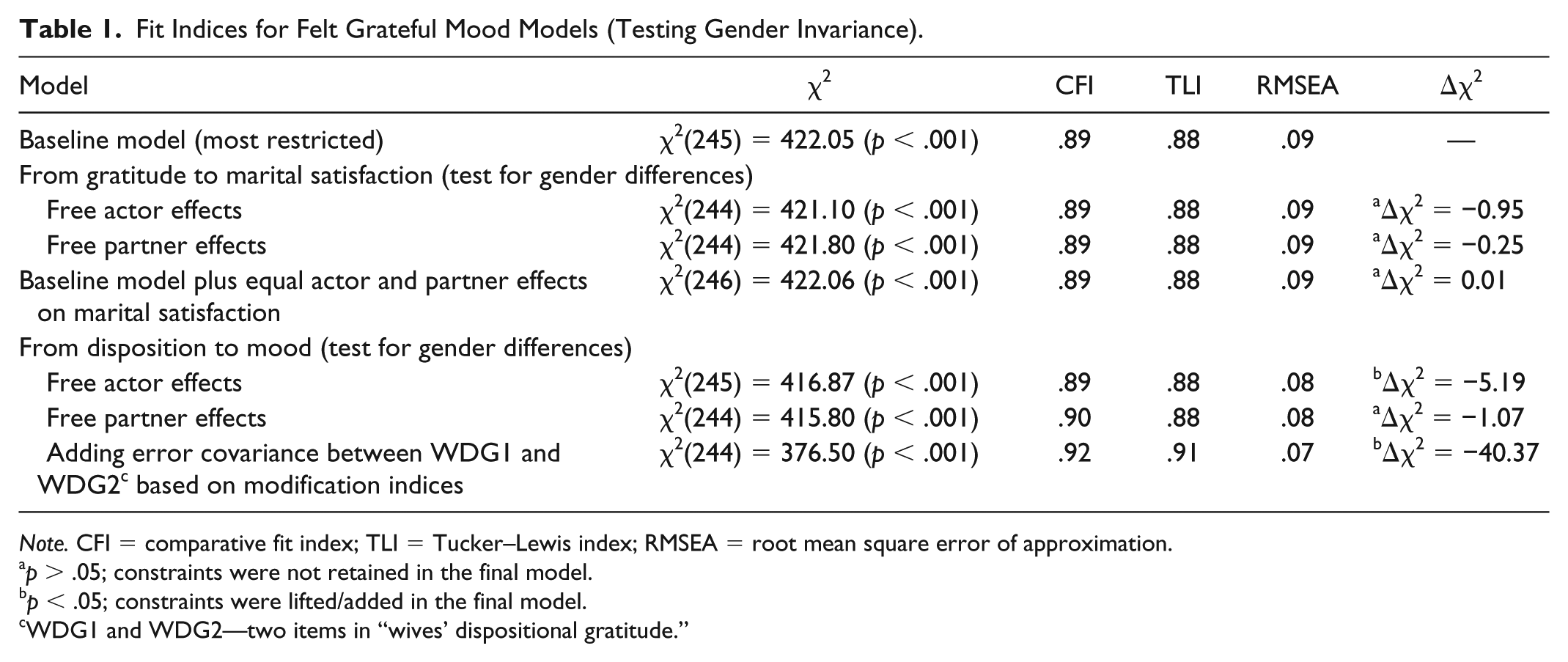
We adopted the APIM (Kenny, 1996; Kenny et al., 2006) to evaluate the mutual influence in dyadic relationships at Time 1. To test H1, that grateful disposition would be positively related to grateful mood, which predicted marital satisfaction, we conducted structural equation modeling (SEM) to examine the APIM with Mplus 7.4 (Kenny, 1996; Kenny et al., 2006). The initial model was the most restricted model, that is, assuming the same actor and partner effects for husbands and wives by forcing the parallel paths to be equal (Franks, Wendorf, Gonzalez, & Ketterer, 2004). The goodness-of-fit indices of this model were acceptable (Bentler, 1992): χ2(245) = 422.05, p < .001; the comparative fit index (CFI) was .89, and the root mean square error of approximation (RMSEA) was .09.
Then we tested for gender equality by setting the constraints free one by one (see Table 1 for details). Significant improvements in model fit (i.e., Δχ2 > 3.84, the critical value for 95% confidence level) subsequent to lifting of any equality constraint would indicate gender differences in the corresponding pair of paths. The results showed no significant gender difference in the effects of grateful mood on marital satisfaction, either in terms of its actor effect (standardized coefficient = .15) or its partner effect (.13). In fact, the actor and the partner effects were of similar strength. One’s grateful mood significantly predicted his or her own marital satisfaction as well as his or her spouse’s marital satisfaction. To test whether the difference between actor and partner effects was statistically significant, a new constraint was added to force them to be equal. The resulting change in model fit was minimal, Δχ2(1) = 0.01, p = 920. This new, more restricted model with equal actor and partner effects on marital satisfaction for both genders then formed the baseline model against which the effects of grateful disposition on grateful mood were tested.
Fit Indices for Felt Grateful Mood Models (Testing Gender Invariance).
Note. CFI = comparative fit index; TLI = Tucker–Lewis index; RMSEA = root mean square error of approximation.
p > .05; constraints were not retained in the final model.
p < .05; constraints were lifted/added in the final model.
WDG1 and WDG2—two items in “wives’ dispositional gratitude.”
When the gender equality constraint of the actor effect was set free, the model fit improved significantly, Δχ2(1) = −5.19, p = .023, indicating a significant gender difference. Specifically, the effect of grateful disposition on grateful mood for husbands (.77) was higher than that of wives (.51), although both were of considerable strength. The corresponding partner effect exhibited no gender difference. In fact, for both husbands and wives, the partner effects were nonsignificant (ranged between −.12 and −.10), ps > .05. In other words, the influence of grateful disposition on grateful mood was only intrapersonal but not interpersonal. One’s grateful disposition predicted his or her own grateful mood, but not his or her spouse’s grateful mood. Moreover, as the actor effect was stronger for husbands than for wives, overall grateful disposition explained more variance of grateful mood for husbands (53%) than for wives (22%). In the final step, we added a residual correlation between two items in wife’s dispositional gratitude based on the modification indices to improve the model fit. 2 The goodness-of-fit indices were adequate: χ2(244) = 376.50, p < .001; CFI was .92, and RMSEA was .07. The final model with the standardized coefficients is summarized in Figure 1.
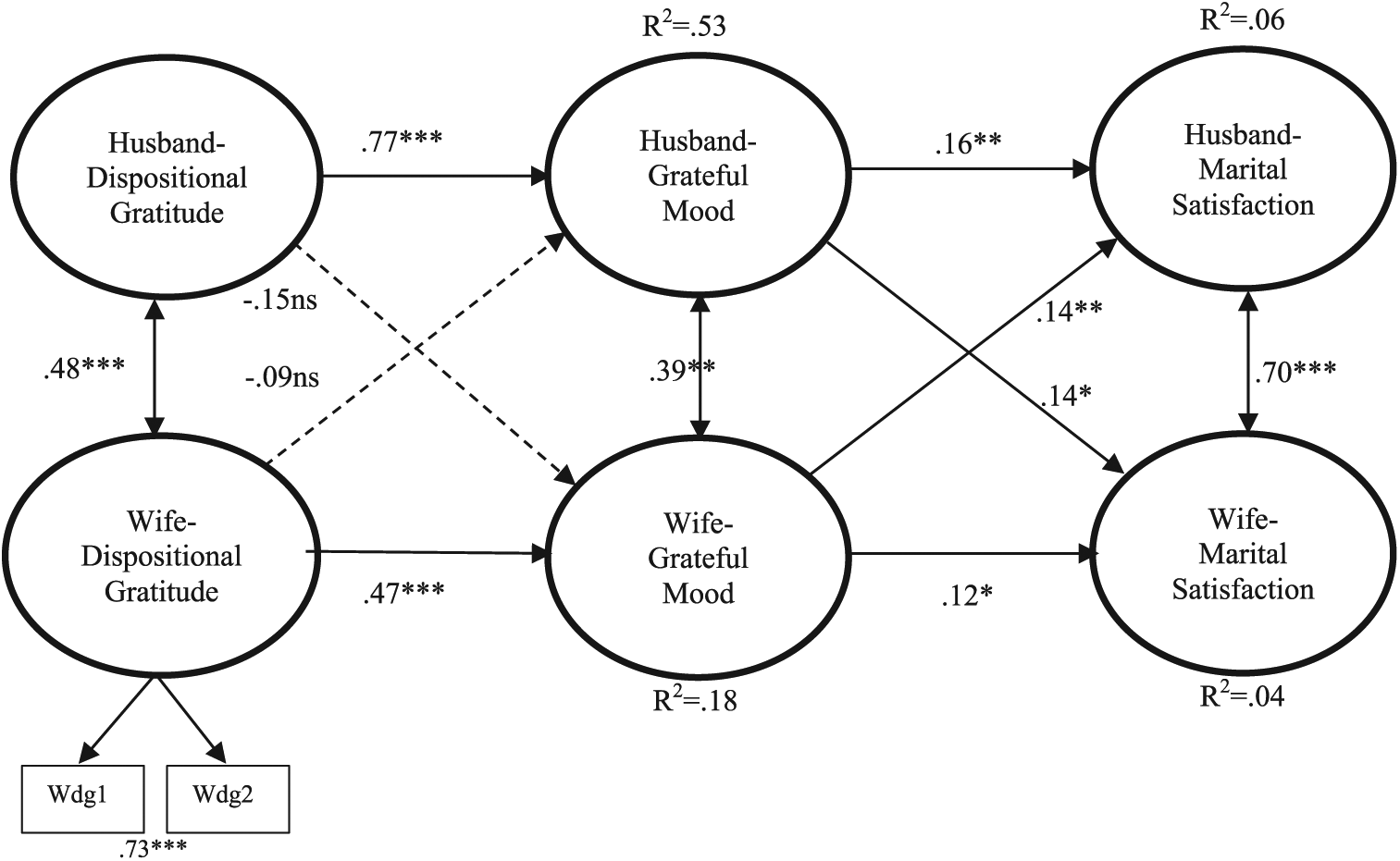
The final SEM model of the antecedents and outcomes of felt grateful mood.
After testing H1, we further examined for the possible mediation effects, even though they were not hypothesized. It was found that husbands’ dispositional gratitude could predict both husbands’ marital satisfaction, β = 0.12, p = .016, 95% bootstrap confidence interval (CI) = [.02, .22], and wives’ marital satisfaction, β = 0.11, p = .022, 95% bootstrap CI = [.02, .20], via husbands’ own gratitude mood. Similarly, wives’ own gratitude mood could mediate both the effects of wives’ dispositional gratitude on husbands’ marital satisfaction, β = 0.07, p = .038, 95% bootstrap CI = [.01, .13], and on wives’ marital satisfaction marginally, β = 0.06, p = .061, 95% bootstrap CI = [–.01, .12].
Effects of Grateful Disposition and Perceived Grateful Mood (H2)
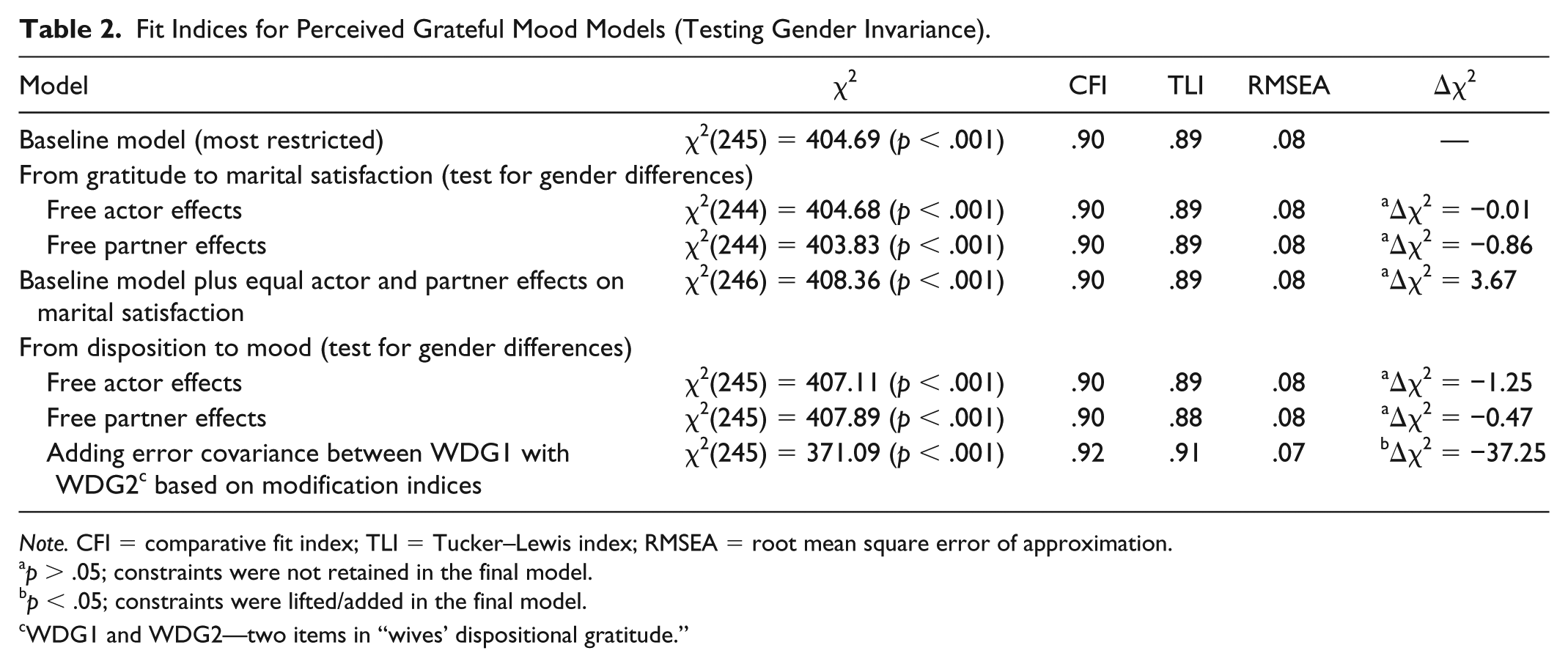
To test H2 that grateful disposition would be positively related to perceived grateful mood of spouse, which predicted marital satisfaction, we conducted the same analyses to assess the effects of perceiving grateful mood of spouse (see Table 2 for details). Similar to the paths from one’s own grateful mood to marital satisfaction, there was no significant gender difference in either the actor (.27) or the partner (.11) effects of perceived grateful mood of spouse on one’s own marital satisfaction. Perceived grateful mood of one’s spouse significantly predicted his or her own marital satisfaction as well as his or her spouse’s marital satisfaction.
Fit Indices for Perceived Grateful Mood Models (Testing Gender Invariance).
Note. CFI = comparative fit index; TLI = Tucker–Lewis index; RMSEA = root mean square error of approximation.
p > .05; constraints were not retained in the final model.
p < .05; constraints were lifted/added in the final model.
WDG1 and WDG2—two items in “wives’ dispositional gratitude.”
There was no significant gender difference in the actor effect of grateful disposition on perceived grateful mood of spouse, Δχ2(1) = −1.25, p = .264, or the partner effect. Specifically, there was a similar relationship between husbands’ own grateful disposition and perceived grateful mood of their wives (.54) than the parallel relationship of their wives (.36). The partner effects were not significant for either husbands or wives (.03), ps > .05. Thus, one’s grateful disposition predicted the perceived grateful mood of spouse, but not his or her spouse’s perceived grateful mood. The final model with the standardized coefficients is summarized in Figure 2.
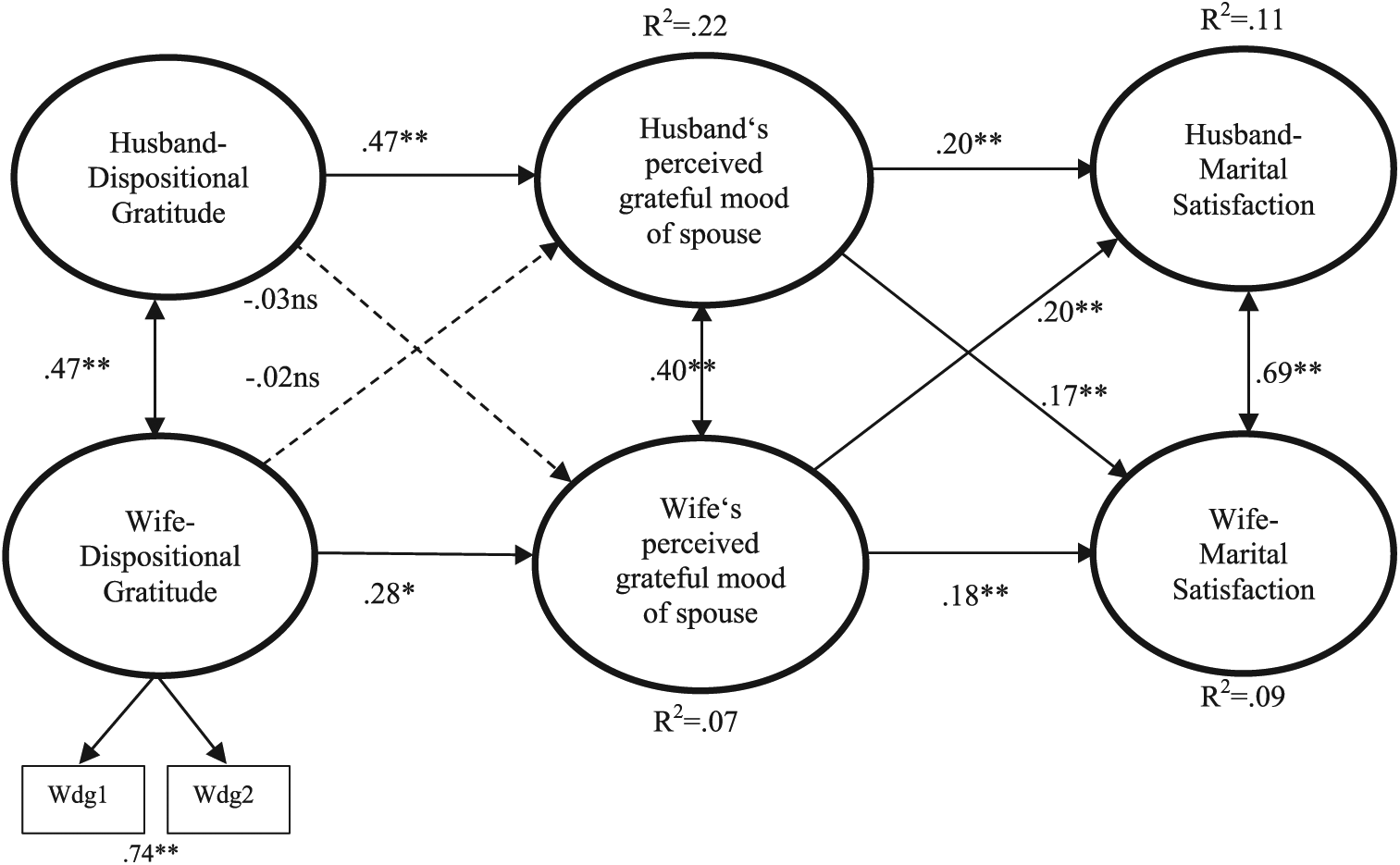
The final SEM model of the antecedents and outcomes of perceived grateful mood of spouse.
Moreover, we also examined for the possible mediation effects. Similarly, husbands’ perceived grateful mood of spouse mediated the effect of husbands’ dispositional gratitude on both husbands’ marital satisfaction, β = 0.09, p = .009, 95% bootstrap CI = [.02, .16], and wives’ marital satisfaction, β = 0.08, p = .013, 95% bootstrap CI = [.02, .15]. Wives’ perceived grateful mood of spouse could mediate the effects of wives’ dispositional gratitude both on husbands’ marital satisfaction, β = 0.06, p = .011, 95% bootstrap CI = [.01, .10] and on wives’ marital satisfaction, β = 0.05, p = .015, 95% bootstrap CI = [.01, .09].
On the whole, the model of perceived grateful mood exhibited nearly the same pattern as that of one’s own grateful mood. The relationship between grateful disposition and grateful mood in both models was essentially “actor-oriented” (Kenny et al., 2006, p. 147). In this light, grateful disposition seemed to better predict one’s own grateful mood (R2 = 53% for husbands and 18% for wives) than did perceived grateful mood of spouse (R2 = 22% and 7%, respectively) (i.e., intrapersonal influences). In both models, grateful mood was found to have a significant albeit weak impact on marital satisfaction. This part of the model can be described as “couple-oriented” (Kenny et al., 2006, p. 147) in that one’s marital satisfaction was about equally affected by the way a person as well as his or her spouse felt/perceived (i.e., interpersonal influences). This said, perceived grateful mood seemed to explain slightly more variance in marital satisfaction (10% on average) than did one’s own grateful mood (5% on average; see Table 3). 3
Summary of Multilevel Analyses Predicting the Effects of Grateful Mood on Marital Satisfaction.
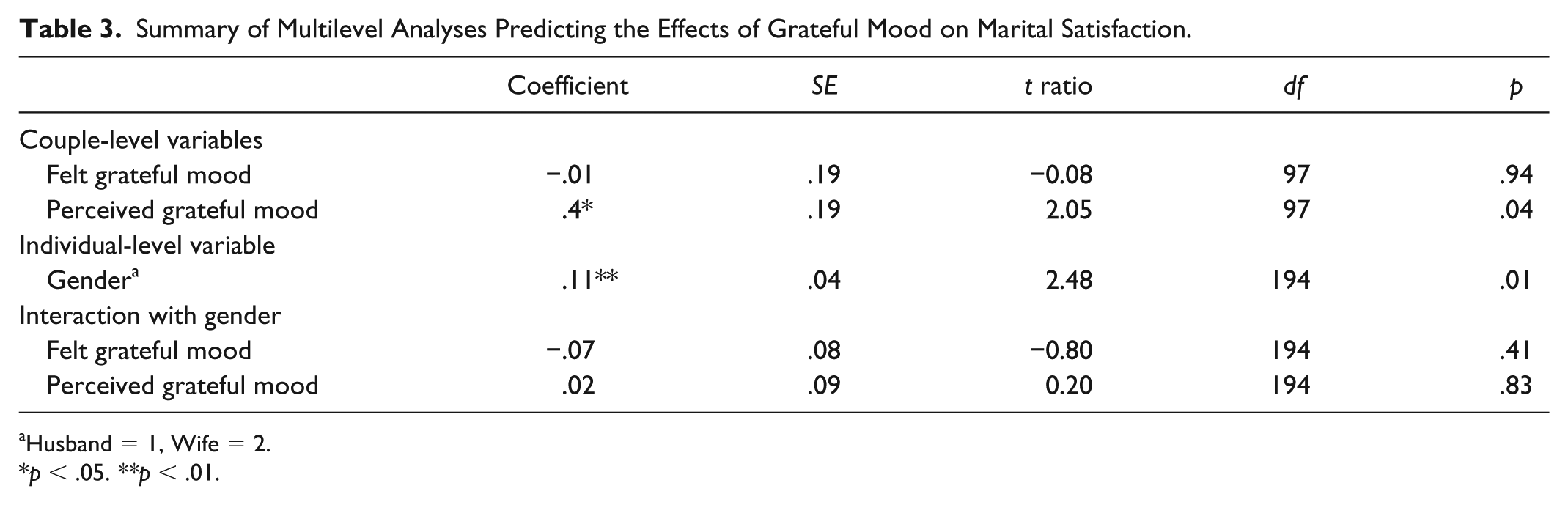
Husband = 1, Wife = 2.
p < .05. **p < .01.
Effects of Grateful Expression
In the second part of the study, couples were divided into two experimental conditions—one simulating the effect of private gratitude outlook by inviting enactors to keep a gratitude journal for 14 days (thoughts-of-gratitude) and the other requiring enactors to make at least four gratitude expressions to their spouse within the 2 weeks’ test period (expression-of-gratitude). Before the manipulations took place, all enactors completed a diary to record their daily spousal exchanges for 7 days between Time 1 and Time 2.
Manipulation check
In the first part, analysis of the 7-day journal showed that in real life, on average, enactors expressed thanks to their spouse 1.68 days (SD = 1.72) a week (e.g., verbally thanked the spouse for cooking a delicious breakfast; hugged and kissed the spouse for taking care of the family). This baseline frequency supported the minimal requirements of the expression-of-gratitude group (four overt gratitude expressions on four separate days during the course of 2 weeks) as reasonable—the level of expressions demanded was above the norm yet not too far off from being realistic. During the 2 weeks’ test periods, the expression-of-gratitude group reportedly made an average of 4.46 (SD = 0.73) explicit gratitude expressions in the manner instructed.
Grateful mood
To check whether the two gratitude interventions (thoughts vs. expression of gratitude) elicited the intended effects, a generalized linear model (GLM) with repeated measures was conducted using SPSS 22. We used couples as the unit of analysis and grateful mood as the dependent variable (DV). There were two within-subject IVs, namely, time (three time points) and role of spouse (enactor vs. benefactor), as well as one between-subject IV, namely, experimental condition. The results showed a significant effect of time, F(2, 98) = 6.70, p = .002, η2 = .06, but no major difference between the roles of the spouse, F(1, 98) = 0.87, p = .352, η2 = .01, or conditions, F(1, 98) = 0.23, p = .632, η2 = .002. None of the interaction effects was significant, ps > .05.
Follow-up univariate analyses with Bonferroni adjustments showed that grateful mood at Time 3 (M = 3.11, SD = 0.07) was significantly higher than that at both Time 2 (M = 2.81, SD = 0.07), F(1, 98) = 10.68, p = .001, η2 = .10, 95% bootstrap CI = [.12, .47], and Time 1 (M = 2.84, SD = 0.07), F(1, 98) = 9.31, p = .003, η2 = .09, 95% bootstrap CI = [.09, .44], whereas the latter two were not significantly different, p = .737, 95% bootstrap CI = [–.15, .21]. In other words, both manipulations were able to raise grateful mood of both the enactors and the benefactors. Keeping a private gratitude journal (no expression) and overtly expressing gratitude to the spouse seemed to trigger similar levels of increase in grateful mood.
Such an increase in grateful mood could be, and indeed was, perceived by one’s spouse. A parallel GLM analysis corroborated that the perceived grateful mood of spouse differed across the three time points, F(2, 98) = 8.36, p < .001, η2 = .08, but not between the roles of spouse (i.e., enactor vs. benefactor), F(1, 98) < 0.01, p = .986, η2 < .001, or intervention conditions, F(1, 98) = 0.13, p = .716, η2 < .001. No significant interaction was found, ps > .05. Similarly, perceived grateful mood at Time 3 (M = 2.89, SD = 0.08) was higher than that at both Time 2 (M = 2.63, SD = 0.08), F(1, 98) = 6.39, p = .013, η2 = .06, 95% bootstrap CI = [.05, .45], and Time 1 (M = 2.50, SD = 0.08), F(1, 98) = 15.08, p < .01, η2 = .15, 95% bootstrap CI = [.20, .58], whereas no significant change was found between Time 1 and Time 2, p = .150, 95% bootstrap CI = [–.32, .05].
Marital satisfaction
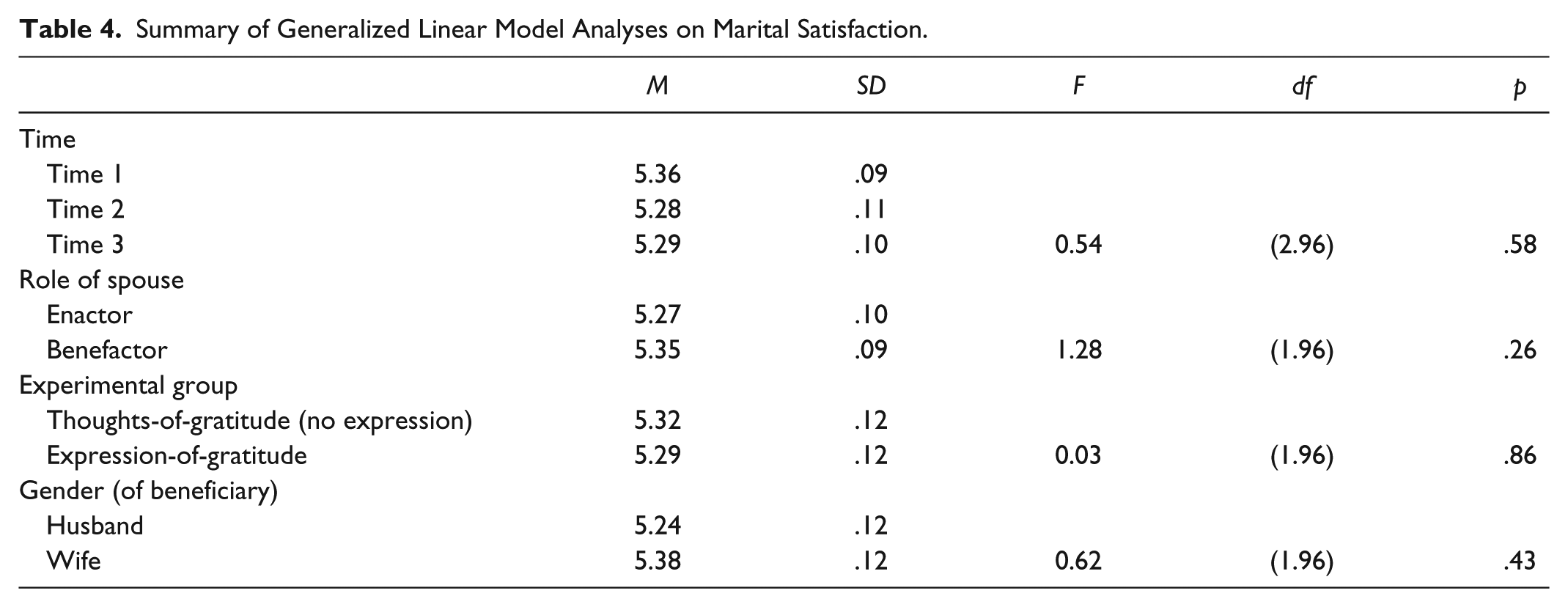
To test whether the manipulations led to improved marital satisfaction, GLM with repeated measures was conducted (see Table 4). It was a four-way, split-plot design, involving two within-subject variables, that is, time (three time points) and role of spouse (enactor vs. benefactor), and two between-subject variables, that is, experimental condition and gender (of the enactor). The results showed no significant main effects, ps > .05, but there was a significant interaction, which was a significant quadratic contrast between time and role of spouse, F(1, 96) = 5.50, p = .021, η2 = .05. Specifically, enactors’ marital satisfaction slipped at Time 2 but increased at Time 3, whereas benefactors’ marital satisfaction appeared rather similar between the first two time points but then slipped at Time 3. The divergent pattern of change in the enactors’ and benefactors’ marital satisfaction suggested the involvement of different mechanisms or intervening factors. Next, we tested the effect of judged sincerity on marital satisfaction over time.
Summary of Generalized Linear Model Analyses on Marital Satisfaction.
Effect of Sincerity (H3)
To test for the effect of sincerity (H3), we conducted GLM with martial satisfaction as DV. There were one within-subject IV (three time points) and three between-subject IVs (sincerity, gender, and experimental condition). The results confirmed the significant main effect of sincerity, F (3, 67) = 5.23, p = .003, η2 = .19. Those who appraised their spouse’s grateful expression as more sincere were more satisfied with their marriage across time than those who perceived less sincerity. The main effects of time, F(2, 66) = 1.44, p = .244, η2 = .04, gender, F(1, 67) = 0.98, p = .326, η2 = .01, and experimental condition, F(1, 67) = 1.00, p = .321, η2 = .01, were not statistically significant.
Furthermore, sincerity did not interact significantly with time, F(6, 132) = 0.62, p = .714, η2 = .03. Yet, there was a significant three-way interaction of sincerity, time, and gender, F(4, 132) = 3.83, p = .006, η2 = .10 (see Figure 3). Further analyses found that sincerity interacted significantly with time for male partners, F(6, 90) = 3.29, p = .006, η2 = .18, but not for female partners, F(8, 90) = 1.12, p = .358, η2 = .09 (see Figure 3). For husbands who appraised their wife’s grateful expressions as less sincere, marital satisfaction slipped from Time 2 to Time 3. In contrast, among those who appraised their wife’s grateful expression as more sincere, there was an increase in marital satisfaction for Time 2 to Time 3.
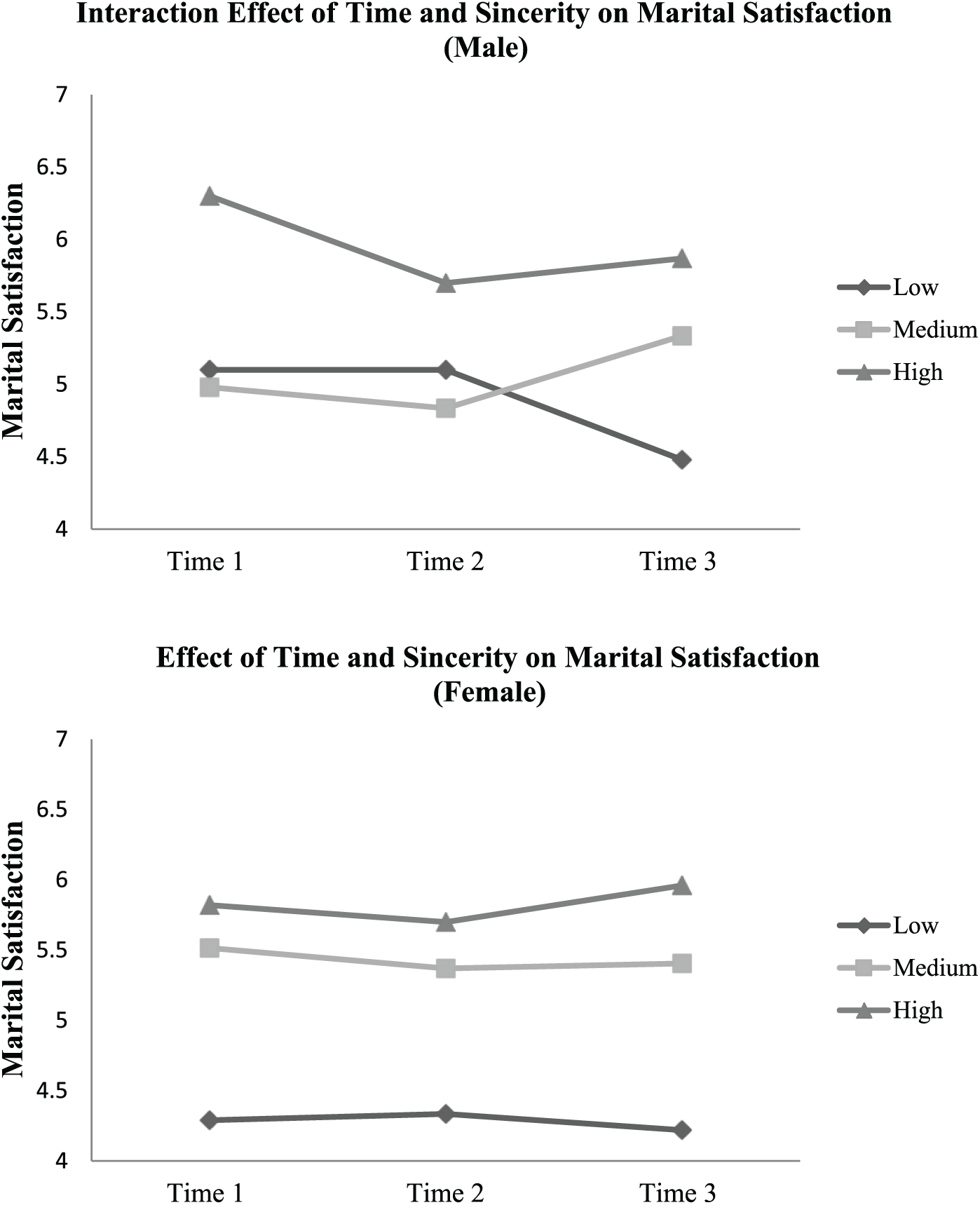
Three-way interaction of sincerity, time, and gender on marital satisfaction.
Discussion
The results of the present study show that gratitude is beneficial to the relational well-being of married couples, for benefactors and beneficiaries alike, as well as for both husbands and wives, but the mechanisms involved are dynamic. We used both intrapersonal and interpersonal approaches by adopting the APIM (Kenny, 1996; Kenny et al., 2006) to analyze both parties’ responses to our prospective design. Findings indicate that grateful disposition was significantly related to one’s own grateful mood and perceived grateful mood of spouse, both of which predicted marital satisfaction. The actor and partner effects from one’s grateful mood or perceived grateful mood of spouse to marital satisfaction were both significant, indicating interpersonal influences, whereas the actor effects from grateful disposition to one’s grateful mood or perceived grateful mood of spouse was stronger than partner effects, indicating intrapersonal influences.
Gratitude intervention, be it in the form of private gratitude diary or overt gratitude expression, is able to enhance the grateful mood one feels as well as perceives from his or her spouse. However, a higher intensity of gratefulness may not automatically lead to a more satisfying marriage (as illustrated by the absence of main effect of time on marital satisfaction despite the general increase in grateful mood at Time 3). Instead, judgment of sincerity can be involved in affecting the process. Husbands who judge their wife’s grateful expressions as less sincere decline in their martial satisfaction.
The present research contributes to the literature on gratitude in a number of ways. First, the findings from our Hong Kong Chinese sample of married couples lent support to the relational model of gratitude. The find-remind-and-bind theory (Algoe, 2012) emphasizes the social function of gratitude, especially in creating and maintaining close relationships. In this research, the dyadic influences between husbands and wives as well as the greater effects of perceived mood of spouse underscored the important role of gratitude in ongoing interactions and intimate bonds beyond reciprocal altruism. Second, we incorporated different aspects of gratitude within the same study and revealed their different functions over time. Emmons and Crumpler (2000) conceptualized gratitude as a multifaceted construct encompassing emotion, attitude, virtue, behavior, and motivation. Although we did not hypothesize mediation effects, the current results reveal dispositional gratitude functions as a relatively distal, enduring force, whereas grateful moods work as more proximal, aggregated feelings of gratitude to affect relational well-being. Third, administering gratitude interventions among married couples, our findings demonstrate that both thoughts-of-gratitude and expression-of-gratitude are effective means of boosting grateful mood. Fourth, while previous studies tested the significant effect of perceived enactor responsiveness (Algoe et al., 2013; Algoe & Zhaoyang, 2016) and the nonsignificant effect of attachment styles (Murray & Hazelwood, 2011) on expressing gratitude for beneficial relationship outcomes, we identified another factor—sincerity as judged by the benefactor—to show that it would be judicious to prescribe gratitude exercises to improve relationship quality.
Giving Versus Receiving
Gratitude is by nature a dyadic concept—one side feeling grateful and the other side perceiving the feeling of gratefulness from the other. The findings of the present study indicate that the subjective experience of feeling grateful, such as self-reports of grateful mood and perceived grateful mood of spouse, shared a similar antecedent (grateful disposition) and can predict a similar relational outcome (marital satisfaction). Examining perceived gratefulness enriches our understanding of the experiential and interpersonal aspects of the gratitude construct in that it acts not only through one’s subjective feeling of gratefulness but also through perceiving grateful mood from one’s spouse. In fact, the APIM for the two constructs of grateful mood mirror one another.
Moreover, our results reveal that perceived grateful mood of spouse predicted marital satisfaction more than one’s own grateful mood, suggesting that it should warrant more attention in future research. This finding of the significance of perceived gratefulness over subjective feeling of gratitude is actually consistent with the prediction derived from the Relational Model of Justice (Tyler, 1994)—it is by perceiving gratitude from the spouse, not by feeling grateful toward him or her that one sees his or her efforts or contribution acknowledged, and his or her value in the relationship reaffirmed or even promoted. It is this sense of justice confirmed that leads to the improved satisfaction with the marriage.
Sincerity Matters
For benefactors, sincerity is an important mechanism. The first part of this study illustrated that perceiving grateful mood from spouse was related to more satisfaction in marriage. The second part of the study augmented this finding in that insofar as the communication of “thank you” was concerned, not all expressions were created equal. Gratitude expressions interpreted as insincere could backfire to harm one’s relational well-being. Specifically among those with low sincerity, the decline in marital satisfaction actually started before the manipulations were in place (between Time 1 and Time 2). This might reveal preexistence of some dysfunctional behaviors or patterns in their spousal exchanges, which prompted the perceivers to judge their spouse’s gratitude expressions as less sincere and further dragged down their relationship. In other words, a vicious cycle is suspected. The underlying questions are, How is the sincerity judgment made? What signs do perceivers rely on, verbal and non-verbal?
Attributions of others’ intentions suffuse our everyday lives. However, research on the concept of sincerity is limited, with some empirical work in the area of apologies (e.g., Risen & Gilovich, 2007). It reveals a gap in our knowledge, not only in gratitude research but also in research on interpersonal exchange in general. Algoe, Kurtz, and Hilaire (2016) identified other-praising behavior as the active relational ingredient in expressed gratitude. The expression of gratitude that focused on praising others’ actions predicted the target’s perception of expresser responsiveness, general positive emotions, and the specific emotion of loving, even when controlling for the expresser’s behavior that focused on benefits to the self. Other studies found negative impact of self-focused attention on commitment and closeness to the benefactor (Mathews & Green, 2010), which might weaken perceptions of gratefulness. Further studies of this fundamental interpersonal construct are needed.
Husbands or Wives?
Overall, the present findings suggest that gratitude could function somewhat differently for men and for women. Although much of the individual variation in everyday grateful mood could be explained by gratitude as a general disposition, the extent differed between one’s own grateful mood and perceived grateful mood of spouse, as well as by gender. The proportion of variance explained ranged from as low as 7% (wives’ perceived mood) to the highest at 53% (husbands’ grateful mood). To put it alternatively, despite the strong relationship, over half of the variance is accounted for by factors other than gratitude as a trait, especially for wives and especially for perceived grateful mood. What could contribute to one’s own grateful mood or perceived grateful mood of spouse is a topic worth pursuing in future research.
As stated above, the findings of this study show a rather high level of congruence between spouses, indicating that most couples are in sync with each other’s grateful mood. However, how sincerity affects one’s marital satisfaction can vary by gender. The marital satisfaction of husbands who perceived their wife’s grateful expressions as less sincere slipped from Time 2 to Time 3. Yet, the effect of sincerity by time was not significant for wives. Although gratitude as an affective trait was found to be a good predictor of both one’s own grateful mood as well as the grateful mood he or she perceived from his or her spouse, the effects were consistently stronger for husbands than for wives. Although women are generally responsive to emotional cues, men’s grateful mood is predetermined by their disposition toward gratitude rather than being affected by proximate factors at a particular time. Men pay attention to not only the expression of gratitude per se but also the motive behind the act.
To Express Gratitude or Not?
Satisfying relationships need ongoing effort (Wilson, Charker, Lizzio, Halford, & Kimlin, 2005). Like other behavioral exchanges that generate positive sentiment, such as compliments and gazing (Flora & Segrin, 2000), gratitude interventions were found to serve relational well-being and should be encouraged in everyday practice. The fact that the two manipulations (thoughts-of-gratitude and expression-of-gratitude) did not differ significantly in the grateful mood they induced nor in the subsequent level of marital satisfaction at Time 3 indicated that overt expression did not seem necessary for gratitude intervention to have its effects. Because these couples were generally able to perceive the increase in grateful mood of one another, keeping a private gratitude diary alone seemed sufficient to induce some desirable effects on their marital satisfaction. Paying extra effort to make overt expressions of gratitude was not found to add significant impacts to the gratitude effect.
This result aligns with the findings of C. L. Gordon and colleagues (2011) that long-term married couples’ expressed gratitude did not predict their spouse’s marital satisfaction as felt gratitude did. Unlike encounters with strangers and acquaintances, married couples have many opportunities for interpersonal exchanges. Feeling grateful inwardly can be manifested in daily life interactions and felt by the spouse, whereas expressing gratitude outwardly may go unnoticed if it is out of habit or be interpreted as manipulative. The practical implication for marriage counseling is that interventions that can heighten consciousness of gratefulness should be recommended. Nonetheless, actions taken to express gratitude need to be done convincingly. Impression management tactics judged to be insincere could actually do more harm than good.
In the experiment conducted by Lambert and colleagues (2010), participants in the expression-of-gratitude condition perceived greater communal strength than did those in the thoughts-of-gratitude condition, but they sampled undergraduate students who were assigned to express gratitude to a friend. It is unclear whether the patterns resulting from gratitude interventions in the present research are specific to the domain of marital relationships or specific to the culture of the sample. The cultural norm that values moderate expression of emotions may weaken the impact of explicit gratitude expression among Chinese couples. Given the limited studies on cultural differences in gratitude in ongoing intimate relationships, future research should illuminate how cultural values shape the motivation and experience of gratitude.
Future Directions
With mounting evidence supporting the benefits of gratitude on individuals’ subjective well-being, researchers are turning to identify specific areas where it can serve to enhance coping. For instance, gratitude has been found to facilitate closure around unpleasant memories (Watkins et al., 2008) as well as advice-taking (Gino & Schweitzer, 2008). The present study demonstrated the relevance and values of gratitude in the context of marriage. It could be productive to continue our pursuits in similar directions, aiming to pinpoint the specific spousal exchanges in which gratitude matters and in what particular ways gratitude can enhance coping in one’s marriage life.
The findings of this study suggest that gratitude could function somewhat differently for the two genders. Specifically, wives’ grateful mood was more subject to the influence of factors other than gratitude as a trait. In contrast, husbands’ grateful mood was more determined by their dispositional gratitude. Judgment of sincerity is more important to husbands’ marital satisfaction than that of wives. Together, these findings seem to suggest that relationship satisfaction can be shaped by more “self-directed” considerations for husbands (e.g., intrapersonal effects of dispositional gratitude), but more by “other-directed” considerations for wives (e.g., how grateful “you” are to me). Future research on gratitude, especially in the context of interpersonal relations, should be more gender-sensitive and attend to dyadic interdependence.
Supplemental Material
Chen_Online_Appendix – Supplemental material for Is Gratitude Always Beneficial to Interpersonal Relationships? The Interplay of Grateful Disposition, Grateful Mood, and Grateful Expression Among Married Couples
Supplemental material, Chen_Online_Appendix for Is Gratitude Always Beneficial to Interpersonal Relationships? The Interplay of Grateful Disposition, Grateful Mood, and Grateful Expression Among Married Couples by Joyce L. T. Leong, Sylvia Xiaohua Chen, Helene H. L. Fung, Michael Harris Bond, Nicolson Y. F. Siu and Jay Yijie Zhu in Personality and Social Psychology Bulletin
Footnotes
Acknowledgements
We would like to express our appreciation to Winton Au and Takeshi Hamamura for their constructive comments on earlier versions of this article. We also thank Darryl Andrew for his generous help with data collection.
Authors’ Note
Joyce L. T. Leong and Sylvia Xiaohua Chen share first authorship of this article.
Declaration of Conflicting Interests
The author(s) declared no potential conflicts of interest with respect to the research, authorship, and/or publication of this article.
Funding
The author(s) disclosed receipt of the following financial support for the research, authorship, and/or publication of this article: The contribution of the corresponding author was supported by the Departmental General Research Grant (G-UACJ) from the Hong Kong Polytechnic University.
Notes
Supplemental Material
Supplemental material is available online with this article.
References
Supplementary Material
Please find the following supplemental material available below.
For Open Access articles published under a Creative Commons License, all supplemental material carries the same license as the article it is associated with.
For non-Open Access articles published, all supplemental material carries a non-exclusive license, and permission requests for re-use of supplemental material or any part of supplemental material shall be sent directly to the copyright owner as specified in the copyright notice associated with the article.
