







Abstract
Black male students on college campuses report being frequently misperceived as student-athletes. Across three studies, we tested the role of perceivers’ racial and gendered biases in categorization of Black and White students and student-athletes and the subsequent evaluative consequences. Participants viewed faces of actual Black and White male and female undergraduates who were either non-athlete students or student-athletes and made binary judgments about whether the undergraduate was a student or an athlete. We found an overall bias to judge Black male undergraduates to be student-athletes, driven by Black male students being more likely to be misperceived as student-athletes than White male students. Furthermore, male targets perceived to be student-athletes were rated lower on academic ability (Studies 2 and 3). In contrast, we found an overall bias to judge female undergraduates as students. Implications for how perceiver bias plays a dual role in negatively affecting academic climates for underrepresented groups are discussed.
I am 5’5” and I only weigh 135 pounds. You would be surprised at how many Whites walk up to me and congratulate me on a “good game” the Monday after we win a football game. Besides being a Black dude, nothing else about me even remotely suggests I am a football player or any other kind of athlete.—Black male college student (quoted in Harper, 2015) It is a shame that they think the only Black men qualified to be at a top school like [mine] are athletes. It is insulting.—Black male college student (quoted in Harper, 2015) Traveler: “Did you play football at Michigan?” #everydamntime—Former Black male college student, current Black male Social Psychologist and Professor (Maddox, 2019)
Black college students routinely experience multiple forms of identity-related biases. In addition to assumptions about the means by which they earned their admission decision (e.g., affirmative action versus academic merit; McGee & Martin, 2011), Black students may also face additional burdens related to their status as students. Both anecdotal and empirical evidence indicate that Black male college students are prone to be mistakenly categorized as student-athletes, especially in historically White institutions (Harper, 2009, 2015). Indeed, such mistakes can persist well beyond their collegiate years. Although some might construe such mistakes as innocent compliments, being misperceived as a student-athlete is more often a decidedly negative experience for Black undergraduates (Czopp, 2008). Why? These miscategorizations are unequally distributed across the student body, and they can signal negative impressions in other domains. However, the extent of bias associated with judgments of undergraduates as students or student-athletes remains unknown. Here, we test the accuracy of, bias in, and consequences stemming from categorizing undergraduates as students versus student-athletes.
Although revered by some, student-athletes currently and historically have been highly stigmatized in college academic contexts (Engstrom & Sedlacek, 1991; Simons et al., 2007; Wininger & White, 2015). Compared to non-athlete students, student-athletes endure negative expectations about their academic intelligence and preparedness. In one study, undergraduates expressed more negative attitudes toward student-athletes than toward students in academic contexts, but not social contexts, and they reported more negative affect after being assigned to work with student-athletes on academic tasks (Engstrom & Sedlacek, 1991). Correspondingly, undergraduates hold lower expectations for the intellectual contributions of student-athletes, relative to non-athletes, and believe that their professors share these impressions (Wininger & White, 2015). Moreover, undergraduates were found to be highly confident that they could distinguish between student-athletes and non-athlete students (Wininger & White, 2015), although the veracity of these assumptions was not tested. Therefore, merely being categorized as a student-athlete implicates broader impressions of dubious academic prowess.
Observers’ judgments about which students are likely to be student-athletes may be systematically biased for multiple reasons. First, the most widely viewed collegiate athletic competitions (e.g., Division I football and men’s basketball) do, in fact, have a high percentage of Black male student-athlete participants (45.1% and 53.2% respectively; Lapchick, 2020) relative to their representation on campus (Harper, 2018). Because these revenue-generating sports are markedly public-facing (Chung, 2013; Walker, 2015), Black male student-athletes are highly visible exemplars in advertisements, recruitment brochures, and local and national sports media. The availability of these exemplars influences both non-Black (e.g., Czopp, 2010) and Black Americans’ (e.g., Harrison et al., 2011) expectations about who is likely to be a student-athlete on campus. Indeed, research that probed racialized subcategory representations found that being an athlete is judged as more characteristic of Black men than White men (Hinzman & Maddox, 2017). Because Black male student-athlete exemplars are highly accessible, people might also mistakenly assume that a high percentage of Black male students are likely to be student-athletes. Second, pervasive stereotypes characterize Black Americans as both athletic and unintelligent (Devine & Elliot, 1995; Ghavami & Peplau, 2013). Without individuating information, these racial stereotypes are prone to influence judgments of Black college students in the early stages of social perception and impression formation (Brewer, 1996; Rees et al., 2020). Thus, whether a function of the availability of salient exemplars or the application of extant stereotypes, Black male students are likely targets of miscategorization.
In reality, however, Black male student-athletes make up a relatively small proportion of Black male undergraduates. Student body data from the National Collegiate Athletic Association (NCAA) on Division-I institutions (currently 351 institutions) show that only 8.6% of all Black men entering college as first-time freshmen in 2010 were student-athletes (35,803 total Black male freshmen, of which 3,090 were student-athletes), and that this proportion was stable over time. Comparatively in 2010, White women made up the largest demographic of first-time freshmen Division-I student-athletes (7,138 student-athletes, 2.7% of all White female freshmen), followed by White men (5,720 student-athletes, 2.4% of all White male freshmen), Black men, and Black women (1,560 student-athletes, 3% of all Black female freshmen; National Collegiate Athletic Association [NCAA], 2018a, 2018b). Overall, Black men are unlikely to play collegiate sports at ratio of over 9:1.
To contextualize the 9:1 ratio of Black men on campus, consider the following: In NCAA Division-I football (254 institutions), teams may allocate only 85 athletic-based scholarships 1 (Next College Student Athlete [NCSA], 2020), while in Division-I basketball (351 institutions), teams are allowed a maximum of 15 players. Given the aforementioned percentage of Black men playing Division-I football (45.1%, or 38 Black male student-athletes) and basketball (53.2%, or 8 Black male student-athletes), we could conservatively estimate that within the 72% of Division-I institutions (n = 254) with both football and basketball teams, only 46 Black male undergraduates participate in a sport where they are most disproportionately represented. In the remaining institutions with only men’s basketball (n = 97), only 8 Black male undergraduates participate. Given that nearly 50% of Division-I colleges/universities enroll more than 10,000 undergraduates (NCAA, 2017), with some approaching 60,000 students enrolled (Moody, 2020), it is clear that only a small fraction of Black male undergraduates plays varsity sports. Despite this, the prospect of Black men being misperceived as a student-athlete both on and off-campus still looms inexplicably large.
Being judged as a student-athlete has pernicious consequences, undermining judgments of academic competence, broadly (Wininger & White, 2015). Yet, its impact on Black students might be unique for several reasons. First, student-athlete miscategorizations can arouse broad concerns about racial stereotyping and stigma. Indeed, even when people apply stereotypes that are ostensibly positive, the mere knowledge of being viewed through a stereotypic lens elicits concerns that other more nefarious group-relevant stereotypes are also being applied (Siy & Cheryan, 2016). Such apprehension appears to be warranted (Czopp et al., 2015; Czopp & Monteith, 2006; Fiske et al., 2002). For example, Kay and colleagues (2013) found that when participants were told that a set of positive stereotypes (as opposed to negatives stereotypes) accurately characterized Black Americans, they also attributed negative stereotypes to Black targets. Moreover, student-athlete categorizations also produce stigma more directly. Black student-athletes are simultaneously lauded for their athletic ability and derogated for their intelligence (Hodge et al., 2008; Oseguera, 2010; Walzer & Czopp, 2011). Knowledge of stereotypes is sufficient to evoke stereotype threat among Black male student-athletes (Stone et al., 2012), so it might also arouse concerns among Black male non-athletes, as well. Black male students who are miscategorized might rightfully infer that similar assumptions are being made about them. Therefore, even a seemingly benign mistake can elicit concerns that one’s academic capabilities are in doubt.
Thus far, we have argued that student-athlete miscategorizations are more likely, and thus more consequential, for Black male students. How these factors apply to judgments of Black women is less clear, but existing evidence informs distinct predictions. Some evidence indicates that Black female students might be immune from the assumption that they are student-athletes. Athletic ability is strongly associated with men and masculinity, and this is reinforced within society. Gender parity in access to collegiate sports occurred only recently (i.e., 1972; U.S. Department of Education, 2018), and although Black women make up a significant percentage of women’s basketball participants (41.9%; Lapchick, 2020), media outlets systemically fail to cover women’s sports (T. Adams & Tuggle, 2004; Cooky et al., 2015). In addition, gendered stereotypes characterizing men as strong/athletic and women as weak/soft (Ghavami & Peplau, 2013; Prentice & Carranza, 2002) also weaken the association between women and athletics. Other gendered stereotypes associate academic achievement (e.g., giving high academic effort, being academically engaged) with femininity and women (Heyder & Kessels, 2013, 2015, 2017). Thus, unlike Black men, Black women might escape mistaken categorizations because of a paucity of accessible exemplars of Black female student-athletes and because of stereotypes that link women with academics more than athletics.
Other evidence, however, indicates that the effects linking women with academics described above might not apply equally to Black women, and it supports two distinct predictions. First, judgments of Black women might align closely with judgments of Black men insofar as gender does not shield Black women from racial stereotypes. Intersectional analyses of racial/ethnic and gender stereotypes found that while White women are stereotyped as intelligent, Black women are stereotyped as unintelligent and as athletic along with Black men, and Black Americans in general (Ghavami & Peplau, 2013). Moreover, race remains highly salient in the social perception of Black women, as observers more readily categorize Black women as “Black” than as “women” (Stroessner, 1996). Accordingly, Black female student-athletes report feeling judged as less academically competent because of the intersection of their racial and student-athlete identity (Harmon, 2009). Race and gender appear to be so inextricably intertwined (i.e., race is gendered) that they exert a mutual influence on one another throughout the visual judgment process. Specifically, the categories Black and male share both stereotypic and phenotypic content. Consequently, sex and race judgments of Black women are less efficient than the same judgments of Asian or White women (Carpinella et al., 2015; Johnson et al., 2012). Because the categories Black and male/masculine are both associated with athletics (e.g., Hinzman & Maddox, 2017; Messner, 1989), judgments of Black women might closely resemble judgments of Black men. However, other evidence suggests Black women’s status as both Black and woman may render them “intersectionally invisible” in this categorization and evaluation decision (Purdie-Vaughns & Eibach, 2008; Remedios & Snyder, 2018; Sesko & Biernat, 2010), thereby potentially circumventing the student/student-athlete consideration entirely. From this alternate perspective, Black women might not suffer the negative consequences of being miscategorized as student-athletes like Black men, but they also might not enjoy the benefits of being categorized as students either. Altogether, whereas the predicted patterns for categorizations and their consequences are clear for Black male students, they are less clear for Black female students.
Categorizing others as either student-athletes or non-athlete students is likely to occur through well-established social perceptual processes in which visual information is dynamically integrated with existing knowledge structures to inform judgments (Freeman & Johnson, 2016; see also, R. B. Adams et al., 2017). In addition to multiple social categories that people widely believe to be visibly discernable (e.g., sex, race, and age; Lick & Johnson, 2014), other more ambiguous social categories (e.g., sexual orientation; Rule et al., 2008, 2009) are also readily and rapidly judged by observers, and they impact downstream evaluative judgments. Similarly, more ambiguous decisions about whether someone is a student or a student-athlete might be prone to systematic biases and to influence other evaluative judgments.
To date, no research has systematically tested the determinants or consequences of student-athlete categorizations. Given the potentially pervasive and pernicious nature of these mistaken judgments, we sought to quantify their prevalence and probe their consequences. In three studies, we tested whether the accuracy and bias of student/student-athlete categorizations varied as a function of race, gender, and their intersection and whether these categorizations influenced judgments of academic ability. We report all measures, manipulations, and exclusions.
Study 1
First, we tested whether perceivers are biased to categorize Black undergraduates as student-athletes in separate samples that probed judgments of both male and female targets. For male targets, we hypothesized that categorizations would be (a) less accurate for judgments of Black men than of White men and (b) biased toward Student-athlete for Black men, but toward Student for White men. In a separate sample, we also tested whether similar patterns in categorization accuracy and bias occurred for judgments of women. Here, our predictions were more tenuous because of the intersectional inconsistency in stereotypic expectations. Although women are not stereotyped to be athletic, in general, Black women are more readily categorized by their race than their gender (Stroessner, 1996). Therefore, given the primacy of their race in social perception, judgments of Black women might be similarly biased toward Student-athlete categorizations. Yet, their gender might be sufficient to mitigate this bias.
Method
The methodology, analysis code, data, and codebook for interpreting data files are posted at https://osf.io/sh5gu/.
Participants
Based on existing methods to calculate power for multilevel designs (e.g., Scherbaum & Ferreter, 2009), a sample size of 75 affords more than 99% power to detect a medium effect size. As such, we recruited two distinct samples of 75 participants (150 total) from Amazon’s Mechanical Turk. One sample judged male targets (44% women, 56% men), and the other sample judged female targets (39% women, 61% men). Participants in each sample were predominantly White (71% and 85% White, 15% and 5% Black, 15% and 9% non-Black racial/ethnic minority, for judges of men and women, respectively) and were similar in age (Ms age = 35.07 and 35.12 years, SDs = 10.09, for judges of men and women, respectively). We excluded one participant due to response invariance (i.e., selecting student-athlete for all categorizations), leaving 74 participants in that sample that judged male targets.
Stimuli
Stimuli included photographs of 100 male and 100 female undergraduates from a mid-sized private university in the western U.S. 2 Each set depicted 50 Black and 50 White targets, and within each subgroup, half depicted students and half depicted student-athletes (i.e., 25 each of Black male/female student-athletes, Black male/female students, White male/female student-athletes, White male/female students). We obtained student photos from the university’s 2014 yearbook and student-athlete photos from the university’s online sports roster for the 2013–2014 academic year. All photos were standardized to remove any symbolic cues to athletic status: cropped tightly around the face, depicted in full color, and presented on white backgrounds.
Procedure
The procedures for both samples were nearly identical. All participants were told they would be rating photos of “undergraduates enrolled at a university,” half depicting “athletes” and half depicting “only students (i.e., not athletes).” Participants judged each face in two counterbalanced blocks within which stimuli were presented in random order. In one block, participants categorized each face to be a “student” or an “athlete.” Participants were asked, “Is this individual a student or an athlete?” and made a binary selection of either “student” or “athlete” (order of answer option presentation counterbalanced across participants). Participants were not informed about their accuracy. In a separate block, participants also judged each target’s gendered appearance for exploratory analyses. 3 Participants then completed a battery of standard demographic items, were debriefed, and thanked for their participation.
Results and Discussion
Because judgments of male and female targets were collected from two distinct samples of participants, we analyzed each set of responses separately. However, rhetorically we present them in parallel to facilitate an interim comparison of patterns. Thus, we describe patterns separately by gender and in this study make no explicit statistical conclusions comparing gender.
Categorization Accuracy and Bias
We quantified participants’ ability to distinguish students from athletes by computing standard signal detection parameters for sensitivity (d’) and bias (c) (Stanislaw & Todorov, 1999). Within this framework, categorizing a target as an athlete or a student results in one of four outcomes: Athletes categorized as athletes (Hits) or incorrectly categorized as students (Misses); students categorized as students (Correct Rejection) or incorrectly categorized as athletes (False Alarm). From these outcomes, we can estimate the sensitivity, or accuracy of participant judgment, and the bias, or favoring of one categorical response, independent of accuracy. Thus, c values of 0 indicate no bias, positive c values indicate a “student” categorization bias, and negative c values indicate an “athlete” categorization bias.
Overall, sensitivity was above chance in both samples, Ms d’ = 0.59 and 0.41, both SDs d’ = .37, ts(73 and 74) = 13.63 and 9.61, both ps < .001, for male and female targets, respectively, indicating that observers achieved a modest level of accuracy. For male targets, sensitivity was higher for judgments of White men (Md’ = 0.86, SDd’ = .53) than Black men (Md’ = 0.41, SDd’ = .34), t(73) = 9.87, p < .001, indicating that observers are more accurate when categorizing White men relative to Black men. For female targets, sensitivity did not differ between White women (Md’ = 0.41, SDd’ = .47) and Black women (Md’ = 0.46, SDd’ = .42), t(74) = −.90, p = .37.
We next tested whether response bias associated with judgments differed as a function of Target Race. Judgments of male targets were biased toward student-athlete categorizations for Black men (Mc = −0.13, SDc = .40), t(73) = −2.87, p = .005, but biased toward student categorizations for White men, (Mc = 0.27, SDc = .36), t(73) = 6.39, p < .001, resulting in a significant difference in categorization biases as a function of Target Race, t(73) = 7.11, p < .001. Consequently, Black male students were miscategorized as student-athletes at twice the rate of White male students (See Table 1).
Summary Statistics for Signal Detection Analyses.
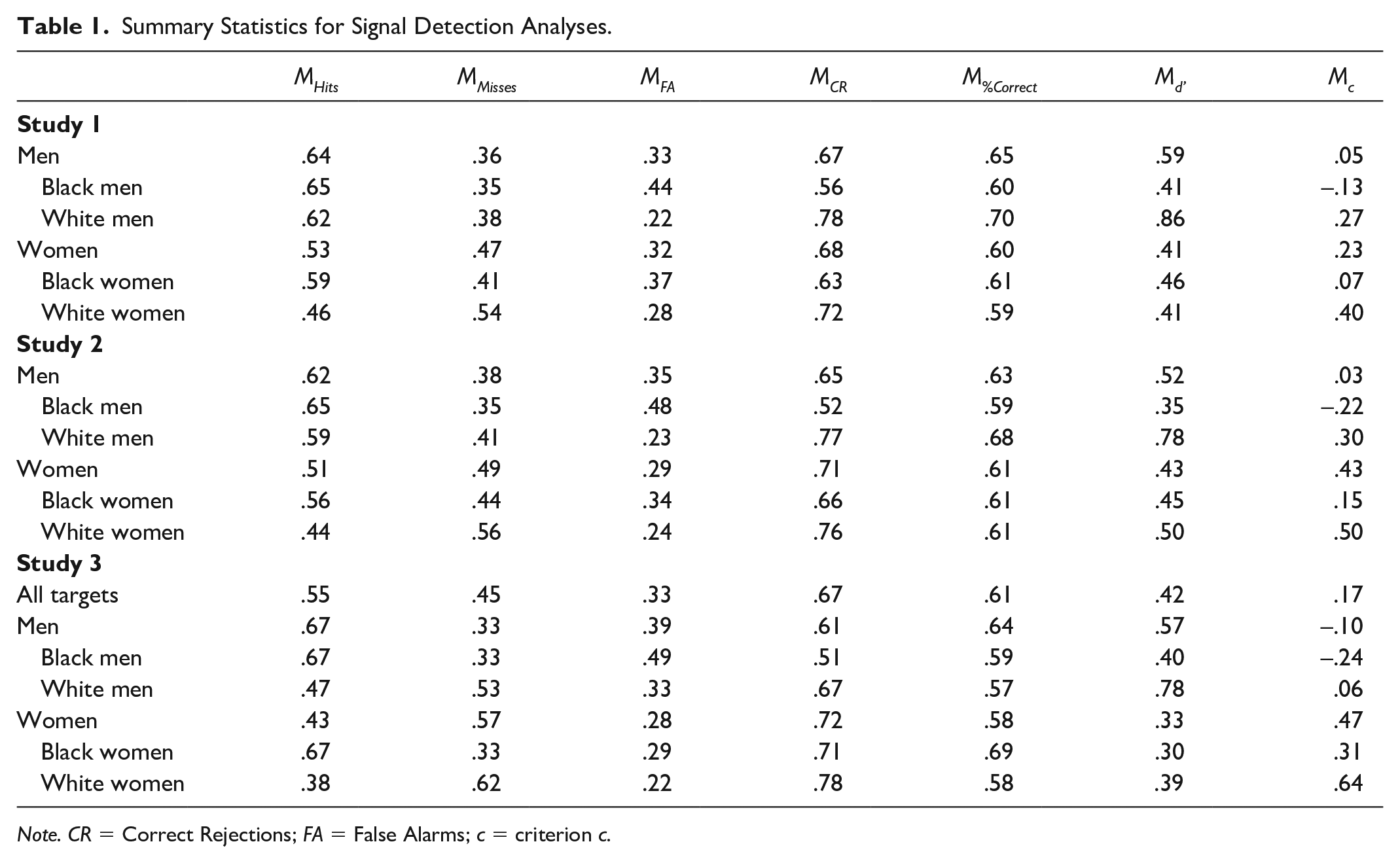
Note. CR = Correct Rejections; FA = False Alarms; c = criterion c.
Judgments of female targets were also biased toward student categorizations for White women, (Mc = 0.40, SDc = .43), t(74) = 8.01, p < .001, but they showed no significant response bias for Black women (Mc = 0.07, SDc = .46), t(74) = 1.38, p = .17. The difference between the two was statistically reliable, t(74) = 5.63, p < .001.
Determinants of Categorizations
To corroborate and extend the patterns for sensitivity and bias described above, we next tested the factors that compelled a student-athlete categorization. Specifically, we used the R packages “lme4” and “lmerTest” to compute hierarchical linear models to predict categorization decisions. These models account for within-subject variation and nesting within participant (Bates et al., 2014; Kuznetsova et al., 2017). All models included random intercept, random slopes using residual maximum likelihood estimation, and were tested in a stepwise fashion. Categorical IVs were dummy coded (Target Race: 0 = White, 1 = Black and Target Identity: 0 = Student, 1 = Athlete). We report unstandardized coefficients throughout.
First, we tested whether Black targets were more likely to be categorized as student-athletes by regressing Categorization on Target Race, Target Identity, and their Interaction, separately for judgments of male and female targets. Among male targets, Black men were more likely to be categorized as student-athletes than White men, B = .74, SE = .23, z = 3.27, p = .001, 95% CIs = [0.29, 1.19], OR = 2.10. Student-athletes were more likely than students to be categorized as student-athletes, B = 1.67, SE = .24, z = 7.04, p < .001, OR = 5.31, 95% CIs = [1.20, 2.14]. As seen in Figure 1, the interaction of Target Race and Target Identity was significant, B = −1.10, SE = .40, z = −2.71, p = .007, 95% CIs = [−1.90, −0.30]. We decomposed this interaction by testing the simple effect of Target Race on Categorization separately for students and student-athletes. For judgments of students, Black men were 3.63 times more likely to be miscategorized as student-athletes, relative to White men, B = 1.29, SE = .30, z = 4.29, p < .001, 95% CIs = [0.70, 1.89], OR = 3.63. For judgments of student-athletes, however, White and Black men were equally likely to be categorized as student-athletes, B = .19, SE = .30, z = .64, p = .52, 95% CIs = [−0.40, 0.78], OR = 1.21.
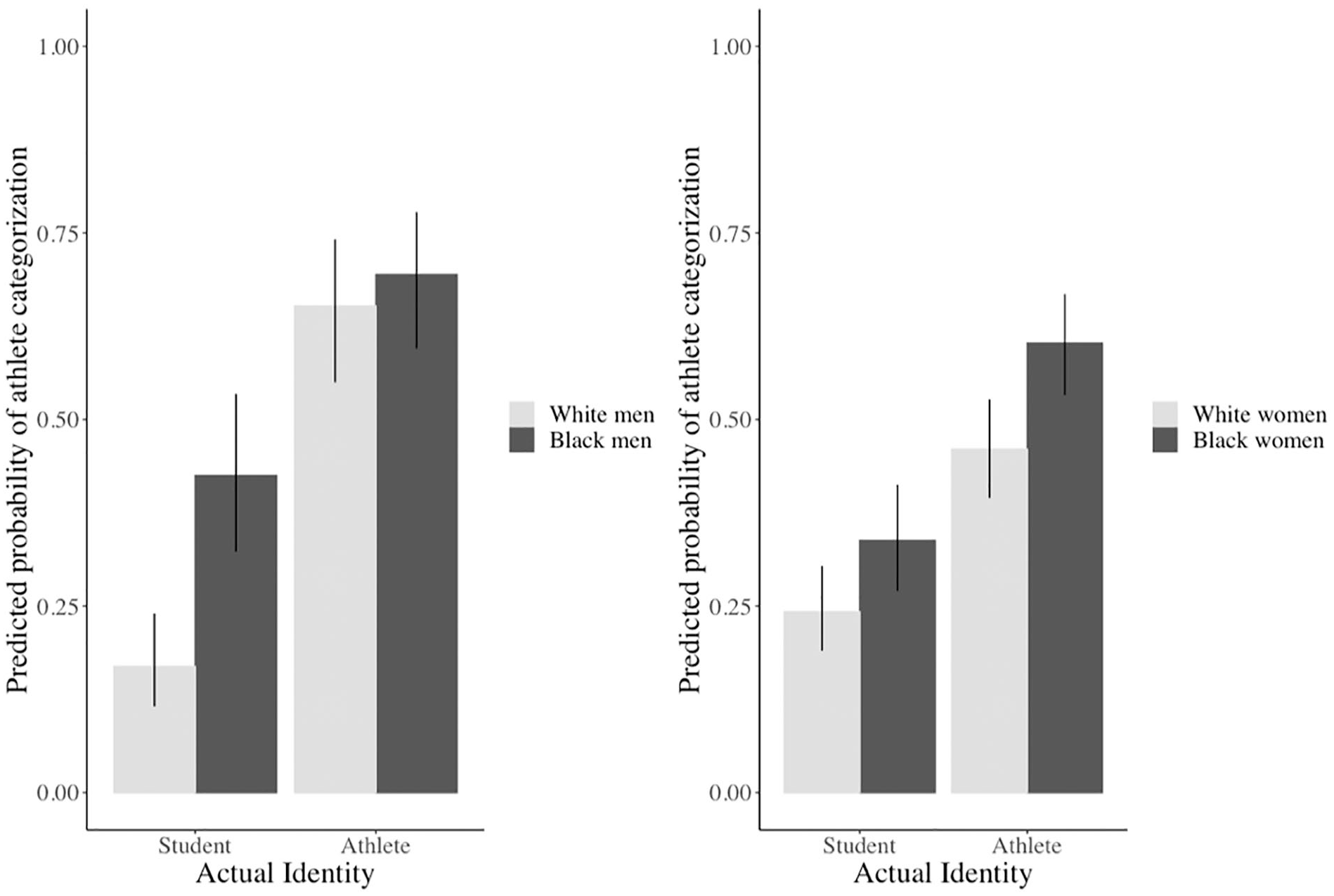
Predicted probability of student-athlete categorizations by actual identity and race in study 1.
Similarly, Black women were more likely to be categorized as student-athletes than White women, B = .52, SE = .14, z = 3.66, p < .001, 95% CIs = [0.24, 0.80], OR = 1.68, and student-athletes were more likely than students to be categorized as student-athletes, B = 1.03, SE = .15, z = 6.76, p < .001, OR = 2.80, 95% CIs = [0.73, 1.34]. However, for female targets, the interaction did not reach significance, B = .11, SE = .24, z = .46, p = .65, 95% CIs = [−0.37, 0.58] (Figure 1).
Thus far, two complementary statistical approaches provide evidence that student-athlete categorizations are not equally distributed. Overall, observers tended to categorize both male and female targets accurately, regardless of the race of the target. However, observers displayed a significant bias to categorize Black male targets as student-athletes. Examining the determinants of categorization, this effect was driven by a strong and systematic bias to categorize Black male students as student-athletes. This pattern was not observed for judgments of Black women. As described in the supplementary materials, although Black men and women were perceived as more masculine than White men and women, respectively, Black men and women were more likely to be categorized as a student-athlete than White men and women, respectively, even when controlling for Facial Masculinity (and Facial Femininity for women). Thus, although tested separately, the distinct patterns observed for judgments of men and women raise the possibility that Black men might be uniquely susceptible to being miscategorized as student-athletes, thereby exposing them to unique forms of stigma.
Study 2
In Study 2, we sought to replicate the pattern of results observed in Study 1 and to probe the consequences of this bias, particularly for evaluations of academic ability. Based on previous literature (e.g., Ghavami & Peplau, 2013; Wininger & White, 2015), we hypothesized that perceived academic ability would be jointly determined by both race and perceived status as a student-athlete, but that this might be most pronounced for Black male students.
Method
Participants
Following recruitment procedures described in Study 1, we recruited two samples of 76 participants (152 total) from Amazon’s Mechanical Turk who provided judgments of either male targets (39% women, 61% men) or female targets (47% women, 53% men). Participants in each sample were predominantly White and similar in age (70% and 77.6% White, 14% and 15.8% Black, 16% and 15.8% non-Black racial/ethnic minority; Ms age = 31.99 and 39.07, SDs = 7.88 and 12.51, for judges of men and women, respectively).
Stimuli and Procedure
Stimuli and procedures for Study 2 were identical to those described in Study 1 with one exception. These participants also rated each target’s perceived academic ability in a block that followed the categorization task. Specifically, participants estimated each target’s overall high school grade point average (GPA) on a Likert-type scale ranging from 0 (F) to 4 (A). We included this measure instead of college GPA estimations for two reasons. We reasoned that these ratings would be construed as a measure of college readiness rather than current academic performance, making it immune to widespread assumptions that student-athletes cluster in and pursue easier undergraduate college majors that artificially inflate college GPA (Denhart et al., 2009; Houston & Baber, 2017) and that as a more indirect measure, it would allow participants to plausibly attribute their judgments to athletic recruitment, rather than race, thus reducing demand characteristics (see, Sailes, 1993). Participants also completed a battery of standard demographic items, were debriefed, and thanked for their participation. 4
Results and Discussion
As with Study 1, we analyzed each set of judgments separately, but we present them in parallel to facilitate comparisons.
Categorization Accuracy and Bias
The same analytic approach described in Study 1 was used. First, we first examined participants’ ability to distinguish students from athletes. Again, overall sensitivity was above chance in both samples, Ms d’ = 0.52 and 0.43, SDs d’ = .39 and .37, ts(75 and 75) = 11.69 and 10.20, both ps < .001. Replicating Study 1, sensitivity was higher for judgments of White men (Md’ = 0.78, SDd’ = .50) than Black men (Md’ = 0.35, SDd’ = .38), t(75) = 9.21, p < .001. For female targets, sensitivity did not differ between judgments of White women (Md’ = 0.50, SDd’ = .49) and Black women (Md’ = 0.45, SDd’ = .43), t(75) = −.96, p = .34.
Analyses of response bias also replicated the patterns observed in Study 1. Judgments of male targets were again biased toward student-athlete categorizations for Black men (Mc = −0.22, SDc = .63), t(75) = −3.04, p = .003, but biased toward student categorizations for White men (Mc = 0.30, SDc = .57), t(75) = 4.63, p < .001, resulting in a significant difference in categorization biases as a function of Target Race, t(75) = 6.32, p < .001.
Judgments of female targets were again biased toward student categorizations for White women (Mc = 0.50, SDc = .42), t(75) = 10.29, p < .001. Unlike in Study 1, judgments of Black women were also modestly biased toward student categorizations (Mc = 0.15, SDc = .52), t(75) = 2.58, p = .012, yet the difference between the two remained statistically reliable, t(75) = 5.77, p < .001.
Determinants of Categorizations
Using the same analytic procedures described in Study 1, we again found that among male targets, Black men were more likely to be categorized as student-athletes, relative to White men, B = .96, SE = .24, z = 4.01, p < .001, 95% CIs = [0.49, 1.43], OR = 2.61, and student-athletes were more likely than students to be categorized as student-athletes, B = 1.49, SE = .22, z = 6.82, p < .001, OR = 4.44, 95% CIs = [1.06, 1.92]. Replicating Study 1, the interaction of Target Race and Target Identity was also significant, B = −1.13, SE = .37, z = −3.06, p = .002, 95% CIs = [−1.85, −0.40]. For judgments of students, Black men were 4.5 times more likely than White men to be miscategorized as student-athletes, B = 1.52, SE =.30, z = 5.13, p < .001, 95% CIs = [0.94, 2.11], OR = 4.57. For judgments of student-athletes, White and Black men were equally likely to be categorized as student-athletes, B = .40, SE = .29, z = 1.35, p = .18, 95% CIs = [−0.18, 0.98], OR = 1.49.
Once again, Black women were more likely to be categorized as student-athletes than White women, B = .52, SE = .16, z = 3.16, p = .002, 95% CIs = [0.19, 0.84], OR = 1.65, and student-athletes were more likely than students to be categorized as student-athletes, B = 1.12, SE = .16, z = 6.82, p < .001, OR = 3.06, 95% CIs = [0.79, 1.44]. Again, there was no significant interaction, B = −.03, SE = .27, z = −.11, p = .91, 95% CIs = [−0.57, 0.51] (see Figure 2).
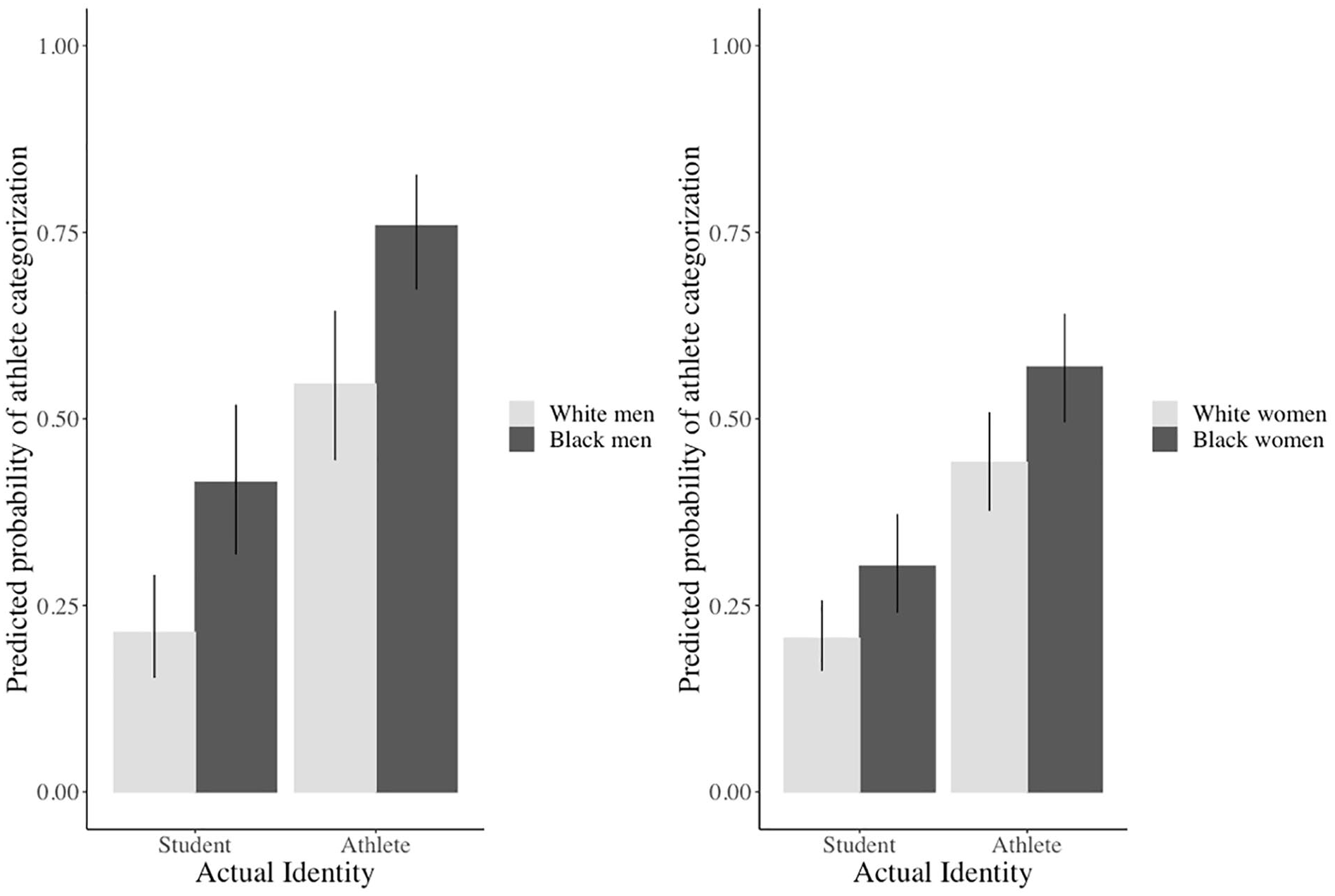
Predicted probability of student-athlete categorizations by actual identity and race in Study 2.
Replicating Study 1, and as described in the supplementary materials, Target Race predicted Categorization when controlling for Facial Masculinity for both the men and women samples (and Facial Femininity for women).
Consequences of Categorizations
We next tested the implications of being perceived to be a student-athlete, and whether this differed as a function of a target’s race. We regressed Judged GPA onto Target Race, Categorization (i.e., whether participants categorized targets as “students” vs. “athletes”), and their Interaction, separately for judgments of male and female targets. For male targets, Judged GPA did not differ between Black and White men, B = −.05, SE = .05, t(131.80) = −1.12, p = .26, 95% CIs = [−0.16, 0.04], but men categorized as student-athletes were judged to have lower GPAs (M = 2.65, a C+ average) than men categorized as students, (M = 2.80, a B– average), B = −.15, SE = .05, t(79.75) = −3.08, p = .003, 95% CIs = [−0.24, −0.05]. Among male targets, the interaction between Categorization and Target Race did not reach significance, B = .07, SE = .04, t(6,507.18) = 1.63, p = .10, 95% CIs = [−0.01, 0.15].
Examining judgments of female targets, participants judged Black women to have lower GPAs than White women, B = −.12, SE = .05, t(108.28) = −2.32, p = .02, 95% CIs = [−0.22, −0.02], and they judged women categorized as student-athletes to have lower in GPAs than women categorized as students, B = −.07, SE = .04, t(74.82) = −2.09, p = .04, 95% CIs = [−0.14, −0.004]. Here, the interaction between Target Race and Categorization was significant, B = −.09, SE = .04, t(6,786.29) = −2.40, p = .02, 95% CIs = [−0.18, −0.02] and thus we examined the simple effects. For White women, Judged GPA did not differ by Categorization as a student (M = 3.02, a B average) or student-athlete (M = 3.00, a B average), B = −.03, SE = .04, t(129.29) = −.64, p = .52, 95% CIs = [−0.11, 0.05]. But Black women categorized as student-athletes were judged lower on GPA (M = 2.82, a B– average) than Black women categorized as students (M = 2.94, a B– average), B = −.12, SE = .04, t(124.61) = −2.98, p = .003, 95% CIs = [−0.20, −0.04].
Overall in Study 2, we replicated the patterns described in Study 1, and we showed their downstream consequences for judgments of academic ability. Interestingly, the association between student-athlete categorizations and judgments of GPA differed by race and gender. For judgments of male targets, race did not directly predict judgments of GPA, but student-athlete categorizations corresponded to lower ratings of GPA for both Black and White men. For judgments of female targets, in contrast, participants judged White women to have higher GPAs than Black women, and student-athlete categorizations corresponded to lower ratings of GPA for Black women, but not White women. Thus far, we have documented a consistent pattern in which Black male students appear to be uniquely prone to be miscategorized as student-athletes. These categorizations proved to be consequential insofar as they corresponded to lower ratings of academic ability for all groups except White women. Because categorization mistakes are not equally distributed, however, Black male students are still the most likely group to experience the negative impact of mistaken assumptions that accompany an observer-imposed student-athlete categorization.
Study 3
Although Studies 1 and 2 shed some light on how the intersection of race and gender impacted categorizations and evaluations, our ability to speak directly to intersectionality was limited because participants judged either men or women, but not both. This design feature precluded making strong comparisons between judgments of men and women. Because the concept of an athlete is widely linked to male identity and masculinity, comparing the impact of student-athlete categorizations for men and women is paramount. We therefore sought to provide a more comprehensive analysis of these issues in Study 3 by obtaining judgments of both men and women from participants. Importantly, this facilitated intersectional comparisons and aligned more closely with the real experience of encountering undergraduates on college campuses.
Methods
Participants
Consistent with power estimates specified in Study 1 and recruitment strategies described in Studies 1 and 2, we recruited 75 participants from Amazon’s Mechanical Turk (29% women, 71% men) to achieve over 99% power to detect a medium effect size. Participants were predominantly White (78.7% White, 9.3% Black, 12% non-Black racial/ethnic minority, M age = 37.61, SD = 10.61).
Stimuli and Procedure
Stimuli included a subset of those used in Studies 1 and 2. Specifically, using a random number generator, we randomly selected 120 photos in equal proportion of Black/White, male/female, and student/student-athlete categories, thus yielding 15 targets in each distinct category. All other procedures were identical to those described in Study 2.
Results and Discussion
Categorization Accuracy and Bias
Once again, overall sensitivity was above chance for all targets, indicating that participants could reliably distinguish students from student-athletes (Md’ = 0.42, SDd’ = .31), t(74) = 11.78, p < .001. A 2 (Target Race) × 2 (Target Gender) within-subjects ANOVA revealed that sensitivity was higher for judgments of White targets than Black targets (Ms d’ = 0.57 and 0.33, SDs = .44 and .31, respectively), F(1, 296) = 18.34, p < .001, and for judgments of men than women (Ms d’ = 0.59 and 0.35, SDs = .53 and .46, respectively), F(1, 296) = 19.95, p < .001. These main effects were qualified by a significant interaction, F(1, 296) = 7.34, p = .007. Sensitivity was higher for judgments of White men than Black men (Ms d’ = 0.78 and 0.40, SDs d’ = .54 and .44, respectively), t(74) = 6.41, p < .001, but did not differ between judgments of White women and Black women (Ms d’ = 0.39 and 0.30, SDs d’ = .51 and .39, respectively), t(74) = 1.38, p = .17.
An analogous analysis of response bias found support for our main hypotheses. First, there was a significant difference in categorization bias for White targets and Black targets (Msc = 0.33 and 0.03 SDsc = .40 and .52, respectively), F(1, 296) = 20.59, p < .001, and women and men (Msc = 0.48 and −0.10 SDsc = .67 and .58, respectively), F(1, 296) = 66.72, p < .001. Although the interaction between Target Race and Target Gender was not significant, F(1, 296) = .03, p = .87, the only group for whom categorizations were biased toward student-athlete was judgments of Black men (Mc = −0.24 SDc = .63), t(74) = −3.38, p = .001. Judgments of both Black and White women favored student categorizations (Msc = 0.31 and 0.64, SDsc = .69 and .60, respectively), ts(74) = 3.94 and 9.62, respectively, both ps < .001, and judgments of White men showed no directional bias (Mc = 0.06 SDc = .48), t(74) = 1.10, p = .28.
Determinants of Categorizations
To test the extent to which race and gender increased the likelihood of a target being perceived as a student-athlete, Categorization was regressed on Target Race, Target Gender, Target Identity, and their two-way and three-way Interaction terms. As expected, men were more likely to be categorized as student-athletes than were women, B = 1.01, SE = .19, z = 5.21, p < .001, 95% CIs = [0.63, 1.39], OR = 2.75. Replicating prior results, Black targets were more likely to be categorized as student-athletes than were White targets, B = .56, SE = .17, z = 3.29, p = .001, 95% CIs = [0.23, 0.90], OR = 1.75, and student-athletes were more likely than students to be categorized as student-athletes, B = 1.19, SE = .17, z = 6.98, p < .001, OR = 3.29, 95% CIs = [0.85, 1.53]. These main effects were qualified by two significant two-way interactions of Target Race and Target Identity, B = −.61, SE = .28, z = −2.15, p = .03, 95% CIs = [−1.16, −0.05], and of Target Gender and Target Identity, B = .58, SE = .28, z = 2.04, p = .04, 95% CIs = [0.02, 1.14]. The two-way interaction of Target Gender and Target Race was non-significant, B = −.04, SE = .28, z = −.16, p = .87, 95% CIs = [−0.60, 0.51], and no significant three-way interaction emerged, B = −.63, SE =.56, z = −1.13, p = .26, 95% CIs = [−1.74, 0.48]. Examining simple effects for the Target Race and Target Identity interaction, we examined how the effect of Target Race on Categorization varied by Target Identity while controlling for Target Gender. Participants were more likely to categorize Black students as student-athletes than White students, B =.87, SE = .22, z = 3.91, p < .001, 95% CIs = [0.43, 1.31], OR = 2.39, but they were equally likely to categorize Black student-athletes and White student-athletes as student-athletes, B = .26, SE = .22, z = 1.18, p = .24, 95% CIs = [−0.17, 0.69], OR = 1.30. Similarly, for the simple effects of the Target Gender and Target Identity interaction, we examined how the effect of Target Gender on Categorization varied by Target Identity while controlling for Target Race. Participants were more likely to categorize both male students and male student-athletes as student-athletes than female students and female student-athletes respectively, B = .71, SE = .24, z = 2.97, p = .003, 95% CIs = [0.24, 1.19], OR = 2.03 and B = 1.29, SE = .24, z = 5.42, p < .001, 95% CIs = [0.82, 1.76], OR = 3.63. However, the magnitude of gender differences in categorization was larger among student-athlete targets (Figure 3).
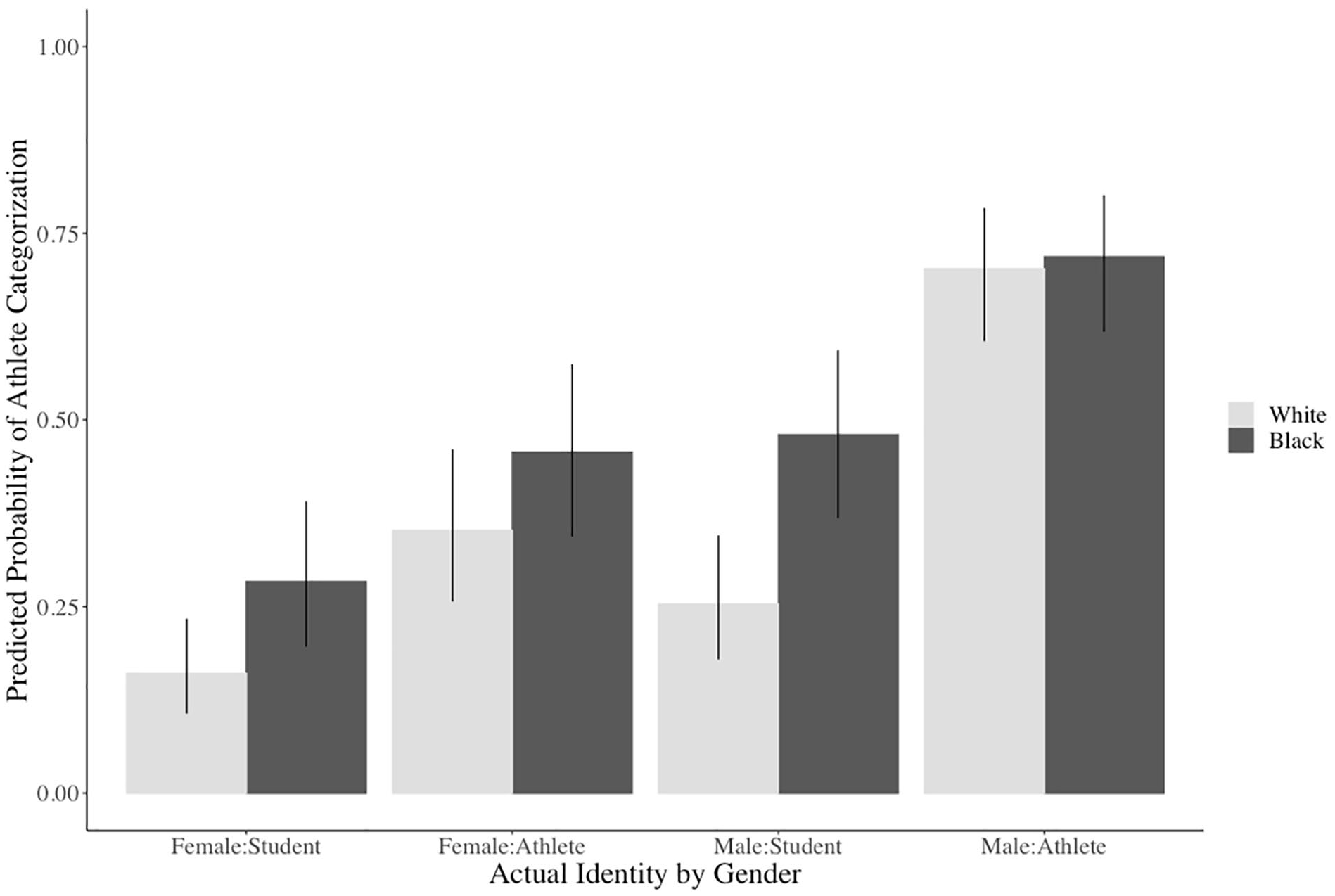
Predicted probability of student-athlete categorizations by actual identity, race, and gender in study 3.
Replicating prior studies, and further described in the supplementary materials, Target Race again predicted Categorization when controlling for Facial Masculinity. However, Target Gender was not predictive of Categorization when controlling for perceived Facial Masculinity.
Consequences of Categorizations
We next tested the association between being perceived to be a student-athlete and academic ability by regressing Judged GPA on Target Race, Target Gender, Categorization, and their interaction. Participants judged men to have lower GPAs than women, B = −.27, SE = .06, t(158.21) = −4.61, p < .001, 95% CIs = [−0.38, −0.15], but judged the GPA of Black and White targets equally, B = .01, SE = .05, t(151.98) = .37, p = .71, 95% CIs = [−0.08, 0.12]. Once again, participants judged targets categorized as student-athletes to have lower GPAs, relative to targets categorized as students, B = −.08, SE = .03, t(82.29) = −2.79, p = .007, 95% CIs = [−0.14, −0.02]. This main effect was qualified by a significant two-way interaction of Target Gender and Categorization, B = −.28, SE =.04, t(8,652.27) = −7.26, p < .001, 95% CIs = [−0.36, −0.21]. Neither the two-way interaction of Categorization and Target Race, B = .07, SE = .04, t(8,362.69) = 1.86, p = .06, 95% CIs = [−0.004, 0.15], nor Target Gender and Target Race reached significance, B = .07, SE = .08, t(112.19) = .78, p = .44, 95% CIs = [−0.10, 0.23]. No significant three-way interaction emerged, B = .07, SE = .08, t(8,677.45) = .87, p = .38, 95% CIs = [−0.08, 0.22]. Examining simple effects for the Target Gender and Categorization interaction, we tested the effect of Categorization on Judged GPA by Target Gender controlling for Target Race. Men categorized as student-athletes were judged as having lower GPAs (M = 2.53, a C+ average) than men categorized as students (M = 2.76, a B– average), B = −.23, SE = .04, t(163.60) = −6.33, p < .001, 95% CIs = [−0.30, −0.16], however, women categorized as student-athletes were judged equally on GPA (M = 2.96, a B– average) to women categorized as students (M = 2.90, a B– average), B = .06, SE = .04, t(174.97) = 1.62, p = .11, 95% CIs = [−0.01, 0.13].
Overall in Study 3, we replicated and extended findings of the previous studies by testing the determinants and consequences of student-athlete categorizations for men and women. Generally, we found that observers’ tendency to accurately distinguish students from student-athletes is also plagued by a systematic pattern of biases. Specifically, Black male students were the only group to be consistently and inaccurately categorized as student-athletes. Consequently, they were therefore uniquely likely to suffer the stigmas associated with the categorization when participants judged their academic ability.
General Discussion
In three studies, we found a consistent pattern in which student/student-athlete categorizations, a highly relevant social distinction for undergraduates, is biased by a target’s race and gender and is linked to negative judgments of academic ability. In each study, Black men were uniquely prone to be categorized as student-athletes, often incorrectly. Judgments of other groups, in contrast, favored student categorizations. Moreover, although race itself did not consistently undermine judgments of academic ability, being perceived as a student-athlete did. This association therefore stands to be the most consequential for the one group that was consistently misperceived: Black male students. Unfortunately, the patterns observed herein appear to be quite common as a recent study found over 90% of Black male students at public research universities reported having been mistaken as student-athletes (Harper, 2015). Collectively, the current findings provide key practical and theoretical insights about how culturally embedded stereotypes about groups impinge on the earliest moments of social perception in ways that can perpetuate racial biases.
Importance for Understanding Social Perception
The patterns of accuracy and bias for categorization advance research aimed at understanding the determinants of social perception. We found that observers’ judgments were significantly above chance, suggesting that people can distinguish between student-athletes and non-athlete students with a modest level of accuracy. This itself contributes to what is now a large body of evidence that observers are sensitive to somewhat ambiguous social category memberships (Tskhay & Rule, 2013).
From our perspective, however, the more important contribution of this work for understanding the mechanisms of social perception is the consistent pattern of systematic bias that was observed: Black men were categorized as student-athletes, but other groups were generally not. This bias joins a smaller, but growing, area of research focused on understanding how systematic biases in judgments serve distinct social functions. For instance, Johnson and colleagues (2012) found that anthropometrically androgynous body shapes were overwhelmingly judged to be men. This pattern was exacerbated when participants were induced to feel fear but attenuated when they were induced to feel positive emotions. The authors argued that these patterns were self-protective, insofar as unknown men pose a greater threat to observers than unknown women (Johnson et al., 2012). Similar patterns of self-protective biases also occur for judgments of emotions depicted in faces (Galperin et al., 2013), particularly when a target has the potential to inflict harm (Holbrook et al., 2014). In other work, judgment biases appear to benefit the target of perception. Lick and Johnson (2016) documented a systematic bias to categorize others as straight, rather than gay, even when these judgments were at odds with known base rates. Part of this bias was attributed to a restricted range of phenotypes that observers were willing to categorize as gay (Lick & Johnson, 2016), but part of it appears to stem from a more socially motivated benevolence. Specifically, Alt and colleagues (2020) found that observers give targets the “benefit of the doubt” to avoid exposing likely gay targets to stigma. Thus, judgments about both perceptually obvious and perceptually ambiguous categories are systematically biased in motivated ways.
Advancing Intersectional Scholarship
In addition to its contribution to understanding the mechanisms of social perception, the specific bias observed here (i.e., to categorize Black men as student-athletes) provides broad theoretical and practical insights, as well. First, this finding corroborates the theoretical and methodological importance of adopting an intersectional approach within science (Cole, 2009; Crenshaw, 1989). Indeed, our adoption of an intersectional approach allowed us to not only discover that student-athlete miscategorizations disproportionately affect Black men but also that unique patterns characterize judgments of other groups that further highlight the influence of race in this bias, as well. For instance, although White women make-up the largest proportion of student-athletes at Division-I institutions, they were the least likely group to be categorized as student-athletes, thus benefiting from assumptions about their gender (and race), which is associated with academic success (e.g., Heyder & Kessels, 2013), and buffering them from stereotypic assumptions about student-athletes. Interestingly, while certainly attenuated, categorization of Black women was more similar to judgments of White women than of Black men insofar as categorizations either showed no bias (Study 1) or favored the student alternative (Studies 2 and 3). Yet, given that Black women were still overall more likely to be categorized as a student-athlete than White women given nearly identical base rates (3% and 2.7% of Black and White female undergraduates, respectively, are student-athletes), our findings affirm the importance of race in biasing student-athlete categorizations.
Although Black women were judged more similarly to White women than Black men in virtually every case, we think the one instance in which they were not is also of interest. In Study 2, Black women were not buffered from the stereotypic academic assumptions about student-athletes. Although speculative, it is possible that the gendered context of these judgments played a role, in that Black women’s race may have been more salient when compared only to White women (Study 2). In the co-ed judgment context (Study 3), in contrast, Black women’s gender may have been more salient, thus contributing to the buffering effect afforded White women in both Studies 2 and 3. Overall, these patterns contradict the possibilities that, in this specific judgment context, Black women would be judged similarly to men by virtue of their race (e.g., Johnson et al., 2012; see also, Zaraté & Smith, 1990) or would be intersectionally invisible (e.g., Purdie-Vaughns & Eibach, 2008). Instead, these patterns might indicate that in this context, Black women were construed more readily by their gender more than by their race, although our data cannot confirm that speculation. Thus, our approach allowed us an important degree of specificity for understanding the observed bias.
The Fallacy of a Rational Bias
Some have argued that differences in observed base rates render biases in social judgments as rational (Cesario, 2021; McCauley et al., 1995). On most college campuses, Black men are underrepresented overall and, as outlined in the introduction, have a higher baseline likelihood of being student-athletes relative to other groups on campus (8.6% vs 2.4%–3%, respectively). If noted by observers, they may incorporate this asymmetry and represent it in their judgments of others. Here, we sought to circumvent this possibility by explicitly including equal representation for each group. Of course, prior knowledge of base rate differences in the real world might still influence judgments, yet such “kernel-of-truth” arguments are insufficient to account for biased social judgments, both here (e.g., White men have identical student-athlete base rates as women but are more likely to be categorized as a student-athlete; Study 3) and in other decision domains. Specifically, racial biases in First-Person-Shooter-Tasks and straight categorization biases in sexual orientation judgments show a clear and consistent pattern of base-rate neglect (Freeman et al., in press; Lick & Johnson, 2016), even when base rates are provided on a trial-by-trial basis (Lick & Johnson, 2016, Study 1). Put simply, categorization biases persist over and above presumed and/or known base rates (Lick & Johnson, 2016, Study 3).
More importantly for this consideration, even under circumstances in which knowing base rates improves accuracy, these modest increases in accuracy are accompanied by concomitant increases in biases that disproportionately impact underrepresented groups, as well. We tested this by modeling the degree to which social perception biases vary as a function of different base rates of Black versus White men being students or student-athletes. Across all combinations (see analyses in supplemental materials), we found the bias to miscategorize Black (versus White) male students as student-athletes increased as base rate differences between these groups increased. In other words, biases are exacerbated as base rate differences increase. Thus, arguments that social perception biases are somehow rational or justified when base rate differences exist comes with a cost that privileges modest gains in accuracy over harms at the expense of underrepresented groups who bear the brunt of miscategorizations. Here, miscategorizing a Black male student as an athlete is an explicit microaggression when it is expressed to the student directly, but an implicit microaggression each time it occurs insofar as miscategorizations that are never corrected perpetuate pernicious and harmful stereotypes. Even if the observed biases in the present research are rationalized as based in a kernel of truth, a perceiver is systematically applying harmful stereotypes which disproportionately impact Black male students. More broadly, any kernel of truth rationale should be cautiously applied when it is likely to produce and reinforce systematic stereotyping and possibly overt discrimination targeting members of a group.
The specificity of the bias to categorize Black men as student-athletes is also theoretically relevant to a broader literature focused on how race biases can be perpetuated in circumstances that afford plausible deniability (Gaertner & Dovidio, 2005; see also, Sears & Henry, 2003). Indeed, whereas a majority of individuals will disavow explicit forms of racism, at least publicly (Plant & Devine, 1998), their biases can seep into judgments that provide them “cover.” For instance, Moskowitz and Carter (2018) argued that the Black Athlete stereotype has unique features that circumvent any positive associations with the athlete category. They found that when veiled under the guise of ambiguous language, participants willingly attributed negative characteristics that implied laziness and arrogance to Black athletes, but not to Black businessmen. Similarly, we found that observers willingly categorized Black men, but not other groups, to be athletes. This categorization might seem to be benign, if not positive, to perceivers. However, our own and others’ findings show just the opposite. Being categorized as a student-athlete was associated with more negative evaluations of academic ability in the current findings, and emboldened racial stereotyping of Black male athletes in other research (Moskowitz & Carter, 2018). As such, the misattribution of student-athlete status to Black men might be construed as a pernicious misperception that makes broader racial stereotyping more palatable to the beholder because it remains cloaked in a more favorable percept (Czopp et al., 2015).
More generally, the miscategorization of Black men as student-athletes might also serve other motivations, as well. Specifically, these biases might serve to perpetuate the characterization of Black male students as beneficiaries of admission through athletic recruitment, rather than academic merit. If correct, this might serve to justify the presence of Black men on campus while maintaining stereotypic beliefs about their intelligence and academic ability. In addition, these biases might also justify a transactional mind-set wherein Black men are considered primarily as a form of entertainment to the spectators of collegiate sports (Beamon, 2008; Harper, 2018; Tucker, 2003). This transactional mind-set is echoed in publicized calls for Black male athletes to “shut up and dribble” when they are engaging intellectually in non-entertainment domains (Sullivan, 2018). Regardless of their origins or motivations, a bias to judge Black undergraduates as student-athletes is likely to be consequential. Importantly, in the present research, we employed the labels student and athlete to examine categorization bias. Future research should investigate whether this bias and its evaluative consequences are exacerbated or attenuated if both groups’ student status are continually salient by having participants categorize targets as student-only or student-athlete.
Implications for Black Male Students and Black Perceivers
The specificity of our observations also provides practical insights for understanding the unique challenges that Black male college students face on campus. In addition to the well-documented assumptions that Black students are the beneficiaries of affirmative action in admission decisions (McGee & Martin, 2011), we found that they also face the additional burden of being presumed to be student-athletes. Among Black men who were non-athlete students, the predicted probability of being mistakenly judged to be a student-athlete hovered near 50% in all three studies—or, put plainly, when perceivers were presented with a Black male student to categorize, perceivers performed no better than guessing. Although considered a benign judgment, given that student-athletes face widespread stigma about their academic competence even from university faculty (Comeaux, 2011a, 2011b), this misperception is likely to influence the quality of instructor engagement and mentorship that Black male students receive (see, Comeaux, 2011a). Yet, obviously student-athletes and non-athlete students are both students in the university student-body demographic. Thus, addressing perceivers’ expectations of the academic ability of student-athletes, and in particular Black and male student-athletes, is critical to facilitate a greater sense of inclusion and academic belonging for all students.
Of equal importance, these biases can also directly impact how Black undergraduates, and Black men in particular, perceive themselves and their place in the academic context. For example, Black male students’ perception of academic validation from key academic stakeholders (e.g., a college professor expressing that the student academically belongs at the institution) is a critical contributor to engagement with faculty (Wood & Newman, 2017). Yet, these stakeholders often rely on shallow, racial perceptions to make judgments of Black students’ ability to succeed in academic majors, such as STEM. Williams and colleagues (2019) demonstrated that Black students who were more stereotypically phenotypical of their racial group were rated as having lesser STEM ability, especially when raters were not concerned about appearing prejudiced. Once again, these perceptions matter. The researchers found that, longitudinally, Black students (and other underrepresented racial minorities) were more likely to leave STEM majors the more they looked stereotypical of their group (Williams et al., 2019). Across academic majors, expecting biased treatment within one’s major because of being Black predicts lower GPA among Black male undergraduates (Chavous et al., 2004). Because being misperceived to be a student-athlete by academic faculty and staff is perceived as a racist act (Czopp, 2008; Harper, 2009, 2015), it can undermine a sense of interpersonal trust with faculty members thereby reducing Black male students’ desire for future academic interactions, effectively cutting off sources of academic mentorship critical for college and later adult life success (Brady et al., 2020). Therefore, this early perceptual bias is likely to have a dual negative academic impact—negatively affecting both the perceiver’s evaluation of Black men’s academic ability and Black men’s perception of and engagement in the academic culture.
Although speculative, it is important to note that sharing racial in-group membership may dampen negative academic expectations associated with a student-athlete categorization. In one study of faculty attitudes toward student-athletes at a Division-I college, Black faculty members reported less surprise when a student-athlete received an “A” in a class compared to non-Black faculty members (Comeaux, 2011a). Among Black Americans generally, being perceived as an athlete might have a qualitatively distinct meaning that is informed by positive cultural history and experiences tied to race/ethnicity. For instance, a Black perceiver categorizing a Black male undergraduate as a student-athlete might be less driven by perceptions of Black men’s academic ability and more driven by perceived sociocultural markers of in-group identity and status. Previous work with Black adolescents found that identifying as a good athlete was tied to identification as a young Black man, regardless of actual participation on a sports team (Higginbotham, 2021). A more thorough understanding of such distinctions is likely to advance insights about how the determinants of social categorizations can vary as a function of culture and identity, yielding distinct evaluative consequences.
Conclusion
Whether taking a glance at someone while walking through campus, before selecting peer-study groups, or as they enter an office hours session, perceiver judgments about an undergraduate’s campus standing can happen quickly and decisively, with meaningful consequences for how that student is treated. Here we documented a systematic bias in which observers assumed, often mistakenly, that Black men were collegiate athletes, a percept that also corresponded to lower assessments of academic ability. Thus, although generally assumedly positive, biased student-athlete categorizations could instead be described as a pernicious misperception that perpetuates racial biases against Black men.
Supplemental Material
sj-docx-1-psp-10.1177_01461672211044067 – Supplemental material for You Play a Sport, Right? A Persistent and Pernicious Intersectional Bias in Categorization of Students vs. Student-Athletes
Supplemental material, sj-docx-1-psp-10.1177_01461672211044067 for You Play a Sport, Right? A Persistent and Pernicious Intersectional Bias in Categorization of Students vs. Student-Athletes by Gerald D. Higginbotham, Jessica Shropshire and Kerri L. Johnson in Personality and Social Psychology Bulletin
Footnotes
Declaration of Conflicting Interests
The author(s) declared no potential conflicts of interest with respect to the research, authorship, and/or publication of this article.
Funding
The author(s) disclosed receipt of the following financial support for the research, authorship, and/or publication of this article: Higginbotham was funded by a UCLA Graduate Research Mentorship Fellowship and by the National Science Foundation Graduate Research Fellowship Program under Grant No. (DGE-1650604). Any opinions, findings, and conclusions or recommendations expressed in this material are those of the author(s) and do not necessarily reflect the views of the National Science Foundation. Johnson was funded by NIH R01-HD082844 during this research.

Supplemental Material
Supplemental material is available online with this article.
Notes
References
Supplementary Material
Please find the following supplemental material available below.
For Open Access articles published under a Creative Commons License, all supplemental material carries the same license as the article it is associated with.
For non-Open Access articles published, all supplemental material carries a non-exclusive license, and permission requests for re-use of supplemental material or any part of supplemental material shall be sent directly to the copyright owner as specified in the copyright notice associated with the article.
