







Abstract
Whether and how self-concept clarity (SCC) affects self-control has not been sufficiently explored in empirical research. We proposed that low SCC inhibits self-control through a lower sense of global self-continuity. The results of five studies provided converging support for our mediation model (N = 898). Compared with participants with high SCC, participants with low SCC scored lower on self-control scales (Studies 1 and 2), spent less time practicing to improve their performance on a tedious task (Study 3), and were less likely to stay focused on an ongoing task (Study 4) or to adhere to the exercise plan to stay healthy (Study 5). Global self-continuity mediated the effects of low SCC on self-control (Studies 1–5) even after emotional affect (Study 5) and self-esteem (Studies 4 and 5) were controlled for. These findings highlight the importance of fostering SCC for coping with self-control failures.
Self-control is a hallmark of adaptation (Mischel, 1996; Rothbaum et al., 1982). It plays a crucial role in guiding people’s behavior in various contexts and confers various benefits (Fitzsimons & Finkel, 2010; Orehek & Forest, 2016). In contrast, self-control failure lies behind many social and personal problems, such as crime, obesity, academic underachievement, alcohol or drug abuse, unhealthy eating behaviors, and juvenile delinquency (Baumeister et al., 2007). Although an individual might intend to exert self-control, surrendering to the temptation can be easier than successfully controlling oneself (Baumeister & Heatherton, 1996; Fujita, 2011; Muraven & Baumeister, 2000). Thus, understanding the factors that contribute to self-control and how these factors influence self-control are crucial.
People who fail to exercise self-control may describe themselves as “getting lost” or “not knowing what they are” (Light et al., 2018). The self-concept plays a core role in exercising self-control, and thus, disruption to the self-concept—in the form of self-concept confusion—impairs self-control (Higgins, 1996; Light, 2017; Markus & Nurius, 1986). However, the literature lacks a sufficient empirical investigation of whether and how this happens. In the current research, we aimed to investigate whether low self-concept clarity (SCC; that is, the extent to which different self-aspects are clearly defined, internally consistent, and temporally stable; Campbell & Lavallee, 1993; Campbell et al., 2003) frustrates a person’s sense of global self-continuity (a sense of connectedness among the past, present, and future selves; Becker et al., 2018; Hong et al., 2022; Sedikides et al., 2018) and thus impairs the ability to exert self-control.
Low SCC and Self-Control
SCC refers to the extent to which various aspects of the self are clearly defined, internally consistent, and temporally stable (Campbell et al., 1996). SCC and self-esteem are positively associated (e.g., Campbell et al., 1996). SCC was proposed to foster an understanding of the puzzling findings of self-esteem. Only positive feedback affects people with high self-esteem, whereas all sorts of external feedback, whether positive or negative, affect people with low self-esteem (Campbell & Fairey, 1985; Campbell & Lavallee, 1993; Jones, 1973). Findings that are not easily explained by the difference in the positivity of self-beliefs could be better understood from the perspective of SCC (Campbell, 1990). Low SCC causes people to seek external factors to maintain coherent identities, and thus, it leaves people vulnerable to external influences (Campbell, 1990). For example, women who were low in SCC were more likely to internalize societal standards (Vartanian, 2009). In addition, ego threats were more likely to affect people who were low in SCC (Stucke & Sporer, 2002), and these individuals were more likely to adopt product and service recommendations (Lee et al., 2010). The self-beliefs of people with high self-esteem are characterized by certainty and consistency, whereas people with low self-esteem are better described as uncertain and confused (Campbell & Lavallee, 1993; Campbell et al., 1996; Setterlund & Niedenthal, 1993). Compared with negative self-evaluations (i.e., low self-esteem), low SCC better explains why low self-esteem people are vulnerable to either positive or negative external influences.
Self-control is demonstrated by resolving conflicts between proximal, small satisfying goals, and distal goals that are more rewarding (Ainslie, 1974; Duckworth et al., 2016; Fujita, 2011). Theorists have suggested that the self plays a crucial role in exercising self-control (Duckworth et al., 2019; Higgins, 1996; Markus & Nurius, 1986). In the process of exercising self-control, the self serves as a guide for deciding which goal to pursue, how to pursue that goal, and how much effort to devote to pursuing that goal (Deci & Ryan, 1987; Light, 2017; Markus & Nurius, 1986). Without a clear sense of self, people may have difficulty processing self-relevant information as behavioral guidance (Baumeister & Scholar, 1986; Setterlund & Niedenthal, 1993). In addition, as noted above, people who are low in SCC are susceptible to external influences. Without a clear “self” to draw upon, the self surrenders to the influence of external forces, which hinders the self from exerting control efforts. Supporting this suggestion, research revealed that people low in SCC were in higher agreement that they had no control over their lives (Błażek & Besta, 2012). Thus, low SCC, manifested by self-confusion, has detrimental effects on self-control. Cross-sectional research provides initial evidence that SCC is positively associated with the trait of self-control (Light, 2017). Further evidence supporting this conjecture comes from research on goal striving. Light et al. (2018) found that self-uncertainty promoted pursuing either an alternative goal or a focal goal, depending on which goal was made salient. When the alternative goal was primed, people with self-uncertainty decreased their pursuit of the focal goal. These findings suggested that low SCC might impede self-regulatory functions. However, it remained unclear whether the decrease in focal goal pursuit represents self-control failure for people with self-uncertainty or if it merely implies a shift toward the alternative goal as the focal goal. Thus, in this research, it was important to investigate whether low SCC inhibits self-control directly. We hypothesized that low SCC hinders self-control. In the following section, we discuss how low SCC inhibits self-control.
Low SCC, Global Self-Continuity, and Self-Control
Self-control has long been framed as the ability to successfully inhibit the desire for smaller, immediately satisfying rewards to attain larger, delayed rewards (e.g., de Ridder et al., 2012; Duckworth et al., 2016; Inzlicht et al., 2021; Nilsen et al., 2020). Recent research has suggested that the effortful inhibition of surrendering to immediate temptation is only one aspect of self-control. Successful self-control is also achieved through proactive self-initiated strategies, which involve anticipating self-control conflicts and initiating actions to avoid the conflicts preemptively (de Ridder et al., 2011; Fujita, 2011; Galla & Duckworth, 2015; Gillebaart & de Ridder, 2015; Hofmann et al., 2012; Hoyle & Davisson, 2016). Both inhibiting immediate satisfying urges to experience the desired results that may come later and using proactive self-initiated strategies to avoid self-control conflicts in advance require the ability to attend to the needs of the distant self. Thus, global self-continuity—the sense of connectedness among the past, present, and future selves (e.g., Becker et al., 2018; Sedikides et al., 2018)—matters. In the following sections, we discuss the importance of global self-continuity for self-control.
The Mediating Effect Through Global Self-Continuity
Self-continuity is a crucial marker of psychological maturity and contributes to psychological adjustment (Erikson, 1963; Sedikides et al., 2016). Research on past–present self-continuity (past self-continuity) and present–future self-continuity (future self-continuity) runs almost parallel. More of the literature links future self-continuity with self-regulation or self-control. Feeling more connected with one’s future self reduces the tendency to see one’s future self as another person and further benefits making long-term decisions (Hershfield, 2011; Rutchick et al., 2018). A wide range of research has supported this assumption. In previous research, the measure of future self-continuity was associated with higher levels of self-control (Adelman et al., 2017). In addition, writing letters to their future selves in 20 years (vs. 3 months) led people to report a stronger sense of future self-continuity and further resulted in more exercise (Rutchick et al., 2018). People who were led to believe that adulthood was characterized by identity stability reported having greater connections with their future selves and thus were more likely to act patiently for the welfare of their future selves (Bartels & Urmnisky, 2011). Furthermore, people who were led to imagine their future selves in a vivid way showed an increase in money-saving behaviors (Hershfield, 2011) and a decrease in delinquency (van Gelder, 2013). Although no empirical research has directly linked past self-continuity with self-control, we suggest that past self-continuity has important consequences for self-control. Prospection is impossible without connectedness with one’s past (D’Argembeau & Van der Linden, 2004). Past self-continuity has been found to be negatively associated with the risk of suicidality, ultimately ending the future self (Ball & Chandler, 1989). These findings imply that disruption to past self-continuity may lead to ignoring future consequences, which is commonly seen in self-control failure (e.g., Hershfield, 2011; Rutchick et al., 2018). Thus, it is important to consider self-continuity in relation to both the future and the past when examining its impact on self-control.
Along with our conjecture, theorists have long conceptualized self-continuity as a sense of connection among one’s past, present, and future (Chandler, 1994; Lewis, 1976; Parfit, 1971; Rutt & Löckenhoff, 2016; Sani, 2008; Strawson, 2009), referring to global self-continuity (e.g., Hong et al., 2022). Recently, researchers have begun to investigate global self-continuity empirically (e.g., Becker et al., 2018; Hong et al., 2021, 2022). Indeed, past and future self-continuity are positively related (Sokol & Eisenheim, 2016), and past and future self-continuity have similar developing trends over the entire lifespan (Rutt & Löckenhoff, 2016). Global self-continuity offers a comprehensive understanding of self-continuity and helps with integrating the separate research lines of past and future self-continuity. In this research, we focused on whether global self-continuity facilitates self-control. As past and future self-continuity are conducive to self-control (e.g., Ball & Chandler, 1989; Hershfield, 2011), we hypothesized that the more continuity people feel with their past and future selves, the better their self-control is.
To have an enduring sense of self, a clearly defined and well-structured sense of self is required (e.g., Erikson, 1994; James, 1890/1950; Jiang et al., 2020; Rogers, 1959). Previous research found that induced low SCC decreased the sense of past self-continuity (Jiang et al., 2020). As discussed earlier, global self-continuity offers a comprehensive understanding of self-continuity. If people feel disconnected from their pasts, they may find it difficult to project their present selves into the future and have a sense of connectedness with their future selves (Becker et al., 2018; Iyer et al., 2008; Jiang et al., 2020). Thus, extending previous research, we suggest that low SCC decreases global self-continuity. Because we expect global self-continuity to be positively associated with self-control, it was reasonable to expect that low SCC would impede self-control through the mediating effect through global self-continuity.
Overview
This research was aimed at investigating whether low SCC hindered self-control through a lower sense of global self-continuity. We conducted five studies to test our hypotheses. In Study 1, we manipulated low (vs. high) SCC and tested whether global self-continuity mediated the effect of low SCC on self-control. Self-control was indicated by concentrating on goal pursuit in the long run and not being distracted by the impulses at hand. In Study 2, we replicated the results of Study 1 using different methods to manipulate low SCC and to measure self-control. In Study 3, we addressed the limitations of Studies 1 and 2 with actual behavior to index self-control. In Study 4, which has been preregistered, we included a self-esteem measure and tested whether the main effect of manipulation on self-control and the proposed mediating effect through global self-continuity could be established beyond self-esteem. In Study 5, we tested whether the mediating effect through global self-continuity could be established when emotional affect and self-esteem were controlled for.
In all studies, we relied on PROCESS 3.5, Model 4 (Hayes, 2018; 5,000 iterations), to conduct the mediation analyses. In addition, we excluded participants who failed to follow instructions. Specifically, two independent researchers who accessed only the participants’ writings coded whether the participants had followed the instructions. The agreement between the two coders was high. A third researcher decided the outcome of a disagreement between the two researchers. We used Chinese materials for studies with Chinese participants. In addition, we used Brislin’s (1980) procedures to translate and back-translate all materials and measures from English to Chinese. We obtained ethical approval for our studies from the corresponding author’s institution. We reported all manipulations, measures, and exclusions in all studies. Data and code for all studies can be found at the Open Science Framework (https://osf.io/drp9q/).
Study 1
In Study 1, we manipulated low (vs. high) SCC by asking participants to describe two aspects of their personalities that conflicted (vs. being coherent) with each other (Jiang et al., 2020). We measured self-control by adapting the 10-item Self-Regulation Index (Schwarzer et al., 1999). We used the Self-Regulation Index to index self-control for two reasons. First, the index captured the way in which people resolve the conflict between staying focused on goal pursuit in the long term and becoming distracted by the impulses at hand. Second, the items reflected both the inhibitory (e.g., “It is difficult for me to suppress thoughts that interfere with what I need to do”; reverse-coded) and the initiatory (e.g., “If an activity requires a problem-oriented attitude, I can control my feelings”) aspect of self-control.
Method
Participants and design
We used the Monte Carlo power analysis for indirect effects application (Schoemann et al., 2017) to determine the sample size for our proposed mediation model. We surmised that the relations among low-SCC manipulation, global self-continuity, and self-control would be medium. At least 153 participants were needed to reach a power of .80 assuming intercorrelations of r = .30 (SD = 0.10). We recruited 245 American participants through Prolific. We excluded 10 participants for not finishing the study, 22 for failing two attention check questions, and another 20 for failing to follow the instructions. Among the excluded participants, 30 were from the low-SCC condition, and 22 were from the high-SCC condition. A total of 193 participants (59 men and 134 women, Mage = 37.80, SDage = 11.02, Minage = 18, Maxage = 58) remained. Among them, 8.29% had a high school degree, 21.24% had some college, 11.40% had a 2-year college degree, 39.90% had a 4-year college degree, 16.06% had a master’s degree, and 3.11% had a professional degree. In addition, 71.50% were White, 8.29% African American, 6.22% Hispanic, 10.88% Asian, 0.52% Native American, and 2.59% other. We randomly assigned the participants to high (n = 97) or low (n = 96) SCC conditions.
Procedure and materials
We adopted a writing task (Jiang et al., 2020) to manipulate the sense of low SCC. Participants in the low-SCC condition were instructed to describe two aspects of their personalities or self-beliefs that conflicted with each other. In the high-SCC condition, participants were asked to describe two aspects of their personalities or self-beliefs that were coherent with each other and the clarity that the coherence brought to them.
We assessed global self-continuity with four items, which we modified from the Self-Continuity Index (Sedikides et al., 2016). The original index measures past to present self-continuity. We included future self to measure global self-continuity. 1 A sample item is “I feel my past self, present self, and future self flow seamlessly together.” We averaged the four items’ scores to index global self-continuity (M = 4.75, SD = 1.41; α = .89).
Next, we assessed self-control with the adapted 10-item Self-Regulation Index (Schwarzer et al., 1999). We rephrased the items to capture the state of self-control with the following stem: “Now, I feel,” Example items include the following: “Now, I feel it is difficult for me to suppress thoughts that interfere with what I need to do” (1 = strongly disagree, 7 = strongly agree). After the relevant items were reversed, the participants’ responses were averaged to create a composite (M = 5.16, SD = 1.12; α = .91).
Finally, to test the effectiveness of SCC manipulation, participants reported their feelings about the writing task shown above by rating their agreement with three items (1 = strongly disagree, 7 = strongly agree; Jiang et al., 2020). Sample items include the following: “My beliefs about myself conflict with one another.” We averaged the three items’ scores to index their perceived SCC (M = 4.42, SD = 1.57; α = .80).
Results and Discussion
Manipulation check
People in the low-SCC condition (M = 3.88, SD = 1.39) perceived lower SCC than those in the high-SCC condition did (M = 4.96, SD = 1.57), t(191) = −5.07, p < .001, d = −0.73, 95% CI [−1.03, −0.43]. The manipulation was effective.
Low SCC, global self-continuity, and self-control
Participants in the low-SCC condition (M = 4.54, SD = 1.41) felt lower global self-continuity than those in the high-SCC condition did (M = 4.95, SD = 1.39), t(191) = −2.04, p = .042, d = −0.29, 95% CI [−0.58, −0.01]. In addition, participants in the low-SCC condition (M = 4.98, SD = 1.16) had lower self-control scores than those in the high-SCC condition did (M = 5.35, SD = 1.05), t(191) = −2.31, p = .022, d = −0.33, 95% CI [−0.62, −0.05].
Next, we conducted a mediation analysis by entering low SCC as the independent variable (high SCC as 0, low SCC as 1), global self-continuity as the mediator, and the self-control scores as the dependent variable. The indirect effect through global self-continuity was significant: b = −.09, SE = 0.06, 95% CI [−0.22, −0.003] (see Figure 1). The direct effect of low SCC on self-control was not significant: b = −.28, SE = 0.16, 95% CI [−0.58, 0.03]. These results supported our prediction that global self-continuity mediates the effect of low SCC on self-control.
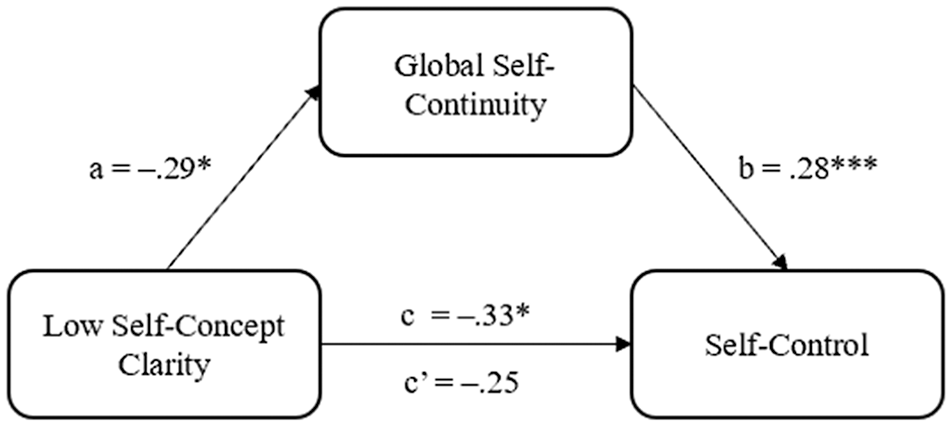
Global self-continuity mediates the effect of low SCC on self-control scores in Study 1.
Study 2
In Study 2, we extended Study 1 by measuring inhibitory and initiatory self-control more directly using the adapted version of the Brief Multidimensional Self-Control Scale (BMSCS; Nilsen et al., 2020). The items in the BMSCS reflect both the inhibitory (e.g., “I’m easily disturbed by my impulses”; reverse-coded) and the initiatory (e.g., “I focus daily on my long-term goals”) definition of self-control (Nilsen et al., 2020).
Method
Participants and design
As in Study 1, at least 153 participants were needed to reach a power of .80 assuming intercorrelations of r = .30 (SD = 0.10). We recruited 170 Chinese participants from Credamo, an online platform (e.g., Gong et al., 2020; Jiang & Sedikides, 2021). After excluding 14 for failing to follow the instructions (10 from the low-SCC condition and four from the high-SCC condition), we had 156 participants (56 men and 100 women, Mage = 26.11, SDage = 7.67, Minage = 18, Maxage = 59). Among them, 0.64% had a junior middle school education or below, 7.05% had a senior middle school education, 82.69% had a bachelor’s degree, 8.97% had a master’s degree, and 0.64% had a PhD degree. We randomly assigned the participants to high (n = 81) or low (n = 75) SCC conditions.
Procedure and materials
In Study 1, we manipulated low SCC by asking participants to write down the internal inconsistency between two aspects of self-concept (Jiang et al., 2020). The definition of SCC suggested that low SCC could be induced in ways other than internal inconsistency. Thus, in addition to asking participants to write down the internal inconsistency between two aspects of their self-concept, we wanted to manipulate low SCC in a more natural way by asking participants to recall an experience during which they felt confused (vs. clear) about themselves. We asked participants in the low-SCC condition to recall and describe life experiences during which they felt confused about the kind of person they were. In addition, we asked participants in the high-SCC condition to recall and describe life experiences during which they felt that they knew what kind of person they were. Previous research has shown that writing tasks, such as the one utilized in this research, can effectively induce people to feel uncertain or lack clarity about themselves (Hogg et al., 2017; Morrison & Johnson, 2011).
As in Study 1, we assessed global self-continuity using the modified Self-Continuity Index. We averaged the four items’ scores to index global self-continuity (1 = strongly disagree, 7 = strongly agree; M = 5.27, SD = 1.03; α = .86).
Next, we assessed self-control with the adapted eight-item BMSCS (Nilsen et al., 2020). The scale has the following two dimensions: four items capturing inhibitory self-control and four capturing initiatory self-control (Nilsen et al., 2020). Following previous research, we rephrased the items to reflect state self-control (Carswell et al., 2021; Jiang & Sedikides, 2021; Koval et al., 2019); in particular, we emphasized the “right now” and preceded each item with the stem “I feel.” Example items include the following: “I feel I am easily disturbed by my impulses” (1 = strongly disagree, 7 = strongly agree). After reverse-coding relevant items, the participants’ responses were averaged to create inhibitory self-control (M = 3.99, SD = 1.41; α = .81), initiatory self-control (M = 5.13, SD = 0.94; α = .73), and composite self-control (M = 4.56, SD = 1.05; α = .84) scores. Next, we used three items (Campbell et al., 1996; for example, “I feel I have a clear sense of who I am”; 1 = strongly disagree, 7 = strongly agree) to measure their subjective SCC—how certain they were that they knew themselves (Guerrettaz & Arkin, 2016; M = 4.29, SD = 1.63; α = .89)—to check whether the manipulation was successful.
Results and Discussion
Manipulation check
Participants in the low-SCC condition (M = 3.16, SD = 1.32) perceived lower SCC than their counterparts in the high-SCC condition did (M = 5.33, SD = 1.11), t(154) = −11.13, p < .001, d = −1.78, 95% CI [−2.20, −1.36]. The manipulation was effective.
Low SCC, global self-continuity, and self-control
As predicted, participants in the low-SCC condition (M = 5.08, SD = 1.07) felt lower global self-continuity than those in the high-SCC condition did (M = 5.45, SD = 0.98), t(154) = −2.25, p = .026, d = −0.36, 95% CI [−0.68, −0.04].
Inhibitory self-control was positively associated with initiatory self-control, r(156) = .59, p < .001. We conducted a multivariate analysis of variance to test the effect of low-SCC manipulation (low SCC vs. high SCC) on inhibitory and initiatory self-control. The manipulation main effect was significant, Wilks’ Lambda = .93, F(2, 153) = 5.41, p = .005,
Means and SD for Self-Control Scores in Study 2.
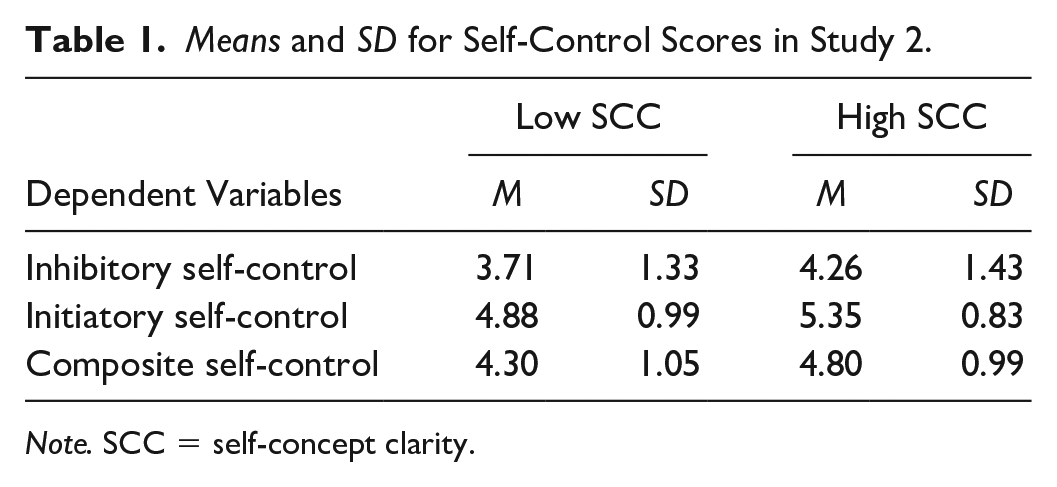
Note. SCC = self-concept clarity.
Next, we conducted three mediation analyses. We entered low SCC as the independent variable (high SCC as 0, low SCC as 1), global self-continuity as the mediator, and inhibitory self-control as the dependent variable. The indirect effect through global self-continuity was significant: b = −.11, SE = 0.07, 95% CI [−0.28, −0.01]. The direct effect of low SCC on inhibitory self-control was significant: b = −.44, SE = 0.22, 95% CI [−0.88, −0.01]. With initiatory self-control as the dependent variable, the indirect effect through global self-continuity was significant: b = −.10, SE = 0.05, 95% CI [−0.22, −0.02]. The direct effect of low SCC on initiatory self-control was significant: b = −.36, SE = 0.14, 95% CI [−0.64, −0.08]. With composite scores of self-control as the dependent variable, the indirect effect through global self-continuity was significant: b = −.11, SE = 0.06, 95% CI [−0.24, −0.01] (Figure 2). The direct effect of low SCC on composite self-control was significant: b = −.40, SE = 0.16, 95% CI [−0.72, −0.09]. Overall, these results supported our prediction that global self-continuity mediates the effect of low SCC on self-control.
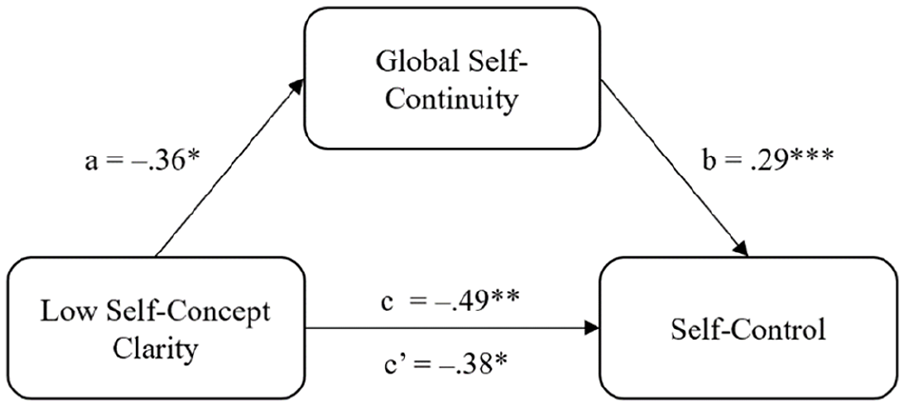
Global self-continuity mediates the effect of low SCC on composite self-control scores in Study 2.
Study 3
In Studies 1 and 2, self-control was indexed through self-report measures. In Study 3, we addressed this limitation by using an actual behavior to index self-control. For this, we used persistence time on a tedious task, which previous studies used to indicate self-control (e.g., Schmeichel & Vohs, 2009; Vohs et al., 2005).
Method
Participants and design
As in Studies 1 and 2, at least 153 participants were needed. We recruited 183 participants from universities in Beijing, China. After excluding nine for failing to follow the instructions (seven from the low-SCC condition and two from the high-SCC condition), we had 174 participants (66 men and 108 women, Mage = 22.77, SDage = 2.67, Minage = 18, Maxage = 30). Among them, 1.72% had a senior middle school education, 0.57% had some college, 56.90% had a bachelor’s degree, 34.48% had a master’s degree, and 6.32% had a PhD degree. We randomly assigned the participants to high (n = 87) or low (n = 87) SCC conditions.
Procedure and materials
First, we manipulated low (vs. high) SCC, measured global self-continuity (M = 5.04, SD = 1.17; α = .89), and perceived SCC (M = 4.43, SD = 1.38; α = .83) in the same way as we did in Study 2.
Next, we told the participants that they were moving on to a different study—one that was ostensibly aimed at testing their performance on a key-pressing task. Better performance was presumably desirable for the participants. We also explicitly asked them to perform as best they could. The task followed the ABBA paradigm. In a trial, Stimulus A was shown, and people were each asked to plan a response (Response A) but to withhold it until the trial’s end. Then, Stimulus B was shown, and these people were asked to respond (Response B) immediately. Finally, these individuals had to finish the trial with Response A. Stimulus A always appeared before Stimulus B, but the response to Stimulus A had to be carried out only after the response to Stimulus B had been performed. During the task, people had to memorize Response A while performing Response B. The prepared Response A interfered with Response B. The people needed to respond correctly as quickly as possible. This task was not easy. The practice helped improve the performance (“ABBA Reversed-Compatibility Effect,” n.d.; Stoet & Hommel, 1999).
After the task was introduced, all participants had the opportunity to take part in the trial to improve their understanding of the task. Then, a research confederate pretended that something was wrong with the formal experimental device and told the participants that they could run demos to achieve better outcomes while debugging the device. The participants were told that practice improves performance and that they could practice for as much time and in as many trials as they wished. We imposed a 10-minute limit on the practice time, which the participants were not informed of until they had completed the task. Pretesting showed that people found this task tedious, and they agreed that practicing to improve their performance on the formal task required self-control. 3 An effective self-controller could have overridden the impulse to quit and instead kept practicing for a longer period to perform the formal task better. Thus, self-control was indexed by the amount of time that the participants remained involved and persisted in practicing (M = 257.34 s, SD = 140.50 s).
Results and Discussion
Manipulation check
Participants in the low SCC condition (M = 3.76, SD = 1.28) reported lower SCC than those in the high SCC condition did (M = 5.11, SD = 1.12), t(169.02) = −7.38, p < .001, d = −1.12, 95% CI [−1.46, −0.78]. The manipulation was effective.
Low SCC, global self-continuity, and self-control
Participants in the low-SCC condition (M = 4.71, SD = 1.26) felt lower global self-continuity than those in the high-SCC condition did (M = 5.38, SD = 0.97), t(161.72) = −3.94, p < .001, d = −0.60, 95% CI [−0.91, −0.29]. As predicted, participants in the low-SCC condition (M = 234.24, SD = 137.46) practiced the key-pressing task for shorter amounts of time than those in the high-SCC condition did (M = 280.44, SD = 140.48), t(172) = −2.19, p = .030, d = −0.33, 95% CI [−0.63, −0.03].
Next, we conducted a mediation analysis by entering low SCC as the independent variable (high SCC as 0, low SCC as 1), global self-continuity as the mediator, and practice time as the dependent variable. The indirect effect through global self-continuity was significant: b = −10.27, SE = 6.07, 95% CI [−24.14, −0.15] (see Figure 3). The direct effect of low SCC on practice time was not significant: b = −35.92, SE = 21.90, 95% CI [−79.14, 7.30]. These results supported our prediction that global self-continuity mediates the effect of low SCC on self-control.
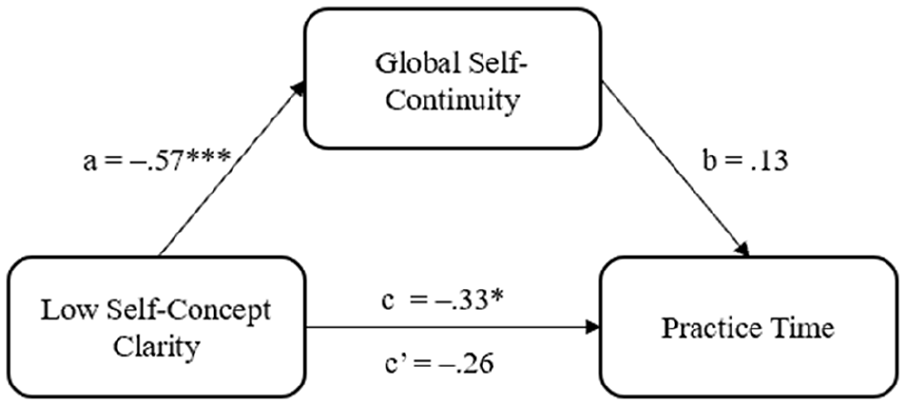
Global self-continuity mediates the effect of low SCC on practice time on key-pressing task in Study 3.
Study 4
Our low-SCC manipulations—which described either experience during which the participants felt confused about themselves or two aspects of each of their personalities that conflicted with each other—were likely to induce low self-esteem (Rosenberg et al., 1995). SCC and self-esteem are related (Nezlek & Plesko, 2001; Wu et al., 2010) but distinctive constructs (Campbell et al., 1996; Morrison & Wheeler, 2010). Because self-esteem is positively associated with self-control (e.g., Tangney et al., 2004; Uzun et al., 2020), changed self-esteem rather than SCC may have driven our observed effects. To rule out this possibility, in Study 4, we measured participants’ perceived SCC, self-esteem, self-continuity, and self-control to explore whether the main effect of manipulation on self-control and the mediating effect through global self-continuity could be established beyond self-esteem. In Study 4, we used staying focused on the task to indicate self-control. We preregistered this study (https://aspredicted.org/qa7mi.pdf).
Method
Participants and design
As in Studies 1 to 3, at least 153 participants were needed in Study 4. We recruited 200 Chinese participants through Credamo. We excluded 13 for failing to follow the instructions and two others for failing the attention check question. Among the excluded participants, 11 were from the low-SCC condition, and four were from the high-SCC condition. A total of 185 participants (62 men and 123 women, Mage = 27.60, SDage = 7.36, Minage = 17, Maxage = 57) remained. Among them, 0.54% had a junior middle school education or below, 8.65% had a senior middle school education, 75.14% had a bachelor’s degree, 14.05% had a master’s degree, and 1.62% had a PhD degree. We randomly assigned the participants to high (n = 96) or low (n = 89) SCC conditions.
Procedure and materials
We manipulated SCC and measured global self-continuity (M = 5.31, SD = 1.04; α = .86) in the same way as we did in Studies 2 and 3. We assessed self-esteem using Webster et al.’s (2020) six-item State Self-Esteem Scale (e.g., “I feel like I’m not doing well” [reverse-coded]; 1 = not at all, 7 = extremely). After reverse-coding the relevant items, we averaged the scores of the six items to index self-esteem (M = 4.40, SD = 1.31; α = .85).
We assessed the participants’ degrees of staying focused on the task to indicate their self-control. We asked the participants to imagine that they had an important work task due at midnight 3 days later. The task was demanding. Playing with their smartphones seemed more appealing, but it may make the task overdue. They had to answer the following three questions: “What would you do?” (1 = stay focused on the task, 9 = play with the mobile phone), “How likely is it for you to play with your mobile phone?” (1 = not at all, 9 = very much), and “How likely is it for you to stay focused on the task?” (1 = not at all, 9 = very much). After reverse-coding the scores of the first two questions, we averaged the scores of the three questions to index staying focused on the task (M = 6.51, SD =1.81; α = .85).
As in Studies 2 and 3, we used three items to measure the participants’ perceived SCC (M = 4.33, SD = 1.65; α = .89). Finally, for validation purposes, we presented participants with the definition of self-control and asked them to indicate the extents to which they agreed that staying focused on the task demanded self-control (self-control index; 1 = strongly disagree, 9 = strongly agree; M = 8.01, SD = 1.15).
Results and Discussion
Low-SCC manipulation, perceived SCC, and self-esteem
People in the low-SCC condition (M = 3.18, SD = 1.32) perceived lower SCC than those in the high-SCC condition did (M = 5.40, SD = 1.12), t(183) = −12.31, p < .001, d = −1.81, 95% CI [−2.20, −1.42]. When self-esteem was controlled for, the difference in SCC between the two conditions remained significant, F(1, 182) = 120.29, p < .001,
People in the low-SCC condition (M = 3.99, SD = 1.23) reported lower self-esteem than those in the high-SCC condition did (M = 4.79, SD = 1.27), t(183) = −4.30, p < .001, d = −0.63, 95% CI [−0.93, −0.33]. When perceived SCC was controlled for, the difference in self-esteem between the two conditions became nonsignificant, F(1, 182) = 0.05, p = .83,
Self-control index
We conducted a one-sample t-test (comparing the participants’ responses with 5, the scale’s midpoint) on the validation question of self-control. We found that the participants’ responses (M = 8.01, SD = 1.15) were significantly higher than 5, t(184) = 35.43, p < .001, d = 2.60, 95% CI [2.30, 2.90], and they did not differ in the low SCC (M = 7.92, SD = 1.09) and high SCC (M = 8.08, SD = 1.21) conditions, t(183) = −.95, p = .34, d = −0.14, 95% CI [−0.43, 0.15]. These results indicated that it was appropriate to index self-control with staying focused on the task in the scenarios they had just imagined.
Low SCC, global self-continuity, and self-control
Participants in the low-SCC condition (M = 5.06, SD = 1.20) felt lower global self-continuity than those in the high-SCC condition did (M = 5.55, SD = .79), t(150.05) = −3.25, p = .001, d = −0.49, 95% CI [−0.78, −0.19]. As predicted, participants in the low-SCC condition (M = 5.92, SD = 1.87) reported that they were less likely to stay focused on the task than those in the high-SCC condition were (M = 7.05, SD = 1.58), t(172.82) = −4.42, p < .001, d = −0.65, 95% CI [−0.96, −0.35].
Next, we conducted a mediation analysis. We entered low SCC as the independent variable (high SCC as 0, low SCC as 1), global self-continuity, and self-esteem as the mediators, and staying focused on the task as the dependent variable. The indirect effect through global self-continuity was significant: b = −.14, SE = 0.07, 95% CI [−0.28, −0.01] (see Figure 4). The indirect effect through self-esteem was also significant, b = −.32, SE = 0.12, 95% CI [−0.58, −0.12]. The direct effect of low SCC on staying focused on the task was significant: b = −.67, SE = 0.25, 95% CI [−1.17, −.17]. These results supported our prediction that global self-continuity mediates the effect of low SCC on self-control beyond self-esteem.
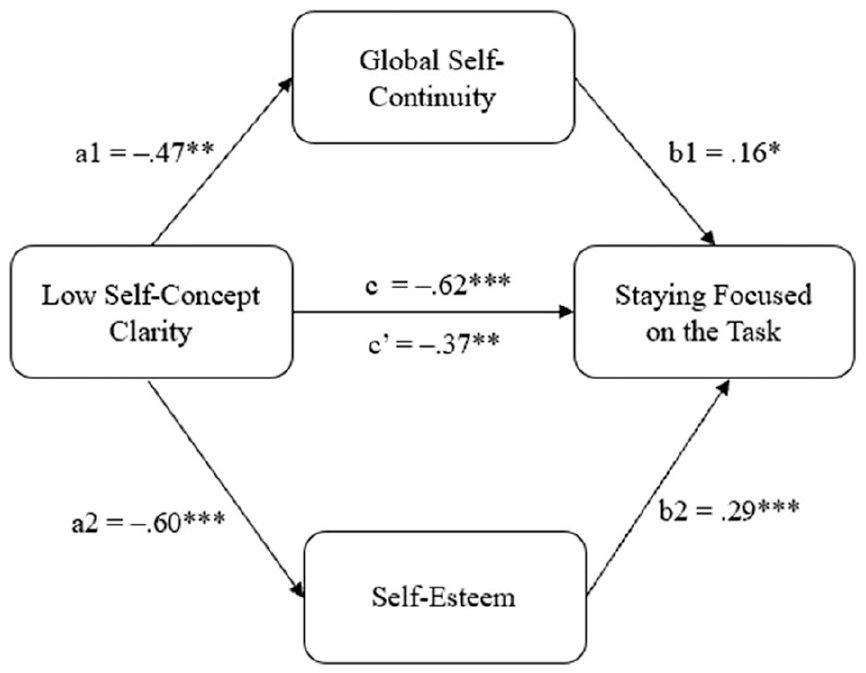
Mediation model in Study 4.
Study 5
Thinking about the experience of feeling confused about oneself is emotionally distressing. Negative affect undermines self-control (Heatherton et al., 1992; Tice et al., 2004). In Study 5, we thus aimed to examine whether global self-continuity mediated the effect of low SCC on self-control beyond emotional affect and self-esteem. We achieved this by measuring participants’ global self-continuity, emotional affect, and self-esteem simultaneously. Moreover, in Study 5, we used the willingness to adhere to the original exercise plan to indicate self-control.
Method
Participants and design
As in Studies 1 to 4, at least 153 participants were needed in Study 5. We recruited 200 Chinese participants through Credamo. After excluding 12 for failing to follow the instructions (five from the low-SCC condition and seven from the high-SCC condition), we had 188 participants (65 men and 123 women, Mage = 28.65, SDage = 6.86, Minage = 19, Maxage = 56). Among them, 5.85% had a senior middle school education, 87.23% had a bachelor’s degree, and 6.91% had a master’s degree. We randomly assigned the participants to high (n = 92) or low (n = 96) SCC conditions.
Procedure and materials
We manipulated low (vs. high) SCC and assessed global self-continuity (M = 5.39, SD = 1.25; α = .91) in the same way as we did in Studies 2 to 4. Next, we measured participants’ emotional affect with the short form of the Positive and Negative Affect Schedule (Thompson, 2007; 1= not at all, 5 = extremely). We averaged the scores of the five positive affects and averaged the scores of the negative affects to index positive (M = 3.18, SD = 0.75; α = .70) and negative affect (M = 1.85, SD = 0.81; α = .81), respectively. We measured self-esteem in the same way as we did in Study 4. After reverse-coding the relevant items, we averaged the scores of the six items to index self-esteem (M = 4.52, SD = 1.33; α = .86).
We assessed the participants’ willingness to adhere to exercise plans to indicate their self-control. We asked participants to imagine that it was a Saturday morning and they had planned to exercise outdoors to stay healthy. However, it was raining outside when they awoke, upsetting their plans. They could either go to the gym to do their exercises or go back to bed. We conducted this study in the summer of 2021. In China, gyms were open but with restricted visitor flows. To stay healthy over time, people must inhibit their immediate urge to go back to bed and choose to exercise at the gym. Thus, a successful self-controller would advance toward distal rather than proximal motivations and show more willingness to adhere to their original exercise plans. A pretest showed that people agreed that adhering to the exercise plan required self-control and that the rain provided them with an excuse for not exercising. 4 Participants had to answer the following three questions: “How likely is it for you to go to bed now?” (1 = not at all, 9 = very much), “How likely is it for you to go to the gym now?” (1 = not at all, 9 = very much), and “What do you prefer?” (1 = going back to bed now, 9 = going to the gym for exercise now). After reverse-coding the first question’s scores, we averaged the three questions’ scores to index the willingness to adhere to the participants’ original exercise plans (M = 5.52, SD = 2.60; α = .97). As with Studies 2 to 4, we used three items to measure the participants’ perceived SCC (M = 4.32, SD = 1.82; α = .93).
Results and Discussion
Low-SCC manipulation, perceived SCC, and self-esteem
People in the low-SCC condition (M = 3.06, SD = 1.47) reported lower SCC than those in the high-SCC condition reported (M = 5.63, SD = 1.06), t(172.49) = −13.81, p < .001, d = −2.00, 95% CI [−2.40, −1.60]. When self-esteem was controlled for, the difference in SCC between the two conditions remained significant, F(1, 185) = 145.51, p < .001,
People in the low-SCC condition (M = 4.08, SD = 1.35) reported lower self-esteem than those in the high-SCC condition reported (M = 4.99, SD = 1.13), t(182.74) = −4.99, p < .001, d = −0.73, 95% CI [−1.03, −0.42]. When perceived SCC was controlled for, the difference in self-esteem between the two conditions was not significant, F(1, 185) = 1.11, p = .30,
Low SCC, global self-continuity, emotional affect, and self-control
Participants in the low-SCC condition (M = 5.00, SD = 1.42) felt lower global self-continuity than those in the high-SCC condition did (M = 5.79, SD = 0.87), t(158.60) = −4.57, p < .001, d = −0.66, 95% CI [−0.96, −0.36].
Participants in the low-SCC condition felt less positive affect (M = 2.94, SD = 0.71), t(186) = −4.64, p < .001, d = −0.68, 95% CI [−0.98, −0.37] and more negative affect (M = 2.09, SD = 0.88), t(173.63) = 4.33, p < .001, d = 0.63, 95% CI [0.33, 0.92], than those in the high-SCC condition (positive affect: M = 3.43, SD = 0.72; negative affect: M = 1.61, SD = 0.64) did.
As predicted, participants in the low-SCC condition (M = 5.14, SD = 2.70) reported that they were less likely to adhere to their exercise plans to stay healthy than those in the high-SCC condition were (M = 5.93, SD = 2.44), t(185.39) = −2.11, p = .036, d = −0.31, 95% CI [−0.60, −0.02].
Next, we conducted a mediation analysis. We entered low SCC as the independent variable (high SCC as 0, low SCC as 1); global self-continuity, positive affect, negative affect, and self-esteem as the mediators; and the willingness to adhere to the exercise plan as the dependent variable. The indirect effect through global self-continuity was significant: b = −.27, SE = 0.15, 95% CI [−0.60, −0.01] (see Figure 5). The indirect effects through positive affect, b = −.38, SE = 0.17, 95% CI [−0.76, −0.09]; negative affect, b = .28, SE = 0.15, 95% CI [0.02, 0.61]; and self-esteem, b = −.72, SE = 0.23, 95% CI [−1.22, −0.32] were also significant. The direct effect of low SCC on the willingness to adhere to the exercise plan was not significant: b = .30, SE = 0.37, 95% CI [−0.43, 1.03]. These results supported our prediction that global self-continuity mediates the effect of low SCC on self-control beyond emotional affect and self-esteem.
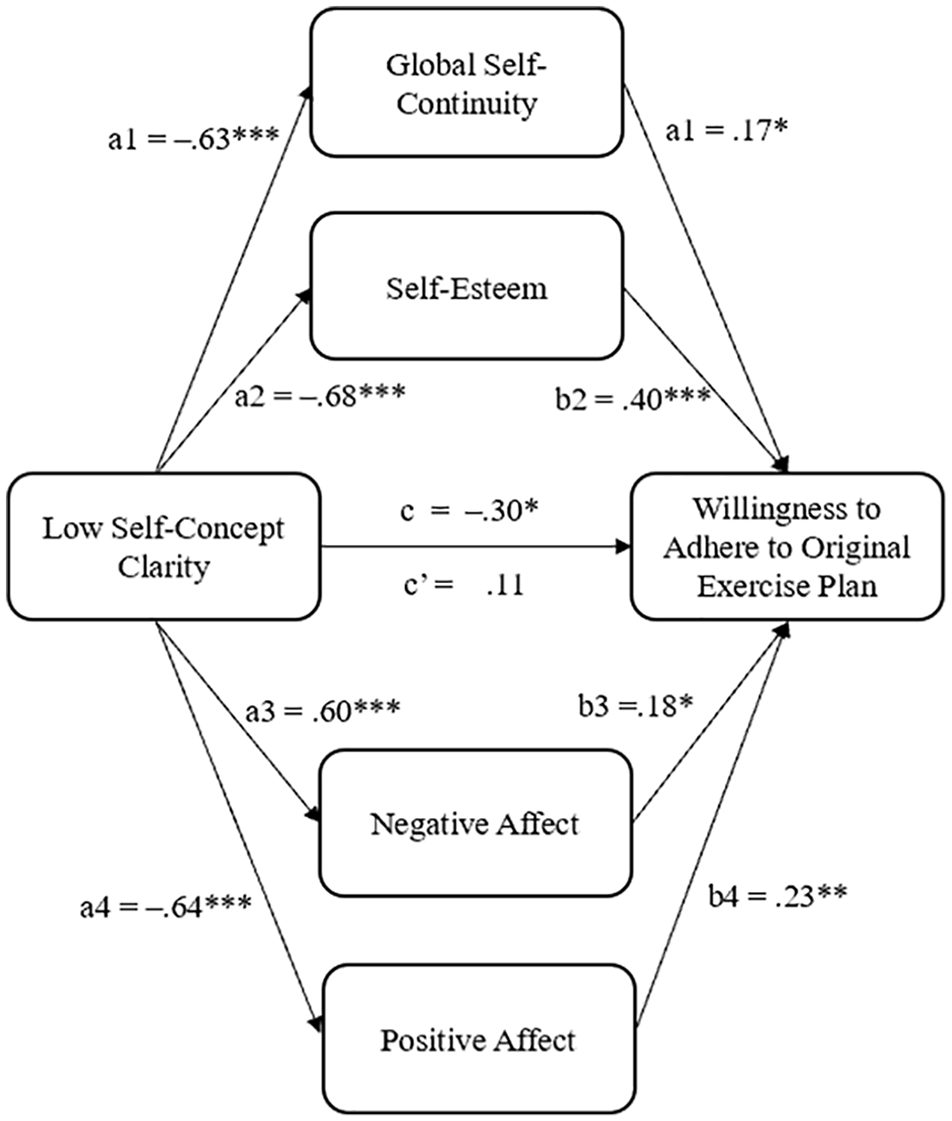
Mediation model in Study 5.
General Discussion
Theorists have suggested that the self-concept lies at the core of exerting self-control (e.g., Markus & Nurius, 1986). People who fail to maintain clearly defined, internally consistent, and temporally stable self-concepts can feel a disrupted sense of global self-continuity, thus resulting in detrimental consequences for self-control. We conducted five studies and provided evidence supporting this prediction. People who were low in SCC had lower scores for self-control (Studies 1 and 2), spent less time practicing to improve their performance (Study 3) and were less likely to stay focused on the ongoing task (Study 4) and to adhere to an exercise plan to stay healthy (Study 5). A meta-analysis examining the effect of low SCC on self-control across the five studies indicated that this effect was significant: The average difference between the low and high SCC was g = −0.42, SE = 0.07, Z = −6.18, p < .001, 95% CI [−0.55, −0.29]. These findings are consistent with previous works that showed positive relationships between SCC and trait self-control (Light, 2017). These findings go beyond previous research by revealing causal relationships between low SCC and self-control.
In addition to documenting the main effect of low SCC on self-control and replicating and extending previous research on low SCC and past self-continuity (Jiang et al., 2020), we found that low SCC decreased global self-continuity. In addition, global self-continuity mediated the effect of low SCC on self-control when emotional affect and self-esteem were controlled for. These results indicated that low SCC decreases self-control not simply because low SCC is emotionally distressing or because it threatens self-esteem.
Implications
Threats to self-certainty can sometimes activate approach motivation and facilitate goal pursuit (Jonas et al., 2014; McGregor et al., 2010). Light et al. (2018) suggested that whether uncertainty about the self impedes or facilitates focal goal pursuit depends on the presence of alternative goals. People will pursue whatever goals are most salient to them to reduce their aversive feelings of uncertainty. The researchers found that when one receives a reminder about attractive alternative goals, feeling uncertainty about oneself reduces one’s commitment to the focal goals (Light et al., 2018). Consistent with these findings, our research suggests that when people feel confused about themselves, they will dismiss distal, larger rewarding goals and advance proximal, smaller satisfying goals at hand. Our research extends these prior findings, suggesting low SCC reducing focal goal pursuit implies people’s failure in self-control instead of their attempt to shift toward a more important goal.
Research on past self-continuity and future self-continuity runs parallel. Despite assumptions that self-continuity refers to the feelings of connectedness among one’s past, present, and future (e.g., Becker et al., 2018; Sedikides et al., 2018), empirical research on global self-continuity is still limited (e.g., Hong et al., 2021, 2022). Extending previous research (Jiang et al., 2020), we found that low SCC impedes global self-continuity, and global self-continuity is positively associated with self-control. More importantly, our research provides the first empirical evidence revealing that global self-continuity as one of the mediators accounts for the effect of low SCC on self-control. This research advances our knowledge about the psychological mechanism underlying the effect of low SCC on self-control.
Our research offers a novel perspective to understanding the literature on self-control. Researchers have found that multiple factors affect self-control. For example, positive affect (Tice et al., 2007), self-affirmation (Schmeichel & Vohs, 2009), and ritual enactment (Tian et al., 2018) facilitated self-control. In contrast, adverse incidents, such as social ostracism (Baumeister et al., 2005), impeded it. Because the self-concept plays a central role in the exertion of self-control, SCC may be an additional mechanism underlying how these factors affect self-control. For example, Ayduk et al. (2009) found that ostracism undermined SCC. Ostracism may cause people to become confused about who they are, thus leading to self-control failure.
Our research highlights the potential benefits of fostering SCC to cope with certain personal and social problems. Multiple clinical symptoms and social problems, such as alcohol addiction, obesity, unhealthy eating behaviors, and juvenile delinquency, are closely linked to failures in exerting self-control (Baumeister et al., 2007). People with such clinical symptoms or social problems often have low-SCC levels. For example, Vartanian (2009) found that low SCC was positively associated with dietary restraint and concerns with body weight and shape, which, in turn, was detrimental to healthy dieting behaviors. Smith et al. (1996) found that people who were low in SCC displayed coping styles that were more passive, including drug or alcohol use. Levey et al. (2019) found that adolescents who were low in SCC reported higher levels of juvenile delinquency. Our findings link these two lines of research because they suggest that low SCC hinders self-control in broad domains and that self-control failure is a new perspective from which to understand the detrimental consequences of low SCC.
Limitations and Future Directions
Demographic factors may affect these findings. For example, age has been found to be significantly associated with SCC and self-continuity (e.g., Bluck & Alea, 2008; Lodi-Smith et al., 2017). Most of our participants were young and midlife adults, which constrains the generalizability of our research. We re-analyzed the data in all of the studies, controlling for age. 5 The result patterns were generally similar to the reported ones, albeit often weaker. We also tested whether age moderated the main effects of low SCC on global self-continuity and self-control. Age did not moderate the effects of low SCC on global self-continuity and self-control except in Study 4, where we found that age moderated the effect of low SCC on staying focused on the task. 6 A single paper meta-analysis showed that global self-continuity mediated the effect of low SCC on self-control when age was controlled for. Future research could systematically investigate how age and other demographic factors affect these findings.
In this research, we did not conduct a long-term assessment. It remains unclear whether low SCC has a long-term effect on global self-continuity and self-control. In addition, except in Study 3, we tested community samples online. In future research, it is worthwhile to test diverse samples in different scenarios and examine the long-term effects of low SCC on global self-continuity and self-control.
With multiple self-control measures, our findings suggest that low SCC hinders self-control in broad domains, such as practicing a tedious task and exercising. More research is necessary for each domain to further examine the effect of low SCC. For example, future research could investigate whether people who would like to buy gym memberships but rarely exercise are those who are low in SCC.
Future research could also explore other possible mechanisms of the effects of low SCC on self-control beyond decreasing feelings of global self-continuity. One possibility, for example, is feelings of uncertainty. People are motivated to alleviate uncertainty feelings with defensive responses in the face of any threat to the self (McGregor et al., 2001, 2010). Approaching the proximal satisfying goals at hand rather than distal rewarding goals may serve as a momentary defensive response to reduce the feelings of uncertainty associated with low SCC. Another possibility is that low SCC inhibits self-control by worsening perceived self-efficacy—beliefs about one’s capabilities that initiate the necessary behaviors for producing specific performance attainments (Bandura, 1997). Future research is needed to investigate these possibilities.
Conclusion
Literature has shown that people with low SCC are more likely to exhibit unhealthy eating behaviors (Vartanian, 2009), delinquency (Levey et al., 2019), self-injury (Scala et al., 2018), and aggression (Edwards & Bond, 2012). This investigation proposes that self-control failure is a new perspective to understanding the detrimental consequences of low SCC and demonstrates how perceived global self-continuity accounts for such an effect. It highlights the significance of fostering SCC coping with these personal and social problems.
Supplemental Material
sj-docx-1-psp-10.1177_01461672221109664 – Supplemental material for Low Self-Concept Clarity Inhibits Self-Control: The Mediating Effect of Global Self-Continuity
Supplemental material, sj-docx-1-psp-10.1177_01461672221109664 for Low Self-Concept Clarity Inhibits Self-Control: The Mediating Effect of Global Self-Continuity by Tonglin Jiang, Ting Wang, Kai-Tak Poon, Wangchu Gaer and Xue Wang in Personality and Social Psychology Bulletin
Footnotes
Authors’ Note
The first two authors contributed equally to this work.
Declaration of Conflicting Interests
The author(s) declared no potential conflicts of interest with respect to the research, authorship, and/or publication of this article.
Funding
The author(s) disclosed receipt of the following financial support for the research, authorship, and/or publication of this article: This research was supported by National Natural Science Foundation for Young Scholars awarded to Tonglin Jiang by the National Natural Science Foundation of China (grant no. 32000767).

Supplemental Material
Supplemental material is available online with this article.
Notes
References
Supplementary Material
Please find the following supplemental material available below.
For Open Access articles published under a Creative Commons License, all supplemental material carries the same license as the article it is associated with.
For non-Open Access articles published, all supplemental material carries a non-exclusive license, and permission requests for re-use of supplemental material or any part of supplemental material shall be sent directly to the copyright owner as specified in the copyright notice associated with the article.
