







Abstract
Intercultural romantic relationships are increasingly common and although the obstacles such couples face are well documented, the factors that facilitate their success are less studied. Although cultural differences may present challenges, they also offer opportunities for self-expansion—personal growth via new perspectives, knowledge, and identities. In three studies using cross-sectional, dyadic, longitudinal, and experimental methods (NTotal = 896), self-expansion was associated with relationship quality and identity outcomes (i.e., identity integration, cultural self-awareness). Self-expanding through a partner’s culture (i.e., cultural self-expansion) was uniquely related to identity outcomes, beyond self-expanding more generally (relational self-expansion). Furthermore, actively sharing cultures and discussing their differences were linked to greater cultural and relational self-expansion, which in turn differentially predicted partners’ relationship quality and cultural identities. These studies provide a first look at the role of self-expansion in intercultural relationships, demonstrating that the way couples negotiate their cultures is linked to both relational and personal outcomes.
Intercultural romantic relationships, in which partners identify with different cultures, are increasingly common in multicultural societies (Rico et al., 2018), a notable shift given their history of criminalization (de Guzman & Nishina, 2017). Social approval of intercultural relationships and openness to intercultural dating are on the rise; 53% of GenZ and Millennial Americans view mixed marriages as “a good thing for society” (Geiger & Livingston, 2019) and up to 50% of young adults report currently or previously dating interculturally (Lalonde & Uskul, 2013; Shenhav et al., 2017). Despite increased acceptance and interest in intercultural relationships—driven primarily by younger generations—intercultural marriages are still relatively rare. For example, in Canada, intercultural marriages (including intercultural common-law relationships) make up 5% of all such unions (Statistics Canada, 2011) and 11% of marriages in the United States (Bialik, 2017); however, this is the fastest growing segment of new marriages (Pew Research Center, 2017). The lower prevalence of intercultural marriages relative to the acceptance of intercultural unions suggests that intercultural couples may face additional barriers in maintaining their relationship over time (e.g., Herman & Campbell, 2012), including family approval (Shenhav et al., 2017) and communicating effectively about cultural differences (Killian, 2013). In fact, most of the existing research has focused on the difficulties intercultural couples face due to their cultural differences (Karis & Killian, 2011; Seshadri & Knudson-Martin, 2013). In the current research, however, we focus on the opportunities for growth in intercultural partnerships, how these opportunities are facilitated, and how they are associated with relationship quality and cultural identity processes. More specifically, our aim is to test how cultural sharing can provide opportunities for self-expansion—novelty or growth as a result of one’s partner or relationship ( A.Aron & Aron, 1986)—in turn, how self-expansion might facilitate cultural identity processes (i.e., integrating a person’s couple identity with their cultural identity, cultural self-awareness) and relationship quality.
Self-Expansion in Romantic Relationships
Self-expansion theory posits that people have an intrinsic motivation to expand their sense of self by seeking growth and novelty to increase their potential resources and broaden their perspectives ( E.Aron & Aron, 1996). For example, people often experience self-expansion when taking up new hobbies, learning a new skill, or starting a new book. One way that people self-expand is through their involvement in romantic relationships by incorporating the resources, perspectives, and identities of one’s partner into the self ( A.Aron et al., 2006). Self-expansion tends to be highest in the early stages of relationships as partners are getting to know each other, but partners in long-term relationships can continue to self-expand by engaging in novel shared activities ( A.Aron et al., 2000). Relational self-expansion has been shown to result in higher relationship satisfaction and lower conflict (e.g., E.Aron & Aron, 1996; Muise et al., 2019). Participating in activities that lead to self-expansion can help couples more successfully overcome conflict by exerting more effort to resolve differences (Mattingly & Lewandowski, 2013a; Raposo et al., 2020) and emotional capital theory suggests that positive experiences in relationships can build up and aid in coping with relational challenges (Feeney & Lemay, 2012).
Given recent work on the benefits of self-expansion in relationships (e.g., Harasymchuk et al., 2020, 2021; Muise et al., 2019) and the unique opportunities for growth that are offered by different cultures (e.g., Clark et al., 2015; Gaines et al., 2015), researchers have applied self-expansion theory to understand the process of intergroup friendships and interactions. In a series of studies by Paolini and colleagues (2016), people who were oriented toward self-expansion were more interested in interacting with outgroup members. In addition, people who were more motivated to self-expand had more positive interactions when they met someone with a different ethnic identity (Dys-Steenbergen et al., 2016). In fact, other research has shown that intercultural social contact improves creativity through cultural learning, which can lead to self-expansion (Lu et al., 2016). Intercultural romantic relationships may provide many opportunities for social contact and experiences, not only with a partner, but with a range of people from another cultural group involving both learning about new cultures and participating in cultural activities. Spending time with intercultural in-laws during holidays, for example, may provide insight into not only a partner’s upbringing and family dynamics but also new exposure to another culture’s customs, beliefs, and values. Furthermore, a partner may act as a “local guide” during such intercultural experiences, providing unique resources (e.g., personal reflections, emotional validation) that might foster deeper cultural learning. Therefore, in intercultural relationships, partners might have special opportunities to self-expand through their cultural differences, which in turn could facilitate cultural identity processes and relationship quality.
Self-Expansion in Intercultural Relationships
Beyond the pre-established ways that self-expansion would be expected to be associated with relationship quality, one additional way that intercultural couples may self-expand is through their cultural differences, which we refer to as cultural self-expansion. In the example of visiting with intercultural in-laws, cultural self-expansion might entail the outgroup partner walking away from the experience with newly developed perspectives that broaden their view of themselves and others in the world. A large body of research has found support for the benefits of intergroup contact (Dovidio et al., 2003; Paolini et al., 2021), but most of this work has focused on interactions with unknown others from a different cultural background or on intergroup friendships. Unlike these traditionally studied contexts, intercultural romantic relationships are both more intimate and complex because of the high level of interdependence and frequent contact across different domains, resulting in opportunities that are unique to romantic partnerships. As A.Aron et al. (2006) note, similarities and differences work together in romantic relationship formation. On one hand, similarity plays a role in relationship initiation in that it enhances intimacy. On the other hand, having a partner with different experiences can be valuable because it can provide opportunities to expand the self. More specifically, as individuals have an intrinsic motivation to pursue novelty, they may seek relationships with people who have different qualities or interests (Paolini et al., 2016). Still, these general individual differences may be fundamentally different from cultural differences that are rooted in belief systems shared by individuals in a group. Indeed, when partners have access to different systems of values and beliefs, successfully sharing these might provide them with opportunities to view the world in new ways and help each partner grow as an individual and together.
Self-expansion has certain known benefits for romantic relationships, such as higher relationship quality, that we expect to replicate among intercultural couples. Beyond this, however, we expect self-expansion to have additional benefits unique to intercultural relationships, including helping partners integrate their cultural and couple identities. People often hold multiple identities based on their different social roles and the groups to which they feel connected (Tajfel & Turner, 1979). Most relevant to the current research are a person’s cultural identity, a sense of affiliation toward a cultural group and its values (Amiot et al., 2007), and their couple identity, the sense of who they are in their romantic relationship, accompanied by the sense of “we-ness” that partners create to express their uniqueness and independence from other couples (Fergus & Reid, 2001; Yampolsky et al., 2020). Connecting or integrating one’s cultural and relationship identities—or identity integration—has been shown to be important for overall well-being and relationship quality (Yampolsky et al., 2020). Identity integration involves being able to recognize and cherish both the similarities and differences between one’s identities as well as bringing them into harmony with one another. People who integrate their identities tend to see overlap among them and can effectively resolve conflicts between their identities (Huff et al., 2017). Couples in which both partners have integrated their identities make each other feel validated and willingly participate in the other partner’s culture while experiencing less unresolved conflict (Seshadri & Knudson-Martin, 2013). We draw parallels between processes of self-expansion and identity integration. Self-expansion operates by increasing the perceived overlap between a partner and the self in relationships (e.g., A.Aron et al., 2013; Muise et al., 2019) in the same way that identity integration, in part, involves finding the similarities between one’s identities. For intercultural couples, self-expansion, and particularly cultural self-expansion, might help each partner integrate their cultural and couple identities.
Positive experiences related to other cultures can also enhance a person’s awareness of their own culture and the ways it shapes who they are and what they think. Cultural self-awareness refers to a person’s understanding of how culture has influenced the self (Lu & Wan, 2018). In general, self-expansion can facilitate greater knowledge and clarity about one’s self-concept (Mattingly & Lewandowski, 2014) as well as greater self-efficacy (Mattingly & Lewandowski, 2013b). In contrast, when people lack clarity about who they are, they show less interest in self-expansion (Emery et al., 2015); when people engage in self-expanding activities, they report greater self-concept clarity (Emery et al., 2022); and when people have clarity about who they and their partner are as a couple, they report greater commitment to the relationship over time (Emery et al., 2021). In addition, when people have greater clarity about their cultural identity, they tend to have greater self-concept clarity overall, suggesting that clarity about one’s cultural identity may mean it is better integrated into other aspects of the self, and greater well-being (Usborne & Taylor, 2010). To our knowledge, these associations have not been applied to cultural self-expansion specifically, but it is possible that expanding through a partner’s culture is associated with greater cultural self-awareness, which previous work suggests is important for overall well-being (Lu & Wan, 2018). In the current research, we consider both relational and cultural-specific self-expansion to understand how each might be associated with relationship outcomes, such as relationship quality and conflict, as well as intercultural relationship–specific identity processes, such as cultural-couple identity integration and cultural self-awareness.
Cultural Sharing as Facilitating Self-Expansion in Intercultural Relationships
Although intercultural couples may have the potential to self-expand by virtue of having different cultures, doing so may depend on the extent to which couples engage in behaviors and interactions that create and seize opportunities to share their cultures. Killian (2013) has used the concept of cultural inclusion or cultural sharing to refer to positive and receptive communication about each partner’s culture(s) in the relationship. This manifests behaviorally as the extent to which intercultural couples expose each other to their cultures through experiences and discussions and provide supportive communication about cultural differences. For example, if a partner never participates in intercultural family gatherings, or if they do but the couple avoids discussing these experiences, both partners would be missing out on these opportunities for cultural sharing. Although more research is needed to establish the benefits associated with cultural sharing, successful intercultural couples are often aware of and curious about their differences (Ting-Toomey, 2011), which can be linked to more supportive and effective communication about culture. Effective communication and feeling understood in general enhance intimate feelings in romantic relationships (Laurenceau et al., 1998). In intercultural relationships, in which misunderstandings are more likely to occur (Holoien et al., 2015), effective and supportive communication may be especially important to fostering relationship success.
Research has begun to explore the antecedents of self-expansion in relationships, that is, the behaviors that partners engage in together (e.g., novel activities) and independently (e.g., new hobby) that foster personal growth and feelings of closeness to one’s partner (for a review, see Slotter & Hughes, 2020). In one set of studies, people who were open to and pursued growth and positive experiences in relationships were more likely to engage in activities that had the potential to lead to self-expansion (Harasymchuk et al., 2020). Meanwhile, ample research on multicultural experiences and self-development shows that exposing oneself to other cultures broadens the scope and increases the flexibility and complexity with which one thinks about themselves and others (Maddux et al., 2020). Some evidence suggests that the relational aspects of multicultural experiences—intercultural interactions—are key to maximizing the benefits (Aytug et al., 2018), and the depth rather than the breadth of intercultural relationships more strongly predicts changes to the self and cognition (Leung & Chiu, 2010; Maddux et al., 2010). Lu and colleagues (2016) found that people who have been in a longer term intercultural relationship were more creative compared with those who had only dated intraculturally and with those who had dated interculturally with more partners but shorter term relationships. The same researchers found that intercultural dating, but not intracultural dating, led to cultural learning that mediated the downstream benefits to creativity. Drawing on this research, we predicted that intercultural couples who engage in more cultural sharing will experience more self-expansion. That is, couples who harness the novelty and challenge that their cultural differences present by engaging with (rather than avoiding) their cultures are the ones who are most likely to actualize their self-expansion potential, growing together and individually through each other and each other’s cultures. In turn, intercultural couples who self-expand more—both in general and around culture specifically—are anticipated to experience higher relationship quality, as well as greater couple-culture identity integration and cultural self-awareness.
The Current Research
In the current research, we conducted three studies using multiple methods—cross-sectional, dyadic, over time, and experimental—to understand self-expansion in intercultural relationships. Extending previous research on intercultural relationships, we aim to test whether and when cultural differences between partners can provide opportunities for self-expansion, questions that have been relatively untapped in past quantitative, empirical work. Across studies, we aim to be more inclusive through studying not only those whose cultures are considered distinct by the researchers, but any couple who identifies as being intercultural. The bulk of the previous research on intercultural relationships has focused on interracial couples, most commonly couples in which one partner identified as White and the other partner as Black (Gaines et al., 2015). This means we currently have limited knowledge about couples in which partners identify as having different cultural identities but not different racial identities, such as an Italian Russian couple (de Guzman & Nishina, 2017). Intercultural couples may have certain common experiences in navigating their cultural differences regardless of whether their cultural differences are related to race, nationality, or religion, and using a broader definition of intercultural relationships can help shed light on the specific behaviors and processes that help maintain satisfying intercultural relationships.
In line with past work, we expected that relational self-expansion will be associated with higher relationship quality and lower levels of conflict in intercultural relationships, but extending past work, we also expected self-expansion to be associated with cultural identity processes, which might be driven particularly by cultural self-expansion. In addition, we expected that cultural sharing in the relationship will facilitate both relational and cultural self-expansion, which in turn will be associated with relationship quality and cultural identity processes (identity integration, cultural self-awareness). Materials, data, and syntax are on the OSF: https://osf.io/7h2ru/
Study 1
In Study 1, we conducted an initial test of our hypotheses. We also explored whether results differed by any of the following: participants’ race, relationship duration, and perceived cultural distance—participants’ perception of the level of differences between partners’ cultures.
Method
Participants
We recruited 249 participants in current intercultural relationships online through Prolific. We based our sample size on recommendations for stable correlation estimates (Schönbrodt & Perugini, 2013). Eligibility criteria—being in an intercultural relationship of at least 6 months—were confirmed at the beginning of the study. We excluded participants who failed more than one of the four attention checks throughout the study (n = 7), leaving a final 242 participants (108 males, 126 females, eight other, Mage = 37.16, SDage = 9.99). Most participants were married and living with their partner (91.7%); living together but not married: 5.4%, in a committed relationship but not living together: 2.5%, casually dating: 0.4%, and were together for an average of 10 (SD = 7.97) years. Of the intercultural couples represented, 56% were also interracial (41% intraracial, 3% not reported). The majority of participants (69.7%) identified as White; 9.6% as Latin American, 7.6% as East Asian, 4.4% as Black, 4% as bi/multicultural, 2.8% as South Asian, and 2% as a race/ethnicity not listed. Of the White participants, 50% were in interracial relationships, whereas 78% of POC participants were in interracial relationships.
Procedure
Participants first answered eligibility questions about their relationship status, length, and type and those who did not meet the criteria were screened out. After providing consent, participants answered demographic questions about their own and their partners’ cultural backgrounds. Several self-report measures followed (see pages 1–12 in the OSM for full list).
Measures
Cultural sharing
We assessed cultural sharing using the Index of Cultural Inclusion (α = .66; Killian, 2013). This measure assesses the extent to which couples engage in open and supportive communication about their cultural differences with 26 items, such as “My partner values my cultural or ethnic beliefs and customs” (1 = strongly disagree to 7 = strongly agree).
Self-expansion
To assess relational self-expansion, we used the 14-item Self-Expansion Questionnaire (α = .91; Lewandowski & Aron, 2002). Items included, “How much do you feel that you have a larger perspective on things because of your partner?” (1 = not very much to 7 = very much). We adapted this measure to assess cultural self-expansion (α = .93), with items such as “How much do you feel that you have a larger perspective on things because of being exposed to your partner’s culture(s)?” on the same response scale. To test the psychometric distinctiveness of the two measures, we conducted multiple confirmatory factor analyses in R (lavaan package) using maximum likelihood estimates (robust) for factor extraction. We constructed competing one-factor, two-factor, and hierarchical solutions and found that the best fitting model was a bifactor solution with a general self-expansion factor and two domain-specific factors that loaded onto relational self-expansion and cultural self-expansion, respectively (see pages 13–15 in the OSM for results and pages 26–71 for the full code).
Relationship quality
The Perceived Relationship Quality Component Inventory (PRQC; α = .97; Fletcher et al., 2000) assesses multiple aspects of relationship quality—satisfaction, commitment, intimacy, trust, passion, and love—using 18 items (1 = not at all, 7 = extremely).
Conflict
As a negative indicator of relationship quality, we assessed conflict using Braiker and Kelly’s (1979) five-item measure (α = .82). Participants reported the frequency and intensity of conflict in the relationship on 9-point response scales.
Identity integration
To assess the extent to which participants had integrated their couple and cultural identities, they were given definitions of couple identity and cultural identity, and then completed an adapted version of the Multicultural Identity Integration Scale (α = .89; Yampolsky et al., 2016). Specifically, we modified the eight-item integration subscale: example, “I have an identity that includes my cultural and couple identities” (1 = not at all to 6 = mostly).
Cultural self-awareness
To assess cultural self-awareness, we used Lu and Wan’s (2018) seven-item measure (α = .91) with items such as “I know how my culture affects what I value” (1 = strongly disagree to 6 = strongly agree).
Cultural distance
We assessed cultural distance with a single face-valid item: “In your opinion, how different or similar are your and your partner’s cultures?” (1 = very similar to 7 = very different).
Data analytic approach
Using SPSSv.27, we conducted multiple regression analyses to test the unique associations between relational self-expansion and cultural self-expansion and our outcomes, by entering them together in the same model. Table 1 contains zero-order correlations between all variables. To test indirect effects between cultural sharing on our outcomes through relational and cultural self-expansion, we created parallel mediation models using PROCESSv.3 (Hayes, 2018). Additional tests of incremental validity using structural equation models are reported in the OSM (see pages 13–14).
Correlations Among Key Variables in Study 1.
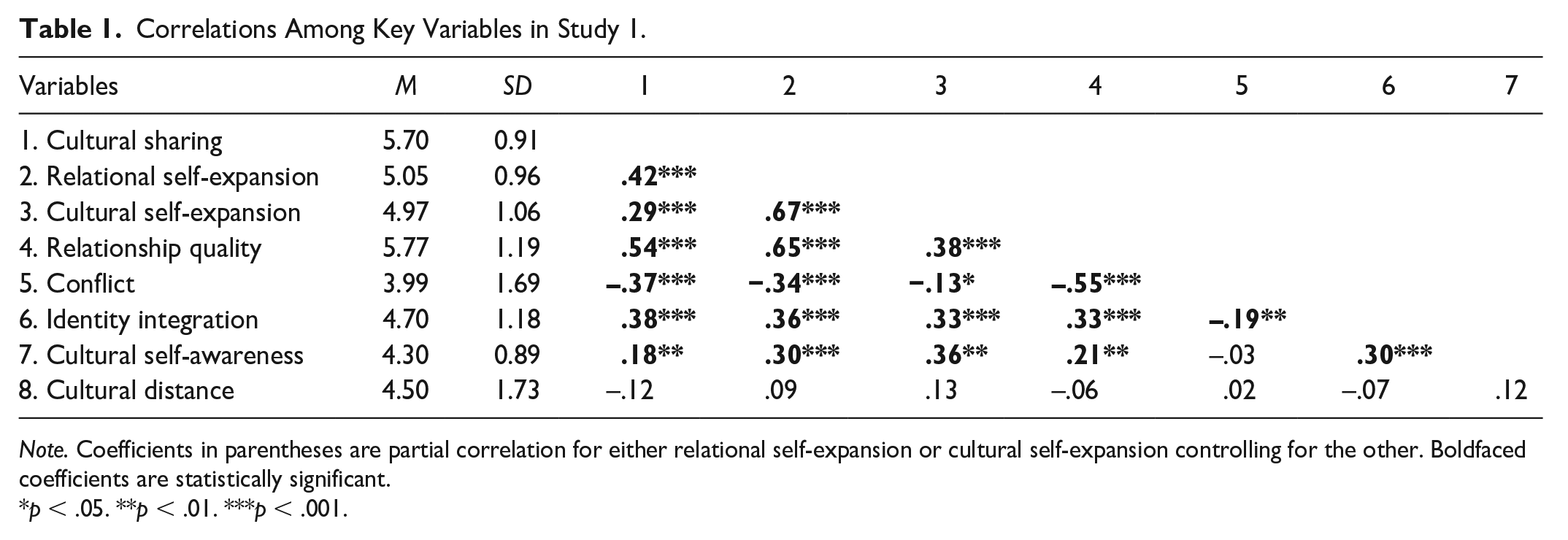
Note. Coefficients in parentheses are partial correlation for either relational self-expansion or cultural self-expansion controlling for the other. Boldfaced coefficients are statistically significant.
p < .05. **p < .01. ***p < .001.
Results and Discussion
Associations between self-expansion, relationship quality, and cultural identity
In line with our predictions, people who reported more relational self-expansion reported higher relationship quality, b = 0.88, SE = 0.08, t(234) = 10.64, p < .001, and less conflict, b = −0.83, SE = 0.14, t(234) = 5.77, p < .001, and people who reported more cultural self-expansion reported more conflict, b = 0.29, SE = 0.13, t(234) = 2.24, p = .026, and there were no associations with relationship quality. Both types of self-expansion uniquely predicted greater couple-cultural identity integration—relational: b = 0.30, SE = 0.10, t(234) = 3.02, p = .003; cultural: b = 0.19, SE = 0.09, t(234) = 2.08, p = .039. However, only cultural self-expansion, and not relational self-expansion, was uniquely associated with greater cultural self-awareness, b = 0.24, SE = 0.07, t(234) = 3.50, p = .001. Incremental validity testing using structural equation modeling produced consistent results showing the unique predictive value of cultural self-expansion over relational self-expansion on all outcomes (see pages 14–15 in the OSM).
Indirect associations
Next, we found that people who reported more culture sharing in their relationship reported higher relational self-expansion, b = 0.44, SE = 0.06, t(234) = 7.07, p < .001, and cultural self-expansion, b = 0.34, SE = 0.07, t(234) = 4.67, p < .001. In a parallel mediation model (Table 2), we found that greater cultural sharing via higher relational self-expansion predicted higher relationship quality and less conflict, whereas greater cultural sharing via higher cultural self-expansion predicted more conflict but also more cultural self-awareness and was not associated with relationship quality. The indirect effects on identity integration through relational and cultural self-expansion were not significant. However, cultural self-expansion as a mediator continued to predict greater integration after controlling for cultural sharing and relational self-expansion, p = .036, 95% CI = [.01, .36], passing a test of joint significance of the a and b paths (Leth-Steensen & Gallitto, 2016). Furthermore, when tested in a separate simple mediation model, cultural sharing via cultural self-expansion was significantly associated with greater couple-cultural identity integration, b = 0.37, SE = 0.07, 95% CI = [.03, .16]. Taken together, the inconsistent indirect associations with identity integration leave some ambiguity over the potential mediating role of cultural self-expansion. Therefore, we will test for evidence of mediation again in the next study and take the inconsistencies here into account in our interpretation of the results.
Total and Indirect Effects of Cultural Sharing on Key Outcomes Through Relational and Cultural Self-Expansion in Study 1.
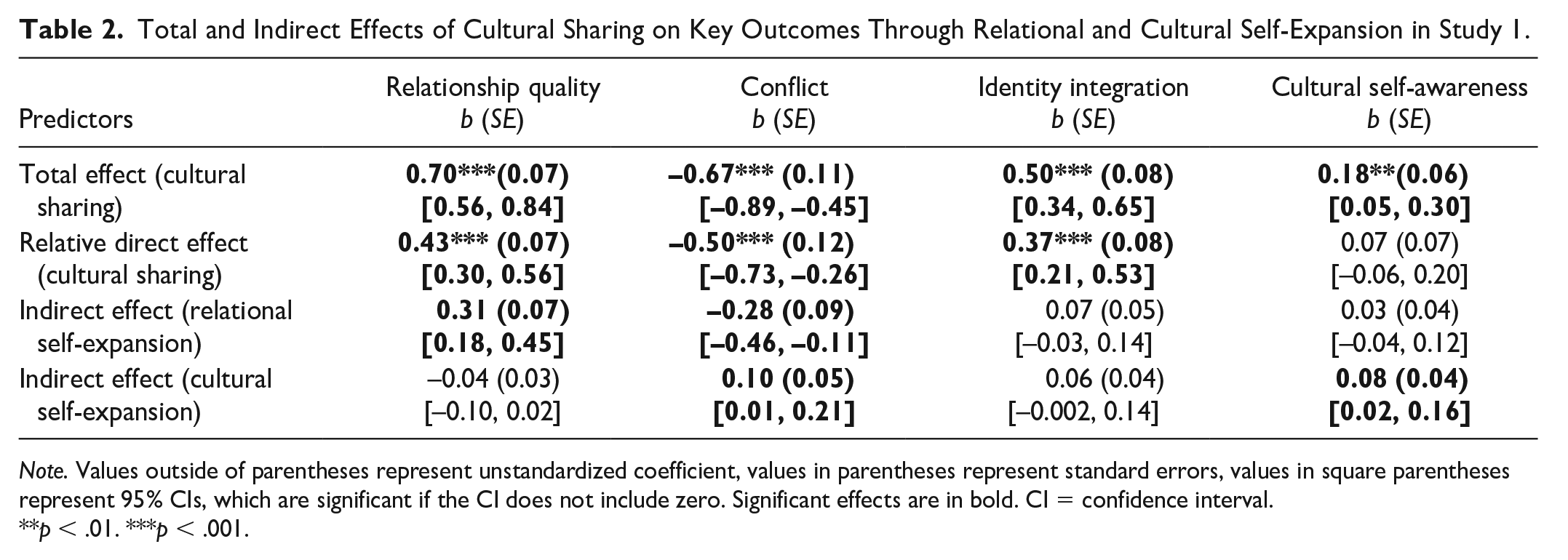
Note. Values outside of parentheses represent unstandardized coefficient, values in parentheses represent standard errors, values in square parentheses represent 95% CIs, which are significant if the CI does not include zero. Significant effects are in bold. CI = confidence interval.
p < .01. ***p < .001.
Overall, the direct and indirect test results suggest that while relational and cultural self-expansion overlap both conceptually and statistically (r = .67), they uniquely predict certain relationship quality and identity outcomes directly and as independent mediators of the cultural sharing predictor, with cultural self-expansion being uniquely associated with cultural self-awareness and integration.
Additional analyses
We ran a series of additional analyses to explore how cultural distance, relationship length, and race influenced the results. Given that we allowed participants to self-identify as being in an intercultural relationship, we wanted to test whether people perceived their culture as distinct from their partner’s culture and whether the degree of cultural distance was associated with our key variables. First, the mean level of cultural distance—how distinct participants view their own and their partner’s cultures—was just above the midpoint (M = 4.30, SD = 0.89), suggesting that on average participants viewed their culture as moderately distinct from the partner’s culture and there is variability across the sample. It is possible that people who perceive more cultural distance might report higher levels of self-expansion as they have more differences to draw on. However, cultural distance was not significantly associated with self-expansion or any of our other key variables (Table 1).
Self-expansion tends to be higher in the early stages of relationships (e.g., E.Aron & Aron, 1996); therefore, we tested whether any of the associations differed based on relationship duration. Several of the associations were moderated, and in most cases, the associations—between cultural sharing and both relational and cultural self-expansion, between relationship self-expansion and relationship quality, and between cultural self-expansion and cultural self-awareness—were strongest for people in newer (compared with more established) relationships. In two cases, the association between cultural self-expansion (controlling for relational self-expansion) and higher conflict (as well as a new link between cultural self-expansion and lower relationship quality) were only significant for people in longer relationships (see pages 16–17 in the OSM).
Considering the racial demographics of our sample and constraints around statistical power, we examined the potential moderating role of race by comparing White with Person of Color (POC) subsamples. Although People of Color are certainly not a monolithic group, we wanted to provide an initial test of whether a person’s race (White vs. POC) might influence the experience of cultural self-expansion on our outcomes of interest. In fact, after accounting for relational self-expansion, White participants reported a negative association between cultural self-expansion and relationship quality and it was only White participants who reported an association between cultural self-expansion and more conflict. Also, the associations between cultural sharing in the relationship and greater relational and cultural self-expansion were strongest for POCs but were also significant for White participants (see pages 18–19 in the OSM).
Study 2
In Study 2, we aimed to extend the findings from Study 1 to a sample that included both partners in intercultural relationships as cultural sharing is a dynamic, dyadic process that unfolds between partners and may affect each partner individually. For instance, if Partner A sees the relationship as a safe and receptive space to share their culture, Partner B may have more opportunities to self-expand culturally and generally. In turn, if Partner B does self-expand through Partner A’s cultural sharing, Partner A may feel better able to integrate their cultural and couple identities. In addition, prior work shows that one partner’s self-expansion is associated not only with their own relationship quality but also with their partner’s (Muise et al., 2019). Our goal was to test whether cultural sharing in the relationship was associated with both partners’ reports of self-expansion, and in turn, both partners’ relationship quality and cultural integration processes. As another step beyond Study 1, we followed up with both partners 4 to 6 months after the initial survey to test whether cultural sharing and self-expansion are associated with our key outcomes at a later time. As in the previous study, we tested whether any of the findings differ based on partners’ ethnicity or relationship duration.
Method
Participants
We recruited 166 intercultural couples on Prolific for a two-part survey. To ensure sufficient power for dyadic analyses (Kenny et al., 2006), we aimed to recruit at least 100 couples, but recruited as many eligible couples as possible. To be eligible, couples had to be in an intercultural relationship for at least 6 months as confirmed at the beginning of the first survey. Of the eligible couples, we excluded participants who failed more than one of the four attention checks (n = 10), did not provide post-debrief consent (n = 1), or had an excluded partner (n = 9). The final sample included 156 couples (N = 312 participants; 146 males, 159 females, seven other) who were 36 years old on average (SD = 9.13) and mostly married (93.3%) and living together (97.8%). On average, couples had been together for 9 (SD = 6.25) years. About half of the couples were also interracial (50%, 48% intraracial, 2% not reported). About 68.5% of participants identified as White, 8.5% as Latin American, 6.9% as East Asian, 4.6% as South Asian, 4.6% as bi/multicultural, 4.3% as Black, and 2.6% as a race/ethnicity not listed. Of the White participants, 43% were in interracial relationships, whereas 79% of POC participants were in interracial relationships.
Of the participants who completed the first survey, 57% completed a second survey (identical to the first) 4 to 6 months later (N = 177; 85 males, 89 females, three other). We compared participants who did versus did not participate in the follow-up survey on all of our key variables using a multivariate analysis of variance (MANOVA). Participants did not differ on any of the key variables, except for relationship satisfaction, p = .043—those who completed the follow-up survey reported higher relationship satisfaction at baseline.
Procedure
Participants’ eligibility was checked once automatically by Prolific and once in the beginning of the study. Members of the couple completed two separate surveys with identical measures. First, they provided their consent and then answered questions on relational and cultural self-expansion, identity integration, cultural inclusion, relationship satisfaction, and conflict. Finally, they answered demographic questions and were debriefed and asked for a post-debrief consent. Approximately 4 to 6 months later, all participants were invited to complete a second survey.
Measures
We used the same measures as in Study 1, but this time answered by both partners. See Table 3 for descriptive and reliability statistics.
Correlations Among Key Variables in Study 2.
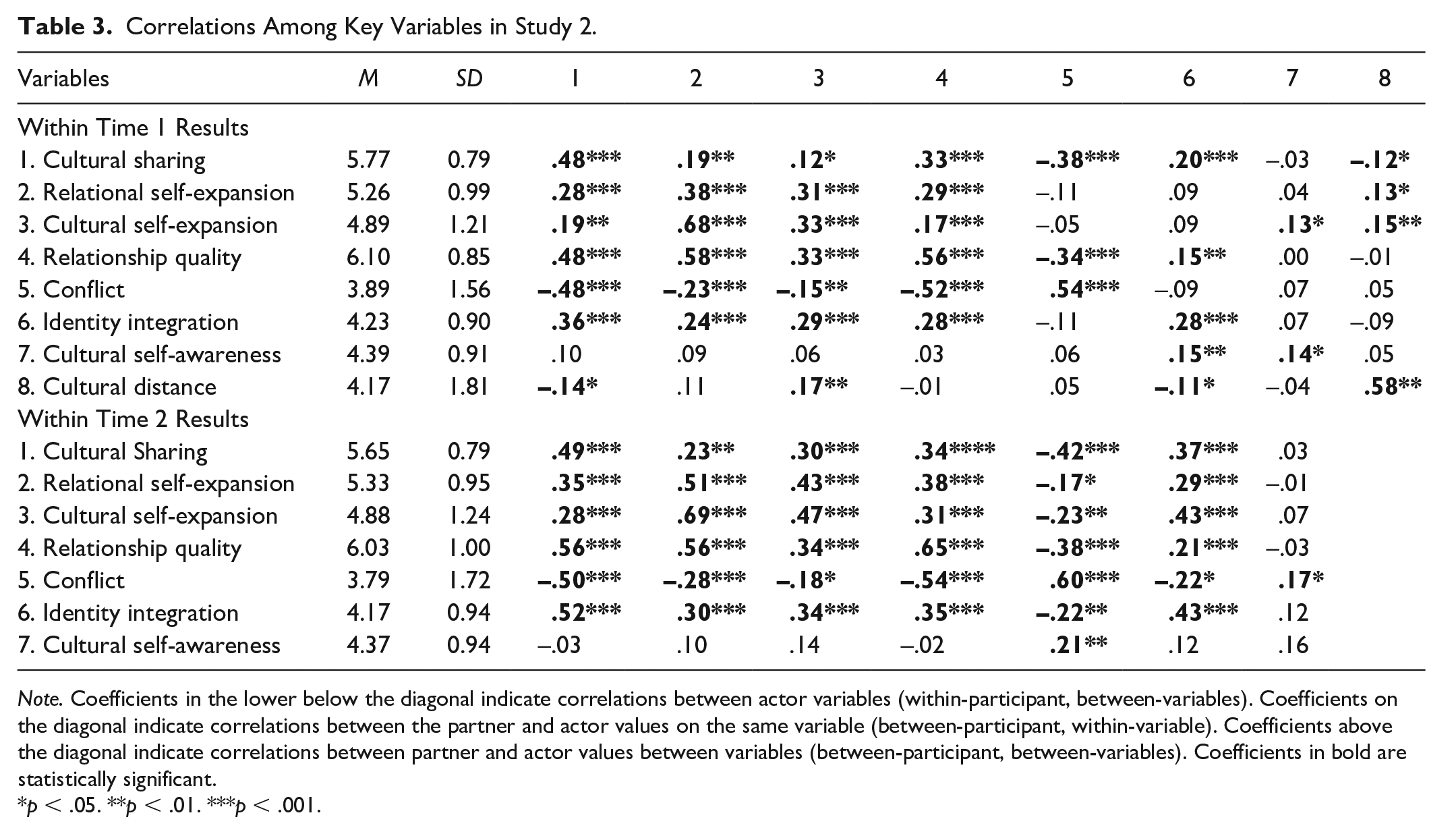
Note. Coefficients in the lower below the diagonal indicate correlations between actor variables (within-participant, between-variables). Coefficients on the diagonal indicate correlations between the partner and actor values on the same variable (between-participant, within-variable). Coefficients above the diagonal indicate correlations between partner and actor values between variables (between-participant, between-variables). Coefficients in bold are statistically significant.
p < .05. **p < .01. ***p < .001.
Data Analytic Approach
To account for the interdependence between partners, we used multilevel modeling with mixed models in SPSSv.27. We tested a two-level model in which participants were nested within dyads, guided by the Actor Partner Interdependence Model in which both partners’ scores were entered as simultaneous predictors (Kenny et al., 2006). Multilevel mediation analyses were conducted using the Monte Carlo Method for Assessing Mediation (Selig & Preacher, 2008) with 20,000 resamples. See Table 3 for correlations between all variables.
Results and Discussion
Baseline associations between self-expansion, relationship quality, and cultural identity
As in Study 1, participants who reported greater relational self-expansion also reported higher relationship quality and lower conflict, and their partners reported higher relationship quality as well, but no associations with cultural self-awareness or integration (Table 4). Participants who reported greater cultural self-expansion reported greater couple-cultural identity integration and their partners reported greater cultural self-awareness, but no associations with relational outcomes. That is, the more a person reported growing through their partner’s culture specifically (cultural self-expansion), the more they felt that their own cultural identity and couple identity were connected harmoniously, and the more their partner understood how their own culture shapes their life.
Associations Between Self-Expansion and Relationship Quality and Cultural Integration Processes in Study 2.
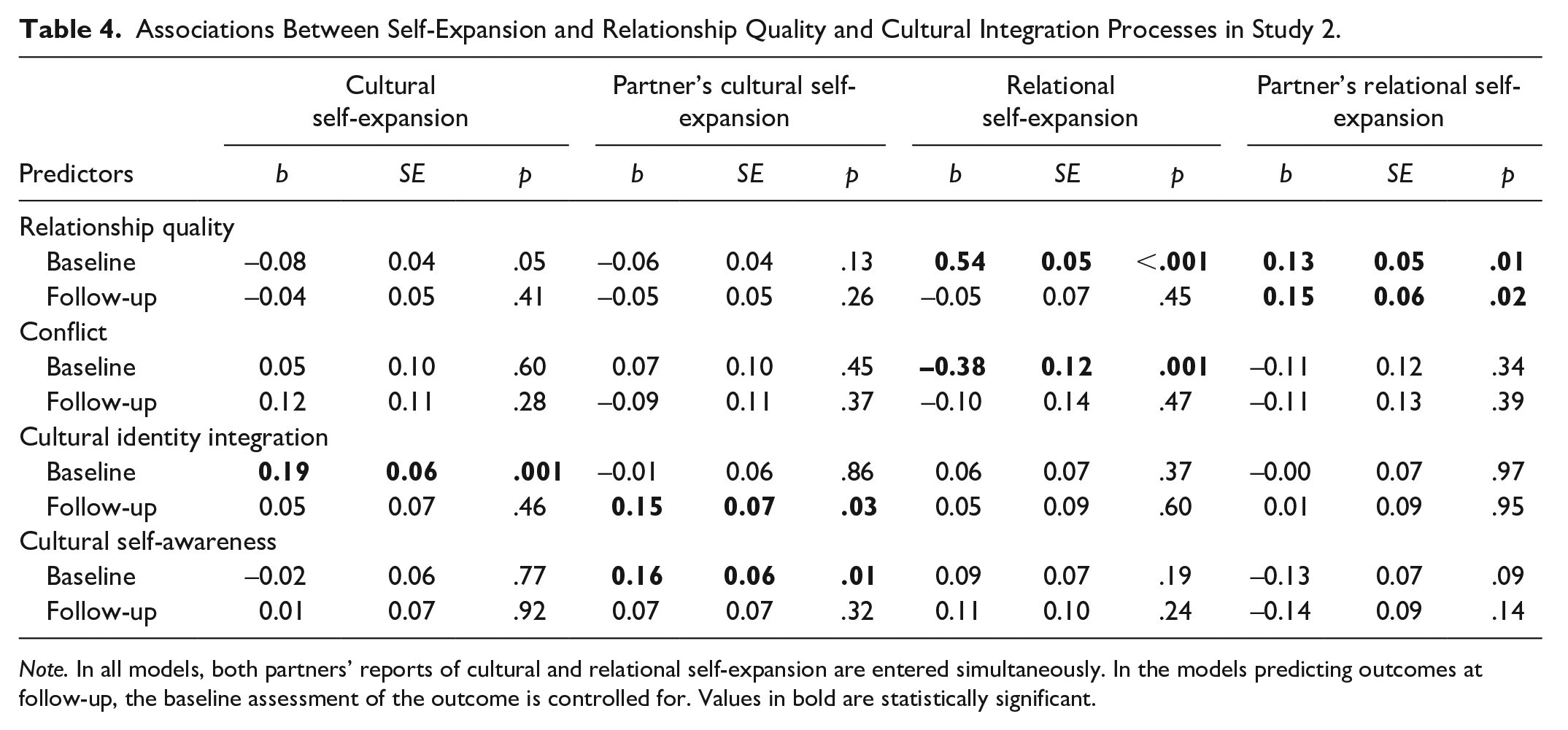
Note. In all models, both partners’ reports of cultural and relational self-expansion are entered simultaneously. In the models predicting outcomes at follow-up, the baseline assessment of the outcome is controlled for. Values in bold are statistically significant.
Baseline indirect associations
At baseline, consistent with effects in Study 1, cultural sharing in an intercultural relationship was positively associated with a person’s own report of both relational, b = 0.30, SE = 0.07, t(292.66) = 4.22, p < .001, and cultural self-expansion, b = 0.22, SE = 0.09, t(289.95) = 2.46, p = .01 (but was unrelated to their partner’s reports of relational or cultural self-expansion, ps > .20). That is, the more a person reported an open, positive exchange of cultures in their relationship, the more self-expansion (both relational and cultural) they reported. The indirect effects of cultural sharing via both relational self-expansion or cultural self-expansion (see Table 5 for parallel mediation results) support our predictions and reinforce findings from Study 1—relational and cultural self-expansion act as separate routes through which cultural sharing is differentially associated with general and cultural outcomes, respectively. That is, cultural sharing via relational self-expansion uniquely predicts a person’s own relationship quality, whereas cultural sharing via cultural self-expansion uniquely predicts a person’s own identity integration and their partner’s cultural self-awareness. But, in this study there were no associations of either cultural or relational self-expansion with conflict.
Indirect Effects of Cultural Sharing Through Cultural and Relational Self-Expansion on Both Partners’ Relationship Quality and Cultural Integration Processes in Study 2
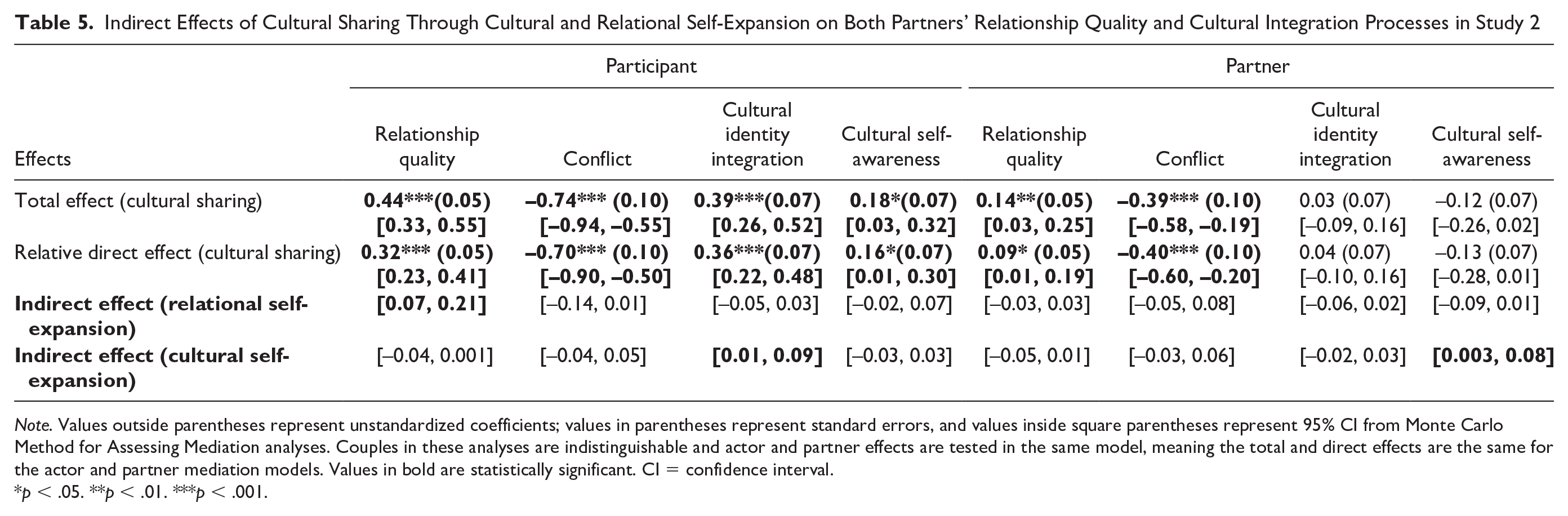
Note. Values outside parentheses represent unstandardized coefficients; values in parentheses represent standard errors, and values inside square parentheses represent 95% CI from Monte Carlo Method for Assessing Mediation analyses. Couples in these analyses are indistinguishable and actor and partner effects are tested in the same model, meaning the total and direct effects are the same for the actor and partner mediation models. Values in bold are statistically significant. CI = confidence interval.
p < .05. **p < .01. ***p < .001.
Self-expansion and outcomes over time
Next, we tested whether associations between relational and cultural self-expansion with relationship and identity outcomes persisted over time, controlling for baseline levels of these outcome variables (Table 4). Results showed a person’s reports of relational self-expansion at baseline were associated with their partner’s relationship quality at follow-up, but not their own outcomes, whereas a person’s cultural self-expansion at baseline was associated with their partner’s couple-cultural identity integration at follow-up, but not their own outcomes. Put another way, when a person reports more self-expansion in the relationship, their partner is more satisfied with the relationship over time. In addition, when a person self-expands more through their partner’s culture, their partner experiences greater integration of their cultural and couple identities over time. Therefore, one partner’s relational and cultural self-expansion is independently associated with the other partner’s relationship quality and identity integration—respectively—several months later.
Cultural sharing and outcomes via self-expansion over time
Cultural sharing at baseline was significantly associated with relational self-expansion at follow-up, b = 0.17, SE = 0.07, t(143.15) = 2.58, p = .01, but was not significantly associated with cultural self-expansion at follow-up, b = 0.07, SE = 0.09, t(145.48) = 0.80, p = .42—possibly due to a stronger baseline association between cultural sharing and cultural self-expansion that is accounted for in these models. After controlling for baseline cultural sharing reported by both partners, relational self-expansion reported at follow-up was associated with participants’ own relationship quality at follow-up, b = 0.19, SE = 0.08, t(125.36) = 2.33, p = .02, and there was a significant indirect effect of cultural sharing at baseline on relationship quality at follow-up through relational self-expansion, 95% CI = [.002, .08].
Despite the absence of a significant association between cultural sharing at baseline with cultural self-expansion at follow-up, cultural self-expansion reported at follow-up uniquely predicted partner identity integration, b = 0.27, SE = 0.08, t(127.19) = 3.57, p < .001, and partner’s reports of conflict, b = −0.36, SE = 0.11, t(127.09) = −3.21, p = .002, after controlling for baseline cultural sharing. There were no significant indirect effects of cultural sharing at baseline via cultural self-expansion at follow-up.
Additional analyses
As in Study 1, participants reported moderate cultural distance on average, with variability across the sample (M = 4.17, SD = 1.81). Cultural distance had a small, positive association with cultural self-expansion and small negative associations with cultural sharing and identity integration, suggesting that when partners view their cultures as more distinct, there might be slightly more opportunities for cultural self-expansion, but it may also be somewhat more challenging to share and integrate the cultures (Table 3).
We also tested whether any of the associations differed based on relationship duration, but unlike Study 1, only the association between cultural self-expansion and a partner’s cultural self-awareness was moderated, b = 0.002, SE = 0.001, t(282.18) = 2.30, p = .02. This association was significant for people in longer (+1SD), b = 0.30, SE = 0.09, t(283) = 3.27, p = .001, but not shorter (−1SD) relationships, b = −0.01, SE = 0.09, t(280.78) = −0.14, p = .89.
The associations between own and partner’s cultural self-expansion (controlling for relational self-expansion) and conflict were moderated by participant race, own: b = 0.37, SE = 0.18, t(241.18) = 2.10, p = .04; partner: b = −0.49, SE = 0.23, t(241.69) = −2.18, p = .03. As in Study 1, White participants’ cultural self-expansion predicted their own reported higher conflict, b = 0.24, SE = 0.12, t(201.35) = 2.00, p = .05, but this was not true of POC participants, b = −0.18, SE = 0.16, t(89.41) = −1.12, p = .27. Conversely, POC participants reported marginally higher conflict when their partner culturally self-expanded more, b = 0.42, SE = 0.24, t(81.11) = 1.70, p = .09, but White participants did not, b = −0.05, SE = 0.10, t(203.21) = −0.51, p = .61.
Study 3
The results of Studies 1 and 2 shed light on the associations between cultural sharing, self-expansion, and relationship and cultural identity outcomes as they naturally occur in intercultural relationships for both partners and overtime. Although the methods used had high ecological validity, they are limited in their ability to evidence causal relationships. Furthermore, our ability to statistically disentangle cultural self-expansion and relational self-expansion is limited by the strong correlation between the two types of self-expansion (r = .67). In Study 3, we overcome both problems using an experimental design that separates cultural and relational self-expansion methodologically and can provide causal evidence for our predicted associations.
Our main goal was to test the prediction that people assigned to a relational or cultural self-expansion condition would report higher relationship quality compared with people in the control condition and people in the cultural self-expansion condition would report higher cultural identity integration and self-awareness. Given the findings from our previous two studies demonstrating that relational self-expansion is most consistently associated with relational outcomes, and cultural self-expansion with cultural outcomes, it is possible that there could be differences between our two experimental conditions. In this study, our experimental manipulation aimed to encourage couples to engage in cultural sharing (which should induce cultural self-expansion as per our previous studies) compared with engaging in novel activities (which induces relational self-expansion, Muise et al., 2019) or a control condition. We expect that when tested this way, both conditions could enhance relationship quality, but that cultural outcomes might only be enhanced in the cultural self-expansion condition and not the relational self-expansion condition. In addition, we explored whether baseline cultural sharing may moderate the effects of self-expansion on our key outcomes, preregistering an exploratory prediction that people who reported more cultural sharing in their relationship premanipulation would report greater benefits of self-expansion than people who reported less cultural sharing. The study was preregistered: https://osf.io/ycqts.
Method
Participants
We recruited 468 participants from Prolific for a two-part study. Our target sample of 150 per condition was based on an 80% power, α = .05 power analysis with a medium effect size, as preregistered. 1 Inclusion criteria were being in a cohabiting intercultural romantic relationship and currently living in Canada, the United States, or the United Kingdom. Participants were compensated £3.51/$4.81 for both surveys. We excluded participants who did not complete the second survey (n = 71) or were deemed intracultural based on open-ended items (n = 3); did not consent post-debrief (n = 2); reported a COVID-19 diagnosis that may have prevented completing the instructed activities (n = 2); and failed to follow the condition instructions (n = 48). The final sample (N = 342; 193 females, 147 males, two other) were on average 28 (SD = 6.58) years old, mostly unmarried (64.6%; 21.3% married; 13.7% engaged), and had been with their partner for an average of 2.55 (SD = 1.25) years. Of the intercultural couples represented, 72% were also interracial (28% intraracial). 59.6% identified as White, 13.5% as East Asian, 10.5% as bi/multicultural, 6.4% as Latin American, 5.3% as Black, 4.4% as South Asian, and 0.3% as a race/ethnicity not listed. Of the White participants, 59% were in interracial relationships, whereas 92% of POC participants were in interracial relationships.
Procedure and manipulation
The initial surveys were sent on Friday and started with eligibility items masked by nonrelevant items. Eligible participants immediately began the study that would continue over the weekend. After providing consent, participants completed baseline measures prior to the manipulation. Following, they were randomly assigned to one of the three conditions: relational self-expansion, cultural self-expansion, or control.
Adapted from an existing manipulation (Muise et al., 2019), in the relational self-expansion condition, participants read a fabricated article ostensibly from the University of Toronto Magazine, which described the benefits of self-expansion in cohabiting relationships. They were then instructed to participate in novel experiences with their partner over the weekend. In the cultural self-expansion condition, participants read a comparable article about the benefits of self-expansion in intercultural relationships and were instructed to pursue novel experiences involving their own and their partners’ cultures over the weekend (see pages 20–21 in the OSM). Participants in the control condition received no article and were instructed to participate in typical activities with their partner. All participants were told to expect the second survey on Monday, roughly 72 hr later.
The second survey started with an attention/compliance check asking participants to reiterate the instructions they were given and to list activities they had engaged in over the weekend. Examples of the activities listed included playing a new board game, taking a knitting class, learning how to paint (relational self-expansion condition), cooking a traditional food from a partner’s culture, watching a film that represented their culture, learning a new language (cultural self-expansion condition);, ordering dinner, going grocery shopping, and watching a movie (control condition). All participants continued to answer questions about their current feelings of relationship quality, conflict, identity integration, and cultural self-awareness. Demographic information regarding cultural backgrounds of participants and their partners were collected postmanipulation. Finally, the participants were debriefed in full about the fabricated article and the purpose of the research and asked for their postdebrief consent.
Measures
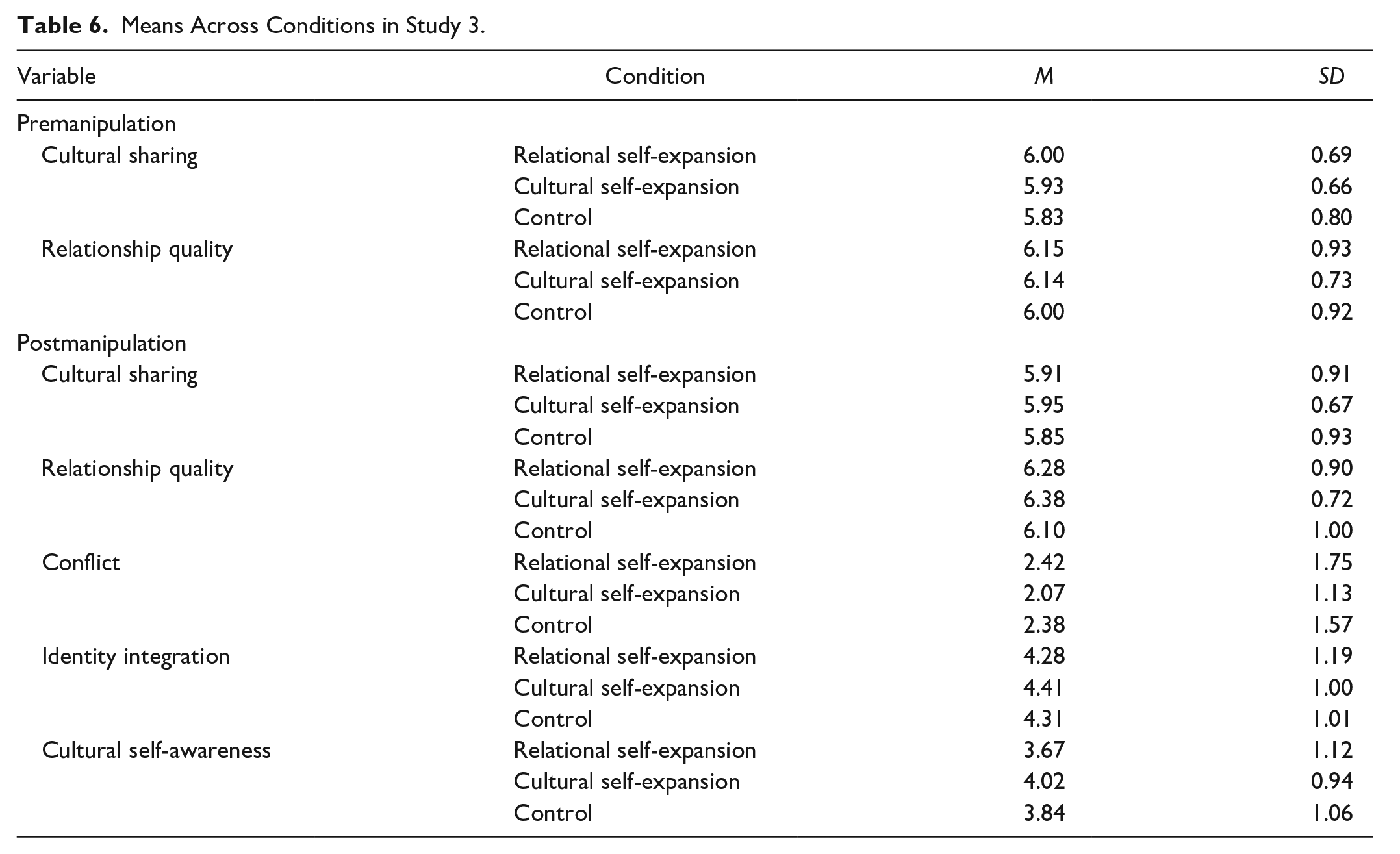
Prior to the manipulation, we assessed cultural sharing and relationship quality using the full measures from the prior studies. After the weekend, truncated versions of the previous studies’ measures were collected (see pages 21–25 in the OSM). As a manipulation check, we assessed relational self-expansion and cultural self-expansion using two face-valid items from the previous measures. Postmanipulation, we also assessed relationship quality using six items and conflict using three items from the previous measures. Couple-cultural identity integration and cultural self-awareness were also assessed pos-manipulation, each with four items from the previous measures. See Table 6 for descriptive and reliability statistics.
Means Across Conditions in Study 3.
Results and Discussion
Manipulation check
First, we tested whether those assigned to the relational and cultural self-expansion conditions reported having more self-expanding experiences over the weekend than those in the control condition. ANOVA results revealed significant differences in relational self-expansion over the weekend, F(2, 339) = 37.99, p < .001, ƞp2 = .18. As intended, participants in the relational self-expansion condition (M = 5.22, SD = 1.39), p < .001, and in the cultural self-expansion condition (M = 5.05, SD = 1.40) reported higher relational self-expansion than those in the control condition (M = 3.66, SD = 1.72), p < .001, and no significant differences between the two experimental conditions, p = .42. There were also differences across conditions in cultural self-expansion over the weekend, F(2,339) = 51.79, p < .001, ƞp2 = .23. As intended, those in the cultural self-expansion condition (M = 5.07, SD = 1.41) reported more culture-specific self-expanding experiences than those in the relational self-expansion condition (M = 3.43, SD = 1.80), p < .001, and in control condition (M = 2.80, SD = 1.81), p < .001. People in the relational self-expansion condition reported higher cultural self-expansion than in the control condition, p = .004.
Main effects of condition
ANOVA results showed that the overall effects of condition were significant for relationship quality, F(2,339) = 2.99, p = .05, ƞp2 = .02, and cultural self-awareness, F(2,339) = 3.11, p = .05, ƞp2 = .02, but not for conflict, F(2,339) = 1.67, p = .19, ƞp2 = .01, or identity integration, F(2,339) = 0.433, p = .65, ƞp2 = .003. More specifically, pairwise comparisons (LSD) showed that participants in the cultural self-expansion condition reported higher relationship quality compared with those in the control condition, p = 0.02, but not compared with those in the relational self-expansion condition, p = .13. Unexpectedly, there were no differences between the relational self-expansion and control groups in relationship quality, p = .27, and people reported the highest relationship satisfaction in the cultural self-expansion condition. In addition, participants in the cultural self-expansion condition also reported greater cultural self-awareness compared with those in the relational self-expansion condition, p = .02, but not compared with the control condition, p = .19. The positive effects of cultural self-expansion on postmanipulation relationship quality and cultural self-awareness remained significant after controlling for baseline levels of these outcomes.
Moderation by baseline cultural sharing
We also tested whether cultural sharing in the relationship facilitated stronger associations between self-expansion and our outcomes of interest. Although we expected that higher levels of cultural sharing at baseline would facilitate stronger effects of the two self-expansion conditions, particularly the cultural self-expansion condition, we did not find this, and in one instance found the opposite effect. For relationship quality, the effects of cultural self-expansion differed by baseline levels of cultural sharing such that participants who began the study with less experience sharing their cultures (−1SD) reaped the most benefits from cultural self-expansion. Although the interaction between cultural self-expansion (vs. control) and baseline cultural sharing was not significant, p = .20, the effect of condition (cultural self-expansion compared with control) on relationship quality was significant for participants who began the study with low levels of cultural sharing (−1SD), b = 0.38, p = .01, or mean levels of cultural sharing, b = 0.23, p = .03, but not for those who already had high levels of cultural sharing at baseline (+1SD), b = 0.09, p = .57. Therefore, instructions to engage in cultural self-expansion might actually be more beneficial for the relationship quality of people who are not already engaging in high levels of cultural sharing. Replicating the prior studies’ results, however, baseline cultural sharing predicted higher relationship quality, b = 0.50, p < .001; lower conflict, b = −0.57, p < .001; and greater identity integration, b = 0.51, p < .001, over the weekend after controlling for condition (but did not predict cultural self-awareness, b = −0.18, p = .12). In this study, the effects of self-expansion did not differ by participant race or relationship duration.
General Discussion
In the current set of studies, we focused on intercultural relationships as opportunities for growth by testing the associations between relational and cultural self-expansion and relationship quality, as well as how self-expansion, specifically related to cultural differences, might facilitate cultural identity processes, and how cultural sharing in relationships might catalyze these experiences. In initial cross-sectional investigation, we demonstrated that cultural self-expansion is distinct from relational self-expansion psychometrically and in uniquely predicting key outcomes of interest. Our results replicated past research demonstrating that relational self-expansion is associated with higher relationship satisfaction and lower conflict (e.g., A.Aron et al., 2000; Muise et al., 2019), but extended these findings to intercultural couples. In our first two studies, people in intercultural relationships who reported higher relational self-expansion reported higher relationship quality and lower conflict, and in Study 2, this extended to a partner’s relationship quality and persisted over time. Extending past research, in Studies 1 and 2, cultural sharing in the relationship was associated with greater relational and cultural self-expansion, and in turn, relational self-expansion was associated with relationship quality, and cultural self-expansion was uniquely associated with partners better integrating their couple and cultural identities and reporting greater cultural self-awareness. In Study 2, cultural self-expansion as reported by one partner was associated with the other partner reporting greater cultural self-awareness and integration of their couple and cultural identities, providing evidence for the dyadic nature of these relationship processes. Finally, Study 3 demonstrated that instructing couples to engage in cultural self-expansion can boost cultural self-awareness beyond relational self-expansion and can boost relationship quality as much as relational self-expansion. The benefits to relationship quality were strongest for people who did not already have high levels of cultural sharing in their relationship, suggesting that cultural sharing may naturally facilitate self-expansion processes.
Extending Self-Expansion Theory to Intercultural Relationships
The current findings are consistent with a large and growing body of research demonstrating the benefits of self-expansion for relationship quality (e.g., Harasymchuk et al., 2021; Muise et al., 2019). However, the current set of studies go beyond previous research to unveil new dynamics of intercultural relationships specifically and, for the first time, provide evidence for the benefits of cultural self-expansion as a unique process, separate from relational self-expansion. It is possible then that certain relationship processes have different mechanisms in intercultural relationships. Past work has illustrated that having a strong cultural identity predicts greater relationship quality (e.g., Brooks et al., 2021; Leslie & Letiecq, 2004) and the current work captures the processes by which people integrate and become aware of their cultural identities in a relationship (see also Yampolsky et al., 2020).
One key extension of the current set of studies is that we aimed to assess self-expansion specifically related to cultural differences or novel cultural experiences (i.e., cultural self-expansion), which we demonstrate is distinct from relational self-expansion in general. Previous research has shown that people higher in self-expansion are more interested in interacting with and have more positive experiences with people from different cultural backgrounds (Dys-Steenbergen et al., 2016; Paolini et al., 2016), but no work had specifically investigated self-expansion related to these cultural differences. In Studies 1 and 2, although statistically distinct, cultural self-expansion and relational self-expansion were highly correlated. To circumvent the overlap between cultural and relational self-expansion as self-reported measures, in Study 3, we were able to distinguish cultural from relational self-expansion through experimental design. When people were instructed to participate in novel activities involving culture over a weekend, they reported higher relationship quality compared with those in a control condition (and to a similar degree as those in a relational self-expansion condition) and reported greater cultural self-awareness compared with a relational self-expansion condition. The latter finding supports the idea that multicultural experiences act as a two-way mirror that not only lets us see into other cultures but also enhances our ability to see our own cultures. That is, novel activities involving partners’ cultures have crucial functions for the quality of intercultural relationships, as well as partners’ awareness of their cultures.
Although self-expansion is a dyadic process in relationships, few studies have looked at how one partner’s feelings of self-expansion influence the other partner’s relationship quality (for exceptions, see Muise et al., 2019; Raposo et al., 2020) and no studies have investigated these processes in intercultural couples. In Study 2, we included both members of couples and examined dyadic associations between relational and cultural self-expansion and relationship quality and cultural identity outcomes. At baseline, a person’s relational self-expansion was associated with their own and their partner’s relationship quality, whereas a person’s cultural self-expansion was associated with their partner’s identity integration and these associations persisted over time. Taken together, these results provide evidence for the dyadic nature of self-expansion and its role in the maintenance of intercultural relationships.
Cultural Sharing as a Catalyst of Self-Expansion
Research on the ways intercultural couples approach their cultural differences is still lacking and the majority has been qualitative, derived from clinical settings in which couples may already be struggling (e.g., Killian, 2013). Such work, however, has shed light on the different styles couples may use to navigate their cultural differences, styles that broadly fall into culture-avoiding versus culture-approaching styles. Previous qualitative findings suggest that the couples who fair best are those who tackle their cultural differences head-on and make space in the relationship for both partners’ cultures, and that it is especially problematic when intercultural couples avoid talking about their cultural differences or prioritize one partner’s culture over the other (Seshadri & Knudson-Martin, 2013). Our work provides some of the first quantitative evidence of the benefits of cultural sharing for intercultural couples, both at individual and interpersonal levels. Although discussing cultural differences in a relationship can be challenging, these discussions can allow couples to negotiate differences and capitalize on opportunities for growth. Thus, cultural sharing is a behavior that intercultural couples can engage in that leads to the cognitive and emotional experiences of both relational and cultural self-expansion. In turn, these two types of self-expansion act as unique novel mechanisms through which cultural sharing can be beneficial, helping to answer the question of why cultural sharing can have a net positive effect on intercultural relationships despite some initial conflict that may occur.
In other research on bicultural people’s experiences, we have posited and documented ways in which actively negotiating multiple cultures can transform a person cognitively and socially (West et al., 2017). Similarly, here we show how cultural sharing in an intercultural relationship—where partners must learn to negotiate multiple cultures externally between themselves as well as internally at an identity level—is an active, dynamic experience that each partner contributes to and can have interpersonal and intrapersonal outcomes. We found strong correlations between cultural sharing and both forms of self-expansion in Studies 1 and 2. We also found in Study 3 that couples who were already sharing their cultures did not reap additional benefits of induced self-expansion, in contrast to those who did not have a high level of cultural sharing in the relationship. Together, this suggests that cultural sharing may indeed prompt cultural and relational self-expansion processes for intercultural partners in their daily lives, which in turn is associated with relationship quality (i.e., relationship quality, conflict) and the ways each partner understands themselves (i.e., identity integration, cultural self-awareness).
Although these studies highlight potential positive effects of cultural sharing within intercultural relationships, an important but contentious issue arises when considering the distinction between cultural sharing and cultural appropriation. Many of the same cultural sharing behaviors—wearing a partner’s culture’s traditional garments, or participating in their sacred rituals, for instance—could be seen as acts of cultural appropriation depending on the relative power each partner’s cultural group holds in society, presently and historically (Kunst et al., 2021; Mosley & Biernat, 2021). A major concern with cultural appropriation is that a majority member individual is taking away and deriving benefits from a minority group’s cultural products, particularly when such cultural products have been a source of discrimination or have been suffered for by the minority group and when the majority individual is seen as only engaging with the minority culture superficially (e.g., aesthetic appeal) versus more deeply (e.g., taking time to understand the origin and significance; Rogers, 2006). While there is currently much debate among researchers and laypeople alike around what is considered to be cultural appropriation or not, and more work on this topic is needed, an implication of the debate may be that cultural sharing can have negative effects for intercultural couples if either partner or others outside of the relationship perceive a partner’s cultural-sharing behaviors to be appropriative. Future research looking at perceptions of cultural appropriation in intercultural relationships promises to shed light on the nuances of cultural sharing, self-expansion, and their outcomes among different pairings of partners (e.g., majority–minority, minority–minority) and in different societal contexts (e.g., the United States, postcolonial India).
Racial Differences in the Experience of Cultural Self-Expansion
Throughout these studies, we explored potential differences for partners based on their race. Although we intentionally adopted an inclusive definition of “intercultural relationship” to capture a more diverse sample than has been typically studied in the past, the majority of the couples we recruited included at least one White partner who was usually a member of the majority culture and identified only with that culture. One can imagine that being exposed to another culture through a romantic partner might involve different levels of novelty, excitement, and comfort depending on whether you are a White monocultural with little prior experience of negotiating a second culture versus you are an ethnic minority bicultural with prior experience negotiating multiple cultures. Interestingly, in both Studies 1 and 2 we found that through cultural self-expansion, cultural sharing was associated with more conflict in the relationship, but only for White partners. Despite the many documented benefits of multicultural experiences, being introduced to another culture’s worldviews can be a threatening experience (Bratter & King, 2008; Tadmor et al., 2009). It may be a natural reaction for monoculturals, particularly those from Western cultures, to see these cultures as conflicting and competing rather than feeling that the two can simultaneously exist without needing there to be a victor (Tadmor et al., 2009). Monoculturals, compared with biculturals, may be more likely to demonstrate “naïve realism,” a bias toward seeing one’s own views as objectively reflecting reality, whereas others’ (particularly those with different views) are thought to be more subjective and skewed (Liberman et al., 2012). Having one’s monolithic views challenged and attempting to accommodate alternatives is not an easy experience, akin to the process of acculturation for people who move abroad and to processes of identity development for biculturals—both of which involve a progression from initial separation of the two cultures to, most beneficially, integration of the two cultures instead (Amiot et al., 2007; Berry et al., 2006).
Limitations and Future Directions
Despite the strengths of the current set of studies, including the use of multiple methods and the focus on an underresearched population, there are several limitations. First, the majority of our participants were in established long-term relationships and were mostly married (Studies 1 and 2). Although in Study 3 we recruited people who were in newer relationships and mostly unmarried, participants had to live with their partner to follow our manipulation instructions due to the COVID-19 pandemic; therefore, they were all cohabitating couples. People in established intercultural relationships have had a long time to negotiate their cultural differences and may have largely had a supportive environment for discussing their cultural differences. In future research, recruiting intercultural couples in the earlier stages of their relationship when they are first negotiating these differences and following them over time could provide additional insights into these processes and how they are associated with relationship quality and identity development.
Second, although all participants in our studies had different cultural backgrounds from their partners, significant portions of these couples were intraracial—about half of Study 1 and 2 samples and a third of Study 3 sample—with White participants significantly more likely than POC participants to have a same-race intercultural partner. Thus, the samples we obtained may not be ideal for assessing certain potential moderators as participant–race effects and intra- versus interracial couple effects could be conflated. This also had implications for our ability to explore the role of cultural distance as perceptions of cultural differences are likely influenced by participants’ and couples’ races. Acculturation research shows that the larger the cultural distance, the more difficulties people face adapting to a new culture (Demes & Geeraert, 2014). Individuals in intercultural relationships may also face more difficulties when their partner’s culture is more dissimilar to their own. Self-expansion theory suggests that greater differences also offer the greatest opportunities for self-expansion, but research shows that perceived global similarity with an interaction partner facilitates self-expansion (Sprecher et al., 2015), suggesting that there may be an optimal balance of similarities and differences between partners. Learning the steps to this “dance of similarities and differences” may be a pivotal process for intercultural partners as a dyad, not unlike biculturals learning to integrate their cultures as individuals (West et al., 2017). Although participants in the current studies perceived a moderate difference between their cultures and their partners’ cultures and we did not find a strong association between perceived cultural distance and self-expansion, future studies should aim to recruit more diverse samples and investigate the direct and moderating effects of cultural distance in the processes we have captured here.
An important future direction will be to understand the couple- and individual-level factors that facilitate cultural sharing and cultural self-expansion in intercultural relationships. At the level of couple composition, it may well be that different pairings of intercultural partners may present more opportunities to self-expand than others—for instance, we might anticipate that a pairing between two monocultural partners (e.g., a White Euro-American partner with a newly immigrated Filipino partner) might have less in common and more to learn from each other’s cultures initially when compared with a pairing where one partner is a monocultural majority member and the other is a bicultural minority member (e.g., already familiar with the majority culture). We encourage efforts by the field to recruit increasingly heterogeneous samples to better understand the role of self-expansion in a greater variety of demographically paired couples. At the level of individual differences, research on racial worldviews suggests that people who endorse multicultural (i.e., acknowledging cultural differences while viewing cultures as distinct and central to people’s identities) or polycultural worldviews (i.e., acknowledging cultural differences while encouraging dialogue and exchange between cultures) acknowledge and discuss cultural differences more aptly, compared with people who hold a color-blind racial worldview (i.e., viewing culture and ethnicity as skin deep and best ignored; Rosenthal & Levy, 2010). It is likely that being able to acknowledge cultural differences is necessary for cultural sharing to be beneficial and to effectively elicit cultural self-expansion. Also, there is more work to do to better understand when and how cultural self-expansion is associated with positive processes in relationships. Although, in general, self-expansion can occur in different ways (Tomlinson et al., 2019)—conversations, participation in adventure sports, learning a new skill—for cultural self-expansion, there may be differences between passive discussions of cultural differences and active engagement in a partner’s cultural practices.
Conclusion
The current research expands our understanding of the dynamics of intercultural relationships. Although intercultural couples face unique challenges in negotiating their cultural differences, the current set of studies shows that intercultural relationships also provide unique opportunities for growth. Cultural sharing between intercultural partners can provide novel, self-expanding experiences, including opportunities to grow together and as individuals through cultural differences. Intercultural romantic relationships, not unlike deep multicultural experiences or being bicultural, have the potential to foster personal growth. Much more than simply learning about a new culture, these relationships can increase people’s awareness of their own culture and its influence on their identities and experiences. At their best, intercultural romantic relationships can give a person fresh eyes through which to see the world—more complexly, more flexibly and, hopefully, more compassionately.
Footnotes
Declaration of Conflicting Interests
The author(s) declared no potential conflicts of interest with respect to the research, authorship, and/or publication of this article.
Funding
The author(s) received no financial support for the research, authorship, and/or publication of this article.

Notes
References
Supplementary Material
Please find the following supplemental material available below.
For Open Access articles published under a Creative Commons License, all supplemental material carries the same license as the article it is associated with.
For non-Open Access articles published, all supplemental material carries a non-exclusive license, and permission requests for re-use of supplemental material or any part of supplemental material shall be sent directly to the copyright owner as specified in the copyright notice associated with the article.
