







Abstract
More than 5,000 Native American and Alaska Native women and girls go missing annually in the United States, and murder is the third leading cause of death for those aged 10 to 24. The current studies assess why, despite such statistics, individuals who are not Native American fail to advocate for Missing and Murdered Indigenous Women and Girls (MMIWG). The Pilot Study (N = 205) and Study 1 (N = 3,992) revealed that greater cognitive invisibility of contemporary Native Peoples (i.e., the absence of cognitive representations) was related to greater minimization of Native Peoples’ experiences with racism. Racism minimization was associated with greater blaming of MMIWG victims and less blaming of societal contributors to the epidemic. These factors predicted greater apathy toward MMIWG and less MMIWG advocacy. The results suggest that the cognitive invisibility of Native Peoples affords attitudes and beliefs that allow non-Native individuals to deny, justify, and distance themselves from the MMIWG epidemic.
Keywords
In 2022, the U. S.’ National Crime Information Center reported 5,491 cases of missing Native women and girls (National Crime Information Center, 2022). 1 This equates to roughly 15 Native women and girls going missing every day in this country. The high rates of missing Native women and girls are coupled with the fact that murder is the third leading cause of death among those aged 10 to 24, and in some states, Native women and girls are murdered at more than ten times the national average (Lucchesi & Echo-Hawk, 2018). Violence against Native women and girls is not new. From the time the first settlers stepped foot on this continent, the murder of Native women and girls has been used as a tool to eliminate Native Peoples and dispossess Native land (Deer, 2015). For example, during the “Reign of Terror” in the 1920s, White men targeted Osage women for marriage and to become government-appointed guardians of their wive’s estates. These men would then plot to murder their wives to inherit their wealth. The Reign of Terror killings destroyed bloodlines among the Osage people, and placed their wealth and resources in the hands of White families that continue to benefit from these tragedies without acknowledgment or consequence (Schilling, 2023).
Historically, and into the present day, Native communities have fought to protect their women and girls from such violence. Today, for example, Native grassroots organizers across the United States are leading campaigns to push back against violence inflicted upon their women and girls. They created the hashtag #MMIWG to bring visibility to and mobilize advocacy efforts for the Missing and Murdered Indigenous Women Girls epidemic (Blaze Baum, 2016), prompting the creation of a Missing and Murdered unit to investigate MMIWG cases (U.S. Department of the Interior, 2021). Family members also use the hashtag to bring awareness to their missing or murdered loved ones and share information about police response to their case.
Despite efforts to increase the visibility of MMIWG, responses from federal authorities, mass media, and the wider American public have been virtually nonexistent. For example, of the thousands of Native women and girls that go missing annually, only 2% of the cases were reported in the National Missing Persons database and less than 5% were covered by national or international media (Lucchesi & Echo-Hawk, 2018). Given that there is little to no national media coverage of MMIWG cases, in the current studies, we included items to assess participant’s familiarity with the epidemic. Across two independent surveys of White Americans, we found that 65% of participants reported that they had never heard about or were not familiar with the MMIWG epidemic, and only 3% reported knowing a substantial amount about the epidemic (see OSF supplement MMIWG Familiarity). In addition, the lack of systemic intervention is so severe that community organizers express that MMIWG “disappear not once, but three times—in life, in the media and in the data” (Lucchesi & Echo-Hawk, 2018). In other words, the lack of attention and national recognition of the MMIWG epidemic suggests that society does not care about what happens to Native women and that, outside of Native communities, Americans are unaware, indifferent, and/or apathetic to the epidemic.
In the current article, we investigate why non-Natives fail to address the MMIWG epidemic. We theorize that the lack of cognitive representations (e.g., ideas, beliefs, images, and schemas) of contemporary Native Peoples, what will be referred to as the cognitive invisibility of Native Peoples, hinders advocacy on behalf of MMIWG. We also explore mechanisms underlying the relationship between cognitive invisibility and advocacy efforts. We propose that greater cognitive invisibility of Native Peoples promotes greater minimization of contemporary forms of racism that Native Peoples face. In turn, we argue that greater racism minimization increases blame placed on MMIWG victims and decreases blame placed on societal contributors (i.e., social systems, policies, practices, and persons) to the MMIWG epidemic. Finally, we anticipate that blaming MMIWG victims and failing to blame societal contributors increases apathy toward the MMIWG epidemic and, ultimately, reduces advocacy intentions (see Figure 1 for the theoretical tested model).
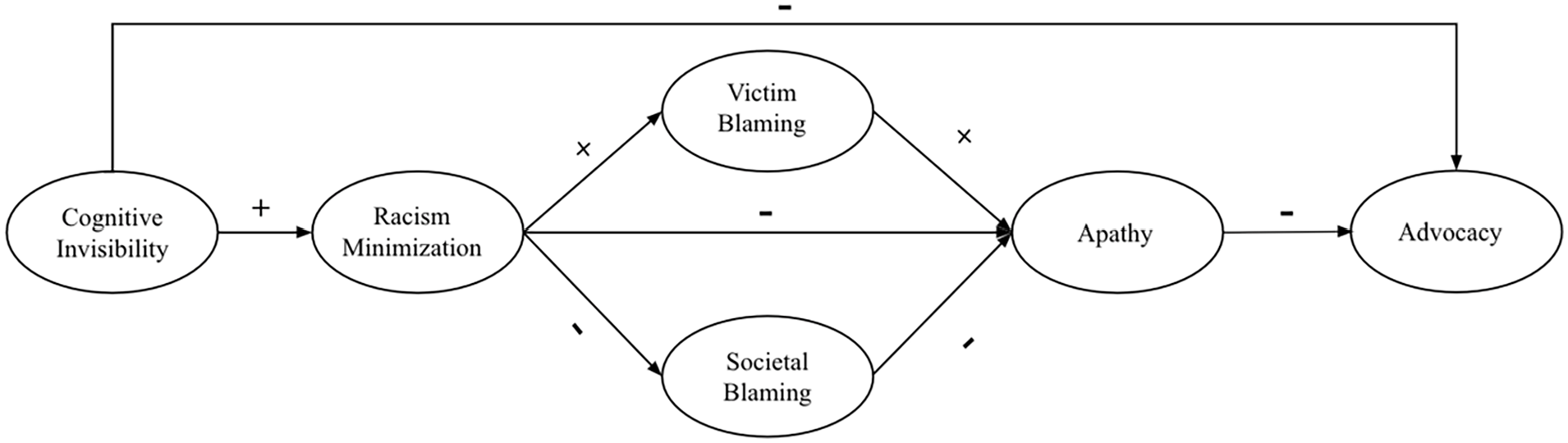
Theoretical Tested Model.
Cognitive Invisibility and Consequences for MMIWG Advocacy
Garnering support for Native issues like MMIWG is difficult when most Americans are not aware of Native Peoples’ existence, let alone their lived experiences and struggles with contemporary injustices. Across two studies, more than 62% of Americans report that they do not personally know a Native person (Reclaiming Native Truths, 2018). Given the lack of contact with Natives, non-Natives’ ideas and beliefs about the group are primarily informed by the dominant culture, which is problematic because there are little to no representations of contemporary Native Peoples in many domains of society. Less than 1% (sometimes less than 0.1%) of characters in television, films, books, and video games are Native (Cooperative Children’s Book Center, 2020; Mastro, 2017; Nielsen, 2020; Ramón et al., 2023; Tukachinsky et al., 2015; Williams et al., 2009). Forty-nine percent of Americans report rarely or never engaging with information about contemporary Native Americans (Reclaiming Native Truths, 2018). As a result of the omission of contemporary representations, Native Peoples are cognitively invisible to many Americans; they do not come to non-Natives’ minds when reflecting on various facets of modern society. Reflecting the cognitive invisibility of contemporary Natives, Americans largely lack knowledge and understanding of Native Peoples. More than 80% of Americans were unable to name a famous living Native American (Davis-Delano et al., 2021; Reclaiming Native Truths, 2018) and when asked about census-type population characteristics and current events, participants responded, “I don’t know” more than half of the time (Eason & Fryberg, 2024).
When individuals do not think about contemporary Native Peoples, we posit that they will be less concerned about issues Natives face and engage less in advocacy efforts to address these issues. In line with this sentiment, individuals who believe that Native Peoples do not exist in contemporary society are also more likely to agree that stereotypical Native caricatures are acceptable (Lopez et al., 2022) and less likely to support policies aimed at Indigenous equity (e.g., protecting sovereignty rights and rectifying resource inequality; Davis-Delano et al., 2024; Eason et al., 2021; Fryberg et al., 2024; Reclaiming Native Truths, 2018). Accordingly, we expect that the cognitive invisibility of contemporary Native Peoples is related to fewer advocacy efforts on behalf of MMIWG. In addition, we theorize that cognitive invisibility facilitates a cascading series of related psychological events that decrease advocacy intentions. In the following sections, we review the effects of cognitive invisibility.
Cognitive Invisibility Increases Racism Minimization
We expect that cognitive invisibility enables individuals to minimize the extent to which contemporary Native Peoples are targets of racism (i.e., racism minimization). Nelson and colleagues (2013) found that individuals who lacked knowledge about minoritized groups’ lived experiences (i.e., legacies of racism) were more likely to discount the group’s experiences with contemporary racism. Similarly, individuals who agree that Native Peoples do not exist in contemporary society also deny Native Peoples’ contemporary experiences with racism and injustice (Eason & Fryberg, 2024; Fryberg et al., 2024; Lopez et al., 2022). Consistent with these findings, we expect that individuals who report greater cognitive invisibility of contemporary Native Peoples will also report greater racism minimization.
Racism Minimization Increases Victim Blaming but Decreases Societal Blaming
Next, we hypothesize that racism minimization will be related to how individuals make sense of the disproportionately high rates of violence against Native women. We expect that greater racism minimization will be related to greater victim blaming and less societal blaming. Victim blaming of MMIWG is evident in the limited media coverage MMIWG cases receive. Thirty-eight percent of articles covering MMIWG cases made references to the victim’s drug and alcohol use and 31% mentioned the victim’s criminal history (Lucchesi & Echo-Hawk, 2018). Victim blaming attempts to justify violence against Native women and girls, and also ignores the social systems, policies, practices, and persons that play a role in maintaining the MMIWG epidemic. For example, approximately 56% of Native women report experiencing sexual violence in their lifetime, and 96% of these women report sexual violence by a non-Native man (Rosay, 2016). While tribal nations do not have jurisdiction to prosecute cases involving non-Native perpetrators (Crepelle, 2020), federal authorities can prosecute perpetrators, but they often fail to do so—the U.S. Attorney’s Office declined 67% of criminal investigations of sexual abuse involving Native victims (U.S. Government Accountability Office, 2010). Furthermore, data revealed that one societal contributor to the MMIWG epidemic are “man camps,” which are temporary housing arrangements for oil, gas, and mining extraction projects. When man camps are established near reservation lands, physical and sexual violence, including rape, sexual assault of minors, and sex trafficking increase in the affected communities (Finn et al., 2017). Taken together, the MMIWG epidemic is largely perpetrated by societal factors such as high rates of outgroup perpetration and the lack of systemic interventions on behalf of local and federal authorities.
The extent to which an individual minimizes contemporary racism influences how one makes sense of such instances of racial inequity (Burkard & Knox, 2004; O’Brien et al., 2009). Racism minimization allows individuals to downplay the role of societal factors perpetuating racial inequalities and, instead, emphasize the actions of individual racial group members (Rucker & Richeson, 2021). Regarding rape events, research suggests that individuals who hold racist beliefs (e.g., greater modern racism, greater symbolic racism, and less empathy for racism) are more likely to blame victims (Dupuis & Clay, 2013; George & Martínez, 2002; Sjöberg & Sarwar, 2022; Suarez & Gadalla, 2010) and less likely to blame perpetrators (George & Martínez, 2002; Sjöberg & Sarwar, 2022). In the current work, we expect that the racism minimization resulting from cognitive invisibility will predict increased blame on MMIWG victims and decreased blame on the societal factors perpetuating the MMIWG epidemic.
Blaming Tactics Enable MMIWG Apathy
We theorize that placing blame on MMIWG victims rather than societal factors perpetuating the epidemic will be associated with greater apathy toward violence against Native women and girls. The effect of victim blaming and societal blaming on apathy is reflected in police departments’ neglect of MMIWG cases. For example, family members of MMIWG victims express that police officers often refer to the victim’s drug and alcohol use, label missing teens as runaways, or deem the circumstances of death as not suspicious (Golden, 2021; Lucchesi & Echo-Hawk, 2018). As a result of blaming MMIWG victims and failing to consider external causes, police departments refrain from sending out search parties and prematurely close cases. This leaves these cases unsolved and forces families to find answers for themselves. Indeed, racial bias research finds that people who believe that racial inequities are the fault of the individual and fail to consider societal contributors feel more apathetic toward racial injustice (Forman, 2004; Forman & Lewis, 2006, 2015; Rucker & Richeson, 2021). Similarly, sex and gender research finds that individuals who blame rape victims (Mainwaring et al., 2023; Robinson et al., 2022), and individuals who fail to recognize the role of systemic sexism in perpetuating gender inequities (Chamberlin & Plant, 2023) are more apathetic toward instances of sexual violence and sexism. Building on these findings, we expect that greater victim blaming and less societal blaming will be related to greater apathy toward the MMIWG epidemic.
Apathy Toward MMIWG Undermines Advocacy
In turn, we expect that individuals who feel apathetic toward high rates of violence against Native women will also be less likely to advocate on behalf of MMIWG victims. In line with this assertion, greater apathy toward unfair treatment of racial minorities predicts less support for race-targeted policies (e.g., federal assistance for racial minorities; Brown et al., 2022; Forman & Lewis, 2006). In addition, individuals who are apathetic toward instances of sexual violence are less likely to intervene in such instances (Banyard & Moynihan, 2011; Chamberlin & Plant, 2023; Mainwaring et al., 2023; Robinson et al., 2022). This research supports our hypothesis that greater apathy toward MMIWG will be related to less advocacy to end violence against Native women and girls.
Current Studies
Taken together, we propose that the cognitive invisibility of contemporary Native Peoples drives non-Natives’ lack of advocacy for MMIWG through several cascading pathways. We hypothesize that when individuals do not think about Native Peoples in modern contexts, they are more likely to minimize Native Peoples’ contemporary experiences with racism. Racism minimization is then related to more blaming of MMIWG victims and less consideration of societal factors maintaining the epidemic. Finally, individuals who blame victims more and societal factors less are more likely to feel apathetic toward the MMIWG epidemic. Thus, they are less likely to express intentions to engage in MMIWG advocacy efforts. In the current work, we empirically test these claims across two studies.
Pilot Study
We conducted a pilot study to provide an initial test of the theoretical model (see Figure 1) with one exception being that our early theorizing did not include apathy. We tested how the cognitive invisibility of contemporary Native Peoples is related to the minimization of racism Native Peoples experience, and in turn, how racism minimization is associated with MMIWG advocacy efforts depending on the extent to which individuals blame MMIWG victims and society at large for the epidemic.
Method
Participants
Two hundred and five White American adults (see Table 1 for demographics) were recruited through Amazon Mechanical Turk to participate in a 15-min online survey purportedly about contemporary social movements. Respondents who completed the survey were compensated $1.502 for their participation.
Demographics of Pilot Study and Study 1 Samples.
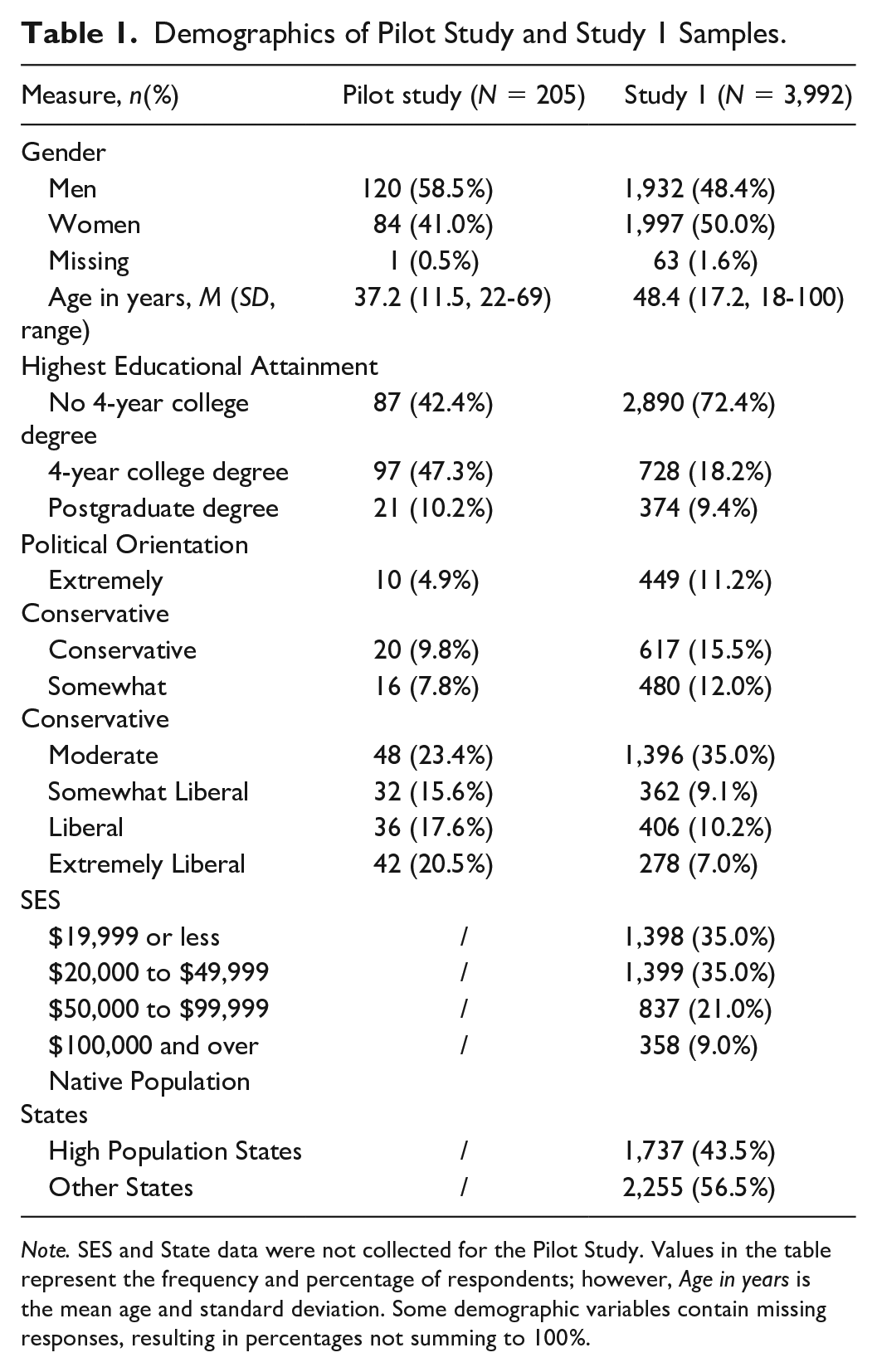
Note. SES and State data were not collected for the Pilot Study. Values in the table represent the frequency and percentage of respondents; however, Age in years is the mean age and standard deviation. Some demographic variables contain missing responses, resulting in percentages not summing to 100%.
Procedure and Measures
Participants completed the survey online. Given that individuals lack knowledge about MMIWG (see OSF supplement MMIWG Familiarity), participants first received basic facts about the epidemic. Participants were then asked to answer a variety of questions related to their perceptions of Native Peoples and MMIWG. For the sake of clarity, we only report the measures examined in the current work below. All measures were rated on a scale from 1, “Strongly Disagree” to 7, “Strongly Agree” unless otherwise noted. Data, code, materials, and codebooks are available at: https://osf.io/6zdh8/?view_only=e6a8d44cb00c466db05b9c146cb2fed1 (for the full survey, see OSF supplement Pilot Study Measures).
Cognitive Invisibility
To measure cognitive invisibility, participants reported their agreement with four statements (e.g., “When I think about successful Americans, Native/Indigenous Americans do not come to mind”; α = 0.81, M = 4.29, SD = 1.41). Responses were coded such that higher values reflected greater cognitive invisibility of contemporary Native Peoples.
Racism Minimization
To measure people’s tendency to minimize contemporary racism facing Native Peoples, participants reported their agreement with three statements (e.g., “Racism against Native Americans is a thing of the past”; α = 0.82, M = 3.06, SD = 1.45). Responses were coded such that higher values reflected greater racism minimization.
Victim Blaming
To measure victim blaming of MMIWG, participants reported their agreement with four statements (e.g., “MMIWG were using drugs and/or alcohol”; α = 0.82, M = 3.04, SD = 1.18). Responses were coded such that higher values reflected greater victim blaming.
Societal Blaming
To measure the level of blame placed on societal factors for contributing to the MMIWG epidemic, participants reported their agreement with six statements (e.g., “Policies and laws that make it difficult to prosecute Non-native offenders contribute to the epidemic of MMIWG”; α = 0.73, M = 4.72, SD = 0.97). Responses were coded such that higher values reflected greater societal blaming.
MMIWG Advocacy
To measure advocacy for MMIWG, participants indicated the likelihood they would engage in seven behaviors (e.g., sharing #MMIWG on social media or writing letters to government representatives; α = 0.90, M = 3.41, SD = 1.00) from 1, “Extremely unlikely” to 5, “Extremely likely.” Responses were coded such that higher values reflected greater advocacy.
Results
As an initial test of our proposed theoretical model (see Figure 1), we conducted a path analysis investigating the predictors of MMIWG advocacy using the lavaan package in R (Rosseel, 2012). Specifically, we tested the relationships between the cognitive invisibility of Native Peoples, racism minimization, victim blaming, societal blaming, and ultimately MMIWG advocacy. For simple bivariate relations between variables, see Table 2.
Bivariate Correlations Between All Pilot Study Variables.
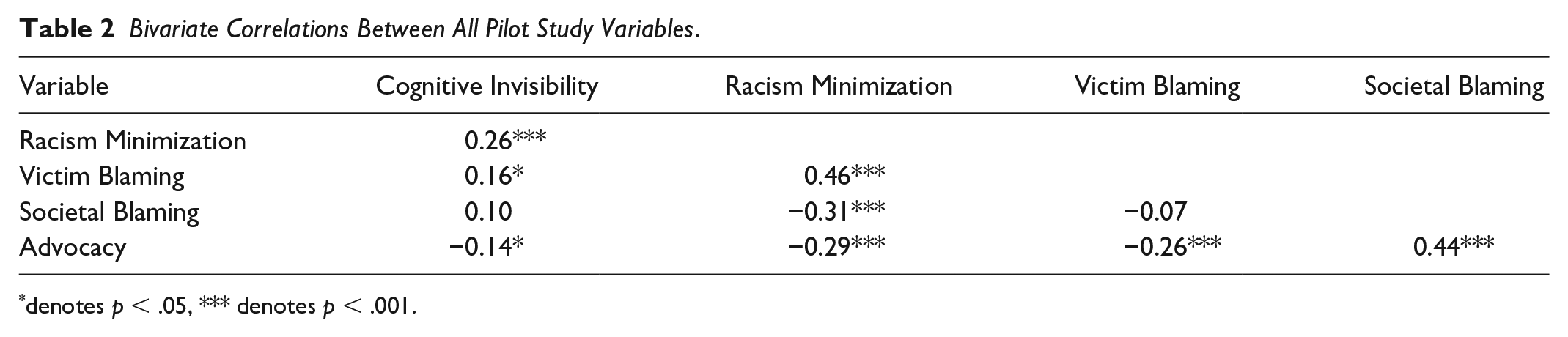
denotes p < .05, *** denotes p < .001.
All direct effects are available in Figure 2. Most pertinent to our theoretical model, greater cognitive invisibility was directly related to less advocacy (β = −0.14, p =.040). Moreover, in line with our theorization, we found evidence of significant indirect relationships (see Table 3 for a summary of indirect effects). Specifically, greater cognitive invisibility was related to greater racism minimization (β = 0.26, p < .001). In turn, greater racism minimization was related to greater victim blaming (β = 0.45, p <.001) and less societal blaming (β = −0.36, p <.001). Finally, greater victim blaming was associated with less advocacy (β = −0.20, p =.014) and less societal blaming was associated with less advocacy (β = 0.43, p < .001). As theorized, the indirect effect of cognitive invisibility on advocacy through racism minimization and victim blaming, serially, was significant (β = −0.02, p = .041). Similarly, the indirect effect of cognitive invisibility on advocacy through racism minimization and societal blaming, serially, was significant (β = −0.04, p =.010).
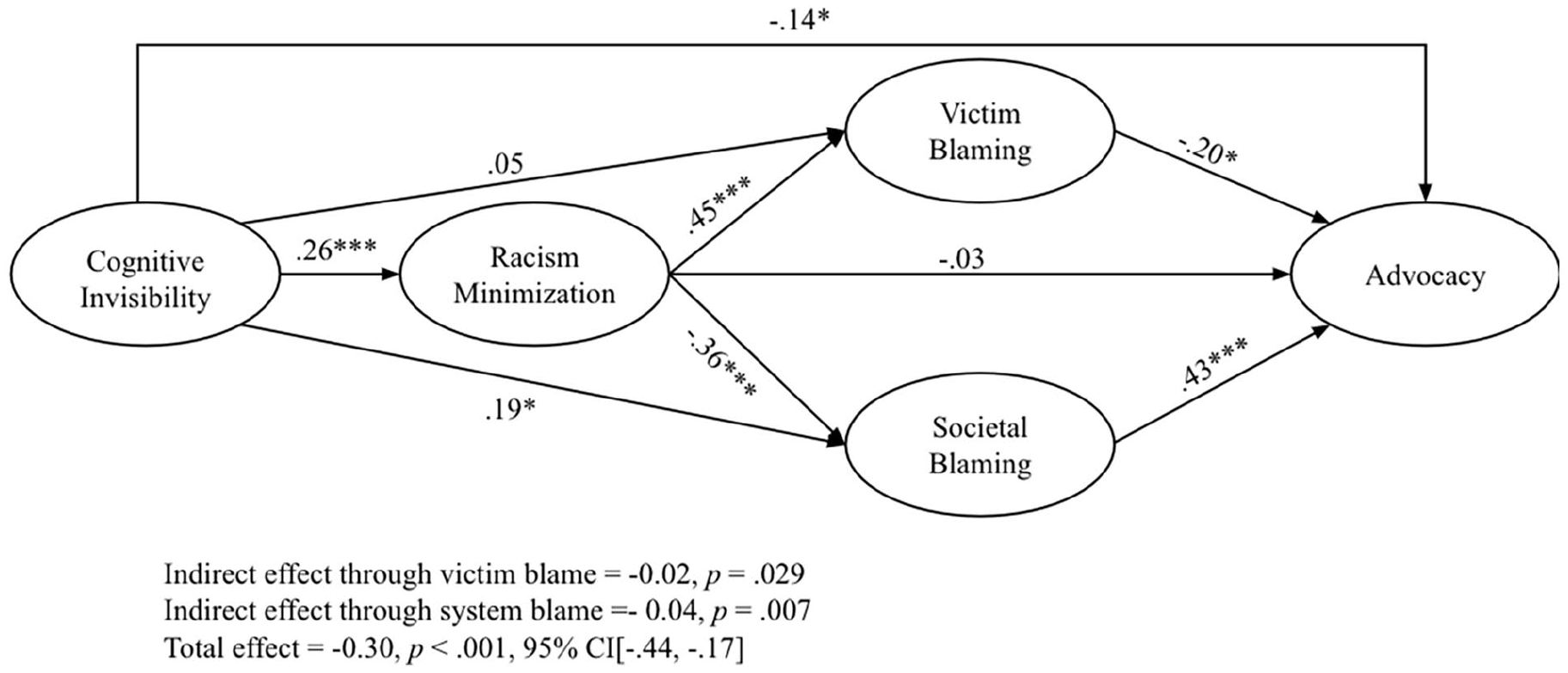
Pilot Study Structural Equation Model Findings With Standardized Beta Coefficients.
Standardized Indirect Effects for the Pilot Study Model.

Discussion
Overall, the Pilot Study supported our theoretical model. Consistent with our hypotheses, the cognitive invisibility of contemporary Native Peoples was related to the minimization of contemporary forms of racism Native Peoples experience. Individuals who minimized racism were also more likely to blame MMIWG victims and less likely to consider societal contributors to the MMIWG epidemic. Finally, greater victim blaming and less societal blaming were associated with less intentions to advocate on behalf of MMIWG.
The one finding contrary to the theoretical model was that cognitive invisibility was associated with a greater propensity to blame societal factors that perpetuate MMIWG (Figure 2). We anticipated that cognitive invisibility would be related to less societal blaming. One potential explanation for this finding is that the positive association between invisibility and societal blaming is a statistical artifact such that it represents the leftover variance after accounting for racism minimization. Indeed, the zero-order correlation between cognitive invisibility and societal blaming was null (r =.10, p > .05) and the association only became positive and significant within the context of the path analysis, which suggests this may be true. The next study will examine this relationship among a larger sample.
Although the Pilot Study provided initial support for our hypothesized model, we realized that there were at least two outstanding issues: one theoretical, and one practical. First, from a theoretical perspective, we thought it was important to better explicate the links between the blame attributions and MMIWG advocacy. That is, while victim blaming and societal blaming reflect cognitions about the epidemic as a whole, the measure of advocacy was focused on individuals’ own personal actions. Thus, the Study 2 model investigates how beliefs about the epidemic (i.e., victim and societal blaming) influence people’s perceptions of their personal roles and responsibilities, ultimately guiding their behavior. Specifically, the initial model was expanded to include apathy or the extent to which people report that the MMIWG epidemic is their responsibility to address, as a predictor of MMIWG advocacy (see Theoretical model; Figure 1). The second, practical issue is that the pilot study was statistically underpowered. To address these issues, we conducted a high-powered replication and extension of the pilot study to fully test the theoretical model (see Figure 1).
Study 1
Study 1 was a high-powered preregistered test of the theoretical model (https://osf.io/6zdh8/?view_only=e6a8d44cb00c466db05b9c146cb2fed1) using a national sample of White Americans. Specifically, we tested how the cognitive invisibility of Native Peoples is related to the minimization of contemporary forms of racism facing Native Peoples and in turn, how racism minimization is associated with the extent to which individuals blame MMIWG victims and societal factors for the epidemic. Moreover, we explore how victim blaming and societal blaming are associated with apathy, ultimately undermining MMIWG advocacy efforts.
Of note, relative to the preregistration, the models tested in Study 1 deviated in one way. We theorized about apathy in the preregistration but did not explicitly state where we would include apathy in the model (i.e., apathy was listed under secondary hypothesis). In Study 1, however, apathy was tested as a direct consequence of victim and societal blaming, impacting MMIWG advocacy.
Method
Participants
Three-thousand nine-hundred and ninety-two White American adults (see Table 1 for demographics) were recruited through Qualtrics Panel to participate in a 15-min online survey. Participants came from all 50 states in the United States. Half of the participants were intentionally recruited from states with high relative Native populations due to their proximity to the MMIWG epidemic. 3 Respondents who completed the survey received their standard incentive through their Qualtrics Panel membership for their participation.
Procedure and Measures
Participants completed the survey online. As before, given that individuals lack knowledge about MMIWG (see OSF supplement MMIWG Familiarity), participants first received basic facts about the epidemic. Participants were then asked to answer a variety of questions related to their perceptions of Native Peoples and MMIWG. For the sake of clarity, we only report the measures examined in the current work below. Data, code, materials, and codebooks are available at: https://osf.io/6zdh8/?view_only=e6a8d44cb00c466db05b9c146cb2fed1. For the full survey, see OSF supplement Study 1 Measures.
We used the same scales from the Pilot Study: cognitive invisibility (α = 0.84, M = 3.75, SD = 1.40), racism minimization (α = 0.73, M = 3.18, SD = 1.32), victim blaming (α = 0.84, M = 3.42, SD = 1.22), societal blaming (α = 0.64, M = 4.90, SD = 1.09), and advocacy (α = 0.90, M = 3.60, SD = 0.91). To measure apathy toward violence against Native women, participants reported their agreement with four items (e.g., “Maybe Native American women are unfairly treated but that is no business of mine”; α = 0.85, M = 2.67, SD = 1.20). Higher ratings reflected greater apathy toward MMIWG.
Analysis Plan
Study 1 uses structural equation modeling (SEM) in Mplus 8.7 (Muthén & Muthén, 2020) to test our proposed model. This approach best accounts for measurement error (which increases estimate precision) and provides the greatest flexibility in estimating indirect paths (Bollen & Noble, 2011; Kline, 2014; Preacher & Hayes, 2008; Rosseel, 2012). A two-step approach was used to estimate our models. We first performed a Confirmatory Factor Analysis (CFA) to assess how well the observed indicators (i.e., survey items) measured the latent constructs of interest. Then we extended the CFA to a full SEM and estimated the relationships among the primary study variables. We used maximum likelihood estimation because all study variables were specified as continuous. To assess model fit across all models, we examined the comparative fit index (CFI), Tucker–Lewis index (TLI), standardized root square mean residual (SRMR), and root mean square error of approximation (RMSEA), which each highlight different aspects of the model (mis)fit (Kline, 2014). SEMs demonstrate good or adequate fit when CFI and TLI are ≥ .95, SRMR is ≤ .08, and RMSEA is ≤ .06 (Hu & Bentler, 1999). However, there are no universal “cutoff” values, so we use the combination of fit indices and the degree to which they approach these values to assess model fit (Kline, 2014; van Laar & Braeken, 2022).
Estimating indirect effects is also straightforward within the SEM framework as it was developed to estimate relationships between multiple variables simultaneously and can easily incorporate bootstrapping (MacKinnon, 2012). We calculated indirect effects using bootstrapping as it tends to outperform other methods (e.g., Sobel method) in more complex models (MacKinnon, 2012).
Results
Measurement Model
To examine how well the observed variable indicators reflected the theoretical constructs of interest, we estimated a CFA in which each survey item was loaded onto its predicted latent variable. Our initial measurement model revealed that the advocacy measure reflected two latent factors—one indexing advocacy to increase the visibility of MMIWG (α = 0.76, M = 3.27, SD = 1.13), and one indexing advocacy for systemic change (α = 0.88, M = 3.86, SD = 0.94). To maximize model fit, we modeled advocacy as two factors reflecting these dimensions in our model. After this change, the CFA demonstrated good fit to the data (X2 (278) = 2,926.60, p < .001; CFI = .949; TLI = .941; RMSEA = 0.049, 90% CI = [0.047, 0.050]; SRMR = .046). All items are loaded onto their respective latent construct with a standardized loading of .44 or above. In this CFA model, all latent constructs were correlated with one another (Curran et al., 1996) (for simple bivariate relations between measures, see Table 4).
Bivariate Correlations Between All Study 1 Variables.
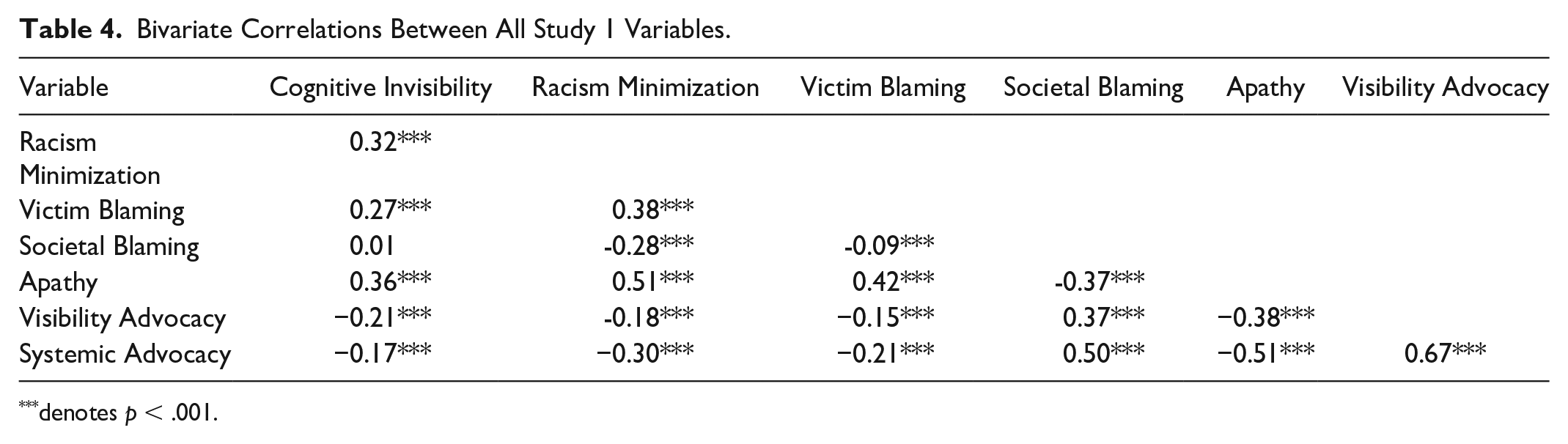
denotes p < .001.
Full Structural Equation Model
Upon confirming our measurement model, we estimated the hypothesized relationships among the latent variables as well as the indirect paths using SEM. We regressed our two advocacy measures onto apathy, victim blaming, societal blaming, racism minimization, and cognitive invisibility; apathy on the blaming constructs, racism minimization, and cognitive invisibility; the blaming constructs on racism minimization and cognitive invisibility; and finally racism minimization on cognitive invisibility (Figure 3). In addition, we estimated indirect effects of cognitive invisibility on MMIWG advocacy via the mediating variables (racism minimization; victim blaming; societal blaming; apathy) with 5000 bootstrap draws. This model fit the data well( χ2 (278) = 2,822.06, p < .001; CFI = .951; TLI = .943; RMSEA = 0.048, 90% CI = [0.046, 0.049]; SRMR = .047).
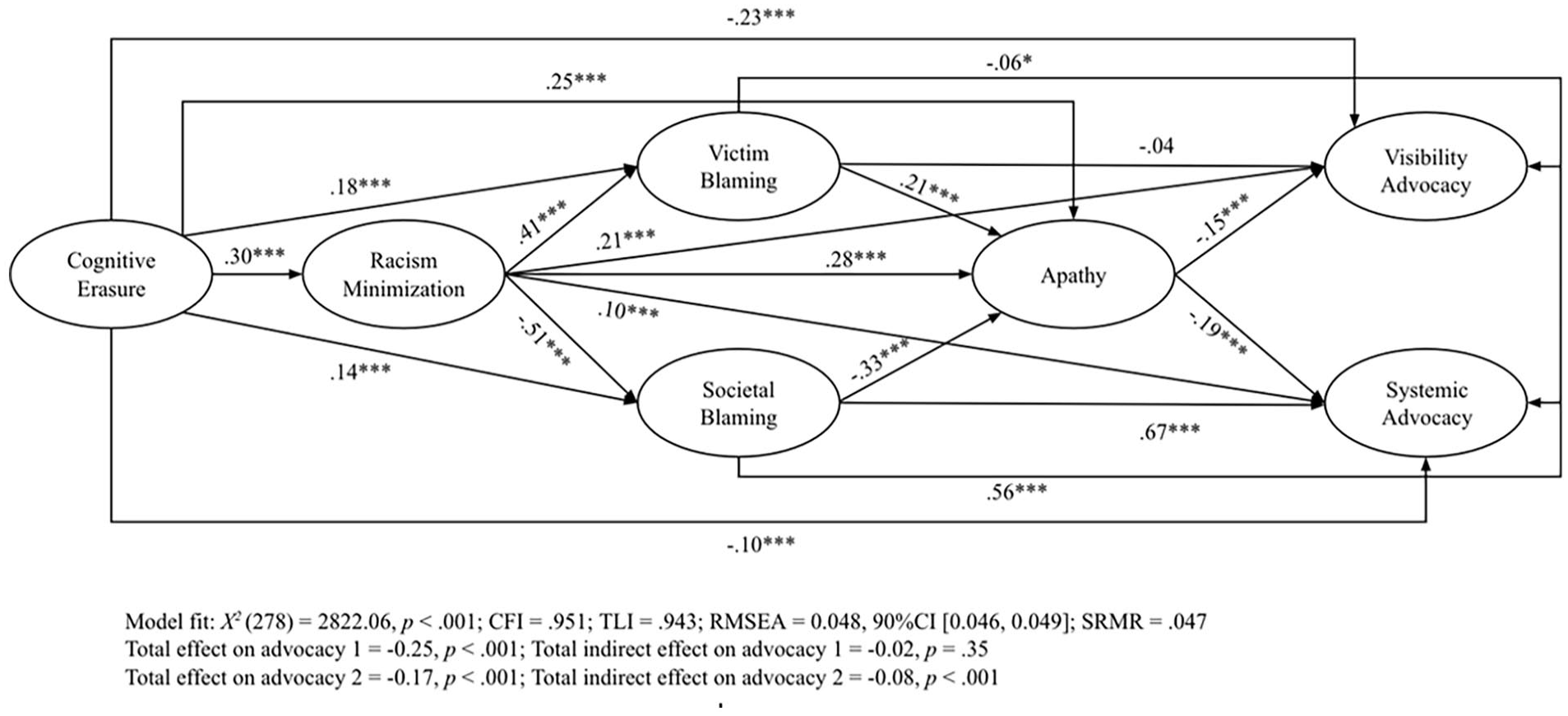
Study 1 Structural Equation Model Findings With Standardized Beta Coefficients.
All direct effects are available in Figure 3. Aside from one path, the two advocacy factors functioned similarly. Thus, for ease of interpretation and given that we did not have theoretical reason to believe these forms of advocacy should yield different results, we describe the findings by summarizing both advocacy factors.
Most pertinent to our theoretical model, greater cognitive invisibility was related to less advocacy (βs < −0.23 ps < .001). Moreover, in line with our theorization, we found evidence of significant indirect relationships (see Table 5 for a summary of indirect effects). Specifically, greater cognitive invisibility was related to greater racism minimization (β = 0.30, p < .001). In turn, greater racism minimization was related to greater victim blaming (β = 0.41, p < .001) and less societal blaming (β = −0.51, p < .001). Greater victim blaming was associated with greater apathy (β = 0.21, p < .001), and less societal blaming was associated with greater apathy (β = −0.33, p < .001). Finally, greater apathy was related to less advocacy (βs < −0.19, ps < .001).
Standardized Indirect Effects for Study 1 Model
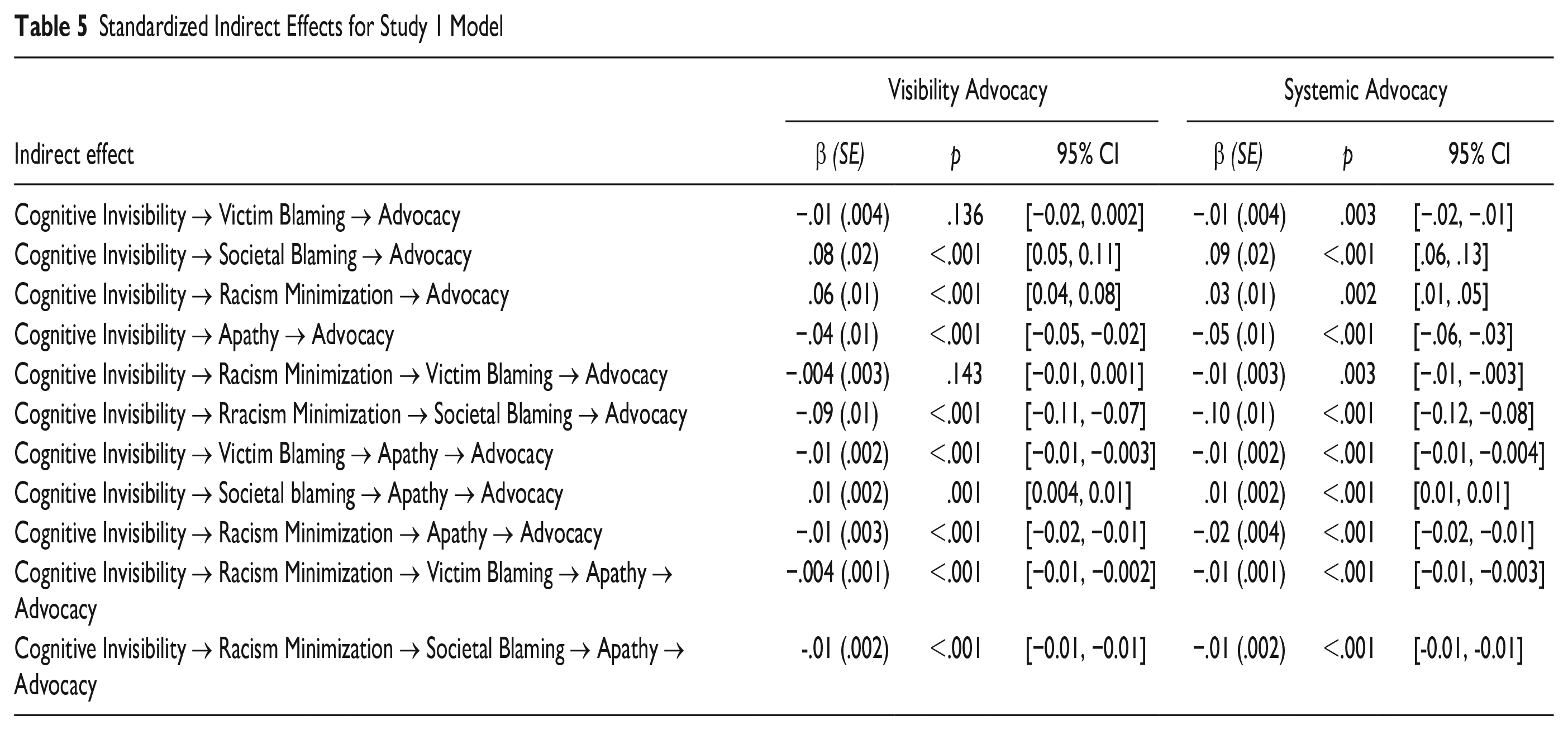
As predicted, the indirect effect of cognitive invisibility on advocacy through racism minimization, victim blaming, and apathy, serially, was significant (βs < −.01, ps < .001). Similarly, the indirect effect of cognitive invisibility on advocacy through racism minimization, societal blaming, and apathy, serially, was significant (βs < −.01, ps < .001).
Discussion
To summarize, Study 1 was a preregistered replication and extension of the Pilot Study using a large national sample of White American adults. As in the Pilot Study, we found that the cognitive invisibility of contemporary Native Peoples was associated with less MMIWG advocacy. We also found that cognitive invisibility was associated with less MMIWG advocacy because cognitive invisibility was related to greater racism minimization, which in turn was related to greater victim blaming and less societal blaming, ultimately relating to greater apathy toward violence against Native women. Notably, similar to the Pilot Study, cognitive invisibility was associated with increased societal blame but this effect only emerged in the context of the model and not in the zero-order correlations (r =.01, p>.05). Overall, the results supported our theoretical model.
General Discussion
Across two studies, we found that the cognitive invisibility of Native Peoples among White Americans undermined engagement in MMIWG advocacy. The results suggested that greater cognitive invisibility of contemporary Native Peoples was related to a greater likelihood of minimizing Native Peoples’ contemporary experiences with racism. Accordingly, racism minimization was associated with higher blame attributed to Native women and girls for their victimization, and a lesser propensity to blame societal factors such as policies or laws that exacerbate MMIWG. Ultimately, these factors predicted greater apathy toward violence against Native women (Study 1) and less support for MMIWG advocacy (Pilot Study and Study 1). The results illuminated the unique associations between Native invisibility and the ongoing MMIWG epidemic such that the cognitive invisibility of contemporary Native Peoples afforded attitudes and beliefs that allow non-Native individuals to deny, justify, and distance themselves from the epidemic.
This work provides the first—and to our knowledge, only—empirical investigation into the unique psychological mechanisms undergirding non-Natives’ apathy toward and failure to address, the MMIWG epidemic. The results are consistent with Native scholars’ theorizing that the invisibility of Native Peoples from American society supports the settler colonial goal of eliminating Native Peoples (Deloria et al., 2018; Fryberg et al., 2024; Jafri, 2017; Kauanui, 2016; Lomawaima & McCarty, 2014; Lopez et al., 2024; Razack, 2002; Robertson, 2015; Tuck & Yang, 2021). That is, the current research examines two forms of elimination: the MMIWG epidemic, which is a form of literal elimination, and cognitive invisibility, which is a form of figurative elimination from the public consciousness.
Moreover, Native Peoples are often rendered invisible in public domains (Eason et al., 2018; Forester, 2020; Leavitt et al., 2015; Mastro, 2017; Mastro & Stern, 2003; for review see: Fryberg et al., 2024) and in the hearts and minds of many Americans (Dai et al., 2024; Eason & Fryberg, 2024; Reclaiming Native Truths, 2018). The current findings suggest that, together, this enables non-Natives to believe anti-Native racism no longer exists (Dai et al., 2021; Fryberg et al., 2024), that MMIWG victims deserve their victimization, and that non-Natives are not responsible for changing these outcomes. To garner more empathy for MMIWG victims and motivate non-Natives to join the fight against Native oppression, the current research underscores how essential it is that society: (1) contends with the invisibility of Native Peoples and (2) works to integrate salient, accurate, and contemporary examples of Native Peoples into the public consciousness.
The current research also intersects with literature on racism and sexual violence. Our studies are consistent with previous work demonstrating that racist beliefs shape blame attributions (e.g., blaming victims for sexual violence and racial inequalities) and decrease concern for oppressed groups (Burkard & Knox, 2004; Dupuis & Clay, 2013; George & Martínez, 2002; O’Brien et al., 2009; Rucker & Richeson, 2021; Sjöberg & Sarwar, 2022; Suarez & Gadalla, 2010). In addition, our study findings expand this literature in at least four ways. First, we established a relationship between racism minimization and blame attributions for physical and sexual violence, which had not been found previously in the literature. Second, the theoretical model demonstrates the importance of examining the effect of global beliefs about the target group and their experiences with systemic injustices, as research on sexual violence tends to focus on specific instances of sexual violence and isolated events. Third, the violence against women literature has primarily examined the effects of sexualized and stereotypical representations (Bates et al., 2019, 2023); building on this, we demonstrate the critical role that the lack or absence of representations (i.e., invisibility) may have on how people make sense of sexual violence. Finally, we extend each of these contributions to Native Peoples, who are not often considered in the psychological literature (Barnett et al., 2019; Fryberg & Eason, 2017; Lopez et al., 2022).
Limitations and Future Directions
While the contributions are clear, there are also some notable limitations and future directions. First, although we relied on prior research and theorizing (Fryberg & Eason, 2017; Fryberg et al., 2024; Lopez et al., 2022) to determine our model, both studies involved cross-sectional survey data and therefore cannot establish causality. Future experimental or longitudinal research is needed to establish causal relationships. Second, future research should test whether the model generalizes among groups who are similarly rendered invisible. For example, Black women, Latinx women, and transgender people each experience disproportionate rates of violence (Falcón, 2016; Federal Bureau of Investigation, 2022; Ritchie, 2017; Stotzer, 2009; Westbrook, 2022) that are relatively underrepresented in the media (Slakoff & Fradella, 2019; Sommers, 2016). Third, given that the sample consists of all White Americans, future research should test whether the model generalizes among minoritized group members. Prior research has found that White Americans and racially minoritized group members show similar relationships between beliefs about Native Peoples and support for Native issues, suggesting that the current model effects may indeed hold across non-Native racial groups (Eason et al., 2021).
Future research should also build upon the limited work aimed at identifying factors that predict the invisibility of Native Peoples in society (Fryberg et al., 2024; Davis-Delano et al., 2023). For example, in what contexts and under what circumstances is invisibility or omission an inherent feature of the current representational landscape versus a motivated process? One option is that non-Natives’ ignorance of Native Peoples’ contemporary lived experiences is a byproduct of the fact that non-Natives rarely interact with contemporary information about Native Peoples (Reclaiming Native Truths, 2018), and therefore, an intervention to counter the cognitive invisibility may be to uplift contemporary, positive and accurate representations of Native Peoples. Another option is that the invisibility of contemporary Native Peoples is motivated by non-Natives’ need to maintain a positive national identity. Recent theorizing suggests that the reality of Native oppression poses a psychological threat to individuals who believe that being American is central to their sense of self (Dai et al., 2021; Lopez et al., 2024). The omission or invisibility of Native Peoples is one strategy to contend with this threat by creating psychological distance between non-Natives and the reality of Native oppression. Cognitive invisibility offers non-Natives reprieve from the discomfort and guilt of settler violence while still allowing them to benefit from continued efforts to eliminate Native Peoples (Tuck & Yang, 2021). That is, if Natives do not exist, past oppression does not deserve attention and contemporary oppression does not occur (Lopez et al., 2022). If participants are motivated to omit Native Peoples, combating omission may require actively challenging and overturning threats to one’s positive national identity.
Finally, future research should investigate additional attitudes and beliefs that perpetuate violence against Native women and girls. The current research investigated attitudes and beliefs about violence that has already occurred. Therefore, there is a dire need for researchers to identify psychological factors that drive individuals to directly commit and/or be complacent bystanders to violence against Native women and girls. Potential factors to investigate include endorsement of dehumanizing (e.g., animal-like, passive, and inferior) and fetishizing (e.g., Indian princess/maiden trope) stereotypes of Native women (MacDougall, 1994). The endorsement of such stereotypes may provide individuals with psychological justifications for violence against women, and in turn, may increase victim blaming and exacerbate apathy for MMIWG. Further investigation into such processes will allow for targeted interventions to prevent future violence against Native women and girls.
Conclusion
For Native women and girls, experiencing physical and/or sexual violence is not a question of “if” it will happen, but rather “when” it will happen. They should not have to live in a world where this is their reality; where they are at risk of disappearing not just once but three times, “in life, in the data and in the media” (Lucchesi & Echo-Hawk, 2018). Native women and girls deserve to live full and whole lives, in a society that values their existence, upholds their humanity, and ensures their protection. Building such a society requires that all Americans combat Native invisibility, recognize Native Peoples’ experiences, and ultimately feel responsible for promoting structural and individual change.
Footnotes
Acknowledgements
The authors thank Sarah Allen and Solo Milner for their contributions to this research.
Declaration of Conflicting Interests
The author(s) declared no potential conflicts of interest with respect to the research, authorship, and/or publication of this article.
Funding
The author(s) disclosed receipt of the following financial support for the research, authorship, and/or publication of this article: This project was supported by Mellon (#2009-09307); Doris Duke (#2021206); and National Science Foundation (#2041233; #2041234).
