







Abstract
We examine how perceived automation and AI threats (the belief that advanced technology threatens humans’ career prospects) shape workers’ strategies for career preparation. In nine studies (N = 2,320; three preregistered), we find that perceived automation threat drives people to prioritize creative skills over technical and social skills. A pilot study revealed that people view creativity as less prone to automation and more likely to complement automation. Subsequent experiments confirmed that automation threat leads people to highlight creativity in job applications (Studies 1a–1c), leads STEM students and professional graphic designers to cultivate creative abilities (Studies 2a–2b), and increases jobseekers’ interest in companies that champion creativity (Study 3). People value creative skills in response to the automation threat even when reminded of generative AI’s ability for creativity (Studies 4a–4b). These results suggest that advanced technology steers individuals to prioritize creativity as a skill necessary to compete in the labor market.
The advent of new technologies like artificial intelligence (AI) has shifted people’s beliefs about the skillsets required in the workforce. As human-specific tasks become increasingly automated, workers are compelled to develop new abilities or refine existing ones to remain competitive and employable. Although extensive research has examined the impact of automation and AI on human labor (Arntz et al., 2016; Frey & Osborne, 2017), detailing the types of tasks and occupations likely to be replaced by these technologies (e.g., Acemoglu & Autor, 2011; Autor, 2015; Autor et al., 2003; Bessen 2015), less research has examined people’s lay beliefs about the skills they feel are essential to find employment amidst the threat of automation.
People’s beliefs shape job search and career choices considerably (Acemoglu & Shimer, 1999; Burdett & Mortensen, 1998; Mortensen & Pissarides, 1994; Sequeira & Banerjee, 2020) suggesting a pivotal role for such beliefs to affect people’s career preparation in response to automation. Here we directly explore people’s beliefs about which types of skills will be most affected by automation and how these beliefs inform their strategies for responding to perceived automation threat (the perception that advanced technology such as robots and AI will threaten humans’ career prospects).
Public discourse on what skills humans should actually cultivate to adapt to automation has been heavily debated. Policymakers and educators advocate for technical skills as an essential defense against technological advancements, thereby directing increased resources into related educational offerings (Office of Management Budget, 2016; National Student Clearinghouse Research Center, 2013). Other scholarly approaches acknowledge the benefits of nontechnical skills as well, deeming creativity and social-emotional skills less susceptible to automation and more valuable for complex, nonroutine tasks (Kosslyn, 2019; Gustein & Sviokla, 2018). The sudden emergence of generative AI casts further uncertainty on this issue, challenging prior assumptions about which skills are truly “automation proof” and forcing a reevaluation of which skills will be most valuable for humans’ employment prospects (e.g., Cremer et al., 2023; Press, 2023; Thompson, 2022).
Against the backdrop of these mixed messages, this research seeks to understand which skills individuals prioritize in response to the automation threat. We focus specifically on technical, social, and creative skills, all of which are commonly recognized as fundamental in the contemporary workplace (Börner et al., 2018; Deming, 2017; Siepel et al., 2021). Importantly, the present research does not make claims about which skills are truly essential for adapting to AI but rather explores lay beliefs about which skills people think they should prioritize.
This research makes several unique contributions to the psychology of technology literature. First, it advances research on the future of work (Fast & Schroeder, 2020; Newman et al., 2020; Raveendhran & Fast, 2021) by introducing a lay beliefs perspective (Dweck et al., 1995; Molden & Dweck, 2006) on how technology will shape the social world. Second, it extends research on the policy implications of new technologies (e.g., Acemoglu & Autor, 2011; Bessen, 2019; Goos et al., 2014), highlighting the importance of anticipating workers’ responses to automation for effective policy and educational program design. Insights into skill prioritization can guide funding and help educational institutions adapt to changing demands. Third, our work builds on the automation and employment literature (e.g., Acemoglu & Autor, 2011; Arntz et al., 2016; Autor et al., 2003; Bessen, 2015) by shifting the focus from economic to psychological factors. While economic studies have examined automation’s impact on labor dynamics, they often overlook its effect on worker perceptions and behaviors. Our study addresses this gap by examining how psychological responses to automation influence workers’ preparations for the future of work.
Prior Theorizing on the Impact of Automation on the Labor Market
Economic research has evolved from the broad assertion that automation decreases jobs altogether to the perspective that it primarily affects specific tasks within jobs (Acemoglu & Restrepo, 2018; Brynjolfsson & McAfee, 2014). This task-based perspective indicates that while machines can automate a subset of jobs, they are more likely to reallocate tasks, leaving humans with tasks that machines cannot perform (e.g., Arntz et al., 2016; Acemoglu & Restrepo, 2019; Autor, 2015; Bessen, 2015). For example, routine tasks like data entry are more susceptible to automation because they are predictable and programmable (Autor & Dorn, 2013; Goos et al., 2014), whereas nonroutine tasks, like negotiation or client relationship management, are less susceptible to automation because they require creativity, complex communication, and adaptability (Acemoglu & Autor, 2011; MacCrory et al., 2014). Consequently, as technology automates routine tasks, it may simultaneously enhance the importance of skills such as problem-solving and complex communication, which are crucial for nonroutine tasks (Acemoglu & Autor, 2011; Acemoglu & Restrepo, 2019; Autor, 2015; Bessen, 2015; MacCrory et al., 2014).
Lay Perceptions of Machine versus Human Capabilities
Our research builds on these economic frameworks to assess whether theories about which skills are truly automatable square with people’s perceptions. The skills that people believe will be substituted versus complemented by automation may partially depend on how people perceive the capabilities of machines compared to humans. For instance, dehumanization research suggests people perceive that humans and machines share cognitive capabilities (e.g., logic, rationality), but that humans possess superior emotional capabilities (e.g., warmth, intuition; Haslam, 2006; Loughnan & Haslam, 2007) to machines. Mind perception research similarly suggests that people perceive robots to possess agency (intentional planning and thought) but not emotional experience (feeling), which people deem more distinctively human (Gray et al., 2007; Waytz & Norton, 2014).
These two streams of research suggest that people perceive humans to possess both cognitive and emotional abilities, but perceive machines to have more cognitive abilities than emotional abilities. These two categories broadly map on to job skills that are more inherently social or technical, which are examined here. Missing from this prior work on perceptions of humans and machines, however, is an assessment of people’s beliefs about creative skills, which we also examine here. Creativity is likely to loom largely in people’s minds when considering competition with automation for at least two reasons suggested by prior work. First, creativity is associated with emotionality (Bullot & Reber, 2013; Sternberg, 1985), an attribute that people view as distinctively human, and second, creativity reflects the type of nonroutine skills that have traditionally faced less susceptibility to automation.
In addition to the perceived substitutability of certain skills by automation, the perceived utility of these skills in an increasingly automated environment should also influence whether or not people value these skills. While social skills like communication and teamwork are often seen as essential in face-to-face interactions, growing concerns about automation removing the need for human contact may cause workers to devalue these skills as more workplaces become technology driven (e.g., Allen, 2018; Backhouse, 2017; Paquette, 2018). In contrast, people frequently depict creativity as not only resistant to automation but also as a skill that may thrive alongside technological advancements. Both popular media and academic literatures highlight creativity’s connection to adaptability, innovation, and problem-solving—traits that are seen as irreplaceable by machines (Jacobs, 2018; Kersten, 2020; Mahdawi, 2017). Given these portrayals of creativity as a unique capability that machines cannot emulate, we hypothesize that people will prioritize creative skills over social skills when facing automation threats. By focusing on creativity, workers may leverage a skill set they believe provides a competitive edge and renders them indispensable in an increasingly automated workplace.
Research Overview
In our experiments, participants faced job threat scenarios where they had to choose specific skills to emphasize in job applications, professional profiles, or further training, reflecting real-world constraints like limited skill options. This setup allowed us to explore which skills are prioritized and how strategic choices are made in an AI-influenced career landscape. By limiting the skills that participants could choose from, our research investigates how individuals navigate trade-offs between different skill sets in response to automation threats. This approach not only highlights the most valued skills but also sheds light on how people strategically manage these choices within the constraints of time, finances, and training availability, offering insights into adaptive behaviors in evolving labor markets.
Control and comparison conditions, such as foreign labor threat, were included to assess whether responses were specific to automation threats or generalized across other job threats.
Unlike Studies 1a to 1c, 3, 4a, and 4b, which recruited a broad sample and asked participants to imagine themselves as recent college graduates, Studies 2a and 2b specifically focused on individuals with a college education. In Study 2a, we recruited college students about to enter the job market, while Study 2b targeted graphic design professionals with a college education. This allowed us to examine not only the skills these more specialized groups choose to highlight but also their decisions around skill acquisition in response to automation threats. College-educated individuals often possess fundamental technical skills and have the motivation and resources to develop further, making them especially relevant for studying how creative versus technical skills are prioritized under automation threats.
All studies, measures, manipulations, and participant exclusions are reported in the manuscript or Supplemental Material. Data and scripts for all studies—including supplementary studies reported in Supplemental Material—are available at https://osf.io/jsx2y/, and data collection was completed based on predetermined targets with all exclusions decided a priori.
Pilot Study
A pilot study (detailed in the Supplemental Material) assessed whether participants viewed automation as likely to substitute or complement technical, social, and creative skills (1 = very unlikely to 7 = very likely). We measured substitutability in terms of beliefs about whether new technologies will be capable of replacing human workers for a particular skill and complementarity in terms of beliefs about whether new technologies will increase the importance of particular skills. Participants rated five social skills (negotiation, teamwork, communication, leadership, and conflict management), five technical skills (software development, programming languages, technical writing, data analysis, and mathematics), and five creative skills (innovation, imagination, originality, inventiveness, and creativity). The creative skills were based on psychological definitions of creativity, emphasizing novelty and usefulness (e.g., Amabile, 1983; Runco, 2004). Social and technical skills were derived from O*NET’s standardized job-related skill classifications. These categories reflect essential competencies in the workplace, as identified in numerous job roles.
The average ratings for the 15 skills were standardized and plotted, with substitutability on the y-axis and complementarity on the x-axis. Figure 1 shows four clusters in a 2 × 2 space of perceived substitutability and complementarity. Creative skills were rated as having low substitutability and high complementarity, while basic technical skills (e.g., mathematics, technical writing) were seen as highly substitutable and low in complementarity. Social skills were rated low in both, and advanced technical skills (e.g., software development, programming) were rated high in both.
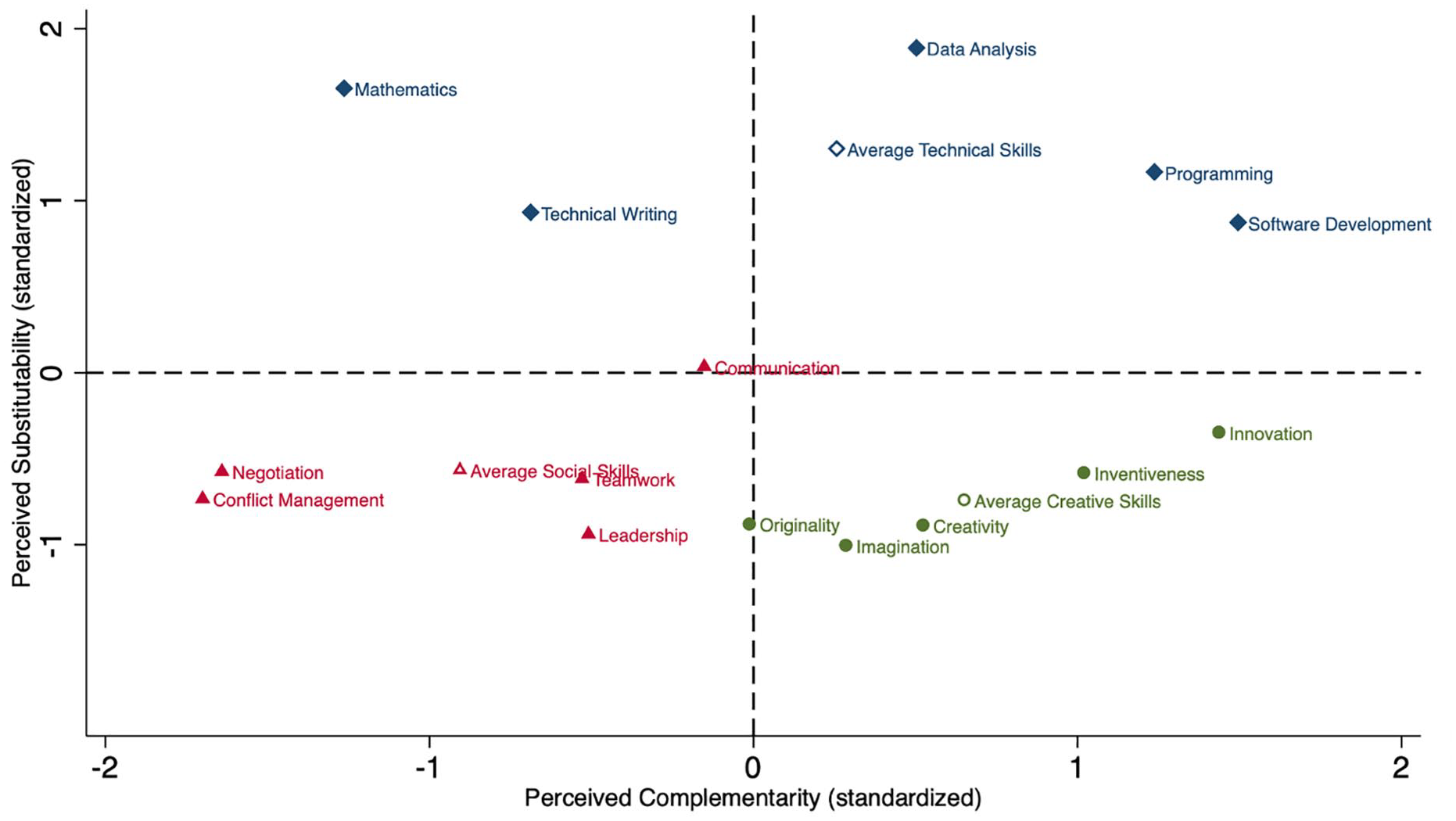
Scatterplot of standardized mean scores of perceived skill substitutability and complementarity for three categories of skills: technical, social, and creative skills.
These results suggest that people’s perceptions of how automation impacts skills do not align with expert predictions, which assume a negative correlation between substitutability and complementarity (e.g., Acemoglu & Autor, 2011; Arntz et al., 2016; Autor et al., 2003). Specifically, experts suggest that if a skill is not substitutable by automation, it should be complementary, and vice versa. However, participants often viewed social skills as neither substitutable or complementary, or advanced technical skills as high in both. This divergence may influence the skills people prioritize in response to automation threats, particularly their emphasis on creativity as resistant to automation and well-suited to complement it.
Study 1a
Whereas the pilot study explored beliefs about whether machines substitute or complement different skills, Studies 1a to 1c examined how awareness of AI job threats affects which skills people highlight in job applications. In these studies, participants took on the role of recent college graduates applying for jobs and were informed about labor trends, including threats from automation and foreign labor. They then selected whether to emphasize technical, creative, or social skills in their applications. Given the results of the pilot study that people view creative skills in particular as both less substitutable by automation, and more complemented by automation, we predicted that automation threats would lead people to prioritize creative skills. Study 1a was preregistered (https://aspredicted.org/5m23-sjkb.pdf).
Methods
Participants
We aimed to collect 300 participants on MTurk. After excluding 5 participants for failing an attention check, the final sample consisted of 295 participants (171 females, 124 males, mean age = 38.63, SD = 11.64). A sensitivity power analysis using G*Power (Faul et al., 2009) indicated that this sample size provided 80% power to detect a job competition effect as small as Cohen’s d = 0.33.
Procedure
Participants were told they were completing a study on the job application process and instructed to imagine themselves as recent computer science graduates applying for jobs. They were randomly assigned to one of two conditions.
In the automation competition condition, participants read about competing with automation and AI in the workplace. In the foreign labor competition condition, participants read about competing with immigrants and foreign workers, designed to mirror the automation condition, while maintaining a neutral tone to avoid xenophobic responses. A validation study confirmed that these conditions effectively manipulated distinct threats: the automation condition significantly heightened perceptions of automation-related job threats, whereas the foreign labor condition increased perceived threats from competition with immigrants and foreign workers. Full details of the manipulation texts, the validation study results, and any additional exploratory measures for this and subsequent studies are available in Supplemental Material.
Skill Selection
After reading about labor market trends, participants chose three skills from a list of 12 to highlight in a job application cover letter. The list included four creative (creativity, innovation, imagination, and originality), four technical (mathematics, programming languages, technical writing, and data analysis), and four social (conflict management, leadership, teamwork, and negotiation) skills.
The number of creative (M = 0.94, SD = 0.77), technical (M = 1.06, SD = 0.92), and social (M = 1.00, SD = 0.80) skills selected were summed up for each participant.
Results
Given that emphasizing one skill might inherently affect the selection of others, we conducted a more integrated analysis of participants’ skill preferences in response to the manipulation. Individual analyses that examine the distinct impact of the manipulation on each skill type are presented in Supplemental Material for this and all other studies.
We conducted a mixed-model ANOVA—with condition (automation vs. foreign labor) as the between-subjects factor, type of skill (social vs. creative vs. technical) as the within-subjects factor, and a random intercept for each individual participant. The use of a mixed-effects model considers the nonindependence of the data by modeling individual-level random effects. Results indicated only a significant interaction between condition and skill type, F(2, 879) = 10.30, p < .001,
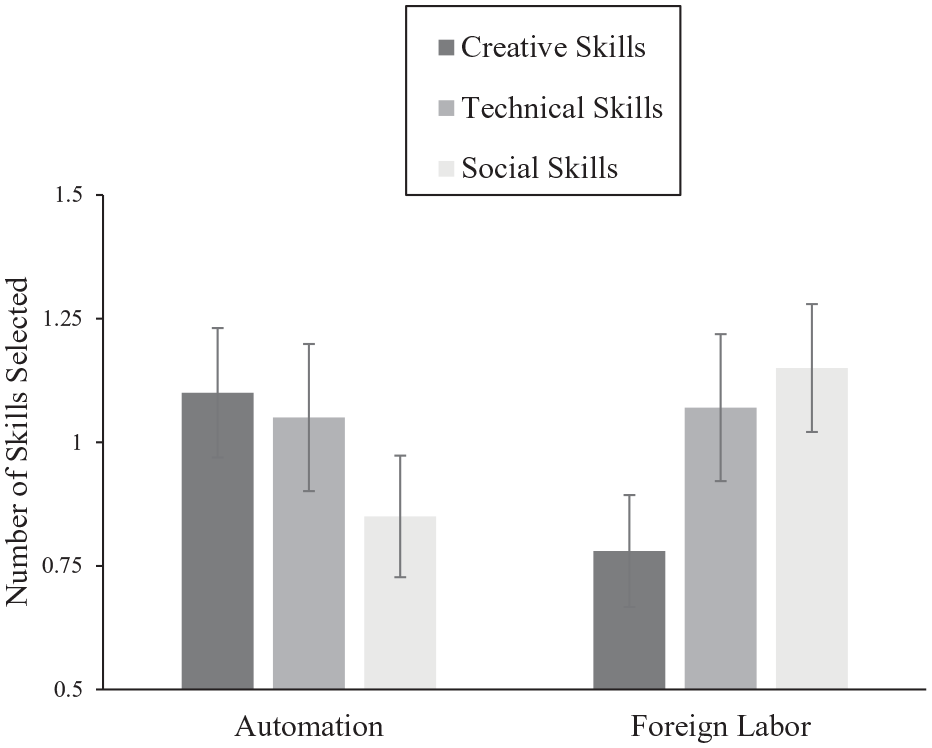
Mean number of skills selected to display on job application as function of type of skill and condition in Study 1a.
Study 1a suggests that people prioritize creative skills more when facing automation threats compared to other job threats, likely because creativity is seen as difficult for machines to emulate and offers a competitive edge in a job market with advancing technology.
While creative and technical skills were equally valued in the automation condition, social skills were deprioritized. This finding may reflect the belief that, consistent with our pilot study, although machines may not replace social roles, these skills may become less important in an increasingly automated workplace. The similar preference for technical skills across both the automation and foreign labor conditions indicates that technical skills are seen as universally valuable, regardless of competition type.
Overall, Study 1a demonstrates that automation threats prompt a preference for creative skills, which are viewed as non-substitutable and complementary to machines. However, it is unclear which skills people prioritize when creative and technical skills are directly compared. Preliminary data from the pilot study suggests that creativity, seen as less substitutable, might be favored over technical skills. Study 1b further explores this by explicitly comparing creative and technical skills.
Study 1b
Study 1b again focused on what skills people highlight on a job application in response to automation, with an emphasis on creative versus technical skills. In addition, this study includes an additional neutral control condition to assess the relative influence of exposure to foreign labor competition and automation competition.
Methods
Participants
We recruited 451 participants via Amazon’s Mechanical Turk. After excluding 10 who failed an attention check, the final sample included 441 participants (279 females, 162 males, mean age = 41.75, SD = 13.59). A sensitivity power analysis indicated that a sample of this size would have 80% power to capture omnibus effect sizes of job competition condition as small as f = 0.15 or pairwise differences (based on a sample of n = 192 for comparisons between automation and foreign labor conditions) as small as Cohen’s d = 0.33.
Procedure
Study 1b replicated the procedure of Study 1a but included a control condition and modified the skill selection measure. Participants were randomly assigned to an automation competition, a foreign labor competition, or a control condition (in which no additional information was provided about the labor market).
Skill Selection Measure
Following the manipulation, participants selected three skills to highlight in a job application cover letter from a list of ten, which included the same four creative and four technical skills from Study 1a, along with two filler skills (communication, time management). We tallied the number of creative (M = 1.03, SD = 0.85) and technical (M = 1.21, SD = 0.90) skills chosen for analysis.
Results
Using the same mixed-model ANOVA design as in Study 1a (job competition as the between-subjects factor and type of skills as the within-subjects factor), results showed revealed a main effect for type of skill, with participants highlighting more technical than creative skills, F(1, 876) = 9.67, p = .002,
As displayed in Figure 3, participants in the automation condition selected to highlight more creative skills (M = 1.35, SD = 0.84) than technical skills (M = 1.01, SD = 0.90), t(876) = 3.35, p < .001, d = 0.21. In contrast, participants in the foreign labor condition selected more technical skills (M = 1.30, SD = 0.91) than creative skills (M = 0.93, SD = 0.82), t(876) = 3.66, p < .001, d = 0.23. Similarly, participants in the control condition selected more technical skills (M = 1.31, SD = 0.88) than creative skills (M = 0.81, SD = 0.81), t(876) = 5.00, p < .001, d = 0.33.
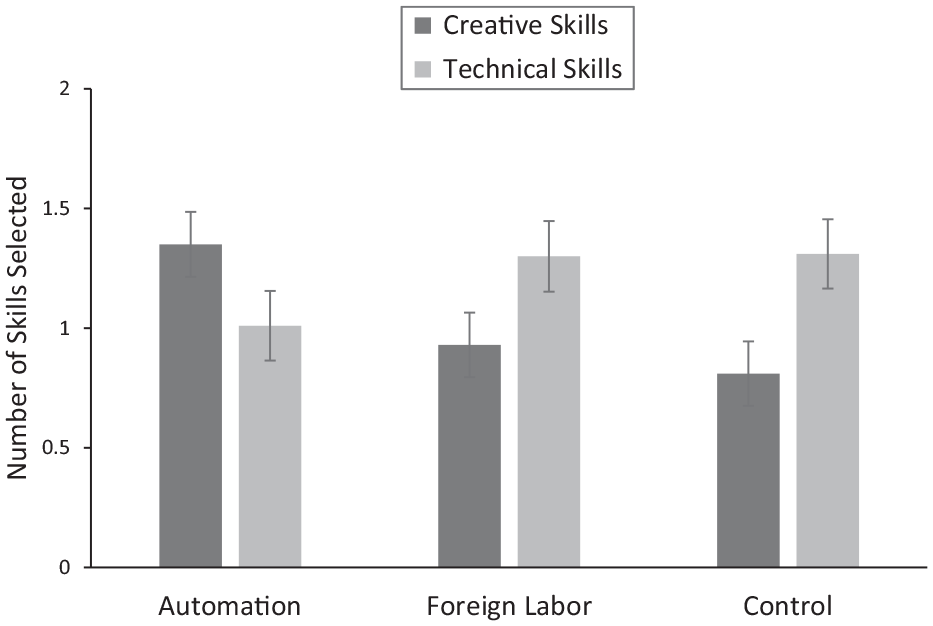
Mean number of skills selected to display on job application as a function of type of skill and condition in Study 1b.
These findings suggest that, compared to a control condition and a foreign worker competition condition, people prioritize creativity over technical skills when facing automation threats. The similar pattern between the foreign worker and control conditions indicates that this effect is specific to automation, highlighting the persistent belief that creativity provides a competitive edge against machines, as seen in Study 1a.
Since Studies 1a to 1b limited participants to a set of predefined skills, Study 1c explores whether people would naturally emphasize creative skills without explicit prompts.
Study 1c
Study 1c examines participants’ preference for highlighting certain skills in response to automation threat by allowing them to freely generate the skills to emphasize in their job applications.
Methods
Participants
We recruited 300 participants via Amazon Mechanical Turk. After excluding 11 who failed an attention check, the final sample included 289 participants (174 females, 115 males, mean age = 38.33, SD = 13.50). A sensitivity power analysis indicated 80% power to capture omnibus effects as small as f = 0.18 or pairwise differences (based on a sample of n = 192 for comparisons between automation and foreign labor conditions) as small as Cohen’s d = 0.41.
Procedure
Procedures for Study 1c were almost identical to those in Study 1b, with a major modification to the skill selection measure (described below). Participants were asked to imagine that they had recently graduated from college with a degree in graphic design and were randomly assigned to read the same information about labor market trends as in Studies 1a to 1b.
Skill Selection Measure
After reading about their industry, participants listed up to five skills or traits to highlight in a job application cover letter. Two independent coders classified each skill as creative, technical, or other, with high inter-rater agreement (Byrt et al., 1993; Sim & Wright, 2005) for both creative (Prevalence – Adjusted Bias – Adjusted Kappa [PABAK] = .92, Cohen’s kappa = .87, Agreement = 94.46%) and technical (PABAK = .80, Cohen’s kappa = .70, Agreement = 83.04%) skills. The average number of creative (M = 0.33, SD = 0.58) and technical (M = 0.59, SD = 0.79) skills identified by each coder was used to create indices for each participant. Any additional exploratory measures are described in Supplemental Material.
Results
Following the analysis strategy from Studies1a to 1b, a mixed-model ANOVA revealed a main effect for condition, F(2, 572) = 4.58, p = .011,
As displayed in Figure 4, participants in the automation condition generated creative skills (M = 0.55, SD = 0.76) and technical skills (M = 0.59, SD = 0.77) to highlight in their cover letter to a statistically indistinguishable degree, t(572) = 0.41, p = .679, d = 0.03. However, participants in the foreign labor condition generated more technical skills (M = 0.53, SD = 0.66) than creative skills (M = 0.19, SD = 0.40), t(572) = 3.31, p < .001, d = 0.44. Similarly, in the control condition, participants generated more technical skills (M = .64, SD = 0.91) than creative skills (M = 0.25, SD = 0.45), t(572) = 3.92, p < .001, d = 0.35. Critically, participants generated more creative skills in the automation condition compared to both the foreign labor condition, t(572) = 3.60, p < .001, d = 0.59, and control condition, t(572) = 3.04, p < .01, d = 0.48. However, the generation of technical skills did not differ significantly across conditions, ts < 1.13, ps > .26.
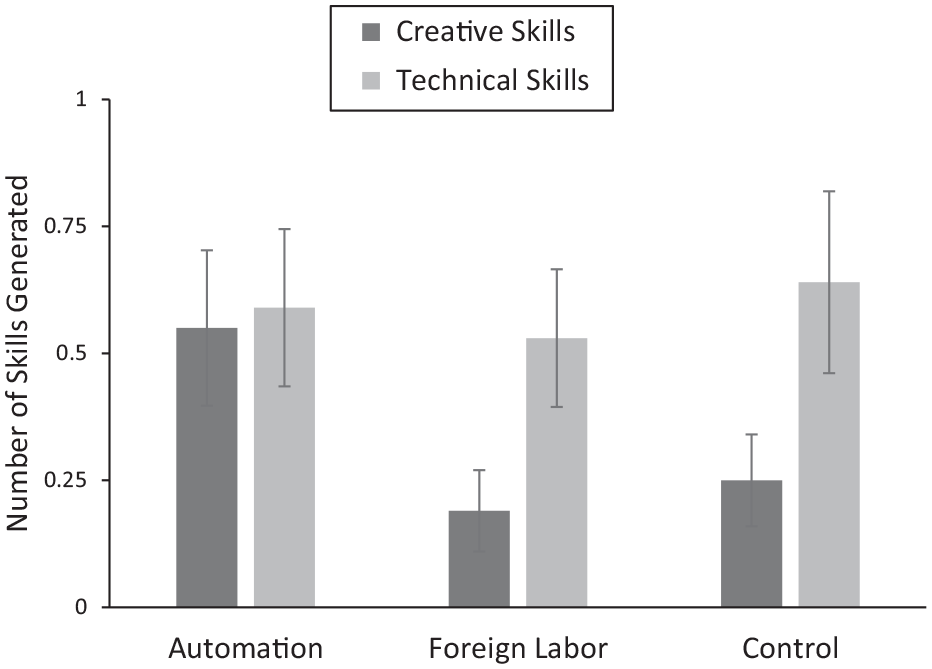
Mean number of skills spontaneously generated to display on job application as a function of type of skill and condition in Study 1c.
Study 1c confirms that, without prompting, individuals naturally highlight more creative skills in job applications when exposed to automation competition compared to foreign labor competition or no additional information. It also suggests that, when not constrained by predefined options, individuals value a balanced skill set, prioritizing creativity while still acknowledging the relevance of technical skills.
Study 2a
Studies 2a and 2b build on Studies 1a to 1c by shifting the focus from the skills people highlight in job applications to additional training and education they seek in response to automation threats. While Studies 1a to 1c explored how automation affects self-presentation, Studies 2a and 2b examine how individuals plan to adapt their skills through further education.
Study 2a focuses on STEM students because this group, while often seen as highly technical, also relies on creativity for innovation and problem-solving. This allows us to examine whether individuals preparing for technical careers still prioritize creativity in their professional development when faced with the automation threat. Study 2b complements this by focusing on graphic designers, a profession that demands both technical and creative skills but tends to emphasize creativity more. By investigating how students and professionals from these two distinct fields—STEM and graphic design—choose to further their education, we aim to understand whether their training preferences shift based on perceived threats. This distinction allows us to explore the broader impact of automation not only just on how people present their skills but also on how they prepare to develop them in an increasingly automated future.
Methods
Participants
We recruited 183 undergraduates in their final 2 years at a large Midwestern University majoring in a STEM field (e.g., biology, chemistry, computer science, engineering, math, physics, etc.) to participate in an online study for payment. After excluding 9 participants who had duplicate IDs and 29 who failed an attention check, the final sample included 145 participants (89 females, 56 males, mean age = 20.48, SD = 0.62). A sensitivity power analysis indicated 80% power to detect omnibus effects as small as f = 0.26 or pairwise differences (based on a sample of n = 97 for comparisons between automation and foreign labor conditions) as small as Cohen’s d = 0.58.
Procedure
Participants were instructed to imagine themselves considering job applications at leading U.S. technology companies such as Google, Amazon, and Apple. They were then randomly assigned to one of three conditions, each presenting different labor market trends. In the automation competition condition, participants read that they may have to compete with automation and AI in the workplace. In the foreign labor competition condition, participants read that they may have to compete with immigrants and foreign workers in the workplace. In the control condition, participants did not receive any additional information about labor market trends.
Skill Selection
Following the industry trend descriptions, participants imagined encountering a job advertisement at a major technology company and were asked to select three skills from a list of 12 to highlight in their cover letter: 5 creative skills (creativity, innovation, imagination, originality, and thinking outside the box), 5 technical skills (mathematics, programming languages, technical writing, data analysis, and logical reasoning), and 2 filler skills (communication and time management).
For each participant, we calculated the total number of creative (M = 1.05, SD = 0.71) and technical (M = 1.21, SD = 0.81) skills selected for inclusion in their cover letter.
Skill Acquisition
Participants were asked to imagine their university was offering professional training seminars for STEM students to enhance their competitiveness in the job market. Participants were presented with six different professional seminars ostensibly offered by the university and were asked to select the three courses that they were most interested in taking. Three of these courses were related to developing creative skills (i.e., Art and Design in STEM, Ideation: How to Generate New Ideas, Leading Innovation and Creativity), and three courses were related to developing technical skills (i.e., Mathematical Tools for Stem, Data Analysis, Applied Programming). Indices were created for each participant, representing the total number of creative (M = 1.61 SD = 0.94) and technical (M = 1.39, SD = 0.94) courses selected.
Results
Skill Selection
A mixed-model ANOVA revealed a significant main effect of type of skill, F(1, 284) = 4.61, p = .033,
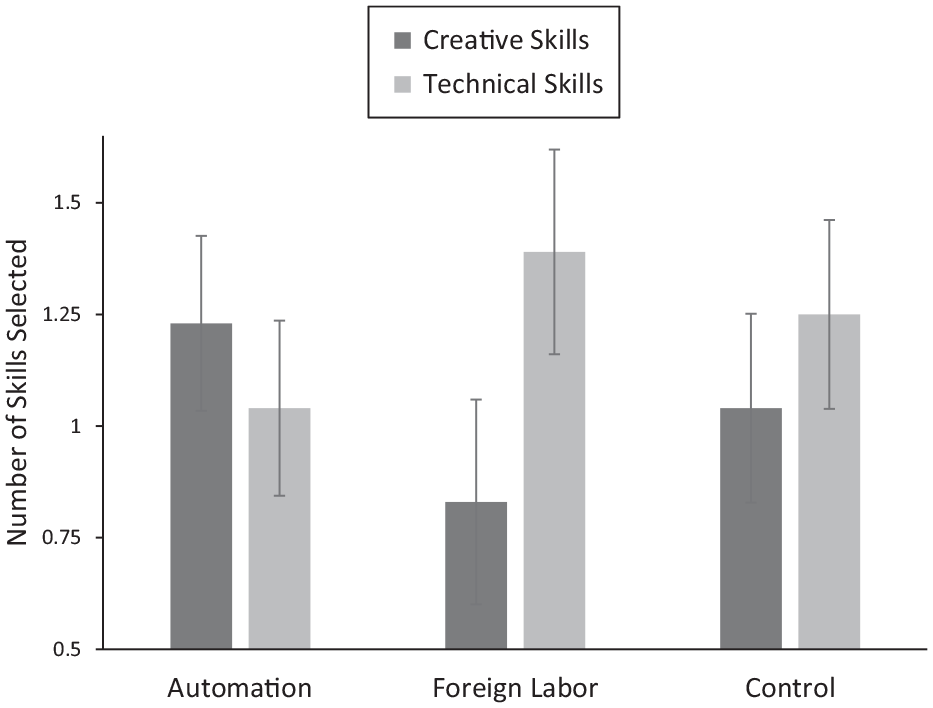
Mean number of skills selected to display on job application as a function of type of skill and condition among STEM students in Study 2a.
Skill Acquisition
A mixed-model ANOVA revealed only the predicted interaction between condition and type of course, F(2, 284) = 6.79, p = .001,
As displayed in Figure 6, participants in the automation condition selected more courses related to developing creativity (M = 1.80, SD = 0.94) than courses related to developing technical skills (M = 1.20, SD = 0.94), t(284) = 3.46, p < .001, d = 0.32. In contrast, in the foreign labor condition, participants did not select more courses related to developing creativity (M = 1.66, SD = 0.94) compared to courses related to developing technical skills (M = 1.34, SD = 0.94), t(284) = 1.54, p = .124, d = 0.17. Similarly, in the neutral control condition participants did not select more courses related to developing creativity (M = 1.33, SD = 0.91) compared to courses related to developing technical skills (M = 1.67, SD = 0.91), t(284) = 1.76, p = .080, d = 0.19.
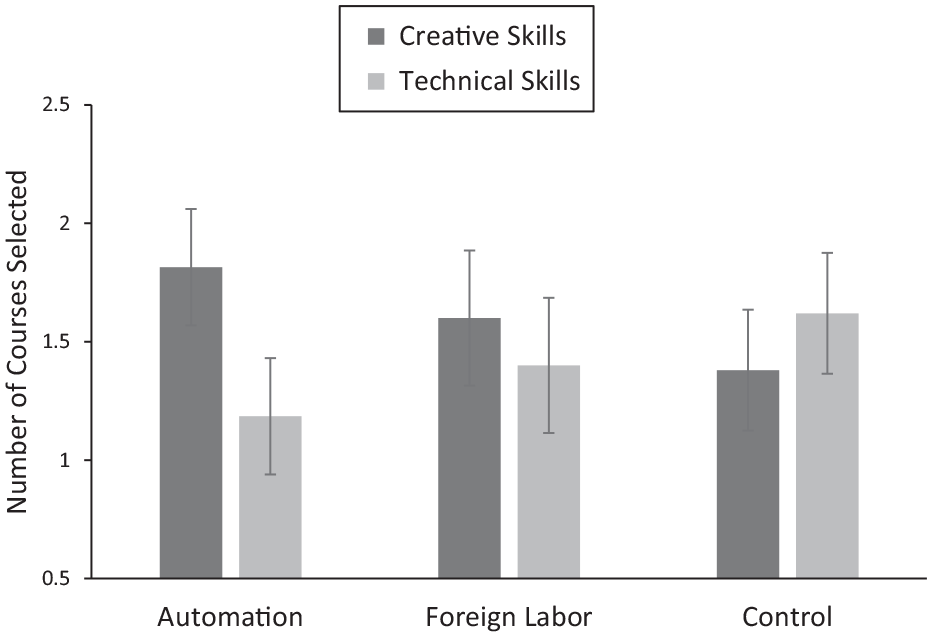
Mean number of courses selected as a function of type of skill and condition among STEM students in Study 2a.
Consistent with Studies 1a to 1c, Study 2a suggests that STEM students approaching their entry into the workforce demonstrated a preference for creative skills when confronted with the threat of automation. Specifically, participants in the automation condition showcased creative skills on their job applications more prominently than those in the foreign labor condition. While the emphasis on creative skills in the automation condition did not differ significantly from the neutral control condition, the observed trend aligned with our predictions.
Furthermore, Study 2a sheds light on the educational aspirations of STEM students, revealing a heightened inclination to invest in further education for creative abilities, as opposed to purely technical ones. The significant interaction between labor market condition and type of skill suggests that the threat of automation and AI nudges participants toward a preference for creative educational opportunities over technical ones, especially when contrasted against other labor market threats.
Study 2b
Study 2b builds on the findings of Study 2a by examining how automation influences skill acquisition for professionals working in graphic design, a group that uses both technical and creative skills.
Methods
Participants
We recruited professional graphic designers in the United States through the freelancing platform Upwork for paid participation. Of the 122 graphic designers initially hired, 13 were excluded for failing an attention check and 19 for not having a college degree, per our a priori exclusion criteria. The final sample consisted of 90 participants (48 females, 38 males, 4 other/prefer not to say, mean age = 31.98, SD = 10.09). A sensitivity power analysis indicated 80% power to detect an effect as small as Cohen’s d = 0.60.
Procedure
Participants read that they were participating in a survey examining graphic designers’ responses to industry trends. They were randomly assigned to one of two conditions, each presenting distinct labor market trends using language identical to Study 2a.
In the automation competition condition, participants were exposed to information detailing the rapid technological changes in the graphic design field. In the foreign labor competition condition, participants were exposed to information about the rapid demographic changes in the graphic design field.
Skill Acquisition
Following the experimental manipulation, participants were asked about their interest in acquiring additional training to stay competitive. They were told they could win a $100 Coursera (an online educational platform) gift certificate through a post-study lottery and instructed to choose 3 courses from a list of 13 related to graphic design. The courses included were all genuine options available on Coursera and recommended for graphic designers. These courses included five focusing on technical skills (e.g., Business Statistics and Analysis, HTML, CSS, and JavaScript for Web Developers, Coding for Designers, Managers, and Entrepreneurs), five on creative skills (e.g., Creative Thinking: Techniques and Tools for Success, Innovation Through Design: Think, Make, Break, Repeat, and Design Thinking for Innovation), and three on other skills unrelated to creative or technical skills (e.g., Budgeting and Scheduling Projects, Work Smarter, Not Harder: Time Management for Personal and Professional Productivity, and Project Management and Other Tools for Career Development Specialization).
We calculated the total number of creative (M = 1.30, SD = 1.09) and technical (M = 1.11, SD = 1.09) courses selected by each participant.
Results
A mixed-model ANOVA revealed only a significant interaction between condition and type of course, F(1, 176) = 4.89, p = .028,
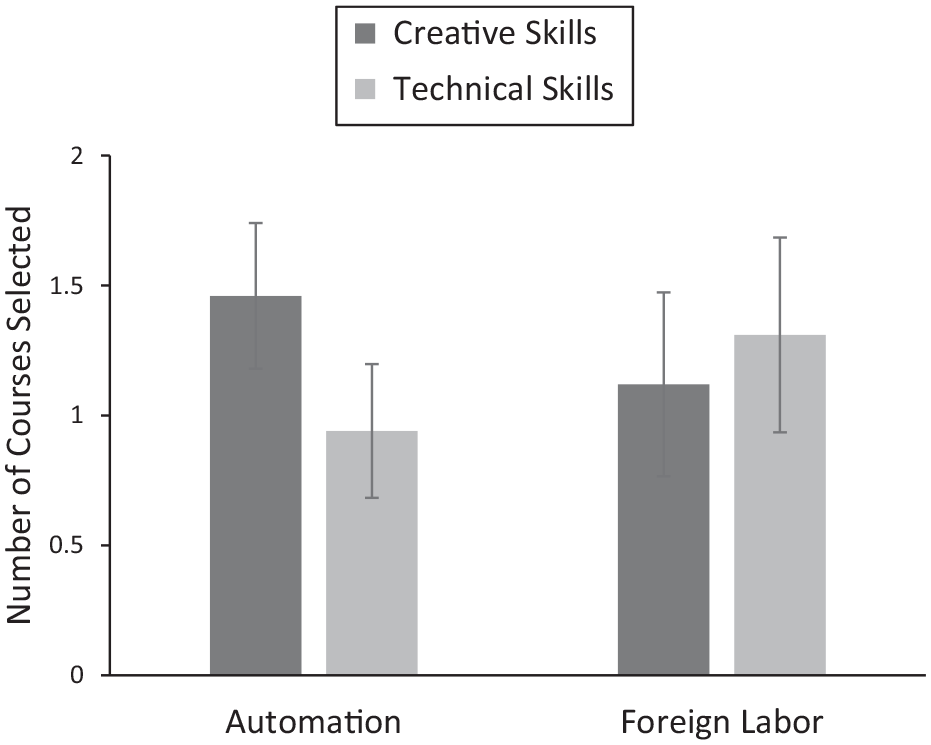
Mean number of Coursera courses selected as a function of type of skill and condition among graphic designers in Study 2b.
Building on findings from Study 2a, Study 2b further underscores the nuanced impact of automation threat on skill acquisition. Although the threat of automation compared to that of foreign labor did not significantly alter the absolute number of creative or technical skills selected, the relative emphasis individuals placed on creative versus technical skills did vary by labor market threat. Specifically, the automation threat compared to the foreign labor threat increased people’s preferences toward courses that cultivate creative abilities over technical abilities. This pattern further indicates that the automation threat may subtly shift professionals’ skill acquisition priorities, emphasizing creativity as a means to navigate an evolving job market.
Study 3
Building on previous studies, Study 3 examines how automation threats influence jobseekers’ preferences for employers. While prior studies focused on skill presentation and acquisition in response to automation, this study explores whether automation threats lead individuals to favor companies that emphasize creativity and innovation over those that prioritize analytical abilities and rationality.
Methods
Participants
We recruited 238 full-time working adults via Amazon Mechanical Turk for paid participation. After excluding 11 participants with repeat IP addresses and 18 who failed an attention check, the final sample consisted of 209 participants (107 females, 102 males, mean age = 38.58, SD = 23.08). A sensitivity power analysis indicated 80% power to detect effects as small as w = 0.19.
Procedure
Participants, imagining themselves as recent, highly qualified graduates entering the job market, were randomly assigned to one of two conditions where they read about labor market trends using the same language as Studies 1a to 1c. In the automation competition condition, they read about increased competition with AI and automation, while in the foreign labor competition condition, they read about competition from foreign workers and immigrants.
Participants then read excerpts from two companies’ recruiting messages: one emphasizing a creative culture valuing innovation and originality, and the other an analytical culture valuing systemic approaches and practical solutions.
Company Choice
After reading the messages, participants selected which company they were most interested in applying for a job.
Results
Condition significantly influenced choice of company, X2(1, N = 209) = 4.75, p = .029, w = 0.15, such that participants exposed to automation threat selected the company with a creative culture over the company with an analytical culture (73%) more frequently than those exposed to foreign labor threat (58%).
Whereas Studies 1a to 2b showed that automation threats could increase people’s valuation of creative skills, Study 3 extends these findings by showing that automation threats increase the value people place on organizations that might enable them to demonstrate these skills. That is, these results suggest that the threat of automation can shift people’s preferences toward companies that emphasize creativity and innovation. Individuals might perceive that organizations valuing creativity can better withstand the challenges posed by automation and AI, potentially offering a more secure and stable career path.
In addition, Study 3 included exploratory measures to assess participants’ creative self-efficacy and creative self-concept, examining whether the threat of automation and AI would influence their beliefs about their own creative abilities. The analyses revealed no significant differences in creative self-efficacy or creative self-concept across conditions, suggesting that although the labor market competition influenced participants’ company preferences, it did not alter their personal beliefs about their creative capabilities. These findings indicate that the observed shift in company preferences toward creative cultures is driven more by external labor market threats rather than changes in self-perception regarding creativity.
Study 4a
Study 4a was a preregistered study (https://aspredicted.org/h4ft-yj3m.pdf) that sought to investigate the skills people emphasize on a job application in light of the rise of advanced machines such as generative AI. Given the growing public interest in generative AI’s capacity for creative work (e.g., Cremer et al., 2023; Press, 2023; Thompson, 2022), this study aimed to examine how information about job threat from generative AI—relative to threat from automation more broadly and from foreign labor—impacts the choice of skills emphasized in a job application.
Methods
Participants
We recruited 359 participants via Amazon Mechanical Turk for paid participation. After excluding 6 participants with repeat IP addresses and 10 who failed an attention check, the final sample comprised 343 participants (157 females, 186 males, mean age = 43, SD = 12.08). A sensitivity power analysis indicated 80% power to detect omnibus effects as small as f = 0.17.
Procedure
Procedures mirrored Study 1a but included an additional condition featuring competition from generative AI. Participants were randomly assigned to one of three conditions, each presenting different labor market trends. Descriptions in the automation and foreign labor competition conditions remained consistent with Studies 1a to 1c. In the generative AI competition condition, participants were informed about the disruptive impact of generative AI and its ability to produce creative content.
Skill Selection Measure
Following the labor market trends, participants selected three skills from a list of 10 to highlight in their cover letter, including the four creative, four technical, and two filler skills from Study 1b. Two skills’ indices were calculated: the total number of creative skills selected (M = 1.68, SD = 0.96) and the total number of technical skills selected (M = 0.73, SD = 0.89).
Results
A mixed-model ANOVA revealed a main effect for type of skill such that, overall, participants chose to highlight more creative skills than technical skills, F(1, 680) = 186.80, p < .001,
As displayed in Figure 8, participants in the generative AI, general automation and AI, and foreign labor conditions all selected to highlight more creative skills than technical skills in their job applications, all ts > 3.79, all ps < .001, although those in the foreign labor condition preferred creative skills over technical skills to a lesser extent.
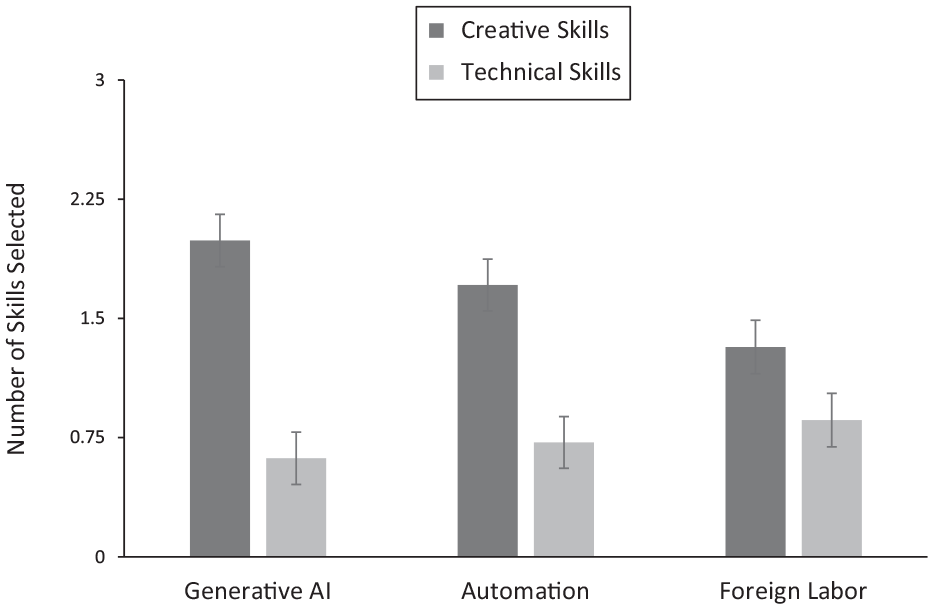
Mean number of skills selected to display on job application as a function of type of skill and condition in Study 4a.
These findings replicate and extend Studies 1a to 2b by showing that people continue to prioritize creativity in the face of automation—even when the technology (e.g., generative AI) is described as having creative capabilities. Despite growing public awareness of AI’s creative potential, participants still preferred to highlight creativity over technical skills in job applications, suggesting durable beliefs about its value. Participants exposed to a foreign labor threat also favored creative skills, though less strongly. As this was the first study conducted after the release of ChatGPT, heightened awareness of AI’s impact on employment may have shaped responses across conditions.
Study 4b
Study 4b, a preregistered study (https://aspredicted.org/y4gs-tnd5.pdf) builds on the findings from Study 4a by examining whether framing generative AI as excelling in specific domains—creative or analytical/computational tasks—affects the skills people prioritize. This study tested whether individuals continue to emphasize creative skills when generative AI is described as particularly good at either creative or technical tasks.
To explore this, Study 4b used a new prompt and context: participants were asked to consider how they would present themselves on LinkedIn, a professional platform, shifting the focus from job applications to public skill presentation. This change allowed us to examine how skill emphasis might differ in a professional, publicly visible setting in response to AI capabilities.
Study 4b did not include the foreign labor or control conditions, as previous studies had already demonstrated that participants show a weaker preference for creative skills in these conditions. By focusing solely on generative AI’s domain-specific capabilities, we aimed to deepen our understanding of how different AI threats influence individuals’ skill presentation strategies.
Methods
Participants
We recruited 400 participants via Amazon Mechanical Turk for paid participation. After excluding 87 who failed an attention check, the final sample comprised 314 participants (177 females, 127 males, 10 others, mean age = 42.22, SD = 6.26). A sensitivity power analysis indicated 80% power to detect omnibus effects as small as f = 0.18.
Procedure
Participants were told the study examined how professionals present themselves on LinkedIn in response to changes in the labor market. They were then randomly assigned to one of three conditions, each emphasizing different AI capabilities: (1) a General AI condition, which described AI’s general capabilities, (2) an Analytical AI condition, which described AI’s proficiency in computational and analytical tasks, and (3) a Creative AI condition, which described AI’s proficiency in creativity. A pilot study indicated that participants successfully distinguished AI’s domain-specific capabilities: those in the creative AI condition rated its creative ability higher than those in the general and analytical AI conditions, while participants in the analytical AI condition rated its analytical ability higher than those in the general and creative AI conditions. This confirms that the manipulations effectively conveyed the intended domain-specific capabilities of AI (see Supplemental Material for details).
Skill Selection
Following the manipulation, participants selected three skills from a list of 10 to highlight on their LinkedIn profiles to attract potential employers in an AI-driven job market. The list included the same four creative, four technical, and two filler skills from Study 1b.
Two skills’ indices were calculated: the number of creative skills selected (M = 1.56, SD = 0.93) and the number of technical skills selected (M = 0.63, SD = 0.85).
Results
A mixed-model ANOVA revealed a main effect for type of skill such that, overall, participants chose to highlight more creative skills than technical skills, F(1, 622) = 173.39, p < .001,
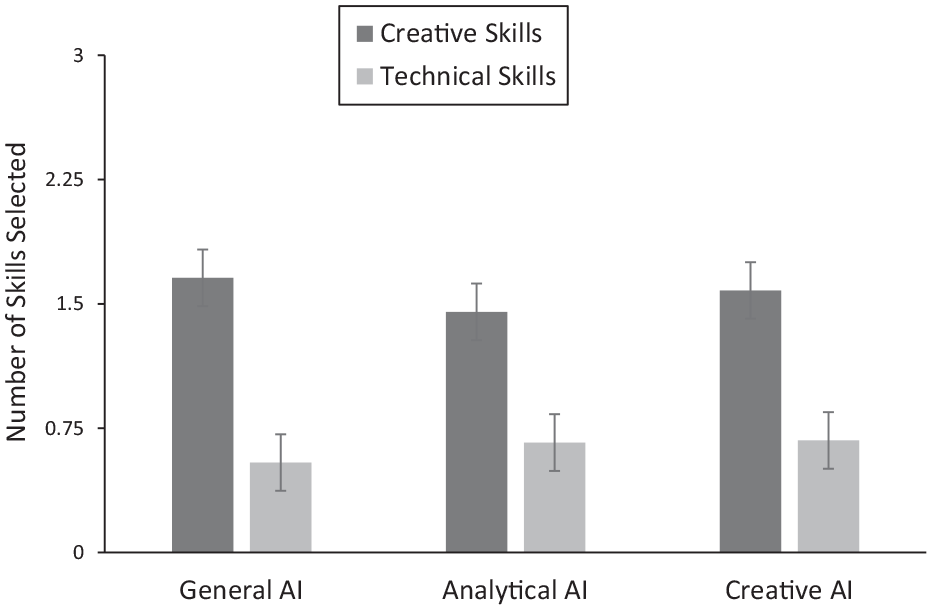
Mean number of skills selected to display on LinkedIn profile as a function of type of skill and condition in study 4b.
Across all three conditions, participants consistently prioritized creative skills over technical skills, regardless of whether generative AI was described as excelling in creative or analytical tasks. These findings build on Studies 1a to 4a, suggesting that AI threats reliably activate a valuation of creativity, even when AI is framed as capable of creative work. Together, Studies 4a and 4b reveal a consistent pattern: whether AI is described generally, as creative, or as analytical, people favor creativity—likely because they view it as both irreplaceable by and complementary to AI.
As in Study 3, Study 4b also explored whether AI framing affected participants’ creative self-efficacy and identity. Results demonstrated that it did not, suggesting that framing AI’s capabilities does not shift people’s broader beliefs about their own creativity (see Supplemental Material).
Internal Meta-analyses of Automation’s Impact on Skill Prioritization
We conducted an internal meta-analysis to examine how automation threats influence the emphasis on creative versus technical skills. Using an inverse-variance weighted (fixed effect) approach with Cohen’s d as the effect size, we compared automation competition to foreign labor competition conditions across Studies 1a, 2b, and 4. In Studies 1b, 1c, and 2a, we combined foreign labor and control conditions for comparison. For Study 2b, which only assessed education preferences, we used the total count of creative and technical courses.
Our analysis revealed a medium effect of automation threat on the preference for creative skills (d = 0.49, Z = 8.99, 95% CI [0.38, 0.59]), and a smaller effect on technical skills (d = 0.17, Z = 3.21, [−0.28, −0.07]). This indicates that automation, compared to other labor market threats, prompts individuals to prioritize creative skills while de-emphasizing technical skills in job applications.
A follow-up analysis using the difference score between creative and technical skills across conditions showed a small-to-medium effect (d = 0.36, Z = 6.23, 95% CI [0.25, 0.46]). These results suggest that automation threat leads participants to prioritize creative over technical skills more strongly than other labor market threats, highlighting automation’s robust impact on the prioritization of creativity.
General Discussion
Our research investigated how automation threat influences the value placed on different skills and professional development choices. A pilot study showed that compared to other common workplace skills such as technical or social skills, people view creative skills as less likely to be replaced by machines and more valuable in an automated future. The next eight experiments demonstrated a consistent preference for creative skills in individuals’ preparatory behaviors in anticipation of automation.
Studies 1a to 1c revealed that people exposed to job threat from automation (compared to other job threats) emphasized creative abilities in job applications. Studies 2a to 2b revealed that job threat from automation (compared to other job threats) prompted STEM students and graphic designers to acquire additional creative skills, rather than technical skills. Study 3 demonstrated that peoples’ preference for creativity in the face of automation extends to preferences to work for a company with a creative culture versus an analytic one.
Study 4a found that even with heightened public awareness of AI’s creative abilities, individuals continued to emphasize creative skills over technical skills in response to automation threat. In Study 4b, people opted to highlight creative skills on their LinkedIn profiles in response to automation threat, even when AI was described as excelling in creative domains. Additional results from internal meta-analyses confirmed a consistent pattern: when confronted with automation threat, individuals prioritized creative over technical skills.
Overall, these results demonstrate that exposure to automation as a threat to one’s employment leads individuals to prioritize creativity. This is evident in their job applications, professional profiles, and preference for employers who value creativity. When faced with automation threats and required to choose between different skills, individuals consistently prioritize creativity due to its perceived unique value and irreplaceability in the face of AI. This strategic emphasis occurs particularly under resource constraints, highlighting the practical implications of our findings in real-world settings.
It’s important to note, however, that our results do not suggest that other skills, such as technical skills, are perceived as less important in all contexts. In scenarios without forced trade-offs, such as in Study 1c, participants valued both creative and technical skills to a statistically indistinguishable degree. This suggests a recognition of their potential complementarity and underscores that in less constrained environments, individuals may appreciate a broader synergy between skills, which might be crucial for navigating a complex, AI-driven job market.
The concept of skill complementarity is particularly relevant as it suggests that the future workforce, when faced with the threat of automation, might increasingly pursue a blend of diverse skills that enhance each other. Therefore, future research should explore how individuals perceive the interdependencies between skills and integrate these perceptions into their career planning and development strategies.
Potential Mechanisms Underlying the Prioritization of Creativity in Contexts of Skill Trade-offs
Findings across studies suggest several potential mechanisms explaining why individuals consistently prioritize creativity when faced with the need to choose between different skills in response to automation threats. One plausible mechanism is the perception that creativity is a distinctively human trait that AI cannot fully replicate. Even with AI’s advancements, people may view human creativity as fundamentally distinct from AI’s capabilities, and therefore a unique capacity that they can showcase to outpace machines. Indeed, research suggests that AI-created art is often perceived as less creative or valuable than that made by humans (Horton et al., 2023; Millet et al., 2023). This implies that people may see their creative contributions as having an irreplaceable value that AI cannot match, leading them to emphasize creativity in self-presentations to highlight uniquely human skills. This strategic positioning could be a conscious or unconscious response to the belief that, as AI replaces more routine tasks, the human workforce will be more valued for their creative and innovative contributions.
Another potential mechanism is creativity’s significant bearing on personal identity and self-worth. Even if AI is seen as capable of producing creative work, individuals may be motivated to highlight their creativity because they are motivated to see themselves as distinctively human (Haslam, 2006; Loughnan & Haslam, 2007). This perspective aligns with theories of self-enhancement, where individuals emphasize traits that distinguish them from others, or in this case, machines (Alicke & Sedikides, 2011; Leary, 2007). Exposing people to AI can activate negative responses ranging from feelings of competition to job insecurity (Lysyakov & Viswanathan, 2023) to threats toward deeper aspects of human identity and uniqueness (Złotowski et al., 2017). Interestingly, in both Studies 3 and 4b, participants did not report higher creative self-efficacy or stronger creative personal identity in the conditions where AI was framed as excelling in creative tasks. This suggests that their emphasis on creativity may not stem from changes in how they actually evaluate their own creative abilities, but rather from a desire to defend and affirm creativity as a core human trait.
A final possible mechanism is that people might gravitate toward creativity when faced with uncertainty about technological advancements. The perceived versatility, adaptability, and future-proof nature of creative skills might lead individuals to prioritize them, particularly as AI capabilities—whether technical, creative, or general—evolve. This could explain why participants consistently prioritized creativity across different AI conditions, suggesting that creativity is seen as a more universally valuable skill in uncertain job environments.
These mechanisms could be interconnected, collectively reinforcing the emphasis on creativity. Future research should delve deeper into these dynamics to determine how they contribute to the observed trends. Understanding these underlying processes will enhance our knowledge of how people adapt to automation threats and evolving professional environments.
Theoretical Implications
This research directly contributes to research on the future of work and the psychology of technology (e.g., Fast & Schroeder, 2020; Raveendhran & Fast, 2021) by demonstrating how beliefs about automation and AI’s impact on work can influence preparatory behaviors. While extensive research has explored interactions with robots and technological agents (e.g., Waytz et al., 2014; Tay et al., 2013) and factors driving technology adoption (e.g., Dietvorst et al., 2015; Jago et al., 2022; Logg et al., 2019; Longoni et al., 2018), less is known about how technology adoption shapes expectations of workplace changes. Emerging research in psychology (Gamez-Djokic & Waytz, 2020; Jackson et al., 2020) and economics (e.g., Dal Bo et al., 2018; Frey et al., 2018) examines how perceptions of automation’s impact influence behaviors and attitudes, and our work is among the first to explore how these beliefs affect career and educational choices.
Our findings also extend previous theorizing on the impact of technology on employment (e.g., Acemoglu & Autor, 2011; Arntz et al., 2016; Autor, 2015; Autor et al., 2013; Bessen, 2015; Frey & Osborne, 2017). Previous work suggests that while routine tasks are more easily automated, nonroutine tasks, such as tasks requiring interpersonal skills or creativity, are more difficult to automate and will thus increase in value with automation. Our findings highlight important nuances in the way people conceptualize automation’s ability to impact different skills. Specifically, although people perceive social skills to be safe from automation, people also believe these skills will decrease in value with automation. Instead, people perceive creative skills as safe from automation and as increasing in value and therefore prioritize these skills in their educational choices. Thus, these results suggest that people’s perceptions of automation can have important consequences for employment. For instance, the actual supply of skills (i.e., the skills available in the workforce) may shift to reflect the skills workers are prioritizing. Therefore, understanding people’s expectations and perceptions of automation and AI can provide a richer understanding of the determinants of skill acquisition.
Practical Implications
Our findings have significant implications for curricular design in higher education. As exposure to new technologies like AI increases, academic programs may need to provide offerings on creative problem-solving and innovation to align with the skill sets increasingly sought by students and professionals. This may involve reimagining technical disciplines to embrace interdisciplinary methods that integrate and emphasize creativity.
Our findings also have important implications for organizational talent retention and recruitment amidst technological changes. The introduction of technologies like automation and AI often incites job insecurity and anxiety about the impacts on existing roles. Many workers fear that automation may bring detrimental changes to their jobs(Khan, 2019). In addition, workplace automation can lead to concerns among job applicants about future job loss or the necessity of extremely steep learning curves. Organizations can mitigate these concerns by valuing distinctly human skills, like creativity. By promoting a culture that emphasizes these uniquely human attributes, companies can help alleviate fear and retain talent more effectively during technological transitions.
Finally, the enhanced value placed on creativity as a result of automation and AI may influence broader societal behaviors. For instance, as automation concerns heighten the value of creativity, people might gravitate toward communities rich in art and culture, which align with creative career opportunities. Research indicates that such environments attract skilled labor and the companies that seek it, potentially enhancing the draw of “creative class” cities (e.g., Glaeser et al., 2001; Florida, 2002). These shifts in preference, driven by automation’s impact on work and skills, could significantly influence the distribution and movement of talent.
Future Directions
Our findings have several limitations that suggest directions for future research. First, while we focused on college-educated individuals because they have more flexibility in terms of career progression and skill acquisition, it remains unclear how those lacking higher education might respond to technological threats. They might prioritize technical skills as a basic employment criterion. Additionally, highly specialized individuals might view skill trade-offs differently depending on their field—for example, a computer scientist may prioritize technical skills, while an artist may not. Future research should explore how educational backgrounds and occupational specializations influence perceptions of skill value in the context of rising automation.
A further limitation of this study is the restricted range of specific skills that participants were allowed to highlight. Other skills might also be viewed as both non-substitutable and highly complementary to automation, and future research can investigate perceptions regarding skills beyond the purely technical, social, and creative ones examined here.
Conclusion
While extensive literature has examined the impact of automation on employment, less attention has been paid to the proactive strategies workers use to adapt. Our research highlights workers’ beliefs in the importance of creative skills as a response to automation and AI. These beliefs shape their job-seeking behavior, prompting them to enhance and emphasize creative skills and seek out organizations that prioritize such abilities. Whether this approach is truly effective in maintaining a competitive edge or simply a psychological strategy to preserve one’s sense of humanity in an increasingly automated world remains an open question for future research.
Supplemental Material
sj-docx-1-psp-10.1177_01461672251337126 – Supplemental material for Poets Over Quants: Automation and AI Threats Increase the Value People Place on Creativity
Supplemental material, sj-docx-1-psp-10.1177_01461672251337126 for Poets Over Quants: Automation and AI Threats Increase the Value People Place on Creativity by Monica Gamez-Djokic, Adam Waytz and Maryam Kouchaki in Personality and Social Psychology Bulletin
Footnotes
Declaration of Conflicting Interests
The author(s) declared no potential conflicts of interest with respect to the research, authorship, and/or publication of this article.
Funding
The author(s) received no financial support for the research, authorship, and/or publication of this article.

Supplemental Material
Supplemental material is available online with this article.
References
Supplementary Material
Please find the following supplemental material available below.
For Open Access articles published under a Creative Commons License, all supplemental material carries the same license as the article it is associated with.
For non-Open Access articles published, all supplemental material carries a non-exclusive license, and permission requests for re-use of supplemental material or any part of supplemental material shall be sent directly to the copyright owner as specified in the copyright notice associated with the article.
