







Abstract
Advice-giving is a key form of social support, yet little is known about how its style varies across cultural contexts. Across three studies, we examined how Americans, Chinese, and Indians give, evaluate, and culturally transmit advice, drawing on the cultural logics of idiocentrism, dialecticism, and allocentrism. In Study 1, open-ended data revealed culturally distinct styles: autonomous advice among Americans, contingent advice among Chinese, and direct advice among Indians. In Study 2, participants preferred their culture’s normative style, with these preferences driven by culturally rooted motives: self-esteem for Americans (reflecting idiocentric values), option generation for Chinese (reflecting dialectical thinking), and fulfilling responsibility for Indians (reflecting allocentric values). Study 3 analyzed children’s storybooks, revealing that these advice styles are reflected in everyday cultural products. These findings suggest that advice-giving is a culturally embedded practice shaped by deeper moral and epistemic values, extending beyond the traditional individualism–collectivism framework.
Introduction
Advice, which has been defined as a “recommendation about what to do, think, or feel to cope with a problematic situation” (Feng & Magen, 2016, p. 752), is one of the most frequently offered forms of social support (Goldsmith, 2000). People around the world commonly offer advice to individuals in their social support networks who are facing personal dilemmas. However, the way advice is given may vary across cultures. Understanding cultural variation in styles of advice is crucial in our increasingly interconnected world (Hamamura, 2012). Misalignments in advice-giving can lead to misunderstandings or offense, underscoring the importance of examining how cultural beliefs shape the ways advice is offered.
Advice-Giving as a Form of Social Support
Social support is commonly differentiated into emotional versus problem-focused forms. Emotional support involves verbal or physical expressions of comfort and validation aimed at alleviating emotional distress, whereas problem-focused support involves addressing a concrete problem that a help seeker is experiencing. Problem-focused support is assumed to encompass the provision of tangible help to address the recipient’s problem, or verbal guidance, such as advice, about how to appraise and respond to the problem (Chen et al., 2012; Cobb, 1976; Taylor et al., 2007; Wills, 1985).
Cross-cultural research involving United States and East Asian populations has found cultural variation in the frequency of using emotional support vs problem-focused support, as well as in the degree of comfort individuals feel in seeking support. Americans show a stronger preference than Chinese for emotional relative to problem-focused support (Burleson & Mortenson, 2003; Chen et al., 2012; Mortenson, 2009; Uchida et al., 2008). In contrast, individuals from East Asian cultural contexts tend to place relatively greater emphasis on problem-focused forms of support, particularly when such support can be provided implicitly rather than overtly (Kim et al., 2006, 2008). Consistent with this pattern, people from East Asian cultures report greater discomfort in requesting social support, especially seeking emotional support, compared to those from individualistic cultures, which is seen as arising, in part, from East Asians’ concerns about burdening others and disrupting relational harmony (Ishii et al., 2017; Taylor et al., 2004, 2007).
Despite extensive research on social support, most existing work has focused on problem-focused social support without distinguishing between whether the support involves concrete help or advice. This type of stance can be seen, for example, in the “instrumental” items on the Brief Cope (Carver, 1997), which combine helping and advice in the same item (e.g., “I am getting help or advice from someone”). As a result of not distinguishing advice from concrete help, relatively little is known about the culturally patterned norms that shape how advice is constructed, evaluated, and transmitted, or about the motivational and epistemic logics that give advice meaning.
The few studies in the communication literature that have focused on advice separately from other forms of social support have identified cases in which advice threatens the recipient’s face, or desired social self-image (Brown & Levinson, 1987; Goffman, 1967; Goldsmith, 2004), making it sensitive to culturally shaped norms governing autonomy and epistemic flexibility. Advice can challenge autonomy by implying that the recipient requires guidance or can disrupt relational harmony by imposing a definitive framing on a context-sensitive situation. Effective advice therefore requires careful message design to manage these and other potential concerns.
Importantly, what constitutes a face threat and how it should be managed varies across cultures. In American settings, advice needs to be evaluated not only in terms of autonomy preservation but also in terms of maintaining relational balance. For example, advice in U.S. contexts is often softened through disclaimers or embedded within expressions of empathy to protect recipients’ self-esteem and preserve their autonomy (Eskreis-Winkler et al., 2018; Goldsmith, 2004). In contrast, in many East Asian contexts, for example, face concerns extend beyond the concern with self-face found among Americans, but include as well concerns with other-face, and mutual-face, reflecting a broader orientation toward relational harmony and social interdependence (Ting-Toomey et al., 2001).
Together, this body of work indicates that advice is not simply the transmission of a recommendation but a relational act whose meaning depends on how it is framed, when it is offered, and what it communicates about the relationship. Supporting this view, Feng (2014) found that participants in both American and Chinese cultural contexts prefer advice to be offered in the temporal order of supportive behaviors, such as inquiry about the nature of the problem and emotional support being mentioned first. They also show that emotional support plays a more central role in American advice than in Chinese advice. Despite these insights, existing research provides only a partial account of how advice is enacted through distinct advice forms, leaving critical questions about advice styles and their cultural basis insufficiently addressed.
Unresolved Issues
Limited Attention to Styles of Advice
Despite considerable social psychological research on social support and communications research on advice-giving, little attention has been paid to variation in the style of advice. Although Feng (2014) presented advice in experimental vignettes, the content of this advice reflected a single, softened style commonly described in the communication literature as protecting the recipient’s self-esteem. For example, in a vignette involving a disgruntled employee concerned about not receiving a raise, the advice offered was framed tentatively and empathically (“If I were you, I’d probably talk to my boss about it. . .,” p. 929). While Feng varied the placement of advice relative to supportive elements, the style of advice itself was held constant, leaving open questions about how different advice styles operate across cultural contexts.
Limited Examination of Cultural Variation
Research on social support has also tended to treat East Asians as proxies for collectivism, obscuring important variation across different collectivist cultural contexts. Recent work challenges this assumption. For example, Miller et al. (2017) found that Indians reported greater comfort in seeking social support than both Japanese and Americans, a pattern linked to Indians’ communal norms, which emphasize moral responsibility to help close others. Similarly, Russians, another collectivist group, have been shown to give advice more frequently than Americans and to view advice as a feature of supportive interactions (Chentsova-Dutton & Vaughn, 2012). In contrast, much cross-cultural work on social support has relied on dichotomous models of individualism/collectivism that fail to capture these nuances (Feng, 2014; Kim et al., 2006, 2008; Taylor et al., 2004, 2007; Ting-Toomey & Oetzel, 2001). As a result, culturally distinct motivations for advice-giving, such as responsibility-based helping in Indian contexts, remain insufficiently theorized. Whereas East Asians may be cautious about offering advice due to concerns about disrupting harmony, South Asians may view advice as an appropriate expression of relational duty.
Theoretical Contribution
In the present investigation, we extend prior work on cultural variation in social support by moving beyond a simple individualism–collectivism distinction and by theorizing about which specific cultural orientations shape advice-giving, and how they generate qualitatively different advice styles. In terms of the cultural orientations, we focus on idiocentrism, allocentrism, and dialecticism, as these orientations capture distinct motivational and cognitive orientations relevant to advice-giving. Because advice involves recommending courses of action to another person, it has the potential to threaten the recipient’s autonomy and to alter relational dynamics. Therefore, in terms of underlying motivations, we focus on motivations to protect autonomy, enact relational obligation, and manage interpersonal and situational nuance.
We propose that idiocentrism, allocentrism, and dialecticism organize different responses to the interpersonal motivations inherent in advice giving. Idiocentrism emphasizes the self as an autonomous agent and should motivate concern for preserving the recipient’s sense of choice and self-worth, leading advice givers to avoid imposing solutions and instead offer reflections or experiences that support the recipient’s self-direction (Chen et al., 2012; Goldsmith & Fitch, 1997; Triandis, 1995). Allocentrism emphasizes the self as embedded in close relationships and should motivate a sense of duty to intervene on behalf of others, making direct and prescriptive advice a culturally appropriate expression of care rather than a violation of autonomy (Miller et al., 2011, 2017). Dialecticism emphasizes contextual sensitivity, tolerance for contradiction, and integrative reasoning, and should therefore motivate offering multiple possible solutions rather than a single fixed recommendation, allowing advisors to support action while maintaining harmony and flexibility (Peng & Nisbett, 1999; Spencer-Rodgers et al., 2010).
We sampled Americans, Indians, and Chinese because these groups instantiate different configurations of these orientations, allowing us to disentangle collectivism from dialecticism and to distinguish among forms of collectivist motivation. Americans tend to score high on idiocentrism and relatively low on dialecticism, making them well-suited for examining advice shaped by autonomy and self-esteem concerns. Indians and Chinese both score high on collectivism, but differ systematically in dialectical thinking and in the moral meaning of helping. Indian cultural contexts emphasize communal obligation and moral responsibility to close others, making allocentrism particularly salient, whereas Chinese contexts emphasize dialectical reasoning and harmony maintenance, making dialecticism more central for understanding advice-giving.
Our approach responds directly to critiques that East Asians are often treated as proxies for collectivism and that collectivism is assumed to uniformly predict relational caution or indirectness (Miller et al., 2017). By including Indians, we address evidence that some collectivist groups experience comfort, rather than hesitation, in offering support when helping is construed as a moral obligation. By including Chinese participants, we capture a form of collectivism in which contextual sensitivity and harmony, rather than duty, regulate interpersonal behavior. This framework allows us to specify which aspects of culture shape advice-giving rather than attributing differences to collectivism broadly.
On this basis, we hypothesized to observe culturally systematic differences in advice-giving style driven by distinct underlying concerns. For Americans, we predicted an autonomous advice style, characterized by sharing personal experiences or reflections rather than prescribing direct solutions. We further predicted that this style reflects idiocentrism and the motivation to preserve the recipient’s autonomy and self-esteem (Chen et al., 2012; Goldsmith & Fitch, 1997; Triandis, 1995). By offering non-directive advice, Americans can be supportive while minimizing threats to the recipient’s agency and competence. For Indians, we predicted a direct advice style, marked by clear and assertive recommendations. We predicted that this style reflects allocentrism and a culturally grounded sense of responsibility to intervene on behalf of close others (Miller et al., 2011, 2017). In Indian relational contexts, helping is often construed as a moral obligation rather than a discretionary act, making direct advice an appropriate and valued expression of care rather than a violation of autonomy. For Chinese participants, we predicted a contingent advice style, characterized by offering multiple possible options rather than a single prescriptive solution. We further predicted that this style reflects dialectical thinking, which promotes tolerance for contradiction, contextual reasoning, and integrative problem-solving (Peng & Nisbett, 1999; Spencer-Rodgers et al., 2010). In advice-giving, dialecticism supports brainstorming and flexibility, allowing the advisor to assist without imposing a fixed solution, thereby maintaining harmony and relational balance.
We prioritized dialecticism over allocentrism in theorizing Chinese advice-giving because prior research shows that allocentrism alone yields mixed predictions in East Asian social support contexts (Kim et al., 2008; Miller et al., 2017). Dialecticism offers a more precise account of why Chinese advisors may avoid prescriptive advice while still providing instrumental input. Together, this framework clarifies why advice-giving varies not simply by individualism versus collectivism, but by the specific motivational and cognitive orientations that cultures cultivate.
Figure 1 depicts our conceptual model for how culturally dominant meaning systems are interrelated with advice motives, and advice styles. The bi-directional arrows indicate mutual constitution of culture and social support beliefs (Shweder, 1991). The three motives represent conceptually distinct rationales for advice-giving rather than a single underlying dimension. They are not equivalent in psychological or moral content; in particular, fulfilling responsibility more directly invokes moral obligation, allowing the model to capture advice-giving as role-based duty in some settings alongside autonomy support or instrumental guidance in others.
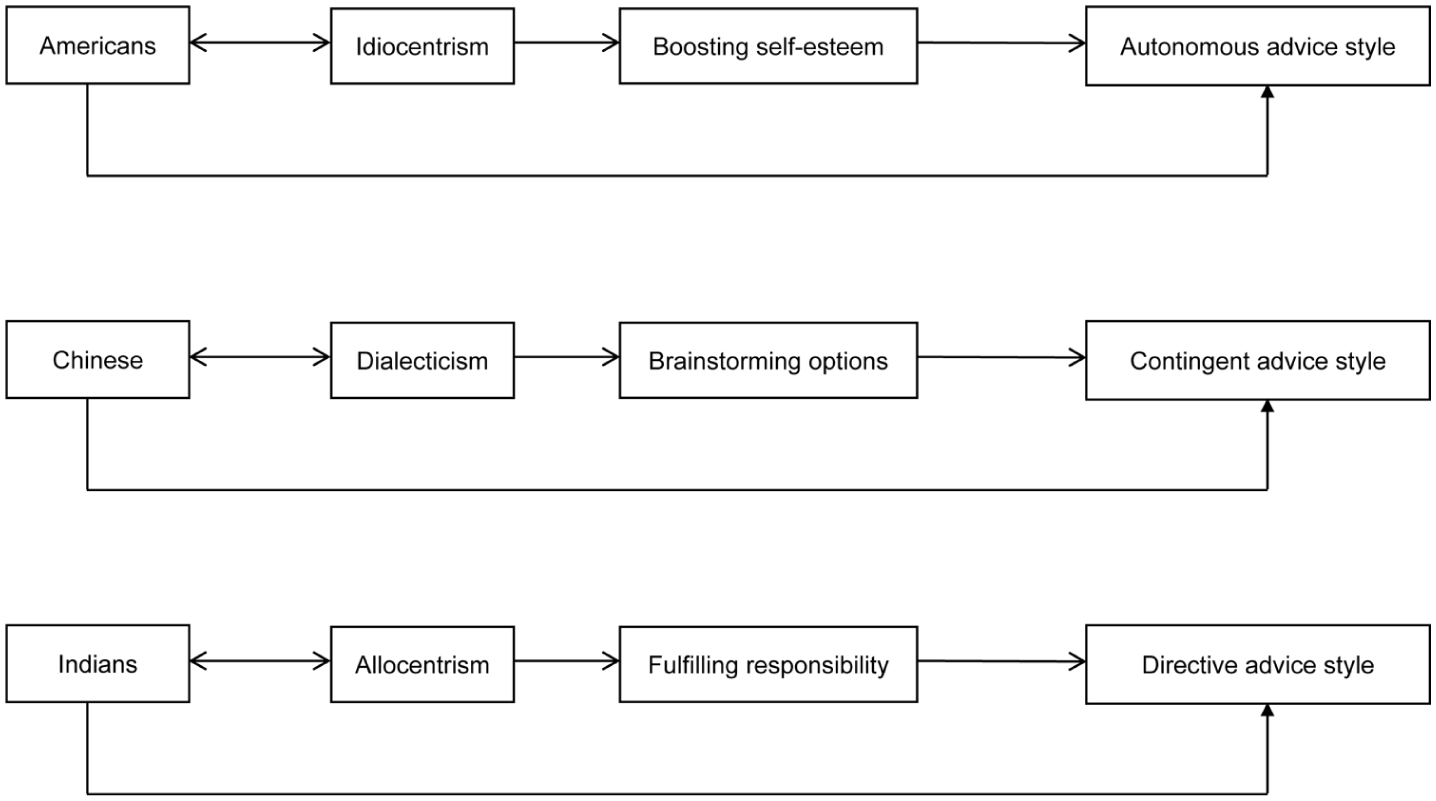
Theoretical model proposed in the investigation.
Goals of the Present Investigation
The present investigation examined cultural influences on advice-giving styles and their underlying motives through three studies using diverse methods, including experiments, surveys, and content analysis of children’s storybooks. In Study 1, we used vignette-based open-ended data to explore whether Americans, Chinese, and Indians spontaneously generate autonomous, contingent, and direct advice, respectively. Study 2 tested whether these culturally preferred advice styles were linked to broader cultural belief systems: idiocentrism among Americans, dialecticism among Chinese, and allocentrism among Indians. Study 3 extended the investigation to cultural products by analyzing children’s storybooks for the presence of these culturally distinctive advice styles.
We hypothesized that Americans would prefer autonomous advice that supports idiocentrism and self-esteem, with emotional support serving as a concomitant of this advice style; that Chinese would favor contingent advice reflecting dialectical thinking; and that Indians would gravitate toward direct advice grounded in role-based responsibility and allocentric values. We also expected that these culturally distinct advice styles would be embedded in cultural narratives found in young children’s storybooks.
Study 1
Study 1 examined whether American, Chinese, and Indian participants differ in their styles of giving advice. Some work has found that qualitative research can provide nuanced insights into human experiences, behaviors, and motivations, often overlooked by quantitative methods (Creswell et al., 2007). Therefore, in this study, we employed a research design that tapped participants’ advice in an open-ended way. We asked participants to spontaneously generate advice that they would give to a friend facing a personal dilemma. We expected that American participants would offer advice that supports the help seeker’s autonomy in decision-making. We expected that Chinese participants would offer advice that presents multiple options to the advice seeker, reflecting their beliefs in the co-existence of multiple truthful solutions to a problem. Lastly, we expected that Indian participants would give direct advice, openly sharing their views.
Furthermore, because advice-giving in everyday interactions often co-occurs with expressions of emotional support (Burleson & Mortenson, 2003; Feng, 2014; Goldsmith, 2004), we examined whether participants provided emotional support alongside advice. Including emotional support allows us to determine whether culturally distinct advice styles differ not only in what is recommended, but in how advice is relationally framed. We expected emotional support to be a central feature of the autonomous advice style, but to be minimal or largely absent in the contingent and direct advice styles, where advice is less oriented toward affirming the self and more toward contextual responsiveness or role-based responsibility.
Method
Participants
We conducted an a priori power analysis using G*Power 3.1 (Faul et al., 2009) for a one-way ANOVA (fixed effects, omnibus) with three groups. Assuming a medium effect size (f = 0.25; Gervais et al., 2015), α = .05, and 80% power, the required sample size was N = 159. Anticipating some attrition, we aimed to recruit 180 participants: 60 Americans and 60 Indians via CloudResearch-approved MTurk workers (Moss et al., 2023), and 60 Chinese via WeChat. All 180 participants completed the study (60 Americans: Mage = 32.7, SD = 8.337, 28 female and 32 male, 60 Chinese: Mage = 30.53, SD = 6.746, 17 male and 43 female; and 60 Indians: Mage = 33.65, SD = 9.444, 39 male and 21 female).
Materials and Procedures
Participants were asked to imagine that they had to give advice to a friend who was facing a dilemma. We sampled two types of dilemmas, a personal dilemma and a professional one. In the personal dilemma, which we label in this manuscript as the “affair” story, we told participants that the friend was contemplating whether they should inform their cousin that they witnessed the cousin’s husband having an affair. In the professional dilemma, which we label here as the “job” story, we told participants that the friend was contemplating whether they should accept a job offer from a less prestigious institution than the one they currently don’t enjoy working for. In constructing each vignette, we included information about both the problem aspect and the psychological stress aspect of the situation (see Supplemental Material for verbatim materials). 1 Participants were asked to generate open-ended responses with advice they would give to each of the friends via the question “Write down exactly what you think would be appropriate for Barbara/Rachel (the advice giver) to say to Alice/Jenny (the advice seeker).”
As manipulation checks, participants rated how common and serious each issue felt (1 = not at all, 7 = extremely). They also indicated whether they personally would recommend disclosing the affair (personal dilemma) or changing the job (professional dilemma).
Qualitative Coding
The coding scheme was developed in collaboration with researchers from China, India, and the United States. All open-ended responses were translated into English prior to coding to standardize the coding language and minimize identifiable cultural markers. Coders did not have access to participants’ nationality or demographic information and were blind to the study hypotheses. Two English-Chinese bilingual coders, one of Chinese origin and one of American origin, independently coded the full dataset. These coders received training focused on the consistent application of the coding manual, including operational definitions of the advice styles and practice coding of sample responses. Inter-rater reliability was strong for types of social support in both the personal (κ = .87, p < .001) and the professional dilemmas (κ = .86, p < .001), as well as for styles of advice in both personal (κ = .88, p < .001) and professional dilemmas (κ = .82, p < .001). Discrepancies were resolved through discussion amongst coders until consensus was reached.
We first coded each participant’s entire written response to determine whether it contained advice. We coded an answer as imparting advice if the participant provided a “recommendation about what to do, think, or feel to cope with a problematic situation” (Feng & Magen, 2016, p. 752). We then determined whether the response contained emotional support. We coded an answer as imparting emotional support if the participant provided support focusing on the recipient’s “emotional reaction” and involved “verbal attempts to comfort the recipient” (Chen et al., 2012, p. 4). Advice and emotional support were coded as separate, nonexclusive dimensions, such that a single response could include both. For example, a response like “I’m sorry you are going through this, I can only imagine how hard it must be.” is coded as containing only emotional support but no advice. In contrast, a response like “It will be better you told your cousin that her husband having affair. It is better for her future also. So don’t be confused, just tell her. It will be okay.” is coded as containing both advice component (“It will be better you told your cousin that her husband having affair. It is better for her future also. So don’t be confused, just tell her.”) and emotional support component (“It will be okay”).
Advice style coding was then applied only to the advice component of responses, which was assigned one and only one advice style: autonomous advice, contingent advice, or direct advice. A response fell into the autonomous category if it suggested a course of action while maintaining the advice seeker’s decision-making autonomy (e.g., “If I were you, I would tell her, but it is your choice”). It was deemed contingent if it presented multiple potential solutions based on possible variations in details of the situation (e.g., “If your cousin already knows, then tell her; otherwise, don’t tell her”). Responses were classified as direct advice if they provided direct instructions or clear guidance (e.g., “You must tell her immediately”). Advice style categories were mutually exclusive, reflecting the theoretical incompatibility among the advice styles. For example, a participant giving both autonomous and direct advice simultaneously or suggesting one clear solution alongside multiple options is theoretically implausible. Although the advice component could include multiple suggested actions, coding focused on how those suggestions were organized, not only on how many were offered; each advice component was therefore treated as a coherent recommendation reflecting a distinct advice style.
Results
Participants across cultures rated the personal and professional dilemmas as equally common and serious (Supplemental Tables 3A and 3B). Most chose to tell the cousin and to change jobs 2 (Supplemental p. S12, Table S4). No story effects were found for the key outcome variables (e.g., styles of advice), so responses for these variables were averaged 3 (Supplemental p. S12, Table S5). Given that gender was unequal in our samples, we performed robustness check and results held even after controlling for gender (Supplemental pp. S13–S14).
In total, 175 of the 180 participants offered advice and 55 of 180 participants offered emotional support. The three participants (two Indians and one American) who did not offer either advice or emotional support were dropped from data analysis. ANOVA with culture (United States, China, India) as the independent variable and advice as the dependent variable, revealed a non-significant effect of culture, F(2, 174) = 0.062, p = .940, η2 = .001. Americans (M = 94.07%, SD = 18.77, 95% CI [89.50, 98.60]), Chinese (M = 95.00, SD = 15.13 [90.50, 99.50]), and Indians (M = 93.97, SD = 18.91 [89.40, 98.50]) were equally likely to generate advice. ANOVA with culture as the independent variable and emotional support as the outcome, however, revealed a significant effect of culture, F(2, 174) = 8.424, p < .001, η2 = .088. Americans (M = 31.36, SD = 38.17 [23.70, 39.00]) were more likely to give emotional support than Chinese (M = 9.17%, SD = 19.51 [1.60, 16.80], Mdiff = .222, p < .001 [9.00, 35.40], d = 0.74) and Indians (M =17.24, SD = 28.94 [9.50, 25.00], Mdiff = .141, p < .001 [0.80, 27.4], d = 0.47).
Next, we examined cultural difference in styles of advice giving. We ran a mixed design ANOVA with culture (United States, China, India) as the between participant variable and advice styles as the within participant variable (autonomous, contingent, direct). We found a significant main effect of advice style, F(2, 348) = 3.86, p = .022, η2 = .022, qualified by a Significant Culture × Advice Style interaction, F(4, 348) = 35.83, p < .001, η2 = .292. The main effect of culture was not significant, F(2, 174) = .002, p = .998.
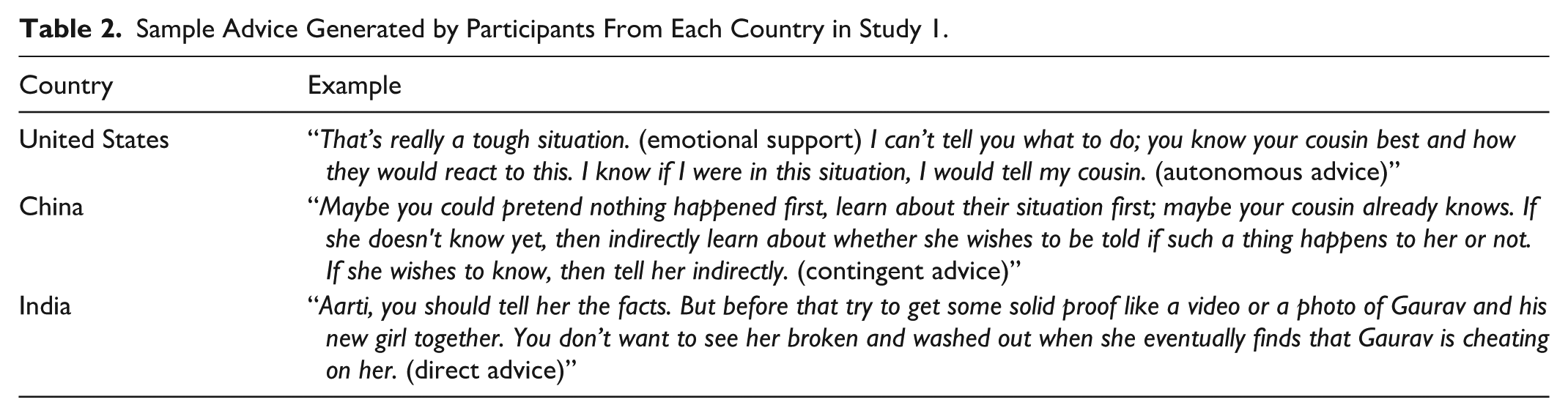
Bonferroni contrasts found that Americans were more likely than both Chinese (Mdiff = 0.359, p < .001, 95% CI [0.220, 0.497]) and Indians (Mdiff = 0.413, p < .001 [0.273, 0.553]) to provide autonomous advice. Chinese were more likely than Americans (Mdiff = 0.330, p < .001 [0.192, 0.468], d = 1.06) and Indians (Mdiff = 0.421, p < .001 [0.282, 0.560], d = 1.35) to provide contingent advice. Indians were more likely than Americans (Mdiff = 0.504, p < .001 [0.357, 0.650], d = 1.53) and Chinese (Mdiff = 0.474, p < .001 [0.327, 0.620], d = 1.44) to provide direct advice. We also looked at whether there was a dominant style of advice within each culture. We found that Americans preferred the autonomous advice style over the contingent (Mdiff = 0.322, p < .001 [0.156, 0.488], d = 1.03) and direct (Mdiff = 0.331, p < .001 [0.156, 0.505], d = 1.01) styles. Chinese preferred the contingent advice style over the autonomous (Mdiff = 0.367, p < .001 [0.202, 0.531], d = 1.17) and direct (Mdiff = 0.308, p < .001 [0.138, 0.479], d = 0.94) styles. Indians preferred the direct advice style over the autonomous (Mdiff = 0.586, p < .001 [0.410, 0.762], d = 1.78) and contingent style (Mdiff = .586, p < .001 [0.413, 0.795], d = 1.88). See Table 1 for means, standard deviation, and 95% confidence intervals, and Table 2 for sample responses.
Descriptive Statistics for Styles of Advice in Study 1.
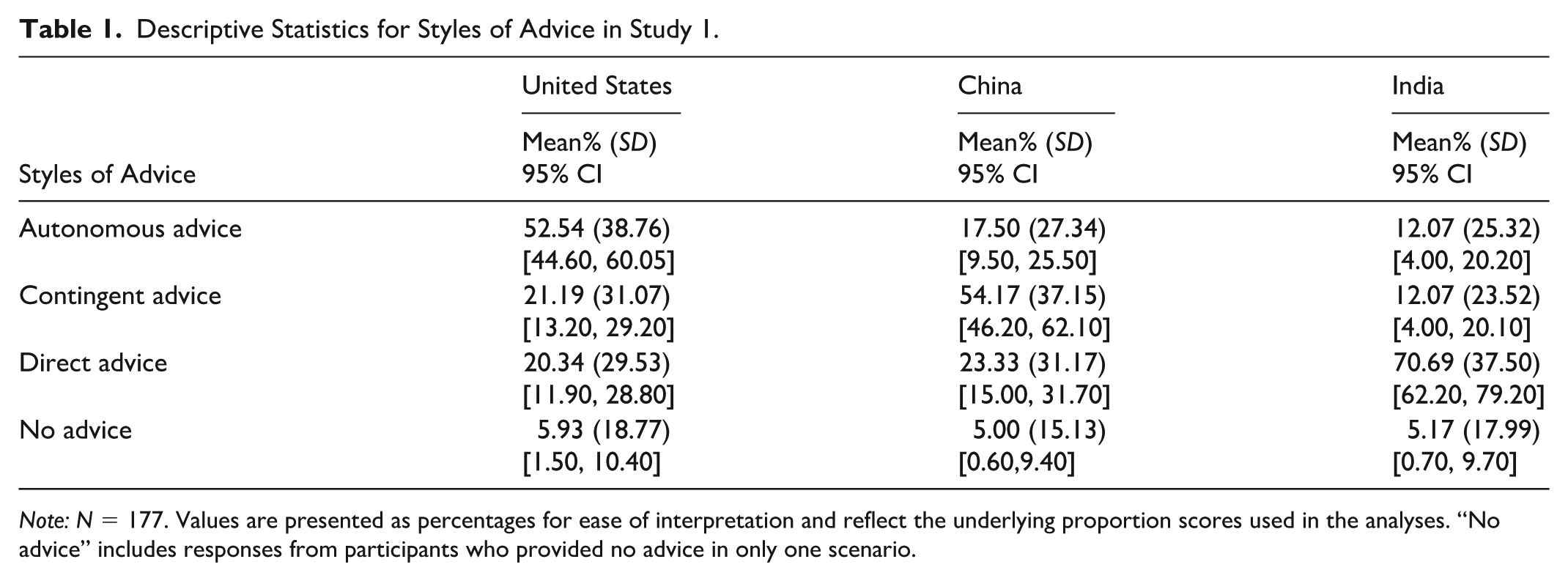
Note: N = 177. Values are presented as percentages for ease of interpretation and reflect the underlying proportion scores used in the analyses. “No advice” includes responses from participants who provided no advice in only one scenario.
Sample Advice Generated by Participants From Each Country in Study 1.
Lastly, we assessed whether emotional support was more likely to co-occur alongside autonomous compared to other styles of advice. As predicted, emotional support was substantially more likely to be present when autonomous advice was provided, r(177) = .44, p < .001. In contrast, emotional support was more likely to be absent when contingent, r(177) = −.17, p = .028, or direct r(177) = −.29, p < .001, advice was provided.
Discussion
Study 1 found that across cultures, people respond to a close friend’s dilemma with advice. However, the way in which they impart advice differs. As predicted, we found that Indians were most likely to offer direct advice, Americans were most likely to offer autonomous advice, and Chinese were most likely to offer contingent advice. By having participants respond to a friend’s dilemmas in an open-ended way, we were able to identify commonalities and differences in culturally normative styles of advice giving not only between different individualistic and collectivistic cultures but also between two collectivistic cultures.
As predicted, we also found stylistic differences in the use of emotionally supportive language. We found that autonomous advice was most likely to contain emotional support compared to other styles of advice. Prior work shows that emotional support plays a particularly central role in how advice is evaluated in U.S. contexts (Feng, 2014). We extend this past work by demonstrating that the presence of emotional support is not a universal feature of effective advice, but rather a culturally contingent marker of an autonomous advice style. By identifying advice styles that differ systematically in their reliance on emotional support, our findings show that advice can be normatively appropriate and effective even when emotional support is minimal, depending on the cultural meanings attached to advice-giving.
Although Study 1 provided valuable insights into culturally distinct advice styles, several limitations emerged. The open-ended format did not allow for direct comparisons of participants’ reactions to advice styles from the other cultures, which they may have preferred. Additionally, we did not assess the motives underlying advice-giving or broader cultural values, limiting our ability to link advice styles to cultural orientations. Finally, Indian participants completed the study in English, which is not their native language, unlike American and Chinese participants, who completed the study in their respective native languages, thereby raising potential concerns about language bias. Study 2 was designed to address these issues.
Study 2
Study 2 assessed whether cultural groups differ not only in advice generation but also in their preferences for advice styles from their own and other cultures. While spontaneous advice may vary, people across cultures might still value similar advice types. We compared how Americans, Chinese, and Indians appraised prototypical advice from their own and other cultures, examining underlying motives and broader cultural beliefs. Because advice varies in the extent to which it affirms autonomy, preserves contextual flexibility and enacts relational responsibility, and because these concerns are culturally patterned (Miller et al., 2017; Peng & Nisbett, 1999; Spencer-Rodgers et al., 2010; Triandis, 1995), we expected preferences to align with culturally prioritized interpersonal motives. Prior work shows that American contexts prioritize autonomy and self-esteem (Chen et al., 2012; Heine et al., 1999), East Asian contexts emphasize harmony and contextual sensitivity (Ishii et al., 2017; Peng & Nisbett, 1999; Ting-Toomey et al., 2001), and Indian contexts emphasize moral responsibility to close others (Miller et al., 2011, 2017). We hypothesized Americans would prefer autonomous advice, associated with self-esteem motives and driven by idiocentrism; Chinese would favor contingent advice, reflecting dialectical thinking (Peng & Nisbett, 1999); and Indians would prefer direct advice, motivated by a sense of responsibility and driven by allocentrism (Miller et al., 2017).
Method
We preregistered our hypothesis and analysis plan at: https://doi.org/10.17605/osf.io/q96gk
Participants
We used the most conservative effect size with Pr (Y = 1 | X = 1) H0 = 0.45 and Pr (Y = 1 | X = 1) H1 = 0.55, with an odds ratio of 1.45. Power analysis (z tests, logistic regression, alpha error prob = .05, R2 other X = 0, X distribution = binomial) at 80% power indicated a total sample size of 619. Expecting some attrition, we posted a survey seeking 210 English-speaking Americans from a U.S.-based data collection platform, Prolific; 210 Chinese from a Chinese data collection platform, Credamo; and 210 Indian participants from a university in Mysore, India, who responded to the questionnaire in which the text was written both in English and in Kannada languages. 4 In total, 623 participants completed the study: 208 Americans (Mage = 24.7, SD = 6.75, 80 men, 114 women, 13 non-binary, 1 not reported), 211 Chinese (Mage = 25.6, SD = 5.31, 86 men, 125 women); and 204 Indians (Mage = 21.9, SD = 2.27, 100 men, 104 women). See Table S12 in Supplemental Material for demographic details.
Materials and Procedure
We first presented participants with the Affair vignette 5 from Study 1. Next, we showed participants three types of advice (autonomous advice, contingent advice, and direct advice) given in response to this dilemma and asked participants to indicate which advice they would prefer to give to their friend. We matched the three types of advice on content (i.e., all three types of advice suggested to the protagonist that she should tell her cousin about the cheating husband). Autonomous advice focused on protecting the recipient’s autonomy and emotional comfort (e.g., “I understand how you feel. If I were you, I would tell him, since I would want to be told if I was cheated on. But you know much better than I do what is best for you. I am sure you can make the best decision”). Contingent advice focused on brainstorming different options (e.g., “Is it possible that your cousin already knew about it? In that case telling him might make it awkward. If he doesn’t know yet, then perhaps try to figure out indirectly whether he wishes to be told if such a thing happens to him. If he wishes to know, then maybe try to imply this to him”). Direct advice focused on blatant suggestions (e.g., “You should tell your cousin. First, confirm the affair. Then tell him exactly what you saw, without exaggerating or implying anything. Ask him if there is any problem in their relationship and work it out with him. We must save your cousin’s marriage”).
Next, we assessed the extent to which participants felt the following concerns were important when imparting advice: boosting self-esteem (“to have Alice feel that she’s capable of making the right decision”), brainstorming options (“to offer as many different options for solving Alice’s problem as possible”), and fulfilling responsibility (“to take responsibility for guiding Alice”). Participants responded to this question on a 7-point Likert Scale (1 = not at all important, 7 = extremely important). 6
Next, we asked participants to complete the Family Allocentrism Scale (FAS; Lay et al., 1998)—a 21-item scale of collectivism (allocentrism) versus individualism (idiocentrism), 7 rated on a 5-point scale (1 = strongly disagree, 5 = strongly agree). Prior research conceptualizes allocentrism and idiocentrism as opposite poles of a single bipolar continuum rather than independent constructs (Lay et al., 1998). Within this framework, allocentrism reflects an interdependent, group-oriented orientation, whereas idiocentrism reflects an autonomous, individual-oriented orientation. Empirical work supports this bipolar structure, indicating that endorsement of allocentric values corresponds to lower endorsement of idiocentric values (Oyserman et al., 2002; Triandis, 1995). The FAS is a validated measure of this construct and has been applied in cross-cultural contexts (Germani et al., 2021). FAS scores index individuals’ placement along the allocentrism–idiocentrism continuum, with higher scores indicating allocentrism and lower scores indicating idiocentrism. Accordingly, we use the FAS to capture this theoretically bipolar distinction. Participants also completed the 13-item Contradiction subscale of the Dialectical Self Scale (DSS; Spencer-Rodgers et al., 2015), rated on a 7-point scale (1 = strongly disagree, 7 = strongly agree), measuring tolerance for contradictory opinions, which is key to our hypothesis. We excluded the Cognitive and Behavioral Change subscales, which assess perceived self-change and were irrelevant here. The DSS has been used cross-culturally with Americans and Chinese (Peng & Nisbett, 1999).
To ensure that participants across cultures understood the protagonist in the character as seeking advice, we asked participants to indicate “to what extent is the protagonist in this story seeking advice from their friend?” on a 7-point scale (1 = not at all, 7 = extremely). To rule out emotional support as a motive underlying a preference for the autonomous advice style, we asked participants to indicate “to what extent is the protagonist in the story seeking emotional support from their friend?” on a 7-point scale (1 = definitely not seeking emotional support, 7 = definitely seeking emotional support).
As manipulation checks, we asked participants how true to life the scenario was on a 7-point scale (1 = not at all, 7 = extremely) and how wrong they felt cheating was on a 7-point scale (1 = not at all, 7 = extremely).
Results
The gender across our samples from the three cultural groups was well balanced. However, the Indian participants were significantly younger than the American and Chinese participants (F[2,617] = 29.183, p < .001, η2 = .086). Therefore, we re-ran the main analysis below controlling for age. The results remained unchanged (See Supplemental Materials pp. S22–S26).
Participants across cultures rated the dilemma as equally realistic and considered cheating as equally wrong. Most indicated that they would disclose the affair. 8 ANOVA with culture as the independent variable and advice seeking motives as the outcome, unexpectedly found a significant effect of culture, F(2, 620) = 8.30, p < .001, ƞ2 = .026. Pairwise comparisons with Bonferroni corrections revealed that the protagonist was perceived as seeking advice to a less extent by Americans than by Chinese (Mdiff = −0.413, p = .002, 95% CI [−0.699, −0.126], d = 0.34) and Indians (Mdiff = −0.433, p = .001 [−0.722, −0.144], d = 0.35). ANOVA with culture as the independent variable and emotional support seeking motives as the outcome also found a significant effect of culture, F(2, 620) = 15.06, p < .001, η2 = .046. Pairwise comparisons with Bonferroni corrections revealed that Chinese were less likely than Americans (Mdiff = −0.644, p < .001 [−0.935, −0.354], d = 0.52) and Indians (Mdiff = −0.463, p < .001 [−0.755, −0.171], d = 0.37) to perceive the protagonist as seeking emotional support. See Table 3 for descriptives.
Descriptive Statistics for Social Support Seeking Motives in Study 2.
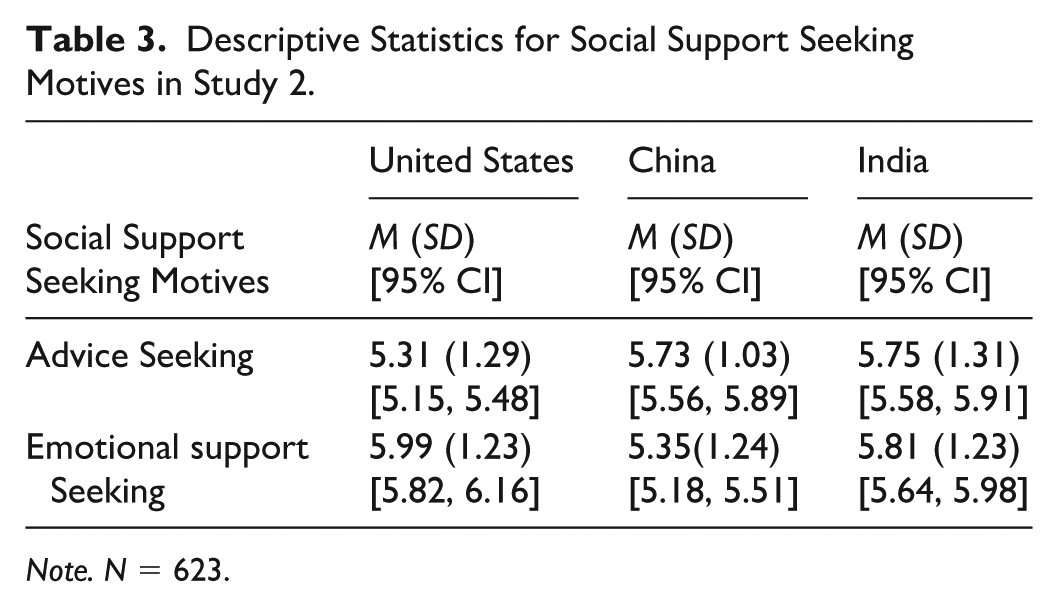
Note. N = 623.
Cultural Differences in Preferred Styles of Advice
To examine whether participants preferred the prototypical style of advice from their own culture even when given other options, we first conducted a Chi-square test, which revealed significant variation in preferred styles of advice, χ2(4) = 261.28, p < .001. As predicted, Americans preferred the autonomous style, Chinese preferred the contingent style, and Indians preferred the direct advice style. See Table 4 for descriptive statistics.
Descriptive Statistics for Preferred Advice (in Percentage) in Study 2.
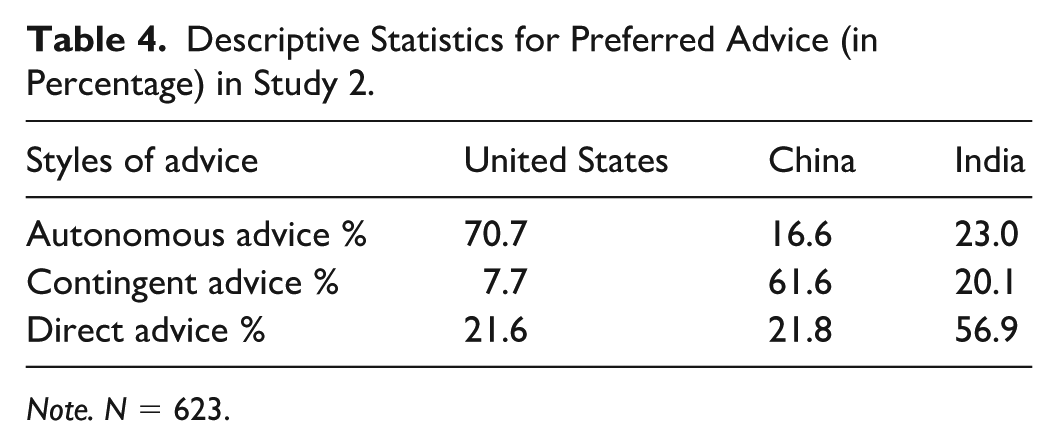
Note. N = 623.
Since American participants were less likely than Indian and Chinese participants to indicate that they were seeking advice, and more likely to suggest that they were seeking emotional support, we assessed whether preference for the autonomous style over the other two styles among Americans remained even after controlling for emotional support and advice seeking intentions. We ran a logistic regression with culture (1 = Americans, 0 = Chinese and Indians) as the independent variable and autonomous advice (1 = autonomous advice, 0 = contingent and direct advice) as the outcome with perceived intention to seek emotional support and advice as covariates in the analysis. The overall model was significant, χ2(3) = 155.71, p < .001, and demonstrated good fit (Hosmer–Lemeshow χ2(8) = 5.65, p = .686), accounting for substantial variance in autonomous advice (Cox & Snell R2 = .22; Nagelkerke R2 = .30). Controlling for both covariates, culture remained a strong predictor of autonomous advice: Americans were significantly more likely than Chinese and Indian participants to provide autonomous advice, B = 2.26, SE = 0.20, Wald χ2 = 126.69, p < .001, OR = 9.60, 95% CI [6.48, 14.24]. Neither the perceived intention of seeking emotional support (B = −0.005, SE = 0.077, Wald χ2 = .004, p = .950) nor advice (B = −0.056, SE = 0.078, Wald χ2 = .505, p = .477) significantly predicted autonomous advice.
Motives in Advice Giving
We utilized a 3 (Culture: United States, China, India) × 3 (Motives: Boosting Self-Esteem, Brainstorming Options, Fulfilling Responsibility) repeated ANOVA and pairwise comparisons with Bonferroni corrections to analyze the effect of culture on the importance ratings given to the different motives. We obtained significant main effects of culture, F(2,621) = 4.67, p = .010, ƞ2 = .015 and of motives, F(2,1240) = 80.67, p < .001, ƞ2 = .115, as well as a significant culture × motives interaction, F(4,1240) = 40.01, p < .001, ƞ2 = .114.
We used pairwise contrasts with Bonferroni corrections to unpack these effects. As predicted, Americans rated boosting self-esteem as more important than did Chinese participants (p < .001, d = 0.37). However, in a non-predicted finding, Americans did not rate self-esteem as more important than did Indians (p = .079, d = 0.22). As predicted, Chinese rated brainstorming options as more important than did both Americans (p < .001, d = 0.54) and Indians (p < .001, d = 0.51). Lastly, Indians rated fulfilling responsibility as more important than did Americans (p < .001, d = 0.45) and Chinese (p < .001, d = 0.86). See Table 5 for descriptives.
Descriptive Statistics for Motives of Advice in Study 2.
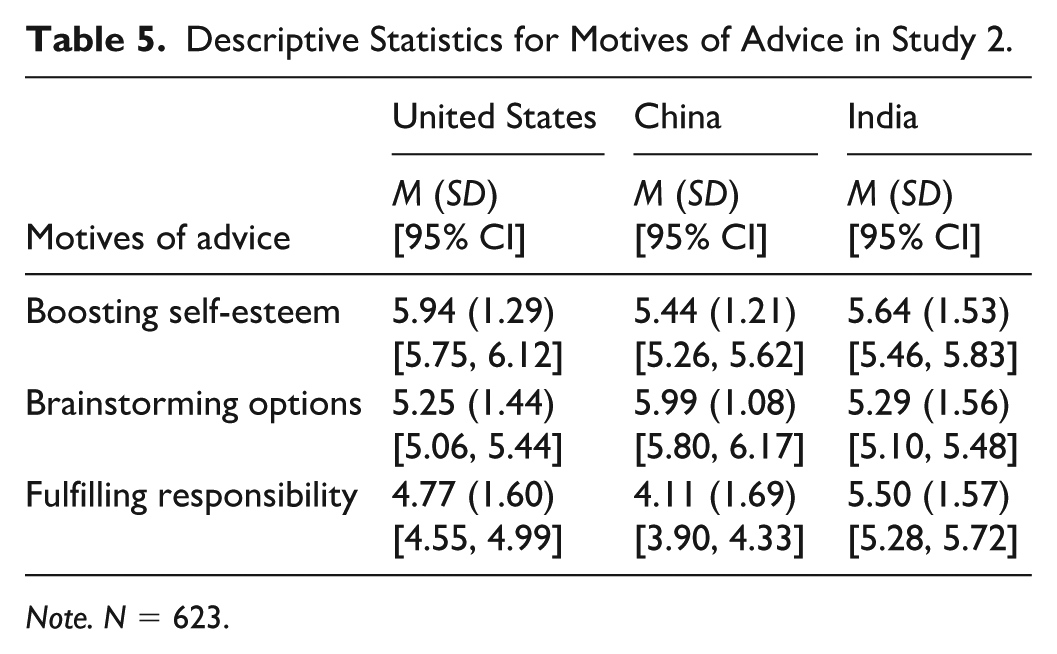
Note. N = 623.
Next, we assessed the importance of each motive within each culture. Americans considered the motive of boosting self-esteem as more important than brainstorming options (p < .001, d = 0.39) and fulfilling responsibility (p < .001, d = 0.66). Chinese considered the motive of brainstorming options as more important than boosting self-esteem (p < .001, d = 0.31) and fulfilling responsibility (p < .001, d = 0.95). Indians did not consider fulfilling responsibility as more important than boosting self-esteem (p = .746, d = −0.08) or brainstorming options (p = .387, d = 0.11) but considered boosting self-esteem as more important than brainstorming options (p = .013, d = 0.20). See Table 5 for means, standard deviation and 95% CI.
Cultural Orientations
As assessed by Cronbach’s alpha, we received high reliability on the FAS measure in all countries (United States: α = .914; China: α = .810; India: α = .717) and on the DSS measure in the United States (α = .724) and China (α = .705). However, the DSS showed extremely poor internal consistency in the Indian sample (α = −.429), indicating that the items did not function as a coherent scale in this cultural context. Because reliability is a prerequisite for measurement in cross-cultural comparison (Tavakol & Dennick, 2011), analyses involving the DSS were restricted to the U.S. and Chinese samples. Despite the historical roots of dialectical philosophy in India (Wong, 2006), the DSS does not appear to validly capture Indian dialecticism.
ANOVA with culture (3: United States, China, India) as the independent variable and allocentrism (FAS) as the outcome, found a significant main effect of culture, F(2, 620) = 132.34, p < .001, ƞ2 = .299. Bonferroni pairwise comparisons found that compared to Americans (M = 2.81, SD = .71, 95% CI [2.73, 2.88]), both Chinese (M = 3.57, SD = 0.42 [3.50, 3.65], p < .001, d = 1.39) and Indians (M = 3.56, SD = 0.45 [3.48, 3.63], p < .001, d = 1.37) held higher beliefs in allocentrism.
A t-test with culture (2: United States, China) as the independent variable and dialecticism (DSS) as the outcome found a significant main effect of culture, t(417) = −4.13, p < .001, d = −0.40. Congruent with our hypothesis, Chinese (M = 4.30, SD = 0.70, 95% CI [4.20, 4.40]) held higher orientations in dialecticism than did Americans (M = 4.01, SD = 0.72 [3.92, 4.11]).
Mediations to Assess Advice Style Preference Within Each Culture
We undertook a series of mediation analyses using PROCESS macro (Model 4) by Hayes to test our theoretical model in Figure 1. We tested the proposed psychological mechanism within each cultural group. 9
First, we assessed why Americans prefer the autonomous style over other styles of advice. We ran a mediation analysis among Americans (N = 208), with allocentrism as the independent variable, boosting self-esteem as the mediator and preference for autonomous advice (dummy coded: autonomous = 1, other styles = 0) as the outcome. As expected, we found an indirect effect of allocentrism on autonomous advice through the motive of boosting self-esteem (indirect effect = 0.09, SE = 0.06, 95% CI [0.0014, 0.2300]). Family connectedness significantly predicted boosting self-esteem (b = 0.35, SE = 0.12, t(206) = 2.86, p = .005), which in turn, predicted endorsement of autonomous advice (b = 0.25, SE = 0.12, Z = 2.12, p = .034). With boosting self-esteem in the model, the direct effect of allocenrism on autonomous advice was not significant, b = 0.17, SE = 0.22, Z = 0.76, p = .449, indicating that boosting self-esteem fully mediated the effect of allocentrism on autonomous advice.
Next, we assessed why Chinese prefer the contingent style over other styles of advice. We ran a mediation analysis among Chinese (N = 211), with dialecticism as the independent variable, brainstorming options as the mediator and preference for contingent advice (contingent = 1, other styles = 0) as the outcome. As expected, we found an indirect effect of dialecticism on contingent advice via brainstorming options (indirect effect = 1.44, SE = 0.34, 95% CI [0.93, 2.25]). Dialecticism significantly predicted the motive of brainstorming options, b = 0.96, SE = 0.08, t(209) = 11.36, p < .001, such that higher dialectical self was associated with greater endorsement of brainstorming motives, which in turn, predicted the endorsement of contingent advice, b = 1.50, SE = .28, z = 5.40, p < .001. With brainstorming option as the mediator, the direct effect of dialecticism on contingent advice was no longer significant (b = −0.62, SE = 0.44, p = .157), indicating that brainstorming option fully mediated the effect of dialecticism on contingent advice.
We then ran a mediation analysis among Indians (N = 204), with allocentrism as the independent variable, fulfilling responsibility as the mediator and direct advice (direct = 1, other styles = 0) as the outcome. As expected, we found an indirect effect of allocentrism on direct advice via fulfilling responsibility, indirect effect = 0.31, SE = 0.14, 95% CI [0.07, 0.61]. Allocentrism was positively associated with endorsement of fulfilling responsibility (b = 1.25, SE = 0.22, t(202) = 5.60, p < .001). In turn, fulfilling responsibility predicted a higher likelihood of providing direct advice (b = 0.25, SE = 0.10, z = 2.50, p = .013). The direct effect of allocenrism on direct advice was not significant, b = 0.22, SE = 0.34, z = 0.66, p = .507, indicating that fulfilling responsibility fully mediated the effect of allocentrism on direct advice.
Serial Mediations to Assess Cultural Differences
To assess cultural differences in preferences for advice style, we conducted a series of serial mediation analyses using PROCESS macro (Model 6) by Hayes. We assessed why Indians prefer direct advice (over other advice styles) compared to Americans and Chinese. We entered Indian culture (Indians = 1, others = 0) as the independent variable, direct advice (direct advice = 1, other styles of advice = 0) as the dependent variable, allocentrism as the first mediator, and motive of fulfilling responsibility as the second mediator. Results revealed a significant indirect effect of Indian culture on preference for direct advice through allocentrism and the motive of fulfilling responsibility (b = 0.06, SE = 0.20, 95% CI [0.03, 0.10]), indicating a significant serial mediation pathway. The direct effect of Indian culture on preference for direct advice remained significant when the mediators were included in the model, (b = 1.22, SE = 0.20 [0.83, 1.61], p < .001), suggesting that allocentrism and responsibility motives partially mediated the relationship between Indian culture and preference for direct advice (Figure 2).
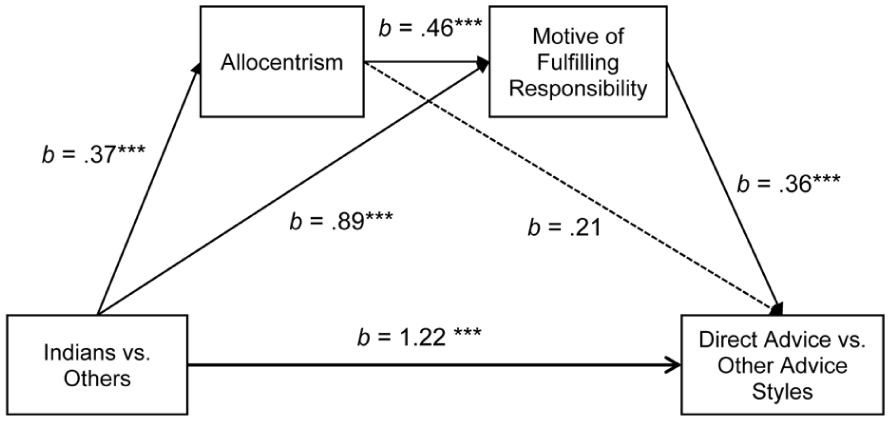
Serial mediation model for direct advice. The link between Indian culture and direct advice was serially mediated by allocentrism and the motive of fulfilling responsibility.
Next, we assessed why Americans prefer autonomous advice (over other advice styles) compared to Indians and Chinese. We included American culture (Americans = 1, others = 0) as the independent variable, autonomous advice (autonomous advice = 1, other styles of advice = 0) as the dependent variable, idiocentrism (indexed by lower scores on the FAS; Lay et al., 1998) as the first mediator, and motive of boosting self-esteem as the second mediator. Results revealed a significant indirect effect of American culture on preference for autonomous advice through allocentrism and the motive of boosting self-esteem, (b = −0.09, SE = 0.04, 95% CI [−0.19, −0.02]), indicating a significant serial mediation. With the mediators present in the model, the direct effect of American culture on autonomous advice remained significant (b = 2.16, SE = 0.24 [1.69, 2.63], p < .001), indicating that idiocentrism and the motive of boosting self-esteem partially mediated the relationship between American culture and contingent advice (Figure 3).
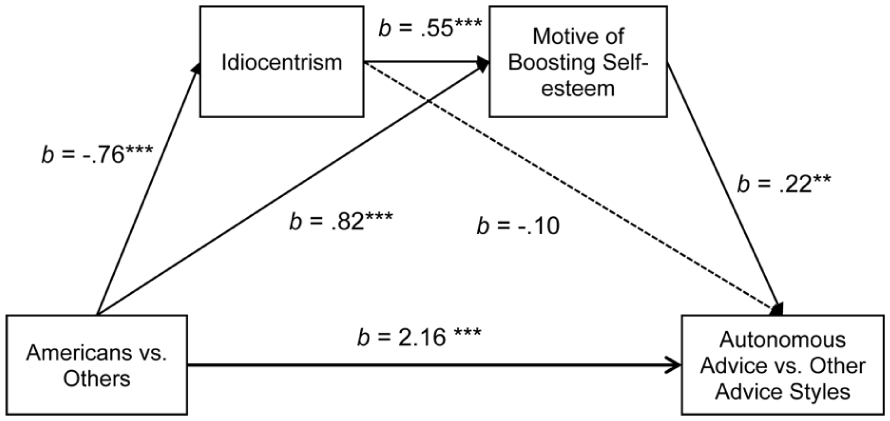
Serial mediation model for autonomous advice. The link between American culture and autonomous advice was serially mediated by idiocentrism and the motive of boosting self-esteem.
Lastly, we assessed why Chinese prefer contingent advice (over other advice styles) compared to Americans. 10 We included Chinese culture (Chinese = 1, Americans = 0) as the independent variable, contingent advice (contingent advice = 1, other styles of advice = 0) as the dependent variable, dialecticism as the first mediator, and motive of brainstorming options as the second mediator. We found an indirect effect of Chinese culture on contingent advice via dialecticism and the motive of brainstorming options, b = 0.12, SE = 0.05, 95% CI [0.04, 0.25]. With the mediators present in the model, the direct effect of Chinese culture on contingent advice remained significant (b = 2.75, SE = 0.31 [2.14, 3.35]), indicating that dialecticism and the motive of brainstorming options partially mediated the relationship between Chinese culture and contingent advice (Figure 4).
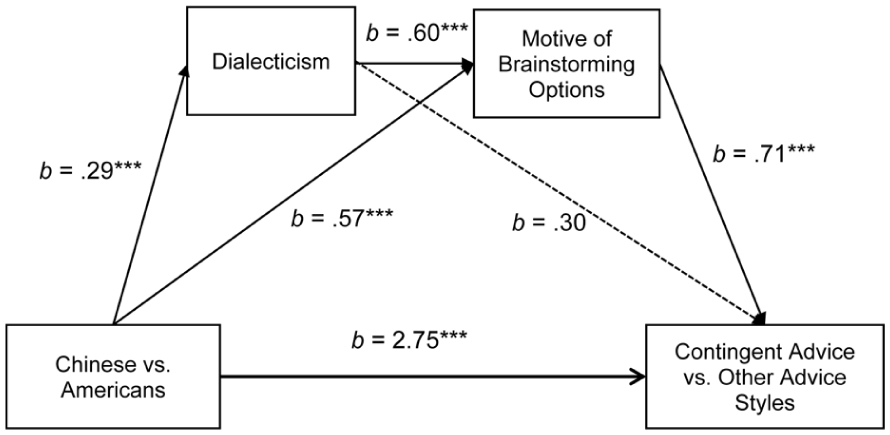
Serial mediation model for contingent advice. The link between Chinese culture and contingent advice was serially mediated by dialecticism and the motive of brainstorming options.
Because Chinese participants were significantly higher on allocentrism than American participants, we also tested whether allocentrism and the motive of brainstorming options mediated the association between Chinese culture and contingent advice, but the model was not significant (see Supplemental Materials p. S21, Table S17 for details). This suggests that dialecticism, not allocentrism, was a unique mediator in explaining the association between Chinese culture, the motive of brainstorming options, and preference for contingent advice.
Discussion
By presenting prototypical advice from all three cultures, Study 2 demonstrated that even when participants were explicitly exposed to alternative ways of giving advice, they continued to prefer the style normative to their own culture. Specifically, while Americans preferred the autonomous style that explicitly grants the recipient’s autonomy and is accompanied by emotional support, Chinese and Indians each preferred the styles that depart from this script, with the autonomous advice style one which has often been treated as universally optimal (Feng, 2014). Instead, Chinese favored contingent advice that is characterized by an analysis of multiple possible solutions and their potential consequences across hypothetical contexts. Indians preferred direct advice that prescribes a clear, step-by-step guidance on courses of action regarded as the best solution. These findings challenge Feng’s (2014) claim that emotional support is a universal hallmark of good advice, as only Americans consistently endorsed the emotionally supportive, autonomous style.
Culturally specific motives predicted advice styles. Americans, consistent with prior research, were driven by the motive to boost self-esteem, leading to autonomous advice. Indians, guided by a sense of responsibility, gave direct advice. For Chinese participants, the novel motive of brainstorming options predicted contingent advice—highlighting a culturally unique approach not previously captured in the literature.
We also uncovered differences in broader cultural orientations. Both Chinese and Indians endorsed allocentrism more strongly than Americans, aligning with a greater focus on problem-solving. However, the allocentrism-idiocentrism dimension only explained the differences between autonomous vs. direct styles of advice that are typical among Indians and Americans, but not Chinese. Chinese (but not Indians) scored higher on dialecticism, which relates to offering multiple, sometimes contradictory, options—consistent with their preference for contingent advice. Interestingly, the dialecticism scale’s contradictory subscale did not apply to Indians, suggesting the need to explore alternative philosophical frameworks, such as Hindu dialectical thought (Ho, 1995).
Serial mediation analyses confirmed that advice-giving styles were shaped by both cultural motives and orientations. Americans’ preference for autonomous advice was mediated by idiocentrism and boosting self-esteem, Chinese preference for contingent advice was mediated by dialecticism and brainstorming options, and Indians’ preference for direct over autonomous advice was mediated by allocentrism and responsibility. These findings highlight that cultural differences in advice are multifaceted—not reducible to an individualism–collectivism dichotomy.
Study 3
Study 3 aimed at exploring advice giving outlooks in the context of the everyday cultural product of children’s storybooks (Cohen & Kitayama, 2007). As a widely used tool for socialization and enculturation, storybooks are produced by adults, in part, to communicate to children important social and cultural messages, such as problem-solving skills that can be applied in challenging situations (Ng & Sun, 2021; Sun et al., 2020). This feature of children’s storybooks has equipped the books with abundant instances of advice. Past research provided evidence for a general congruence between the messages communicated in children’s storybooks and adult outlooks. For example, Goyal et al. (2019) found that cultural differences in adults’ views of agency paralleled those in children’s storybooks. We likewise anticipated to find elements of advice in children’s storybooks that are congruent with the styles of advice observed among adults. Our content analysis centered specifically on identifying the styles of advice portrayed in children’s storybooks from the three cultural groups.
Method
Materials and Procedures
We used the same American (N = 39) and Indian (N = 40) storybooks from prior cross-cultural studies (Dyer et al., 2000; Dyer-Seymour et al., 2004; Goyal et al., 2019). In each country, the books were selected from preschoolers’ “favorites,” award-winners, and random picks from reference lists, all targeting ages 3 to 5 and under 40 pages. Using similar criteria, we selected 41 Chinese storybooks, referencing the Feng Zikai Award and Taobao bestsellers. Indian books were originally in Hindi and Chinese books were originally in simplified Chinese. See a full list of the books in Supplemental Material, Page S6–S10. All texts were analyzed in English: Indian books were sourced from Pratham Books in the English language, and Chinese books were translated and back-translated by bilinguals to ensure accuracy.
Qualitative Coding
Two individual coders from Asian and American cultural backgrounds summarized the main problem of each book independently. Any disagreement was resolved over weekly discussions with the first author to reach consensus. Coding categories for styles of advice were developed by the first author in consultation with researchers from both Asian and American cultural backgrounds. Like in Study 1, the two coders double coded all the books. Unlike the vignette-based responses in Study 1, which elicited a single advice response, the storybooks in Study 3 unfold over extended narratives in which advice may appear multiple times, from multiple characters, and for different purposes. One thing the selected storybooks for young children had in common was that they often featured a main character facing one central problem. We first identified this central problem by generating a brief summary (e.g., the central problem in Alfie Gives a Hand was identified as “Alfie feeling anxious about attending a birthday party”). We also observed in a few cases that some books did not include central problems. For example, a book such as How My Garden Grows was coded as containing no main problem because it consists of a monologic description of gardening activities, without the presence of challenges to be resolved. According to our coding, each book could have no more than one central problem.
The identified central problem served as the unit of analysis: any advice offered in relation to resolving this problem was considered collectively and used to determine the overall advice style. As in Study 1, we coded any verbal suggestions concerning what to do in solving the identified central problem (e.g., “Do you see the little blue dot? Follow that direction and you can find home.” as advice given to how to find home) as one instance of advice, and any verbal or behavioral “attempts to comfort the recipient” (Chen et al., 2012, p. 4) was coded as one instance of emotional support (e.g., “Don’t worry. He won’t hurt you,” said Sammy, or “Ellen picked Fuzzy up and gave him a hug”). Given the nature of storybook narratives, each problem may elicit multiple instances of advice and/or emotional support.
We then quantified the advice instances relevant to resolving the identified central problem based on the three styles identified in Studies 1 and 2: autonomous, contingent, and direct. Given that these books target 3–5-year-olds, we did not expect the advice to match adult expressions exactly. Instead, advice was given in age-appropriate forms and embedded in the story context but still reflected the core features of the adult advice styles. Autonomous advice was defined as advice that acknowledged the child’s individuality, motives, and perspective (Cheung et al., 2016; Moorman & Pomerantz, 2008). Following Cheung et al.’s (2016) coding scheme, this included supportive responses to the character’s bids for help (e.g., hints or explanations), expressions of interest or encouragement (e.g., verbal acknowledgments), and actions promoting independence (e.g., asking pedagogical questions).
Autonomous advice reflected the number of advice instances expressing support, validation, or reassurance, approval or reiteration of the recipient’s original ideas. Contingent advice reflected the number of distinct alternative courses of action proposed across advice instances. Direct advice reflected the number of prescriptive or step-by-step action suggestions provided across advice instances. These counts reflect the prevalence of each advice style within a vignette rather than the verbosity or length of individual responses. Note that advice instances were not mutually exclusive at the level of the book but were mutually exclusive at the level of the instance. Thus, a single book could contain advice reflecting multiple styles. For example, in a book with 13 advice instances, 6 of them might be coded as autonomous and 7 of them as contingent; however, each individual advice instance was coded into only one style and could not be assigned to multiple categories.
We obtained high reliability on the data (autonomous: ICC (3,2) = .992, 95% CI [0.989, 0.995], p < .001; contingent: ICC (3,2) = .997 [0.995, 0.998], p < .001; direct: ICC (3,2) = .998 [0.996, 0.998], p < .001). Table 6 displays examples illustrating the coding scheme.
Sample Coding of Styles of Advice in Study 3.
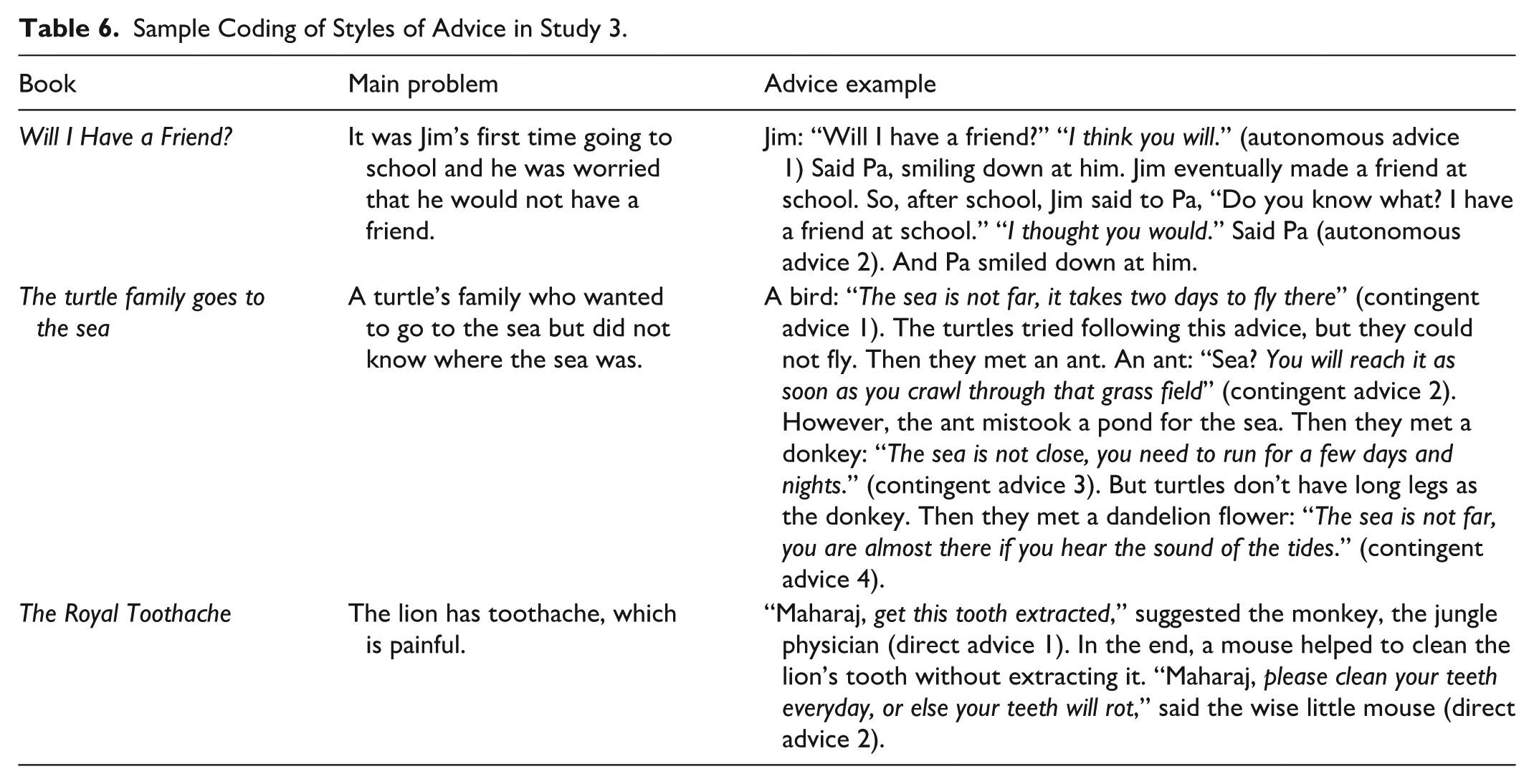
As illustrated above, coding decisions took into account the broader narrative context and the relations among advice instances, rather than treating individual sentences in isolation. In Will I Have a Friend? Jim’s father’s response, “I think you will” and later “I thought you would” both affirmed Jim’s capacity to navigate the situation independently. Across their exchange, these responses reinforced the child’s confidence without directing behavior, reflecting autonomous advice that supports the child’s autonomy and self-esteem through encouragement rather than instruction (e.g., “you know your cousin best and how they would react to this” in adults’ response in Study 1).
In Turtle Family Goes to the Sea, advice instances reflected alternative judgments about the distance to the sea depending on the mode of travel. For example, the bird, who could fly, described the sea as not far, whereas the donkey, who traveled by running, described it as far. These contrasting interpretations of the same problem, grounded in variations of individual capacities in traveling, conveyed a dialectical worldview that informed the contingent nature of the advice (e.g., “if she’s financially independent and emotionally strong, then tell her about the affair, if not, then don’t” in adults’ responses in Study 1).
In contrast, in The Royal Toothache, although the monkey and the mouse offered different suggestions for addressing the lion’s toothache, their advice did not contradict one another. Instead, cleaning the teeth and extracting the tooth formed a coherent procedural sequence, in which extraction became necessary only if cleaning was insufficient. Marked by imperative forms (e.g., “get. . .”, “please clean. . .”), these responses reflected the advice giver’s assumption of responsibility for solving the problem for the lion, consistent with the nature of direct advice (e.g., “You must tell her about the affair, but first get a photo as proof” in adults’ responses in Study 1).
Results
We identified a total of 116 central problems, with 37 in the American storybooks, 40 in the Chinese storybooks and 39 in the Indian storybooks. The four books that had no problem were dropped from the analyses. Since advice was coded at the level of the problem rather at the level of individual pages, our primary analyses treated the problem as the unit of analysis. Because Indian storybooks were shorter in pages than Chinese and American books, we additionally conducted robustness analyses in which we averaged the advice instances by the number of pages in each book. Results were substantively unchanged across analytic approaches (see Supplemental Materials pp. S29–S31).
ANOVA with culture (United States, China, India) as the independent variable and total number of advice instances as the dependent variable revealed a significant effect of culture, F(2, 113) = 10.454, p < .001, η2 = .156. There were more discrete advice instances regarding the main problem in American (M = 6.00, SD = 4.77, 95% CI [4.86, 7.14], p = .025, d = 0.62) and Chinese (M = 7.43, SD = 3.34 [6.33, 8.52], p < .001, d = 1.02) books than in Indian books (M = 3.85, SD = 1.86 [2.74, 4.96]). The ANOVA with culture as the independent variable and emotional support instances as the outcome also revealed a significant effect of culture, F(2, 113) = 28.979, p < .001, η2 = .339. There were more emotional support instances regarding the main problem in American books (M = 4.14, SD = 3.58 [3.41, 4.86]) than in Chinese (M = 0.68, SD = 1.12 [−0.03, 1.38], p < .001, d = 1.55) and Indian (M = 0.82, SD = 1.19 [0.11, 1.53], p < .001, d = 1.48) books.
Styles of Advice
Given cross-cultural differences in the total number of advice instances across main problems, we transformed advice-style variables into proportions by dividing the number of instances of each advice style by the total number of advice instances for that problem. We then utilized a 3 (Culture: United States, China, India) × 3 (Styles Of Advice: Autonomous Advice, Contingent Advice, Direct Advice) repeated ANOVA and pairwise comparisons with Bonferroni corrections to analyze the effect of culture on the styles of advice present in the storybooks. We obtained a significant main effect of styles of advice, F(2, 216) = 12.87, p < .001, ƞ2 = .106, qualified by a styles of advice x culture interaction, F(4, 216) = 50.64, p < .001, ƞ2 = .484.
Congruent with our findings in Studies 1 and 2, pairwise comparisons with Bonferroni corrections revealed that autonomous advice occurred more frequently in American storybooks than in Chinese (p < .001, d = 2.07) and Indian storybooks (p < .001, d = 1.96), with Chinese and Indian books not differing from each other (p = 1.00, d = −0.10). Contingent advice occurred more frequently in Chinese storybooks than in American (p < .001, d = 1.70) and Indian storybooks (p < .001, d = 1.98), with American and Indian books not differing from each other (p = .723, d = 0.28). Direct advice occurred more frequently in Indian storybooks than in American (p < .001, d = 2.26) and Chinese storybooks (p < .001, d = 2.21), with American and Chinese books not differing from each other (p = 1.00, d = −0.05).
The within-cultural effect was also congruent with our findings in Studies 1 and 2. Autonomous advice was more common than contingent (p = .017, d = 0.55) and direct (p < .001, d = 1.20) styles of advice in American storybooks. In an unpredicted finding, contingent advice was also more common than direct advice in American storybooks (p = .029, d = 0.46). Contingent advice was more common than autonomous (p < .001, d = 1.57) and direct (p < .001, d = 1.46) styles of advice in Chinese storybooks. Direct advice was more common than autonomous (p < .001, d = 1.42) and contingent (p < .001, d = 0.88) styles of advice in Indian storybooks (See Table 7 for descriptives).
Descriptive Statistics for Styles of Advice in Children’s Storybooks in Study 3.
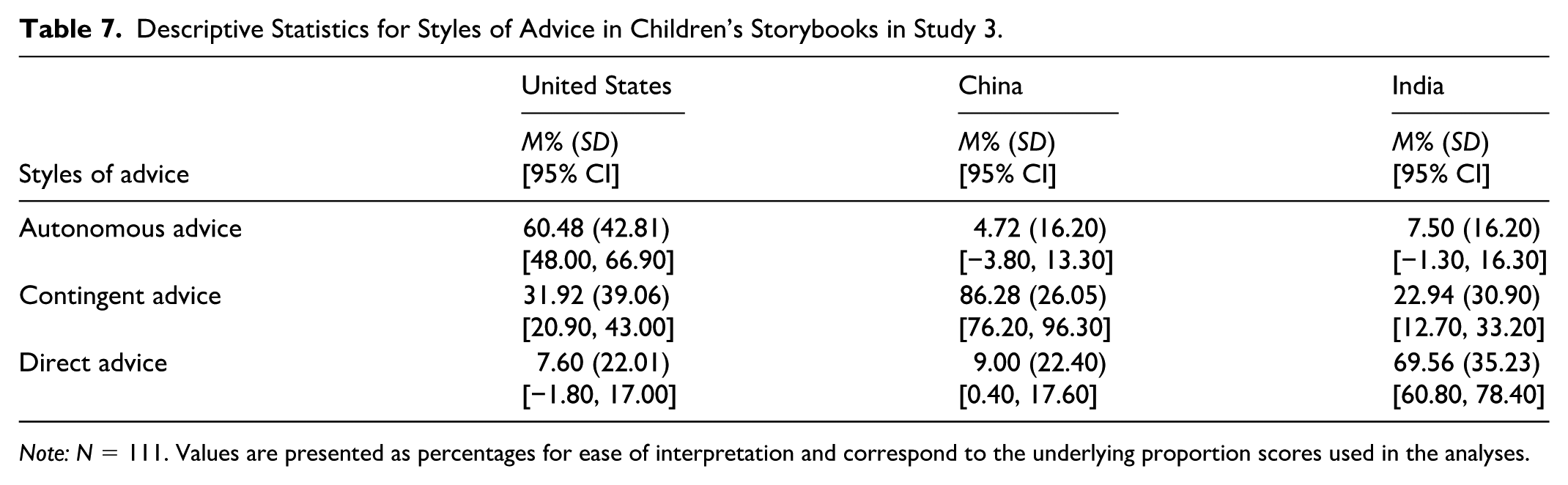
Note: N = 111. Values are presented as percentages for ease of interpretation and correspond to the underlying proportion scores used in the analyses.
Lastly, we assessed whether emotional support was more likely to co-occur alongside autonomous compared to other styles of advice. Replicating Study 1, emotional support was substantially more likely to be present when autonomous advice was provided, r(1) = .50, p < .001. In contrast, emotional support was more likely to be absent when contingent, r(111) = −.25, p = .008, or direct r(111) = −.19, p = .042, advice was provided.
Discussion
Our analysis of children’s storybooks revealed patterns consistent with adult cultural differences in social support. While advice appeared equally across American, Chinese, and Indian books, the styles of advice in storybooks differed, mirroring those found in our earlier studies: American books emphasized autonomous advice that encouraged independent decision-making, Chinese books featured contingent advice offering multiple options, and Indian books provided direct advice with clear recommendations. These parallels reinforce the cultural consistency of normative advice-giving from childhood through adulthood.
General Discussion
Advice-giving plays a crucial role in social interactions, influencing decision-making, relationships, and personal growth. Our findings reveal notable cross-cultural differences in advice-giving styles among Americans, Chinese, and Indians. Americans tended to emphasize personal autonomy, offering advice in a way that respects individual choice. In contrast, Chinese participants, influenced by dialectical thinking, were more likely to acknowledge multiple perspectives and provide balanced guidance. Indian participants, reflecting a collectivist and duty-oriented mindset, often framed advice with a stronger sense of responsibility and obligation. These cultural differences in advice-giving were shaped by idiocentrism, dialecticism, and allocentrism (Study 2). Dialecticism explains why Chinese participants provided more nuanced and context-dependent advice, recognizing the complexity of decision-making and the coexistence of multiple perspectives. Allocentrism, or a focus on interdependence, was particularly evident in Indian advice-giving, where guidance was framed as a duty to support others and uphold social obligations. In contrast, individualism played a key role in American advice-giving, where advice was framed in a way that emphasized personal choice and autonomy, reinforcing the value of self-determination over external influence.
We found consistent evidence for these patterns across qualitative data (Study 1), experimental data (Study 2), and the analysis of cultural artifacts (Study 3). Qualitative accounts illustrated how participants spontaneously framed their advice, revealing underlying cultural assumptions about autonomy, balance, and duty. Experimental findings confirmed that these patterns held across different advice-giving scenarios, demonstrating how cultural values shape responses in controlled settings. Artifactual data provided further support, showing how culturally distinct advice styles are reflected in children’s storybooks—narratives that convey values related to autonomy, relational balance, and social responsibility. Together, these findings highlight that advice-giving is not merely a form of guidance—it reflects deeper cultural frameworks that shape how people navigate social interactions and support one another.
Culturally Variable Styles of Advice
Our findings underscore the impact of cultural values on advice-giving, not only in terms of content but also in the stylistic and structural ways advice is conveyed. While prior research has often framed American patterns of emotional support as a universal standard, our study highlights the diverse strategies different cultural groups use to navigate social support and decision-making.
Beyond differences in preferred advice structures, we found that cultural beliefs about responsibility and dialecticism shape how advice is framed and delivered. For example, although both Indian and American participants expressed a strong preference for disclosing the affair, they differed in how they communicated this message. Indian participants delivered the advice in a direct manner, motivated by a sense of interpersonal obligation rooted in allocentric cultural values. In contrast, American participants softened their delivery, framing the advice in a way that emphasized their friend’s autonomy—reflecting a cultural orientation toward individualism. Meanwhile, Chinese participants, guided by a dialectical worldview, showed a weaker initial preference for either disclosing or not disclosing the affair. Yet, they often provided a comprehensive evaluation of the pros and cons of each option, reflecting an orientation toward complexity and the coexistence of multiple perspectives. These findings suggest that cultural expectations surrounding social responsibility and problem-solving worldviews can override initial judgments of a situation, influencing not only what advice is given, but also how it is framed.
Notably, Chinese participants were less likely than Americans and Indians to endorse disclosing the affair or changing jobs if they themselves were in the dilemma. Although a majority in all groups endorsed these actions, this difference may reflect greater sensitivity to situational contingencies in Chinese contexts, consistent with dialectical thinking traditions. In close relational contexts, individuals shaped by dialectical reasoning may weigh competing obligations and potential consequence more heavily, resulting in more cautious endorsement of direct intervention. Such responses need not signal weaker moral judgments, but rather an effort to reconcile emotional reactions with a desire for balanced, context-sensitive reasoning. From this perspective, lower willingness to endorse immediate action may reflect a preference for maintaining multiple considerations simultaneously rather than committing to a single, decisive course. Broadly, this orientation also resonates with the Confucian doctrine of Zhongyong (the “middle way”, e.g., Peng & Nisbett, 1999), which emphasizes avoiding extremes and harmonizing competing considerations in context.
Beyond the Individualism–Collectivism Dichotomy
Our findings underscore the need for cultural research to move beyond the individualism–collectivism dichotomy as a singular explanation for differences in advice-giving. According to Hofstede’s framework (Hofstede et al., 2010), India ranks the lowest on individualism (24), followed by China (43), with the U.S. scoring the highest (60). However, our results do not align neatly with this continuum. If individualism–collectivism was the primary driver of advice-giving styles, we would expect Chinese and Indians—who score closely on this dimension—to have more similarities. Instead, our findings reveal a different pattern: Chinese and Americans shared more similarities with each other than with Indians, particularly in their indirect styles of advice and their tendency to withhold true opinions if they differed from those of the advice seeker. Indians, in contrast, provided the most direct and straightforward advice.
Our findings are consistent with Sinha and colleagues’ argument that individualistic and collectivistic orientations are expressed in context-sensitive ways rather than as fixed cultural traits (Kao & Sinha, 1997; Sinha & Tripathi, 1994). From this perspective, the fact that Chinese and Indian participants both exhibited high levels of allocentrism yet relied on different cultural logics when giving advice suggests that collectivism may be organized and activated differently across contexts. In particular, advice giving among Indian participants appeared to be more closely structured around responsibility-based considerations, whereas among Chinese participants, dialectical reasoning played a more central role, with allocentrism exerting little independent influence.
These results also echo the arguments made by Miller et al. (2017) that cross-cultural research should avoid reducing cultural differences to a single dimension like individualism–collectivism or assuming that one culture within a category (e.g., collectivist or individualist) represents all others. Instead, our findings highlight the need for more nuanced approaches that account for specific cultural beliefs and values—such as dialecticism, allocentrism, and responsibility norms—that shape advice-giving styles in ways that transcend broad cultural categories.
Children’s Storybooks as Cultural Products
Our findings suggest that children’s storybooks are not just educational tools for fostering social and emotional learning—they also serve as a powerful mechanism for cultural transmission. While the advice styles depicted in storybooks did not perfectly mirror those found in adult advice-giving, they captured key cultural elements in a simplified form, reflecting what is considered important in guidance within each society.
At the same time, the differences between adult advice-giving and the advice found in children’s books highlight how cultural messages are adapted to the cognitive capacities and developmental needs of young audiences. Across all three cultures, storybooks are written in a more accessible style, ensuring that children can grasp key lessons. This adaptation underscores the role of both cultural and non-cultural influences—while storybooks reflect cultural values, they are also shaped by universal considerations such as children’s cognitive and social development.
Moreover, cultural messages in storybooks tend to be tacit rather than explicitly constructed. Authors are rarely consciously motivated to communicate cultural values and may not even be aware of how their messages are culturally shaped. This reinforces the importance of examining cultural products as sources of shared meaning—rather than viewing culture solely as an individual’s set of attitudes or values. Analyzing artifacts like storybooks allows researchers to understand culture as a socially embedded system of practices and beliefs. Integrating psychological research with content analysis of cultural products provides a richer, more holistic perspective on how culture is communicated and sustained across generations.
Limitations
While this study provides valuable insights into cultural differences in advice-giving, it has some limitations. First, our sample was limited to participants from three cultural groups, and future research should examine whether these patterns extend to other cultural contexts, especially other cultures identified as collectivist, such as Turkey, Eastern Europe, South America. Second, our studies primarily relied on hypothetical scenarios, which may not fully capture how people give advice in real-life, high-stakes situations. Third, although we identified key cultural influences, individual differences within each culture may also shape advice-giving styles. Factors such as cognitive style, emotional regulation tendencies, communication preferences, and social motivations could all influence how individuals offer advice. Finally, our content analysis of children’s storybooks that focused on contemporary publications, while insightful, may not encompass the full range of narrative traditions through which children are socialized. In Indian and Chinese contexts, traditional stories play an important role alongside contemporary narratives, and children are often exposed to these traditions through oral transmission rather than printed storybooks. In contrast, children’s literature in the United States is predominantly contemporary in form. Accordingly, the present findings should be interpreted as reflecting advice-giving themes in contemporary storybooks, rather than reflecting the full set of narrative influences shaping children’s socialization. Future cross-cultural research would benefit from directly comparing traditional and contemporary narratives to examine their differential impacts on children’s social and emotional development. In the end, despite high interrater reliability and blinding procedures, qualitative coding necessarily involves interpretive judgment, and subtle biases cannot be entirely ruled out, especially in Study 3, where coders could not be completely blind to the story’s origin.
Implications and Future Directions
Our findings have important theoretical and practical implications. Theoretically, they challenge the overreliance on the individualism–collectivism framework in cross-cultural psychology, demonstrating the need for more nuanced cultural dimensions such as dialecticism, allocentrism, and responsibility norms in understanding advice-giving. Future research should utilize experimental manipulation to causally assess the impact of these constructs (e.g., priming dialecticism, autonomy) on both advice selection and adherence, building on our observed cultural differences in advice giving.
Practically, these insights can inform intercultural communication, counseling, and education, where awareness of differing advice-giving styles can improve interactions across cultures. For instance, professionals working in multicultural settings may need to adapt their guidance strategies to align with culturally specific expectations about responsibility and social support. Additionally, recognizing how cultural messaging is embedded in children’s literature can help educators and parents foster culturally sensitive approaches to social-emotional learning.
Supplemental Material
sj-docx-1-psp-10.1177_01461672261447643 – Supplemental material for Advice Across Cultures: How Autonomy, Dialecticism, and Responsibility Differentially Shape Advice Giving in the United States, China, and India
Supplemental material, sj-docx-1-psp-10.1177_01461672261447643 for Advice Across Cultures: How Autonomy, Dialecticism, and Responsibility Differentially Shape Advice Giving in the United States, China, and India by Zhenlan Wang, Namrata Goyal, Shagufa Kapadia and Joan G. Miller in Personality and Social Psychology Bulletin
Footnotes

Funding
The authors disclosed receipt of the following financial support for the research, authorship, and/or publication of this article: This research was supported in part by a Dissertation Fellowship from Department of Psychology at New School for Social Research.
Declaration of Conflicting Interests
The authors declared no potential conflicts of interest with respect to the research, authorship, and/or publication of this article.
Data Availability Statement
Supplemental Material
Supplemental material is available online with this article.
Notes
References
Supplementary Material
Please find the following supplemental material available below.
For Open Access articles published under a Creative Commons License, all supplemental material carries the same license as the article it is associated with.
For non-Open Access articles published, all supplemental material carries a non-exclusive license, and permission requests for re-use of supplemental material or any part of supplemental material shall be sent directly to the copyright owner as specified in the copyright notice associated with the article.
