






Abstract
Despite extensive research on upward mobility, the psychological consequences of perceived downward mobility remain understudied. Across two cross-sectional and two experimental studies (N = 2,819), conducted in high-income, post-industrial economies, we investigated the effects of perceived upward and downward mobility on status anxiety and well-being. Across designs, downward mobility beliefs consistently increased status anxiety, which in turn mediated harmful effects on life satisfaction and related well-being outcomes. Upward mobility beliefs reduced status anxiety and produced a positive indirect effect on life satisfaction only in an experimental study with U.S. participants, but it yielded inconsistent effects across the remaining three studies. Our findings suggest that both upward and downward beliefs influence well-being through status anxiety, but the effects of downward mobility beliefs are stronger and more consistent.
Keywords
Introduction
The neoliberal ideology—a belief system that frames the economic systems as fair and rational, and advocates for minimal government interventions in the free market—has become dominant across modern societies (Bay-Cheng et al., 2015). With it come widespread expectations of better well-being based on socioeconomic success (De Botton, 2004; Graeber, 2011; Harvey, 2007; Piketty, 2014). Yet, despite this promise of prosperity, the past decades have been marked by recurring economic crises (International Monetary Fund, 2022), and forecasts predict sustained inflation and stagnation in the years ahead (International Monetary Fund, 2023; World Bank, 2023). In such a context of instability, many people face uncertainty about both their economic situation and their position in society (OECD, 2018).
In contrast to the broadly rising living standards that characterized many post-1945 cohorts in high-income, post-industrial countries, contemporary youth in these regions now face stagnating or declining living standards relative to their parents (Bessant et al., 2017). Importantly, these patterns are neither universal nor evenly distributed: Trends toward lower relative living standards are most apparent in many high-income, post-industrial (OECD) settings and vary substantially across countries, cohorts, and social groups. For example, outcomes differ by educational attainment, labor-market attachment, region, gender, and ethnicity—with lower-skilled workers, early-career cohorts hit by labor-market shocks, and some minority groups at greater risk of downward mobility. Although some young people still believe in the promise of economic prosperity, a substantial proportion now expect to do worse than their parents, particularly in regions with high youth unemployment or precarious labor markets (e.g., Southern Europe; Mitrea et al., 2021).
What are the effects of such expectations about a person’s future socioeconomic situation for their well-being?
Previous literature investigated the psychological effects of general or upward mobility beliefs (for an overview, see Davidai & Wienk, 2021). However, less attention has been paid to the effects of downward mobility beliefs on well-being. Existing studies typically often rely on cross-sectional evidence regarding the effects of experienced downward mobility and on indirect indicators such as subjective present and parents’ socioeconomic status (SES; Alcántara et al., 2014; Kim et al., 2023; H. Zhao et al., 2025), Yet, expectations and concerns about future SES may differ from past experiences and exert distinct psychological effects. We expand on this argument in the next section. The present research addresses this gap by investigating how upward or downward mobility beliefs shape well-being and why. To that end, we relied on cross-sectional and experimental evidence, direct measures capturing different dimensions of mobility beliefs, and investigated a psychological process linking mobility beliefs and well-being: namely status anxiety.
SES, Mobility Beliefs, and Well-Being
The American Psychological Association (2023) defines well-being as a state of happiness and satisfaction, characterized by low distress, good physical and mental health, and general outlook, or good quality of life, and comprises individuals’ affective reactions to the subjective evaluation of their personal development, social relationships, professional success, and their overall functioning as community members (National Research Council, 2013). Consistent with this definition, well-being is shaped by economic resources: Greater access to resources generally predicts higher well-being, though this relationship weakens once basic needs are met (Diener & Biswas-Diener, 2002; Diener & Oishi, 2000; Easterlin et al., 2010; Oishi & Kesebir, 2015; Oishi et al., 2011). Conversely, resource scarcity is linked to lower happiness and life satisfaction (Auger et al., 2024).
Beyond objective access to valued resources, people also care about their social status—their relative rank position in society and the respect it entails (Anderson et al., 2015). Both feeling respected by others and a person’s subjective perception of their economic situation relative to others matter for their well-being (Adler et al., 2000; Anderson et al., 2012; Marmot, 2004; Präg, 2020). Specifically, believing that one does better than others predicts greater subjective well-being (Hagerty, 2000; Liao, 2021). Yet, individuals’ material rank in their social context (i.e., SES) is not a static attribute: Individuals can ascend or descend the social ladder, either because others or themselves acquire or lose material resources. As such, not only individuals’ well-being is affected by their material resources compared to similar others, but also by their resources in the present compared to themselves in the past and the future (i.e., by their social mobility; Hirschman & Rothschild, 1973; Verme, 2009).
Sociologists and economists have long been mainly interested in the link between objective social mobility and well-being (Islam & Jaffee, 2024; Präg et al., 2022; Schuck & Steiber, 2018). However, social psychologists alert that people tend to misperceive economic circumstances and that the effects of objective material circumstances depend on how they are perceived (Easterbrook, 2021). For instance, perceptions of economic inequality and SES predict psychological outcomes beyond the effects of objective indicators (Melita et al., 2024, Willis et al., 2022). Likewise, subjective perceptions of mobility do not always align with actual changes (Berger & Engzell, 2020; Gugushvili, 2020; Kelley & Kelley, 2009). In other words, perceived mobility can exert unique psychological effects that go beyond measurable socioeconomic shifts.
Social mobility beliefs describe lay understandings of how SES changes over time and can regard either positive or negative changes in SES (i.e., upward or downward mobility). It is a multidimensional concept, requiring analysis of how various types of social mobility may have distinct impacts (Davidai & Wienk, 2021; Day & Fiske, 2019; Matamoros-Lima et al., 2023). These dimensions differ based on characteristics such as the temporal context (past or future), the direction of movement (upward or downward), and the point of reference used for comparison (individual or societal).
Previous studies show that upward mobility beliefs are associated with greater psychological health and subjective well-being (Präg & Gugushvili, 2021; Gugushvili et al., 2022). For example, perceiving one’s life as better than that of one’s family of origin—through higher income, stable employment, or improved living conditions—fosters pride, optimism, and a sense of control (Davidai & Gilovich, 2015; Gugushvili et al., 2022). These feelings can enhance psychological well-being.
Much less research has been dedicated to examining the effects of downward mobility beliefs. This neglect partly reflects ideological biases: Cultural myths such as the “American Dream” emphasize upward rather than downward trajectories (Mandisodza et al., 2006), and individuals often underestimate the possibility of downward mobility (Cheng & Wen, 2019). Yet, people are more sensitive to losing what they already have rather than gaining something new (Kahneman et al., 1990), and research shows that income loss substantially reduces subjective well-being (Boyce et al., 2013). Perceived threats to SES—arising from unemployment, recessions, or insecurity—can fuel frustration, depression, and long-term behavioral change (Malmendier & Nagel, 2011; Sheehy-Skeffington, 2020). Our research, therefore, examines the effects of both upward and downward status mobility expectations.
Furthermore, most prior work has examined perceptions of past mobility, but expectations about the future can play a crucial role for mental health and subjective well-being (Maslow, 1943; Ryan & Deci, 2000; Seligman, 2002; Weinstein, 1980). Future selves shape self-efficacy, meaning, and motivation (Dweck, 2006; Hernández et al., 2023; Markus & Nurius, 1986; Vignoles et al., 2008). Accordingly, mobility expectations have been shown to influence academic persistence among low-SES students (Browman et al., 2017), hiring decisions (Gobel & Kim, 2023), and emotional responses (Shariff et al., 2016). Building on this, we focus on the psychological consequences of future mobility beliefs.
Status Anxiety and Well-Being
Status anxiety—chronic concern about one’s socioeconomic rank—has been proposed as a key mechanism linking inequality to diminished well-being (Delhey et al., 2017; Layte & Whelan, 2014; Melita et al., 2024). As socioeconomic distances widen, worries about relative position intensify and harm well-being (Buttrick & Oishi, 2017; Wilkinson & Pickett, 2017). Crucially, status anxiety extends beyond current position to include fears of losing status or failing to rise (De Botton, 2004). As such, status anxiety could be linked to mobility beliefs: Expectations of upward mobility may foster hope about accessing valuable resources. Indeed, when economic inequality is associated with hope, people report greater happiness (Cheung, 2016). In contrast, expectations of downward mobility signal a threat of resource loss. Thus, when people expect to occupy lower position in society, they may report being less happy (Delhey & Dragolov, 2014).
Previous studies have found evidence that mobility beliefs increase worries among high-SES individuals regarding the future of their social group (i.e., collective angst; Jetten et al., 2021) or losing their dominant position over low-SES individuals (i.e., status threat; Silverman et al., 2024). However, status anxiety differs from these intergroup psychological reactions, as it is fundamentally an individual-level concern about one’s own social rank: It captures personal worries about meeting social standards and not being left behind in the competition with those above, below, and similar others (De Botton, 2004; Delhey et al., 2017; Keshabyan & Day, 2020). As such, research on the effects of mobility beliefs on status anxiety and its mediating role in the effects on well-being is scarce.
On this matter, prior experimental work suggests that upward and downward mobility beliefs can mediate opposing effects of perceived inequality on status anxiety: While lower expected downward mobility suppressed the effect of perceived inequality, lower expected upward mobility exacerbated it (Melita et al., 2023). However, causal tests of how personal mobility expectations themselves shape status anxiety remain lacking. We propose that upward and downward mobility beliefs would yield opposing effects on well-being because they could suppress or amplify status anxiety.
In sum, we predicted that individuals’ upward mobility beliefs would yield better well-being, whereas individuals’ downward mobility beliefs would yield lower well-being. Moreover, we hypothesized that the opposing effects of upward and downward mobility beliefs on well-being will be mediated by status anxiety.
The Present Research
We report four studies: an exploratory cross-sectional study in the United States (Study 1), a confirmatory preregistered cross-sectional study in Spain (Study 2), and two preregistered experiments in Spain and the United States (Studies 3 and 4). Across studies, we assessed three complementary well-being indicators—life satisfaction, subjective health, and depressive symptoms—because theoretical and empirical work links SES and mobility to cognitive, emotional, and somatic pathways (Delhey et al., 2017; DeSalvo et al., 2006; Diener & Biswas-Diener, 2002; Lachman & Weaver, 1998; National Research Council, 2013; World Health Organization, 2021). However, life satisfaction was the primary, preregistered outcome in Studies 2–4. We prioritized life satisfaction because it provides a robust, global cognitive evaluation of life circumstances that is psychometrically reliable, cross-culturally comparable, and well-suited to capture the longer-term, evaluative effects that mobility beliefs are theorized to exert (Diener, 2006; Diener et al., 2018).
Studies 1 and 4 were approved by the University of Exeter Ethics Committee. Studies 2 and 3 were approved by the University of Granada Ethics Committee. All participants provided written informed consent following the Declaration of Helsinki. All materials, pre-registration, datasets, and codes can be found at https://osf.io/qy6tw/overview?view_only=f290064b1bd2400ba3ae911c217ec665.
Study 1
This study examined the links between mobility beliefs, status anxiety, and three indicators of well-being: life satisfaction, perceived health, and depressive symptoms.
Method
Participants and Procedures
We recruited 232 full-time workers residing in the United States through MTurk to complete an online survey. The target sample size was based on recommended lower bounds for models with 5 latent variables and 29 observed variables (Soper, 2023; Westland, 2010), as well as available resources. Three attention check items were included (e.g., “Please select Strongly agree”), and participants failing any were excluded. The final sample comprised 216 participants, ranged in age from 22 to 76 (Mage = 39.21, SDage = 11.39, 49% self-described as female, 75.46% White, 7.87% Asian, 6.02% Black, 5.09% Hispanic, 3.7% Mixed Ethnicities). Most (70.83%) held at least a university degree; 56.48% reported annual household incomes above $65,000; and 54.17% identified as liberal or very liberal.
Measures
Unless otherwise specified, all items were rated on a 1 (strongly disagree) to 7 (strongly agree) scale.
Mobility Beliefs
Societal upward and downward mobility beliefs were assessed with the Bidimensional Social Mobility Beliefs Scale (Matamoros-Lima et al., 2023). Each subscale contained four items (upward, ω = .89; downward, ω = .93). Example items include: “Generally, in the United States, children have better jobs than their parents” (upward) and “In American society, most people have lower incomes than the previous generation” (downward).
Status Anxiety
The five-item Status Anxiety Scale (Keshabyan & Day, 2020; ω = .94) assessed concern about one’s social position (e.g., “I am concerned that my current social position is too low”).
Life Satisfaction
The five-item Satisfaction with Life Scale (Diener et al., 1985; ω = .91) was used (e.g., “I am satisfied with my life”).
Subjective Health
A single-item scale of general self-rated health (GSFH) was used to measure subjective health: “How would you rate your health in general?” Answer options were really poor (1), quite bad (2), fair (3), quite good (4), or excellent (5). The single-item GSFH is commonly used to measure general health and previous research obtained evidence of its validity and reliability (DeSalvo et al., 2006).
Depression Symptoms
Six items (Lachman & Weaver, 1998; ω = .91) asked how in the past month participants felt worn out, physically or emotionally exhausted, tired, full of energy (reverse coded), or full of life (reverse coded). Answer options were never (1), rarely (2), sometimes (3), frequently (4), or all of the time (5).
Results
We estimated the structural equation model reported in Figure 1 using the robust maximum likelihood method with package lavaan in R (Rosseel, 2012).
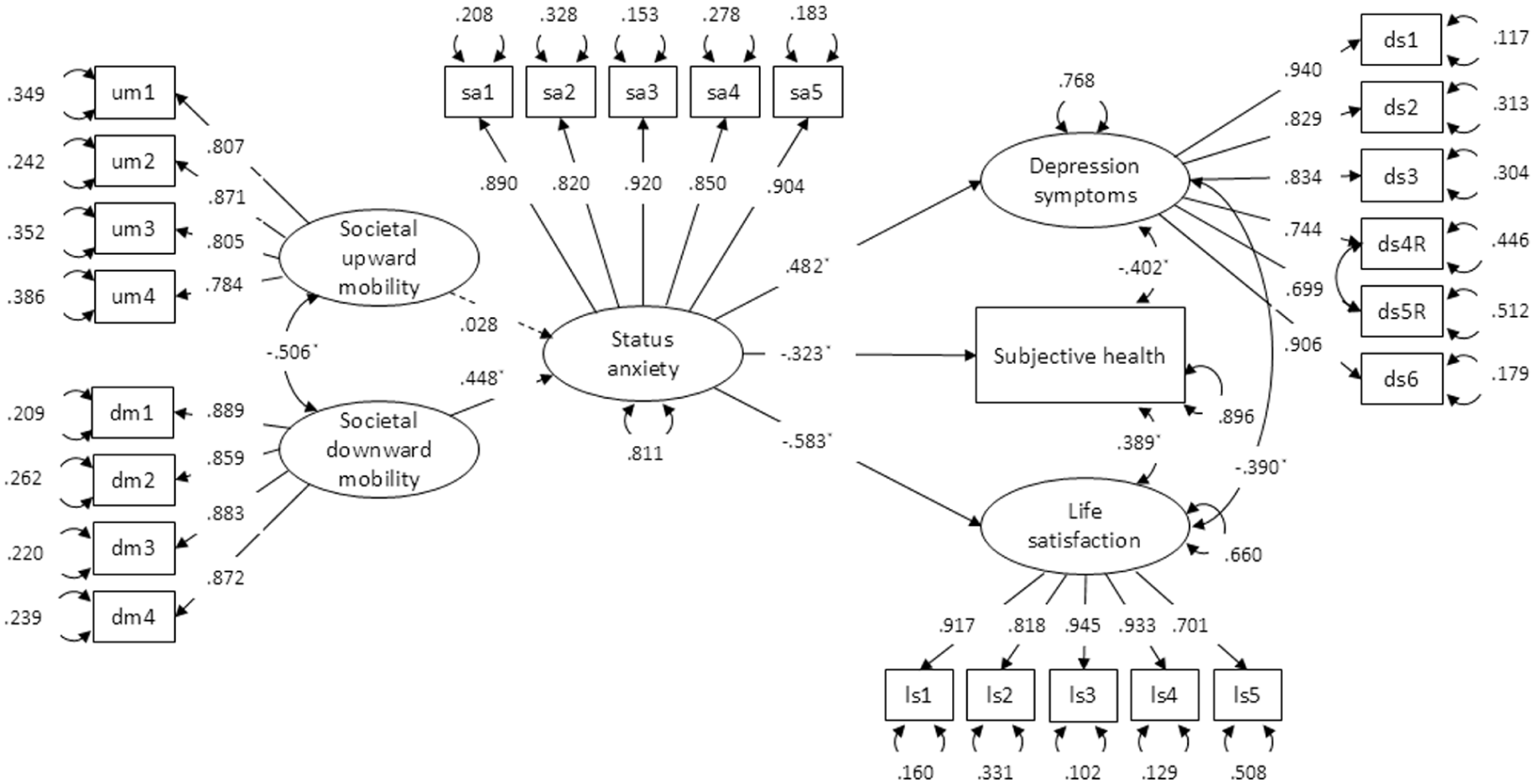
Structural equation model in Study 1.
Missing data were handled with full information maximum likelihood (Enders & Bandalos, 2001). Robust fit indices indicated acceptable fit (χ2[266] = 470.013, p < .001, CFI = 0.953, TLI = 0.947, RMSEA 90% CI [0.054, 0.074], SRMR = 0.075). Robust confidence intervals for the indirect effects were obtained via Monte Carlo resampling (MacKinnon et al., 2004).
Results indicated that greater perceptions of societal downward mobility were associated with higher levels of status anxiety. In turn, heightened status anxiety predicted more frequent depressive symptoms, lower life satisfaction, and poorer perceived health. This pattern produced significant indirect effects of perceived societal downward mobility via status anxiety on depressive symptoms (ab 95% CI [0.140, 0.361]), life satisfaction (ab [−0.460, −0.192]), and subjective health (ab [−0.169, −0.054]). In contrast, perceptions of societal upward mobility did not predict status anxiety (β = .028, p = .739), resulting in non-significant indirect effects of perceived societal upward mobility (abdepressive symptoms 95% CI [−0.082, 0.102]; ablife satisfaction [−0.137, 0.108]; absubjective health [−0.048, 0.036]).
The robustness of the results was tested by repeating the same analyses controlling for subjective and objective SES, political orientation, age, and gender, as these variables could be associated with both mobility beliefs and status anxiety. Results did not vary after including covariates (see Supplemental Materials, Section 1). Furthermore, we explored whether subjective SES and gender moderate the effects of upward and downward mobility beliefs: No significant interaction was found. Results are reported in Supplemental Materials (Section 2).
Discussion
In this first exploratory study, we found that mobility beliefs negatively impacted participants’ well-being via status anxiety. Specifically, perceiving that Americans tend to obtain lower SES than the previous generation (i.e., downward mobility beliefs) predicted poorer perceived health, lower life satisfaction, and more frequent depressive symptoms. Status anxiety completely mediated these effects. In contrast, upward mobility beliefs were not associated with status anxiety.
These findings should be interpreted with caution. In Study 1, we examined perceptions of societal mobility—that is, beliefs about the mobility of others—which may differ from perceptions of personal mobility—that is, beliefs about one’s own trajectory (Davidai & Wienk, 2021). Depending on individual expectations, societal mobility beliefs could lead to divergent outcomes. For example, perceiving that others are performing well could foster optimism, suggesting that one might also experience upward mobility in line with the broader trend. Alternatively, the same perception could provoke frustration if individuals feel stuck while others move ahead (Hirschman & Rothschild, 1973). Thus, perceptions of societal mobility may mask opposing effects on status anxiety—one linked to anticipated personal mobility, and another tied to social comparison with others’ trajectories.
To address this issue, the following studies focused on personal mobility beliefs, rather than societal ones. In Study 2, we sought to replicate the findings from Study 1 while extending them by testing the effects of expectations of personal upward and downward mobility on life satisfaction, as well as the mediating role of status anxiety.
Study 2
In Study 2, we examined how expectations of personal social mobility relate to status anxiety and life satisfaction. We hypothesized that expecting personal upward mobility would reduce status anxiety (H1), whereas expecting personal downward mobility would increase it (H2).
Moreover, we predict that status anxiety would mediate two opposing indirect effects of expected upward mobility (H3a) and expected downward mobility (H3b) on life satisfaction. Specifically, higher expected upward mobility would be associated with lower status anxiety, while higher expected downward mobility would be associated with higher status anxiety. Higher status anxiety, in turn, would be associated with lower life satisfaction. This was a pre-registered study. Pre-registration can be consulted at: https://osf.io/fvydq/?view_only=2aa2c72024c94bc894d90e182796f1df.
This study was part of a larger project. As part of this project, other variables than those described in this study, and out of the scope of the present research, were included in the same survey.
Method
Participants and Procedures
Participants were recruited in Spain by an online survey company (i.e., NETQUEST), and those who failed more than one of the three attention checks set during data collection were screened out. The sample (N = 1,536, 51.43% women; see Table S2 in Supplemental Materials for detailed sociodemographics) was stratified by quotas based on participants’ social class, gender, age, and region of residence to resemble de Spanish population (as described by available data at the Spanish National Institute of Statistics in 2022).
A sensitivity analysis indicated that, for a model with 2 latent variables and 10 observed variables, with α = .05, our sample is large enough to detect effects of size β >= .101 with 95% of statistical power (Soper, 2023).
Measures
Subjective health was measured as in Study 1.
Status Anxiety
A shortened Spanish Version of the Status Anxiety Scale was administered (Melita et al., 2020). Three items with high factor loadings and conceptual representativeness from the original five-item scale were selected (see preregistration at: https://osf.io/fvydq/?view_only=2aa2c72024c94bc894d90e182796f1df; ω = .88). Responses ranged from 1 (Totally disagree) to 7 (Totally agree).
Life Satisfaction
A single-item measure adapted from the European Social Survey asked: “All things considered, how satisfied are you with your life as a whole nowadays?” (0 = completely unsatisfied, 10 = completely satisfied).
Expected Personal Mobility
Expectations of personal upward and downward mobility were assessed with two “My socioeconomic status is very likely to improve/worsen in the future,” rated from 1 (strongly disagree) to 7 (strongly agree).
Results
Pre-Registered Analyses
We estimated the structural equation model shown in Figure 2 using the same method and covariates as in Study 1. The model showed good fit (χ2[6] = 43.207, p < .001, CFI = 0.986, TLI = 0.966, RMSEA 90% CI [0.049, 0.088], SRMR = 0.017). Bootstrap percentile confidence intervals for indirect effects were obtained with maximum likelihood estimations.
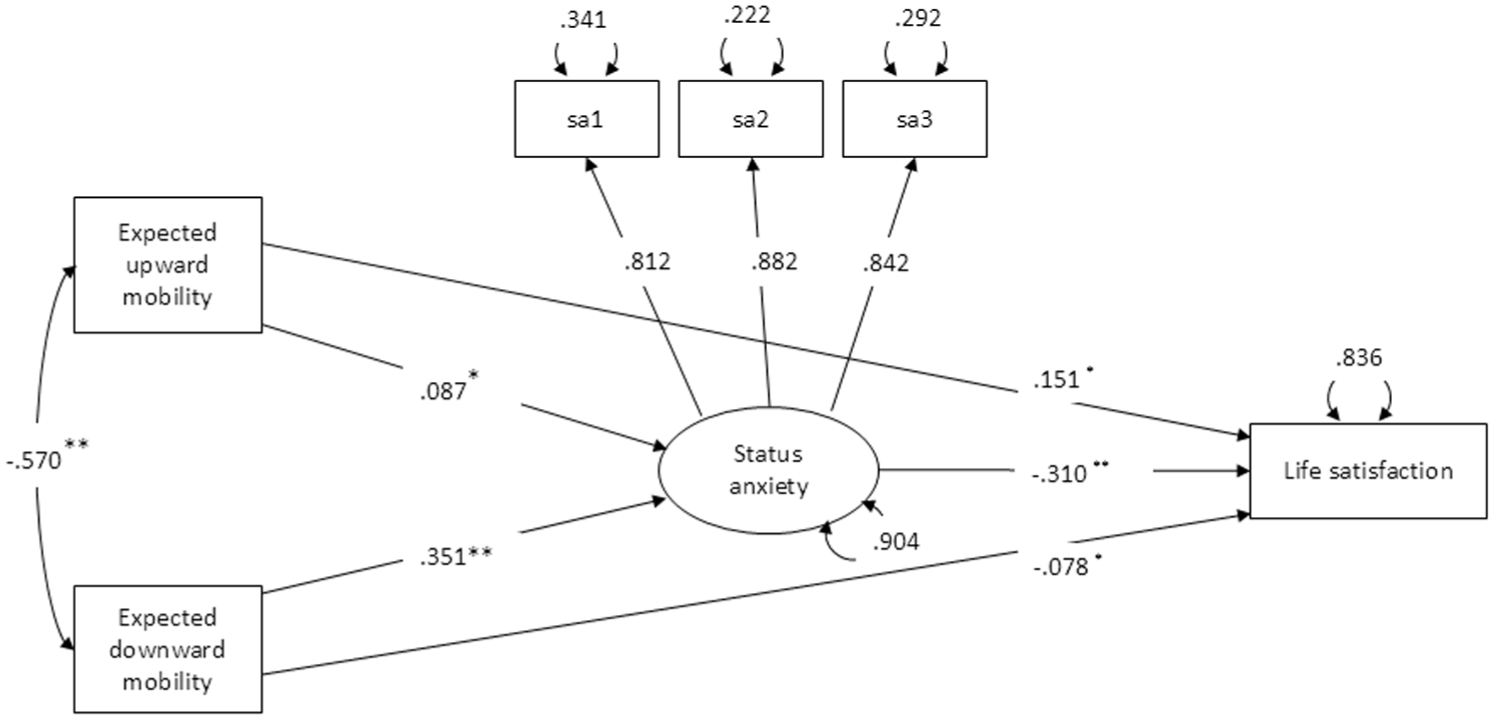
Structural equation model in Study 2.
As predicted in H2, higher expectations of personal downward mobility predicted higher status anxiety, which in turn predicted lower life satisfaction. This produced a significant indirect negative effect of expected personal downward mobility on life satisfaction through status anxiety (ab 95% CI [−0.139, −0.080]). A significant negative residual direct effect of expected personal downward mobility on life satisfaction was also observed.
Contrary to H1, expected personal upward mobility also predicted higher status anxiety, yielding a negative indirect effect of expected personal upward mobility through higher status anxiety on life satisfaction (ab 95% CI [−0.050, −0.005]). However, personal upward mobility expectations simultaneously showed a significant positive residual direct effect on life satisfaction.
As in Study 1, the results did not vary when including covariates in the analysis (see Supplemental Materials, Section 3).
Exploratory Analyses
To explore whether this pattern extended to another well-being outcome, subjective health was added as an endogenous outcome variable. Because subjective health was ordinal, we estimated the model using the weighted least square method (Flora & Curran, 2004) and obtained bootstrap percentile confidence intervals for standardized solution of the indirect effects with the same estimation method. The model showed good fit (χ2[8] = 79.902, p < .001, CFI = 0.994, TLI = 0.992, RMSEA 90% CI [0.062, 0.092], SRMR = 0.026).
Results paralleled those for life satisfaction (See Figure S2 in Supplemental Materials): Both expected personal downward and upward mobility showed negative indirect effects on life satisfaction (abupward mobility 95% CI [−0.050, −0.000], abdownward mobility [−0.153, −0.089]), and subjective health (abupward mobility [−0.030, −0.000], abdownward mobility [−0.094, −0.043]) through status anxiety. The results did not vary when including covariates in the analysis (see Supplemental Materials, Section 3).
Also, the same interaction effects as in Study 1 were explored. Subjective SES was found to moderate the effect of upward mobility beliefs on status anxiety: That is, upward mobility beliefs predicted status anxiety to a higher extent among those who reported higher subjective SES (see Supplemental Materials, Section 4).
Discussion
In Study 2, we found that both upward and downward personal mobility expectations were associated with status anxiety. As predicted, downward mobility expectations were linked to lower well-being both directly and indirectly through heightened status anxiety. However, contrary to our hypotheses, upward mobility expectations also predicted higher status anxiety. This produced a negative indirect effect on well-being through higher status anxiety, alongside an opposite positive direct effect.
One possible explanation for this unexpected pattern is that participants with stronger expectations of mobility—whether upward or downward—may experience greater uncertainty regarding their future SES (Destin et al., 2017). Such uncertainty has been associated with lower well-being and may be especially pronounced during periods of transition, such as when individuals acquire higher SES (e.g., attending college; Feasel et al., 2023), or when their social standing does not align with the norms and expectations of their environment (Destin et al., 2017; Liu et al., 2004; Stephens et al., 2014). From this perspective, higher expectations of upward mobility could simultaneously foster optimism and increase well-being, while also heightening status anxiety and thereby diminishing well-being.
These findings should be interpreted with caution. First, the measures of expected upward and downward personal mobility were single-item indicators, chosen due to space limitations in the questionnaire. Second, the cross-sectional design of Studies 1 and 2 prevents causal inferences and does not rule out the role of unmeasured confounding variables. To address these limitations, we conducted two additional experimental studies in Spain (Study 3) and the United States (Study 4).
Study 3
To test the causal effects of upward and downward mobility beliefs on status anxiety, we conducted an online experiment in Spain. Participants were randomly assigned to one of three conditions: downward mobility, low mobility, or upward mobility. To manipulate personal expectations of mobility, we adapted a paradigm often used to study economic inequality. In this paradigm, participants imagine starting a new life in a fictitious society called Bimboola (Jetten et al., 2015; Sánchez-Rodríguez et al., 2019). In our adapted version, perceived inequality was held constant across conditions, but expectations about moving up or down the socioeconomic hierarchy varied. Study 3 was pre-registered (https://osf.io/hjpn9/?view_only=2ee802589f2e4d56ae4c5354fb7488bc).
Method
Participants and Procedures
Based on Studies 1 and 2, we estimated the omnibus effect of the mobility beliefs manipulation to be ηp2 ≥ .026. To achieve 80% statistical power with α = .05, we aimed to collect a minimum of 362 and a maximum of 500 valid observations. A total of 885 Spanish students were recruited via a university mailing list. After applying pre-registered exclusion criteria, the final sample consisted of 472 participants, mostly from working and middle-class backgrounds (Mage = 22.05, SDage = 3.68; 70% self-described as female; see Table S4 in Supplemental Materials for sociodemographics). Specifically, 101 participants were excluded because they did not complete the study, 5 failed an attention check (i.e., “to which group were you assigned in Bimbola?”), 205 had previously participated in related experiments (6 did not specify), 72 were not Spaniards, and 30 did not complete the manipulation reinforcing task as instructed.
Manipulation of Expected Personal Mobility
Participants were randomly assigned to one of the three mobility conditions. In all conditions, they imagined beginning a new life in a Bimboola, chose some goods from a list in order to start their new life (house, car, holiday trip), and were informed that the fictitious society was divided into five income groups. All participants were assigned to the middle-income group (group 3) and were told that consumption options depended on group resources.
They then read condition-specific infographics about the chances people in the middle-income group in Bimboola and participants themselves had to move to a higher or a lower group of income (see Figure 3).
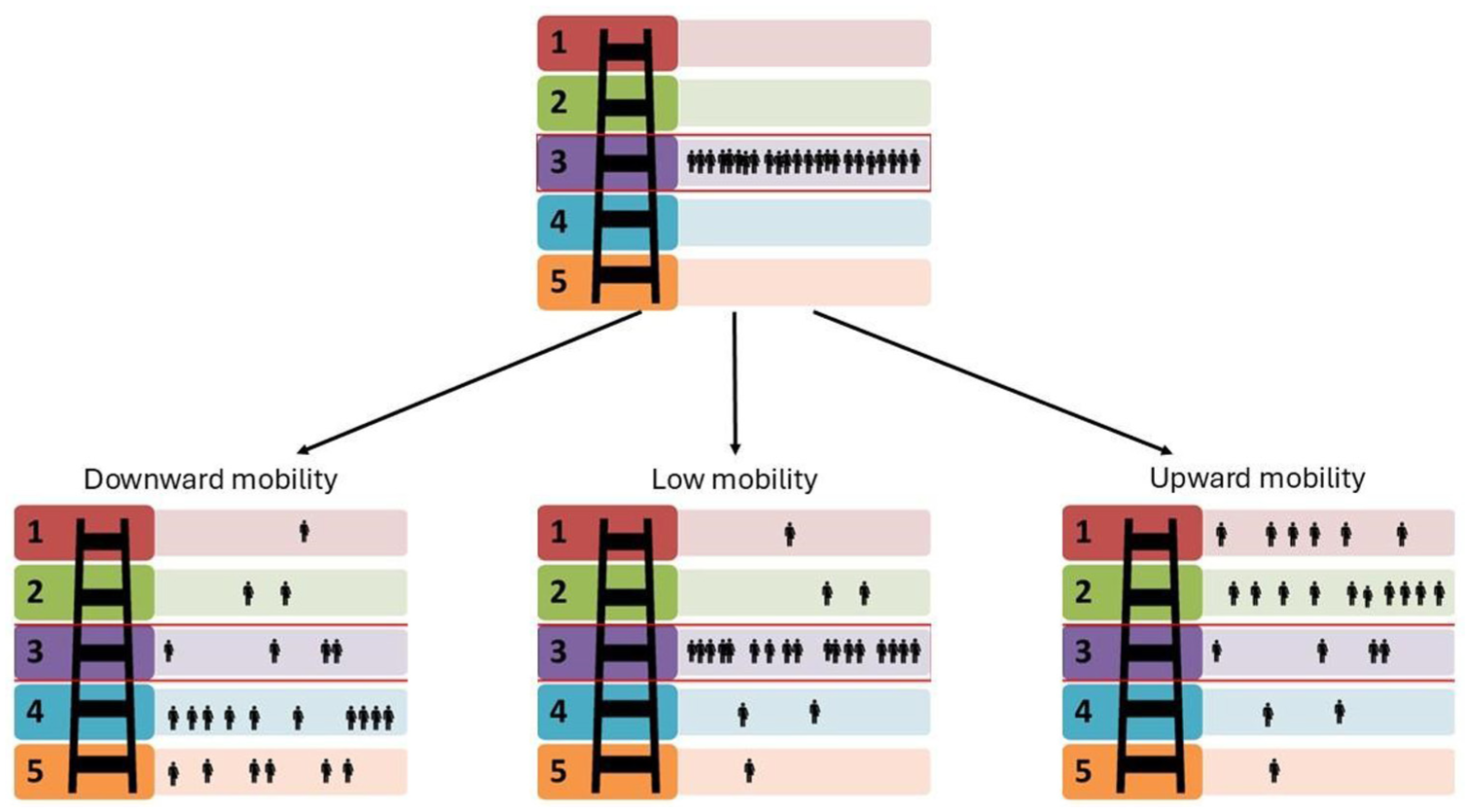
Manipulation of expected personal mobility in Studies 3 and 4.
In the upward mobility condition, they had good chances to move to a higher income group, and low chances to stay in the same group or move to a lower income group.
In the low mobility condition, they had good chances to stay in the same income group, but low chances to move to a higher income group, or to a lower income group.
In the downward mobility condition, they had high chances to move to a lower income group, and low chances to stay in the same group or move to a higher income group.
To reinforce the manipulation, participants were also informed about their personal chances of mobility, which matched their group’s prospects. Finally, they wrote a short narrative imagining their life in Bimboola over the next 5 years.
Measures
Life satisfaction measure was adapted from Study 2 (e.g., “All things considered, how satisfied are you with your life in Bimboola as a whole these days?”).
Manipulation Checks
To measure participants’ expectations of personal mobility in Bimboola, we adapted previously validated measures of mobility beliefs (Browman et al., 2022; Davidai & Gilovich, 2015). Participants distributed 100 points across the five groups to indicate their expected chances to ending up in each after a time (0 = very unlikely to 100 = very likely). Expected upward mobility was indexed by averaging groups 1 and 2 scores (r = .247, p < .001). Expected downward was indexed by averaging groups 4 and 5 scores (r = .524, p < .001).
Status Anxiety
The same scale as in Study 1 was used (ω = .82). Following pre-registration, the average score across the five items served as dependent variable in the ANCOVA.
Results
Pre-Registered Analyses
We first conducted heteroscedastic ANOVAs for trimmed with package WRS2 (Mair & Wilcox, 2020), on expected upward and downward mobility as criteria variables, and experimental conditions as predictor. The omnibus tests indicated overall effects of the experimental paradigm on both expected upward (F[2, 186.85] = 8.072, p < .001, ξ = .26, 95% CI [0.13, 0.39]) and downward mobility (F[2, 179.64] = 6.596, p = .002, ξ = .26 [0.16, 0.40]). Pairwise post-hoc tests indicated that expected upward mobility was higher in the upward mobility condition (M = 40.00, SD = 23.40) than in the low mobility (M = 30.90, SD = 21.30; psi hat = 9.133, p = .001 [2.964, 15.302]) and the downward mobility conditions (M = 30.50, SD = 19.90; psi hat = 9.332, p = .001 [3.196, 15.468]), and that expected downward mobility was higher in the downward mobility condition (M = 32.80, SD = 20.90) than in the low mobility (M = 22.60, SD = 15.20; psi hat = 8.459, p = .002 [2.755, 14.163]) and the upward mobility conditions (M = 25.30, SD = 19.30; psi hat = 7.520, p = .007 [1.431, 13.610]). No significant differences were observed between the downward and low mobility conditions for expected upward mobility (psi hat = −.199, p = .932 [−5.759, 5.360]), nor between the upward and low mobility conditions for expected downward mobility (psi hat = .939, p = .639 [−3.844, 5.722]).
Next, we tested the effect of mobility condition on status anxiety. The omnibus test of ANOVA indicated an overall effect of expected personal mobility on status anxiety (F[2, 469] = 4.138, p = .017, ω p 2 = .013, 95% CI [0.000, 0.038]). Planned contrasts confirmed that, according to our hypothesis, participants in the downward mobility condition reported higher status anxiety (M = 4.23, SD = 1.41) than those in the low mobility condition (M = 3.84, SD = 1.38; t[469] = 2.398, p = .017, d = 0.221 [0.040, 0.403]). In contrast, no difference emerged between the upward (M = 3.82, SD = 1.42) and the low mobility conditions (t[369] = −0.176, p = .861, d = −0.016 [−0.197, 0.165]). The results did not vary when including covariates in the analysis (see Supplemental Materials, Section 4).
Exploratory Analyses
We tested the same mediation model as in Studies 1 and 2, with mobility condition (upward vs. low, downward vs. low) as exogenous predictors, life satisfaction in Bimboola as criterion variable, and status anxiety as mediator. The model represented in Figure 4 showed good fit (χ2[17] = 52.930, p < .001, CFI = 0.958, TLI = 0.939, RMSEA 90% CI [0.047, 0.089], SRMR = 0.032). confidence intervals for standardized indirect effects were obtained with the same procedure as in Studies 1 and 2.
Structural equation model in Study 3.
Consistent with Studies 1 and 2, downward mobility expectations exerted a negative indirect effect on life satisfaction through status anxiety: Participants in the downward mobility condition (vs. low mobility) reported greater status anxiety, which in turn predicted lower life satisfaction (ab 95% CI [−0.109, −0.014]). The direct effect of downward mobility on life satisfaction was not significant, indicating full mediation by status anxiety (β = −.058, p = .250). By contrast, upward mobility (vs. low mobility) did not exert a significant indirect effect on life satisfaction through status anxiety (ab [−0.046, 0.046]). The results did not vary when including covariates in the analysis (see Supplemental Materials, Section 5). Furthermore, an additional model was explored, with perceived control and status anxiety as parallel mediators. Perceived control did not mediate any indirect effect, and the indirect effect of downward mobility expectations through status anxiety remained significant. Rationale, methods, and results for these analyses are reported in Supplemental Materials (Section 6).
Finally, the same interaction effects as in Studies 1 and 2 were explored. As in Study 2, SES was found to moderate the effect of upward mobility beliefs on status anxiety. The effect was only marginally significant but showed a negative tendency for high- SES participants and a positive tendency for low-SES participants, resulting in opposite indirect effects on life satisfaction (see Supplemental Materials, Section 7).
Discussion
Results from Study 3 provided evidence that expectations of downward mobility increase status anxiety. In contrast, upward mobility expectations did not significantly affect status anxiety in either direction. Exploratory analyses further suggested that status anxiety mediated the negative effect of downward mobility expectations on life satisfaction.
Several limitations should be noted. Although the experimental paradigm was designed to avoid socio-cultural biases and enhance generalizability, participants may have projected elements of their own social environment into the fictitious Bimboola scenario. This possibility is particularly relevant given that our sample consisted mainly of young adults in Spain, a context marked by high youth unemployment rates. Such participants may be predisposed to skepticism regarding opportunities of upward mobility (Matamoros-Lima et al., 2024). By contrast, United States citizens tend to overestimate mobility and could be more easily influenced by mobility manipulations in both real-world and fictional scenarios (Kraus & Tan, 2015). Therefore, cultural contexts such as the United States—characterized by stronger meritocratic beliefs and greater materialism (Bartolini & Sarracino, 2017; Gobel & Kim, 2023)—might yield different patterns of results.
To explore this possibility, in Study 4, we tested the same causal model in a markedly different cultural context: the United States.
Study 4
The same experimental paradigm used in Study 3 was applied to a different cultural context—the United States—to test whether results would replicate. We predicted that status anxiety would mediate two opposing causal effects: Downward mobility expectations would increase status anxiety and lower life satisfaction, whereas upward mobility expectations would reduce status anxiety and improve life satisfaction.
Study 4 was pre-registered. Pre-registration can be consulted at: https://osf.io/uebqm/?view_only=dd67c05f1f7648caadac6e198c7c0164.
Method
Participants and Procedures
Based on Study 3, we adjusted the estimated omnibus effect of mobility beliefs to .019 < η p 2 < .024. Power analysis indicated that 501 to 600 valid cases would be needed to detect effects of this size with 80% power at α = .05. We recruited 643 fully employed U.S. participants via Prolific. After excluding those who did not complete the study (n = 39), did not write what they were asked for in the manipulation reinforcing task (n = 1), failed to correctly answer a comprehension check item (i.e., “to which group were you assigned in Bimboola?”; n = 3), or omitted nationality/birthplace (n = 5), the final sample included 595 participants, mostly from middle and upper-middle social class (Mage = 39.98.02, SDage = 11.57; 48.07% self-described as female, 77.82% White, 7.56% Asian, 6.86% Black, 3.19% Hispanic, 3.03% Mixed Ethnicity, 76.30% obtained an undergraduate or higher university degree; full demographics in Table S2).
Measures
All variables (i.e., expected personal upward and downward mobility, perceived inequality, status anxiety, life satisfaction, political orientation, SES) were measured as in Study 3 (rexpected upward mobility = .420, p < .001; rexpected downward mobility = .576, p < .001; ωstatus anxiety = .86).
Results
Pre-Registered Analyses
As in Study 3, heteroscedastic ANOVAs for trimmed means indicated overall effects of the experimental paradigm on both expected upward (F[2, 225.24] = 126.353, p < .001, ξ = .69, 95% CI [0.63, 0.76]) and downward mobility (F[2, 218.68] = 82.071, p < .001, ξ = .73, 95% CI [0.66, 0.81]). Post-hoc tests indicated that expected upward mobility was higher in the upward mobility condition (M = 27.10, SD = 13.50) than in the low mobility (M = 10.90, SD = 9.50; psi hat = 19.097, p < .001 [16.122, 22.071]) and the downward mobility conditions (M = 12.80, SD = 11.80; psi hat = 18.513, p < .001 [15.465, 21.561]), and that expected downward mobility was higher in the downward mobility condition (M = 23.20, SD = 13.20) than in the low mobility (M = 8.67, SD = 7.59; psi hat = 16.804, p < .001 [13.600, 20.009]) and the upward mobility conditions (M = 9.87, SD = 10.20; psi hat = 16.605, p < .001 [13.348, 19.863]). No significant differences emerged between the downward and the low mobility conditions for expected upward mobility (psi hat = .583, p = .492 [−1.441, 2.607]) or between the upward and the low mobility conditions for expected downward mobility (psi hat = .199, p = .770 [−1.422, 1.819]).
Moreover, a similar ANOVA as in Study 3 indicated an overall effect of expected personal mobility on status anxiety (F[2, 592] = 55.367, p < .001, ω p 2 = .155, 95% CI [0.104, 0.206]). Planned contrasts supported predictions: Compared to the low mobility condition (M = 3.28, SD = 1.45), participants assigned to the upward mobility condition reported lower status anxiety (M = 2.91, SD = 1.37; t[592] = −2.589, p = .010, d = −0.213 [−0.374, −0.051]), while those in the downward mobility condition reported higher status anxiety (M = 4.36, SD = 1.43; t[592] = 7.565, p < .001, d = 0.622 [0.457, 0.787]).
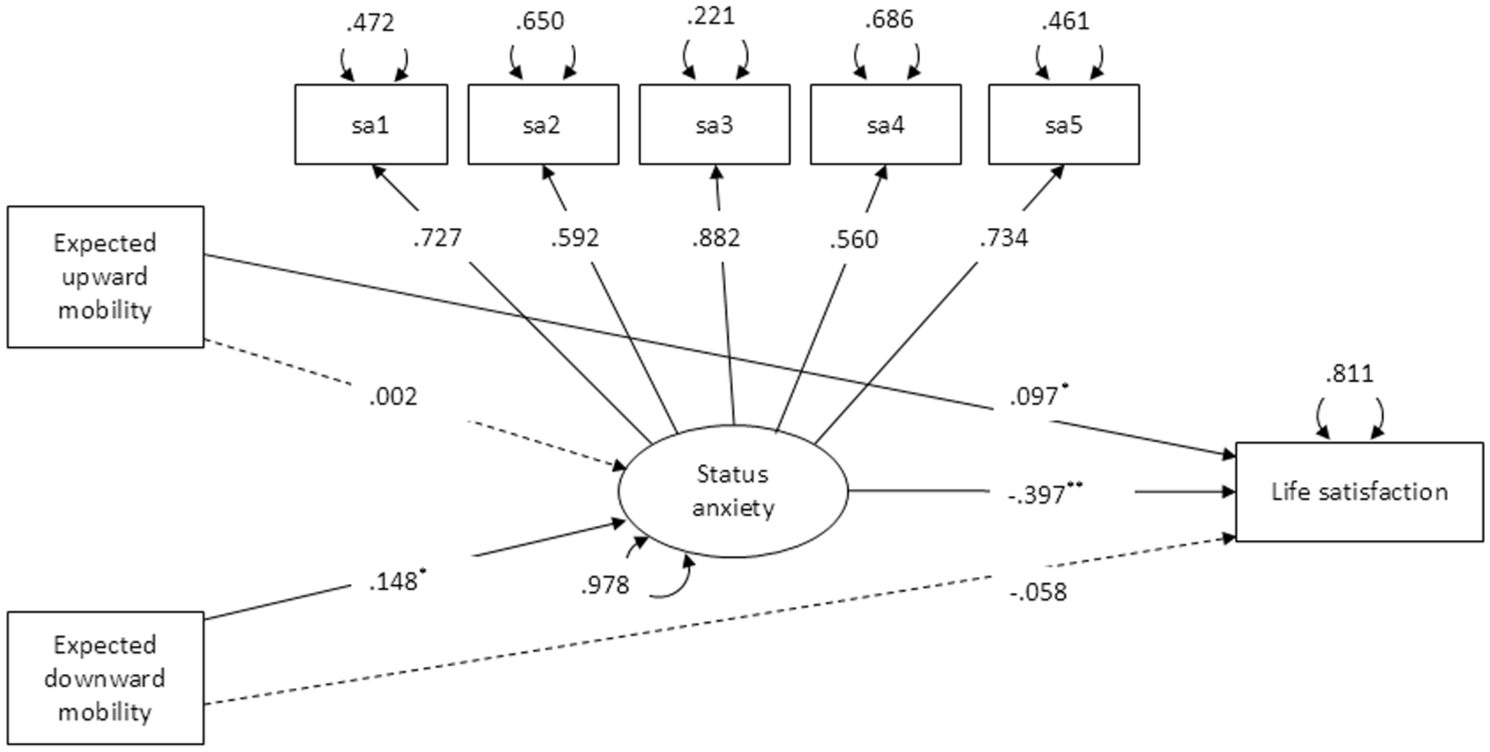
We then tested the pre-registered mediation model from Studies 1 to 3, entering mobility condition (upward vs. low, downward vs. low) as exogenous predictors, life satisfaction in Bimboola as criterion variable, status anxiety as mediator, and perceived inequality, participants’ sex, SES, age, and political orientation as control variables. The model (Figure 5) showed mediocre robust fit indices (χ2[16] = 165.313, p < .001, CFI = 0.922, TLI = 0.868, RMSEA 90% CI [0.116, 0.154], SRMR = 0.057), and bootstrap percentile confidence intervals for standardized solution of the indirect effects were obtained with maximum likelihood estimations.
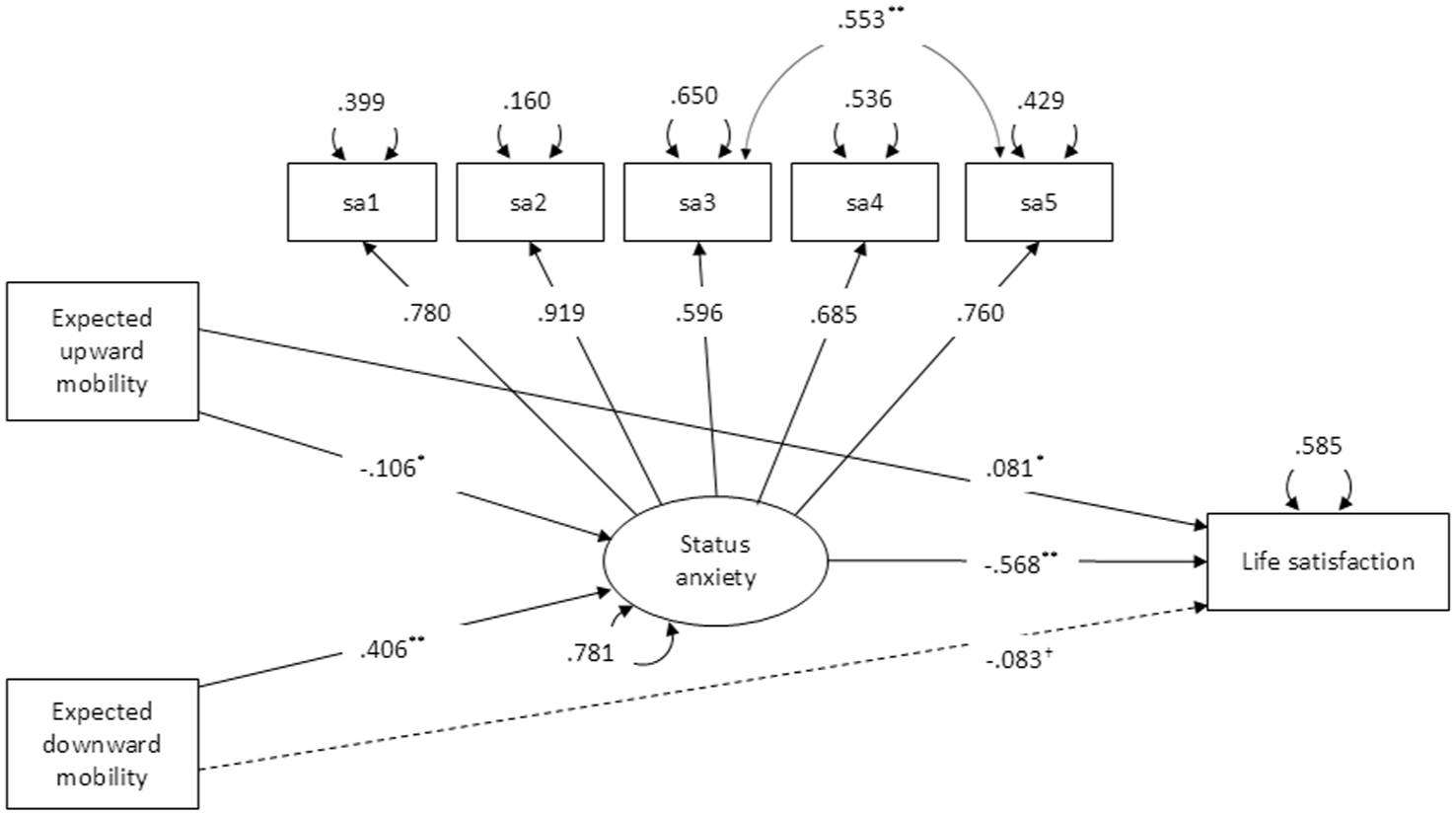
Structural equation model in Study 4.
Consistent with hypotheses, both upward and downward mobility conditions (compared to the low mobility condition) produced indirect opposing effects on life satisfaction through status anxiety.
Upward mobility (vs. low mobility) reduced status anxiety, leading to higher life satisfaction (ab 95% CI [0.013, 0.111]). Conversely, downward mobility (vs. low mobility) increased status anxiety, leading to lower life satisfaction (ab [−0.297, −0.172]). A significant positive direct effect of upward mobility on life satisfaction indicated partial mediation (β = .081, p = .020), whereas the direct effect of downward mobility on life satisfaction was only marginally significant, indicating full mediation (β = −.083, p = .058). The results did not vary when including covariates in the analysis (see Supplemental Materials, Section 8).
Exploratory Analyses
Following Study 3, an additional model was explored, with perceived control and status anxiety as parallel mediators. Perceived control mediated a positive indirect effect of upward mobility expectations on life satisfaction, while the indirect effects of both upward and downward mobility expectations through status anxiety remained significant. Rationale, methods, and results for these analyses are reported in Supplemental Materials (Section 9).
Consistently with Studies 1–3, we explored whether subjective SES and gender moderate the effects of upward and downward mobility beliefs: No significant interaction was found. Results are reported in Supplemental Materials (Section 10).
Discussion
Study 4 replicates and extends Study 3 findings in a different cultural setting. Relevantly, the effect size on the manipulation checks was considerably higher in Study 4 than Study 3, indicating that the experimental manipulation was more effective in Study 4 and that baseline mobility beliefs and the cultural context could influence how participants react to new information of mobility, even in a fictitious scenario.
Results provided evidence of opposite causal effects of downward versus upward personal mobility expectations on status anxiety and life satisfaction, and the role of status anxiety as mediator of the effects of both mobility expectations on life satisfaction. Expectations of upward mobility reduced status anxiety, resulting in higher life satisfaction. In contrast, expectations of downward mobility increased status anxiety, resulting in lower life satisfaction. The magnitude of the negative indirect effect of downward mobility was greater than the positive indirect effect of upward mobility (abtotal 95% CI [−0.242, −0.062]), suggesting that the detrimental psychological consequences of anticipated decline may outweigh the benefits of anticipated advancement. These findings reinforce the robustness of the proposed mechanism, underscoring status anxiety as a central psychological response to mobility expectations—especially in the case of anticipated decline—and a key correlate of subjective well-being.
General Discussion
Across two cultural contexts and using both natural observation in cross-sectional surveys and experimental studies, the present research provided evidence that mobility beliefs shape well-being, with status anxiety as a key psychological mechanism. Specifically, downward mobility beliefs consistently decreased well-being by heightening status anxiety.
In contrast, the effects of upward mobility beliefs on status anxiety and well-being were less consistent. Only in Study 4 did upward mobility beliefs reduce status anxiety and improve well-being, as predicted. This inconsistency suggests that additional processes and boundary conditions shape the effects of upward mobility beliefs. We discuss several possible explanations below.
Whereas previous research has mostly examined upward mobility beliefs, recent work highlights downward mobility beliefs as a distinct dimension with potential opposing effects (Browman et al., 2022; Matamoros-Lima et al., 2023; Melita et al., 2023). Our findings add to evidence that in many cases downward mobility can have a stronger and more consistent impact on mental well-being than upward mobility (Dolan & Lordan, 2021; Y. Zhao et al., 2017). Indeed, through our studies, downward mobility exerted larger and more robust effects. In other words, the effects of downward mobility beliefs outweighed those of upward mobility beliefs. This suggests that research should devote greater attention to the prevalence and consequences of downward mobility beliefs, while accounting for the effects of upward mobility beliefs. Furthermore, future research should examine under what circumstances, and for whom, the effects of downward or upward mobility beliefs prevail.
Future research should also address why the effects of upward mobility beliefs were less consistent. Several avenues appear especially promising. We outline in the next section some limitations in our research and potential avenues for advancing in the study of mobility beliefs.
Limitations and Future Directions
One important distinction we partially implemented here is societal versus personal mobility beliefs, (Davidai & Wienk, 2021): Societal beliefs may amplify worries about being left behind, whereas personal beliefs may foster optimism. Consistent with this, people tend to be more optimistic about their personal prospects than about society (Matamoros-Lima et al., 2024). Crucially, however, these two belief types can confound one another: People may infer their own chances from what they believe is happening at the societal level or conversely project their personal expectations onto society. We therefore recommend experimental designs that manipulate—or observational studies that simultaneously assess—both personal and societal mobility beliefs so researchers can estimate their unique and joint effects. Also, multi-level studies could dive into the specific contribution of objective societal and personal mobility and mobility beliefs to predict status anxiety and well-being.
Relatedly, Gilbert et al. (2023) highlight the difference between subjective-need income (perceived sufficiency relative to basic needs) and subjective-relative income (perceived standing relative to others). Building on that distinction, while we tested the effects of relative mobility beliefs—that is, beliefs regarding changes in one’s SES—future studies should explore what is the unique contribution of absolute mobility beliefs—that is, beliefs regarding changes in one’s economic resources—relative to one’s needs in predicting health and well-being outcomes.
Second, the effects of upward mobility beliefs could depend on the cultural context: While they could serve a palliative function in highly meritocratic cultures, they could have unpredictable effects in societies that have undergone severe economic crises (Gobel & Kim, 2023). In the United States, for instance, citizens tend to overestimate mobility due to widespread meritocratic beliefs (Kraus & Tan, 2015). These beliefs tend to go hand in hand with economic inequality and favor optimistic views on mobility (Mijs, 2021). However, in context where external factors such as global economic trends and structural barriers are considered to weigh more on economic success, both upward and downward mobility beliefs could increase status anxiety to a higher extent, as they are perceived to be out of personal control.
Third, the effects of upward mobility beliefs could depend on structural variables, such as economic stability and inequality. Not only does economic inequality influence mobility beliefs, but also it can moderate their effects. In this regard, research carried out by S. Zhao et al. (2024) found that upward mobility beliefs had a smaller effect on subjective well-being in contexts of higher inequality. Future studies should test the interaction effects among mobility beliefs and economic inequality in experimental settings.
Fourth, structural conditions and cultural context may interact with the multiple social hierarchies people occupy. Prior work shows that psychological responses to perceived inequality and mobility beliefs vary systematically by race and other social-group memberships (Gordils et al., 2023; Hernández et al., 2023). Consistent with this, our exploratory analyses (see Sections 4 and 7 in the Supplemental Materials) revealed that SES moderated the effect of upward mobility beliefs on status anxiety, but in opposite directions across Studies 2 and 3 (both conducted in Spain). Expectations of mobility may therefore increase status anxiety for both advantaged and disadvantaged groups depending on the perceived costs and benefits of moving between strata. For example, if the middle class shrinks, competition may intensify for disadvantaged groups and raise the perceived costs of upward mobility (e.g., cultural barriers; Stephens et al., 2014). Conversely, when the elite tier contracts, further upward movement might become costly even for advantaged groups, who may fear intensified competition at the top. Future work should explicitly test SES and other social-group memberships as moderators and examine whether these patterns generalize across racial/ethnic and other group lines.
Fifth, future research may explore suppressing mechanisms explaining the inconsistent association between upward mobility beliefs, status anxiety, and well-being. One promising candidate is financial contingent self-worth—the tendency to base self-esteem on financial success (Park et al., 2017). Anticipating upward mobility may encourage a high-status mindset and greater identification with wealth, increasing the extent to which individuals make their self-worth contingent on material outcomes (Jetten et al., 2017). Because financial contingency of self-worth is associated with greater stress and anxiety (Park et al., 2017), it could help account for why upward mobility expectations sometimes link to higher status anxiety rather than lower. Future studies should therefore measure (or manipulate) financial contingency of self-worth and test whether it mediates the positive association between upward mobility beliefs and status anxiety.
Finally, while real-world scenarios have been used to investigate the effects of societal mobility beliefs in previous studies (Silverman et al., 2024), participants could be suspicious toward manipulations of personal mobility beliefs in real contexts. Therefore, we adapted a well-established method from research on economic inequality (Jetten et al., 2015; Sánchez-Rodríguez et al., 2019) using hypothetical scenarios. This approach is designed to reflect real-world thought processes and offers strong internal validity by isolating the psychological mechanism of interest from real-world confounds. However, future research should complement our findings by employing longitudinal designs or real-world manipulations to further establish generalizability.
Theoretical and Practical Implications
Our findings have theorical implications which open the way to novel research questions. That is, downward mobility beliefs are aversive, as they increase status anxiety. Therefore, underestimating the likelihood of downward mobility acts as a psychological coping strategy. People tend to display optimistic biases and motivated reasoning when faced with threatening information (Kunda, 1990). Downplaying the chance of decline may therefore be an avoidance or emotion-regulation strategy to cope with status anxiety in the short term. Future research should investigate underestimation of downward mobility and overestimation of upward mobility and examine whether they could serve as a self-deceiving mechanism to prevent psychological distress, by investigating their antecedents and consequences (Melita et al., 2024). 1
Furthermore, practical implications could be derived from the present research. Political actors seeking to promote social policies that enhance well-being (e.g., unconditional basic income; see Guerendiain-Gabás et al., 2024) must build broad social consensus. A key insight from our research is that downward mobility beliefs exert stronger negative effects than upward mobility beliefs. Thus, policies should not only expand real opportunities for upward mobility—for instance, through more inclusive and less competitive educational systems—but also protect vulnerable groups from the cyclic crises of modern economies, by strengthening social welfare and safety nets.
Conclusion
In sum, we live in extraordinary times: For the first time since World War II younger generations in wealthy countries face worse economic conditions than the previous one. This research contributes to understanding how such prospects affect well-being. Across multiple studies, we show that downward mobility beliefs increase status anxiety, which mediates a negative effect on well-being. We hope these insights will inform policies and specific interventions to mitigate status anxiety and future research on the psychological consequences of mobility beliefs.
Supplemental Material
sj-docx-1-psp-10.1177_01461672261451296 – Supplemental material for Prospects of Downward Mobility Cause Status Anxiety and Life Dissatisfaction
Supplemental material, sj-docx-1-psp-10.1177_01461672261451296 for Prospects of Downward Mobility Cause Status Anxiety and Life Dissatisfaction by Davide Melita, Matthias S. Gobel, Juan Matamoros-Lima, Rosa Rodríguez-Bailón and Guillermo B. Willis in Personality and Social Psychology Bulletin
Footnotes

Ethical Considerations
Studies 1 and 3 were approved by the Ethics Committee at the University of Exeter. Studies 2 and 4 were approved by the Ethics Committee at the University of Granada.
Consent to Participate
All participants provided written informed consent following the Declaration of Helsinki.
Author Contributions
The authors’ contributions are as follows: DM and MG developed the rationale for the paper and concept for the study; DM, MG, RRB, and GW prepared the materials, MG, RRB, and GW collected data, DM analyzed data, and DM, MG, and JML wrote the manuscript. All authors critically commented on the first draft and critically read the manuscript and provided comments that helped refine the final version. All authors approved the final version of the manuscript for submission.
Funding
The authors disclosed receipt of the following financial support for the research, authorship, and/or publication of this article: The present work was funded by the SRA (State Research Agency /10.13039/501100011033) of Spanish Government and the European Social Fund (PSI2016-78839-P and PID2019-105643GB-I00), and by SRA Grant BES-2017-082707.
Declaration of Conflicting Interests
The authors declared no potential conflicts of interest with respect to the research, authorship, and/or publication of this article.
Data Availability Statement
Supplemental Material
Supplemental material is available online with this article.
Notes
References
Supplementary Material
Please find the following supplemental material available below.
For Open Access articles published under a Creative Commons License, all supplemental material carries the same license as the article it is associated with.
For non-Open Access articles published, all supplemental material carries a non-exclusive license, and permission requests for re-use of supplemental material or any part of supplemental material shall be sent directly to the copyright owner as specified in the copyright notice associated with the article.
