






Abstract
Intellectual humility, lauded as an important intellectual virtue, is theorized to encompass metacognitive tendencies (i.e., appreciation of the limits of one’s knowledge and intellectual abilities) and interpersonal ones (i.e., appreciation of others’ knowledge and intellectual abilities). Although prior research has investigated potential epistemic benefits, it remains unclear whether intellectual humility is personally beneficial—that is, conducive to individuals’ well-being. Two main studies and one supplemental study (total N = 4,049) tested for associations cross-sectionally, within and between persons, and in longitudinal changes over 2 years. Results indicated that, whereas interpersonal intellectual humility is associated with better well-being, metacognitive intellectual humility is generally associated with worse. These findings highlight the importance of the distinction between these two forms of intellectual humility, align with theoretical work on the determinants of well-being, and have implications for intellectual humility’s status as a virtue and for efforts to encourage people to cultivate intellectual humility.
Introduction
Intellectual humility is widely regarded as an essential intellectual virtue (e.g., Kidd, 2015; King, 2021; Snow, 2018; Whitcomb et al., 2017) and is important for everything from conducting and communicating the results of scientific research (Fischer & Huff, 2025; Hoekstra & Vazire, 2021) to maintaining a healthy form of religious faith (Church, 2018). People are more trusting of those who are intellectually humble (e.g., scientists; Koetke et al., 2025), are more willing to interact with them, and generally hold more favorable attitudes toward them (Stroud & Murray, 2025). Even children as young as six value expressions of intellectual humility (Bowes et al., 2025). In short, people strongly value intellectual humility in others. But this invites the question of whether the trait is beneficial for those who possess it (Bowes & Tasimi, 2023).
One way in which intellectual humility might be beneficial is epistemically. For example, it may help people to form more true beliefs and fewer false ones, to more aptly match their confidence to the strength of their evidence, and so on. Consistent with this idea, prior studies have found that people who are more intellectually humble than others tend to score higher on general knowledge tests and have more accurate beliefs about how well they performed on such tests (Bowes et al., 2024; Krumrei-Mancuso et al., 2020). They are also better at identifying “fake news” and various forms of misinformation (Bowes & Fazio, 2024; Koetke et al., 2022) and are less inclined to believe in conspiracy theories, pseudoscience, and superstitions (Bowes & Tasimi, 2022; Huynh & Bayles, 2022). Hence, although there is more work to be done in clarifying the causality of these relationships, there is at least some evidence that intellectual humility might be conducive to good thinking.
But is intellectual humility conducive to a good quality of life? Prior research offers reasons to think it might not be. Research on “positive illusions” suggests that good mental health is characterized by an overly rosy view of the self, rather than accurate perceptions (Taylor & Brown, 1988; Taylor et al., 2000). Puncturing such illusions is, therefore, likely to be psychologically costly. Moreover, people fear the unknown and are unnerved by threats to the simplicity and certainty of their beliefs (Carleton, 2016; Webster & Kruglanski, 1994), whereas stable, unquestioned belief systems enable people to make sense of and find meaning in their lives and experiences (Park, 2010). Hence, even if intellectual humility is beneficial for individuals’ thinking, it might be harmful to their mental health and well-being. If so, this would have substantial theoretical and practical implications.
Theoretically, whether intellectual humility is conducive to well-being is important for its status as an intellectual virtue. According to some of the most venerable, influential theories, one of the defining features of virtues is that they promote individuals’ flourishing. This theoretical claim is often associated with Aristotle (trans. 2000), though philosophers have defended it in numerous cultures historically (Al-Fārābī, trans. 2016; Confucius, trans. 2007), and still today (Bloomfield, 2014; Rossi & Tappolet, 2016). It is also very influential within personality psychology (Fowers et al., 2021; Ratchford et al., 2024), where some argue that it follows from self-determination theory (Arvanitis & Stichter, 2023). The claim is also empirically well-supported. Cross-cultural, observational, and experimental data indicate that generosity, kindness, compassion, patience, and other virtuous tendencies lead to better well-being (Aknin et al., 2013; Curry et al., 2018; Dunn et al., 2008; Kushlev et al., 2021; Prinzing et al., 2025). Of course, not all theorists endorse this idea (e.g., Haidt & Kesebir, 2010; Kohlberg, 1984). But, given its prominence, if intellectual humility were not conducive to well-being, or even opposed to it, then this would raise serious questions about whether, when, and for whom intellectual humility might be virtuous.
In terms of practical implications, given that people want others to be intellectually humble and often encourage them to be, it is important to understand how this could impact their well-being. Recent years have seen many calls for greater intellectual humility, from scientists conducting and communicating their research (Hoekstra & Vazire, 2021) to ordinary folks in their conversations about social and political issues (Fischer & Fleming, 2024). Yet, even if communities or societies are better off when their members are intellectually humble, as some have suggested (Krumrei-Mancuso et al., 2025), the implications for individuals must be borne in mind as well. Those calling for greater intellectual humility should consider the costs and benefits at both the individual and societal levels.
Unfortunately, as we discuss further below, empirical evidence concerning the association between intellectual humility and well-being is remarkably limited and murky (Bak & Kutnik, 2021; Haggard et al., 2018; Jankowski et al., 2019; Van Tongeren et al., 2023). Accordingly, in these studies, we investigated the associations between intellectual humility and a range of well-being outcomes both cross-sectionally and longitudinally.
Metacognitive Versus Interpersonal Intellectual Humility
The past decade has seen enormous growth in intellectual humility research (for reviews, see Porter et al., 2022a, 2022b). Yet key definitional questions continue to beleaguer the field. Some define intellectual humility metacognitively—that is, in terms of how people think about their own thinking. As a recent review article stated, metacognitive intellectual humility involves “recognizing the limits of one’s knowledge and awareness of one’s fallibility” (Porter et al., 2022b, p. 525). This understanding of the construct appears to have become the predominant one and has been called the “core” of intellectual humility (Leary et al., 2017; Porter et al., 2022a). Yet, other researchers define intellectual humility interpersonally (Priest, 2017; Roberts & Wood, 2007). Understood this way, intellectual humility is not about how people think about their own minds, but about how they think about others’ minds. It involves engaging with other people in a way that shows them and their ideas an appropriate degree of respect, recognizing others’ intellectual strengths, and treating them as potential sources of knowledge and insight. Some researchers incorporate both metacognitive and interpersonal components into their definitions of intellectual humility (Krumrei-Mancuso & Rouse, 2016; Porter & Schumann, 2018).
In light of persistent definitional debates, we would argue that the important question is not which of these two phenomena is the true intellectual humility or the “core” of the construct. Rather, the important questions would seem to be: Which of these should people be more interested in cultivating in themselves, and which is worth encouraging in others? In light of this, one natural question is how metacognitive and interpersonal intellectual humility might relate to individuals’ well-being. Research on general humility offers some precedent for thinking that there may be important differences. Specifically, studies have found that “appreciative” humility is associated with better well-being, whereas “self-abasing” humility is associated with worse well-being (Weidman et al., 2018). If there were an analogous asymmetry between metacognitive and interpersonal forms of intellectual humility, this would underscore the importance of the distinction between them.
Possible Associations with Well-Being
Well-being is theorized to encompass a range of positive as well as negative outcomes (Diener et al., 2010; Keyes, 2007; Payton, 2009). Just as physical health is “not merely the absence of disease or infirmity” (WHO, 2026), so too is mental health and well-being more than the absence of anxiety, depression, or other forms of psychological languishing. It also encompasses the presence of joy, a sense of meaning, and other forms of psychological flourishing (APA, 2018). Among positive outcomes, researchers often distinguish between hedonic and eudaimonic aspects of well-being (Ryan & Deci, 2001). Hedonic outcomes are pleasant states of mind (e.g., joy or contentment), whereas eudaimonic outcomes are more about personal expression and the fulfillment of one’s potential. Perhaps the most paradigmatic eudaimonic outcome is a sense of meaning in life. This construct is widely regarded as a “flagship indicator” (Steger et al., 2013) of well-being due to its associations with practically every other metric of health and flourishing.
Prior research offers reasons to predict that interpersonal intellectual humility will be associated with better well-being, whereas metacognitive intellectual humility will be associated with worse. Starting with negative outcomes, people desire certainty and clarity in their beliefs, whereas nuance, uncertainty, and doubt can be anxiety-provoking (Carleton, 2016; Webster & Kruglanski, 1994). This is particularly so when considering beliefs about important and difficult questions, such as ethical, political, and religious ones (Hogg et al., 2010; Yalom, 1980). An acute awareness of the possibility of being wrong could potentially prompt feelings of anxiety, and recognition of one’s intellectual limitations, mistakes, or weaknesses could be demoralizing and a potential trigger for depressive affect. By contrast, appreciating the knowledge and intellectual strengths of others could be reassuring. It might help people to feel that they do not need to have all of the answers themselves because they can lean on others, benefiting from their knowledge and insight. That is, metacognitive intellectual humility might provoke, whereas interpersonal intellectual humility might alleviate symptoms of anxiety and depression.
Turning to positive outcomes, the literature on self-enhancement biases (Weiner & Guenther, 2020) and “positive illusions” (Taylor & Brown, 1988; Taylor et al., 2000) suggests that an inflated perception of oneself and one’s abilities is conducive to feelings of contentment and satisfaction. Metacognitive intellectual humility is likely to “burst the bubble” of such illusions and thereby diminish pleasant feelings. Conversely, when people recognize others’ strengths, abilities, and competence, this triggers pleasant affect (Thrash et al., 2010) and specific positive emotions such as admiration (Algoe & Haidt, 2009) and awe (Graziosi & Yaden, 2021). Hence, interpersonal intellectual humility is likely to boost hedonic well-being.
Finally, considering eudaimonic well-being, a person’s sense of meaning in life is theorized to depend partly on their sense of comprehension (George & Park, 2016; Martela & Steger, 2016). People find their lives more meaningful when they feel that they understand themselves, their lives, and how they fit into the “bigger picture” of the world around them (Baumeister & Landau, 2018; Prinzing, 2020). Yet, such perceptions may be threatened by a clear awareness of one’s fallibility and intellectual limitations. Hence, metacognitive intellectual humility could potentially undermine a person’s sense of meaning in life. By a different means, interpersonal intellectual humility might do the opposite. When asked what makes their lives meaningful, people overwhelmingly mention relationships, especially with family and close friends (Lambert et al., 2010; van Kessel et al., 2018), and high-quality social interactions can increase a person’s sense of meaning (Prinzing et al., 2023). Because interpersonal intellectual humility involves recognizing others’ intellectual strengths, treating them as sources of knowledge, and spotting opportunities to learn from them, it may improve the quality of people’s social interactions and relationships. In this way, it might increase their eudaimonic well-being.
In short, whether we consider negative outcomes, such as anxiety or depression, or positive outcomes, like pleasant feelings or a sense of meaning in life, interpersonal intellectual humility seems likely to be conducive to well-being, whereas metacognitive intellectual humility does not. In fact, there are reasons to predict the opposite.
Inconsistencies in Existing Evidence
If metacognitive and interpersonal intellectual humility are indeed asymmetrically related to well-being, this could potentially explain inconsistencies in the results of prior studies. As indicated above, remarkably few studies have investigated intellectual humility’s association with well-being, and they have yielded contradictory results. One study found that intellectual humility is negatively associated with neuroticism, the Big 5 trait characterized by a tendency to experience negative affect (Haggard et al., 2018), and another found that it is positively associated with self-esteem (Bak & Kutnik, 2021). However, a series of studies (Van Tongeren et al., 2023) on intellectual humility regarding the question of whether there is life after death found positive, cross-sectional correlations with death-related anxiety, and negative longitudinal associations with a measure of “religious well-being” (encompassing a person’s sense of closeness and satisfaction in their relationship with God), though these same studies found no such links with a measure of “existential well-being” (a eudaimonic outcome including a sense of fulfillment, purpose, and meaning in life). A similar null finding also emerged in a cross-sectional study (Jankowski et al., 2019) that tested for an association between intellectual humility and a measure of overall well-being (i.e., the Mental Health Continuum scale; Keyes, 2009).
One potential explanation for these apparent inconsistencies would be that the intellectual humility measures used in different studies differentially emphasize interpersonal and metacognitive aspects. For example, one very popular measure is the Intellectual Humility Scale developed by Leary and colleagues (2017), who defined the construct in metacognitive terms: “recognizing that a particular personal belief may be fallible, accompanied by an appropriate attentiveness to limitations in the evidentiary basis of that belief and to one’s own limitations in obtaining and evaluating relevant information” (p. 793). Hence, the scale that they developed uses metacognitive items like, “I accept that my beliefs and attitudes may be wrong.” However, other popular measures include interpersonal items as well. For example, the Comprehensive Intellectual Humility Scale (Krumrei-Mancuso & Rouse, 2016) includes items like “My ideas are usually better than other people’s ideas” (reverse-coded) and “Even when I disagree with others, I can recognize that they have sound points.”
In the aforementioned studies on intellectual humility and well-being, the two that found significant associations (Bak & Kutnik, 2021; Haggard et al., 2018) used intellectual humility measures with a substantial number of interpersonal items (i.e., the Comprehensive Intellectual Humility Scale and the Limitations-Owning Intellectual Humility Scale; Haggard et al., 2018). The study that found no association (Jankowski et al., 2019) used a predominantly metacognitive measure (i.e., the Specific Intellectual Humility Scale; Hoyle et al., 2016). And the series of studies yielding mixed results (i.e., a positive association with death-related anxiety, negative association with “religious well-being,” and no association with “existential well-being”) used an ad hoc measure with a mix of metacognitive and interpersonal items (Van Tongeren et al., 2023, p. 140). If interpersonal and metacognitive intellectual humility have different associations with well-being, then studies using one kind of measure might find one thing, whereas studies using another kind of measure find something different.
The Present Studies
In two main studies and one supplemental study, we investigated the associations between interpersonal and metacognitive intellectual humility and well-being. The supplemental study was a secondary analysis of cross-sectional data collected for other projects. Study 1 used a similar design but was preregistered and intended to replicate and extend the findings. Study 2 was also preregistered and used a four-wave, longitudinal design that enabled us to test for within- as well as between-person associations and examine processes of growth over 2 years. Specifically, we tested whether intrapersonal changes in each form of intellectual humility are associated with corresponding intrapersonal changes in well-being.
Independently assessing interpersonal and metacognitive intellectual humility poses an important challenge because the most common scales are based on either purely metacognitive definitions of intellectual humility (e.g., Leary et al., 2017) or hybrid definitions that incorporate metacognitive and interpersonal components (e.g., Porter & Schumann, 2018). To assess metacognitive intellectual humility, we used the scale developed by Leary and colleagues’ (2017), but to find a measure of specifically interpersonal intellectual humility, we had to look outside of the most common measures. We decided to use the Teachability subscale from the Expressed Humility Scale (Owens et al., 2013). The researchers who developed this measure defined expressed humility as “a pattern of behaviors that occur in interpersonal interactions” (Owens et al., 2013, p. 1518), and teachability as a receptivity to others’ ideas and readiness to learn from them.
Across studies, we examined a range of well-being outcomes, both positive and negative. Study 1 included four well-being measures, encompassing hedonic and eudaimonic positive outcomes (pleasant feelings and meaning in life) as well as negative outcomes (depression and anxiety). In study 2, our preregistered analyses focused on eudaimonic well-being (meaning in life), but exploratory analyses extended the findings to negative outcomes (depression and anxiety) as well.
Transparency and Openness
We report how all sample sizes were determined and all exclusions. No study included any experimental manipulations. We report all measures used in study 1. The data for study 2 come from a larger project on college students’ character development. Study 2 participants, therefore, completed measures beyond the scope of the present work that are not discussed here. However, the complete materials are available online, alongside data and analysis code (https://osf.io/a6nsy/files/osfstorage). Analyses were conducted in R version 4.4.2 (R Core Team, 2024). Procedures for the supplemental study, study 1, and study 2 were approved, respectively, by the Institutional Review Boards at Emory University (#00107584), Wake Forest University (#00026319), and Baylor University (#0000277). All participants provided informed consent. The data collection and analysis plans for study 1 were preregistered (https://osf.io/qv9gk/overview). There were no deviations. Because the data for study 2 come from a larger project, the data analysis plan (https://osf.io/p9ya8/overview) was preregistered separately from the data collection plan for this larger project (https://osf.io/h2rqp/overview). We deviated slightly from the analysis plan to prevent an inadmissible solution in a latent growth model (see “Preregistered Analysis Plan” section). There were no further deviations.
Study 1
In the supplemental study, reported in Section 1 of the Supplemental Material, we examined the associations between the two forms of intellectual humility and well-being. Using a cross-sectional design and two samples (N = 596 undergraduates and N = 527 U.S. adults), we found that interpersonal intellectual humility was associated with better well-being (i.e., fewer symptoms of depression and anxiety), whereas metacognitive intellectual humility showed no significant associations with these outcomes. This study aimed to replicate and extend those findings. Hence, our preregistered hypotheses were that interpersonal intellectual humility would be associated with better well-being, whereas metacognitive intellectual humility would be either not associated with well-being or associated with worse well-being.
We assessed four well-being outcomes, encompassing hedonic and eudaimonic positive outcomes (i.e., pleasant feelings and meaning in life) as well as negative outcomes (symptoms of depression and anxiety). We examined both bivariate correlations (i.e., Pearson’s r) and unique associations (i.e., coefficients in a multiple regression), and, because virtues are often thought to be means between extremes of excess and deficiency (Aristotle, 2000), tested for curvilinear associations. The rationale was that more intellectual humility may not always be better. By testing for curvilinearity, we were able to consider whether the highest levels of well-being may be found among those with moderate levels of intellectual humility.
Method
Participants
We aimed for a sample size of 400. A priori power analyses indicated that, when examining bivariate correlations, this would afford over 80% power to detect rs = .14, and over 95% power to detect rs = .18. In regressions, it would afford over 80% power to detect f2s = .02 and over 95% power to detect f2s = .03. The effect sizes observed in the “Supplemental Study” section in Supplemental Material were in this range, meaning that we would be amply powered to replicate those findings.
We recruited participants through Connect by Cloud Research (https://connect.cloudresearch.com/), using the platform’s demographic screeners to proportionally match the sample to the U.S. adult population with respect to age, sex, and race/ethnicity. We requested 400 participants, with the plan to reject and seek replacements for responses that failed at least 1 of 2 attention checks. These were survey items that asked participants to select a specific response. Failing the check involved selecting any response option other than the requested one. We rejected n = 16 responses and found replacements. Hence, even after exclusions, the analysis sample included N = 400 participants (Mage = 45.75, SDage = 16.24; 50.5% identified as female, 49.3% as male, <1% other or declined to state; 66% identified as White, 14% Black or African American, 13% Hispanic/Latine, 5% Asian, and 3% other race/ethnicity).
Procedure and Measures
Participants completed measures of intellectual humility and well-being. The presentation order was randomized both for the scales themselves and for the individual items within each scale.
We assessed participants’ intellectual humility using Leary and colleagues’ (2017) six-item Intellectual Humility Scale, as well as the three-item Teachability subscale from the Expressed Humility Scale (Owens et al., 2013). The former was used as a measure of metacognitive intellectual humility and includes items like, “I question my own opinions, positions, and viewpoints because they could be wrong.” The latter was used as a measure of interpersonal intellectual humility and includes items like, “I am willing to learn from others.” All of the items were included in a single survey block and used the same response scale: a seven-point Likert scale ranging from “strongly disagree” to “strongly agree.” Both measures showed good internal consistency (ω = .89 for the metacognitive measure; ω = .79 for the interpersonal measure). 1 Using confirmatory factor analyses, we verified that these two measures reflect distinct latent variables. Whereas a one-factor structure showed very poor fit, a two-factor structure, with the items from each measure indicating separate latent variables, showed significantly better fit and reasonably good fit overall (see Section 2 of the Supplemental Material for these results).
We assessed pleasant feelings using the six-item Positive subscale from the Scale of Positive and Negative Experience (Diener et al., 2010). Participants used five-point Likert scales (ranging from “very rarely or never” to “very often or always”) to indicate how often in the past 2 weeks they had felt, “good,” “positive,” “joyful,” “pleasant, “happy,” and “contented.” This scale showed excellent internal reliability (ω = .97).
We assessed meaning in life using the four-item Meaning in Life Judgments subscale from the Multidimensional Meaning in Life Scale (Costin & Vignoles, 2020). Participants used seven-point Likert scales (ranging from “strongly disagree” to “strongly agree”) to respond to statements such as, “My life as a whole has meaning” and “My life is meaningless” (reverse-coded). This scale showed excellent internal reliability (ω = .98).
We assessed depression symptoms using the nine-item Patient Health Questionnaire (Kroenke et al., 2001). Participants used four-point Likert scales (ranging from “not at all” to “nearly every day”) to indicate how often in the past 2 weeks they had experienced problems like “Little interest or pleasure in doing things” and “Feeling down, depressed, or hopeless.” This scale showed excellent internal reliability (ω = .92).
Finally, we assessed anxiety symptoms using the seven-item Generalized Anxiety Disorder Scale (Spitzer et al., 2006). Participants used four-point Likert scales (ranging from “not at all” to “nearly every day”) to indicate how often in the past 2 weeks they had experienced problems like “Feeling nervous, anxious, or on edge” and “Not being able to stop or control worrying.” This scale showed excellent internal reliability (ω = .94).
Results
Descriptive statistics and bivariate correlations are presented in Table 1. Unsurprisingly, interpersonal and metacognitive intellectual humility were positively correlated with each other. However, whereas metacognitive intellectual humility was not significantly correlated with any of the well-being outcomes, interpersonal intellectual humility correlated with pleasant feelings and meaning in life—though not symptoms of anxiety or depression.
Descriptive Statistics and Bivariate Correlations in Study 1.
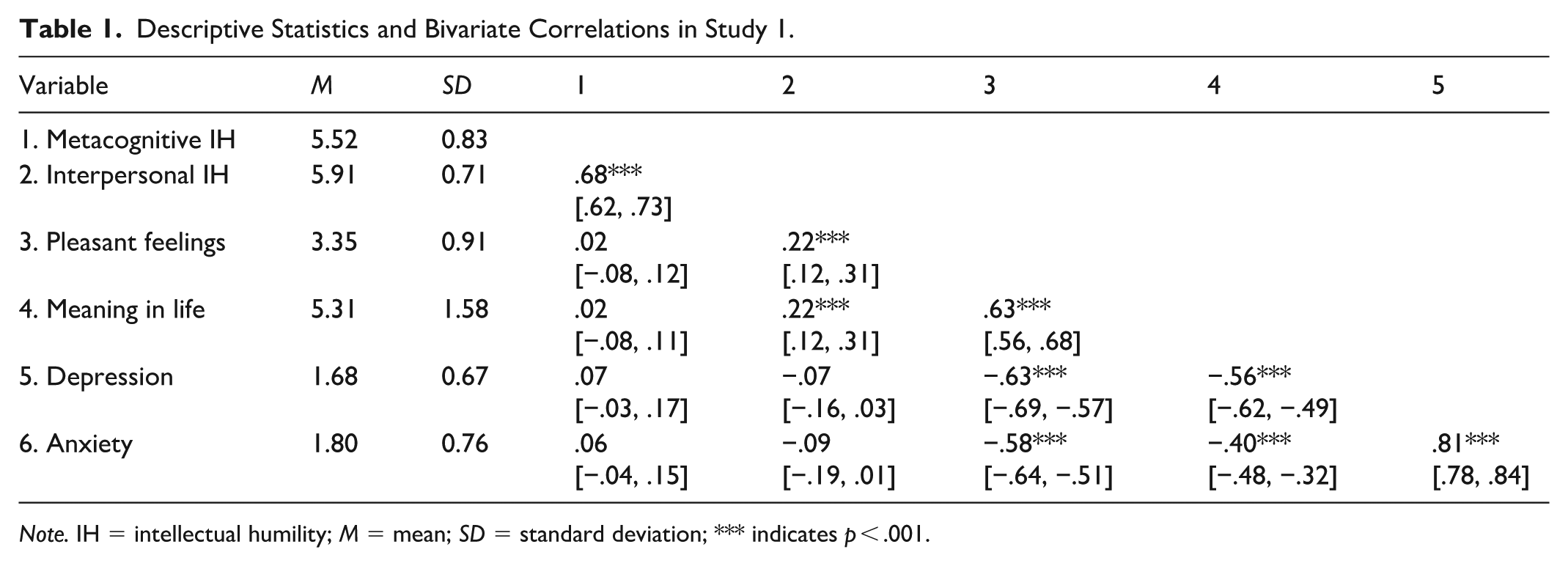
Note. IH = intellectual humility; M = mean; SD = standard deviation; *** indicates p < .001.
To test for unique associations, we regressed each well-being outcome on both interpersonal and metacognitive intellectual humility. We standardized (z-scored) the variables before entering them into these models. As Figure 1 illustrates, interpersonal intellectual humility was positively associated with pleasant feelings (β = .38, 95% CI [0.25, 0.50], p < .001), whereas metacognitive intellectual humility was negatively associated (β = −.25 [−0.36, −0.10], p < .001). Similarly, interpersonal intellectual humility was positively associated with meaning in life (β = .38 [0.26, 0.51], p < .001), whereas metacognitive intellectual humility was negatively associated (β = −.25 [−0.37, −0.12], p < .001). A similar, but inverted pattern emerged for the negative well-being outcomes. Interpersonal intellectual humility was negatively associated with depression symptoms (β = −.21 [−0.34, 0.08], p = .002), whereas metacognitive intellectual humility was positively associated (β = .22 [0.08, 0.35], p = .002). Similarly, interpersonal intellectual humility was negatively associated with anxiety symptoms (β = −.24 [−0.37, −0.11], p < .001), whereas metacognitive intellectual humility was positively associated (β = .22 [0.09, 0.35], p = .001).
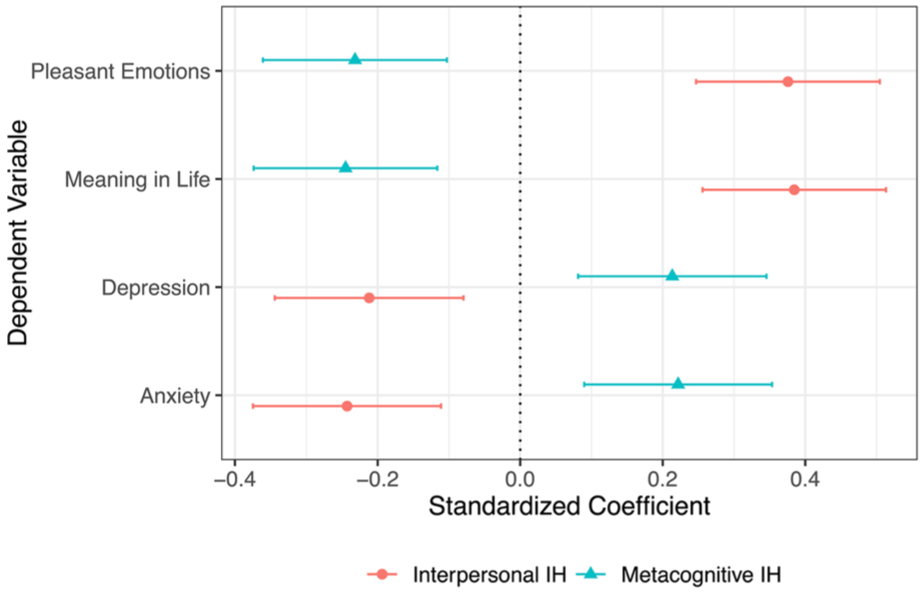
Associations between metacognitive and interpersonal intellectual humility and well-being (study 1). Points and error bars indicate standardized coefficients and 95% confidence intervals, respectively.
To test for curvilinear associations, we added quadratic terms for each form of intellectual humility to the models. However, none of these quadratic terms were significant (all ps ≥.261). Additionally, as a robustness check, we added demographic covariates to the original models. Controlling for age, sex, race, income, and educational attainment had no effect on the pattern of results reported above. Neither the sign nor significance of any coefficient changed, and no coefficient estimate differed by more than .056 (
Finally, we ran a series of analyses parallel to those reported above, only with a different measure of interpersonal intellectual humility—namely, Porter and Schumann’s (2018) Intellectual Humility Scale. The items for this scale were included in the same block as the items for the other two intellectual humility scales. Unlike the Expressed Humility–Teachability scale, Porter and Schumann’s scale was not designed to be purely interpersonal. For present purposes, therefore, it is less ideal. However, it is more common in the intellectual humility literature and, among measures used in that literature, it is perhaps the most strongly interpersonal. Hence, we sought to determine whether the choice of measure impacted our results. Supporting the robustness of our findings, we obtained very similar patterns of results when using Porter and Schumann’s scale. The only notable differences pertained to metacognitive intellectual humility, which was not significantly associated with pleasant feelings in these supplemental analyses, though the sign of the coefficient remained negative (β = −.11, 95% CI [−0.23, 0.01], p = .077). See Section 4 of the Supplemental Material for further details.
Discussion
These results present a striking contrast between metacognitive and interpersonal intellectual humility. Although they are strongly correlated with each other, using multiple regression models to examine unique associations, we found that—across the board—interpersonal intellectual humility was associated with better well-being, whereas metacognitive intellectual humility was associated with worse. That is, people who are more inclined to recognize others’ intellectual strengths and treat them as potential sources of knowledge and insight also tend to experience more pleasant feelings, a stronger sense of meaning in life, and fewer symptoms of depression and anxiety. By contrast, people who are more inclined to recognize their own fallibility and the limits of their knowledge tend to experience fewer pleasant feelings, a weaker sense of meaning in life, and more symptoms of depression and anxiety.
In short, these findings provide clear support for both of the preregistered hypotheses. They also align with theoretical work positing a distinction between these two aspects of intellectual humility (Priest, 2017; Roberts & Wood, 2007) and are consistent with prior empirical findings that have begun to identify asymmetries between them. Whereas prior studies have found asymmetric associations with cognitive outcomes like receptivity to misinformation (Bowes & Fazio, 2024), this study revealed an asymmetry in their associations with affective and evaluative outcomes.
Study 2
This study used a 2-year longitudinal design, examining links between each form of intellectual humility and well-being within persons, between persons, and in trajectories of change. We preregistered the following hypotheses: intellectual humility is associated with well-being within and between persons; people who become more intellectually humble experience parallel changes in well-being; and these associations differ between metacognitive and interpersonal conceptions of intellectual humility.
Method
Participants
Using email lists, on-campus events, and flyers, we recruited participants from 14 postsecondary educational institutions across the United States. Together, the institutions spanned a wide geographic range and included a diversity of institutional types (e.g., R1 public universities, small liberal arts colleges, Ivy League universities). Sampling and data cleaning processes are documented online (https://osf.io/7fv65/files/4gxq5). There were 2,791 participants in total, half of whom (n = 1,381, 50%) completed 3 out of 4 surveys. About one-third of participants (n = 998, 36%) completed all four surveys.
We excluded (n = 265) participants who were missing data for all measures involved in the present analyses, leaving an analysis sample of N = 6,922 observations from N = 2,526 participants (Mage = 20.25, SDage = 3.03; 65% identified as female, 30% male, <1% other, and 5% did not indicate a sex; 58% identified as White, 15% Asian or Pacific Islander, 6% Hispanic, 4% Black or African American, 1% another race or ethnicity, 12% mixed race, and 4% did not indicate a race). Post-hoc, simulation-based sensitivity analyses indicated that this study had over 80% power to detect between-person associations as small as β = .058 and within-person associations as small as β = .018, as well as over 95% power to detect between-person associations as small as β = .079 and within-person associations as small as β = .027. Hence, this study was very likely to detect even quite modest associations.
Procedure
Participants completed four waves of assessments over the course of 2 years. The exact timing of the surveys varied slightly across institutions, but the first survey was administered during September and October 2022; the second during February and March 2023; the third during September and October 2023; and the fourth during February and March 2024. The surveys included measures of intellectual humility and well-being. They also included measures related to participants’ goals, religious practices, and beliefs. However, these are beyond the scope of the present investigation.
Measures
We assessed metacognitive and interpersonal intellectual humility using the same measures as in study 1. Both scales showed good internal reliability at each timepoint (.85 ≤ ωs ≤ .86 for the metacognitive measure; .77 ≤ ωs ≤ .80 for the interpersonal measure). As before, we verified that these two scales reflect distinct latent variables using confirmatory factor analyses. These analyses, reported in Section 5 of the Supplemental Material, supported the empirical distinctness of the measures and, furthermore, established their scalar invariance across assessment occasions.
Participants also completed the same meaning in life measure as in study 1, only in this case they completed the full, 16-item version. This measure showed excellent internal consistency at each timepoint (.91 ≤ ωs ≤ .92). Participants also completed the same depression and anxiety measures as in Study 1. These too showed excellent internal consistency at each timepoint (.89 ≤ ωs ≤ .88 for depression and .87 ≤ ωs ≤ .91 for anxiety).
Preregistered Analysis Plan
Our preregistered analysis plan began with a multilevel regression to test for within- and between-person associations. We fit the model using the lme4 and lmerTest packages in R (Bates et al., 2020; Kuznetsova et al., 2017). Observations were nested within participants who were nested within institutions. Following a standard approach for disaggregating within- and between-person associations (Curran & Bauer, 2011), we computed grand mean-centered person means (i.e., each participant’s average score, centered around the mean for the entire sample) and deviations from person means (i.e., individual observations centered around the corresponding participant’s average), including each as a predictor in the model. The former reflects the between-person association and the latter the within-person association.
To examine trajectories of change, we used a latent growth curve model (Preacher et al., 2008), fit using the lavaan package in R (Rosseel, 2012). This model estimated intercepts and slopes for interpersonal intellectual humility, metacognitive intellectual humility, and perceived meaning in life. It estimated covariances among all three intercepts, among all three slopes, and between each construct’s intercept and its slope. Each slope was regressed on the intercepts for the other constructs. We preregistered a plan to use robust, full information maximum likelihood estimation and cluster-corrected standard errors to accommodate the fact that participants were drawn from different institutions. However, we were forced to deviate slightly from this plan as the model converged with an inadmissible solution. Specifically, there was a negative eigenvalue, and the covariance matrix of latent variables was not positive definite. We were able to resolve these problems by reverting to complete-case analysis (i.e., not using full information maximum likelihood, and using only n = 999 participants with no missing data) and by treating institutions as fixed effects (i.e., regressing all observed variables on dummy codes for the different schools).
The preregistered analysis plan for this study included perceived meaning in life as the only well-being outcome. However, in exploratory analyses, we fit the same models using anxiety and depression symptoms as the dependent variables. Hence, although not preregistered, the analyses involving anxiety and depression symptoms were directly parallel to the analyses that we preregistered for meaning in life.
Results
Within and Between-Person Associations
The results of the multilevel models are illustrated in Figure 2. In the preregistered model, interpersonal intellectual humility was positively associated with perceived meaning in life, both between persons (b = 0.62, 95% CI [0.54, 0.69], β = .30 [0.26, 0.33], p < .001) and within persons (b = 0.15 [0.11, 0.18], β = .06 [0.04, 0.07], p < .001). However, metacognitive intellectual humility was negatively associated with perceived meaning in life between persons (b = −0.17 [−0.22, −0.11], β = −.12 [−0.15, −0.08], p < .001), and not significantly associated within persons (b = 0.03 [−0.00, 0.06], β = .01 [−0.00, 0.02], p = .091).
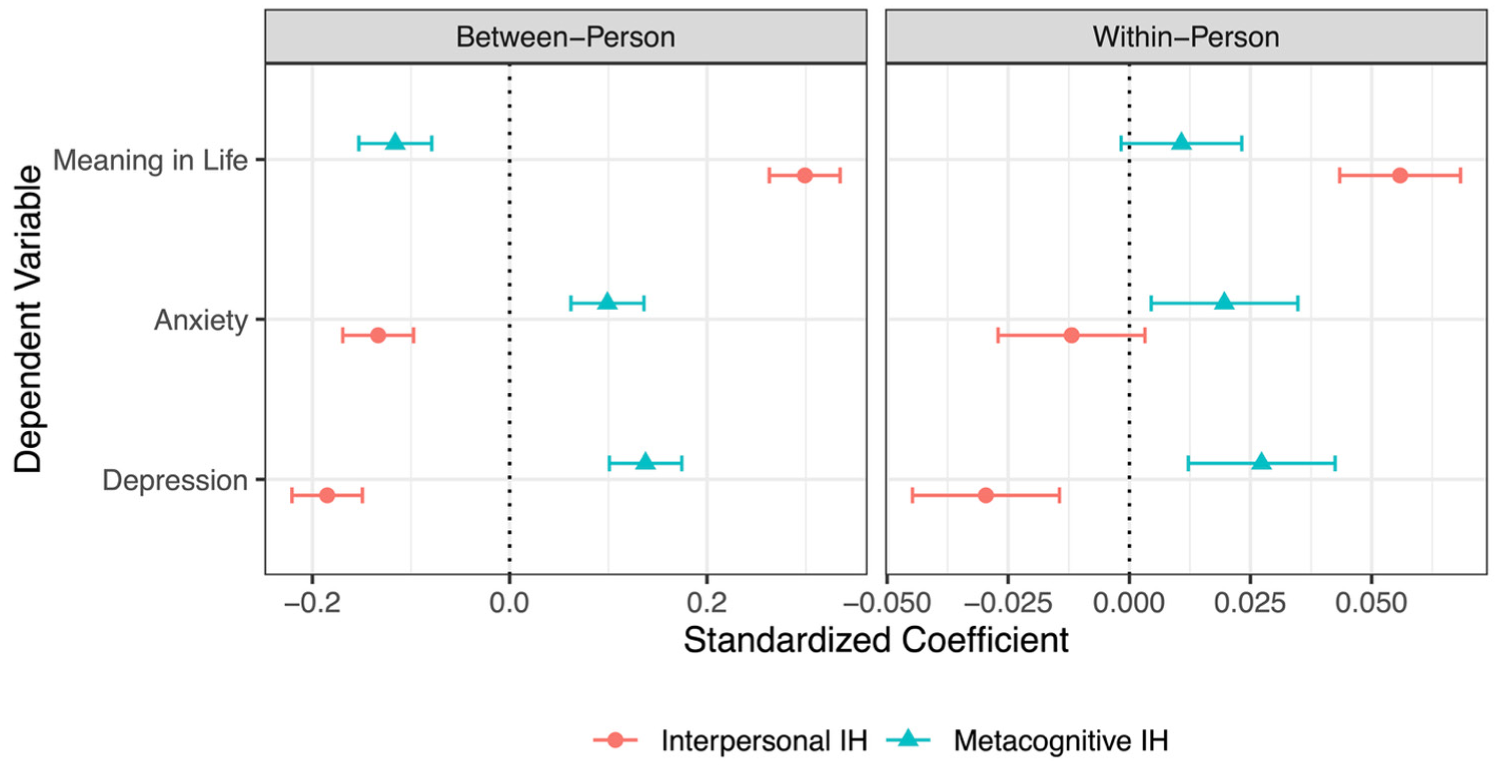
Associations between metacognitive and interpersonal intellectual humility and well-being (study 2). Points and error bars indicate standardized coefficients and 95% confidence intervals, respectively.
In the exploratory analyses with depression and anxiety symptoms, we found very similar (but inverted) patterns of results. Interpersonal intellectual humility was negatively associated with depression symptoms both between persons (b = −0.26, 95% CI [−0.31, −0.21], β = −.18 [−0.22, −0.15], p < .001) and within persons (b = −0.05 [−0.08, −0.03], β = −.03 [−0.04, −0.01], p < .001), whereas metacognitive intellectual humility was positively associated with depression symptoms both between persons (b = 0.13 [0.10, 0.17], β = .14 [0.10, 0.17], p < .001) and within persons (b = 0.04 [0.02, 0.07], β = .03 [0.01, 0.04], p < .001). For anxiety, interpersonal intellectual humility was negatively associated with anxiety symptoms between persons (b = −0.22 [−0.28, −0.16], β = −.13 [−0.17, −0.10], p < .001) but not significantly associated within persons (b = −0.02 [−0.06, 0.01], β = −.01 [−0.03, 0.00], p = .122). Metacognitive intellectual humility was positively associated with anxiety symptoms both between persons (b = 0.11 [0.07, 0.16], β = .10 [0.06, 0.14], p < .001) and within persons (b = 0.04 [0.01, 0.07], β = .02 [0.01, 0.03], p = .011).
In sum, interpersonal intellectual humility was associated with more meaning in life within and between persons, less depression within and between persons, and less anxiety between persons. Metacognitive intellectual humility, by contrast, was associated with less meaning in life between persons, more depression within and between persons, and more anxiety within and between persons.
Associations in Longitudinal Changes
Each of the latent growth models demonstrated excellent fit. The key results are in Table 2, including fit indices and parameter estimates for the three models (involving meaning in life, depression, and anxiety, respectively). Further results are reported in Section 6 of the Supplemental Material.
Results of Latent Growth Models (Study 2).
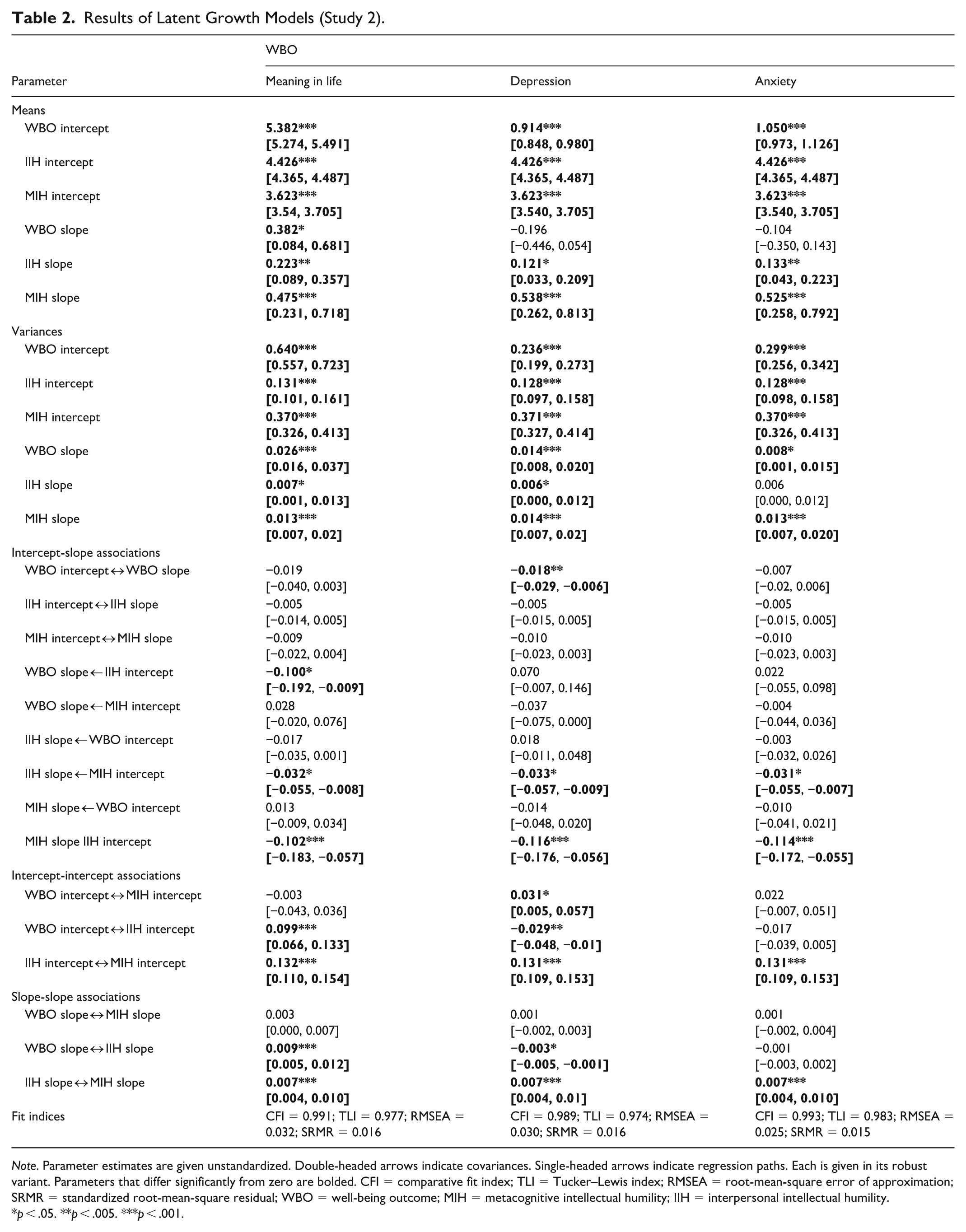
Note. Parameter estimates are given unstandardized. Double-headed arrows indicate covariances. Single-headed arrows indicate regression paths. Each is given in its robust variant. Parameters that differ significantly from zero are bolded. CFI = comparative fit index; TLI = Tucker–Lewis index; RMSEA = root-mean-square error of approximation; SRMR = standardized root-mean-square residual; WBO = well-being outcome; MIH = metacognitive intellectual humility; IIH = interpersonal intellectual humility.
p < .05. **p < .005. ***p < .001.
The mean slopes for metacognitive and interpersonal intellectual humility were significantly greater than zero in all models, indicating that, on average, participants experienced increases in both aspects of intellectual humility over the course of the study. Mean slopes for meaning in life were also significantly greater than zero, whereas the mean slopes for depression and anxiety symptoms were negative but not significant. Thus, on average, participants experienced significant increases in meaning in life but non-significant declines in depression and anxiety symptoms over 2 years. There was significant variance in all slopes in all models, apart from interpersonal intellectual humility in the model with anxiety (though the parameter estimate was the same as in the model with depression, where it was significant). This indicates that there were interpersonal differences in intrapersonal changes in each construct. Naturally, this is critical if we are to examine associations between the rates of change in one construct and the rates of change in another. 2
In each model, the intercepts for metacognitive intellectual humility and interpersonal intellectual humility were positively associated, as were the slopes. That is, individuals who started higher in one aspect of intellectual humility tended to start higher in the other, and those who grew more in one tended to grow more in the other. There were few significant intercept–slope associations. Those that were significant suggested that people who started off higher tended to grow less. Specifically, baseline levels of perceived meaning in life were negatively related to growth in perceived meaning in life, and baseline levels of depression symptoms were negatively related to growth in depression symptoms. The intercepts for each aspect of intellectual humility also negatively predicted the slopes in the other. Hence, although the starting points and rates of change for these two aspects of intellectual humility were positively associated with each other, the starting points for each were negatively associated with rates of change for the other. Finally, the intercepts for interpersonal intellectual humility negatively predicted the slopes for meaning in life, and the intercepts for metacognitive intellectual humility negatively predicted the slopes for depression symptoms.
The crucial results are the intercept–intercept and slope–slope associations. In the preregistered model, the intercepts for interpersonal intellectual humility were positively associated with the intercepts for meaning in life. The slopes for interpersonal intellectual humility and meaning in life were also positively associated with each other. However, no significant links emerged between metacognitive intellectual humility and meaning in life, either in the intercepts or the slopes. In the exploratory model with depression, the intercepts for interpersonal intellectual humility were negatively associated with the intercepts for depression symptoms. The slopes for these two constructs were also negatively associated. However, the intercepts for metacognitive intellectual humility were positively associated with the intercepts for depression symptoms. The slopes for metacognitive intellectual humility were not significantly associated with the slopes for depression symptoms. In the exploratory model with anxiety, no significant intercept–intercept or slope–slope associations emerged between anxiety symptoms and either aspect of intellectual humility.
In sum, individuals who started higher in interpersonal intellectual humility tended to start higher in perceived meaning in life and lower in depression symptoms (though not anxiety symptoms), and those who increased more in interpersonal intellectual humility also tended to increase more in perceived meaning in life and decrease more in depression symptoms (though not anxiety symptoms). Not so for metacognitive intellectual humility. Indeed, the only significant link between metacognitive intellectual humility and well-being was that individuals who started higher in metacognitive intellectual humility tended to start higher in depression symptoms as well.
Discussion
These results provide further evidence that metacognitive and interpersonal intellectual humility have strikingly different associations with well-being. Supporting our preregistered hypotheses, we found that intellectual humility is associated with well-being within and between persons and that people who become more intellectually humble experience parallel changes in well-being, yet these associations differ dramatically between metacognitive and interpersonal intellectual humility. Specifically, people who are more interpersonally intellectually humble than others tend to experience better well-being than others. And when people are more interpersonally intellectually humble than they usually are, they tend to experience better well-being than they usually do. Yet null or inverted associations emerged for metacognitive intellectual humility. Preregistered analyses examining perceived meaning in life and exploratory analyses examining depression and anxiety symptoms yielded very similar patterns of results.
An asymmetry also emerged in longitudinal changes. Baseline levels of interpersonal and metacognitive intellectual humility were positively associated, and people who tended to grow in one form of intellectual humility over 2 years tended to grow in the other as well. Yet only interpersonal intellectual humility showed any associations with well-being. Specifically, we found that people who started off higher in interpersonal intellectual humility also tended to start off with a stronger sense of meaning in life and lower levels of depression symptoms. Moreover, those who experienced larger increases in interpersonal intellectual humility tended to experience larger increases in meaning and decreases in depression symptoms during that same period. No such associations emerged for metacognitive intellectual humility. Indeed, the only significant link was that those who started off higher in metacognitive intellectual humility tended to start off more depressed.
When examining within- and between-person associations, the results for anxiety looked similar to the results for depression. However, the longitudinal analyses did not reveal significant links between anxiety symptoms and either interpersonal or metacognitive intellectual humility. It is possible that this is because there was less variance in the intercepts and slopes for anxiety symptoms compared with the intercepts and slopes for meaning in life and depression symptoms (see Table 2). Or there may be a more substantive explanation—that is, intellectual humility’s association with anxiety symptoms may genuinely differ from its associations with other well-being outcomes. Notwithstanding this minor difference, the overall takeaway from the study is that, although interpersonal and metacognitive intellectual humility are associated with each other, only interpersonal intellectual humility is associated with better well-being, both concurrently and over a 2-year period.
General Discussion
These studies reveal a striking asymmetry between interpersonal and metacognitive intellectual humility. Interpersonal intellectual humility is consistently associated with better well-being, cross-sectionally and longitudinally, between and within persons, and in changes over 2 years. By contrast, for metacognitive intellectual humility, we found no significant links when examining trajectories of change but otherwise found that metacognitive intellectual humility is generally associated with worse well-being. These findings clearly support theoretical work that has highlighted the distinction between these two aspects of intellectual humility (Priest, 2017; Roberts & Wood, 2007). They also invite the question of why these two traits, which are positively associated with each other, would have opposing associations with mental health and well-being.
Because metacognitive intellectual humility involves having accurate perceptions of one’s knowledge, intellectual abilities, and the limits of one’s understanding, it is likely to burst the bubble of positive illusions (i.e., flatteringly distorted self-perceptions), which are theorized to promote pleasant feelings (Taylor & Brown, 1988; Taylor et al., 2000). Metacognitive intellectual humility may also undermine the cognitive schemas that people use to make sense of their lives and the world around them. Theories of meaning-making posit that people’s beliefs are organized into schemas or frameworks through which people make sense of, and find meaning in, their experiences (Heine et al., 2006; Park, 2010). Uncertainty about such schemas has long been theorized to generate anxiety and even feelings of meaninglessness and despair (Yalom, 1980). Hence, by keeping one’s fallibility and ignorance in view, metacognitive intellectual humility may reduce pleasant feelings, undermine individuals’ abilities to find meaning in their lives, and foster the anxious and depressive states that come from lingering uncertainty (Carleton, 2016).
Conversely, because interpersonal intellectual humility involves recognizing others’ intellectual strengths, treating them as sources of knowledge, and taking their ideas seriously, it is likely to improve the quality of individuals’ social interactions and relationships—consistent with recent theorizing that humility is important for the formation of social bonds and for reducing frictions within them (Van Tongeren et al., 2019). High-quality interactions and relationships are, in turn, critical to health and well-being (Holt-Lunstad, 2024). Indeed, numerous theories posit that humans have a basic psychological need for belonging (Baumeister & Leary, 1995) and relatedness (Ryan & Deci, 2000), a need that is thought to be biologically grounded. According to social baseline theory (Beckes & Coan, 2011), the human brain treats the presence of other people as a default operating condition, whereas social isolation and disconnection are costly and difficult. In other words, because humans have survived by cooperating in groups, we are wired for social connection and require it for healthy functioning. Hence, to the extent that interpersonal intellectual humility improves social interactions and deepens social connections, it should also improve well-being.
In short, the asymmetry revealed in these studies aligns with decades of research on the determinants of mental health and well-being. Furthermore, as we will discuss, our findings have implications for theories of intellectual virtues and for practical efforts to cultivate intellectual humility in oneself or promote it in others.
Is Intellectual Humility a Virtue?
These days, intellectual humility is widely regarded to be an intellectual virtue (e.g., Kidd, 2015; King, 2021; Snow, 2018; Whitcomb et al., 2017). Yet, historically, there has been much debate over humility’s status as a virtue (see Bommarito, 2018 for an overview), and recent review articles have discussed the philosophical challenges that come with understanding intellectual humility in this way (Musholt et al., 2026; Porter et al., 2022a). The present findings pose a further challenge when considering metacognitive intellectual humility specifically.
As discussed above, a venerable theory about the nature of virtues (Aristotle, 2000) that still exerts considerable influence in contemporary personality psychology (Fowers et al., 2021; Ratchford et al., 2024) defines virtues as traits that (among other things) promote individuals’ flourishing. Hence, if metacognitive intellectual humility does not promote well-being, and perhaps even undermines it, then it would seem to follow that metacognitive intellectual humility is not a virtue, though interpersonal intellectual humility might still be.
Of course, future research might complicate matters by revealing boundary conditions on our findings. That is, perhaps one or the other form of intellectual humility is associated with well-being only for certain people in certain contexts, stages of life, or social positions. Studies might investigate such possibilities and thereby identify important moderators of the links between intellectual humility and well-being (e.g., cultures of individualism versus collectivism). If so, then it might be that metacognitive and interpersonal intellectual humility are intellectual virtues for some people, just not for everyone.
Then again, some might argue that we have focused on the wrong standard of evaluation. Well-being might be one important, even the most central, aspect of an individual’s flourishing. But perhaps there are others. Theories focused specifically on intellectual virtues typically define these as the character traits of excellent thinkers (Baehr, 2025; King, 2021). Hence, perhaps the more appropriate test is whether intellectual humility promotes a distinctively intellectual form of flourishing. It is not immediately obvious what intellectual flourishing would involve. But it would likely be something other than high levels of positive affect and low levels of anxiety and depression symptoms, and it might have little to do with whether one finds one’s life meaningful. Perhaps intellectual flourishing consists of holding more true beliefs than false ones, possessing insight into important questions, or something along those lines. If so, a natural next step for future research would be to compare the links between interpersonal and metacognitive intellectual humility and these sorts of epistemic outcomes.
Numerous studies have examined the links between intellectual humility and, for example, general knowledge, belief in conspiracy theories, pseudoscience, and the like (Bowes & Fazio, 2024; Huynh & Bayles, 2022; Krumrei-Mancuso et al., 2020). Yet, these studies have not delineated between the two kinds of intellectual humility and tested for unique associations. Hence, future studies could test whether metacognitive or interpersonal intellectual humility is more strongly associated with cognitive or epistemic outcomes that might indicate intellectual flourishing. The results could support the idea that metacognitive intellectual humility is an intellectual virtue. However, if the results paralleled our findings regarding well-being, then its status as a virtue would be left in serious doubt.
So far, we have assumed that virtues are a subset of traits. But other, very different theoretical frameworks could also be adopted. For example, some argue that a virtue is not a particular kind of trait, but rather a situation-specific optimality (Ng & Tay, 2020). That is, whereas traits are tendencies to think, act, or feel in particular ways across situations, this theory posits that virtues are tendencies to match one’s thoughts, actions, and feelings to the demands of situations. If we adopt this theoretical framework, the question would no longer be whether intellectual humility (i.e., the trait) is a virtue, but instead how much intellectual humility would be optimal for someone to express in a particular situation. Because the present studies used trait measures, our results clearly do not speak to this kind of question. However, future studies might use intensive longitudinal designs to examine the expression of intellectual humility in specific moments of daily life and explore whether and how people adapt to suit changing circumstances.
Practical Implications for Promoting Intellectual Humility
As discussed above, people value and encourage intellectual humility in others (Bowes et al., 2025; Hoekstra & Vazire, 2021; Lynch, 2019; Stroud & Murray, 2025). But our findings suggest that those encouraging others to be metacognitively intellectually humble are likely to face an uphill battle. People may not be very receptive to appeals to reflect on their intellectual limitations and the ways in which their thinking might be incorrect if this comes with worse well-being. Indeed, if metacognitive intellectual humility actually reduces a person’s well-being, then this would raise ethical questions about seeking to promote it. By contrast, it may be far easier, and less ethically complicated, to encourage people to be more interpersonally intellectually humble. People will likely be more amenable to requests to take others’ ideas seriously and to treat them as sources of knowledge and insight, given that doing so seems to come with better well-being.
Furthermore, prior research on behavioral change and habit formation suggests that people will be more likely to follow through on intentions to cultivate interpersonal versus metacognitive intellectual humility. Specifically, consistent with the broaden-and-build theory (Fredrickson, 2013), new behaviors are more likely to be sustained and become habitual if they are accompanied by positive emotions (Fredrickson et al., 2020; Van Cappellen et al., 2020). Thus, if people tend to experience lower levels of well-being when exercising metacognitive intellectual humility, then they will likely struggle to sustain that behavior. By contrast, if people tend to experience better well-being when exercising interpersonal intellectual humility, then they will be more likely to persist.
Are Measures of Metacognitive Intellectual Humility Valid?
One possible reaction to the present findings would be to raise questions about the validity of the metacognitive intellectual humility measure. First, one might argue that measures of metacognitive intellectual humility, such as Leary and colleagues’ (2017) scale, are overly focused on limitations and weaknesses, when they should assess the degree to which people adopt a balanced and accurate self-perception. That is, it is possible that metacognitive intellectual humility is positively associated with well-being; it is just that extant definitions and measures fail to capture the construct properly. If so, then clearly future theoretical and empirical work must do a better job of explicating the construct and validating measures that can assess it more effectively.
Alternatively, one could argue that it is a bad idea to use self-reports of any kind to assess metacognitive traits. After all, reporting on one’s metacognition (i.e., how one thinks about one’s own thinking) involves engaging in meta-metacognition. This may be quite difficult. Indeed, prior studies have found null to weak associations between self-reports of metacognitive intellectual humility and test-based measures of metacognition (Bowes et al., 2024; Costello et al., 2023; Deffler et al., 2016; Fischer et al., 2025). If people struggle to report on their metacognitive tendencies but have an easier time reporting on how they engage with other people, then this could potentially explain the observed asymmetry in the links between each kind of measure and well-being. If this is right, then future research on this self-focused form of intellectual humility ought to rely on test-based measures rather than self-reports.
Alternative Causal Explanations
Because these studies used non-randomized designs, we must be careful in making causal inferences. Nonetheless, our findings are informative about causal pathways insofar as they restrict the range of plausible causal explanations.
First, one possibility is that well-being causally influences intellectual humility rather than the other way around. However, the asymmetry that we discovered has implications for what these reverse pathways might involve. For example, if pleasant feelings were to affect intellectual humility, our findings suggest that they do so in a peculiar way: increasing interpersonal intellectual humility while simultaneously decreasing metacognitive intellectual humility. It is not clear why that would be. There is strong theoretical basis (discussed above) for predicting that interpersonal and metacognitive intellectual humility would have asymmetric effects on outcomes like anxiety, depression, pleasant feelings, and meaning in life. However, we are not aware of any theoretical or empirical work that would support the reverse prediction.
Another potential causal explanation is that intellectual humility and well-being share a common cause. Again, however, our findings constrain the range of plausible possibilities. For example, our within-person findings rule out time-invariant common causes (i.e., variables that, for a given person, do not change across occasions), as these cannot explain within-person associations (Rohrer & Murayama, 2023). Hence, if the associations we observed are products of confounding, then the confound would have to be a time-varying variable that improves well-being while increasing interpersonal intellectual humility and decreasing metacognitive intellectual humility. Again, it is far from clear what would fit that bill.
Further theorizing, as well as data from longitudinal and/or experimental designs would, naturally, help to clarify the possibilities. But, to reiterate, the crucial point that arises from our findings is that the causal pathways would seem to be strikingly different depending on which form of intellectual humility one considers.
Conclusion
In the voluminous intellectual humility research published in the past decade or so, it is remarkably rare for researchers to clearly distinguish between metacognitive and interpersonal forms of intellectual humility. The present studies suggest that this may be an important gap in the literature. The two forms of intellectual humility show opposing associations with well-being, suggesting that something similar may apply to other outcomes or predictors as well. Indeed, much of the research on intellectual humility has centered on its salubrious social consequences. For example, studies have found that people who are more intellectually humble are also more prosocial (Krumrei-Mancuso, 2017), respond more constructively to interpersonal conflicts (Koetke et al., 2024), and are better at apologizing after offenses (Ludwig et al., 2022). Although these studies did not carefully attend to the distinction between interpersonal and metacognitive intellectual humility, social benefits seem far more likely to arise from the former than the latter. Hence, these findings have implications for research on intellectual humility quite generally. When theorizing or testing hypotheses, it is important to specify whether the relevant trait is one that concerns how people think about their own minds or about others’ minds.
Supplemental Material
sj-docx-1-psp-10.1177_01461672261457222 – Supplemental material for Metacognitive and Interpersonal Intellectual Humility Are Asymmetrically Associated with Well-Being
Supplemental material, sj-docx-1-psp-10.1177_01461672261457222 for Metacognitive and Interpersonal Intellectual Humility Are Asymmetrically Associated with Well-Being by Michael M. Prinzing, Shauna M. Bowes, Karen Melton, Perry Glanzer and Sarah Schnitker in Personality and Social Psychology Bulletin
Footnotes

Ethical Considerations
Procedures for the supplemental study, Study 1, and Study 2 were approved, respectively, by the Institutional Review Boards at Emory University (#00107584), Wake Forest University (#00026319), and Baylor University (#0000277). All participants provided informed consent.
Funding
The authors disclosed receipt of the following financial support for the research, authorship, and/or publication of this article: This publication was made possible through the support of a grant from the John Templeton Foundation (#62208) as well as a grant from Lilly Endowment, Inc. The opinions expressed in this publication are those of the authors and do not necessarily reflect the views of the John Templeton Foundation or the Lilly Endowment, Inc.
Declaration of Conflicting Interests
The authors declared no potential conflicts of interest with respect to the research, authorship, and/or publication of this article.
Supplemental Material
Supplemental material is available online with this article.
Notes
References
Supplementary Material
Please find the following supplemental material available below.
For Open Access articles published under a Creative Commons License, all supplemental material carries the same license as the article it is associated with.
For non-Open Access articles published, all supplemental material carries a non-exclusive license, and permission requests for re-use of supplemental material or any part of supplemental material shall be sent directly to the copyright owner as specified in the copyright notice associated with the article.
