






Abstract
This study aims to propose measures to promote stakeholder, especially citizens, involvement in the revision process of the General Recommendation (GR). To achieve this, we analysed the public comments for ICRP recommendations. Sixty-one public comments have been conducted by ICRP since 2005; a total of 1613 comments were posted (an average of 26.4 comments/publication draft). The draft of ICRP Publication 146 received 308 comments, followed by ICRP Publication 103’s (2007 GR) second and first drafts which received 217 and 195 comments, respectively. We examined the posters’, ‘organisation’, and ‘name’ and classified them as general public (GP) or not (non-GP). Among the 1135 posters, we identified 268 GP and 867 non-GP. ICRP Publication 146 received 251 comments from GP, but the first and second drafts of ICRP Publication 103 received only 33 and 23 comments, respectively, from GP. The largest comment for the draft of ICRP Publication 146 is attributed to the citizen group's briefing, and ICRP accepted Japanese comments. Despite the large number of comments, critical comments from GP were not well reflected in ICRP Publication 146. In developing ISO 26000: Guidance on social responsibility, the International Organization for Standardization (ISO) involved representatives from (1) industry, (2) government, (3) labour, (4) consumers, (5) NGOs, and (6) service, support, research, and others. The working group included 355 experts and 77 observers from 72 countries. In 2008's public comment, 5200 comments were posted worldwide. On the other hand, the ICRP 2007 GR was developed by 14 main commission members of ICRP or specialists in radiological protection. Accepting comments in multiple languages effectively promotes public engagement with ICRP recommendations. However, a reflection of citizens’ comments was limited in the past ICRP public comments. Involving the general public or a citizen group from the initial stage of the revision process is essential to formulating multi-stakeholder–involved general recommendations.
RESEARCH BACKGROUND AND PURPOSE
ICRP has initiated a revision process of its 2007 General Recommendation (GR). Despite the 2007 GR (ICRP, 2007) recommending stakeholder involvement in decision-making on radiation protection measures, the 2007 GR was developed by 14 ICRP members. Other ICRP publications are similarly developed by task groups. The GR's stakeholders include various parties, industries, radiation workers, regulatory authorities, government, patients, and the general public (GP). Thus, the GR should be developed by a task group including various stakeholders.
The purpose of this study is to propose measures to promote stakeholder involvement in the revision process of GR. To achieve this, we analysed the public comments for ICRP recommendations and conducted case studies on the multi-stakeholder process.
ANALYSIS OF ICRP PUBLIC COMMENTS
Data
ICRP has published the results of public comments on their homepage 1 . These data include the name of the commenter; the organisation of the commenter, if any; and the posted comment. Descriptive statistical analysis was performed using the published data. For ICRP Publication 146, we compared the draft with the final version to examine how citizens’ comments were incorporated.
Summary of ICRP public comments
As of September 2023, 61 public comments had been made since 2005; a total of 1613 public comments were posted, or 26.4 comments were posted on average per draft 2 . The draft of ICRP Publication 146 (ICRP, 2020) received 308 comments, followed by ICRP Publication 103’s (2007 GR) second and first drafts which received 217 and 195 comments, respectively (Fig. 1).
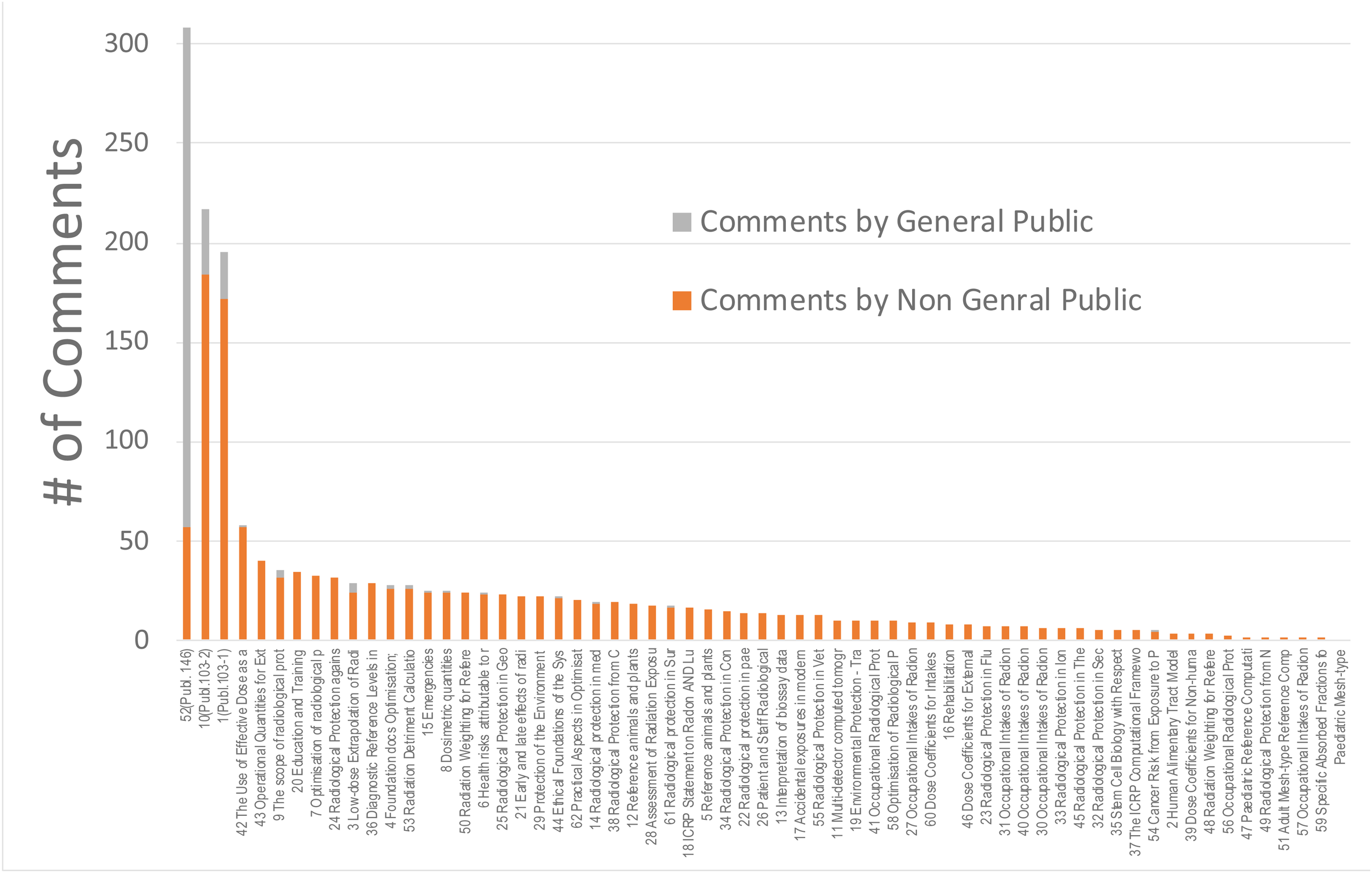
Number of comments for ICRP public comments.
Based on the posters’, ‘organisation’, and ‘name’, we identified 1135 posters: A poster posts 1.42 comments on average (Table 1). Then, we classified them as general public (GP) if a poster belongs to a citizen group and non-general public (non-GP) 3 . We identified 268 GP and 867 non-GP. ICRP Publication 146 also received the largest number of 251 comments from GP. We guess that the largest number of comments for ICRP Publication 146 should be the results of Japanese citizen groups holding briefing sessions to understand the nature of ICRP recommendations and problems in the draft. Dr. Kai and Dr. Homma of ICRP attended some briefings and explained the major updated points. Moreover, ICRP's public comments accept only English comments; in response to requests from Japanese civic groups, ICRP also accepted Japanese comments for this public comment. In fact, among 308 comments on the draft, 184 were posted in Japanese.
Descriptive statistics of posters and comments.
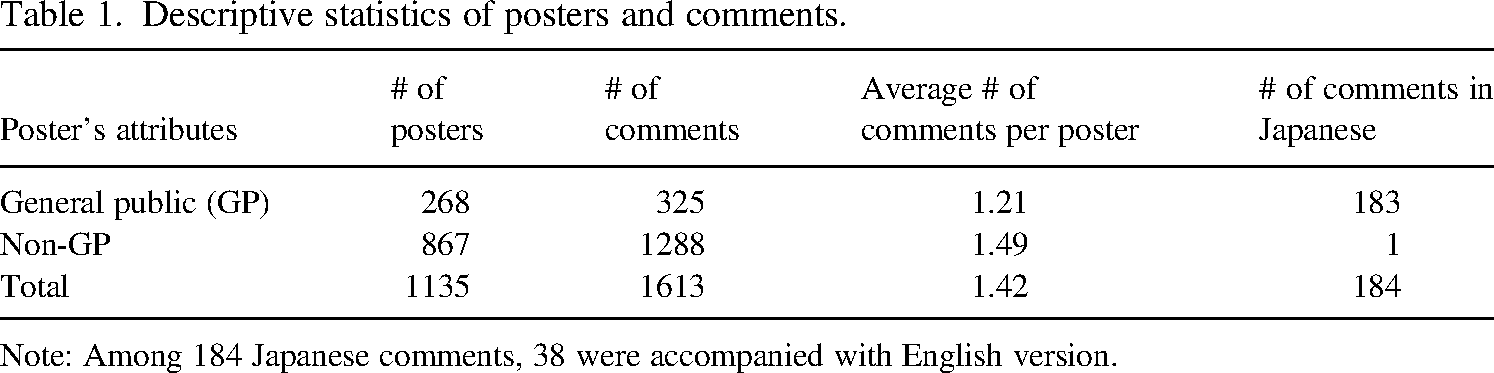
Note: Among 184 Japanese comments, 38 were accompanied with English version.
The number of comments by GP is followed by the second and first drafts of ICRP Publication 103, which received 33 and 23 comments, respectively. Although GR affects the general public, it received only 56 comments from GP. The greater number of comments on ICRP Publication 146 may be attributed to the factors mentioned above and to Japanese citizens who suffered from the radiation disaster itself and felt conflicts in radiological protection during the Fukushima Daiichi Nuclear Power Plant (FDNPP) accident. It is crucial to inform public comments to citizens not only in Fukushima but also around the world and accept comments in multi-language.
As mentioned in the previous section, the draft of ICRP Publication 146 ‘Radiological Protection of People and the Environment in the Event of a Large Nuclear Accident: Update of ICRP Publications 109 and 111’ received the largest number of comments, 308. This section examines how major points posted through public comment were reflected in ICRP Publication 146.
We browsed all the posted comments in the draft and selected the most comprehensive ones posted by one of the present authors 4 . Based on the posts, we extracted fundamental critiques mentioned in public comments, summarised in Table 2.
Major points posted toward the draft of ICRP Publication 146.
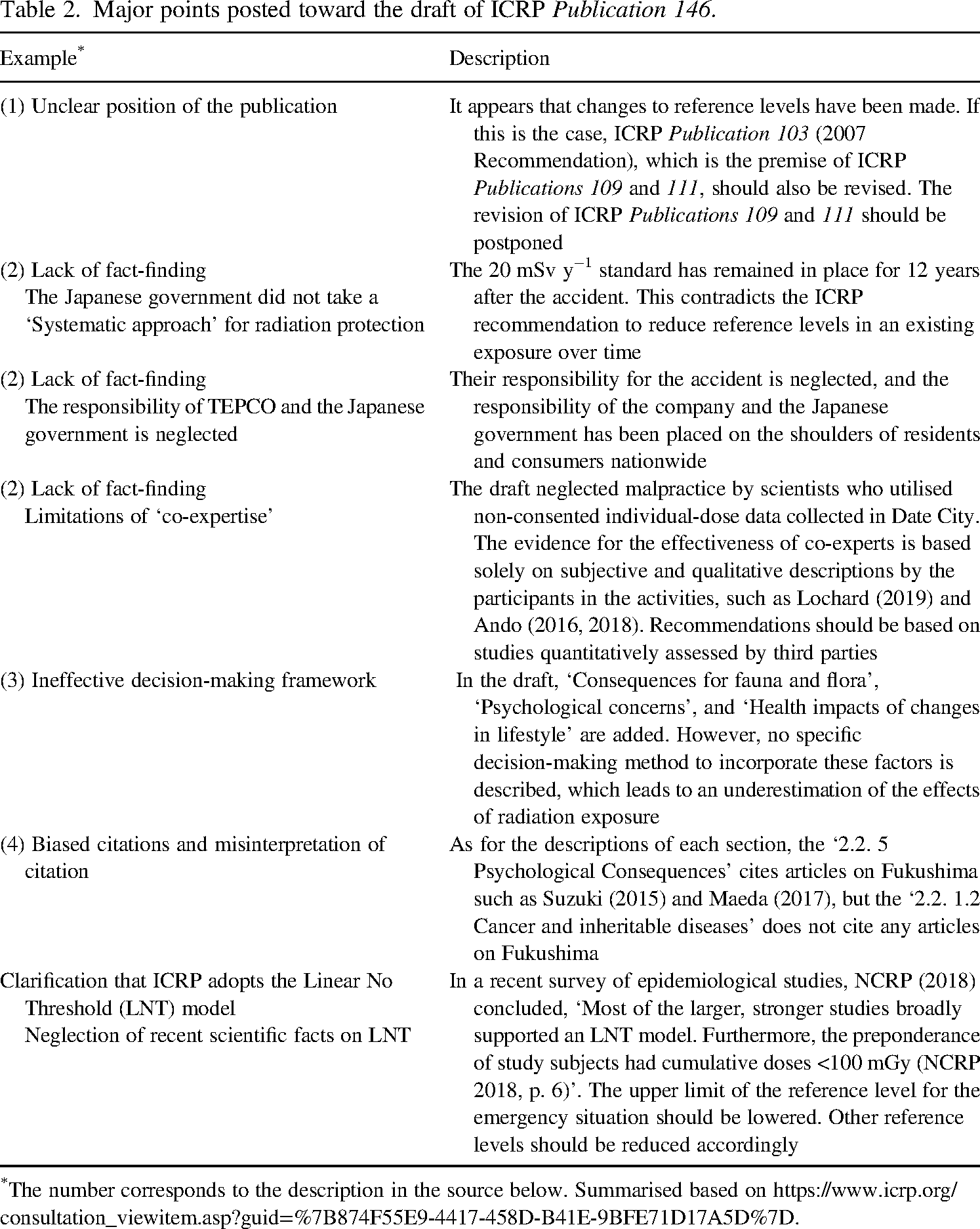
Major points posted toward the draft of ICRP Publication 146.
The number corresponds to the description in the source below. Summarised based on https://www.icrp.org/consultation_viewitem.asp?guid=%7B874F55E9-4417-458D-B41E-9BFE71D17A5D%7D.
Citizens’ comments point out fundamental problems, for example, ‘revision of ICRP Publications 109 and 111 should be postponed because the FDNPP accident is ongoing’, ‘the co-expertise process should be discarded because of malpractice of scientists, including non-consented data usage by scientists’, and ‘description of Fukushima accident is limited and biased’. However, they were neglected, and ICRP Publication 146 was published with minor revisions from the draft.
Research target
The International Organization for Standardization (ISO) is a non-governmental organization, like ICRP, with 169 national standards bodies as members. ISO adopted a multi-stakeholder approach in developing the Guidelines for Organizational Social Responsibility (SR): ISO 26000. Based on ISO (2017, 2023) and Slob and Oonk (2007), the development process of ISO 26000 is summarised.
Multi-stakeholder process in ISO 26000 development
The working group (WG) on SR is composed of experts and observers nominated by members of the national standardisation bodies from six different stakeholder categories: (1) industry, (2) government, (3) labour, (4) consumers, (5) NGOs, and (6) service, support, research, and others (ISO 2017). In 2007, WG comprised 355 experts and 77 observers representing 72 countries (Slob and Oonk 2007, Fig. 2).
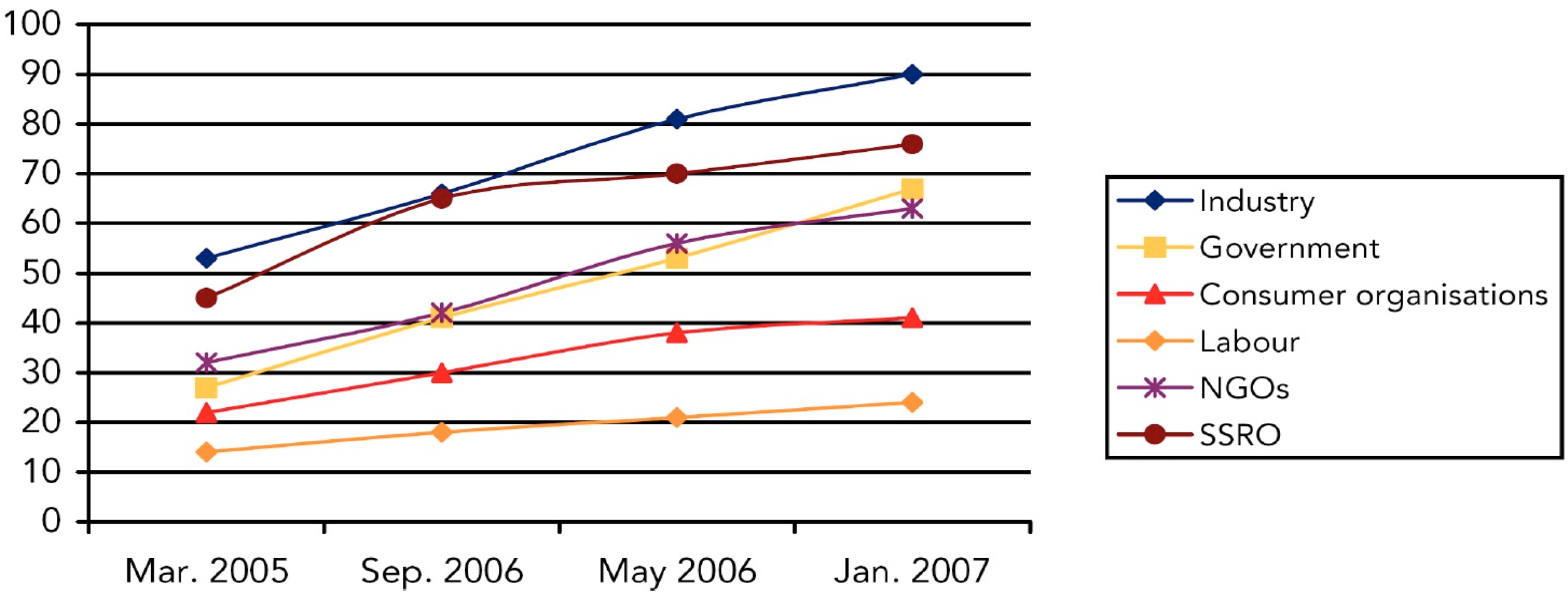
Stakeholder participation in the working group for ISO 26000 (Slob and Oonk, 2007).
ISO applied ‘twinning’ for WG composition: All leadership positions are shared between a representative from a developed country and a representative from a developing country. However, the voices of developing countries’ representatives are not heard sufficiently in plenary meetings due to difficulties with the English language. Representatives from NGOs contributed sufficiently to WG, for example, determining the structure of the guideline. Before the Santiago meeting held in 2008, the WG SR received 5200 comments on the second edition of the fourth working draft of the standard 5 .
ICRP has initiated a revision process of its 2007 GR. As recommended in the 2007 GR or ICRP Publication 103, stakeholder involvement is essential in determining radiation protection measures. From this perspective, stakeholder involvement in the revision of GR must be assured. For the GR, stakeholders include various parties, including industries, radiation workers, regulatory authorities, government, patients, and the general public. Among them, this study focuses on the general public or citizens. Our analysis revealed that even GR, which affects citizens, received some 80 public comments.
Accepting comments in multiple languages will promote public engagement with ICRP recommendations. As described in the ISO 26000 development process case study, 5200 comments were obtained for the Santiago meeting, far exceeding the total comments, i.e. 1613, for 61 ICRP public comments.
Moreover, a reflection of citizens’ comments was limited in the past ICRP public comments. The ICRP 2007 GR was developed by 14 main commission members of ICRP (ICRP, 2007) or specialists in radiological protection-related fields. Other publications were developed similarly. Involving multi-stakeholders, especially citizens or citizen groups, from the initial stage fits the ‘stakeholder involvement’ philosophy emphasised in ICRP Publication 103 and ICRP Publication 146.
It is natural to adopt a multi-stakeholder process for revising the General Recommendation. The twining process must be employed to prevent the undervoice of consumers and NGOs, and care for non-English participants must be assured.
Footnotes
FUNDING
The authors disclosed receipt of the following financial support for the research, authorship, and/or publication of this article: This research was supported by JSPS KAKENHI 21H00501.