






Abstract
In Japan, individual medical facilities are responsible for deciding whether their nurses, doctors, and other healthcare professionals are legally designated as radiation workers and thereby subject to radiation control measures. The designation criteria vary across individual institutions, causing inconsistencies that make workers performing similar roles receive different designations. In March 2020, the Radiological Nursing Society of Japan developed the ‘Guidelines for the Designation of Nurses as Radiation Workers’, proposing criteria for designating nurses as radiation workers. In developing the guideline, a survey of 3000 hospitals in Japan was conducted. The survey found that many hospitals did not have a standard for designating nurses as radiation workers; however, they did so based on the department to which the nurses belonged and the nature of their work. Based on these surveyed results, the guideline divides nurses into three categories: (A) radiation worker, (B) temporary visitors to the controlled area, and (C) general nurse who does not fall under radiation worker or temporary entry. In the future, we will conduct publicity campaigns to make the guidelines accessible to as many medical professionals as possible.
BACKGROUND
Among the 1.27 million nurses currently working in Japan (data from Japanese Nursing Association, 2023), approximately 10% (117,000) wear personal dosimeters (data from Council on Personal Dosimetry Service, 2022). Individual medical facilities are responsible for deciding whether their nurses, doctors, and other healthcare professionals are legally designated as radiation workers and are thereby subject to radiation control measures. The designation criteria vary across individual institutions, causing inconsistencies in which workers performing similar roles receive different designations. This presents a particular challenge for healthcare professionals, who frequently transfer between workplaces. Therefore, in March 2020, the Radiological Nursing Society of Japan developed ‘Guidelines for the Designation of Nurses as Radiation Workers’, proposing appropriate criteria which ensure domestic uniformity between and within institutions for a proper radiation management practice (including dose monitoring, health checks, and education and training). This article reports the results of a questionnaire survey conducted during the guideline development process and presents the guidelines developed based on the survey results.
2. QUESTIONNAIRE SURVEY FOR GUIDELINE DEVELOPMENT
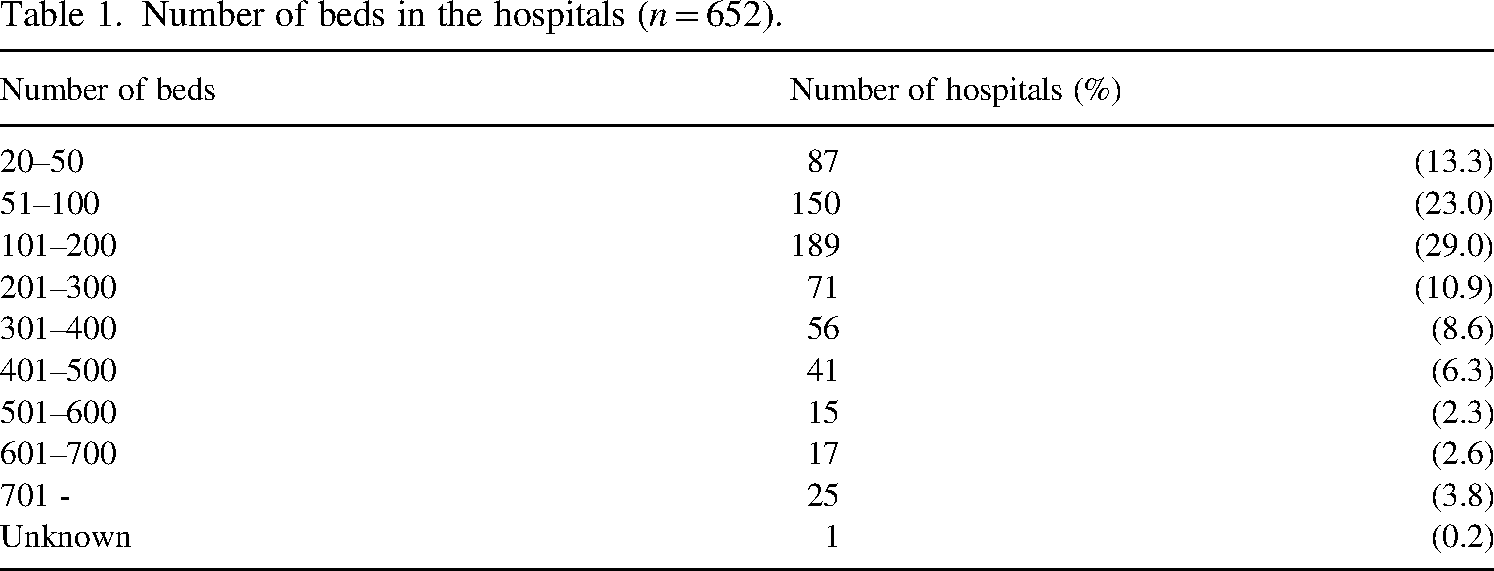
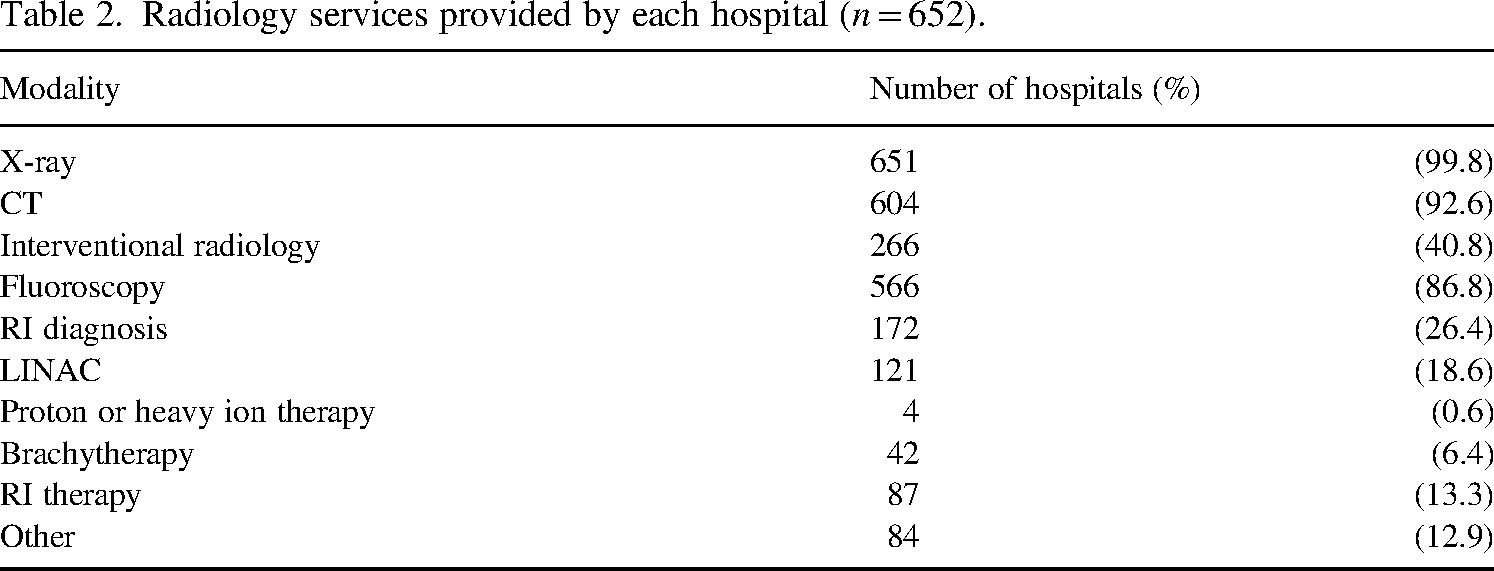
A questionnaire survey was administered to 3000 hospitals that were randomly selected from approximately 8000 hospitals nationwide. The survey was conducted between February and April 2018. A total of 652 hospitals (response rate: 21.7%) were included in this analysis. The size of hospitals (number of beds) and type of radiology services provided by the hospitals analysed are shown in Tables 1 and 2, respectively. This survey has been approved by the research ethics committee of Tokyo Healthcare University.
Number of beds in the hospitals (n = 652).
Radiology services provided by each hospital (n = 652).
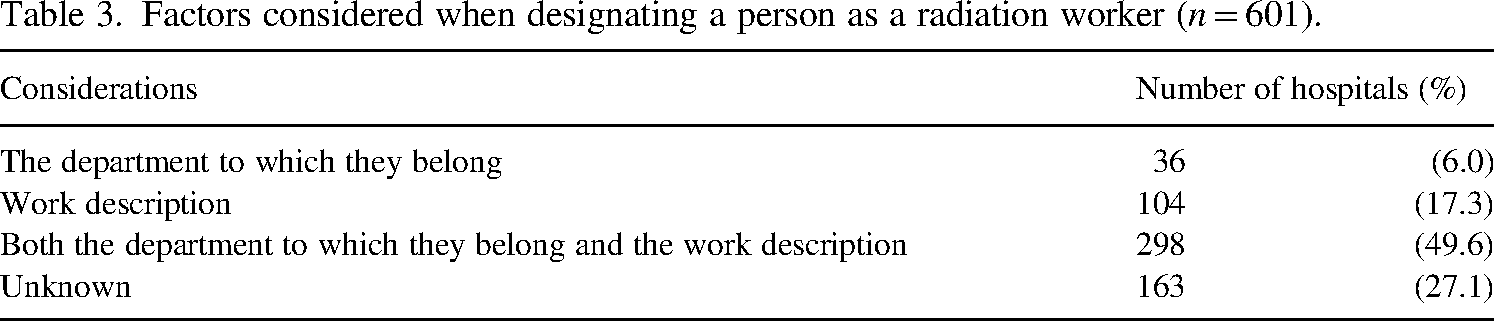
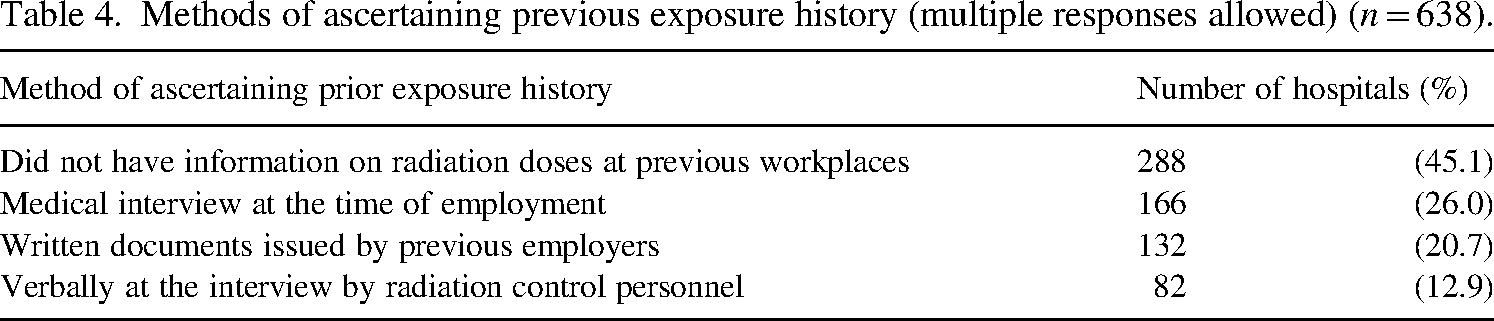
The questionnaire survey revealed that 371 hospitals (58.6%, n = 633) did not have criteria or guidelines for designating radiation workers. Many hospitals designated nurses as radiation workers, based on the department to which they belong and the nature/content of their work (Table 3). In addition, 288 hospitals (45.1%) did not have information on radiation doses of their employees’ previous workplaces, which was necessary to determine the accumulated doses over a given period. Although Japanese radiation protection laws and regulations stipulate that information on exposure doses prior to transfer should be obtained before first entering the radiation-controlled areas, only 132 (20.7%) hospitals were getting such reliable information according to the document (Table 4).
Factors considered when designating a person as a radiation worker (n = 601).
Methods of ascertaining previous exposure history (multiple responses allowed) (n = 638).
3. OVERVIEW OF THE GUIDELINES DEVELOPED
The results of the questionnaire survey suggest the need to develop guidelines at the national level. The Japanese radiation protection law defines a radiation worker as ‘a person who enters a radiation-controlled area’. However, it is unrealistic to designate approximately 1.27 million nurses as radiation workers in accordance with the law without considering the frequency of entry into radiation-controlled areas and the nature of their work, and it is impractical to apply the law to the field. We decided to develop a guideline that can be easily applied to the medical field, duly considering the department to which the nurses belong and the nature of their work (predicted exposure dose). Nurses were classified into three categories: (A) radiation workers, (B) temporary visitors to the controlled area, and (C) other than A and B (Table 5), focusing on the frequency of entry into the controlled area, that is, their predicted exposure dose.
Three categories of nurses from a radiation work perspective.
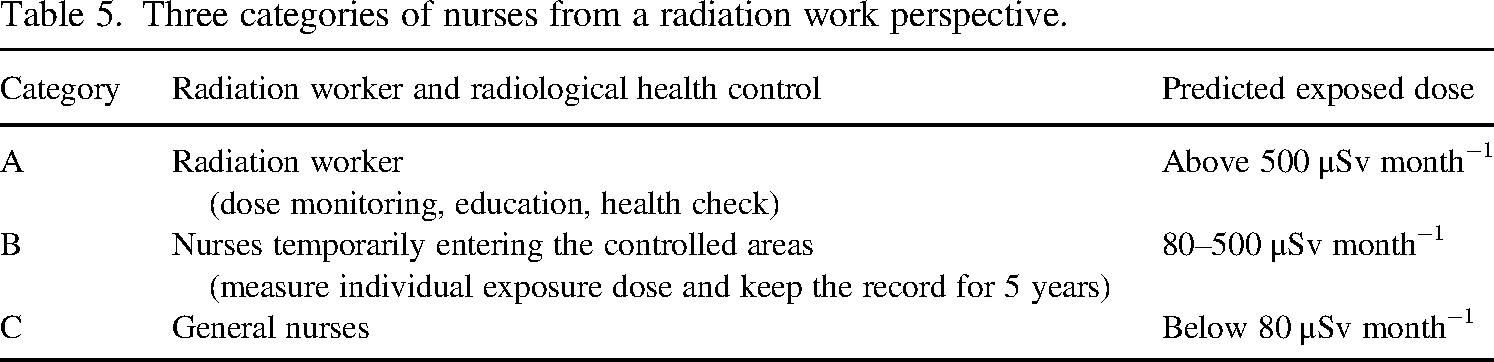
A dose of 500 μSv month−1 was calculated as 3/10 of the legal dose limit (100 mSv 5 years−1). In 1977, the International Commission on Radiological Protection (ICRP, 1977) recommended that workers whose annual exposure dose exceeds 3/10 of the dose limit should be monitored. The 80 μSv month−1 was calculated from 1 mSv year−1, which is the ICRP dose limit for public exposure. A flow chart for classifying nurses into categories A, B, and C is shown in Fig. 1.
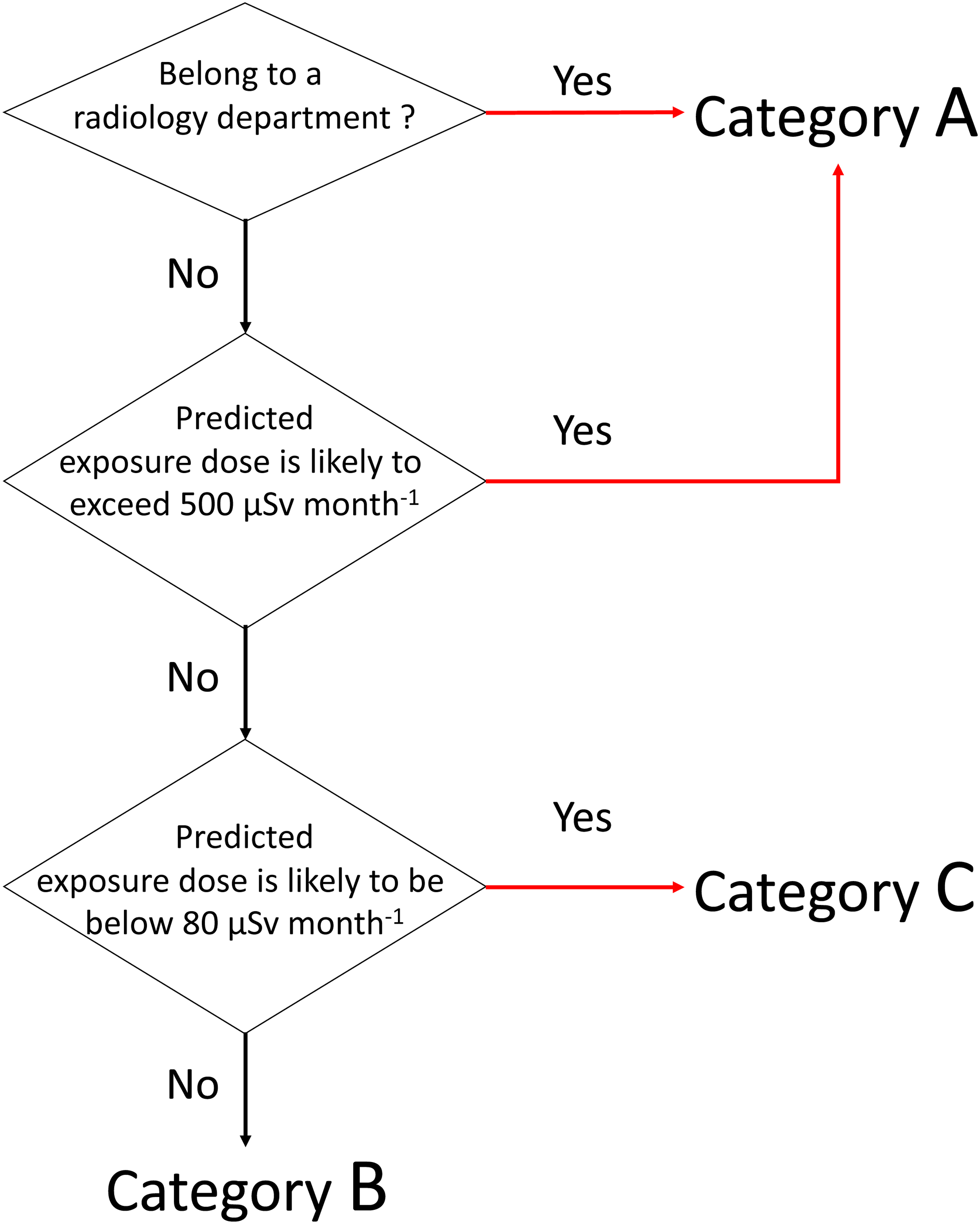
Procedure for classification (A, B, C) of nurses as radiation workers.
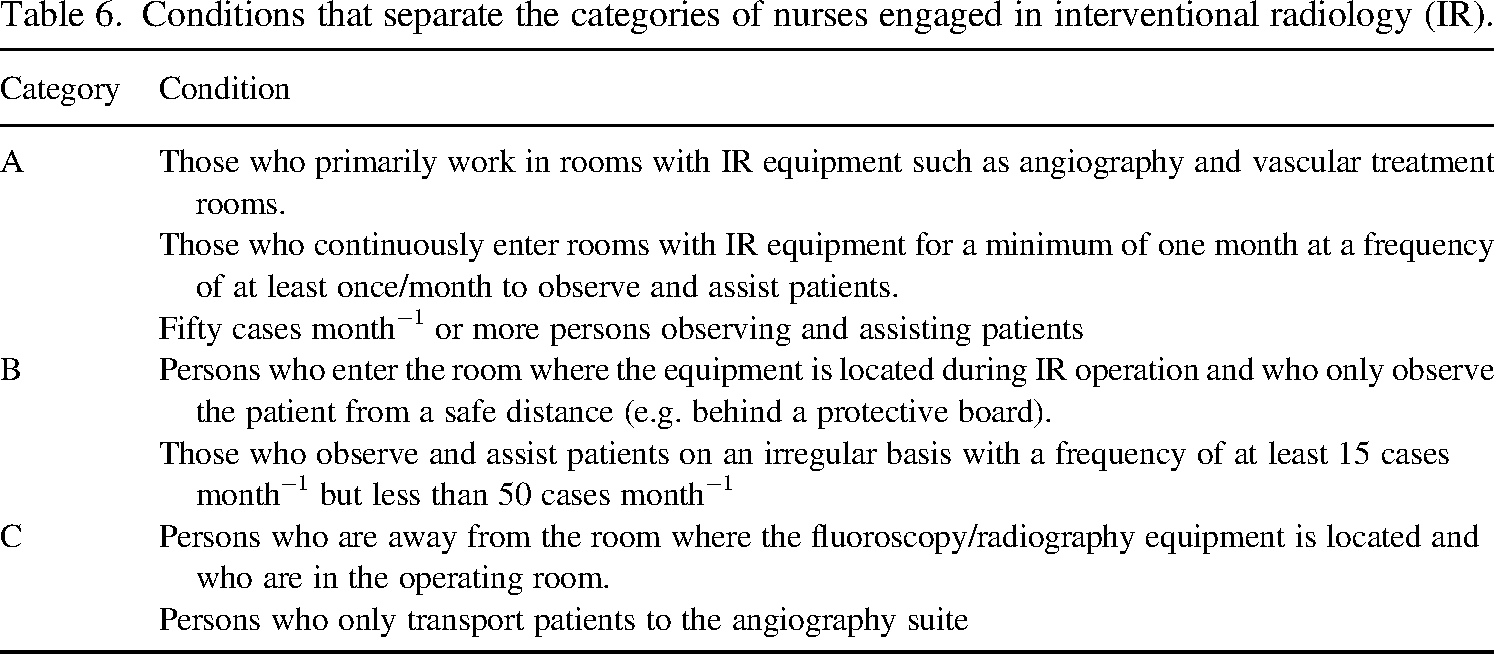
The following table lists examples of radiation work that may exceed 500 or 80 μSv month−1 (content and frequency of involvement in radiology work) based on the results of the literature survey for the ease of using the guidelines in the field (Table 6).
Conditions that separate the categories of nurses engaged in interventional radiology (IR).
4. CONCLUSION
For nurses to engage in radiation work under safe and secure conditions, it is necessary to designate them as ‘radiation workers’ and to stringently implement the necessary radiation protection measures. We developed guidelines and standards that can be applied in the medical field to designate nurses as ‘radiation workers’. We conducted public relations activities to disseminate these guidelines to medical institutions.
Footnotes
ACKNOWLEDGEMENTS
This study was supported by the Radiation Safety Research Promotion Fund.