





Abstract
ICRP initiated a review of the System of Radiological Protection. Contributing to this the World Nuclear Association (WNA) organised a workshop in collaboration with ICRP covering optimisation and communication as main topics. This article summarises the outcome of the optimisation part. ICRP and WNA addressed the expectations referred to the review and corresponding challenges. In this context ICRP mentioned the TG114 work, whereas WNA underpinned the need to include industry expertise in the review. A regulatory perspective and several examples of successful applications of the optimisation principle were presented. As an outcome, four main areas were identified, which need to be looked at more closely. These were the all-hazards approach as radiation was not always the primary hazard, graded approach as too much focus on very low doses doesn’t deliver reasonable ‘value for money’ for society, balanced regulations for the different hazards as over-conservatism in one field hampers an all-hazards approach, and simplicity as the existing system in some parts confuses society and practitioners. ICRP isn’t expected to develop an all-embracing ‘all-hazards approach’ to protection. A clear upfront top-tier statement in the revised Recommendations recognising that radiation cannot be considered in isolation would allow authorities to implement such an approach into the national regulations.
INTRODUCTION
Initiated in 2018, the International Commission on Radiological Protection (ICRP) is reviewing and revising the System of Radiological Protection over the next decade. Clement et al. (2021), Laurier et al. (2021), and Rühm et al. (2022) noted that the review was triggered to remain fit for purpose, although the System had been demonstrated as both robust and well-performing. The need for review and revision came up to address changes in science, society, and future applications of ionising radiation. The revised System will supersede the existing 2007 General Recommendations and will shape radiation-related policy, practice, guidelines, and regulations around the world. Recognising the call from ICRP to ensure that those who wish to contribute can, the World Nuclear Association (WNA) in collaboration with ICRP organised a 2-day workshop in the UK on the 27 and 28 September 2023 addressing the topic of ‘Optimisation in the System of Radiological Protection based on the All-Hazards Approach’ and ‘Effective communication and stakeholder engagement in the System of Radiological Protection’. The workshop aimed to give WNA member companies and nuclear industry representatives a platform to address areas of particular challenges to the nuclear industry related to the optimisation process, along with effective communication of the System of Radiological Protection to both practitioners and stakeholders (such as the public). The results of the workshop will be used to inform the next update to the ICRP General Recommendations.
Around 80 participants from across the globe attended the workshop and represented a balanced audience from research, industry, regulatory, and public bodies. This article summarises the outcome of the first day of the workshop, which addressed the ‘Optimisation in the System of Radiological Protection based on the All-Hazards Approach’ part. Some areas of challenges were addressed in both, the optimisation and communication parts. They will be included in this article.
WORKSHOP PROGRAM
Both ICRP and WNA opened the workshop with some opening remarks. This was followed by an ICRP presentation on its work and perspective to address the implementation of optimisation into the system of protection and a regulatory perspective on broadening optimisation.
A series of presentations was given on practical examples on the application of the optimisation principle covering the whole spectrum of the nuclear fuel cycle as well as future applications. Thereby all exposure situations were included.
The workshop was closed with a wrap-up session, jointly given by ICRP and WNA.
See Table 1 for the detailed workshop programme.
Detailed workshop programme.
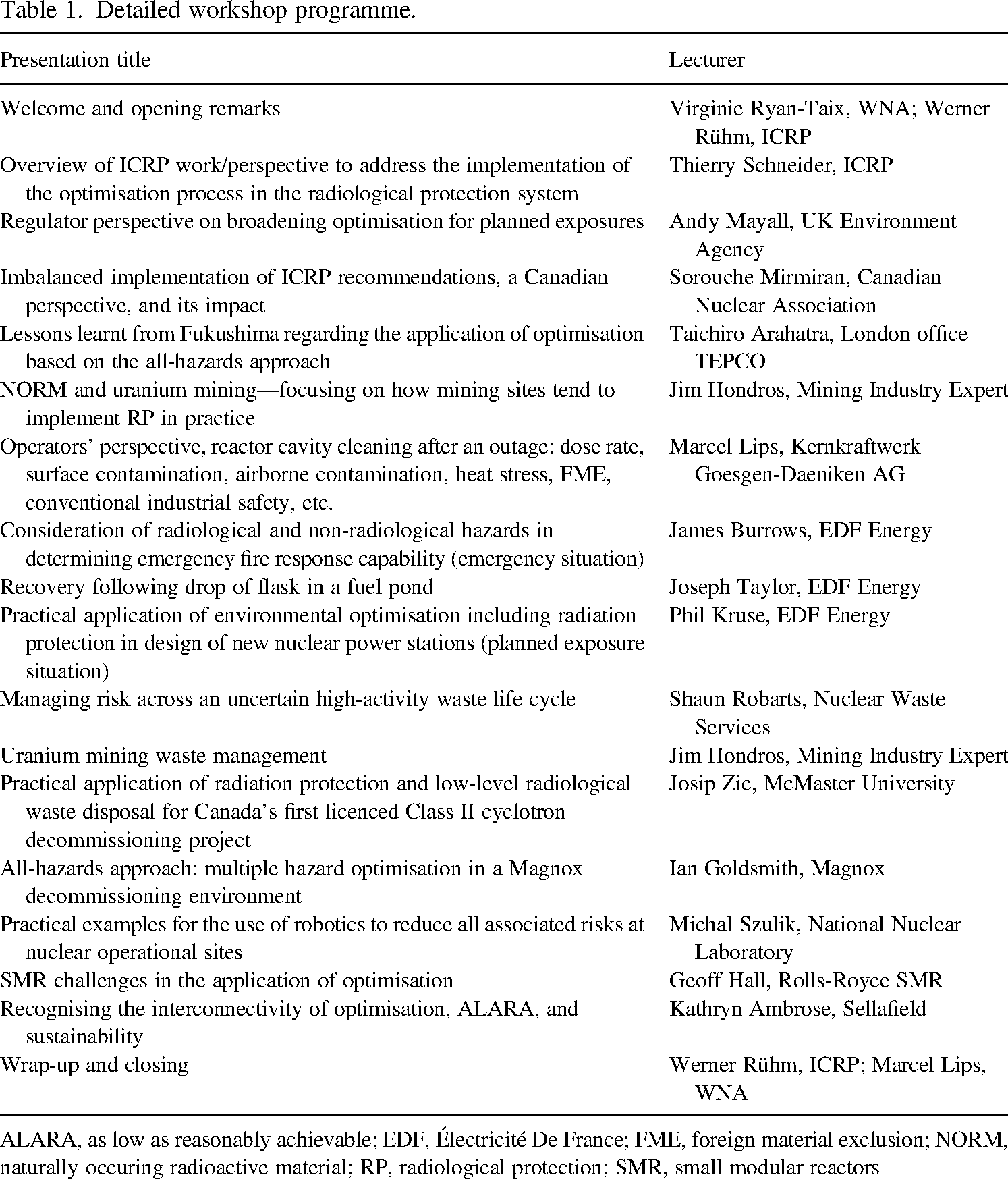
Detailed workshop programme.
ALARA, as low as reasonably achievable; EDF, Électricité De France; FME, foreign material exclusion; NORM, naturally occuring radioactive material; RP, radiological protection; SMR, small modular reactors
Introductory remarks
In its introductory remarks and overview, ICRP mentioned that tolerability of risk and reasonableness was already on the agenda of ICRP Publication 1 (ICRP, 1959). Ongoing discussions at national and international levels to clarify the corresponding concepts led ICRP in 2019 to create Task Group 114 with the aim to review the historical and current perspectives on reasonableness and tolerability of radiation risks and to clarify and consolidate ICRP Publication 103 (ICRP, 2007) in order to prepare the considerations and basis needed for the development of future recommendations. Key issues thereby are as follows:
Considerations and criteria on which the concepts of tolerability and reasonableness are based, and their application in the optimisation process. Application of the concepts in different exposure situations. Trade-off between the level of exposure and benefit. Accounting for sensitive or vulnerable populations. Interests reflected and integrated for human and non-human exposure. Strategies to assist in balancing competing values in determining what is tolerable and/or reasonable. How do we best support a reasonable value for society?
ICRP also highlighted that:
Reasonableness refers to optimisation involving stakeholders to achieve a workable and sustainable protective approach. Reasonableness refers to practicability and good judgement. Tolerability is not a demarcation between safe and unsafe. Multi-hazards situations need to be considered.
For the application in the nuclear sector, ICRP mentioned important issues like:
Establishing places of dialogue with the various stakeholders (workers, authorities, citizens, etc.) Better balancing the individual level of exposure, the collective dose, and the ‘non-radiological factors’ in the optimisation process Clarifying the role of the dose constraints in the optimisation process Addressing potential exposures including risk constraints Dealing with conservatism in the assessment at the planning stage Addressing the complexity of the situation
ICRP emphasised its willingness to include all its stakeholders in the revision process but also underpinned the potential challenges given by many contradictory stakeholder requirements.
WNA stated in its introduction that the process for the review of the System of Radiological Protection, which ICRP has initiated, is likely to lead to a new set of General Recommendations that will shape radiation-related policy, practice, guidelines, and regulations around the world in the decades to come. The outcome of this process could have an enormous impact on the nuclear industry and other nuclear technology sectors. That's why it is appropriate to ensure due consideration is given to practicality and proportionality in relation to any changes in the System of Radiological Protection and to ensure that industry expertise and perspectives are considered in the setting of radiological protection standards with global implications for nuclear commerce and operations.
Nuclear technologies, and hence radiological protection, play an important role in the United Nations Sustainable Development Goals, but if the System of Radiological Protection is not appropriate, there is a risk that the system could have a negative contribution to the delivery of these goals. For example, putting greater emphasis on minimisation of radiation exposure could be a challenge to new nuclear build and life extension of existing plants in the context of a climate emergency. Focusing too exclusively on radiation can also transfer risk to other areas, whilst it reinforces the view that radiation is a particularly harmful hazard compared to other workplace or public risks.
WNA therefore wishes to integrate a broad view beyond limitations to radiological protection into the revision process.
Regulatory perspective
A regulatory perspective was given by the UK Environment Agency. From such a perspective, optimisation means that the level of protection should be the best under the prevailing circumstances, maximising the margin of benefit over harm (the net benefit). In this context it was clearly said that optimisation is not radiation dose minimisation but an important contributor to finding a balance of many factors and facilitating sustainable outcomes and that focusing entirely on a single risk or impact (e.g. radiation) and minimising that at all costs is likely to have negative unintended consequences. So, there is a need for broadening of optimisation and to integrate and consider all relevant impacts and benefits (e.g. all-hazards approach). The challenges hereby are how to evaluate societal and economic factors, e.g. life-cycle analysis, carbon accounting, natural capital accounting, biodiversity/environmental net gain, and how to include potential attributes such as characteristics of exposures, social considerations and values, sustainability, human rights, environmental considerations and values, non-radiological hazards, technical and economic considerations, political factors, and regulatory constraints. At the end it is the duty of the whole radiological protection (RP) community to enable the most sustainable outcomes.
Practical examples for application of the optimisation principle and corresponding challenges
Fourteen presentations (see Table 1) covering the whole spectrum of the nuclear fuel cycle (mining, new build, operation, waste management, decommissioning, emergency planning and response, recovery) as well as naturally occuring radioactive material and future applications in small modular reactor including all exposure situations were given. They addressed practical examples for the application of the optimisation principle. Many successful applications of the principle were presented, showing how collective and individual doses have been optimised.
Some challenges in today's regulatory environment have been identified, and the necessary conclusions that could increase the value of future recommendations have been addressed.
Challenge 1: all-hazards approach
A first challenge that has been mentioned repeatedly (as it was the workshop's main topic) concerns the multi-hazard issue. Workers are exposed to a wide variety of hazards (chemical, mechanical, electrical, radiation, fall from heights, heat stress, etc.). Often, there are individual sets of regulations for these hazards, and in some cases, they are even contradictory. One presentation reported on a recurring work in a nuclear power plant. Individual and collective doses for it were significantly reduced over the years as a result of the optimisation process. There is still potential to further reduce these doses, simply at the expense of increased other risks like industrial and nuclear hazards. Answering the question about which set of regulations should become a priority needs good judgement and stakeholder involvement. It might be different depending on the situation. The issue is, if the different regulations do not foresee such a cross-cutting all-hazards view, practitioners could become a problem if they are not able to comply with all regulations.
An all-hazards approach must also apply to the protection of the public and the environment. Floods, droughts, water and air pollution, climate change, etc. are hazards society is currently facing. Actions to mitigate the consequences and to reduce the corresponding risks and hazards need broad views. A single action must not be over-optimised at the expense of others. For example, a solution with the lowest radiation exposure (such as abandoning nuclear technologies) does not necessarily represent the best and most sustainable protection with the biggest benefits.
Challenge 2: graded approach
A second challenge reported was about the graded approach. The nuclear industry spends millions of $ to comply with the 10 μSv year−1 criterion for clearance, which is probably more of a 1 or 0.1 μSv year−1 criterion due to the conservatism the calculation models and the measuring procedures contain. On the other hand, millions of individuals receive several tenths of a mSv additional dose sitting on long-haul flights and/or spending a fortnight holiday or more in an area with increased natural background radiation. Not a single cent is spent to reflect about optimisation of these doses, because their origin is from existing exposure situations. The question here is does this contrast really give value for money to society? Is this in line with the duty of the RP community to enable the most sustainable outcomes? The answer might not be black or white but should trigger some reflections on the current interpretation of the system of protection. A graded approach putting more emphasis on elevated doses and less focus on very low doses would probably add value that is perhaps missing from the system, and it would still be consistent with the linear no threshold approach as a practical and commonly accepted model.
Challenge 3: balanced regulations/over-conservatism
A graded approach goes in line with the need for balanced regulations for the different hazards avoiding over-conservatism in a single or several fields. In one of the presentations, the dismantling of a cyclotron was discussed. Several risks were identified, including radiation and asbestos. The collective and maximal individual dose for dismantling was at a very low level with 48 and 5 μSv, respectively. With protective measures implemented, risks for injuries, stochastic effects, and releases to the environment from radiation were seen to be low to very low. Asbestos was found in all building structures, and concentrations of asbestos above occupational exposure limits were known to be present. With protective measures implemented, risks for injuries, stochastic effects, and releases to the environment from asbestos were seen to be low to very low as well.
Despite these comparable risk evaluations, the contributions from radiation protection exceeded those from asbestos protection by a factor of five on the timeline of the project and by a factor of fourteen in terms of costs. Over-conservatism and over-regulation in nuclear/radiation did not allow a proper application of an all-hazards approach for protection. This is far from being balanced and additionally developed a wrong risk perception among the persons involved. The question here is whether the overall net benefit for persons involved was really maximised? Here again the answer might not be black or white, and good engineering judgement is needed. As already mentioned in Section 3.3.2, a graded approach could help to get a better balance in such multi-hazard protection situations.
Challenge 4: simplicity
A last item that was addressed is simplicity, a topic that came up in the communication as well as in the optimisation part of the workshop. As said in the Introduction, the system of protection performs well and seems to be robust. It has been developed over many years and is, according to current scientific knowledge, academically sound. But it became in some parts rather complex and confusing.
Is a dose limit less than natural background radiation, implying that man-made radiation is more dangerous than natural radiation, understandable to the public? Does it deliver the right risk perception? It is very challenging to explain to typical members of the public why we should allocate significant societal resources to ensuring extremely low doses in some cases (e.g. clearance; see Section 3.3.2), whilst at the same time formally allowing much higher exposures from individual decision-making (see Coates, 2022). This shows that some reflections on improvements and/or simplifications are necessary.
Are dose limits, constraints, and reference levels containing numbers across two orders of magnitude and their applicability to different exposure situations clear to all RP practitioners in the field? These practitioners don’t have university degrees like many of the policymakers have. So, some confusion must be expected, especially if these practitioners experience a change in the exposure situation. This may hamper the required protection they need to give in the field.
CONCLUSIONS
In summary, the following not entirely new findings were confirmed from the workshop:
There are many good examples of how optimisation has been applied in the industry, but radiation is not always the primary hazard. An all-hazards approach helps optimise overall and sustainable protection. A graded approach would prevent unnecessary cost and deliver reasonable ‘value for money’ for society. Such an approach would even help to eliminate at least part of the existing confusion—keyword simplification. And it will lead to a better balance between the different regulations for the different hazards. The workshop emphasised that it is not ICRP's role to recommend protection measures against hazards other than radiation. But future recommendations should clearly identify the all-hazards approach in a top-tier statement, allowing authorities to implement such an approach into the national regulations.