






Abstract
The current liability for decommissioning offshore oil and gas infrastructure in Australia is estimated to exceed US$ 31 billion over the next 50 years. This is founded on the base-case regulatory position of complete removal of all infrastructure, with over half the liability occurring in the next 10 years. Naturally occurring radioactive materials (NORM) are ubiquitous in oil and gas reservoirs worldwide and may form contamination products including scales and sludges in production infrastructure. Globally, assessment of the ecological impact of in-situ decommissioning typically fails to consider the long-term effects of exposure to potential contaminants contained within pipelines. There remain broad gaps in our understanding of NORM contaminants in the marine environment and how to effectively assess and measure the risk of NORM to marine organisms. This article discusses the application of a tiered assessment process to determine potential radioecological impacts of pipeline scale related to decommissioning practices using real-world NORM scale: (1) advanced nuclear and imaging techniques to characterise NORM-contaminated scale; (2) conducting radiological biota dose modelling using MicroShield and ERICA for different decommissioning scenarios; and (3) performing a series of marine infauna-exposure tests to understand the bioaccumulation and organ biodistribution of scale-associated constituents. This research provides a methodological approach that contributes valuable insights to inform infrastructure decommissioning planning. Several research gaps remain in our understanding of the fate of NORM contaminants in subsea oil and gas systems relative to decommissioning risk assessments including investigating radiobiological effects in marine organisms at elevated NORM levels and the establishment of a NORM inventory to better understand its characteristics and formation from different types of infrastructure.
INTRODUCTION
Over the next 50 years, a large quantity of offshore oil and gas infrastructure in Australia will be destined for decommissioning (Melbourne-Thomas et al., 2021). This decommissioning may result in the release of contaminants into the marine environment (e.g. metals, mercury, plastics, and naturally occurring radioactive materials [NORM] from infrastructure, e.g. pipelines), and therefore there is a need for research into their potential impacts on the marine environment. Globally, assessments of the ecological impact of in-situ decommissioning typically fail to consider long-term effects of exposure to potential contaminants contained within pipelines, including NORM, which can be present in pipe scale and is often dominated by 226Ra and 228Ra. Scale-contaminated infrastructure may be left on the seabed if permitted by relevant regulatory bodies, and NORMs may be present for years beyond cessation of operations (tens to thousands of years) and could be at concentrations that lead to potential harm if released to the marine environment (Watson et al., 2023).
In Australia, further research into the influence of scale-based NORM contaminants associated with offshore infrastructure on marine ecosystems is required to guide the future development of an ecological risk assessment framework and inform decommissioning decisions. There remain broad gaps in our understanding of NORM contaminants in the marine environment and how to effectively assess and measure the risk of NORM to marine organisms (MacIntosh et al., 2021). In order for the potential impacts of NORM to be appropriately addressed in regulatory assessments, novel data need to be collated and techniques used to assess the chemical and biological fate of scale contaminants in Australian marine environments.
This article describes recent research based on the tiered assessment approach proposed by Cresswell et al. (2021), following the decision-making tree illustrated in Fig. 1, with the following aims.
To understand the chemical and radiological characteristics of NORM-contaminated scales and their formation, composition, and morphology To investigate the likely radiological dose rates from NORM-contaminated scale under environmentally realistic exposure scenarios to model marine organisms To understand the potential bioavailability, bioaccumulation, and organ biodistribution of NORM-contaminated scale to sediment-dwelling marine organisms To investigate the influence of NORM-based contaminants on marine sediment-microbe community composition and diversity.
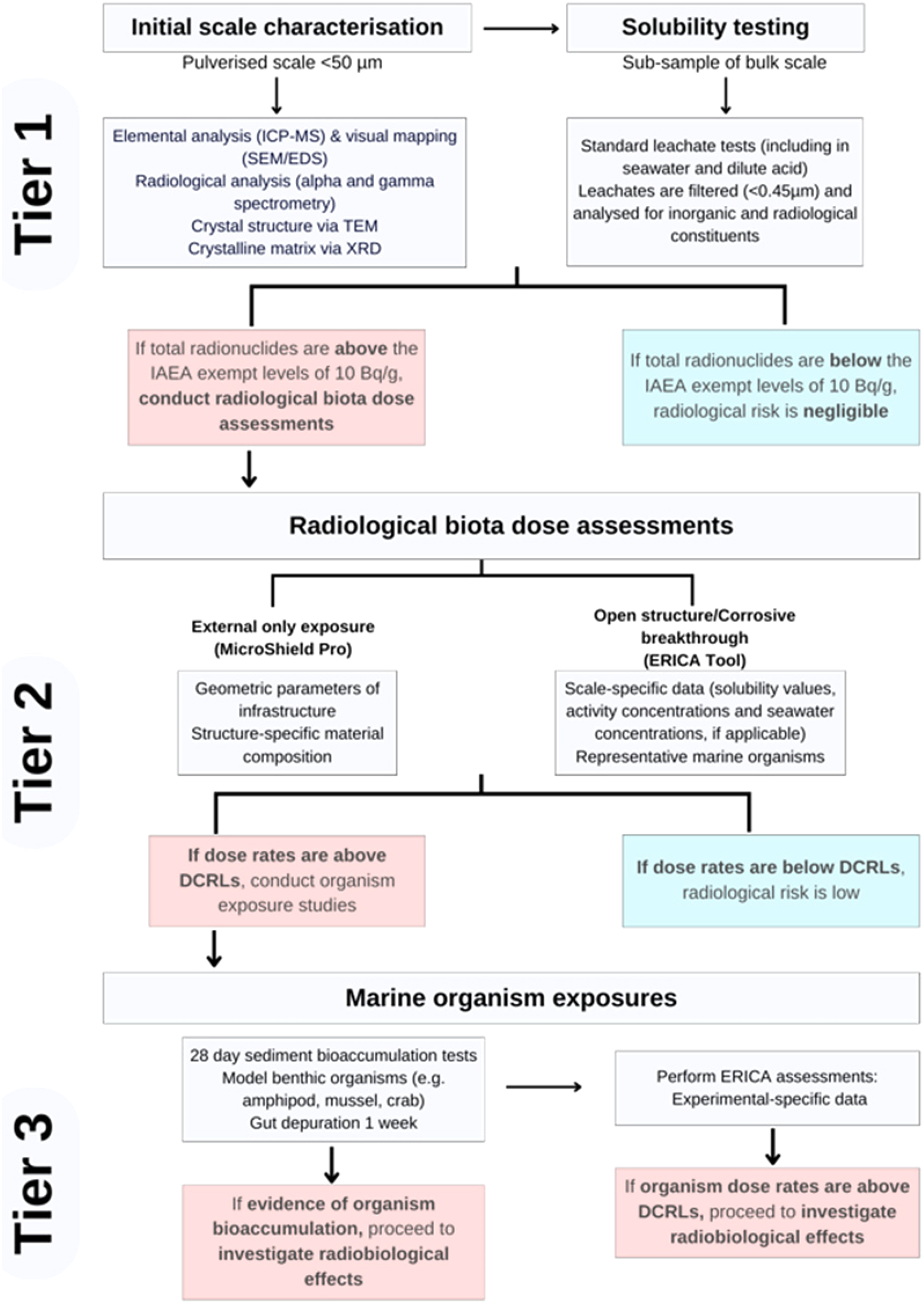
Illustrative decision-making process following the tiered framework described by Cresswell et al. (2021) for the assessment of naturally occurring radioactive contaminants (NORM) scale from offshore petroleum structures.
Characterisation of scale residues
The formation of NORM residues within offshore oil and gas infrastructure is often controlled by site-specific physical and chemical conditions during operations (MacIntosh et al., 2021). An understanding of the mineralogical and radiological characteristics of site-specific NORM is rarely studied. Conducting scale-specific assessments can provide an early detection tool and enable operators and regulators to plan for the management of decommissioning processes.
The initial stage is to identify and classify the chemical composition and radioactivity levels of scale or other potential NORM-contaminant products. Taking into account the environmental and operational disparities among offshore petroleum systems, the collection, analyses, and characterisation need to be conducted on several different sources of scale. MacIntosh et al. (2021) recommended that scale samples from subsea infrastructure (wells, subsea pipes) be recovered, either by cutting and lifting pipelines and/or recovery of scale mechanically or by analysis of pigging dust/solids.
Materials and nuclear-based science can aid in the characterisation of a NORM inventory within a production system. MacIntosh et al. (2024) conducted a study with the aim of characterising pipeline scale using a variety of radiometric, imaging, and isotopic tracing techniques including transmission electron microscopy, x-ray fluorescence microscopy, and photostimulated luminescence autoradiography. The focal material of the study was barium sulphate (baryte), one of the most commonly found mineralised forms of scales.
The findings of this novel study were that the formation and origins of baryte NORM scales are ultimately controlled by the physical and chemical conditions of the microenvironment within subsea pipelines. Radium was also hypothesised to become incorporated early at the beginning of the scale formation and to continually coprecipitate over the 17 year period of oil and gas extraction.
Whilst this case study provides an example of the application of the first stage of scale-specific assessments, it only included a small sample of baryte scale from a single structure and therefore does not provide a representative overview of the variability of NORM scale products from other offshore infrastructure or even within other sections of pipeline within the same field. When visualising the parent head of chain or daughter radionuclides, 226Ra concentrations in solids are too low to be measured by energy-dispersive x-ray spectrometry, thus making it difficult to precisely determine the localisation of 226Ra-associated radionuclides. Additionally, photostimulated luminescence autoradiography only images beta emissions. To estimate the potential radionuclide exposure to marine organisms during operations and decommissioning, it is crucial to employ a blend of analytical and imaging techniques for characterising and assessing the radiological properties of NORM-contaminated products.
Scale-specific radiological biota dose assessments
Using the scale-specific primary data obtained from the initial scale characterisation, it is recommended to perform radiological biota dose assessments to predict the potential radiation doses to representative marine organisms of the given exposed ecosystem. For planned decommissioning exposure scenarios, dose rates should be below the ICRP-derived consideration reference level (DCRL) bands for the following marine organisms (above which, population-level impacts are expected):
- 40–400 μGy h−1 for flatfish and seaweed - 400–4000 μGy h−1 for crab (i.e. invertebrates)
A recent modelling study conducted by MacIntosh et al. (2022) presented a case study using commercially available radiological dose modelling software including the ERICA Tool and MicroShield Pro to estimate the likely radiological doses and risks of effects from NORM-contaminated products from a decommissioned offshore oil and gas pipeline. Using measured activity concentrations of NORM-contaminated scale (226Ra, 210Pb, 210Po, 228Th) from a subsea pipeline, environmentally realistic exposure scenarios were modelled; radiological exposures from both an intact pipe (external only; accounting for radiation shielding by a cylindrical carbon steel pipe) and a decommissioned pipeline with corrosive breakthrough were simulated to estimate doses to model marine organisms. Predicted dose rates for the external only exposure (ranging from 26 to 33 μGy h−1) and a corroded pipeline (ranging from 300 to 16,000 μGy h−1) exceeded screening levels (10 μGy h−1) and DCRL, respectively, for radiological doses to marine environmental receptors (MacIntosh et al., 2022). Using scale-specific solubility data (i.e. Kd) values for individual NORM radionuclides are important, as using the default values may under- or overestimate the solubility of individual radionuclides, which in turn would influence the estimated radiation dose to marine organisms.
Using the ERICA Tool for modelling worst-case environmental exposure scenarios of NORM-contaminated petroleum products to marine biota has several underlying uncertainties that could impact the certainty and applicability. The dosimetric methodology delineated in ICRP Publication 136 (ICRP, 2017) adopts a dose assessment strategy grounded in the uniform isotropic model. This model presupposes a homogeneous distribution of radioactive sources within the environment and organisms, characterised by identical density and elemental composition (MacIntosh et al., 2022). However, this scenario is improbable in the marine environment surrounding a subsea NORM-contaminated structure, considering the intricate interactions with adjacent marine organisms. It is difficult to extrapolate dose rate exceedances as there are no data regarding the full extent of effects from exceeding the 10 μGy h−1 screening level for benthic marine organisms in a subsea marine environment. Therefore, future biota dose assessments need to be carefully thought out and considered highly conservative.
Marine organism exposures
Following the tiered assessment approach, if the scale-specific radiological biota dose assessments demonstrate a negligible dose to exposed marine organisms, organism exposure and/or effects testing needs to be conducted in controlled laboratory conditions (Fig. 1). Coincidentally, there is a lack of knowledge of radiotoxicological effects of NORM contaminants on benthic microorganisms. Knowledge of the bioavailability and bioaccumulation potential that could impact the transfer from sediment to marine biota is crucial to understanding the potential risks that NORM-contaminated sediments could pose on the marine environment, if scale-contaminated infrastructure is left in situ.
Microcosm-based exposures for short (i.e. 1 week) and long-term (28 days) bioaccumulation studies have not, until recently, been applied to NORM-contaminant exposures. Conducting an experiment to assess the ecological effects of NORM requires careful planning and execution. The first step is to clearly define the study objectives, which focus on understanding the bioavailability and impact of NORM on marine organisms. Key questions to address can include how different distributions of NORM in sediments affect marine biota and what the short-term and long-term effects of NORM exposure are on benthic organisms.
The design of the microcosm experiments is critical, whereby two sediment conditions (in addition to a control uncontaminated sediment) can be created to simulate potential real-world scenarios: one where barite scale containing NORM is homogenised throughout the sediment, representing a scenario where scale has been mixed due to disturbances or sedimentation, and another where the barite scale is applied as a surface layer, mimicking the natural deposition of scale on the seabed. The study should incorporate both short-term (1 week) and long-term (28 days) exposure durations to capture immediate bioaccumulation effects and chronic exposure outcomes.
Selecting appropriate test organisms that represent the benthic community or the ecosystem of interest is an ideal test species as they are representative of the benthic community and are sensitive to sediment-associated contaminants. Prior to the experiment, these organisms should be acclimated to laboratory conditions to ensure they are in a stable state of health, minimising stress that could otherwise confound the results. The microcosm set up involves simulating the environmental conditions of the marine ecosystem as closely as possible. This includes maintaining temperature, salinity, and oxygen levels reflective of natural conditions. Additionally, natural processes such as sedimentation and bioturbation should be considered, as they can significantly influence the distribution and bioavailability of NORM within the microcosms.
Sampling should be conducted at key intervals, such as after 1 week and at the end of the 28-day period, to assess changes in contaminant levels and the health of the test organisms. Analytical procedures should include measuring radionuclide concentrations in both sediment and biota using appropriate techniques. The whole-body burden of radionuclides in the organisms should also be assessed to evaluate the extent of bioaccumulation.
To complement these measurements, radiation dose assessments should be performed using the ERICA Tool and the experiment-specific parameters to estimate the radiation doses received by the organisms, and the results should be compared with established screening thresholds to determine the potential ecological risks posed by NORM.
MacIntosh et al. (2023) were the first to explore the ecological impacts of NORM scale material on marine organisms. A microcosm approach was used to investigate the bioaccumulation of NORM-contaminated scale from a decommissioned subsea pipe by multiple sediment-dwelling organisms (i.e. amphipod and clam) and assessed the potential impacts of NORM scale within sediment at elevated concentrations of metals and radionuclides. Two sediment types were tested: one sediment with barite scale homogenously distributed and one sediment where barite scale was added as a surficial layer to simulate scale mixed into the sediment by physical and biological processes (i.e. bioturbation) and to simulate scale settling on the sediment surface, respectively. 210Po and 226Ra were significantly elevated in the scale-contaminated sediments when compared with the control sediments. The whole-body burden of Ba and 226Ra was significantly higher in the scale-exposed amphipods. Using experiment- and scale-specific parameters in biota dose assessments suggested potential dose rates may elicit individual and population-level effects. However, the low sensitivity of beta-spectrometry by liquid scintillation counting meant the whole-body tissue concentrations of 210Pb in the animals were below detection levels and were unreliable.
By using a semi-realistic cosm approach (natural sediments, actual pipe scale), we can determine a conservative estimate of contaminant bioavailability from scale, which could greatly aid in the determination of the ecological fate of scale-associated contaminants in the marine environment. However, accurate simulation of the environmental conditions of subsea pipelines within a laboratory setting is always difficult. Therefore, the accuracy of the estimates may be limited with further studies of this nature needed to be undertaken, encompassing a range of marine physico-chemical parameters in addition to field-based studies.
UTILITIES OF THIS RESEARCH
This collective research has applied the tiered approach developed by Cresswell et al. (2021), providing a starting point for industry to make evidence-based integrated assessments to determine the need for assessing NORM scale contaminants. The new insights into the formation and characteristics of contaminated scales can assist pipeline scale testing and provide operators with an understanding of the presence and fate of scale contaminants. Additionally, regulators such as the Australian National Offshore Petroleum Safety and Environmental Management Authority (NOPSEMA) can recommend this approach to industry titleholders for the integration into robust decommissioning environmental risk assessments, especially if the titleholder is seeking an in-situ disposal option.
This research can initiate a NORM inventory and can accelerate the production of preliminary data sets of the effects of pipeline scale exposure to key marine fauna, both in Australia and worldwide. This tiered approach can further be extrapolated to assessing the risk of other contaminants present in pipelines, for example, the formation of mercuric sulphide (cinnabar or metacinnabar) in gas-export pipelines that also forms as a scale (Gissi et al., 2022).
Whilst some information is immediately usable, such as the successful application of nuclear and imaging techniques to understand the formation and characteristics of NORM-contaminated products and the microcosm approach to investigate the bioaccumulation of NORM-contaminated scales from a decommissioned subsea pipe, further gaps remain in our understanding of how to effectively measure risk and define appropriate risk assessment criteria.
RESEARCH AND INDUSTRY-FOCUSED PRIORITIES
The application of a tiered approach described in this article (illustrated in Fig. 1) has highlighted the importance of the initial risk assessment stages for NORM contaminants in the marine environment from decommissioned oil and gas infrastructure. However, future actions are still required to understand and measure the potential risk of NORM in the marine environment as part of decommissioning NORM-contaminated subsea production infrastructure:
Establish NORM inventories and material characteristics associated with subsea infrastructure to better understand the spatial extent of NORM contamination and the associated timeline for release to the environment. Understand the potential dispersion of radionuclides from subsea pipelines postcorrosion to predict contamination spread and assess ecological impacts. This can involve developing and validating models, conducting field studies, and establishing long-term monitoring programs. Understand the temporal extent of NORM contamination from subsea infrastructure by focusing on how radionuclide inventories evolve due to decay and ingrowth over time. This can include modelling the equilibrium states of radionuclides at various stages of pipeline corrosion. Derive contaminant, speciation-specific Kd values to better model NORM behaviour and partitioning to inform potential exposure pathways to marine organisms associated with the site-specific location of the infrastructure. Determine ionising radiation effects data for marine organisms at the individual and population level including both external radiation exposures, i.e. from gamma-emitting NORM radionuclides and internal radiation exposures, i.e. resulting from the bioaccumulation of NORM radionuclides via respiration, ingestion, or transfer across permeable membranes. This will increase certainty on dose–response relationships and refine estimates of radiation dose and subsequent acute and chronic radiation-induced effects, especially where predicted dose rates exceed screening levels (e.g. DCRLs). Develop lines of evidence for assessing NORM-contaminated products in subsea pipelines and evaluate potential impacts. These must be predictive and conservative for future release scenarios, on timescales associated with infrastructure corrosion rates and radionuclide decay rates. Various lines of evidence can include environmental monitoring, radiological analyses and/or modelling approaches, dosimetry-based studies, and radiation effect studies on marine organisms.
Encourage multi-stakeholder collaboration to provide the opportunity to create open-source datasets of NORM inventories and associated ecological risk assessments. Knowledge transfer between national and international regulators, operators, and academic stakeholders can help towards a risk-based decommissioning framework that is fit for purpose.
To enhance relevant ICRP Publications related to the assessment of NORM, the ICRP should consider the following research priorities:
Developing radiotoxicological guidance specifically to marine environments that is tailored to the characteristics of marine ecosystems and the diverse range of marine organisms, including establishing maximum permissible concentration of radionuclides in the marine environment, the standardised protocols for monitoring radionuclide levels in marine environments, and defining safe dose rate thresholds for different marine organisms. Encouraging the integration of radiological models with ecological models for a more comprehensive understanding of the potential impacts of NORM on marine species and ecosystems. Advocating and supporting the establishment of monitoring programs to assess NORM levels in marine environments.
By implementing these measures, the ICRP can contribute significantly to advancing our understanding and management of NORM impacts on marine ecosystems, aligning with the organisation mandate for the radiological protection of the environment. Our approach to assessing the risk of NORM-contaminated products from offshore infrastructure has the potential for seamless integration into the framework of ICRP, which centrally addresses the assessment of industrial processing entailing NORM.