





Abstract
This study investigates the effects of culture on the design of merger and acquisition (M&A) contracts. Specifically, we empirically analyze how the acquirer’s cultural background influences the contractual choice to implement an earnout. We operationalize the acquirer’s cultural background by using Hofstede’s country-level indices for individualism, power distance, uncertainty avoidance, masculinity, and long-term orientation. Using a comprehensive sample of 9,669 M&As, we find that earnout use is significantly positively associated with the acquirer’s masculinity level. Furthermore, we provide evidence that earnout use is significantly negatively associated with the acquirer’s power distance and uncertainty avoidance scores. Our study contributes to the literature by demonstrating that, in addition to economic theories, cultural differences are important in understanding the heterogeneity of earnout use.
Introduction
Mergers and acquisitions (M&As) have become a primary strategic choice for organizational growth. However, executing M&As poses important challenges to acquirers. In particular, information asymmetry and differing expectations about the target’s future performance can create a gap between the acquirer’s and seller’s estimates of the target value. Differences between the acquirer and seller in their target value expectations are thus a crucial subject of debate in the M&A negotiation process.
Acquirers can use contingent considerations (earnouts) as a contractual means to bridge the valuation gap “between the seller’s rosy forecast and the buyer’s healthy skepticism” (Gundersen, 2005). Earnouts consist of a two-stage payment structure: an initial upfront fixed payment and deferred, variable payments that are conditional on certain agreed-upon performance standards within a prespecified period, typically 1 to 3 years after the deal has occurred. As such, earnouts partly transfer the chances and risks of a target’s future performance to sellers by linking parts of the purchase price to financial performance measures (e.g., cash flow or sales) and/or nonfinancial goals, such as product development milestones (Cain, Denis, & Denis, 2011). Consequently, the final purchase price is unknown when the deal is closed, as it depends on the target’s future performance.
Prior research employs economic theories and identifies two important economic determinants of why earnouts are integrated into M&A contracts. First, earnouts can mitigate the risk of adverse selection in acquisitions, which is more prominent when the acquirer and seller have a high degree of information asymmetry. Therefore, earnouts are more likely when there is a high degree of asymmetry in the acquirer’s and seller’s information about the target firm. For instance, earnouts are more likely when target firms are privately held or when they operate in the service or high-tech industry, hold large amounts of intangible assets, or have high sales growth ratios (Barbopoulos & Adra, 2016; Barbopoulos & Sudarsanam, 2012; Cain et al., 2011; Datar, Frankel, & Wolfson, 2001; Ewelt-Knauer, Knauer, & Pex, 2011; Kohers & Ang, 2000; Reuer, Shenkar, & Ragozzino, 2004). Second, earnouts can also be implemented to resolve moral hazard problems. Empirical evidence supports this argument, suggesting that earnouts are more likely when it is crucial to retain and motivate target managers for the successful realization of the target’s potential value (Barbopoulos & Sudarsanam, 2012; Cadman, Carrizosa, & Faurel, 2014; Cain et al., 2011; Coff, 1999; Datar et al., 2001; Kohers & Ang, 2000).
Our study extends the literature by investigating the effect of culture on earnout use. We focus on the acquirer’s cultural background because prior empirical evidence suggests that earnouts are primarily in the interest of acquirers (e.g., Barbopoulos & Sudarsanam, 2012; Cain et al., 2011). In addition, sellers generally wish to avoid earnouts as they involve participating in the target’s development and its business and management risk while having limited influence on its strategic or operational development, which can thus subject sellers to opportunistic behavior by the new owner (Datar et al., 2001; Kohers & Ang, 2000). 1
Culture can be defined as “the collective programming of the mind that distinguishes the members of one group or category of people from another” (Hofstede, 2001, p. 9). Hofstede developed a model of national culture that consists of the following six dimensions describing preferences that distinguish national cultures from each other (Hofstede, 1980; Hofstede, Hofstede, & Minkov, 2010): individualism, power distance, uncertainty avoidance, masculinity, long-term orientation, and indulgence. Hofstede argues that these factors are relevant to predicting differences in decision making (Hofstede, 1985).
Our study builds on Hofstede’s framework and uses five factors to predict how culture affects earnout use. 2 The first cultural factor, individualism, refers to the relationship between the individual and the collective. Members of individualistic societies make choices according to their own preferences, whereas gaining social acceptance of decisions is particularly important for members of collectivistic societies. We predict that earnout use is positively associated with the acquirer’s level of individualism because members of individualistic societies tend to engage in less common and complex contracts and allow individualism to persist within the target firm after the transaction because earnouts are effectively performance-based compensation contracts.
The second cultural factor, power distance, indicates whether individuals accept an unequal distribution of power and organizational hierarchy. We predict a negative association between the use of earnouts and the acquirer’s degree of power distance. We argue that a low power distance leads to more intense discussion about the purchase price with the seller and within the acquirer’s organization. Therefore, less power distance for the acquirer leads to a higher likelihood of earnout use because earnouts help to solve such contentious debates.
The third factor, uncertainty avoidance, refers to a society’s tolerance of uncertain situations with indeterminate outcomes. Theoretically, acquirers with a high degree of uncertainty avoidance could place more valuation risk on the seller and thus be more likely to insist on an earnout. Therefore, we predict a positive association between the use of earnouts and the acquirer’s degree of uncertainty avoidance.
The fourth factor, masculinity, refers to individuals’ behavior in contentious discussions. Individuals in more masculine societies are willing to exert pressure and to force others to agree on nonpreferred issues, whereas individuals in less masculine societies are more consensus oriented. We predict a positive association between the use of earnouts and the acquirer’s degree of masculinity because acquirers from more masculine societies are more likely to insist on their opinion such that earnouts help to solve such conflicts.
Finally, long-term orientation addresses how individuals value short-term performance in contrast to long-term-oriented strategies. Individuals from short-term-oriented societies focus more on the next quarter’s profits of an investment, while individuals from long-term-oriented societies focus more on enhancing the target’s market strategy for the future (e.g., Hofstede, 1991). We predict a negative association between the use of earnouts and the acquirer’s degree of long-term orientation because earnout payments are typically based on the target’s short-term performance and thus better reflect the time orientation in short-term-oriented societies.
Using a sample of 9,669 M&As announced between 2007 and 2012, we find that the acquirer’s cultural background is important for explaining the contractual choice to implement an earnout. In detail, we find that earnout use is negatively associated with the acquirer’s degree of power distance, suggesting that earnouts help to solve the more contentious debates of such acquirers. Furthermore, earnout use is (in contrast to our hypothesis) negatively associated with the acquirer’s level of uncertainty avoidance, potentially due to noise in the Hofstede measure of uncertainty. We also find that acquirers from more masculine societies are more likely to include earnouts. This result supports our argument that earnouts are more important for acquirers from more masculine countries because earnouts help to resolve disputes regarding the target’s value and the purchase price. Finally, we find no support for our hypotheses that the acquirer’s degree of individualism and long-term orientation is associated with the likelihood of implementing an earnout, potentially because the commitment to an acquisition is in itself a long-term commitment.
Our study contributes to research and practice. First, we contribute to the literature on earnouts and, more generally, to the broader literature on contract design in M&As (e.g., Barbopoulos, Paudyal, & Sudarsanam, 2017; Cadman et al., 2014; Cain et al., 2011; Datar et al., 2001; Elnahas, Hassan, & Ismail, 2017; Kohers & Ang, 2000). We extend the literature by demonstrating that not only economic determinants but also culture is important in contract design. Specifically, we provide evidence that the acquirer’s cultural background affects the likelihood of implementing an earnout in the M&A contract. Second, our article adds to the understanding of the importance of culture for M&As (e.g., Chakrabarti, Gupta-Mukherjee, & Jayaraman, 2009; Sarala & Vaara, 2010; Vaara, Sarala, Stahl, & Björkman, 2012). Our study complements the literature by revealing that culture is important not only for target integration but also for contract design. Third, our study adds to the literature that compares the relative importance of investor protection with culture (e.g., Stulz & Williamson, 2003). Prior earnout literature shows that earnout use is more likely under a law system that provides a stronger protection of investor interest (Reuer et al., 2004). We provide evidence that culture better predicts earnout use than investor protection, and when culture is explicitly accounted for, investor protection and other variables for the institutional environment become nonsignificant. Finally, an understanding of how the acquirer’s cultural background affects earnout use facilitates the negotiation process by helping sellers to better predict the acquirer’s negotiation strategy. Furthermore, we inform sellers which acquirers are more likely to insist on earnouts such that sellers can allow for the associated transaction costs during the earnout period. Our study also provides potential acquirers with information on the negotiation strategies of competing bidders. Thus, information about others bidders’ behavior in M&As can support successful negotiations.
The remainder of this article proceeds as follows: In “Background and Hypotheses” section, we discuss prior research and derive our hypotheses. “Sample and Research Design” section describes our sample selection process and research design. “Results” section presents our results. “Discussion and Conclusion” section concludes the article.
Background and Hypotheses
Background
Designing an appropriate contract is a crucial aspect of acquisitions because acquirers fear overpayment and mistrust data provided by the seller, potentially leading to different expectations about the target’s enterprise value in M&A transactions (e.g., Reuer et al., 2004). Earnouts are an important payment method in acquisitions, as they allow acquirers to reduce such problems associated with information asymmetry. Prior research on earnouts, therefore, primarily examines their role in mitigating costs in acquisitions that arise from information asymmetry.
Kohers and Ang (2000) analyze a sample of 938 M&A deals involving earnouts from 1984 to 1996 and find that earnouts reduce the risk of misevaluating targets with high information asymmetry and resolve moral hazard problems, leading to positive effects on shareholder value. Datar et al. (2001) arrive at similar conclusions when studying a sample of 8,298 transactions of acquirers located in the United States from 1990 to 1997. Reuer et al. (2004) also support the argument that the likelihood of earnouts is positively associated with information asymmetry. These authors investigate contingent payout structures for 1,325 cross-border acquisitions by firms located in the United States from 1995 to 1998. Further support is provided by Ragozzino and Reuer (2009) with a U.S. sample of private targets between 1993 and 2000 and by Barbopoulos and Sudarsanam (2012) for a sample of 4,788 M&A in the United Kingdom from 1986 to 2008. Cain et al. (2011) and Cadman et al. (2014) investigate the specific contractual earnout agreements used in acquisitions by U.S. acquirers during 1994-2003 and 2006-2011, respectively. Both studies support prior research showing that earnouts are structured to mitigate problems associated with information asymmetry. Finally, investigating a sample of 30,553 M&A by U.S. acquirers during 1986-2013, Barbopoulos et al. (2017) find that the risk-mitigating effects of earnouts are supported when the initial payment method also spreads the risk between acquirers and sellers. In sum, prior research provides evidence that earnouts are more likely when targets are private and small, operate in the service or high-tech industry, and have large amounts of intangibles, high sales growth, or a high market-to-book ratio. Moreover, earnouts are more likely in cross-industry or cross-border transactions but less likely in management buyouts.
The literature review reveals that prior research exclusively employs economic theories to predict earnout use and design. However, M&A research shows that culture is important for M&A performance. For instance, Vaara et al. (2012) suggest that cultural differences are important for social conflict and knowledge transfer in international M&As. Frijns, Gilbert, Lehnert, and Tourani-Rad (2013) show the importance of the CEO’s cultural background in corporate takeover decisions. Focusing on the negotiation process between the acquirer and seller, prior research shows that culture also affects behavior in negotiations and reveals fundamental differences in norms and behavior in negotiations between cultures (Brett et al., 1998). As M&A contract negotiation is an important part of the M&A process and is generally subject to discussions between the acquirer and seller, we extend prior research on earnouts by investigating the effect of culture on earnout use.
We build on Hofstede’s cultural framework (Hofstede et al., 2010) and use relevant cultural dimensions because this approach is widespread in accounting, auditing, and finance research. For instance, in accounting research, Cieslewicz (2016) examines the effects of power distance, collectivism, and uncertainty avoidance on collusive accounting supervision. In an auditing context, Alzeban (2015) analyzes the impact of power distance, uncertainty avoidance, and individualism on internal audit quality. Referring to the M&A literature, Lim, Makhija, and Shenkar (2016), for example, analyze the asymmetric relationship between national cultural distance and target premiums in cross-border M&A and measure cultural distance based on four of Hofstede’s cultural dimensions. Overall, we conclude that Hofstede’s cultural dimensions constitute an appropriate instrument to investigate the effects of culture on our variable of interest, which is earnout use.
Hypothesis Development
We first consider how individualism affects earnout use. The distinction between individualistic and collectivistic cultures relates to the societal relationship between the individual and the collective (Bochner & Hesketh, 1994). It refers to the degree to which individuals in a society are integrated into groups and attached to societal norms, values, and traditions. Individualistic societies are characterized by loose ties among “autonomous, independent persons” (Markus & Kitayama, 1991, p. 226). This view results in individual decision making independent from society’s view on the respective issue (Hofstede, 1980). Thus, members of an individualistic society make their own choices and are more open to innovative approaches and new ideas.
In contrast, collectivistic cultures are characterized by strong informal ties among cohesive in-groups. Therefore, individuals in collectivistic cultures are loyal to other members of society (Hofstede, 1980). Individuals consider themselves “not as separate from the social context but as more connected and less differentiated from others” (Markus & Kitayama, 1991, p. 227). Steenkamp, ter Hofstede, and Wedel (1999) report that collectivists perceive more social pressure when making a decision than individualists do. Similarly, Radford, Mann, Ohta, and Nakane (1991) demonstrate that decision makers in an individualistic culture focus on personal goals, while those in collectivistic cultures emphasize social acceptance when making a decision.
Regarding the effect of individualism on earnout use, it is important to note that earnouts are reasonably uncommon. Prior research reports that earnouts are included in less than 10% of M&A contracts (e.g., Cadman et al., 2014). Furthermore, as contractual agreements with complex specifications, earnouts must be negotiated based on the special needs of each individual transaction. Prior research has documented considerable heterogeneity regarding important terms of the earnout contract, for example, in terms of the underlying performance measure and the time period (Cain et al., 2011; Ewelt-Knauer et al., 2011). Acquirers from individualistic societies tend to make their own choices and deviate from standard ways of conducting M&As, while acquirers from collectivistic societies prefer standard routes. Research also indicates that individuals from individualistic societies believe that they have superior decision-making abilities and that their decisions tend to be driven by overconfidence (Chui, Titman, & Wei, 2010). As overconfident individuals are more likely to engage in complex M&As (Ferris, Jayaraman, & Sabherwal, 2013), this also implies that acquirers from individualistic societies are more likely to engage in complex M&A contracts.
Finally, earnouts are effectively performance-based compensation contracts for target firm management and force the management of the target firm to retain responsibility for the target’s performance. As acquirers from more individualistic countries are more likely to assume that target management is self-interested, earnouts support a shared responsibility for the target’s success and hence reduce acquirers’ fear of managerial opportunism (e.g., Ragozzino & Reuer, 2009). Therefore, earnouts are likely more appreciated by acquirers from individualistic cultures.
In sum, these arguments suggest that acquirers from individualistic countries are more likely to integrate earnouts into M&A contracts than acquirers from collectivistic societies are. We thus posit the first hypothesis.
To derive our second hypothesis, we consider the impact of power distance on the likelihood of earnout use. Power distance can be defined as the extent to which individuals expect and accept that power in institutions and organizations is distributed unequally (Hofstede, 1985). Members of high power distance societies accept an unequal distribution of power and organizational hierarchy. Societies with high power distance are more dependent on those in positions of power, and critical discussions about information provided and decisions are less likely; instead, the willingness to accept information asymmetry is relatively high (e.g., Bochner & Hesketh, 1994). Furthermore, people in those societies are more likely to defer to individuals with title, rank, or status. Research shows that individuals with stronger power distance beliefs are more likely to respect and trust their superiors (Kirkman, Chen, Farh, Chen, & Lowe, 2009). Moreover, members of high power distance societies react less negatively than members of other societies when they do not have a voice in organizational decision making. In contrast, members of low power distance societies are less likely to submit to authority but are accustomed to demanding justification and debating critically, implying a higher degree of interdependence between superiors and subordinates (Hofstede, 1980). Subordinates are also more likely to participate in organizational decision making, and they prefer frequent and open communication with their superiors (Kirkman et al., 2009) because their willingness to accept information asymmetry is relatively low.
To predict the effect of power distance on earnout use, it is important to recall that estimating the target’s enterprise value is one of the most complicated aspects of M&As, as expectations about the target’s true value often differ between the acquirer and the seller. Referring to the acceptance of an unequal distribution of power, acquirers from low power distance countries are accustomed to critical debates and more likely to question the information provided by the seller. Thus, they are less willing to accept information asymmetry and more likely to insist on concessions by the seller. Therefore, earnouts are the visible result of contentious discussions about the target’s value between seller and acquirer. In contrast, acquirers from high power distance countries are less experienced in debating a seller’s arguments about a target’s future success but are more likely to accept information asymmetry between themselves and the seller, resulting in a lower likelihood of earnout use.
Furthermore, the level of power distance also impacts the pressure experienced by the acquirer’s management within its organization. In organizations operating in societies with low power distance, stronger oversight exists within the acquiring firm. Management must critically defend the M&A contract within the organization, suggesting that management must justify the purchase price. Such internal debate is easier for management if part of the purchase price is linked to the future performance of the target. In contrast, management of organizations in societies with a high level of power distance face a less critical internal debate about the target’s enterprise value. Instead, subordinates respect and trust their management’s decision making. Therefore, acquirers from high power distance countries face less pressure to defend the appropriateness of the purchase price and less pressure to implement an earnout.
Overall, we argue that acquirers from high power distance countries are more willing to pay a fixed price for the target, resulting in a lower likelihood of implementing an earnout. In contrast, acquirers from low power distance countries debate the purchase price more critically with the seller and within the organization, leading to a higher likelihood of earnout use. We posit the second hypothesis as follows.
The third cultural dimension we investigate is uncertainty avoidance, which indicates the extent to which people feel comfortable in ambiguous, uncertain, unstructured, or undefined situations that are different from the usual situation (Hofstede, 1980). Hofstede (2001) notes that to cope with uncertainty, people “look for structure in their organizations, institutions and relationships, which makes events clearly interpretable and predictable” (p. 148). Individuals from high uncertainty avoidance countries avoid indeterminate outcomes, while individuals from low uncertainty avoidance countries are more open to indeterminate outcomes (e.g., Vitell, Nwachukwu, & Barnes, 1993). Moreover, societies with a high degree of uncertainty avoidance generally fear and distrust others (Hofstede et al., 2010).
Earnouts are designed to reduce the acquirer’s risk because the purchase price depends on the target’s future performance. By (partly) linking the purchase price to the actual performance, earnouts stabilize the acquirer’s cash flows because the acquirer is (partly) shielded from an unsuccessful development of the target. Acquirer’s from societies with a high degree of uncertainty avoidance are particularly interested in taking actions that reduce risk. In this vein, prior research often uses uncertainty avoidance as a measure of risk aversion at the nationwide level, meaning that individuals from cultures with high uncertainty avoidance tend to be more risk averse than individuals from cultures with low uncertainty avoidance (e.g., Kailani & Kumar, 2011). 3
In addition to the overall uncertainty about the target’s future performance, the acquirer faces information asymmetries relative to the seller, who is better informed about the target’s actual value, resulting in additional information risk surrounding the target’s firm value. Related to the general distrust toward others in societies with a high degree of uncertainty avoidance (Hofstede et al., 2010), acquirers from societies with a high degree of uncertainty avoidance are more likely to distrust numbers related to the target’s future performance presented by the seller. Thus, acquirers from societies with a high degree of uncertainty avoidance particularly fear the risk of overpaying for the target due to information disadvantages. As earnouts can help to reduce the acquirer’s risk of overpayment because the acquirer and seller share risk in the target’s future performance (Lukas, Reuer, & Welling, 2012), acquirers from societies with a high degree of uncertainty avoidance could be more likely to insist on implementing an earnout.
In sum, we argue that the propensity to include earnouts is higher for acquirers from high uncertainty avoidance countries than for acquirers from low uncertainty avoidance countries. Therefore, we predict the third hypothesis as follows.
Next, we consider the effect of masculinity on earnout use. The distinction between masculine and feminine cultures refers to how the members of a society interact with each other (Hofstede, 1980). Masculine societies emphasize “tough values” (Doney, Cannon, & Mullen, 1998, p. 608), such as preferences for assertiveness, achievement, and success. Individuals from masculine societies are willing to exert power and feel comfortable forcing others to agree on nonpreferred issues. In contrast, “tender values” (Doney et al., 1998) prevail in feminine societies. Feminine societies are more consensus oriented, with preferences for cooperation, modesty, nurturance, and solidarity, especially in cases of disputes (e.g., Vitell et al., 1993).
An earnout indicates that the acquirer and seller are not able to reach immediate consensus on the purchase price. Instead, the counterparties are willing to incur additional transaction costs to make the final purchase price dependent on the target’s future performance. Acquirers from masculine countries are accustomed to accomplishing their optimal routes. Moreover, such acquirers feel comfortable in tough negotiation processes and do not necessarily need immediate consensus. In contrast, acquirers from feminine countries are more consensus oriented and generally seek to find a compromise between the seller’s ideas and their own preferences based on cooperative and moderate negotiations. Therefore, acquirers from feminine countries are more likely to resolve disputes regarding the purchase price without an earnout, while acquirers from masculine countries are more likely to insist on their opinion, leading to the need to resolve disputes via earnouts. Consequently, we state the following hypothesis.
Finally, we investigate the effect of long-term orientation on earnout use. In short-term-oriented societies, individuals focus on “this year’s or this quarter’s profits” and “saving face” with regard to decisions made (Hofstede et al., 2010, p. 497, respectively, p. 498). Thus, societies with a short-term orientation refer more to the past and the present than to the future. In contrast, individuals from long-term-oriented societies are more forward-looking and desire to gain long-term rewards. Therefore, businesses in long-term-oriented societies focus more on market shares and do not expect immediate payoffs of investments made (Hofstede, 1991).
Earnouts address acquirers’ concerns about target firm value and partly divide the valuation risk between the seller and the acquirer. However, this effect is limited by the length of the earnout period, which typically ends 1 to 3 years after the deal has occurred (Cain et al., 2011). As firm value depends less on short-term development and more on long-term development, particularly the terminal value in valuation models, earnouts transfer only a small part of the valuation risk to the seller. This reasoning implies that acquirers that place greater weight on short-term development should be more inclined to implement an earnout than acquirers that place a greater weight on long-term development. As acquirers from short-term-oriented countries particularly care about the target’s short-term performance, the implementation of an earnout reduces the acquirer’s risk of overpayment. In contrast, acquirers from long-term-oriented countries are less concerned about the target’s short-term performance but more interested in the long-range implications and impact of decisions that come to fruition after an extended time period. Thus, acquirers from long-term-oriented countries are less likely to use an earnout because the target’s performance during the limited earnout period is less important to them.
Collectively, we predict that earnout use is more likely among acquirers from short-term-oriented countries than among acquirers from long-term-oriented countries. 4 We posit the fifth hypothesis as follows.
Sample and Research Design
Sample
Our initial sample comprises all M&A transactions announced between January 1, 2007, and December 31, 2012, obtained from the Mergermarket database. We selected the Mergermarket database because it provides data on a comprehensive sample of deals worldwide, including key figures and detailed deal descriptions. We chose the 2007 to 2012 period because it spans the end of the sixth merger wave in 2007, the economic and financial crisis in 2008 and 2009, and the European sovereign debt crisis from 2010 to 2012. Therefore, we use a period that includes periods of economic and financial declines and upswings and thus includes M&A activity given that the benefits of earnouts might be altered during the M&A cycle. We did not restrict our sample to geographic regions to include M&As in a variety of different cultures. To avoid small deals, the deal value had to be at least 10 million euros. In line with Reuer et al. (2004), we included acquisitions of less than 50% of equity, as earnouts are also used in minority stake acquisitions. This procedure resulted in 16,858 M&As. We arrive at a final sample of 9,669 M&As for which we had sufficient available data for the independent variables.
The Mergermarket database does not contain coded information concerning the use of earnouts, but this information is revealed in the deal descriptions. Therefore, we developed a search strategy and analyzed each deal description via a keyword search to determine whether an earnout was included in the respective M&A contract. Specifically, we searched for 30 different keywords pertaining to earnouts, such as earnout, deferred payment, contingent payment, contingent consideration, payment based on, and variations thereof. We also analyzed in detail the descriptions of those deals that indicated the use of earnouts in relation to earnout values and converted them into euros by applying the corresponding exchange rates. We further computed earnout ratios as earnout values divided by the deal value and retrieved data on the earnout period from the deal descriptions.
Panel A of Table 1 shows that we identify earnout agreements in 763 M&As, corresponding to an earnout use rate of 7.9% in our M&A sample. This rate of earnout use is similar to that of prior research (e.g., Cadman et al., 2014; Cain et al., 2011). The rate of earnout use was below average during 2009 and 2010, suggesting that it might be important to capture the different phases of the M&A cycle. Earnouts are more likely in small M&As, as M&As with earnouts account for only 3.6% of the value of all M&A transactions. Panel B of Table 1 breaks down our sample by the acquirer’s country of origin. The sample comprises acquirers from 26 different countries. Acquirers located in the United Kingdom and the United States account for the largest share of the total volume at 24.5% and 24.9%, respectively. Regarding the number of M&As, acquirers located in the United Kingdom and the United States account for 30.1% and 20.9% of our sample, respectively. The number of acquisitions by acquirers located in the United Kingdom is high because the Mergermarket database was founded in the United Kingdom and therefore pays special attention to small U.K. deals. Among countries with a relevant number of M&As, the rates of earnout use are also above average for the United Kingdom and the United States (11.4% and 8.6%, respectively) and below average in China (1.4%), Italy (2.7%), Japan (0.5%), and Spain (2.6%).
Sample Distribution.
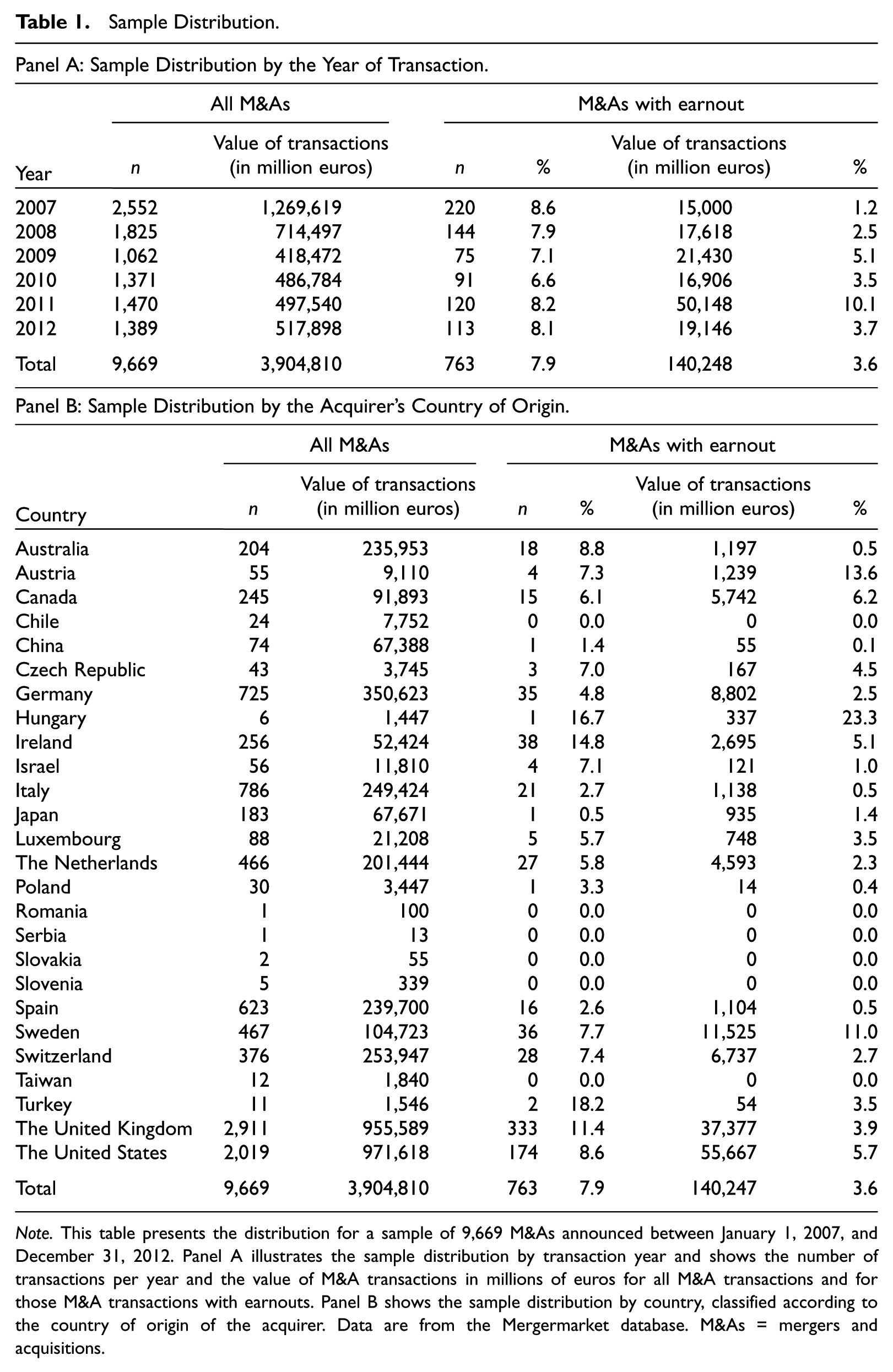
Note. This table presents the distribution for a sample of 9,669 M&As announced between January 1, 2007, and December 31, 2012. Panel A illustrates the sample distribution by transaction year and shows the number of transactions per year and the value of M&A transactions in millions of euros for all M&A transactions and for those M&A transactions with earnouts. Panel B shows the sample distribution by country, classified according to the country of origin of the acquirer. Data are from the Mergermarket database. M&As = mergers and acquisitions.
Table 2 presents earnout characteristics. Depending on the respective earnout characteristic, data are available for 542 to 643 of the 763 M&As including earnout agreements. On average, the maximum earnout value that could be paid to the sellers was 41.20 million euros (median 9.50 million euros). Defined as the maximum earnout value of the deal value, the mean earnout ratio of 29.3% (median 24.6%) shows that earnouts are economically important parts of M&A contracts. The last column reports the earnout period, which is the time period in which performance is measured after the deal has occurred. The mean earnout period is 2.04 years (median 2.00 years), indicating that earnout contracts typically span a total of 2 years. Table 2 also shows that earnout characteristics are similar across acquirers’ countries of origin. In particular, our analysis does not indicate that the pattern in the rate of earnout use, as shown in Panel B of Table 1, also translates into a similar pattern regarding the specific earnout characteristics.
Earnout Characteristics by the Country of Origin of the Acquirer.
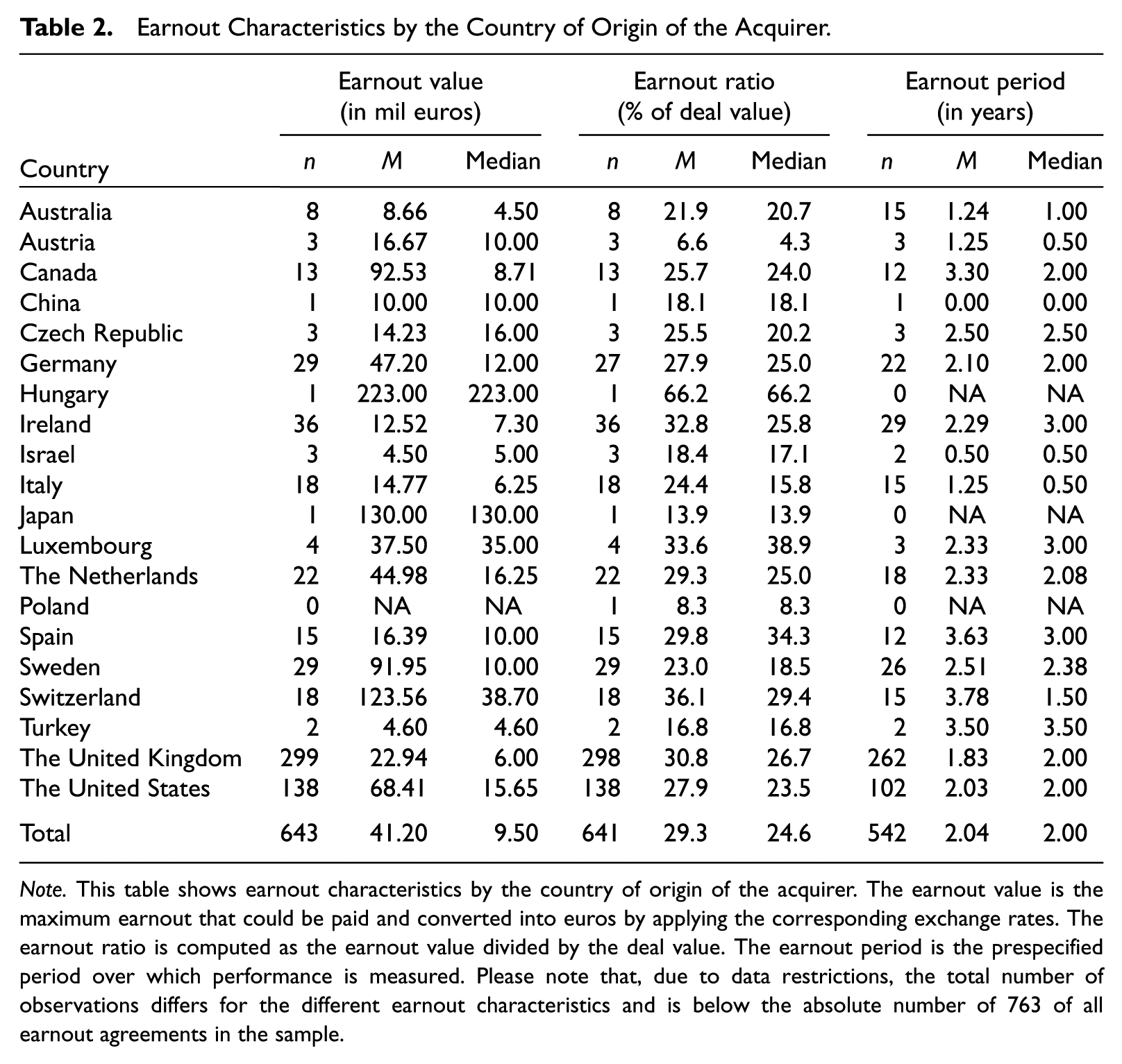
Note. This table shows earnout characteristics by the country of origin of the acquirer. The earnout value is the maximum earnout that could be paid and converted into euros by applying the corresponding exchange rates. The earnout ratio is computed as the earnout value divided by the deal value. The earnout period is the prespecified period over which performance is measured. Please note that, due to data restrictions, the total number of observations differs for the different earnout characteristics and is below the absolute number of 763 of all earnout agreements in the sample.
Research Design
As the dependent variable in our model is the dichotomous variable earnout use, we estimate a binomial logistic regression. As explained above, we determine for each transaction whether it includes an earnout, and we assign the value one to the variable Earnout if an earnout is involved and zero otherwise.
Our hypotheses predict that the acquirer’s cultural background is associated with earnout use. To test our hypotheses, we proxy for the acquirer’s cultural background based on five factors of Hofstede’s framework and use the values provided by Hofstede et al. (2010). 5 We thereby follow prior research, as Hofstede’s dimensions have become the standard tool for analyzing culture in business research (Kirkman, Lowe, & Gibson, 2006). In addition, most research applies Hofstede’s framework at the individual level, although Hofstede originally focused on cultural differences between countries (Kirkman et al., 2006; Oyserman, Coon, & Kemmelmeier, 2002). Our operationalization is further supported by Leung and Bond (1989), who provide evidence that individual-level cultural values are comparable with country-level cultural values. Finally, our design choice is consistent with the literature on the effects of culture on M&As, where Hofstede’s framework is a common tool (e.g., Chakrabarti et al., 2009; Frijns et al., 2013; Stahl & Voigt, 2008).
H1 predicts a positive association between earnout use and acquirer’s degree of individualism. To proxy for the variable Individualism Acq, we build on Hofstede et al. (2010) and measure the level of individualism for each acquirer according to the country of origin on a scale of 0 to 120, with 0 being extremely collectivistic and 120 being extremely individualistic.
H2 predicts a negative association between earnout use and the acquirer’s degree of power distance. The corresponding variable Power Distance Acq measures for each acquirer the power distance on a scale of 0 to 120, with 0 indicating an equal distribution of power and 120 indicating an extremely unequal distribution of power.
H3 predicts a positive association between earnout use and the acquirer’s degree of uncertainty avoidance. To test H3, we use Hofstede et al.’s (2010) scores for uncertainty avoidance for our variable Uncertainty Avoid Acq, again on a scale of 0 to 120. While 0 suggests that acquirers are extremely willing to take on uncertainty, a score of 120 indicates that acquirers feel extremely uncomfortable in uncertain situations.
H4 refers to the acquirer’s level of masculinity and predicts a positive association with earnout use. Data for the variable Masculinity Acq are again obtained from Hofstede et al. (2010) and measured on a scale from 0 to 120. A score of 0 indicates that the culture of the acquirer’s country of origin is extremely consensus oriented with a preference for cooperation, modesty, and solidarity, while 120 indicates an extremely strong desire to exert power.
Finally, H5 tests the effect of the acquirer’s level of long-term orientation on earnout use and predicts a negative association between the likelihood of including an earnout in the M&A contract and the acquirer’s degree of long-term orientation. Data for the variable LT Orientation Acq are obtained from Hofstede et al. (2010) and measured on a scale from 0 to 120.
We include control variables that potentially affect earnout use. First, we control for a number of characteristics at the target level. As target size affects the scope of publicly available information and thus information asymmetry (Datar et al., 2001), we add the variable Deal Value (source: Mergermarket) and use the natural logarithm in the regression analysis to consider the right-skewed distribution of the variable. Furthermore, we add the dummy variable Private Target to indicate whether the target is a private firm (1 = yes, 0 = no; source: Mergermarket) because private firms are associated with higher levels of information asymmetry (Barbopoulos & Sudarsanam, 2012; Cain et al., 2011). We also control for the level of uncertainty in the target firm’s operating environment (Cadman et al., 2014; Cain et al., 2011). To proxy for uncertainty in the target firm’s operating environment, we add the variable MSCI and use the monthly standard deviation of industry-level returns using the MSCI World Sector Indices and calculate it with a 3-month lag to account for negotiation time prior to closing (source: Thomson Reuters Datastream).
Second, we include control variables that capture acquirer characteristics. If acquirers follow a buy and build strategy and use a specific target to enter a market, then the target’s value is less important in the short term. Meanwhile, the possibility of reorganization is highly important, resulting in a lower likelihood of implementing an earnout. Therefore, we introduce the dummy variable Buy and Build to the literature on earnouts to control for the acquirer’s strategy; this variable is equal to 1 if the acquirer’s strategy is to buy and build and 0 otherwise (source: Mergermarket). Moreover, we control for whether the acquirer is a private equity company, which typically has a limited holding period of up to 8 years, potentially interfering with the earnout period. The variable Private Equity is equal to 1 if the acquirer is a private equity investor and 0 otherwise (source: Mergermarket). As prior research also provides evidence that management buyouts are less likely to implement earnouts (Datar et al., 2001), we add MBO to indicate whether a transaction is a management buyout (1 = yes, 0 = no; source: Mergermarket).
Third, consistent with prior research, we consider the level of information asymmetry arising from the acquirer–target relationship and add dummy variables to control for cross-border and cross-industry transactions (e.g., Datar et al., 2001; Kohers & Ang, 2000). The variable Cross-industry is equal to 1 if the acquirer and target operate in different industries and 0 otherwise (source: Mergermarket). The variable Cross-border is equal to 1 if the acquirer and target are located in different countries and 0 otherwise (source: Mergermarket).
Fourth, we control for the economic environment and its association to earnout use, which has been demonstrated for M&As in general (e.g., Yagil, 1996). For the real economy, we include the variable GDP, measured by the country-specific real economic growth rate in the year prior to the transaction (source: World Bank). To control for the financial economy and whether a transaction is conducted during a financial crisis, we add the variable Crisis because information asymmetry can be particularly high in a turbulent financial market environment. To determine the variable, we follow Mishkin and White (2002) and first analyze monthly returns for the major stock indices for each country (source: Thomson Reuters Datastream). Then, we analyze whether the monthly stock market was lower than –10% in one of the last 12 months and set the variable Crisis equal to 1 and 0 otherwise. Thus, we use a boundary of –10% because it equals the mean monthly return over the selected sample in September 2008, which is universally agreed to be a stock market crash, and capture the crisis aftermath by including the subsequent 12 months. Furthermore, we control for a target’s country-specific risks and include the variable Yield Spread. We follow Damodaran (2003) and measure Yield Spread as the difference between monthly government bond yields and a reference bond (source: Thomson Reuters Datastream).
Fifth, we control for a target’s institutional environment because earnout contracts are complex and incomplete and thus often subject to legal proceedings (Reuer et al., 2004). The variable Contract Enforcement refers to the efficiency of legal contract enforcement across countries (source: World Bank’s Doing Business Report). The variable refers to the time and money needed to collect a clear-cut debt, measured on a scale from 0 to 10, with 10 indicating the strongest enforcement. We also consider the strength of a country’s mechanisms to protect minority shareholders against the misuse of corporate assets by directors. Therefore, we include the variable Investor Protection (source: World Bank’s Doing Business Report), measured on a scale from 0 to 10, with 10 indicating the strongest protection. We also add the variable Formal Institute to control for a country’s overall quality of formal institutions. Thus, we follow Mihet’s (2013) approach and aggregate six of the World Bank’s Worldwide Governance Indicators (rule of law, control of corruption, regulatory quality, government effectiveness, voice and accountability, and political stability) by using factor analysis.
Sixth, we control for the cultural background of the seller because the seller’s cultural background can also impact the seller’s decision of whether to agree on an earnout. We also control for the cultural background of the target because target management is generally involved in the transaction process. 6 We use the approach for our variables of interest and measure the cultural background by the individualism (Individualism Tar; Individualism Sel), power distance (Power Distance Tar; Power Distance Sel), uncertainty avoidance (Uncertainty Avoid Tar; Uncertainty Avoid Sel), masculinity (Masculinity Tar; Masculinity Sel), and long-term orientation (LT orientation Tar; LT orientation Sel) of the target’s and seller’s countries of origin.
We estimate the following binomial logistic regression model, which also captures industry and time fixed effects. Details on the construction of the variables are summarized in Table OA II of the online appendix.
where
To check the robustness of our results, we estimate separate models for the economic control variables, all control variables, and the full model including the cultural factors. We estimate all models using the maximum likelihood estimation procedure with Huber–White estimators (Huber, 1967; White, 1980) clustered by the acquirer country to account for correlations of residuals across countries.
Panel A of Table 3 presents the descriptive statistics for the independent variables in our full model. 7 Panel B of Table 3 exhibits the Pearson and Spearman correlations between the independent variables in the full model.
Descriptive Statistics and Correlation Matrix for the Independent Variables.
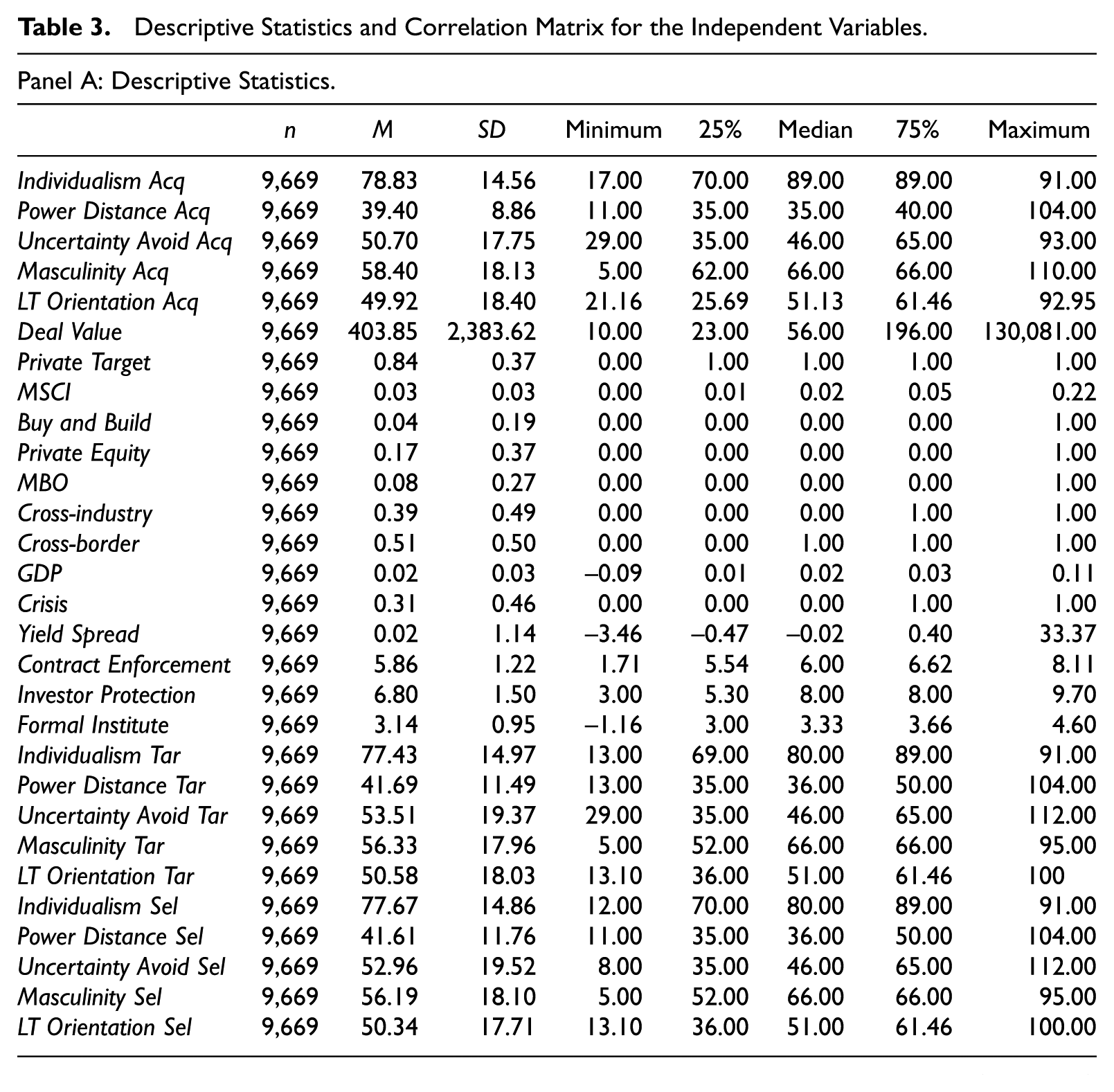
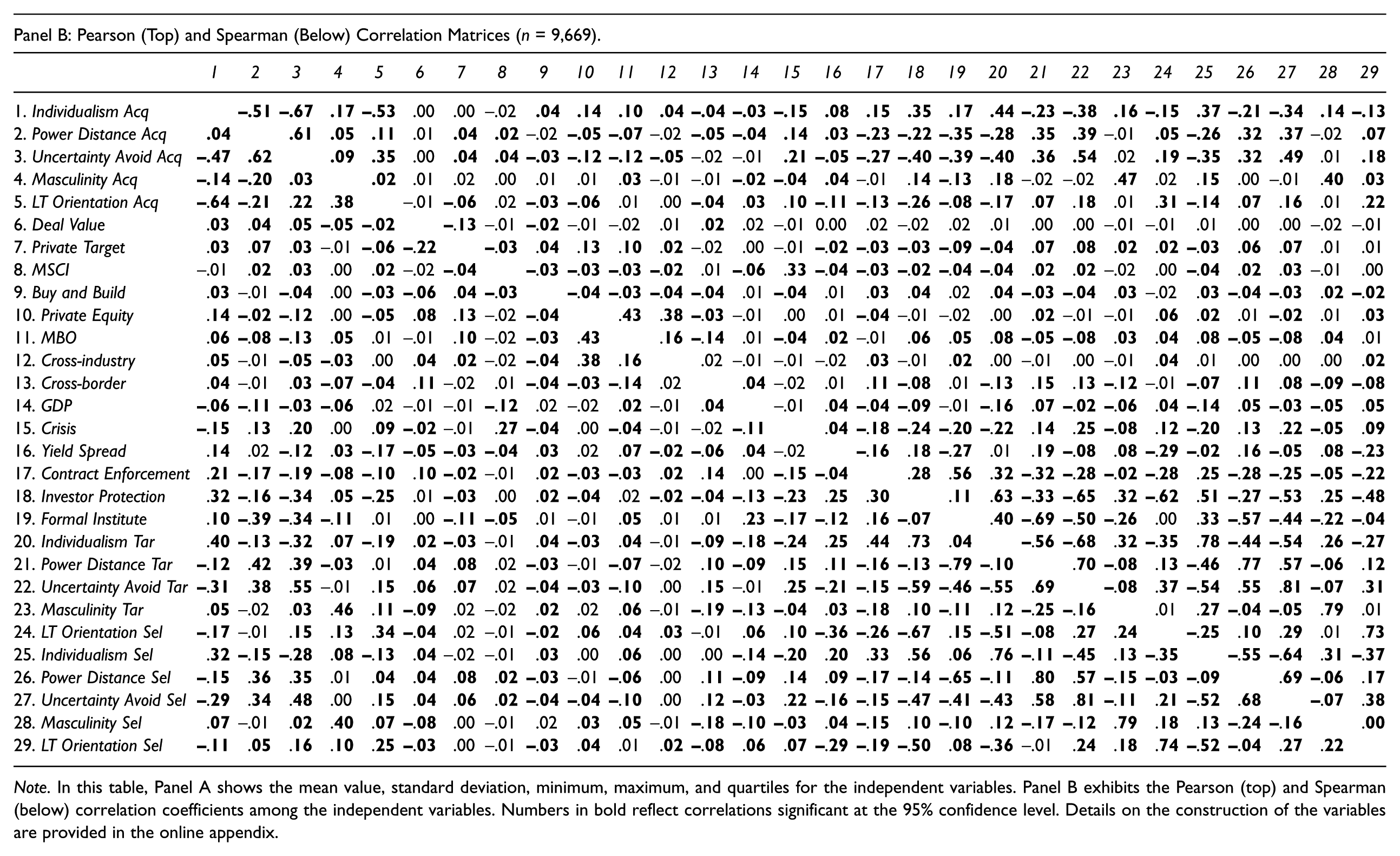
Note. In this table, Panel A shows the mean value, standard deviation, minimum, maximum, and quartiles for the independent variables. Panel B exhibits the Pearson (top) and Spearman (below) correlation coefficients among the independent variables. Numbers in bold reflect correlations significant at the 95% confidence level. Details on the construction of the variables are provided in the online appendix.
Results
Univariate Results
To test our hypotheses, we first conduct univariate tests. For the continuous variables, we use parametric t tests and Wilcoxon rank sum tests. For the categorical variables, we test for differences using the Pearson chi-square test. Panel A of Table 4 shows the results for the continuous variables, and Panel B of Table 4 the results for the categorical variables.
Univariate Results for the Continuous and Categorical Variables.
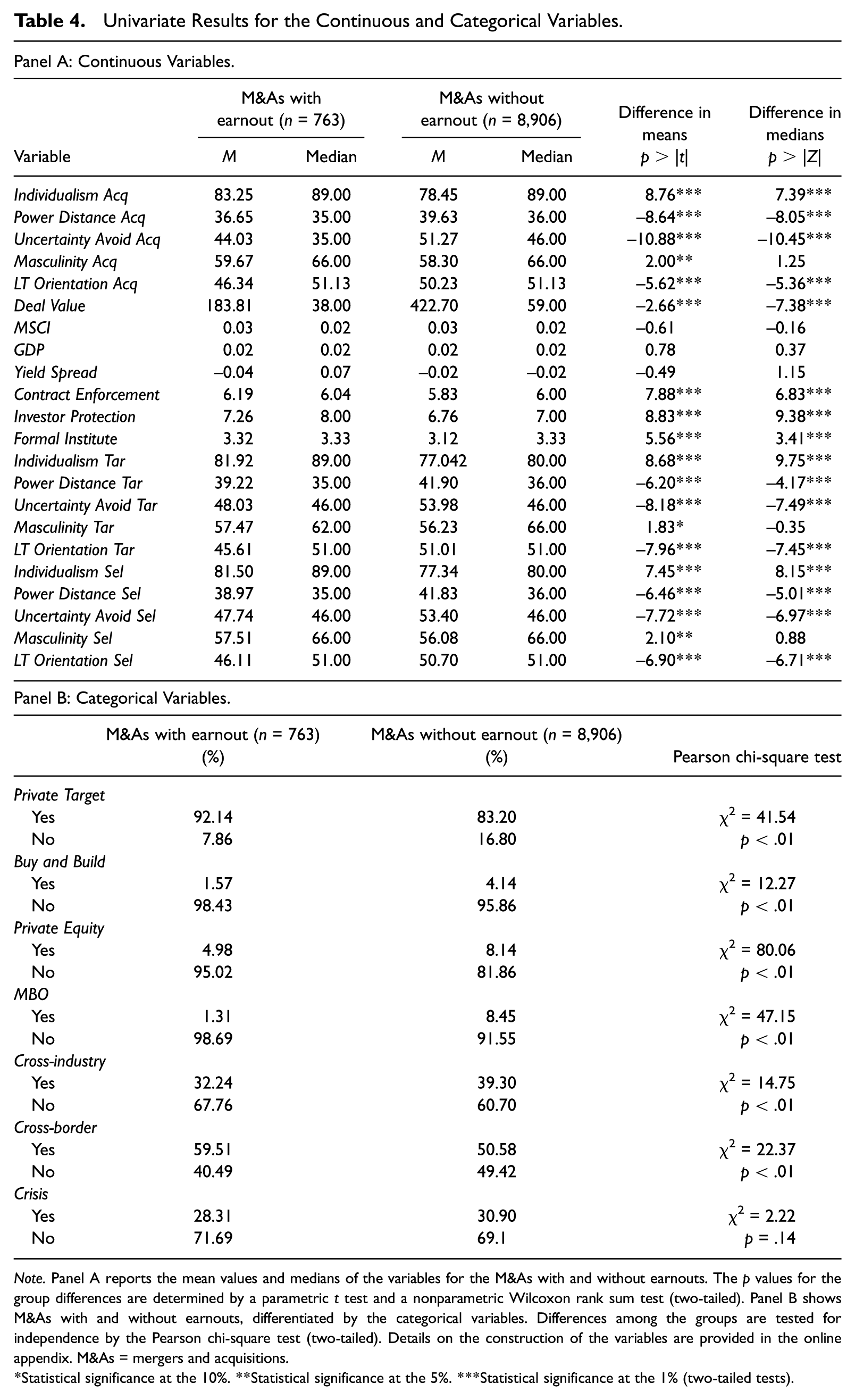
Note. Panel A reports the mean values and medians of the variables for the M&As with and without earnouts. The p values for the group differences are determined by a parametric t test and a nonparametric Wilcoxon rank sum test (two-tailed). Panel B shows M&As with and without earnouts, differentiated by the categorical variables. Differences among the groups are tested for independence by the Pearson chi-square test (two-tailed). Details on the construction of the variables are provided in the online appendix. M&As = mergers and acquisitions.
Statistical significance at the 10%. **Statistical significance at the 5%. ***Statistical significance at the 1% (two-tailed tests).
Consistent with H1, the individualism score (Individualism Acq) is significantly higher for M&As with earnouts than for M&As without earnouts (means: 83.25 vs. 78.45; medians: 89.00 vs. 89.00), with p < .01 in a two-tailed test for differences in both means and medians. The acquirer’s degree of power distance (Power Distance Acq) is lower for transactions with earnouts than for transactions without earnouts (means 36.65 vs. 39.63; medians: 35.00 vs. 36.00). This difference is statistically significant, with p < .01 in a two-tailed test for differences in both means and medians, and is consistent with H2. In contrast to H3, we find that the acquirer’s degree of uncertainty avoidance (Uncertainty Avoid Acq) is significantly lower for M&As including earnouts than for transactions without earnouts (means: 44.03 vs. 51.27; medians: 35.00 vs. 46.00), with p < .01 in a two-tailed test for differences in both means and medians. Regarding the acquirer’s degree of masculinity (Masculinity Acq), we find that the mean masculinity score is higher for M&As including earnouts than for M&As without earnouts (means: 59.67 vs. 58.30; medians: 66.00 vs. 66.00). However, only the difference in means is statistically significant (p < .05). Thus, we find weak support for H4. In line with our prediction for H5, the acquirer’s degree of long-term orientation (LT Orientation Acq) is significantly lower for M&As including earnouts than for M&As without earnouts (means: 46.34 vs. 50.23; medians: 51.13 vs. 51.13), with p < .01 in a two-tailed test for differences in both means and medians.
Multivariate Results
To control for possible interfering effects, we test our hypotheses in a multivariate context. Table 5 presents the respective results. Model 1 (2) shows the results for the configuration when all variables except the cultural factors (acquirer culture variables) are included. Model 3 displays the results for our full model. Overall, the chi-square values of the likelihood ratio tests indicate that the independent variables significantly separate M&As including earnouts from M&As without earnouts (p < .01 in all models). Furthermore, including the cultural variables for acquirers, sellers, and targets increases the explanatory power of the model (McFadden R2 in Model 1: .126; McFadden R2 in Model 2: .130; McFadden R2 in Model 3: .146). In the following, we focus on Model 3 because it includes our main variables of interest.
Multivariate Analysis.
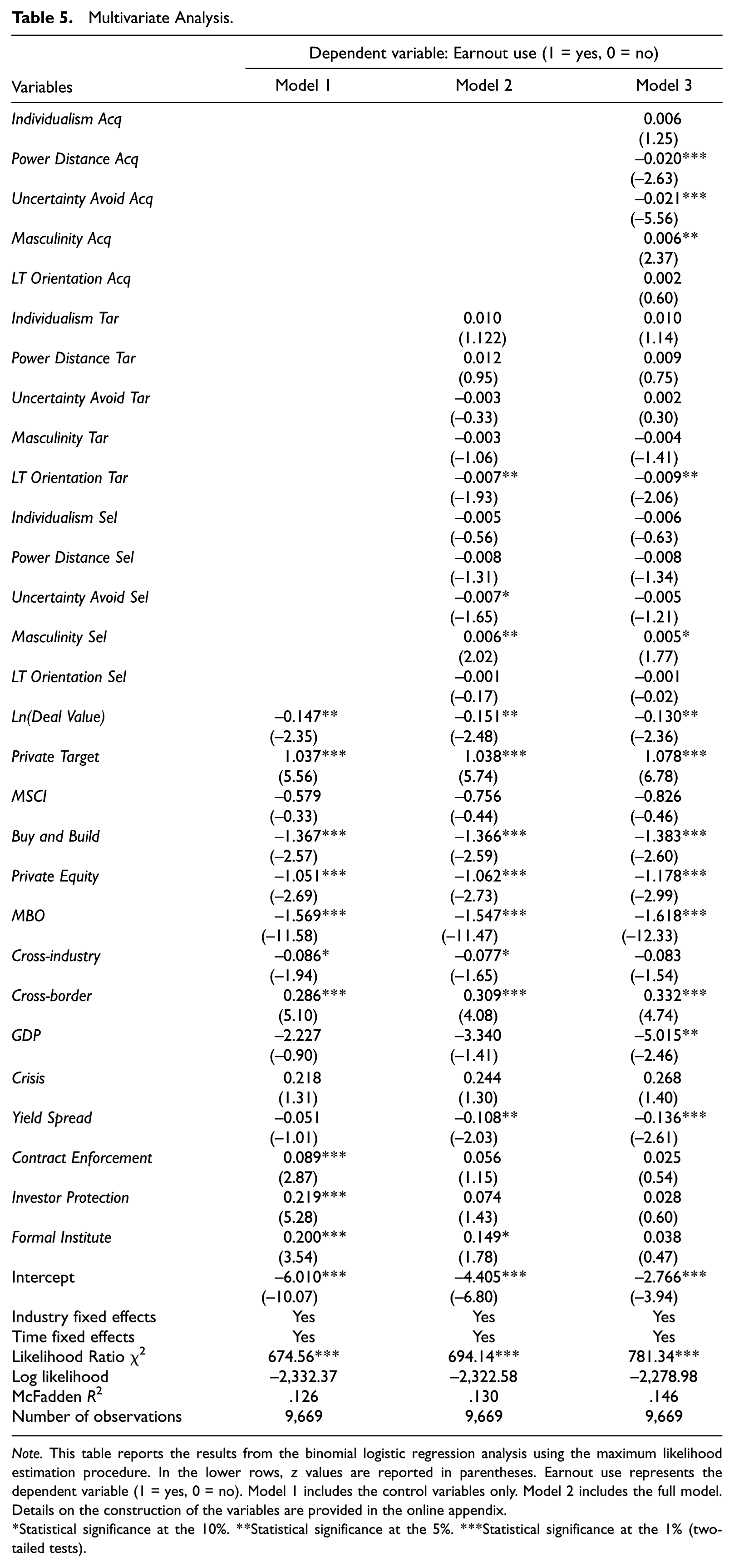
Note. This table reports the results from the binomial logistic regression analysis using the maximum likelihood estimation procedure. In the lower rows, z values are reported in parentheses. Earnout use represents the dependent variable (1 = yes, 0 = no). Model 1 includes the control variables only. Model 2 includes the full model. Details on the construction of the variables are provided in the online appendix.
Statistical significance at the 10%. **Statistical significance at the 5%. ***Statistical significance at the 1% (two-tailed tests).
Hypothesis 1 refers to the acquirer’s degree of individualism. The positive coefficient of Individualism Acq supports our prediction that acquirers from individualistic countries are more likely to use earnouts in M&As than acquirers from collectivistic countries are. However, the estimated coefficient of 0.006 is nonsignificant. Therefore, we do not find support for H1.
Consistent with H2, our results suggest that the likelihood of an earnout is highly significantly associated with the acquirer’s score on Hofstede’s power distance scale (p < .01). More precisely, the negative coefficient of –0.020 of Power Distance Acq suggests that acquirers from countries with a low power distance are more likely to implement earnouts in M&A contracts.
In contrast to our prediction for H3, we find that the likelihood of using an earnout is significantly negatively associated with the uncertainty avoidance score (estimated coefficient: –0.021; p < .01). A potential explanation relates to the problems associated with measuring cultural attributes and the possibility of noise in the Hofstede measure of uncertainty. Another potential explanation for the negative association relates to the contingent nature of earnouts. When an earnout is implemented, the final purchase price is uncertain for the acquirer by the time the deal is closed. In contrast, if no earnout is implemented, the acquirer knows the exact amount of lump-sum payment. Thus, an earnout evokes uncertainty about the overall transaction price, and this uncertainty is not resolved until the deferred payment is known. As acquirers from low uncertainty avoidance countries are more open to indeterminate outcomes than acquirers from high uncertainty avoidance countries, acquirers from low uncertainty avoidance countries may be more likely to use an earnout, if they focus on the certainty concerning the purchase price.
Focusing on H4, regarding masculinity, we find in line with H4 that the likelihood of using an earnout is significantly positively associated with the masculinity score (estimated coefficient 0.006; p < .05). Thus, earnouts are more likely when the acquirer is from a country where it is usual to exercise power in negotiations and where individuals tend to insist on their opinion. In contrast, firms tend to avoid earnout agreements when they are from consensus-oriented countries.
Finally, with regard to H5, the results do not support our prediction of a negative association between the acquirer’s degree of long-term orientation and the likelihood of implementing an earnout because we find neither a negative nor significant coefficient.
Turning to the control variables, we find that Deal Value is significantly negatively associated with the likelihood of using earnouts (p < .05), suggesting that earnouts are more likely when the target is small. Furthermore, our analysis shows that earnouts are significantly more likely (p < .01) for privately held targets (Private Target). Focusing on the acquirer’s characteristics, we document a significantly negative coefficient of Buy and Build (p < .01); hence, if the acquirer uses the target as a nucleus for a buy and build strategy, then the near-term development of the target’s value is less important for the acquirer. If the acquirer is a private equity fund (Private Equity), the coefficient is significantly negative (p < .01). Therefore, private equity funds appear to avoid earnouts, as they are experienced in valuing targets and wish to sell the target after a limited holding period. Moreover, the likelihood of using earnouts is lower for management buyouts (p < .01), as the acquirer is an insider and information asymmetry is low. In addition, we find a significantly positive coefficient for cross-border transactions (p < .01), suggesting that firms use earnouts to account for the high information asymmetry in cross-border acquisitions.
The macroeconomic control results indicate that earnouts are more likely to be included in M&A contracts during economic downturns according to the negative and significant coefficient of GDP (p < .05). As a proxy for the target’s country risk, the variable Yield Spread is significantly negatively associated with the likelihood of using earnouts (p < .01). Thus, the higher the risk premium for the target country, the less likely a transaction is to include an earnout.
Notably, the variables for the target’s institutional environment (Contract Enforcement, Investor Protection, and Formal Institute) all become nonsignificant when we control for cultural factors, even though they are all significant (p < .01) when we ignore the cultural factors (Model 1). As such, our results add to research that compares the relative importance of the institutional environment with culture (e.g., Stulz & Williamson, 2003) and suggest that culture is a better predictor of earnout use than the institutional environment is.
Finally, we find that Hofstede’s five cultural factors for the seller’s and target’s cultural background are nonsignificant, except for the negative coefficient (p < .05) of the target’s long-term orientation (LT Orientation Tar) and the positive coefficient (p < .10) of the seller’s masculinity (Masculinity Sel) on earnout use. These findings support our view that the acquirer’s cultural background is especially important when negotiating whether to integrate an earnout.
Sensitivity Analysis
We conduct additional tests to validate our results. First, we consider the specific structure of the data with a low number of 26 countries and a low frequency of earnouts. Second, we address potential concerns that our results are driven by the high percentage of observations from the United Kingdom and the United States.
First, we consider that our data are subject to the Moulton problem, which describes the methodological problem of connecting micro and macro data. In our sample, culture is determined at a country level (macro-level data), whereas acquisitions occur in organizations within this country (micro-level data), resulting in a limited asymptotic efficiency of the standard errors (Moulton, 1986). In addition, the low frequency of earnouts is problematic, as the probability of earnouts may be underestimated. Moreover, the included fixed effects and indicator variables bias the maximum likelihood estimation. To address these statistical concerns, we re-run the full model using ordinary least squares (OLS) and probit regressions as sensitivity analyses. Models 1 and 2 of Table OA III of the online appendix show that our results are robust and support our main inferences.
Second, our results are potentially driven by acquirers from the United Kingdom and the United States because these acquirers account for approximately half of our sample. Therefore, we run four different robustness checks by excluding (a) acquirers from the United Kingdom/United States, (b) sellers from the United Kingdom/United States, (c) targets from the United Kingdom/United States, and (d) all transactions in which at least the acquirer, the seller, or the target is located in the United Kingdom/United States. Models 3 to 6 of Table OA III of the online appendix show the respective results. In all models, we again find a negative association between earnout use and the acquirer’s level of power distance as well as uncertainty avoidance. Furthermore, we find support for a positive association between the acquirer’s degree of masculinity and earnout use in two of the robustness check models. Moreover, in line with H5, three of the robustness check models show a significantly negative association between the level of the acquirer’s long-term orientation and the likelihood of implementing earnouts in M&A contracts. Finally, the variables for the target’s institutional environment remain nonsignificant in all models, supporting our conclusion that culture is a better predictor of earnout use than the institutional environment.
Discussion and Conclusion
This article reports the results of an empirical study that addresses whether the acquirer’s cultural background influences the likelihood of using earnouts in M&As. We analyze whether the acquirer’s level of individualism, power distance, uncertainty avoidance, masculinity, and long-term orientation affect the likelihood of implementing earnouts. We investigate our research question using a sample of 9,669 M&As (from 2007 to 2012) by acquirers from 26 countries and find that earnout use in M&A contracts is associated with the acquirer’s cultural background. More precisely, we find that earnout use is significantly negatively associated with the acquirer’s power distance and uncertainty avoidance scores. Furthermore, we document a significantly positive association with masculinity.
We contribute to the literature on earnouts and more generally to the literature on contract design in M&As. Specifically, our study extends prior research on factors influencing the use of earnouts. While prior work primarily indicates that earnouts help acquirers to reduce problems associated with information asymmetry, we provide evidence that the acquirer’s cultural background is an important determinant of earnout use. Furthermore, our results underline the importance of considering culture during M&A negotiations, as we demonstrate that informal institutions, such as the acquirer’s cultural background, are important for M&A decision-making processes. We also provide evidence that the acquirer’s cultural background predicts earnout use better than the target’s institutional environment does. Finally, the inclusion of extensive control variables demonstrates the robustness of our results.
Our study results have several implications for M&A negotiations. Generally, our study informs acquirers and sellers about the importance of cultural factors in M&A negotiations. Specifically, our results suggest that the cultural background of the acquirer is important for earnout use. Thus, our results imply that sellers should consider cultural facets when trying to understand the bidder’s negotiation strategy. Moreover, competing bidders should consider the cultural background of other interested parties to understand their bidding strategy.
This study is subject to limitations. First, Hofstede’s model has been criticized for its use in cross-cultural research, for example, because Hofstede’s scores are based on work-related values and a limited number of cultural dimensions. However, Hofstede’s values have been replicated (e.g., Merkin, 2006) and used in many research studies (e.g., Alzeban, 2015; Chui et al., 2010). Second, our sample is based on transactions included in the Mergermarket database. Using secondary data on M&As suggests that not all earnout agreements are displayed in the Mergermarket database because earnout contracts are privately negotiated between the contracting parties and usually do not need to be disclosed to the public. Manual examination could result in further bias in the sample if deals were analyzed incorrectly, even though we analyzed each deal twice. Finally, our data may have a selection bias with respect to the level of uncertainty avoidance because research on M&As shows that firms also cancel international investments to avoid deals with a high level of information asymmetry or that they prefer to engage in less commitment-intensive deals, such as joint ventures (e.g., Reuer & Koza, 2000). Thus, acquirers from high uncertainty avoidance countries could completely resign from risky deals, which could bias our sample.
Supplemental Material
Online_appendix – Supplemental material for Acquirers’ Cultural Background and the Use of Earnouts
Supplemental material, Online_appendix for Acquirers’ Cultural Background and the Use of Earnouts by Corinna Ewelt-Knauer, Johannes Gefken, Thorsten Knauer and David Wiedemann in Journal of Accounting, Auditing & Finance
Footnotes
Acknowledgements
The authors gratefully acknowledge helpful comments and suggestions by Bharat Sarath, the Editor in Chief; Naomi Soderstrom, the Associate Editor; and an anonymous reviewer.
Declaration of Conflicting Interests
The author(s) declared no potential conflicts of interest with respect to the research, authorship, and/or publication of this article.
Funding
The author(s) received no financial support for the research, authorship, and/or publication of this article.
Notes
References
Supplementary Material
Please find the following supplemental material available below.
For Open Access articles published under a Creative Commons License, all supplemental material carries the same license as the article it is associated with.
For non-Open Access articles published, all supplemental material carries a non-exclusive license, and permission requests for re-use of supplemental material or any part of supplemental material shall be sent directly to the copyright owner as specified in the copyright notice associated with the article.
