







Abstract
Although there is a vast literature on employee reactions to procedural injustice, little is known about the important issue of why some managers are less procedurally just than others. In this field study we found that a manager’s implicit person theory (IPT; i.e., extent of assumption that people can change) predicted employees’ perceptions of the procedural justice with which their last performance appraisal was conducted. These procedural justice perceptions in turn predicted employees’ organizational citizenship behavior, as partially mediated by their organizational commitment. This research provides an initial empirical basis for a new line of inquiry that extends existing IPT theory into the realm of perceptual, attitudinal, and behavioral responses to people as a function of their IPT. Other contributions to the IPT, performance appraisal, and procedural justice literatures are discussed.
One important function of performance appraisals is to encourage and guide improved employee performance (Latham & Wexley, 1994). If performance appraisals are perceived as unfair, however, they can diminish rather than enhance employee attitudes and performance (Kay, Meyer, & French, 1965; Latham & Mann, 2006). Specifically, perceptions of procedural unfairness can adversely affect employees’ organizational commitment, job satisfaction, trust in management, and performance (Colquitt, Conlon, Wesson, Porter, & Ng, 2001), as well as their work-related stress (Judge & Colquitt, 2004), organizational citizenship behavior (OCB; Organ, Podsakoff, & Mackenzie, 2006), theft (Greenberg, 2001), and inclination to litigate against their employer (Werner & Bolino, 1997).
In contrast to the voluminous literature on the many significant consequences of procedural (in)justice, there is a paucity of theory and research regarding the attributes of managers associated with their perceived procedural (in)justice. Given that unfair performance appraisals can be so damaging, it is imperative to more fully understand why some managers are still so ineffective in conducting the appraisal process. The need to address this aspect of the literature is underscored by Colquitt and Greenberg’s (2003) observation that:
The justice literature has all but ignored what causes leaders to act fairly. Specifically, we know very little about personality differences between fair and unfair leaders. Examining such questions would bring more balance to a literature that has virtually ignored the actor who creates fairness, in favor of the observer who reacts to it. (p. 197)
We take up this important though understudied issue by investigating whether managers’ procedural justice is predicted by their implicit person theory (IPT), that is, the manager’s assumptions about the malleability of the personal attributes (e.g., ability and personality) that guide human behavior (Dweck, 1999; Dweck, Chiu, & Hong, 1995). A prototypical entity implicit person theory assumes that such personal attributes are largely a fixed entity, while an incremental implicit person theory assumes that such personal attributes are relatively malleable and can be developed over time (Dweck et al., 1995).
We chose to examine the role of managers’ IPTs in their perceived procedural justice for two reasons. First, clear conceptual links can be drawn between what is known about how IPT influences the way that managers act toward their employees (Dweck, 1999; Heslin & VandeWalle, 2008) and the factors that drive employee perceptions of procedural injustice (Colquitt, 2001; Leventhal, 1980). Second, although IPT has been conceptualized (Dweck et al., 1995) and shown (Robins & Pals, 2002) to be a relatively stable disposition, there is also evidence that it can be modified with a compelling, self persuasion-based intervention (Aronson, Fried, & Good, 2002; Heslin, Latham, & VandeWalle, 2005). This potential for intervention makes IPT a promising candidate for addressing the proactive justice research agenda (Greenberg & Wiethoff, 2001) of striving to improve procedural justice.
Contributions and Overview
The present study contributes to the IPT literature (cf. Dweck, 1999; Heslin & VandeWalle, 2008) a new line of inquiry regarding the basic issue of whether a person’s IPT affects how they are perceived by others, focusing specifically on employee perceptions of procedural justice that often have organizationally significant affective (e.g., organizational commitment) and behavioral (e.g., OCB) consequences (Colquitt et al., 2001; Organ et al., 2006). In doing so, this research addresses the call by justice scholars (e.g., Colquitt & Greenberg, 2003; Folger & Skarlicki, 2001; Gilliland & Schepers, 2003; Mayer, Nishii, Schneider, & Goldstein, 2007) for new, conceptually derived accounts of why some managers are less procedurally just than others. This study thus paves the way for more theoretically grounded and targeted approaches to selecting managers who are likely to be viewed as procedurally just, to identifying managers most in need of procedure justice training, and for potentially increasing the effectiveness of that training. The practical significance of this research on managers’ perceived procedural justice is highlighted by the fact that managers can either amplify or diminish the shortcomings, and thus negative impact, of any procedural injustice within organizational policies and procedures (Naumann & Bennett, 2000; Roberson & Colquitt, 2005); as Colquitt (2006) observed, “A good leader can bolster a bad policy, (while) a bad leader can harm a good policy.”
We first summarize the literature on modeling and enhancing the perceived procedural justice of the performance appraisals that managers provide, which we note is underspecified insofar as it largely neglects the potential role of managers’ dispositions in determining their need for justice training. We next discuss the nature and behavioral manifestations of IPT, and then outline the basis for the proposed relationship between managers’ IPTs and their perceived procedural justice.
Performance Appraisal Procedural Justice
Procedural justice refers to the perceived fairness of the procedures used to make decisions (Colquitt & Greenberg, 2003; Thibaut & Walker, 1975). One defining element of procedural justice is providing individuals with voice in making decisions that affect them (Thibaut & Walker, 1975). Leventhal (1980) proposed that fair procedures also include, for instance, bias suppression rather than decisions based on preconceptions; accuracy in terms of reflecting all available, relevant information; and correctability in light of employee input. In the context of performance appraisals, procedural justice pertains to the apparent fairness of the procedures by which an individual’s performance is evaluated (Greenberg, 1986).
The strong employee reactions to perceived procedural injustices outlined in the opening paragraph, especially in the highly socioemotionally and economically salient context of performance evaluations (Murphy & Cleveland, 1995), has inspired theory and interventions aimed at improving the procedural fairness with which performance appraisals are conducted in organizations. In a pioneering study, Greenberg (1987) reasoned and showed that a manager keeping detailed records facilitates the extent to which employees perceive that their performance appraisals accurately reflect their actual work behaviors.
Folger, Konovsky, and Cropanzano (1992) developed a seminal, comprehensive three-stage due process model for conducting a fair performance appraisal. According to this model, employees need to first receive adequate notice of performance standards, as well as regular, timely performance feedback. Second, a fair hearing entails supervisors presenting—based on sufficiently frequent observations of an individual’s work or work product—a tentative performance assessment, which employees are encouraged to complement with their input and challenge it if they perceive it to be unfair. Finally, due process evaluations are judgments based on evidence about an employee’s actual performance, rather than being biased by factors such as personal prejudices.
Empirical support has been provided for Folger et al.’s (1992) due process model. Specifically, a field experiment by Taylor et al. (1995) examined employee reactions to a performance appraisal system delivered in accordance with Folger et al.’s due process principles. Taylor et al. observed that even though the employees assigned to the due process condition received lower performance evaluations than those in the control condition, they nonetheless displayed more favorable reactions—specifically, to the perceived system fairness, appraisal accuracy, attitudes toward the system, evaluations of managers, and intentions to remain with the organization. Several subsequent studies (e.g., Cole & Latham, 1997; Greenberg, 2001; Skarlicki & Latham, 1996, 1997) have also demonstrated that methods such as explaining procedural justice principles, followed by activities including facilitated case analyses and role-plays, can improve managers’ procedural justice.
In contrast to this substantial stream of research, as well as the emerging literature on individual differences in employees’ procedural justice sensitivity (e.g., Colquitt, Scott, Judge, & Shaw, 2006; Kamdar, McAllister, & Turban, 2006; Scott & Colquitt, 2007), only one published study has examined the dispositional characteristics of managers that are associated with their perceived procedural justice. Specifically, Mayer et al. (2007) examined whether leader personality, operationalized using the five-factor model (FFM) of personality, predicts the organizational justice climate within leaders’ departments. They found that managers’ Agreeableness and Conscientiousness positively predicted, while Neuroticism negatively predicted, procedural justice climate. On observing that the observed effects are “relatively small,” however, Mayer et al. (2007: 954) noted that “the broad dimensions of the FFM may not be the most useful individual differences to examine when studying organizational justice” and recommended that future studies examine the role of dispositions other than those comprising the FFM. In accordance with this suggestion, we next outline the nature of implicit person theory (IPT), followed by theory and research pertaining to why we believe managers’ IPTs might influence the degree of procedural justice they are perceived as exhibiting.
Implicit Person Theory
Implicit theories are the assumptions that individuals hold about the plasticity of personal attributes, such as ability and personality. An entity implicit person theory involves assuming that the personal attributes that influence human behavior (e.g., ability and personality) are largely fixed and thus not likely to change much over time. By contrast, an incremental implicit person theory reflects the assumption that such personal attributes are relatively malleable and able to be developed 1 (Dweck, 1999; Dweck et al., 1995). A range of studies have established that most people readily endorse either an entity or incremental theory, each theory occurs with roughly equal frequency, and neither implicit theory is empirically related to people’s ability level, education, or cognitive complexity (Dweck & Molden, 2008).
Dweck et al. (1995: 279) conceptualized implicit theories as “relatively stable but malleable personal qualities, rather than as fixed dispositions.” The temporal consistency of implicit theories is illustrated by a test-retest corrected correlation of r = .64 across a 3-year period (Robins & Pals, 2002). However, studies showing that implicit theories can be temporarily induced by achievement attributions (Dweck & Leggett, 1988; Heyman, 2008), task framing (Wood & Bandura, 1989) and “scientific” testimonials (Chiu et al., 1997; Levy, Stroessner, & Dweck, 1998) highlight the potential malleability of implicit theories. Although entity implicit theories are more readily induced than incremental implicit theories (Tabernero & Wood, 1999), interventions that simultaneously employ multiple principles of self-persuasion (e.g., counterattitudinal idea generation, advocacy, and cognitive dissonance induction; cf. Aronson, 1999) have been shown to evoke changes in implicit theories and behavior that endure over periods of 6 weeks (Heslin et al., 2005) and 9 weeks (Aronson et al., 2002). Implicit theories are thus fairly stable, though still amenable to be altered by “a compelling or continuing message” (Dweck, 1999: 133). 2
In their seminal contribution to the educational and social psychology literature, Dweck and Leggett (1988) theorized that implicit theories create a framework for interpreting and responding to the events that an individual experiences. An incremental implicit theory about the plasticity of ability is associated with constructive self-regulatory activities such as adopting learning goals (Dweck & Leggett, 1988; Robins & Pals, 2002), voluntarily undertaking needed remedial education (Hong, Chiu, Dweck, Lin, & Wan, 1999), maintaining self-efficacy and persisting following setbacks, and subsequently exhibiting high performance on complex decision-making tasks (Tabernero & Wood, 1999; Wood & Bandura, 1989).
Beyond this initial stream of research on how implicit theories affect self-regulation, Dweck et al. (1995) theorized that implicit theories are likely to also influence interpersonal judgments and reactions to others. Three avenues stemming from this line of IPT theory and research—pertaining to how peoples’ IPTs affect their judgments of others, their willingness to develop others, and their inclination to seek others’ input—provide the foundation for our investigation into whether managers’ IPTs are related to the perceived procedural (in)justice of the performance appraisals they provide.
Implicit Person Theory and Judgments of Others
As noted earlier, performance appraisals need to be based on up-to-date, unbiased information about employee performance in order to be perceived as procedurally just (Latham & Mann, 2006). Erdley and Dweck (1993) theorized and found that compared with incremental theorists, 3 entity theorists hold rigid initial impressions of other people and construe these impressions as prognostic of others’ future behavior. Hong, Chiu, Dweck, and Sacks (1997) reported that entity theorists attached much stronger evaluative labels (e.g., “competent” or “incompetent”) to other people, such as a trainee pilot, based on minimal data about his or her test score performance. Dweck (1999) theorized that entity theorists’ deeply encoded evaluative labels of others could function as an anchor that is resistant to change. In a series of four studies, Heslin et al. (2005) found that compared to the initial employee behavior that managers had observed, the extent to which they held an incremental IPT positively predicted their recognition of both improved and diminished employee performance. Relative to those holding a prototypical entity IPT, incremental theorists’ performance appraisals were not as strongly anchored by their prior impressions, thereby enabling appraisal judgments that are more correctable, as well as being a more accurate and unbiased reflection of actual employee performance.
Implicit Person Theory and Providing Developmental Assistance
For performance appraisals to be seen as procedurally just, performance requirements need to have been clarified and employees provided with coaching to address performance deficiencies (Skarlicki & Latham, 2005). A second stream of IPT research has been guided by Dweck et al.’s (1995) theory that entity theorists’ belief that human attributes are innate and unalterable makes them disinclined to invest in developmental initiatives, such as clarifying standards and providing information to help others improve. Empirical support for this proposition includes evidence that compared with those holding an entity theory, subscribing to an incremental IPT predicts students wanting to counsel rather than punish wrongdoers (Chiu, Dweck, Tong, & Fu, 1997; Gervey, Chiu, Hong, & Dweck, 1999), as well as providing a struggling fellow student with more extensive and helpful suggestions about precisely what that person should do to improve (Heyman & Dweck, 1998). Two subsequent longitudinal field studies by Heslin, VandeWalle, and Latham (2006) extended Dweck’s research from an educational to an organizational context. Heslin et al. found that managers’ incrementalism positively predicted employee reports of the extent to which their manager illuminated performance standards with developmental feedback and coaching. Levine and Ames (2006) similarly reported that relative to incremental theorists, entity theorists had less intent to provide coaching to remedy a critical weakness. Levine and Ames also found that compared to incremental theorists, entity theorists participating in a multirater feedback process gave less and lower quality developmental input to clarify performance standards and how these standards could be attained.
Implicit Person Theory and Seeking Input
Another hallmark of procedural justice is providing employees with voice by actively seeking their input and feedback on their performance appraisal (Thibaut & Walker, 1975). IPT research has explored the relationship between IPT and feedback seeking. Feedback cues can trigger ego concerns that lead to dysfunctional self-regulation (Kluger & DeNisi, 1996). Entity theorists are particularly inclined to see their competence and worth as being on-the-line when faced with challenging or difficult situations, making them disinclined to seek feedback (Dweck, 1999, 2006). In contrast, Dweck argued that the implicit belief that human attributes can be developed leads incremental theorists to be relatively more task-focused and willing to risk drawing negative judgments of themselves, in order to improve their performance. A field study by Heslin and VandeWalle (2005) reported that holding an incremental IPT positively predicted managers’ seeking disconfirmatory input from employees—a critical behavior for providing employees with voice in their performance appraisal process to help ensure that the evaluation is based on accurate information. Sensing that one’s voice has been heard is a strong predictor of the perceived fairness of performance appraisal processes (Cawley, Keeping, & Levy, 1998).
Overall, based on the range of typical behavioral manifestations of an incremental IPT, we theorize that managers’ incrementalism will positively predict employee perceptions of their procedural justice. In turn, employees’ perceptions of their manager’s procedural justice are important insofar as they are antecedents of organizationally significant outcomes such as organizational commitment and OCB.
Summary of Rationale for Hypotheses
The three lines of IPT research just reviewed show that holding the incremental assumption that people can change appears to foster the kinds of managerial behavior that tend to result in employee perceptions of procedural justice. 4 These include providing relatively unbiased, correctable, and accurate performance appraisals (Erdley & Dweck, 1993; Heslin et al., 2005; Hong et al., 1997), coaching to provide adequate notice of performance standards and how they can be attained (Chiu et al., 1997; Gervey et al., 1999; Heslin et al., 2006; Heyman & Dweck, 1998; Levine & Ames, 2006), as well as seeking input from others (Dweck, 1999, 2006; Heslin & VandeWalle, 2005) thereby providing employees with voice. Nonetheless, leader behavioral dispositions do not necessarily translate into followers’ perceptual, attitudinal, and behavioral responses to leaders (Yukl, 2002). Thus, it remains an unexplored empirical question whether managers’ IPTs are associated with their procedural justice, which employees tend to reciprocate (Blau, 1964) with positive attitudes (e.g., organizational commitment; Colquitt et al., 2001) and behaviors (e.g., OCB; Organ et al., 2006).
Hypothesis 1: Managers’ IPTs predict their procedural justice, such that managers’ incrementalism is positively associated with employees’ perceptions of managers as having provided a procedurally just performance appraisal.
A well-replicated theme in the justice literature is that the behavioral outcomes of procedural justice (e.g., OCB) tend to be partially mediated by attitudinal outcomes (e.g., organizational commitment; Moorman & Byrne, 2005; Organ et al., 2006). To examine whether the proposed association between IPT and procedural justice exists within the context of the nomological network of established justice relationships, we also tested the following hypothesis:
Hypothesis 2: Employee perceptions of procedural justice predict their OCB, partially mediated by their organizational commitment.
Overview of Study Design
We collected data from two sources: managers and their employees. The employees in this study invited the manager who performed their most recent performance appraisal to complete a confidential online survey of (a) the manager’s IPT, as well as (b) his or her assessment of the OCB exhibited by the employee who invited them to complete this survey. Employees completed assessments of the procedural justice with which their manager conducted their last performance appraisal, as well as their personal organizational commitment and OCB. This enabled analysis of employees’ perceptions of procedural justice, as well as their organizational commitment and OCB, as a function of their managers’ IPT. Also, as perceptions of procedural justice can be contingent on the perceived distributive justice of the outcomes individuals have received (Brockner & Wiesenfeld, 1996), distributive justice was included as a control variable.
We contemplated collecting employee ratings of the managerial behaviors theorized to link managers’ IPTs and their perceived procedural justice, such as managers providing accurate, unbiased, and correctable performance appraisals and clarifying performance standards through coaching. Adoption of such behavioral measures would have been redundant, however, because of their clear overlap with employee perceptions of the extent to which managers provided accurate, correctable appraisals based on unbiased information and elucidated performance standards, which are key defining characteristics of a procedurally just performance appraisal (Colquitt, 2001; Folger et al., 1992; Greenberg, 1986, 1987; Leventhal, 1980; Skarlicki & Latham, 1996, 1997, 2005). To avoid this foreseeable conceptual and methodological redundancy—and consistent with other research assessing perceptions of managers directly as a function of their personal dispositions without measuring behavioral indicators of those dispositions (e.g., Judge, LePine, & Rich, 2006; Mayer et al., 2007; Ng, Ang, & Chan, 2008)—we investigated the direct relationship between managers’ IPT and employees’ perceptions of the procedural justice of their most recent performance appraisal.
Method
Participants
The employees in the present study were 105 out of 111 working professionals enrolled in a part-time, 7-week evening MBA module on Organizational Behavior at a private, southwestern U.S. university. Their mean age was 28.9 years (SD = 5.2) and average work experience was 4.8 years (SD = 4.8). The employees were offered the opportunity to contribute to a class project and to earn modest extra course credit if they participated in this study. A total of 92 managers of the employees—with an average age of 42.9 years (SD = 7.8), an average work experience of 20.6 years (SD = 8.3), and 9.6 years (SD = 7.4) of management experience—chose to participate in the study. Our analyses were thus based on data for 92 matched manager–employee dyads.
Measures
Implicit person theory
We assessed IPT using the 8-item domain-general kind-of-person measure developed by Levy and Dweck (1997) that gauges implicit beliefs about the malleability of the personal attributes that underlie people’s behavior. We used this measure based on evidence that it predicts social judgments and behaviors directed toward others such as ethnic minorities (Levy et al., 1998), people who are homosexual (Bastian & Haslam, 2006), immigrants (Bastian & Haslam, 2008), and employees (Heslin et al., 2005; Heslin et al., 2006).
This scale has four items that assess incremental beliefs and four items that assess entity beliefs. A sample incremental belief item is “People can substantially change the kind of person they are.” A sample entity belief item is “Everyone is a certain kind of person, and there is not much they can really change about that.” This scale has been reported to yield data with test–retest reliability of .82 over a 1-week period and .71 over a 4-week period (Levy & Dweck, 1997), as well as high internal consistency (α = .93; Levy et al., 1998). For a comprehensive analysis of how responses to this scale are (generally not significantly) related to other constructs, such as general mental ability, attributional complexity, need to evaluate, self-esteem, and personal need for structure, see Dweck et al. (1995) and Levy et al. (1998).
Participants rated each item on a 6-point Likert-type scale with the anchors 1 (strongly disagree) to 6 (strongly agree). Consistent with Levy et al. (1998) and Heslin et al. (2005, 2006), we reverse-scored responses to the entity-worded items and calculated a mean IPT score for each manager, such that high scores represent an incremental IPT. Reverse scoring the entity items to produce a single scale is based on the evidence regarding the unitary nature of incremental and entity beliefs (Chiu et al., 1997; cf, Dweck, 1999), as well as Tabernero and Wood’s (1999: 125) observation that unlike more complex constructs such as goal orientations, implicit theories reflect “a simple belief about plasticity or fixedness . . . that has a complex set of effects.” The alphas for all measures are listed in Table 1.
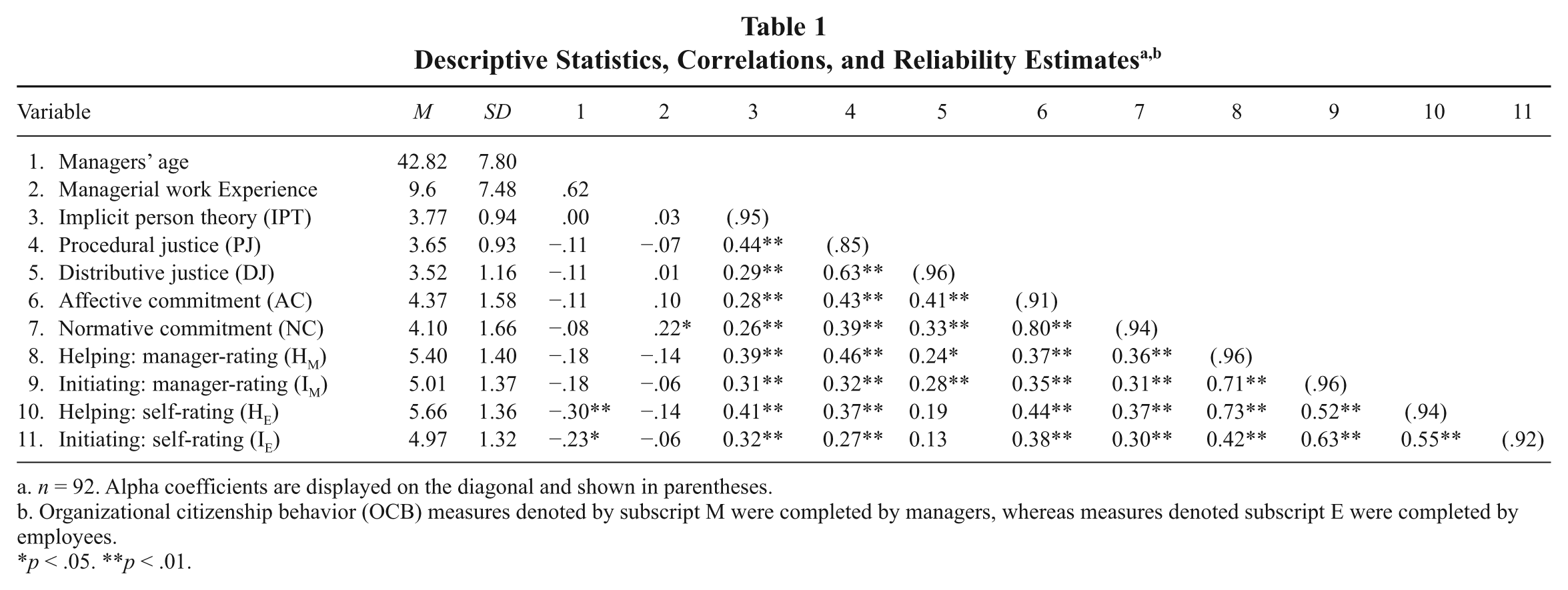
n = 92. Alpha coefficients are displayed on the diagonal and shown in parentheses.
Organizational citizenship behavior (OCB) measures denoted by subscript M were completed by managers, whereas measures denoted subscript E were completed by employees.
p < .05. **p < .01.
Procedural justice
Greenberg (2001) advises that organizational justice measures be tailored to study conditions. To assess procedural justice, we adapted the five conceptually relevant procedural justice items (i.e., those pertaining to bias, correctability, consistency, voice, and accurate information) developed by Colquitt (2001), so that they pertained to the perceived procedural justice of performance appraisals. 5 With regard to the process that the employees’ manager used to conduct their most recent performance appraisal, employees responded to items such as, “Was the procedure based on accurate information?” and “Were you able to question the performance appraisal arrived at by the process?” The employees responded using a Likert-type scale with anchors from 1 (to a small extent) to 5 (to a large extent).
Distributive justice
We assessed distributive justice using Colquitt’s (2001) 4-item measure. Again, we tailored the items to ask employees about the outcome of their most recent performance appraisal. Sample items include the following: “Does the performance appraisal you received reflect the effort you have put into your work?” and “Was your performance appraisal justified, given your performance?” Participants responded using a Likert-type scale with anchors from 1 (to a small extent) to 5 (to a large extent).
Organizational commitment
Because procedural justice often affects social exchanges (Blau, 1964), Colquitt, Greenberg, and Scott (2005: 603) identified affective and normative commitment as among the justice mediators “most worthy of study.” We thus assessed these two facets of organizational commitment with the widely adopted commitment subscales developed and validated by Meyer, Allen, and Smith (1993). The affective commitment scale has six items that ask respondents to indicate the extent of their agreement with statements such as, “I would be very happy to spend the rest of my career with this organization” and “This organization has a great deal of personal meaning for me.” Meyer et al.’s 5-item normative commitment subscale includes items such as: “I would not leave my organization right now because I have a sense of obligation to the people in it,” and “I owe a great deal to my organization.” Participants responded to both scales using a Likert-type scale with the anchors 1 (strongly disagree) and 7 (strongly agree).
Organizational citizenship behavior
Organ (1997) discusses how the two major dimensions of OCB are discretionary efforts directed at either (a) providing assistance to other people or (b) improving one’s task performance or the organization’s performance. LePine, Erez, and Johnson (2002: 61) recommend that “when OCB is the focal construct of interest, scholars should avoid focusing on the specific dimensions of OCB when conducting research and interpreting results.” Thus, we assessed employees’ OCB as a latent construct with helping others and individual initiative subscales. The helping others subscale, called altruism in the Podsakoff, MacKenzie, Moorman, and Fetter (1990) study from which this subscale was drawn, has five items which ask to what degree an employee engaged in behaviors such as “Helps others who have been absent,” and “Helps others who have heavy work loads.” The individual initiative subscale consists of five items from the OCB behavioral scale developed by Tsui, Pearce, Porter, and Tripoli (1997). Sample items are “Makes suggestions to improve work procedures” and “Informs management of potentially unproductive policies and practices.” Participants responded to both subscales using a Likert-type scale with the anchors 1 (strongly disagree) and 7 (strongly agree). Owing to the potential biases inherent in both self- and manager-ratings of OCB, and consistent with the recommendation of Organ et al. (2006), we collected data about employees’ OCBs from employees and from their managers, before using both sources of data in the analyses.
Control variables
Managers were requested to report both their age and their years of managerial experience in order to assess the potential influence of these variables on managers’ procedural justice.
Procedure
During the second week of the full-time employees’ part-time MBA class, we gave each of them an individualized Web link to send to their manager. Managers (n = 92) completed this “managerial survey,” which included measures of each manager’s IPT, as well as the OCB exhibited by the employee who asked for the survey to be completed. Managers indicated their personal IPT before knowing that they would assess their employee in any way, thereby reducing potential priming of managers’ IPTs by the employee who asked them to complete the managerial survey. The employees also completed a confidential web-based survey about the procedural justice of their last performance appraisal, as well as regarding their organizational commitment and OCB. We encouraged the employees to be as honest as possible, in part by assuring them that their manager would not receive a copy of their ratings. During a debriefing session 4 weeks later, when we presented the underlying theoretical model and the results of the data analysis for pedagogical reasons, the employees indicated that they had no prior knowledge of the theoretical model being tested.
Results
Table 1 reports the descriptive statistics, reliability estimates, and the variable intercorrelations for the data. 6
We used regression analysis to test the hypothesis that the extent to which managers hold an incremental IPT is positively related to their employees’ procedural justice perceptions. As reported in Table 2, we used managers’ age and management experience as control variables in the first step. Given that perceptions of procedural justice can depend on the favorability of the outcomes that individuals receive (Brockner & Wiesenfeld, 1996), and consistent with Ambrose and Arnaud (2005), we added distributive justice as a control variable in the second step. In the third step, IPT predicted an additional 8% of the variance in managers’ procedural justice during employees’ most recent performance appraisal, and the full three-step model predicted 48% of the variance in procedural justice. The β for IPT was .29, and the 95% confidence interval was .13 to .45. Thus, Hypothesis 1 was supported, and the results suggest that the key finding regarding the relationship between IPT and PJ was not an artifact of differences in perceived performance appraisal outcome favorability.
Hierarchical Regression Analysis of Implicit Person Theory on Managers Procedural Justice
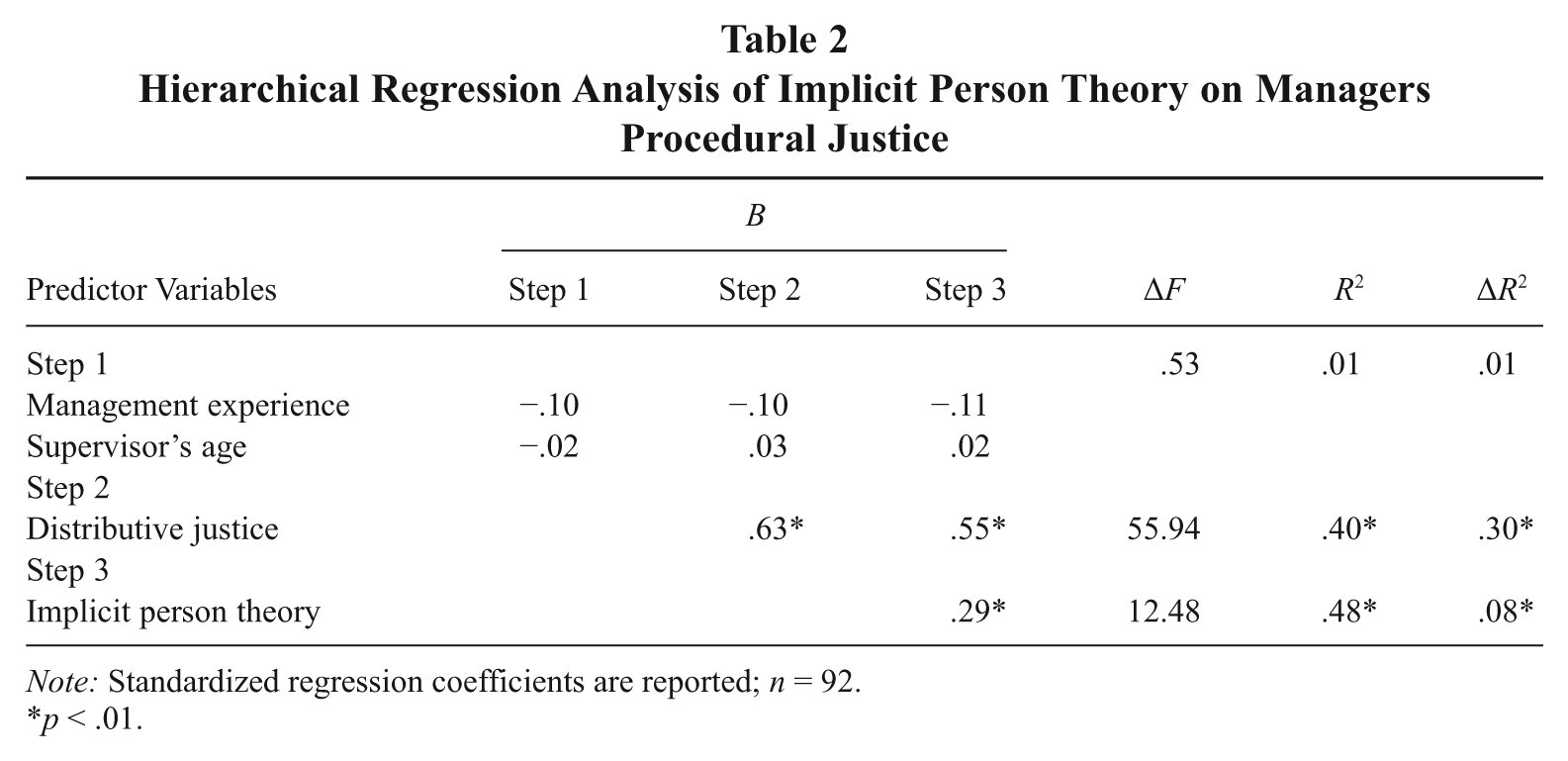
Note: Standardized regression coefficients are reported; n = 92.
p < .01.
A supplemental analysis revealed that the correlations between IPT and each of the procedural justice items—specifically, those pertaining to consistency (r = .37), bias (r = .44), accuracy (r = .38), correctability (r = .27), and voice (r = .31)—were each significant at the .01 level. These results are consistent with our reasoning that having an incremental IPT would predict managers providing consistent, unbiased, accurate, and correctable appraisals, as well as giving employees input into the appraisal of their performance.
To calculate the parameter estimates and model fit regarding Hypothesis 2, we conducted structural equation modeling (LISREL 8.7; Jöreskog & Sörbom, 2004). We used the sample covariance matrix as the input data and the maximum likelihood procedure for parameter estimation. For each construct, we combined the item responses into a single observed indicator value equal to the arithmetic mean. For the IPT and procedural justice latent variables, the value of the path from the latent variable to the observed indicator was fixed to equal the square root of the measure of reliability, and the error variance of the observed indicator was set equal to one minus the measured reliability (Loehlin, 1998). Given that the organizational commitment and OCB measures each have multiple subscales, the observed indicator paths and error variances were freely estimated.
The results of the structural equation modeling indicated an acceptable fit of the data for the overall model shown in Figure 1, χ2 (18, N = 92) = 52.94, p <.01; comparative fit index (CFI) = .93; standardized root mean square residual (SRMR) = .07 (Browne & Cudeck, 1993), as the CFI exceeds the conventional standard of .90 and is close to the .95 recommendation of Hu and Bentler (1998, 1999). The standardized path coefficients are presented in Figure 1. All of the parameter estimates are significant at the p < .01 level and indicate support for our second hypothesis. Specifically, consistent with Hypothesis 2, managers’ procedural justice predicted employees’ OCB via a partially mediated relationship through their organizational commitment. The R2 values (the squared multiple correlations for the structural equations) for the percentage of variance explained in the latent endogenous variables were as follows: .28 for procedural justice, .26 for organizational commitment, and .38 for OCB.
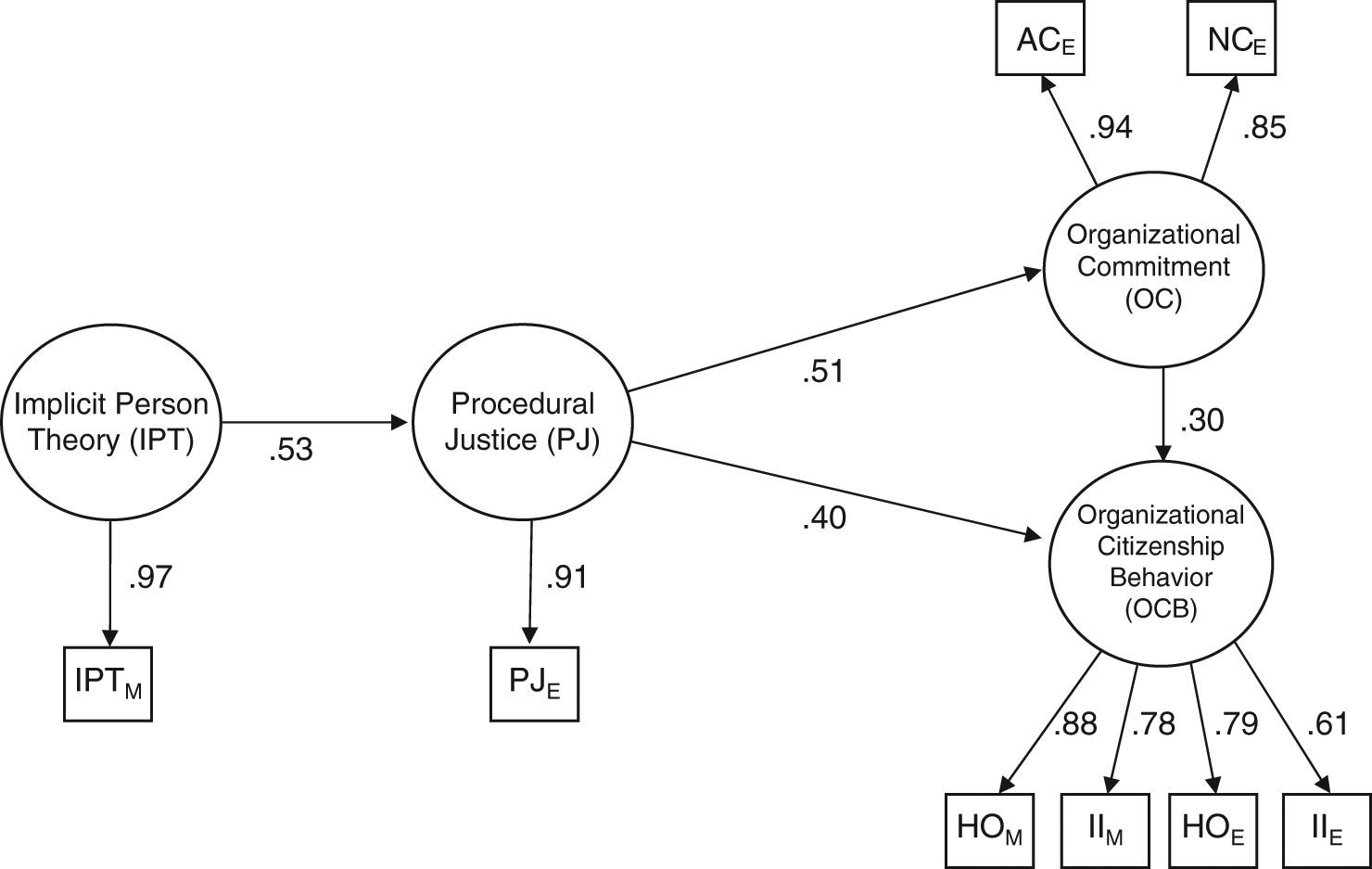
Proposed Effects of a Manager’s Implicit Person Theory (IPT) on the Procedural Justice (PJ) of Their Performance Appraisals, as Well as Employees’ Subsequent Organizational Commitment (OC) and Organizational Citizenship Behaviors (OCB)
Using the procedure outlined by James, Mulaik, and Brett (2006), we also estimated the fit of a competing fully mediated model without the direct path from procedural justice to OCB. The two nested models were significantly different, Δχ2(1, N = 92) = 9.60, p <.01. This direct comparison indicates that the more complex partially mediated model in Figure 1 provides a significantly better fit to the data than does a fully mediated model. We also examined the statistical significance of the mediation effect by using the Sobel test (see MacKinnon, Lockwood, Hoffman, West, & Sheets, 2002) and found further evidence to support organizational commitment as a mediator of the relationship of procedural justice and OCB proposed in Hypothesis 2; z = 2.15, p = .03.
To assess potential concerns about common-method variance influencing parameter estimates, we evaluated an alternative model that excluded the subordinate self-reports of OCB. The model fit indices and parameter estimates for the structural relationships were invariant to whether self-report OCB data was included or excluded. In addition, the correlation coefficients in Table 1 indicate that the organizational commitment–OCB relationships did not vary much as a function of the source of the OCB ratings. Given this equivalence, we used the more complete OCB data from both the manager and subordinate employee to test Hypothesis 2.
Finally, McDonald and Ho (2002: 75) observed that the overall fit of a structural equation model can appear to be good even if “the few constraints implied by the path model are not, in fact, correctly specified.” Thus, following the recommendations of McDonald and Ho, we also directly tested the fit of our partially mediated model with a path analysis, using the covariance matrix of only the observed variables. The results indicated an acceptable fit of the data to the path model, χ2(2, N = 92) = 8.11, p < .01; CFI = .93; SRMR = .08, thereby providing further support for Hypothesis 2. 7
We thus conclude that managers’ procedural justice operates both directly and indirectly, via organizational commitment, to predict OCB. The basis for confidence in this conclusion is strengthened by the OCB criterion measurement, following Organ et al. (2006), being based on both manager- and employee-assessments of employees’ OCBs.
Discussion
We theorized and found that managers’ IPTs predict employee perceptions of their procedural justice. Just as individual differences in narcissism predict other peoples’ ratings of an individual’s workplace behaviors, such as leadership, workplace deviance, and contextual performance (Judge et al., 2006), the present study shows that differences in IPT predict managers’ procedural justice when conducting a performance appraisal. Validation of the present procedural justice measurement, through replication of the well-established association between procedural justice and employees’ organizational commitment and OCB, helps substantiate this novel contribution to the IPT, performance appraisal, and procedural justice literatures.
Implications for Implicit Person Theory
As noted, the two major streams of existing IPT theory and research pertain to how people’s IPT affects either their self-regulation, or their interpersonal judgments and interactions with other people (e.g., Dweck, 1999; Heslin & VandeWalle, 2008). The present study contributes to the IPT literature a new third line of IPT theory and research—specifically, a dimension pertaining to the way people’s IPT relates to how other people perceive and respond to them. This study is unique in that no prior research, to our knowledge, has examined how an individual’s IPT is empirically related to the perceptual, affective, and behavioral responses they elicit from others. The present evidence that holding an entity IPT is associated with being perceived as not particularly procedurally just begs the question: How else are people perceived as a function of their IPT? Research might examine whether the evaluative inflexibility characteristic of a strong entity IPT leads to managers being perceived primarily as either obstinate, or as self-assured leaders who stick to their convictions. Such research may usher in a fourth new stream of IPT theory and research that simultaneously examines interpersonal perceptions as a function of the IPT of both the perceiver and the perceived, as well as their interaction, thereby going beyond the main effect of IPT on how one is perceived that has been first documented in the present study. Related aspects of cultural context, such as power distance (Hofstede, 2001), might also moderate how managers are perceived as a function of their IPT.
Implications for Performance Appraisal Research and Practice
Scott, Colquitt, and Zapata-Phelan (2007: 1598) observed that “From a practical standpoint, identifying factors that influence justice rule adherence could have a profound impact by helping to stop injustice before it starts.” The present findings provide initial evidence that IPT is a valuable construct for selecting managers into roles for which perceived procedural justice is likely to be important, as well as for identifying managers most in need of procedural justice training. On the other hand, the dysfunctional self-regulatory tendencies associated with holding an entity theory—such as reluctance to seek developmental feedback (Heslin & VandeWalle, 2005), undertake needed remedial training (Hong et al., 1999), or persist in the face of setbacks during skill acquisition (Tabernero & Wood, 1999)—could potentially limit the efficacy of interventions designed to train entity theorist managers to provide more procedurally just performance appraisals. Indeed, such self-regulatory inclinations could make entity theorist managers less likely to attend, wholeheartedly engage, and thus benefit from procedural justice training than those who hold an incremental IPT.
Resolution of this apparent dilemma may stem from the relatively stable though still potentially modifiable nature of IPT discussed earlier. Research is needed on the practical issue of whether compelling incremental interventions (Aronson et al., 2002; Heslin et al., 2005) can increase the procedural justice of managers who hold a predominantly entity IPT. Such research may fruitfully investigate whether the effectiveness of existing methods for training managers to provide more procedurally just performance appraisals (e.g., Greenberg, 1987; Skarlicki & Latham, 1996, 1997; Taylor et al., 1995) can be enhanced when they are supplemented with an incremental induction component. This training efficacy improvement might occur by virtue of (a) increasing entity theorist managers’ general receptiveness to being trained (Dweck, 1999; Hong et al., 1999) and/or (b) reducing the entity IPT belief that the present study found is associated with managers providing performance appraisals lacking in procedural justice.
Positive results from such research would bolster the present preliminary evidence that, with regard to the procedural justice of the performance appraisals that managers provide, IPT is a strong candidate for meeting the explanatory, predictive, and change facilitation criteria that are the hallmarks of a useful theory (cf. Bandura, 1986; Miner, 2005). First, IPT provides the abovementioned theoretical explanation of how the behavioral dispositions of entity theorists seem to be associated with providing performance appraisals viewed as lacking in procedural justice. Second, managers’ IPTs enable the prediction of employees’ procedural justice perceptions, organizational commitment, and OCB observed in the present study. Finally, future incremental intervention-based research might reveal that IPT provides a viable consideration for designing interventions to ultimately cultivate desired employee perceptions, feelings, and behaviors (such as procedural justice, organizational commitment, and OCB, respectively), as a result of persuading entity-oriented managers to adopt a more incremental IPT. Positive results from such research would provide the basis for new, theoretically-grounded training interventions for fostering employees’ organizational commitment and OCB.
Implications for Procedural Justice Research
Folger and Skarlicki (2001: 111) called for a “paradigm shift . . . which turns managerial fairness as an independent variable into managerial fairness as a dependent variable.” Folger and Skarlicki subsequently emphasized the need for research into potential dispositional determinants of the (un)fairness that managers exhibit. Gilliland and Schepers (2003: 82) similarly highlighted a need for “research suggesting psychological explanations” for managers’ justice-related behavior. The present exploration of the extent to which managers’ procedural justice is a function of their IPT contributes to the emergence of this new line of psychologically based justice theorizing and research. For instance, IPT potentially informs Folger et al.’s (1992) due process model by suggesting that managers’ inclination to exhibit at least some of the procedures it identifies for providing a procedurally just performance appraisal appear to be a function of differences in managers’ IPTs.
The present evidence of the consequential relationship between IPT and procedural justice in an appraisal context raises the issue of whether managers’ IPTs also predict their procedural justice within a host of other resource allocation settings, such as those involving selection (cf. Gilliland, 1993), task/project allocation, and layoff decisions (cf. Folger & Skarlicki, 2001; Gilliland & Schepers, 2003). Following Greenberg (2001), we tailored Colquitt’s (2001) procedural justice items pertaining to accuracy, bias, correctability, consistency and voice to the performance appraisal context, though these same attributes also define procedural justice within the other resource allocation contexts just mentioned. In addition, studies showing that an incremental IPT predicts judgments that are not unduly affected by initial impressions (Erdley & Dweck, 1993; Heslin et al., 2005) suggest that managers’ IPTs may predict the procedural justice with which they make selection decisions. Similarly, holding an entity IPT is associated with managers responding to employee performance deficiencies by being more inclined to replace employees, rather than to help them to improve (Levine & Ames, 2006). This exemplifies why IPT could be an antecedent of the perceived procedural justice with which termination decisions are made. We thus believe that IPT will predict managers’ procedural justice beyond the context of performance appraisals, though we encourage empirical investigation of this issue.
Finally, over and above the procedural justice they personally receive, employees’ attitudes and behaviors also reflect the procedural (in)justice experienced by other team members (Colquitt, 2004) and the procedural justice climate in which they work (Colquitt, Noe, & Jackson, 2002). Because supervisors act as “climate engineers” (Naumann & Bennett, 2000: 883) who shape how employees experience organizational policies and procedures (Mayer et al., 2007), future research may fruitfully investigate whether managers’ IPTs are associated with the procedural justice climate within the units they manage.
Limitations and Future Research
Several limitations of this study suggest additional avenues for future research. First, replication of the present results using both a larger sample and longitudinal design that is not retrospective would increase the basis for confidence in the robustness of the reported findings.
Second, within the justice literature, the event paradigm posits that employees evaluate the justice of a specific event, such as a performance appraisal, whereas the entity paradigm contends that employees also assess the justice of social entities (e.g., their supervisor) as a whole (Cropanzano, Byrne, Bobocel, & Rupp, 2001). By virtue of assessing only the perceived procedural justice of a recent performance appraisal event, how managers’ IPTs are associated with their perceived procedural justice in general was not examined. Given that performance appraisals are central to peoples’ perceptions of generally how well they are treated by their manager (Folger et al., 1992), we suspect that managers’ IPTs will also predict employees’ perceptions of managers’ overall procedural justice. In addition, extrapolating from Choi (2008), employees’ perceptions of the overall procedural justice of their manager and organization might moderate the present findings. Future research assessing both performance appraisal event and entity-based justice perceptions could empirically inform these issues.
Third, it is important to establish that the behaviors presumed to be associated with IPT are actually observable. In order to avoid conceptual and methodological redundancy we noted that we did not gather behavioral ratings of managers’ procedural justice. However, substantial direct evidence of IPT having relevant behavioral manifestations has been provided by prior research (Chiu et al., 1997; Erdley & Dweck, 1993; Gervey et al., 1999; Heslin et al., 2005, 2006; Heyman & Dweck, 1998; Levine & Ames, 2006). In addition, IPT significantly predicted employee perceptions of managers’ consistency, bias, accuracy, and provision of voice and correctable appraisals—perceptions that most likely reflected managerial actions. Future research measuring overall justice perceptions (Ambrose & Schminke, 2009), rather than only using a dimensionality-based measure of procedural justice (Colquitt, 2001), will nonetheless enable explicit examination of managers’ procedural justice-related behaviors associated with their IPTs. Such research might also shed light on whether, consistent with fairness heuristic theory (Lind, 2001), employees’ general perceptions of fairness stemming from their overall dealings with their managers predict employees’ organizational commitment and OCB even more strongly than the procedural justice with which their performance has been appraised.
Fourth, data on the level of employees’ performance evaluations was not collected in this study. It is conceivable that our significant results were driven primarily by employees who did not receive a favorable performance appraisal, though our finding that the relationship between IPT and procedural justice was robust when distributive justice was held constant suggests that this is unlikely to be the case. Nonetheless, research might fruitfully address this issue more directly by examining whether receiving a low performance appraisal makes employees particularly sensitive to observing and reacting to the IPT and procedural justice of their manager.
Fifth, the rationale and focus of the present preliminary study led us to examine only managers’ IPTs. As employees’ beliefs and attitudes affect their justice perceptions (Colquitt et al., 2006; Kamdar et al., 2006; Scott & Colquitt, 2007), further research may examine whether managers’ and employees’ IPTs interact to determine the extent of procedural (in)justice perceived by employees. Employees who have an incremental IPT could perceive even more injustice than entity theorists when their managers have an entity IPT, owing to potentially unmet expectations for the process-oriented developmental feedback that incremental theorist employees seek (Heslin & VandeWalle, 2005) and that entity theorist managers are disinclined to provide (Heslin et al., 2006; Heyman & Dweck, 1998; Levine & Ames, 2006). Conversely, extensive feedback and coaching by incrementally oriented managers could potentially increase entity theorist employees’ perceptions of procedural injustice, if perceived as highlighting and dwelling on the presumably immutable aspects of the kind-of-person they are. These possibilities illustrate the scope for future theorizing and research about potential interactions between manager and employee individual differences in determining employee perceptions of procedural justice. Such research might also extend Dweck’s IPT theory by beginning to empirically reveal potential boundary conditions to the widely documented liabilities of holding an entity IPT, as well as benefits of an incremental IPT (cf. Dweck, 1999, 2006; Heslin & VandeWalle, 2008).
Sixth, evidence that employees’ behaviors can change managers’ cognitions about them (Goodwin, Wofford, & Boyd, 2000) warrants consideration. Managers’ IPTs might conceivably be affected by employees’ organizational commitment and OCB, or primed by the employee who asked them to complete the managerial survey containing the IPT items. However, we assessed IPT about people in general (Dweck, 1999) rather than about particular employees. Also, managers indicated their IPT before they knew they would be surveyed about their employee’s OCB. Finally, two studies by Heslin et al. (2006) together established that the effect of managers’ IPTs on their employee coaching was invariant to whether or not employees had requested that their manager complete an IPT survey. This suggests that employees asking managers to complete the managerial survey containing the IPT items is unlikely to have significantly affected the managers’ IPTs in the present study. Nonetheless, our study establishes merely that managers’ IPTs statistically predict employee perceptions of their procedural justice. Experimental, longitudinal research would be useful to explore the extent to which the relationship between (a) managers’ IPTs and (b) employees’ procedural justice perceptions, attitudes and behaviors potentially operate in the opposite direction to that outlined in Figure 1.
Seventh, because the level of fit of our structural equation model is less than ideal and slightly below the level reported elsewhere in the literature (e.g., Colquitt et al., 2006; Judge & Colquitt, 2004), following Hox (2002) we deemed our model an “acceptable” rather than “good” fit to the data. Caution is thus warranted in interpreting our structural equation model.
Finally, owing to the procedural focus of most prior theorizing (e.g., Folger et al., 1992) and research (e.g., Greenberg, 1986; Skarlicki & Latham, 1996, 1997; Taylor et al., 1995) on the role of justice in reactions to performance appraisals, as well as for the numerous reasons outlined in the fourth footnote, the present study focused solely on the role of managers’ IPTs in their perceived procedural justice. Procedural and interactional justice are arguably conceptually (Ambrose & Arnaud, 2005; Ambrose & Schminke, 2009) and often empirically (e.g., Mayer et al., 2007; Simons & Roberson, 2003) highly related. An incremental IPT nonetheless predicts providing people with supportive information to help them improve their performance (Heslin et al., 2006; Heyman & Dweck, 1998), rather than giving them a tongue-lashing (Chiu et al., 1997) or being punitive (Gervey et al., 1999) after they make mistakes. Thus, future research might usefully explore whether managers’ IPTs also predict their interactional justice.
Conclusion
In the context of the vacuum within the justice literature regarding personal dispositions associated with managers’ procedural justice (Colquitt & Greenberg, 2003; Folger & Skarlicki, 2001), IPTs have been shown to be a theoretically derived predictor of managers providing performance appraisals that are perceived as procedurally just. Future research may elucidate the potential significance of the present results for modeling, predicting, and modifying justice climate and managers’ procedural justice in a range of resource allocation contexts, as well as selecting more procedurally just managers and for improving the effectiveness of justice training interventions by supplementing them with an incremental intervention. Each of these lines of research could yield useful insights for both scholars and practitioners interested in modeling, predicting, and cultivating procedural justice.
Footnotes
Acknowledgements
An earlier version of this article was presented in the Featured Posters session of the All-Conference Reception at the annual meeting of the Society for Industrial/Organizational Psychology, Dallas, Texas, April 2006. We thank Rob Folger for helpful advice on this project, and are grateful to Maureen Ambrose, Jay Carson, Jason Colquitt, Carol Dweck, Mel Fugate, Jerry Greenberg, Maribeth Kuenzi, Paul Levy, Debra Shapiro, Deidra Schleicher, and three anonymous reviewers for valuable comments and suggestions on an earlier draft of this article.