






Abstract
In this article, the authors develop and test a theory on the effect of institutional investor heterogeneity on CEO pay. Their theory predicts that institutional investors’ incentives and capabilities to monitor CEO pay are determined by the fiduciary responsibilities, conflicts of interest, and information asymmetry that institutional investors face. Their theory suggests, in contrast to previous literature, that public pension funds and mutual funds exert different effects on CEO pay at their portfolio firms because they do not have the same monitoring incentives and capabilities. Using a longitudinal sample of S&P 1500 firms for the years 1998 to 2002, the authors find that public pension fund ownership is more negatively—indeed, oppositely—associated with both the level of CEO pay and CEO pay-for-performance sensitivity than mutual fund ownership. Their findings suggest that (a) researchers’ use of institutional investor classifications that do not distinguish public pension fund ownership and mutual fund ownership can be misleading and (b) while CEO pay critics have called for pay plans that are in line with the “less pay and more sensitivity” principle, this may be an ineffective goal to pursue.
The significant increase in CEO pay over the past two decades has made CEO pay practices a controversial public issue. In particular, critics have voiced concerns that CEO pay has not been closely tied to firm performance (Bebchuk & Fried, 2004). Bebchuk and Grinstein (2005), for example, argue that executive pay has increased far beyond levels that can be explained by the growth in firm size and performance observed over the 1993-2003 period. They show that while executive pay in public firms amounted to as much as 10% of corporate earnings in 2001-2003, only 20% of the increase in executive pay could be explained by the growth in firm size and performance. In response to such concerns, institutional investors, whose aggregate stock ownership share increased from 16% in 1965 to more than 61.3% in 2002 (Brandes, Goranova, & Hall, 2008), have come to view CEO pay as an important indicator of a firm’s corporate governance. A recent survey shows that 90% of institutional investors perceive corporate executives to be overpaid (Brandes et al., 2008). This perception has led some institutional investors to abandon their traditional passive role and actively exercise their influence over CEO pay decisions at their portfolio firms (Bushman & Smith, 2001; Hartzell & Starks, 2003). 1
Numerous prior studies examine the role of institutional investor monitoring—”monitoring includes both information gathering and efforts to influence management” (Chen, Harford, & Li, 2007: 282)—of CEO pay. However, to date there is no consensus about which institutional investor characteristics determine their role in monitoring CEO pay at their portfolio firms. Some researchers simply examine whether total institutional investor ownership is associated with the level of CEO pay and the sensitivity of CEO pay to firm performance (Hartzell & Starks, 2003). Other researchers (e.g., David, Kochhar, & Levitas, 1998) use Brickley, Lease, and Smith’s (1988) institutional investor classification to suggest that pressure-resistant institutional investors that have no business relationships with their portfolio firms (e.g., public pension funds and mutual funds) can successfully monitor and curb CEOs’ rent extraction, while pressure-sensitive institutional investors that have business relationships with their portfolio firms (e.g., banks, insurance companies, and nonbank trusts) cannot (Brickley et al., 1988; David et al., 1998). However, recent empirical studies suggest that institutional investors exhibit more heterogeneous monitoring behaviors than Brickley et al.’s classification predicts. Davis and Kim (2007) and the Corporate Library (2006), for example, find that, unlike public pension funds, mutual funds do not appear to be willing to use their considerable voting power to reform CEO pay. These recent findings suggest that more rigorous investigation of institutional investor heterogeneity and its role in the monitoring of CEO pay is needed.
In this article, we seek to shed light on the role of institutional investors in CEO pay by developing a theory of institutional investor heterogeneity and CEO pay. We focus our attention on public pension funds and mutual funds because (a) these institutional investors account for the majority of total institutional investor ownership in U.S. firms (Ryan & Schneider, 2002: 557), (b) prior studies regard these institutional investors as having both the incentive and the capability to protect shareholder value through monitoring (Brickley et al., 1988), and (c) recent empirical studies present evidence that, in contrast, challenges the conception of these two institutional investors as having monitoring potential (Hoskisson, Hitt, Johnson, & Grossman, 2002). Our theory focuses on three factors that affect these institutional investors’ incentives and capabilities to monitor CEO pay. We first posit that institutional investors’ fiduciary responsibilities affect their incentives to monitor CEO pay. In particular, institutional investors’ incentives to monitor CEO pay are expected to be increasing to the extent of their fiduciary responsibilities. Next, we posit that the incentives of institutional investors to monitor CEO pay are affected by the conflicts of interest that the institutional investors face. Such conflicts, which become more pronounced as financial institutions engage in more diversified activities, are expected to lead institutional investors to compromise their fiduciary role in monitoring CEO pay. A third factor that we posit to affect institutional investors’ monitoring of CEO pay is the degree of information asymmetry that institutional investors face. If institutional investors have more information about the management of their portfolio firms, they have greater capability to directly monitor CEOs’ behavior and thus are less likely to rely on stock-based pay to incentivize their portfolio firms’ CEOs. However, institutional investors’ monitoring incentives are likely to affect whether institutional investors use firm-specific information to directly monitor CEOs’ behavior. Hence, our theory suggests that institutional investors’ fiduciary responsibilities, conflicts of interest, and information asymmetry interact with each other to jointly determine the influence of institutional investors on CEO pay.
To test the above predictions, we employ longitudinal data that comprise S&P large-, medium-, and small-cap firms in the United States over the years 1998 to 2002. We find that public pension funds and mutual funds have different monitoring incentives and capabilities, which result in different CEO pay practices in their portfolio firms. Thus, our study suggests that the use of institutional investor classifications that do not distinguish between public pension fund ownership and mutual fund ownership can be misleading.
Theory and Hypotheses
Institutional Investor Monitoring
Atomistic shareholders generally lack sufficient knowledge to effectively monitor a firm’s management. Further, they have little incentive to actively monitor managerial decisions because of a potential free-rider problem—while an individual owner bears the costs of monitoring, all shareholders enjoy the benefits. Monitoring costs include reduced market liquidity, which adversely affects a shareholder’s ability to sell shares of poorly performing firms (Holmstrom & Tirole, 1993). Thus, historically, institutional investors have preferred “liquidity” to “monitoring” (Coffee, 1991).
In recent years, however, institutional investors have begun to play a key role in the monitoring of firm management. Institutional investors’ increasingly large shareholdings together with their use of indexing portfolio strategies often preclude them from simply selling their shares in poorly governed firms and purchasing alternative stocks without suffering further losses (Coffee, 1991; Gillan & Starks, 2003; Gilson & Kraakman, 1991; Holmstrom & Tirole, 1993; Hoskisson et al., 2002). 2 As a result, institutional investors have found it necessary to engage (if reluctantly) in monitoring activities (Ryan & Schneider, 2002). This implies that, for institutional investors, in more recent years the benefits from monitoring have been sufficient to offset the associated costs (Chen et al., 2007; Davis & Thompson, 1994; Ryan & Schneider, 2002).
The Role of Institutional Investors in CEO Pay
Institutional investors can influence the management of their portfolio firms in a variety of ways, for example by negotiating with firm management, by publicly targeting firms through media campaigns, by filing shareholder proposals at firms’ annual shareholder meetings, or by voting on proxies in opposition to firm management. Regardless of the mechanism used to influence portfolio firms, the issue that has attracted the greatest attention from institutional investors is CEO pay.
Institutional investors exercise influence over both the level and the structure of CEO pay in accordance with shareholder interests, which may be in conflict with the interests of CEOs (David et al., 1998). In particular, whereas CEOs prefer greater total pay, institutional investors seek to limit CEO total pay so as to increase their share of the firm’s rents (Werner, Tosi, & Gomez-Mejia, 2005). More important, while CEOs prefer less performance-contingent pay, institutional investors are interested in CEO pay being structured such that it has a large stock-based component that explicitly ties the CEO’s pay to firm performance, as doing so is believed to increase CEO pay risk and thus help align the CEO’s interests with those of shareholders (Hall & Liebman, 1998). Institutional investors’ preference for pay-for-performance—together with favorable tax rules, favorable accounting treatment of stock options, and the 1990s bull market—resulted in a huge rise in the use of stock option grants in the 1990s (Hall & Murphy, 2003). Not surprisingly, therefore, extant research on the association between institutional investor ownership and CEO pay examines whether institutional investors contribute to CEO pay outcomes in a way that reduces CEO total pay but increases its sensitivity to firm performance (i.e., less pay and more sensitivity).
Two perspectives have been offered on the role of institutional investors in CEO pay. On the one hand, some researchers assume a homogeneous effect of institutional investors on CEO pay and examine the impact of total institutional investor ownership on the level and structure of CEO pay. Hartzell and Starks (2003), for example, find that as total institutional investor ownership increases, the level of CEO pay decreases, while the pay-for-performance sensitivity of CEO pay increases. Following this literature, the majority of empirical research on CEO pay includes total institutional investor ownership as a control variable to account for the overall influence of institutional investors on the level and structure of CEO pay (e.g., Core, Holthausen, & Larcker, 1999).
On the other hand, some researchers argue that not all institutional investors contribute equally to the monitoring of CEO pay. Classifying banks, insurance companies, and nonbank trusts as pressure-sensitive institutional investors (since these institutional investors are susceptible to influence from portfolio firms with which they have business relationships) and classifying public pension funds, mutual funds, endowments, and foundations as pressure-resistant institutional investors (since these institutional investors are less likely to have a business relationship with firms in their portfolios), Brickley et al. (1988) argue that pressure-resistant institutional investors are less likely to suffer from conflicts of interest arising from business relationships and hence more likely to actively engage in monitoring. 3 Brickley et al.’s classification has been widely used in CEO pay studies concerning the role of institutional investors. For example, using data from the early 1990s, David et al. (1998) and Almazan, Hartzell, and Starks (2005) find that pressure-resistant institutional investors are more likely than pressure-sensitive institutional investors to influence CEO pay in accordance with shareholder preferences. That is, they find that the shareholdings of these institutional investors are negatively associated with the level of CEO pay but positively associated with pay-for-performance sensitivity. A key implication of this line of research is that institutional investors are not a homogeneous group in terms of their monitoring activities.
Extending the above research, recent studies show that, in contrast to Brickley et al.’s (1988) classification, public pension funds and mutual funds may not equally affect CEO pay practices at their portfolio firms. For example, Davis and Kim (2007) and the Corporate Library (2006) find that mutual funds tend not to challenge portfolio firms’ efforts to grant generous pay packages to their CEOs. Indeed, using mutual funds’ proxy voting on CEO pay, the Corporate Library finds that mutual funds voted in support of management proposals on CEO pay 73.9% of the time. Governance researchers further demonstrate that public pension funds and mutual funds exert different influences on governance outcomes besides CEO pay. 4 These recent studies suggest that public pension funds and mutual funds have become more heterogeneous in their preferences for and hence role in corporate governance than earlier studies assumed, which points to the need for further analysis of the relationship between institutional investor heterogeneity and CEO pay.
Theory on Institutional Investor Heterogeneity and CEO Pay
In this article, we develop a theory that seeks to explain why different types of institutional investors have different incentives and capabilities to monitor CEO pay, which ultimately results in different CEO pay outcomes at their portfolio firms. We argue that the effects of institutional investors on CEO pay practices are determined by the extent of institutional investors’ incentives and capabilities to monitor CEO pay. These incentives and capabilities are determined, in turn, by the extent of institutional investors’ fiduciary responsibilities vis-à-vis their shareholders, by the degree of conflicts of interest that institutional investors face due to business relationships with portfolio firms, and by the amount of information institutional investors have about their portfolio firms. These three factors (fiduciary responsibilities, conflicts of interest, and information asymmetry)—although not equally important to all institutional investors—interact with each other to determine institutional investors’ influence on the level and structure of CEO pay at their portfolio firms.
Heterogeneous preferences for CEO incentive pay
Before developing a theory of institutional investor heterogeneity and CEO pay, we note that although extant studies assume that shareholders have an inherent preference to decrease CEO total pay but increase the sensitivity of CEO pay to firm performance, shareholders may not always prefer to increase the sensitivity of CEO pay to firm performance because such incentive pay schemes may have detrimental effects as well as beneficial effects on shareholder wealth (Devers, Cannella, Reilly, & Yoder, 2007).
Research based on agency theory points to the beneficial aspects of CEO incentive pay. In particular, agency-theoretic research documents that stock-based pay plays an important role as an incentive mechanism to mitigate potential agency problems between managers and shareholders (see Murphy, 1999, for a review). First, agency research shows that stock-based pay helps align CEO interests with shareholder interests because, by explicitly tying a CEO’s wealth to the firm’s stock price, it provides CEOs with a strong incentive to increase firm value (Hall & Murphy, 2003). Second, agency theory suggests that when shareholders lack information on CEO performance and thus direct monitoring of CEO behavior is costly, it is more efficient to base a CEO’s compensation on outcomes of the CEO’s behavior than to engage in costly monitoring (Eisenhardt, 1989). A third benefit of CEO incentive pay, according to agency theory, is that it can help align the risk preferences of CEOs and shareholders. Specifically, while shareholders can diversify their investment risk across firms and thus are risk neutral with respect to investment decisions at their portfolio firms, CEOs’ job security and income are inextricably tied to their firms, and thus CEOs are assumed to be risk averse, taking fewer risks than is optimal (Fama & Jensen, 1983). CEO incentive pay therefore helps align risk preferences between CEOs and shareholders by inducing more risk-taking behavior from CEOs (Carpenter, 2000; Wiseman & Gomez-Mejia, 1998). Finally, agency theory suggests that stock-based pay is an efficient sorting mechanism to attract and retain top executive talent (Hall & Murphy, 2003). In sum, agency theory suggests that CEO incentive pay helps align CEOs’ interests with institutional investors’ interests, and thus, CEO pay should be tightly linked to firm performance.
However, a growing body of research provides evidence that CEO incentive pay is not always net beneficial (see Devers et al., 2007, for a review). First, recent empirical evidence suggests that stock-based pay may motivate a CEO to engage in fraudulent behavior since heavy use of stock-based pay provides CEOs with perverse incentives to maximize their private wealth by boosting accounting earnings, sometimes fraudulently (Bergstresser & Philippon, 2006; Burns & Kedia, 2006; Zhang, Bartol, Smith, Pfarrer, & Khanin, 2008). Thus, CEOs with high stock-based incentives may have a strong incentive to manipulate earnings. Second, CEOs can control the board—specifically, nominations to the board—and thus they can pressure directors to acquiesce to the CEO’s desired pay (Bebchuk & Fried, 2003; Main, O’Reilly, & Wade, 1995). In such circumstances, stock-based pay can be used to further CEOs’ efforts to extract more rents. For instance, Pollock, Fischer, and Wade (2002) find that CEO power increases the likelihood of option repricing when stock options are underwater. Because CEO power generally increases in the CEO’s stock ownership, granting substantial stock-based pay to CEOs may “dilute shareholders’ ownership right” (Brandes et al., 2008: 43) and increase CEOs’ ability to manipulate firm earnings and influence board decisions on CEO pay. Third, some components of stock-based pay—for example, stock options—may encourage CEOs to take too much risk (Hall & Murphy, 2003). Stock options offer upside potential but no downside risk (Sanders, 2001; Wiseman & Gomez-Mejia, 1998). Because the value of stock options increases as the stock price becomes more volatile (Black & Scholes, 1973), stock options—especially those that are underwater—may provide CEOs with a strong incentive to undertake riskier investments than is optimal.
Taken together, the above discussion suggests that CEO incentive pay has the potential to align CEO and shareholder interests on the one hand or induce undesirable CEO behavior and overly generous CEO pay on the other. We argue that institutional investors’ preferences with respect to CEO incentive pay will vary depending on their monitoring incentives and capabilities as determined by the fiduciary responsibilities, conflicts of interest, and informational challenges that they face. For example, institutional investors that have stronger fiduciary responsibilities will be interested in preventing the detrimental effects of CEO incentive pay from occurring, whereas institutional investors that face a higher degree of information asymmetry will be more interested in the beneficial effects of CEO incentive pay as a substitute for costly monitoring.
Fiduciary responsibilities and CEO pay
All institutional investors have discretion over the assets of others (David et al., 1998). However, under the Prudent Man Investment Act and state trust law, the fiduciary legal standards that apply to managers of banks, insurance companies, mutual funds, and public pension funds differ from one another depending on the institutional investors’ clients (Bushee, 2001; Bushee, Carter, & Gerakos, 2007; Del Guercio, 1996). Thus, examination of institutional investors’ fiduciary responsibilities is important, as institutional investors that are subject to different fiduciary standards will have different incentives to monitor CEO pay (both its level and structure) at their portfolio firms.
Public pension funds, as retirement vehicles of public sector employees, face strict fiduciary responsibilities under extensive state and local laws and regulations governing their operations. Moreover, the administration of public pension plans, as a public trust of state and local governments, is subject to the highest standard of public scrutiny from, for example, state legislative bodies. Public pension funds therefore have a strong incentive to tilt their investment portfolios toward safe or high-quality stocks, avoiding stocks that courts would view as imprudent and risky (Bushee, 2001; Del Guercio, 1996; Murphy & Van Nuys, 1994). As a result, public pension funds are expected to attach greater importance to the detrimental potential of CEO incentive pay. Accordingly, although public pension funds prefer low CEO total pay, they are likely to discourage their portfolio firms from linking CEO pay tightly to firm performance, because such pay schemes may encourage CEOs to engage in fraudulent behavior such as earnings manipulation or excessive risk taking (Burns & Kedia, 2006; Hall & Murphy, 2003; Zhang et al., 2008). That is, insofar as stock-based incentives are associated with an increased likelihood of earnings manipulation or excessive managerial risk taking and insofar as CEOs can manipulate stock-based incentives for their own benefit, public pension funds, which have a high degree of fiduciary responsibility to avoid imprudent and risky investments, have a strong incentive to discourage a firm’s board from using stock-based incentives in rewarding the firm’s CEO.
In contrast, mutual fund managers generally operate under “the least restrictive fiduciary responsibilities of any type of institution” (Bushee, 2001: 215). In particular, mutual fund managers do not face strict prudence standards or high threats of legal action by their funds’ shareholders. Thus, unlike public pension fund managers, mutual fund managers need not limit themselves to safe investment portfolios (Del Guercio, 1996) and are expected to attach less importance to the detrimental potential of CEO incentive pay.
To summarize, the strict fiduciary responsibilities borne by managers of public pension funds lead us to predict that these managers have a strong incentive to rein in the level of CEO total pay but little incentive to tie CEO pay to firm performance; rather, they have a strong incentive to reduce the use of stock-based pay at their portfolio firms. In contrast, mutual fund managers are unlikely to exert pressure to reduce CEO incentive pay in their portfolio firms.
Conflicts of interest and CEO pay
Organization theory on power (e.g., resource dependence theory; Pfeffer & Salancik, 1978) observes that conflicts of interest may arise within an organization “when intraorganizational groups perform duties for at least two parties who each have conflicting goals or objectives” (Hayward & Boeker, 1998: 1). Such conflicts of interest are particularly pervasive at firms that provide multiple services to their clients (Hayward & Boeker, 1998). Focusing on the context of institutional investors, Brickley et al. (1988) argue that when institutional investors have both a business relationship and an investment relationship with their portfolio firms, they are likely to have a strong incentive to compromise their monitoring role to secure continued business from their portfolio firms. This suggests that institutional investors that have a business relationship with their portfolio firms are likely to grant more generous CEO pay than is consistent with their role as a monitoring shareholder (David et al., 1998).
Public pension funds have few business relationships and hence few conflicts of interest with their portfolio firms (David, Hitt, & Gimeno, 2001), which should increase their incentive to actively influence CEO pay toward lower total pay level and less use of stock-based pay, as their fiduciary responsibilities require. Thus, examination of the conflicts of interest that public pension funds face further strengthens our argument above for the effect of public pension fund ownership on the level and structure of CEO pay.
Mutual fund managers, in contrast, are not immune to the influence of their portfolio firms, because in today’s context a mutual fund’s parent firm generates substantial revenue from firms in the fund’s portfolio by providing financial services to these firms. Until recently, regulation constrained firms in the financial industry from providing a full range of financial services to their customers. Many of these regulatory constraints disappeared, however, over the course of the 1990s. Deregulation was followed by a number of mergers and acquisitions, with large firms acquiring smaller ones and expanding their reach across both geography and scope of activities. As a result, “The number of mutual funds belonging to financial conglomerates has increased sharply” (Mehran & Stulz, 2007: 276), and these financial conglomerates generate considerable revenue from mutual funds’ investment portfolio firms. For instance, among top-10 mutual fund families that manage 51% of all fund assets (Corporate Library, 2006), Fidelity Management & Research Company had business ties with 22.8% of the firms in its portfolio, and one quarter of its revenues came from administering various employee benefits such as 401(k) plans to its portfolio firms in 2001 (Davis & Kim, 2007). 5 Under these circumstances, although a manager of a mutual fund has a fiduciary duty to increase the wealth of the fund’s shareholders, conflicting interests may overwhelm this obligation because of the potential costs of jeopardizing the parent firm’s business ties with portfolio firms. Mutual fund managers are therefore likely to have weaker incentives to monitor CEO pay and thus may secure their parent firm’s revenue at the expense of the fund’s shareholders.
Recent evidence generally supports these arguments. For example, using the 2004 proxy voting data of large mutual fund families that became publicly available in accordance with the Securities and Exchange Commission’s (SEC’s) new regulation, Davis and Kim (2007) find that mutual funds with more business ties are more likely to vote with management. Proxy voting records also reveal that mutual funds generally appear not to use their voting power to constrain executive pay and to tie executive pay more closely to firm performance (Corporate Library, 2006; Levitz, 2006). For instance, Corporate Library (2006) examines the votes of 18 large mutual funds on executive pay and finds that mutual funds supported 75.6% of the proposals to grant new stock options or other forms of pay to executives, whereas they supported only 27.6% of the shareholder proposals to restrict executive pay.
In sum, the influence of mutual funds on CEO pay at their portfolio firms may favor the CEO because of conflicts of interest stemming from business relationships between the fund’s parent firm and portfolio firms. While mutual funds do not have an incentive to use stock-based pay to increase shareholder wealth, they will cater to the CEOs of their portfolio firms by granting them more fixed pay and more stock-based pay. As a result, we expect higher levels of CEO total pay and higher pay-for-performance sensitivity associated with mutual funds’ portfolio firms. It is important to note that shareholder value may be enhanced if a portion of a CEO’s fixed pay is converted to performance-contingent pay, increasing CEO pay risk but not CEO total pay. In contrast, simply adding stock-based pay to a CEO’s fixed pay (i.e., “layering”) increases CEO total pay but not CEO pay risk, which serves the interest of the CEO but not the interest of shareholders (Bebchuk & Fried, 2003; Hall & Murphy, 2003; Wiseman & Gomez-Mejia, 1998).
Information asymmetry and CEO pay
As noted above, agency theory suggests that information asymmetry around CEO performance not only contributes to agency problems but also leads shareholders to rely on performance-contingent incentive pay to control CEO behavior (Carpenter & Westphal, 2001; Holmstrom, 1979; Mace, 1971; Main et al., 1995). Accordingly, when institutional investors face a high degree of information asymmetry, these institutional investors are likely to attach greater importance to the beneficial effects of CEO incentive pay and thus show a preference for linking a larger part of CEO pay to firm performance.
However, the degree of information asymmetry decreases for those institutional investors that have access to important inside, value-relevant information. These institutional investors have a good deal of information on the operations of their portfolio firms and thus are able to make better means–ends assessments of CEO performance. As a result, they are less likely to look favorably upon CEO pay that is beyond the level that can be explained by their assessment of CEO performance. Furthermore, these institutional investors are less likely to use stock-based pay to influence CEO behavior because they are able to directly influence CEOs’ decisions. Chen et al. (2007), for example, find evidence that independent long-term institutional investors that have substantial incentive and capability (through information) to monitor CEO decision making are less likely to make CEOs at their portfolio firms propose bad acquisition deals but are more likely to make portfolio firm CEOs withdraw bad bids.
Extant research on substitution effects supports our argument. Governance researchers have long argued that multiple governance mechanisms operate in firms and that these mechanisms can substitute for each other (Rediker & Seth, 1995; Tosi, Katz, & Gomez-Mejia, 1997; Zajac & Westphal, 1994). The substitution argument suggests that increased monitoring capabilities by institutional investors substitute for the use of an incentive pay scheme that imposes risk on CEOs (i.e., stock-based pay). Ke, Petroni, and Safieddine (1999) find that closely held ownership creates direct monitoring that substitutes for incentive pay, and Zajac and Westphal (1994) also find that direct monitoring (by the board and by shareholders) and incentive pay schemes substitute for each other. To summarize, a reduction in information asymmetry is expected to increase institutional investors’ capability to directly monitor CEO behavior, which allows these institutional investors to pay the CEO less and to use less stock-based pay, resulting in lower pay-for-performance sensitivity.
We argue, however, that although institutional investors’ monitoring capabilities increase as they have more firm-specific information, the actual effect of reduced information asymmetry on CEO pay is shaped by the institutional investors’ monitoring incentives. In particular, while we assume that both public pension funds and mutual funds have the potential to gather substantial information about the firms that they invest in, public pension funds will benefit more from a reduction in information asymmetry than will mutual funds because public pension funds have greater incentives to use firm-specific information (and voting power) to limit CEO pay due to their stricter fiduciary responsibilities and lower conflicts of interest. Indeed, prior research shows that public pension funds have been playing a primary role in protecting shareholder wealth by directly exercising their influence over important decisions at their portfolio firms (Bhagat, Black, & Blair, 2004). Thus, a reduction in information asymmetry will further lead managers of public pension funds to discourage the use of stock-based pay because these managers are more likely to directly monitor CEO behavior, decreasing their reliance on the use of incentive pay. In contrast, mutual funds have weaker incentives to use firm-specific information (and voting power) to serve their shareholders because they face substantial conflicts of interest and have little fiduciary responsibilities. Thus, a reduction in information asymmetry would not necessarily translate into lower CEO total pay and less use of incentive pay among mutual funds.
The Effects of Public Pension Funds and Mutual Funds on CEO Pay
Although we agree with the extant view that both public pension funds and mutual funds have the potential to affect CEO pay at their portfolio firms (Brickley et al., 1988), our theory suggests that public pension funds and mutual funds have different monitoring incentives and capabilities and thus have different effects on CEO pay outcomes at their portfolio firms.
Our examination of the fiduciary responsibilities that public pension funds face leads us to predict that public pension funds seek to lower CEO total pay levels but that they have little incentive to tie CEO pay to firm performance. Instead, these funds have a strong incentive not to link CEO pay to firm performance. Public pension funds’ preference for less total pay and less pay-for-performance sensitivity is likely to be reinforced by the fact that these institutional investors have few conflicts of interest with their portfolio firms and greater capability to actively monitor their portfolio firms using the value-relevant information they have about their portfolio firms.
On the other hand, mutual funds have a strong incentive to increase the level of CEO total pay and to grant substantial stock-based pay to the CEOs of their portfolio firms. Examination of the business relationships between mutual funds’ parent firms and portfolio firms together with examination of mutual funds’ fiduciary responsibilities suggest that mutual funds are likely to be pressure-sensitive institutional investors. Mutual fund managers face conflicts of interest and thus are under pressure to please CEOs of firms in the managers’ portfolios. In addition, as mutual fund managers are not subject to strict fiduciary standards, they can more easily grant more total pay and more pay-for-performance sensitivity to the CEOs of their portfolio firms to solidify their business relationships. Therefore, mutual fund managers’ capability to actively monitor CEO pay using the information they have about their portfolio firms will be compromised. We thus predict that mutual fund managers are more likely to approve of proposals to increase CEO total pay, including stock-based pay, at the funds’ portfolio firms than are public pension fund managers.
More formally, our hypotheses are stated as follows:
Hypothesis 1: The proportion of shares held by public pension funds is more negatively associated with the level of CEO total pay than is the proportion of shares held by mutual funds.
Hypothesis 2: The proportion of shares held by public pension funds is more negatively associated with CEO pay-for-performance sensitivity than is the proportion of shares held by mutual funds.
Method
Data and Sample
To test our hypotheses, we use a sample that comprises S&P large-, medium-, and small-cap firms in the United States over the years 1998 to 2002. Our initial sample is generated by the intersection of ExecuComp, CDA/Spectrum, CRSP, and COMPUSTAT for the years 1998 to 2002. We obtain CEO pay data from ExecuComp, which covers firms from the S&P 500, S&P 400 mid-cap, and S&P 600 small-cap indices starting in 1992. Stock returns and accounting variables come from CRSP and COMPUSTAT, respectively. We obtain quarterly institutional investor ownership data from 13F filings available in the CDA/Spectrum database. All investors with at least $100 million in equity holdings are required to file 13F forms to the SEC. In all analyses below, we use institutional investor ownership data from the quarter closest to firms’ fiscal year end. Key governance variables are drawn from the IRRC database, which covers firms from the S&P 500, S&P 400 mid-cap, and S&P 600 small-cap indices from 1998 through 2002.
We winsorize the top and bottom 1% of the distributions of our dependent variables—CEO pay and pay-for-performance sensitivity—in order to reduce the effects of extreme observations. Our final sample consists of 4,493 firm-year observations from 1,261 distinct firms.
Dependent Variables
CEO total pay
To test our hypothesis regarding the effect of institutional investor ownership on the level of CEO pay, we measure CEO total pay as the total of all cash pay (salary and bonuses) and long-term pay (stock option grants, restricted stocks, and other long-term compensation). To account for skewness, we take the natural logarithm of CEO total pay.
Pay-for-performance sensitivity
To test our hypothesis regarding the effect of institutional investor ownership on CEO pay-for-performance sensitivity, we use the ex ante measure of pay-for-performance sensitivity using newly granted stock options and restricted stocks. Following Yermack (1995) and Core and Guay (1999), we define the sensitivity of newly granted stock options and restricted stocks to firm performance (CEO new equity incentive) as the predicted dollar change in a CEO’s new stock options and restricted stock grants for every 1% change in stock price, where the sensitivity of a stock option’s dollar value (in thousands) to the stock price is estimated as the partial derivative of the stock option’s value with respect to a 1% change in stock price (option delta). Using detailed stock option and restricted stock grant data such as strike price, stock price, grant date, and time to maturity from the ExecuComp database, we compute CEO new equity incentive using the following formula scaled by the sum of CEO salary and bonus: 6
where
N(z) = cumulative normal distribution function of z
P = market price of the stock at the grant date
X = exercise price
r = risk-free rate
d = dividend yield
σ = stock return volatility
T = time to maturity of the option (in years).
Independent Variables
To measure institutional investor ownership of a firm by institutional investor type, we begin with the CDA/Spectrum classification, which divides institutional investors into five types: banks (Type 1), insurance companies (Type 2), investment companies (Type 3), independent investment advisors (Type 4), and others (Type 5). The “others” category consists of corporate or private pension funds, public pension funds, and university and foundation endowments. We combine Type 3 and Type 4 institutional investors to form a mutual funds category.
Owing to a mapping error in the CDA/Spectrum data, the type classifications are not accurate beyond 1998. In particular, many Type 3 and Type 4 institutional investors are improperly classified as Type 5 institutional investors. Because our sample period starts in 1998, this mapping error could cloud proper identification of institutional investor ownership. To address this issue, we first follow Chen et al. (2007) and apply the pre-1998 CDA/Spectrum classification of each particular institutional investor to institutional investor ownership in 1998 and thereafter. In addition, we use Bushee et al.’s (2007) classification to classify Type 5 institutional investors according to the name of each institutional investor. Note that Bushee et al. break Type 5 institutional investors down into corporate or private pensions, public pensions, and university and foundation endowments. Together, the CDA/Spectrum and the Bushee classifications, along with our merged Type 3 and Type 4 mutual fund category, yield the following types: banks, insurance companies, mutual funds, corporate or private pensions, public pensions, and university and foundation endowments.
While the above procedure corrects classification errors associated with institutional investors in the CDA/Spectrum database, it does not address the possibility that new Type 3 or Type 4 institutional investors that enter the CDA/Spectrum after 1998 are erroneously misclassified as Type 5 institutional investors. To account for this possibility, we take a conservative approach and assign to mutual fund ownership the Type 5 institutional investor ownership remaining after deducting the ownership of corporate or private pensions, public pensions, and university and foundation endowments from Type 5 institutional investor ownership (Bushee et al., 2007). The resulting percentage shareholdings of banks, insurance companies, mutual funds, corporate or private pensions, public pension funds, and university and foundation endowments are then used as our main explanatory variables of interest.
Control Variables
We include a set of control variables known to influence the level of CEO pay and pay-for-performance sensitivity. Prior research documents that institutional investors that hold larger ownership shares have a stronger incentive to engage in monitoring (Chen et al., 2007; Hartzell & Starks, 2003). We thus include the percentage shareholdings held by the top-five institutional investors in a firm (institutional investor ownership concentration) to control for any effects from concentrated institutional investors. We also include average portfolio turnover of institutional investors (institutional investor ownership turnover) to control for any effect of institutional investors’ investment horizon on CEO pay practices (Chen et al., 2007; Gaspar, Massa, & Matos, 2005). Following Gaspar et al. (2005), we first measure how frequently each institutional investor rotates its position in all the stocks of its portfolio (churn rate); then, for a given firm, we calculate the weighted average of institutional investors’ portfolio churn rates over the prior four quarters to capture the investment horizon of a firm’s institutional investors (see Gaspar et al., 2005, for details).
We control for firm performance using both return on assets and shareholder return. We control for a firm’s capital structure using leverage, which is defined as book value of liabilities divided by book value of assets. Prior research indicates that firm risk is related to the level and structure of CEO pay (Bloom & Milkovich, 1998; Gray & Cannella, 1997). Thus, we also control for firm idiosyncratic risk. To capture firm risk, we compute the time-series standard deviation of annual stock returns over the prior five years (Core, Guay, & Verrecchia, 2003). Firm size is also related to the level and structure of CEO pay. Therefore, we control for the effects of firm size using the natural logarithm of the market value of the firm. We additionally control for CEO ownership (%) because, according to agency theory, substantial CEO ownership can solve agency problems by aligning CEO interests with shareholder interests (Core & Guay, 1999; Fama & Jensen, 1983).
Board independence and CEO power are also potential determinants of the level of CEO pay and pay-for-performance sensitivity. We control for the effect of board independence using (a) the proportion of board directors elected by shareholders who are not affiliated with the company (board independence), (b) the natural logarithm of board size, and (c) the natural logarithm of the number of board meetings. We measure CEO power in two ways. The first measure is CEO duality, coded 1 if a CEO served as the chairman of the board and 0 otherwise. The second measure is CEO tenure, the number of years that the person had been CEO (Finkelstein, Hambrick, & Cannella, 2009). CEO tenure also serves as a proxy for CEO human capital, which affects the level of CEO pay (O’Reilly, Main, & Crystal, 1988). Finally, we include industry dummy variables to control for any industry-level differences in CEO pay practices. To conserve space, industry dummy variables are omitted from the tables but included in the analyses.
Analysis
To test our hypothesis regarding the effect of institutional investor ownership on the level of CEO pay, we estimate a pooled cross-sectional time-series ordinary least squares specification. We use Huber-White robust standard errors clustered by firm. These standard errors are robust to both serial correlation and heteroskedasticity in panel data (Petersen, 2009). When we use the pay-for-performance sensitivity of newly granted options and restricted stocks as our dependent variable, we employ a Tobit model, which is appropriate when a dependent variable is roughly continuous over strictly positive values but zero for a nontrivial fraction of the population, as not every firm grants stock options or restricted stocks to its CEO every year—indeed, about 17% of the pay-for-performance sensitivity observations take a value of zero in our sample. 7
To test our hypothesis, we run a control model and then a fully specified model that includes all controls and theoretical variables. First, we add to the control model traditional institutional investor ownership classification variables such as pressure-sensitive, pressure-resistant, and pressure-indeterminate variables. Then, to further disentangle the effects of these different institutional investor groups, we divide pressure-resistant ownership into ownership of public pension funds, mutual funds, and university and foundation endowments. We also divide pressure-sensitive ownership into ownership of banks and insurance companies.
Endogeneity
Institutional investors may invest in firms whose CEO pay practices they prefer (Hartzell & Starks, 2003). Both annual proxy statements that contain a compensation committee report and business media interested in ranking CEO pay levels contribute to making information on the level and structure of CEO pay readily available to institutional investors. Thus, information on CEO pay level and structure may influence institutional investors’ portfolio weighting decisions, which raises the issue of potential endogeneity. For example, a firm that grants less stock-based pay to its CEO, ceteris paribus, may attract more public pension funds than a firm that grants more stock-based pay to its CEO.
To address the possibility of reverse causality, we employ a two-stage least squares approach (Bascle, 2008) in our pay level and pay-for-performance tests. In the first stage, we estimate the percentage holdings by public pension funds and mutual funds, respectively, using the S&P 500 dummy, liquidity, fundamental financial ratios, recent stock performance, and risk proxies as instrumental variables (Bushee et al., 2007). In the second stage, we use the fitted values from the first-stage regression as our independent predictors for CEO pay level and pay-for-performance. The results from the two-stage least squares regression are similar to those from the pooled cross-sectional time-series regression model and Tobit model. 8
Results
Descriptive Statistics
Table 1 presents descriptive statistics for the variables used in our analyses. The mean institutional investor ownership for the sample firms is 62.9%. Consistent with prior research (e.g., Bushee, 2001; Bushee et al., 2007), mutual funds have the largest average holdings (46%). The mean percentage holdings of banks, insurance companies, corporate or private pensions, public pension funds, and university and foundation endowments are 8.1%, 4.3%, 0.5%, 3.0%, and 0.2%, respectively. Before scaling by the sum of CEO salary and bonus, the mean and median dollar values of CEO new equity incentives (i.e., the predicted dollar change in a CEO’s newly granted stocks and options to a 1% change in a firm’s stock price) are $66,498 and $23,913, respectively. On average, CEOs of the sample firms own about 2.5% of total shares outstanding, and boards consist of nine directors and meet seven times per year. The average fraction of directors independent of the corresponding firm’s management is 65.8%.
Descriptive Statistics
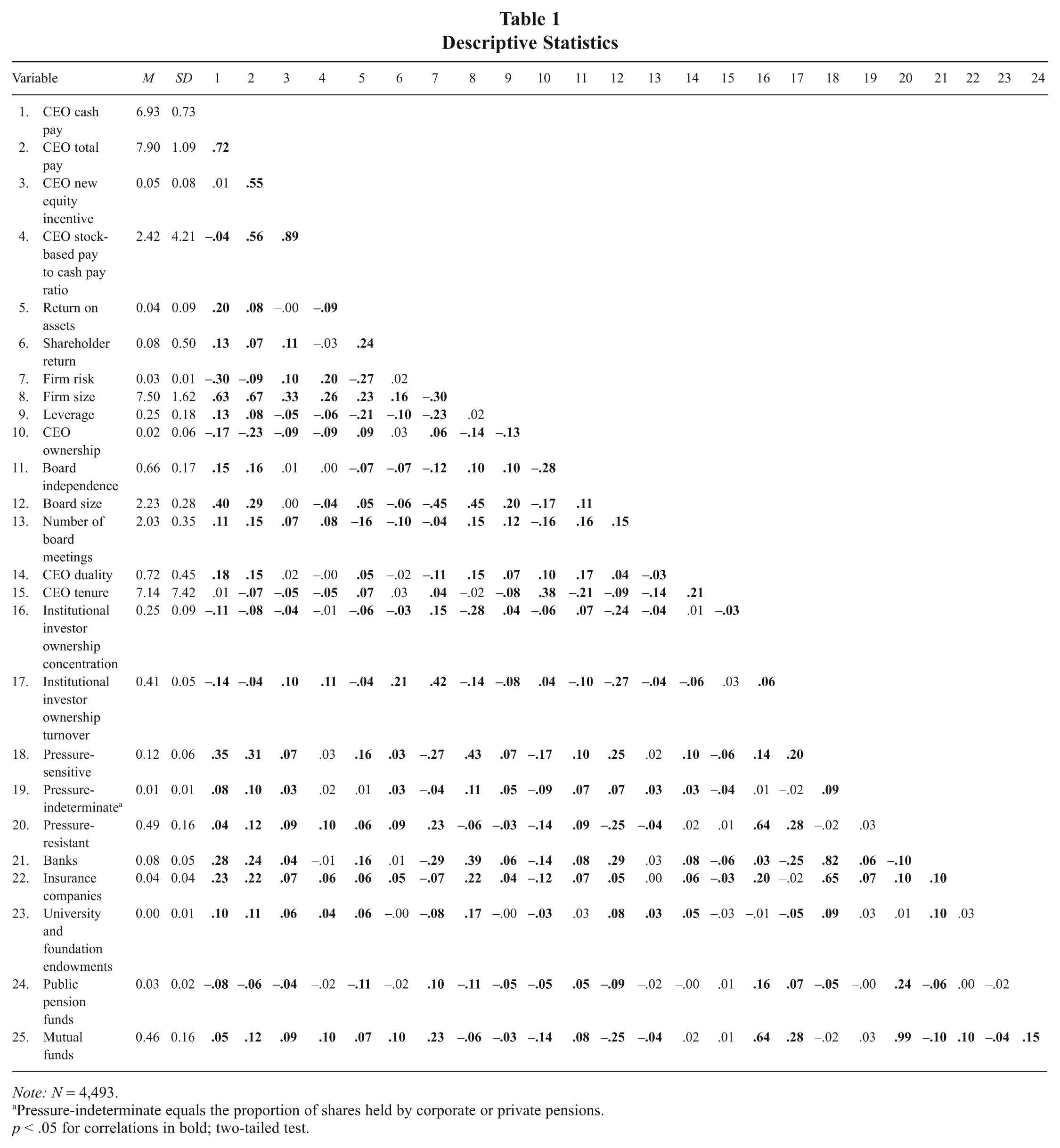
Note: N = 4,493.
Pressure-indeterminate equals the proportion of shares held by corporate or private pensions.
p < .05 for correlations in bold; two-tailed test.
Not surprisingly, consistent with Bushee (2001), most of the correlations among institutional investor ownership variables are positive and significant, suggesting the need to check for potential multicollinearity problems in multivariate analyses. However, none of the variables exhibit excessive correlations, and variable inflation factor scores are within acceptable limits (< 2.5). Thus, multicollinearity does not appear to be a problem in our analyses.
Pay Level
Table 2 presents our pooled cross-sectional time-series models that we use to examine our hypothesis regarding the level of CEO pay. Here we use both the level of CEO total pay and the level of CEO cash pay. Models 1 and 4 report the results for the control variables. In Models 2 and 5, we test the effect of institutional investor ownership on the level of CEO pay using Brickley et al.’s (1988) pressure-based classification. The results show that CEOs receive larger pay—both total pay and cash pay—in firms where pressure-resistant ownership is high, a surprising finding that is not consistent with previous research. However, the results in Models 3 and 6 resolve this mystery. As we predict in Hypothesis 1, public pension funds and mutual funds exert different effects on the level of CEO pay. Mutual fund ownership is significantly and positively associated with both CEO total pay and CEO cash pay, while public pension fund ownership is significantly negatively associated with CEO total pay. Public pension fund ownership is also negatively associated with CEO cash pay, but the relationship is not statistically significant at conventional levels. This result suggests that public pension funds endeavor to rein in CEO pay levels by granting less stock-based pay but not by cutting CEO cash pay. To formally test our hypothesis, we perform an F test comparing the coefficients on public pension funds and mutual funds in both Models 3 and 6 of Table 2. The results of the F test indicate that the coefficient on public pension funds is significantly smaller than that on mutual funds at the 1% level in both Models 3 and 6, supporting Hypothesis 1. Overall, the results support our hypothesis over Brickley et al.’s (1988) predictions. Given that mutual fund shareholdings overwhelm shareholdings of public pension funds at a typical firm, the positive effects of pressure-resistant ownership on CEO total and cash pay in Models 2 and 5 are not surprising.
Institutional Investor Ownership and the Level of CEO Pay

Note: N = 4,493. Standard errors are in parentheses. They are corrected for heteroskedasticity and serialcorrelation.
p < .05. **p < .01. ***p < .001.
Interestingly, institutional investor ownership concentration is significantly positively associated with both CEO total pay and CEO cash pay in control-only models. However, it is no longer significant when classified institutional investor ownership variables are entered. This result suggests that when we examine the effect of institutional investor ownership on CEO pay, although it is important to investigate whether there are concentrated institutional investors, it is more important to examine the effects of heterogeneous institutional investors. On the other hand, institutional investor ownership turnover remains positive and significant in the CEO total pay model even when classified institutional investor ownership variables are included. However, the variable becomes insignificant in the CEO cash pay model when classified institutional investor ownership variables are included. These results suggest that the investment horizon of institutional investors only affects CEO noncash pay—that is, CEO long-term pay.
As noted above, to ensure that our findings are not driven by potential reverse causality, we reexamine our CEO total pay model using instrumental variable two-stage least squares. In untabulated results, we continue to find that mutual fund ownership is positively associated with CEO total pay but that public pension fund ownership is negatively associated with CEO total pay. We also confirm our finding that the coefficient on public pension funds is significantly smaller than that on mutual funds at the 1% level. We thus conclude that our pay-level results are robust to potential endogeneity bias.
Pay-for-Performance Sensitivity
Table 3 reports the results from the Tobit model that we use to examine whether public pension fund and mutual fund ownership differ with respect to their effects on CEO pay-for-performance sensitivity. Models 1 through 3 report the estimation results where we test our hypothesis using as the dependent variable the sensitivity of new options and stocks to a 1% change in stock price. Model 1 reports the results for control variables. In Model 2, we use Brickley et al.’s (1988) pressure-based institutional investor classification. Consistent with previous research, our results show that pressure-sensitive ownership is significantly negatively associated with pay-for-performance sensitivity but that pressure-resistant ownership is significantly positively associated with pay-for-performance sensitivity. In line with Hypothesis 2, however, the results in Model 3 again show that public pension funds and mutual funds exert different effects on CEO pay policy regarding sensitivity to firm performance. Ownership of public pension funds is significantly negatively associated with pay-for-performance sensitivity, while ownership of mutual funds is significantly positively associated with pay-for-performance sensitivity.
Institutional Investor Ownership and CEO Pay-for-Performance Sensitivity

Note: N = 4,493. Standard errors are in parentheses. They are corrected for heteroskedasticity and serial correlation.
p < .05. **p < .01. ***p <.001.
For Models 4 through 6, we test our Tobit model using the ratio of CEO stock-based pay to cash pay as an alternative dependent variable in lieu of pay-for-performance sensitivity resulting from new option and stock grants. While the positive coefficient on mutual funds becomes insignificant in Model 6, the negative coefficient on public pension funds continues to be significant.
To formally test our hypothesis, we perform a Wald chi-square test comparing the coefficients on public pension funds and mutual funds in both Models 3 and 6 of Table 3. The results of the Wald chi-square test indicate that the coefficient on public pension funds is significantly smaller than that on mutual funds at the 1% level in both Models 3 and 6, supporting Hypothesis 2. Overall, the results again support our hypothesis over Brickley et al.’s (1988) predictions.
Institutional investor ownership turnover is positive and significant in all models, while institutional investor ownership concentration is insignificant in all models. This result lends additional support to our finding from the CEO pay-level model that, regardless of institutional investor type, institutional investors’ investment horizon affects a CEO’s long-term pay.
We again reexamine our CEO pay-for-performance sensitivity model using two-stage least squares. In untabulated results, we continue to find that mutual fund ownership is positively associated with pay-for-performance sensitivity. While the relationship between public pension fund ownership and pay-for-performance sensitivity is negative but insignificant, we confirm our findings that the coefficient on public pension funds is significantly smaller than that on mutual funds at the 1% level. Overall, these results suggest that our findings are not significantly affected by potential endogeneity bias.
Discussion
In this study, we examine whether public pension funds and mutual funds are resistant to pressure from their portfolio firms’ management and thus exercise tight control over CEO pay (Brickley et al., 1988). Our theory predicts that public pension funds and mutual funds do not have the same monitoring incentives and capabilities. In particular, because public pension funds face strict fiduciary responsibilities, they are expected to exercise greater control over CEO pay than do mutual funds, which experience conflicts of interest. We find that the effects of public pension funds and mutual funds on CEO pay are not only different, as predicted by our hypotheses, but also diametrically opposite: Public pension fund ownership is negatively associated with CEO total pay, whereas mutual fund ownership is positively associated with CEO total pay.
We further find that public pension fund ownership is negatively associated with a firm’s grant of stock-based incentives to its CEO. On the surface this may suggest a reduction in the sensitivity of CEO pay to performance. However, we argue that this actually works to protect shareholder wealth because it results from better informed monitoring and may help reduce the probability of detrimental CEO behavior such as earning manipulation and excessive risk taking. Importantly, while public pension fund ownership reduces stock-based pay, it does not increase CEO cash pay and thus results in lower CEO total pay. This finding indicates that public pension funds exercise influence over various aspects of CEO pay on behalf of shareholders.
In contrast, as the ownership of mutual funds increases, CEOs tend to receive greater stock-based pay and greater cash pay, resulting in increased CEO total pay. The fixed component of CEO pay (i.e., cash pay) is not converted to performance-contingent pay (“layering”). Thus, mutual funds appear to help their portfolio firms grant generous pay packages to their CEOs. This does not enhance value for the shareholders of either the portfolio firm or the fund. Rather, facing conflicts of interest, mutual fund managers shirk their role as corporate watchdogs and serve their parent firms’ goal of securing more business revenue from portfolio firms.
Our study advances our understanding of the role that different groups of institutional investors play in CEO pay, making contributions to the institutional investor ownership literature and the CEO pay literature in the following ways. First, we develop and test a theory that questions the previous literature’s assumption that both public pension funds and mutual funds are pressure resistant to firm management and hence that the two types of institutional investors contribute equally to shareholder wealth enhancement. Our study, therefore, provides a theoretical underpinning to the recent research stream that finds diverging effects of public pension funds and mutual funds on governance outcomes (e.g., Davis & Kim, 2007; Hoskisson et al., 2002). Our study suggests that the use of pressure-based classifications of institutional investors can be misleading because the pressure-resistant institutional investor category will reflect the confounding effects attributable to both public pension funds and mutual funds that differ significantly from each other in terms of their incentives and capabilities to monitor. Given the relative ownership composition, mutual funds will likely drive the overall effect of pressure-resistant institutional investor ownership at a typical firm. This is not because Brickley et al.’s (1988) classification was wrong but because institutional investors have become more heterogeneous in terms of their fiduciary responsibilities, conflicts of interest, and information asymmetry since Brickley et al.’s pressure-based classification was first introduced. Our theory explains why the results of our study, which uses relatively recent data, depart markedly from those of previous studies that use data from the late 1980s and early 1990s (e.g., David et al., 1998; Hoskisson et al., 2002). 9
Second, we add to the growing literature that questions the effectiveness and feasibility of the normative principle in controlling CEO pay, which calls for a low level of CEO total pay but high pay-for-performance sensitivity (e.g., Smith & Swan, 2008). CEO pay critics argue that CEO pay is too high and not sufficiently tied to firm performance (Bebchuk & Fried, 2004). Agency theory, however, predicts that a risk-averse executive with an undiversified portfolio will demand higher pay in order to compensate for bearing more risk induced by higher pay-for-performance sensitivity (Holmstrom, 1979; Holmstrom & Milgrom, 1987). Our results show that neither public pension funds nor mutual funds have an incentive to decrease the level of CEO total pay and increase pay-for-performance sensitivity simultaneously. Thus, our results suggest that the “less pay and more sensitivity” principle that pay critics have long advocated might be an ineffective goal to pursue.
Third, from an empirical standpoint, we use a more powerful ex ante measure of pay-for-performance sensitivity; specifically, we use the magnitude of new equity incentives that are contingent on a change in stock price rather than the simple ratio of long-term pay to CEO total pay typically used by prior research (e.g., David et al., 1998). Our more refined measure of pay-for-performance sensitivity lends more support to the validity of our empirical tests. We also employ an institutional investor classification that is more refined than the broad legal type classification provided by the CDA/Spectrum database.
This study is not without limitations. First, shareholders’ monitoring incentives and capabilities are hard to observe, and hence, our classifications are subject to possible measurement error that may bias our results. Second, it is difficult to disentangle holdings held by pensions and endowments from those held by mutual funds. Because mutual funds often serve as external managers for pensions and endowments, those externally managed holdings are recorded as holdings of mutual funds.
A fruitful avenue for future research would be to examine the mechanisms that institutional investors with different and sometimes conflicting incentives use to influence CEO pay decisions. Because institutional investors can influence CEO pay in their portfolio firms in various ways, ranging from filing shareholder proposals and casting proxy votes (i.e., proxy based) to negotiating with portfolio firm management (i.e., non–proxy based), a better understanding of these mechanisms is likely to have important implications for researchers and practitioners alike (e.g., Chowdhury & Wang, 2009). The SEC’s new regulation requiring mutual funds to disclose their proxy votes could provide a fertile setting to directly examine such mechanisms.
Additionally, it would be interesting to directly test the strength of the compromising effects of economic bonds between mutual funds and their portfolio firms. In 2007, the U.S. House of Representatives passed the Shareholder Vote on Executive Compensation Act, which became effective for annual meetings on or after January 1, 2009. This act requires that shareholders be provided an annual nonbinding vote to approve executive pay as disclosed in the proxy statements. However, our results suggest that mutual funds, the largest group of institutional investors, are unlikely to exercise their voting power to curb excessive executive pay because they face conflicts of interest arising from the funds’ business ties with their portfolio firms (Corporate Library, 2006). This concern warrants future research using detailed data on the fees that mutual funds receive for providing 401(k) management and other financial services to their portfolio firms as proxies for conflicts of interest.
Another interesting avenue for future research would be to classify public pension funds further based on their investment strategy. While we treat public pension funds as a homogeneous group of investors, there is a substantial level of heterogeneity in public pension funds (Del Guercio & Hawkins, 1999). Further classifying each public pension fund based on fund organization, activism objective, and investment strategy using field interviews and examining the potential effect of heterogeneity in public pension funds on CEO pay would provide a much richer understanding of the role of public pension funds in influencing CEO pay practices.
Finally, the conflict-of-interest problems associated with CEO pay are not limited to mutual funds. Compensation consultants also face conflicts of interest because they earn more fees from client firms by providing services other than executive pay advice. According to a U.S. House of Representatives report, “In 2006, the compensation consultants that provided . . . services to Fortune 250 companies received an average of $220,000 for executive compensation advice and $2.3 million for other services from each client company.” 10 Given that compensation consultants have been described as playing an important role in escalating CEO pay (Crystal, 1991), it would also be interesting to examine the effects of compensation consultants’ conflicts of interest on CEO pay practices.
Footnotes
Acknowledgements
We wish to thank Senior Associate Editor Christopher Shook and two anonymous reviewers for helpful suggestions for improving the manuscript. We also benefited from the insightful comments of Ana Albuquerque, Mason Carpenter, Heechun Kim, and Ella Mae Matsumura. This work was supported by the research fund of Hanyang University (HY-2009-O).