







Abstract
From the origins of resource-based theory, scholars have emphasized the importance of human capital as a source of sustained competitive advantage, and recently there has been great interest in gaining a better understanding of the micro-foundations of strategic capabilities. Along these lines, there is little doubt that heterogeneous human capital is often a critical underlying mechanism for capabilities. Here, the authors explore how individual-level phenomena underpin isolating mechanisms that sustain human capital–based advantages but also create management dilemmas that must be resolved in order to create value. The solutions to these challenges cannot be found purely in generic human resource policies that reflect best practices. These are not designed to mitigate idiosyncratic dilemmas that arise from the very attributes that hinder imitation (e.g., specificity, social complexity, and causal ambiguity). The authors drill down deeper to identify individual- and firm-level components that interact to grant some firms unique capabilities in attracting, retaining, and motivating human capital. This cospecialization of idiosyncratic individuals and organizational systems may be among the most powerful isolating mechanism. The authors conclude by outlining a research agenda for exploring cross-level components of human capital–based advantages.
From the origins of the resource-based theory of the firm, scholars have emphasized the importance of human capital as a source of sustained competitive advantage (Barney, 1991). However, the underlying mechanisms tying human capital to competitive advantage have not been fully developed. Recent calls to drill down to the “micro-foundations” of resources and capabilities have highlighted the critical role of individuals in creating and sustaining competitive advantages (Abell, Felin, & Foss, 2008; Felin & Hesterly, 2007; Teece, 2007). As such, the more we drill down, the more we see that the micro-foundations of capabilities are bolstered by human capital—that is, the knowledge skills and abilities of individual employees. Presumably, firms with superior human capital are better positioned to create resources and capabilities characterized by asset specificity, social complexity, and causal ambiguity, making them very difficult to imitate (Barney, 1991; Hall, 1993; Reed & DeFillippi, 1990).
While human capital may be at the root of many capabilities, the micro-foundations of human capital management are not well developed (Coff, 1997). This lack of development is concerning because, as we shall see, the very factors that make human capital inherently hard to imitate may also make maximizing value through human capital a highly complex and difficult challenge. Since valuable capabilities rely on individuals with idiosyncratic goals, desires, and preferences who can choose whether to join, stay, or exert effort, our search for solutions may also need to focus on individuals. As Foss (2011; this issue) points out, a more detailed understanding of individuals and their interactions with each other and the firm may help us to uncover how firms are better able to cope with the inherent dilemmas associated with human capital–based competitive advantages.
Our primary thesis, then, is that human capital–based advantages require multilevel solutions to address vexing challenges associated with attracting, retaining, and motivating talented employees. As such, a human capital–driven advantage requires a set of capabilities and a complementary set of unique individuals. We review the separate problems of attracting, motivating, and retaining talented employees and highlight the multilevel nature of human capital dilemmas as well as their possible solutions. In keeping with the goals of this special issue, we also highlight fruitful opportunities for future research.
Human Capital and the Promise of Competitive Advantage
Early human capital theory focused on investment decisions that individuals face when considering acquisitions of new knowledge or skills (Ashenfelter, 1978; Ashenfelter & Krueger, 1994; Becker, 1964; Griliches, 1977). Thus, we must define human capital at the micro level—an individual’s stock of knowledge, skills, and abilities (hereafter, skills) that can be increased through mechanisms like education, training, and experience (Becker, 1964). This definition contrasts conceptualizations often utilized by strategy scholars that characterize human capital as a unit-level resource (Ployhart & Moliterno, 2011). For convenience, we refer to the firm-level aggregation of employee skills as firm-level human assets. As such, the origins of human capital are inherently at the micro level despite a more macro focus in the strategy literature on the aggregate human capital resources available to the firm (Hatch & Dyer, 2004; Kor & Leblebici, 2005).
To focus our arguments, we first define human capital–based competitive advantage. Peteraf and Barney (2003: 314) argue that “an enterprise has a competitive advantage if it is able to create more economic value than the marginal (breakeven) competitor in its product market.” By extension, a human capital–based advantage arises when this “greater economic value” is attributable to the firm’s access to and utilization of employee knowledge, skills, and abilities. Thus, for the present discussion, the critical path to human capital–based competitive advantage requires attracting, retaining, and motivating employees with valuable human capital at an economic discount relative to competitors.
Isolating Mechanisms and Human Capital
It is widely accepted that human capital holds promise as a source of sustainable advantage since human assets are often valuable, rare, and imperfectly imitable (Barney, 1991; Hall, 1993; Hatch & Dyer, 2004). Human capital is valuable for the unique abilities that individuals can bring, and it can also be quite rare—particularly at high levels of specialized expertise. Finally, to result in a sustained advantage, human capital must be associated with isolating mechanisms that keep rivals at bay. Human capital–based advantages are often linked to three key isolating mechanisms: firm-specificity, social complexity, and causal ambiguity. These operate simultaneously at the firm level and the individual level in slightly different ways, as we discuss below. It is worth underscoring that human capital derives its strategic importance from idiosyncratic individual differences—again highlighting the need for strong micro-foundations.
Firm-specificity is the extent to which individual assets are tailored for use in a single firm (Williamson, 1975). The strategy literature often treats specificity as a requirement for strategic assets (Amit & Schoemaker, 1993). Firm-specificity can serve as an isolating mechanism since there is no market to bid up the price of these assets (Klein, Crawford, & Alchian, 1978)—they cannot be deployed in other contexts. At the firm level, firm-specificity describes the extent to which human assets are more valuable to the current firm than to rivals. For individuals, firm-specificity may limit mobility since employees’ skills are less valuable to other firms. Skills can be more or less firm-specific due to idiosyncratic attributes (Becker, 1964) or due to complex combinations of general skills that lead to idiosyncratic bundles of skills (Lazear, 2009).
Social complexity refers to the extent to which individual assets are embedded in highly complex social systems (Barney, 1991). At the firm level, these socially complex systems hinder the replication of human assets—systems that are more complex are harder to copy. The resources might be quite valuable to competitors, but the complexity makes them very difficult to copy. Additionally, as complexity increases, it becomes more difficult to extract any single piece of the system without degrading value. In other words, the value of a single employee’s human capital may be drastically reduced if plucked out of the particular complex social system.
Causal ambiguity is the extent to which individual assets are difficult to link to organizational performance (Lippman & Rumelt, 1982; Reed & DeFillippi, 1990). At the firm level, it may be hard to link human capital to performance. On the individual level, the importance of tacit knowledge presents additional dilemmas precisely because it resides in the heads of individuals (Felin & Hesterly, 2007). Tacit knowledge can be causally ambiguous both for managers and competitors. It is unclear who has the knowledge, or even which knowledge is critical. Thus, causal ambiguity hinders rivals’ attempts to identify which aspects of a firm’s human capital management routines to copy and which employees are most important to hire away.
Generic Human Resource Systems Cannot Fully Explain Human Capital–Based Advantages
Taken together, firm-specificity, social complexity and causal ambiguity provide three mechanisms that may explain why human assets can be a key source of sustained advantage. Accordingly, the strategic human resource (HR) management literature has continued a rich tradition of prescribing HR systems and policies that enhance a firm’s human capital resources (Arthur, 1994; Lado & Wilson, 1994). However, one could argue that these fully codified solutions are easily understood and, thus, unlikely to offer sustained human capital advantages on their own (Chadwick & Dabu, 2009). If so, we should generally expect these “best practice” solutions to be strategically less relevant. In other words, these systems may help firms increase efficiency given their chosen strategies, but the systems are chosen to fit with a strategy rather than to provide sustained advantages in and of themselves.
Additionally, Becker and Huselid (2006) critique the strategic HR literature for its “black box” approach to relating HR systems to firm performance. They explicitly call for more theory and empirical analysis to open this black box and more carefully articulate the mechanisms connecting HR systems to human capital–based advantages. We echo these concerns and also suggest that an excessive focus on firm-level HR practices has obscured the inherently multilevel nature of human capital (Ployhart & Moliterno, 2011). A more careful analysis at the individual and firm levels reveals both varied sources of the isolating mechanisms and underappreciated dilemmas created by these mechanisms.
Micro-Foundations and Human Capital–Based Dilemmas
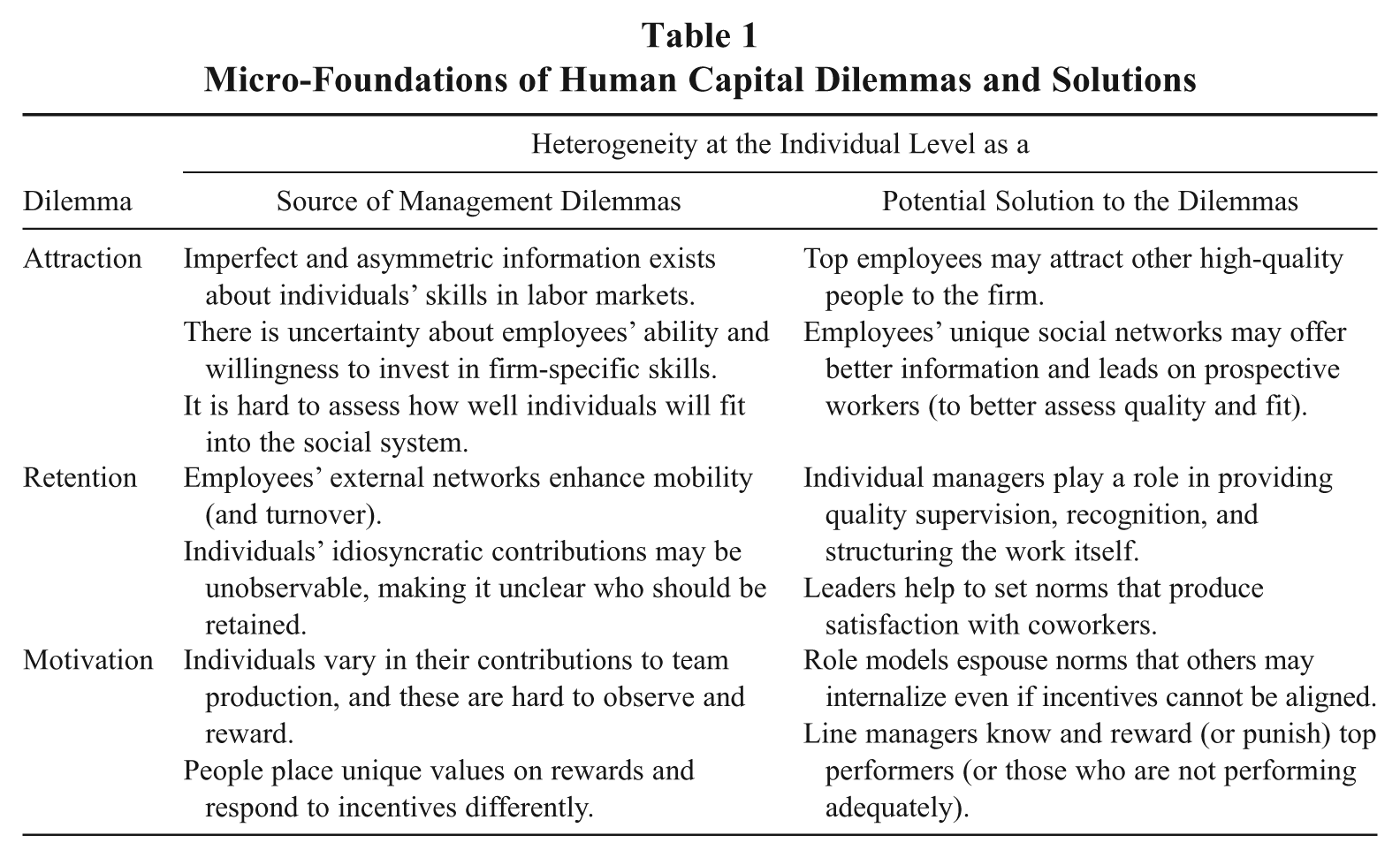
While human capital is a promising source of sustained competitive advantage, the attributes that make these resources so attractive also pose significant management dilemmas. As Coff (1997) points out, unlike other types of resources, humans can quit, withhold effort, and bargain for rents. To create and sustain superior human assets, managers must mitigate challenges linked to (1) attracting and hiring critical employees, (2) retaining the best employees, and (3) motivating employees. Successfully navigating these challenges provides a necessary, but not sufficient, condition for a human capital–based competitive advantage. In the following sections, we explore these challenges along with potential coping strategies. A summary of our arguments is shown in Table 1.
Micro-Foundations of Human Capital Dilemmas and Solutions
Attracting Human Capital
Attraction dilemmas from isolating mechanisms
The first challenge on the road to a human capital–based advantage is attracting and hiring employees with valuable human capital. Doing so is challenging because individuals have unique mixes of human capital that are difficult to observe and evaluate ex ante. As a result, human capital markets are imperfect and laden with hazards. First, since firms cannot generally hire employees with firm-specific human capital, they must seek individuals who have both the motivation and the ability to acquire the desired firm-specific human capital once hired. As we see from the substantial literature exploring employee selection challenges (e.g., Ployhart, 2006; Trank, Rynes, & Bretz, 2002), identifying employees with this future potential can be especially difficult. This difficulty is amplified when the focal skills are idiosyncratic to the firm and cannot be observed ex ante.
Beyond hiring employees with the right skills and potential to learn, firms must also hire employees who properly “fit” into the organization. Those who do not fit may not be as motivated or productive and/or may quickly leave the firm (O’Reilly, Chatman, & Caldwell, 1991; Schneider, 1987). Hiring for fit can be especially challenging in firms with socially complex human capital resources since individuals must internalize and adapt to the organizational culture, identity, routines, norms, values, and so forth. For these complex systems to work, employees need to cooperate and share knowledge. As Borgatti and Cross (2003) show, however, the social costs of sharing and accessing valuable information may overshadow the perceived value of cooperating—especially for employees who are not well integrated.
Additional hiring challenges arise from the classic “market for lemons” adverse selection problem (Akerlof, 1970). Adverse selection happens when there is asymmetric information in the market—that is, individuals know more about their skills than potential employers do. As employers offer lower wages to mitigate the risk of hiring lemons, workers with exceptional human capital choose to avoid this job-switching penalty. Thus, job seekers will be disproportionately low-quality workers. Causal ambiguity can further exacerbate this lemons problem by making it more difficult to identify how prospective employees may have contributed to their prior employers’ successes. For example, applicants may misrepresent themselves by taking credit for others’ successes. Causal ambiguity will thwart efforts to verify such claims.
These dilemmas highlight a very complicated attraction challenge—firms must attract high-quality employees amid imperfect information about their skills, abilities, and fit with the organization, while employees may offer incorrect or misleading information about their own qualities. Firms often rely on crude signals, such as educational level, even though wide variations in productivity remain (Delfgaauw & Dur, 2007; Spence, 1973). Thus, the ability to identify individuals with valuable human capital, using incomplete information, may be quite central to competitive advantage. This mastery may take the form of a competency in gathering and interpreting labor market signals—a driving force behind strategic factor market theory (Barney, 1986b; Makadok & Barney, 2001). For example, in the book Moneyball, Michael Lewis (2004) describes how the Oakland Athletics used a different set of signals than those of rivals and so were able to identify good baseball players that other teams ignored and acquired those players at economic discounts.
Coping strategies for attraction dilemmas
Strategic HR scholars have devoted much research to uncovering various selection policies and practices that reduce uncertainty and improve fit in the hiring process (see Ployhart, 2006, for a recent review). However, our discussion has focused on the specific problems linked to firm-specificity, social complexity, and causal ambiguity. These problems may not be present in all cases in equal measure. As such, HR practices geared toward identifying those who can and will invest in specific human capital may be important only in some contexts. These practices might include gaining labor market intelligence through checking references or, perhaps, in-basket exercises to see if applicants pick up subtleties as they respond to simulated problems. In other settings, the problem may be finding people who fit into a team-based setting. Here, it may be more important to develop an assessment center approach to identify team-based skills. Thus, the specific bundle of HR policies may need to be just as idiosyncratic as the underlying human assets.
Beyond the application of idiosyncratic HR policies, we suggest two additional avenues of research that especially highlight the micro-foundations of this attraction problem. First, high-quality employees may be particularly concerned with the quality of coworkers, especially in knowledge-intensive environments where mentorship can have long-term career impacts. Having current “stars” may help an organization attract future stars. This possibility opens interesting avenues for human capital scholars where the economic value of hiring stars is repeatedly questioned (Adler & Kwon, 2002; Groysberg & Lee, 2009)—since stars can appropriate so much of their value, are they really worth the high market wages? If up-and-coming stars are attracted by existing stars, then these up-and-coming stars may be willing to make wage or other sacrifices in order to work with existing stars, just as employees may be willing to forego wages for other nonpecuniary job benefits (Cable & Turban, 2003; Stern, 2004).
Second, the interpersonal networks of current employees can provide excellent sources of information about potential employees, as evidenced by recent increases in employee referral programs. Firms appear to experience substantial hiring benefits, such as better fit, higher employee quality, and lower subsequent turnover, by using employee referrals (Fernandez, Castilla, & Moore, 2000). These benefits derive not from intraorganizational social networks, or from any formal organizational ties, but rather from the informal and personal social networks of the individual employees.
In this way, a focus on organization-level solutions to attraction dilemmas may lead to a lack of emphasis on individual-level factors that may be critical in generating firm-level heterogeneity in human capital. While heterogeneity among individuals may be the source of substantial attraction and hiring dilemmas, individuals may also be part of the solution to overcome these challenges. These examples of how individuals may help to mitigate hiring dilemmas only scratch the surface. The strong focus on organization-level policies and routines has undoubtedly left many opportunities to integrate micro-foundations of attraction and hiring into theories of human capital–based advantages.
Retaining Human Capital
Retention dilemmas from isolating mechanisms
The three isolating mechanisms also engender challenges for retaining human capital. For example, a paradox arises from the fact that firms often seek people who, once hired, will be adept at acquiring firm-specific knowledge and routines. In this case, ironically, the best labor market signal of employee quality may be whether individuals have gained specific skills at other firms (Morris, Alvarez, Barney, & Molloy, 2010). The most observable indicator of employees’ firm-specific skills may be their tenure at firms known to produce proprietary knowledge. The employees’ actual skills may not be valuable outside of the focal firm, but the ability to acquire new firm-specific knowledge may be quite valuable. The irony, then, is that knowledge that cannot be applied in other firms may actually increase employees’ mobility, as other employers infer that such individuals will be able to acquire new firm-specific knowledge. Accordingly, turnover may be more of a threat for firm-specific human assets then is normally presumed in the literature (Becker, 1964).
Social complexity also may pose retention hazards. On one hand, it can have a strong firm-specific component—as social complexity increases, employees need more sophisticated mental mappings of who knows what and how things get done in the firm. Here, social complexity may enhance retention if the social ties are valuable within the firm but not applicable externally. Of course, as the discussion above suggests, the ability to form ties may be in strong demand even if the actual ties are not.
On the other hand, some forms of social complexity may directly increase an individual’s value in the labor market. Boundary spanners, for example, are embedded in complex social networks that span both internal and external relationships. These boundary-spanning relationships may be quite valuable to rivals (Bartol, 1979; Kerr, von Glinow, & Schriesheim, 1977). Losing these boundary spanners, however, can be quite damaging because they are critical for dynamic capabilities—that is, they often help the firm to incorporate external knowledge and information. Accordingly, social complexity may directly or indirectly increase the threat of employee turnover. Whether a given individual is at risk for turnover depends on the nature of his or her social ties.
Finally, causal ambiguity also can create a retention dilemma. It can increase talent retention because it is hard for rivals to identify knowledge that specific employees hold and the relative value of that knowledge. At the same time, however, internal managers may not know any more about employee skills than their competitors do. In knowledge-intensive environments, it can be very difficult to identify who knows what and equally difficult to identify how any one individual’s knowledge connects to performance outcomes. The problem for the manager, then, is identifying which employees to retain. Recent work by Oettl (2010) shows that some stars may actually increase productivity more through helping others than by producing themselves. As such, it may be especially hard to identify these “mavens” in work environments where helping behaviors are not immediately clear to supervisors and/or coworkers. For example, Grant Hill is the only person to have won the National Basketball Association’s (NBA) sportsmanship award three times. While NBA players across the league have voted repeatedly for Hill, his team-building behaviors may be hard for owners to observe directly. If firms fail to retain these helpful stars, the firms may lose substantial sources of economic productivity.
Potential coping strategies for retention dilemmas
One clear possibility for retaining human capital is simply to pay people enough that they stay (Akerlof, 1984; Weiss, 1990)—this distributes rent and thereby lowers observed profitability. Beyond this, there is a variety of alternatives that may promote retention without allocating rent. Drawing from the turnover literature, we see that a person’s propensity to change jobs depends on perceptions of the current job relative to alternatives (Shaw, Delery, Jenkins, & Gupta, 1998). Thus, firms may decrease turnover by either (1) raising perceptions of the current job or (2) lowering perceptions of alternatives. These perceptions can be influenced both by managing the nonfinancial aspects of job satisfaction and by investing in firm-specific skills.
Firms can raise employee perceptions of the current job by managing the nonfinancial facets of employee job satisfaction. Job satisfaction is featured prominently in the turnover literature as a trigger to prompt search behavior (Hom, Caranikas-Walker, Prussia, & Griffeth, 1992; Lee, Mitchell, Wise, & Fireman, 1996). For example, the Job Descriptive Index measures five dimensions: (1) pay, (2) supervision, (3) coworkers, (4) promotion, and (5) the work itself (Jung, Dalessio, & Johnson, 1986), and there is evidence that nonfinancial facets can substitute for wages (Cable & Turban, 2003; Stern, 2004).
The four nonpecuniary dimensions of job satisfaction offer significant opportunities to retain employees at potentially low cost. These dimensions can be elevated either through systematic HR policies or through individual-level phenomena. First, firms can improve satisfaction with supervision by training and selecting managers who provide learning opportunities, promote employee participation, provide recognition, and promote fairness in their decisions. Of course, we must also recognize that perceptions of the quality of supervision may be linked to specific high-profile leaders and role models as opposed to systematic firm-level HR policies.
Second, satisfaction with coworkers can be increased by managing group demography and social activities to create a team-based work environment (O’Reilly, Caldwell, & Barnett, 1989). As people develop strong relationships within the firm, they are less likely to leave (Mitchell, Holtom, Lee, Sablynski, & Erez, 2001; Shaw, Duffy, Johnson, & Lockhart, 2005). Similarly, individual-level processes may enhance satisfaction with coworkers. For example, leaders may actively set work group norms that generate satisfaction with the team as a whole.
Third, firms can enhance satisfaction with promotion through HR policies that structure desirable career paths such that assignments are offered as rewards. This is a consistently important facet—especially among workers with substantial human capital (Rice, Gentile, & McFarlin, 1991; Scarpello & Campbell, 1983). At the same time, individual managers may play a role in framing work assignments as rewards or forms of recognition to employees. Indeed, small changes in responsibilities may take on symbolic significance depending on how they are presented.
The last dimension, the work itself, is particularly important to professionals who often seek autonomy and input (Raelin, 1986)—something that may be inexpensive to provide. In some cases, jobs are designed through active HR intervention. However, jobs often emerge and are structured by line managers. As such, individual managers may be in a position to generate intrinsically rewarding work settings.
In sum, since employees value nonfinancial dimensions of satisfaction, these facets can substitute for wages while still enhancing retention. Indeed, some have studied the extent to which attempts to motivate individuals extrinsically (wages, etc.) can crowd out natural intrinsic motivation (Frey, 1993, 2002; Murdock, 2002). Since these intrinsic facets can be quite valuable to employees, but inexpensive to maintain (once in place), they may serve as important components of a sustainable advantage.
In addition to influencing perceptions of their current jobs, firms can affect employee perceptions of alternative jobs. One way firms may affect employee perceptions of outside options is by encouraging employees to become embedded in their organizations and communities (Holtom, Mitchell, & Lee, 2006; Lee, Mitchell, Sablynski, Burton, & Holtom, 2004). The many links that employees form with other individuals and organizations in their communities lead to idiosyncratic networks that are, by their very nature, very difficult to re-create elsewhere. The more embedded employees become, the more likely they are to believe that they cannot replace these networks should they choose to leave. In other words, by helping employees to become socially embedded in their organizations and communities, firms can change employee perceptions of their outside options. The strategic value of embeddedness is not that employees derive value from their connections but that employees derive more value from these connections than they think they can find elsewhere. While embeddedness can emanate from unique HR policies, it may also emanate naturally from interpersonal relationships or other aspects of organizational life not directly created or bestowed by the firm and its managers.
Motivating Human Capital
Motivation dilemmas from isolating mechanisms
In addition to having the right human capital, firms must deal with the complex problems associated with employee motivation. Just having the right employees in place does not ensure that they will exert sufficient effort toward essential work tasks. As with attraction and retention, each of the three isolating mechanisms poses challenges in motivating employees.
Firm-specificity, the first of the isolating mechanisms, is the focus of a classic human capital motivation dilemma. Wang and Barney (2006) observe that while firm-specific human capital may be critical for competitive advantage, employees may be unmotivated to invest in such skills since they may effectively decrease their opportunities outside of the firm. All else equal, employees may prefer not to undertake such investments.
Social complexity may pose a different sort of motivational challenge. Complex social systems engender team production problems by which individual effort and contributions are hard to observe (Alchian & Demsetz, 1972). This, in turn, makes it hard to rely on powerful incentives and may lead to shirking, poor motivation, or even subversive behavior (Ouchi, 1980). While these problems are addressed in agency theory (Jensen & Meckling, 1976), the motivation literature also documents reduced effort in some team settings (Kidwell & Bennett, 1993). When individual contributions are intertwined, employees may be uncertain about whether their efforts will impact outcomes (e.g., expectancy). In addition, the firm cannot easily provide performance-based rewards (e.g., instrumentality). Finally, individuals have distinct utility functions such that the value of rewards (valence) varies across people. If valence, expectancy, and instrumentality are low, it will be hard to motivate employees (Vroom, 1964).
Similarly, causal ambiguity paves the way for problems of moral hazard. People often take credit for successes and assign external attributions for failures when it is difficult to observe causality. Attribution theory refers to this as the “self-serving bias” (Miller & Ross, 1975). Therefore, it may be very hard for managers to recognize what behaviors and/or skills ought to be rewarded. Since causality cannot be established, organizations may inadvertently reward or punish employees for events that are beyond the employees’ control or influence (Kerr, 1975, 1995).
Potential coping strategies for motivation dilemmas
Conventional solutions to the firm-specific investment problem include offering higher wages to compensate employees for firm-specific investments or providing contractual assurances of ex post compensation. There may also be nonpecuniary or intrinsic rewards linked to human capital investments. For example, socialization research suggests that individuals may actively choose to invest in firm-specific human capital (Morrison, 1993). That is, people may experience positive utility by matching a group’s norms, values, and culture (Gottschalg & Zollo, 2007; Morrison, 1993)—similar to what Foss (2011) calls a normative frame. Where organizational norms support investments in firm-specific human capital, some individuals will choose to conform with expectations. These norms may be reinforced both by HR policies to integrate new hires and by specific individuals who espouse the norms.
The other motivation dilemmas arise around difficulties in identifying and measuring individuals’ contributions. In this context, cultural norms may substitute for close monitoring or powerful incentives (Ouchi, 1980). Some aspects of a corporate culture can be encouraged and maintained by HR policies and other organization-level routines (Lengnick-Hall & Lengnick-Hall, 1988; Schein, 2004). For example, recruitment, selection, and recognition systems can focus on those who espouse the firm’s core values. At the same time, high-profile individuals who espouse those values may be invaluable and irreplaceable (Meindl, 1989; Pettigrew, 1979). The idiosyncratic blend of critical individuals with organizational systems may be a key to understanding why corporate culture holds so much promise as a source of competitive advantage (Barney, 1986a).
Beyond this, individuals may play an important role in resolving the information asymmetries that hinder effective reward systems. Performance appraisal data can be gathered from a wide array of individuals who, in turn, have unique perspectives on each other. Such 360-degree feedback draws on individual variation in information and perspectives and may therefore help firms craft effective incentives even in the context of social complexity or causal ambiguity. Additionally, some firms are beginning to utilize social media to allow employees to nominate others for positive work as a way to better observe and reward performance.
Future Directions and Conclusion
While we agree that human capital provides a promising source of competitive advantage in the resource-based theory of the firm, we add our voices to those who have called for stronger micro-foundations for understanding resources and capabilities (Coff, 1997; Felin & Hesterly, 2007; Foss, 2011; Teece, 2007). Here, we focus specifically on the context of human capital–based advantages. Beyond our general call for research, we identify several specific areas we believe will be particularly fruitful. A greater understanding of the micro-foundations of human capital–based competitive advantage requires further integration of micro theories of individual motivation and behavior with macro theories explaining firm-level activities.
Table 1 summarizes our discussion of the role that individual-level differences play in (1) creating management dilemmas that could hinder the emergence of a competitive advantage and (2) discovering possible solutions to these challenges. This represents a rich set of opportunities for further research needed to build a more robust theory of human capital–based competitive advantages. In this way, we have contributed by highlighting how the isolating mechanisms at the core of the resource-based view emanate from phenomena at the individual level. These make human capital a promising source of competitive advantage, but they also generate challenging management dilemmas that require idiosyncratic solutions.
These embedded dilemmas are probably not conducive to standardized organization-level solutions. First, each firm is likely to experience idiosyncratic challenges depending on the firm’s unique mix of people—there is no one size that fits all. Furthermore, the solutions require the integration of firm-level systems with key individuals. This focus on idiosyncratic problems and cross-level solutions differs considerably from much of the extant literature.
In moving forward with this agenda, we see two especially fruitful avenues of inquiry. First, the development of micro-foundations requires a better understanding of how firm-level policies and procedures interact with individual-level phenomena. Here, we have focused on how the idiosyncratic isolating mechanisms linked to human capital require similarly idiosyncratic organizational policies and procedures. As such, we hope to see a move away from studying standardized bundles of organizational best practices to identifying which practices mitigate specific dilemmas arising from the idiosyncratic attributes of a given firm’s pool of human capital. Some nascent research begins to explore whether firms with unique corporate strategies also have superior performance. Likewise, there may be fruitful opportunities to explore whether firms with unique or idiosyncratic HR systems, as opposed to standard HR systems, realize human capital–based advantages.
Second, while there has been a strong focus on such firm-level systems, there has been less emphasis on the role of individuals. Here, we offered some examples of how individuals may play central roles in addressing the dilemmas in attracting, retaining, and motivating human capital. This is a central question of the emerging literature studying the impact of stars on organizational outcomes (Groysberg & Lee, 2009). It is also quite apparent as we observe stock prices that fluctuate with the health of key contributors such as Steve Jobs at Apple Computer. Similarly, we hope to stimulate work that emphasizes the interaction of key individuals with organizational systems. It seems likely that effective systems may be cospecialized to create highly idiosyncratic capabilities composed of distinct structures, systems, and individuals. One very interesting opportunity for future research may be to explore how the reputations of current stars affect attraction of future stars and how rents are divided accordingly. Are up-and-coming stars willing to accept lower wages in order to work for current stars? If so, are current stars able to appropriate some of the value associated with the productivity of up-and-coming stars?
In conclusion, we have argued that simply acquiring superior human capital is not enough, despite conventional assumptions that superior human capital can lead to sustained competitive advantage. We have reviewed the challenges associated with attracting, retaining, and motivating human capital and explored how complex idiosyncratic cross-level solutions are required to mitigate these challenges. There is much to be done, and the path will not be easy given silo-like divisions among micro and macro scholars. Nevertheless, drilling down in this way holds great promise in energizing the strategic human capital literature.