







Abstract
An integrative self-definition model is proposed to improve our understanding of how procedural justice affects different outcome modalities in organizational behavior. Specifically, it is examined whether the strength of different levels of self-definition (collective, relational, and individual) each uniquely interact with procedural justice to predict organizational, interpersonal, and job/task-oriented citizenship behaviors, respectively. Results from experimental and (both single and multisource) field data consistently revealed stronger procedural justice effects (1) on organizational-oriented citizenship behavior among those who define themselves strongly in terms of organizational characteristics, (2) on interpersonal-oriented citizenship behavior among those who define themselves strongly in terms of their interpersonal relationships, and (3) on job/task-oriented citizenship behavior among those who define themselves weakly in terms of their distinctiveness or uniqueness. We discuss the relevance of these results with respect to how employees can be motivated most effectively in organizational settings.
Ever since Organ and colleagues introduced the term organizational citizenship behavior (Bateman & Organ, 1983; Smith, Organ, & Near, 1983), scholars and practitioners have shown a particular interest in understanding the processes that explain these types of behaviors. Citizenship refers to a variety of discretionary, extra-role behaviors that contribute to organizational effectiveness but are not explicitly required (e.g., LePine, Erez, & Johnson, 2002; Organ, 1988, 1997). Given that employees are not necessarily rewarded for citizenship, it has been argued that the motivation to engage in these behaviors depends upon how employees define, evaluate, and regulate themselves in organizational life (Deci & Ryan, 2000; De Cremer & Tyler, 2005).
One factor that has a profound influence on the display of citizenship behaviors is the perceived fairness of the procedures used to arrive at outcome allocation decisions (i.e., procedural justice; Tyler, 1988; for overviews of the relation between procedural justice and citizenship behavior, see, e.g., Cohen-Charash & Spector, 2001; Fassina, Jones, & Uggerslev, 2008; LePine et al., 2002). It has been argued that this pervasive effect results because procedural justice contributes greatly to employee self-regulatory functioning in organizations by satisfying the basic needs associated with how employees define themselves (e.g., pride, respect, and standing; De Cremer & Tyler, 2005; Sedikides, Hart, & De Cremer, 2008).
Interestingly, employees distinguish between citizenship behaviors that demonstrate commitment and loyalty to the organization, behaviors that help and assist other organization members, and extra effort to demonstrate dedication and persistence in one’s own job (Coleman & Borman, 2000; LePine et al., 2002). Although procedural justice has revealed positive associations with each of these types of citizenship behavior (e.g., Moorman, Blakely, & Niehoff, 1998; Tepper, Lockhart, & Hoobler, 2001), it is as yet unclear exactly when (and thus why) procedural justice translates into which specific type of citizenship behavior (Colquitt, Conlon, Wesson, Porter, & Ng, 2001; Greenberg, 2001).
In the present contribution, we will draw upon identity theory and research (e.g., Blader & Tyler, 2009; De Cremer & Tyler, 2010; Farmer & Van Dyne, 2010; Markus & Wurf, 1987; Stryker, 1987; Tyler & Blader, 2003) to argue that the specific type of citizenship behavior that is regulated according to perceptions of procedural justice depends on employee self-definition. Self-definition refers to the salience of particular levels of identity in one’s overall self-concept. Specifically, employees define themselves in terms of characteristics shared with salient groups or organizations (i.e., collective identity) or with others in the group or organization (i.e., relational identity) or, conversely, in terms of characteristics that highlight their uniqueness (i.e., individual identity; Brewer & Gardner, 1996; Sedikides & Brewer, 2001). We will argue that procedural justice influences each type of citizenship behavior because it potentially validates each level of identity (Sedikides et al., 2008). Thus, we propose that procedural justice regulates the enactment of a particular identity by means of engaging in types of citizenship behavior that fit the employee’s identity (Farmer & Van Dyne, 2010; Markus & Wurf, 1987; Stryker, 1987).
In doing so, we build on research that examined another, yet related, question of whether each level of identity relates to a specific type of justice (Collective Identity × Procedural Justice, Relational Identity × Interactional Justice, and Individual Identity × Distributive Justice) to predict targeted attitudes and behavioral intentions (Johnson, Selenta, & Lord, 2006). Results, however, were not supportive of this model when predicting citizenship intentions. Importantly, we aim to go beyond this work by examining all procedural justice–by–identity interactions simultaneously, but we predict that each type of citizenship is influenced by procedural justice only among those who strongly define themselves on the corresponding level of identity.
The current research thus contributes first of all to the citizenship literature by introducing the self-concept as a determinant of the type of citizenship employees engage in as a response to perceived procedural justice. Specifically, it helps to explain why different employees engage in different kinds of citizenship, even when they perceive equal amounts of procedural justice. This is an important issue to address because the citizenship literature is in need of a better understanding of shared and distinct antecedents of different types of citizenship behaviors (Bolino, 1999; LePine et al., 2002; Podsakoff, McKenzie, Paine, & Bachrach, 2000). Second, this research adds greater precision to our understanding of how justice affects behavior by examining the conditions under which procedural justice relates to three theoretically relevant outcome modalities (i.e., the types of citizenship behavior). Thus, we follow up on Greenberg’s argument when he noted that the justice literature is “hard-pressed to tell exactly what form a response might take” (2001: 254). Third, we extend prior work on the influence of self-definitions on procedural justice effects. This work either examined only one level of self (Brebels, De Cremer, & Sedikides, 2008; De Cremer et al., 2005; Johnson et al., 2006) or compared different levels of self as competing moderators of a single outcome modality (Van Prooijen & Zwenk, 2009). The present work integrates this research and goes beyond discussing which specific level is most qualified as a moderator of procedural justice effects by arguing that all levels of self matter but that each level matters only in predicting corresponding behavioral responses toward procedural justice. In addition to these theoretical implications, the present research also bears important implications for management practitioners. For instance, our theoretical model provides tools for managers to promote specific types of citizenship by increasing their understanding and awareness of the psychological conditions under which employees engage in each.
In the following sections, we will first discuss the theoretical background concerning procedural justice, self-concept, and citizenship behavior. Then, we develop our argument regarding the combined effects of procedural justice and self-definition in predicting identity-relevant citizenship behavior.
Procedural Justice as Social Validation of the Self
The term procedural justice was introduced by Thibaut and Walker (1975) and refers to the decision-making procedures through which outcome distributions are made. Typically, individuals form judgments about procedural justice by gauging whether those organizational procedures are accurate, consistent, unbiased, ethical, correctable (Leventhal, 1980), and open to employee input (Folger, 1977). This can concern formal aspects of organizational decision making and also more informal aspects of interpersonal interaction in organizations (Tyler & Blader, 2000, 2003). Procedural justice is clearly distinguished from other commonly examined justice dimensions. Whereas distributive justice refers to the fairness of received outcomes (e.g., pay or other compensation, promotions, office assignments) rather than to the procedures used to derive these outcomes (Greenberg, 1987), interactional justice refers to concerns about interpersonal communication and thus focuses more on the enactment rather than on the procedure itself (Bies & Moag, 1986).
Procedural justice influences a wide variety of employee attitudes and behaviors (see, e.g., Cohen-Charash & Spector, 2001; De Cremer & Tyler, 2005, for overviews). A significant amount of justice theory and research has been devoted to understanding why procedural justice has such a pervasive influence. Several theoretical statements like the group-value model (Lind & Tyler, 1988), the relational model of authority (Tyler & Lind, 1992), the group engagement model (Tyler & Blader, 2003), and the self-based model (De Cremer & Tyler, 2005) have argued that this profound influence results because the use of fair procedures communicates that employees are valued, accepted, and respected members of the group. Hence, procedural justice has a powerful influence in shaping how employees evaluate and feel about themselves in the workplace because it satisfies important needs associated with their self-concepts (e.g., belongingness, standing, and social reputation; De Cremer & Tyler, 2005). In line with these ideas, an impressive body of evidence shows that fair procedures positively influence employee self-esteem (e.g., Koper, Van Knippenberg, Bouhuijs, Vermunt, & Wilke, 1993), and particularly so among those with salient concerns about belongingness (De Cremer & Blader, 2006), status (Van Prooijen, Van den Bos, & Wilke, 2002), and reputation (De Cremer & Sedikides, 2008). In sum, procedural justice, thus, represents an important source of social validation to the self.
Procedural Justice and Levels of Self-Definition in Predicting Different Types of Citizenship Behavior
Numerous studies have shown that procedural justice relates to citizenship behavior (Cohen-Charash & Spector, 2001; Colquitt et al., 2001). Traditionally, this relationship has been understood in terms of social exchange. In other words, employees engage in citizenship to adhere to an internalized obligation to exchange the social rewards brought on by perceived fairness (Konovsky & Pugh, 1994; Moorman, 1991; Moorman et al., 1998). More recently, however, research has started to explore the psychological underpinnings of this relationship by looking at the role of employee self-concept (Blader & Tyler, 2009; De Cremer & Tyler, 2005, 2010; Tyler & Blader, 2003). Still, this perspective has conceptualized citizenship behavior as a generalized cooperative orientation that results from a validated sense of self.
Employees meaningfully discriminate between different targets when directing their citizenship efforts (Karriker & Williams, 2009; Lavelle et al., 2009). Despite that citizenship research often relied on the distinction between organizationally oriented and interpersonally oriented citizenship behaviors (Williams & Anderson, 1991), rigorous multimethod cluster analyses have revealed a third dimension of citizenship behaviors that include extra effort in one’s personal tasks or job that go beyond the call of duty (Coleman & Borman, 2000). Although many commonly used citizenship subdimensions closely relate to this distinction (e.g., Graham, 1989; Moorman & Blakely, 1995), research has not examined when exactly procedural justice influences each of these dimensions.
We build on recent developments in the justice literature indicating that the self-concept plays a key role in determining when procedural justice is more versus less influential (Brockner, De Cremer, Van den Bos, & Chen, 2005; De Cremer & Sedikides, 2005; Holmvall & Bobocel, 2008; Johnson, Selenta, & Lord, 2006). This approach is based upon the accessible identity model (Skitka, 2003), which argues that justice should become more impactful when the self-concept or any relevant aspect of it is more rather than less salient. The self, however, is not a unitary construct but can be trichotomized into collective, relational, and individual levels of self-definition (Sedikides & Brewer, 2001).
The collective level includes self-definition based on characteristics that differentiate the employee from employees of other groups or organizations. Employees with a strong collective self-definition derive their self-worth from favorable intergroup comparisons and their connectedness to the group or organization. As a result, they are motivated by the welfare of the group or organization. The relational level involves the extent to which employees define themselves in terms of the characteristics that they share with important relationship partners (e.g., coworkers, supervisors, managers, customers) and those characteristics that define their role in the relationship. Employees with a strong relational self-definition derive their self-worth from positive interpersonal relationships and are motivated by the welfare of specific others. Finally, the individual level concerns self-definition based on the unique constellation of characteristics that differentiate an employee from others. It is achieved through social comparison processes, that is, by deriving self-worth from favorable comparisons with others within the group or organization. Employees with a strong individual self-orientation are motivated by high levels of achievement and unique contributions (see Sedikides & Brewer, 2001, for an overview).
Procedural justice has unique implications with respect to the motive satisfaction, goal pursuit, and behavioral regulation associated with each level of self (Sedikides et al., 2008). This suggests that employees engage voluntarily in positive and constructive behaviors that are tied to how they define the self but only to the extent that relevant underlying motives are satisfied. Regretfully, evidence that links specific types of citizenship to corresponding levels of employee self and identity is very scarce. This may be due to the fact that prior research looked at the role of either identity salience (Stryker, 1987) or situational validation (Markus & Wurf, 1987), rather than examining the interaction between both sources (see e.g., Farmer & Van Dyne, 2010). In line with such a perspective, the present research examines the interactive effects of procedural justice and all levels of self-definition in the prediction of different types of citizenship.
Procedural Justice × Collective Self in Group/Organization-Oriented Citizenship
Procedural justice is most often examined as a group-level phenomenon, referring to the more formal aspects of decision making that exist in the procedures and policies of an organization (Johnson et al., 2006; Masterson, Lewis, Goldman, & Taylor, 2000; Rupp & Cropanzano, 2002). Thus, procedural justice reflects upon one’s group or organization and should therefore be relevant among those who define themselves in terms of the group or organization (i.e., a strong collective self; Sedikides & Brewer, 2001). Hence, fair (vs. unfair) procedures satisfy (vs. threaten) these individuals’ need for a positive social reputation and status (Sedikides et al., 2008). This should, in turn, increase (vs. decrease) organizational identification, pride, and commitment (Tyler & Blader, 2003). In support of these ideas, an abundant amount of evidence shows a positive relationship between procedural justice and group/organization-oriented citizenship behavior (see e.g., Cohen-Charash & Spector, 2001, for an overview). In fact, research also has suggested the importance of the collective self in this relationship (Johnson et al., 2006). In sum, the idea that identity enactment is most likely to emerge when the relevant identity is both personally salient and contextually validated results in the following hypothesis:
Hypothesis 1: Procedural justice effects on group/organization-oriented citizenship are more pronounced among employees with a strong (as opposed to weak) collective self-definition.
Procedural Justice × Relational Self in Interpersonally Oriented Citizenship
Procedures also form important aspects of employees’ interactions with significant others in their professional lives (e.g., supervisors, coworkers). In fact, besides being tied to the organization, employees see organizational members as individual agents who develop, use, and participate in their own decision-making procedures. Thus, procedural justice reflects upon one’s role in interpersonal relationships and should therefore be particularly relevant to those who define themselves in terms of their relations with others (i.e., a strong relational self; Sedikides & Brewer, 2001). Fair (vs. unfair) procedures, then, satisfy (vs. threaten) these individuals’ need for belongingness and respect (De Cremer & Blader, 2006; Sedikides et al., 2008), which in turn increases (vs. decreases) the motivation to develop and maintain good relationships with others at work (coworkers, supervisors, managers, customers). Combining this idea with the identity enactment idea leads to the following hypothesis:
Hypothesis 2: Procedural justice effects on interpersonally oriented citizenship are more pronounced among employees with a strong (as opposed to weak) relational self-definition.
Procedural Justice × Individual Self in Job/Task-Oriented Citizenship
Some research suggested that procedural justice has implications for the individual self (Brebels et al., 2008; Van Prooijen & Zwenk, 2009). These implications derive from social comparison processes within the group or organization. For instance, people make comparisons between procedures affecting themselves and procedures affecting others in the group or organization (Greenberg, Ashton-James, & Ashkanasy, 2007). These comparisons in turn can be expected to contribute to one’s perceived distinctiveness from others in the organization, which is particularly relevant to employees with a strong individual self. Fair (vs. unfair) procedures have been argued to satisfy (vs. threaten) these individuals’ strong need for self-enhancement (Sedikides et al., 2008). Despite that job/task-oriented citizenship—which is a theoretically relevant type of prosocial behavior of the individual self’s striving to positively stand out—has revealed clear positive associations with procedural justice (see e.g., Moorman et al., 1998; Tepper et al., 2001), no evidence exists regarding the role of the individual self in this relationship. Nevertheless, in line with the identity enactment idea, we formulate the following hypothesis:
Hypothesis 3: Procedural justice effects on task-oriented citizenship are more pronounced among those with a strong (as opposed to weak) individual self-definition.
The Present Research
We present three studies—a laboratory experiment, a single-source field study, and a multisource field study—to test our predictions. In all studies we assessed the strength of each participant’s chronic collective, relational, and individual self-orientation, using the Levels of Self-Concept Scale (LSCS; Johnson et al., 2006), a scale consisting of three subscales that validly tap into an individual’s dispositional orientation toward each of the three self-concept levels. Furthermore, group/organization-, coworker-, and job/task-oriented citizenship were operationalized by using the loyal boosterism scale, the interpersonal helping scale, and the personal industry scale of Graham’s (1989) four-factor citizenship measure. Each of these dimensions has revealed moderate to strong relationships with procedural justice in several studies (Moorman & Blakely, 1995; Moorman et al., 1998; Tepper et al., 2001), and they are highly congruent with the motivational orientation of collective, relational, and individual self-definitions, respectively. 1 Loyal boosterism refers to promoting the organizational image to outsiders (we will refer to this as collective citizenship behavior, or CCB). Interpersonal helping refers to helping colleagues when such help is needed (we will refer to this as relational citizenship behavior, or RCB). Finally, personal industry refers to performing well beyond the call of duty on one’s personal tasks (we will refer to this as individual citizenship behavior, or ICB). Although some have criticized this scale for measuring in-role performance per se, it has been widely used as a measure of citizenship performance based on the idea that high scores on this scale represent extra effort on one’s personal tasks (Coleman & Borman, 2000; Farmer & Van Dyne, 2010; Moorman et al., 1998; Podsakoff et al., 2000; Tepper et al., 2001). In fact, all kinds of citizenship performance could be regarded as in-role performance (Bolino, 1999; Tepper et al., 2001; Vey & Campbell, 2004). Promotion decisions, for instance, often depend partly on being inventive, taking initiative, and picking up work oneself. Often, however, this also involves helping coworkers and actively improving the organizational image to outsiders. Thus, it is very difficult to draw the line as to whether certain behaviors serve as their own reward or whether employees display them because they believe it might ultimately pay off for oneself.
Study 1: Manipulating Procedural Justice Through Voice Method
Method
Participants and Design
In Study 1, 114 undergraduate students at a southern Dutch university participated voluntarily in exchange for course credit (89 females, 25 males; Mage = 19.99, SD = 3.68). Participants were randomly assigned across the voice versus no voice (i.e., fair vs. unfair procedure) conditions. The study was run in Dutch.
Measures and Experimental Procedure
Participants registered to participate in a study titled Task Performance in a Group Context. Upon arriving at the laboratory, the experimenter explained that they would be divided in groups of four people to work on several tasks. Subsequently, the experimenter led them to separate cubicles. In the cubicles, they found computer equipment that was used to present all stimulus information and to register the data. Participants responded to all measures in this study on a 7-point Likert-type scale ranging from 1 (strongly disagree) to 7 (strongly agree). First, they completed the LSCS (Johnson et al., 2006). As a result, we obtained an indication of the strength of each participant’s collective (five items, e.g., “Making a lasting contribution to groups that I belong to is very important for me”; α = .65, M = 5.93, SD = 0.73), relational (five items, e.g., “If a friend is having a personal problem, I would help him or her even if it meant sacrificing my time or money”; α = .71, M = 6.19, SD = 0.57), and individual (five items, e.g., “I thrive on opportunities to demonstrate that my abilities or talents are better than those of other people”; α = .69, M = 4.14, SD = 0.97) self-orientation.
The group formation phase ensued. It was explained that groups would have to compete against each other on four tasks (i.e., solving logical problems, anagrams, pictograms, and mathematical problems) to win €40 (approximately USD 49 at the time of the study). It was further explained that, within each group, each member would be responsible for one task but that group members would be able to help each other to solve the tasks. Allegedly, the computer randomly assigned a leader, who subsequently contacted the other group members to explain how he or she planned to divide tasks between them. This communication contained the procedural justice manipulation. In the voice condition, the leader explained the following:
Hi, I just looked at the different tasks and purposes of the group assignment. I took some time to think it over. I think it is important that tasks are distributed based upon our preferences. So, here is what I plan to do: first, I want to hear from you which task you would like to perform and why. Based upon this input, I will make a decision.
In the no voice condition, the leader explained the following:
Hi, I just looked at the different tasks and purposes of the group assignment. I already made up my mind on which task I will perform myself. To avoid a long discussion on how to distribute the rest of the tasks to you, I decided not to solicit your preferences first. Instead, I will distribute the tasks right away.
After the procedural justice manipulation, the manipulation checks were solicited. First, two questions assessed perceived voice by asking participants the extent to which they perceived having an opportunity to express their preferences in the task allocation procedure and the possibility to influence the resulting task allocation. These two items were highly correlated (r = .89, p < .001) and combined into a single voice scale. Second, two items assessed global perceptions of procedural justice by asking participants how appropriate and just their group leader enacted the decision-making process. These two items were also highly correlated (r = .86, p < .001) and combined into a single procedural justice scale.
The main dependent measures ensued. Participants were asked to indicate their inclination to engage in several positive behaviors. Participants’ inclination to “show pride when representing the group in public,” “defend the group when it is criticized,” and “alert the group when things go wrong” were combined and formed the CCB scale (α = .65, M = 4.89, SD = 0.99). Participants’ inclination to “help other group members solve their tasks,” “provide help when other group members need it,” and “refuse helping others with their task” (reverse coded) were combined and formed the RCB scale (α = .72, M = 4.96, SD = 0.99). Finally, participants’ inclination to “invest extra effort in avoiding errors while performing their task,” “work with extra dedication,” and “finish their assigned task in due time” were combined to form the ICB scale (α = .76, M = 5.81, SD = 0.78). After completion, the experiment ended and participants were debriefed, thanked, and dismissed.
Results
Scale means, standard deviations, reliabilities, and correlations are reported in Table 1.
Means, Standard Deviations, and Correlations of the Measures in Study 1
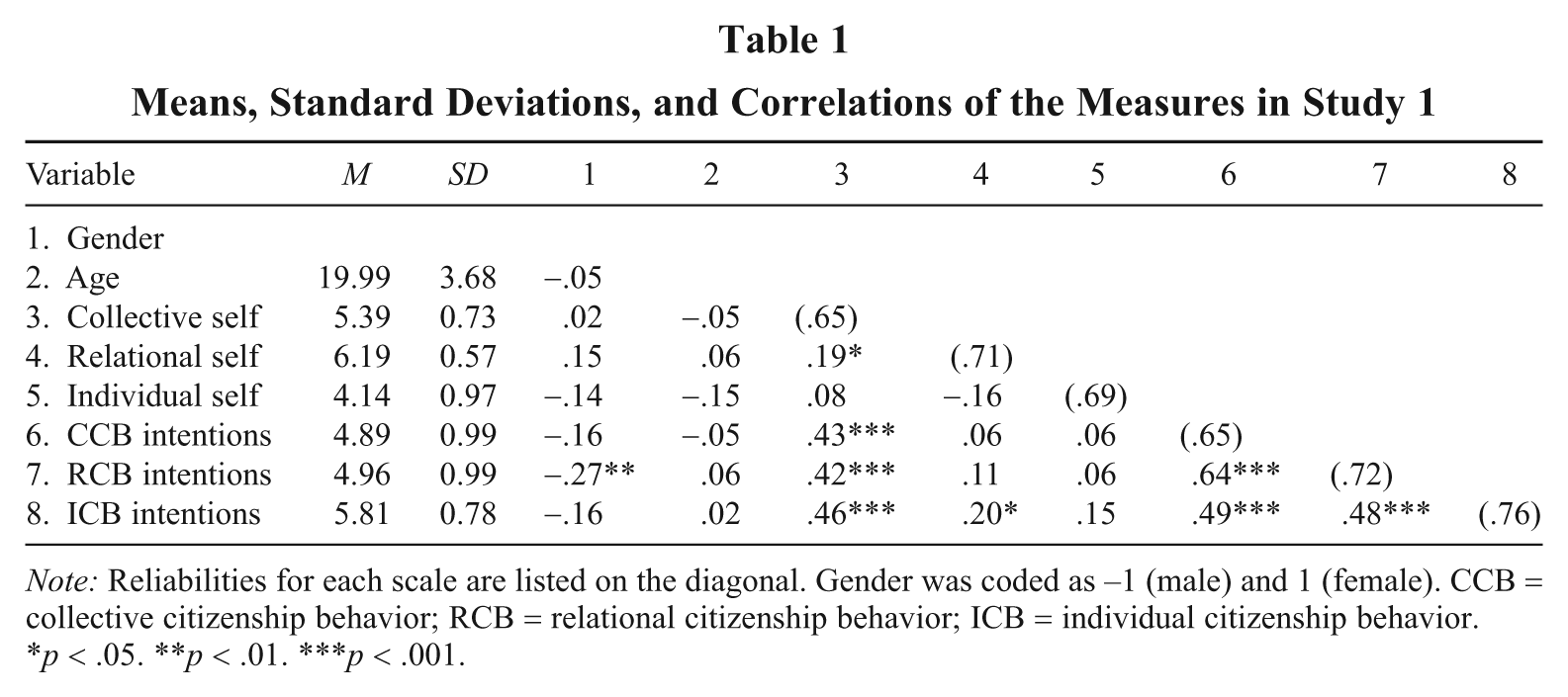
Note: Reliabilities for each scale are listed on the diagonal. Gender was coded as −1 (male) and 1 (female). CCB = collective citizenship behavior; RCB = relational citizenship behavior; ICB = individual citizenship behavior.
p < .05. **p < .01. ***p < .001.
Measurement Model
Before testing our hypotheses, we conducted confirmatory factor analyses (CFAs) to test our measurement model at the item level to determine whether scale items adequately indicate their intended underlying constructs (Anderson & Gerbing, 1988; Bandalos & Finney, 2001). The initial measurement model had six latent factors and 24 indicators (i.e., individual, relational, and collective self-definition and ICB, RCB, and CCB). The resulting model had an adequate fit—χ2(238) = 314.31, p < .01; standardized root mean square residual (SRMR) = .08; comparative fit index (CFI) = .90; root mean square error of approximation (RMSEA) = .05 (90% confidence interval [CI] .04-.07)—and all indicators had significant (p < .01) factor loadings. We also estimated a four-factor model, which had the same structure as the previous model except that all citizenship items loaded on the same factor. This model had insufficient fit, χ2(247) = 355.66, p < .001; SRMR = .09; CFI = .84; RMSEA = .06 (90% CI .05-.07). Subsequently, we tested a model with the same structure as the first model but this time with all self-definition items loading onto a single factor. This model also had inadequate fit, χ2(247) = 449.14, p < .001; SRMR = .11; CFI = .79; RMSEA = .09 (90% CI .06-.07). Further, because the self-definition variables at the different levels may psychologically reflect (rather than predict) the same construct as the respective outcome variables do (e.g., an individual-level self-definition may capture the same construct as ICB does), we subsequently tested a three-factor model in which each level of self loaded onto the same factor as the corresponding type of citizenship. This model had inadequate fit, χ2(250) = 511.27, p < .001; SRMR = .12; CFI = .61; RMSEA = .10 (90% CI .08-.11). Finally, we tested a model in which all items loaded onto a single factor. This model also had inadequate fit, χ2(253) = 546.20, p < .001; SRMR = .12; CFI = .56; RMSEA = .10 (90% CI .09-.11). Chi-square difference tests showed that all models fit the data significantly better than all nested simpler models (p < .001). In sum, it appears that the different scales effectively capture empirically distinct underlying constructs.
We included the main effects of gender and age in all analyses reported below because these variables likely influence citizenship behaviors (Kidder, 2002; Ng & Feldman, 2008). Although included in all analyses, we report only effects associated with these covariates in the tables and not in the main text. We checked our manipulations and tested our hypotheses using regression analyses with the main effects of gender and age, the three self-concept levels, and procedural justice in the first step, and the three self-concept levels–by–procedural justice interactions in the second step. Interaction terms were based on the product of the effect-coded manipulation of procedural justice (–1 vs. 1 for the unfair vs. fair conditions) and the centered self-level scores (Cohen, Cohen, West, & Aiken, 2003). In this and all other studies, we present one-sided significance tests for predicted directional effects (i.e., tests of our manipulation checks and tests of our hypotheses) and two-sided tests for not explicitly predicted effects (i.e., tests of significance for the background variables and the main effects for procedural justice and levels of self). Also, we present effect sizes of all significant procedural justice and self-level main and interaction effects. For the sake of clarity in presenting results, effect sizes of all other effects are not given, but interested readers can obtain them from the first author.
Manipulation Checks
A hierarchical regression analysis on the voice scale revealed a significant main effect of procedure only, β = .94, p < .001, f2 = .91. Participants perceived more voice in the fair (M = 5.47, SD = 1.00) than in the unfair (M = 1.04, SD = 0.27) procedure condition. None of the other effects in both steps of the regression analysis were significant, p > .13.
An additional regression analysis on the procedural justice scale revealed a main effect of procedure only, β = .68, p < .001, f2 = .47. Participants perceived more procedural justice in the fair (i.e., voice; M = 5.60, SD = 1.11) than in the unfair (i.e., no voice; M = 3.17, SD = 1.47) procedure condition. Again, none of the other effects in both steps of the regression analysis were significant, p > .09. We concluded that the procedural justice manipulation was effective.
Hypothesis Testing
CCB
The results of the hierarchical regression analyses are displayed in Table 2. Procedure, β = .24, p < .01, f2 = .08, and collective self-definition, β = .44, p < .001, f2 = .21, both positively influenced CCB levels. More important and in line with Hypothesis 1, the only significant Procedure × Self interaction term was the Procedure × Collective Self interaction effect, β = .17, p < .05, f2 = .04 (see Figure 1). To illustrate the nature of this interaction, we computed the relation between procedural justice and CCB at a high (1 standard deviation below the mean) and a low (1 standard deviation above the mean) level of collective self-definition (Aiken & West, 1991). As expected, these simple slope analyses revealed that procedural justice significantly and positively predicted CCB among those with a strong collective self-definition, β = .42, p = .001, f2 = .11, whereas procedural justice did not predict CCB among those with a weak collective self-definition, β = .04, p > .77, f2 = .00.
Results of Hierarchical Regression Analyses of CCB, RCB, and ICB on Gender, Age, Procedural Justice, and Self-Definition, Study 1
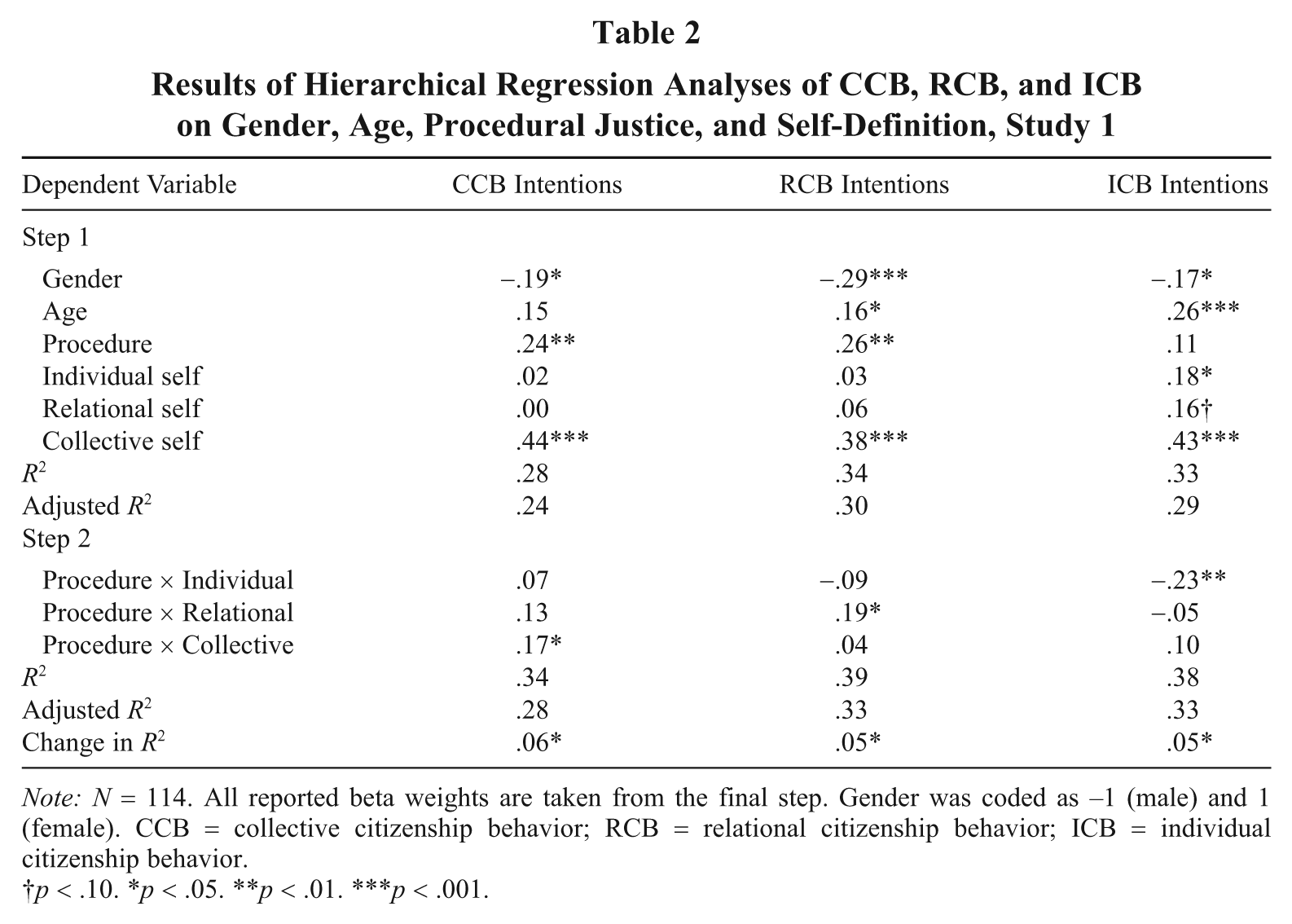
Note: N = 114. All reported beta weights are taken from the final step. Gender was coded as −1 (male) and 1 (female). CCB = collective citizenship behavior; RCB = relational citizenship behavior; ICB = individual citizenship behavior.
p < .10. *p < .05. **p < .01. ***p < .001.
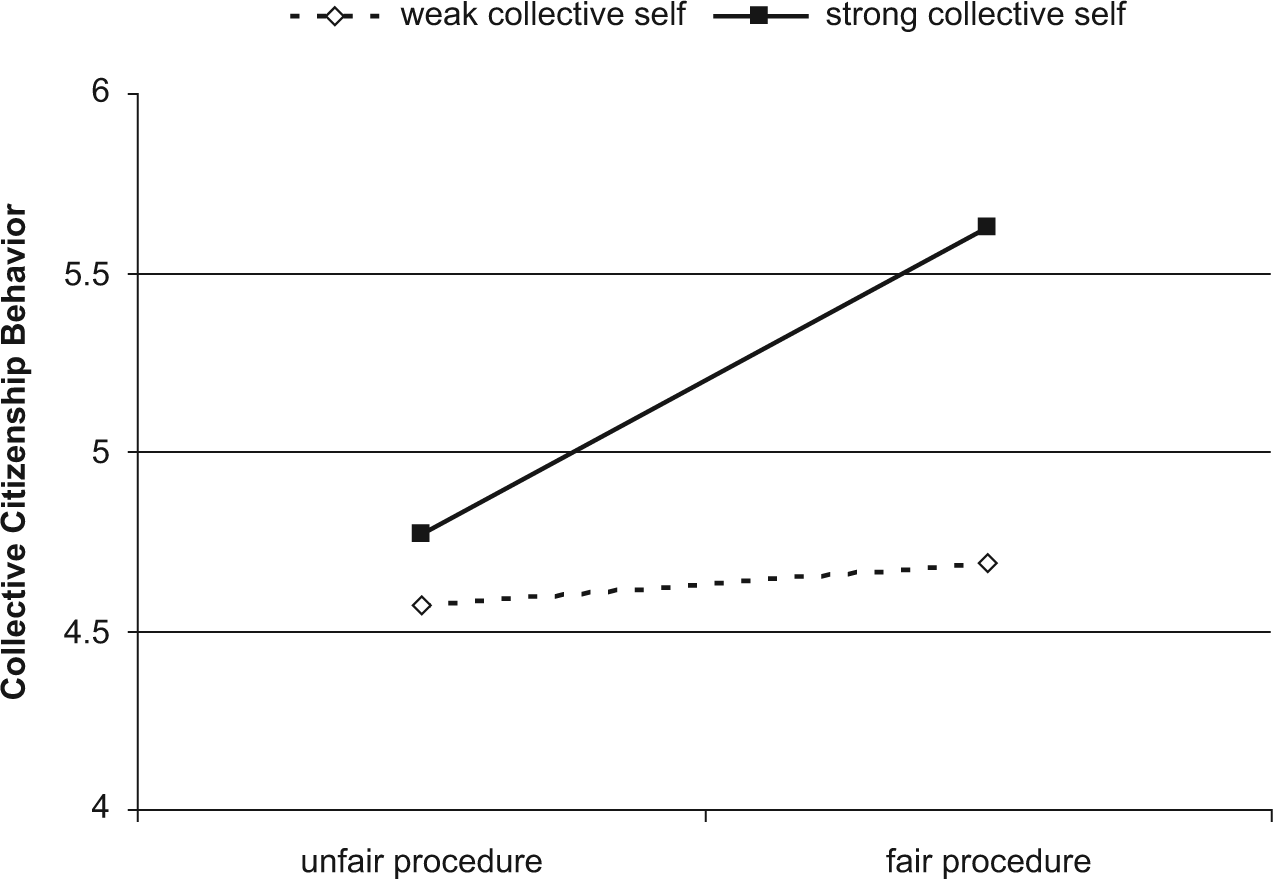
The Relation Between Procedural Justice and Collective Citizenship Behavior Intentions as a Function of Collective Self-Definition in Study 1
RCB
Both procedure, β = .26, p < .01, f2 = .10, and collective self-definition, β = .38, p < .001, f2 = .17, positively influenced RCB levels. More important and in line with Hypothesis 2, the only significant Procedure × Self interaction term was the Procedure × Relational Self interaction effect, β = .19, p < .05, f2 = .05 (see Figure 2). As expected, procedural justice significantly and positively predicted RCB among those with a strong relational self-definition (1 standard deviation below the mean; β = .41, p < .001, f2 = .11), whereas procedural justice did not predict RCB among those with a weak relational self-definition (1 standard deviation above the mean; β = .07, p > .55, f2 = .00).
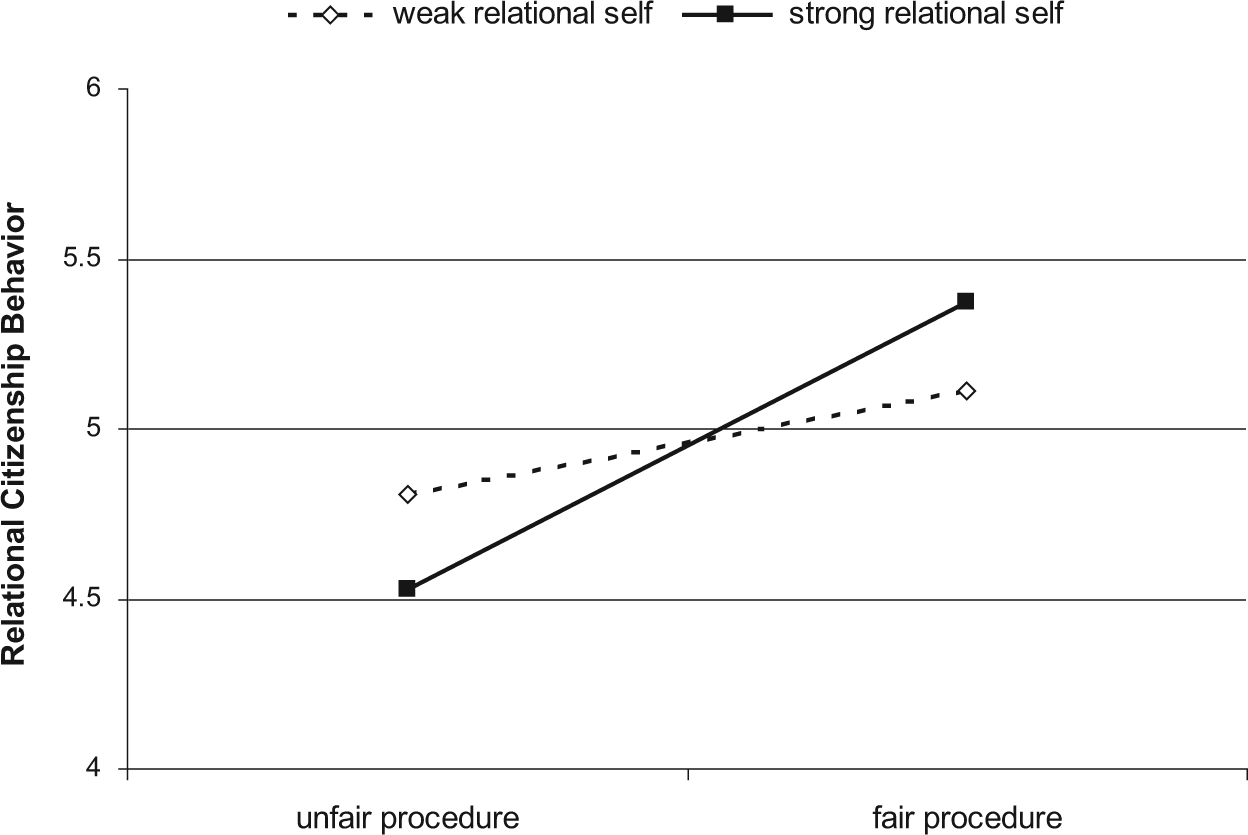
The Relation Between Procedural Justice and Relational Citizenship Behavior Intentions as a Function of Relational Self-Definition in Study 1
ICB
Both collective, β = .43, p = .001, f2 = .18, and individual, β = .18, p < .05, f2 = .05, self-definition positively influenced ICB. More important and in line with Hypothesis 3, the only significant Procedure × Self interaction term was the Procedure × Individual Self interaction effect, β = –.23, p < .01, f2 = .07. Contrary to Hypothesis 3, however, this interaction was significant in the opposite direction (see Figure 3). Procedural justice did not predict ICB among those with a strong individual self-definition (1 standard deviation below the mean; β = –.12, p > .31, f2 = .01), whereas procedural justice significantly and positively predicted ICB among those with a weak individual self-definition (1 standard deviation above the mean; β = .31, p = .01, f2 = .06).
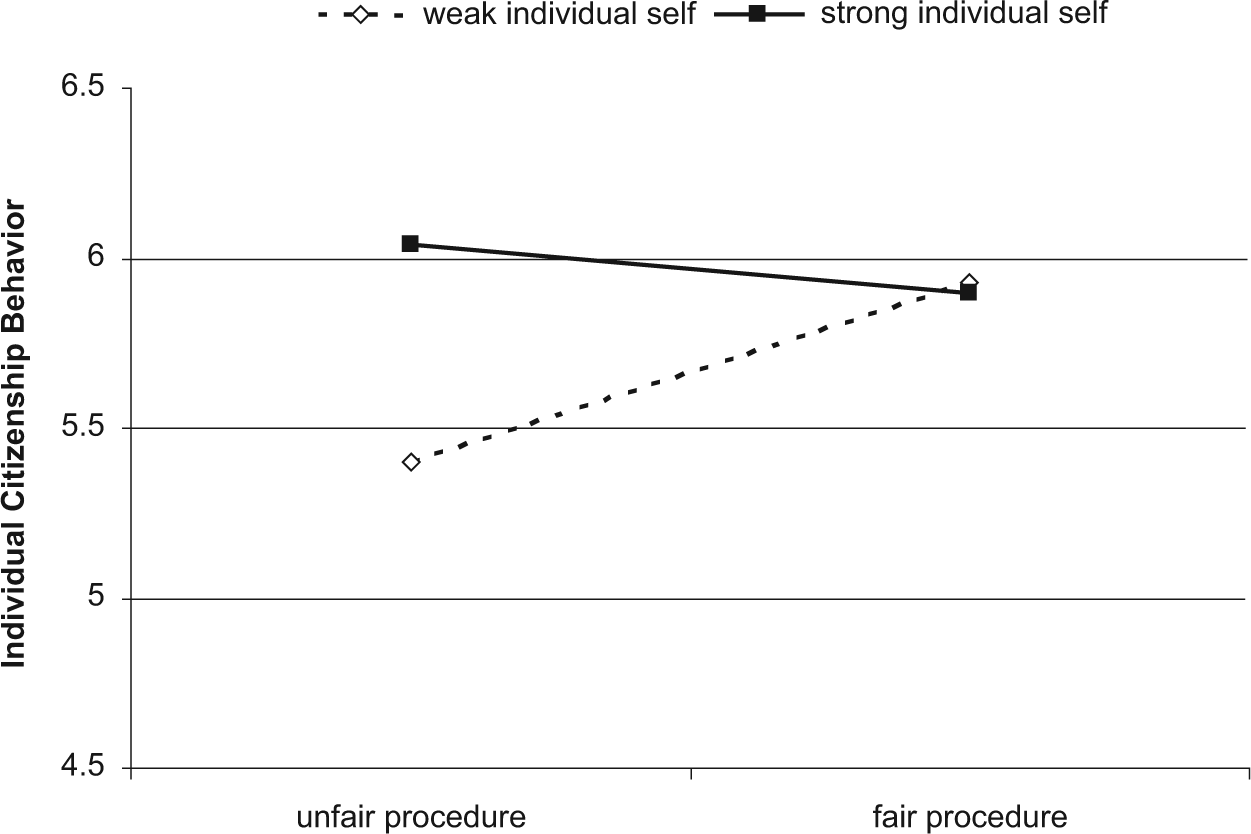
The Relation Between Procedural Justice and Individual Citizenship Behavior Intentions as a Function of Individual Self-Definition in Study 1
Summary
The findings in Study 1 are the first to show that the causal effects of procedural justice on specific types of citizenship are moderated by the corresponding level of self-definition. In addition, the results of Study 1 provide initial support for two of our three predictions: CCB intentions were influenced by procedural justice among those with a strong (but not among those with a weak) collective self-orientation, and RCB intentions were influenced by procedural justice among those with a strong (but not among those with a weak) relational self-orientation. Opposite to predictions was the significant interaction effect between procedural justice and the individual self on ICB intentions, such that the effect of procedural justice on ICB emerged only among those with a weak (but not among those with a strong) individual self-orientation. We will return to this finding in the general discussion.
Study 2: Improving Ecological and Construct Validity
The Study 1 findings were observed in a controlled laboratory setting with groups that were relevant only within the scope of the experimental situation. In addition, Study 1 used behavioral intentions rather than actual citizenship behaviors. Study 2 therefore examined the suggested processes in an actual organizational setting. In this study, we relied upon participants’ self-reports of actual citizenship behaviors. In addition, participants’ procedural justice perceptions in Study 2 were based upon the evaluation of a number of different procedural aspects (cf. Leventhal, 1980) rather than on the rule of voice only. To minimize the likelihood that our results would be biased by common method effects, we measured the dependent variable two weeks after we measured the independent variables (cf. Podsakoff, MacKenzie, Lee, & Podsakoff, 2003).
Method
Respondents
Five hundred and seventy Dutch members of a research panel who worked for at least 12 hours each week were invited to fill out a questionnaire on a webpage. For their participation, they received credit points that would allow them to receive certain gifts (e.g., tickets for the movies). All respondents who filled out our initial questionnaire (N = 473) were asked to fill out the second questionnaire (about two weeks later), of which 440 responded (for an overall response percentage of 77%).
We included only respondents who completed our questionnaires at the first and the second measurement point (N = 440). Respondents worked for various organizations (60.1% female and 39.9% male; Mage = 37.7, SD = 10.68). On average, they worked 31.49 (SD = 10.39) hours a week and had 7.67 (SD = 8.45) years of tenure at their current organizations. Furthermore, 70.7% of the respondents were employed in private service, 24.4% in public service, and 4.9% worked temporary or standby.
Procedure and Measures
We assessed procedural justice and levels of self-definition at Time 1, and the three different types of citizenship behaviors two weeks later, at Time 2. Chronic self-concept was measured using the LSCS (Johnson et al., 2006), as employed in Study 1. Participants responded to this scale (and all of the following scales) on a 5-point Likert-type scale ranging from 1 (strongly disagree) to 5 (strongly agree). As a result, we obtained an indication of the strength of respondents’ collective (α = .64, M = 3.69, SD = 0.44), relational (α = .77, M = 4.03, SD = 0.45), and individual (α = .71, M = 2.83, SD = 0.57) self-orientation.
Procedural justice was measured using Colquitt’s (2001) seven-item procedural justice scale. An example item is, “The procedures used to determine my salary were based on accurate information.” These items were combined into a highly reliable procedural justice scale (α = .91, M = 3.55, SD = 1.22).
Two weeks later, participants indicated their engagement in citizenship behaviors using the loyal boosterism, interpersonal helping, and personal industry subdimensions of Moorman and Blakely’s (1995) citizenship scale. More specifically, we operationalized CCB using the five-item loyal boosterism subscale (e.g., “I show pride when I represent the organization in public”; α = .81, M = 3.41, SD = 0.59), RCB using four items from the interpersonal helping subscale (e.g., “I go out of my way to help coworkers with work-related issues”; α = .73, M = 3.81, SD = 0.46), and finally ICB using the four-item personal industry subscale (e.g., “I perform my duties with unusually few errors”; α = .66, M = 3.82, SD = 0.52).
Results
Scale means, standard deviations, reliabilities, and correlations are reported in Table 3.
Means, Standard Deviations, and Correlations of the Measures in Study 2
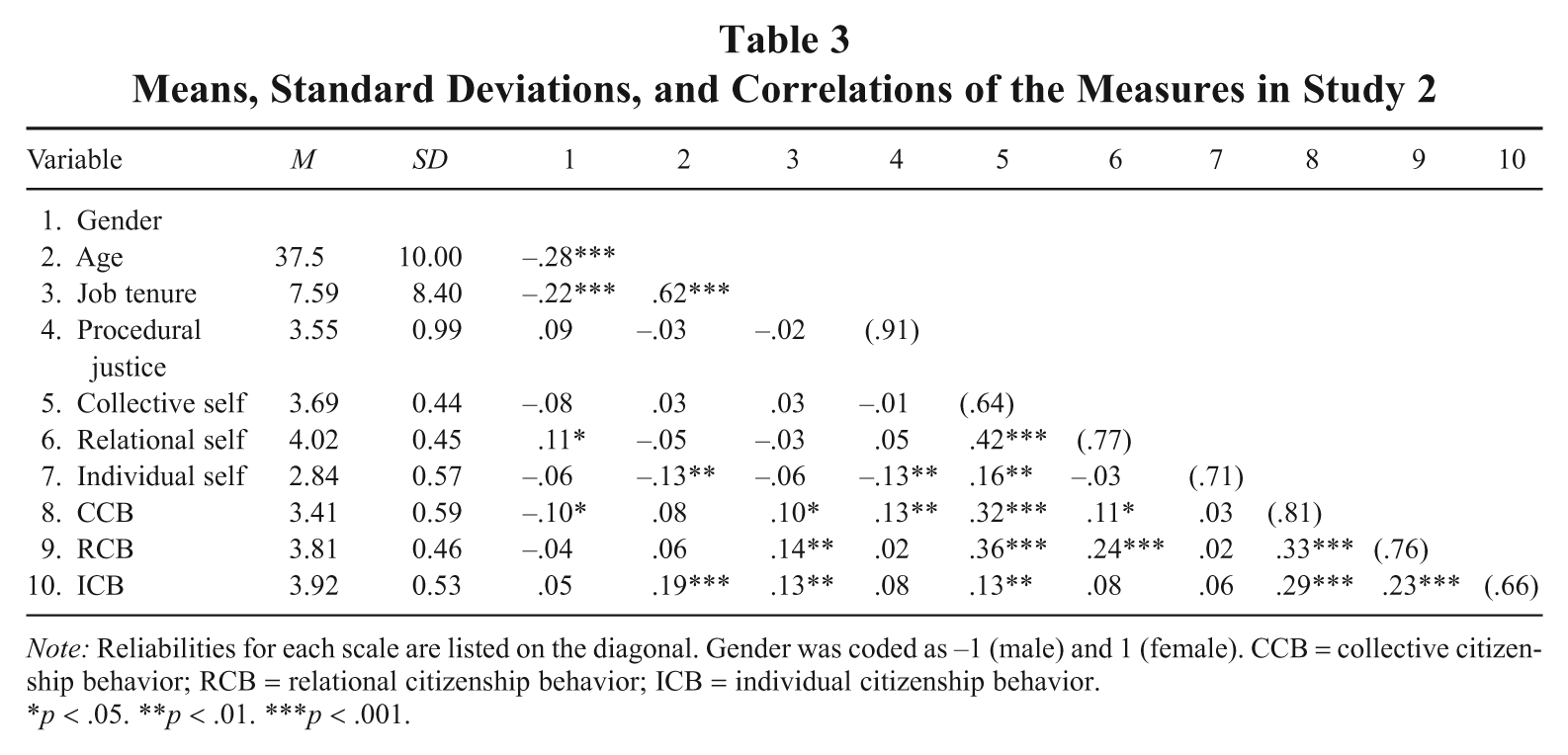
Note: Reliabilities for each scale are listed on the diagonal. Gender was coded as −1 (male) and 1 (female). CCB = collective citizenship behavior; RCB = relational citizenship behavior; ICB = individual citizenship behavior.
p < .05. **p < .01. ***p < .001.
Measurement Model
Like in Study 1, we first conducted CFAs to determine whether scale items adequately indicate their intended underlying constructs. The initial measurement model had seven latent factors and 35 indicators (i.e., procedural justice, CCB, RCB, ICB, collective self, relational self, and individual self). The resulting model had an adequate fit—χ2(572) = 1,142.16, p < .001; SRMR = .06; CFI = .90; RMSEA = .05 (90% CI .04-.05)—and all indicators had significant (p < .05) factor loadings. We also estimated a five-factor model that had the same structure as the previous model except that all citizenship items loaded on the same factor. This model had insufficient fit, χ2(583) = 1,705.90, p < .001; SRMR = .07; CFI = .80; RMSEA = .07 (90% CI .06-.07). Subsequently, we tested a model that had the same structure as the first model but this time with all self-definition items loading onto a single factor. This model also had inadequate fit, χ2(583) = 1,701.01, p < .001; SRMR = .07; CFI = .81; RMSEA = .07 (90% CI .06-.07). Like in Study 1, we proceeded with estimating a model in which the three different types of self-definition items loaded onto the same factor as the corresponding type of citizenship (e.g., individual self level loaded onto the same factor as ICB). This model also had inadequate fit, χ2(587) = 2,266.82, p < .001; SRMR = .10; CFI = .71; RMSEA = .08 (90% CI .08-.08). Finally, we tested a model in which all items loaded onto a single factor. This model also had inadequate fit, χ2(593) = 4,337.82, p < .001; SRMR = .14; CFI = .35; RMSEA = .12 (90% CI .12-.12). Chi-square difference tests showed that all models fit the data significantly better than all nested less complex models (p < .001). In sum, it appears that the scales accurately reflect their distinct underlying constructs.
Hypotheses Testing
We tested our hypotheses using hierarchical multiple regression analyses. All predictor variables were centered, and interaction terms were calculated using the centered scores (Cohen et al., 2003). We controlled for the effects of job tenure, gender, and age because these variables likely correlate with specific self-definitions as well as with engagement in different types of citizenship (Johnson et al., 2006; Kidder, 2002; Ng & Feldman, 2008; Organ & Ryan, 1995). Although included in all analyses, we report only effects associated with these covariates in the tables and not in describing the results. In the first step, we entered the control variables and the main effects of procedural justice and all three self-concept levels (individual, relational, and collective). Subsequently, in the second step, we entered the focal interactions between procedural justice and each of the self-concept levels. Table 4 presents the results of these analyses, which will be discussed in the following sections. Again, we present one-sided significance tests for predicted directional effects (i.e., tests of our manipulation checks and tests of our hypotheses) and two-sided tests for not explicitly predicted effects (i.e., tests of significance for the background variables and the main effects for levels of self).
Results of Hierarchical Regression Analyses of CCB, RCB, and ICB on Procedural Justice and Self-Definition, Study 2
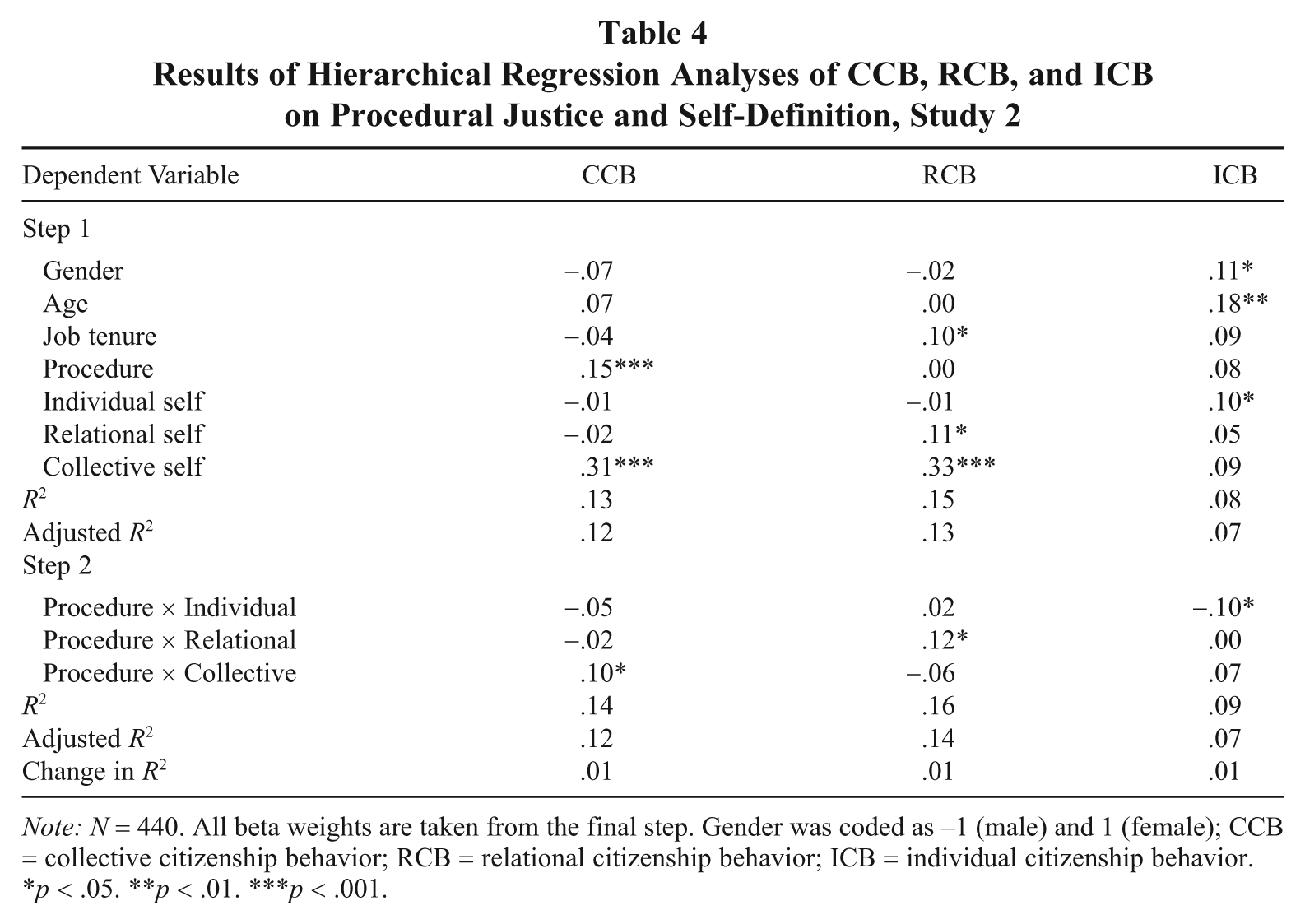
Note: N = 440. All beta weights are taken from the final step. Gender was coded as −1 (male) and 1 (female); CCB = collective citizenship behavior; RCB = relational citizenship behavior; ICB = individual citizenship behavior.
p < .05. **p < .01. ***p < .001.
CCB
There were significant main effects of procedural justice, β = .15, p < .01, f2 = .02, and of collective self-definition, β = .31, p < .001, f2 = .08. More important and in line with Hypothesis 1, only the Procedure × Collective Self interaction effect was significant, β = .10, p < .05, f2 = .01 (see Figure 4). Simple slope analyses revealed that procedural justice significantly and positively predicted CCB among those with a strong collective self-definition (1 standard deviation below the mean; β = .25, p < .001, f2 = .03), whereas procedural justice was not a significant predictor of CCB among those with a weak collective self-definition, (1 standard deviation above the mean; β = .03, p > .67, f2 = .00).
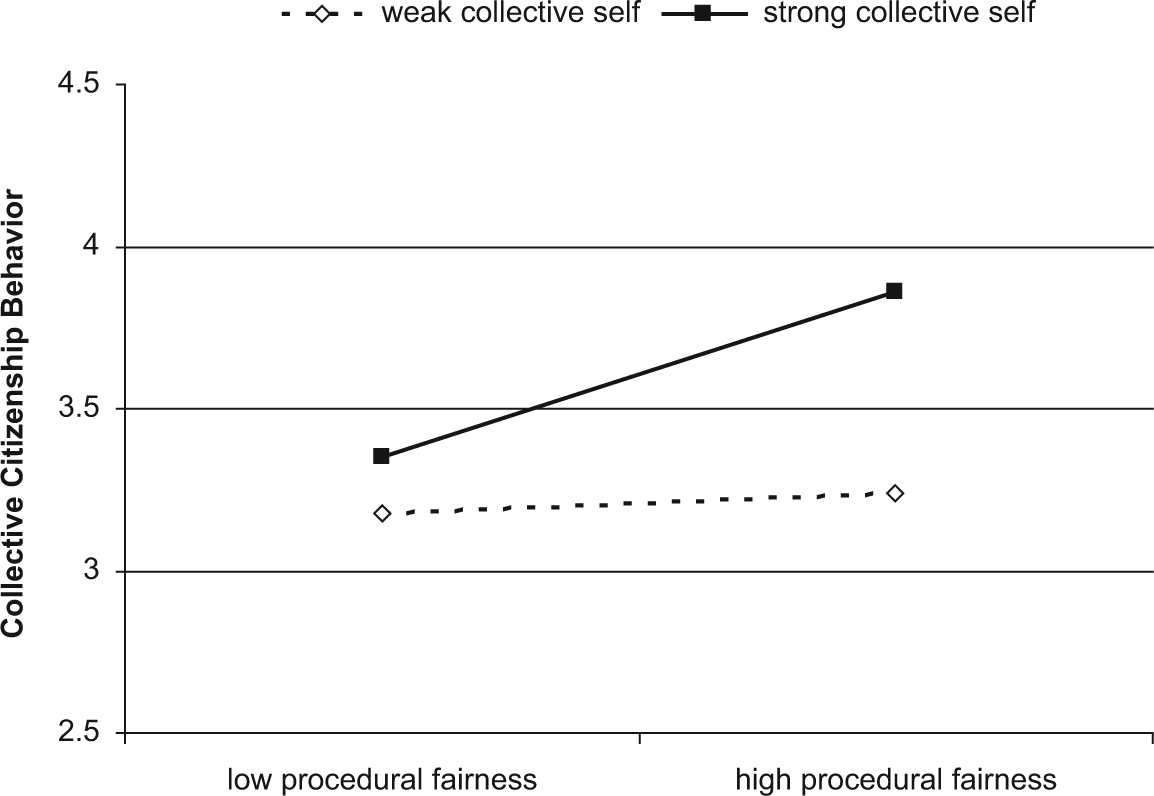
The Relation Between Procedural Justice and Collective Citizenship Behavior as a Function of Collective Self-Definition in Study 2
RCB
There were significant main effects of collective self-definition, β = .33, p < .001, f2 = .09, and relational self-definition, β = .11, p < .05, f2 = .02. More important and in line with Hypothesis 2, the only significant Procedure × Self interaction term was the Procedure × Relational Self-Definition interaction effect, β = .12, p < .05, f2 = .01 (see Figure 5). Simple slope analyses revealed that procedural justice significantly and positively predicted RCB among those with a strong relational self-definition (1 standard deviation below the mean; β = .15, p < .05, f2 = .01), whereas procedural justice was not a significant predictor of RCB among those with a weak relational self-definition (1 standard deviation above the mean; β = –.14, p > .07, f2 = .01).
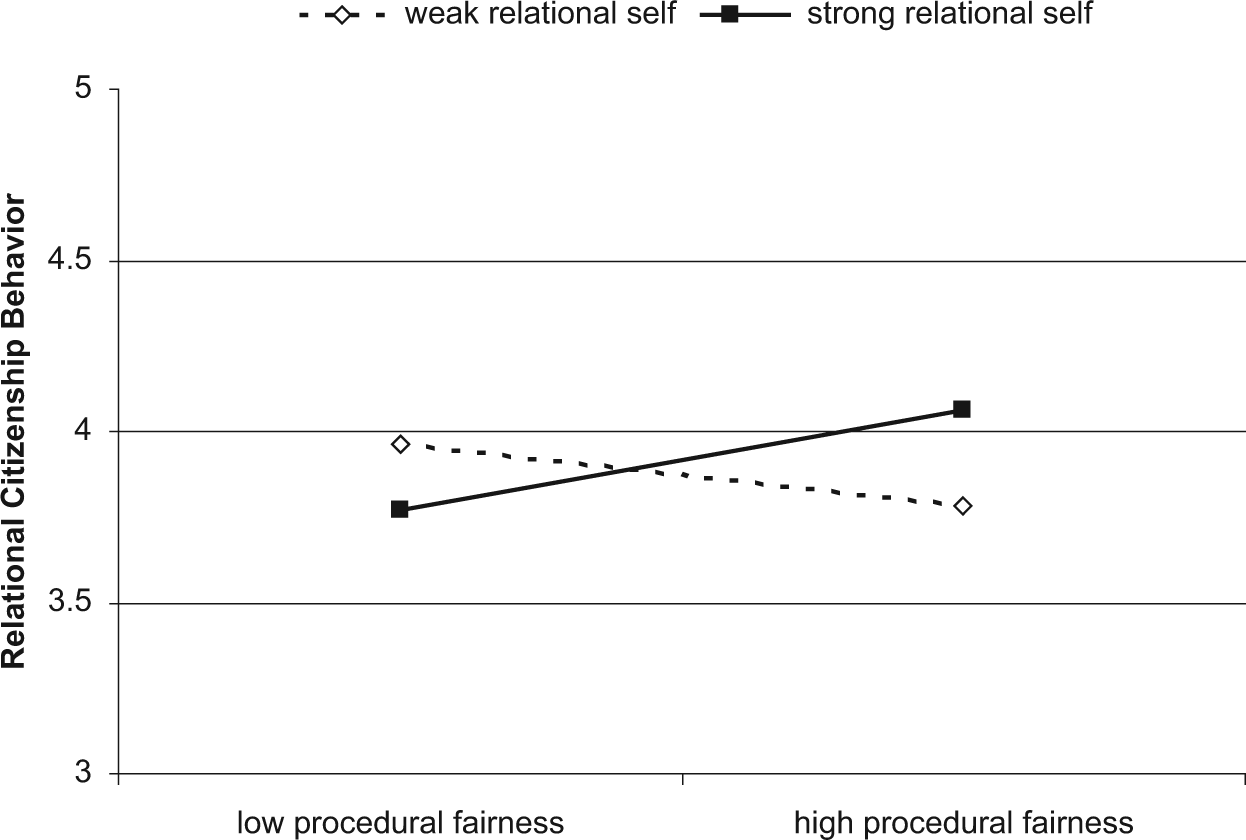
The Relation Between Procedural Justice and Relational Citizenship Behavior as a Function of Relational Self-Definition in Study 2
ICB
Individual self-definition was positively related to ICB, β = .10, p < .05, f2 = .01. More important and in line with Hypothesis 3, the only significant Procedure × Self interaction was the Procedure × Individual Self-Definition interaction effect, β = –.10, p < .05, f2 = .01 (see Figure 6). Contrary to Hypothesis 3, however, this interaction was in the opposite direction. Procedural justice significantly and positively predicted ICB among those with a weak individual self-definition (1 standard deviation above the mean; β = .17, p < .01, f2 = .02), whereas procedural justice was not a significant predictor of ICB among those with a strong individual self-definition (1 standard deviation below the mean; β = –.02, p > .79, f2 = .00).
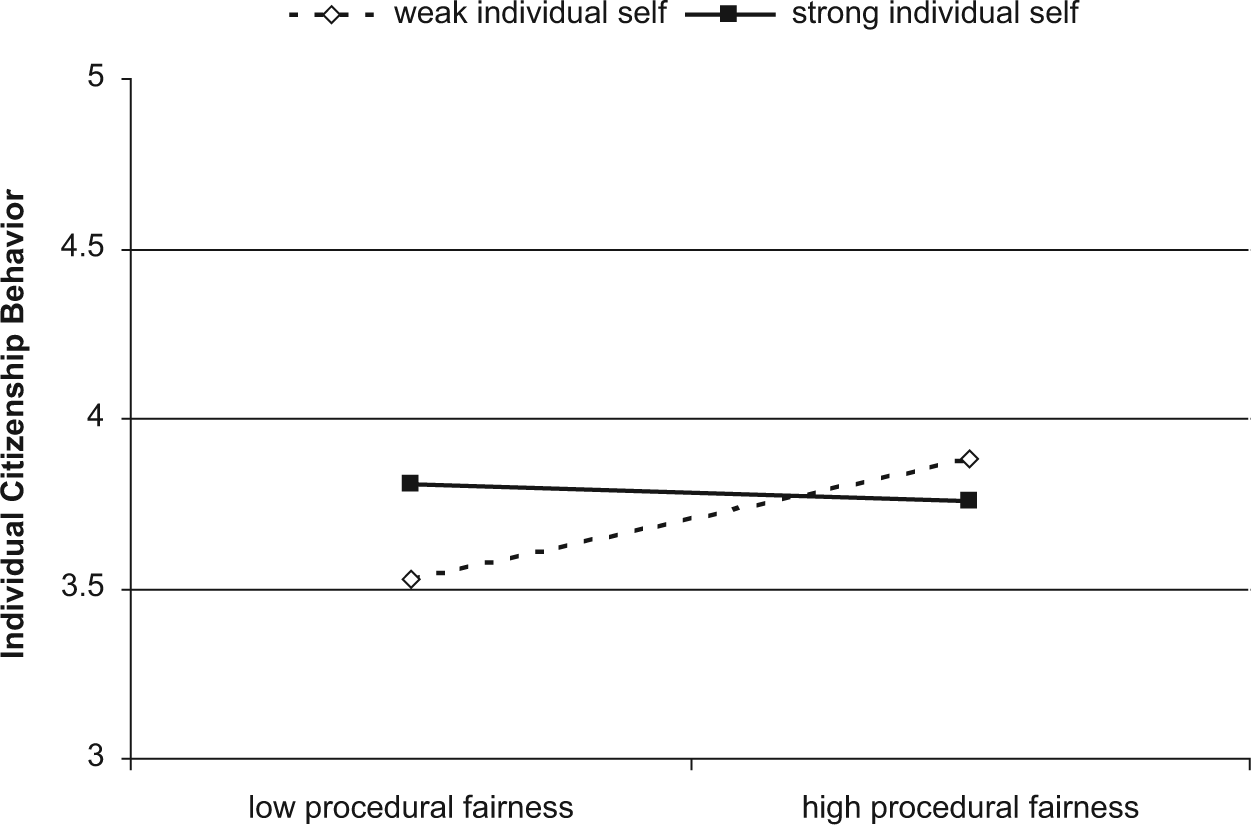
The Relation Between Procedural Justice and Individual Citizenship Behavior as a Function of Individual Self-Definition in Study 2
Summary
The results of Study 2 further consolidate the Study 1 findings and show that Hypotheses 1 and 2 are confirmed also when tested among employees working in a variety of organizations and by using self-reports of actual citizenship behaviors. As in Study 1, procedural justice influenced CCB and RCB, respectively, among those with a strong (vs. weak) collective and relational self-definition. Also as in Study 1, and thus contrary to Hypothesis 3, procedural justice influenced ICB among those with a weak (vs. strong) individual self-definition. The implications of these findings will be further discussed in the general discussion.
Study 3: Using Coworker Ratings of Citizenship to Test Alternative Explanations
The Study 2 findings were obtained by using self-report ratings of citizenship. The use of self-report data is often criticized because the respondent can bias the observed relationship between the predictor and criterion variable via the effects of consistency motives, implicit theories, social desirability tendencies, or any other tendencies on the part of the respondent to acquiesce or respond in a lenient manner (Podsakoff et al., 2003). One way to control for these biases is to collect measures from sources other than the target participant. In doing so, Study 3 collected coworker ratings of target participants’ engagement in the three types of citizenship behavior.
Method
Respondents and Procedure
We invited 253 Dutch members of a research panel who worked for at least 12 hours a week to fill out the questionnaire on a webpage. We also asked these employees to each invite a coworker to respond to some items regarding the respondent. For their participation, they received credit points that allowed them to receive gifts (e.g., movie tickets). We administered the focal employee and coworker surveys online. The focal employee was responsible to forward his or her coworker a link to the respective surveys. Each respondent had a unique identification number to ensure anonymity and also to make sure that we could match the focal employee and coworker data. We took a number of steps to ensure that the surveys were completed by the correct sources. First, in introducing the study, we emphasized the importance of integrity in the scientific process. We reminded employees that focal and coworker respondents should fill out the correct surveys. Second, when participants submitted their online surveys, time stamps and IP addresses were recorded to ensure that the surveys were submitted at different times and with different IP addresses. We found no irregularities in the responses.
A total of 129 employee–coworker dyads filled out the questionnaire. The focal employees were all Dutch employees working for various organizations (29.5% female and 70.5% male; Mage = 45.2, SD = 10.00).
Measures
As in Studies 1 and 2, participants’ self-definition was measured using the LSCS (Johnson et al., 2006). Participants responded to this scale (and all of the following scales) on a 5-point Likert-type scale ranging from 1 (strongly disagree) to 5 (strongly agree). As a result, we obtained an indication of the strength of participants’ collective (α = .71, M = 3.76, SD = 0.48), relational (α = .70, M = 3.95, SD = 0.46), and individual (α = .67, M = 2.89, SD = 0.52) self-orientation. As in Study 2, procedural justice was measured using Colquitt’s (2001) seven-item procedural justice scale. These items were combined into a reliable procedural justice scale (α = .81, M = 3.55, SD = 0.58).
As in Study 2, we measured loyal boosterism, interpersonal helping, and personal industry (Moorman & Blakely, 1995) to assess CCB, RCB, and ICB, respectively. This time, however, coworkers rated the extent to which the target participants usually engage in CCB (α = .72, M = 3.41, SD = 0.53), RCB (α = .77, M = 3.86, SD = 0.53), and ICB (α = .69, M = 3.80, SD = 0.55).
Results
Scale means, standard deviations, reliabilities, and correlations are reported in Table 5.
Means, Standard Deviations, and Correlations of the Measures in Study 3
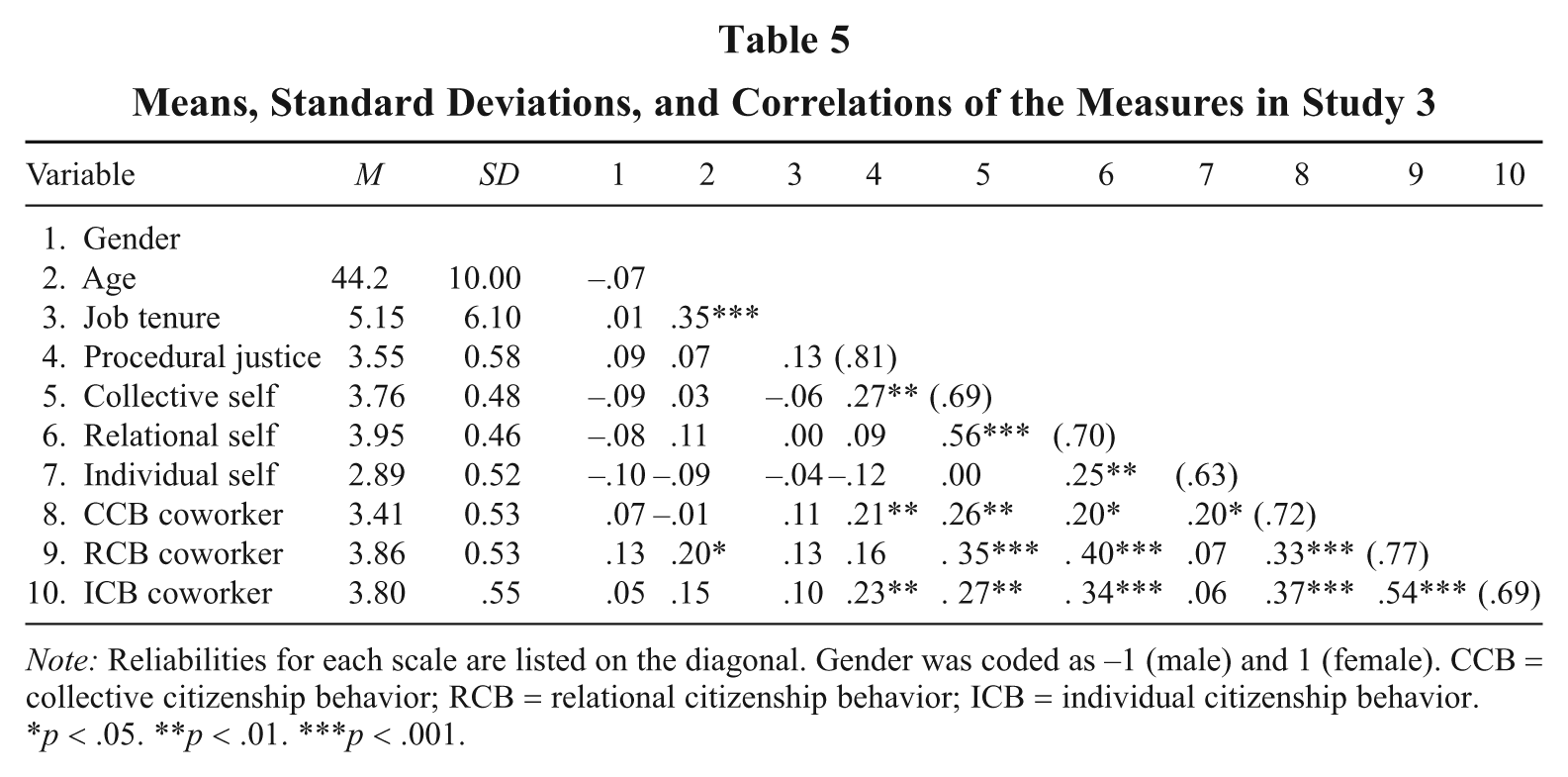
Note: Reliabilities for each scale are listed on the diagonal. Gender was coded as −1 (male) and 1 (female). CCB = collective citizenship behavior; RCB = relational citizenship behavior; ICB = individual citizenship behavior.
p < .05. **p < .01. ***p < .001.
Measurement Model
Like in Studies 1 and 2, we first conducted CFAs. The initial measurement model had seven latent factors and 35 indicators (i.e., procedural justice, CCB, RCB, ICB, collective self, relational self, and individual self). The resulting model had an adequate fit—χ2(572) = 847.39, p < .001; SRMR = .09; CFI = .90; RMSEA = .06 (90% CI .05-.07)—and all indicators had significant (p < .05) factor loadings. We subsequently estimated a five-factor model that had the same structure as the previous model except that all citizenship items loaded on the same factor. This model had insufficient fit, χ2(583) = 1,018.77, p < .001; SRMR = .10; CFI = .79; RMSEA = .08 (90% CI .07-.08). Subsequently, we tested a model that had the same structure as the first model but this time with all self-definition items loading onto a single factor. This model also had inadequate fit, χ2(583) = 962.04, p < .001; SRMR = .10; CFI = .83; RMSEA = .07 (90% CI .06-.08). Like in the prior studies, we then estimated a model in which the three different types of self-definition items loaded onto the same factor as the corresponding type of citizenship (e.g., individual self-concept loaded onto the same factor as ICB). This model also had inadequate fit, χ2(587) = 1,169.65, p < .001; SRMR = .10; CFI = .69; RMSEA = .09 (90% CI .08-.10). Finally, we tested a model in which all items loaded onto a single factor. This model also had inadequate fit, χ2(593) = 1,406.92, p < .001; SRMR = .12; CFI = .53; RMSEA = .10 (90% CI .10-.11). Chi-square difference tests showed that all models fit the data significantly better than all nested less complex models (p < .001). In sum, like in the previous studies, the scales seem to accurately reflect their distinct underlying constructs.
Hypotheses Testing
We tested our hypotheses using hierarchical multiple regression analyses. All predictor variables were centered, and interaction terms were calculated using the centered scores (Cohen et al., 2003). As in Study 2, we controlled for the effects of gender, age, and job tenure in all analyses. Although included in all analyses, we report only effects associated with these covariates in the tables and not in describing the results. At Step 1, we entered the control variables and the main effects of procedural justice and all three self-concept levels (individual, relational, and collective). Subsequently, at Step 2, we entered the focal interactions between procedural justice and each of the self-concept levels. Table 6 presents the results of these analyses, which will be discussed in the following sections. As in Studies 1 and 2, we present one-sided significance tests for predicted directional effects (i.e., tests of our hypotheses) and two-sided tests for not explicitly predicted effects (i.e., tests of significance for the background variables and the main effects for levels of self).
Results of Hierarchical Regression Analyses of Coworker Ratings of Target Participants’ CCB, RCB, and ICB on Procedural Justice and Self-Definition, Study 3
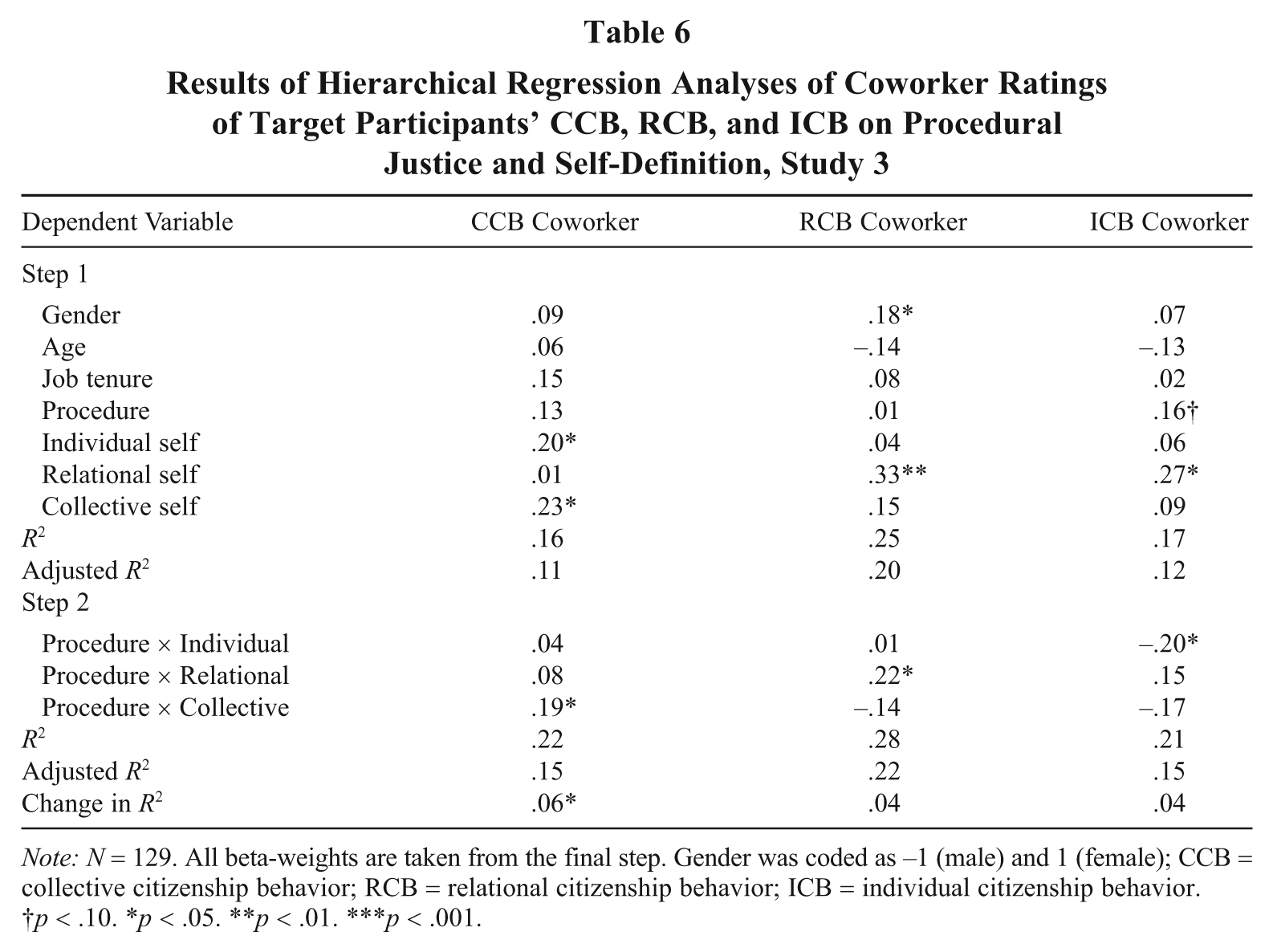
Note: N = 129. All beta-weights are taken from the final step. Gender was coded as −1 (male) and 1 (female); CCB = collective citizenship behavior; RCB = relational citizenship behavior; ICB = individual citizenship behavior.
p < .10. *p < .05. **p < .01. ***p < .001.
CCB
There were significant main effects of collective self-definition, β = .23, p < .05, f2 = .04, and of individual self-definition, β = .20, p < .05, f2 = .04. More important and in line with Hypothesis 1, the only significant Procedure × Self interaction was the Procedure × Collective Self-Definition interaction effect, β = .19, p < .05 (one sided), f2 = .03 (see Figure 7). Simple slope analyses revealed that procedural justice significantly and positively predicted CCB among those with a strong collective self-definition (1 standard deviation below the mean; β = .38, p < .01, f2 = .07), whereas procedural justice was not a significant predictor of CCB among those with a weak collective self-definition (1 standard deviation above the mean; β = –.07, p > .57, f2 = .00).
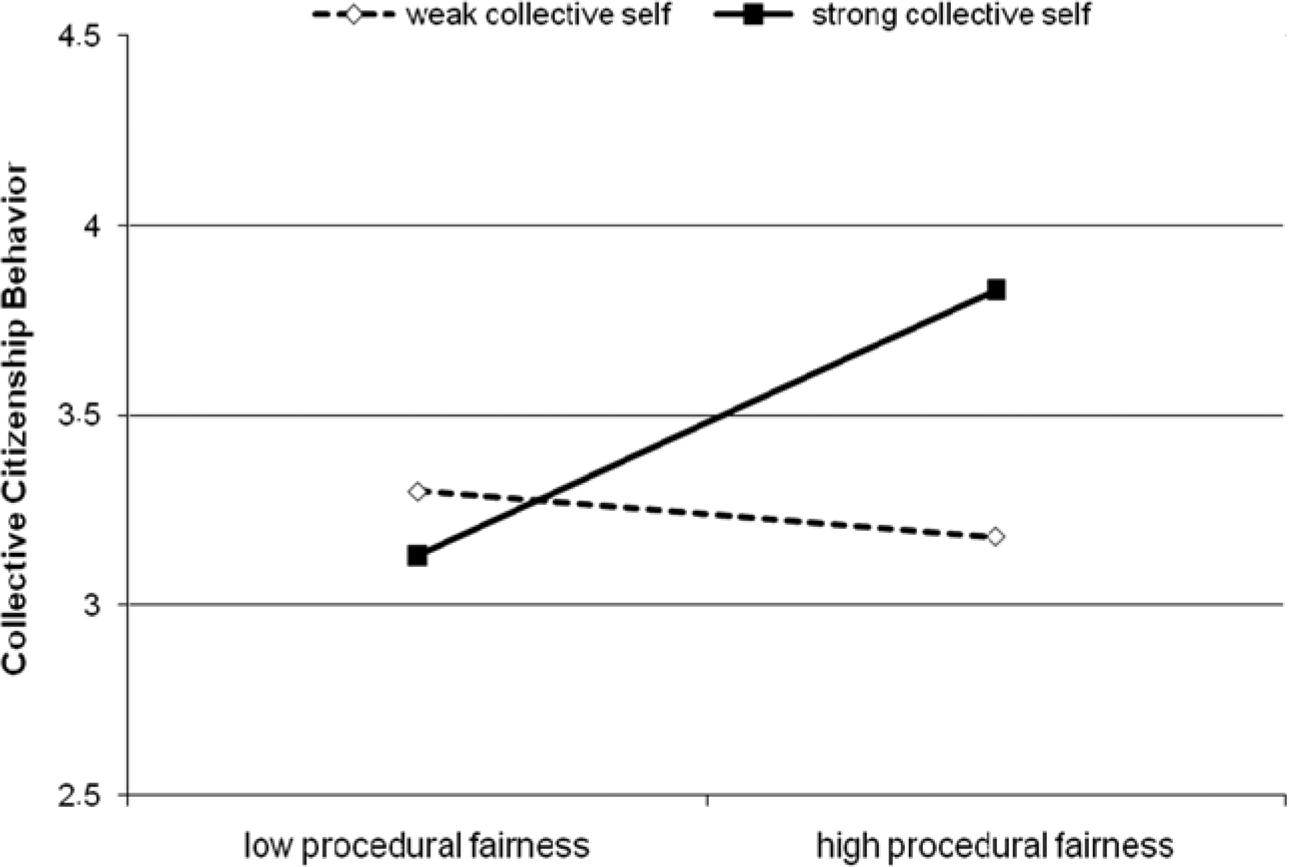
The Relation Between Procedural Justice and Coworker-Rated Collective Citizenship Behavior as a Function of Collective Self-Definition in Study 3
RCB
There was a significant main effect of relational self-definition, β = .33, p < .01, f2 = .08. More important and in line with Hypothesis 2, the only significant Procedure × Self interaction was the Procedure × Relational Self-Definition interaction effect, β = .22, p < .05, f2 = .04 (see Figure 8). Simple slopes analyses revealed that procedural justice had a significant positive effect on RCB among those with a strong relational self-definition (1 standard deviation below the mean; β = .25, p < .05, f2 = .04), whereas procedural justice was not a significant predictor of RCB among those with a weak relational self-definition (1 standard deviation above the mean; β = –.07, p > .56, f2 = .00).
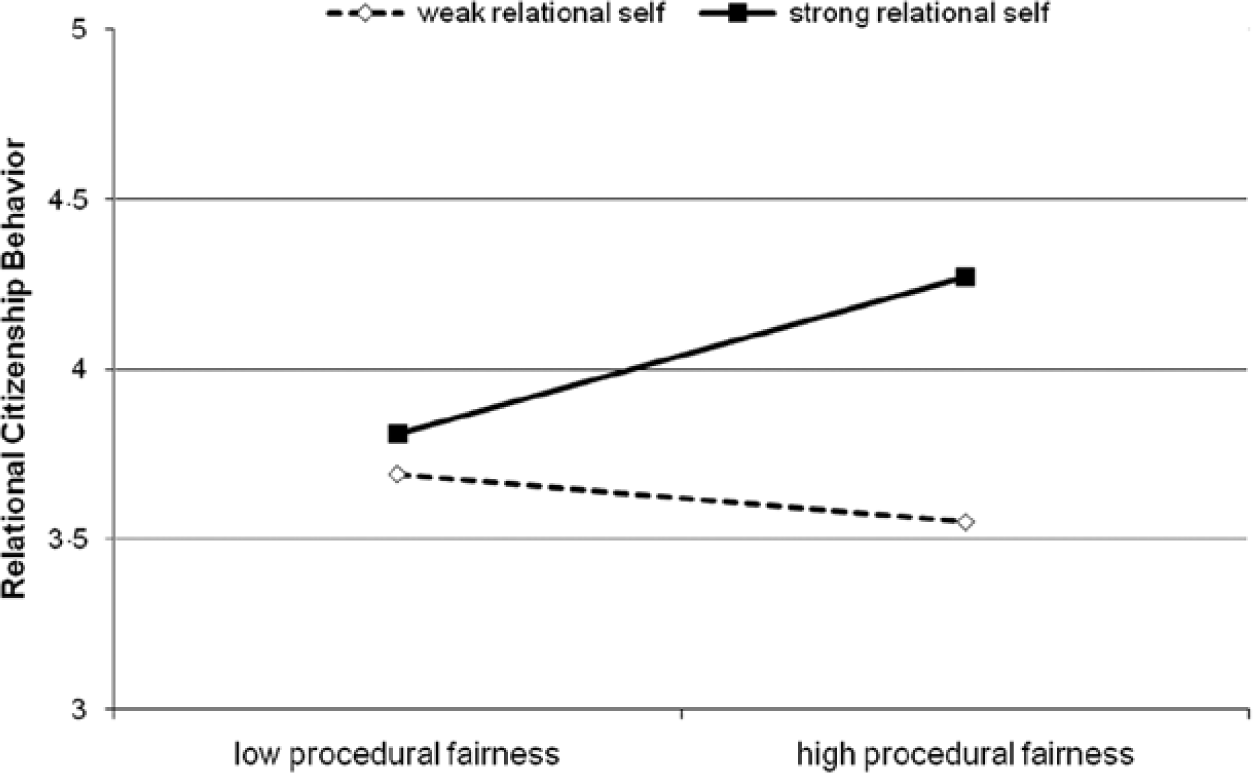
The Relation Between Procedural Justice and Coworker-Rated Relational Citizenship Behavior as a Function of Relational Self-Definition in Study 3
ICB
There was a significant main effect of relational self-definition, β = .27, p < .05, f2 = .05. More important and in line with Hypothesis 3, the Procedure × Individual Self-Definition interaction effect was the only significant interaction term, β = –.20, p < .05, f2 = .04 (see Figure 9). Contrary to Hypothesis 3, the interaction was significant in the opposite direction. Procedural justice significantly and positively predicted ICB among those with a weak individual self-definition (1 standard deviation above the mean; β = .40, p < .01, f2 = .06), whereas procedural justice was not a significant predictor of ICB among those with a strong individual self-definition (1 standard deviation below the mean; β = .11, p > .34, f2 = .00).
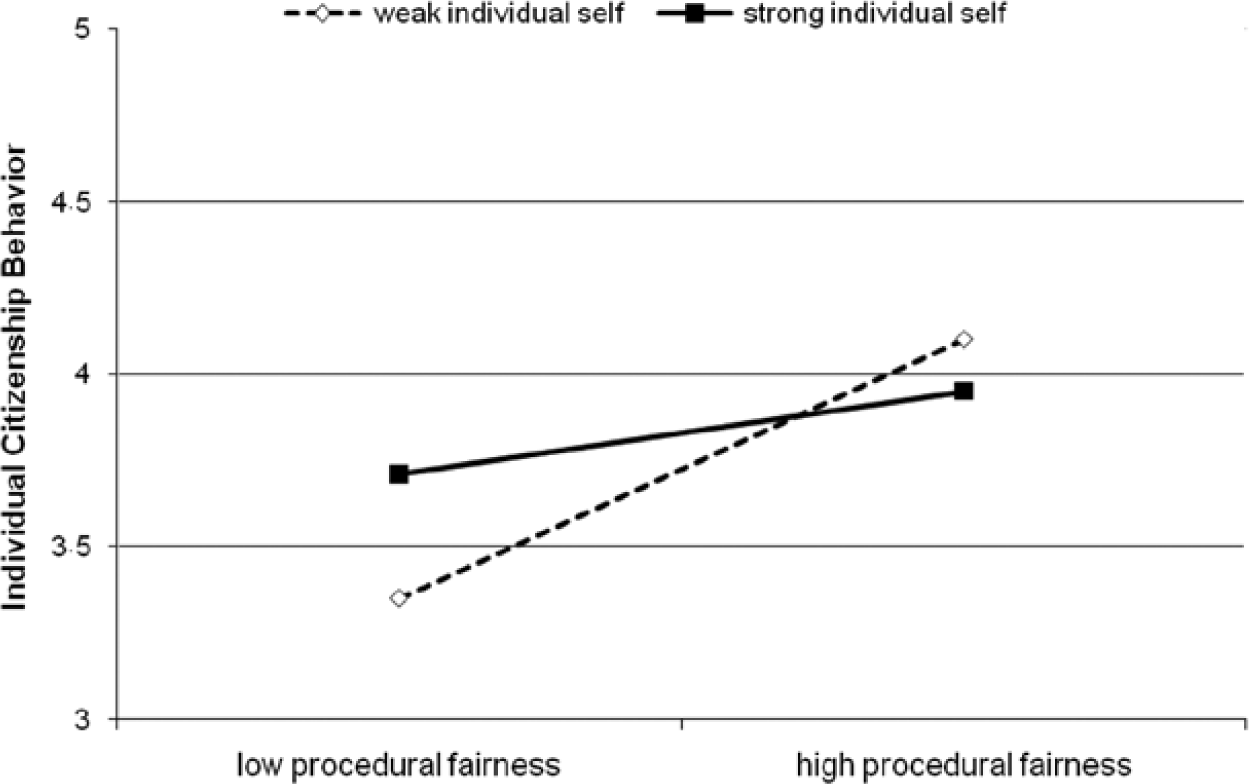
The Relation Between Procedural Justice and Coworker-Rated Individual Citizenship Behavior as a Function of Individual Self-Definition in Study 3
Summary
The results of Study 3 further consolidate the findings observed in Studies 1 and 2 and show that Hypotheses 1 and 2 are confirmed also when the different types of citizenship were rated by coworkers of target participants. In addition, as in Studies 1 and 2, Study 3 finds an opposite effect of the procedural justice–by–individual self-interaction effect on ICB. The implications of these findings will be further discussed in the general discussion.
General Discussion
Three studies using different methodologies clarify the interactive effects between procedural justice and different levels of self-definition in predicting group/organizational-, interpersonal-, and job/task-oriented citizenship behavior. Building on the idea that citizenship depends upon how employees define, evaluate, and regulate themselves (De Cremer & Tyler, 2005) and on suggestions that procedural justice has the potential to validate collective, relational, and individual levels of self-definition (Sedikides et al., 2008), we tested whether procedural justice uniquely regulates the type of citizenship that corresponds to the level of self that is salient among employees. In line with this reasoning, results consistently revealed that procedural justice has a stronger effect on group/organization-oriented citizenship behavior when employees define themselves strongly in terms of characteristics of the group or organization and that procedural justice has a stronger effect on interpersonally oriented citizenship behavior when employees define themselves strongly in terms of their relationships with others. Contrary to our reasoning, however, results also consistently revealed that procedural justice has a weaker effect on task/job-oriented citizenship behavior when employees define themselves in terms of characteristics that distinguish them from others in the group or organization.
Theoretical Implications
Our findings reveal several important insights that refine our thinking about the self, procedural justice, and citizenship behavior. Before proceeding, however, we feel that it is important first to interpret the unexpected direction of the individual self–by–procedural justice interaction effect in predicting job/task-oriented citizenship behavior. As mentioned before, no prior evidence exists regarding the role of the individual self in task-oriented behavior. As a result, we relied on the identity enactment perspective to remain consistent with predictions for the other two levels of self. Results, however, disconfirmed the prediction that task-oriented citizenship is highest when the relevant identity is both salient in the employee’s overall self-concept (i.e., a strong individual self-definition) and socially validated by the situation (e.g., via high levels of perceived procedural justice). The individual self-concept results clearly diverge from the collective- and relational-level findings and strongly suggest that the individual self is not validated by procedural justice. Overall, however, these results do not oppose the general idea that self-definition matters in regulating the impact of procedural justice on behavior. What, then, can we learn from the findings concerning the individual self in our effort to move toward an integrative self-definition model?
A closer look shows that these results consistently follow a substitution pattern (see Howell, Dorfman, & Kerr, 1986, for a formal definition and statistical criteria). Specifically, either a strong individual self-definition or high levels of procedural justice are sufficient to result in high levels of task-oriented citizenship. However, high scores on both predictor variables do not further increase task-oriented citizenship. This implies that the process explaining the effect of one predictor (e.g., individual self-definition) on task-oriented citizenship is made irrelevant by high levels of the other predictor (e.g., procedural justice). This aligns well with evidence that procedural justice influences task performance because it increases intrinsic motivation (see Zapata-Phelan, Colquitt, Scott, & Livingston, 2008). As argued by Rawsthorne and Elliot (1999), intrinsic motivation decreases the relevance of an otherwise strong orientation to achieve or desire to prove uniqueness (as is the case among those with a strong individual self-definition; Gaertner, Sedikides, Vevea, & Iuzzini, 2002; Stapel & Van der Zee, 2006). From this perspective, it can be expected that high levels of task-oriented motivation (as revealed through task-oriented citizenship behavior) result either from perceiving high levels of procedural justice because it increases intrinsic motivation or from a more controlled strong individual self-definition. As our results reveal, the presence of both conditions does not further increase task-oriented motivation. Future research is urged to study these proposed mediating variables that may explain the procedural justice–by–individual self-definition interaction directly. For now, we can conclude that the present findings identify the individual self as a boundary condition of the degree of influence that procedural justice may exert on task-oriented behavior.
The present research has important implications for the citizenship literature. By studying the combined effects of procedural justice and levels of self-concept, our research provides a unique theoretical contribution that addresses prior calls in the citizenship literature for better understanding when and why employees target their citizenship efforts at different beneficiaries (Bolino, 1999; LePine et al., 2002; Podsakoff et al., 2000). It is fair to note, however, that the present research is not the first to address this issue. Most importantly, research in the context of the multifoci perspective (e.g., Lavelle et al., 2009; Lavelle, Rupp, & Brockner, 2007; Rupp & Cropanzano, 2002) revealed that supervisory-directed outcomes are predicted by perceived supervisor procedural justice and that organizationally directed outcomes are predicted by both perceived procedural justice at the organizational level and perceived supervisor procedural justice. The current self-definition model complements and extends this perspective by showing that, within a single level, procedural justice regulates distinct types of citizenship as a function of the level of self that is salient among employees. This focus on characteristics of specific employees (rather than on characteristics of the source of procedural fairness) is clearly in line with Blau’s reasoning that “the nature of the return cannot be bargained about, but must be left to the discretion of the one who makes it” (1964, p. 93). Taken together, rather than focusing on different sources of justice, the present research highlights that procedural justice has positive implications, at least for collective and relational self-definitions, which in turn regulate an employee’s engagement in the corresponding self-defining citizenship behavior. Future research might do well to expand on this line of reasoning and examine, for instance, whether situational cueing of different social identities that people have would also successfully increase the influence of fair procedures on different desirable employee outcomes that correspond to these social identities.
The present research also has important implications for the procedural justice literature. It falls within the recent tradition to examine the self-concept as a moderator of procedural justice effects. Prior examinations in this tradition, however, either have examined only one level of self in interaction with procedural justice (Brebels et al., 2008; De Cremer et al., 2005; Johnson et al., 2006) or have examined different levels of self as competing moderators of the influence of procedural justice on only one particular outcome (Van Prooijen & Zwenk, 2009). The current results do not contradict these prior findings. Instead, they integrate and extend these studies by demonstrating that all levels of self-concept represent suitable moderators of the effects that procedural justice conveys, but each moderates procedural justice effects only on outcomes that correspond to its motivational and behavioral repertoire. More generally, our research points to the importance of considering both contextual validation and personal salience of the self when examining the importance of identity at work (Farmer & Van Dyne, 2010).
The present research builds upon and extends other work in which different levels of self are examined as moderators of corresponding responses as a function of justice (Johnson et al., 2006). Johnson and colleagues’ (2006) research, however, examined each level of self only in interaction with a specific type of justice (Collective × Procedural, Relational × Interactional, and Individual × Distributive) to predict outcome beneficiaries. Specifically, their work tested these effects via chronic individual difference measures in a first study and via cued levels of self in a second study (by controlling for chronic self-level main effects). Some results were in line with their predicted models (e.g., in the first study the relational self interacted with interactional justice to predict outcome, supervisor, and management satisfaction, and in the second study the collective self interacted with procedural justice to predict task, coworker, and company satisfaction). Despite these results, Johnson et al.’s model did not reveal the predicted effects on citizenship beneficiaries. Therefore, in an extension of their work, the present research examined a question that is more specific and directly relevant to understanding organizational behavior. That is, we examined all levels of self simultaneously in interaction with procedural justice but predicted that each level of self moderates only the influence of procedural justice on self-congruent citizenship beneficiaries. In addition, whereas Johnson and colleagues relied on behavioral intentions as an assessment of citizenship behavior, the present research also included self-reports (in Study 2) and coworker ratings (in Study 3) of the relevant citizenship dimensions. This multimethod approach allowed us to rule out alternative explanations in terms of common method bias or self-presentation.
Strengths and Limitations
A major strength of the present research is that the interaction effects between different levels of self-definition and procedural justice were obtained using different research methods. Most studies that examined the justice–citizenship relationship were correlational in nature and therefore remained elusive with respect to a causal relation between justice and citizenship behavior (for an exception, see De Cremer & Van Knippenberg, 2002). Study 1, however, yielded experimental evidence that allows for valid causal conclusions. A potential criticism of Study 1 is that it might be relatively low in external validity. However, the fact that Study 2, for which concerns about external validity pose less of a problem, yielded results consistent with those of Study 1 counters this potential criticism. In fact, to assess predictor variables before the criterion variables, as we did in Study 2, makes the direction of causality clearer relative to cross-sectional research (Levy & Williams, 1998; Murphy & Tyler, 2008). Nevertheless, only a cross-lagged approach allows for a definite assessment of causality in field studies. A potential criticism of Study 2 is that both predictor and criterion variables were collected using self-reports. To rule out the possibility that the observed relationships in Studies 1 and 2 emerged from respondents’ consistency motives, implicit theories, social desirability, or other tendencies to acquiesce or respond in a lenient manner, Study 3 collected criterion measures from respondents’ coworkers (Podsakoff et al., 2003). In sum, the consistent support that we found across these different methods increases confidence in the way our constructs relate to one another.
A limitation of the present research is that we did not explicitly test the different mediating processes (i.e., the satisfaction of specific needs) that should explain the relationship between procedural fairness and specific types of citizenship behavior as a function of a specific self-concept level (De Cremer & Tyler, 2005; Sedikides et al., 2008). Future research should empirically address these mediating processes. Nevertheless, the fact that, across three studies, we uniquely observed the predicted moderating role of specific self-definitions on the relationship between procedural justice and specific types of citizenship behaviors (and not on other types) forms powerful evidence for the processes we set out to study (see Jacoby & Sassenberg, 2011; Spencer, Zanna, & Fong, 2005, for more formal treatments of the role of moderators in the study of psychological processes underlying predictor–criterion relationships). A side effect of accounting for all procedure-by-self interactions when testing each specific interaction of focal theoretical interest is that the change in the overall explained variance in the second step of the regression analysis was sometimes not significant. However, given that all our effect sizes for our focal interaction effects were equal to or higher than what is usually considered acceptable in top-tier journals in applied psychology and management (Aguinis, Beaty, Boik, & Pierce, 2005), we are rather confident in our results.
Practical Implications
Given that citizenship behaviors in various forms represent favorable outcomes to organizations, the results of the studies reported here provide valuable information to management practitioners. If managers aim to promote specific types of citizenship behavior (e.g., interpersonal helping), they may want to do so by increasing the extent to which enacted procedures adhere to valued principles of procedural justice (Colquitt, 2001; Folger, 1977; Leventhal, 1980). Managers should be aware, however, of the differences that exist between employees in how they define and evaluate themselves, as this influences whether and how exactly they are influenced by increased fairness of enacted procedures. In addition, the present research advocates procedural justice as a tool to promote effective employee self-regulation in organizations, which has a positive influence on the motivation of a variety of employees in the most diverse organizational settings.
Training managers and organizational decision makers in the principles of procedural justice has proven to be an important organizational tool to increase employees’ perceptions of procedural justice and their engagement in citizenship behaviors (Skarlicki & Latham, 1996). In addition to this, managers could also be trained in recognizing how exactly specific employees define themselves in the organization. This will help managers be more successful in guiding employees toward their potential and in developing strong social exchange relationships that are of benefit to all parties involved. Specifically, investing in procedurally fair decision making will help those who define themselves in terms of the group or organization to stand up for and promote the organization in public. It will help those who define themselves in terms of their relationships to help and support the people centered around the organization. Finally, it will also inspire those who do not naturally define themselves in terms of their personal tasks to perform their personal tasks above normatively prescribed levels. Thus, the present research helps managers to increase their understanding and awareness of the psychological conditions under which employees engage in which kind of citizenship behavior. Taken together, this research contributes to an understanding of procedural justice as an important source to manage people and to consider the enactment of fair procedures as a social responsibility (cf. Brebels, De Cremer, van Dijke, & Van Hiel, 2011).
Conclusion
The current investigation provides a first step in developing an identity-based perspective on citizenship behaviors that are directed at specific targets or beneficiaries. Results from laboratory and field studies provide convincing support for the idea that collective, relational, and individual self-definition strengths moderate the impact of procedural justice on group/organizational-, interpersonal-, and task-oriented citizenship behaviors, respectively. We hope that our investigation will spark additional forays into procedural justice, citizenship behaviors, and levels of self-definition.
Footnotes
Acknowledgements
This research was supported by a research grant from the Netherlands Organization for Scientific Research (NWO; Grant No. 016-005.019) awarded to the second author.