







Abstract
As empirical research exploring the relationship between justice and emotion has accumulated, there have been key questions that have remained unanswered and theoretical inconsistencies that have emerged. In this article, the authors address several of these gaps, including whether overall justice relates to both positive and negative emotions and whether both sets of emotions mediate the relationship between overall justice and behavioral outcomes. They also reconcile theoretical inconsistencies related to the differential effects of positive and negative emotions on behavioral outcomes (i.e., performance, withdrawal, and helping). Across two field studies (Study 1 is a cross-sectional study with multirater data, N = 136; Study 2 is a longitudinal study, N = 451), positive emotions consistently mediated the relationship between overall justice and approach-related behaviors (i.e., performance and helping), whereas negative emotions consistently mediated the relationship between overall justice and avoidance-related behaviors (i.e., withdrawal). Mixed results were found for negative emotions and approach-related behaviors (i.e., performance and helping), which indicated the importance of considering context, time, and target of the behavior. The authors discuss the theoretical implications for the asymmetric and broaden-and-build theories of emotion as well as the importance of simultaneously examining both positive and negative emotions.
There can be no knowledge without emotion. We may be aware of a truth, yet until we have felt its force, it is not ours. To the cognition of the brain must be added the experience of the soul. Let’s not forget that the little emotions are the great captains of our lives and we obey them without realizing it.
Emotions are a fundamental aspect of organizational life—they characterize our experiences, direct our focus, and guide our attitudinal and behavioral reactions (Fineman, 1993). Surprisingly, emotions have long been “underemphasized and underappreciated” within the field of organizational justice (Bies & Tripp, 2001: 205). Despite the emphasis on emotions in early justice theories (e.g., Adams, 1965; Homans, 1961) and the recognition that people often focus on their emotional reactions when discussing justice (e.g., Mikula, 1986), the field became enraptured with the study of justice appraisals (e.g., What do individuals appraise?) and delineating the different facets of justice perceptions (Cropanzano, Byrne, Bobocel, & Rupp, 2001). In many ways, emotions became lost in the cognitive/perceptual landscape of contemporary justice research (Breugelmans & De Cremer, 2007; Weiss, Suckow, & Cropanzano, 1999). In recent years, however, justice scholars have reacknowledged the fundamental role played by emotions within the realm of organizational justice and numerous scholars have called for more research exploring the relationship between justice perceptions and emotions (e.g., Barclay, Skarlicki, & Pugh, 2005; Barsky & Kaplan, 2007; Cropanzano, Stein, & Nadisic, 2011; De Cremer, 2007).
Although empirical research has begun to shed light on these relationships, key questions remain unanswered and theoretical inconsistencies have arisen. One key question relates to the emotional outcomes of justice. As depicted by the first quote, in order to understand people’s experiences, it is important to focus not only on their perceptions but also on the emotions generated by these perceptions. Although justice research has demonstrated that justice perceptions can predict discrete emotions, these studies have often approached this question in a piecemeal fashion, leaving several important gaps.
First, most research exploring justice and emotions has focused on negative emotions, whereas positive emotions have received relatively little attention in the justice literature (Cohen-Charash & Byrne, 2008). Specifically, it has often been assumed that negative emotions are sufficient for understanding emotional experiences and/or positive emotions are the mere absence of negative emotions (cf. Fredrickson, 1998). However, there are fundamental theoretical differences between positive and negative emotions that point to the importance of differentiating between them. Fredrickson (2001), for instance, argued that thought–action repertoires are narrowed by negative emotions but broadened by positive emotions. Positive and negative emotions can also have different functions, antecedents, and consequences. Moreover, individuals can react to events with both positive and negative emotions at the same time (e.g., be pleased with the presence of open communication but angry about a personal outcome). Thus, to understand individuals’ emotional experiences, it is important to consider both positive and negative emotions.
A second significant gap in the literature relates to our understanding of emotions and behavioral outcomes. As exemplified by the second quote, emotions can be a strong driving force that motivates our behavioral reactions. Within the justice literature, however, most studies have focused on negative emotions and on a limited range of outcomes, such as retaliation (e.g., Barclay et al., 2005; Cohen-Charash & Mueller, 2007; Stouten, De Cremer, & van Dijk, 2006) and emotional labor (e.g., Rupp, McCance, & Grandey, 2007; Rupp & Spencer, 2006). Broadening our perspective to include positive emotions and outcomes associated with approaching the organization is important to (a) identify the implications of experiencing positive emotions within the context of fairness perceptions, including whether these emotions help individuals engage with their organization, and (b) develop a more comprehensive understanding of the role of positive and negative emotions across a range of important outcomes.
Moreover, it is critical to explore positive and negative emotions simultaneously in order to isolate the relationships between each set of emotions and justice as well as explore the differential effects of positive and negative emotional outcomes for behavioral reactions. This is a particularly important gap to address because there are theoretical inconsistencies related to the effects of positive and negative emotions. Specifically, the broaden-and-build perspective (e.g., Fredrickson, 1998, 2001) suggests that positive emotions should be more influential than negative emotions in predicting approach-related outcomes (e.g., performance), whereas negative emotions should be more influential than positive emotions in predicting avoidance-related outcomes (e.g., withdrawal). In contrast, the asymmetric perspective (e.g., Baumeister, Bratslavsky, Finkenauer, & Vohs, 2001; Taylor, 1991) suggests that negative emotions should be more influential than positive emotions, regardless of the type of outcome. We attempt to reconcile these theoretical differences by arguing that the effects of emotions depend on the context and the type of behavior. Accordingly, we explore the mediating role of positive and negative emotions in the relationship between overall justice and approach (i.e., performance) as well as avoidance-related outcomes (i.e., psychological withdrawal). We also examine helping behaviors in order to determine whether the target of the behavior influences the effects of positive and negative emotions.
Finally, although justice research has demonstrated that specific justice dimensions can predict discrete emotions, these studies have often approached this question in a fragmented manner. For instance, studies often focus on a single justice dimension (e.g., procedural justice; Murphy & Tyler, 2008; Rupp & Spencer, 2006) instead of exploring the dimensions in tandem and/or examining individuals’ overall experiences of justice. As a result of this piecemeal approach, a comprehensive understanding of the relationship between justice perceptions and emotions has remained elusive. Although the individual justice facets may predict specific discrete emotions, each facet offers only a small slice of the individual’s justice experience. Thus, it is important to examine the relationship between overall justice and emotional outcomes since overall justice can reflect a more phenomenologically accurate depiction of people’s justice experiences and can be a proximal indicator of their reactions more so than the specific justice dimensions (Ambrose & Schminke, 2009). In other words, although each individual justice facet may predict a discrete emotional reaction, it is important to explore how the facets create an overall experience of justice and generate the associated emotional terrain.
To address these gaps, we explore (a) the relative contributions of the specific justice dimensions (i.e., distributive, procedural, and interactional justice) to overall justice, (b) the relationships between overall justice and both positive and negative emotional outcomes, (c) the mediating role of emotions between overall justice and behavioral outcomes, and (d) the differential effects of positive and negative emotions on behavioral outcomes. We examine these research questions in two field studies. Study 1 was conducted in a single organization and uses multisource data, whereas Study 2 focuses on a sample drawn from a range of industries and organizations and uses longitudinal data to explore the relationships over time.
Overall Justice
One of the central questions in the justice literature has focused on identifying what people appraise when forming justice judgments (Cropanzano et al., 2001). Research has demonstrated that individuals can consider distributive justice (i.e., the fairness of outcomes, such as pay; Adams, 1965), procedural justice (i.e., the fairness of the procedures used to derive outcomes; Leventhal, 1980), and interactional justice (i.e., the fairness of interpersonal treatment; Bies & Moag, 1986). Interactional justice has been further delineated into interpersonal justice (i.e., treatment reflecting respect and dignity; Bies & Moag, 1986) and informational justice (i.e., providing an adequate explanation; Greenberg 1993). Meta-analyses have shown that each justice dimension is related to a broad range of attitudes and behaviors (e.g., Cohen-Charash & Spector, 2001; Colquitt, Conlon, Wesson, Porter, & Ng, 2001). 1
Examining the specific justice dimensions has led to a number of fruitful insights (see Cropanzano et al., 2001, for a discussion). However, there has been a movement in the literature to examine overall justice, with several scholars calling for research that explores the relationship between specific types of justice, overall justice, and outcomes (e.g., Ambrose & Schminke, 2009; Lind, 2001a). Researchers have advocated the use of overall justice because (a) overall justice can offer a more parsimonious, robust, and phenomenologically accurate depiction of people’s justice experiences than individual justice dimensions do (e.g., Ambrose & Schminke, 2009; Shapiro, 2001; Tornblom & Vermunt, 1999), (b) examining the individual dimensions may leave variance unaccounted for (e.g., Fassina, Jones, & Uggerslev, 2008; Jones & Martens, 2009; Rupp & Paddock, 2010), and (c) overall justice ultimately drives reactions to other outcomes, such as attitudes and behaviors (Greenberg, 2001; Kim & Leung, 2007; Lind, 2001a, 2001b). With respect to the latter point, in addition to being more proximal to outcomes than the specific justice dimensions are, it can also be advantageous to examine overall justice since this allows researchers to match the level of specificity of the justice construct to the outcomes of interest. Specifically, Colquitt and Shaw (2005) argued that questions involving global attitudes or behaviors (e.g., job performance) are more appropriately examined with overall justice since this matches the level of specificity between the predictors and outcomes.
In our studies, we used the individual justice dimensions (i.e., distributive, procedural, and interactional justice) to create a latent overall justice factor (hereafter, we refer to this latent variable simply as “overall justice”). Although scholars have argued that the specific justice dimensions should each contribute to overall justice (e.g., Ambrose & Schminke, 2009; Colquitt & Shaw, 2005; Lind, 2001a), few studies have examined the influence of these dimensions on overall justice. Moreover, studies that have examined these relationships have shown mixed results. For example, Ambrose and Schminke (2009) conducted two studies but found somewhat disparate results. In their first study, procedural (β = .43, p < .001), interactional (β = .14, p < .001), and distributive (β = .25, p < .001) justice all significantly predicted overall justice. In their second study, procedural (β = .58, p < .001) and interactional justice (β = .24, p < .001) significantly predicted overall justice, but distributive justice was not a significant predictor (β = .08, p > .05). In contrast, in their study examining justice within a single organization undergoing contentious contract negotiations, Jones and Martens (2009) found that procedural justice (β = .01, p > .05) was not a significant predictor of overall justice, whereas the other forms of justice were significant predictors.
Drawing upon fairness theory (Folger & Cropanzano, 1998, 2001) and relational models of justice (e.g., Lind & Tyler, 1988; Tyler & Lind, 1992), we argue that distributive, procedural, and interactional justice should each contribute to overall justice, with procedural and interactional justice having a greater influence on overall justice than distributive justice does. Specifically, in fairness theory, Folger and Cropanzano (1998, 2001) argue that differences in the relative influence of the justice dimensions are related to the degree to which each dimension carries information that allows individuals to make attributions during the appraisal process. Although each justice dimension can activate counterfactuals (e.g., could, should, and would appraisals), the dimensions vary in terms of attributional ambiguity (i.e., the ease or readiness associated with making clear-cut judgments about accountability for justice or injustice; Cropanzano & Ambrose, 2001; Folger & Cropanzano, 2001). Rank-ordered, distributive justice is the most ambiguous dimension, followed by procedural justice, whereas interactional justice is considered the least ambiguous (Folger & Cropanzano, 2001). Distributive justice is the most ambiguous because additional information is needed in order to make attributions about why an outcome occurred. In contrast, procedural and interactional justice can carry attributional information (e.g., Barclay et al., 2005; Cropanzano & Ambrose, 2001). For example, interpersonal treatment can usually be attributed directly to an individual (e.g., accountability for an insult can be directly attributed toward the source of the insult). With respect to procedures, attributions are possible because there is typically someone “in charge” who has responsibility for the decision, but there is somewhat more ambiguity because mitigating considerations can exist (e.g., the decision maker followed regulations from a committee). Fairness theory suggests that when individuals are able to make clear attributions, this can have a stronger influence on their reactions. Thus, procedural and interactional justice should have more influence in predicting overall justice than distributive justice does because these dimensions have less attributional ambiguity.
The relative influence of each justice dimension might also be understood by considering the personal implications or concerns (e.g., self-identity, self-worth, self-esteem) associated with experiencing distributive, procedural, or interactional justice. Numerous scholars have argued that procedural and interactional justice can evoke more personalized (i.e., relational) concerns for individuals than distributive justice does. Relational models of fairness, for instance, suggest that individuals are particularly sensitive to fair treatment with respect to both procedures and interpersonal treatment (Lind & Tyler, 1988; Tyler & Lind, 1992). Specifically, fair procedures convey one’s standing and value to the group (Tyler & Lind, 1992), and fair interpersonal treatment acknowledges one’s dignity and intrinsic worth (Bies & Moag, 1986). In other words, procedural and interactional justice are likely to be particularly influential in predicting overall justice because these dimensions signal the degree to which individuals are valued, have standing, and/or are respected in groups (e.g., Tyler & Lind, 1992), and both dimensions are strongly related to the sense of self that socially sensitive treatment conveys (Bies & Tripp, 2001).
Taken together, we argue that distributive, procedural, and interactional justice will each significantly contribute to overall justice. However, procedural and interactional justice will be relatively more important in predicting overall justice than distributive justice is because they have less attributional ambiguity and more significant implications for the individual’s sense of self.
Hypothesis 1: Procedural (Hypothesis 1a) and interactional justice (Hypothesis 1b) are more influential in predicting overall justice than distributive justice.
Emotions as an Outcome of Overall Justice
Although empirical studies examining overall justice have been accumulating, research in this area has focused on attitudinal and behavioral outcomes (e.g., Ambrose & Schminke, 2009; Jones & Martens, 2009). Exploring the relationship between justice and emotional outcomes is important because (a) previous research has demonstrated that emotions are an important outcome of justice perceptions (e.g., Barclay et al., 2005; Weiss et al., 1999), (b) emotions can help individuals navigate their environments and their social relationships (Fineman, 1993; Morris & Keltner, 2000), (c) emotions can drive other outcomes (e.g., attitudes and behaviors; Weiss & Cropanzano, 1996), and (d) it is important to understand when and why emotions are generated so that they can be effectively managed.
We argue that it is important to explore the relationship between overall justice and positive and negative emotions for at least two reasons. First, although there is some evidence that each justice facet is related to emotions, few studies have examined these relationships using all of the justice facets simultaneously and/or as indicators of overall justice. Thus, our understanding of the relationships between justice and emotions remains incomplete. We propose that it is important to go beyond the individual justice facets to examine the relationship between overall justice and emotional outcomes because overall justice (a) reflects individuals’ general experience of justice, thereby accounting for each of the justice facets, and (b) is a more proximal indicator of individuals’ reactions (Ambrose & Schminke, 2009). In other words, although each individual justice facet may predict a discrete emotional reaction, it is important to explore the emotional terrain that is reflective of individuals’ general justice experience. Second, few studies have examined justice with both positive and negative emotions. It is important to explore positive and negative emotions simultaneously because it allows us to isolate the relationships between each set of emotions and justice. Moreover, this approach allows the differential effects of positive and negative emotions to be examined, which can increase our understanding of these emotions.
Theoretically, there is a strong relationship between fairness perceptions and emotional outcomes. Appraisal theories of emotions (e.g., Lazarus, 1991; Scherer, 2001), for example, indicate that people are constantly scanning their environments to detect and evaluate changes. Emotional reactions can occur when individuals perceive experiences that are relevant to their goals, affect their well-being or coping potential, and/or impact their self-concepts or norm systems (Scherer, 2001). Positive emotions (e.g., joy) are elicited when individuals perceive that an experience can facilitate the fulfillment of one’s objectives, whereas negative emotions (e.g., anger) are elicited when an experience is perceived to hinder the fulfillment of one’s objectives.
Empirical research has supported the relationship between justice perceptions and emotional reactions. In a meta-analytic review, Cohen-Charash and Spector (2001) examined the relationship between negative emotions, defined as anger and negative moods, and the specific justice dimensions. The authors found a mean correlation of –.28 for distributive justice and –.32 for procedural justice. However, neither interactional justice nor positive emotions were examined in this study, which is likely due to the lack of research in these areas.
Although the majority of studies exploring emotions as an outcome of justice perceptions have examined the specific justice dimensions (e.g., distributive, procedural, and/or interactional justice), there have been some qualitative studies exploring the relationship between overall justice and emotions. For example, in a series of descriptive studies, Mikula and colleagues (Mikula, 1986, 1987; Mikula, Sherer, & Athenstaedt, 1998) found that individuals reported strong emotional reactions to injustice, which included a range of emotions such as anger, disgust, sadness, fear, shame, and guilt. Similarly, using open-ended questions, Clayton (1992) found that individuals reported experiencing anger, sadness, and disappointment in reaction to injustice.
Based on appraisal theories of emotions (e.g., Lazarus, 1991; Scherer, 2001), we propose that overall justice is associated with increased positive emotions and decreased negative emotions. This is because fairness is associated with the fulfillment of a variety of psychological needs and concerns. Specifically, justice can address instrumental, relational, or moral concerns (Rupp, 2011); fulfill psychological needs related to control, belonging, self-esteem, and meaningful existence (Cropanzano et al., 2001); and address existential concerns by helping individuals find meaning in their experiences (Zhu, Martens, & Aquino, in press). In contrast, feeling unfairly treated can prevent the fulfillment of these needs.
Hypothesis 2: Overall justice will be associated with increased positive emotions (Hypothesis 2a) and decreased negative emotions (Hypothesis 2b).
Although the majority of studies examining justice and affect (e.g., moods, emotions) have examined emotion as an outcome of justice perceptions (for a review, see Cohen-Charash & Byrne, 2008), we should note that studies have also demonstrated that affect can be an antecedent of justice perceptions. For example, in a meta-analytic review, Barsky and Kaplan (2007) found moderate estimated mean population correlations for the relationships between positive mood and distributive (.31) and procedural (.35) justice (interactional justice was not examined due to lack of available studies) as well as relationships between negative mood and distributive (–.25), procedural (–.24), and interactional (–.43) justice. There were also significant estimated mean population correlations for the relationships between trait negative affect and distributive (–.16), procedural (–.20), and interactional (–.20) justice. We acknowledge, therefore, that mood and trait affect can impact the formation of justice perceptions and that emotions (e.g., anger) might also be capable of serving as antecedents of such perceptions. Given our research interests, however, we focus on the emotions that arise after justice perceptions have formed.
The Mediating Role and Differential Effects of Emotions
In addition to acting as an outcome of justice perceptions, emotions are particularly important in justice frameworks because they play an “explanatory” role. That is, emotions help explain how and why individuals react to justice issues, and they provide insight into the types of reactions individuals are likely to have (Breugelmans & De Cremer, 2007; De Cremer & van den Bos, 2007). Moreover, a great deal of justice research has explicitly or implicitly assumed that emotions are a central mechanism through which a sense of (un)fairness is related to attitudinal and behavioral outcomes (Weiss et al., 1999). Some empirical evidence supports the mediating role of emotions between justice and outcomes. Fox, Spector, and Miles (2001), for example, found that a composite score of negative emotions mediated the relationship between procedural justice (but not distributive justice) and counterproductive work behaviors. 2 However, most studies have focused on the specific justice dimensions, negative emotions, and a limited range of outcomes, such as retaliation (e.g., Barclay et al., 2005; Cohen-Charash & Mueller, 2007; Stouten et al., 2006) and emotional labor (e.g., Rupp et al., 2007; Rupp & Spencer, 2006).
We argue that both positive and negative emotions can play a mediating role in the relationship between overall justice and outcomes. Specifically, appraisal theories suggest that assessments and judgments generate emotional reactions, which in turn impact individuals’ subsequent attitudes and behaviors (e.g., Lazarus, 1991; Weiss & Cropanzano, 1996). With respect to behaviors, emotions can focus or guide individuals toward behaviors that are designed to deal with the target of the emotion. Individuals who are experiencing anger, for instance, might feel compelled to react against the source of the anger (e.g., retaliate), whereas individuals who are experiencing happiness might feel compelled to further connect or engage with the source of the happiness. In other words, emotions can redirect or reorganize individuals’ attention toward behaviors that help them deal with or respond to the demands of the situation.
Although both positive and negative emotions are likely to serve as mediators in the relationship between justice perceptions and behaviors, emotion theories suggest that positive and negative emotions might differentially predict outcomes. Specifically, broaden-and-build theories of emotion suggest that positive emotions are generally associated with the tendency to engage in adaptive activities and approach behaviors that connect individuals with their environments, whereas negative emotions are generally related to the tendency to withdraw, avoid, or retaliate (Fredrickson, 1998, 2001; Frijda, 1993; Lazarus, 1991). Complicating matters, however, is the asymmetry that is often observed between positive and negative phenomena (cf. Baumeister et al., 2001; Taylor, 1991). Specifically, it has been argued that negative emotions produce stronger and more pervasive reactions than positive emotions do because negative emotions can be disruptive and require cognitive as well as emotional resources to manage (Weiss & Cropanzano, 1996). Moreover, negative emotions can be threatening to the individual and serve as signals that some state of affairs is problematic and needs to be fixed (Lazarus, 1991).
Research has found evidence for the asymmetric effects of emotion in a wide range of contexts (for an extensive review, see Baumeister et al., 2001). Within the context of justice, theory and research have suggested that individuals may have particularly strong emotional reactions to injustice, such as moral outrage or deontic rage (e.g., Bies, 1987; Folger, 2001). That is, injustice has been argued to spark emotional reactions that have a “fierce intensity” that can help propel the individual to respond to the injustice (Folger, Cropanzano, & Goldman, 2005: 226). Although previous theory and research suggest that negative emotions may have stronger effects than positive emotions, we argue that it may be inappropriate to assume that this holds with all behavioral outcomes, particularly within organizational contexts. Specifically, there are other factors and constraints within organizations that may affect the relationship between emotions and behaviors. For example, as discussed below, the effects of negative emotions on performance may be tempered by the need to meet performance expectations (i.e., decreasing performance may result in the loss of opportunities or termination). Thus, it is important to consider the effects of emotion on outcomes within organizational settings.
Our general argument is that negative emotions will have stronger relationships with avoidance behaviors than positive emotions do, which is consistent with the asymmetric perspective. We propose that this occurs because negative emotions are associated with specific action tendencies that narrow individuals’ thought–action repertoires and focus them on the urge to behave in a particular manner (e.g., avoid, attack; cf. Fredrickson, 2001). In some cases, this narrowed focus can motivate individuals to take quick and decisive actions that carry immediate benefits (e.g., allow individuals to conserve resources and/or redirect their energy toward managing the situation at hand; Fredrickson, 1998, 2001). However, in contrast to the typical asymmetric perspective, we argue that within organizational contexts positive emotions will have stronger relationships with approach-related behaviors (e.g., performance, helping) than negative emotions do. We propose that this occurs for two reasons. First, within organizational contexts, individuals can have constraints on their behaviors. For example, although individuals experiencing negative emotions may be motivated to reduce their performance, they may refrain from doing so if this will have potentially negative consequences (e.g., termination). In other words, when individuals might suffer personal consequences, they are likely to mitigate or redirect the adverse effects of negative emotions. Second, positive emotions broaden individuals’ thought–action repertoires and typically promote a longer term orientation toward engaging with the environment rather than quick and decisive action (Fredrickson, 1998, 2001). Following this argument, the effects of negative emotions are likely to dissipate relatively quickly, whereas positive emotions are likely to have a more sustained influence on approach-related outcomes than negative emotions do. Taken together, our general argument is that negative emotions will have stronger relationships with avoidance behaviors within an organizational context, whereas positive emotions will have stronger relationships with approach behaviors.
We test our arguments with three sets of outcomes: performance, psychological withdrawal, and helping behaviors (targeted toward one’s colleagues). These outcomes were selected because (a) research has demonstrated significant theoretical and empirical relationships with these behaviors (cf. Cohen-Charash & Spector, 2001; Colquitt et al., 2001), (b) examining performance and withdrawal allows us to explicitly test the approach/avoidance argument, and (c) exploring helping behaviors allows us to examine whether the effects for approach-related outcomes differ depending on the target of the behavior (e.g., peers). We outline our theoretical rationales for each behavioral outcome below.
Performance
We argue that positive emotions are likely to be positively associated with performance since these emotions increase arousal and the desire to engage with one’s work (e.g., Fredrickson, 1998, 2001). That is, positive emotions broaden thought–action repertoires and build enduring personal resources (e.g., physical, intellectual, social, and psychological resources), which can enhance performance by encouraging individuals to engage in positive and creative behaviors and ensuring that they have the resources necessary to perform. Negative emotions, in contrast, can redirect individuals’ energy toward managing the situation at hand rather than focusing on performance (Lazarus, 1991).
Although it is generally expected that positive emotions are associated with increased performance and negative emotions are associated with decreased performance, affective events theory (AET) suggests that these relationships may be more complicated within organizational contexts. Specifically, AET suggests that emotions (positive or negative) can impact performance in at least three ways: Emotions can (a) produce responses that are incompatible with job demands or deplete the cognitive resources needed for job performance, (b) facilitate job performance by increasing arousal levels or instigating performance-compatible behaviors, or (c) be unrelated to job-related behaviors (Weiss & Cropanzano, 1996). In other words, emotions (positive or negative) can have a positive, negative, or no relationship with performance.
Generally speaking, we expect that positive and negative emotions both are likely to mediate the relationship between overall justice and performance. However, we argue that within organizational contexts the effects of positive emotions are likely to be stronger than those of negative emotions for at least three reasons. First, performance can be considered an approach-related outcome because it requires individuals to engage with the environment; thus, the broaden-and-build perspective suggests that positive emotions should have a relatively strong impact (Fredrickson, 1998, 2001). Second, although one might expect that negative emotions can distract individuals or refocus their resources toward dealing with the situation (and away from performing), individuals might be constrained by the situation (i.e., they must meet minimum performance standards). As a result, individuals experiencing negative emotions might be reluctant to decrease performance for fear of personal repercussions (e.g., decreased performance ratings, fewer promotion opportunities, termination). Third, the nature of negative versus positive emotions suggests that these are likely to have different effects. Specifically, negative emotions tend to narrow individuals’ thought–action repertoires and focus them on specific action tendencies (Fredrickson, 1998, 2001). Over time, however, these effects can dissipate since negative emotions are narrowly focused on the target. In contrast, positive emotions are broad and typically focus not on quick and decisive action but rather on a longer term orientation toward engaging with the environment. Thus, the effects of positive emotions on performance are likely to be stronger, particularly over time. Taken together, we expect that both positive and negative emotions will mediate the relationship between justice and performance and that the effects of positive emotions on performance will be stronger than the effects of negative emotions.
Hypothesis 3a: Positive emotions mediate the relationship between overall justice and performance, such that positive emotions are associated with increased performance.
Hypothesis 3b: Negative emotions mediate the relationship between overall justice and performance, such that negative emotions are associated with decreased performance.
Hypothesis 3c: Positive emotions have a stronger effect on performance than negative emotions.
Psychological Withdrawal
Psychological withdrawal refers to an individual’s cognitive disengagement from his or her work situation, including daydreaming or thinking of being absent (Lehman & Simpson, 1992). Given that psychological withdrawal is an avoidance-related outcome, the broaden-and-build theory of emotion suggests that positive emotions should have relatively little (if any) impact (Fredrickson, 1998, 2001). In contrast, negative emotions should have a strong effect since they can be disruptive and require the individual to devote cognitive and/or emotional resources in order to manage these emotions (Weiss & Cropanzano, 1996). This can encourage individuals to refocus their energies toward managing these emotions rather than remaining engaged in their environments (Lazarus, 1991). Moreover, individuals may be particularly likely to engage in psychological withdrawal in organizational settings since this is less overt and observable by others than failing to meet performance standards. Given that the broaden-and-build perspective does not suggest a relationship between positive emotion and withdrawal, we focus our hypotheses on negative emotions. Thus, we argue that negative emotions are likely to have a strong role in predicting psychological withdrawal within organizational contexts because this is not a visible behavior and it can be difficult to recognize or penalize its occurrence.
Hypothesis 4a: Negative emotions mediate the relationship between overall justice and psychological withdrawal, such that negative emotions are associated with increased psychological withdrawal.
Hypothesis 4b: Negative emotions have a stronger effect on psychological withdrawal than positive emotions.
Helping
We argued that positive emotions connect individuals with their environments, whereas negative emotions are primarily associated with withdrawal or avoidance tendencies. However, these effects may depend on the target of the behavior. Specifically, target similarity models (e.g., Lavelle, Rupp, & Brockner, 2007) suggest that when unfair treatment gives rise to negative emotions, individuals are likely to target their reactions toward the source of the unfairness—in this case, the organization or its agents (i.e., supervisors)—whereas negative emotions are unlikely to have an effect on behaviors directed toward other targets (e.g., colleagues).
It is theoretically possible, however, that negative emotions might impact other targets, such as one’s colleagues, for other reasons. Research in social psychology, for example, has demonstrated that negative emotions can be positively associated with helping behaviors (e.g., Baumann, Cialdini, & Kendrick, 1981). Specifically, negative emotions can facilitate helping behaviors since engaging in these behaviors can create a rewarding experience for individuals that can help relieve, validate, or distract individuals from their negative emotions (Baumann et al., 1981; Cialdini et al., 1987) and/or buffer the effects of anxiety (Grant & Wade-Benzoni, 2009). This suggests that when individuals are experiencing negative emotions toward the organization, they may manage these emotions by enhancing their helping behaviors toward their colleagues. This perspective is also consistent with Lee and Allen’s (2002) argument that helping behaviors that benefit other individuals are likely to have stronger affective than cognitive underpinnings. Taken together, we expect that both positive and negative emotions will mediate the relationship between overall justice and helping behaviors.
We also propose that positive emotions will have a stronger relationship with helping behaviors than do negative emotions for at least three reasons. First, helping behaviors are approach related, which suggests that positive emotions should have a strong impact on these behaviors (Fredickson, 1998, 2001). Second, negative emotions are focused on managing the immediate environment. This suggests that individuals are more likely to focus their energies on behaviors directed toward the target of their negative emotions (i.e., unfair treatment from the organization) rather than other targets (e.g., colleagues) since targeting the sources responsible for their treatment is likely to allow them to be more effective at managing the situation at hand. Third, negative emotions are focused on the immediate situation and may have relatively short-lived effects as compared with positive emotions whose effects are likely to be more sustained.
Hypothesis 5a: Positive emotions mediate the relationship between overall justice and helping behaviors, such that positive emotions are associated with increased helping behaviors.
Hypothesis 5b: Negative emotions mediate the relationship between overall justice and helping behaviors, such that negative emotions are associated with increased helping behaviors.
Hypothesis 5c: Positive emotions have a stronger effect on helping behaviors than negative emotions.
Study 1
Method
Participants
We conducted a field study of employees at a medium-size software development company located in Canada. All employees received an e-mail invitation directly from the researchers that included a link to an electronic survey and the name of a coworker to evaluate. The electronic nature of the survey allowed us to randomize the scale items for participants, which can reduce order effects and common method bias (Fraley, 2007). The company provided a list of project teams, and coworker assignment was done randomly within these teams to ensure that raters would be familiar with their targets. All employees were informed that the survey was completely voluntary and, if they chose to participate, they could withdraw at any time. They were also assured confidentiality and that their responses would be used solely for research purposes. The response rate for the survey was 85%. Using company records, we determined that there were no significant differences on the demographic variables between employees who responded to the survey and those who did not. The average participant was 31 years old and had been employed at the company for approximately 13 months. The sample was 54% Caucasian and 85% male. Supervisors completed performance ratings for each subordinate, with paper-and-pencil surveys. The response rate for the supervisor ratings was 100%. The final sample consisted of 136 participants who had complete data.
Measures
With the exception of personality and demographic variables, each set of measures used a time frame of six months (e.g., “Thinking back on the last six months in your job/at work . . .”). Justice perceptions, emotions, negative affectivity, and psychological withdrawal were measured with ratings from the target employee. Performance was rated by supervisors, whereas helping behavior was rated by peers.
Overall justice
This latent variable consists of three indicators: distributive, procedural, and interactional justice. We used Colquitt’s (2001) scale to measure distributive (four items; e.g., “Does your pay reflect what you have contributed to the organization?”) 3 , procedural (seven items; e.g., “Have organizational policies and procedures been applied consistently?”), and interactional justice (nine items; e.g., “Has your supervisor treated you with dignity?” and “Has your supervisor communicated details in a timely manner?”). The response set for the items was a 5-point scale with anchors from (1) to a small extent to (5) to a large extent.
Emotions
We used a short version of Van Katwyk, Fox, Spector, and Kelloway’s (2000) Job-Related Affective Well-Being Scale (JAWS) to measure negative and positive emotions. The question stem was “Please indicate the extent to which you have experienced each of the following emotions with respect to your job/work over the last six months.” This scale can be scored in a number of different ways, depending on the research question (cf. Spector, 2010). We created two scales—one that averaged the negative emotions and one that averaged the positive emotions. 4 Sample negative emotion items are angry, anxious, and frustrated. Sample positive emotion items are happy, proud, and optimistic. Anchors ranged from (1) very rarely to (5) very often.
Performance
Performance was measured with a six-item scale from Hochwarter, Witt, Treadway, and Ferris (2006). A sample item is “This person finds creative and effective solutions to problems.” The response set was a 5-point scale with anchors ranging from (1) strongly disagree to (5) strongly agree.
Psychological withdrawal
Lehman and Simpson’s (1992) four-item scale was used to assess psychological withdrawal. A sample item is “How often did you think of leaving the current job?” Anchors ranged from (1) very rarely to (5) very often.
Helping behaviors
This latent construct was composed of two indicators: altruism, that is, engaging in helping behaviors directed toward others, such as coworkers (four items; e.g., “Did this person lend a helping hand to those around him/her?”), and participation, that is, actively contributing to the organization and encouraging the involvement of other members (five items; e.g., “Did this person encourage others to speak up at meetings?”). Both measures were from Van Dyne, Graham, and Dienesch (1994). Anchors ranged from (1) very rarely to (5) very often.
Control variable
We controlled for negative affectivity for three reasons. First, negative affectivity can influence the formation of justice perceptions and how individuals react to these perceptions (e.g., Barsky & Kaplan, 2007; Bolger & Zuckerman, 1995). Second, research has demonstrated that retrospective emotion assessments may be biased by personality-related information, such as negative affectivity (for a discussion, see Barsky & Kaplan, 2007; Robinson & Clore, 2002a, 2002b). Third, Podsakoff, MacKenzie, Lee, and Podsakoff (2003) suggest that controlling for negative affectivity can reduce common method bias concerns. Accordingly, we controlled for negative affectivity with seven items from Fortunato and Stone-Romero (1999). A sample item is “If I were given a difficult project to work on, I would worry about it a lot.” Anchors ranged from (1) strongly disagree to (7) strongly agree.
Analytic Strategy
To assess our hypotheses, we conducted structural equation models using EQS 6.1 with maximum likelihood estimation (cf. Bentler, 2004). We used several fit indices to examine the models, including chi-square, comparative fit index (CFI; values between .90 and .95 indicate average fit, and values above .95 indicate good fit), and the root mean square error of approximation (RMSEA; smaller values indicate better fit, and values should not exceed .08; Bentler, 2004; Browne & Cudeck, 1993; Carmines & McIver, 1981).
Structural analyses have been deemed appropriate when there are at least five observations per parameter (e.g., Guadagnoli & Velicer, 1988) and/or a minimum of 100 participants (Hoyle, 1995; Loehlin, 1992). To be consistent with these recommendations, we ran two models. The first model tested our approach/avoid hypotheses (i.e., performance and withdrawal). The second model tested our helping hypotheses. Positive and negative emotions were included simultaneously in both models to allow the differential effects of these variables to be explored. We used latent variables for constructs with subscales (justice; helping) to help control measurement error (e.g., Hall, Snell, & Foust, 1999; Little, Cunningham, Shahar, & Widaman, 2002). We followed an internal consistency strategy (cf. Kishton & Widaman, 1994) in which existing dimensions and constructs are used to form multi-item parcels and create higher order factors with internally consistent manifest indicators. This strategy has the advantage of “keeping the multidimensional nature of the construct explicit, and allowing the unique component of a facet to relate to other constructs in the model” (Little et al., 2002: 167). We used aggregates for all other variables without internal structure in order to keep the ratio of observations per parameter within acceptable boundaries.
We followed recommendations from Podsakoff et al. (2003) to reduce common method bias concerns. Specifically, we controlled for negative affectivity and allowed error terms to correlate between subscales within a construct (i.e., between positive and negative emotions). Error correlations between constructs within a theoretical group (i.e., behaviors) was not necessary due to the use of different sources (self, peers, supervisor).
To test for mediation, we followed procedures from Iacobucci, Saldanha, and Deng (2007). For partial or full mediation, the paths from the independent variable (IV) to the mediator and from the mediator to the dependent variable (DV) need to be significant (with both direct and indirect paths from IV to DV present). A Sobel test (z) was calculated to test the relative sizes of indirect (mediated) versus direct paths. Full mediation occurs when the z is significant but the direct path from the IV to the DV is nonsignificant. Partial mediation occurs when (a) both the direct path and z are significant, (b) the direct path is significant and z is nonsignificant (assuming the IV–mediator and mediator–DV paths are significant), or (c) neither z nor the direct path are significant. Iacobucci et al. (2007) suggest that this approach is superior to testing mediation with regression analysis.
To test the differences in the strength of our beta weights, we used Cheung and Chan’s (2004) procedure to test the relationships between positive and negative emotions and our outcomes (i.e., performance, psychological withdrawal, helping) and the procedure recommended by Olkin and Finn (1990; see also Cheung & Chan, 2004; Fornell & Larcker, 1981) for testing relationships within latent variables (i.e., the three justice dimensions to overall justice). Cheung and Chan’s procedure imposes equality (constraint) on the relationships between two predictors and the same outcome (e.g., negative emotions and positive emotions on performance); if the chi-square difference value calculated by this constraint is significant, then the two beta weights are statistically significantly different from each other in weight. Olkin and Finn’s (1990) procedure for latent variables uses a z transformation to establish significant differences.
Study 1 Results
Means, standard deviations, reliabilities, and correlations are shown in Table 1. Before testing our hypotheses, we conducted a confirmatory factor analysis to ensure that our distinction between positive and negative emotions was appropriate. The results provided support for this distinction (χ2 = 214.55, df = 148, p < .05; CFI = .98; RMSEA = .06). We also conducted a confirmatory factor analysis to establish that our three-dimensional latent overall justice measure was appropriate. Results supported this approach (χ2 = 1.39, df = 2, p > .05; CFI = 1.00; RMSEA= .00; consistent Akaike information criterion [CAIC] = −10.23). Finally, we found that an alternative model with direct paths from the three justice dimensions (with correlations between the dimensions) had a poorer fit than our final latent model (χ2 = 34.34, p > .05; CFI = .97, RMSEA = .06, CAIC = −50.17), which provides empirical evidence for the appropriateness of adopting a latent variable approach.
Study 1: Means, Standard Deviations, Reliabilities, and Intercorrelations
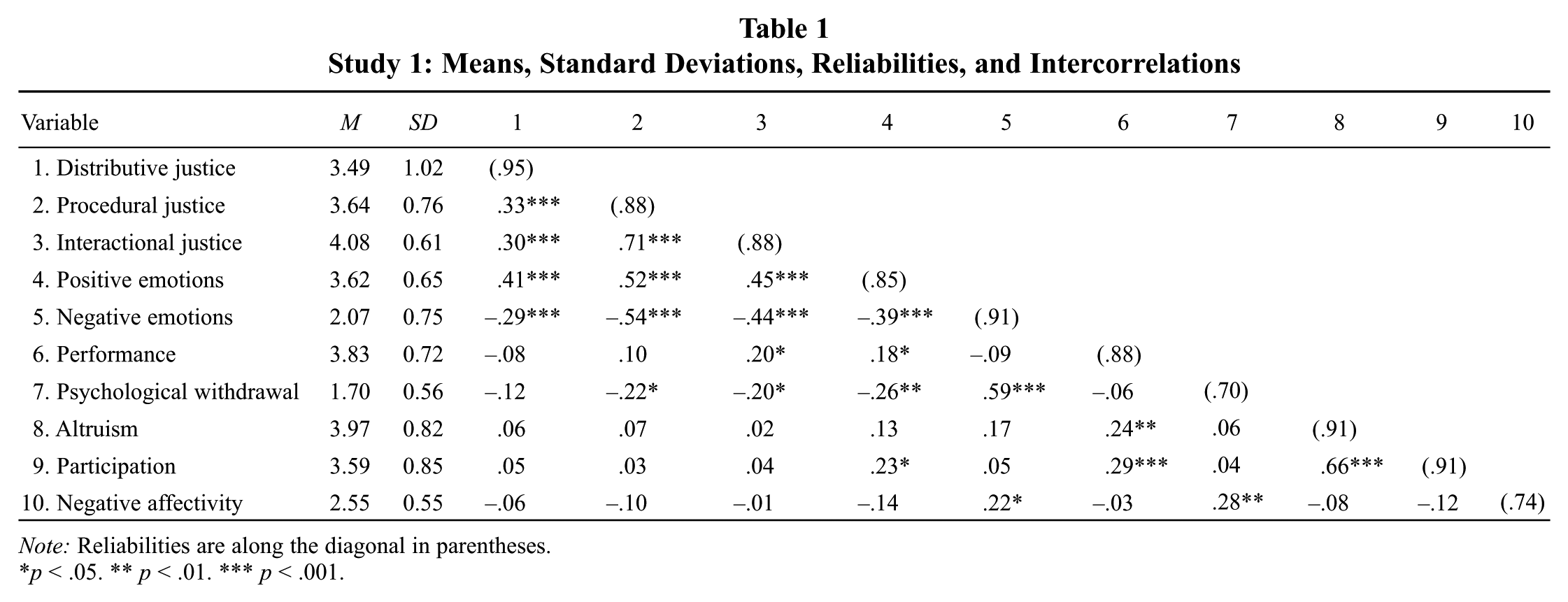
Note: Reliabilities are along the diagonal in parentheses.
p < .05. ** p < .01. *** p < .001.
As noted above, we tested our hypotheses in two models; Model 1 tested performance and withdrawal (χ2 = 22.21, df = 15, p > .05; CFI = .98; RMSEA = .05), and Model 2 examined helping (χ2 = 25.41, df = 17, p > .05; CFI = .97; RMSEA = .07). Consistent with the implications of the Wald test (e.g., Byrne, 2006; Kline, 1998), we removed the nonsignificant link between negative emotions and performance in Model 1. The final Model 1 had a good fit to the data (χ2 = 20.21, df = 16, p > .05; CFI = .99; RMSEA = .04). Figure 1 displays the final models.
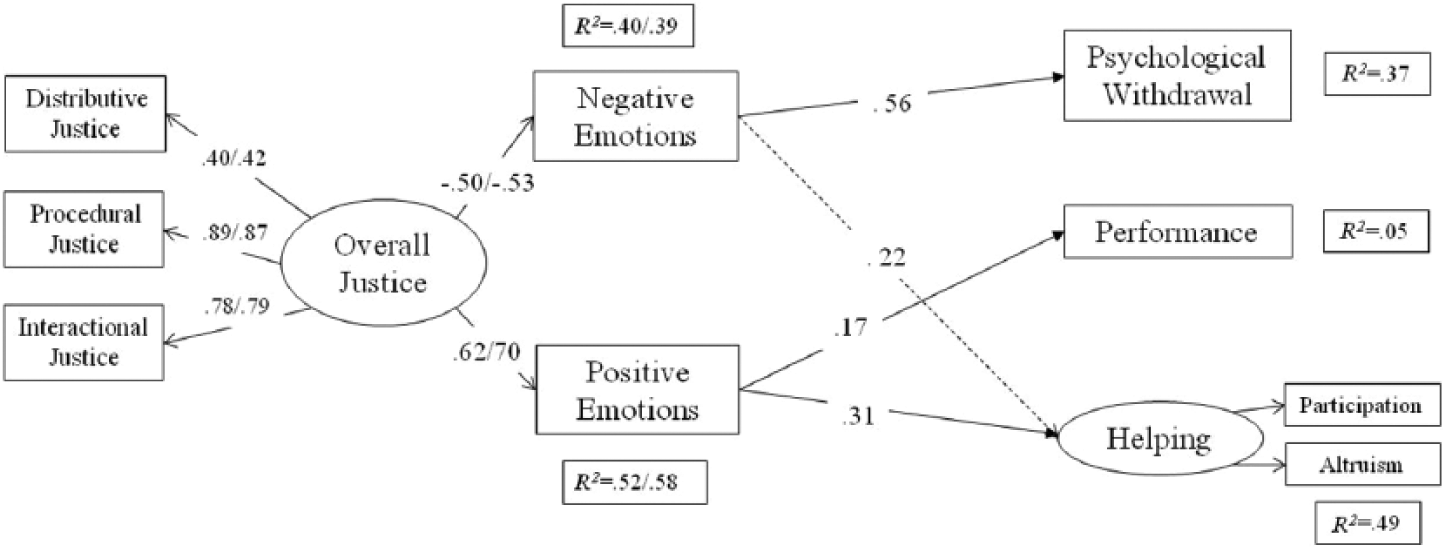
Study 1 Results
Given that our research question focuses on emotions as an outcome of justice perceptions, we used the final models as a template to test an alternative model in which the mediators (positive and negative emotions) and IV (overall justice) were reversed (cf. MacCallum & Austin, 2000). Table 2 summarizes the results. In both cases, our final models had superior fit to the alternative model, which provides support for our conceptualization that both positive and negative emotions can act as mediators in the relationship between overall justice and outcomes.
Study 1: Summary of Models
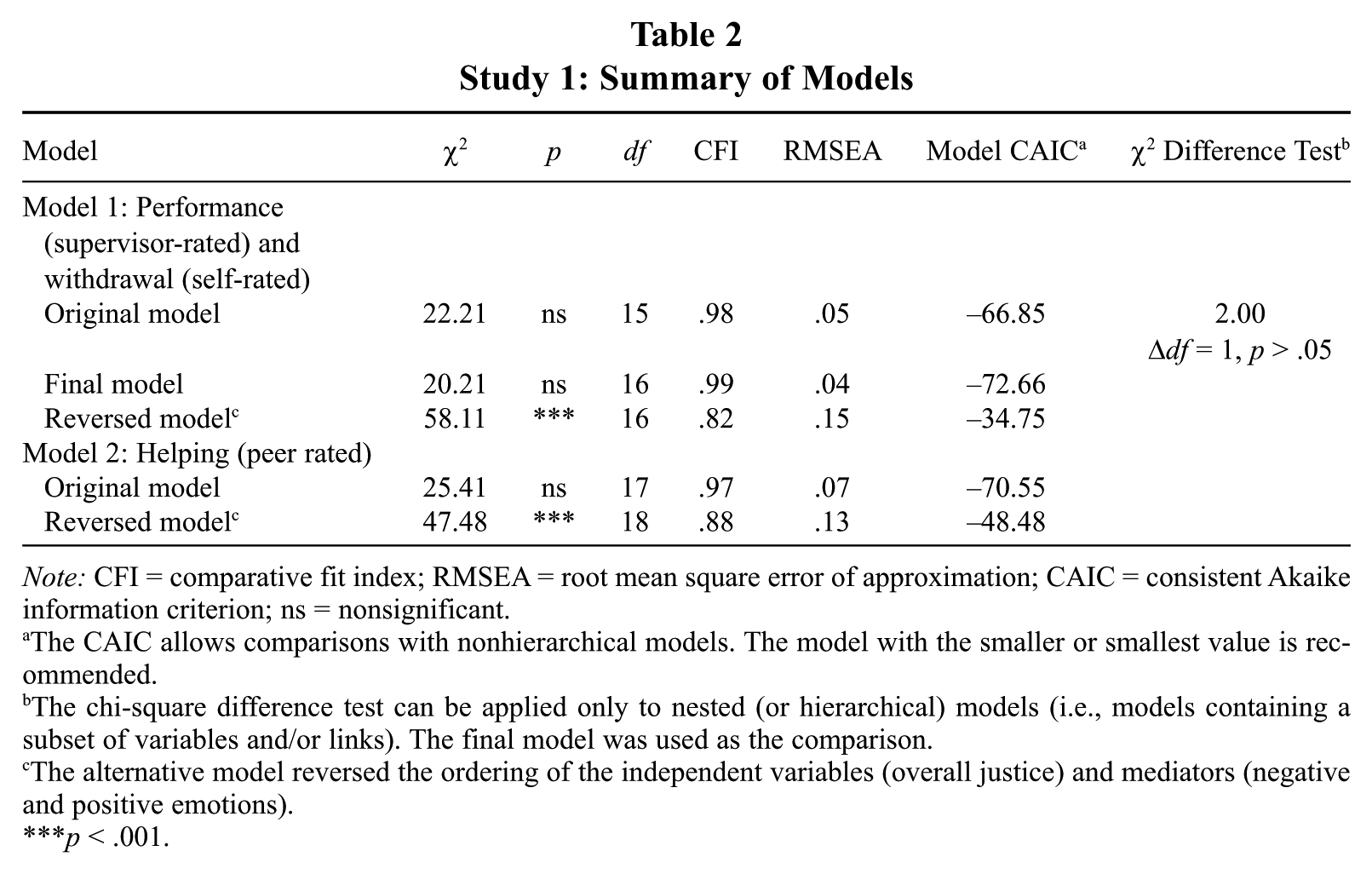
Note: CFI = comparative fit index; RMSEA = root mean square error of approximation; CAIC = consistent Akaike information criterion; ns = nonsignificant.
The CAIC allows comparisons with nonhierarchical models. The model with the smaller or smallest value is recommended.
The chi-square difference test can be applied only to nested (or hierarchical) models (i.e., models containing a subset of variables and/or links). The final model was used as the comparison.
The alternative model reversed the ordering of the independent variables (overall justice) and mediators (negative and positive emotions).
p < .001.
Given that overall justice was a latent variable, the constraints test was not appropriate, so we used z transformations to test Hypothesis 1. Results indicated that procedural justice (Model 1: z = 8.26, p < .001; Model 2: z = 6.90, p < .001) and interactional justice (Model 1: z = 5.15, p < .001; Model 2: z = 5.29, p < .001) had significantly stronger relationships with overall justice than distributive justice did (also see Figure 1). We also explored the differences between procedural and interactional justice and found that procedural justice had a stronger relationship with overall justice than interactional justice did (Model 1: z = 3.12, p < .001; Model 2: z = 1.61, p < .001). Hypothesis 1a and Hypothesis 1b were both supported.
Results for Hypothesis 2 indicated that overall justice was significantly related to increased positive emotions (Model 1: β = .62, p < .001; Model 2: β = .70, p < .001) and decreased negative emotions (Model 1: β = −.50, p < .001; Model 2: β = −.53, p < .001). Hypothesis 2a and Hypothesis 2b were both supported.
To conserve space, the full results for Hypotheses 3, 4, and 5 are presented in Table 3. Results for performance indicated that positive emotions significantly mediated the relationship between overall justice and performance, whereas no significant mediation was observed for negative emotions. Moreover, the constraints test indicated that positive emotions had a stronger effect on performance than negative emotions did, which were not significantly related to performance (χ2 = 3.87, df = 1, p < .05). Hypothesis 3a and Hypothesis 3c were supported, whereas Hypothesis 3b was not supported.
Study 1: Mediation Results
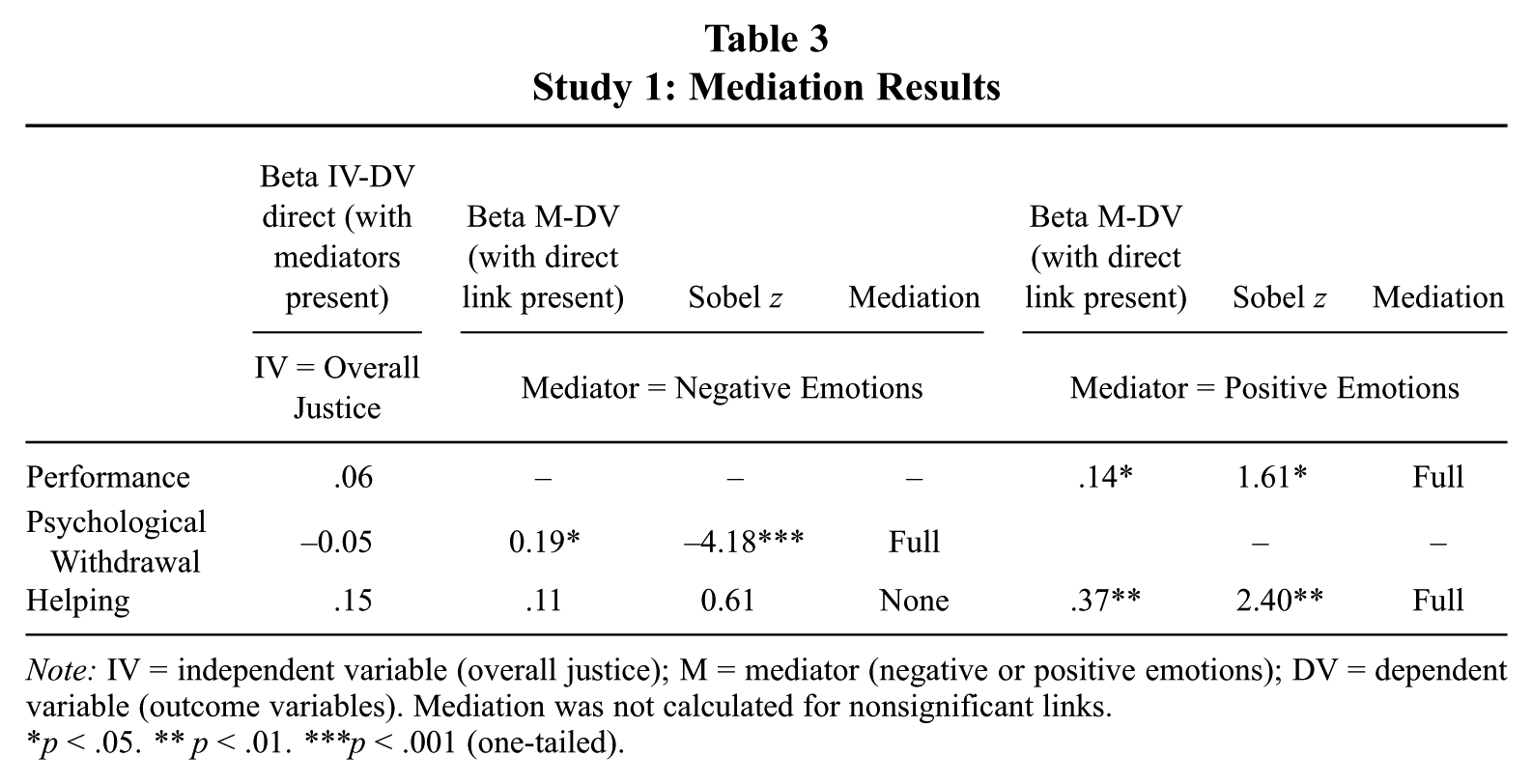
Note: IV = independent variable (overall justice); M = mediator (negative or positive emotions); DV = dependent variable (outcome variables). Mediation was not calculated for nonsignificant links.
p < .05. ** p < .01. ***p < .001 (one-tailed).
Results for psychological withdrawal indicated that negative emotions fully mediated the relationship between overall justice and psychological withdrawal. The constraints test indicated that negative emotions had a stronger relationship with psychological withdrawal than positive emotions did, which were not significantly related to withdrawal (χ2 = 14.60, df = 1, p < .001). Hypothesis 4a and Hypothesis 4b were both supported.
Results for helping indicated that both positive and negative emotions were associated with increased helping, but there were no significant differences between the strength of the relationships between positive and negative emotions with helping (χ2 = 1.03, df = 1, p > .05). Additionally, only positive emotions significantly mediated the relationship between overall justice and helping. Hypothesis 5a was supported, whereas Hypothesis 5b and Hypothesis 5c were not supported.
Study 1 Discussion
Several important findings emerged from Study 1. First, we found that both procedural and interactional justice were significantly more predictive of the overall justice latent variable than distributive justice was, supporting our argument that these dimensions have less attributional ambiguity and more significant implications for the individual’s sense of self than distributive justice does. However, we also found that procedural justice was significantly more predictive of the overall justice latent variable than interactional justice was. Instrumental models of procedural justice may shed light on this result (e.g., Thibaut & Walker, 1975). Specifically, the instrumental model suggests that individuals often take a long-term perspective when considering procedural fairness and prefer fair procedures that will provide them with beneficial outcomes over time (e.g., Greenberg, 1990). Thus, procedural justice may be particularly influential since it is likely to be relatively stable over time and across situations and people (Cropanzano et al., 2001).
Second, we found empirical support for our argument that positive emotions are likely to be particularly influential with approach-related outcomes (i.e., performance), whereas negative emotions are likely to be important for avoidance-related outcomes (i.e., withdrawal). With respect to performance, we found that positive emotions fully mediated the relationship between overall justice and performance, whereas negative emotions were not significantly related to performance. This supports the broaden-and-build perspective of positive emotions and directly contrasts the asymmetric perspective (i.e., there should be stronger effects for negative as compared with positive phenomena). With respect to withdrawal, the opposite was true: Negative emotions fully mediated the relationship between overall justice and psychological withdrawal, whereas positive emotions did not significantly predict psychological withdrawal. Together, these results suggest that it is important to consider the context in which emotions are occurring in order to understand their effects. Within organizational contexts, for example, negative emotions can motivate individuals’ behaviors; however, individuals may prefer to direct this energy toward some outcomes (e.g., psychological withdrawal) rather than other outcomes (e.g., decreasing performance). In other words, within organizations, psychological withdrawal (e.g., considering leaving job or putting in less cognitive effort) is likely to be a preferable option because it is less overt and observable by others than failing to meet performance standards.
Third, our findings also suggest that it is important to consider the target of the behavior when examining the effects of emotions. We found that both positive and negative emotions were associated with increased helping behaviors and that there were no significant differences in the strength of these relationships. Although negative emotions are generally assumed to distract individuals and consume resources required to engage in approach-related behaviors, our results indicate that negative emotions can be related to increased helping behaviors that are targeted toward one’s coworkers. Thus, although negative emotions can detract from behaviors directed toward the organization, these same emotions can have functional consequences for other targets in the workplace. Moreover, it is interesting to note that positive emotions but not negative emotions mediated the relationship between overall justice and helping. This suggests different roles for these emotions. Whereas individuals who feel fairly treated may help others because they are feeling positive emotions, the same relationship does not necessarily exist with negative emotions. Instead, individuals experiencing negative emotions may use helping as a way of receiving support and validation or as a distraction. This suggests that the different roles and functions of positive and negative emotions require further study.
Although Study 1 made important contributions, a second study was deemed necessary for several reasons. First, our measure of emotion targeted how individuals felt at work in general rather than the emotions arising directly from individuals’ justice perceptions. On the one hand, this is interesting because it suggests that overall justice can predict general work-related emotions (i.e., overall justice has the ability to go beyond specific emotions to influence how one feels generally about work). On the other hand, this is problematic because these emotions can also be influenced by other factors (e.g., poor working conditions). Thus, we believed it was important to reexamine these relationships with a measure that directly targeted the emotions arising specifically from justice perceptions. Second, although the use of multirater data is a strength of Study 1, the data were collected cross-sectionally, which (a) limits our ability to conclude that emotions were indeed impacting our behavioral outcomes (i.e., that the causal ordering of our variables was justified) and (b) does not allow us to explore the time element underlying our theoretical rationales. Study 2 was designed to address these issues.
Study 2
The overall objectives of Study 2 were threefold. Specifically, we wanted to (1) address the limitations of Study 1, (2) retest our hypotheses with a broader and more generalizable sample that came from a range of occupations and industries, and (3) explore whether the same effects hold over the course of time. Accordingly, we conducted a field study with full-time employees from across the United States. We collected the data in two time periods that were separated by one month. To explore the effects of time, we examined how overall justice and positive and negative emotions collected at Time 1 impacted outcomes at Time 2, while controlling for the outcomes collected at Time 1.
Method
Participants and Procedure
Participants were recruited with the assistance of Zoomerang—an online data collection service that caters to educational, nonprofit, and market research. The age and annual household income of this panel is largely comparable to that of the U.S. census (Zoomerang, 2005). Researchers in a number of domains have used this service, including organizational behavior (e.g., Rogers & Bazerman, 2008; Thau, Bennett, Mitchell, & Marrs, 2009) and psychology (e.g., Inbar, Pizarro, & Bloom, 2009). The quality of data from Internet sources has been found to be comparable to traditional paper-and-pencil data collection (Gosling, Vazire, Srivastava, & John, 2004). Moreover, there are numerous advantages to the use of Internet data collection, including (a) obtaining more diverse samples than typical college samples and (b) allowing scale items to be randomized, which can minimize order effects as well as common method bias concerns (e.g., Fraley, 2007; Gosling et al., 2004). In our case, this strategy also allowed us to recruit full-time employees from a broad range of companies and occupations across the United States, thereby increasing the generalizability of our findings.
Target employees provided all of the ratings, and data were collected at two separate time periods that were separated by one month. We had 722 respondents at Time 1 and 490 respondents at Time 2; 68% of our participants responded at both time periods, which is considered relatively high for this type of sample (Baruch, 1999; Visser, 1982). We dropped 39 respondents from the final sample because they had changed organizations or lost their jobs since Time 1. Our final sample consisted of 451 participants. In our final sample, the average participant was 48.2 years of age and had been employed at their company for 10.67 years. The sample was 49% male and 85% Caucasian. There were no significant demographic differences between individuals who only completed Time 1 and those who completed both time periods.
Measures
Although we used the same scales as in Study 1, there were some modifications. At Time 1, we asked individuals to reflect on the last week (e.g., “Thinking back on the last week in your job/at work . . . ”), and the time frame used for Time 2 was over the last month (e.g., “Thinking back on the last month in your job/at work . . . ”). The distributive justice items in this study focused on “outcomes” instead of being restricted to “pay,” and we changed the question stem for the emotion items to “Please indicate the extent to which you have experienced each of the following emotions in reaction to any fair/unfair treatment that you have experienced at work over the last week.”
Analytic Strategy
To test our hypotheses, we followed the same procedures as in Study 1. However, given the longitudinal nature of our data, we followed recommendations from Cole and Maxwell (2003) for examining mediations with longitudinal data. Specifically, we included the Time 1 outcome variable in the models (i.e., direct links between the mediator to the Time 1 outcome and between the Time 1 and Time 2 outcome were included). We also included the Time 1 variable in the mediation analyses (see also Williams & Podsakoff, 1989). Thus, our analyses examine whether the relationship between the mediators and Time 2 outcomes were significant over and above Time 1 (i.e., with the Time 1 outcomes present in the model).
Study 2 Results
Means, standard deviations, reliabilities, and correlations are shown in Table 4. Similar to Study 1, results of a confirmatory factor analysis supported our distinction between positive and negative emotions (χ2 = 602.47, df = 148, p < .05; CFI = .96; RMSEA = .07) and our use of the three-dimensional latent overall justice variable (χ2 = 10.70, df = 2, p > .05; CFI = .99; RMSEA = .00; CAIC = −13.89). Moreover, an alternative model with direct paths from the three justice dimensions (with correlations between the dimensions) had a poorer fit than our final latent model (χ2 = 159.62, p < .001; CFI = .96; RMSEA = .08; CAIC = −196.85), which provides empirical evidence for the appropriateness of adopting a latent variable approach.
Study 2: Means, Standard Deviations, Reliabilities, and Intercorrelations
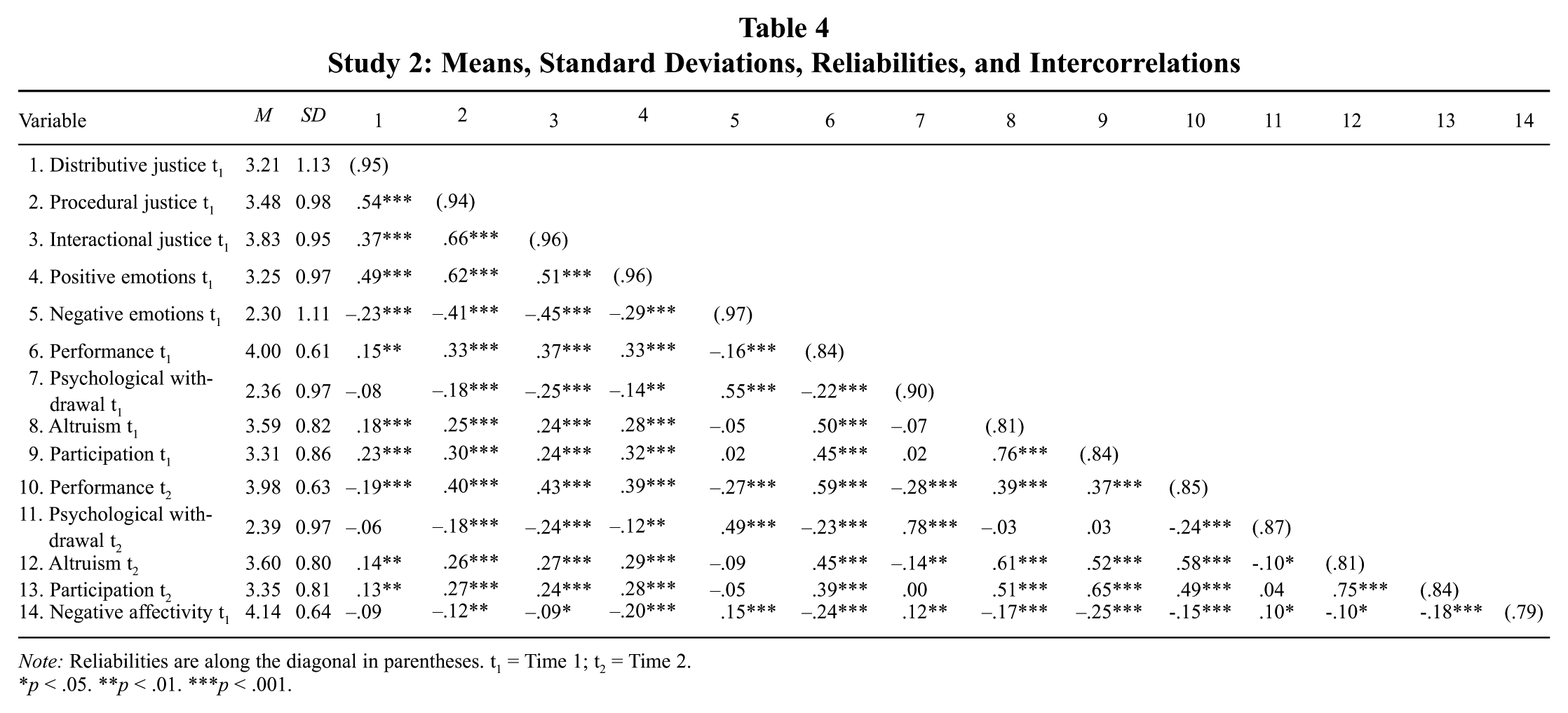
Note: Reliabilities are along the diagonal in parentheses. t1 = Time 1; t2 = Time 2.
p < .05. **p < .01. ***p < .001.
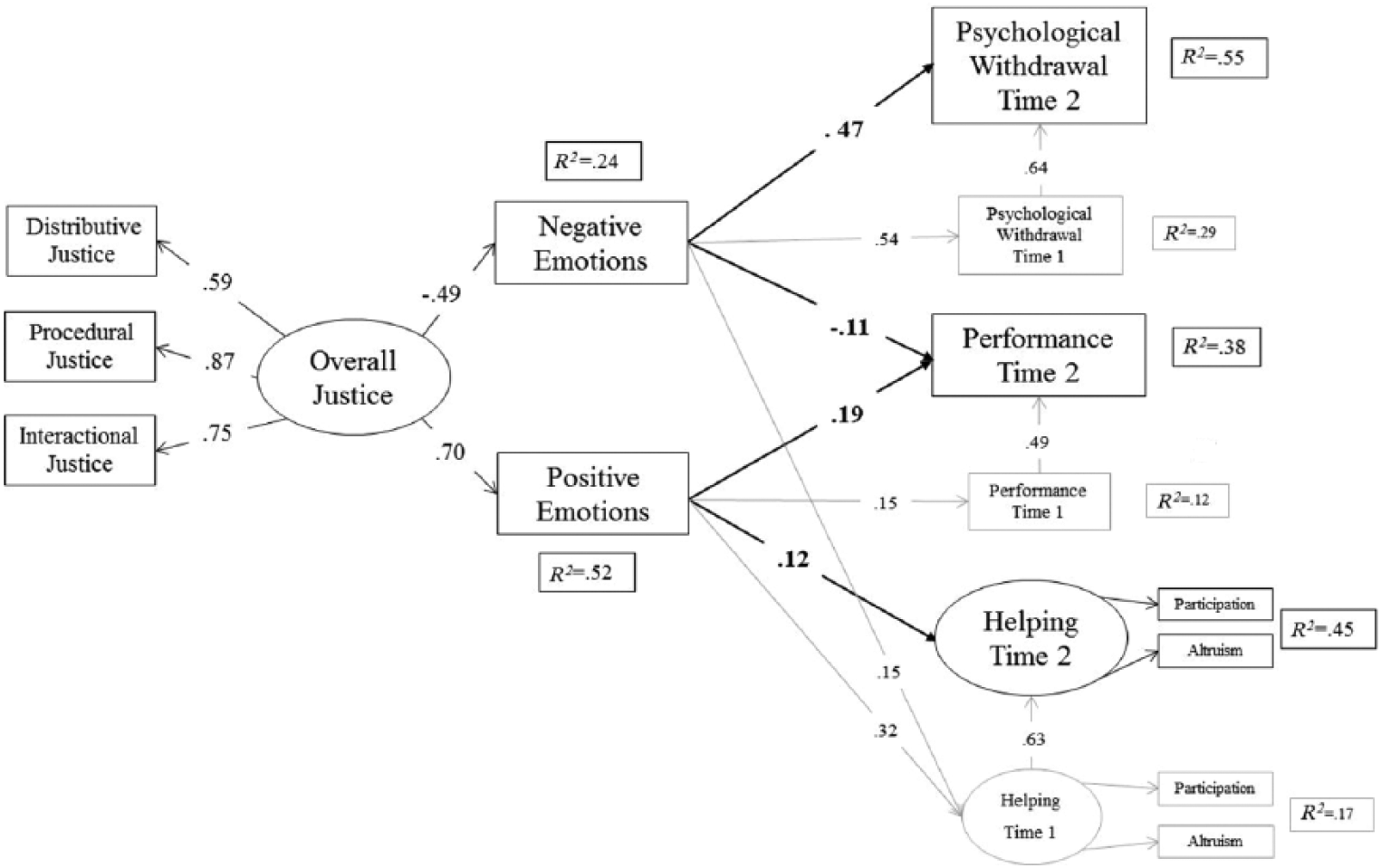
Given the larger sample size, we tested our hypotheses in one model, which had an adequate fit to the data (χ2 = 167.54, df = 56, p < .001; CFI = .96; RMSEA = .07). Consistent with the Wald test (e.g., Byrne, 2006; Kline, 1998), we removed the nonsignificant links between negative emotions and performance (at Time 1) and negative emotions and helping (at Time 2). The final model had a good fit to the data (χ2 = 169.62, df = 58, p < .001; CFI = .97; RMSEA = .07). Figure 2 displays the results. Analogous to Study 1, we tested an alternative model that reversed the mediators (positive and negative emotions) and the IV (overall justice). Table 5 summarizes the results. Our final model had a superior fit to the alternative model, which provides support for our conceptualization that positive and negative emotions can serve as mediators in the relationship between overall justice and outcomes.
Study 2 Results
Study 2: Summary of Models
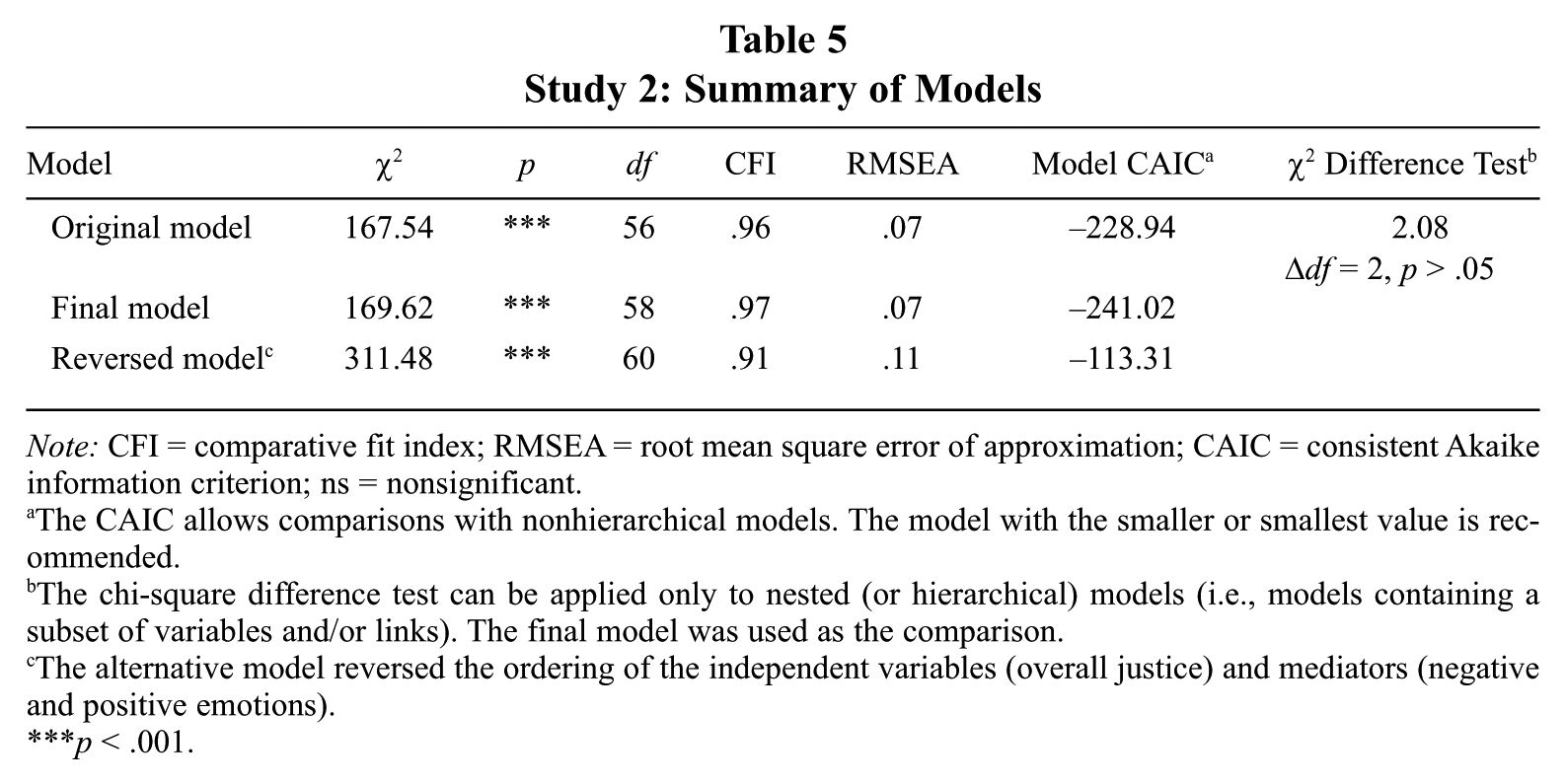
Note: CFI = comparative fit index; RMSEA = root mean square error of approximation; CAIC = consistent Akaike information criterion; ns = nonsignificant.
The CAIC allows comparisons with nonhierarchical models. The model with the smaller or smallest value is recommended.
The chi-square difference test can be applied only to nested (or hierarchical) models (i.e., models containing a subset of variables and/or links). The final model was used as the comparison.
The alternative model reversed the ordering of the independent variables (overall justice) and mediators (negative and positive emotions).
p < .001.
Hypothesis 1 results indicated that procedural justice (z = 9.23, p < .001) and interactional justice (z = 5.55, p < .001) had significantly stronger relationships with overall justice than did distributive justice (also see Figure 2). We also explored the differences between procedural and interactional justice and found that procedural justice had a stronger relationship with overall justice than did interactional justice (z = 3.69, p < .001). Hypothesis 1a and Hypothesis 1b were both supported.
Hypothesis 2 results indicated that overall justice was significantly related to increased positive emotions (β = .70, p < .001) and decreased negative emotions (β = −.49, p < .001). Hypothesis 2a and Hypothesis 2b both were supported.
Full mediation results for Hypotheses 3, 4, and 5 are presented in Table 6. Results for performance indicated that both positive emotions and negative emotions partially mediated the relationship between overall justice and performance. Moreover, the constraints test indicated that positive emotions had a stronger effect on performance than did negative emotions (χ2 = 14.03, df = 1, p < .001). Hypotheses 3a, 3b, and 3c were supported.
Study 2: Mediation Results
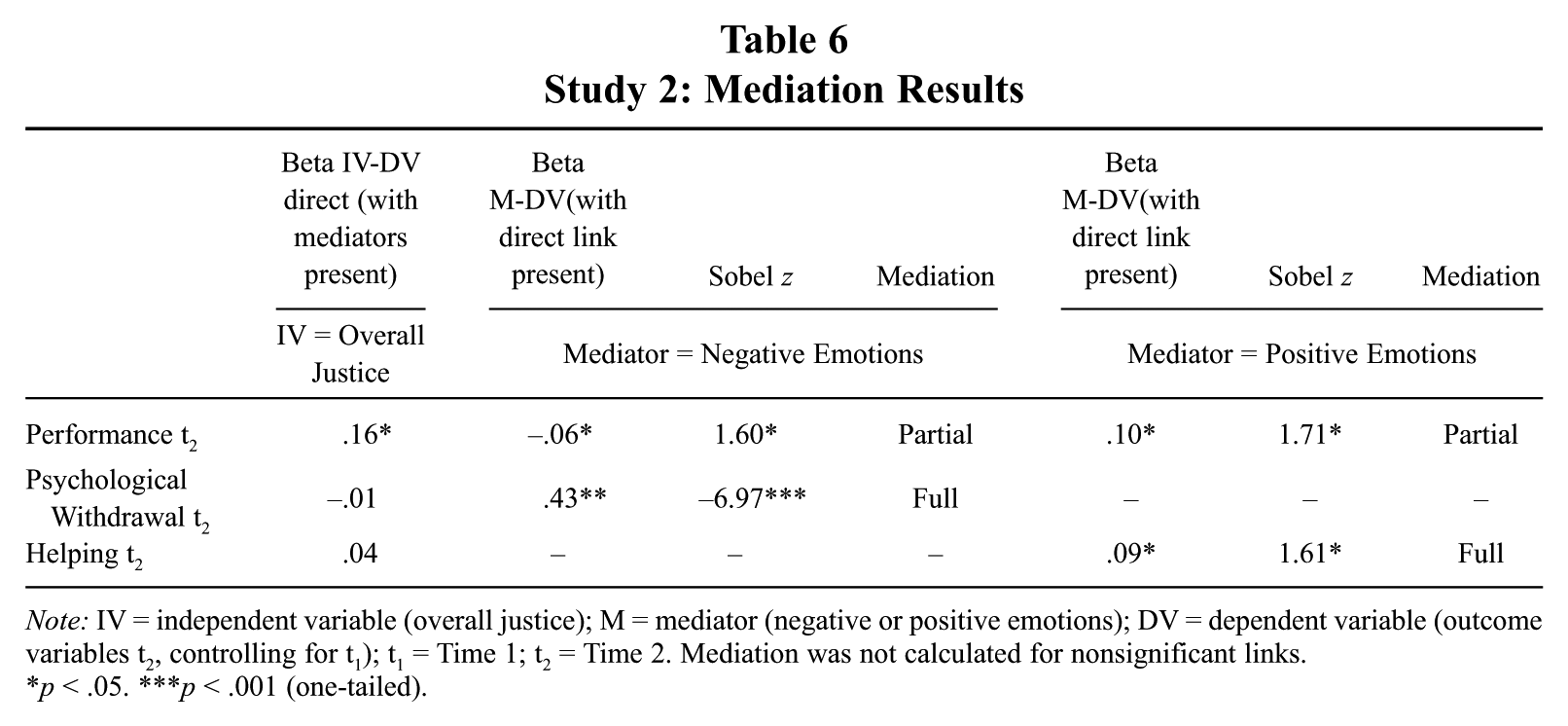
Note: IV = independent variable (overall justice); M = mediator (negative or positive emotions); DV = dependent variable (outcome variables t2, controlling for t1); t1 = Time 1; t2 = Time 2. Mediation was not calculated for nonsignificant links.
p < .05. ***p < .001 (one-tailed).
Results for psychological withdrawal indicated that negative emotions fully mediated the relationship between overall justice and psychological withdrawal. The constraints test indicated that negative emotions had a stronger relationship with psychological withdrawal than did positive emotions, which were not significantly related to withdrawal (χ2 = 60.80, df = 1, p < .001). Hypothesis 4a and Hypothesis 4b were both supported.
Results for helping indicated that positive but not negative emotions significantly mediated the relationship between overall justice and helping. Moreover, positive emotions had a stronger relationship with helping than did negative emotions, which were not significantly related to helping (χ2 = 6.61, df = 1, p < .05). Hypothesis 5a and Hypothesis 5c were supported; Hypothesis 5b was not supported.
Study 2 Discussion
In Study 2, we reexamined each of our hypotheses. Consistent with Study 1, we found that both procedural and interactional justice were significantly stronger predictors of overall justice than distributive justice was. Moreover, procedural justice was again a stronger predictor of overall justice as compared with interactional justice. This provides further evidence that each specific justice dimension is likely to be important for entity-related overall justice and that procedural justice might be particularly influential since its relative stability can indicate how the individual can expect to be treated over time. Additionally, overall justice significantly predicted both positive and negative emotions. This finding indicates that it is important to examine not only attitudinal and behavioral outcomes but also emotional outcomes in order to more comprehensively understand how individuals respond to justice issues. Moreover, despite receiving less attention in the literature, positive emotions were found to be a significant outcome of overall justice, which indicates that more attention should be directed toward understanding these emotions within the context of justice.
With respect to our approach/avoid argument, we found support for our prediction that positive emotions are more influential in predicting performance (i.e., approach), whereas negative emotions are more influential in predicting psychological withdrawal (i.e., avoidance). This contrasts the asymmetric perspective, which suggests that the effects of negative emotions should be consistently stronger than those of positive emotions, and provides further support for the notion that the effects of negative emotions might be constrained within organizations.
With respect to helping behaviors, positive emotions were a stronger predictor of helping than negative emotions were, the latter of which had a significant positive relationship with helping at Time 1 but not at Time 2. Moreover, positive but not negative emotions significantly mediated the relationship between overall justice and helping. We discuss these relationships in detail in the general discussion.
General Discussion
Given the movement in the literature toward examining overall justice, as well as the “affective revolution” that is currently taking place (Barsade, Brief, & Spataro, 2003), the time is ripe to study the role of emotion within the context of overall justice. In this research, we addressed several significant gaps in the literature, including (a) the degree to which specific justice dimensions contribute to overall justice, (b) whether overall justice predicts both positive and negative emotional outcomes, and (c) the mediating role and differential effects of positive and negative emotions in predicting behavioral outcomes that can arise from overall justice. Addressing these gaps is important because it can provide insight into (a) the most influential predictors of overall justice, (b) how and why individuals react to justice issues, (c) the types of reactions individuals are likely to have, and (d) how overall justice is related to behaviors.
Predicting Overall Justice
Our findings contribute to the justice literature by providing further insight into the relative contributions of the specific justice dimensions (i.e., distributive, procedural, and interactional justice) in predicting overall justice. Across two studies, we found that procedural justice was the most important predictor of overall justice, followed by interactional justice and then distributive justice. These results provide support for the argument that procedural and interactional justice are stronger predictors than distributive justice because these dimensions can carry attribution information with them and also can have significant implications for the individual’s self-worth (Barclay et al., 2005; Folger & Cropanzano, 1998, 2001; Tyler & Lind, 1992). Moreover, procedural justice is likely to be particularly important since procedures are likely to be relatively stable and consistent across situations and individuals over the course of time (Thibaut & Walker, 1975).
Overall Justice as a Predictor of Emotions
Our study also sheds light on the relationship between overall justice and emotional outcomes. In contrast with previous research that has focused on the specific justice dimensions and negative emotions, our study is the first (to our knowledge) that has empirically tested the relationships between overall justice with both negative and positive emotions while also controlling for the other set of emotions. Across two field studies, we found that overall justice is a significant predictor of both positive and negative emotions. Whereas existing research has primarily focused on the relationships between overall justice and attitudinal or behavioral outcomes, these findings support the notion that overall justice is also important for predicting emotional outcomes. Moreover, as argued in detail below, this is an important finding because positive and negative emotions differentially influence behavioral outcomes. Thus, understanding positive and negative emotions can be important in order to manage behaviors.
Emotion as a Mediator Between Overall Justice and Behavioral Outcomes
In addition to serving as an outcome of justice perceptions, our studies indicate that both positive and negative emotions can play an important mediating role in the relationship between justice and behaviors. Moreover, the effects of positive emotions can be as strong as, and in some cases stronger than, negative emotions for a variety of behavioral outcomes. Below, we summarize the results for each outcome.
Performance
Across the two studies, the effects of positive emotions on performance were consistent. In both studies, positive emotions (a) enhanced performance and (b) significantly mediated the relationship between overall justice and performance. This supports the broaden-and-build perspective, which suggests that positive emotions should encourage individuals to engage with their environments (Fredrickson, 1998, 2001). However, the effects of negative emotions on performance were inconsistent across the two studies. In Study 1, negative emotions were not significantly related to performance, whereas in Study 2, negative emotions (a) detracted from performance and (b) mediated the relationship between overall justice and performance. There are at least three potential explanations for this disparity. First, although we used the same measure of performance across the studies, performance was rated by supervisors in Study 1 and by target individuals (i.e., self-report) in Study 2. Thus, these disparities may be due to differences across raters (Schoorman & Mayer, 2008). Specifically, Harris and Schaubroeck’s (1988) meta-analytic review suggested that employees tend to inflate their performance ratings, which may decrease the validity of self-ratings and result in a moderate correspondence between self-ratings and supervisor ratings of performance (e.g., average correlation of .35). Indeed, in our studies, performance was significantly higher when rated by oneself (Study 2, Time 2, M = 3.98) than when rated by a supervisor (Study 1, M = 3.83); t(585) = 2.35, p < .05. However, it is also possible that genuine differences in supervisor versus employee perspectives might have impacted these relationships. Whereas supervisors can evaluate only the behaviors they observe, employees may be privy to additional information that can impact their performance ratings. That is, employees who are experiencing negative emotions may find it more difficult to work efficiently and “get the job done,” or they may reduce their performance in areas that their supervisors are not likely to immediately notice. From an outsider’s perspective (i.e., supervisor rating), it may not appear that performance levels have changed. However, from the employee’s perspective, the employee may recognize that he or she is not working as efficiently as normal or has “let a few things slide.”
A second possibility comes from AET, which suggests that the relationships between emotions and performance may depend on whether emotions instigate behaviors that are (in)compatible or unrelated to the job domain (Weiss & Cropanzano, 1996). In Study 1, we focused on employees from one company, whereas Study 2 sampled employees from a range of different occupations and industries. Thus, there might have been differences in the degree to which negative emotions generated behaviors that (mis)matched those required in the job domain. Future research should explore the compatibility between the behaviors that are instigated by emotions and behaviors in the job domain.
A third possible explanation, and likely the most plausible, relates to time. Our data were collected cross-sectionally in Study 1 and longitudinally in Study 2 (i.e., performance was collected at Time 1 and again one month later at Time 2). Given the differences across the studies, we probed the results of Study 2 and found that the relationships at Time 1 were the same as in Study 1—negative emotions were not significantly related to performance. In other words, when examined cross-sectionally, negative emotions and performance were not significantly related. Instead, the relationship between negative emotions and performance emerged over time. This is theoretically relevant because it suggests that, in the short term, individuals may be able to mitigate the effects of negative emotions (e.g., they may let a few things “slide,” but their general performance is relatively unaffected). However, over time, negative emotions may have a variety of implications for individuals’ performance. For example, negative emotions may distract individuals and/or deplete their resources such that more serious decrements in performance begin to emerge. Alternatively, individuals may be motivated to redirect their energy away from performing and toward correcting the situation and/or “getting even” for the injustice.
Overall, our findings for performance indicate the importance of considering context. In other words, it is important to recognize (a) who is rating the behavior, (b) when the behavior is rated, and (c) whether the emotions are instigating behaviors that are (in)compatible or unrelated to the job. Moreover, within the context of the asymmetric perspective, we cannot assume that (a) negative emotions will always have detrimental effects or (b) the effects of negative emotions will be stronger than those of positive emotions. Rather, the effects of emotions may be constrained by the work setting. That is, individuals experiencing negative emotions might be reluctant to decrease performance for fear of personal repercussions. Taken together, these results indicate that researchers should be careful about making broad generalizations since the context within which a phenomenon is studied and the methodologies that are used can have implications for the relationships that are observed.
Withdrawal
Across both studies, negative emotions fully mediated the relationship between overall justice and withdrawal, whereas positive emotions were not significantly related to withdrawal. This is consistent with our reasoning that negative emotions motivate individuals to engage in avoidance-related outcomes (i.e., psychological withdrawal) because these emotions narrow individuals’ thought–action repertoires and encourage them to focus on dealing with the immediate situation. In contrast, positive emotions were unrelated to psychological withdrawal, which was likely due to their tendency to connect individuals with rather than disassociate individuals from their environments. Additionally, it is noteworthy that the zero-order correlations for both studies indicate a significant negative relationship between positive emotions and withdrawal. However, this effect disappears when positive and negative emotions are simultaneously present, thereby highlighting the importance of examining positive and negative emotions together.
The relatively strong relationships between negative emotions and psychological withdrawal are also important because they suggest that, within organizational contexts, individuals may have some discretion in how they manage their negative emotions. That is, although negative emotions may encourage individuals to withdraw from the environment; individuals may choose to withdraw in ways that are less overt and observable by others (e.g., psychological withdrawal) rather than in ways that may result in personal repercussions (e.g., decreasing performance).
Summarizing the Relationship Between Emotions and Approach/Avoidance Behaviors
Taking the results for performance and psychological withdrawal together, we found evidence to support the broaden-and-build perspective. Specifically, the relationships between positive emotions and approach-related behavior (i.e., performance) and between negative emotions and withdrawal/avoidance-related behavior (i.e., psychological withdrawal) are consistent with the perspective that positive emotions broaden individuals’ thought–action repertoires, thereby encouraging them to approach and engage with their environments, whereas negative emotions narrow individuals’ thought–action repertoires, thereby encouraging them to avoid or withdraw. Moreover, the performance findings indicate that the asymmetric perspective may not always hold within organizational contexts. Thus, it is important to consider the role of context in the relationship between emotions and outcomes.
Helping Behaviors
Across both studies, we found that positive but not negative emotions significantly mediated the relationship between overall justice and helping. We also noted that negative emotions were significantly related to increased helping in Study 1, whereas this relationship was not significant (at Time 2) in Study 2. To better understand the results of Study 2, we reexamined the relationships at Time 1 and found that both negative and positive emotions were significantly related to helping behaviors at Time 1, which suggests that time is an important element to consider when examining the effects of negative emotions on helping behaviors. Specifically, negative emotions may increase helping in the short term as a way for individuals to alleviate and/or validate their negative emotions (e.g., Baumann et al., 1981; Cialdini et al., 1987; Grant & Wade-Benzoni, 2009). Over the course of time, however, helping others is unlikely to remain effective as a coping mechanism. Previous research, for example, has demonstrated that a person who repeatedly expresses negative emotions to others can lead others to avoid him or her. This is because the expression of negative emotions can be experienced as irritating by others and/or can evoke discomfort or uncertainty about how to respond to the negative emotions, which can lead others to distance themselves from the individual and make it more difficult for the individual to engage in helping (O’Brien & DeLongis, 1997). Moreover, helping provides only temporary relief, and individuals are unlikely to continue to engage in these behaviors if they perceive them as short-term fixes rather than as something that will help them cope long term with their negative emotions or the situation at hand (Cialdini et al., 1987). Taken together, these results indicate that positive and negative emotions can have an influential role with helping behaviors, particularly in the short term. Additionally, more research is needed that explores the effects of justice, emotions, and helping behaviors over time.
Limitations and Future Research
Our hypotheses were generally supported in two field studies with different samples of working employees and with different sources of data for the behavioral measures. Nonetheless, as with any research, the findings should be viewed in light of their limitations. In this section, we outline the limitations of this research and opportunities for future research.
Causality, Longitudinal Designs, and Person-Centric Perspectives
The complex, intricate, and dynamic relationships between justice and emotions can make these constructs challenging to study, and our findings raise issues related to causality, the importance of longitudinal research, and the appropriateness of the current paradigms used to study these constructs. With respect to the issue of causality, we examined our relationships cross-sectionally (Study 1) and one month apart (Study 2). We chose the latter approach for Study 2 since it can reduce common method bias and ensure that justice and emotion preceded outcomes, thereby providing additional confidence in our results. However, neither study permits causal explanations. Moreover, our research only implies that justice perceptions can relate to emotional outcomes. Previous research has shown that affect (i.e., moods, trait affect, and emotions) can also influence the formation of justice perceptions and/or accompany injustice reactions (e.g., Folger, 2001). This suggests that it can be difficult to disentangle affective/emotional and cognitive/perceptual reactions—particularly since the interplay between emotions and cognitions might happen very quickly. Thus, the relationships in our study might not hold in other research that has conceptualized emotions differently (e.g., as an antecedent or accompaniment of justice perceptions). More research is needed to better understand the relationships between justice perceptions and different types of affect, including (a) how mood, trait affect, and emotions can precede, infuse, and shape justice perceptions; (b) how affect-infused perceptions impact the types of emotional outcomes that arise; and (c) the dynamic interplay between emotions and cognitions in the formation and use of justice perceptions.
Our research question focused on delineating the relationships between justice, emotions, and behavioral outcomes, and as such, our measurement strategy involved examining the variability in justice and emotion at a given time and how this related to outcomes. However, justice perceptions and emotions can also change over time (e.g., Holtz & Harold, 2009). Thus, future research may benefit from conceptualizing justice and emotion as dynamic phenomena and exploring these relationships over multiple time periods. Ployhart and Vandenberg (2010), for example, suggest that exploring three or more time periods can enhance our understanding of the causality of these relationships and also how these relationships change over time. Specifically, when two time periods are explored, researchers can determine that some change occurred, but the nature of the change cannot be assessed. By exploring phenomena over multiple time periods, the form of the change (e.g., when it occurred, whether it changed multiple times, etc.) can be determined, thereby deepening our understanding of the relationships. In other words, this approach allows variability in the constructs, and their ability to predict variability in other outcomes to be examined over time (i.e., whether the change in the predictor contributes to change in the outcome).
Our research has offered significant insights into the relationships between justice, emotions, and outcomes. We believe that the next steps in this line of inquiry should include adopting a person-centric perspective that focuses on how individuals experience justice as they experience it and how these experiences unfold over the course of time (Guo, Rupp, Weiss, & Trougakos, 2011; Weiss & Rupp, 2011). In other words, the emphasis should be on delving into the dynamic psychological and experiential processes that influence and shape individuals’ changing experiences of justice. Adopting this perspective can deepen our understanding of the role of time and emotions in the experience of justice. For example, incorporating a temporal aspect can shed light on how episodic justice events (with their affective and cognitive reactions) form the basis for higher level judgments (e.g., perceptions of entities and overall justice; Rupp, 2011; Rupp & Paddock, 2010). Taken together, by adopting a person-centric perspective and methodologies that allow these processes to be examined in the moment and over time, future research can further delineate the relationships between justice and emotions.
Conceptualizing and Operationalizing Justice
Our research raises questions related to the measurement of justice, including when to focus on specific dimensions versus overall justice, the different justice sources, and events versus entities. We discuss each of these issues below.
Overall justice
In the justice literature, there is debate about how justice should be measured (for detailed discussions, see Ambrose & Schminke, 2009; Colquitt et al., 2001; Colquitt & Shaw, 2005; Shapiro, 2010). We focused on the relative contributions of the specific justice dimensions in predicting overall justice and then how overall justice predicts emotions. Although there is a great deal of research indicating that the specific justice dimensions can interact to predict outcomes (for extensive reviews, see Brockner, 2010; Brockner & Wiesenfeld, 1996), previous research has suggested that additive models are more appropriate than multiplicative models when examining overall justice (e.g., Holtz & Harold, 2009; Jones & Martens, 2009). Nonetheless, in some cases, it can be fruitful to explore the effects of specific dimensions on specific outcomes (i.e., the differential effects approach; Ambrose & Arnaud, 2005; Ambrose, Hess, & Ganesan, 2007). 5
In our studies, we used the individual justice dimensions (i.e., distributive, procedural, and interactional) as indicators of a latent overall justice factor. However, other authors have directly measured overall justice (e.g., Ambrose & Schminke, 2009). Latent variables have been described as advantageous over measured variables because they help extract measurement error (e.g., Hall et al., 1999). Latent variables can also keep the multidimensional nature of the justice construct explicit, which allows for the possibility of the unique component of a justice dimension to relate to other constructs in the model (Little et al., 2002). Future research should further explore the implications of focusing on latent versus measured justice variables and ensure that the approach adopted is congruent with the research question being explored (cf. Shapiro, 2010).
Multifoci approaches to justice
When assessing each of the justice dimensions, we followed a “traditional” approach in which procedural justice was targeted at the organization and interactional justice was targeted at the supervisor (e.g., Colquitt et al., 2001; Masterson, Lewis, Goldman, & Taylor, 2000). We adopted this approach because we were interested in how individuals’ general justice perceptions at work influence their emotions and general behavioral outcomes, which suggests that both the supervisor and organization should be important sources of fairness. However, multifoci models of justice indicate that (a) individuals can assess multiple sources of fairness, (b) procedural and interactional justice can be assessed at both the supervisor and organizational levels, and (c) individuals typically reciprocate their treatment to the source of the (in)justice (e.g., Cropanzano et al., 2001; Lavelle et al., 2007; Rupp & Cropanzano, 2002). To increase specificity, future research may wish to examine overall justice related to one particular target (e.g., supervisor or organization) and outcomes that are matched to the same target (e.g., supervisor-related justice perceptions with supervisor-directed retaliation).
Event versus entity
When assessing justice perceptions, researchers have typically focused on events or entities (cf. Cropanzano et al., 2001). Whereas event paradigms focus on how employees react to specific events (e.g., a performance appraisal), entity paradigms address how employees assess a target (e.g., supervisor, organization) as (un)fair across time and situations. In our studies, we adopted an entity-based approach to justice because we were interested in how general fairness perceptions relate to emotions and outcomes. Future research should explore the relationship between specific events and their associated emotions as well as how these events or emotions create and shape entity judgments. As noted above, adopting longitudinal designs and a person-centric approach can help address these questions and undoubtedly enhance our understanding of the experience of justice.
Conceptualizing and Operationalizing Emotions
Given the nature of our research question, we examined general categories of negative and positive emotions rather than the effects of each discrete emotion (e.g., anger, happiness). We deemed this strategy to be appropriate for two main reasons. First, individuals often experience multiple emotions at the same time in reaction to justice evaluations (Mikula et al., 1998), particularly when considering a global evaluation such as overall justice. This strategy allowed us to assess a wide range of emotional responses and to better adhere to bandwidth-fidelity theory, which suggests that it is important to match the breadth or generality of a predictor variable to the outcome being predicted (i.e., Cronbach, 1970; Cronbach & Gleser, 1965). Second, we were interested in testing for general differences between negative and positive emotions. As noted above, although negative emotions are associated with specific action tendencies, positive emotions are associated only with a general approach orientation, which can broaden individuals’ thought–action repertoires (Fredrickson, 1998). This strategy allowed us to test negative and positive emotions at the same level of specificity. Different discrete emotions, however, can have different action tendencies and might be better able to predict some outcomes than others. For example, recent research on the deontic model has suggested that injustice and anger or “moral outrage” are fundamentally linked and that anger may be a particularly important driving force to consider (e.g., Folger, 2001; Skitka, Bauman, & Mullen, 2004). 6 Future research should examine the effects of discrete emotions as mediators with different outcomes and, in particular, the effects of anger and moral outrage as a reaction to injustice. 7
We used self-reported emotions since this is the most common and effective way to measure emotional experiences (Clore, 1994; Diener, 2000). We measured emotions over the last six months in Study 1 and over the last week in Study 2. Within the emotions literature, there has been debate about the use of retrospective ratings and how the time frame used can impact these ratings (e.g., Barsky & Kaplan, 2007; Robinson & Clore, 2002a, 2002b; Thoresen, Kaplan, Barsky, Warren, & de Chermont, 2003). Specifically, some authors have suggested that asking respondents to reflect on their emotions over a long time span (e.g., more than one week) is likely to tap into semantic rather than episodic knowledge (e.g., Robinson & Clore, 2002a, 2002b). In other words, over time, individuals may be less able to recall details of an emotional event, which can impact their ability to accurately report retrospective emotions. In these cases, ratings may be impacted by individuals’ beliefs about how they should have felt (i.e., semantic memory) rather than how they actually felt (i.e., episodic memory). In particular, individuals can draw on personality-related information as a source of knowledge about how they believe they may have felt or behaved (Robinson & Clore, 2002a). To help minimize this possibility, we controlled for negative affectivity in our models.
Although it is possible that the emotion measure in Study 1 can be biased by dispositional affect when measured over a long period of time, our emotion measure is not designed to assess dispositional affect but rather state affect. We argue that our measure reflects state affect for at least three reasons. First, the emotion measure asks participants to reflect on the emotions that they experienced with respect to their jobs or work over the last six months. Thus, the targeted nature of the question stem directs participants to report state rather than trait affect. Second, there was a relatively weak correlation between negative affectivity (i.e., trait affect) and our emotion measures (r = −.14, p > .05, for positive emotions, and r = .22, p < .05, for negative emotions). Third, research has demonstrated that memories that involve affect or emotional arousal are typically remembered better and reported more accurately than those that are affectively neutral (Kihlstrom, Eich, Sandbrand, & Tobias, 2000). Thus, individuals are likely to be able to report their state emotions over the last six months because individuals are typically able to retrieve these types of memories by virtue of their affective nature. Nonetheless, future research would greatly benefit from adopting a person-centric perspective and alternative methodologies (e.g., experience sampling method, daily diaries), which would allow emotions to be examined as they occur, thereby minimizing or eliminating these issues (see Guo et al., 2011, for an overview of the various methodologies that can support research questions within the person-centric approach).
Additionally, our measures of emotions were targeted at different sources. Study 1 focused on general emotions in reaction to the job, which may have introduced error into the measure by including other factors (e.g., poor working conditions). On the other hand, it also shows that justice perceptions are related to how people generally feel about their work. Study 2 targeted emotions that arose from individuals’ perceptions of (in)justice at work. The relationships observed across the two studies were generally similar, suggesting that the target of the emotions does not have a substantial effect on these relationships. Nonetheless, future research should explore the relationships between justice and emotions targeted at different sources.
Practical Implications
In addition to theoretical implications, our research has several practical implications. First, our results highlight the importance of each dimension of fairness. Although distributive justice often is emphasized, managers must carefully manage perceptions of each facet. Second, managers should attend not only to employees’ justice perceptions but also to their emotional reactions. Managers often employ strategies that are aimed at managing attributions or cognitive perceptions, whereas the emotional side of injustice is underemphasized (e.g., Reb, Goldman, Kray, & Cropanzano, 2006; Shaw, Wild, & Colquitt, 2003). Our research suggests that leaders and organizations must understand how to manage not only employees’ perceptions of fairness but also their emotional reactions. Moreover, it is important to recognize that the effects of justice and emotions may not always be visible in the short term but rather may emerge over the course of time. Third, although managers often tend to be “problem focused” (i.e., emphasize how to prevent or mitigate unfairness and negative emotions; Cameron, Dutton, Quinn, & Wrzesniewski, 2003), our results suggest that they would be well served to also focus on fostering positive experiences and emotions. Managers should recognize that the absence of negative events is not enough—positive events and emotions are also important in their own right, and capitalizing on these can help motivate employees to further engage with the organization.
Footnotes
Acknowledgements
This research was supported by a grant from the Social Sciences and Humanities Research Council of Canada awarded to Laurie J. Barclay. We thank Neil Conway and Rob Briner for their helpful suggestions on previous drafts.