







Abstract
This article attempts to move beyond the contradictions regarding the motivational effects of self-efficacy. Self-efficacy beliefs are viewed as the conscious reflection of an implicit process of self-motivation that occurs as a response to the perception of increased demands. A positive rate of change in self-efficacy beliefs, rather than a steady state of self-efficacy, indicates self-motivation and is associated with positive motivational consequences. It is argued that the oscillating interplay of demand-perception and self-motivation is linked to the dynamics of positive and negative affect. The theoretical model can account for the conflicting findings that exist with regard to the motivational consequences of self-efficacy and opens an agenda for future research.
The debate regarding the potential negative motivational effects of self-efficacy that started with Vancouver and colleagues’ empirical work touches on fundamental and practically relevant questions of adaptive human functioning (Vancouver, Thompson, Tischner, & Putka, 2002; Vancouver, Thompson, & Williams, 2001). Is it beneficial to always be highly confident about one’s capabilities, or are feelings of self-doubt, fear of failure, and a focus on the hurdles of life essential and unavoidable aspects of human striving? Is an agentic concept of the self scientifically valid or can behavior be sufficiently accounted for by reactive feedback control? Although I found the first round of the debate between Vancouver and Bandura stimulating with respect to these questions (Bandura & Locke, 2003; Vancouver, 2005), I perceived a lack of theoretical progress in the recent resurgence of the debate (Bandura, 2012; Vancouver, 2012). The proponents of the debate do not move beyond the apparent contradictions and instead vigorously defend their theoretical approaches. Rather than integrating advances in basic psychological research and further developing theoretical models, the debate centers on technical details of single studies.
In this guest editorial, I aim to contribute to the ongoing debate about the consequences of self-efficacy for motivation by unpacking the cognitive-affective dynamics of self-regulation that are reflected in conscious self-efficacy beliefs. My line of argument is based on a dynamic-systems-theory point of view and attempts to integrate control-theoretical considerations with principles of self-organization (Carver & Scheier, 2002; Vallacher, Read, & Nowak, 2002). I first conceptualize self-efficacy as a reflection of an implicit process of self-motivation and posit that a positive rate of change in task-specific self-efficacy indicates self-motivation and has positive motivational consequences. Next, I argue that self-motivation is inseparably linked to an opponent process, the oscillating perception of demands. The outlined interplay between demand-perception and self-motivation can account for conflicting lines of thought and inconsistent empirical findings. I then draw from theories that suggest that the interplay of self-motivation and demand-perception is coupled to the regulation of positive and negative affect to explain how the proposed opponent processes operate (Kuhl, 2001; Solomon & Corbit, 1974). Finally, I discuss implications for future research.
Self-Efficacy Dynamically Revisited
Self-regulation research seeks to explain the intraindividual processes that are involved in the pursuit of desired states (Lord, Diefendorff, Schmidt, & Hall, 2010). Although significant progress has been made in the understanding of the influence of desired future states such as the influence of difficult and specific goals on behavior (Locke & Latham, 1990, 2006), the ongoing self-regulatory processes that enable a person to propel forward toward desired states are far less well understood (Gendolla & Richter, 2010; Kanfer, Chen, & Pritchard, 2008). My discussion of self-efficacy focuses on these ongoing self-regulatory processes and is based on two broad assumptions. First, in contrast to desired future states which can be conceptualized as fixed internal representations, self-regulation toward these states refers to an inherently dynamic process. As a consequence, a construct such as self-efficacy that is supposed to play a causal role in this process needs to be conceptualized dynamically. This assumption also entails that a scientifically valid account of the self as the agent of self-regulation refers to a dynamic process and not to a static and discrete entity within the person (cf. Metzinger, 2011; Rescher, 2012). Second, self-regulation is not limited to what is consciously accessible but includes processes that occur outside of people’s awareness, for instance, the subconscious activation of goals and motives in response to environmental clues and the implicit regulation of affect to facilitate goal pursuit (e.g., Bargh & Ferguson, 2000; Koole & Jostmann, 2004; Stajkovic, Locke, & Blair, 2006). Implicit processes include elementary as well as highly complex operations and play an essential role in successful self-regulation (Dijksterhuis, 2004).
To avoid misconceptions regarding the role of self-efficacy in the process of self-regulation, a distinction between the latent construct, which has causal effects, and its observed reflection in a measure of self-efficacy beliefs is necessary. In the measurement process, the latent construct is “frozen” to fixed numerical values. However, although the values on a measure are fixed, the latent construct is necessarily dynamic. A latent construct can have causal effects within a person only if it refers to a dynamic process, as causality requires change not only in the outcome but also in the antecedent (Borsboom, Mellenbergh, & van Heerden, 2003; Cohen & Cohen, 2003). If a latent construct is measured, variability in the dynamic process causes variability in the measure (Borsboom, Mellenbergh, & van Heerden, 2004). For instance, when we ask people to indicate their agreement with questionnaire items on generalized self-efficacy such as “When facing difficult tasks, I am certain that I will accomplish them” (Chen, Gully, & Eden, 2001, p. 79), differences between people in their response to demanding situations are elicited and captured by the measure. Below, I posit that a dynamic response to demanding situations rather than a static belief is the source of the motivational benefits associated with self-efficacy.
Bandura defines self-efficacy as “beliefs in one’s capabilities to mobilize the motivation, cognitive resources, and courses of action needed to meet given situational demands” (Wood & Bandura, 1989, p. 408). Studies indeed suggest that experimentally changing self-efficacy beliefs can have a causal effect on behavior (McNatt, 2000). For instance, through verbal self-persuasion that one can master a selection interview, people with low confidence can increase their performance (Latham & Budworth, 2006). However, self-efficacy theory reduces the “active ingredient” of self-efficacy to the content of people’s thoughts (Kuhl, 2001). This is a limited view of psychological functioning that fails to acknowledge that behavior results from a dynamic interplay of conscious as well as unconscious cognitive and affective processes (e.g., Bargh, Gollwitzer, Lee-Chai, Barndollar, & Trotschel, 2001; Barsade, Ramarajan, & Westen, 2009; Baumeister, Masicampo, & Vohs, 2011). The reason that interventions such as verbal self-persuasion work might not be because they change people’s conscious self-efficacy beliefs but rather because they activate a broad set of largely unconscious processes (Lang & Lang, 2010). Moreover, the majority of studies on the benefits of self-efficacy in organizational settings use correlational designs and cannot rule out the alternative explanation that the self-efficacy–performance relation is the result of unmeasured processes that influence both conscious self-efficacy beliefs and performance (Stajkovic & Luthans, 1998).
In contrast to self-efficacy theory, I posit that conscious self-efficacy beliefs are only the “tip of the iceberg” of a more inclusive set of self-regulatory processes that produce the effects researchers commonly attribute to self-efficacy beliefs. Although these processes can surface to conscious reflection, for instance, when answering a self-report scale or when people try to intentionally motivate themselves or others, I argue that the mechanisms underlying the motivational effects of self-efficacy occur implicitly. Indeed, it would be a highly nonadaptive characteristic of the human mind if effective self-regulation depended on the effortful conscious processing of self-efficacy beliefs. Thereby, the cognitive resources that are available for task performance would be reduced (Kanfer & Ackerman, 1989). Rather, the accumulated evidence suggests that the cognitive and motivational support for an activity is implicitly generated within the person (Kuhl & Koole, 2004).
In line with Kuhl (2001), I use the concept of self-motivation to refer to this implicit process, which has positive motivational consequences and is reflected in conscious self-efficacy beliefs. Self-motivation departs from Bandura’s definition of self-efficacy insofar as it refers to the actual, self-initiated mobilization of cognitive and behavioral resources rather than referring to beliefs in one’s capabilities. Differences in generalized self-efficacy beliefs are consequences of individual differences in the ability to engage in self-motivation in response to demanding situations. Regarding within-person variability in task-specific self-efficacy, I posit that a positive rate of change in self-efficacy beliefs indicates self-motivation, that is, self-motivation is present if people report an increase in self-efficacy for a task over time. Self-efficacy increases as a consequence of an internal mechanism that mobilizes resources for a task. When self-efficacy reaches a high plateau, there should be no further motivational effect, as there is no positive rate of change and thus no self-motivation. In line with this reasoning, studies have found that self-efficacy interventions have the strongest effect if self-efficacy is low—thus, when a high rate of change in self-efficacy is possible (McNatt, 2000; Schmidt & DeShon, 2009). Before I discuss research on the mechanisms through which self-motivation operates, I next outline its interplay with demand-perception as an opponent process and demonstrate how the outlined model can explain conflicting empirical results.
Demand-Perception and Self-Motivation as Opponent Processes
In contrast to the process of self-motivation which originates from within the self, the point of reference of demand-perception is external to the self. Demands indicate a discrepancy between a person’s current state and a desired future state and provide the urge for effort mobilization (Brehm & Self, 1989; Powers, 1973). In work settings, demands can be the result of a high work load or a difficult task that needs to be accomplished. Demands can be externally imposed, or they can be generated internally, for instance, if a person sets a difficult goal, chooses a challenging project, or realizes a lack of knowledge for a task. In line with the general proposition that causality requires change in the antecedent, I posit that the critical causal effect for ongoing self-regulation does not reside in the demands themselves as static internal representations but rather in their rate of change (cf. Carver & Scheier, 1990). I use the term demand-perception to indicate that a situation is perceived as becoming increasingly demanding such that there is a positive rate of change in demands. This can occur, for instance, when difficulties arise during goal pursuit, when a person receives feedback that his or her performance is inadequate, or when a person makes an upward adjustment to the goal level.
Demand-perception and self-motivation are complementary processes insofar as their combined effect leads to high motivation; they are opponents insofar as the two processes inhibit each other. If a situation is perceived as becoming more demanding, self-motivation is temporarily inhibited. As the focus of attention shifts to difficulties, a person’s confidence to be able to master the situation is reduced. External as well as internal reasons for increased demands such as a lack of competence for a difficult task are critically assessed. This primary process is followed by a secondary opponent process. Through the process of self-motivation, cognitive and behavioral resources are mobilized, and thereby progress is made on a task (Kuhl & Koole, 2004). Self-motivation occurs proportionally in strength to the primary process of demand-perception because people do not invest more resources than necessary for goal attainment (Brehm & Self, 1989). If progress is made as a consequence of mobilizing internal resources, there is a negative rate of change in demands such that a situation is perceived as becoming less demanding.
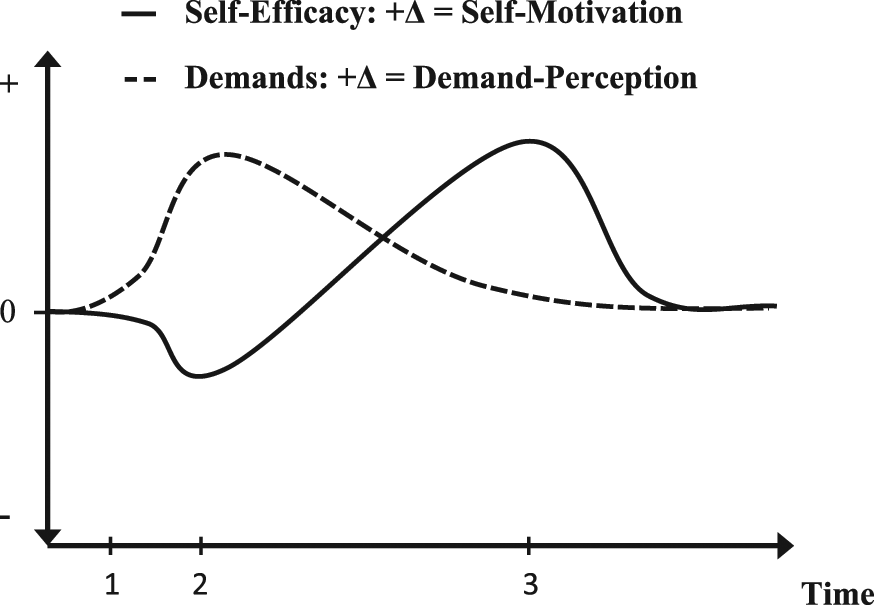
The proposed oscillating interplay of demand-perception and self-motivation within a person is illustrated in Figure 1. The figure displays within-person change on the two parameters demands (dotted line) and self-efficacy (solid line) relative to their baseline levels. Demand-perception refers to the interval between Time 1 and 2, where there is a positive rate of change (+Δ) in demands; self-motivation refers to the interval between Time 2 and 3, where there is a positive rate of change in task-specific self-efficacy. The displayed dynamics begin with an increase in demands, for instance, because a person receives feedback that his or her performance on a task was lower than expected (Time 1). As a consequence of the amplification of the distance between the current state and the desired future state, self-efficacy is temporarily reduced. The process of self-motivation starts when the rate of change in self-efficacy changes from negative to positive (Time 2). Cognitive and behavioral resources are then mobilized such that a course of action can be initiated or motivation for an ongoing activity can be increased (Kuhl & Kazén, 1999). An increase in the level of effort a person displays continues as long as there is a positive rate of change in self-efficacy. Because of the progress a person makes, demands begin to decline. The perception of decreasing demands and progress toward a goal via a person’s own effort in turn further stimulates self-motivation (Amabile & Kramer, 2011).
Demand-Perception and Self-Motivation as Opponent Processes
An essential implication of an opponent-process model is, however, that the motivational momentum that results from demand-perception and subsequent self-motivation should level off at some point. The more demands decrease, the lower the signal that effort needs to be invested to maintain an adequate speed of goal progress (Brehm & Self, 1989). If self-efficacy reaches a high plateau such that there is no rate of change (Time 3), there should be no subsequent increase in the person’s effort on a task. To the contrary, the mobilization of cognitive and behavioral resources for a task will eventually be reduced, and a person will switch to the pursuit of other activities or a phase of recovery (Carver & Scheier, 1998; Vancouver et al., 2001). This is an adaptive characteristic of the psychological system as it prevents escalating degrees of effort on any one activity and allows the organism to conserve energy. An alternative consequence of high self-efficacy—about which there is no disagreement in the literature—is that a person might raise the bar and set a higher goal (Seo & Ilies, 2009). In this case, increased demands are perceived and a further cycle in the self-regulatory processes displayed in Figure 1 begins.
The Self-Efficacy Debate Revisited
From the perspective of opponent processes, the question of whether the within-person relation between self-efficacy and subsequent effort and task performance is positive or negative needs to be reconsidered. It may appear to be a contradiction at first sight; however, it follows that the relation between the level of self-efficacy and subsequent effort on a task is both positive and negative. The underlying reason is that it is the rate of change rather than a steady state of self-efficacy that produces motivational effects. At a given level of self-efficacy, effort should subsequently increase if there is a positive rate of change in self-efficacy. However, effort should subsequently decrease if the rate of change is zero or negative. If the level of self-efficacy rather than the rate of change is measured, the sign and magnitude of the observed relation depend on where an observer steps in and measures self-efficacy in the motivational cycle illustrated in Figure 1. Moreover, within-person variability in self-efficacy is closely linked to fluctuating demand-perceptions, which need to be accounted for when examining the relations between self-efficacy and outcomes.
To illustrate this proposition, I next reinterpret the findings of Yeo and Neal (2006) as an example of a study that reported a negative effect of self-efficacy. Yeo and Neal examined participants’ self-efficacy and performance on an air traffic control task. Participants completed 30 two-minute trials of the task and communicated their self-efficacy before each trial by indicating their confidence that they would reach different performance levels. Performance on each trial was the dependent variable. Results showed that generalized self-efficacy as well as the average level of task-specific self-efficacy across the 30 trials were positively related to performance. Moreover, participants with higher self-efficacy showed a steeper learning curve across the trials. At the within-person level, however, self-efficacy assessed before a trial was negatively related to performance on the subsequent trial if past performance was controlled for.
According to the rationale I have outlined, self-efficacy assessed before each trial was the indicator of self-motivation on the previous trial. If self-efficacy beliefs were high relative to a person’s baseline level, they were measured at Time 3 in Figure 1 and captured the preceding wave of self-motivation that contributed to performance on the previous trial. However, the optimistic belief regarding future performance was thus an indicator of a self-regulatory process rather than its cause. In support of self-efficacy theory, people who reported higher self-efficacy across the 30 trials learned more quickly and performed better. Why then were self-efficacy beliefs negatively related to performance on the next trial? The proposed dynamics in Figure 1 suggest that there was a decrease in the mobilization of resources on the next trial rather than further self-motivation. As the difficulty of the task remained the same across trials, participants presumably did not perceive the situation as demanding after a successful trial such that the mobilization of resources declined and returned to its baseline level. As a consequence, performance fell below participants’ optimistic expectations, which is reflected in the negative within-person relation between self-efficacy and subsequent performance. As a result of performing below their expectations, participants presumably perceived an increase in demands, and thus their self-efficacy for the subsequent trial was relatively lower. This provided the starting point for the next wave of self-motivation, which increased performance and self-efficacy beliefs. Thus, relatively low self-efficacy was associated with higher subsequent performance.
The model of opponent processes outlined in this article departs from past explanations. In contrast to the explanation provided by Yeo and Neal (2006), the present rationale provides an integrated explanation and does not assume that self-efficacy operates differently at the within-person and between-person levels. Rather, it posits that the causal effect operates only at the within-person level and that trait measures of self-efficacy are related to important behavioral outcomes because they measure individual differences in the within-person dynamics of demand-perception and self-motivation. In contrast to Bandura’s (1997) theory, the causal effect of self-efficacy is not attributed to static and conscious beliefs but rather to dynamic and implicit processes of self-regulation. Finally, in contrast to perceptual control theory (Vancouver et al., 2001), I suggest that a positive motivational effect is associated with self-efficacy beliefs that is not merely the result of the adoption of higher goals but also due to the self-initiated mobilization of personal resources.
The proposition of opponent processes is in line with the findings of two recent studies by Schmidt and DeShon (2009, 2010). In the first study, Schmidt and DeShon (2009) showed that the self-efficacy–performance relation was positive after poor prior performance and negative after successful prior performance. According to the current rationale, in their study, only poor prior performance elicited demand-perception and subsequent self-motivation. In the second study, Schmidt and DeShon (2010) asked participants to find as many solutions for an anagram as possible and showed that the self-efficacy–performance relation was moderated by performance ambiguity. In the low ambiguity condition, participants were informed about the number of possible solutions that existed for an anagram and could compare their performance against this standard. In the high ambiguity condition, they were given no such information. As expected, the self-efficacy–performance relation was positive only if ambiguity was low. From the current perspective, however, it was not ambiguity per se but the perception of demands as the mediating process that was responsible for these results. By communicating the maximum number of possible solutions, a difficult and specific goal was communicated such that the outlined processes of demand-perception and subsequent self-motivation were elicited.
The Affective Dynamics Underlying Demand-Perception and Self-Motivation
In the following, I outline how the interplay of demand-perception and self-motivation is linked to the regulation of positive and negative affect to provide a functional explanation of the proposed opponent processes. Solomon and Corbit (1974) coined the term opponent processes and referred to the dynamics of positive and negative affect as the basic mechanism of acquired motivation, regardless of whether motivation concerns achievement striving or other life domains (also see Landy, 1978). For instance, Solomon (1980) examined the affective dynamics associated with skydiving and argued that the motivation to skydive develops through the initial experience of negative affect before a jump (e.g., fear) and the subsequent experience of positive affect during and after the jump (e.g., exhilaration). Self-regulation involves not only the basic affective mechanism outlined by Solomon’s theory, but also higher-order cognitive functions that are coupled with positive and negative affect (George, 2011). A theory that specifies the link between the affective and the cognitive dynamics of self-regulation is the theory of personality systems interactions (PSI; Kuhl, 2000, 2001).
According to the theory, the outlined dynamics of demand-perception and self-motivation are modulated by the temporary reduction of positive affect and its subsequent restoration (Baumann & Scheffer, 2010). Demand-perception leads to a reduction in positive affect because a desired state such as a difficult self-set goal is not in one’s immediate reach. Reduced positive affect enables a realistic assessment of a situation and facilitates planning and problem-solving operations (Schwarz & Bless, 1991). A subsequent increase in positive affect leads to behavioral activation and the initiation of goal-directed behavior. For instance, Kuhl and Kazén (1999) showed that priming participants with positive words after they formed a difficult intention enabled them to implement the intention and to overcome incompatible automatic responses. In this experiment, positive affect was externally induced; by contrast, self-motivation operates through an internally induced increase in positive affect (Baumann, Kaschel, & Kuhl, 2007).
PSI theory posits that the basis for the internally induced increase in positive affect underlying self-motivation is a cognitive system termed extension memory, which operates in an implicit manner and is linked to affect-generating mechanisms. Extension memory refers to integrated representations about a person’s past experiences, personal needs and values, and possible courses of action. These integrated representations are based on the parallel-distributed processing of extended memory networks and therefore exceed the processing capacity of conscious thought (Baumann & Kuhl, 2002). The activation of integrated representation in response to the perception of increased demands provides an overview of possible actions in a given situation that satisfy a person’s needs and motives. The belief to be able to master a situation, although one is not yet able to pinpoint exactly how one will do it, indicates the activation of extension memory. Positive motivational consequences, however, are not the result of the belief that one is self-efficacious, but are rather the result of being able to access the integrated representations of extension memory. As extension memory is linked to affect-generating mechanisms, its activation is associated with an increase in positive affect so that a course of action can be initiated or engagement on a task can be increased (e.g., Kazen, Kaschel, & Kuhl, 2008).
Distinct motivational consequences occur if demand-perception not only reduces positive affect because desired states are not in immediate reach but also elicits negative affect (Baumann et al., 2007; Koole, 2009). Negative affect arises if people experience or expect events that they seek to avoid—for instance, if goal achievement is threatened (Carver & Scheier, 1998). Negative affect reduces the activation of extension memory and thus the top-down influence of integrated knowledge representations. As a consequence, attention is focused on the origin of negative affect, and incongruent information—for example, about the possibility of failure—is processed in detail. If self-motivation occurs as a secondary process after the experience of negative affect, particularly high levels of motivation can result. In a recent set of studies, my colleagues and I examined the motivational consequences of sequences of negative affect followed by positive affect. We termed this sequence affective shift and showed that it was related to high work engagement and creativity (Bledow, Rosing, & Frese, 2012; Bledow, Schmitt, Frese, & Kuehnel, 2011).
Further analyses of these studies and additional studies confirmed that individual differences in self-efficacy were related to the process we termed affective shift (Schmitt, 2012). People with high self-efficacy showed patterns of affect regulation that were more adaptive for work motivation as compared to people with low self-efficacy. They were more likely to restore positive affect after positive affect was temporarily reduced, suggesting an improved ability to engage in self-motivation. Moreover, participants who reported high self-efficacy showed particularly high motivation after the experience and a subsequent decrease in negative affect. Individual differences in self-efficacy thus indicate the degree of development of internal mechanisms that enables people to transform negative experiences into high work motivation.
An opponent-process model further implies that the outlined affective dynamics develop over time by means of associative learning. According to Solomon (1980), the opponent process starts earlier, increases in strength, and decays more slowly after repeated exposure to a stimulus. For instance, on the second jump, the excitement of skydiving will set in more quickly and be more pronounced compared to the first jump. The initial fear will be quickly brushed aside, and the overall hedonic quality of the experience will become more positive. Applied to work motivation, this rationale suggests that the process of self-motivation is strengthened if people repeatedly choose and master difficult tasks. The initial hedonic sacrifice associated with pursing difficult goals will become weaker over time as the opponent process of self-motivation and the associated increase in positive affect set in earlier and become more pronounced (Landy, 1978).
Implications
The proposed dynamics of self-motivation and demand-perception as opponent processes imply a set of testable hypotheses. First, the relation between a person’s self-efficacy and subsequent effort should depend on whether or not a situation is perceived as demanding. If a task or the work situation as a whole is perceived as demanding, the expected relation is positive because a person is likely to respond with self-motivation rather than with a decrease in resource mobilization. Second, changes in self-efficacy and demands should be related to subsequent effort and behavioral outcomes above and beyond the level of these variables at any point in time. To examine rates of change within a person, these parameters need to be measured at multiple points in time. Third, the present account implies a close relation between the cognitive and affective dynamics of self-regulation. For instance, the positive effect of an increase in self-efficacy on subsequent effort should be mediated by an increase in positive affect. It needs to be noted, however, that such a linear-sequential process hypothesis describes only an isolated aspect of a larger set of reciprocal system dynamics.
Regarding future research, the present approach suggests that a focus on the dynamics underlying self-efficacy and the role of implicit processes stand out as critical topics. Based on theory, computational modeling, and empirical observations, greater precision is needed to determine the way in which demand-perception and self-motivation temporarily unfold (Mitchell & James, 2001). For instance, field studies are needed to examine the proposed processes on the time scales that are relevant for self-regulation in everyday work life as compared to the short time scales typically used in laboratory studies. Moreover, a reviewer suggested that the outlined processes are not necessarily continuous and that there may be thresholds (also see Vancouver, More, & Yoder, 2008). For instance, an initially easy task may become gradually more difficult and only at a threshold may a person’s conscious appraisal of the task change from easy to difficult. Such a discontinuous process is likely to evoke distinct reactions and may coexist with continuous oscillations of demand-perception and self-motivation. A further important avenue for future research is to delimitate the roles of conscious thought and implicit processes. In contrast to self-efficacy theory, I have argued that the self-regulatory processes that are captured by measures of self-efficacy occur mostly outside of a person’s awareness. However, this does not imply that conscious reflections are merely an epiphenomenon. A nuanced theory needs to specify when and how conscious reflections on self-efficacy beliefs play a role in self-regulation and how they are linked to implicit processes (Baumeister et al., 2011). For instance, if a leader verbalizes positive performance expectations and thereby increases follower motivation, conscious reflection on the leader’s message presumably plays a mediating role (McNatt & Judge, 2008).
With respect to a trait perspective (Jackson, Hill, & Roberts, 2012), the present rationale suggests that a more detailed functional analysis of individual differences in self-regulation is necessary. Because of its breadth, generalized self-efficacy can predict substantial variability between people in behavioral outcomes (Stajkovic & Luthans, 1998). However, generalized self-efficacy aggregates different self-regulatory processes and is thus imprecise regarding the specific processes that operate at the individual level. Namely, measures of individual differences in generalized self-efficacy aggregate the processes of demand-perception and self-motivation as they use statements such as “Even when things are tough, I can perform quite well” (Chen et al., 2001, p. 79). For the explanation of individual-level behavior and the diagnosis of failures of self-regulation, a broadband construct such as generalized self-efficacy is not sufficient (Kuhl, 2001). For these purposes, psychological traits that refer to dynamic parameters of self-regulation may be more beneficial. For instance, action-orientation scales assess the speed and efficiency with which people move from perceiving the difficulties associated with a demanding or threatening situation to an action-oriented state of high motivation (Baumann et al., 2007; Kuhl, 1994). An example item is “When I am facing a big project that has to be done, (a) I often spend too long thinking where I should begin, (b) I don’t have any problems getting started” (Option b reflects high action orientation). Action-orientation scales assess individual differences in self-regulation that are not sufficiently captured and differentiated by scales on generalized self-efficacy beliefs (Diefendorff, Hall, Lord, & Strean, 2000).
Regarding practical implications, an opponent process model implies that a focus on strengthening conscious self-efficacy beliefs alone is insufficient. Higher motivation should result by strengthening the self-regulatory mechanisms that enable a person to generate motivation in the face of high demands. Indeed, self-efficacy interventions such as enabling mastery experiences may work because they strengthen the ability to self-motivate and not merely because they enhance beliefs about capabilities. The ability to self-motivate, however, is not sufficient for high motivation and needs to be complemented by factors that elicit the perception of demands. Demand-perception can result from challenging task assignments and from the performance feedback a person receives. Moreover, demand-perception can be the consequence of internal processes such as proactive goal setting (Parker, Bindl, & Strauss, 2010) or metacognitive activity that results in the realization of gaps in one’s knowledge and skills (Kruger & Dunning, 1999). From the perspective of opponent processes, the critical issue for high motivation and performance is thus how people oscillate between perceiving demands and mobilizing their internal resources.
Footnotes
Acknowledgements
I would like to thank Nona Bledow, Jana Kuehnel, Antje Schmitt, Hannes Zacher, and Jane Zagorski for their helpful comments on previous versions of this article.
The Journal of Management continues to invite commentaries on the issues presented by Bandura (2012), Vancouver (2012), Jackson et al. (2012), and Bledow (herein). Please submit to  as “Original Research,” including “Response to Bandura [and/or] Vancouver [and/or] Jackson et al. [and/or] Bledow” in the title. Commentaries will be treated as editorials, but will also be peer reviewed.