







Abstract
Recent advances in leadership research suggest that collective-focused leadership climate and differentiated individual-focused leadership might simultaneously, yet oppositely, affect collective outcomes. The present study extends this literature by addressing open questions regarding theory, methods, statistics, and level of analysis. Therefore, a new and more parsimonious theoretical model is developed on the organizational-level of analysis. Drawing on the commitment literature, we argue for opposite relations of the two leadership constructs on the affective organizational commitment climate. We subsequently theorize that contingent-reward leadership climate moderates these opposing relationships, making our study the first in this field to investigate moderators. Last, we reason that organizational effectiveness is enhanced when affective commitment is “put into action” and raises the organizational citizenship behavior climate. Our three-path moderated-mediation hypotheses are tested, and supported, by structural equation modeling analyses in a multisource data set containing 16,911 respondents from 157 companies. Extensive alternative model testing shows that our theory and findings are robust.
Wu, Tsui, and Kinicki (2010) showed that leader behaviors directed at the collective can have very different effects compared to behaviors directed at individuals. Their research reignited the interest in the question posed over a decade ago, namely, to which extent “leaders should or should not differentiate among their members” (Sparrowe & Liden, 1997: 545). The current study builds on this renewed interest and inspects the organizational-level relationships of a collective-focused leadership climate, defined by the average of the collective dimensions (i.e., articulating a vision, fostering collective goals) of the transformational leadership (TFL) measure (Podsakoff, MacKenzie, & Bommer, 1996), and differentiated individual-focused leadership, defined by the differentiated individual dimensions (i.e., individual consideration, intellectual stimulation) of the TFL measure (Podsakoff et al., 1996), with organizational effectiveness. Originally, both behaviors were argued to be positive, assuming that the former enhances collective outcomes by creating a shared understanding and the latter increases individual outcomes by providing idiosyncratic benefits to followers (e.g., Henderson, Liden, Glibowski, & Chaudry, 2009; Liden, Erdogan, Wayne, & Sparrowe, 2006; Wang & Howell, 2010). However, Wu et al.’s (2010) study showed that such positive outcomes should not always be expected.
More specifically, Wu et al. (2010) showed that at the group level, two separate indirect routes lead from a collective-focused leadership climate and differentiated individual-focused leadership to group effectiveness. It was found that collective-oriented leadership increases group identification, collective efficacy, and ultimately, group effectiveness. In contrast, more differentiated individual-focused leadership behaviors were reported to indirectly and negatively relate to group effectiveness through leader identification divergence and self-efficacy divergence. Although this discovery was an important step for research on differentiated leadership, many theoretical questions and alternative explanations remain unanswered. The current study, therefore, aims to expand upon the work of Wu et al. and extend the research on collective and differentiated leadership by addressing open questions regarding the level of analysis, theory, methods, and statistics.
For us, the first open question was if and how these different types of leadership behaviors would affect organizational effectiveness (as opposed to group effectiveness studied by Wu et al. in 2010). Therefore, our first objective was to take this topic from the group to the organizational level. Additionally, since previous work theorized only about two separate and indirect mediating routes (Kark & Shamir, 2002; Wu et al., 2010), we wondered whether a single and more parsimonious theoretical route would be possible. Moreover, although previous theorizing highlighted the importance of positive (collective) behaviors for collective effectiveness (e.g., Kark & Shamir, 2002), no behaviors were actually modeled or tested, and despite Wu et al.’s (2010) call to investigate moderators, no contextual factors have been assessed in this research area so far. Finally, existing research (Wang & Howell, 2010; Wu et al., 2010) has theoretically and empirically neglected important alternative model specifications that might challenge previous results, such as the reversed operationalization of the leadership variables (e.g., Cole, Bedeian, Hirschfeld, & Vogel, 2011).
We address these questions by drawing on the commitment literature (e.g., Meyer, Stanley, Herscovitch, & Topolnytsky, 2002) and the theories often used within this field, namely, social-exchange theory (SET; Blau, 1964) and perceived organizational support theory (POS; Eisenberger, Huntington, Hutchison, & Sowa, 1986). In short, we will argue that employees in organizations in which leaders, on average, provide more collective-focused leadership will reciprocate this support for collective action by displaying greater affective commitment to the organization (Becker, 1992). At the organizational level, this manifests itself in a stronger affective-organizational-commitment climate (Cropanzano & Mitchell, 2005), which we define as an aggregated and shared emotional attachment to, identification with, and involvement in the organization by employees (Meyer & Allen, 1997). 1 Conversely, we expect that when employees experience a more individualistic and differentiated leadership approach in their organization, the affective organizational commitment climate will be lower because this leadership tends to infringe upon a key imperative for a strong organizational commitment climate, namely, “to treat all employees fairly” (Meyer et al., 2002: 38). We then hypothesize that the above relationships might become impaired when leaders provide more contingent-reward leadership, defined as the amount of behavior through which leaders establish individual expectations and provide rewards for meeting those expectations (Judge & Piccolo, 2004). Thus, we reason that contingent-reward leadership acts as a moderator of the mentioned relationships. Subsequently, we will add organizational citizenship behavior (OCB) climate, defined as extra-role behaviors that benefit an organization and its members (Johnson & Chang, 2006), as a second mediator because we argue that affective climates increase effectiveness only when they are transformed into actions that benefit the collective (e.g., Bishop, Scott, & Burroughs, 2000; Eisenberger, Armeli, Rexwinkel, Lynch, & Rhoades, 2001). Last, we theorize about core alternative explanations, investigating primarily whether the reversed leadership measures (i.e., mean individual-focused leadership and differentiated collective-focused leadership) are related to organizational processes and outcomes.
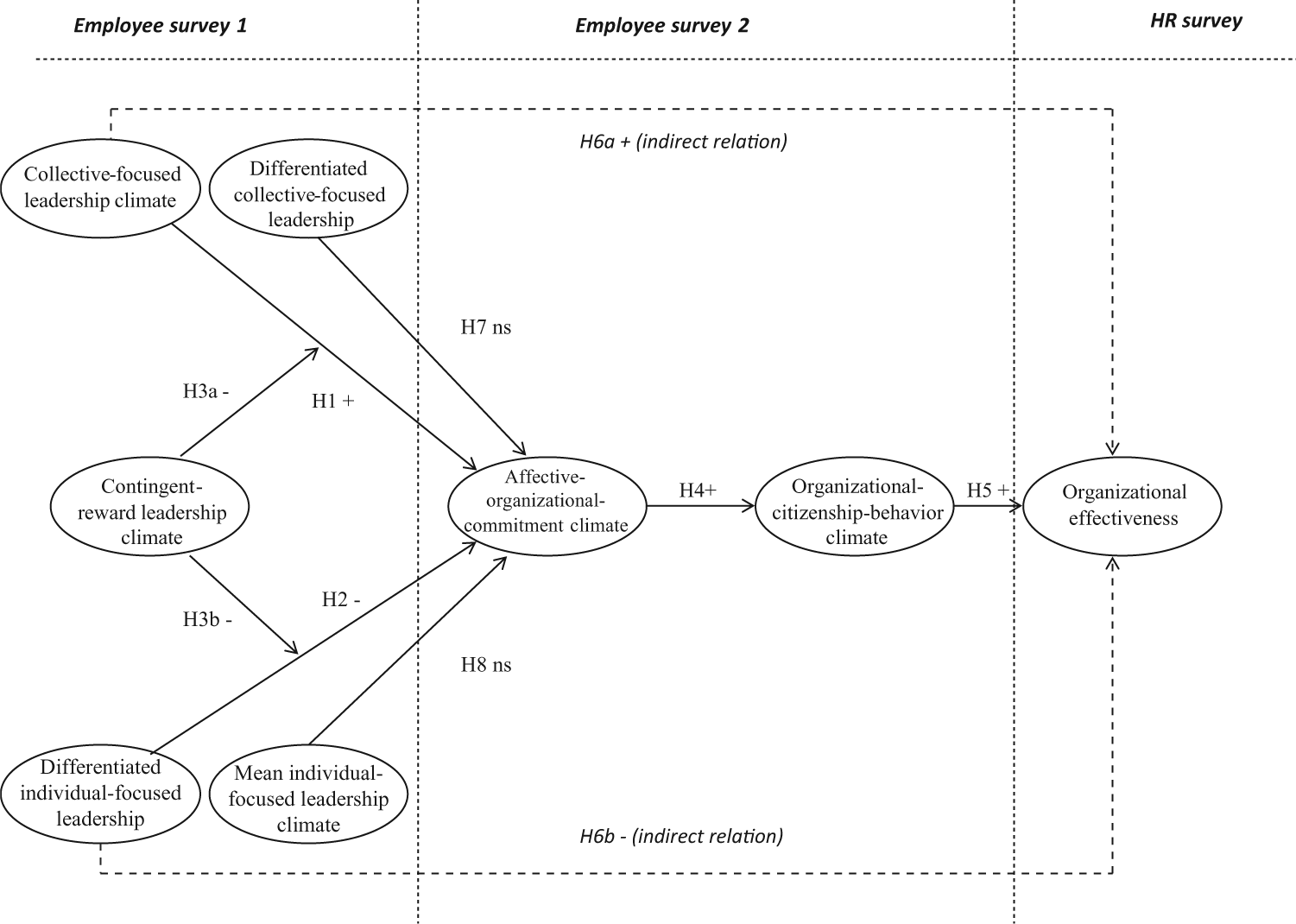
To summarize, we view our contributions to the differentiated leadership literature as an overall package of extensions of previous work, as we seek to improve and provide alternative viewpoints on the issues of theory, methods, statistics, and level of analysis. Below, we explain in detail our moderated three-path mediation framework in which the two leadership behaviors relate, in opposition, to (a) the affective organizational commitment climate, (b) the OCB climate, and (c) organizational effectiveness. As Figure 1 shows, we also expect contingent-reward leadership climate to moderate the relationships with affective organizational commitment climate.
Overview Conceptual Model
Hypotheses Development
Collective-Focused Leadership Climate and Commitment Climate
Akin to other climate constructs (e.g., Zohar & Luria, 2005), leadership climate assesses the average perceptions and behaviors throughout an organization. Similar to recent research (e.g., Walter & Bruch, 2010), we argue that a leadership climate can emerge in organizations through the mechanisms of newcomer socialization and attraction-selection-attrition (Schneider & Reichers, 1983) as well as via joint experiences and mutual interactions among the organization’s members (Kozlowski & Hattrup, 1992; Morgeson & Hofmann, 1999). A collective-focused leadership climate can emerge if employees perceive that leaders in an organization engage in specific transformational leadership behaviors directed toward the collective, such as articulating a collective vision and fostering collective goals. Below, we first discuss the content and collective focus of these two TFL behaviors and then their relationship to a commitment climate.
Articulating a vision means developing and articulating a captivating idea for the future of the collective entity (Podsakoff, MacKenzie, Moorman, & Fetter, 1990). To ensure this behavior, leaders apply various strategies, such as slogans, speeches, symbols, or rituals, to disseminate an appealing collective vision that followers can accept and jointly pursue (Shamir, Zakay, Breinin, & Popper, 1998). Meanwhile, fostering the acceptance of collective goals refers to leaders’ behaviors targeted at supporting and promoting cooperation among employees to reach common, overarching, and shared goals in line with the collective vision (Podsakoff et al., 1990). Consequently, such behaviors show that leaders throughout the organization are committed to building, communicating, and executing collective goals.
As Figure 1 illustrates, we propose a positive influence of collective-focused leadership on affective commitment climate because we expect leaders who are committed to the organization and its success to support employees to achieve collective outcomes (Blau, 1964; Eisenberger et al., 1986). Research on commitment supports this reasoning by showing that perceived organizational support motivates employees to reciprocate through showing high support for organizational goals and values (Eisenberger, Fasalo, & Davis-LaMastro, 1990). Further, as is evident from the feedback literature (e.g., Hinsz, Tindale, & Vollrath, 1997), giving collectively oriented information and feedback also changes employees’ attributional orientation toward the collective. Research shows that this attributional shift can occur at the group level (e.g., Van der Vegt, De Jong, Bunderson, & Molleman, 2010), yet it is likely that similar organizational processes arise when leaders show employees that collective goals are crucial for organizational success.
Hence, we expect that a stronger collective-focused leadership climate will enhance employees’ perceived organizational support for collective outcomes (e.g., Eisenberger et al., 1986), social-exchange relationships with their organization (e.g., Blau, 1964), and focus on the collective (e.g., Hinsz et al., 1997). Subsequently, the “global” affective commitment (Becker, 1992) of employees to the overall goals and values of their organization is increased. Thus, our first hypothesis is as follows:
Hypothesis 1: A collective-focused leadership climate positively relates to affective-organizational-commitment.
Differentiated Individual-Focused Leadership and Commitment Climate
Differentiated individual-focused leadership stems from follower-oriented leadership approaches, such as the leader-member exchange (LMX) theory (Graen & Uhlbien, 1995) and situational leadership (Hersey & Blanchard, 1982). These theories argue that successful leaders need to adjust their leadership behavior based on contextual factors and the individual characteristics of each employee; thus, for example, leaders should give more attention and coaching to some followers than to others. Although this individual-focused leadership can be beneficial to individual employees, collectively it can lead to differentiated treatment of members of groups or companies (Wu et al., 2010). In line with Kark and Shamir (2002), we expect two components of transformational leadership—individual consideration and intellectual stimulation—to be particularly directed toward individual strengths and needs and prone to the negative effects of differentiation. Below, we first explain each dimension and then discuss their effect on affective commitment climate.
Individual consideration refers to leadership behaviors, such as respect, support, and encouragement for the followers. With these behaviors, leaders strive to assess the individual situations of their followers and offer additional assistance to those who seem to need it the most (Kark & Shamir, 2002; Podsakoff et al., 1990). Intellectual stimulation involves leadership behaviors that encourage followers to question their assumptions about their work and consider new perspectives on solving their work-related problems (Podsakoff et al., 1990). Akin to individualized consideration, leaders must account for individual characteristics and competencies when providing intellectual stimulation because employees will differ in their intellectual capacities (Gardner, 2000).
Traditionally, individual-focused leadership has been thought to enhance followers’ self-worth and self-efficacy and increase their identification with their leader, given that the leader shows higher confidence in the followers’ ability and integrity (Kark & Shamir, 2002; Wang & Howell, 2010). However, at a higher level of analysis, such as the organizational level, we expect the consequences of individual-focused leadership behaviors to be less positive, as they can result in the differentiation of leadership behaviors and thereby attenuate collective affective commitment.
First, differentiated individual-focused leadership could dilute an overall good social-exchange relationship (Blau, 1964) and perceived organizational support relationship (Eisenberger et al., 1986) between the employees and the organization because employees could reason that their individual effectiveness is most crucial (Hinsz et al., 1997; Van der Vegt et al., 2010). Thus, in contrast to a collective-focused leadership climate, which emphasizes common visions and goals, differentiated individual-focused leadership forces followers to compete for the individual attention of their leader as they attempt to develop a higher-quality dyadic leader-follower relationship than their colleagues (Dumdum, Lowe, & Avolio, 2002; Kark & Shamir, 2002). Consequently, this leadership is likely to create a more “local” and self-centered orientation across the organization, failing to increase employees’ “global” commitment to the organization (Becker, 1992).
Second, differentiated individual-focused leadership indicates that leaders—and by extension, the organization itself—value some employees more than they do others and thus allow, or even encourage, certain inequalities to persist. Although those who get preferential treatment might be happy at first and perhaps be even more committed to their leaders (Dumdum et al., 2002), others will become envious and wonder why their leaders are not helping them as much and why the organization does not intervene (Adams, 1965). Even the “in crowd” might start to worry, as leaders may withdraw their assistance when they believe that the favored employee has benefited enough and that it is another’s turn to be the leader’s favorite. In the first case, the company fails to display commitment to all employees, thus lowering the employees’ affective commitment, while in the second case, the organization demonstrates that its commitment to employees can change; thus, employees might be in or out of favor seemingly at random.
Overall, in organizations with higher levels of differentiated individual-focused leadership, employees should perceive lower organizational support from and worse social-exchange relationships with their employer. Consequently, employees’ emotional attachment to the company is likely to deteriorate, resulting in a lower organizational commitment climate. Therefore, we expect the following:
Hypothesis 2: Differentiated individual-focused leadership throughout an organization relates negatively to the affective-organizational-commitment climate.
Moderation of the Contingent-Reward Leadership Climate
Building upon the aforementioned theories and arguments, we expect that the amount of individual rewards provided by leaders to followers might influence the relationships proposed in Hypotheses 1 and 2. When leaders throughout an organization place, on average, a strong emphasis on rewarding individual performance, a contingent-reward leadership climate arises (Chun, Yammarino, Dionnne, Sosik, & Moon, 2009). As Burns (1978) and Bass (1985) argued, contingent-reward and transformational leadership are two related yet separate and unique concepts; thus, they could possibly interact with each other.
More specifically, we expect that if there were a high contingent-reward climate, the positive effects of collective-focused leadership on commitment climate would be reduced because employees who perceive these two contradictory leadership behaviors simultaneously might question whether the collective orientation advocated by their leaders is trustworthy, since individual goals and rewards are also encouraged. Consequently, the perceived organizational support for collective outcomes and the attributional focus toward the collective (Hinsz et al., 1997) are likely to be lower.
Similarly, when there is both differentiated individual-focused leadership and a strong contingent-reward climate, employees’ attributional focus should turn even more to accomplishing individual goals, further lowering any collective focus (e.g., Hinsz et al., 1997). In other words, employees are thus even more directed toward a self-centered “local focus” at the expense of becoming “globally” attached to their organization (e.g., Becker, 1992). We therefore propose the following two moderation hypotheses:
Hypothesis 3a: The positive relationship between collective-focused leadership and commitment climate is less pronounced under higher levels of contingent-reward leadership climate.
Hypothesis 3b: The negative relationship between differentiated individual-focused leadership and commitment climate is more pronounced under higher levels of contingent-reward leadership climate.
Commitment Climate and OCB Climate
As briefly stated in our introduction, having a strong affective organizational commitment climate does not automatically translate into higher organizational effectiveness. We expect that “feelings” among employees of belonging to the organization must somehow be put into concrete “actions” that benefit the collective, as for example through organizationwide OCB (e.g., Ng & Feldman, 2011). Researchers have increasingly investigated the OCB construct at the group (e.g., Nielsen, Hrivnak, & Shaw, 2009), unit, and organizational levels (e.g., Ehrhart, 2004). Building on this, and following Pugh and Dietz’s (2008) reasoning, we argue that an OCB climate might spread throughout an organization via the processes of attraction-selection-attrition (Schneider & Reichers, 1983) and via the previously discussed contagion mechanisms (Salanova, Agut, & Peiro, 2005). Hence, we argue that the OCB climate captures precisely the moment at which the positive “feelings” of the commitment climate are translated into beneficial actions for the organization.
More specifically, drawing again from POS (Eisenberger et al., 1986) and SET (Blau, 1964), we expect that a high collective-focused leadership climate is related to a high commitment climate because employees are not only more focused on the collective (Hinsz et al., 1997) but also more willing to reciprocate the benefits they receive from their employers by becoming more committed to the organization (e.g., Becker, 1992). Subsequently, voluntary helping behavior is likely to be higher because of the collectively oriented visions and goals. In contrast, highly differentiated individual-focused leadership creates a more individualized focus (e.g., Hinsz et al., 1997), lowers perceived organizational support for collective actions (Eisenberger et al., 1986), and increases perceptions of unfairness (Adams, 1965). Consequently, such leadership is likely to decrease “global” forms of commitment, such as affective organizational commitment (cf., Becker, 1992); thus, voluntary helping is reduced among employees. We therefore propose the following:
Hypothesis 4: Commitment climate positively relates to OCB climate.
OCB Climate and Organizational Effectiveness
For the third and final step in our model, we posit that OCB climate relates to organizational effectiveness. Below, we highlight four distinct yet related processes that have been put forward for this relationship.
First, Nielsen and colleagues (2009) proposed that high levels of OCB climate help newcomers adapt by teaching them best practices and helping them learn the ropes (Podsakoff & MacKenzie, 1997), which increases the productivity of new coworkers. Second, high OCB climate increases productive interactions between organizational members, such as voluntarily assisting before being asked, thereby enhancing collective effectiveness (Edmondson, Roberto, & Watkins, 2003). Third, it enhances the organization’s efficiency by unleashing new resources (e.g., Borman & Motowidlo, 1993). For example, a strong OCB climate enables supervisors to spend less time on managing, freeing time and resources for other important tasks, such as strategic planning (Podsakoff & MacKenzie, 1997). Fourth, it enables companies to adjust to changing environments and attract and retain the most talented employees (Podsakoff & MacKenzie, 1997). The recent meta-analysis of Podsakoff, Whiting, Podsakoff, and Blume (2009) supports these conceptual arguments; therefore, our fifth hypothesis is as follows:
Hypothesis 5: OCB climate positively relates to organizational effectiveness.
Three-Path Mediation Effects
The hypotheses developed thus far indicate that collective-focused leadership and differentiated individual-focused leadership share a mediation route through which they indirectly, although in opposite directions, relate to organizational effectiveness. More specifically, drawing from SET (Blau, 1964) and POS (Eisenberger et al., 2001), we first argued that a collective-focused leadership climate positively affects the commitment climate (Hypothesis 1), whereas differentiated individual-focused leadership negatively affects such commitment (Hypothesis 2). This positive or negative effect on affective commitment climate in turn encourages employees to invest or disinvest in OCBs, respectively (Hypothesis 4), affecting organizational effectiveness (Hypothesis 5). Therefore, we posit two opposing three-path mediations:
Hypothesis 6a: Collective-focused leadership climate indirectly and positively relates to organizational effectiveness via the mediation of the commitment climate and OCB climate.
Hypothesis 6b: Differentiated individual-focused leadership indirectly and negatively relates to organizational effectiveness via the mediation of the commitment climate and OCB climate.
Relationships of the Reversed Leadership Constructs
As mentioned in the introduction, one of the main limitations of previous studies on the collective consequences of differentiated and collective-focused leadership (Wang & Howell, 2010; Wu et al., 2010) is that they theoretically and empirically neglected the association of the reversed leadership operationalizations (e.g., mean individual-focused leadership and differentiated collective-focused leadership) with collective processes and outcomes. Accordingly, critics could argue that previous results are (partially) attributable to these unmeasured reverse operationalizations or to the failure to control them (e.g., Cole et al., 2011). To gain more insight, we will explicitly integrate these reversed leadership operationalizations in our study.
More specifically, we expect that mean individual-focused leadership does not directly relate to commitment climate or indirectly to OCB climate or organizational effectiveness. Although high average levels of these leadership behaviors might have positive effects on the individual level of analysis (e.g., Wang & Howell, 2010) or increase individual attachment to a specific leader (Kark & Shamir, 2010), they are unlikely to improve collective social-exchange relationships with the organization, as employees might not attribute positive individualized treatment by a leader to the overall organization (cf. Becker, 1992).
We also theorize that a differentiation of collective-focused leadership does not relate directly to commitment climate or indirectly to OCB climate or organizational effectiveness. If leaders throughout the organization diversify these collective-focused leadership behaviors, the collective social-exchange relationships are less likely to be affected because the attributional focus (e.g., Hinsz et al., 1997) is not aimed at individual performance, nor are individual inequalities and unfairness created between employees (Adams, 1965). Thus, employees should be largely unaffected in terms of their perceived organizational support from their employer.
In sum, we thus propose that the reverse operationalizations of our leadership constructs are unrelated to the commitment climate. Our last hypotheses are therefore as follows:
Hypothesis 7: Mean individual-focused leadership does not relate to commitment climate.
Hypothesis 8: Differentiated collective-focused leadership does not relate to commitment climate.
Method
Sample
Data were collected in cooperation with a benchmarking agency located in Germany, and companies had to (a) be located in Germany and (b) not exceed 5,000 employees to participate. Companies received a benchmarking report for their participation. We contacted 189 companies, out of which 32 provided insufficient data or declined to participate, resulting in an organizational-level response rate of 83% (N = 157). 2 Companies were from various industries, including service (54%), manufacturing (30%), trade (12%), and finance and insurance (6%); they employed 270 employees on average (SD = 533).
To avoid common method concerns (Podsakoff, MacKenzie, & Podsakoff, 2012), we used three different data sources—namely, two unique groups of employees and data from human resource (HR) departments. We used a split-sample design (Rousseau, 1985) with two different employee surveys to capture (a) the leadership constructs and (b) the affective commitment and OCB constructs. Additionally, HR executives were asked to provide information on their organization’s effectiveness as well as general information (i.e. industry affiliation, organization size). Akin to standard employee surveys and other scientific studies (e.g., Kunze, Boehm, & Bruch, 2011), participating companies sent a standardized e-mail invitation to all their employees briefly describing the study’s purpose: “It is a survey study through which you can participate to contribute to change in your workplace; your contribution is voluntary, and we will guarantee anonymity of all your answers.” The e-mail contained a link to a web-based survey, and a web-based algorithm transferred participants to one of two versions of the employee survey.
Overall, 16,911 employees chose to participate in the survey, resulting in a within-organization response rate of 57% (SD = 25.2). Participants had a mean age of 37 years (SD = 10.3), included more males (59%) than females (41%), and had on average worked 9 years for their organization (SD = 8.7).
Measures
Unless stated otherwise, we used 7-point scales (1 = strongly disagree, 7 = strongly agree) for our measures. To justify aggregation procedures, we inspected common statistical benchmarks, such as intraclass coefficient (ICC1 and ICC2; Bliese, 2000) and rwg (James, Demaree, & Wolf, 1984).
Collective-focused leadership climate (α = .97, ICC1 = .11, ICC2 = .77; median rwg = .86)
We measured this construct with two manifest factors to economize the degrees of freedom (Williams & Boyle, 2008): articulating a vision and fostering collective goals. 3 Following previous research on transformational leadership climates (Walter & Bruch, 2010), we asked employees to evaluate the extent to which their direct supervisor showed leadership behavior on the two dimensions. We took the nine items for the two indicators from subscales of the instrument developed by Podsakoff and colleagues (1996). Each indicator represented the average of several items aggregated to the organizational level. All items had a collective referent (i.e. “My direct supervisor encourages employees to be team players”), and we applied a direct-consensus composition model (Chan, 1998) for the aggregation on the organizational level.
Differentiated individual-focused leadership
To assess this construct, we applied two subscales with seven items from the Podsakoff et al. (1996) TFL instrument as indicators: individualized consideration and intellectual stimulation. Once again, the individual items were used to form indicators that were subsequently aggregated to the organizational level. In contrast to collective transformational leadership scales, these items had an individual referent (i.e. “My direct supervisor shows respect for my personal feelings”). In line with Wu and colleagues (2010), we specified this construct as a dispersion composite measure (Chan, 1998) and thus operationalized it using the coefficient of variation (Harrison & Klein, 2007). The larger the coefficient of variation, the more dispersion exists in company members’ perceptions of individualized transformational leadership (Wu et al., 2010). 4
Differentiated collective-focused leadership
To measure this construct, we used the same scales as for the collective-focused leadership climate (i.e., articulating a vision and fostering collective goals) but used the coefficient of variation instead of the mean to aggregate to the organizational level.
Mean individual-focused leadership (α = .78, ICC1 = .08, ICC2 = .70, median rwg = .86)
To capture this construct, we applied the same scales as for the differentiated individual-focused measure (i.e., individualized consideration and intellectual stimulation) but used the mean instead of the coefficient of variation for aggregation to the organizational level.
Contingent-reward-leadership climate (α = .97, ICC1 = .10, ICC2 = .74, median rwg = .53)
We captured contingent-reward leadership by using all five items developed by Podsakoff and colleagues (1996). A sample item was “My direct supervisor always gives me positive feedback when I perform well.” Again, these items were aggregated to the organizational level to form a climate variable.
Commitment climate (α = .96, ICC1 = .17, ICC2 = .85, median rwg = .76)
To gauge the collective affective commitment of employees, we used six items developed by Eisenberger and colleagues (2001), such as “I feel a strong sense of belonging to this organization.” We applied a direct-consensus composition model (Chan, 1998), which is in line with prior research that operationalized commitment at the collective level (Gonzalez-Roma, Peiro, & Tordera, 2002; Kunze et al., 2011).
Organizational-citizenship-behavior climate (α = .82, ICC1 = .04, ICC2 = .52, median rwg = .87). 5
We measured OCB climate by applying five out of eight items from Lee and Allen’s (2002) scale, asking employees to rate, for example, the extent to which they devote time to help others who have problems. As is common practice (e.g., Ehrhart, 2004; Podsakoff & MacKenzie, 1994), we aggregated these individual answers to the organizational level of analysis by applying a direct-consensus composition model (Chan, 1998). To check the validity of this shortened measure, we ran a separate confirmatory factor analysis only for the OCB scale. This showed that the measurement structure was good (χ2 = 5.38, df = 5; comparative fit index [CFI] = .99, incremental fit index [IFI] = .99, root mean square error of approximation [RMSEA] = .02).
Organizational effectiveness (α = .73)
We gauged the information on organizational effectiveness by asking the organization’s chief HR executive or another top management team member. To account for the variety of organizational effectiveness outcomes (Combs, Crook, & Shook, 2005), we constructed a four-item measure that captured the following important aspects: (a) return on investment, (b) efficiency of business procedures, (c) employee productivity, and (d) timely production of goods and services. Similar to other studies that had a diverse sample of companies (e.g., Delaney & Huselid, 1996; Kunze, Boehm, & Bruch, 2013; Wall et al., 2004), we asked respondents to assess their organization’s effectiveness over the last 6 months compared to that of their main competitors within the same region and industry (1 = far below average; 7 = far above average).
Controls
Several factors might also affect study’s dependent variables and thus need to be included to avoid biased results. First, we controlled for organization size (provided by the HR executives), as this can be related to employee attitudes and behaviors (Ragins, Cotton, & Miller, 2000). As this measure was skewed, we log-transformed it. Second, we controlled for the average response rate per company to account for potential nonresponse bias. Third, following other studies that researched the effectiveness of small and medium-sized companies (Kalleberg & Leicht, 1991), we controlled for company age. Fourth, to control for potential effects of different hierarchical levels of leadership relationships within companies, we controlled for the number of employees who reported to the top management team. Finally, we included affiliation to four industry sectors—services, production, trade, and finance—as dummy variables, because these were the main sectors in our sample and because industry affiliation can relate to organizational effectiveness (Dickson, Resick, & Hanges, 2006).
Analytical Techniques
We tested all hypotheses at the organizational level of analysis, applying structural equation modeling (SEM) techniques with AMOS 18. Following Anderson and Gerbing (1988), we tested measurement models and structural models separately to avoid confounding the results. To test our proposed moderated indirect effects, we followed Little, Bovaird, and Widaman (2006) and used an orthogonal-centered product term of the manifest variables. To investigate the three-path mediation effects, we followed Taylor, MacKinnon, and Tein (2008), and to directly test the indirect effects, we performed bootstrapping analyses in AMOS. Akin to the procedure applied in regression analyses (Preacher, Rucker, & Hayes, 2007), we tested two additional models in SEM with low values of the moderator (–1 standard deviation) and high values of the moderator (+1 standard deviation) to investigate the conditional indirect effects of differentiated leadership on organizational effectiveness.
Results
Table 1 provides the means, standard deviations, and intercorrelations of our study variables. As proposed by Hypotheses 1 and 2, collective-focused leadership relates to commitment climate positively (r = .58, p < .001) and differentiated individual-focused leadership negatively (r = −.47, p < .001). As Hypotheses 3 and 4 predicted, commitment climate positively relates to OCB climate (r = .50, p < .001), and OCB climate positively relates to effectiveness (r = .21, p < .01). We also observed several significant relations of the reversed leadership measures with the outcome variables. Those relations, however, mainly vanish in the more advanced multivariate structural model (see Figure 2). Some of the leadership measures show relatively high intercorrelations, so we paid special attention to establishing discriminatory validity between these measures through alternative model testing (see Table 2), which showed that the measurement structure was good enough to proceed with our main analyses.
Means, Standard Deviations, and Intercorrelations of Study Variables
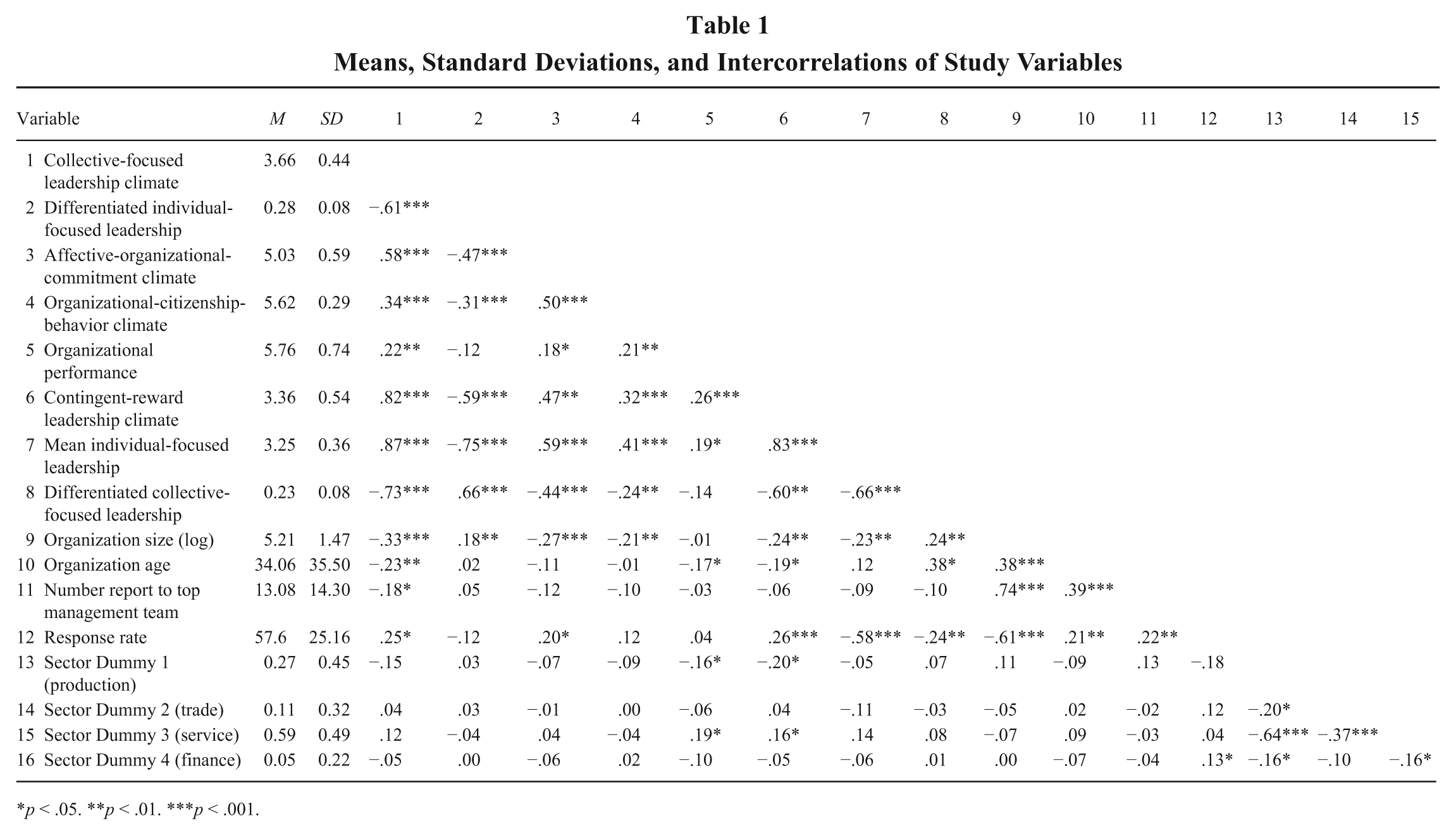
p < .05. **p < .01. ***p < .001.
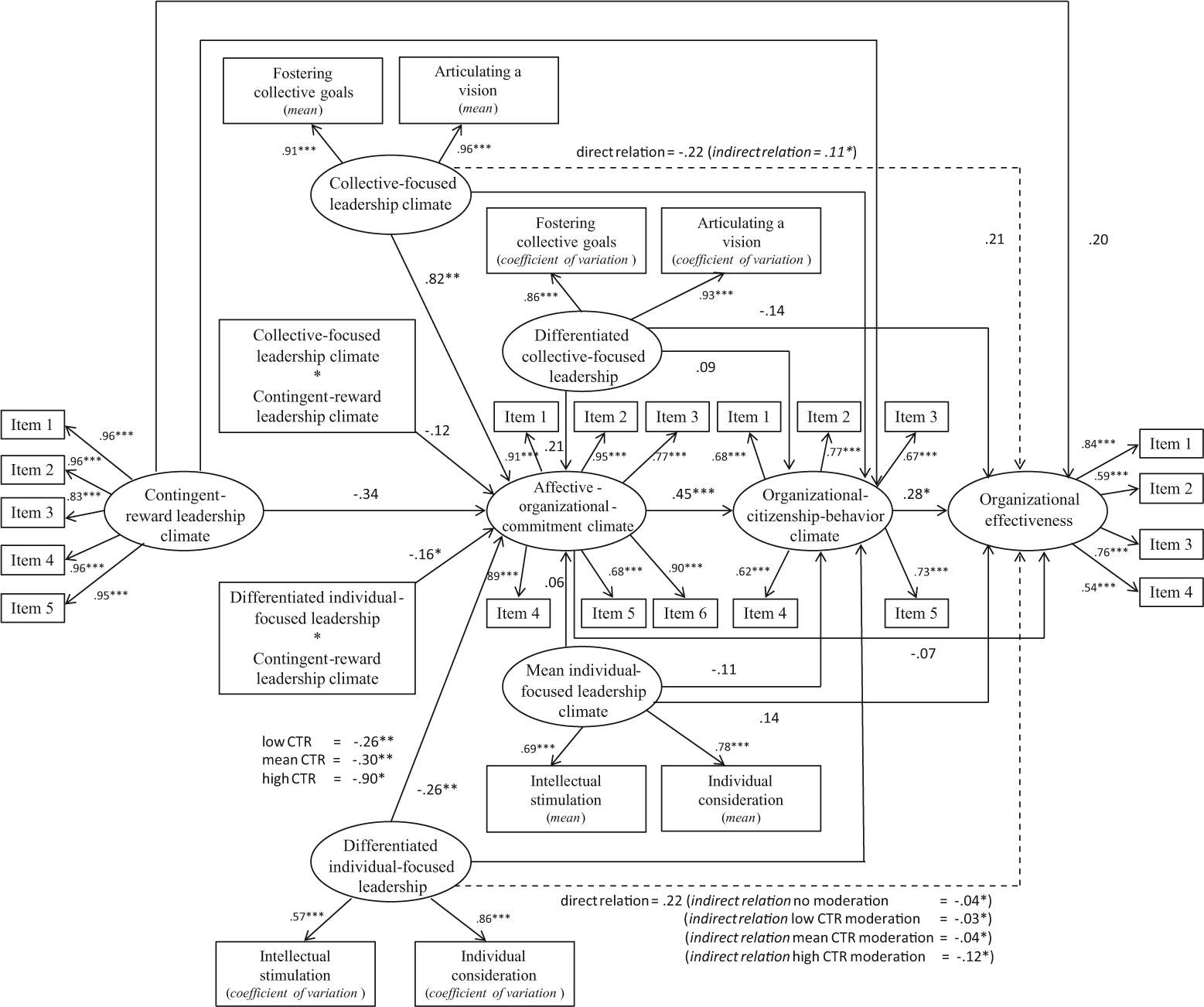
Structural Model Results
Measurement Model Comparisons
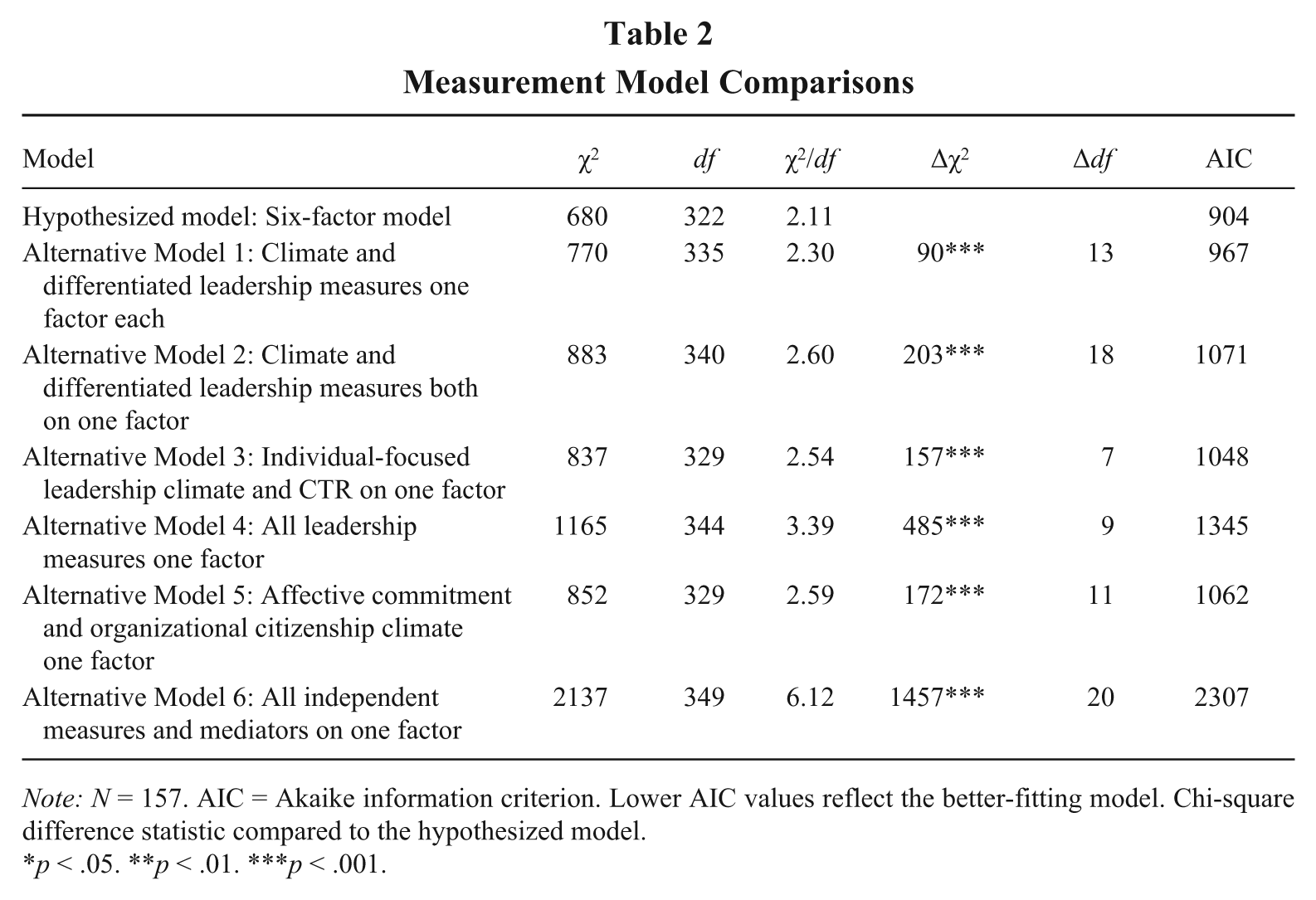
Note: N = 157. AIC = Akaike information criterion. Lower AIC values reflect the better-fitting model. Chi-square difference statistic compared to the hypothesized model.
p < .05. **p < .01. ***p < .001.
Measurement Model
The measurement model consisted of eight latent constructs—collective-focused leadership climate, differentiated individual-focused leadership, differentiated collective-focused leadership, individual-focused leadership climate, contingent-reward leadership climate, commitment climate, OCB climate, and organizational effectiveness—with 28 indicators overall. Following the recommendation of Hu and Bentler (1999) and Bentler (2007) for sample sizes of less than 200, we reported the RMSEA in combination with two incremental fit indices—the CFI and the IFI—to test the overall model fit. A common cutoff value for the comparative fit indices is .90 (Hu & Bentler, 1999). RMSEA values below .08 indicate a reasonable fit, values between .08 and .10 are acceptable, and values above .10 indicate a poor fit (Browne & Cudek, 1993). The coevally confirmatory factor analysis of all constructs showed that our expected measurement model fitted well to the data (χ2 = 680, df = 322; CFI = .92, IFI = .92, RMSEA = .08, AIC = 904), and all factor loadings were above .50 and significant on a 1% level.
To compare different model solutions, we used the Akaike information criterion (AIC; Akaike, 1987). Lower AIC values indicate better fit. To inspect the discriminated validity of our measures, we inspected seven additional specifications, as shown in Table 2. First, Alternative Model 1 with the four mean dimensions and four differentiated leadership dimensions of the TFL measure forming two common factors fitted worse (Δχ2 = 90, Δdf = 13, p < .001, AIC = 967), indicating that the leadership constructs were distinct. Second, Alternative Model 2, in which the eight leadership dimensions loaded on one common factor, also had an inferior fit (Δχ2 =203, Δdf = 18, p < .001, AIC = 1071), further supporting the distinctiveness of the leadership constructs. Third, to investigate the distinctiveness of the individual-focused and contingent-reward leadership measure, we specified Alternative Model 3 so that the individual-focused leadership dimensions and the five contingent-reward items loaded on one common factor. This model had a poorer fit (Δχ2 = 157, Δdf = 7, p < .001, AIC = 1048). Fourth, Alternative Model 4 loaded all TFL and contingent-reward items on one common factor. The worse fit (Δχ2 = 485, Δdf = 9, p < .001, AIC = 1345) indicated that there was no common leadership factor. Fifth, Alternative Model 5 loaded all items from the same source (commitment climate and OCB climate) on one common factor. The inferior fit (Δχ2 = 172, Δdf = 11, p < .001, AIC = 1062) showed the distinctiveness of these same source measures. Sixth, Alternative Model 6 loaded all items of the independent variables and mediators (all leadership dimensions, contingent-reward leadership, commitment climate, and OCB climate) on one common factor. The poorer fit (Δχ2 = 1457, Δdf = 20, p < .001) indicated that the independent variables and mediators were separate constructs. Overall, these results strengthened the confidence in our assumed measurement structure.
Structural Model
Hypotheses testing
In the second step of our SEM analyses, we inspected the structural relationships of our proposed model. In line with the stepwise approach of moderated mediation models in ordinary least squares regression analyses, we first specified a model setting the moderation effects to zero, as main effects might be confounded by the interaction term (Aiken & West, 1991), and then inspected the effects of the interaction terms in two separate models. For this three-path mediation model (Hypothesized Model A), we followed Taylor and colleagues (2008) and specified a model that integrated the indirect effects from the leadership constructs to effectiveness as proposed by our Hypotheses 1, 2, 4, 5, 7, and 8 while also allowing for a direct relationship between the study’s variables. This three-path mediation model showed good model fit properties (χ2 = 982, df = 529; CFI = .91, IFI = .91, RMSEA = .07, AIC = 1482).
All hypothesized structural relationships proposed in Hypotheses 1, 2, 4, 5, 7, and 8 were in line with our theoretical expectations (see Figure 2). Collective-focused leadership positively related to commitment climate (β = .82, t = 3.13, p < .01), while differentiated individual-focused leadership negatively related to it (β = −.26, t = −2.59, p < .01), supporting Hypotheses 1 and 2, respectively. The results also supported Hypotheses 4 and 5, as commitment climate and OCB climate related positively (β = .45, t = 3.92, p < .001) and as OCB climate related positively to organizational effectiveness (β = .28, t = 2.14, p < .05). In line with our theoretical expectation, neither individual-focused leadership climate (β = .06, t = 3.92, ns) nor differentiated collective-focused leadership (β = .21, t = 3.92, ns) significantly related to commitment climate, supporting the null relationship proposed in Hypotheses 7 and 8.
Furthermore, to inspect in more detail the robustness of our key relationships, we ran a series of alternative model tests, which are shown in the second section of Table 3. First, an “individual-focused leadership only” model (Alternative Model 1), in which the two paths from collective-focused leadership climate and differentiated collective-focused leadership to commitment climate were restricted to zero, had a worse fit (Δχ2 = 11, Δdf = 3, p < .01, AIC = 1483). As hypothesized, only the path from differentiated individual-focused leadership to commitment climate was significant (β = .92, t = 3.63, p < .05). Second, a “collective-focused leadership only” model (Alternative Model 2), in which the two paths from the individual-focused leadership climate and differentiated individual-focused leadership were restricted to zero, had a worse fit (Δχ2 = 11, Δdf = 3, p < .05, AIC = 1483). As hypothesized, only the path from collective-focused leadership climate to commitment climate was significant (β = −.28, t = 3.27, p < .01). Third, a “no-reversed leadership” model (Alternative Model 3), in which the paths from the two reversed operationalized leadership constructs were set to zero, had almost a similar fit as the hypothesized three-path mediation model (Δχ2 = 6, Δdf = 3, ns, AIC = 1478), and the proposed paths from Hypotheses 1 (β = .54, t = 2.72, p < .05) and 2 (β = −.22, t = −2.53, p < .05) remained significant and in the correct direction. Fourth, a “reversed leadership measures only” model (Alternative Model 4), which allowed the two paths of differentiated collective leadership and individual-focused leadership climate to relate only to affective commitment climate, showed a poorer fit (Δχ2 = 23, Δdf = 7, p < .001, AIC = 1487). For this model, bootstrapping analyses showed that none of the reversed measures had a significant indirect relation to organizational effectiveness, and this again supports our core theorizing. In sum, this further testing not only increases the confidence in our main results but also shows that alternative explanations are unlikely.
Structural Model Comparisons
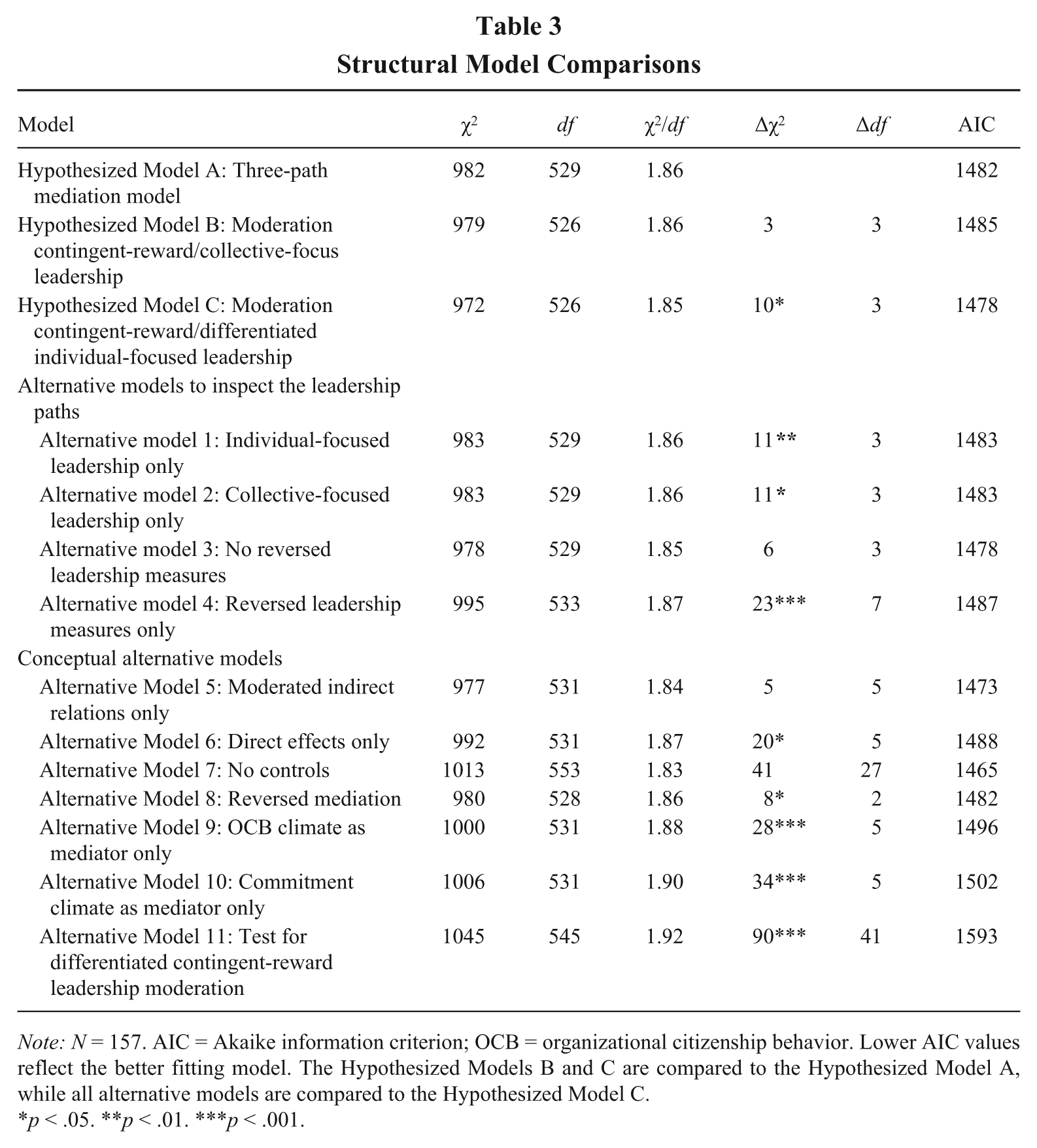
Note: N = 157. AIC = Akaike information criterion; OCB = organizational citizenship behavior. Lower AIC values reflect the better fitting model. The Hypothesized Models B and C are compared to the Hypothesized Model A, while all alternative models are compared to the Hypothesized Model C.
p < .05. **p < .01. ***p < .001.
Furthermore, our model was also supported by the fact that the two direct paths from collective-focused leadership climate (β = −.22, t = −.69, ns) and from differentiated individual-focused leadership (β = .22, t = 1.78, ns) to organizational effectiveness were not significant. Yet, our test for the indirect results (using 3,000 bootstrapping samples in AMOS) showed that, as expected, there was an indirect positive relation of collective-focused leadership climate with organizational effectiveness (β = .11, with a 95% bias-corrected confidence interval [BCCI] between .019 and .353) and an indirect negative linkage between differentiated individual-focused leadership and organizational effectiveness (β = −.04; 95% BCCI [−.128, −.004]).These results fully support Hypotheses 6a and 6b.
After finding clear support for the three-path mediation model, we took a subsequent step and also tested for the more complex, moderated relations proposed in Hypotheses 3a and 3b. For that purpose, we specified two additional models with orthogonalized interaction terms of contingent-reward leadership climate with collective-focused as well as differentiated individual-focused leadership, respectively (see Hypothesized Models B and C in Table 2). 6 First, the hypothesized Model B, including the interaction term of contingent-reward leadership and collective-focused leadership, did not show increased fit properties (Δχ2 = 3, Δdf = 3, ns, AIC = 1485), and the interaction term was not significantly related to affective commitment climate (β = −.12, t = 1.51, ns), rejecting Hypothesis 3a. Second, the Hypothesized Model C, including the interaction term of contingent-reward leadership and differentiated leadership, showed increased fit properties (Δχ2 = 10, Δdf = 3, p < .05, AIC = 1478) as well as increased explained variance (Δ = .03) compared to the model without an interaction term (Hypothesized Model A), and the interaction term was significantly related to affective commitment climate (β = −.16, t = −2.08, p < .05), supporting Hypothesis 3b. A plot of the interaction is provided in Figure 3.
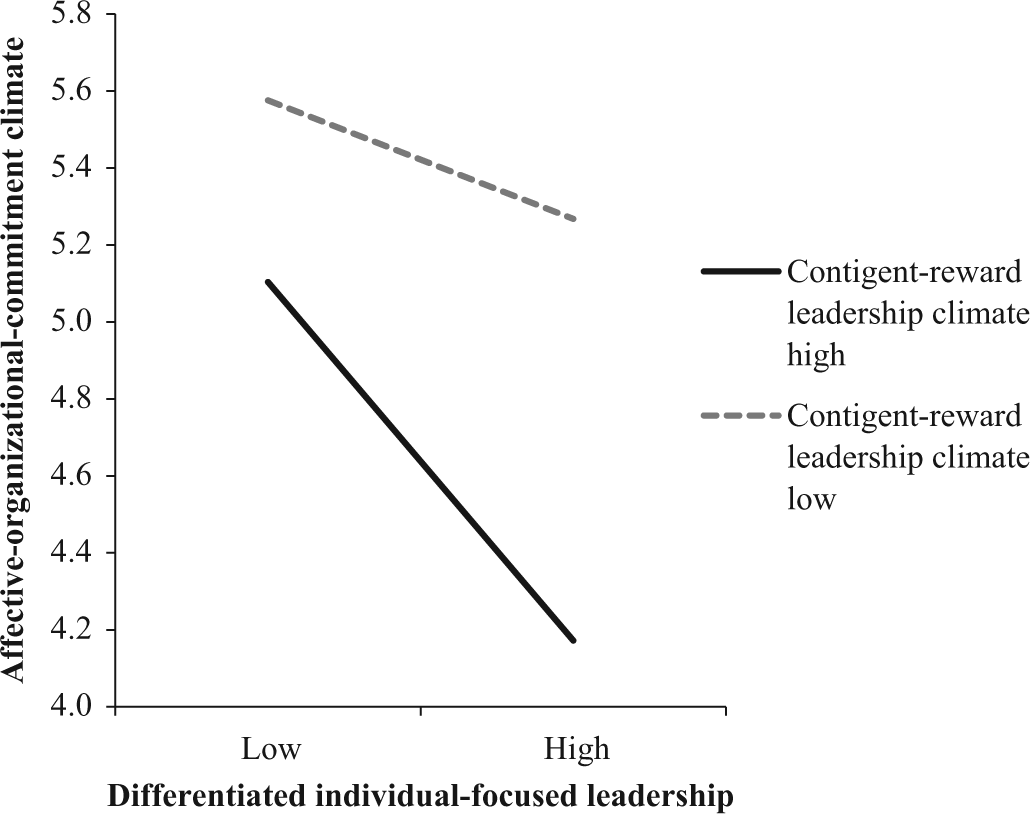
Moderation Effect of Contingent-Reward Leadership Climate on the Relation Between Differentiated Individual-Focused Leadership and Organizational-Affective-Commitment Climate
Figure 3 shows that the negative relationship between differentiated individual-focused leadership and affective commitment climate is much more pronounced under high levels of contingent-reward leadership climate than under low levels. To further inspect the two different slopes, we specified two additional models: one with high levels of contingent-reward leadership climate (+1 standard deviation) and one with low levels of contingent-reward leadership climate (–1 standard deviation). The results further substantiate our reasoning by showing that high levels of contingent-reward leadership climate lead to a much steeper negative slope between differentiated individual-focused leadership (β = −.90, t = −2.12, p < .05) than low levels of contingent-reward leadership climate (β = −.26, t = −2.65, p < .01). Finally, we also inspected potential conditional indirect relations with bootstrapping procedures in the high-level (+1 standard deviation) and low-level (–1 standard deviation) models. Results show that the indirect relation between differentiated individual-focused leadership and organizational effectiveness is affected by the level of contingent-reward leadership, with an indirect relation of −.03 (95% BCCI [−.110, −.001]) for low contingent-reward leadership and an indirect relation of −.12 (95% BCCI [−.638, −.002]) for high contingent-reward leadership.
Alternative model testing
As is illustrated in the third section of Table 3, we further inspected the robustness of our results by testing seven models that could be put forward as conceptual alternative explanations for our findings. First, to assess if the indirect effects are indeed the key in our framework, irrespective of the direct relationships, we first tested a “moderated indirect relations only” model (Alternative Model 5), in which all direct relationships from the leadership constructs to performance were restricted to zero. In support of our theory and hypotheses, this alternative model had a similar fit as our hypothesized model but did not significantly differ (Δχ2 = 5, Δdf = 5, ns, AIC = 1473). Second, a “direct effects only” model (Alternative Model 6), in which all indirect relationships were set to zero, had a significantly worse model fit (Δχ2 = 20, Δdf = 5, p < .05, AIC = 1488), indicating that our hypothesized indirect relationships are crucial for understanding the relationships between our key variables. Third, a “no controls” model (Alternative Model 7), in which all paths from the controls to the dependent constructs were restricted to zero, did not show a significantly better fit (Δχ2 = 41, Δdf = 27, ns, AIC = 1465), indicating that our findings are not altered by adding or deleting the controls. 7 Fourth, to test for the conceptual alternative that commitment climate mediates between OCB climate and organizational effectiveness, we tested a “reversed mediation” model (Alternative Model 8) that reversed the order of the two mediators and found that it had a significantly worse fit (Δχ2 = 8, Δdf = 2, p < .05, AIC = 1482). In this alternative model, the indirect effects from the two leadership constructs to effectiveness were not significant, supporting our theorized model in which affective commitment climate comes before the OCB climate. Fifth, to test if our model indeed needs two mediators, we ran two alternative models, namely, an “OCB climate as mediator only” model (Alternative Model 9), in which commitment climate was excluded as a mediator variable, and an “affective commitment climate as mediator only” model (Alternative Model 10) that excluded OCB climate. Both models had a poorer fit (Alternative Model 9, Δχ2 = 28, Δdf = 5, p < .001, AIC = 1496; Alternative Model 10, Δχ2 = 34, Δdf = 5, p < .001, AIC = 1502), showing that our framework indeed requires two mediators. Sixth, we also tested a conceptually alternative model in which differentiated contingent-reward behavior was added as a further moderator on the differentiated individual-focused leadership to commitment climate relationship (Alternative Model 11). This model showed inferior fit properties (Δχ2 = 90, Δdf = 41, p < .001, AIC = 1593), and the additional moderation path was nonsignificant, supporting the hypothesized importance of contingent-reward leadership climate. 8 Consequently, these results clearly indicate support for our hypothesized relationships and overall model. These results also reveal that alternative explanations are not likely to be behind our findings. 9
Discussion
The present study investigated if and how collective-focused leadership climate and differentiated individual-focused leadership relate to organizational processes and effectiveness. Drawing upon POS (Eisenberger et al., 1986) and SET (Blau, 1964), we hypothesized and empirically demonstrated that the collective-focused leadership climate (operationalized as the mean of articulating a vision and fostering collective goals by leaders throughout an organization) indirectly enhanced organizational effectiveness by sequentially increasing the affective commitment climate and OCB climate. In contrast, the results showed that differentiated individual-focused leadership (operationalized as the coefficient of variation in individual consideration and intellectual stimulation among leaders throughout an organization) influenced organizational effectiveness negatively by sequentially decreasing these organizational processes. Furthermore, we found that the contingent-reward leadership climate (Bass, 1985) moderated the relationship between individual-focused leadership and commitment climate by making this relationship even more negative; however, it was irrelevant as a context factor for the relation between collective-focused leadership climate and commitment climate. Last, we showed that the two reversed leadership measures (i.e., differentiated collective-focused leadership and individual-focused leadership climate) were unrelated to commitment climate, as expected.
Theoretical Contributions and Future Research Directions
These findings corroborate and extend contemporary theory, methods, and statistics in the area of differentiated leadership (Wang & Howell, 2010; Wu et al., 2010) in several ways. First, we built and subsequently tested a unified organizational-level framework of the relation of collective-focused leadership climate and differentiated individual-focused leadership with collective outcomes. This opens up new theoretical avenues for future research on collective and differentiated leadership in organizations. For example, although Wu and colleagues (2010) provided valuable insights into the separate routes that both leadership constructs can take, their study left open the question of how such opposing mechanisms can operate simultaneously at higher levels of analysis. To provide answers to these questions, we used SET (Blau, 1964) and POS (Eisenberger et al., 1986) and developed a coherent theoretical framework about the organizational consequences of differentiated and collective-focused leadership. Moreover, following prior conceptual arguments in the field of differentiated leadership research (e.g., Kark & Shamir, 2002), this was the first study to add and empirically test a behavioral step (i.e., OCB climate) for the relationship between the two types of leadership and collective effectiveness. Consequently, compared to existing studies (e.g., Wang & Howell, 2010; Wu et al., 2010), our first contribution is that we provided an alternative theoretical framework on how collective-focused leadership and differentiated individual-focused leadership may lead to collective effectiveness.
Second, until now, no context factors have been studied in this area of leadership research; thus, we investigated whether contingent-reward leadership climate (Bass, 1985) might be a moderator. The findings from our moderation analyses provided additional support for our reasoning, as we found that contingent-reward leadership climate increases the negative relation of differentiated individual-focused leadership with commitment climate, while it did not affect the positive relationship of a collective-focused leadership climate with commitment climate. Our results thus suggest that providing employees with both differentiated individual-focused leadership and contingent rewards creates too strong individualistic orientation (Hinsz et al., 1997), as this combination fails to activate the positive mechanisms underlying POS and SET. Given that our study is the first to show these results, we encourage other researchers to further explore whether the above reasoning is indeed valid. One option would be to explicitly include such variables as collective versus individual orientation (Hinsz et al., 1997) in future models. Another option would be to expand our model, for example, by including related variables, such as perceptions of (un)fairness or (in)equity (Adams, 1965) or different types of organizational justice (Colquitt et al., 2013).
Third, we also extend prior studies in this area (Wang & Howell, 2010; Wu et al., 2010) by being the first to apply more competitive methods, measures, and data to rule out key alternative explanations of previous research. More specifically, we hypothesized and tested the alternative explanation that previous findings were found because they failed to include the reversed operationalizations of the leadership constructs (Cole et al., 2011). While our correlation table might at first glance support such criticism, our multivariate analyses and alternative model testing reject it. Compared to prior studies (Wang & Howell, 2010; Wu et al., 2010), we hypothesized and controlled for reversed leadership operationalizations (e.g., mean individual-focused leadership climate and differentiated collective-focused leadership), and our results showed that none of these had a significant influence on the outcome variables. These effects also hold true in numerous alternative model tests through which we inspected the relations among the four different leadership measures in more detail, and they also hold true in our tests for potential biases due to endogeneity issues (Antonakis, Bendahan, Jacquart, & Lalive, 2010), such as common-factor or omitted-variable biases. Consequently, our results strongly support the notion that only a differentiation of the individual dimensions negatively relates to organizational effectiveness, while a high average of the collective dimensions relates to organizational effectiveness positively. In addition, we also adopted the Podsakoff et al. (1996) TFL scale as another measure, as this freely available measure is able to capture the components of collective-focused and individual-focused leadership at least equally to, and potentially better than, the Multifactor Leadership Questionnaire (Bass & Avolio, 2000) used in previous studies. Last, our study is the first to show that the previously reported collective consequences of differentiated and collective-focused leadership are also present in a non-U.S. sample of 157 German companies.
In our view, this overall package of theoretical and methodological advancements provides many avenues for future research. For instance, future studies can now use two alternative theoretical models to understand the relationships of differentiated individual-focused leadership and collective-focused leadership with collective processes and effectiveness. This opens the possibility to compare the different theoretical routes together in one model so as to investigate whether an independent route on the individual and collective levels (Wu et al., 2010) or our more parsimonious reasoning through a unified POS and SET mechanism is more valid.
Beyond comparing these two models head-to-head, or testing the mechanisms underlying our model in more detail, research might also add other theoretical routes not yet researched. A candidate for this is the level of trust within organizations (e.g., Schoorman, Mayer, & Davis, 2007), as this might play a key role in the relationship between differentiated leadership and collective outcomes. Yet, trust could be both a mediator and a moderator. For example, trust might be a moderator if followers who trust their supervisors are found to be less affected by individual-focused leadership differentiation, because they might expect, at least initially, that leadership differentiation is necessary to increase other colleagues’ productivity for the good of the group or company. However, if practiced over a longer period, differentiated leadership might prevent the development of reciprocal trust (Serva, Fuller, & Mayer, 2005) between supervisors and followers, as employees who are continuously disfavored might eventually lose their trust in their supervisor. Moreover, the above example also highlights the importance of conducting longitudinal studies, as the effects and development of differentiated leadership over time seem to be crucial. Consequently, future research might not only compare the two frameworks but also integrate them or expand upon them in order to work toward a deeper understanding of this topic. Alternatively, scholars might first build an alternative third model (e.g., containing trust and/or fairness) and test it before engaging in the time- and resource-intensive task of comparing different frameworks. We encourage future researchers to tackle some of these mechanisms more directly than has been done in the past. We hope that our research design, methods, and statistics might be useful for all these endeavors.
Another interesting avenue for future studies is to use our theory and findings as a starting point to search for more moderators, as to date, only contingent-reward leadership climate has been studied as a context factor. For example, we expect that the HR management system (e.g., Ichniowski & Shaw, 1999) might enhance or buffer the SET and POS consequences of leadership behaviors in companies. Following our theoretical reasoning to explain the moderation by contingent-reward leadership climate, HR practices that create an individualistic orientation, such as individual-oriented reward or bonus systems, would make the already existing negative consequences of differentiated individual-focused leadership even worse. In contrast, HR practices that favor collective rewards, such as reward systems based on collective performance, might help buffer the negative consequences of differentiated individual-focused leadership and potentially even increase the positive effects of collective-focused leadership. Another option is to link our framework to literature on the role-modeling and sense-giving leadership behaviors of CEOs (e.g., Carmeli, 2008), as this might be a crucial boundary condition for the consequences of leadership climates in companies. For example, if the CEO is able to create a vision for the company that focuses on collective goals, a high level of individual-focused leadership differentiation should be less harmful for the social-exchange relationships in organizations and could even increase affective commitment and helping behavior of employees. Conversely, a CEO who lacks such a collective vision or who tries to create one but does not provide a clear role model (e.g., awards himself or herself a high bonus or promotes staff solely on individual preferences) might actually damage the already strained social-exchange relationships associated with the differentiated individual-focused leadership climate and thus lower commitment and helping across the entire organization.
Practical Implications
In addition to theoretical implications, the current study also provides important practical implications, as the results indicate that executives and other high-level practitioners, such as board members, need to be aware of the potential detrimental effects of differentiated leadership for organizational effectiveness. Our results show that substantial differences within the individual-focused leadership treatment of employees can endanger organizational effectiveness by lowering the affective commitment and OCB climates. These findings concur with Hill’s (2007) observation that leaders often fail to recognize their responsibility to manage a collective entity because they erroneously believe that investing in the relationship with each individual is sufficient for the emergence of collective (e.g., group or organizational) effectiveness. Hence, our first managerial implication is that practitioners should realize that individual-focused leadership could have detrimental effects on organizational processes and outcomes while benefiting only some individuals (e.g., Vecchio, 1987). Practitioners should also realize that high rewards for individual-focused goals could further deteriorate these negative relations to collective outcomes. Therefore, companies should try to avoid having too many individualized-focused goals set in place, for instance, by avoiding an overly individual-focused incentive structure.
Second, we advise managers to promote collective-focused leadership throughout the organization, as it increases the affective commitment and OCB climates as well as organizational effectiveness. Organizations can achieve this goal in several ways. For example, given that TFL can be assessed in a relatively reliable way (Goodstein & Lanyon, 1999), the first intervention could assess the collective-focused leadership competencies during the processes of selecting, appraising, and promoting leaders. Second, organizations could implement systematic leadership development efforts focused on collective-focused leadership (Bass, 1990; Day, 2000) to further boost these leadership competencies across the organization. As a final suggestion, top management could provide an adequate role model (Bass, 1985) to entice lower-level leaders to show the relevant collective-focused leadership behaviors as well.
Limitations
Like any other study, our study has its limitations. First, given our specific sample of German small and medium-sized companies, the generalizability of our findings might be limited to similarly sized companies and/or comparable cultural contexts. However, given that our sample consisted primarily of small and medium enterprises, which make up the majority of economic activity in most nations (Beck, Demirguc-Kunt, & Levine, 2005), and given that our companies are from diverse industry backgrounds within the largest economy in the European Union, the generalizability of our results does not seem overly limited. Previous research (Brodbeck, Frese, Javidan, & Krall, 2002) has found that leadership behavior in Germany is characterized by high performance and low team orientation, which should make differentiated individual-focused leadership relatively acceptable. Yet, we found that even in such an individualistic culture, clear negative organizational-level relations are associated with differentiated leadership. As such, these negative relations might be even more pronounced in more collective cultures, such as Southeast Asia (House, Hanges, Javidan, Dorfman, & Gupta, 2004). Moreover, combining our results with the findings of previous group-level studies (Wang & Howell, 2010; Wu et al., 2010) that focused on North American companies, we conclude that the effects of the differentiated individual-focused leadership and collective-focused leadership climates appear to be rather robust (at least across the Western world). However, to further assess whether this is the case, future research could try to replicate our results in other cultural settings, for instance, by going beyond the Western cultures studied so far or by focusing on other (types of) companies.
Second, we used a key informant (i.e., a top HR representative) to assess organizational effectiveness, which might evoke some concerns regarding the reliability or accuracy (e.g., Wright, Gardner, Moynihan, Park, Gerhart, & Delery, 2001). Indeed, objectively available stock market measures would appear to be the most desirable source of organizational effectiveness; however, given that most small and midsized enterprises in our sample were privately owned and thus not publicly listed, such data do not exist. After investigating the potential problems with subjective effectiveness data (Starbuck, 2004), prior studies concluded that subjective measures are a valid source of organizational effectiveness (e.g., Wall et al., 2004). As a further cross-validation, we were able to collect objective effectiveness data from a subsample of 35 organizations in our sample after they published annual reports. This objective effectiveness information was obtained from a third-party agency that summarizes the effectiveness data of small and midsized companies based on their annual reports. The objective effectiveness data of these 35 companies was positively related to our subjective effectiveness measure, namely, to growth in revenues (r = .35, p < .05) and growth in profits (r = .38, p < .05) during the year of the survey. Taken together, we therefore believe that both prior research and our own robustness analyses indicate that the use of subjective measures is appropriate for our sample of small and midsized enterprises; yet, we acknowledge that future research—especially research in larger and publicly traded companies—might also use more objective effectiveness data to assess our relationships more rigorously.
Third, we acknowledge that the specific operationalizations of the organizationwide leadership measures might have affected our observed relationships. While we used an aggregated measure of all individual leadership relationships throughout the organization, an alternative way of operationalizing would be to first measure the amount of differentiation or mean level of leadership in teams and/or units and then aggregate those values to the organizational level. Unfortunately, due to the companies’ privacy concerns, we did not gain access to this information. Such information would also enable researchers to account for multilevel effects of leadership climates and, for example, investigate whether a collective-focused leadership climate in the entire organization can help to buffer the negative consequences of a high differentiation in individual-focused leadership within specific business units. Furthermore, some business areas might even profit from differentiated individual-focused leadership behaviors (i.e., a sales department with independent working sales agents), whereas such high differentiation in other departments might be especially harmful (i.e., an R&D department with many collaborative projects). Accordingly, the amount of interdependence needed to complete collective tasks might be crucial (e.g., Van der Vegt et al., 2010). Hence, we encourage future researchers to collect such multilevel data sets in organizations and to test and extend our results in more elaborate data sets.
Conclusion
In sum, in line with previous studies (Wu et al., 2010), our answer to Sparrowe and Liden’s (1997: 545) question regarding “whether leaders should or should not differentiate among their members” is that such individual-focused differentiation between employees should be viewed with caution at the organizational level, as we found that it diminished the affective commitment and voluntary helping (i.e., OCB) climates within organizations as well as organizational effectiveness. We also found that these negative effects are even stronger when an organizational climate encourages rewards for individual performance in companies. We therefore recommend creating a collective-focused leadership climate, as this increases both organizational climates and effectiveness.
We hope that our theory and results can offer scholars new insights and avenues to continue investigating the role of differentiated individual-focused and collective-focused leadership climates in organizations. Moreover, we hope that our study benefits practice by providing a new empirically supported framework through which the relationships of collective and differentiated leadership can be better understood and managed.
Footnotes
Acknowledgements
This article was accepted under the editorship of Deborah E. Rupp. We thank editor Mark Griffin and two anonymous reviewers for their helpful and constructive feedback during the publication process. Additionally, we would like to acknowledge the feedback of the reviewers and participants of the Academy of Management Meeting 2012 and the participants of the research seminars at the University St. Gallen and at the University of Lausanne. In particular, we thank Anneloes M. L. Raes for her diligent reviews. Finally, we want to thank the whole team at the IFPM (University of St. Gallen) for their support during data collection.