







Abstract
This study examined workplace interactions in which lesbian, gay, and bisexual (LGB) workers faced decisions related to revealing or concealing their LGB identities at work (i.e., identity management situations). Participants were 61 LGB adults who completed a baseline survey about their organization and, over 3 weeks, responded to event-based surveys immediately after identity management situations. Results suggested that LGB workers manage their stigmatized identity strategically according to situational characteristics. Indeed, much of the variance in use of revealing and concealing strategies was due to differences within people from situation to situation. Use of identity management strategies was predicted by interaction partner cues of acceptance or rejection as well as perception of LGB-related organizational climate and policies. Results at the within-person and between-person levels diverged in noteworthy ways.
To display or not to display; to tell or not to tell; to let on or not to let on; to lie or not to lie; and in each case, to whom, how, when, and where.
As bearers of a stigmatized identity that can be concealed, lesbian, gay, and bisexual (LGB) individuals must navigate an ongoing process of deciding whether, when, and how to reveal their sexual orientation identity to others (Crocker, Major, & Steele, 1998). This identity management process is often salient in the context of the workplace, where LGB persons must balance fears of rejection and formal discrimination with the desire for authentic work relationships and a sense of personal integrity (Croteau, Anderson, Distefano, & Kampa-Kokesch, 2000). For individuals who are employed, the workplace is often second only to the immediate family as the most important context for social interaction (Chadsey & Beyer, 2001). Thus, it is perhaps not surprising that decisions about identity disclosure are a central concern for many LGB workers (Button, 2001; Clair, Beatty, & MacLean, 2005; Croteau, 1996).
Although the outcome of disclosure decisions has typically been characterized as dichotomous (i.e., revealing versus concealing one’s identity), research indicates that LGB individuals use a variety of behavioral strategies to manage levels of disclosure across diverse work relationships and situations (Chrobot-Mason, Button, & DiClementi, 2001). For example, when interacting with a new supervisor, LGB employees may deliberately provide false information about their partner’s gender, avoid questions about nonwork activities, or provide subtle cues about their sexual identity (Clair et al., 2005). Moreover, the strategies employees may use with a new supervisor may differ from those they use in other work relationships.
In line with Lewin’s (1936) assertion that human behavior is a function of the person and the situation, LGB identity management strategies likely vary with individual and situational features. Indeed, preliminary findings from qualitative studies suggest that identity management strategies can vary from situation to situation and relationship to relationship (Cain, 1991; Woods, 1994). However, such within-person variability has received relatively little quantitative investigation. To date, studies have focused on global differences among stigmatized employees in identity management. Such studies have revealed striking individual differences in the identity management strategies that stigmatized workers in general, and LGB people in particular, typically use, and they have yielded important findings regarding the person-level antecedents and consequences of these strategies (Chrobot-Mason et al., 2001). Yet, this focus on differences between individuals has left unanswered many basic questions about the differences within individuals across situations and relationships. Moreover, because such research has relied on workers’ reports of past identity management experiences, results may be influenced by retrospective memory biases.
The goal of the current research is to explore identity management strategies that LGB workers employ in interpersonal interactions. This research uses an experience-sampling methodology to examine interpersonal interactions as they occur at work over a 3-week period. We assess a variety of situational and individual factors to allow discovery of yet unknown answers to Goffman’s (1963: 42) questions of “to whom, how, when, and where” LGB identities are revealed and concealed in real-world workplace settings. This inclusive, exploratory approach allowed us to address three fundamental yet unexamined issues regarding LGB identity management. First, this approach will detect the degree to which identity management strategies vary from person to person (between-person differences) and from situation to situation (within-person differences). This will provide novel evidence responding to Goffman’s question of “how” concealable stigmas are managed by considering the degree to which individuals respond to different interactions with similar identity management strategies. Second, we will explore whether situational characteristics predict both stable (between-person) and dynamic (within-person) components of identity management strategies. That is, we will describe the features of interactions that involve particular LGB identity management behaviors, thereby addressing Goffman’s questions of “to whom,” “when,” and “where” identity management occurs. Third, we will consider whether LGB-related perceptions of self and the organization predict subsequent identity management strategies to determine “for whom” particular identity management behaviors arise. Overall, this research will build new understanding of the dynamic interplay between individual and situational characteristics in determining identity management behavior.
How Do People Manage Their LGB Identities at Work?
It has been widely argued that managing identity in the workplace is a major issue facing stigmatized individuals (e.g., Button, 2001; Chrobot-Mason et al., 2001; Griffith & Hebl, 2002; Ragins, 2004; Roberts, 2005; Triandis, Kurowski, & Gelfand, 1994). Clair et al. (2005) suggested that the salience of identity management is due to potentially opposing psychological forces. On the one hand, individuals are motivated to be authentic in their interactions in order to maintain and verify their sense of self (Friskopp & Silverstein, 1996) and build open relationships with others (Creed & Scully, 2000). Revealing an LGB identity may be necessary to gain benefits afforded to domestic partners or advocate on behalf of other LGB workers. On the other hand, concerns about how one is perceived by others are particularly salient in workplace contexts where most employees attempt to make positive impressions on supervisors, coworkers, and subordinates (Roberts, 2005). Moreover, the likelihood of experiencing discrimination increases when a stigmatized identity is confirmed (e.g., Griffith & Hebl, 2002; Herek, 1996). LGB workers must weigh these opposing forces in deciding how to negotiate the “disclosure dilemmas” presented by each new social situation (Ragins & Cornwell, 2001). Before we can understand the dynamic and stable predictors of identity management, we must first understand the substantive process of interest. Thus, we first consider Goffman’s question of how LGB identities are managed to clarify the act of managing identity.
Preliminary research indicates that LGB individuals use a variety of behavioral strategies to manage levels of disclosure. For example, in an interview study, Woods (1994) concluded that LGB identity management consists of three overarching strategies: counterfeiting (i.e., fabricating a false heterosexual identity), avoiding (i.e., eluding questions about personal life), or integrating (i.e., revealing an LGB identity). Although only one of these three strategies involves identity disclosure, other theorists have noted additional means of disclosure. For example, Clair et al. (2005) considered signaling one’s identity to be a revealing strategy. Signaling can be viewed as an individual’s attempts to gauge others’ potential reactions to disclosure by providing ambiguous hints or questions that “test the waters” for disclosure and to elicit informative responses (Jones et al., 2013). The nature of these behaviors as they occur in specific moments may be different from a person’s general behavioral tendencies. Decisions about which of these identity management approaches to use may depend on characteristics of the situation, characteristics of the individual, or both.
Existing literature has generally characterized people with concealable stigmas as being on a continuum ranging from total concealment to total openness with respect to disclosure of the stigma. This perspective suggests that there may be an overarching identity management construct that differentiates people based on their use of revealing versus concealing strategies. However, at the situation level, use of specific identity management strategies may vary greatly depending on the unique context—the setting, players, recent experiences, and so on. Some situations may pull for a variety of strategies if the interaction evolves with respect to cues of acceptance or rejection (e.g., hints of acceptance after signaling may lead workers to reveal their identity) or if it involves a mixture of people (e.g., some people give clear acceptance cues but others give possible rejection cues). Other situations may be relatively simple and lead the person to adopt a narrower palette of identity management strategies. Thus, at the situation level, identity management may have a multifactorial structure that depicts concealing strategies and revealing strategies as related yet distinct constructs. This discussion suggests that the construct of identity management may itself depend on whether one is considering global differences between workers versus differences within a worker from one situation to another. Here we explore this little discussed possibility by assessing the structure of identity management at the level of the person and at the level of the situation
Predictors of LGB Identity Management
In describing a theoretical model of social interactions between stigmatized and nonstigmatized individuals, Hebl and Dovidio (2005: 164) noted that “the physical, social, and selection characteristics of the setting can greatly influence the way in which interactions proceed.” Similarly, we contend that individuals’ use of identity management strategies depends on characteristics of the situation and interactants. Below, we discuss situation-level and person-level factors that influence to whom, when, and where LGB workers reveal and conceal their sexual orientation.
Situation-Level Predictors of LGB Identity Management
In contrast with growing evidence of predictors of disclosure assessed at the person level, no previous work has examined situational determinants. Nevertheless, Fleeson (2004) argued that situational characteristics should be the strongest predictors of situation-based behavior. We focus on characteristics of the person with whom LGB individuals are interacting—gender, sexual orientation, job level, and acceptance and rejection cues—as immediately accessible and salient situational factors. In addition, we consider features of the specific context in which each identity management episode emerges that affect revealing and concealing. This focus allows us to directly address Goffman’s questions regarding the situational conditions that influence to whom, when, and where identity management behaviors emerge.
The very focus of situation-level variables may suggest that they may be used only to account for differences within persons from situation to situation. However, because people may differ in the extent to which certain situational characteristics arise, such variables may also explain differences between workers in identity management. For example, some people may have relatively more identity management situations with supervisors compared to their peers. Such differences in the percentage of identity management situations with supervisors may then account for overall differences between workers in use of concealing strategies. In contrast, at the within-person level, an identity management situation with a supervisor might account for differences in a worker’s typical use of concealing strategies. Thus, studying situational variables has the potential to illuminate both stable (between-person) and variable (within-person) components of identity management strategy use.
To whom?
Characteristics of interaction partners can literally stare LGB workers in the face as they engage in identity management and thus likely have a substantial—yet unstudied—impact. A basic but largely untested assumption about identity management is that LGB workers are more likely to adopt a revealing or signaling strategy when they believe they will be accepted by their interaction partners or when they have no reason to believe they will not be accepted (Griffith & Hebl, 2002). In contrast, concealing strategies may be more likely when individuals expect negative reactions to identity disclosure.
But how can individuals determine whether an interaction partner might be supportive or rejecting? In a qualitative study, LGB workers reported relying on cues about their interaction partner to determine the extent to which disclosure may be positively received (King, Reilly, & Hebl, 2008). Thus, for many sexual-minority individuals, sensitivity to assumed correlates of LGB-affirming attitudes is a central component of identity management (Chrobot-Mason et al., 2001). A respondent in an interview study of lesbian executives described this “prescreening” process by stating, I listen to people before I engage with them. So if I sense a lack of tolerance for certain kinds of things, people, music, art, a total focus on themselves, who they peer with, kinda gives me give me a clue that these are people are . . . there’s a vibe. There’s just a vibe. (Gedro, Cervero, & Johnson-Bailey, 2004: 394)
This rationale implies that, in a given interaction, LGB workers will pay attention to acceptance and rejection cues exhibited by their interaction partners. When information is available that the interaction partner may not be supportive of LGB people, concealing strategies are likely utilized, whereas cues that indicate acceptance will encourage revealing. This rationale also applies to the between-person level: Individuals who perceive more acceptance (and fewer rejection) cues would be more likely to reveal and signal (and less likely to conceal) than individuals who perceive fewer acceptance (or more rejection) cues.
Cues about anticipated acceptance my also stem from demographic characteristics of interaction partners, particularly, their sexual orientation and gender. In the case of sexual orientation, gay employees likely expect their gay colleagues to be more accepting of their orientation than heterosexual colleagues. Gender, too, may serve as a proxy for anticipated acceptance since women (on average) have more positive attitudes toward gay and lesbian people than do men (Herek, 1988; Kite & Whitley, 1996).
Another characteristic of interaction partners that is unique to workplace contexts may influence the nature of identity management behaviors: hierarchical level. The structure of organizations typically involves hierarchies that reflect implicit power dynamics wherein supervisors generally have both status and power over their subordinates (see Magee & Galinsky, 2008). Because fears of demotion or job loss partially motivate concealing an LGB identity (see Ragins, 2004; Ragins, Singh, & Cornwell, 2007), it stands to reason that LGB people may be particularly hesitant to disclose their sexual identities with people who have the power to affect their job status. Revealing behaviors, then, may be more likely to emerge in situations in which LGB people interact with others who are below them in the hierarchical structure.
Finally, it is important to consider momentary identity management decisions in light of previous ones. When a person has already disclosed an LGB identity to a coworker, many of the potential feared outcomes (such as negative reactions and recrimination) would have manifested. Later decisions about revealing that identity would therefore be less risky to the extent that interaction partners are already aware of their gay orientation. LGB people may simply have less to lose by revealing their orientation to someone who already is aware of that orientation. Moreover, the alternative would be to suppress or conceal their orientation and potentially create interpersonal mistrust. In summary, we expect that LGB workers will be more comfortable and less fearful about revealing their orientation—given greater certainty of positive receptivity—to interaction partners who are LGB, to colleagues who are already aware of their LGB identity, to women, to colleagues at the same or a lower job level, or to those who have indicated acceptance of LGB people.
When?
A psychological mantra is that past behavior is the best predictor of future behavior. In the case of revealing or concealing an LGB identity, experience or practice with a particular identity management approach likely fuels future identity management decisions. That is, in a given situation, an LGB person is more likely to reveal his or her sexual orientation to the extent that he or she previously engaged in more revealing and less concealing. Consistent with this reasoning, a survey of LGB workers found that the best predictor of disclosure was previous positive disclosure experience (Griffith & Hebl, 2002). Indeed, this behavioral momentum may be part of what fuels chronic tendencies toward revealing or concealing that have been typically studied through retrospective accounts at the person level.
Where?
Workplace interactions that are relevant to sexual orientation can take place in a variety of situations. For example, discussion of weekend social plans could occur at the water cooler, in a meeting planning for travel or product delivery, or via phone or e-mail. Relevant dimensions underlying these various locations within which revealing or concealing may occur are face-to-face versus virtual interactions and work- versus non-work-related tasks.
Experimental research suggests that social disclosures may be more likely in virtual (i.e., computer-mediated) interactions than face-to-face interactions (Bargh, McKenna, & Fitzsimons, 2002; Tidwell & Walther, 2002). Dominant explanations for this tendency include fewer discouraging social cues, feelings of control of self-presentation, and exaggerated intimacy perception in computer-mediated interactions (see Nguyen, Bin, & Campbell, 2012). For these reasons, LGB-revealing behaviors may be more likely in virtual interactions than those that are face-to-face.
King and colleagues (2008) reported that heterosexual respondents to an open-ended survey question indicated that discussions of sexuality—whether heterosexual or gay—were inappropriate in workplace contexts. Indeed, in narrow work situations in which social relationships and nonwork lives are entirely irrelevant and focused task-related attention is required, discussions of sexuality may be outside socially normative behavior. Instead, revealing of sexual identities may be more likely to emerge in work situations in which relationships and nonwork aspects of life are directly relevant. Based on this rationale, we expect that more revealing and less concealing will occur in social or nonwork conversations than in task or work-related interactions.
Person-Level Predictors of LGB Identity Management
Person-level approaches to identity management are distinct from situational experiences; person-level factors are individual difference characteristics that pertain to where and when people are generally likely to engage in concealing or revealing behaviors. We describe below several factors—including characteristics of the person and their perceptions of the context—that are likely important predictors of identity management.
Where?
Theory and data indicate that the supportiveness of the context in which LGB individuals work is a critical determinant of their experience (Button, 2001; Griffith & Hebl, 2002; Huffman, Watrous-Rodriguez, & King, 2008; Ragins & Cornwell, 2001). Revealing or signaling an LGB identity likely has fewer risks and more benefits when organizations affirm diverse sexual identities through formal policies (e.g., nondiscrimination policies, domestic partner benefits) and informal norms (e.g., same-sex partners are welcomed at social gatherings). However, if supportive policies or a supportive climate are not perceived to be present, concealing strategies are more likely to be relied upon to avoid potential risks of disclosure (Clair et al., 2005). Studies of LGB workers have confirmed that perceived climate for sexual diversity is positively correlated with a tendency to use integrating strategies and negatively correlated with avoiding and counterfeiting approaches (Button, 2001; Chrobrot-Mason et al., 2001). We anticipate replicating this finding using identity management data sampled from actual social interactions experienced by LGB workers, such that organizations that are perceived to be supportive will encourage revealing and reduce concealing at the between-person level.
When?
Organizational tenure may impact the experience of and reaction to identity management episodes. When individuals first join an organization, a major dimension of their adjustment involves social acceptance: the sense that one is liked by new colleagues and integrated into the interpersonal fabric of the workplace (Bauer, Bodner, Erdogan, Truxillo, & Tucker, 2007). As employees seek social acceptance, they must manage uncertainty about norms for interpersonal behavior as well as factors salient to forming positive relationships with specific colleagues. LGB employees likely face additional layers of uncertainty due to the lack of information about the degree to which coworkers and supervisors are LGB affirming. Though unstudied in LGB workers, research suggests that racial-minority employees experience higher levels of relational uncertainty than their White counterparts early in their organizational tenure compared to later (Teboul, 1999). Thus, we expect identity management situations in general, and decisions to reveal less and conceal more, are negatively associated with organizational tenure.
Who?
We also consider individual differences that likely have a proximal impact on identity management: identity centrality, self-stigma, stigma sensitivity, and identity uncertainty. Each of these constructs concerns ways people understand and respond to their social or collective identity as LGB. Identity centrality—the degree to which an aspect of one’s identity is personally important—likely increases revealing of that identity feature. Indeed, previous research has shown that identity centrality among LGB people was related to less motivation to conceal their identities (Mohr & Kendra, 2011). Conversely, the degree to which individuals stigmatize that aspect of their identity may reduce revealing. Internalized homonegativity has been linked with feelings of shame and reduced self-esteem (Meyer, 2003) that would likely influence identity management. Similarly, sensitivity to potential stigmatization can create hypervigilance (Lewis, Derlaga, Griffin, & Krowinski, 2003) that may reduce revealing. We examined individual differences in both awareness of and concern with the potential for stigmatization. Finally, uncertainty about one’s sexual orientation identity has been shown to be negatively associated with time in the LGB identity formation process, which may explain why it has also been linked with higher motivation to conceal and acceptance concerns (Mohr & Fassinger, 2000; Mohr & Kendra, 2011).
Person-Situation Interactions?
Although contemporary scholars agree that behavior results from the joint effects of person and situation factors, much remains to be learned regarding how this occurs (Nezlek, 2007). The basic idea is that differences between people influence the magnitude or direction of the effects of situations (Kenrick & Funder, 1988). Here, person predictors might interact with situation predictors in determining identity management (Fleeson, 2007). For example, high identity centrality might reduce the impact of situational cues on concealing. If, instead, person and situation variables impact identity management independently, this would point to a new and different understanding of behavior. By simultaneously exploring both situation- and person-level predictors of identity management in real-time, real-world interactions, we offer unique data responding to the person-situation debate.
Method
Participants
The sample comprised 61 adults who identified as LGB; held a full-time job with an employer in the Washington, D.C., region; and had worked in their current office/unit for no more than 12 months. These adults included 23 women (6 bisexual, 17 lesbian) and 38 men (all gay identified) and represented ages ranging from 20 to 56 (M = 30.48, SD = 8.00). One of the bisexual women identified as a male-to-female transgender person. Regarding race-ethnicity, 7 participants identified as African American, 4 as Asian, 4 as Hispanic, 2 as Other, and 44 as White. Time in their workgroup ranged from 1 to 12 months (M = 6.05, SD = 3.73).
All of the people described above completed the study, but only 51 of the 61 participants reported having an identity management situation during the study. The main analyses are based on data from these 51 participants. This subsample included 20 women (5 bisexual, 15 lesbian) and 31 men (all gay identified) and represented ages ranging from 20 to 56 (M = 30.58, SD = 8.47). Regarding race-ethnicity, 5 participants identified as African American, 4 as Asian, 3 as Hispanic, 2 as Other, and 38 as White (categories were not mutually exclusive). Time in their workgroup ranged from 1 to 12 months (M = 6.24, SD = 3.67). No differences were found between participants who did and did not report identity management situations on any of the demographic or main variables of the study (ps > .10).
Procedure
Participants were recruited in two ways. First, we advertised the study in local publications in the Washington, D.C., area. To reach a wide range of potential participants, we ran ads in publications with a primarily LGB readership and a free weekly publication with a more heterogeneous readership. Individuals who responded to the ads were invited to participate if they met the basic requirements for participation and were willing to complete short surveys during their workdays over a 3-week period. Second, we asked individuals responding to the ads to pass along our contact information to LGB peers who might otherwise be unlikely to learn of our study, particularly, individuals who are not very “out” at work. This second strategy was used to increase the heterogeneity of our sample with regard to levels of outness and LGB identity salience. Financial incentives are recommended for experience-sampling studies because of the time commitment required of participants (Christensen, Barrett, & Bliss-Moreau, 2003). As suggested by Christensen et al. (2003), we paid participants $20 after completing the 1st week of the study and the remaining $30 after the 3rd and final week of the study. This remuneration approach is believed to increase participant commitment and minimize attrition.
Upon receiving an e-mail or phone call from interested individuals, we scheduled a meeting with participants at a mutually acceptable time and location. At the initial meeting, participants completed an informed consent document and completed a “baseline” survey designed to gather basic demographic data as well as information related to their organization.
Participants then received training from the researchers, which first focused on operating the Tungsten E2 personal data assistant (PDA): a handheld device that we used to collect data on experiences as they occurred in participants’ work lives. The PDA was set up to run the Purdue Momentary Assessment Tool (PMAT; Beal & Weiss, 2003; Weiss, Beal, Lucy, & MacDermid, 2004) survey software. Training included instruction in how to correctly complete the PDA survey and to determine when they should take a survey. This study used an event-contingent sampling strategy, wherein participants took a survey any time they became aware of issues related to revealing or concealing their identity as an LGB person (i.e., an “identity management situation”). Various scenarios in which a survey should be completed were described to participants, and several practice surveys were completed to ensure participants’ full comprehension. On completion of training, participants were assigned a PDA for 3 weeks. A reminder e-mail was sent to each participant on each workday of his or her participation.
After the initial meeting, participants met with the researchers at two additional points throughout the study for the purposes of data retrieval and PDA battery checks. The second meeting was held 5 to 7 days into the study, at which point the researchers uploaded data from the PDAs and provided the first installment of compensation. At this meeting, participants were debriefed and asked to share any questions that had arisen. The same process was used in the third and final meeting, approximately 10 days later.
Person-Level Baseline Measures
Perceptions of LGB-supportive policies
The Workplace Policies and Practices Inventory (Button, 2001) was used to assess participants’ perceptions regarding the presence of LGB-affirming policies in their workplace. Respondents indicate whether their employer has adopted each of nine organizational policies (e.g., “a written policy prohibiting discrimination on the basis of sexual orientation”). The measure is scored for the number of affirmative responses (α = .68). In Button’s (2001) study, participants reported that their organization had adopted anywhere from one to eight of the policies (M = 4.76). In the present study, the number of supportive policies reported ranged from zero to nine (M = 3.39). This measure was strongly and negatively related to an aggregated measure of perceived discrimination (Button, 2001), supporting the validity of scale scores.
Perceptions of LGB-supportive climate
Bipolar adjective pairs from Rankin’s (2001, 2003) survey of campus climate for LGB students were used to assess perceptions about the degree to which participants viewed their work climate as positive. Participants were asked to “rate the climate for LGB employees at your workplace using the following scales.” The adjective pairs were friendly-hostile, concerned-indifferent, respectful-disrespectful, and improving-worsening. Each pair was rated using a 5-point semantic differential scale (ranging from 1 to 5). Preliminary analysis of ratings on these items (including item intercorrelations, factor analysis, and reliability statistics) suggested that respectful-disrespectful appeared to assess a different dimension of climate than the other three items. Based on this finding, we scored the measure by reverse scoring and averaging all items except for respectful-disrespectful (α = .78). Scores on the measure could range from 1 (indicating an unsupportive climate) to 5 (indicating a supportive climate).
Identity measures
Identity centrality was assessed with the four-item Importance of Identity subscale of the Collective Self-Esteem Scale, adapted (α = .78; Luhtanen & Crocker, 1992; e.g., “Being an LGB person is an important reflection of who I am”). Self-stigma and concern with the potential for stigmatization were assessed with Internalized Homonegativity and Acceptance Concerns subscales from the LGB Identity Scale, respectively (α = .88 and .74; Mohr & Kendra, 2011; e.g., “I wish I were heterosexual” and “I often wonder whether others judge me for my sexual orientation”). A different component of stigma sensitivity—awareness of the potential for stigmatization—was assessed with the Stigma Consciousness Scale (α = .70; Pinel, 1999; “Most heterosexuals have a lot more homophobic thoughts than they actually express”).
Demographic items
Participants indicated their gender, ethnicity, sexual orientation, and the length of time they had been working in their current organization or unit.
Event-Level Measures
Identity management
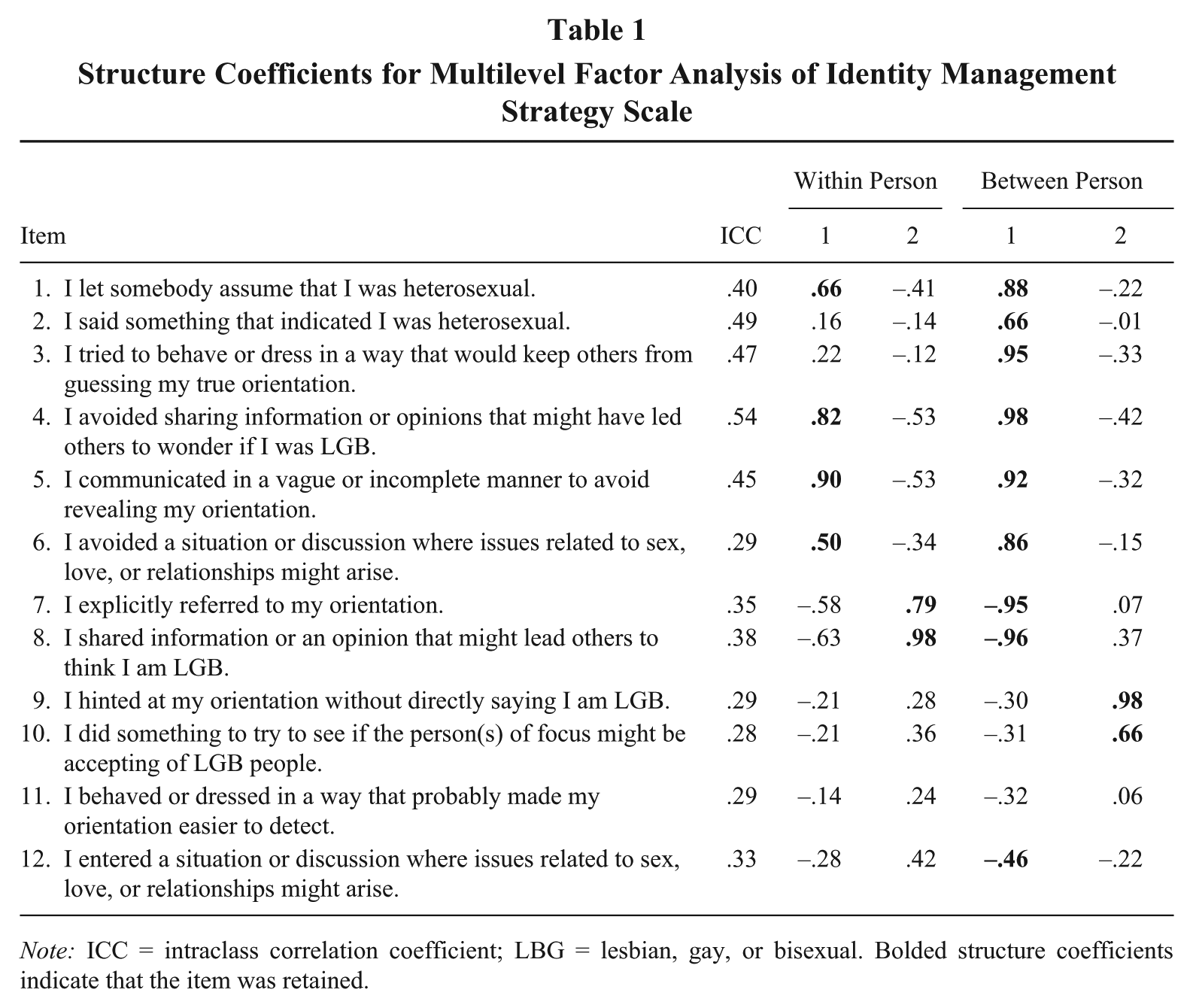
Twelve items were adapted from two instruments designed to assess individual differences in use of a range of identity management strategies (Anderson, Croteau, Chung, & Distefano, 2001 Button, 2001). Items were reworded to reflect the respondent’s behavior in a specific situation rather than the person’s typical behavioral strategies. Participants indicated the degree to which they had used the strategy using a fully anchored 4-point rating scale (1 = not at all to 4 = a lot). Items are listed in Table 1, and development of the identity management subscales is described below.
Structure Coefficients for Multilevel Factor Analysis of Identity Management Strategy Scale
Note: ICC = intraclass correlation coefficient; LBG = lesbian, gay, or bisexual. Bolded structure coefficients indicate that the item was retained.
Characteristics of interaction partners
Participants indicated their interaction partners’ gender (female, male), sexual orientation (LGB, heterosexual, unknown), and organizational position relative to the participant (above direct supervisor, direct supervisor, at same level, direct supervisee, below level but not direct supervisee, coworkers generally, clients). For the purpose of this study, the organizational position variable was simplified into the following categories: higher level, same level, below level, coworkers generally, clients. Because identity management experiences could potentially involve more than one interaction partner, respondents were allowed to use multiple levels of these categorical variables to describe people (e.g., both female and male interaction partners within the same situation).
One item assessed whether the interaction partner(s) knew the participant’s sexual orientation (1 = yes; 2 = no; 3 = some did, some did not). Two items assessed whether the respondent believed his or her interaction partner(s) demonstrated signs of acceptance or rejection of LGB people using a 3-point scale (1 = definitely, 2 = maybe, 3 = definitely not): “Did the person of focus express or imply having positive/negative views about LGB people?” Two dummy variables were created for positive views: one indicating the presence of a “definitely” response, and one indicating the presence of a “maybe” response. One dummy variable was created for negative views to indicate the presence of a response that was either “definitely” or “maybe” because only 12 of 219 situations involved perception of “definitely” homonegative attitudes.
Results
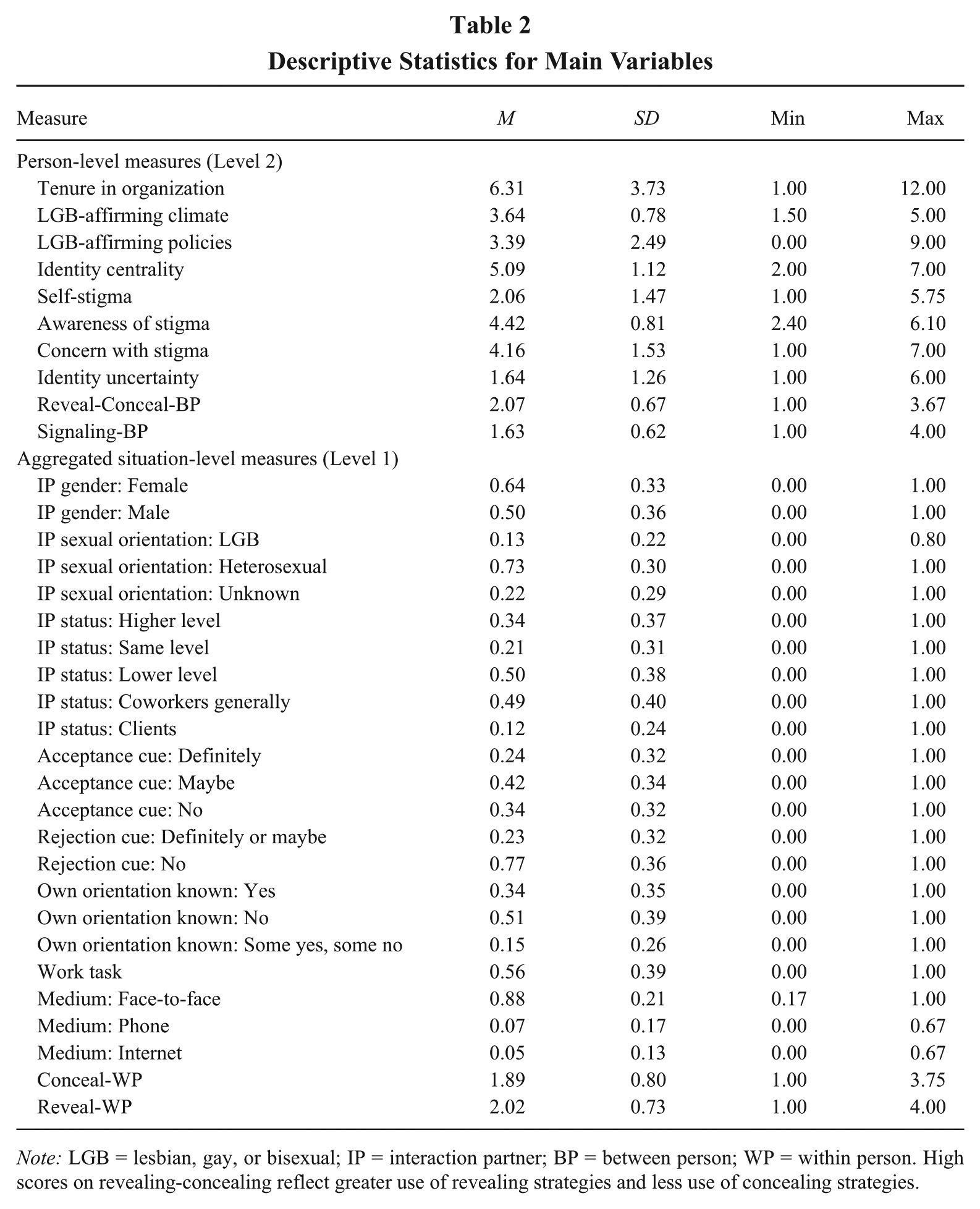
LGB workers in this study reported anywhere from 0 to 13 identity management situations over 3 weeks (median = 3.00, M = 3.59, SD = 3.10, total = 219). Of the 61 participants, 10 reported no situations. Descriptive statistics for all variables are presented in Table 2.
Descriptive Statistics for Main Variables
Note: LGB = lesbian, gay, or bisexual; IP = interaction partner; BP = between person; WP = within person. High scores on revealing-concealing reflect greater use of revealing strategies and less use of concealing strategies.
“How” Do People Manage Their LGB Identities?
How did workers manage their sexual orientation identity over this period of time? Our first step in addressing this question was to investigate the latent dimensions of identity management underlying participants’ responses to the items adapted for this study. We did this using a series of multilevel exploratory factor analyses (B. Muthén, 1991), which allowed for the possibility that the dimensions of identity management differentiating one person from another (between-person level) differ from the dimensions differentiating a person’s identity management from one situation from another (within-person level). In other words, the how of identity management may involve somewhat different constructs at different levels of analysis.
As recommended by Reise, Ventura, Nuechterlein, and Kim (2005), we examined intraclass correlation coefficients (ICCs) for each of the identity management items prior to factor analysis (see Table 1). In the context of this study, an ICC could be interpreted as the proportion of item variance attributable to the person level of analysis. ICCs ranged from .28 (“I did something to try to see if the person(s) of focus might be accepting of LGB people”) to .54 (“I avoided sharing information or opinions that might have led others to wonder if I was LGB”), indicating the presence of item variance at both the within-person and between-person levels of analysis. Only one item had an ICC greater than .50, which suggested that a substantial portion of item variance was explained by differences within persons from situation to situation. This analysis of item variance supported the use of a multilevel factor analysis.
We proceeded to run factor analyses for models with different numbers of within-person and between-person factors, ranging from one to three factors at each level. This analysis was conducted using the robust maximum likelihood estimation capabilities of Mplus software (L. Muthén & Muthén, 2010), as were all subsequent multilevel analyses. Factors were rotated using the oblique geomin method. Models with three factors at the between-person level failed to converge. The fit of the remaining models was evaluated through examination of the root mean square error of approximation (RMSEA), the standardized root mean square residual (SRMR), and the comparative fit index (CFI). Goodness of fit was assessed using the following guidelines for good fit suggested by Hu and Bentler (1999) with respect to covariance structure analysis: RMSEA (≤.06), SRMR (≤.08), and CFI (≥.95). The model with two factors at each level of analysis clearly had the best profile of fit indices: RMSEA = .06, SRMR (within person) = .05, SRMR (between person) = .10, and CFI = .94. Given this favorable profile relative to the other models, along with a clear and interpretable factor structure, we used this model as the basis for conceptualizing and measuring identity management strategies.
Inspection of structure coefficients suggested that the structure and meaning of factors differed at the within-person and between-person levels (see Table 1). At the within-person level, the first factor had the strongest loadings on items describing concealing strategies; the second factor had the strongest loadings on items describing revealing strategies. This pattern of loadings suggested that within-person differences in workplace identity management are best conceptualized in terms of the person’s use of concealing strategies and revealing strategies from situation to situation. Items related to signaling behaviors generally did not have strong loadings on these factors. The correlation between the two factors was –.61. Thus, when a person was concealing more than usual in an identity management situation, the person was less likely than usual to use revealing strategies.
At the between-person level, the first factor had strong positive loadings on items describing concealing strategies and strong negative loadings on items describing revealing strategies. The second factor had the strongest loadings on items describing signaling strategies. This pattern of loadings suggested that differences between workers in identity management are best conceptualized in terms of a person’s typical outness level (on a spectrum ranging from high concealer to high revealer) as well as a person’s typical use of signaling behavior. The correlation between the two factors was .26. Thus, people who were generally not out at work were also somewhat less likely than others to use signaling strategies in the workplace.
To create subscales reflecting this multilevel factor structure, we retained items that had at least one structure coefficient of .40 or greater and differences between the two highest structure coefficients of >.15. At the within-person level, these retention rules led to development of two subscales: the four-item Conceal–Within Person (WP) subscale (α = .80; ICC = .47) and the two-item Reveal-WP subscale (α = .89; ICC = .34). At the between-person level, these retention rules led to development of two subscales (scored by reverse coding items as needed, averaging responses to the subscale-relevant items, and then calculating the average for each person across her or his identity management experiences): the nine-item Reveal–Conceal–Between Person (BP) subscale (α = .91) and the two-item Signal-BP subscale (α = .77). These subscales were named to reflect the interpretation of higher scores (e.g., higher Reveal-WP scores reflect greater use of revealing strategies). Reveal-Conceal-BP was scored so that higher scores reflect a tendency to use revealing strategies more than concealing strategies.
We examined descriptive statistics for these four subscales to gain further insight into how LGB adults manage their sexual orientation identity at work (see Table 2). The mean score for Reveal-Conceal-BP was above the midpoint of possible scores, which suggested that participants were generally more likely to use revealing strategies than concealing strategies. Means for Conceal-WP, Reveal-WP, and Signal-BP were below the midpoint of possible scores, indicating that none of the related identity management strategies was typically used to a noteworthy degree. However, inspection of the minimum and maximum values suggested considerable diversity across participants in typical use of identity management strategies over the course of the study. Indeed, the full range of possible scores was represented for Reveal-WP and Signal-BP, and nearly the full range was represented for Conceal-WP and Reveal-Conceal-BP. In addition to these individual differences in identity management, results suggested that there was substantial diversity in use of identity management strategies within participants from situation to situation. ICCs for Conceal-WP and Reveal-WP were, respectively, .47 and .34, indicating that more than half of the variability in use of these strategies was attributable to differences within workers (and measurement error).
Predictors of Identity Management Strategies
We examined predictors of identity management strategy use, organizing results according to whether the predictors addressed the “who,” “when,” or “where” of identity management. One challenge for data analysis, relative to many other multilevel studies, was the fact that our main outcome variable had a different factor structure at the two levels of analysis. To handle this challenge, different data analytic approaches were used for the within-person and between-person identity management subscales.
Multilevel regression was used to predict scores on the within-person identity management subscales. Each analysis began with a random intercept model, in which the outcome variable was regressed on the situation-level predictor. Situation-level predictors were centered at the person mean, reflecting our focus on within-person variability in the outcomes. A model with random intercepts and slopes was then run to determine whether the within-person association between predictor and outcome varied across participants. This potential variability in situation-level slopes was tested using a deviance test adjusted for the scaled chi-square statistic produced with robust maximum likelihood estimation (Satorra, 2000). A relatively liberal alpha level of .10 was used for each deviance test to maximize the chances of detecting individual differences in links between predictors and identity management. We planned to follow significant deviance tests with models in which each of the three person-level variables was tested as a predictor of the randomly varying intercepts and slopes (tenure, LGB-affirming climate, LGB-affirming policies). However, these models were not tested because none of the deviance tests reached statistical significance.
We used ordinary least squares regression and correlation analyses to examine predictors of between-person identity management scales. Predictors included those assessed at the person level (tenure, LGB-affirming climate, LGB-affirming policies) as well as aggregated versions of the situation-level variables (e.g., percentage of situations involving supervisors). Regression analysis was used for predictors that were dummy coded at the situation level (e.g., interaction medium). Correlation analysis was used with predictors that were dichotomous or continuous at the situation level.
To whom?
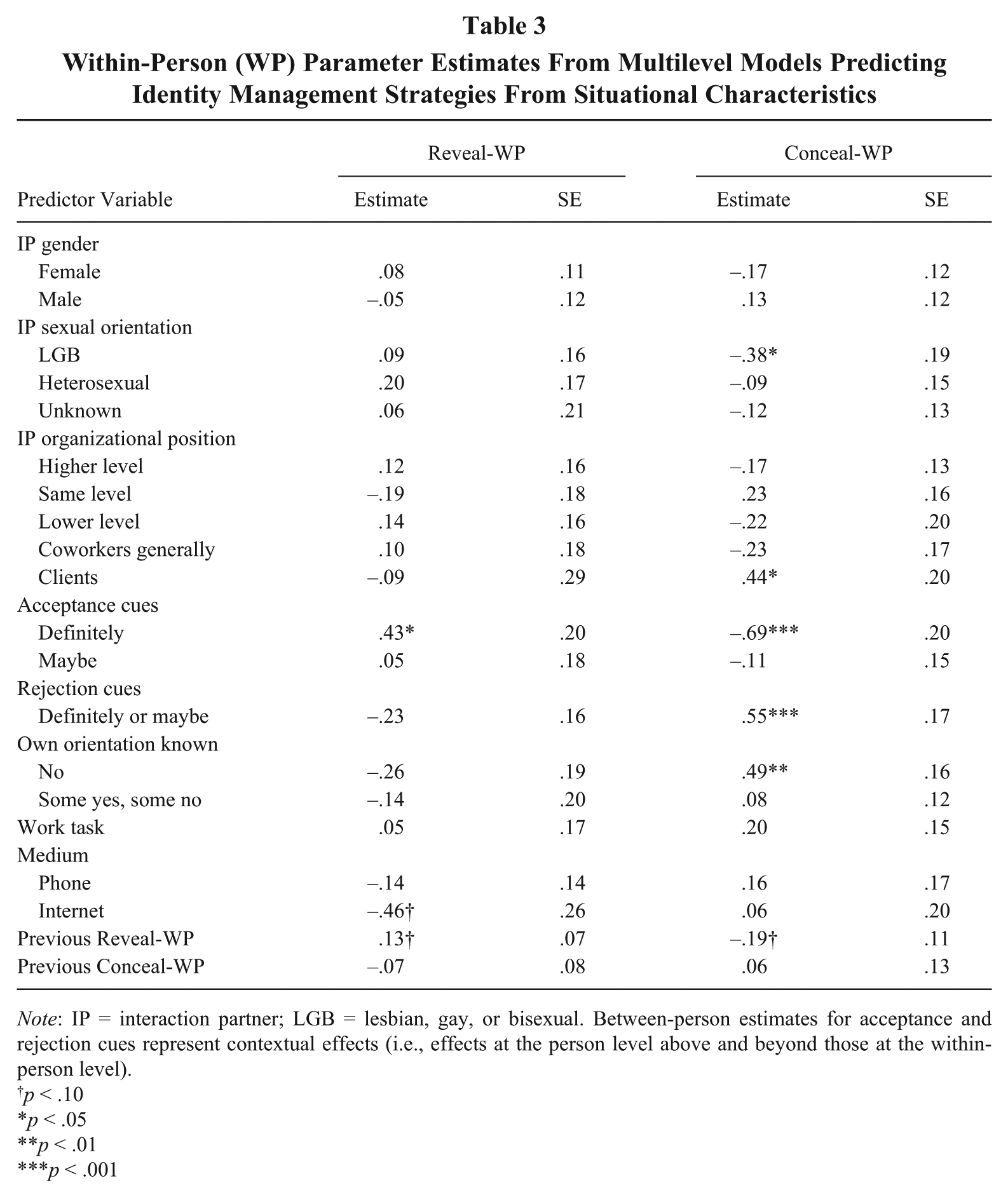
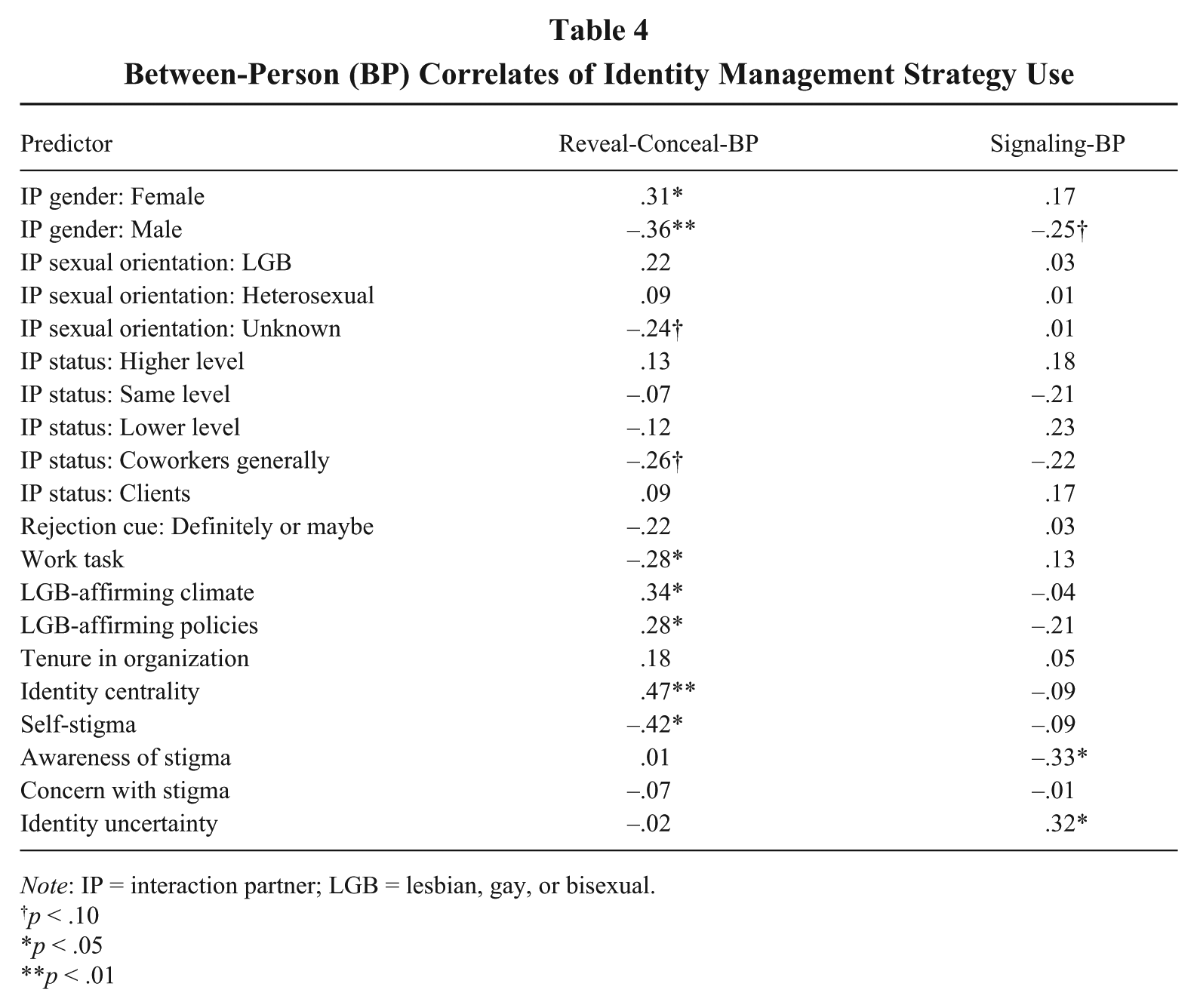
The characteristics of focus in this set of analyses included the gender, sexual orientation, and organizational position of interaction partners as well as acceptance and rejection cues and prior knowledge of the target’s sexual orientation. Results for the gender of the interaction partner were null at the within-person level (see Table 3 for these and all within-person results). At the between-person level, Reveal-Conceal-BP was positively associated with percentage of situations involving female interaction partners and negatively associated with percentage of situations involving male partners (see Table 4). Thus, the participants who, over the course of the study, most used revealing strategies and least used concealing strategies had identity management situations typically involving female interaction partners and not male partners. A marginally significant negative association was found between percentage of situations involving male partners and Signaling-BP, suggesting that LGB workers may also generally be less likely to use signaling strategies with male interaction partners.
Within-Person (WP) Parameter Estimates From Multilevel Models Predicting Identity Management Strategies From Situational Characteristics
Note: IP = interaction partner; LGB = lesbian, gay, or bisexual. Between-person estimates for acceptance and rejection cues represent contextual effects (i.e., effects at the person level above and beyond those at the within-person level).
p < .10
p < .05
p < .01
p < .001
Between-Person (BP) Correlates of Identity Management Strategy Use
Note: IP = interaction partner; LGB = lesbian, gay, or bisexual.
p < .10
p < .05
p < .01
One statistically significant result emerged for the sexual orientation of the interaction partner at the within-person level: Relative to participants’ typical use of concealing strategies, participants were less likely to conceal when their interaction partner was known to be LGB. None of the between-person associations was significant at the .05 level, although a marginally significant negative correlation was found between Reveal-Conceal-BP and percentage of situations involving partners of unknown sexual orientation (see Table 4).
Interaction partners’ cues of acceptance and rejection were linked with identity management at both levels of analysis. Within-person analyses indicated that participants were more likely than usual to use revealing strategies when partners demonstrated behavior interpreted as clear acceptance cues. Acceptance cues were negatively associated with use of concealing strategies. Conversely, cues viewed as possible or clear signs of rejection were positively associated with more-than-typical use of concealing strategies. At the between-person level, acceptance cues were related to Reveal-Conceal-BP. Specifically, participants who had the highest levels of revealing behavior and lowest levels of concealing behavior had a higher percentage of identity management situations involving clear acceptance cues, B(48) = 1.28, p < .001; no such finding emerged for ambiguous acceptance cues, B(48) = 0.39, p = .138. A marginally significant association was found between acceptance cues and Signaling-BP: Participants who most often used signaling behavior had a higher percentage of situations involving possible acceptance cues, B(48) = 0.52, p = .065. No effect on signaling behavior was found for clear acceptance cues, B(48) = 0.13, p = .668. Moreover, at the between-person level, rejection cues were not associated with identity management (see Table 4).
Identity management strategy was predicted by interaction partners’ knowledge of the participant’s sexual orientation at both levels of analysis. At the within-person level, participants were more likely than usual to use concealing strategies when interacting with someone who did not know the participant’s sexual orientation. At the between-person level, participants who were most likely to conceal and least likely to reveal tended to have situations in which the participant’s sexual orientation was unknown by all partners, B(48) = −1.49, p < .001, or some partners, B(48) = −0.65, p = .016. In contrast, knowledge of the participant’s sexual orientation was unrelated to signaling behavior, F(2, 48) = 0.55, p = .579.
Results for the organizational position of the interaction partner differed according to level of analysis. At the within-person level, one association was found: Participants were more likely than usual to use concealing strategies when interacting with clients. At the between-person level, no effects were found at the .05 level. However, at the .10 level, the participants who most often concealed and least often revealed tended to have identity management situations involving “workers in general” (see Table 4).
Together, these findings suggest that demographic characteristics, such as gender and organizational position, have little influence on the situation-level identity management decisions of LGB people. The constructs more closely related to anticipated reactions to a LGB identity—such as acceptance and rejection cues and prior knowledge of the identity—did impact situation-specific decisions to engage in concealing (and to a lesser extent, revealing) behaviors. In the aggregate, however, interaction partners’ gender did impact average tendencies toward revealing.
When?
The variables of focus in considering when identity management occurs were previous identity management behaviors and organizational tenure. At the within-person level, revealing and concealing were not predicted at the .05 level by amount of revealing and concealing in the previous identity management situation. However, at the .10 level, amount of revealing in the previous situation was positively related to current revealing and negatively related to current concealing. Tenure in the organization was not associated with identity management strategy (see Table 4).
Where?
The environmental characteristics analyzed included work versus nonwork tasks, medium of communication, perceived climate, and supportive policies. Strategy use was predicted by whether the situation occurred in the context of a work-related task but only at the between-person level. Specifically, participants who most concealed and least revealed tended to have situations occurring during work tasks (see Table 4).
The medium through which the interaction occurred was unrelated to identity management at the .05 level, although there were marginally significant results at both levels of analysis. At the within-person level, participants were less likely than usual to use revealing strategies when the situation occurred through the Internet than face-to-face. At the between-person level, participants who most revealed and least concealed tended to have a higher percentage of situations occurring through the Internet, B(48) = 1.24, p = .089; no such effect was found for situations occurring by phone, B(48) = 0.16, p = .772.
Climate and policies were investigated at the between-person level only because they are both person-level variables. People who most used revealing strategies and least used concealing strategies were more likely than others to perceive as LGB affirming their organization’s climate and policies (see Table 4). When Reveal-Conceal-BP was regressed on both of these organizational predictors, neither predictor remained statistically significant at the .05 level. The regression coefficient for climate, however, was marginally significant (B = 0.24, p = .097).
Who?
Tendency to use revealing versus concealing strategies over the study was negatively associated with identity centrality and positively associated with self-stigma but not associated with awareness of the potential for stigmatization, concern with the potential for stigmatization, or identity uncertainty (see Table 4). When the significant predictors were entered simultaneously into an ordinary least squares regression, both identity centrality (B = 0.22, p = .007) and self-stigma (B = −0.13, p = .031) remained statistically significant at the .05 level.
Tendency to use signaling strategies over the 3 weeks of the study was negatively associated with awareness of the potential for stigmatization and positively associated with identity uncertainty but not associated with identity centrality, self-stigma, or concern with potential for stigmatization (see Table 4). When the significant predictors were entered simultaneously into an ordinary least squares regression, both awareness of stigmatization potential (B = −0.28, p = .006) and identity uncertainty (B = 0.18, p = .007) remained statistically significant at the .05 level.
Discussion
Identity management is a significant concern differentiating LGB workers from their heterosexual counterparts (Clair et al., 2005); however, previous research has relied on one-time, retrospective reports regarding typical use of identity management strategies. The experience sampling methods used in the present study yielded rich exploratory data on LGB identity management situations shortly after they occurred over multiple weeks, offering insights regarding the frequency and characteristics of these situations, variability in individual workers’ use of identity management strategies, contextual and person-level correlates of strategy use, and differences in identity management processes at the within-person and between-person levels. Overall, the current findings demonstrate that characteristics of persons and situations, but not their interactions, are linked with decisions about identity management. We briefly describe the primary results and their theoretical and practical implications.
On average, these workers encountered 3.6 identity management experiences in a 3-week period. The number of such experiences varied widely among participants: Over 16% reported no identity management situations, whereas 1 participant reported 13. Among those who reported on experiences, strategy use varied at least as much from situation to situation as from person to person. Providing evidence toward Goffman’s question of “how” stigmatized individuals manage their identities, the factor structure of identity management behaviors differed at the level of the situation and at the level of the person—whereas situational forms of identity management could be understood by separate behaviors pertaining to concealing and revealing, person-level identity management involved a bipolar revealing-concealing factor and a signaling factor. The mean levels of these scales suggest that participants were generally more likely to use revealing strategies than concealing strategies. Moreover, the fact that nearly the full range of scores was represented suggests substantial diversity across participants in their reports of identity management strategies. We considered predictors of these identity management behaviors—within situations and across individuals—with the goal of understanding to whom, when, and where these strategies were enacted.
Situation-Level Findings
Analyses at the level of the situation investigated predictors of within-person variation in identity management (i.e., the extent to which a person’s identity management strategy in a given situation differed from her or his typical strategy) Findings indicated that workers were less likely than usual to use concealing behaviors when interaction partners were LGB or provided definite cues of their acceptance of LGB people. Concealing strategies were used at higher-than-typical levels, however, in situations when interaction partners were clients, did not previously know about an LGB identity, or provided any indication that they might reject LGB people. At the within-person level, the only situational characteristic that was significantly related to revealing behavior was definite cues of acceptance. This means that interaction partners’ gender and hierarchical position did not affect the likelihood of revealing in a particular situation (relative to the participant’s typical level of revealing in the study). In addition, identity management did not seem to vary depending on whether or not the situation was directly related to a work task. The overall pattern of findings suggests that, at the within-person level, situational characteristics were more predictive of concealing strategies than revealing strategies. This suggests that substantial within-person variability (ICC = .36) in revealing behavior cannot be explained by the characteristics situations that were considered here. In addition, the overall configuration of results suggests that decisions to conceal and reveal one’s LGB identity had little to do with when or where and more to do with whether the person to whom they are disclosing is likely to be supportive.
These results show that the same person will make different identity management decisions depending on the specific people with whom he or she is interacting. In this sense, the study provides clear support for the view that disclosure cannot be simplified as a one-time decision about whether to come out of the closet (Button, 2001; Chrobot-Mason et al., 2001). Disclosure decisions should be conceptualized as part of an ongoing stigma management process of attending to situational cues and specific behavioral responses rather than as an “out” or “not out” characteristic of a person. Moreover, the different pattern of results for the within-person measures of concealing and revealing behavior underscore the potential importance of viewing these variables as distinct behavioral strategies rather than the two ends of a unidimensional construct.
In sum, the within-person analyses suggest that individuals who possess a concealable stigmatized identity engage in distinct behavioral patterns as a function of particular situational attributes. The results show that the episodic behavior of LGB people is affected by their perceptions of interaction partners that directly relate to their likely reactions to their LGB status. In addition, consideration of patterns of effects between people also yields important conclusions about more general patterns.
Person-Level Findings
Analyses at the person level investigated predictors of individual differences in identity management; some predictors were aggregated contextual variables (reflecting aspects of situations consistent throughout the study), and some were person-level variables assessed prior to the experience-sampling phase. Interestingly, some of the contextual features that were unrelated to identity management at the situation level did predict person-level differences in identity management. For example, LGB workers whose identity management experiences tended to include women (and not men) were generally more likely to use revealing behaviors. In addition, participants who most often revealed were more likely than others to report identity management experiences in non-work-related interactions and in organizations perceived to have affirming policies and climate.
Dimensions of LGB identity predicted subsequent identity management behavior, consistent with Clair et al.’s (2005) proposition that disclosure decisions are influenced by individual differences in adaptation to stigma. Between-person differences in identity centrality and self-stigma emerged as robust predictors of tendency to reveal versus conceal, even controlling for identity uncertainty, awareness of stigma, and concern with stigma. It seems possible that some of the disclosure-related motives discussed by Clair et al., such as motives to establish close relationships and promote a sense of self-coherence, may underlie the finding for identity centrality. If one’s LGB identity is experienced as an important part of the self, then it makes sense that disclosing one’s identity could help to increase a sense of closeness and self-integration. Using similar reasoning, the motive to view oneself and to be viewed in a positive light may decrease the likelihood of disclosure among LGB workers high in self-stigma. Such workers view their sexual orientation as a personal shortcoming and thus may conceal this characteristic in an effort to keep the focus on what they view as their more admirable qualities.
A different pattern emerged for signaling behaviors—which involve “testing the waters” or seeking information about likely acceptance—for which awareness of stigma and identity uncertainty (but not identity centrality, self-stigma, or concern with stigma) were robust predictors. LGB workers who expect to be stigmatized for their sexual orientation may see little value in signaling, given their tendency to believe that acceptance is often unlikely. In this sense, stigma consciousness may lead workers to foreclose on a process of identity-related exploration in the workplace, which could have implications for longer-term work adjustment. In contrast, participants who were unsure of their sexual orientation were more likely than others to use signaling behavior. We speculate that this finding may be related to the fact that identity uncertainty has been found to be inversely related to time in the LGB identity development process (Mohr & Kendra, 2011). LGB workers who are in the earlier phases of identity formation may not only be unsure of their sexual identity but may also have less experience and confidence coming out directly to others and less of an LGB-affirming support network. Thus, individuals high in identity uncertainty may use signaling as a general strategy for identifying potential support without using the types of direct disclosure behaviors that may feel overly risky. Finding that determinants of signaling behavior patterns are quite separate from those of revealing underscores the importance of considering signaling as a separate aspect of identity management (see also Jones et al., 2013).
Themes Across Levels
Comparison of findings for the two levels of analysis highlights ways that stable and dynamic situational characteristics may engender similar identity management processes in some cases but very different processes at other times. For example, clear acceptance cues (indicated in more than half of situations) encouraged revealing at within- and between-person levels. This suggests that when in a particular situation (or in situations generally) in which partners’ acceptance is clearly communicated, LGB workers often choose to share their sexual orientation. It seems that signs of possible rejection affect identity management as they nonsystematically cross a person’s path. When considered at the between-person level, both ambiguous and obvious acceptance cues were associated with greater tendencies toward revealing. It is also possible that there are person- or organization-level factors that may increase a person’s awareness of ambiguous cues that, in turn, increase a person’s general propensity to reveal. Another noteworthy difference at the two levels of analysis was that ambiguous and clear signs of rejection within (but not between) situations were associated with more concealing. While acceptance cues seem to exert a cumulative influence on identity management strategies, the effects of rejection cues on identity management may be more confined to specific situations. These findings could be explained by differences in attributions; whereas rejection may be attributed to individual actors, acceptance may be attributed both to specific actors and globally to the environment as a whole.
A systematic comparison of results from the two levels of analysis indicates that findings were the most similar for two variables: interaction partner’s acceptance cues and interaction partner’s knowledge of the participant’s sexual orientation. Compared to the other situational variables, these variables appear to offer the highest level of information directly germane to identity management decisions. Perhaps it is for this reason that they relate to identity management behavior similarly across levels; identity management may be determined most directly by information that directly pertains to expectations of positive reactions rather than inferences based on proxy characteristics, such as gender. One interpretation of this pattern of results is that allies can be any gender, sexual orientation, or position in the status hierarchy. Supportive supervisors and other allies might simply need to consciously and continuously look for opportunities to communicate their acceptance of LGB people.
We further anticipated that organizational support for LGBT workers in the form of both policies and supportive climate would be related to more revealing and signaling at the between-person level. The results show that, consistent with previous findings (e.g., Huffman et al., 2008), organizational policies and perceptions of a supportive LGB climate promoted general revealing tendencies. Indeed, from a practical perspective, the current results suggest that global indicators of employees’ positive interpersonal experiences in the workplace are likely enhanced through supportive organizational climates. In other words, the average level of LGB workers’ positive interactions with supportive coworkers increases with supportive culture. This confirms previous studies that have shown positive effects of organizational efforts to support LGB people (e.g., Griffith & Hebl, 2002; Ragins & Cornwell, 2001) and extends their findings on outcomes, such as job stress and satisfaction, to include the quality of interpersonal interactions.
However, the findings also suggest that such support may be insufficient in overcoming the potential consequences of unsupportive members of the organization. Even when organizations as a whole are supportive of LGB people, LGB workers encounter individuals who are not supportive and engage in defensive identity management tactics. This points to the importance of matching top-down organizational efforts with programs, such as diversity training (Madera, King, & Hebl, 2013), that change individual behaviors or behavioral norms. Managers who strive to create LGB-inclusive cultures cannot assume that general supportiveness will be reflected in uniformly positive experiences. Managers must be attuned to not only the more macro questions of climate or culture but also the more micro everyday experiences in which rejection cues are encountered. LGB people, and people with stigmatized identities more generally, will likely face identity management challenges until social norms of support are clarified and strengthened at the individual level.
The notion that organizational factors cannot negate the impact of individual employees is further bolstered by the lack of evidence of cross-level interactions; neither perceived organizational support nor policies (nor any other situational factor) influenced the magnitude or direction of situational effects on identity management. One explanation for this pattern of findings is that the factors that emerged as important determinants of identity management within situations—whether an interaction partner was LGB, a client, and likely to accept LGB people—were more immediate features of situations than distant contextual characteristics. These features that center around to whom identity management behavior is directed seem to matter across contexts.
To date, empirical research on identity management has relied entirely on cross-sectional, global assessments and focused on between-person differences in strategies. By exploring these experiences as they unfold in daily interactions, the current research points to new conclusions. Together, the results suggest that decisions to conceal an invisible stigma are affected by characteristics of both the person and the situation. Interestingly, and in apparent contradiction to an interactionist perspective, there was no evidence that individual differences moderated the effects of situational characteristics. Thus, this unique evidence highlights the importance of examining concealable stigma management and behavior more broadly as it relates to variability both within and between individuals.
Limitations and Future Research Directions
The strength of this research—its focus on identity management episodes as they occur in real work environments—also allows for several potential weaknesses that should be addressed in future research. One limitation of this study is that we cannot directly assess the causal relations among variables. Because event-based measures were completed at the same time within each episode, it is reasonable to question whether the patterns of relations could be reversed. This concern is partially mitigated for person-level variables, which were assessed prior to the interaction-based surveys. Nevertheless, additional efforts to explore the antecedents, mediators, and consequences of identity management over time would contribute to our understanding of how these processes unfold dynamically (see Hebl & Dovidio, 2005).
Another limitation of experience-sampling methodology is that it is possible that asking participants to reflect on times in which they made decisions about whether to conceal or reveal their sexual orientation actually caused participants to be more aware of these experiences. In other words, the study may prime participants to attend to specific cues, and thus participants’ responses may reflect reactions to the study rather than their genuine experience (Scollon, Kim-Prieto, & Diener, 2003). In the case of identity management, there is simply no way to know what LGB people are thinking without asking them explicitly. While reactivity is a possible factor in between-person differences, such as the frequency of experiences reported, it is unlikely to have caused the particular patterns of within-person effects given that these essentially control for between-person differences in factors such as reactivity. In addition, the fact that some individuals reported zero identity management experiences suggests that reactivity did not necessarily result in inflated reports.
Indeed, the fact that only a small sample of individuals reported more than a few instances of identity management could itself raise additional concerns pertaining to the power of our design, the outness of participants, and the consciousness of identity management processes. The statistical power of the inferential statistics reported here is inherently constrained by the number of identity management experiences that participants reported. It is possible that some effects (and cross-level interactions) would have emerged as significant predictors of identity management with a larger sample size. It is also possible that people who agreed to participate in this research were generally more “out” and thus less likely to experience identity management concerns than people who are “closeted.” To determine the range of overall outness in our sample, we asked respondents to indicate their degree of outness to people (e.g., coworkers, supervisors) at work. The mean was 4.15 in our full sample of 61 people, which is the midpoint of possible scores on a 7-point scale. Nearly the full range of possible scores was represented (1.00 to 6.67), and there was virtually no skew (–0.25). Approximately 37% of the sample had scores of at least 5.00, which indicated that a person at work was aware of their LGB identity. These statistics suggest that the sample was somewhat diverse in outness at work, thereby reducing concerns about its representativeness. However, the current data cannot address the final concern pertaining to the small sample of identity management experiences—it may be that concerns about revealing or concealing an LGB identity occur outside of explicit or conscious awareness. We could not capture here the—potentially much more common—thoughts and anxieties that were not labeled and attributed to concerns about revealing a stigmatized identity. Given these questions, additional research that replicates these new findings and integrates less explicit methodologies would be useful in understanding the stability and generalizability of the findings.
Conclusion
The current findings shed new light on Goffman’s (1963) original questions regarding the complexity of stigmatized identity management. Examination of identity management episodes shows substantial within-person variability: LGB workers’ strategies vary from situation to situation. Indeed, LGB workers reveal, conceal, and signal their sexual orientation as a function of the anticipated reactions of the people with whom they are interacting. Disclosure dilemmas cannot be seen as one-time, yes-or-no decisions (Ragins, 2004) but, rather, involve ongoing, episodic, strategic behavioral responses to situational cues. As a whole, this study describes unique challenges of individuals with concealable stigmatized identities and points to important person- and situation-level predictors of identity management behaviors as they occur in the workplace.
Footnotes
Acknowledgements
This article was accepted under the editorship of Deborah E. Rupp. This research was supported by a Placek Research Grant from the American Psychological Foundation of the American Psychological Association to George Mason University. We appreciate the time and effort of participants and thank the reviewers and action editor for their helpful feedback in revising this manuscript. Please note that the first and second authors contributed equally to this manuscript and author order was determined alphabetically.