






Abstract
We present and test a self-consistency theory framework for gossip: that perceived negative workplace gossip influences our self-perceptions and, in turn, this influences our behaviors. Using supervisor-subordinate dyadic time-lagged data (n = 403), we demonstrated that perceived negative workplace gossip adversely influenced target employees’ organization-based self-esteem, which, in turn, influenced their citizenship behavior directed at the organization and at its members. Moreover, by integrating victimization theory into our framework, we further demonstrated that negative affectivity, an individual’s dispositional tendency, not only moderated the self-consistency process but also predicted perceived negative workplace gossip. Our study therefore shifts attention to the target of negative workplace gossip and in doing so offers a promising new direction for future research. Implications to theory and practice are discussed.
Keywords
Introduction
Gossip is a naturally occurring social phenomenon that has been shown to affect the hearts, minds, and deeds (affect, cognition, and behavior) of individuals (Baumeister, Zhang, & Vohs, 2004; Beersma & Van Kleef, 2012). Its influence has been explored from different perspectives, including philosophy, anthropology, linguistics, psychology, biology, and the organizational sciences (Dunbar, 2004; Kniffin & Wilson, 2010; Noon & Delbridge, 1993; for a review, see Foster, 2004). Understanding its implications to organizations is important because individuals devote approximately 65% of their time to discussing social topics (Dunbar) and up to two-thirds of all conversations refer to third parties (Emler, 1994). Yet much of what we know about gossip in the organizational sciences is either theoretical (Kurland & Pelled, 2000), inferred from related literatures (e.g., social mistreatment; Duffy, Ganster, & Pagon, 2002; Kulik, Bainbridge, & Cregan, 2008) or other fields (e.g., social anthropology; Kniffin & Wilson, 2010), or confined to gossip’s antecedents and functions (Grosser, Lopez-Kidwell, Labianca, & Ellwardt, 2012; Kniffin & Wilson, 2005, 2010) and its impact on the gossiper (Farley, Timme, & Hart, 2010; Grosser, Lopez-Kidwell, & Labianca, 2010; Waddington & Fletcher, 2005).
Despite considerable progress, scholarly work on gossip in organizations remains incomplete, particularly the effects of perceived negative workplace gossip on the target’s work-related behaviors (Mills, 2010; van Iterson & Clegg, 2008). Scholars have urged greater attention to the effects of negative gossip (Baumeister et al., 2004; Dunbar, 2004), but to our knowledge, few studies have examined negative workplace gossip from the target’s perspective (with the exception of target characteristics; see Ellwardt, Labianca, & Wittek, 2012, and Ellwardt, Wittek, & Wielers, 2012). Indeed, we know little about how the perception of being targeted by negative workplace gossip will influence one’s work-related behaviors and, specifically, the process through which perceived negative workplace gossip might influence organizational citizenship behavior (OCB). Such research is of significance not only because gossip is a prevalent type of informal communication that is likely to play a central role in employees’ work life but also because in its negative form, a form argued to be more widespread and to have more pronounced effects than positive gossip (Baumeister, Bratslavsky, Finkenauer, & Vohs, 2001), it represents a unique type of social mistreatment that may influence targets’ work attitudes and behaviors (Grosser et al., 2010; Kurland & Pelled, 2000). A more specific understanding of negative gossip’s effects on target behavior is therefore needed if organizations are to better promote desirable work-related behaviors, such as OCB.
One possible reason that the literature on workplace gossip is being held back is that it lacks a theoretical framework. Given that perceived negative workplace gossip represents essentially believing that other members of an organization view you negatively, this suggests that it may be particularly detrimental to an individual’s self-esteem at work (Korman, 1970; Leary, Tambor, Terdal, & Downs, 1995). Thus, a self-consistency theory framework (Korman) may be useful for understanding the effects of perceived negative workplace gossip. In particular, a self-consistency theory framework suggests that as our self-esteem in a domain varies, so too does our behavior, that is, we try to behave consistent with our self-perceptions. To the extent that perceived negative workplace gossip influences our self-perceptions, it should also affect our behavior.
The purpose of our study is to test this framework for gossip: that perceived negative workplace gossip influences our self-perceptions and, in turn, this influences our behaviors. Following Ajzen and Fishbein’s (1977) exhortation to align measures, given that negative workplace gossip is organizational, we therefore examined organizational self-perceptions (organization-based self-esteem, OBSE) and OCB. Incorporating gossip within a self-consistency theory framework is generative in terms of helping us understand the process (OBSE) through which gossip influences OCB. However, we also sought to contribute to the self-consistency theory literature by outlining a moderator of the process. In particular, integrating work on victimization (e.g., Aquino & Thau, 2009), as being targeted by negative workplace gossip is similar to being a victim (Ellwardt, Labianca, & Wittek, 2012), we argue that a target’s dispositional tendency to experience aversive and negative emotional states, negative affectivity, is likely to moderate the self-consistency theory process (Watson & Clark, 1984), such that the effects of perceived negative workplace gossip may have a disproportionate impact. Moreover, because high negative affectivity individuals may be more likely to be the targets of negative gossip as well as to perceive negative gossip, we further suggest that negative affectivity is likely to predict perceived negative workplace gossip. The conceptual framework we propose and test is depicted in Figure 1.
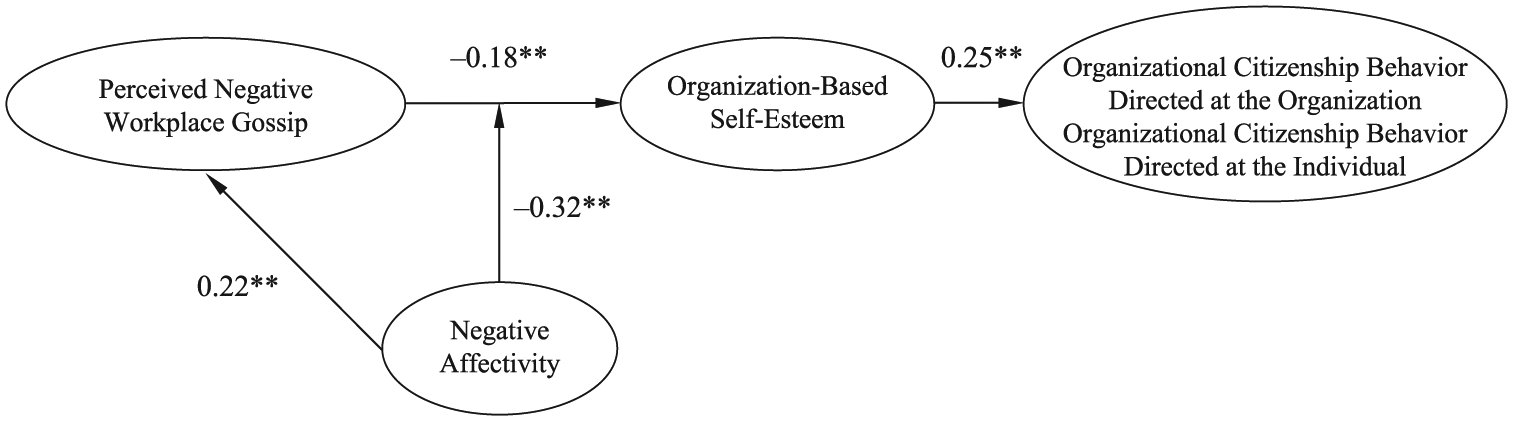
Conceptual Framework
Our study contributes to the literature in several ways. First, by incorporating gossip within a self-consistency theory framework, we improve understanding of the process (OBSE) through which perceived negative workplace gossip influences targets’ OCB, a link that has yet to be established by prior research. Second, we outline a moderator of the self-consistency theory process (negative affectivity), an omission from the literature that has restricted our understanding of the mitigating and exacerbating conditions of perceived negative workplace gossip. Third, we provide a new direction for gossip research. Whereas progress has been made toward understanding the psychological and attitudinal outcomes of workplace gossip on the gossiper (e.g., Farley et al., 2010; Waddington & Fletcher, 2005), our study shifts attention to the target and in doing so demonstrates that one possible behavioral response of a target to perceived negative workplace gossip may be to withhold OCB. Fourth, by demonstrating the effects of a specific type of informal communication and social mistreatment (i.e., negative workplace gossip), we advance these literatures. Lastly, we offer insights into the Asian context.
Theory and Hypotheses
Defining Workplace Gossip
Workplace gossip occurs when one organizational member (the gossiper) engages in informal and evaluative communication with another member(s) (the gossip recipient) about an absent third member (the target; Foss, 2004; Kurland & Pelled, 2000). Considered a type of behavior (personal and social; Haften, 2004), gossip can be either positive (e.g., discussing a coworker’s accomplishments) or negative (e.g., discussing a coworker’s poor performance; Fine & Rosnow, 1978). Moreover, because a gossip episode involves interpersonal interactions and at least three parties (i.e., the gossiper, the gossip recipient, and the target), it can be viewed as a relational (Grosser et al., 2010) or group (Ellwardt, Labianca, & Wittek, 2012) process as opposed to simply a sender-receiver dyad.
To qualify as workplace gossip, the gossip should (a) be targeted towards individuals (vs. events or circumstances), (b) be evaluative in nature, (c) occur in a social setting (e.g., organization) in which the target is known to both the gossiper and the gossip recipient(s), and (d) be disseminated in the absence of the target, making it difficult if not impossible for the target to identify its source (Foss, 2004; Kurland & Pelled, 2000). Informal communication about a potential organizational downsizing (an event) or about the birth of a colleague’s baby (not evaluative) or bad news about a celebrity (not personally known to the gossiper or the gossip recipient) would not constitute workplace gossip.
Attention in prior research has mainly been devoted to workplace gossip’s antecedents, functions, and consequences on the gossiper. For example, attempts have been made to understand its antecedents, such as who is more likely to gossip, why (motives) individuals gossip, and when gossip occurs. Studies have shown that frequent gossipers possess a greater need to exert control over others (Farley et al., 2010), and the propensity to gossip negatively is negatively related to affective trust and friendship ties (Grosser et al., 2010). Gossip has also been shown to facilitate information sharing (e.g., during periods of uncertainty and organizational change; Mills, 2010), preserve group solidarity, and control self-serving behavior (e.g., to enforce group norms; Grosser et al., 2012; Kniffin & Wilson, 2005), among other functions. Research on its consequences has primarily investigated the impact of gossiping on the gossiper, which can be either beneficial (e.g., help the gossiper to express emotion, thereby relieving stress; Waddington & Fletcher, 2005) or detrimental (e.g., frequent gossipers have been found to be associated with lower supervisor-rated performance, Grosser et al., 2010, and may possess greater behavioral problems, such as being disrespectful and unreliable, Loughry & Tosi, 2008). Gossip may also produce interorganizational power dynamics (van Iterson & Clegg, 2008) and cause work disruptions (Powell, 2001).
Understanding Negative Workplace Gossip
Negative workplace gossip is a distinct sociopsychological construct that differs from other types of informal communication and social mistreatment. First, it is negative, evaluative, and directed at an organizational member (the target), and the exchange of information between the gossiper and the gossip recipient(s) typically occurs in a private context (Kurland & Pelled, 2000; Mills, 2010; Noon & Delbridge, 1993). This is different from other types of informal communication (e.g., chitchat, social talk), which are often entertainment oriented, nonintentional, less evaluative, and not necessarily personally focused and may operate in the public sphere (Haften, 2004). Second, it is covert and indirect in nature, occurring in the absence of the target. This is different from other forms of social mistreatment (e.g., social undermining, bullying, and abusive or aggressive behaviors), which typically include both overt and covert behaviors (Duffy et al., 2002). In this sense, negative workplace gossip can be viewed as a form of indirect attack, aggression (Beersma & Van Kleef, 2012), or victimization (Ellwardt, Labianca, & Wittek, 2012) that is likely to provoke moral and judgmental responses (Noon & Delbridge). Unlike direct forms of informal communication and social mistreatment, because it may not be possible for the target to identify the source of the gossip or to verify its content, gossip often precludes confrontation and is susceptible to greater uncertainty (for conceptual distinctions, see Hershcovis, 2011).
Perceived Negative Workplace Gossip and OCB
While there has been a good deal of work describing gossip, to date, there has been no theoretical perspective provided for understanding negative gossip’s effects on targets in the workplace and, in particular, how the perception of being targeted by such gossip might influence one’s OCB. We propose that self-consistency theory (Korman, 1970) is a logical framework for understanding the effects of perceived negative workplace gossip on target behavior. Our interest in negative workplace gossip in part stems from the fact that negative gossip has been shown to be more prevalent and to have more pronounced effects than positive gossip (Grosser et al., 2010; Kurland & Pelled, 2000). Moreover, we investigated perceptions because perceiving oneself to be the target of negative workplace gossip is largely a subjective process (Aquino & Thau, 2009), an approach similar to Chandra and Robinson (2010) and consistent with prior research on workplace victimization (Aquino & Bradfield, 2000). The salience and implications of individual perceptions are widely recognized in the organizational sciences (e.g., Holtz & Harold, 2013).
Building on cognitive consistency or balance theories (Festinger, 1957; Heider, 1958), self-consistency theory suggests that in order to maintain cognitive consistency between attitudes and behaviors, individuals are motivated to engage in behavior consistent with their overall self-views (Korman, 1970). According to Korman (32), individuals’ behavioral responses are strongly affected by the desire to maintain a consistent cognition toward self-image. That is, in order to preserve stable self-views (Swann, Stein-Seroussi, & Giesler, 1992), high self-esteem individuals generally behave in ways that maintain their positive self-views (self-enhancement strategies), whereas low self-esteem individuals generally behave in ways that maintain their negative self-views (avoidance or self-protective strategies; Crocker & Park, 2004). Such strivings are thought to bring about “stability to people’s lives, rendering their experiences more coherent, orderly, and comprehensible than they would be otherwise” (Swann, 2012: 36). Thinking and behaving in ways that perpetuate one’s conceptions of self (e.g., maintaining negative self-views) aids with prediction and control of perception (Swann et al., 1992). Doing so also protects one’s self-esteem from further erosion that could result from uncertainty and unfamiliarity (Leary et al., 1995) because individuals’ “thought processes are structured so that confirmatory information seems especially trustworthy, diagnostic, and accurate” (Swann, Griffin, Predmore, & Gaines, 1987: 881). Theoretically, individuals strive to maintain self-verifications because of potential psychological benefits. For example, individuals with low self-esteem desire to maintain negative self-views because “negative but self-verifying evaluation has the virtue of holding anxiety at bay” (Swann: 36).
Given that self-consistency theory is about acting in a manner that is consistent with our self-perceptions, this suggests that to the extent gossip can influence our self-perceptions, it will also influence our behavior. Self-perceptions in themselves are highly influenced by our social standing. This notion is central to the looking-glass argument (Cooley, 1902/1956) and, more recently, sociometer theory (Leary et al., 1995), whereby individuals construct images of themselves on the basis of how they believe others view them. The image that people see of themselves when looking into a mirror (the “looking glass”) is the same image that they think others see. Similarly, feelings of self-esteem are a barometer (“sociometer”) of how individuals perceive their relational value. Feelings of low self-esteem lead one to doubt one’s perceived relational value and social standing, thereby influencing one’s social behaviors (Anthony, Wood, & Holmes, 2007). Perceiving oneself as a victim of negative gossip, a target is unlikely to feel that relationships are meaningful and valuable in the workplace. Such feelings are a direct reflection of being excluded or rejected (exclusionary status) at work (Leary et al.). Following sociometer theory’s prediction, individuals are likely to feel less committed and may engage in self-protective social behavior in response to the perception of being targeted by negative workplace gossip (Stinson et al., 2008).
One such self-protective behavioral response is to withhold OCB. OCB represents “individual behavior that is discretionary, not directly or explicitly recognized by the formal reward system and that in the aggregate promotes effective functioning of the organization” (Organ, 1988: 4) and can be directed at the organization (OCBO) and its individual members (OCBI). A reduction in extra performance and discretionary behavior has been shown to be related to social stressors (e.g., negative workplace gossip; Kern & Grandey, 2009). It is their discretionary nature that makes examining OCB particularly relevant to perceived negative workplace gossip versus other forms of behavior that could get one sanctioned or fired (e.g., not performing one’s formal job demands). Although scholars (Andersson & Pearson, 1999) contend that incivility is responded to with incivility, in the case of negative workplace gossip, because it is overt and indirect and it may not be possible for the target to identify the source of the gossip or verify its content, a target’s response is likely to be less direct and expressive, such as withholding discretionary behavior. Evidence suggests that withholding OCB may be preferred because it represents a safer response than withholding formal job demands, as the latter risks organizational sanction (Zellars, Tepper, & Duffy, 2002).
Because negative workplace gossip invades one’s privacy, erodes one’s sense of control, and undermines one’s reputation and social image, the target is unlikely to feel valued or fairly treated by the organization and its members (Colquitt, Conlon, Wesson, Porter, & Ng, 2001). Organizational members represent significant others in the workplace context. Negative feelings towards them, such as that engendered from the perception of being targeted by negative gossip, are likely to affect broader feelings about the organization as a whole, making it difficult for targets to maintain a positive orientation toward their organization or feel motivated to perform discretionary behaviors directed at the organization, such as OCBO (Duffy et al., 2002). Negative feelings and relationships within an organization have been shown to adversely affect employee commitment, performance, and feelings toward the organization (Eisenberger et al., 2010).
Moreover, norms of social interaction prescribe that others should be treated with dignity and that the personal privacy of individuals should be respected. Perceiving oneself as a victim of negative gossip, the target is unlikely to feel that interpersonal relationships are meaningful. The harmful and secretive nature of negative workplace gossip undermines one’s social integrity and the congeniality of working relationships (Foss, 2004) and signals potential problems in future interactions with colleagues (Chua, Ingram, & Morris, 2008). Perceptions of poor relationship quality and the associated lack of a sense of social belonging are therefore unlikely to induce OCBI.
Withholding discretionary effort, a flight response, can feel like a way of responding to negative gossip without risking punishment or retaliation whilst at the same time avoiding direct confrontation with the source of gossip, a fight response (Cannon, 1932). Hence, the withdrawal of OCB can serve as a means by which targets can restore balance in the exchange relationship with their organization and its members when they perceive they are being treated poorly.
Hypothesis 1a: Perceived negative workplace gossip is negatively related to OCBO.
Hypothesis 1b: Perceived negative workplace gossip is negatively related to OCBI.
The Mediating Role of OBSE
As stated, a self-consistency theory framework suggests that as our self-esteem in a domain varies, so too does our behavior in order to behave in a manner consistent with our self-perceptions (Ferris, Brown, Lian, & Keeping, 2009; Ferris, Lian, Pang, Brown, & Keeping, 2010). Because perceived negative workplace gossip represents essentially believing that other members of an organization view you negatively, this suggests that it may be detrimental to our self-esteem at work. According to the sociometer hypothesis, if employees perceive that others are speaking ill of them, then their OBSE will reflect that in time (Ferris, Brown, & Heller, 2009; Ferris, Spence, Brown, & Heller, 2012). Hence, following sociometer theory’s prediction, chronic feelings of low self-esteem due to perceived negative workplace gossip influences the target’s OCB because withholding OCB “reflects a self-protective interpersonal style aimed at limiting the hurt and embarrassment that could result from further rejection” (Stinson et al., 2008: 414).
Such a predisposition creates a model by which gossip influences behaviors on the basis of its impact on self-esteem. Following Ajzen and Fishbein’s (1977) suggestion to align measures, perceived negative workplace gossip should be particularly likely to influence workplace self-esteem and behaviors. As the reference point of perceived negative workplace gossip and OCB is the organization, it is therefore logical to align interpersonal experiences at work (i.e., negative workplace gossip) with a self-perceived value that is specific to these organizational experiences (OBSE)—the principle of compatibility (Lee & Peccei, 2007). While self-esteem refers to the “self-evaluation that individuals make with regard to themselves” or, simply put, an overall assessment of one’s own value as a person (Pierce, Gardner, Cummings, & Dunham, 1989: 625), OBSE represents a more specific form of self-esteem that reflects an individual’s self-perceived value (being capable, significant, and worthy) as an organizational member (Pierce & Gardner, 2004: 593). OBSE has also been shown to be a stronger predictor of a wide range of task and extratask behaviors than other forms of self-esteem (e.g., Z. X. Chen & Aryee, 2007; Van Dyne & Pierce, 2004). Organizational members’ comments and evaluations provide individuals with self-references through which they perceive themselves and form their self-esteem specific to the organizational context (Korman, 1970; Pierce & Gardner). Negative information and experiences in the organization can be self-reinforcing and lead to a negative sense of self-worth that one is not a valuable or contributing organizational member. Because perceived negative workplace gossip contains unfavorable content that undermines one’s role and social image in the organization (Foster, 2004), the incorporation of such negative information into the target’s self-concept leads to deteriorated OBSE (Pierce & Gardner).
When one perceives oneself as not being valued by the organization (low OBSE) as a result of negative gossip, one is unlikely to be motivated to contribute (e.g., withholding OCB) in order to maintain consistency with one’s negative self-image (Korman, 1970). Individuals can either avoid failure in a domain in which the self-esteem is contingent (preventive or avoidance strategies; Crocker & Park, 2004) or justify their work behavior (self-protective strategies; Korman, 2001). Withholding OCB is one way to protect self-esteem from further erosion (Leary et al., 1995). According to Ashforth, targets are likely to “react (directly or indirectly) against perceived causes of frustration to restore the situation to what was expected” (1997: 129). Given that employees have discretion over whether they perform OCB, withholding such behavior represents a safer means of avoidance and prevents one from being further exposed to the source of negative workplace experiences, thereby helping to prevent additional loss of self-esteem (Crocker & Park). It also reduces the risk of organizational sanction, which could be the case with other types of behavior, such as reducing performance of formal job demands or counterproductive behavior. Research has shown that individuals with low self-esteem are consistent in their preferences for lower raises (Schroeder, Josephs, & Swann, 2006) and lower procedural justice (Wiesenfeld, Swann, Brockner, & Bartel, 2007) and are associated with decreased performance and OCB (Z. X. Chen & Aryee, 2007; Van Dyne & Pierce, 2004). Perceived negative workplace gossip should affect OCB negatively (both OCBO and OCBI) through its influence on targets’ self-perceptions by thwarting their self-esteem and self-worth in the organization.
Hypothesis 2a: OBSE mediates the relationship between perceived negative workplace gossip and OCBO.
Hypothesis 2b: OBSE mediates the relationship between perceived negative workplace gossip and OCBI.
The Moderating Role of Negative Affectivity
Although, according to sociometer theory, if employees perceive that other members of the organization are speaking ill of them then their OBSE will reflect that in time (Leary et al., 1995), individuals may vary in their reactions to perceived negative workplace gossip. We argue that negative affectivity, a personality trait, is likely to attenuate or accentuate the sociometer (i.e., OBSE; Begley & Lee, 2005). Prior research on workplace victimization, incivility spiral, and counterproductive work behavior has acknowledged the potential moderating effect of negativity affectivity (e.g., Andersson & Pearson, 1999; Aquino, Grover, Bradfield, & Allen, 1999; Penney & Spector, 2005). Individuals with high negative affectivity, also known as negative emotionality, have a dispositional tendency to focus on negative aspects of themselves and the world around them (Watson & Clark, 1984). They are sensitive to even minor frustrations and irritations and are inclined to interpret slightly negative or ambiguous social information as threatening (Aquino et al.). Their more narrow (vs. broad) and negative (vs. positive) focus (Rowe, Hirsch, & Anderson, 2007) can be dysfunctional (Avramova, Stapel, & Lerouge, 2010) and lead to negative occurrences being attributed to the self (self-blaming; Scott, Ingram, & Shadel, 2003). Such traits are in contrast to low negative affectivity individuals who tend to be more optimistic (Watson & Tellegen, 1985), broader in focus, less sensitive, and less prone to worry, act nervous, or experience tension (Zevon & Tellegen, 1982). Hence, the sociometer may be especially sensitive for high negative affectivity individuals.
Faced with ambiguous and negative social information or aversive interpersonal experiences in the organization, such as perceived negative workplace gossip, targets with high (vs. low) negative affectivity are likely to be more negatively affected because they are not only more sensitive to negative information (Penney & Spector, 2005) but also more likely to interpret the perception of being targeted by negative workplace gossip as a signal of their incompetence at work, thereby threatening their self-esteem (Aquino et al., 1999). The way negative events are interpreted (their dispositional tendency) influences reactions to perceptions of negative information or cues in an environment (e.g., negative workplace gossip), which, in turn, influences behavior. Affective events theory (Weiss & Cropanzano, 1996) similarly argues that negative affect can serve as an intervening mechanism between adverse work stimuli and performance-related outcomes (for a review, see Elfenbein, 2007). Thus, following sociometer logic, because perceived negative workplace gossip is likely to more adversely affect high negative affectivity individuals, it is likely to pose a greater disproportionate impact on their OBSE (Leary et al., 1995).
Hypothesis 3: Negative affectivity moderates the relationship between perceived negative workplace gossip and OBSE such that the relationship is stronger when negative affectivity is high rather than low.
Thus far, we have developed theoretical underpinnings for the mediating effect of OBSE between perceived negative workplace gossip and OCB (both OCBO and OCBI) as well as the moderating effect of the personality trait negative affectivity on the perceived negative workplace gossip–OBSE relationship. In other words, individuals with low levels of OBSE are less likely to perform OCB, and high negative affectivity individuals (because they are more sensitive to negative events and information) are more likely to feel that their OBSE is being threatened when they perceive they are being targeted by negative workplace gossip. Hence, the theoretical rationales supporting the above hypotheses suggest a moderated mediation model (Edwards & Lambert, 2007; Hayes, 2013) to further predict that
Hypothesis 4a: Negative affectivity moderates the indirect effect of perceived negative workplace gossip on OCBO via OBSE, such that the indirect effect is strongest when negative affectivity is high.
Hypothesis 4b: Negative affectivity moderates the indirect effect of perceived negative workplace gossip on OCBI via OBSE, such that the indirect effect is strongest when negative affectivity is high.
The Antecedent Role of Negative Affectivity
Finally, because our interest was to understand when or under what circumstances the underlying process through which perceived negative workplace gossip affects target employees’ behavior might be mitigated or exacerbated, we treated negative affectivity as a moderator (boundary condition), an approach consistent with prior research (e.g., Penney & Spector, 2005). Nevertheless, it is possible that high negative affectivity individuals may be more likely to be the targets of negative workplace gossip. As the victim precipitation model (Aquino & Thau, 2009) suggests, by virtue of their characteristics or behaviors (e.g., submissive, vulnerable), high negative affectivity individuals are more likely to behave in ways that lead to their own mistreatment. Moreover, it is possible that because high negative affectivity individuals are more sensitive to cues of mistreatment and negative stimuli in their environment, they are more likely to perceive they are being targeted by negative workplace gossip (Watson & Clark, 1984). High negative affectivity individuals have been shown to be more likely to perceive higher levels of victimization and mistreatment from supervisors than their low negative affectivity counterparts (Aquino & Bradfield, 2000; Tepper, Duffy, Henle, & Lambert, 2006). Thus, negative affectivity should also predict perceived negative workplace gossip.
Hypothesis 5: Negative affectivity positively influences perceived negative workplace gossip.
Method
Sample and Procedure
The sample was composed of supervisor-subordinate dyads (n = 403) from two large-scale organizations (i.e., a state-owned service organization and a privately owned manufacturer located in China). Prior to surveying respondents, interviews were conducted with human resource managers, supervisors, and subordinates to refine the survey and ensure that it was well understood and applicable to the sample organizations. Interviews provided additional contextual understanding about the variables being investigated, including that negative workplace gossip was considered quite common in both organizations and that the managements of both organizations considered OCB important to employee work life.
With the assistance of human resource managers, a list of 778 randomly selected subordinates and their corresponding 778 supervisors was generated. Respondents’ jobs were mainly technical or administrative in nature. Separate questionnaires were administered to subordinates and supervisors. Coding ensured that supervisor-subordinate responses were matched. Supervisors were also provided with their subordinate’s name to ensure accuracy in rating. Respondents were informed that the purpose of the study was to examine human resource practices and that all responses would be kept confidential. Questionnaires were completed at work and returned by respondents in sealed envelopes to a designated location in each organization.
To minimize potential for common method bias (Podsakoff, MacKenzie, Lee, & Podsakoff, 2003), we collected data at three separate time intervals over a period of 6 months (3 months between the independent variable and the mediator and 3 months between the mediator and the dependent variables). Prior research has shown this to be an appropriate length of time for observing changes in employee perceptions and behaviors (Y. Y. Chen, Ferris, Kwan, Yan, Zhou, & Hong, 2013). Precautions were also taken to minimize possible confounds during the sampling period (e.g., annual employee performance appraisal). During Wave 1 (T1), subordinates were surveyed on their perceived negative workplace gossip, negative affectivity, conscientiousness, general self-esteem, and demographic information (i.e., age, gender, and organizational tenure). During Wave 2 (T2), 3 months later, subordinates were surveyed on their OBSE. Finally, during Wave 3 (T3), approximately 3 months after T2, supervisors (only those whose subordinates had returned completed surveys in both T1 and T2) were asked to rate their subordinates’ OCB.
For T1, of the 778 questionnaires distributed to subordinates, 599 completed questionnaires were returned, representing a response rate of 77.0%. For T2, of the 599 questionnaires distributed to subordinates who completed questionnaires in T1, 500 completed questionnaires were returned, representing a response rate of 83.5%. Finally, for T3, of the 500 surveys distributed to supervisors of the subordinates who completed questionnaires in both T1 and T2, 403 were returned, representing a response rate of 80.6%. The final sample therefore consisted of 403 supervisor-subordinate dyads. In terms of their demographic profile, subordinates were on average 33.82 years of age (SD = 5.93), male (59.3%), and employed an average of 5.39 years in their respective organization (SD = 3.38).
To determine whether respondent attrition created any detectable differences in our sample, we conducted a multivariate analysis of variance comparing the three subject groups (Lance, Vandenberg, & Self, 2000): (a) Group 1 completed all three waves (n = 403), (b) Group 2 completed the first two waves but not the third (n = 97), and (c) Group 3 completed only the first wave (n = 99). Results indicated that the three groups were invariant in terms of age, gender, and organizational tenure. Moreover, no significant differences were detected when the levels of perceived negative workplace gossip were compared at T1 for the three groups. Thus, attrition bias was not apparent.
Measures
To ensure equivalence in meaning, we used commonly accepted procedures (Brislin, 1980) to back-translate into Chinese the scales and measures originally written in English. Unless otherwise indicated, responses were made on Likert-type scales ranging from 1 (strongly disagree) to 5 (strongly agree).
Perceived negative workplace gossip
A three-item scale developed by Chandra and Robinson (2010) was used to measure perceived negative workplace gossip. Minor adjustments were made to item wordings to better reflect the workplace context. Responses were made on a scale ranging from 1 (never) to 5 (daily). Items included “In the past six months, others (e.g., coworkers and/or supervisors) communicated damaging information about me in the workplace,” “In the past six months, others (e.g., coworkers and/or supervisors) spread unfavorable gossip about me in the workplace,” and “In the past six months, others (e.g., coworkers and/or supervisors) made negative allegations about me in the workplace” (α = .78).
Negative affectivity
A 10-item scale developed by Watson, Clark, and Tellegen (1988) was used to measure negative affectivity. Responses were made on a scale ranging from 1 (not at all likely) to 5 (extremely). Respondents were asked to describe how they generally feel on average by using adjectives, including “nervous,” “afraid,” “upset,” “irritable,” and “distressed” (α = .90).
OBSE
A five-item scale developed by Van Dyne and Pierce (2004) was used to measure OBSE. A sample item included “I am taken seriously around here” (α = .89).
OCB
A 14-item scale developed by Williams and Anderson (1991) was used to measure OCBO and OCBI. Sample items included “This employee conserves and protects organizational property” (OCBO) and “This employee helps others who have been absent” (OCBI). Confirmatory factor analysis indicated that the two-factor model fit the data well—χ2 = 218.98, df = 76, comparative fit index (CFI) = .96, Tucker-Lewis index (TLI) = .95, root mean square error of approximation (RMSEA) = .068—while the one-factor model did not fit the data well (χ2 = 710.09, df = 77, CFI = .80, TLI = .76, RMSEA = .143; α = .89 for OCBO and α = .91 for OCBI).
Control variables
Demographic variables, conscientiousness, and general self-esteem were controlled. Age, gender, and organizational tenure were controlled because these variables have been shown to be associated with OCB (Z. X. Chen & Aryee, 2007). Age and organizational tenure were self-reported in years, and gender was dummy-coded as 0 for male and 1 for female. Conscientiousness, individual differences in the propensity to follow socially prescribed norms for impulse control, being task and goal directed, delaying gratification, and following norms and rules (John & Srivastava, 1999) were controlled because they have been shown to be associated with employee task performance and OCB (e.g., Kumar, Bakhshi, & Rani, 2009). A 10-item scale developed by Goldberg (1990) was used to measure conscientiousness. A sample item included “I am always prepared” (α = .87). Last, general self-esteem, an individual’s overall self-evaluation of his or her competencies (Rosenberg, 1965), was controlled because it has been shown to be associated with OBSE (Jex & Elacqua, 1999) and OCB (Khaola, 2008). A 10-item scale developed by Rosenberg was used to measure general self-esteem. A sample item included “On the whole, I am satisfied with myself” (α = .88).
Results
Confirmatory Factor Analyses
Because our data for perceived negative workplace gossip, OBSE, and negative affectivity were collected from the same source, we performed a common method bias test by using Harman’s single-factor test. Analyses revealed that only one factor emerged and that it explained only 29.6% of the variance, indicating that common method bias was not a problem in the current study. In addition, we tested construct validity by first examining the baseline model, which included all three variables. We used the overall model’s chi-square, CFI, RMSEA, and TLI values to assess fit. As our analysis revealed, the baseline model fit the data well (χ2 = 275.32, df = 132, CFI = .96, TLI = .95, RMSEA = .052) and all factor loadings were significant, demonstrating convergent validity.
Discriminant validity of the three constructs was then tested by contrasting the baseline model against two alternative models: Model 1, in which perceived negative workplace gossip and OBSE were combined into one factor while negative affectivity remained distinct, and Model 2, in which all three factors were combined into one single factor (Model 1: χ2 = 586.96, df = 134, Δχ2 = 311.64, df = 2, CFI = .87, TLI = .85, RMSEA = .092; Model 2: χ2 = 1,639.84, df = 135, Δχ2 = 1,364.52, df = 3, CFI = .56, TLI = .50, RMSEA = .167). Results indicated that the baseline model yielded the best fit in comparison to Models 1 and 2, supporting its distinctiveness.
Descriptive Statistics
Means, standard deviations, scale reliabilities, and zero-order Pearson correlations for each variable are presented in Table 1. As our analysis revealed, negative affectivity is positively correlated with perceived negative workplace gossip (r = .22, p ≤ .01); perceived negative workplace gossip is negatively correlated with OBSE (r = −.30, p ≤ .01), OCBO (r = −.20, p ≤ .01), and OCBI (r = −.23, p ≤ .01); OBSE is positively correlated with OCBO (r = .35, p ≤ .01) and OCBI (r = .36, p ≤ .01); and OCBO and OCBI are positively intercorrelated (r = .61, p ≤ .01), providing preliminary support for our hypotheses.
Correlations, Scale Reliabilities, Means, and Standard Deviations
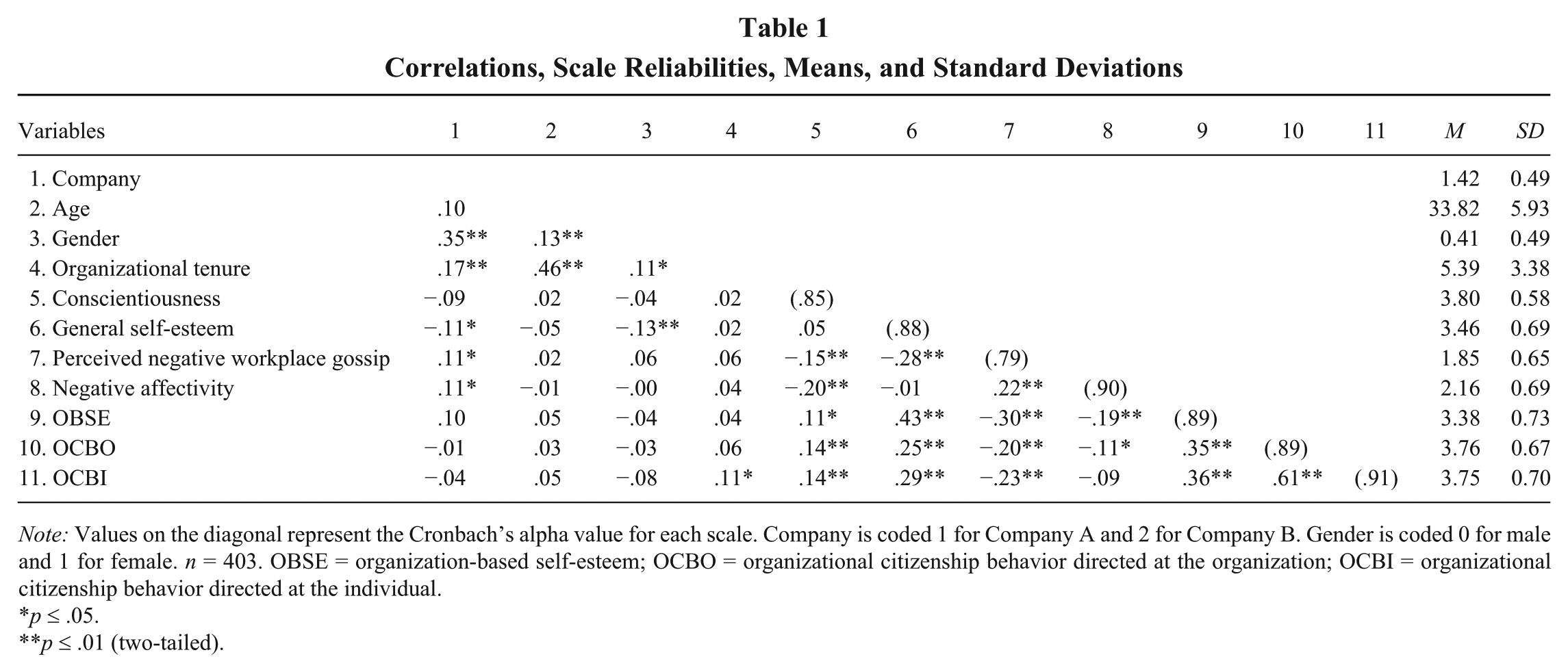
Note: Values on the diagonal represent the Cronbach’s alpha value for each scale. Company is coded 1 for Company A and 2 for Company B. Gender is coded 0 for male and 1 for female. n = 403. OBSE = organization-based self-esteem; OCBO = organizational citizenship behavior directed at the organization; OCBI = organizational citizenship behavior directed at the individual.
p ≤ .05.
p ≤ .01 (two-tailed).
Testing of Hypotheses
Hypotheses 1a and 1b predict that perceived negative workplace gossip is negatively related to OCB (i.e., OCBO and OCBI). We performed hierarchical multiple regression analysis to test these hypotheses. As our results in Table 2 indicate, perceived negative workplace gossip is negatively related to OCBO (β = −0.13, p ≤ .05, Model 8) and OCBI (β = −0.15, p ≤ .01, Model 14). Thus, Hypotheses 1a and 1b are supported.
Results of Hierarchical Regression Analysis
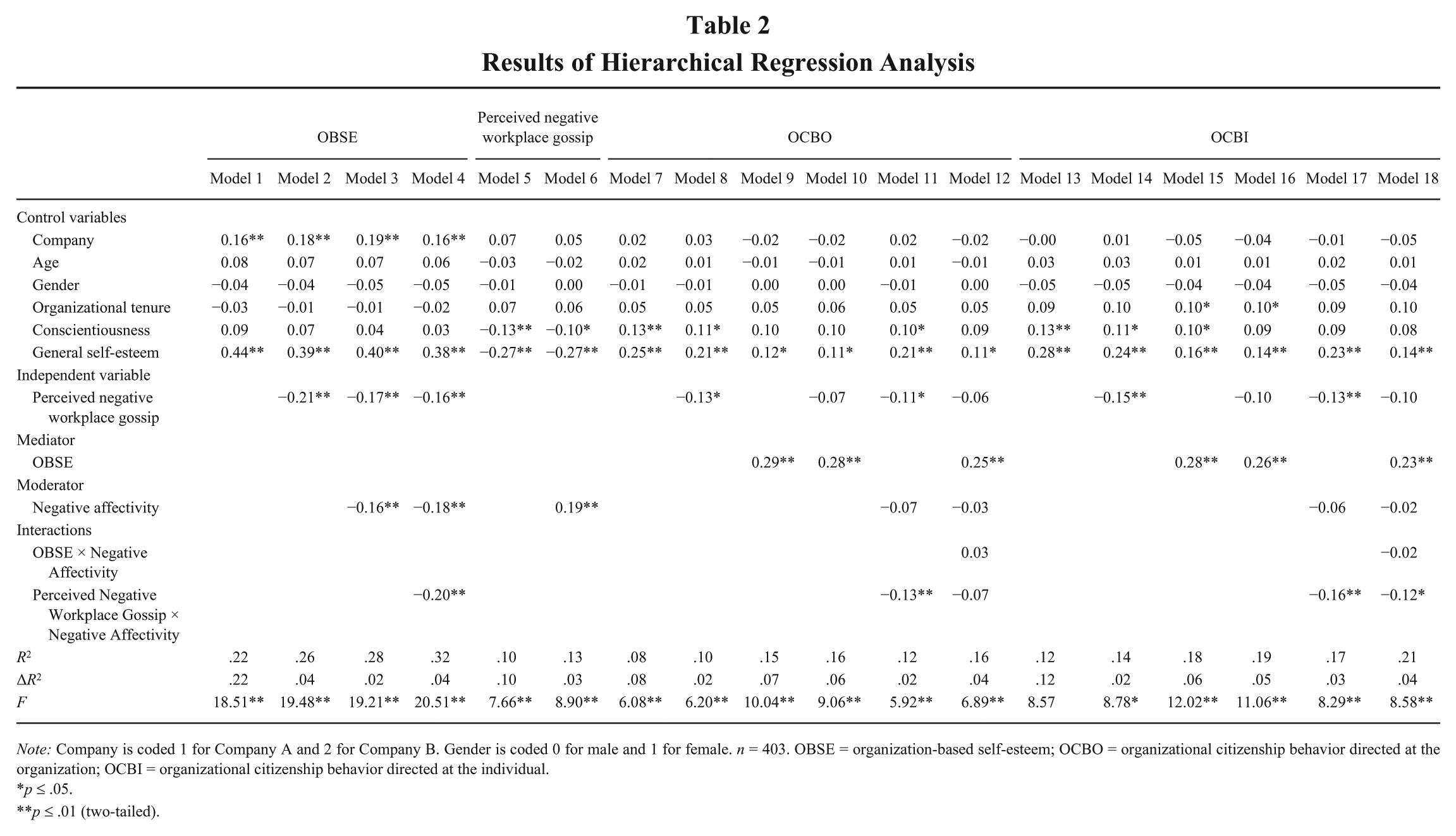
Note: Company is coded 1 for Company A and 2 for Company B. Gender is coded 0 for male and 1 for female. n = 403. OBSE = organization-based self-esteem; OCBO = organizational citizenship behavior directed at the organization; OCBI = organizational citizenship behavior directed at the individual.
p ≤ .05.
p ≤ .01 (two-tailed).
Hypotheses 2a, 2b, 3, 4a, and 4b propose a first-stage moderated mediation model. To test these hypotheses, we adopted PROCESS (Hayes, 2013) because it enables us to perform the most comprehensive analysis to test the model simultaneously and completely. Specifically, we opted for Model 7 analysis in PROCESS with a 2,000 resample bootstrap method to generate bias-corrected 95% confidence intervals (CIs) for indirect effects (see Hayes’ model templates for PROCESS for SPSS and SAS). Hypotheses 2a and 2b predict that OBSE mediates the relationship between perceived negative workplace gossip and OCB (i.e., OCBO and OCBI). As shown in Table 3, perceived negative workplace gossip is negatively related to OBSE (β = −0.18, SE = 0.05, p ≤ .01), and OBSE is positively related to OCBO (β = 0.25, SE = 0.05, p ≤ .01) and OCBI (β = 0.25, SE = 0.05, p ≤ .01). Additionally, PROCESS results indicate that there are significant mediation effects from OBSE on the relationship between perceived negative workplace gossip and OCB (i.e., OCBO and OCBI). For OCBO, the 95% CI of the indirect effect is –.11 to –.03, and for OCBI, the 95% CI of the indirect effect is –.10 to –.02. Thus, Hypotheses 2a and 2b are supported.
PROCESS Results
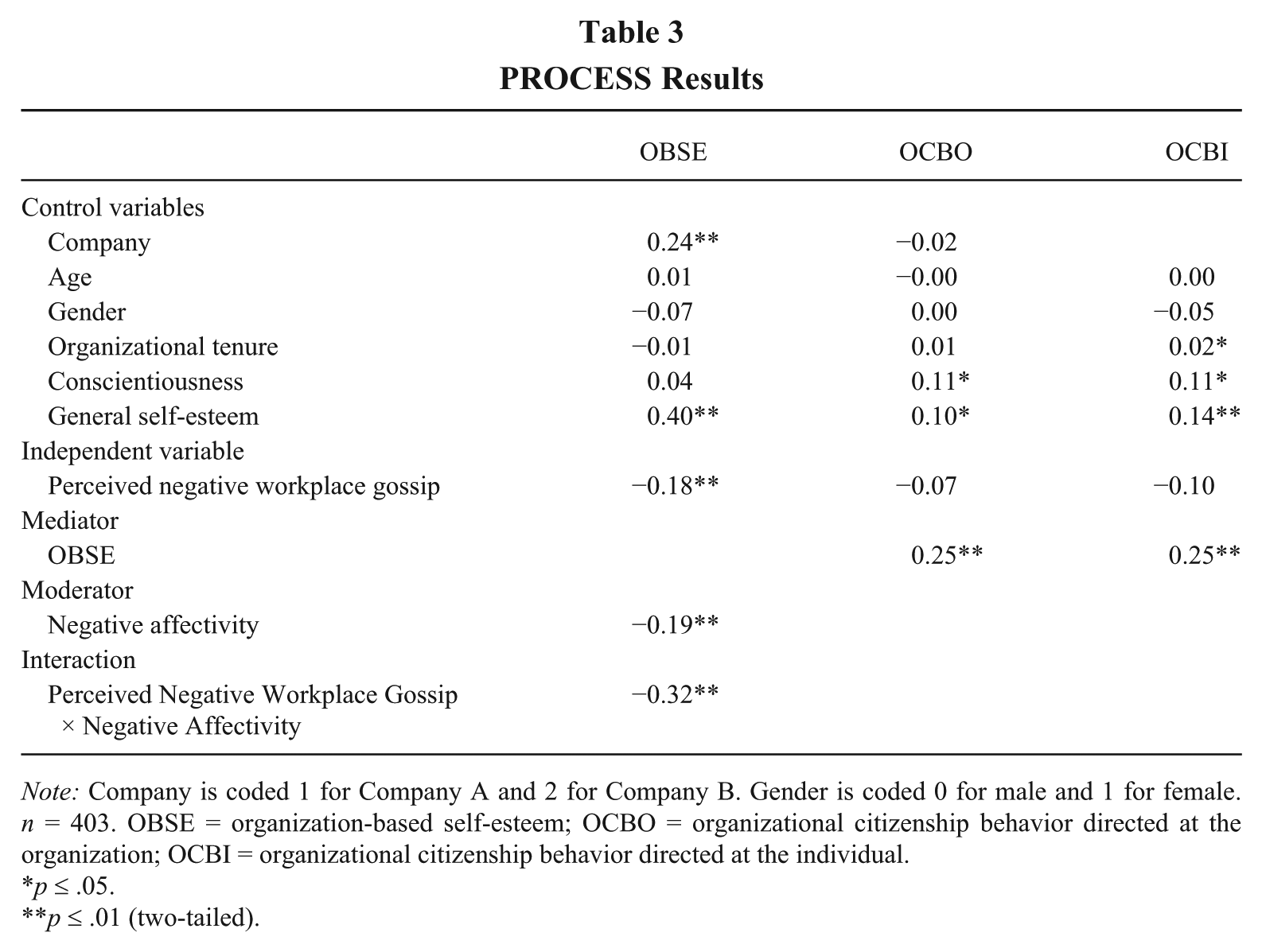
Note: Company is coded 1 for Company A and 2 for Company B. Gender is coded 0 for male and 1 for female. n = 403. OBSE = organization-based self-esteem; OCBO = organizational citizenship behavior directed at the organization; OCBI = organizational citizenship behavior directed at the individual.
p ≤ .05.
p ≤ .01 (two-tailed).
Moreover, as shown in Table 3, the interaction between perceived negative workplace gossip and negative affectivity is negatively related to OBSE (β = −0.32, SE = 0.07, p ≤ .01). Interaction effects were plotted by using Stone and Hollenbeck’s (1989) procedure (see Figure 2). Specifically, perceived negative workplace gossip is more negatively related to OBSE when negative affectivity is high (β = −0.36, p ≤ .01) and is unrelated to OBSE when negative affectivity is low (β = 0.04, n.s.). Thus, Hypothesis 3 is supported.
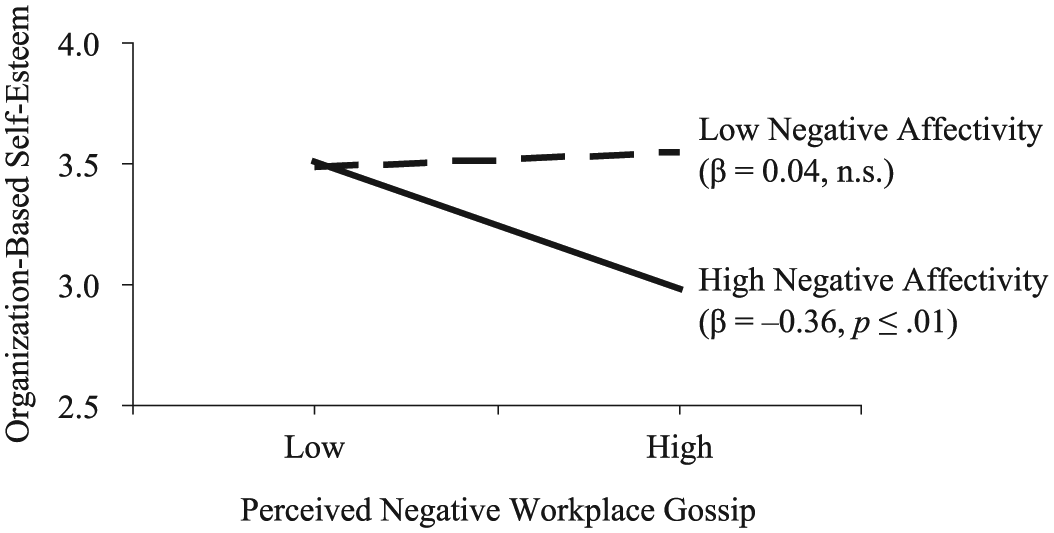
Moderating Effect of Negative Affectivity on the Relationship Between Perceived Negative Workplace Gossip and Organization-Based Self-Esteem
Furthermore, results in Table 4 provide empirical support for our moderated mediation hypotheses predicting that negative affectivity moderates the indirect effects of perceived negative workplace gossip on OCBO and OCBI via OBSE, such that the indirect effects are strongest when negative affectivity is high. Specifically, OBSE has a significant mediation effect on the relationship between perceived negative workplace gossip and OCBO when negative affectivity is high (i.e., conditional mediation effect = −.12, 95% CI = [–.20, –.07]) versus low (i.e., conditional mediation effect = .03, 95% CI = [–.01, .08], n.s.). In addition, OBSE has a significant mediation effect on the relationship between perceived negative workplace gossip and OCBI when negative affectivity is high (i.e., conditional mediation effect = −.12, 95% CI = [–.20, –.06]) versus low (i.e., conditional mediation effect = .03, 95% CI = [–.01, .08], n.s.). Thus, Hypotheses 4a and 4b are supported.
Conditional Indirect Effect(s) at Values of the Moderator(s)
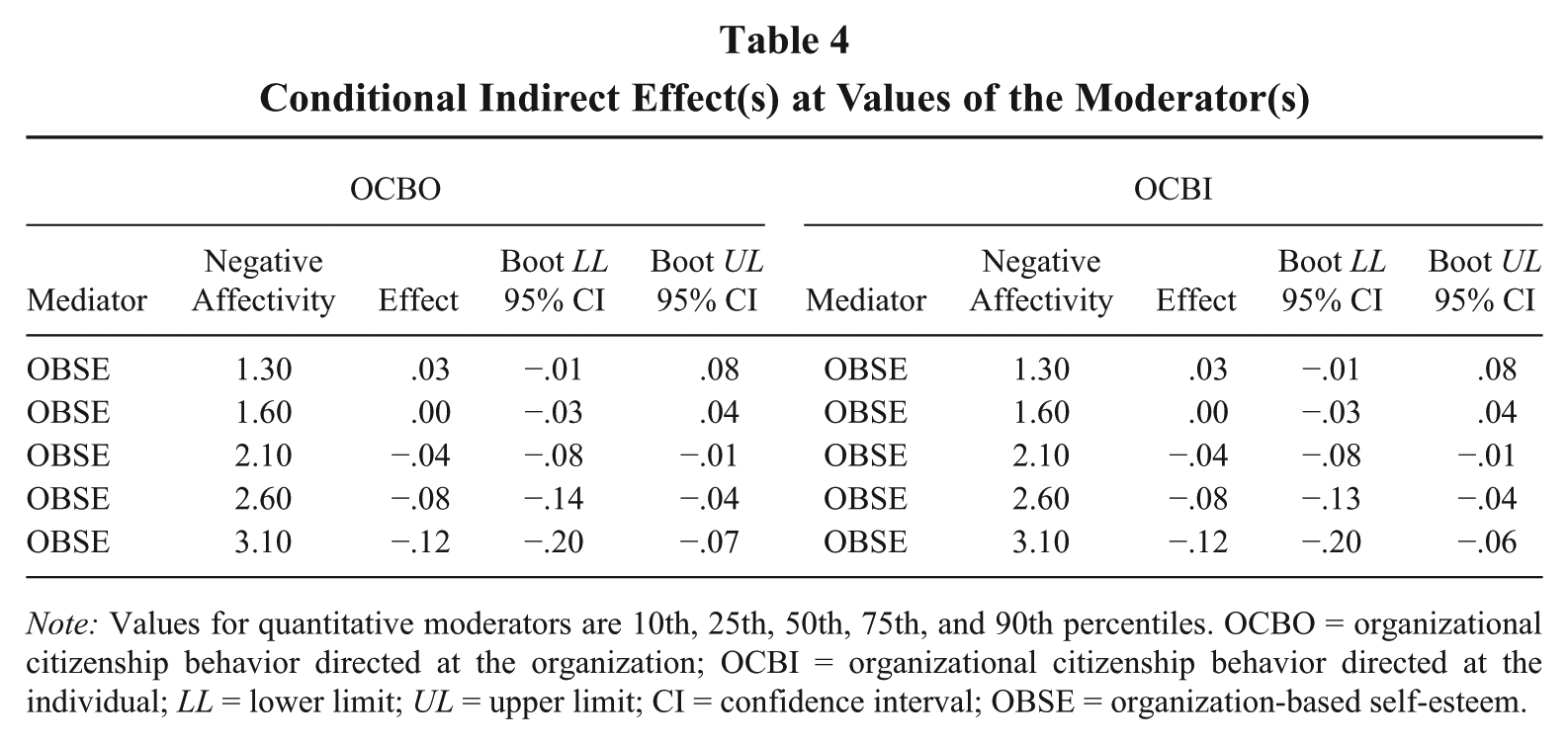
Note: Values for quantitative moderators are 10th, 25th, 50th, 75th, and 90th percentiles. OCBO = organizational citizenship behavior directed at the organization; OCBI = organizational citizenship behavior directed at the individual; LL = lower limit; UL = upper limit; CI = confidence interval; OBSE = organization-based self-esteem.
Finally, Hypothesis 5 predicts that negative affectivity positively influences perceived negative workplace gossip. Structural equation modeling analysis using Amos 17.0 was used to generate standardized path coefficients for Hypothesis 5 (see Figure 1). In addition to demonstrating excellent model fit (χ2 = 13.48, df = 6, CFI = .98, TLI = .95, RMSEA = .056) confirming that negative affectivity is positively related to perceived negative workplace gossip (β = 0.22, p ≤ .01), thereby supporting Hypothesis 5, the path analysis results provide additional support for the results of the above PROCESS analyses.
Discussion
Our results provide empirical support for a self-consistency theory framework for workplace gossip. In particular, we provide novel and important insights into the underlying process through which perceived negative workplace gossip affects target employees’ behavior as well as when or under what circumstances (a boundary condition) such a process is augmented.
Theoretical Implications
The study makes several contributions to theory. First, one novel contribution of our work is that we incorporate gossip within a self-consistency theory framework. Such an introduction helps improve our understanding of the process (OBSE) through which perceived negative workplace gossip influences target behavior (OCB), to our knowledge, a link that has yet to be established in the literature. Lending support to our conceptual framework, we demonstrated the significance of OBSE as a mediator of the perceived negative workplace gossip–OCB relationship. As scholars assert (e.g., Pierce et al., 1989; Pierce & Gardner, 2004), employees form self-perceptions about their value, worth, and competence in an organization on the basis of their experiences and interpersonal cues from their work environment. When they perceive that these experiences and interpersonal cues are unfavorable and that their sense of self-esteem is at stake, such as from the perception of being targeted by negative workplace gossip, then their OBSE will be threatened (Korman, 1970; Pierce & Gardner). Thus, not only do our findings advance extant research about the effects of perceived negative workplace gossip on targets’ work-related behaviors but also we improve understanding about the underlying mechanism through which such an effect might occur.
Second, a further contribution of our research to self-consistency theory is that we outline a moderator or boundary condition of the underlying process through which perceived negative workplace gossip affects target employees’ behavior. Building on the notion that certain individuals may be more sensitive to negative experiences and interpersonal cues at work than others (e.g., Aquino et al., 1999; Skarlicki, Folger, & Tesluk, 1999), we demonstrated that when individuals’ negative affectivity was high, the perception of being targeted by negative workplace gossip had a greater negative impact on their OBSE and, in turn, their OCB. Such an omission from the gossip literature has restricted our understanding of what factors might mitigate or exacerbate gossip’s effects (Foster, 2004). Our further finding that negative affectivity also predicts perceived negative workplace gossip lends support to the notion that dispositional affect plays an important role in precipitating victimization (Aquino & Bradfield, 2000; Aquino et al.). In this manner, we respond to calls for greater attention to the role of individual characteristics in workplace mistreatment (Bowling & Beehr, 2006) and interpersonal processes research (Srivastava & Beer, 2005).
Third, another novel contribution of our study is that we shift attention in the gossip literature to the target, thereby prompting a new research direction in the field. Whereas progress has been made toward understanding the psychological and attitudinal outcomes of workplace gossip on the gossiper (e.g., Farley et al., 2010; Waddington & Fletcher, 2005), little attention has been devoted to its effects on the target. Specifically, we found that one behavioral response of the target to perceived negative workplace gossip may be to withhold OCB. Interestingly and contrary to prior work (e.g., Andersson & Pearson, 1999), this suggests that individuals may not necessarily respond to incivility with incivility. Moreover, consistent with our self-consistency theory framework that we align our behaviors with our self-perceptions and, thus, OCBO and OCBI—both being behaviors relevant to self-verification—should not exhibit different relations because both are attempts to self-verify, our findings showed that the decreased OCB due to perceived negative gossip was directed at both the organization (OCBO) and its members (OCBI). Intuitively, one might expect that negative gossip should be more closely associated with OCBI because it represents a signal of the quality of interpersonal relationships in an organization. By shifting attention in the literature to the target, our findings represent an important first step toward systematically examining target employees’ behavioral responses to negative gossip in the organizational setting. Our study’s focus on OCB addresses the “flight” (withholding positive behaviors) behavioral response (Cannon, 1932). Although withholding OCB represents a safer and less confrontational response to perceived negative workplace gossip (Zellars et al., 2002), individuals could choose to “fight” or engage in deviant behavior as a response, an argument consistent with “tit-for-tat” logic (Andersson & Pearson) and warranting future research.
Fourth, our study also helps advance the informal communication and social mistreatment literatures. Whereas prior research on the former mainly emphasizes positive outcomes (e.g., job satisfaction, improved performance) and on the latter mainly emphasizes overt and direct forms of behavior (e.g., bullying, incivility, social undermining, and workplace aggression), by investigating negative workplace gossip, our study extends understanding about the consequences of a specific and often misunderstood type of informal communication and social mistreatment. Viewing negative workplace gossip as a form of victimization from the target’s perspective is also instructive. Given that negative workplace gossip is a behavior that is negative, evaluative, and done covertly or in secret with the intent to violate privacy and can be used to distort, manipulate, and misinform, by explicating its deleterious effects on the target, our findings also inform the broader literature on ethical behavior.
Last, we extend the gossip literature into the Asian context, specifically, Chinese organizations—increasingly important participants in the global economy. According to cross-cultural research, one might expect that because China is a collectivist culture and is believed to value harmonious relationships, negative workplace gossip would not take place in Chinese organizations. Contrary to such logic, however, we not only found support for our hypothesized effects on targets’ behavior but also found that negative workplace gossip was a common occurrence in the Chinese organizations sampled. There is a growing recognition that social mistreatment (e.g., incivility) may be more prevalent in Chinese organizations than prior research would have us believe (e.g., Y. Y. Chen et al., 2013). In the case of negative workplace gossip, it might be that it acts as a form of social sanctioning that helps to preserve social order. It might even be that gossip is a preferred means of communicating information in Chinese organizations because the culture is more resistant to direct and open confrontation, especially when the communication is negative. Such counterintuitive findings necessitate further research. Comparative studies that include culture and other contextual variables may also enhance the generalizability of our conceptual framework.
Managerial Implications
Our study also offers implications to practice. First, the more precise understanding we offer about the effects and characteristics of negative workplace gossip is constructive to organizations. For example, because managers often rely on informal communication (e.g., workplace gossip) as a shortcut when making decisions (Chakravarthy, McEvily, Doz, & Rau, 2003) and because gossip is pervasive in society (e.g., gossip columns, social media, reality TV), not a type of behavior “whose existence we can recognize as neatly as rocks, trees, or automobiles” (Kniffin & Wilson, 2010: 153), and is often “taken for granted” or considered inconsequential, there is a danger that without improved understanding, managers may overlook its potentially harmful effects. Greater context specific knowledge about gossip is also important given the problems associated with generalizing findings to organizations from prior research conducted in different social settings (e.g., rural communities, clans, social clubs, politics).
Second, in addition to helping clear up some possible misconceptions about negative workplace gossip, our study alerts managers to its potential costs. Because the perception of being targeted by negative workplace gossip may lead to a reduction in OBSE and, in turn, OCB, and given its other deleterious effects (e.g., eroding trust and social relationships), managers should formally recognize negative gossip as an act of indirect aggression, establish codes of conduct that prevent its spread, and educate employees about its potentially harmful effects on targets. Perhaps Socrates (469–399 BC) was the first to provide appropriate guidance on how best to treat gossip. Aware of its darker side, Socrates proposed that gossip should satisfy three conditions: truth, goodness, and usefulness (the “triple filter test”) or be ignored.
Third, in addition to demonstrating the impact of perceived negative workplace gossip on OBSE, we further demonstrated that OBSE was positively related to OCB. Because OCB represents highly desirable work-related behavior (Organ, 1988) and is positively related to organizational effectiveness (Farh, Early, & Lin, 1997), managers should implement measures to bolster OBSE, such as organizational support and recognition, leader–member exchange, and job autonomy. Such interventions not only may improve OBSE but also may foster improved quality in social exchange relationships, thereby helping to mitigate negative workplace gossip.
Finally, our study suggests that the effects of perceived negative workplace gossip may be more devastating for high negative affectivity targets. By identifying these individuals and providing them with appropriate training and counseling, managers can help alleviate the effects associated with perceived negative workplace gossip. For example, improving employees’ emotional intelligence through training not only may help to cushion the ill effects of workplace stressors, such as negative gossip, but also may benefit employee performance, interpersonal success, happiness, and health (Van Rooy & Viswesvaran, 2004).
Strengths, Limitations, and Future Research
Several aspects of the study’s methodological design strengthen its contributions. For example, collecting data from multiple sources and at different points in time helps minimize common method/source bias (Podsakoff et al., 2003). The sampling of two sectors (i.e., a state-owned service organization and a privately owned manufacturer) also helps to improve the generalizability of findings. Moreover, most prior gossip research is confined to data collected in social contexts outside the workplace, such as neighborhoods, sport clubs, and dormitories (e.g., Weaver & Bosson, 2011), or consists of student samples (e.g., Bosson, Johnson, Niederhoffer, & Swann, 2006). Because the nature, antecedents, and consequences of gossip are likely to vary according to context, examining gossip in the organizational setting represents an important contribution essential to providing greater clarity and developing a more precise understanding of the phenomenon and its implications to organizations.
However, our study is not without limitations. First, our main interest was to achieve a unified model of workplace gossip, which helps to explain how and when perceived negative workplace gossip may undermine a target’s OCB. To measure OCB, we used a widely tested and empirically validated taxonomy that included dimensions for both OCBO and OCBI. The similarity in effects we observed on the two aspects of OCB is consistent with the prediction of our self-consistency theory framework that we align our behaviors with our self-perceptions; hence, OCBO and OCBI—both being behaviors relevant to self-verification—should not exhibit different relations because both are attempts to self-verify. Nevertheless, incorporating other theoretical perspectives and taxonomies in future research could provide additional insights. For example, identity theory suggests that targets’ behavior may be more strongly influenced by the actions of those they more closely identify with (e.g., where the withdrawal of OCB is directed; Tajfel, 1981). The inclusion of alternative taxonomies of OCB or related concepts that differ in emphasis may also be instructive and provide more nuanced observations (e.g., Griffin, Neal, & Parker’s, 2007, model of work-role performance classifies different types of discretionary behavior).
Second, in our study, we measured OBSE after perceptions of gossip, a measurement timing consistent with its role as a mediator in our model. However, we do recognize that theoretically the direction may be reversed or reciprocal. That is, if individuals desire to maintain consistent images of themselves, it could be that OBSE precedes the perceptions of negative workplace gossip. In other words, OBSE could influence the perceptions and interpretation of events (gossip perceptions), and these perceptions and interpretations are consistent with self-perceptions to maintain consistency. Such a possibility should be considered in future research.
Third, despite the methodological advantages we outline above, our findings may still be susceptible to bias because the independent variable, mediator, and moderator were reported by the same respondents. Also, the direction of causality cannot be unequivocally determined. For example, reciprocal relationships between OCB and perceived negative workplace gossip may exist because individuals who do not perform OCB may be devalued by their colleagues and, as a consequence, be targeted by negative gossip. This suggests that alternative research designs (e.g., longitudinal and experimental) should be considered in future work. The development of a more refined measure of workplace gossip should also be considered (e.g., using items that set boundaries and impose constraints more specific to gossip in the workplace context).
Fourth, although further analyses revealed that our results were not significantly affected (see Osborne, 2002), the distribution of perceived negative workplace gossip was positively skewed. Additionally, albeit the level of perceived negative workplace gossip reported appears low (mean of 1.85), it is similar to that found in prior gossip research (Chandra & Robinson, 2010) and in studies on abusive supervision (e.g., mean levels below 1.5; Tepper, 2000; Tepper, Moss, Lockhart, & Carr, 2007). Thus, researchers should exercise caution about the effects associated with nonnormality on statistical models (Skarlicki et al., 1999).
Fifth, although perceived negative workplace gossip was significantly related to the two dependent variables in the predicted direction, thus providing support for its salient impact (even at low levels), future research should examine gossip’s influence on employee work-related behaviors and outcomes relative to other types of informal communication and social mistreatment (e.g., workplace ostracism, Ferris, Brown, Berry, & Lian, 2008, and abusive supervision, Tepper, 2000).
Last, future research avenues could include exploring additional boundary conditions (e.g., perceived organizational support, which may influence targets’ ability to cope with work stressors; Carlson & Perrewé, 1999) and behaviors (e.g., task performance, proactive behavior, and workplace counterproductive behavior). Because negative workplace gossip may stigmatize and damage the reputation of the target (Kulik et al., 2008), its effects on the target’s career progression should also be investigated. Examining the potential implications of additional organizational (e.g., corporate citizenship, Evans, Davis, & Frink, 2011; close surveillance, O’Donnell, Ryan, & Jetten, 2013) and individual (e.g., careerism; Hsiung, Lin, & Lin, 2012) factors has similar merit.
Conclusion
This study developed and empirically tested a self-consistency theory framework for gossip that explicates how and when employees are likely to withdraw from OCB as an interpersonal way of responding to feelings of being targeted by negative workplace gossip. Specifically, we demonstrated that OCB (both OCBO and OCBI) withdrawal is more likely to occur when individuals’ OBSE is adversely affected by the perception of being targeted by negative workplace gossip. Moreover, by integrating work on victimization, we showed that when individuals are more sensitive to negative information, as reflected by a high negative affectivity personality trait, their response is likely to be exacerbated. Additionally, negative affectivity was found to predict perceived negative workplace gossip. By incorporating both mediating and moderating processes, we attempt to achieve a unified model of workplace gossip. In this manner, we demonstrate who suffers most from perceived negative workplace gossip. We also identify leverage points that organizations can use to help alleviate negative gossip and its potentially harmful effects on target behaviors. Therefore, our study not only provides novel contributions to the literature but also shifts attention to the target of negative workplace gossip, an important and neglected area in the organizational sciences that is ripe for future research.
Footnotes
Acknowledgements
This article was accepted under the editorship of Patrick M. Wright. The first three authors contributed equally to this manuscript. The authors wish to offer a special note of thanks to Gary Greguras, action editor, and two anonymous reviewers for their helpful guidance and advice throughout the revision process. We would also like to acknowledge a number of other organizational scholars for their valuable insights on earlier versions of this manuscript, in particular, Lance Ferris, Donald Gardner, Robert Liden, and Huiwen Lian. Financial support was received from the National Natural Science Foundation of China (71202001 and 71472116), New Century Excellent Talents in University (NCET-13-0892), Shanghai Pujiang program (13PJC053), the Chen Guang project (12CG44), Shanghai Municipal Education Commission, and Shanghai Education Development Foundation.