







Abstract
Despite substantial scholarly interest in the role of contracts in alliances, few studies have analyzed the mechanisms and conditions relevant to their influence on alliance performance. In this paper, we build on the information-processing view of the firm to study contracts as framing devices. We suggest that the effects of contracts depend on the types of provisions included and differentiate between the consequences of control and coordination provisions. Specifically, control provisions will increase the level of conflict between alliance partners, whereas coordination provisions will decrease such conflict. Conflict, in turn, reduces alliance performance, suggesting a mediated relationship between alliance contracts and performance. We also contribute to a better understanding of contextual influences on the consequences of contracts and investigate the interactions of each contractual function with both internal and external uncertainties. Key informant survey data on 171 alliances largely support our conceptual model.
Strategic alliances are interorganizational relationships that allow otherwise independent firms to share a variety of resources (e.g., Schilke & Goerzen, 2010). The contracts used in these alliances are a central mechanism for governing the interfirm exchange (Schepker, Oh, Martynov, & Poppo, 2014). These alliance contracts usually consist of a variety of provisions with markedly different functions. Specifically, an important differentiation can be made between contractual provisions pertaining to control and contractual provisions pertaining to coordination (e.g., Lumineau, 2017). Contractual control creates adherence to a desired outcome with a minimal amount of deviant behavior through the exercise of authority or power mechanisms. Contractual coordination, on the other hand, is a means to achieve a desired collective outcome and to facilitate goal congruence by providing the appropriate linkages between partners (Malhotra & Lumineau, 2011). While the differentiation between control and coordination provisions is now well accepted in the literature and important progress has been made to understand their antecedents (e.g., Reuer & Ariño, 2007; Ryall & Sampson, 2009), little is known about these provisions’ distinct consequences.
In order to address this oversight, our study analyzes the effects of contractual control and coordination on alliance performance. Building on the information-processing view of the firm (Cyert & March, 1963; Thompson, 1967; Tushman & Nadler, 1978), we develop a theoretical argument suggesting that contracts are linked to alliance performance through their effect on the level of interpartner conflict during the alliance—a central process characteristic of alliance relationships (refer to Lumineau, Eckerd, & Handley, 2015, for a recent review). That is, we propose that partner conflict mediates the link between contractual provisions and performance. Further, a distinctive feature of strategic alliances is that partners have to navigate both the dynamism in their environment and their interdependence on each other (Harrigan, 1985; Krishnan, Martin, & Noorderhaven, 2006). Therefore, we consider that the effects of contractual provisions might be influenced by environmental dynamism and partner interdependence.
Overall, our study addresses the important research questions of how and when contracts matter to alliance performance (Hoetker & Mellewigt, 2009; Weber & Mayer, 2011), thus addressing relevant mechanisms and conditions in the contract–performance relationship. Using the information-processing view as our model’s theoretical foundation, we connect research on alliance contracts with the literature on interorganizational conflict and uncertainty to make two main contributions that add nuance to our understanding of contractual performance effects. First, all else equal, we find that the level of conflict between partners mediates the relationship between each contractual function (i.e., coordination and control) and alliance performance, thus shedding new light on the mechanism through which contracts are linked to performance. Second, we show how environmental dynamism and interdependence moderate the relationship of each contractual function with conflict, thus pointing to two important contingencies. Figure 1 depicts the paper’s theoretical model.
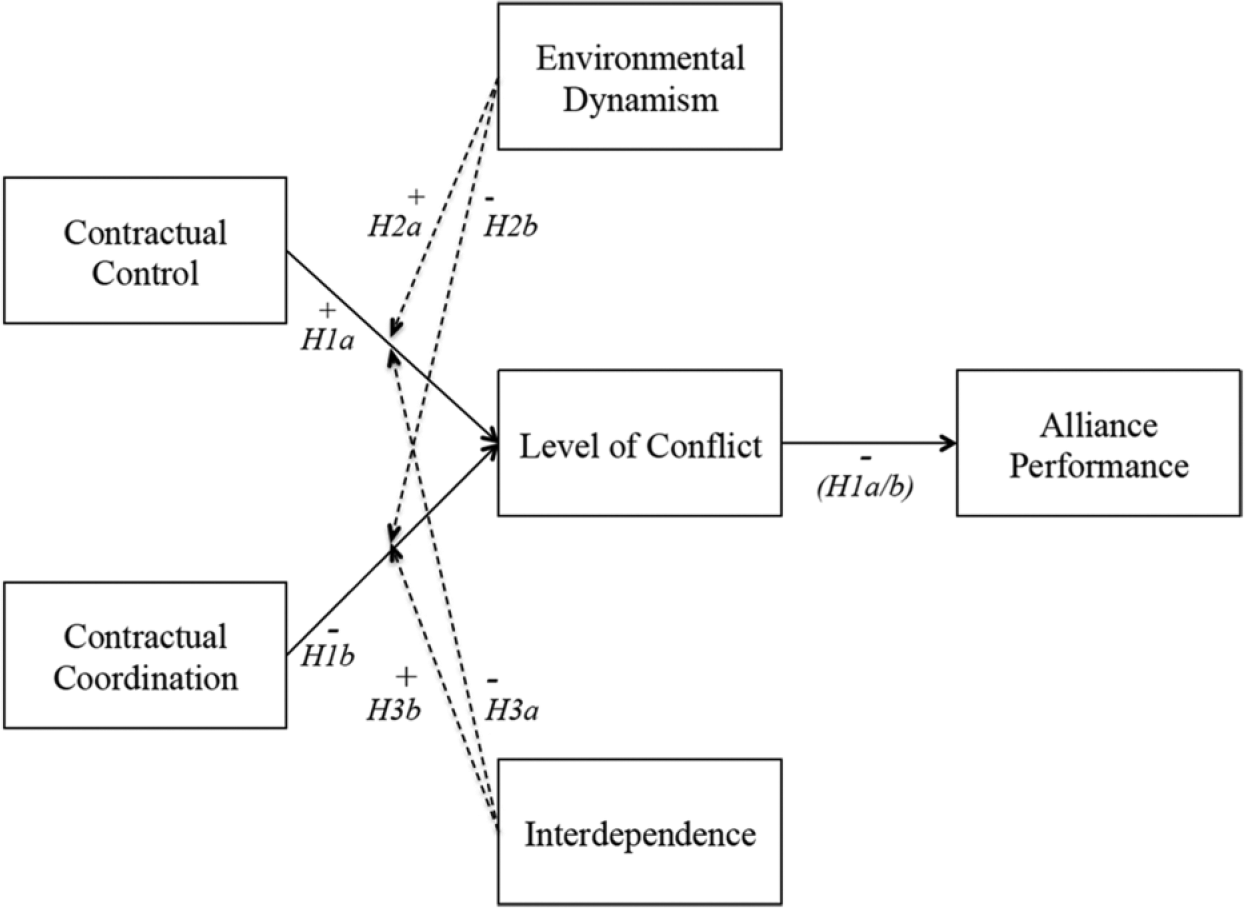
Overview of Our Research Model
Conceptual Background
The Contractual Functions of Control and Coordination
Contracts that specify the terms of an agreement between alliance partners are a key instrument for governing the exchange (Gulati & Singh, 1998; Parkhe, 1993; Parmigiani & Mitchell, 2010). Management scholars have shown much interest in examining the content of written contracts, with the view that the more contingencies a contract covers, the more complete it is (Luo, 2002; Mesquita & Brush, 2008; Poppo & Zenger, 2002). As contracts specify the terms of an agreement between partners, they play a central role in the management of interorganizational relationships (e.g., Argyres & Mayer, 2007; Poppo & Zhou, 2014).
Earlier work has often aggregated individual contractual provisions in order to study the whole contract design as the agreed-upon governance structure for supporting partnerships and transactions. According to this approach, contracts are governance mechanisms whose provisions aim, for instance, to specify what is and is not allowed, to inflict penalties in the event of violating behaviors, or to determine the outcomes to be delivered and the performance that is expected (Argyres, Bercovitz, & Mayer, 2007).
Some more recent works suggest that contracts may serve distinct purposes, particularly, the functions of control and coordination (Gulati, Lawrence, & Puranam, 2005; Lumineau & Henderson, 2012). Vlaar (2008: 46) observes that the most common and influential theoretical perspectives describing the role of formal interorganizational governance can be grouped into two broad categories: (1) the ones focusing on formal governance as a mechanism for control, and (2) the ones viewing formal governance as a means of coordination.
This distinction is also in line with some of the foundational treatments of organizational governance, which differentiate between control and coordination (Galbraith, 1973; Simon, 1961).
Contractual control and coordination focus on different types of issues. On the one hand, contractual control defines the rights and obligations of the parties involved (Lyons & Mehta, 1997; Salbu, 1997), thus supporting the mitigation of appropriation concerns, the management of potential moral hazards, the alignment of incentives, and the monitoring of problems. By reducing concerns about free riding and opportunism, they constrain the ability of one party to extract additional rents from the other by failing to perform as agreed (Gulati & Singh, 1998; Hoetker & Mellewigt, 2009).
On the other hand, contracts may also serve as a framework to define the objectives of the relationship and support coordination (Lumineau & Quélin, 2012; Mooi & Ghosh, 2010). The coordinating function of contracts refers to ordering desires and expectations between or among the transacting parties and organizing priorities for the future (Ryall & Sampson, 2009; Salbu, 1997). By guiding formal communication and reporting, contractual coordination may facilitate a convergence of expectations (Faems, Janssens, Madhok, & Van Looy, 2008). Importantly, all the works in this stream of research have suggested that contractual control and contractual coordination are two distinct constructs. As such, they should not be studied as two opposite ends of a continuum. A contract may thus have high (or low) levels of both control and coordination at the same time. 1
In studying contract design, it is possible to distinguish between (a) explaining the antecedents and (b) explaining the consequences of contract design. While a whole stream of research has specifically focused on the antecedents to contractual design in alliances (see Schepker et al., 2014, for a review), “we know considerably less about the post-formation governance processes in alliances than about their set-up structures” (Contractor & Reuer, 2014: 247). Recent works insist that it is important to go beyond the overall level of contractual complexity to examine the specific impact of relevant contractual functions more closely (Malhotra & Lumineau, 2011; Poppo & Zenger, 2002). We thus draw upon the distinction between the controlling function and the coordination function of alliance contracts when deriving our hypotheses regarding contractual consequences.
Contracts as Framing Devices
A main tenet of the information-processing view is the notion that organizational mechanisms not only have functional consequences but also fundamentally shape the way in which problems are framed, understood, and ultimately handled (Cyert & March, 1963; Thompson, 1967; Tushman & Nadler, 1978). Contracts are central organizational governance mechanisms (Stinchcombe, 1985), and thus can be viewed as important framing devices, in strategic alliances (Foss & Weber, 2016; Lumineau, 2017; Weber & Mayer, 2011).
Our key premise is that contracts have important psychological ramifications that affect the ongoing relationship between partners (Ghoshal & Moran, 1996). According to this view, a contract, like other organizational mechanisms, can act as a frame because its “characteristics organize a vast array of stimuli in the work setting to delimit a situation” (Herman, Dunham, & Hulin, 1975: 231). This indicates that the framing approach to contracting is well aligned with a bounded-rationality perspective while adding a novel information-processing aspect to it (Weber, Mayer, & Macher, 2011). In particular, the types of information included in a contract can induce specific behaviors and views of the relationship. By creating certain expectations about the exchange, contractual provisions affect the way in which partners perceive and interact with each other, which in turn influences exchange success (Lumineau, 2017; Lumineau & Malhotra, 2011; Weber & Mayer, 2011). As such, the framing perspective suggests that contractual design has an effect on exchange performance that is mediated by relevant social processes characterizing the ongoing relationship.
The emerging literature adopting this theoretical approach suggests that alliance contracts are associated with particular frames and, as such, are likely to impact the exchange and the ongoing relationship between firms. However, this stream of research has not yet been connected with another critical theoretical issue in the alliance contract literature: the functionality of contracts (Schepker et al., 2014). On the one hand, prior works have suggested that different contract foci may have a strong impact on how the parties perceive and engage with one another. On the other hand, contract scholars have noted that contracts have multiple functions (e.g., Argyres et al., 2007; Gulati et al., 2005; Reuer & Ariño, 2007), as we discussed earlier.
Nevertheless, the first stream of research has taken a general approach or focused on the wording of provisions (e.g., Heide & Wathne, 2006; Weber & Mayer, 2011), while the second stream of research has not explored how each contractual function (i.e., control or coordination) is likely to bring about specific behaviors and distinctively influence alliance performance. Accordingly, an important question remains unanswered: How do contractual control and contractual coordination influence partner interactions and, ultimately, alliance performance?
To address this theoretical gap, we analyze the distinct effects of each contractual function on the level of partner conflict and the performance of alliances. Consistent with Foss and Weber (2016), our study focuses on conflict as a key social process affected by governance choice. Prior research has established that conflict is a critical characteristic of strategic alliances (Barden, Steensma, & Lyles, 2005; K. Kumar & van Dissel, 1996; Lumineau et al., 2015; Luo, 2002). In line with the framing perspective, we suggest that contractual provisions can induce specific behaviors and views of the relationship that manifest themselves in the level of partner conflict and ultimately affect relationship performance.
As such, our study’s research model is based on the idea that the level of conflict during the alliance represents a critical theoretical mechanism explaining the link between alliance contracts and performance. Even though some works (e.g., Lumineau, Fréchet, & Puthod, 2011) have focused on the influence of preexisting conflict (i.e., tensions prior to alliance formation) on the alliance contract design, as contracts are typically established at the beginning of the alliance (Mayer & Teece, 2008), here we focus on conflict during the alliance as a consequence of contracts. In other words, we focus on the causal relationship between initial contract design and subsequent relationship conflict, which in turn is related to alliance performance, as we develop in greater detail next.
Hypotheses
Mediated Performance Effects of Contractual Control and Coordination
We begin our investigation by examining the role of a key mediator that may explain the mechanism underlying the contract–performance link—the level of conflict between the alliance partners. In line with the information-processing view, we focus on the indirect effects of contractual mechanisms on performance. This approach also heeds earlier calls for alliance research studying how behavioral characteristics intermediate between initial structural conditions and alliance success (Noorderhaven, 2005; Schepker et al., 2014).
Conflict—defined as tension between social entities due to real or perceived differences (Thomas, 1992)—has been suggested to be one of the most relevant behavioral constructs for explaining performance differentials of interorganizational relationships (Christoffersen, 2013; Reus & Rottig, 2009). Conflict is a key characteristic of interorganizational alliances, since these alliances tend to contain the seeds of behavioral contradictions (cooperation vs. competition), temporal contradictions (short term vs. long term), and structural contradictions (rigidity vs. flexibility) (refer to T. Das & Teng, 2000, for a review). In the event that the alliance partners are unable to avoid such contradictions, the alliance is likely to enter conflict. We therefore consider the level of conflict during the alliance as a key mediating mechanism linking alliance contracts and performance. First, we discuss the influence of contractual control on the level of conflict; second, the influence of contractual coordination on the level of conflict; and third, the influence of the level of conflict on alliance performance.
Drawing upon the information-processing view, there are several reasons to believe that both control and coordination provisions have an important bearing on the level of conflict, albeit in opposite directions. First, the mere existence of control provisions can imprint a purely instrumental, impersonal, or even skeptical attitude toward the relationship (Ghoshal & Moran, 1996; Sitkin & Roth, 1993). As Macaulay (1963: 64) put it, contractual control frequently “blunts the demands of friendship, turning a cooperative venture into an antagonistic horse trade.” Because control provisions make it easy to detect divergences from the agreed-upon terms of the transaction (Lyons & Mehta, 1997), they may not only allow but actually encourage the parties to vigilantly observe their rights and obligations as well as the potential sanctions, thus creating incentives to question the appropriateness of the other’s actions (Tenbrunsel & Messick, 1999). As such, a strong controlling focus may lead to a constant policing of the partner, stimulating an escalating spiral of suspicion and distance (Ghoshal & Moran, 1996). Further, control provisions aim to reduce the threat of opportunism by regulating the partner organizations’ actions and decisions (Lumineau & Henderson, 2012). In doing so, they significantly decrease the partners’ autonomy. Social psychological research has demonstrated that autonomy loss in controlling contexts is often associated with feelings of pressure and resentment as well as aggressive behavior (Deci & Ryan, 1987), all of which increases the potential for conflict to arise (Scherer, Abeles, & Fischer, 1975). Finally, by specifying contractual control clauses in advance, parties may refrain from devoting time and resources to searching for solutions that integrate the interests of both parties, which may cause an accumulation of imbalances and unresolved conflict throughout the alliance process (Hart & Saunders, 1997).
Even though most prior theorizing points to a positive relationship between control and conflict (Ghoshal & Moran, 1996; Macaulay, 1963; Sitkin & Roth, 1993; Tenbrunsel & Messick, 1999), we should acknowledge that some scholars indicate that control may reduce conflict by supporting a clear definition of the rights and obligations between parties (Stinchcombe, 1985). Moreover, as formal legal documents, contracts define mutual obligations between partners and are thus intertwined with the notion of safeguards. As such, the effects of contractual control on conflict may be particularly pronounced for relatively high levels of control (we further explore the possibility of nonlinear effects in our post hoc analysis). Nonetheless, in line with the dominant view in the literature, we expect that the overall control provisions included in the alliance contract are positively related to the level of conflict in the alliance.
We posit, however, that the relationship between contracts and conflict is quite different when it comes to coordination provisions. Coordination provisions define some cornerstones of partner communication, such as frequency, content, and timeliness (S. Anderson & Dekker, 2005; Malhotra & Lumineau, 2011). By requesting periodic written reports, they foster regular information sharing between the alliance partners and thus provide a means by which these firms can align their expectations (Argyres et al., 2007; Gulati et al., 2005). This should lead to a common understanding of what goals the alliance aims to pursue and the roles and responsibilities of each party in achieving these goals (Macaulay, 1963; Smitka, 1994). Frequent communication may also promote the development of routinized interactions and shared language that can make it easier for the parties to ensure they meet each other’s needs (Zollo, Reuer, & Singh, 2002). As a result of shared expectations and routinized interactions, the likelihood of misinterpretations and misunderstandings that may have raised questions about the intent of the other party should decline (Gulati & Singh, 1998; K. Kumar & van Dissel, 1996; Mayer & Argyres, 2004). Another positive side effect of regular written reports is increased partner learning, which makes it easier to anticipate likely behavior and motives (Ring & Van De Ven, 1994) and reduces skepticism and paranoia toward the other organization (Lewicki & Bunker, 1996). Moreover, coordination provisions make the partners’ individual contributions to the alliance more explicit. With a clear understanding of responsibilities and ongoing alliance activities, partners are more likely to fulfill obligations on time, which should reduce the risk of an alliance partner feeling exploited (Mesquita & Brush, 2008). While written communication can undoubtedly also have some downsides (discussed later), overall we expect coordination provisions to be associated with a reduced level of conflict in the alliance.
Interpartner conflict, in turn, affects the performance of the alliance. Although conflict may have beneficial outcomes, such as helping to avoid groupthink and supporting creative team tasks (De Dreu & Weingart, 2003), much evidence points to a negative effect of conflict on alliance performance (see Christoffersen, 2013; Reus & Rottig, 2009, for reviews). 2 Conflict is likely to give rise to opponent-centered behavior, which can slow down decision making and result in inefficient integration of activities (Barden et al., 2005; Killing, 1983). The presence of conflict may also reduce partners’ engagement level and willingness to contribute needed resources to the alliance (Cullen, Johnson, & Sakano, 1995; Killing, 1983). In line with this reasoning, several earlier studies have found a negative link between the level of conflict and alliance performance outcomes (Li & Hambrick, 2005; Steensma & Lyles, 2000).
In summary, coordination provisions will lower the level of conflict in the alliance, whereas control provisions will have the opposite effect of increasing conflict levels. Conflict, in turn, should be associated with lower alliance performance. Taken together, these arguments underscore the intermediary position of conflict in explaining the mediated relationship between alliance contract functions and performance. According to our model, contracts relate to performance indirectly by affecting the level of conflict inherent in the alliance, as implied by the following hypotheses:
Hypothesis 1a: Contractual control has a positive relationship with the level of conflict, and the level of conflict has a negative relationship with alliance performance, such that the level of conflict mediates the negative relationship between contractual control and alliance performance.
Hypothesis 1b: Contractual coordination has a negative relationship with the level of conflict, and the level of conflict has a negative relationship with alliance performance, such that the level of conflict mediates the positive relationship between contractual coordination and alliance performance.
Starting with Tushman and Nadler’s (1978) seminal article, the information-processing view places a strong emphasis on understanding the effectiveness of organizational mechanisms under varying degrees of uncertainty (Lumineau, 2017). Indeed, uncertainty is viewed as key to understanding how organizations operate. It increases the information-processing requirements for organizations; thus, different levels of uncertainty influence the effectiveness of different organizational mechanisms (Tushman & Nadler, 1978). Consequently, considerations about control and coordination mechanism need to be informed by an understanding of uncertainty, both within the broader environment and in the relationship between units. Therefore, our study heeds Foss and Weber’s (2016) call for further research into how uncertainty moderates the extent to which organizational mechanisms engender conflict.
Moderating Effects of Uncertainty on the Relationship Between Contracts and Conflict
Research on the role of uncertainty in business exchanges has a long history (Knight, 1921), and various definitions of uncertainty can be found in the extant literature (see McMullen & Shepherd, 2006, for a review). Common to many of these definitions is the notion that, in uncertain contexts, the probabilities of future outcomes are unknowable (Schilke, Wiedenfels, Brettel, & Zucker, in press).
Prior research has suggested that alliances face two major types of uncertainty: external and internal (Harrigan, 1985; Krishnan et al., 2006). External uncertainty refers to uncertainty in the environment, a key aspect of which is environmental dynamism (Azadegan, Patel, Zangoueinezhad, & Linderman, 2013; Garg, Walters, & Priem, 2003), or the volatility and unpredictability of the external environment (D. Miller & Friesen, 1983). In a highly dynamic environment, alliances are subject to rapid and unpredictable changes. Such highly dynamic environments are characterized by technological change, variations in customer preferences, and fluctuations in product demand or supply of materials (Schilke, 2014). Such changes in the environment are, for the most part, outside the organizations’ control and are hard to predict. This unpredictability requires organizations to be quickly responsive while they lack detailed and reliable information to anticipate the changes (Dess & Beard, 1984; Garg et al., 2003).
Internal uncertainty, on the other hand, refers to uncertainty arising from the other partner’s behavior. This behavioral facet of uncertainty is particularly salient in alliances involving high interdependence (Krishnan et al., 2006; Park & Ungson, 2001; Pfeffer & Salancik, 1978). Such interdependence increases when there is strong overlap in the partners’ respective activities (Gulati & Sytch, 2007) and when the partners’ contributions are highly intertwined (Nooteboom, 2002; Park & Russo, 1996). In highly interdependent alliances, any change made by one firm is likely to affect its partner in unplanned and significant ways (Nooteboom, 2002), thus raising the level of behavioral uncertainty (e.g., Achrol & Stern, 1988; Krishnan et al., 2006).
In line with the framing perspective, we argue that both environmental dynamism and interdependence moderate the contract–conflict link. On a general level, we suggest that environmental dynamism reduces the advantageousness of contractual provisions (Krishnan et al., 2006; Vlaar, Van den Bosch, & Volberda, 2007) in the domains of both control and coordination. First, we propose that contractual control can be expected to increase all the more the level of conflict in situations of high environmental dynamism. Control provisions reflect management’s best effort to create adequate contingencies at the time of contract formation. In highly dynamic environments, however, unpredictable and rapid contextual changes demand frequent and flexible adaptation (Volberda, 1996). In these contexts, detailed ex ante specifications of rights and responsibilities that are typical for contractual control can breed conflict, because they make it difficult for parties to adjust the deal appropriately (Folta, 1998; Nooteboom, 1999). While environmental dynamism demands speedy and responsive decisions, a strong emphasis on the mechanistic rules of contractual control may create inertia and stiffness in the relationship. The rigidity and stringency of control provisions contradict the need for flexibility required by a dynamic environment and can make mutually agreed-upon adaptation and renegotiation cumbersome, increasing the likelihood of adversarial situations. Under such circumstances, control provisions are likely to foster misunderstandings between partners. As such, the potential for control provisions to create conflict is accentuated further when the frequency of environmental changes is high. Therefore, we propose that control provisions will result in greater levels of conflict in dynamic rather than in stable environments:
Hypothesis 2a: Environmental dynamism strengthens the positive relationship between control provisions and conflict.
We suggest that environmental dynamism is also likely to moderate the influence of contractual coordination provisions on conflict, albeit in a different way. Specifically, we expect the relative effectiveness of contractual coordination in reducing conflict to be comparatively lower in dynamic environments than in more stable environments. Contractual coordination can be considered a form of formal coordination (Vlaar et al., 2007) that prespecifies both the content and schedule of interpartner communication. Such formal coordination works particularly well in stable environments characterized by comparatively low ambiguity and frequency of change. Here, the structured information flow facilitated by coordination provisions is likely to be most beneficial in establishing a routinized exchange, which makes it particularly effective in reducing conflict between partners. In highly dynamic environments, on the other hand, tasks are frequently unstructured or poorly understood, and decisions need to be made on the basis of ambiguous information (Aldrich, 2000; K. Miller, 2007). Such ambiguous information is difficult to communicate in codified form (Nelson & Winter, 1982; Polanyi, 1966), with written communication being a key aspect of coordination provisions (Reuer & Ariño, 2007). In addition, we expect predefined time intervals of partner interaction (which are typical for coordination provisions) to be less appropriate in highly dynamic environments. When the environment is very dynamic and when relevant issues may come up on an irregular basis, prescheduled communication intervals are often inadequate (Burns & Stalker, 1961). In summary, we suggest that coordination clauses work best when change does not complicate partner interactions, which is why the conflict-reduction advantages of coordination provisions may be relatively less pronounced in dynamic environments as compared to stable environments. Hence, we hypothesize the following:
Hypothesis 2b: Environmental dynamism weakens the negative relationship between coordination provisions and conflict.
Besides environmental dynamism, firms in alliances may also face another type of uncertainty that is related to their interdependence with the alliance partner. Highly interdependent alliances are characterized by substantial overlap between the partners’ responsibilities and typically involve ongoing mutual adjustment between partners (Gulati & Singh, 1998). Under such circumstances, we suggest that control provisions will lead to conflict to a lesser extent than in situations where interdependence is low. High interdependence makes it more difficult for partners to anticipate each other’s actions (Krishnan et al., 2006), and this is where control provisions may prove useful in avoiding conflict. These control provisions support a clear definition of the rules and acceptable behaviors between the parties (Stinchcombe, 1985). As a result, they may help to improve the predictability of the partner’s behavior (K. Kumar & van Dissel, 1996). This reduced equivocality and ambiguity may be particularly helpful when alliances are highly interdependent and there is a significant potential for misinterpretation of each party’s responsibilities (K. Kumar & van Dissel, 1996). These arguments suggest that under high interdependence, contractual control will be a comparatively weaker source of conflict.
Hypothesis 3a: Interdependence weakens the positive relationship between control provisions and conflict.
Finally, we argue that high interdependence in an alliance strengthens the negative influence of coordination provisions on the level of conflict; in other words, it makes contractual coordination an even more effective conflict reducer. As discussed above, coordination consists of protocols and decision mechanisms designed to achieve concerted actions between interdependent units (Thompson, 1967). When there is an important overlap between the partners’ responsibilities, partners have to share (and thus expose to each other) valuable knowledge-intensive resources (Nooteboom, 2002; Park & Ungson, 2001). Interdependence thus creates the potential for misunderstandings concerning each partner’s intents and contributions to the alliance (Krishnan et al., 2006; Oxley, 1999), which often escalate in tensions and conflict between partners (Park & Ungson, 2001; Ring & Van De Ven, 1994). Rather than relying on rigid requirements, coordination provisions aid communication between partners (Gulati, Wohlgezogen, & Zhelyazkov, 2012; Malhotra & Lumineau, 2011; Mesquita & Brush, 2008). They promote the development of common knowledge and homogeneous expectations (Faems et al., 2008; Mooi & Ghosh, 2010). Contractual coordination may thus be particularly adequate to deal with the behavioral uncertainty in highly interdependent alliances by supporting openness in knowledge sharing between partners, allowing them to synchronize critical tasks more smoothly and facilitating mutual adjustment. Hence, we hypothesize the following:
Hypothesis 3b: Interdependence strengthens the negative relationship between coordination provisions and conflict.
Methods
Data Collection
Our empirical research consisted of two sequential stages. First, we conducted a pre-study to explore the role of contracts in alliances in greater detail. Second, the paper’s main study used a large-scale survey to test our hypotheses (we acknowledge that data from the same survey were previously employed by Schilke & Cook, 2015).
Pre-study
We carried out a total of 51 qualitative interviews with alliance managers, lawyers, and law professors who specialize in contract law. Each interview lasted between 45 and 180 min. The main objectives of the pre-study were to better understand the dynamics of contract implementation and enforcement, to assess the practical importance of contracts for ongoing alliance operations, and to reflect on the relevance of contractual control and coordination functions. Overall, the interviews allowed us to ascertain the face validity of our theoretical model, helped us to refine our constructs, and reinforced the importance of differentiating between the consequences of control and coordination provisions.
Survey study
Similar to previous survey research on alliances (e.g., Eisenhardt & Schoonhoven, 1996), our survey focused on bilateral domestic alliances in R&D because of their prevalence and the idiosyncratic goals, policies, and structures associated with other types of alliances. We collected information from firms operating in the following five industries: machinery, chemicals, motor vehicles, electronics, and information technology. We selected these industries because they are among the most prolific in terms of alliance activity (e.g., Grant & Baden-Fuller, 2004).
Survey data collection took place in Germany and comprised several distinct phases. We initially obtained contact information for 3,326 firms in the five target industries from Hoppenstedt Firmendatenbank, a large commercial database containing a comprehensive listing of firms located in Germany. Previously trained employees of a professional call center phoned each of these firms and inquired whether it was currently involved in an R&D alliance. On the basis of this information, we sent out questionnaires to 1,893 eligible firms. We targeted the firms’ heads of R&D as key informants, given that they are responsible for overseeing the firm’s R&D activities and are thus knowledgeable about R&D alliances with other firms while also being able to report on firm-level phenomena. Initially, we requested information on several firm-level characteristics. The 512 firms that responded were then asked to list up to three R&D partner firms and to provide contact information for an appropriate key informant in each partner firm along with information on contractual provisions, relationship-specific control variables, and alliance performance. After several reminders, 210 firms provided alliance-specific information for at least one alliance.
In the next step, we called the managers in the partner firms to request their participation in our study. Those who agreed were sent a questionnaire with questions about the level of conflict as well as the moderating variables (environmental dynamism and interdependence). The data collection effort eventually concluded with 180 partner firm responses. Information from nine informants had to be excluded from further analysis because these informants failed a post hoc respondent competency test (N. Kumar, Stern, & Anderson, 1993), resulting in a sample of 171 responses matched across partner firms. 3
We took great care to investigate the possibility of nonresponse bias for each of the data collection stages. 4 Given the importance of obtaining responses from appropriate key informants (N. Kumar et al., 1993), we also analyzed several indicators of informant competency. After dropping the nine responses mentioned above, we found key informant competency to be satisfactory and comparable to similar studies (e.g., Poppo, Zhou, & Ryu, 2008). 5
We also undertook several steps to address common method bias (Podsakoff, MacKenzie, Lee, & Podsakoff, 2003). Most importantly, we collected information from both alliance partners rather than only a single source. When testing our hypotheses, information on contractual provisions and alliance performance came from the first survey, whereas data on the level of conflict, environmental dynamism, and interdependence came from the second survey. In order to reduce evaluation apprehension, which may have produced common method bias, we promised respondents that we would protect their anonymity and assured them that there were no right or wrong answers. We also used two statistical procedures that suggested common-method bias was not a serious problem in our data. 6
Measures
The appendix provides a summary of the survey items used to operationalize the study’s constructs. Our survey was translated from English into German and then back-translated into English in order to ensure accuracy. We first created an item pool based on prior studies and then conducted a pretest of the survey instrument with 21 managers who responded to all the items and provided general feedback. Based on these insights, we reworded and omitted a few questionnaire items. As discussed below, survey information on the theoretical constructs was validated with complementary data wherever this was feasible (Homburg, Klarmann, Reimann, & Schilke, 2012).
Alliance performance
We measured our dependent variable in terms of performance satisfaction and perceived goal fulfillment of the respective R&D alliance, using a three-item scale based on Judge and Dooley (2006) and anchored on a 7-point answer scale (1 = strongly disagree; 7 = strongly agree). The measure had good psychometric properties (α = 0.89; composite reliability = 0.90; average variance extracted = 0.75). To further assess the accuracy of our alliance performance measure, we gathered information from a second key informant in a total of 36 firms participating in the initial survey. This allowed us to calculate the intraclass correlation coefficient (ICC[1]) in order to determine the level of agreement. We obtained an ICC(1) of 0.26, which clearly exceeded Bliese’s (1998) 0.1 threshold and indicated high convergent validity.
Level of conflict
Conflict refers to tensions that arise from disagreements between alliance partners. To capture this construct, we used two items, one original to this study and the other based on Zaheer, McEvily, and Perrone’s (1998) single-item measure. A coefficient α of 0.95, a composite reliability of 0.94, and an average variance extracted of 0.88 indicated high reliability and convergent validity.
Control and coordination provisions
Our measurement of contractual control and coordination provisions was adapted from prior work. Specifically, we applied two indices extensively validated by Malhotra and Lumineau (2011) and based on studies by Parkhe (1993), Reuer and Ariño (2007), and Schilke and Cook (2015). In line with this earlier research, we asked about the presence or absence of four specific contractual safeguards, with an emphasis on control and two provisions more strongly associated with coordination. The responses were summed to create respective indices, one for control provisions and one for coordination provisions. We took great care to cross-validate the contract measures to ensure their accuracy. First, we had both partner firms provide information on the contractual provisions employed. Both the control provisions index (r = .67) and the coordination provisions index (r = .53) were significantly correlated across the partners’ reports (p ≤ .01). Second, we were able to obtain the actual alliance contracts from key informants for a subsample of 24 alliances. We content analyzed these contracts (e.g., Lumineau & Quélin, 2012; Ryall & Sampson, 2009), coding for the presence of the four control and two coordination provisions. We then correlated the summed information obtained in the content analysis with the indices based on the managerial information in Survey 1. The high level of correspondence for both types of provisions (control, r = .43, p ≤ .05; coordination, r = .66, p ≤ .001) further increased confidence in the survey measures
Environmental dynamism
Environmental dynamism refers to the volatility and unpredictability of the firm’s external environment (Miller & Friesen, 1983). We used five items developed by Jap (1999) and Miller and Friesen (1982) to measure this construct (also see Schilke, 2014). We found the reliability and convergent validity of the five-item scale to be satisfactory (α = .90; composite reliability = 0.89; average variance extracted = 0.61). We corroborated this perceptual measure by relating it to two archival indexes measuring instability in sales and net assets, respectively (Sutcliffe, 1994). These indexes were computed by regressing sales and net assets for a period of 3 years prior to the survey on a variable representing the time period and dividing the standard errors of the regression by the mean level of the dependent variable (Dess & Beard, 1984). We were able to obtain relevant archival information on sales and net assets through the Bureau van Dijk’s Amadeus database for a subset of 37 of the firms participating in our second survey. We found positive and significant correlations of both indexes with the subjective measure of environmental dynamism (sales, r = .32, p ≤ .01; net assets, r = .33, p ≤ .01), supporting the validity of our survey measure.
Interdependence
Interdependence is high when many important resources are shared between partners and there is a significant overlap in the division of labor between them. In measuring interdependence, we adopted the operationalization developed by Gulati and Singh (1998) and expanded by Krishnan et al. (2006) that infers the level of interdependence from the types of goals pursued by the alliance. For this purpose, we listed a total of nine strategic goals and asked the managers to indicate the extent to which each of these goals applied to their alliance. In constructing the composite interdependence index, we assigned a weight of 1 to the first three goals, a weight of 2 to the next three goals, and a weight of 3 to the last three goals and divided the weighted sum by 9 (see Krishnan et al., 2006, for more details on the rationale for this procedure). Similar to our validation of the contractual provisions variables, we had managers from both sides of the alliance provide information on interdependence and found their responses to be highly correlated (r = .32, p ≤ .01).
Control variables
We controlled for the influence of the industry, alliance duration, asset specificity, and other relational characteristics that might be related to contractual provisions, level of conflict, and performance levels. First, we controlled for industry effects with four dummy variables that account for differences in the primary industry in which the firm operated (e.g., Poppo et al., 2008): chemicals, motor vehicles, electronics, and information technology (with machinery representing the baseline). Second, we captured alliance duration with an item reflecting the natural logarithm of the number of years the alliance had been in existence at the time of measurement (Krishnan et al., 2006). Third, we controlled for asset specificity by asking about the extent to which a termination of the relationship would result in a significant loss (Lui, Wong, & Liu, 2009). Including this control allows us to account for the fact that misappropriation risk is plausibly related to both contractual provisions and the level of conflict in an alliance. Fourth, we accounted for partner-specific experience by including the natural logarithm of the number of prior agreements between the two partners within the past 5 years (Zollo et al., 2002). Fifth, we had respondents specify the alliance type as one of the following (Reid, Bussiere, & Greenaway, 2001): joint venture, equity alliance, or non-equity alliance. Here, we used non-equity alliance as the base dummy. Prior research has argued that the risk of misappropriation can be mitigated through equity investment (e.g., T. Das & Teng, 1996, 2001), which is why it was important to control for alliance type in our analyses. Sixth, we controlled for the structure of the alliance, differentiating between vertical, horizontal, and lateral relationships (Albers, Wohlgezogen, & Zajac, 2016), with the latter serving as base dummy. Finally, we controlled for possible power imbalances by including the size difference and the age difference between partner firms (e.g., Autio, Sapienza, & Arenius, 2005). To construct these measures, firm size was captured by the number of employees, while firm age was captured by the number of years since the incorporation of the firm, using six answer categories, respectively (e.g., Capron & Mitchell, 2009). We then computed the absolute values of the differences in the partners’ responses for both firm size and firm age. This resulted in values ranging from 0 (both partners fall in the same category) to 5 (one of the partners had the maximum and the other the minimum value) for both measures.
Reliability and Validity
We ran a confirmatory factor analysis (CFA) for an overall 19-factor measurement model with all the variables included, using the structural equation modeling software AMOS 16.0 and applying the maximum likelihood (ML) procedure. Skewness and kurtosis in the data were well below the common cutoffs of 2 and 7, so ML estimation can be expected to provide reliable estimates (Curran, West, & Finch, 1996). The CFA measurement model fit the data well, χ2(144) = 225.07, χ2/df = 1.56 (comparative fit index = 0.94; goodness-of-fit index = 0.92; incremental fit index = 0.95; standardized root mean square residual = 0.03).
Further, we assessed discriminant validity in two ways. First, following the procedure that Fornell and Larcker (1981) proposed, we found that the square root of the average variance extracted by the measure of each multi-item factor exceeded the correlation of that factor with all other factors in the model. Second, for all multiple-item scales, we tested discriminant validity by running pairwise χ2-difference tests (J. Anderson & Gerbing, 1988). These tests compared a model in which the interfactor correlation is fixed at 1 with an unrestricted model. Every restricted model exhibited a significantly worse fit when compared to the unrestricted model. These results demonstrate appropriate discriminant validity. Overall, we concluded that our measures possess satisfactory reliability and validity. Table 1 presents descriptive statistics and correlations for the constructs.
Construct Descriptive and Correlations
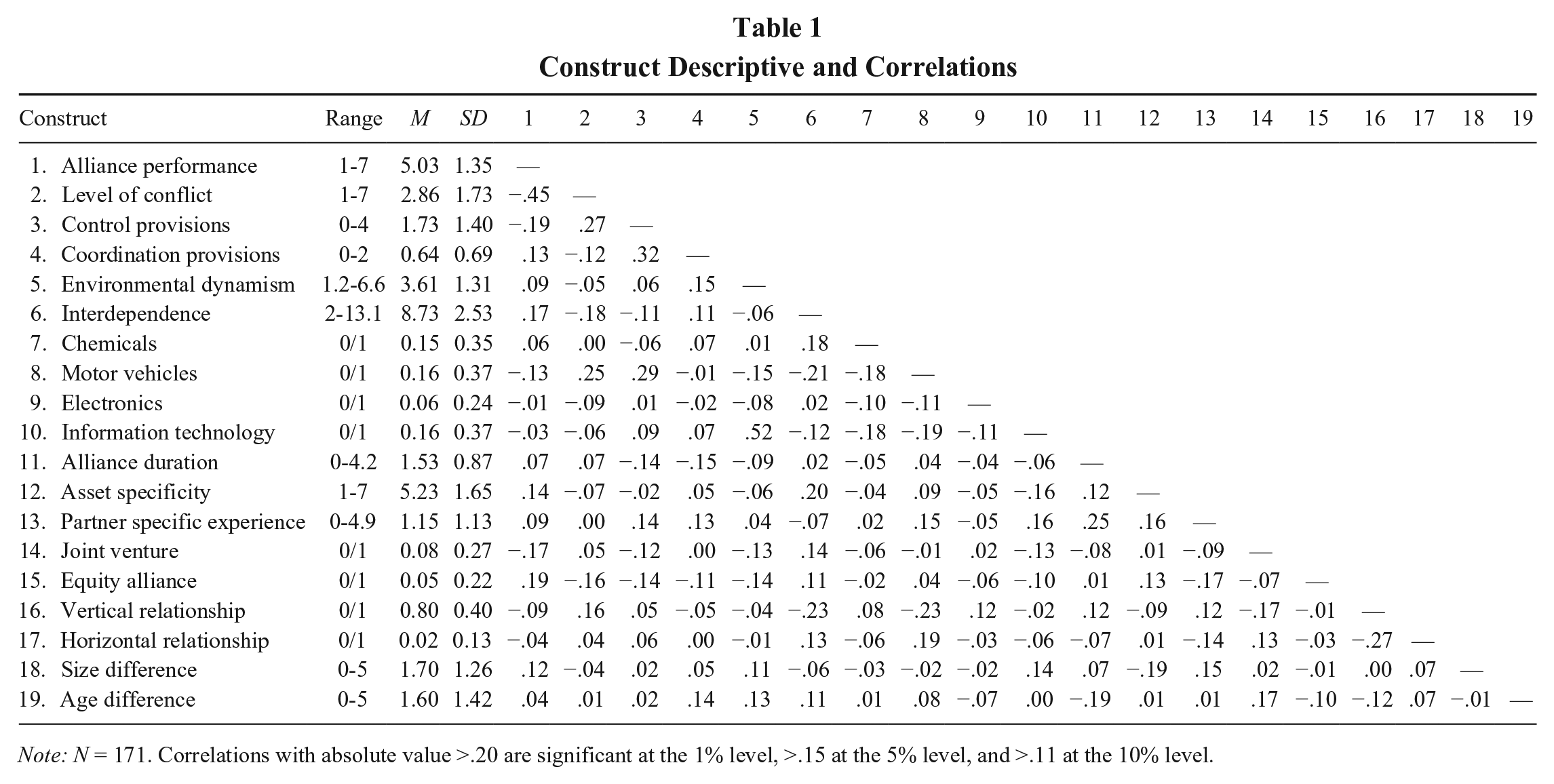
Note: N = 171. Correlations with absolute value >.20 are significant at the 1% level, >.15 at the 5% level, and >.11 at the 10% level.
The correlation matrix reveals several statistically significant bivariate relationships. Here, we briefly discuss selected aspects of the nomological network of control and coordination provisions. First, alliances high on control provisions also tend to be high on coordination provisions. However, the correlation of 0.32 is only moderate, underlining that the two types of provisions can be considered distinct constructs. Moreover, control provisions tend to be present when alliance performance is low, conflict is high, interdependence is modest, the setting is the motor vehicles industry, alliance duration is short, partner-specific experience is high, and the alliance is a non-equity alliance. Coordination provisions, on the other hand, are common when alliance performance is high, conflict is low, environmental dynamism is high, interdependence is high, alliance duration is short, the alliance is an equity alliance, and there is an age difference between partners.
Endogeneity
Since control and coordination provisions represent choice variables that are not randomly assigned across the sample, analyses of their consequences might be affected by endogeneity bias. We used three statistical analyses to assess the potential for endogeneity bias in our study. First, we conducted the Heckman (1979) two-step procedure. This procedure uses a probabilistic choice model to describe the self-selection decision in the first stage and then corrects for self-selection in the second stage by incorporating these predicted probabilities via inverse Mills ratios into the analysis. Specifically, we ran a bivariate probit first-stage model (Mackey & Barney, 2013), in which control provisions and coordination provisions were the dependent variables. Similar to Leiblein and Miller (2003), we previously recoded these variables to create dummies that had a value of 1 if there was at least one relevant provision present and 0 otherwise. All control variables as well as the two moderators were used as predictors of the two dummies in the first-stage model. The results from the second stage revealed that the inverse Mills ratios were not significant for either control provisions (b = −7.11, p > .1) or coordination provisions (b = 7.72, p > .1) and that the inclusion of these ratios in the model did not significantly change the other estimated coefficients, suggesting that our analyses were not affected by endogeneity bias.
Second, we ran propensity score matching (PSM) analyses. Invoking the ignorability assumption, PSM allows biases in the estimate of the treatment effect to be removed by adjusting for differences in the set of pretreatment covariates (Morgan & Winship, 2007). Originally devised for situations where treatment is binary (Rosenbaum & Rubin, 1983), PSM has more recently been extended to independent variables with more than two categories (Hirano & Imbens, 2004), such as, in our case, contractual provisions. Specifically, we used the PSM Stata command dose response, which has been developed specifically for nonbinary treatments (Bia & Mattei, 2008). ML estimation was employed to model the conditional distribution of the treatments given the pretreatment covariates. For this, we used all control variables and moderators of the study. Then, we regressed level of conflict on the two obtained propensity scores as well as our measures for control provisions and coordination provisions. Both the effect of control provisions (b = 0.39) and the effect of coordination provisions (b = −0.48) remained significant in this regression (ps ≤ .05). These findings further alleviated concerns that endogeneity might bias our results.
Third, and finally, we conducted the Durbin-Wu-Hausman endogeneity test (Davidson & MacKinnon, 1993) using two instrumental variables—centralization of alliance management and strategic importance of alliance—as well as the interaction term of these instruments (e.g., Weigelt & Sarkar, 2012). First, contracts can be expected to contain more complex control and coordination provisions when organizations possess centralized units supporting the setup of alliances (Kale, Dyer, & Singh, 2002). Second, more complex control and coordination provisions are typically crafted for strategically important alliances (Reuer & Ariño, 2007). We measured these two instrumental variables on 7-point scales (1 = strongly disagree; 7 = strongly agree) using the following items: “In our firm, there is a great deal of support for the management of R&D alliances through a central unit” (Schilke & Goerzen, 2010) and “We are highly dependent on this R&D alliance” (Reuer & Ariño, 2007). Using Stata 12 software, we found that the two instruments and their interaction are jointly significant predictors of control provisions, F(3, 154) = 3.53, p ≤ .05, as well as coordination provisions, F(3, 154) = 6.76, p ≤ .01, indicating satisfactory instrument strength. We also conducted the Hansen (1982) J test and were unable to reject the null hypothesis that the instruments are exogenous (p = .36), supporting the satisfaction of the exclusion restriction. These two analyses confirm the appropriateness of our instruments (Bascle, 2008). We then ran the Durbin-Wu-Hausman test, which showed that we cannot reject the null hypothesis that the contractual provisions variables are exogenous, χ2 = 1.45, p > .1, further alleviating concerns about endogeneity biasing our estimates. Taken together, the results of the three tests reported above (i.e., Heckman, propensity score matching, and Durbin-Wu-Hausman) attenuated concerns about potential endogeneity in our analysis.
Results
Because two-stage models can yield inefficient estimates when endogeneity is not significant (Davidson & MacKinnon, 1993; Wooldridge, 2008), we used ordinary least square regression analysis for our hypotheses tests. Table 2 presents the results of the regressions. In the table, Models 1 to 5 use level of conflict as the dependent variable, while Models 6 and 7 use alliance performance. The highest variance inflation factor among the explanatory variables in all models was 1.81, suggesting that no problematic multicollinearity is present (Kleinbaum, Kupper, & Muller, 1988).
Regression Results
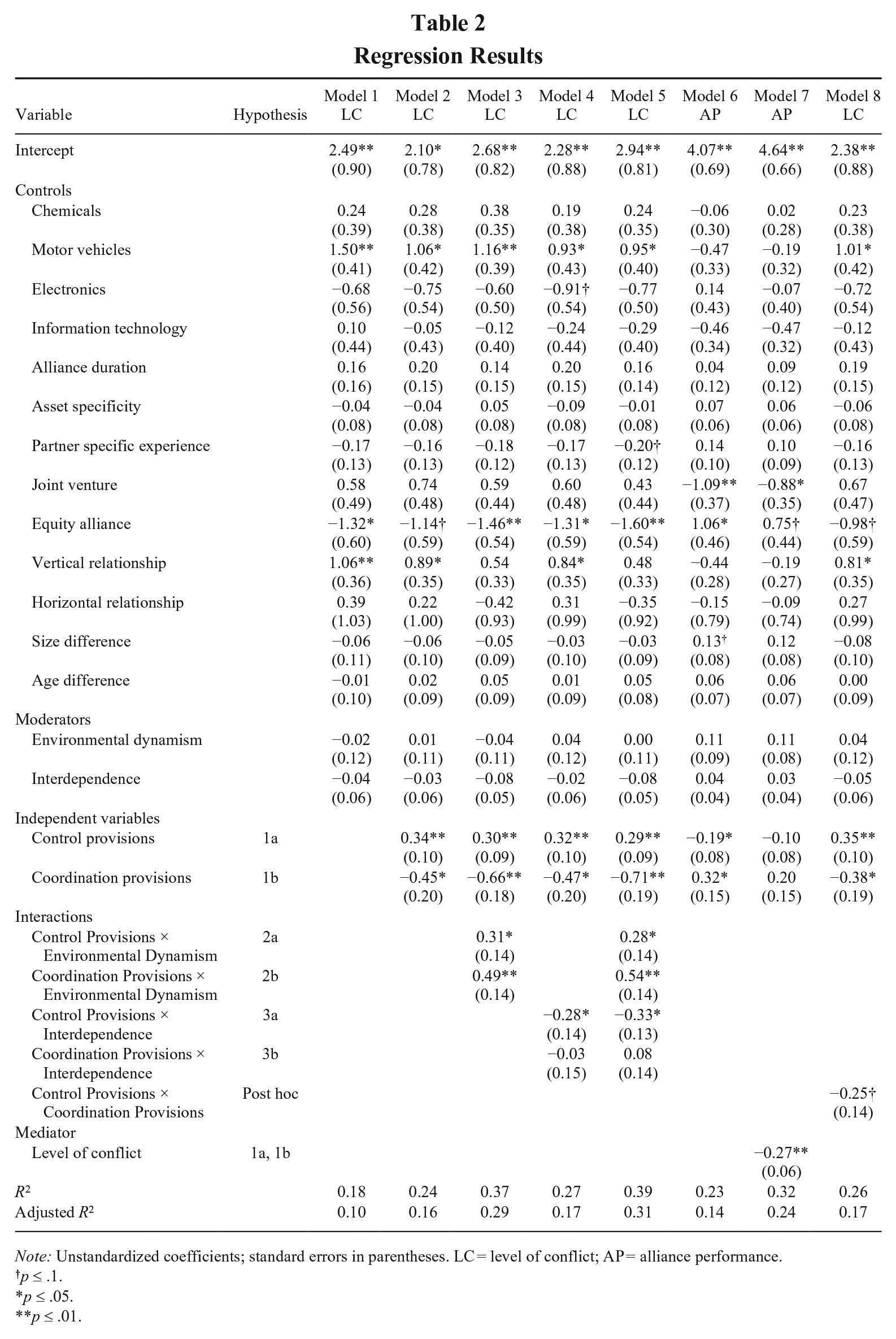
Note: Unstandardized coefficients; standard errors in parentheses. LC = level of conflict; AP = alliance performance.
p ≤ .1.
p ≤ .05.
p ≤ .01.
We first screened the regression results with regard to the mediation effects proposed in Hypotheses 1a and 1b. These hypotheses stated that the effect of both control provisions and coordination provisions on alliance performance is mediated by the level of conflict. Consistent with the standard analytical procedure suggested by Baron and Kenny (1986), three conditions are necessary for the presence of a mediation effect: (a) The independent variable (Hypothesis 1a, control provisions; Hypothesis 1b, coordination provisions) must significantly affect the dependent variable (alliance performance) while not controlling for the mediator (level of conflict), (b) the independent variable (control provisions in Hypothesis 1a, coordination provisions in Hypothesis 1b) must significantly affect the mediator (level of conflict), and (c) the mediator (level of conflict) must significantly affect the dependent variable (alliance performance) after the influence of the independent variable (control provisions in Hypothesis 1a, coordination provisions in Hypothesis 1b) is controlled for.
The results relevant to condition (a) can be found in Model 6. They show that both control provisions and coordination provisions significantly affect alliance performance. Further, the results for Models 2 to 5 consistently show that control provisions and coordination provisions significantly affect the level of conflict, satisfying condition (b). Finally, the results in Model 7 provide evidence for condition (c), as the level of conflict significantly affects the dependent variable when controlling for control and coordination provisions. In this model, the effect of both types of provisions is no longer significant, indicating full mediation (Baron & Kenny, 1986). To further assess whether the mediation pattern was statistically significant, we used Sobel’s (1982) test to determine whether the indirect effects of the two types of contractual provisions on alliance performance via the level of conflict were different from zero. Sobel’s (1982) test was significant for both control provisions (z = 2.69, p ≤ .01) and coordination provisions (z = 2.05, p ≤ .05). Taken together, these results provide empirical support for Hypotheses 1a and 1b.
Next, we turned to our moderating hypotheses by inspecting the interaction terms included in Models 3 to 5. When creating these interaction terms, we standardized their components before multiplying them in order to reduce multicollinearity. Hypothesis 2a suggested that environmental dynamism strengthens the positive relationship between control provisions and conflict, while hypothesis 2b posited that environmental dynamism weakens the negative relationship between coordination provisions and conflict. As Models 3 and 5 show, Control Provisions × Environmental Dynamism has a positive relation with the level of conflict (thus strengthening the positive main effect of control provisions). Moreover, Coordination Provisions × Environmental Dynamism relates positively to the level of conflict (thus weakening the negative main effect of coordination provisions). Therefore, Hypotheses 2a and 2b were supported.
Further, Hypothesis 3a stated that interdependence weakens the positive relationship between control provisions and the level of conflict, while Hypothesis 3b posited that interdependence weakens the negative relationship between coordination provisions and the level of conflict. In line with Hypothesis 3a, the interaction term Control Provisions × Interdependence is significantly related to the level of conflict. However, Coordination Provisions × Interdependence has no significant relationship to the level of conflict (p > .1 in Models 4 and 5). Thus, Hypothesis 3a is supported, while Hypothesis 2b is rejected.
Figure 2 illustrates the interaction effects posited in Hypotheses 2 and 3 graphically. For the purpose of creating this figure, all predictors were standardized, and the independent and moderating variables were split into a low group (one standard deviation below the mean) and a high group (one standard deviation above the mean) (Aiken & West, 1991). Consistent with Hypotheses 2a and 2b, the figure shows that the positive relationship between control provisions and conflict becomes stronger when environmental dynamism is high rather than low, whereas the negative relationship between coordination provisions and conflict is more pronounced when environmental dynamism is low rather than high. The figure also illustrates that the positive relationship between control provisions and conflict is stronger when interdependence is low rather than high, which is in line with Hypothesis 3a. However, there is no significant difference in the relationship between coordination provisions and the level of conflict when comparing conditions of low versus high interdependence, and thus no empirical support for Hypothesis 3b is found.
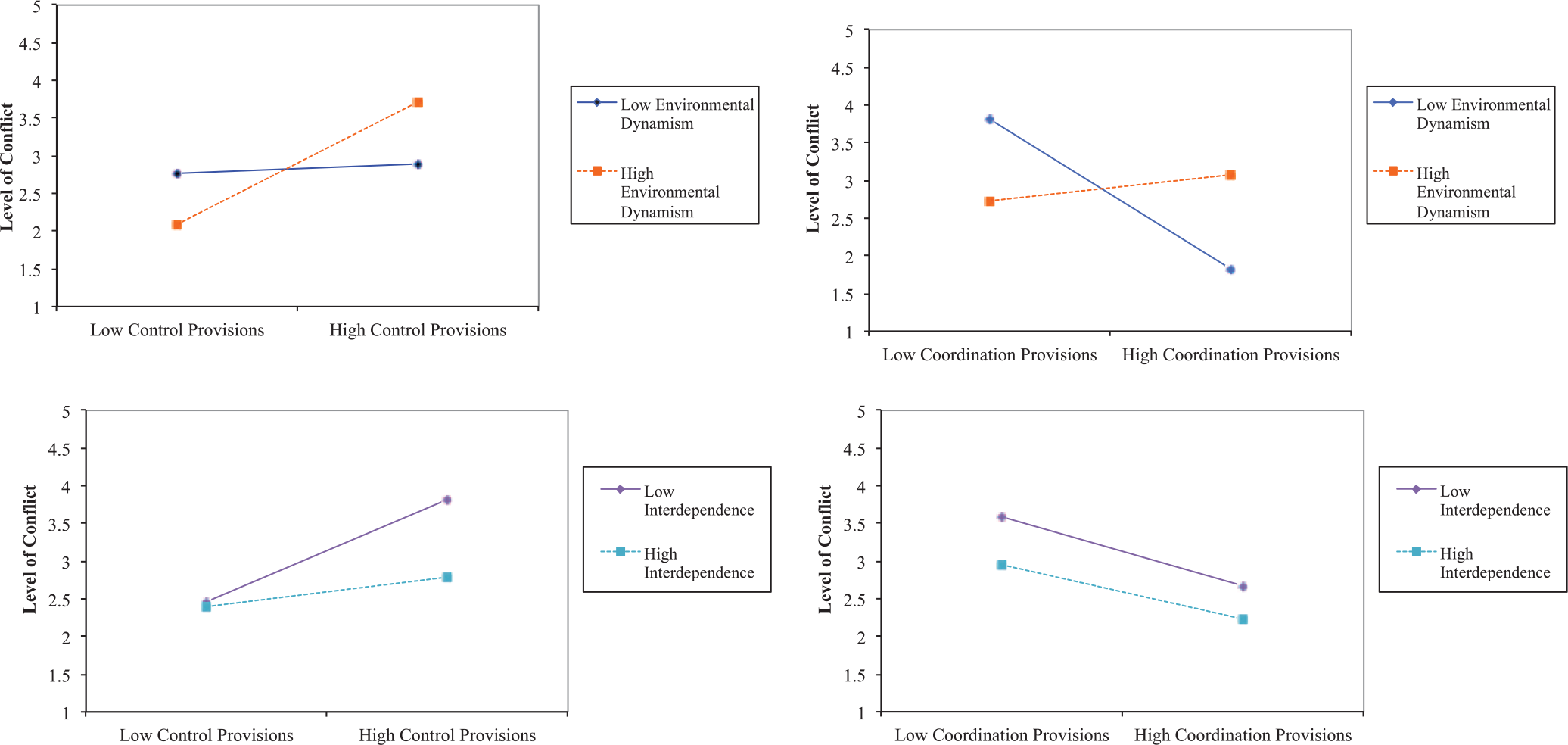
Environmental Dynamism and Interdependence as Moderators of the Effects of Control Provisions and Coordination Provisions on the Level of Conflict
Post Hoc Analyses
Since much previous research on alliance contracts used a holistic measure of contractual safeguards, we were interested in how our results would have differed had we not differentiated between control and coordination provisions in our analysis. We thus reran our Model 2, this time replacing control provisions and coordination provisions with a holistic contractual safeguards measure (i.e., the sum of the four control and two coordination provisions). In this model, the relationship between contractual safeguards and the level of conflict dropped out of statistical significance (b = 0.13, p > .1). Had we used this measure in the main study, this finding may have led us to believe that contractual provisions are essentially unrelated to conflict levels. This insight underscores the relevance of fine-grained approaches to investigating the consequences of contractual provisions.
In another post hoc analysis, we examined a possible interactive effect of control and coordination provisions on conflict, exploring the questions of whether and how the presence of coordination provisions affects the relationship between control provisions and conflict, and whether and how control provisions influence the coordination provisions–conflict relationship. In order to estimate the interactive effect of control provision and coordination provisions on the level of conflict, we estimated Model 8 (shown in Table 2), which included an interaction term for Control Provisions × Coordination Provisions. Results revealed that this interaction term has a negative relationship with the level of conflict at a statistical trend level (p ≤ .10). We elaborate on the theoretical implications of this exploratory finding in our Discussion section below.
Finally, we explored nuances in the pattern of the effects of the two types of contractual provisions on conflict by estimating a spline specification (inspection of margins plots revealed that a spline was a better fit than a polynomial specification). A spline is a continuous function formed by connecting linear segments, and the points where the segments connect are called knots. When rerunning our main-effects model (Model 2), we broke both control provisions and coordination provisions into two linear splines knotted at their respective medians. For control provisions, effects were weak and nonsignificant for the first spline (b = 0.05, p > .1) but strong and highly significant for the second spline (b = 0.79, p ≤ .01), suggesting that the main increase in conflict happens when moving from a medium to a high degree of contractual control. This suggests that if contracts specify the level of control in too elaborate a fashion, they may generate the very conflict they are meant to avoid. Conversely, for coordination provisions, effects were strong and significant for the first spline (b = −0.67, p ≤ .05) but weak and nonsignificant for the second spline (b = −0.21, p > .1). Therefore, having some coordination provisions (versus none) makes a major difference.
Discussion
Theoretical Implications
Our study makes two important theoretical contributions to extant research on alliance contracts. First, we introduce partner conflict as a key social process that is substantially affected by alliance contract design. Whereas transaction cost economics sheds some light on how governance structures are implemented to forestall anticipated conflict (Williamson, 1985), it has paid far less attention to how the governance structures, once implemented, can also induce different levels of subsequent conflict as a result of how these structures frame the relationship. However, as Schepker et al. (2014: 218) make clear, “it is important to understand how to structure contracts to promote social processes that enhance outcomes.” Therefore, we follow the direction of recent inquiry (Poppo & Zhou, 2014) to shed more light on social process and how it can help us to explain how contracts function. Building on the information-processing view, we develop the theoretical argument that contractual provisions influence the level of conflict between partners, which in turn impacts alliance performance. Our empirical study provides strong support for this proposed mediating effect of conflict between contractual provisions and performance.
The study’s second contribution is to enrich extant research on alliance contracts by adopting a granular approach to studying their effects. Whereas earlier research tried to generalize, considering contracts as either beneficial (e.g., Baker, Gibbons, & Murphy, 1994; Sitkin, 1995) or detrimental (e.g., Ghoshal & Moran, 1996; Macaulay, 1963), our findings are much more nuanced, emphasizing the importance of the specific situation in determining contractual effects. Two features of our research model allow us to arrive at more nuanced results: (a) We follow recent recommendations to explicitly distinguish between the contractual functions of control and coordination, and (b) we embrace a contingency approach and study contractual effects under conditions of different degrees of uncertainty. Indeed, our results reveal that contractual provisions can have directly opposite effects depending on whether they pertain to control or coordination. This coexistence of potential beneficial and detrimental outcomes indicates a double-edged effect of contracts.
Moreover, environmental dynamism and partner interdependence strongly qualify any contractual effects. Specifically, we find that environmental dynamism strengthens the positive relationship between control provisions and conflict while weakening the negative relationship between coordination provisions and conflict. Finally, we also find that interdependence weakens the positive relationship between control provisions and the level of conflict. These findings enrich the literature regarding the influence of governance mechanisms on the performance of interorganizational relationships, which has often overlooked any contingency effects (cf. Cao & Lumineau, 2015).
Overall, our study’s findings provide significant novel insights into alliance contracting. They clearly show that alliance contracts are neither good nor bad—their consequences strongly depend on what is in them and in what context they are employed. We thus start to address the all-important “what” and “when” questions in alliance research on contractual performance consequences (Cao & Lumineau, 2015; Weber, Mayer, & Wu, 2009). Our study enriches our understanding of alliance contract design by examining how contractual framing impacts alliance performance. We not only show that each contractual function (control and coordination) may have distinct consequences but also theorize on why and how they work as framing devices to induce specific behaviors. By advancing an alternative approach to combine the study of contract framing and the functionality of contracts, we complement prior research on contract framing (Foss & Weber, 2016; Lumineau & Malhotra, 2011), suggesting that each contractual function is associated with particular frames and thus is likely to distinctively impact the alliance.
Our post hoc analyses also reveal an interesting interactive effect of control and coordination. This is a novel finding, since most previous studies seem to implicitly assume independence between contractual functions in terms of their effects. However, this assumption may be too simplistic, as an emerging literature on the interplay of cooperation and coordination implies (Gulati et al., 2005, 2012). As our results show, control provisions and coordination provisions have a joint impact on alliance outcomes that exceeds their combined individual impacts because of synergies between the two types of provisions. In other words, the marginal effect of control provisions on conflict is dependent on the extent of coordination provisions and vice versa.
Specifically, our results imply that coordination provisions can alleviate the effect of control on conflict. This may be because well-coordinated partners are less prone to suspect hidden agendas and disadvantageous consequences of control provisions. That is, if coordination provisions help align activities and goals between partners, goal direction through control provisions will bring about comparatively less conflict than if no coordination provisions are present. At the same time, control provisions may strengthen the negative effect of coordination on conflict. For coordination to succeed and an alignment of actions to be feasible, some agreement on the respective contributions by both partners is a prerequisite. A context in which partner obligations are clearly delineated by control provisions will thus improve the effectiveness of coordination provisions in reducing conflict. Taken together, these arguments may serve to explain the identified negative interaction between control and coordination provisions. In addition, the correlation of 0.32 between control and coordination provisions may further support this interpretation.
Managerial Implications
This study also provides several important implications that managers may consider helpful when using alliance contracts. While prior research has pointed out the role of contracting capabilities as an essential ingredient of alliance management (Argyres & Mayer, 2007), we contribute to explaining why it is important to adapt the contract design to situational conditions. Managers could gain by better understanding the different functions of contracts and how each function operates under diverse settings. One key implication of our study is that contracts cannot be relied upon in the same way across all alliances. Instead, managers must carefully consider the context surrounding each transaction. In situations of high environmental dynamism, control provisions are a particularly strong source of partner conflict, whereas coordination provisions are less effective. In contrast, when partners are strongly interdependent, the use of contracts as a controlling instrument tends to bring about relatively less conflict. Thus, an effective contract design should go hand in hand with a fine-grained understanding of the type of uncertainty, and alliance negotiations should be oriented toward implementing a contract that is best suited for the individual alliance, rather than trying to use a one-size-fits-all contract.
Limitations and Future Research Directions
Despite our broadly supportive findings, this study is not without limitations, and it also raises new questions that point to fruitful areas for future research. First, our empirical focus on R&D alliances among small- to medium-sized firms in German manufacturing industries requires caution in generalizing our findings. R&D alliances (as opposed to marketing alliances, for example) are commonly oriented toward coexploration (Parmigiani & Rivera-Santos, 2011) and are thus characterized by a relatively high baseline level of uncertainty (e.g., S. Das, Sen, & Sengupta, 1998). Therefore, it seems likely that the contracting process may play a less central role in simpler, shorter, or more exploitation-oriented types of alliances (Argyres & Mayer, 2007), possibly attenuating contractual performance effects. Second, alliances in manufacturing industries follow dynamics that differ from those in service industries in a variety of ways (Lei & Slocum, 1991), making it unclear to what extent our findings also apply to alliances in service industries. Third, Germany’s legal system is known for its efficiency in contract enforcement, providing strong protection for the implementation of agreements specified in contracts (World Bank Group, 2014). It is likely that contracts play a less important role in less efficient legal systems (Cao & Lumineau, 2015). Further studies could therefore analyze the possible influence of the institutional, legal, and cultural contexts and check whether our results generalize to other settings.
Another limitation of our survey study relates to its cross-sectional design. Alliances are dynamic exchanges, but we offer only a snapshot of how contracts influence alliance performance. For instance, environmental uncertainty and interdependence might also work as antecedents for contract clauses. We thus encourage future research to validate our findings using longitudinal data, particularly by exploring the temporal aspect of contracts (i.e., how they are initially created and then enacted). Moreover, as we needed to ensure satisfactory response rates, our measures are sometimes not as fine-grained as we might wish. Future research could thus make an important methodological contribution by developing a more comprehensive measurement instrument capturing contractual functions. In addition, our study focuses on formal contracts, whereas exchanges are also typically governed by informal mechanisms. We therefore acknowledge that repeated partnerships can also affect conflict and contracting, especially since “performance” is not necessarily unidimensional (Holloway & Parmigiani, 2016). Further, it would be interesting to explore whether distinct types of conflict (e.g., operational vs. financial, rooted in bounded rationality vs. opportunism) differentially mediate the contract–performance relationship.
Finally, a detailed explanation of why many organizations implement a great number of control provisions despite the detrimental performance effects identified here is beyond the scope of this paper. We can speculate that it may be quite difficult for managers to identify the right amount of different provisions, especially given the nonlinear effects identified in one of our post hoc analyses. Beyond managers’ bounded rationality, one possible reason that emerged during our field interviews may be related to the strong involvement of lawyers in the design of contracts. For instance, a manager in the chemicals industry mentioned, “Our lawyers really insisted to add several provisions to check and monitor the activities of [our partner]. I wasn’t sure about it but, you know, it’s their job to be sure that the partner is not going to cheat.” Similarly, a purchasing manager from a car manufacturer observed, “I never like when we bring the legal counsel at the negotiation table. [He] looks at every single point of the contract and imagines the worst. For several of our alliances, we had to include a lot of legal stuff just in case.”
The above quotes are in line with research in law suggesting that legal experts tend to be more risk averse than their clients (Langevoort & Rasmussen, 1996) and that they perceive contract design as a central means to codify rights and obligations (Sampson, 2003). More generally, these quotes are also consistent with the notion that powerful parties whose prerogatives would be threatened by abandoning contractual control may advocate these provisions even if they are inconsistent with the interests of economic performance (Adler, 2001). We agree with Argyres and Mayer (2007) that further research is needed to shed more light on the micromechanisms in alliance contract design.
Despite these limitations, our research provides important new insights into how and when contracts matter to alliance performance. The study underscores the need to move beyond a broad approach to contract design to consider the different functions of contracts. Specifically, we suggest that each contractual function (control and coordination) has a different effect on the level of conflict between partners and interacts differently with internal and external uncertainties; thus, in turn, each contractual function tends to have a distinct influence on performance. We hope our study stimulates further research to understand the influence of contractual governance mechanisms.
Footnotes
Appendix
Measurement Items Used in the Survey
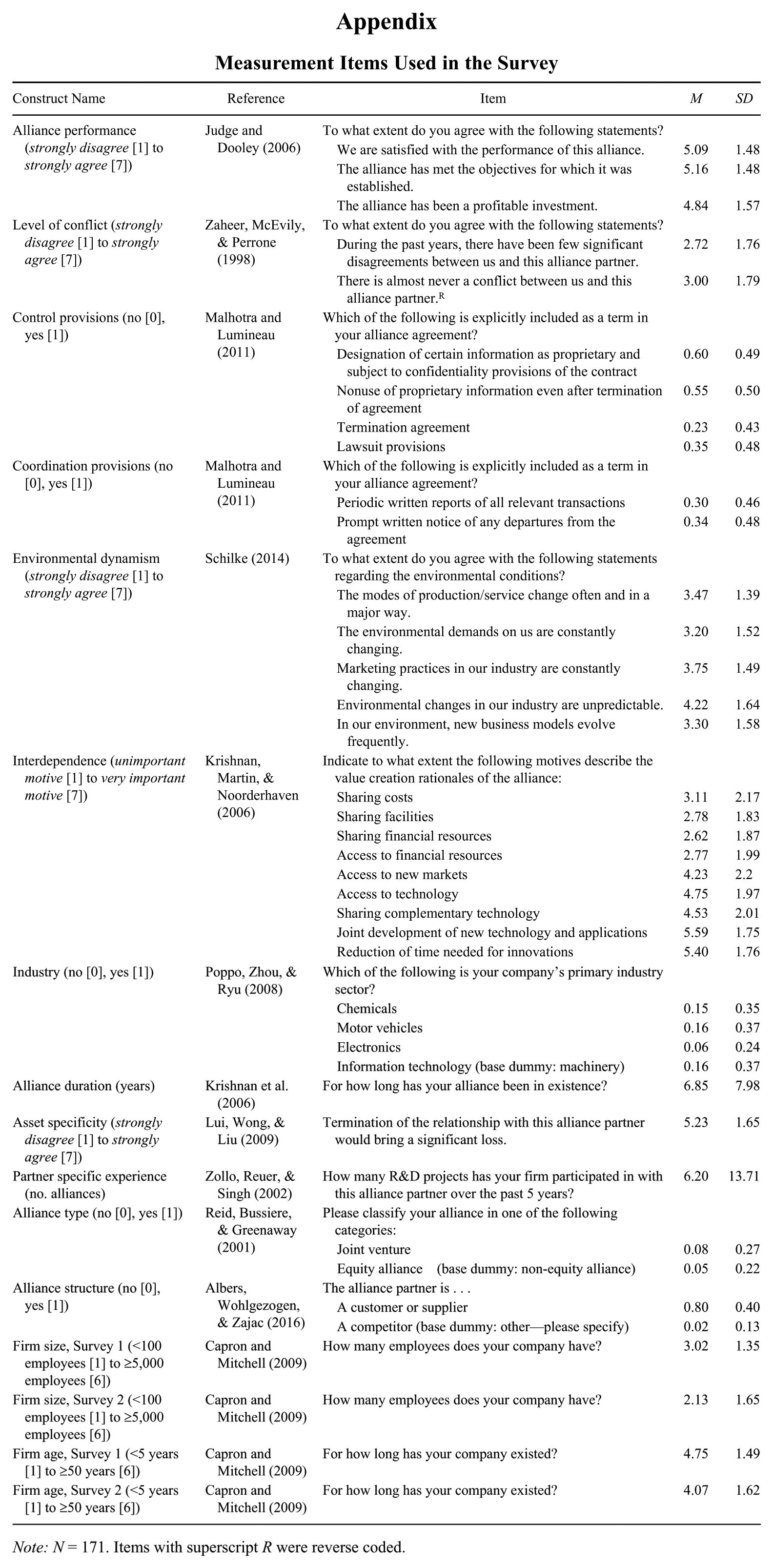
| Construct Name | Reference | Item | M | SD |
|---|---|---|---|---|
| Alliance performance (strongly disagree [1] to strongly agree [7]) |
Judge and Dooley (2006) | To what extent do you agree with the following statements? | ||
| We are satisfied with the performance of this alliance. | 5.09 | 1.48 | ||
| The alliance has met the objectives for which it was established. | 5.16 | 1.48 | ||
| The alliance has been a profitable investment. | 4.84 | 1.57 | ||
| Level of conflict (strongly disagree [1] to strongly agree [7]) | Zaheer, McEvily, & Perrone (1998) | To what extent do you agree with the following statements? | ||
| During the past years, there have been few significant disagreements between us and this alliance partner. | 2.72 | 1.76 | ||
| There is almost never a conflict between us and this alliance partner.R | 3.00 | 1.79 | ||
| Control provisions (no [0], yes [1]) |
Malhotra and Lumineau (2011) | Which of the following is explicitly included as a term in your alliance agreement? | ||
| Designation of certain information as proprietary and subject to confidentiality provisions of the contract | 0.60 | 0.49 | ||
| Nonuse of proprietary information even after termination of agreement | 0.55 | 0.50 | ||
| Termination agreement | 0.23 | 0.43 | ||
| Lawsuit provisions | 0.35 | 0.48 | ||
| Coordination provisions (no [0], yes [1]) |
Malhotra and Lumineau (2011) | Which of the following is explicitly included as a term in your alliance agreement? | ||
| Periodic written reports of all relevant transactions | 0.30 | 0.46 | ||
| Prompt written notice of any departures from the agreement | 0.34 | 0.48 | ||
| Environmental dynamism (strongly disagree [1] to strongly agree [7]) | Schilke (2014) | To what extent do you agree with the following statements regarding the environmental conditions? | ||
| The modes of production/service change often and in a major way. | 3.47 | 1.39 | ||
| The environmental demands on us are constantly changing. | 3.20 | 1.52 | ||
| Marketing practices in our industry are constantly changing. | 3.75 | 1.49 | ||
| Environmental changes in our industry are unpredictable. | 4.22 | 1.64 | ||
| In our environment, new business models evolve frequently. | 3.30 | 1.58 | ||
| Interdependence (unimportant motive [1] to very important motive [7]) | Krishnan, Martin, & Noorderhaven (2006) | Indicate to what extent the following motives describe the value creation rationales of the alliance: | ||
| Sharing costs | 3.11 | 2.17 | ||
| Sharing facilities | 2.78 | 1.83 | ||
| Sharing financial resources | 2.62 | 1.87 | ||
| Access to financial resources | 2.77 | 1.99 | ||
| Access to new markets | 4.23 | 2.2 | ||
| Access to technology | 4.75 | 1.97 | ||
| Sharing complementary technology | 4.53 | 2.01 | ||
| Joint development of new technology and applications | 5.59 | 1.75 | ||
| Reduction of time needed for innovations |
5.40 | 1.76 | ||
| Industry (no [0], yes [1]) | Poppo, Zhou, & Ryu (2008) | Which of the following is your company’s primary industry sector? | ||
| Chemicals | 0.15 | 0.35 | ||
| Motor vehicles | 0.16 | 0.37 | ||
| Electronics | 0.06 | 0.24 | ||
| Information technology (base dummy: machinery) | 0.16 | 0.37 | ||
| Alliance duration (years) | Krishnan et al. (2006) | For how long has your alliance been in existence? | 6.85 | 7.98 |
| Asset specificity (strongly disagree [1] to strongly agree [7]) | Lui, Wong, & Liu (2009) | Termination of the relationship with this alliance partner would bring a significant loss. | 5.23 | 1.65 |
| Partner specific experience (no. alliances) | Zollo, Reuer, & Singh (2002) | How many R&D projects has your firm participated in with this alliance partner over the past 5 years? | 6.20 | 13.71 |
| Alliance type (no [0], yes [1]) | Reid, Bussiere, & Greenaway (2001) | Please classify your alliance in one of the following categories: | ||
| Joint venture | 0.08 | 0.27 | ||
| Equity alliance (base dummy: non-equity alliance) | 0.05 | 0.22 | ||
| Alliance structure (no [0], yes [1]) | Albers, Wohlgezogen, & Zajac (2016) | The alliance partner is . . . | ||
| A customer or supplier | 0.80 | 0.40 | ||
| A competitor (base dummy: other—please specify) | 0.02 | 0.13 | ||
| Firm size, Survey 1 (<100 employees [1] to ≥5,000 employees [6]) | Capron and Mitchell (2009) | How many employees does your company have? | 3.02 | 1.35 |
| Firm size, Survey 2 (<100 employees [1] to ≥5,000 employees [6]) | Capron and Mitchell (2009) | How many employees does your company have? | 2.13 | 1.65 |
| Firm age, Survey 1 (<5 years [1] to ≥50 years [6]) | Capron and Mitchell (2009) | For how long has your company existed? | 4.75 | 1.49 |
| Firm age, Survey 2 (<5 years [1] to ≥50 years [6]) | Capron and Mitchell (2009) | For how long has your company existed? | 4.07 | 1.62 |
Note: N = 171. Items with superscript R were reverse coded.
Acknowledgements
This article was accepted under the editorship of Patrick M. Wright. Valuable guidance from the action editor, Anne Parmigiani, and two anonymous referees is gratefully acknowledged. Guilhem Bascle, Valérie Duplat, Shiau-Ling Guo, Rekha Krishnan, Joon Mahn Lee, Jason Pattit, and participants at the AOM Philadelphia 2014, ACAC Atlanta 2015, and SMS Denver 2015 conferences and seminars at the London School of Economics, King’s College London, Telecom Business School, and VU Amsterdam also provided helpful suggestions on earlier drafts of this manuscript. All errors remain our own.
The authors contributed equally to this paper and both are co–first authors.