






Abstract
In this study, we hypothesized that perceived overqualification would interact with person-organization fit (P-O fit) to predict extra-role behaviors toward coworkers (organizational citizenship behaviors targeting others [OCBI] and voice) and indirectly relate to advice network centrality. We collected data from 332 municipality services employees reporting to 41 supervisors in Istanbul, Turkey, across three timepoints and from three different sources. Tests of our model provided partial support for our predictions. Results revealed that perceived overqualification had negative main effects on OCBI and interacted with P-O fit to affect voice. Further, P-O fit moderated the indirect effects of perceived overqualification on advice network centrality such that there were significant negative indirect effects via OCBI only when P-O fit is low. Implications for the overqualification, perceptions of fit, and social network literatures are discussed.
Despite efforts by employers to match employees to position requirements and a desire on the part of job applicants to fully utilize their skills, employees may find themselves in positions where they feel overqualified. Perceived overqualification, or the perception that one’s skills, abilities, education, and experience are neither required by nor utilized on the job (Erdogan, Bauer, Peiró, & Truxillo, 2011b), is increasingly common. For example, a study by the nonprofit Urban Institute found that in 2014, 25% of college graduates held jobs that did not require their degree (Rose, 2017), paving the way for potential feelings of overqualification. Perceived overqualification is considered a barrier to both engagement and retention. For example, a meta-analysis of the literature has shown that perceived overqualification is related to dissatisfaction with one’s job, lower levels of commitment to the organization, and an increased desire to leave the company (Harari, Manapragada, & Viswesvaran, 2017). At the same time, there is emerging evidence that under the right conditions, feelings of overqualification may be associated with more positive outcomes such as proactive behaviors (Zhang, Law, & Lin, 2016) and creativity (Lin, Law, & Zhou, 2017; Luksyte & Spitzmueller, 2016). Given its potential upsides as well as downsides, investigating the consequences of perceived overqualification remains an important research topic (Erdogan et al., 2011b).
One frequently proposed but yet unexamined implication of overqualification is that it may give employees a social capital advantage (e.g., Feldman & Maynard, 2011; Russell, Ferris, Thompson, & Sikora, 2016). Social capital refers to resources an individual has as a result of their social network connections and relationships (Belliveau, O’Reilly, & Wade, 1996). An important source of social capital for employees is their centrality in advice and information networks (Bono & Anderson, 2005). Advice network centrality, or being sought after for advice and information, bestows advantages including greater influence in the workplace (Brass & Burkhardt, 1993). Researchers proposed that employees who feel overqualified may utilize their knowledge and skills in ways that are beneficial to coworkers (e.g., Erdogan et al., 2011b; Sikora, Thompson, Russell, & Ferris, 2016). For example, Thompson, Shea, Sikora, Perrewé, and Ferris (2013) noted that overqualified employees “represent an important training and mentoring resource for companies. These employees can share their knowledge and experiences by helping other employees learn new skills, thus shortening the learning curve for newly-hired employees” (p. 120). Further, hiring managers express the view that overqualified employees may increase the knowledge base of the department, resulting in “one more person you can go to” (Kulkarni, Lengnick-Hall, & Martinez, 2015, p. 538). The likelihood that employees who feel overqualified would share their knowledge and skills is often cited as a potential advantage of employing them (e.g., Gallo, 2011; Wells, 2004). In other words, employees who feel overqualified could behave in ways that will put their skills to the use of others, which would help them become centralized members in their social network.
Notwithstanding these positive arguments, the accumulated body of knowledge hints that in reality, feelings of overqualification may not always be a positive force with respect to helping or supporting coworkers. To date, the empirical literature is relatively silent regarding how feelings of overqualification affect behavior targeting one’s colleagues, and the few studies on outcomes such as proactive behaviors targeting coworkers (Zhang et al., 2016), social acceptance, and altruism (Deng, Guan, Wu, Erdogan, Bauer, & Yao, 2018) suggest that any observed positive effects are conditional, and in some cases, the effects are negative (e.g., Deng et al., 2018). Thus, the absence of studies linking perceived overqualification to social capital represents a theoretically and practically important research opportunity.
In this study, we develop a two-stage model predicting that perceived overqualification will have an indirect relationship with advice network centrality via two extra-role behaviors targeting coworkers (organizational citizenship behaviors targeting coworkers [OCBI] and voice). Our model is grounded in person-environment (P-E) fit theory (Caplan, 1987) and network generation theory (Nebus, 2006). First, drawing from P-E fit theory, we examine how employees’ perceived overqualification is associated with behaviors of employees toward their coworkers. In the P-E fit literature, overqualification is regarded as a type of person-job misfit (e.g., Kristof-Brown, Zimmerman, & Johnson, 2005; Maynard, Joseph, & Maynard, 2006). The P-E fit theory also recognizes the simultaneous existence of multiple types of fit, with person-organization fit (P-O fit), or the degree to which the individual shares the values, goals, and priorities of those of the organization (O’Reilly, Chatman, & Caldwell, 1991), among the most frequently studied types of fit (Kristof-Brown et al., 2005). Our prediction is that perceived overqualification will interact with P-O fit to determine employee extra-role behaviors benefiting others. In the second part of the model, we switch our focus to how coworkers in turn react to employees’ extra-role behaviors. Network generation theory (Nebus, 2006) predicts that individuals who are willing to share their knowledge with others and are not too costly to seek advice from emerge as central in social networks. As a result, we regard extra-role behaviors as the mediating mechanism linking perceived overqualification to advice network centrality.
Our study makes three specific and important contributions to the literature. First, we seek to integrate the perceived overqualification and social network literatures. Specifically, we examine the degree to which employees who feel overqualified will act in ways benefitting their coworkers and thereby indirectly affecting their own centrality in an advice network. The possibility that perceived overqualification is a barrier to camaraderie is one of the reasons hiring managers express hesitation when hiring overqualified workers (Korkki, 2009), whereas the potential that these employees could help, support, and share information with their colleagues is cited as a reason to hire these employees (e.g., Gallo, 2011). Thus, investigating the nature of the relationship between perceived overqualification and one’s network standing is important for both theory and practice. Our investigation also asks the question of when perceived overqualification may indirectly affect network centrality. By incorporating a moderator drawn from P-E fit theory, we present a more finely tuned examination of the effects of perceived overqualification and add to the small body of studies adopting a contingency perspective to overqualification (e.g., Hu, Erdogan, Bauer, Jiang, Liu, & Li, 2015; Zhang et al., 2016). Understanding the effects of overqualification in interaction with P-O fit is important in that both organizational decision makers and employees consider fit with the job and the organizational values simultaneously in their decision-making processes (Cable & Judge, 1996; Chuang & Sackett, 2005).
Second, we contribute to the extra-role behavior literature by our joint examination of OCBI and voice as the mechanisms linking perceived overqualification to advice network centrality. OCBI and voice are two forms of complementary extra-role behaviors, with OCBI representing affiliative behaviors of helping and supporting coworkers and voice referring to the challenging behaviors of questioning the status quo with the intention of improving it (LePine & Van Dyne, 1998; Van Dyne & LePine, 1998). Given that voice behavior entails more risk than helping, Morrison (2014) called for research examining implications of voice for coworker relations, employee image, and career success that goes beyond how voice is evaluated by supervisors. Thus, even though studies have examined effects of voice on supervisor reactions such as performance evaluations (e.g., Burris, 2012), how voice behavior may affect the standing of the employee among coworkers in a social network is unknown. Therefore, the investigation of advice network centrality as a potential outcome of voice is an important contribution because despite carrying risks for employees, being vocal about issues that affect the group may have the hidden benefit of facilitating greater network centrality.
Finally, our study seeks to make a contribution to the social network literature. Studies of informal advice and informational networks have typically examined outcomes of these networks (e.g., Venkataramani, Labianca, & Grosser, 2013), while studies treating the network itself as an outcome are rare. Further, existing studies in the latter category have primarily focused on characteristics of the actors within the networks, such as personality (Landis, 2016), technical knowledge (Keith, Demirkan, & Goul, 2010), education, and tenure (Liu & Ipe, 2010). Our study adds to the limited research examining behavioral correlates of advice network centrality (e.g., Erdogan, Bauer, & Walter, 2015; Klein, Lim, Saltz, & Mayer, 2004; Zhang, Zheng, & Wei, 2009). This is an important direction because examining network centrality solely as a function of who the focal actors are rather than what they actually do will provide only an incomplete picture of how and why employees occupy a central position in social networks.
Theoretical Overview
Collegial networks constitute the “informal organization” at work (Barnard, 1938), and network centrality captures one’s position in the social hierarchy. Individuals are hired not only to perform a specific job but also with the hope that they will become integrated into the social fabric of the organization. Particularly centrality in the advice network is important to one’s social integration because those who occupy central positions in the advice network are regarded as influential (Sparrowe & Liden, 2005) and hold social power (Chiu, Balkundi, & Weinberg, 2017). Unlike centrality in friendship networks, advice network centrality is associated with status within a collective because it grants individuals access to more influence (Ibarra & Andrews, 1993).
Our proposed two-stage model (presented in Figure 1) suggests that the hypothesized relationship between perceived overqualification and advice network centrality will occur through individuals’ extra-role behaviors targeting coworkers. This is because a reliable way in which individuals gain centrality in their groups and achieve status is through actions that benefit others (Willer, 2009). According to network generation theory, individuals do not emerge as central in their advice network solely due to their qualifications or expertise. Instead, they become targets of advice seekers when they are regarded as willing to share their knowledge with others and are not too costly to seek advice from (Nebus, 2006). Therefore, individual behaviors signaling cooperativeness should positively relate to advice network centrality. Past research is supportive of a potential link between cooperative actions and advice network centrality. In their model of social capital development, Bolino, Turnley, and Bloodgood (2002) regarded citizenship behaviors as precursors to social capital. Others have found main effects of helping behaviors on advice network centrality (Liu & Ipe, 2010; Zhang et al., 2009). As a result, in our model, we regard extra-role behaviors targeting coworkers as the mediator, linking how employees feel about their qualifications to how coworkers react to them.
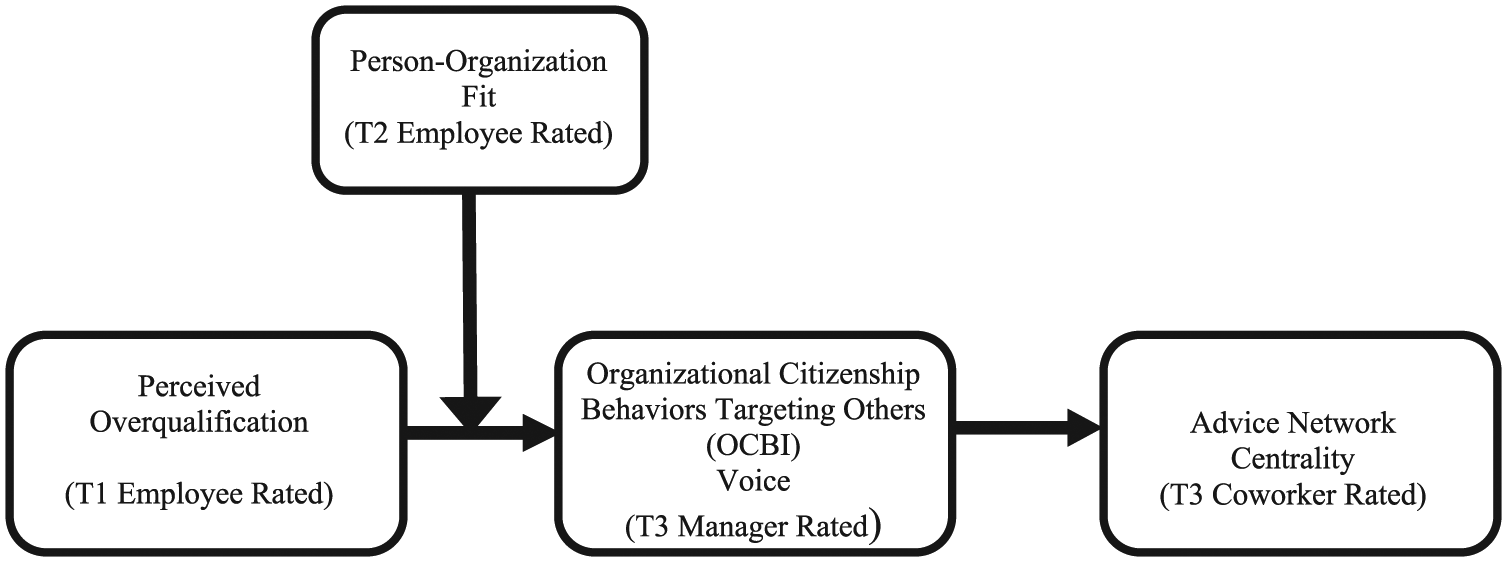
Study Model
OCBI and Voice
We focus on two types of extra-role behaviors targeting coworkers: engaging in citizenship behaviors targeting coworkers (known as OCBIs) and engaging in voice behaviors. A review of the past literature suggests that these two are both behaviors that are not part of employee job descriptions and have the potential to benefit others (Lavelle, 2010; Van Dyne, Ang, & Botero, 2003). OCBI involves discretionary effort to aid others (Williams & Anderson, 1991). Examples of OCBI include helping others who have heavy workloads and mentoring new colleagues. Predictors of OCBI include employee personality (Chiaburu, Oh, Berry, Li, & Gardner, 2011) and leader-member exchange (Ilies, Nahrgang, & Morgeson, 2007).
Voice is an extra-role behavior that involves speaking up on important issues and ideas (Van Dyne & LePine, 1998), including developing recommendations to solve problems facing the group and speaking up with ideas for new projects and/or those that may benefit the group. Voice behavior is thought to benefit the collective, as opposed to solely benefiting the instigator of voice (Van Dyne et al., 2003). For example, McClean, Burris, and Detert (2013) noted that To be prosocial, and thus meet organizational scholars’ definition of voice, an employee’s input about needed improvements does not primarily benefit just the one individual who speaks up, but instead has the possibility of bettering the situation for a broader set of employees around the speaker. (p. 526)
Supporting this view, group-level voice has been shown to be positively related to group performance (Frazier & Bowler, 2015). Unlike OCBI, voice involves changing the status quo and has a greater knowledge-sharing component. Further, voice entails more risk for the employee due to the inherent challenge to the status quo. Studies have shown that leadership style and behaviors (Tangirala & Ramanujam, 2012), psychological safety (Liu, Tangirala, et al., 2015), and trust in the organization (Ng & Feldman, 2013) are among its predictors.
Perceived Overqualification and Extra-Role Behaviors Targeting Coworkers
Past research examining the implications of perceived overqualification for discretionary actions targeting coworkers is scant. Burris’s (1983) interviews of a small sample of clerical workers suggested that employees who were overeducated for their jobs reported negative feelings toward their coworkers and distanced themselves from them in an elitist manner. More recently, Sierra (2011) predicted that in a group setting, overqualification may result in less collaboration with coworkers by increasing one’s psychological distance from coworkers. In fact, there is some evidence that perceived overqualification is negatively related to behaviors targeting coworkers and coworker relations. Specifically, Khan and Morrow (1991) found that perceived overqualification was negatively related to satisfaction with coworkers. Luksyte, Spitzmueller, and Maynard (2011) found that perceived overqualification predicted employee cynicism about the meaningfulness of the job, which in turn was related to counterproductive behaviors, including those targeting coworkers.
At the same time, other studies have shown that in some cases, perceived overqualification serves as a positive influence over how employees behave toward their coworkers. Hu et al. (2015) reported a positive relation with fitting in with one’s group, and the relation was even more positive when peer overqualification was high. Zhang et al. (2016) showed that overqualification was positively related to proactive behaviors targeting coworkers when performance goal orientation was high. Deng et al. (in press) found that overqualification could have positive or negative relations with social acceptance and subsequent interpersonal altruism, depending on the social skills of employees. These contingent relations are in line with other studies examining perceived overqualification in relation to discretionary behaviors that do not target coworkers, such as creativity (Luksyte & Spitzmueller, 2016), counterproductive work behaviors targeting the supervisor and the organization (Liu, Luksyte, Zhou, Shi, & Wang, 2015), and task crafting (Lin et al., 2017). In other words, the literature suggests that perceived overqualification could result in employees demonstrating higher or lower levels of extra-role behaviors targeting coworkers, and the relationship is likely to depend on the presence of factors that would motivate an employee to utilize their underutilized skills for the benefit of others.
P-O Fit as a Moderator of Perceived Overqualification
We propose that the degree to which employees who feel overqualified choose to use their surplus qualifications for the benefit of their colleagues as opposed to withhold effort due to low motivation will depend on their level of P-O fit. Perceived overqualification can be thought of as a type of person-job (P-J) misfit (Kristof-Brown et al., 2005). However, according to P-E fit theory, employees fit into their environments in multiple ways, and achieving all types of fit within the same job may not always be possible (Kalleberg, 2008). P-O fit indicates an alignment between values that are central to the employee’s own personal identity and those of the organization (O’Reilly et al., 1991). P-E fit literature regards P-J and P-O fit as related but distinct types of fit with the environment (Lauver & Kristof-Brown, 2001). At the same time, there is increasing interest in understanding how employees simultaneously interpret and react to fit with different aspects of their environment (Kristof-Brown & Guay, 2011). As a result, there is emerging evidence that person-job and person-organization fit may interact to affect employee behaviors. For example, in a policy capturing study, Kristof-Brown, Jansen, and Colbert (2002) demonstrated interactive effects between different types of fit and concluded that individuals could compensate for low fit in one area with high fit in others with respect to work satisfaction. Subsequently, Jansen and Kristof-Brown (2006) argued for interactive effects because individuals would downplay the cognitive dissonance that would arise from having fit on one dimension when they fit on a different dimension. Supporting this prediction, Resick, Baltes, and Shantz (2007) studied employees taking part in an internship program and showed that P-O fit alleviated the negative effects of low P-J fit for job choice intentions. In the overqualification literature, Bills (1992) interviewed recruiters to examine reactions to atypical job candidates. The interviews revealed that one instance where employers felt comfortable with hiring overqualified candidates (presumably with the expectation that such overqualification would not be a problem from a motivation standpoint) was a situation where fit with the company was high.
In their examination of why P-O fit leads to positive outcomes, Edwards and Cable (2009) theorized and found support for three mechanisms. First, P-O fit enhances shared understanding of what is right and wrong and thus enhances trust. Second, P-O fit facilitates a shared understanding with organizational members for interpreting events and thereby enhances communication with others. Third, shared values increase attraction to the organization and its members. Employees who have high perceived overqualification have favorable opinions about their own skills and feel underutilized. Such feelings are often accompanied by a sense of cynicism regarding the meaningfulness of their job (Luksyte et al., 2011) and withdrawal (Maynard & Parfyonova, 2013). When P-O fit is also low, employees are likely to lack confidence that the organization will not take advantage of them and will have low desire to behave in ways that will benefit other organizational members and low confidence that any ideas or extra effort offered by the employee will be aligned with the organization’s preferences and therefore will be well received. As a result, when P-O fit is low, perceived overqualification is likely to have negative relations with demonstrating helping behaviors.
In contrast, when P-O fit is high, employees who feel overqualified should experience a desire to utilize their perceived surplus skills by helping coworkers, given their greater trust in the organization, shared understanding with others, and greater regard for what happens to the organization. Employees who feel overqualified feel a sense of underutilization with respect to their training, experience, education, and skills. One way of resolving the discrepancy between the skills they could utilize versus those they actually do is to be more helpful to others and put their surplus skills to the service of their coworkers. We expect that high levels of P-O fit would facilitate a shared understanding with and attraction to others (Edwards & Cable, 2009) and increase the motivation to utilize one’s surplus skills by benefiting other organizational members, resulting in a positive relation between perceived overqualification and OCBI.
Similarly, the relation between perceived overqualification and voice behavior should be contingent on P-O fit. Morrison (2014), in her summary model of voice behavior, posited that voice behavior is a function of “voice opportunity” or opportunities to recognize areas for improvement in interaction with motivators and inhibitors. In other words, for voice to occur, employees should have something to say and the motivation to say it. Employees who feel overqualified and therefore feel that they have experience, skills, and abilities that surpass the job should be able to generate ideas about how to improve the work context and therefore will have voice opportunities. However, they may not necessarily be motivated to benefit others or believe that others will be receptive to their ideas when they have low P-O fit. Conversely, when they have high P-O fit, their thinking is likely to be more aligned with that of the organization, and their desire to benefit the organization will be greater, which should motivate employees who feel overqualified to display greater voice. In contrast, when P-O fit is low, the more overqualified an employee feels, the lower is the likelihood to engage in discretionary actions benefiting others, resulting in lower levels of voice behavior.
Hypothesis 1: P-O fit will interact with perceived overqualification to affect the extra-role behaviors of (1a) OCBI and (1b) voice such that the relationship between perceived overqualification and extra-role behaviors will be positive when P-O fit is high but negative when P-O fit is low.
Extra-Role Behaviors Targeting Coworkers and Advice Network Centrality
In the second part of our model, we adopt the viewpoint of coworkers and propose that the extra-role behaviors of OCBI and voice will be positively related to a person’s advice network centrality. Social network scholars postulated that individuals who show willingness to be of service to others are more likely to be selected as potential advice sources (Nebus, 2006). Advice seeking is an inherently risky activity because it involves admitting gaps in one’s knowledge and makes the advice seeker vulnerable to the advice giver (Erdogan et al., 2015). Advice seekers engage in cost/benefit analyses to decide who to go to for advice (Hofmann, Lei, & Grant, 2009), and those who offer greater benefits and lower costs to advice seekers will emerge as central in advice networks. As a result, individuals are expected to achieve a central position in a given social network through their own actions signaling willingness to be of service to others. Similarly, studies have shown that those who behave cooperatively toward others enjoy greater status in a collective (Hardy & Van Vugt, 2006; Willer, 2009), suggesting a link between extra-role behaviors targeting others and social standing.
Extra-role behaviors targeting coworkers in the form of helping others and speaking up are both potential indicators of goodwill, making the individual a suitable target of others’ advice seeking. Members who display extra-role behaviors targeting coworkers are likely to be selected as potential advice givers and also retained as part of one’s advice network because they signal willingness to help and put forth effort for the well-being of others. Research to date has examined interpersonal citizenship behaviors as a precursor to the likelihood of emerging as someone others go to for advice (Liu & Ipe, 2010; Zhang et al., 2009). To our knowledge, no studies to date have treated voice as a predictor of advice network centrality. However, Liang and Gong (2013) showed that employees who display voice attract greater levels of informal mentors. The authors of the study contended that this is because voice will signal to others that the employee is competent and increase the visibility of the employee. Based on this rationale, we predict that employees who display higher levels of OCBI and voice will be desirable targets of coworker advice seeking efforts, predicting greater levels of advice network centrality.
Hypothesis 2: There is a positive relationship between extra-role behaviors of (2a) OCBI, (2b) voice, and advice network centrality.
Finally, to summarize the earlier hypotheses, we expect extra-role behaviors targeting coworkers to mediate the relationship between perceived overqualification and advice network centrality. Perceived overqualification and P-O fit should interact to affect extra-role behaviors targeting coworkers. The degree to which they engage in discretionary actions that benefit their team members should in turn relate to the individual’s advice network centrality. Perceived overqualification is expected to have negative indirect effects when P-O fit is low and positive indirect effects when P-O fit is high.
Hypothesis 3: Extra-role behaviors of (3a) OCBI and (3b) voice will mediate the interaction between P-O fit and perceived overqualification in relation to advice network centrality.
Method
Sample and Procedure
We collected data from employees and supervisors working in one of the 39 district municipalities in Istanbul, Turkey. Each municipality provides urban infrastructure services to residents living within their boundaries. The municipality we studied serves a population of approximately 250,000 residents. After securing permission from the head of municipality, we carried out the study with the cooperation of their Human Resources and Training department. Because of the physically dispersed nature of work, we excluded employees who worked offsite (e.g., groundskeepers working in the parks and recreation department) and focused only on employees working in an office setting, resulting in a population of 730 employees.
We conducted the study in three waves. Employees filled out surveys at three points in time (T1, T2, and T3), and their supervisors completed a survey at T3. The T2 surveys were distributed one month after T1, and T3 surveys were distributed two months after T2. There was a longer lag between T2 and T3 surveys because we wanted to avoid distributing surveys during Ramadan as during the month of Ramadan, many employees fast (abstain from eating or drinking) from sunrise to sunset, which could have resulted in lower response rates and quality.
Due to uneven employee access to computers, we used paper-based surveys to gather data. In T1, employees reported their demographics and perceived overqualification. In T2, employees reported their perceived level of P-O fit. At T3, supervisors rated the extra-role behaviors targeting coworkers for each of their subordinates (OCBI, voice). Finally, in T3, employees reported the names of peers who they frequently go to for job-related advice. We used coworker reports of the number of times a focal employee was named as a source of advice to others on organizational matters to operationalize advice network centrality. Thus, data were collected at three time periods from three sources: employees (perceived overqualification, P-O fit), supervisors (extra-role behaviors), and coworkers (advice network centrality). We assigned a unique code number to each employee and ensured that each survey listed the correct ID number to match surveys across time. Supervisor questionnaires also included a predefined code number for each employee instead of names. We provided each supervisor with a list of names matched to code numbers to facilitate their ratings. The second author physically collected the completed surveys. Participation was voluntary, and we raffled a gift as an incentive to increase the response rate. The winner of the raffle was eligible for one of three alternative prizes, which included sailing classes, English as a second language classes, or a mini tablet computer.
We distributed the first survey to all 730 employees. At T1, we received 421 completed surveys (response rate = 58%). We received 388 completed surveys in the second phase and 317 in the third phase from the employees. A total of 51 supervisors rated extra-role behaviors targeting coworkers for 423 employees. Finally, advice network centrality information was reported for 534 employees.
In cases where other-rated data were available (OCBI, voice, and network centrality), we were able to compare respondents and nonrespondents. Respondents (those who responded to at least one wave) differed from nonrespondents (those who did not respond in T1 or T2) in terms of their manager-rated OCBI (means 5.55 vs. 5.04, t = 3.76, p = .000) and voice (means 5.27 vs. 4.83, t = 3.41, p = .001). Further, the respondents differed from nonrespondents with respect to advice network centrality (means .72 vs. .36, t = 3.22, p = .001). Survey completion being related to citizenship behaviors has been recognized in the literature (Spitzmüller, Glenn, Sutton, Barr, & Rogelberg, 2007), and a limitation of our study is that range restriction could be a problem in our sample (Weiner, Graham, & Naglieri, 2003). However, a review of our sample responses showed that respondents used the full response scale, with observed ranges between 1.11 to 7 (SD = 1.29) for overqualification, 1 to 7 (SD = 1.47) for P-O fit, 2.14 to 7 (SD = .96) for OCBI, and 1.50 to 7 (SD = 1.06) for voice. Further, following Halbesleben and Whitman’s (2013) recommendation, we reviewed the extant literature relating to our study variables to examine whether we had sampled an unusually positive sample with respect to their overqualification, P-O fit, and extra-role behaviors. Our examination of studies from the past five years suggests that the means and standard deviations we observed for our study variables were well within the range of what was observed in prior published research. These results suggested that range restriction may not be a severe problem in our sample.
At the same time, our response-nonresponse analyses suggest that the missing data in our study may violate the missing completely at random (MCAR) assumption and instead are more consistent with the missing at random (MAR; Newman, 2009) pattern. In other words, whether employees responded to the survey or not was not a random process, and instead, whether employees completed the surveys where we measured their perceived overqualification and P-O fit was a function of other variables in our data set, such as their overall level of extra-role behaviors. With this pattern of missing data and following Enders’s (2010) recommendation, we utilized the maximum likelihood estimator with robust standard errors (MLR) in Mplus, as opposed to using listwise deletion, which may yield biased parameters when missing data are not completely at random. At the same time, the direction and the significance of results do not change when listwise deletion was used, as opposed to MLR.
Our sample was 45% female. The mean age was 34.92 years (SD = 8.16). On average, employees had 13.63 years of work experience (SD = 7.82) and had worked in this organization for an average of 5.54 years (SD = 5.66). Of the participants, 4.2% had less than high school education, 25.3% had completed high school, 65.4% had a college or university education, and 5.1% had a graduate degree. Participants held 107 different job titles and represented 22 departments, including municipal enforcement (26%), press and public relations (11%), financial services (7%), cultural and social affairs (2%), and health services (7%).
Measures
Surveys were administered in Turkish. To confirm the accuracy of the translation and correct any discrepancies, we employed back-translation procedures (Brislin, Lonner, & Thorndike, 1973). Unless otherwise indicated, we used a 7-point Likert-type scale, ranging from 1 (strongly disagree) to 7 (strongly agree).
Perceived overqualification
For the measurement of overqualification, we used the nine-item Scale of Perceived Overqualification by Maynard et al. (2006). A sample item is “I have more abilities than I need in order to do my job” (α = .82).
Person-organization fit
To assess person-organization fit, we used the three-item scale by Cable and DeRue (2002) that focuses on the value congruence employees perceive. A sample item is “My organization’s values and culture provide a good fit with the things that I value in life” (α = .91).
Organizational citizenship behaviors
Organizational citizenship behaviors targeting individuals (OCBI) was reported by supervisors for each employee using the seven-item scale by Williams and Anderson (1991). A sample item is “Helps others who have heavy workloads” (α = .94).
Voice
Voice was measured using the six-item scale developed by Van Dyne and LePine (1998). We asked supervisors to rate each of their subordinates on each item. A sample item is “This particular employee develops and makes recommendations concerning issues that affect this work group” (α = .94).
Advice network centrality
Using standard network techniques (e.g., Burt, 1992), we asked each participant to “list the names of all employees in the organization you frequently go to for job-related advice.” If there was no one they went to for advice, we asked them to write NONE. In-degree centrality (Freeman, 1978/1979), or the total number of employees who named the focal person as their source of advice, was used to operationalize advice network centrality (Klein et al., 2004). Of the respondents, 32.2% were named by at least one coworker as a source of advice. A large number of employees were not named as anyone’s advice contact, and therefore this variable was skewed to the right (skewness = 5.97, SE = .13). As a result, we used zero-inflated Poisson regression to test hypotheses relating to advice network centrality.
Control variables
Potential controls were selected based on theoretical and methodological considerations. Education and tenure were controlled with respect to advice network centrality (ANC) as they are indicative of work-related knowledge, potentially affecting network centrality (Rollag, 2004). Because past research found relations between education, tenure, and extra-role behaviors (e.g., LePine & Van Dyne, 1998; Ng & Feldman, 2010), we also added paths to OCBI and voice. Department size constrains how many individuals can go to a person for advice (Venkataramani, Zhou, Wang, Liao, & Shi, 2016). Further, women have been theorized to be less integrated into social networks (Zagenczyk & Murrell, 2009). Therefore, we entered department size and sex as controls for ANC. Finally, recent findings (Deng et al., 2018) indicate that political skills moderate the relation between overqualification and coworker acceptance. Individuals with greater political skills may have greater understanding of organizational values, and therefore we tested the moderating role of P-O fit while controlling for political skills with respect to OCBI, voice, and ANC. We measured political skills at T1, using a six-item scale by Ahearn, Ferris, Hochwarter, Douglas, and Ammeter (2004). A sample item is “I am good at getting others to respond positively to me” (α = .81). It is important to note that the pattern of results reported in the paper remain the same when the control variables were excluded from the analyses.
Results
Prior to testing our hypotheses, we conducted a confirmatory factor analysis (CFA) to assess the relative distinction of study variables. Items for P-O fit served as indicators for the construct, while three randomized parcels were created to serve as indicators for each of the other variables (perceived overqualification, OCBI, and voice behavior). A four-factor model showed acceptable fit to the data, χ2(48) = 110.86, p = .000; root mean square error of approximation (RMSEA) = .05; Comparative Fit Index (CFI) = .98; Tucker-Lewis Index (TLI) = .98. Due to the high correlation between OCBI and voice (r = .76, p = .000), we tested an alternative model in which OCBI and voice loaded on to a single factor. The results of this alternative model showed significantly worse fit to the data, Δχ2(3) = 467.24, p = .000; RMSEA = .14; CFI = .87; TLI = .83. As such, OCBI and voice behavior were treated as distinct yet correlated variables. Table 1 provides descriptive statistics and bivariate correlations for the study variables.
Descriptive Statistics and Bivariate Correlations

Note. n = 280 to 332. Tenure is years spent in the organization. Statistics relating to department size were reported by assigning the same department size to all employees working in the same department. P-O fit refers to person-organization fit; OCBI refers to organizational citizenship behaviors targeting individuals; advice network centrality refers to the number of coworkers who named the focal employee as someone they go to for advice. Sex is coded 0 = male, 1 = female. T1 was Time 1; T2 was one month after T1; T3 was two months after T2. E = employee-rated variable; manager = manager-rated variable; Co = coworker-rated variable. In each cell, correlations are followed by p values.
p < .05. **p < .01.
Managers rated voice and OCBI behaviors, which introduces the possibility of nonindependence due to common raters (Bliese, 2000). Managers rated an average of 10 employees. The intraclass correlation (ICC1) values were .37 for OCBI and .49 for voice, indicating a need to account for the nested structure using multilevel modeling. Hypotheses were tested using multilevel path analysis in Mplus (Muthén & Muthén, 1998-2016), using the default estimator maximum likelihood with robust standard errors. A single, moderated mediation model was specified with random intercepts and fixed slopes at the within-group level, with endogenous variables allowed to vary both within- and between-group. Predictor variables were grand mean centered to aid interpretability and reduce the potential for multicollinearity (Hox, 2002). The interaction term was created by multiplying the centered predictor variables and entered into the model as an observed predictor. Interaction effects were probed using simple slopes tests, with high and low conditions of P-O fit specified as one standard deviation above and below the mean.
The primary outcome of interest, advice network centrality, represents a count variable, of which a large proportion of responses are zero (i.e., zero indicating an individual was not nominated in the advice network), resulting in a distribution that is positively skewed. Thus, analyses including ANC were estimated using zero-inflated Poisson regression (Blevins, Tsang, & Spain, 2015; Gardner, Mulvey, & Shaw, 1995). This method estimates two regression equations. One is a logistic regression estimating the probability of a zero response (i.e., not being nominated in the advice network). The other is concerned with the frequency of nominations. The latter is the focus of the current study and is therefore reported in the following section. In addition, Monte Carlo integration was used to account for a nonnormal distribution of the indirect effect and generate confidence intervals for multilevel indirect effects.
Although we hypothesized an indirect effect of perceived overqualification on ANC, we conducted a set of preliminary analyses to explore whether any main effects existed. Specifically, we tested a model in which ANC was regressed on to perceived overqualification. Results of the multilevel model indicated that the relationship between perceived overqualification and ANC was not significant (γ = −.01, p = .913). Next, we included P-O fit as a moderator of the relationship between perceived overqualification and ANC. Our results showed that the interaction was not a significant predictor of ANC (γ = −.04, p = .519). These findings indicate that any effects of perceived overqualification on ANC are likely to be indirect.
Hypothesis Testing
The results from our multilevel path analysis are presented in Table 2. Hypothesis 1 predicted that P-O fit would moderate the relationship between perceived overqualification, OCBI (Hypothesis 1a), and voice (Hypothesis 1b). The results showed that the interaction between perceived overqualification and P-O fit was not a significant predictor of OCBI (γ = .06, p = .071). However, there was a significant effect on manager-reported voice behavior (γ = .07, p = .006). To examine the nature of the interaction further, we plotted the interaction between perceived overqualification and P-O fit on voice in Figure 2. A separate simple slope analysis revealed that at low levels of P-O fit, the relationship between overqualification and voice was negative and significant (γ = −.15, p = .000), while at high levels of P-O fit, the relationship was not significant (γ = −.02, p = .606). These results indicate a buffering effect of P-O fit in that the propensity for employees who feel overqualified to demonstrate lower levels of voice was neutralized under conditions of high fit with the organization. Based on these results, Hypothesis 1a was not supported. Hypothesis 1b was partially supported such that the relation between perceived overqualification and voice was negative when P-O fit was low but not significant when P-O fit was high.
Unstandardized Path Estimates for Perceived Overqualification, P-O Fit, Extra-Role Behaviors, and Advice Network Centrality

Note. N = 332. The model reported is a random intercept fixed slopes model. P-O fit = person-organization fit; OCBI = organizational citizenship behaviors targeting other individuals; Est. = the unstandardized estimate; SE = standard error.
p < .05. **p < .01.

Person-Organization Fit as a Moderator of Perceived Overqualification With Respect to Voice
Hypothesis 2 predicted that OCBI and voice would be positively related to the extent to which participants were nominated as central to the advice network. After accounting for control variables, results showed a positive and significant relationship between OCBI and ANC (γ = .77, p = .002); however, the relationship between voice and ANC was not significant (γ = −.05, p = .916). Therefore, Hypothesis 2a was supported, but Hypothesis 2b was not.
Finally, taken together, Hypothesis 3 proposed a moderated mediation in which the interaction between perceived overqualification and P-O fit and its effect on ANC is mediated by OCBI and voice behaviors. Even though our results for Hypothesis 1a suggested that P-O fit and perceived overqualification did not interact to predict OCBI, our results for Hypothesis 3a showed a significant conditional indirect effect on ANC via OCBI. Specifically, at low levels of P-O fit, the indirect effect of overqualification on ANC via OCBI was negative and significant (unstandardized indirect effect = −.12, p = .039); however, at high levels of P-O fit, this relationship was not significant (unstandardized indirect effect = −.04, p = .312). There was no support for a conditional indirect effect via voice behavior at either high or low levels of P-O fit (unstandardized indirect effect = .00, p = .919 and unstandardized indirect effect = .01, p = .917, respectively). Ninety-five percent confidence intervals for the conditional indirect effects are shown in Table 3. These results partially supported Hypothesis 3a but not 3b.
Moderated Mediation Results for Extra-Role Behaviors Targeting Coworkers Across Levels of P-O Fit

Note: N = 332. OQ = perceived overqualification; OCBI = organizational citizenship behaviors targeting other individuals; ANC = advice network centrality; P-O fit = person-organization fit.
As a supplemental analysis, we explored the possibility that P-O fit could serve as a moderator of the relationship between extra-role behaviors and ANC instead of the relationship between perceived overqualification and extra-role behaviors. It is theoretically plausible that the relation between extra-role behaviors and ANC is contingent on the level of P-O fit. The result of this analysis showed that P-O fit was not a significant moderator of OCBI or voice with respect to advice network centrality (γ = -.17, p = .076 and γ = .18, p = .304, respectively).
We also explored the possibility that employee sex and department size could have potential implications for OCBI or voice. The addition of these two variables as controls for OCBI and voice resulted in potentially untrustworthy standard errors due to the large number of parameters estimated relative to number of clusters. At the same time, an examination of the correlations in Table 1 suggest that only department size is correlated with voice, which led us to specify a path between department size and voice. The results of this analysis suggested that there was a significant relationship between department size and voice (γ = .00, p = .035). The addition of this path did not result in any changes in the direction or significance levels of the findings reported for our hypothesis tests.
Discussion
One of the purported benefits of overqualification is that for organizations, overqualified employees may be reservoirs of knowledge and skills beneficial to coworkers, and these employees may be sources of information and advice for others (Erdogan et al., 2011b; Kulkarni et al., 2015; Thompson et al., 2013). However, the literature to date is mixed regarding whether employees who feel overqualified would feel motivated to behave in ways that will benefit their coworkers and thereby emerge as someone others go to for advice. In this study, we developed a model based on P-E fit theory (Caplan, 1987) and network generation theory (Nebus, 2006) to predict that perceived overqualification and P-O fit will interact to determine extra-role behaviors in the form of OCBI and voice. Based on network generation theory, we predicted that perceived overqualification would indirectly relate to advice network centrality via extra-role behaviors targeting coworkers. Based on P-E fit theory, we expected that perceived overqualification’s effects on extra-role behaviors would be contingent on P-O fit, with both negative and positive effects possible, depending on P-O fit.
Using data from municipality employees in Turkey gathered across three time periods from three sources, we found partial support for our model. First, even though we did not hypothesize main effects, perceived overqualification was negatively related to OCBI and voice. Second, P-O fit played a moderating role for voice. The results suggest that even though employees who feel overqualified are less likely to engage in voice, the negative relation became nonsignificant when P-O fit was high and was negative only when P-O fit was low. In other words, consistent with P-E fit theory, employee behavior is a function of multiple types of fit, and high levels of perceived overqualification may have detrimental effects on employee voice behaviors in the absence of high P-O fit. Finally, our results showed that perceived overqualification had conditional indirect effects on advice network centrality via OCBI. Specifically, when P-O fit was low, perceived overqualification had indirect negative effects on advice network centrality via lower levels of OCBI. When P-O fit was high, no such indirect effects were observed. The indirect effects via voice were not significant, regardless of the level of P-O fit. It is important to note that OCBI and voice are highly correlated, and when their indirect effects are estimated separately, they each had conditional negative indirect effects when P-O fit was low. However, OCBI emerged as the dominant mediator such that when both OCBI and voice were treated as mediators, the results supported only OCBI as a mediator.
Theoretical Implications
Our investigation of whether and how overqualification is related to advice network centrality is our first contribution to the literature. In our model, we predicted indirect effects of perceived overqualification, but we also examined the possibility of a main effects relationship. Perceived overqualification did not have any direct effects or moderated effects on advice network centrality. This is in line with our prediction that any relation between the two would be indirect, mediated through extra-role behaviors. P-O fit was the determinant of the degree to which perceived overqualification was related to voice and the degree to which perceived overqualification had indirect effects on advice network centrality via OCBI. Unexpectedly, and despite the more positive arguments regarding the benefits of hiring overqualified workers for their coworkers (e.g., Erdogan et al., 2011b; Sikora et al., 2016), the effects of perceived overqualification on both extra-role behaviors were negative, except when P-O fit was high, in which case the relation became nonsignificant in the case of voice. We did not find any evidence that perceived overqualification could positively relate to OCBI or voice. Similarly, under low P-O fit, perceived overqualification was negatively associated with advice network centrality via OCBI, and we did not find any evidence that there may be indirect positive effects on advice network centrality when P-O fit was high.
To summarize, our results show that perceived overqualification has implications for one’s social network position, but these effects are indirect and contingent on P-O fit. However, our results do not provide any evidence that perceived overqualification could motivate higher levels of extra-role behaviors and thereby indirectly help employees improve their network centrality: The effects ranged between negative to nonsignificant. These findings increase our understanding of the nomological network of perceived overqualification. Further, we add value to P-E fit theory through our joint investigation of perceived overqualification and P-O fit. The results are consistent with Jansen and Kristof-Brown’s (2006) argument that P-O fit and P-J fit would interact and provide evidence that treating perceived overqualification as a type of person-job misfit may be appropriate.
Our second contribution is to the extra-role behaviors literature. We were interested in jointly examining OCBI and voice in relation to advice network centrality. OCBI and voice emerged as distinct but highly correlated variables in our study, and even though at the correlational level voice had a slightly higher correlation with advice network centrality, when examined jointly, only OCBI was related to advice network centrality. On the one hand, voice has a larger knowledge-sharing component relative to OCBI. As a result, we considered voice a salient correlate of advice network centrality. At the same time, voice entails greater risk (LePine & Van Dyne, 1998), and therefore employees who engage in high levels of voice may not always be perceived as ideal targets of advice seeking. One possibility is that employees who demonstrate high levels of voice may not be regarded as the most discreet employees in a work group, and research has shown that even when employees are otherwise positioned to give good advice, behaviors signaling that they would lack discretion prevents them from emerging as central in an advice network (e.g., Erdogan et al., 2015). Even though voice and advice network centrality were positively correlated, the relationship disappeared in multivariate analyses when OCBI was accounted for, suggesting that the helpfulness component of voice may be responsible for any observed relationship between the two.
Finally, we make a contribution to the network centrality literature. Studies examining predictors of network centrality are rare. First, our results failed to show a relation between control variables (education, tenure, political skills, department size, or sex) and advice network centrality. However, we showed that OCBI predicted advice network centrality. Further, we found that feelings of overqualification interacting with P-O fit was indirectly related to advice network centrality via lower OCBI. Even though past research has shown that qualifications such as education and experience are positively related to network centrality (Rollag, 2004; Zhang et al., 2009), the perception that one has surplus qualifications had an indirect negative association with advice network centrality as these employees were less likely to engage in OCBI when they felt low value congruence with the organization.
Practical Implications
Hiring and managing overqualified employees remain a challenge for organizations. One assumption some managers may make is that hiring the most qualified person for the job would elevate the skill level within the organization and therefore may be desirable. At the same time, their unhappiness with their working situation may lead to behaviors that would make them challenging to manage as team members. These are important considerations for organizations when hiring and managing employees who will end up feeling overqualified.
Our results suggest that feelings of overqualification may translate into lower extra-role behaviors targeting coworkers and indirectly be associated with lower network centrality. In other words, even though under some conditions organizations may benefit from the surplus skills these employees have, the knowledge sharing process is by no means automatic, and in fact, a more likely outcome is for these employees to engage in lower levels of extra-role behaviors. The feelings of having surplus skills do not necessarily motivate employees to use their skills for the good of their group; instead, it may result in less helping and lower levels of voice. At the same time, we found that to the degree to which employees share the organization’s values, the negative effects of perceived overqualification on voice or the negative indirect effects on network centrality was alleviated. When considering these employees for positions in which they are likely to feel overqualified, a key consideration could be their P-O fit. If the employee is too highly skilled for the job but shares the values of the organization, then some of the negative effects of perceived overqualification may be neutralized. The results suggest that P-O fit serves as a moderator of perceived overqualification, and decision makers could benefit from jointly considering them when estimating the potential effects of perceived overqualification.
Potential Limitations and Future Research Directions
As with any study, ours had potential limitations that should be noted. First, our results were based on a single study within one organization. However, the jobs we sampled were diverse and included 107 different job titles. Studying a public service organization is an appropriate context to test our hypotheses because it is a context that allows for the possibility of feelings of overqualification and enables P-O fit to emerge as a relevant influence. The organization we studied provided public services and had a clearly identifiable set of values. For example, the organization provides free or discounted services to residents including free health care, services to poor and elderly including operating soup kitchens, rehabilitating stray animals, and cultural and educational services. To employees who identified with the values of the organization, perceived overqualification held a weaker influence over outcomes. Therefore, the results may be more readily generalizable to organizations with clearly identifiable values. It is important to replicate and extend the results to other organizational contexts.
We examined perceived P-O fit as a moderator but did not identify the specific dimensions on which fit occurred and whether the value on which match or mismatch occurs matters. For example, our measurement approach did not allow us to distinguish between employees who fit with the perceived job stability and structure of the organization as opposed to employees who fit with the humanitarian values of the organization. Future research investigating and identifying the salient values of the organization is important. Investigating the role of person-group fit (P-G fit) in addition to P-O fit is also a potentially fruitful direction. We focused on P-O fit as a moderator given some preliminary evidence that recruiters consider P-O fit in conjunction with overqualification (Bills, 1992). Examining which aspects of fit interact with perceived overqualification and investigating the role of P-G fit would extend our work.
A second important potential limitation is that our study focused on existing employees who had been employed for an average of over five years. Implications of perceived overqualification for new versus long-term employees may differ. Further, employees may feel overqualified when they accept the position, or they may start to feel overqualified after working there for an extended period of time (Erdogan et al., 2011a). Our study did not allow for an examination of these influences on how employees react to feeling overqualified. Examining newcomers to organizations and how their cooperative tendencies shape and develop over time is an important future research direction and one that we encourage.
Even though our study was time lagged, we did not utilize a longitudinal design. As a result, reverse causality remains a possibility. This is particularly the case for the extra-role behaviors–advice network centrality relationship. Our theoretical rationale, based on network generation theory (Nebus, 2006), was that feelings of overqualification would affect how employees behave toward their coworkers, which would determine the likelihood that these employees would be named as someone others go to for advice. However, it is plausible that advice network centrality is a predictor of extra-role behaviors. We did not find this direction equally plausible because feelings of overqualification may be transparent only to one’s closest peers, and therefore we did not expect perceived overqualification to give employees immediate legitimacy in the eyes of coworkers at large so that they would emerge as central advice givers. However, such a relationship may be observed when overqualification is in the form of highly observable characteristics, such as visible forms of overeducation. Examining under which conditions perceived overqualification may have direct effects on advice network centrality remains an important research direction.
A remaining question is whether there are conditions under which perceived overqualification may positively relate to network centrality. Examining other moderators should be helpful to answer this question. For example, some employees may have a generativity motive (Erikson, 1963), which involves developing the next generation, nurturing and teaching them. This motive is expected to be higher in older workers (Carstensen, 1995), and the degree to which employees who feel overqualified cooperate with others and are perceived as a source of advice may depend on the degree to which employees have a high generativity motive. Alternatively, utilizing different operationalizations of social capital may be useful. In fact, employees who feel overqualified may target their efforts to higher status employees within the organization or organizational outsiders to gain power and status. For example, Collins and Long (2015) showed that overeducated employees were more likely to engage in volunteer activities outside of their jobs. One explanation these authors brought to this finding is the desire to acquire social capital by investing in relationships. In other words, employees may be engaging in extra-role behaviors outside the organization rather than within the organization. One study cannot bring a conclusive answer to this important question, and we hope that future research may continue to build on our work and continue to examine social capital implications of perceived overqualification.
Conclusion
In this study, we examined the indirect effects of perceived overqualification on advice network centrality. Contrary to our expectations, our results do not reveal any positive effects of perceived overqualification on OCBI or voice, even in the presence of high P-O fit. Instead, we found that the negative relationship with voice was alleviated by the degree to which employees perceived high P-O fit. Further, perceived overqualification had indirect negative effects on advice network centrality when employees had low P-O fit. Therefore, considering perceived overqualification in conjunction with other types of fit and misfit employees perceive with respect to their work situation is warranted.