







Abstract
Impostorism, a phenomenon whereby a person perceives that the role they occupy is beyond their capabilities and puts them at risk of exposure as a “fake,” has attracted plentiful attention in the empirical literature and popular media. However, despite evidence that impostorism is frequently experienced by people in leadership positions, there has been little consideration of why this happens. In this theoretical article, we explain why formal leadership roles—roles that are characterized by elevated expectations, high visibility, and high levels of responsibility—are fertile ground for impostorism experiences. We also discuss how the associated self-conscious emotions of shame and fear, can increase leaders’ risk-aversion and enhance leader role performance, yet at the same time drive emotional exhaustion, and reduce their motivation to lead. This can ultimately inhibit leaders from seeking, claiming, and thriving in leadership roles. We offer individual-, dyadic-, and organization-level contextual characteristics that can either enhance or reduce this phenomenon. We also discuss how supportive organizations can mitigate leadership impostorism. Furthermore, we highlight how women and minority-status leaders may be more vulnerable to this experience and conclude by suggesting the practical implications of the leader impostorism phenomenon for individuals and organizations.
I still have a little impostor syndrome. . . . We all have doubts in our abilities, about our power and what that power is. I suppose I wonder why they chose me [for this leadership position]. I think they may have made a mistake.
In recent years, the popular media has shared an abundance of disclosures by objectively successful public figures (Michelle Obama), acclaimed novelists (Maya Angelou), top producers (Tina Fey), and corporate leaders (Sheryl Sandberg) of their long-standing struggles with self-doubt. The individuals listed have described how their careers have been plagued by a concern that they are impostors, unable to measure up to the expectations and standards set by others in similar roles. While many of these disclosures come from women, men have expressed similar concerns. For instance, Matt Munson describes his challenges in running a start-up: “I’m just afraid of being found out and looking foolish. Looking like the impostor CEO” (Blakely, 2020). These disclosures track a more general increase in interest in the phenomenon of impostorism. Since 2015, Google searches for the term “impostor syndrome” have grown 10 times faster than other searches on average. There has also been an exponential increase in citations of the seminal Clance and Imes (1978) paper on the “impostor phenomenon” (henceforth the IP; over 30% of all citations occurred in the past 2 years).
However, while public and empirical interest in the IP has grown, associated theorizing has languished. That is, current notions of impostorism, its causes, and consequences are largely informed by Clance and Imes’s (1978) observation of clients in a therapeutic setting almost half a century ago. While this work is still a source of considerable insight, it is limited in its ability to speak to some important aspects of contemporary experiences and understandings of impostorism. Their treatment of impostorism as a trait-like phenomenon, shaped by early developmental experiences and requiring therapeutic intervention, sits uncomfortably with contemporary treatments in popular culture. In particular, disclosures of impostor feelings, and the accompanying discussions, imply that these feelings may have more to do with people’s experiences in particular occupational roles than with their chronic and generalized tendencies to feel like “a fake” in the face of copious evidence to the contrary.
For instance, in a recent presentation in London (BBC, 2018), Michelle Obama attributed her self-doubt not to her chronic traits but to contextual cues and external sources, stating that the people in positions of power, intentionally or not, make members of underrepresented groups—women, the working class, people of color—feel as though they do not belong and are “not good enough” to assume a position of power. Pointing to the possibility that such feelings of impostorism may diminish with experience, she stated, “Here is the secret. I have been at probably every powerful table that you can think of. . . . they are not that smart.” Executive coach Corkindale (2008) also emphasized the importance of context, describing how many of her clients experienced impostorism when thrust into “a new role in which their experience is being tested to the limits.”
Accounting for these cases requires a new impostorism theory—one that focuses on the socially constructed and contextually triggered nature of this phenomenon. While the dynamics that we describe may apply to a range of social roles, in and outside the workplace (e.g., Feenstra, Begeny, Ryan, Rink, Stoker, & Jordan, 2020; Hutchins & Rainbolt, 2017), we focus exclusively on leadership roles for three main reasons. First, we argue that people who occupy formal leadership positions are faced with a potent combination of elevated expectations, high levels of responsibility, and high visibility, which together increase the likelihood that they will feel like impostors. Second, we suggest that in the context of leadership roles, impostorism may have particularly important organizational consequences, such as negatively impacting leaders’ tendencies to seek, claim, and thrive in leadership roles. At the same time, however, impostorism may drive leaders to work harder and to avoid risky decisions—behaviors that may benefit organizations. Whether organizations are able to capitalize on these beneficial outcomes, while retaining potentially talented individuals in leadership positions, will depend on the extent to which they can foster the supportive context that will ameliorate impostorism experiences. Finally, we discuss how people’s impostorism experiences may be elevated among underrepresented groups, contributing to continued lower representation of women and other minorities in leadership roles and hindering their ability to “take the lead.”
In what follows, we develop our theory of leader impostorism, extending the phenomenon to the organizational field and to the domain of leadership, where it has not previously received specific attention. We define leader impostorism as consisting of two related cognitions. The first is a person’s appraisal that who they are (e.g., attributes, experiences, skills, and abilities) does not meet the standards and expectations of the specific formal leadership role they occupy. The second is the belief that the act of occupying the leader role is, therefore, deceptive and puts them at risk of being found out.
Our work advances both theory in the scholarly field of leadership and our understanding of the lived experiences of leaders. In building this theory, we first review the existing literature and show that the dominant individual differences approach is poorly suited to the task of explaining how impostorism can be malleable and shaped by social factors in organizations. Next, we unpack expected antecedents of leader impostorism at the individual, relational, and organizational levels, providing a contextually sensitive perspective on the widely reported phenomenon of impostorism among leaders and outline a pathway for future empirical testing. After this, we articulate the proximal emotional consequences of leader impostorism experiences and their implications for a leader’s motivation to lead (MTL), ambition to advance, well-being, and in-role performance behaviors. Finally, we unpack how this experience may have particular relevance for minority groups, allowing us to better understand why certain talented leaders may lose the motivation to attain and hold higher positions. We conclude by considering the implications of our theory for leadership effectiveness as well as for the continued efforts to increase diversity in leadership roles.
Defining Leader Impostorism
The Impostor Phenomenon (IP)
The possibility that high-achieving individuals could have concerns about a lack of capability that could be discovered by others was first noted by Clance and Imes in their 1978 paper in which they coined the term “impostor phenomenon” to describe an experience of intellectual phoniness that they had observed among high-achieving women in their clinical practice (see also Clance & O’Toole, 1987). While these women all had indicators of career success, they seemed to be unable to internalize them, believing that these objective indicators provided an elevated representation of their true abilities. Accompanying this belief was a concern that others would discover their undeservingness.
This paper was followed by the publication of the Clance Impostor Phenomenon Scale (Clance, 1985), which measures three components claimed to comprise the experience: first, people’s perceptions that others have inflated perceptions of their abilities and that they will not be able to live up to these expectations; second, their concerns that their true lack of competence will be discovered; and third, their tendency to attribute their success to external factors—the result of “some kind of error.” This conceptualization and the associated scale have been utilized in most of the existing empirical work on impostorism; therefore, they have shaped the estimates of its incidence, causes, and consequences. Generally, this work has suggested that impostorism characterizes many people’s workplace experiences and may be maladaptive. For instance, there is evidence that university staff who are higher on impostorism scores are more likely to report avoidant coping styles and emotional exhaustion (Hutchins, Penney, & Sublett, 2018). Among students, it is associated with higher levels of anxious attachment, depression, and anxiety (Gibson-Beverly & Schwartz, 2008; Oriel, Plane, & Mundt, 2004). More generally, higher IP scores have been shown to co-occur with less adaptive traits, like higher neuroticism and lower extraversion and conscientiousness (Chae, Piedmont, Estadt, & Wicks, 1995; Kumar & Jagacinski, 2006; McDowell, 2015; Ross, Stewart, Mugge, & Fultz, 2001).
Importantly, although this work explicitly focuses on the IP as a chronic individual factor, it nonetheless provides some evidence that impostorism may be elicited by the social context. For instance, Prata and Gietzen (2007) found that medical graduates’ impostorism scores declined as they spent more time in professional practice, which suggests that being in a new role may heighten feelings of impostorism. Further, McDowell (2015) found that rates of impostorism are higher among university employees who felt less supported by their organization. Additionally, Kets de Vries (2005) observed that rates of impostorism are especially high in medicine and academia—roles that put a high value on intelligence. In light of evidence that less conscientious people report higher impostorism (see Chae et al., 1995; Ross et al., 2001), it seems more likely that the highly competitive nature of these professions may spark feelings of impostorism rather than that those who feel like impostors are more likely drawn to these professions. Together, these patterns point to a need to consider impostorism as not only an inherent characteristic but also an experience that can be produced by particular occupational roles and organizational contexts.
The Leadership Role: “Exceptional,” Visible, and Solitary
According to the popular media—and to a lesser extent, the academic literature (e.g., Ibarra, 2015; Kets de Vries, 2005)—feelings of impostorism are not uncommon among people in formal leadership positions. In this section, we will argue that there are good reasons for believing that this reflects the particular ability of leadership roles to make people feel like impostors and not merely society’s particular interest in the experiences of people in these roles. Underpinning our argument is work that shows that the social roles that people occupy in society come with widely shared standards against which people in those roles are measured. Social roles are social categories that are associated with a specific set of tasks and responsibilities (Katz & Kahn, 1978). Importantly, expectations about these tasks and responsibilities are socially shared (Biddle, 1979; Eagly & Karau, 2002). These expectations take the form of descriptive norms describing what role occupants actually do and injunctive norms describing what they ought to or ideally should do (Cialdini & Trost, 1998).Thus, a person who occupies a role is aware of not only what the role requires of them but also others’ expectations that they will satisfy these requirements. For this reason, failure to perform in a role has consequences not only for the self (and a person’s feelings of competence) but also for others (who may be harmed if a role is not competently executed).
In the contemporary world, meeting the expectations of the “leader role” is particularly challenging because there is a broadly shared expectation that leaders should be exceptional and at times extraordinary (Conger & Kanungo, 1987; Razin & Kark, 2013).This is not to say that leaders are in fact any different from subordinates or other organizational members; rather, there is a general tendency to attribute extraordinary characteristics to the social role of leader and, by extension, to those who occupy this role. There is a range of evidence for this tendency in the leadership literature. Burnes and By (2012), for instance, observe that there is an almost “cult-like belief” in leaders, who can be seen as heroic and charismatic figures. Indeed, people were shown to view leaders’ characteristics—levels of conviction, strength, inspiration, proactivity, and courage—as equal to those they attribute to their personal heroes (Kinsella, Ritchie, & Igou, 2015). This tendency also underpins the classic “romance of leadership” phenomenon, which describes people’s tendencies to consider leaders uniquely powerful in determining whether an organization will succeed or fail (Meindl, Ehrlich, & Dukerich, 1985).
Importantly, people tend to think not only that leaders are exceptional but also that they should be. Evidence for this is provided by the work on implicit leadership theories (ILTs), which argues that people develop cognitive schemas of the attributes and behaviors that they expect from the “ideal business leader” (e.g., intelligent, deductive, sensitive, and dynamic; Epitropaki, 2000; Epitropaki & Martin, 2004). These personal ILTs are activated when followers interact with a person in a leadership position and form the set of standards that people expect their leaders (and themselves as leaders) to meet (Kenney, Schwartz-Kenney, & Blascovich, 1996). Further, it is not just that people in formal leadership roles are expected to be dedicated, charismatic, and so on; they are expected to exhibit these attributes to a greater extent than others, as this “specialness” justifies their elevation into a role above their colleagues that, more often than not, has greater autonomy, power, responsibility, and pay.
In sum, the leader role is, more than most, characterized by exacting standards across a broad array of characteristics: Leaders should be agentic, competent, brave, sociable, and inspiring. At the same time, there are other aspects of the leader role that may make it particularly difficult to meet these standards. Specifically, leaders are not only expected to stand out and perform well in highly complex and rapidly changing environments, where many factors may be out of their control (Hambrick, Finkelstein, & Mooney, 2005); they are also expected to do so from a highly visible position—one that attracts a great deal of attention from those in subordinate positions (e.g., Magee & Galinsky, 2008)—with little social support. Indeed, Ibarra and Petriglieri (2016) discuss how occupying a leadership position provides many people with their first experience of serious negative feedback. Leaders are expected to be self-sufficient, especially as they climb toward the pinnacle of the organization, and those who admit that they are unsure about how to proceed can be punished for failing to appear in control and powerful (Ibarra & Petriglieri, 2016). This limits the ability of leaders to reach out for the social support that may protect them from the excessive expectations of their role (Lovelace, Manz, & Alves, 2007).
In sum, high expectations, greater visibility, and difficulty accessing support are part of the job description of the role, wherein the “real or imagined demands of others invariably exceed the capacity of ordinary human beings to meet them” (Knights & Willmott, 1999: 72). Thus, to be a leader in today’s world is to occupy a social role that, perhaps more than any other, is designed to make incumbents feel like they do not measure up. Indeed, Ibarra (2015) argued that feeling like a fake is an almost unavoidable consequence of seeking to occupy a leader role. In the next section, we discuss our definition of leader impostorism, which explains why people’s perceptions that they do not measure up to the standards of the leadership role is a core contributor to experiences of leader impostorism.
Leader Impostorism
We consider leader impostorism to be an experience that is underpinned by two connected beliefs: (a) the belief that one is not able to meet the requirements and expectations of a formal leadership role and (b) the belief that occupancy of this leadership role can, therefore, be considered deceptive with the potential of being “found out.” In short, we define leader impostorism as a person’s appraisal that who they are—their attributes, experiences, skills, and abilities—does not meet the standards and expectations of the formal leadership role they occupy and that they are, therefore, being deceptive to others in their occupation of the leader role. By leadership role, we mean one that is recognized and designated as such within an organization by virtue of the leader’s position, hierarchical standing, and the accompanied responsibility for setting strategic direction and managing people and/or tasks within the organization. The requirements and expectations include those that are part of the formal role description as well as informal role expectations, such as those implied by the leader prototype and the ILTs that are endorsed by members of the organization who elevate an individual to a leadership position. In concert with this is the sense of having agreed to (or claimed that one can) meet these expectations. By applying for and accepting a leadership role, a person makes a public statement of their ability to meet the expectations of the role. The sense that this statement may be fraudulent underlies the sense of being a fake or an impostor.
Our definition and theorizing differs from the IP in three main ways. First, we emphasize that impostorism is produced by a person’s perceptions of self in relation to their perceptions of their leadership role and their assessment of the ways the role is perceived by others. And while we focus specifically on leadership roles, we are in no way suggesting that impostorism is limited to these roles. Rather, our focus reflects our supposition that leadership roles are particularly likely to trigger feelings of impostorism, with especially important organizational consequences. Second, unlike the IP, we see leader impostorism not as a stable personality trait but rather as an emergent property of the situation. Where Clance (1985) suggests that those who experience the IP have a chronic and unreasonable tendency to believe they are “faking it,” we focus on experiences triggered by the social context. Thus, we do not view impostorism as a pathological experience that should be treated “therapeutically” (Clance & Imes, 1978) but rather as a societal process that may benefit from a systemic intervention (Kim, Fitzsimons, & Kay, 2018). By implication, the experience of leader impostorism should also be temporally bounded, that is, it describes an experience within a specific formal leadership role at a specific point in time and therefore can be expected to change.
Third, where Clance (1985) sees impostorism as reflecting a difference between a person’s perceptions of their own capabilities and others’ (more positive) beliefs about these capabilities, we focus on a person’s perceptions that they are not living up to the expectations of the role, regardless of what others may think. Indeed, our definition does not require that other people perceive the individual as being worthy of the leadership role. While the fact that a person occupies a formal leadership position does speak to the fact that someone within the organization thinks they are capable of performing the role (and was thus willing to grant it to them; DeRue & Ashford, 2010), this evaluation may not be widely shared among organizational members or external stakeholders.
Further, our definition does not refer to those individuals who are undeserving of the leadership role (e.g., someone who may have achieved a leadership role due to nepotism or some arbitrary organizational need rather than leadership capability). Rather, we suggest that the individual is deserving of the role and has capabilities within the range of the formal role expectations, as perceived by a nonbiased subjective standard. However, it is entirely possible that a person who feels like an impostor could be considered by others in the organization as either highly suitable or unsuitable for the role. This distinction serves to address the possibility that one of the contextual factors that may make it more likely that a leader feels like an impostor in their role is the fact that others in the workplace or in society hold and communicate a belief that they are unsuitable, while they may objectively be suitable. Michelle Obama’s depiction of the role of external sources and “people in power” in eliciting her self-doubt and feelings of not belonging provides an illustration of this possibility.
Based on the preceding, our starting point is that experiences of leader impostorism are a product of beliefs about the self (who I am and what I am capable of) and the role (who do others need me to be within a specific role, and what do they expect me to do). We term leader impostorism as a person’s assessment that they are unable to meet the requirements and expectations of a specific leadership role, and therefore, occupying this role is deceptive although they are deserving of the role. In the next section, we outline the key contextual antecedents of impostorism at the levels of the individual, the relationship, and the organization (see Figure 1).
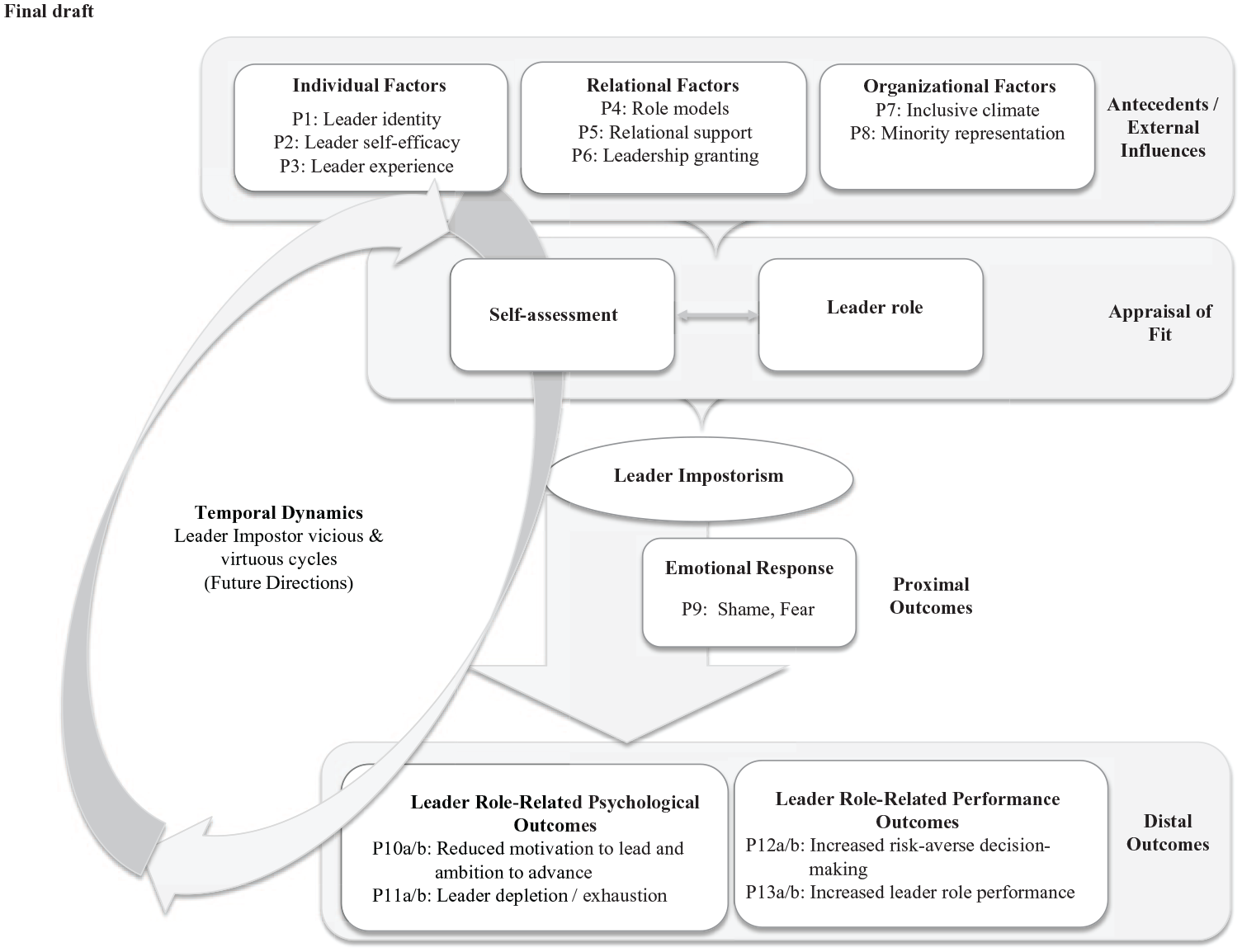
The Anatomy of Leader Impostorism
Leader Impostorism Antecedents
Individual-Level Factors
We first highlight key malleable and situationally shaped characteristics at the individual leader level that can influence a leader’s experience of leader impostorism. While we recognize that certain trait-like individual differences may increase the likelihood of experiencing leader impostorism, including those that have been linked to the IP (e.g., Kumar & Jagacinski, 2006; Ross & Krukowski, 2003; Vergauwe, Wille, Feys, De Fruyt, & Anseel, 2015), our focus is on individual-level differences that are constructed either within or in conjunction with the specific leadership context: leader identity, leader self-efficacy, and role experience and transitions.
Leader Identity
The widely recognized leader role (cf. Northouse, 2021) becomes a leader identity when it is internalized to form part of a person’s self-definition—their sense of who they are (DeRue, Ashford, & Cotton, 2009; Ibarra, Wittman, Petriglieri, & Day, 2014). This leader identity is a subcomponent of an individual’s working self-concept, which includes leadership schemas and past and future representations of themselves as leaders (for a review, see Epitropaki, Kark, Mainemelis, & Lord, 2017). Importantly, an individual’s leader identity is not always linked to a particular leadership role (DeRue et al., 2009). An individual might hold the formal role of “leader” yet not self-identify as a leader; conversely, they might identify strongly as a leader having never held a formal leadership role (e.g., Carter, DeChurch, Braun, & Contractor, 2015; Zheng, Meister, & Caza, 2020).
The more salient and central a person’s leader identity is in their self-definition, the more likely it is that this identity will shape their behavior (Epitropaki et al., 2017; Stryker & Serpe, 1994). This means that individuals who identify as a leader will be more likely to seek out leadership roles and experiences, which has the effect of further strengthening the identity, creating a leader identity-development spiral (Day & Sin, 2011). A person’s leader identity can change and develop over time according to their experiences and interactions with others and in their different fields of action (e.g., the home, various jobs and tasks, etc.; Zheng et al., 2020). On the basis of this, we suggest that individuals who have not internalized a leader identity (i.e., do not actually see themselves as leaders), or who have low leader identity salience, will be less likely to see themselves as able to meet the expectations of the leader role, igniting a sense of impostorism.
Proposition 1: The more salient and stronger an individual’s leader identity is, the less likely they are to experience leader impostorism.
Leader Self-Efficacy
Self-efficacy is a belief in one’s own ability to perform in a specific situation (Bandura, 1997). While self-efficacy is sometimes unrelated to actual ability, it is also malleable and influenced by environmental factors (Bandura, 1997; Dugan, Fath, Howes, Lavelle, & Polanin, 2013). Importantly, those with high levels of self-efficacy are more persistent in striving to reach their goals and are more successful in pursuit of them (Bandura, 1997; Judge & Bono, 2001). Meta-analyses show that self-efficacy is positively related to performance (Stajkovic & Luthans, 1998) and that it can influence important organizational outcomes, such as career choice (Hackett & Betz, 1995) and job attitudes (Saks, 1995).
When it comes to leadership, leader self-efficacy is the level of confidence an individual has regarding their knowledge and their skills and abilities to lead others (e.g., Hannah, Avolio, Luthans, & Harms, 2008; Hannah, Avolio, Walumbwa, & Chan, 2012). Leader self-efficacy has been identified as a key factor in facilitating leadership behavior, leader functioning, and leader outcomes (Hannah et al., 2008). For example, it has been shown to influence whether and how an individual enacts their leadership capacity and has a host of beneficial effects, such as increasing leadership aspirations, leader development, MTL, and leader performance (e.g., Chan & Drasgow, 2001; Hannah et al., 2008). Thus, we argue that individuals with high leader self-efficacy are more likely to believe that they can achieve the expectations of a formal leadership role.
Proposition 2: The greater an individual’s leader self-efficacy, the less likely they are to experience leader impostorism.
Role Transitions/Experience in Role
We contend that the more experience an individual has accumulated in formal leadership roles in general, as well as in their specific (current) role, the less likely they are to feel like an impostor in the role. As we have explored earlier, leadership roles are high-status, elite, and sought-after roles in organizations and throughout society (Burnes & By, 2012; Lord, 1985; Meindl et al., 1985). Given the potential competition over promotion to these coveted roles, those who are selected to fill them—often from among their peers—can come under intense scrutiny. When selected over other candidates, others may question “why them and not me” and challenge (implicitly or explicitly) the new leader to “prove” their deservingness of the role and its elevated status. For example, evidence shows that executive women leaders feel that their competence, abilities, and capacity to meet the role’s requirements are subject to intense scrutiny upon, and for a period after, transitioning into their leadership role. During this time, they felt they were informally challenged to prove themselves (Kark & Eagly, 2010; Meister, Sinclair, & Jehn, 2017).
Further, the novelty and unfamiliarity of the tasks and challenges that a new leadership role poses for the individual may lead the individual to question their own competence and abilities—to ask themselves, “Why me?” Early in a new leadership role, individuals may feel that they are still incapable of managing other people and leading teams and projects as they lack experience in doing so. Indeed, Ibarra and Obodaru (2016) highlight that the act of stepping into a leadership role is not enough for a person to “feel like a leader”; rather, this identity process is one that takes time and experience. This implies that prior experience in leadership roles, as well as in the specific role itself, is likely to have meaningful effects on impostorism. Indeed, Ibarra (2015) argues that for people to develop as leaders, they need to “stretch the limits” of who they are and that feeling like a fake is an almost unavoidable consequence of seeking to occupy a leadership role. This possibility has even been acknowledged by Clance, Dingman, Reviere, and Stober (1995), who suggested that new tasks and challenges would cause impostors’ fears to rise to the surface. Thus, the extent to which an individual has experience with the challenges of their leader role is likely to impact their experiences of impostorism.
Proposition 3: The more experience an individual has in past leadership positions, and the more time that has passed since they entered their current role, the less likely they are to experience leader impostorism.
Relational Factors
Leadership Role Models
A role model is an individual who has mastered a given role—for instance, demonstrated proficiency in a leadership role—and who is perceived as an ideal or aspirational version of a person’s current self (Markus & Nurius, 1986). The selection of a role model can be considered an act of future-oriented personal identification (Peters, Steffens, & Morgenroth, 2018). Just as people’s tendencies to personally identify with other members of the organization has been shown to have a range of important organizational outcomes (e.g., Sluss & Ashforth, 2007), there is evidence that role models can serve a number of functions that, all else being equal, should help people achieve desired roles and perform well within them. Specifically, according to the motivational theory of role modeling (Morgenroth, Ryan, & Peters, 2015: 486), role models are “individuals who influence role aspirants’ achievements, motivation, and goals by acting as behavioral models, representations of the possible, and/or inspirations.” They provide an example to emulate and in this way can help others learn the attributes, skills, and behaviors that are associated with competent performance in a role (Bandura, 1986; Lockwood, 2006; Yaffe & Kark, 2011). They also provide an example of “what someone like me can do” and, in this way, they can help boost people’s role-related self-efficacy (McIntyre, Paulson, Taylor, Morin, & Lord, 2011). By showing what is possible, role models can boost people’s motivation to do what is required to achieve a similar role (e.g., Paice, Heard, & Moss, 2002).
While the role-modeling literature has primarily focused on the motivational and performance outcomes of having role models, the preceding logic provides a clear basis for our expectation that leaders who have role models who successfully occupy leadership roles that are similar to their own will experience lower levels of leader impostorism. This is because role models—as internalized examples of who one wants to be—provide a cognitive bridge between a person’s personal identity and their social (role) identity (Gibson, 2003; Sealy & Singh, 2009; Zheng, Kark, & Meister, 2018), helping them believe that they, too, can fulfill the role expectations.
Proposition 4: Individuals in leadership roles who have role models in similar (or more senior) roles will be less likely to experience leader impostorism.
Relational Support and Mentors/Sponsors
Although role models may play an important role in shaping individuals experience of impostorism, role models may not be in direct contact with the leader experiencing impostorism. Thus, the direct relational contact and support, such as that provided by mentors, sponsors, and developmental networks, is likely to be as important as role models, if not more so. Mentoring is considered to be a transformative dyadic relationship between an experienced person (mentor) and a less experienced person (protégé, mentee) in which the former aims to help the latter realize personal and professional goals (Kram, 1985). A large body of work has shown that formal and informal mentors serve psychosocial and career functions by providing feedback, emotional support, and political advice; sharing informal knowledge; providing protection and sponsorship; and constructing the protégé’s reputation (e.g., Ely, Ibarra, & Kolb, 2011; Higgins & Kram, 2001). In other words, effective mentors provide keys and open doors. Sponsors go beyond this; as well as giving feedback and advice, they advocate for their mentees, help them gain visibility, and fight for their promotion in the company (Ibarra, Carter, & Silva, 2010). Recent literature suggests that that mentoring is most effective when it occurs across multiple relationships, a constellation that has been described as a developmental network (Higgins & Kram, 2001; Yip & Kram, 2017).
With respect to leader impostorism, there are three main reasons why having access to these supportive relationships are likely to matter. First, these relationships may function symbolically by helping individuals develop and internalize their leader identity and craft ideal or possible future identities as effective leaders (Ibarra, 1999; Markus & Nurius, 1986). In this way, these relationships can help an individual believe that they are both entitled and able to lead. Second, by providing informational and instrumental support, these relationships have the ability to measurably alter the objective gap between a person’s capabilities and the expectations of the role. When an individual is given aid (i.e., the keys that open the doors to the role), doing well is significantly easier. Third, when individuals gain support and trust from mentors, they are more likely to think they are or will soon be capable of performing effectively in the leadership role. In other words, this support nourishes the individual’s belief that they have what it takes to succeed in the role.
Proposition 5: Individuals in leadership roles who have mentors and sponsors will be less likely to experience leader impostorism.
Leadership Granting
Our argument, so far, has emphasized that an individual’s perception that they are able to meet the requirements of the leader role (and, thus, are not an impostor) can fluctuate over time, perhaps reflecting their attainment of further experience and increased internalization of a leader identity. In this regard, role claiming and granting interactions between a leader and other organizational members are of major importance. As we argued earlier, roles are social categories with shared expectations about their tasks and responsibilities (e.g., Biddle, 1979; Katz & Kahn, 1978). This means that a person can be said to truly occupy a leadership role only if their leadership claim is “granted” (legitimized) by others (DeRue et al., 2009; DeRue & Ashford, 2010). That is, whether a leader measures up is largely a matter for others to decide. This means that whether an individual will internalize an identity as a leader in a specific leadership role and perceive that they are meeting people’s expectations of them will occur through a process in which the individual claims the leader identity and has it granted to them repeatedly by others (DeRue et al., 2009).
This claiming–granting process can explain why having one’s leadership directly challenged by others could heighten a leader’s sense of impostorism in the role. As we noted earlier, those in leadership positions may be more likely than most to be subject to serious negative feedback (Ibarra & Petriglieri, 2015). Such criticism may result from impossibly high standards, internal competition over the role (and the envy of unsuccessful contenders), or the high degree of interdependence between leaders and their subordinates (such that a leader’s decisions may often have negative implications for others). Whatever the reason, when this criticism takes the form of public statements around a leader’s deservingness or capability (DeRue et al., 2009; Kets de Vries, 2005), it denies the leader’s attempts to claim the role and may produce feelings of impostorism. Hutchins and Rainbolt (2017) provide some evidence for this possibility; they found that academics were particularly likely to have an impostorism experience if their academic expertise was questioned.
While public criticism of a leader challenges their attempts to claim the role, public statements or actions that support the leader and praise their capabilities—that is, granting behaviors—are likely to lessen experiences of impostorism. In this context, positive feedback, statements of support for the leader’s strategy, and requests for them to take on additional leadership responsibilities are likely to play an important role in diminishing leader impostorism experiences. The acts of sponsorship and positive reputational work that mentors and sponsors provide are also likely to serve as an important granting role.
Proposition 6: The more individuals, in their execution of their leadership roles, are granted leadership, the less likely they are to experience leader impostorism.
Organizational Factors
Inclusive Climate
Organizations with an inclusive climate tend to value all members of the organization, include them in decision-making, and treat them fairly, regardless of the social group they represent (Ferdman & Davidson, 2004; Shore, Randel, Chung, Dean, Holcombe Ehrhart, & Singh, 2011). In an inclusive climate, the focus is on the integration of diverse cultural identities and leveraging the increased insight and skill that such diversity can bring (Ely & Thomas, 2001). In addition, inclusive organizations tend to assign employees somewhat equal status, enhance interactions between people to reduce the impact of stereotypes, and encourage joint decision-making across roles, levels, and demographic boundaries (Ensari & Miller, 2006; Fiol, Pratt, & O’Connor, 2009; Nishii, 2013).
We postulate that inclusive organizational climates can limit leader impostorism experiences. First, in these climates, demographic factors (e.g., such as gender or race) are less strongly related to status, ultimately allowing employees to be judged based on their ability or potential rather than visible characteristics (DiTomaso, Post, & Parks-Yancy, 2007; Ridgeway, 1991; Ridgeway & Correll, 2006). Supporting this, Nishii (2013: 1755) stated that a climate of inclusion is an organizational characteristic that limits the evaluation of individuals and the status ascribed to them based on their existing identity factors, highlighting that “a particular identity characteristic can lose its psychological meaning so that it no longer triggers the negative social categorization processes that result in conflict.” Thus, inclusive climates may reduce the extent to which those who differ from the societal prototype of leaders (e.g., in terms of gender, age, cultural background, and ethnicity) feel that they do not measure up to the role.
The second reason inclusive organizational climates are less likely to trigger impostorism among leaders is that they promote the idea that the organization is better off with greater interdependence and mutuality (Ferdman, 2014). A consequence of this is that, unlike traditional hierarchical organizations that expect individuals closer to the top to have the answers to problems (Hollander, 2009), inclusive climates place less responsibility on specific individuals or individuals of certain rankings. Indeed, Gallegos (2014: 183) writes, “Critical to the building of inclusion is reframing notions of leadership, from glorified and unrealistic expectations that leaders have the answers to the organization’s challenges . . . to a shared sense of responsibility.” This shared sense of responsibility and greater equality in status imply that the leadership role expectations are likely to be less overwhelming, reducing individuals’ sense that they do not measure up to the role. Indeed, the philosophy of inclusion is arguably directly antithetical to feelings of impostorism. In the words of Ferdman (2010: 37), Inclusion involves both being fully ourselves and allowing others to be fully themselves in the context of engaging in common pursuits. It means collaborating in a way in which all parties can be fully engaged and subsumed, and yet, paradoxically, at the same time believe that they have not compromised, hidden, or given up any part of themselves.
Proposition 7: The higher the climate of inclusion is in the organization in which the individual holds a leadership role, the less likely they are to experience leader impostorism.
Minority Status and Representation
The degree to which members of specific groups are represented in the higher echelons of an organization is an important signal to individuals of the characteristics that are particularly valued among that organization’s leaders. For this reason, the degree of representation of the target person’s characteristics is likely to have a major effect on their leader impostorism experiences. Importantly, underrepresentation can take many forms, such as being from a different profession (e.g., an accountant when all the senior managers are business people), a different age group (e.g., being under 40 when all managers are over 50), or a different gender, race, ethnicity, and so on from most members occupying similar positions. While the dynamic described later can be meaningful for various identity markers and minority groups (e.g., type of profession, age, disability), we demonstrate our arguments through the example of women and minority status, as they comprise a major category of underrepresentation that has also received a great deal of research attention.
When leaders belong to underrepresented groups, their sense that they are capable of meeting the expectations of the leader role is likely to be affected by the level of representation of their identity group (e.g., gender) in the organizational context, especially in higher-ranking roles. One reason for this is that when majority members dominate a specific organization, people from minority groups become more visible due to their solo or token status. In the case of women, for example, this makes their female gender role more prominent (e.g., Cota & Dion, 1986; Kanter, 1977), enhancing the experience that they are seen by others as different (Cohen & Swim, 1995; Niemann & Dovidio, 1998) and do not meet the role expectations (e.g., Ely, 1995). In contrast, in firms in which there is greater representation of women and minorities, these leaders may be less inclined to feel they do not measure up.
A second reason is that when people are exposed to others who are similar to them in leadership roles, the expectations of the role become more associated with their social group. For example, a higher representation of women in managerial roles reduces the sense of incompatibility between the leader role and the female gender role (Koenig, Eagly, Mitchell, & Ristikari, 2011; Miller, Kark, & Zohar, 2019). In management positions with a higher representation of women, or in occupations that are dominated by women, leader role expectations are associated with women and behaviors that are stereotypically ascribed to women (e.g., more communally oriented). In higher-echelon positions, in occupations that are male dominated, or in male-populated contexts, leader role expectations are found to be more highly associated with men and “masculine” behaviors (more agentically oriented; Kark, Waismel-Manor, & Shamir, 2012; Koenig et al., 2011). Thus, leader roles that are associated with men/masculinity are likely to contribute to an enhanced experience of impostorism among women. The same process is likely to happen with other minority-status markers.
It is also important to highlight that minorities and other underrepresented groups may also be held to a higher standard when performing their roles because they are associated with stereotypes that are not compatible with leadership roles, which makes them less likely to be granted leadership and more likely to be challenged by others. For example, there is evidence that women entrepreneurs are asked prevention-oriented questions by investors (asked “not to lose”), while men are asked promotion-oriented questions by investors (e.g., asked “to win”; Kanze, Huang, Conley, & Higgins, 2018). Similarly, Asian Americans are often perceived by evaluators as relatively unfit to lead due to the stereotype of submissiveness, which conflicts with characteristics of dominance that are central to the conventional prototype of a business leader (e.g., Festekjian, Festekjian, Tram, Murray, Sy, & Huynh, 2014; Sy et al., 2010). All these dynamics likely contribute to experiences among women and members of other underrepresented groups of feeling that they have less legitimacy to lead and are more likely to be found out as a fake.
Proposition 8: Individuals in leadership roles who have a majority status (are more highly represented) are less likely to experience leader impostorism, while leaders with a minority status (who are underrepresented) are more likely to experience leader impostorism.
Leader Impostorism Consequences
For years, I suffered in silence, and [feeling like an impostor] often held me back from the goals I desired and even the money I wanted to make. (female CEO; Phillips, 2020 in Entrepreneur) My never-ending battle with impostor syndrome actually led me to make a number of great decisions. My fear drove some of the most clever and valuable choices I made. (male CEO; Roa, 2020: 149)
Perusal of the popular press suggests that at least some leaders have experiences of impostorism that are intense, long-lasting, and life changing. Both of the quoted CEOs describe their impostorism as an intensely negative affective event—involving “suffering” and “fear.” They both describe how it had substantial implications for their ability to achieve their goals. Interestingly, the nature of these implications differs starkly: While one accused her impostorism experiences of holding her back, the other credited it with helping him succeed. Building on this, we explore several key proximal and more distal effects of impostorism.
Proximal Outcomes: Negative Emotions
Leader impostorism experiences are affective in nature because the twin beliefs that underpin leader impostorism (i.e., an individual’s beliefs that they cannot meet role expectations and are committing an act of deceit that may be uncovered) fall within the broader category of cognitions called appraisals: evaluations that inform a person about the way in which circumstances or events may affect their goals and well-being (e.g., Lazarus, 1991; Lazarus & Folkman, 1984; Parkinson, 1997). Because impostorism experiences reflect an evaluation that occupying a leadership role may have harmful consequences (failing and being exposed or “found out”), it is likely to trigger negative emotions. In line with this possibility, earlier work in psychology has reported a positive association between people’s impostorism beliefs and experiences of negative affect (Cowman & Ferrari, 2002; Kolligian & Sternberg, 1991; Langford & Clance, 1993; Leary, Patton, Orlando, & Funk, 2000). We argue that leader impostorism will elevate two specific negative emotions in the leader: shame and fear.
Shame
Shame is a self-condemning moral emotion that arises when an individual perceives that they have violated moral standards (Greenbaum, Bonner, Gray, & Mawritz, 2020; Leary, 2002; Leary & Miller, 2000). In other words, it is the negative feelings that accompany the appraisal of having a flawed moral character. Shame is an internally focused emotion (Wicker, Payne, & Morgan, 1983) that relates to the full or entire self (Lewis, 1971, 1987; Lindsay-Hartz, 1984; Tangney & Fischer, 1995; Woien, Ernst, Patock-Peckham, & Nagoshi, 2003). It is the judgment of oneself as a “bad self” and is, in this way, distinguished from guilt, which is more focused on and related to doing a specific “bad thing.” In sum, shame is a general negative evaluation of the broader self-concept.
Leader impostors are likely to suffer from shame as a result of their belief that they “do not have what is needed” to meet the role expectations and that they are phony and fraudulent toward the organization and its members. In other words, their moral “transgression” is that they are being deceitful in occupying a role for which they are unqualified. Additionally, as suggested earlier, leadership roles usually come with high levels of visibility. Various experimental studies show that public exposure of both moral (transgressions) and nonmoral (incompetence) behaviors, together with negative self-evaluation, are associated with heightened emotions of shame (R. Smith, Webster, Parrott, & Eyre, 2002). Thus, those who experience leader impostorism are likely to experience strong feelings of shame.
Fear
Another negative emotion that may be experienced by those with leader impostorism is fear. Although fear is a basic emotion, it can be triggered by a self-evaluation process (Buss, 2001; Tangney & Dearing, 2002; Tracy & Robins, 2004). Fear is an intense negative emotion that is associated with the appraisal that one is facing an imminent threat (Lazarus, 1991; C. Smith & Ellsworth, 1985). The fear emotional system is activated by threat cues and elicits individuals’ defenses (Maack, Buchanan, & Young, 2015). Leader impostorism experiences are likely to be accompanied by perceptions of imminent threats in the form of failure, negative social evaluation, and discovery of one’s lack of capability (i.e., not able to meet the requirements and expectations). These threats are likely to elicit feelings of fear. In line with this possibility, Thompson, Foreman, and Martin (2000) found that impostors are more fearful of negative evaluation and more concerned with meeting other people’s standards. We further contend that the highly visible and scrutinized nature of leadership roles and the tendency to unduly “romanticize” the role of the leader in organizational failure and success (e.g., Meindl et al., 1985), which contribute to leader impostorism, are likely, in turn, to enhance the experience of threat and fear in the role.
Proposition 9: Leaders who experience leader impostorism will be more likely to experience shame and fear in their role.
The possibility that leaders who experience impostorism will experience feelings of shame and fear in their role is an important outcome in and of itself. However, the impact of emotional experiences is not limited to feelings but extends to an individual’s cognitions, motivations, and behavioral tendencies (Lazarus, 1991; Lazarus & Folkman, 1984; Parkinson, 1997). For example, there is evidence that self-conscious emotions, like shame, can drive hard work in achievement- and task-related domains (Stipek, 1995; Weiner, 1985) and shape people’s behaviors in the moral domain as well as their approach to social interactions (Baumeister, Stillwell, & Heatherton, 1994; Leith & Baumeister, 1998; Retzinger, 1987). Fear, in contrast, serves to motivate behaviors that are likely to help people avoid the threat (i.e., flight or freeze) or defend themselves against it (i.e., fight; Maack et al., 2015). For these reasons, the emotions that accompany leader impostorism experiences are likely to have several important distal outcomes for leaders and their organizations.
Distal Outcomes: Psychological and Performance Outcomes
We focus on two broad sets of distal outcomes of leader impostorism experiences that occur through the accompanying emotions of shame and fear. The first set focuses on role-related psychological consequences (which we refer to as “leader role-related psychological outcomes”), while the second set focuses on consequences related to the leader’s in-role performance, which has more direct implications for the broader organizational system (which we, therefore, refer to as “leader role-related performance outcomes”).
Leader Role-Related Psychological Outcomes
MTL and ambition to advance
We argue that leaders in the grips of sustained experiences of impostorism will eventually face a reduced MTL and ambition to advance in their leadership careers. This is because role-related fear and shame are likely to place limits on leaders’ advancement throughout their careers because they can fuel the desire to “hide” leadership achievements and shy away from leadership opportunities. Individuals who experience shame often feel exposed and have negative self-evaluations and beliefs about how others see them (Goss, Gilbert, & Allan, 1994). The highly visible and exposed nature of leadership positions are especially likely to trigger an awareness of the possibility of negative social evaluations and the potential exposure of one’s “flawed moral character” (Woien et al., 2003). The shame associated with the possibility of being “found out” can be expected to spark the desire to hide or disappear (Baumeister, Stillwell, & Heatherton, 1995; Woien et al., 2003). The emotion of fear is similarly associated with a desire to hide (by either freezing or fleeing) in order to avoid a potential threat. This dynamic is consequently associated with the need to withdraw (Breugelmans & Poortinga, 2006) or even engage in self-destructive behaviors (Tangney & Dearing, 2002). For these reasons, a leader who experiences impostorism is more likely to shy away from, or sabotage, leadership opportunities for fear of negative evaluation and exposure.
Furthermore, apart from a general motivation to advance, Chan and colleagues (Chan & Drasgow, 2001; Chan, Rounds, & Drasgow, 2000) developed the construct of MTL as capturing the aspiration to lead, the decision to assume leadership roles and responsibilities, and the intensity of effort and the persistence in leadership roles. The strongest force of MTL (affective MTL) is being motivated because of the intrinsic enjoyment of leading others. Individuals who experience leader impostorism, and feel the associated negative emotions of shame in who they are and fear of being negatively evaluated, will be less likely to view their leadership as enjoyable and are less likely to aspire to leadership and be motivated to lead others. Rather, they may be drawn to lead due to a sense of obligation, others’ expectations, and a calculative fear of paying a price for not complying with a promotion to a more senior leadership role. Thus, leader impostorism will reduce the tendency of people to be attracted and motivated to leadership roles and to advancement.
Proposition 10a: Leaders who experience leader impostorism will suffer a reduced MTL and reduced ambition to advance.
Proposition 10b: This relationship will be partially mediated by the emotions of shame and fear.
Leader depletion/exhaustion
We also suggest that leader impostorism will enhance leaders’ experience of cognitive depletion and emotional exhaustion—a state of physical and emotional depletion resulting from job demands (Wright & Cropanzano, 1998)—especially if leader impostorism is sustained over time. Heightened by a persistent fear of being discovered or negatively evalulated, individuals with impostorism will have a persisting concern and worry about social approval (Chrisman, Pieper, Clance, Holland, & Glickauf-Hughes, 1995) and may become preoccupied with deciphering what others think of them (Ferrari & Thompson, 2006). Also, once they form perceptions of what others think (Kenny, 1994), they may subsequently engage in considering and crafting strategies to manage these perceptions (e.g., Baumeister, 1982). This cognitively taxing process consumes the same cognitive resources (an individual’s cognitive-processing capacity; Sweller, 1998) that are simultaneously required to fulfill the duties of their actual leadership role, leading to an ongoing depletion in available cognitive resources (e.g., Vohs, Baumeister, & Ciarocco, 2005).
Hand in hand with this consuming rumination and worry ignited by negative emotions are the corresponding behaviors that leader imposters engage in to create and maintain a “façade of conformity” (Hewlin, 2003, 2009; Hewlin, Dumas, & Burnett, 2017). This facade occurs in situations in which an individual (in our case, a leader who experiences impostorism) conceals their true self and emotions (e.g., “I am not really worthy of being a leader, and I feel shame and fear about this”) to project the socially appropriate self, required by the context or role (e.g., “I am a leader and I feel no shame or fear”). For example, those who experience shame may try to protect their outward image so as to continue to be seen as “good” in the eyes of others. Concealing one’s true emotions (e.g., intense shame and fear) while projecting socially acceptable emotions is emotionally depleting and exhausting over time (Grandey, 2000, 2003; Grandey, Foo, Groth, & Goodwin, 2012). In summary, leader impostorism is a highly negative emotional experience that can lead to cognitive preoccupation and the leader’s need to manage their external impression. This will lead to a depletion of cognitive and emotional resources and emotional exhaustion over time (Meister et al., 2017; Wright & Cropanzano, 1998).
Proposition 11a: Leaders who experience leader impostorism will suffer depletion and emotional exhaustion over time.
Proposition 11b: This relationship will be partially mediated by shame and fear.
Leader Role-Related Performance Outcomes
We now discuss how leader impostorism can—at least in the short term—positively influence the individual’s in-role behaviors and thereby affect the organization more broadly. In particular, we discuss the way in which impostorism experiences can be expected to, first, reduce a leader’s tendencies to take risky decisions and, second, motivate extra effort that may result in higher in-role performance.
Less risky decisions
We posit that leaders who experience impostorism will be less likely to engage in risk-taking (Sitkin & Pablo, 1992; Sitkin & Weingart, 1995). First, fear of failure (and subsequently, exposure as an impostor) may directly reduce a leader’s willingness to engage in risk-taking and encourage a less impulsive and more calculated approach to decision-making. Consistent with this possibility, there is evidence within the IP tradition that people who experience impostorism can show perfectionistic tendencies, including an exaggerated concern over making mistakes (Thompson et al., 2000).
Second, shame and negative self-evaluations may indirectly lead to less risk-taking by enhancing other-oriented decision-making—that is, decisions that explicitly incorporate a concern for the well-being of others (De Dreu & Nauta, 2009; Korsgaard, Meglino, & Lester, 1996). We expect that leader impostors are likely to make decisions that are less self-serving and more other serving, both as a restorative measure for their moral transgression (perceived fraudulence) and as a result of their perception that they are unworthy of taking risks on behalf of others. Evidence that such other-oriented decision-making can reduce risk-taking comes from work showing that individuals who are more other focused tend to adopt more risk avoidance and prevention-focused decision-making strategies in order to avoid losses (Hamstra, Bolderdijk, & Veldstra, 2011; Lee, Aaker, & Gardner, 2000). Anecdotal support for the relationship between shame, impostorism, and less risky decisions comes from the case study of Jacinda Ardern, prime minister of New Zealand, who has proven herself to be a competent, twice-elected politician. However, along with her success and competence, she has referred to her self-doubts and feelings of impostorism, including recently during the COVID pandemic (Bennett, 2020). Her government’s policy for tackling the pandemic was highly cautious and preventative from the start, leading New Zealand to be one of the most successful countries in limiting the number of deaths during the pandemic.
It is of course important to recognize that decisions that are more cautious may not always be objectively “better,” as the outcomes of different decision strategies are likely to vary across contexts. However, in contexts where leaders are not equally exposed to the benefits and costs of risky decisions—especially contexts where leaders benefit personally from “wins” while the organization bears the costs of “losses”—a shift toward less-risky decision-making is likely to be broadly beneficial. Taken together, leaders who experience impostorism, and in turn, fear and shame, are likely to make more risk-averse decisions.
Proposition 12a: Leaders who experience leader impostorism will make less risky decisions in their role.
Proposition 12b: This relationship will be partially mediated by shame and fear.
Leader role performance
Another way in which leader impostorism may have organizationally beneficial consequences is by motivating leaders to exert extra effort into their role, which ultimately drives their in-role performance (e.g., Katerberg & Blau, 1983; Rich, Lepine, & Crawford, 2010). That is, these leaders may be highly motivated to ensure they perform to the “extraordinary” role expectations of a leader. For example, these individuals may work harder in an attempt to compensate for their perceived lack of aptitude and to alleviate their feelings of shame over their perceived fraudulence and acute fear of exposure. Indeed, there is evidence that self-conscious emotions, such as shame, motivate people to work hard toward achievement (Stipek, 1995; Weiner, 1985). Moreover, individuals experiencing shame have been found to show exemplification behaviors (e.g., arriving early, leaving late, self-sacrificial behavior, dedication, and hard work) in order to manage their shame and signal to people around them that they are worthy (Bonner, Greenbaum, & Quade, 2017). We expect, then, that those experiencing leader impostorism will likewise attempt to show exemplary leader behaviors, driving up their perceived in-role performance.
While the notion that impostorism (as part of the pathological IP) is associated with enhanced effort and achievement is not new (Rohrmann, Bechtoldt, & Leonhardt, 2016), our argument that this can be considered beneficial (for the organization, if not the leader) is novel. While prior work has emphasized that the effort-related behaviors associated with the traditional IP are problematic (e.g., Hu, Chibnall, & Slavin, 2019; Vergauwe et al., 2015), we contend that among leaders this may not be so—at least in the short run. Specifically, leaders who are motivated to extra effort are likely to fare better in the face of the additional scrutiny and responsibility that come with their role (Hambrick et al., 2005; Sparks, Faragher, & Cooper, 2001); this is also likely to have beneficial consequences for those who work with and rely on them. In other words, the negative personal cost of exerting extra effort to perform to (or above) role expectations is likely to be balanced by better outcomes for their colleagues and subordinates and, consequently, more positive evaluations of their performance in the role.
Evidence consistent with this claim comes from a study on the influence of various types of competencies on perceived leader effectiveness and on leadership emergence (Vaculik, Prochazka, & Smutny, 2014). The study showed that the amount of energy and effort a leader invests in solving problems is considered an aspect of task-related competence (see also Analoui, Labbaf, & Noorbakhsh, 2000) and that task-related competencies are key predictors of leader effectiveness and performance. Importantly, leader diligence and investment influenced both subordinates’ perceptions of the leader as a “good leader” and evaluations of the leader as contributing to their group’s performance (Vaculik et al., 2014). Thus, when leaders exert extra effort, it could lead to positive organizational outcomes (better group performance) as well as positive outcomes for the leader (leader performance, positive subordinate evaluations of the leader, and subsequently, more leadership granting). Taken together, leaders who experience impostorism, and in turn feel fear and shame, are likely to invest extra effort in the role, which may have positive performance consequences for the organization and the leader. We must note, however, that this sustained extra effort, combined with the depletion that leader imposterism is likely to generate, may be unsustainable in the long term and lead to burnout.
Proposition 13a: Leaders who experience leader impostorism will invest extra effort in their roles, driving increased leader role performance.
Proposition 13b: This relationship will be partially mediated by shame and fear.
Discussion
In this article, we introduced the construct of leader impostorism: a person’s appraisal that who they are (their attributes, experiences, skills, and abilities) does not meet the standards and expectations of the formal leadership role they occupy; this is accompanied by a feeling that they are being deceptive to others in their occupation of the role. We also aimed to explain why impostorism may be widespread among those in leadership positions and to better understand the individual, organizational, and relational factors that may fuel leader impostorism as well as some key consequences for leaders themselves and the organization more broadly. Next, we highlight the implications of our theory for the management and leadership literature. We then extend our theory to suggest future research directions and highlight practical implications for organizations and their leaders.
Theoretical Implications for the Leadership and Management Literature
Impostorism
Our construct of leader impostorism builds upon the IP (Clance & Imes, 1978) by showing how impostorism not only is a characteristic of certain individuals but also can be a characteristic of certain contexts. In this way, we answer recent calls for research and theory that consider the socially constructed and context-specific nature of the IP (e.g., Feenstra et al., 2020; Hutchins & Rainbolt, 2017). In doing so, we also highlight the importance of processes at the individual, dyadic, and organizational levels in shaping how impostorism can be triggered and played out in leadership roles. Our theory provides insights concerning the downsides of this phenomenon (e.g., how it may curtail an individual’s ability to claim leadership and take on a leadership role) as well as its potential benefits (e.g., leader role performance, less-risky decision-making, etc.).
Negative Emotions in Leadership
While research exploring the leader role and experience has burgeoned over the past decade, little is known about the negative emotions that can be experienced in leadership roles. Indeed, to the extent that has been explored, the focus often is on the lack of these emotions among leaders. For example, a search on fear and leadership highlights essays on “fearless leaders” (e.g., Fisher, 2003; Rapoport, 2001). Regarding shame, prior works found that people who believe in their own suitability for positions of leadership and authority are less prone to experiences of shame (e.g., Gramzow & Tangney, 1992). Where there is a focus on leaders’ experiences of shame, it tends to be limited to the domain of political leadership (e.g., as a consequence of poor decisions). This is an important oversight because leaders’ emotions (including self-conscious emotions; Tangney & Fischer, 1995) are likely to have important social consequences (Zineldin & Hytter, 2012). For instance, it has been suggested that fear is a mechanism through which leaders affect followers (i.e., leaders exert power through eliciting fear among followers; e.g., Guo, Decoster, Babalola, De Schutter, Garba, & Riisla, 2018; Maccoby, Gittell, & Ledeen, 2004). We explore how leader impostorism triggers the self-conscious emotion of shame as well as the more basic emotion of fear. We explore how these emotions play a major role in leader well-being and performance. Building on this, in future work it would be useful to empirically examine the unique aspects of these two emotions (and other emotions, such as guilt or pride) as well as their differential effect on leader outcomes. This theory thus points to a new direction for studies of self-conscious emotions in leadership.
Diversity and Inclusion
Leader impostorism helps shed light on the experiences of women and other minorities in leadership. We suggest that the experience of leader impostorism is a potent barrier for women and other minorities in the workplace. There has been a great deal of work trying to understand why women and minorities “hold back” in leadership roles (Brescoll, 2011), limit their risk-taking, and tend to ask and negotiate less for salary increases and promotions (Babcock & Laschever, 2009). We suggest that leader impostorism may account for some of these gendered behaviors in leadership roles.
According to our theory, when individuals are in a minority status in organizations where they do not have role models, do not fit the leadership culture, or are not represented in leadership roles, they are also more likely to experience leader impostorism. This offers an alternative explanation for many findings in the leadership field concerning gender and minority status. For example, it could explain why women are more prone to feel shame than men (e.g., Harvey, Frank, Gore, & Batres, 1998; Woien et al., 2003). It can also help explain findings concerning gender differences in leadership styles. Specifically, women may assume more democratic or collaborative styles than men (who take more autocratic or directive styles) because they feel that, as impostors, they are less deserving (e.g., Eagly & Johnson, 1990; Zheng et al., 2020). It could also account for why women may invest extra effort in displaying agentic behaviors and tempering communal behaviors, in an effort to be seen as fit for the role and not a fake (Zheng, Surgevil, & Kark, 2018; Zheng et al., 2018). Specifically, when leader impostorism is low, we can expect people to feel more comfortable with showing their direct power and authority and with claiming their role up front, without feeling the need to temper it with behaviors that may seem less powerful and intimidating. Furthermore, leader impostor dynamics can account for why women and minorities ask for less when negotiating for salary increases and resources in leadership roles (Babcock & Laschever, 2009). If they experience leadership impostorism, they are likely to feel undeserving of higher salaries and refrain from asking for a raise (Babcock & Laschever, 2009). In sum, earlier findings in the leadership field on the complex experiences and restricted possibilities of minority-status individuals in leadership can be explained by the IP.
Practical Implications
One major implication of our theory is that organizations that want to support their employees to thrive and to reduce turnover of top talent should invest resources in attempts to reduce the emergence and vicious cycle of leader impostorism. The reasons for this are twofold. First, since the experience can lead to negative outcomes for these employees and, ultimately, the organizations, it is in organizations’ best interests. Specifically, the emotional toll of experiencing leader impostorism—depletion and decreased MTL—should be considered by organizations because it can lead to burnout and turnover of top talent. Since impostors work harder than others to overcompensate for their inner sense of deficiency, organizations stand to benefit from understanding the phenomenon and its accompanying long-term risks (e.g., talent loss, dissatisfaction, and sick leave; Whitman & Shanine, 2012).
Second, since leader impostorism is a contextually and socially situated phenomenon, it is not the individual suffering from impostor syndrome alone that can “solve” the issue. Rather, resolution requires an organizational perspective that focuses on altering the organizational environment in conjunction with intrapersonal processes. Because leader impostorism may be easily concealed, overlooked, and even hard to detect, organizations must confront the issue in a systemic manner through raising awareness of its existence and finding systemic ways to counter it. Indeed, recent work on diversity in organizations found that a better strategy to achieve change is by altering processes, procedures, and organizational structures rather than by enhancing individualistic self-empowerment messages (the do-it-yourself solutions; Kim et al., 2018). Suggesting that the “victims” themselves are the ones who can solve the problem can imply that they are also responsible for their condition and for their underrepresentation and negative experience. Similarly, when aiming to reduce leader impostorism, we must focus on procedures and processes that can alter the system.
Our antecedents provide guidance as to the levers that organizations might use to alleviate this experience. For instance, organizations can implement programs to promote climates of inclusion (Nishii, 2013; Nishii & Rich, 2014)—that do not merely enhance the representation of diversity and expect individuals to subscribe to prototypical leadership norms but that also promote acceptance of diverse leadership—as well as a motivation-focused (rather than performance-focused) climate. Additional directions include recognizing leaders’ successes; providing ongoing empowering and developmental feedback, emphasizing the skills and qualifications of the leaders; giving stage and visibility to diverse role models; and providing formal mentoring/sponsorship programs and peer support in order to alleviate the feelings of inadequacy (Arena & Page, 1992; Craddock, Birnbaum, Rodriguez, Cobb, & Zeeh, 2011; Ragins, 1997).
Limitations and Future Research Directions
Given the necessity to somewhat limit the scope of this article, we do not discuss the potential effects of followers on leaders’ impostorism as well as leader–follower relational factors, such as leader-member exchange, on leader impostorism. We also do not consider cultural differences. Future work might explore both. For example, future research might explore whether cultural tightness (cultures that have strong norms and little tolerance for deviance) versus cultural looseness (those that have weak norms and high tolerance for deviance; e.g., Gelfand, Nishii, & Raver, 2006) influences the likelihood of leader impostorism. Cultures high in tightness and social control may strengthen the tendency to feel leader impostorism due to higher social surveillance that may heighten feelings of shame and fear of being exposed. It is also the case that shame and fear are experienced and manifested differently in different cultures (Poulson, 2000), suggesting that impostorism may have likewise different effects.
Additionally, since our focus here is on how leadership impostorism is contextually shaped and socially constructed, we do not discuss stable individual attributes that can interact with this dynamic. Future studies should explore how individuals’ stable traits—such as chronic impostorism, the Big 5, self-monitoring, and regulatory focus—contribute to the likelihood of experiencing leadership impostorism and to what extent the antecedents discussed here do in fact predict leader impostorism beyond individuals’ chronic tendencies. Future work might also explore to what extent contextual factors nurture leader impostorism among diverse groups, such as age groups (Generation Y, Z), different professional groups, physical disability, and sexual orientation. Furthermore, the role of intersectionality of identities should be explored in an attempt to better understand the effect of multiple exclusion forces on leadership impostorism among minorities (e.g., African American women, Hispanic lesbian women). Last, there are many aspects of organizational culture and climate that can be considered for future research (apart from inclusion) that can hinder or enhance feelings of leader impostorism. For example, organizational psychological safety (Kark, 2011) or a climate of mastery, evaluating individuals on the basis of their learning and promoting cooperation (Ames, 1992), is likely to reduce leader impostorism versus a performance climate, evaluating individuals based on their relative performance while promoting comparative competition (Ntoumanis & Biddle, 1999), which likely enhances leader impostorism.
Moreover, although leader impostorism can lead to a wide range of outcomes in the current article, we offer several exemplary outcomes for each category. For example, beyond shame and fear, leader impostorism can lead to more focused feelings of guilt, or it can harm feelings of self-pride. In terms of motivational outcomes, leader impostorism may reduce certain types of MTL (e.g., affective MTL) and may possibly enhance or not harm other types of motivation (e.g., normative and calculative MTL; Chan et al., 2000; Chan & Drasgow, 2001). Apart from extra in-role behaviors, individuals who experience leader impostorism are likely to enhance their organizational citizenship behavior contributions. Furthermore, beyond taking less risk in decision-making, there are indications that leader impostorism can lead to making more moral decisions, since people feeling shame may make an effort to rectify the damage they perceive they have done to others (by hiding who they are) or in an effort to sustain the responsible—“socially appropriate”—prior actions of the organization (Bagozzi, Sekerka, & Sguera, 2018; Tangney, Stuewig, & Mashek, 2007). However, moral decisions may be also reduced, since shame tends to be more selfishly oriented. All these directions need to be further explored.
Last, future work may explore the possible trajectories and temporal processes of leader impostorism, which we label the “vicious and virtuous cycles of leader impostorism” (see Figure 1). Past work has shown that leader impostorism may become a negative self-reinforcing cycle, leading to what has previously been referred to as the “impostor cycle” (Clance & Imes, 1978). This cycle unfolds when an individual experiences doubt or fear regarding their ability to succeed and may experience a range of symptoms (e.g., anxiety, psychosomatic outcomes, and nightmares). In response, the individual will either overprepare or procrastinate and then prepare frantically—resulting in significant extra effort. While this investment of energy is likely to result in success and positive feedback, it may not directly reduce the experience of impostorism itself, attributing the positive feedback to others being fooled by them yet again.
On the other hand, our theorizing with respect to the dynamic and contextually triggered nature of leader impostorism suggests that under certain conditions, the negative cycle may be interrupted, giving rise to a virtuous cycle that results in generative and positive outcomes for the leader and the organization. For example, extra effort and success might lead to positive (and somewhat self-disconfirming) evaluations that can be incorporated into their sense of enhanced self (e.g., Sedikides, 1993), positively feeding into the individual’s leader identity and efficacy. Gaining more leadership experience over time can also reduce leader impostorism. Furthermore, relational and contextual factors can also enable this change. For example, if the leader impostor over time receives relational granting (e.g., affirmation) of their leadership from others (DeRue & Ashford, 2010), or if senior managers provide more mentoring and support (Lanka, Topakas, & Patterson, 2020), this might reinforce the sense that they are deserving of the role—and, therefore, less of an impostor, which in turn will lower their sense of shame and fear and will further enhance their performance. These temporal dynamics are crucial not only for understanding leader impostorism’s potential for ongoing persistence and harm but also for understanding how the experience can be disrupted and changed for the better.
Building on this, future work could examine the role of personal, relational, and organizational factors in contributing to possible vicious/virtuous cycles, such as the conditions or tipping point at which the vicious cycle becomes a virtuous one and vice versa. It would also be interesting to uncover if and how its effects diminish over time as individuals gain experience in their role. Are feelings of impostorism enhanced or reduced as people rise up the corporate ladder? What are the conditions in which leaders incorporate a positive sense of self, due to extra effort and less-risky decision-making, and lead to a virtuous cycle, and when will they spin into a vicious cycle, feeling they cannot incorporate a sense of success? The critical role of relational and organizational moderators in disrupting the negative cycle and supporting the positive needs to undergo further theoretical and empirical exploration.
To conclude, while the press and media have popularized impostorism, theory and research have not kept up with the popularization of the concept. We have introduced and constructed a theoretical framework exploring the antecedents, dynamics, and outcomes of leader impostorism, an important experience that ignites affect and can limit leaders’ overall well-being, MTL, and motivation to progress. We hope this opens up a novel domain for future research on this intriguing and influential phenomenon.
