







Abstract
Across three studies, we integrate relational leadership theory with affective events theory to examine the leader perspective in dyadic relationships and how this perspective influences differential leader behaviors directed toward each subordinate in terms of safety enforcement. First, in two field studies with different high-risk contexts, we delineate a curvilinear relationship between supervisor-rated leader–member exchange (SLMX) and safety enforcement. In our second field study we also examine the moderating role of leaders’ safety commitment as well as the linkage between safety enforcement and accidents. Finally, in a fully randomized experiment, we explore three relational dynamics as mechanisms of the effect of SLMX on safety enforcement—trust, consideration, and liking. Through these efforts, we offer rare direct tests of the theoretical assertion that leader–member exchange includes differential treatment based on affective relationship cues within a leader-and-subordinate relationship. Our two field studies reveal that leaders are likely to monitor safety most closely for low- and high-SLMX subordinates, but mid-SLMX subordinates are most likely to be overlooked. This U-shaped relationship emerges only for less committed leaders, and safety enforcement translates these effects to actual accidents. Our experimental study reveals a similar U shape between liking and enforcement, but a positive relationship emerges between distrust and enforcement, as well as between consideration on enforcement. These results shed insight into theoretical and practical implications for how leaders can foster a safer workplace for all.
Keywords
As a dominant leadership theory for over 40 years, leader–member exchange (LMX) theory is based on the premise that leaders differentiate among their followers. As leaders form dyadic relationships that vary in quality across subordinates (Dansereau, Graen, & Haga, 1975; Graen & Cashman, 1975; Graen, Liden, & Hoel, 1982; Graen, Novak, & Sommerkamp, 1982; Graen & Scandura, 1987; Liden, Wayne, & Stilwell, 1993; Scandura, Graen, & Novak, 1986), they treat each subordinate according to the quality of that relationship. Interestingly, although this differential treatment is a central tenet of LMX theory (Liden, Sparrowe, & Wayne, 1997; Martin, Guillaume, Thomas, Lee, & Epitropaki, 2016; Scandura et al., 1986) and drives what many now call relational leadership theory as a recent evolution of LMX (Day & Miscenko, 2015), this core tenet remains underexamined, thus creating a theoretical void. Integrating arguments from relational leadership theory (Day & Miscenko, 2015; Graen & Uhl-Bien, 1995; Wilson, Sin, & Conlon, 2010) with affective events theory (AET; Weiss & Cropanzano, 1996), we focus on this principle within LMX theory that each party's perceptions of relationship quality, developed through a series of ongoing interpersonal interactions, influence behaviors targeted at the other party and subsequent outcomes (Brower, Schoorman, & Tan, 2000; Dinh, Lord, Gardner, Meuser, Liden, & Hu, 2014; Engle & Lord, 1997; Lazarus, 1991; Lord & Maher, 1991).
In taking this perspective, we seek to add to the field's understanding of how and why a leader's perception of the relationship quality with each subordinate informs potentially differential treatment of that subordinate in the area of safety enforcement and how enforcement affects safety outcomes. Namely, by considering the leader viewpoint in this equation and in the context of safety, we add unique insight into the relationship between what a leader perceives about the quality of their relational interactions and the safety-related decisions that leader makes in relation to each subordinate and, in turn, how that treatment translates to safety performance.
Part of the reason for the limited understanding of these processes so far is that the voluminous LMX literature remains largely one-sided, focused almost exclusively on employee perceptions of LMX and the same employees’ outcomes (Epitropaki & Martin, 2015; Markham, Yammarino, Murry, & Palanski, 2010; Sin, Nahrgang, & Morgeson, 2009; X. Zhou & Schriesheim, 2010). There are good reasons for this reliance on follower reports (e.g., socially desirable responding by leaders; Scandura et al., 1986), but notwithstanding broad consensus on the role leaders play as participants in dyad exchanges (Bauer & Green, 1996; DeRue, Nahrgang, Wellman, & Humphrey, 2011; Erdogan & Bauer, 2016; Gooty & Yammarino, 2016; Lanaj, Johnson, & Lee, 2016; Lorinkova & Perry, 2018), leader perceptions and differential treatment by leaders remain virtually unexamined. The few studies that have examined supervisor-rated LMX (SLMX) primarily focus on employee outcomes (e.g., satisfaction with supervisor: Greguras & Ford, 2006; psychological contract breach: Restubog, Bordia, & Bordia, 2011; performance: Schriesheim, Neider, & Scandura, 1998) or on leader–member agreement in ratings (Cogliser, Schriesheim, Scandura, & Gardner, 2009; Markham et al., 2010; Matta, Scott, Koopman, & Conlon, 2015; Sherman, Kennedy, Woodard, & McComb, 2012; Sin et al., 2009), largely ignoring the implications of SLMX for leader behavior targeted at subordinates. 1
Differential treatment by a leader as influenced by SLMX is especially important in the context of safety enforcement because “leadership is one of the main factors that emerge in studies as essential to improving safety in organizations” (Katz-Navon, Kark, & Delegach, 2020: 3). If safety behaviors by leaders are biased by relationship quality (e.g., Ehrhardt & Ragins, 2019; Wilson et al., 2010), this has serious implications for the safety records of organizations, safety climate and morale in teams, and individual fairness perceptions. The theoretical predictions of traditional leadership approaches focus primarily on linear relationships, including those related to employees’ perceptions of LMX and the correspondent safety-related attitudes and behaviors (Clarke, 2013; Griffin & Neal, 2000; Kark, Katz-Navon, & Delegach, 2015; Katz-Navon et al., 2020; Neal & Griffin, 2006; F. Zhou & Jiang, 2015). This focus on linear relationships and employee (rather than leader) perceptions ignores the possibility of inconsistent or even noncommensurate treatment by leaders across the workgroup. Predicting differentially targeted attitudes and behaviors of a leader, we apply relational leadership theory in conjunction with AET to explain how leader perceptions of relational dynamics influence leader attitudes and behavior toward each subordinate (Brower et al., 2000; Dinh et al., 2014; Graen & Uhl-Bien, 1995; Tse, Yu, Ashkanasy, & Paulsen, 2013). Thus, our first major contribution is this direct test of this central tenet in LMX theory.
Our focus on safety also constitutes a central contribution. Safety-related decisions and behaviors have serious, even life-or-death, implications for employees and organizations, and we empirically test this linkage. As these decisions are inherently risk based, the effects of SLMX on them are important to understand (Brower et al., 2000). Building on research that shows safety enforcement behaviors of leaders relate to a range of important safety outcomes (Christian, Wallace, Bradley, & Burke, 2009; Clarke, 2013; Petitta, Probst, Barbaranelli, & Ghezzi, 2017; Probst, 2015; Probst & Estrada, 2010), we study the role of safety enforcement behaviors in predicting workplace accidents, an indicator of objective safety performance. As an additional contribution, we explore leader safety commitment as a moderator of the SLMX–enforcement link, which signals how motivated a leader is to uniformly enforce safety across the workgroup. Thus, we provide further insight into how the nuances of each leader–member relationship matter for safety.
We also depart from the traditional “more is better” approach by extending the traditional LMX perspective (Blau, 1964; Graen & Uhl-Bien, 1995) with theoretical work on relational leadership (Adler & Kwon, 2002; Brower et al., 2000; Ehrhardt & Ragins, 2019; Robertson, O’Reilly, & Hannah, 2020; Scandura & Pellegrini, 2008; Wilson et al., 2010) to specify a curvilinear relationship between SLMX and safety enforcement. To further explain this differential treatment, we test three mechanisms of SLMX—trust, individual consideration, and liking—that reflect leader reactions to their relationships with each subordinate. Extending the work of Tse and Troth (2013), and in line with Lazarus (1991) and Weiss and Cropanzano (1996), we theorize these dynamics ensue as leaders and their subordinates build a relationship through ongoing interactions and, in turn, predict critical leader behaviors. Thus, this exploration of mediating mechanisms of SLMX adds insight into how leadership, affective experiences, attitudes, and follower-targeted behaviors interrelate (e.g., Morgan, Perry, & Wang, 2018; Tse et al., 2013; Tse & Troth, 2013).
Finally, we consider these questions in three separate studies. First, two field studies with different high-risk contexts provide a direct test of differential treatment across each workgroup, based on a leader's perceptions of relational dynamics with each subordinate. The second of these field studies allows us to test the relationship between safety enforcement and accidents as well as safety commitment as a moderator of SLMX. A final experimental study provides the opportunity to manipulate variables of interest, establishing causal relationships and giving insight into mechanisms that underlie the hypothesized effects of SLMX. Triangulating results from three studies adds validity to our conclusions and sheds further insight into the nuances of the leader–member relationship by capturing inputs from both parties across three contexts.
SLMX and Safety Enforcement Behaviors
Safety enforcement is a critical but often less-prioritized leadership responsibility (after core task performance). Thus, leaders who enforce safety must make an explicit judgment about how and when to do so. As an extrinsic motivator, safety enforcement includes monitoring compliance with safety rules and disciplining safety-related violations (Probst, 2015; Probst & Brubaker, 2001). Research suggests employees are more likely to understand safety policies when enforcement occurs, because reward and punishment conditions are clearly communicated and implemented by leaders (Sawhney & Cigularov, 2019; Zohar, 2003; Zohar & Luria, 2003, 2004). This makes leader safety enforcement an important outcome, as it leads to other desirable safety-related attitudes, behaviors, and outcomes at the individual, team, and organizational levels (Christian et al., 2009; Clarke, 2013; Hofmann & Morgeson, 1999; Petitta et al., 2017; Probst, 2015; Probst & Estrada, 2010; Zohar & Luria, 2004).
At first glance, subordinate and supervisor perceptions of LMX may appear to rely on the same social exchange dynamics and thus have similar safety-related outcomes. But these distinct perspectives of the leader–member relationship have distinct patterns of effects (Brower et al., 2000). Subordinates are more likely to demonstrate safety-related behaviors (such as compliance and participation; Jiang, Li, Li, & Li, 2017) when they enjoy a higher-quality relationship with their leader (Johnson et al., 2017; Martin et al., 2016). This is a form of repayment for positive treatment received, which results in a linear relationship between employee-rated LMX and employee safety engagement (Jiang et al., 2017; F. Zhou & Jiang, 2015). In contrast, leaders have multiple subordinates who compete for their resources, attention, and approval, making it difficult for leaders to enforce safety or develop relationships uniformly across all subordinates (Brower et al., 2000).
Thus, unlike employee safety compliance executed as a form of payback for a high-quality relationship with the leader (Jiang et al., 2017; F. Zhou & Jiang, 2015), leader safety enforcement can hardly be treated as the leader “repaying” the employee. To the contrary, as implied by AET, this judgment-driven behavior may take the form of monitoring cued by negative relational interactions with the subordinate or favorable interpersonal safety-oriented care and concern cued by positive relational interactions (Tse & Troth, 2013). Leaders spend a large portion of their time interacting with subordinates, and the nature of these interactions can act as salient affective events for the leaders, resulting in differential decisions and outcomes by those leaders across the workgroup (Dinh et al., 2014; Lanaj et al., 2016; Lanaj & Jennings, 2020). As noted by Tse and Troth (2013: 274), the LMX relationship can be characterized as “a series of uplifts and hassles . . . that accrue and begin to shape” each party's reactions. In view of leaders’ limited cognitive and attentional resources (Wilson et al., 2010), relational dynamics inherent in the exchange relationship could reflect ongoing interpersonal events, which Weiss and Cropanzano (1996) describe as emotional episodes comprising a core relational theme in any relationship. For leader–member dyads, the sum of these interpersonal interactions likely cues leader decisions, resulting in differential judgment-driven behaviors toward each subordinate (Colbert, Bono, & Purvanova, 2016; Dinh et al., 2014). Later we theorize about the role of three relational dynamics—trust, consideration, and liking—that may explain differential safety enforcement across subordinates. But first we specify the direct relationship between SLMX and safety enforcement, and safety outcomes.
Curvilinear Relationship of SLMX and Safety Enforcement
Building on Katz-Navon et al. (2020) and directly testing the central tenet within LMX theory that different relational dynamics predict differential treatment across subordinates, we build our reasoning primarily on relational leadership theory, which suggests that “the leader's view of the quality of the relationship with a subordinate . . . leads to leader behaviors directed at the subordinate” (Brower et al., 2000: 241). We also extend this reasoning to loosely include arguments from AET to suggest that the relational experiences comprising SLMX would trigger decisions (or judgment-driven behaviors, in the parlance of AET) by the leader on how to enforce safety for each subordinate, potentially resulting in nonuniform, nonlinear patterns across the workgroup.
In the work context, monitoring, surveillance, delegation, and empowerment are frequently discussed as outcomes of relational leadership (Brower et al., 2000). Low levels of SLMX are characterized by negative relational themes, which may reflect or trigger feelings of distrust and dislike as well as low levels of loyalty, respect, and support (Wilson et al., 2010). These relational dynamics likely cue the judgment-driven behaviors of higher levels of monitoring and rule enforcement (i.e., higher levels of safety enforcement by the leader). In contrast, high SLMX is characterized by positive relational themes, where high trust, support, and care and concern are likely dominant (Tse & Troth, 2013; Wilson et al., 2010). Leaders also like their high-SLMX subordinates, which is a positive relational dynamic that encourages them to spend more time together and ensure they are doing well (Wilson et al., 2010). Thus, in both low- and high-SLMX dyads, we predict higher levels of safety enforcement, which is an inherently risk-based decision that includes calculations about trust, concern, respect, liking, and other relational dynamics inherent in SLMX (Brower et al., 2000).
This leaves employees for whom leaders report moderate levels of SLMX in a vulnerable middle ground, at risk of being overlooked. These employees do not engender the highest levels of distrust, but they are not strongly liked or disliked either, reducing the likelihood that the leader would monitor them closely or interact with them frequently (Wilson et al., 2010). They likely do not ask for or receive much support or other attention from their leader. Thus, these individuals represent the least salient socioemotional interactions experienced by a leader (Colbert et al., 2016; Dinh et al., 2014; Weiss & Cropanzano, 1996). As a result, those with midrange relationship quality (as perceived by the leader) may stay “under the radar,” receiving the least positive or negative attention (i.e., safety enforcement) from the leader.
Safety Enforcement and Accidents
In turn, a well-established literature supports the link between safety-related managerial practices and safety performance (e.g., Sawhney & Cigularov, 2019; Zohar, 2003; Zohar & Luria, 2003, 2004). Subordinate safety participation and compliance are reliably linked to safety outcomes (Nahrgang, Morgeson, & Hofmann, 2011). Further, leader safety enforcement is consistently linked to objective safety measures, such as reduced accidents and injuries (Christian et al., 2009; Clarke, 2013; Petitta et al., 2017; Probst, 2015). Mediated models have also been supported; LMX leads to safety communication, which leads to employee safety commitment and reduced accidents (Hofmann & Morgeson, 1999). Increased safety enforcement and communication help employees understand relevant safety rules and procedures as well as the consequences of unsafe behaviors, resulting in fewer accidents. Integrating these arguments with our logic from earlier would suggest that the curvilinear relationship between SLMX and safety enforcement may be extended to mediate the effect of SLMX on workplace accidents. Thus, we explicitly predict a relationship between safety enforcement and accidents, but we perform an exploratory test of mediation as well.
Hypothesis 1: (a) SLMX and leader safety enforcement targeted at individual subordinates exhibit a curvilinear, U-shaped relationship. (b) In turn, safety enforcement has a negative relationship with workplace accidents.
Leader Safety Commitment as Moderator
We also explore the role of leader safety commitment as a moderator of SLMX. Safety commitment reflects the degree to which a leader prioritizes safety-related goals and communication, and how motivated a leader is to make decisions to devote resources to uniform safety enforcement. Most extant research on safety commitment is focused on the importance of top management commitment to safety as an antecedent to safety climate or to employee safety commitment (e.g., Arboleda, Morrow, Crum, & Shelley, 2003; Delegach, Kark, Katz-Navon, & Van Dijk, 2017; Huey, Nan, Dongping, & Chunlin, 2018).
When leaders are highly committed to safety, they have an intrinsic interest in safety and are motivated to devote more resources to uniform safety enforcement (Zohar & Luria, 2003). Thus, the relational dynamics reflected by SLMX should matter less for these leader decisions. That is, when safety is a high priority for leaders, they are motivated to make sure all subordinates comply with safety rules and policies by employing consistent managerial practices, creating a safe work environment for all, regardless of SLMX (Zohar & Luria, 2004). This motivation, we reason, overrides the relational cues that may otherwise drive enforcement behavior, so that leaders instead enforce safety uniformly across all subordinates. Thus, commitment weakens the curvilinear effect specified in Hypothesis 1a, similar to the moderating role of emotional intelligence in AET, which overrides relational cues that could otherwise detrimentally bias decisions (Pirola-Merlo, Härtel, Mann, & Hirst, 2002; Walter & Bruch, 2009; Weiss & Cropanzano, 1996). In contrast, when leaders are less committed to safety, they are more likely to rely on readily available relational cues in deciding how to differentially treat each subordinate. As theorized earlier, employees who attract the most attention are the lower- and higher-SLMX subordinates, which leaves those in the middle especially vulnerable for low safety enforcement when the leader's safety commitment is lower.
Hypothesis 2: Leader safety commitment moderates the curvilinear relationship between SLMX and safety enforcement, such that a U-shaped relationship emerges at lower levels of safety commitment, whereas at higher levels of safety commitment, safety enforcement is unaffected by SLMX.
Relational Dynamics as Mechanisms Underlying Effects of SLMX
As LMX has evolved with a strong emphasis on the relational foundation between leader and subordinate, scholars have repeatedly described LMX as a series of interpersonal events, often including socioemotional exchanges (Dinh et al., 2014; Matta et al., 2015; Tse & Troth, 2013; Wilson et al., 2010), which comprise an overarching relationship, or core relational theme, between each leader and subordinate (Brower et al., 2000; Tse, Troth, Ashkanasy, & Collins, 2018). Much of this theory is built on Lazarus (1991) and Weiss and Cropanzano (1996), who describe a core relational theme that evolves as people interact and form relationships. We suggest that SLMX is also characterized by a series of ongoing interactional events between a leader and a subordinate that accrue to reflect a core relational theme from the leader's perspective. To further elaborate on why SLMX may impact safety enforcement behavior by the leader, we highlight three leader reactions to this overarching relational dynamic: trust, individual consideration, and liking. Although these reactions are sometimes included within the definition of LMX quality, AET helps distinguish these constructs as mediators of the relationship between SLMX and safety enforcement, shedding light on how perceived relational quality impacts specific reactions to leader perceptions of the relationship, and subsequent behavior of a leader toward subordinates (Brower et al., 2000; Lanaj et al., 2016). Furthermore, we acknowledge, consistent with Lazarus (1991) and decades of other research (e.g., Pinder, 2008), that all attitudes have affective, cognitive, and behavioral components that are built upon a series of affective interpersonal events (e.g., leader–member relationships).
First, trust describes the extent to which a leader is likely to take a risk by empowering subordinates to perform their jobs without close monitoring (Mayer, Davis, & Schoorman, 1995; Whitener, Brodt, Korsgaard, & Werner, 1998). Trust is a well-established mediator between LMX and performance (Martin et al., 2016), and it stands to reason that this would also apply to SLMX. In focusing on cognitive trust (McAllister, 1995), we suggest leaders make an assessment about how much they can trust each subordinate based on their past interactions and overall relationship quality (Kim, Wang, & Chen, 2018). When they have a high level of trust in a subordinate (i.e., in a high-SLMX relationship), they empower and rely on them to act on their own. However, they are more likely to closely monitor lower-SLMX subordinates whom they judge as less trustworthy to follow rules on their own, bestowing more negative attention and rule enforcement.
Individual consideration—the extent to which a leader shows care and concern, including seeking insight about each subordinate's well-being (Bass & Avolio, 1994; Lanaj et al., 2016; Zacher, Pearce, Rooney, & McKenna, 2014)—presents an interesting contradiction to trust. Borrowing from the notion of individual consideration within the transformational leadership literature, this frequent and open communication is a form of behavioral intention or action by the leader, which also may be interpreted by subordinates as higher safety enforcement (Hofmann & Morgeson, 1999). Individual consideration arises as a behavioral intention framed within the larger backdrop of affective reactions to the overall relational theme in the dyad. As leaders perceive high-quality relationships (high SLMX), they are likely to want to support and nurture those relationships. Ironically, this could also result in decisions to monitor and enforce safety rules for those subordinates to actively express care and concern (Clarke, 2006; Griffin & Neal, 2000; Salancik & Pfeffer, 1978).
Finally, liking—the degree of affective interpersonal attraction the leader has for each subordinate—is the most clearly affective response to the relationship out of the three we consider (Lanaj et al., 2016; Liden et al., 1993; Liden & Maslyn, 1998; Wilson et al., 2010). Consistent with relational leadership theory and decades of LMX research, leaders like their high-SLMX subordinates most and perhaps dislike their low-SLMX subordinates most. Relational leadership theory and AET would further predict that the leader chooses to give the most-liked individuals the most attention, including safety-related attention, because the leader benefits from and enjoys being around them (Dinh et al., 2014; Lanaj et al., 2016; Liden et al., 1993; Liden & Maslyn, 1998; Weiss & Cropanzano, 1996; Wilson et al., 2010). In contrast, but also consistent with AET, leaders may turn their dislike of a subordinate into the decision to monitor and enforce their safety compliance more closely (Liden & Maslyn, 1998). Thus, we expect a curvilinear relationship between liking and safety monitoring, such that both the least- and most-liked subordinates are most closely monitored.
Hypothesis 3: (a) Distrust and (b) consideration exhibit a positive relationship, whereas (c) liking exhibits a U-shaped curvilinear relationship with safety enforcement. These mechanisms mediate the effect of SLMX on safety enforcement.
Context of Three Studies
We test these hypotheses in three different study contexts. We test Hypothesis 1a in our first field sample from the construction industry. This industry is traditionally linked to a large number of work-related incidents (Bureau of Labor Statistics [BLS], 2020) and is often the focus of safety-related studies. We test Hypotheses 1a, 1b, and 2 in our second field sample, which is from the hospitality industry. This industry is less often the focus of safety research, but it represents a major sector in the economy, in which workers report work-related injuries and illnesses at a rate of 4.2%. Hotel employees are nearly 40% more likely to be injured on the job than any other service-sector employee (BLS, 2010). Housekeeping ranks in the top 10 in workplace injuries out of nearly 800 occupations, followed closely by food-service employees (BLS, 2020). Finally, we test Hypothesis 3 in a third study using experimental design to shed insight into the mechanisms of SLMX.
Study 1
Method
Procedure and Sample
Our first field sample comprised supervisors and front-line workers in a midsized skilled-trade company, operating in the construction industry in the mid-Atlantic United States. The nature of the organization's work exemplified the importance of safety; there were extensive safety procedures in place, including protective clothing, safety equipment, and specific safety procedures for all tasks. New hires were required by the organization to undergo an extensive safety training seminar, and supervisors were required to complete annual safety training.
In total, 145 front-line employees reporting to 41 supervisors participated in the study (ranging from 2 to 7 employees per supervisor; average 3.54 per team). 2 The sample was all male, as is typical in the industry and line of work. The average supervisor age was 41.23 years (SD = 6.07), and the average worker age was 33.96 years (SD = 9.16). The average team project length was 5.83 months (SD = 3.31). Management agreed to supervisors’ and workers’ participation in this study after it was explained that questionnaires were to be completed on-site, during regular working hours, and that management would receive aggregated, anonymous results of the study.
Prior to administering the surveys, records from the company were obtained with supervisors’ age, tenure, and workgroup membership. Following this, each supervisor completed the survey (87% response rate) and reported on the quality of his exchange relationships with each subordinate (SLMX), so that an individual-level score was used in the models for each subordinate. Workers completed surveys (76% response rate) assessing demographic data and the safety enforcement behaviors of their leaders. Questionnaires were completed on-site and collected immediately by members of the research team. All were given the option to decline to respond without penalty, and all were assured that management would receive only aggregated, anonymous results in a summary report.
Measures
SLMX
We modified the LMX-7 measure to reflect the supervisor's viewpoint of the subordinate relationship (α = .74; e.g., “I am clear about where [employee name] stands with me”; Graen & Uhl-Bien, 1995; Scandura et al., 1986). All items were rated on a 5-point scale (5 = strongly agree). Thus, SLMX was an individual-level construct for each subordinate, as rated by the supervisor. See Appendix A for a full list of items.
Safety enforcement
Subordinates responded to seven items to assess their supervisor's safety enforcement behaviors, adapted from Katz-Navon, Naveh, and Stern's (2005) managerial safety practices and Zohar and Luria’s (2005) direct supervisor safety measure. Consistent with the approach advocated by Zohar (2003), we asked workers to indicate their level of agreement with the extent to which their supervisor engaged in each safety enforcement behavior in the recent past (5 = completely agree; α = .85; e.g., “Monitored you closely to ensure following of safety procedures”).
Control variables
When testing our hypothesized relationships, we considered three controls. First, we considered leader tenure with the company because safety research suggests a positive correlation between tenure and company rule enforcement as well as between tenure and perceived LMX (Sin et al., 2009). Second, we considered employee age because older workers are likely to have more job-relevant experience, which perhaps leads to a lower level of monitoring (Sin et al., 2009). Finally, we also considered SLMX differentiation, which is important because it represents the range of SLMX in the workgroup. It is calculated using the standard deviation of all SLMX scores in each workgroup. Leaders with lower SLMX differentiation do not perceive much difference across subordinates, whereas those with higher SLMX differentiation view their lowest- versus highest-rated subordinates quite differently (Li & Liao, 2014). As seen in Table 1, leader tenure was not correlated with any of the variables of interest, but both employee age and SLMX differentiation were correlated with safety enforcement at p < .10. Thus, following Bernerth and Aguinis (2016), we included both age and SLMX differentiation as controls, since these have both theoretical and empirical relevance, but dropped leader tenure. We ran results with all the controls, comparing results with only our two chosen controls (age and differentiation) and then without any controls. Results with and without leader tenure as a control variable were identical. Results with and without age and differentiation were almost identical, with minor differences in the level of significance of the parameters of interest. Thus, we report results with these two controls for the empirical and theoretical reasons above.
Descriptive Statistics and Intercorrelations of Study 1 Variables
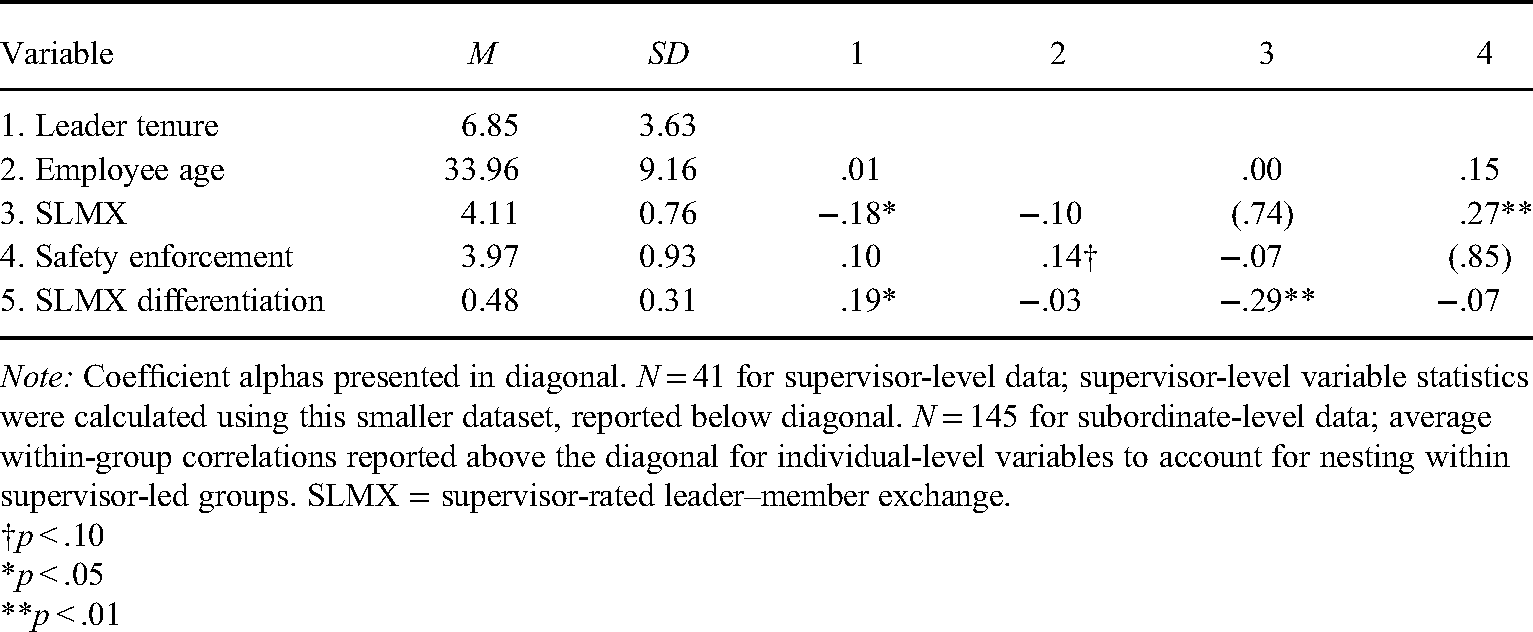
Note: Coefficient alphas presented in diagonal. N = 41 for supervisor-level data; supervisor-level variable statistics were calculated using this smaller dataset, reported below diagonal. N = 145 for subordinate-level data; average within-group correlations reported above the diagonal for individual-level variables to account for nesting within supervisor-led groups. SLMX = supervisor-rated leader–member exchange.
†p < .10
*p < .05
**p < .01
Statistical Analyses
Before proceeding with the analyses, we first estimated the variability in safety enforcement that could be attributed to workgroup membership (workgroups led by one supervisor), using the formulas for random coefficient models (Raudenbush & Bryk, 2002). The mean within-group agreement (rwg) was estimated at .75, whereas the intraclass correlation coefficients (ICC) were estimated at .34 (ICC1) and .65 (ICC2). Therefore, to account for the nested structure of our data, we proceeded with a multilevel modeling approach, with all variables measured at the individual level. We used Proc Mixed in SAS v9.4 for all analyses.
Results
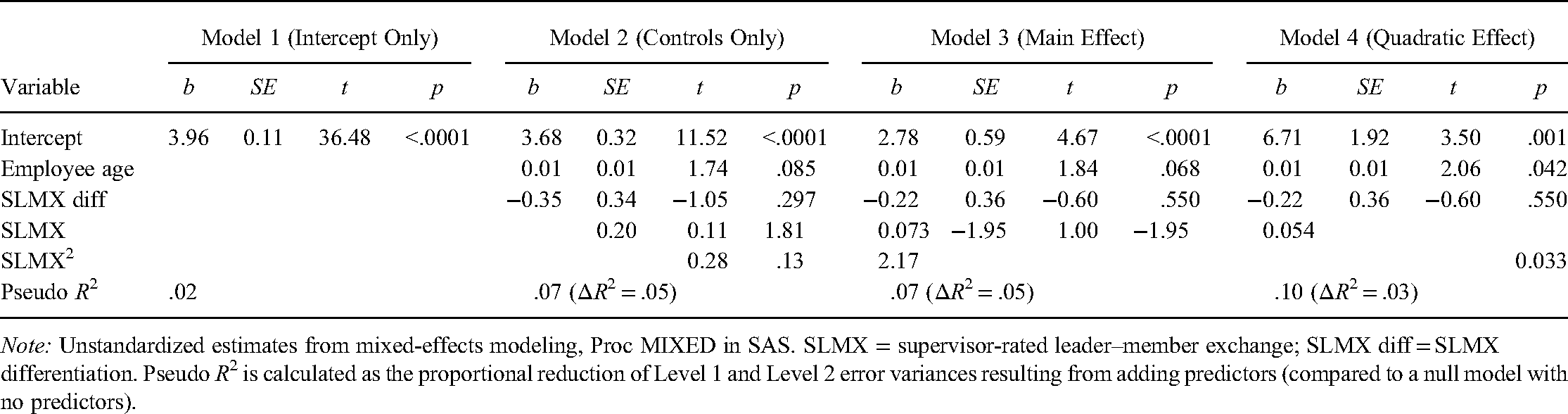
Table 1 presents the means, standard deviations, and zero-order correlations among all study variables. Hypothesis 1a predicted a curvilinear relationship between SLMX and safety enforcement. Table 2 presents the results, which are represented by the following equation:
Multilevel Random Coefficient Modeling Results Predicting Safety Enforcement (Study 1)
Note: Unstandardized estimates from mixed-effects modeling, Proc MIXED in SAS. SLMX = supervisor-rated leader–member exchange; SLMX diff = SLMX differentiation. Pseudo R2 is calculated as the proportional reduction of Level 1 and Level 2 error variances resulting from adding predictors (compared to a null model with no predictors).
As seen in Table 2, Model 3, when safety enforcement was regressed on the linear term of SLMX, the coefficient was positive but just missed the conventional significance cutoff (b = .20, p = .07). To estimate the effect size of this multilevel model, we calculated pseudo R2 as .07 (ΔR2 = .05 over the intercept-only model; Snijders & Bosker, 2012). When the quadratic term for SLMX was included in the equation (Table 2, Model 4), it was positive and significant (b = .28, p = .03) and the linear term was negative (b = −1.95, p = .05; pseudo R2 = .10, ΔR2 = .03). Together, these results provided initial support for Hypothesis 1a.
To better understand the nature of this relationship, we plotted it in Figure 1a. As shown there, the relationship was U shaped, as predicted. We estimated the inflection point as 3.48, using the standard formula, −b1/2b2, in which b1 is the coefficient for the linear term of SLMX and b2 is the coefficient for the quadratic term. This inflection point is approximately two-thirds of a standard deviation below the mean of SLMX. Therefore, Hypothesis 1a was supported, suggesting that the employees who receive the least safety enforcement attention are those for whom supervisors report moderately low levels of SLMX, whereas employees at the lowest and highest levels of SLMX receive more safety enforcement attention.
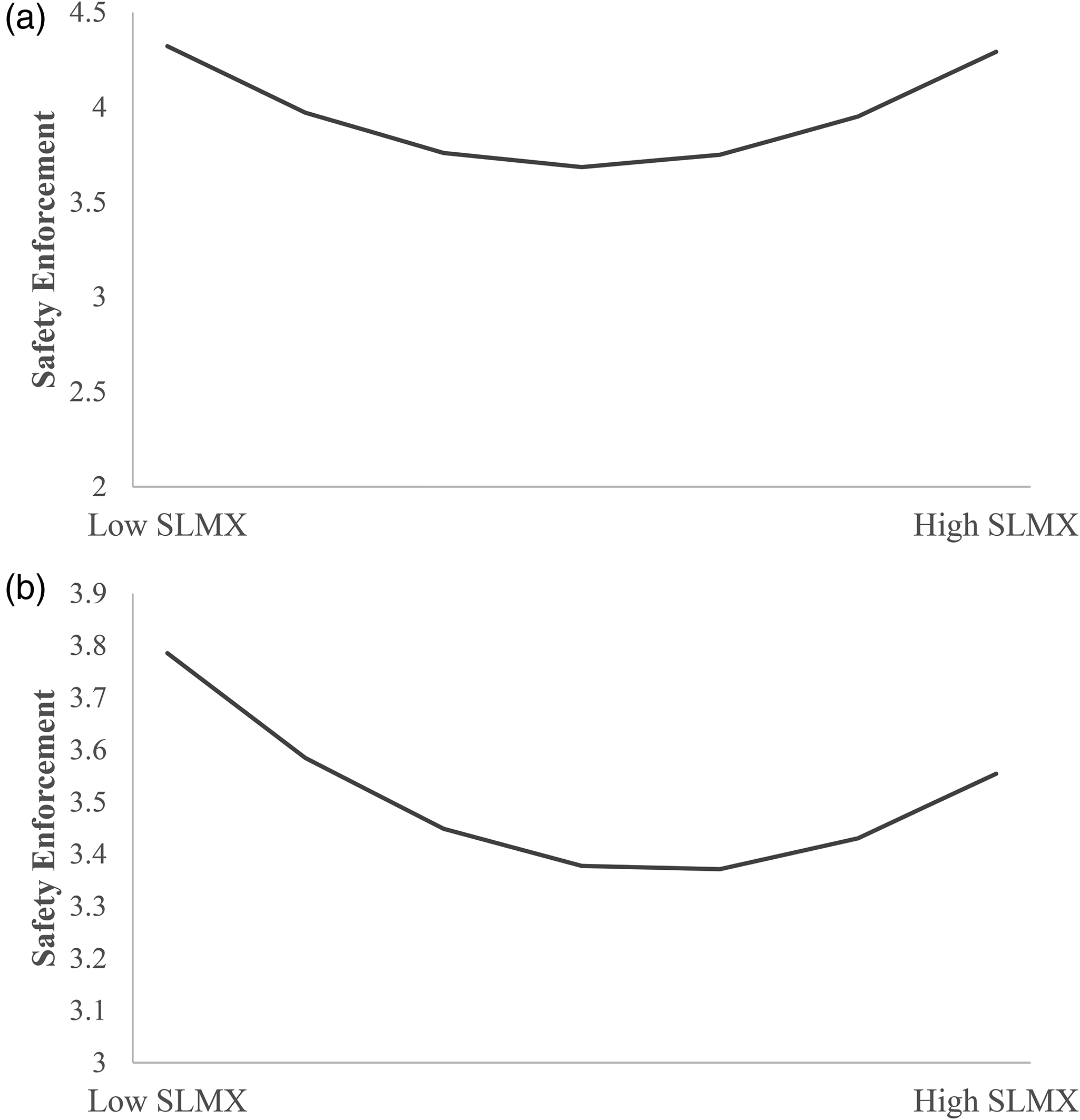
Curvilinear Relationship Between SLMX and Safety Enforcement. (a) Study 1, (b) Study 2
Study 2
Method
Procedure and Sample
Data for the second field study were obtained from four hotels in the southeastern United States. All hotels were full-service hotels and were closely colocated. To capture variability in supervisor safety enforcement, we restricted the sample to the hotels’ housekeeping, maintenance, food and beverage services, and banquet facilities personnel. Before distributing surveys on-site, we obtained a list of potential study participants from hotel management, inviting 339 employees and 58 supervisors. We administered two surveys, 1 month apart, to limit common-source bias. Each time, members of the research team visited each hotel and administered surveys on the premises during regular work hours. During the first survey administration, supervisors provided demographic information and assessed SLMX for each of their subordinates, and employees provided demographic information and assessed their own perceptions of LMX. At Time 2, employees provided reports on their supervisor's safety commitment and enforcement behaviors, and supervisors reported accidents that had occurred in the past month. Employee and supervisor surveys were administered at different times in different rooms, so both sets of respondents were assured of complete confidentiality. Completed surveys were returned in closed envelopes to the research team member on-site or mailed to the research team in postage-paid envelopes. After matching participants’ Time 1 and Time 2 surveys and supervisor–employee surveys, we had observations for 266 employees reporting to 41 different supervisors. Each supervisor had between 2 and 11 direct reports (M = 6.49).
Measures
SLMX
We used the same approach and scale for SLMX, with supervisors recording their perceptions of LMX quality with each of their subordinates using LMX-7 (α = .85; Graen & Uhl-Bien, 1995; Matta et al., 2015).
Leader safety commitment
Employees assessed the extent to which their supervisor appeared to be committed to safety for the workgroup overall using three items from Katz-Navon et al.'s (2005) safety measure (α = .75; 5 = completely agree). Per the organization's request, we chose items that focused on subordinate perceptions about how managers demonstrated their commitment to safety in the workgroup (e.g., “Our manager insists we follow safety rules and procedures”). We used this as a Level 2 moderator in our hypothesis testing after we aggregated all subordinate responses in each workgroup to the supervisor (workgroup) level (ICC1 = .17, ICC2 = .57; rwg(j) = .72; Bliese, 2000; James, Demaree, & Wolf, 1984; Kreft & De Leeuw, 1998).
Safety enforcement
Employees also assessed the extent to which their supervisors enforced safety for them as individuals (α = .74; 5 = completely agree) using three items from Katz-Navon, Naveh, and Stern (2005) in consultation with the participating hotels’ management (e.g., “My supervisor approached me to bring safety issues to my attention”). To avoid availability bias, we anchored the items to refer to employees’ experiences “during the last week,” and we included only items for which the referent was the individual employee. This prevented us from using the full seven-item scale that was included in Study 1, but this gave us a more focused examination of each individual employee's perceptions of how the leader enforced safety for them specifically. This was modeled as an individual-level dependent variable.
Accidents
We also collected objective safety performance data in the form of number of accidents in the workgroup. Supervisors responded to 10 items reflecting types of minor accidents potentially occurring in the environment (e.g., “had something fall on him/her”; 1 = never to 5 = almost daily). The instructions focused on the extent to which any of these events happened to any subordinates in that supervisor's workgroup during the last month. We averaged the responses to the 10 items to represent an overall accidents measurement for each workgroup.
Control variables
We collected information on leader age and sex as possible controls because past research suggests that these demographic variables influence individual perceptions of relationship quality (Truxillo & Burlacu, 2015). In line with our theorizing that both perspectives in the dyad are important to consider, we felt it was important to include the employee perspective of LMX, even though it was not the focus of our model. We assessed employees’ LMX perceptions with the LMX-7 scale (Graen & Uhl-Bien, 1995; α = .92). We also considered including the quadratic term of LMX in our model as a control but opted against this since we did not expect a curvilinear relationship with safety enforcement like we did for SLMX (i.e., it is only the leader's perspective that we suggest explains safety enforcement efforts in a curvilinear pattern). Finally, as in Study 1, we controlled for SLMX differentiation, calculated using the standard deviation of all SLMX scores for each workgroup (a Level 2 variable; Li & Liao, 2014). Following Bernerth and Aguinis (2016), we considered both empirical and theoretical rationale for which controls to include in our final models. As shown in Table 3, LMX was the only control variable significantly correlated with safety enforcement, but SLMX differentiation is highly relevant to our study questions, and we wanted to replicate Study 1 as closely as possible, causing us to lean toward its inclusion. We ran the analyses with and without leader age and sex as well as with and without all controls; in every case, results were identical. Thus, we kept LMX and SLMX differentiation only as controls.
Descriptive Statistics and Intercorrelations of Study 2 Variables
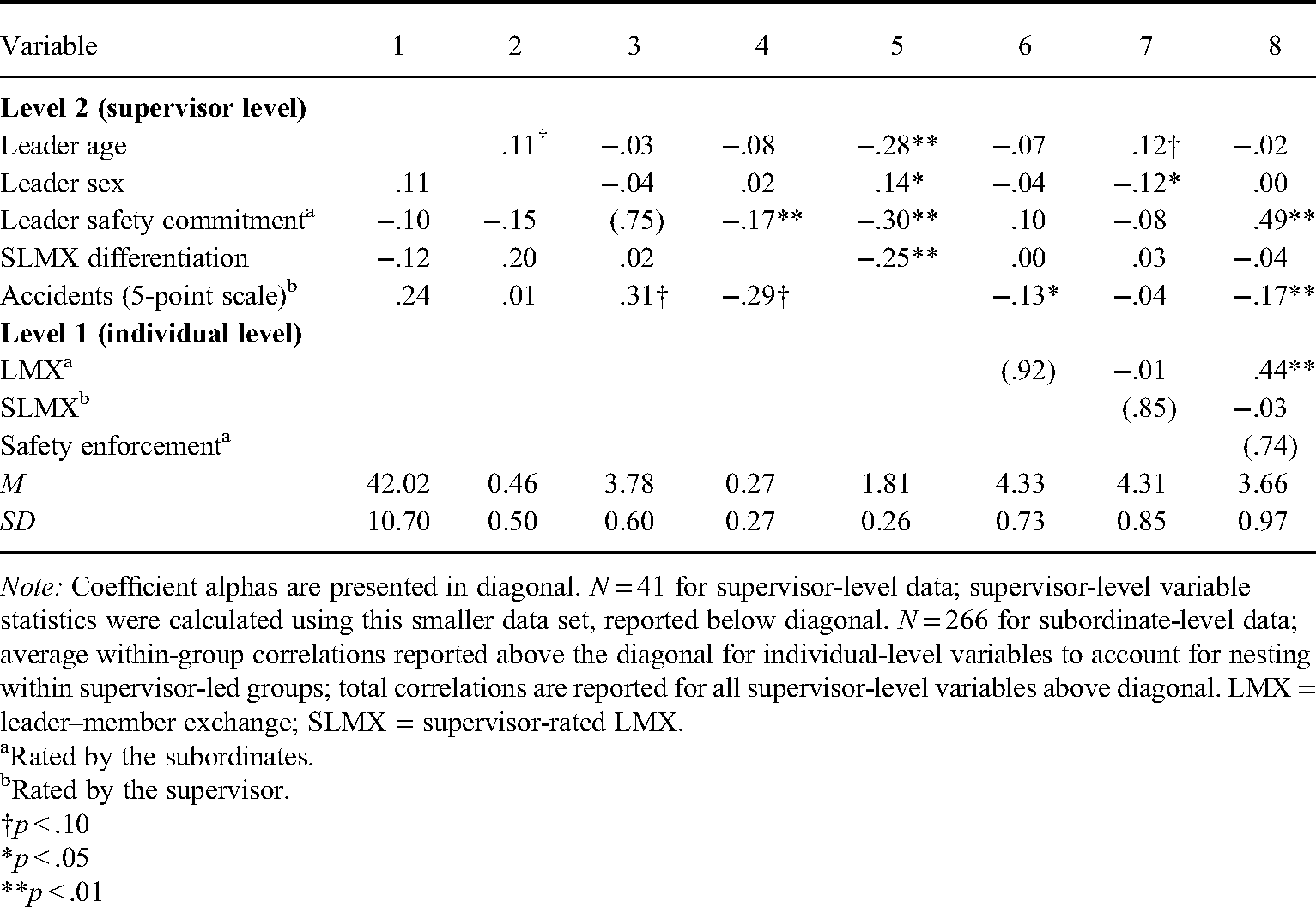
Note: Coefficient alphas are presented in diagonal. N = 41 for supervisor-level data; supervisor-level variable statistics were calculated using this smaller data set, reported below diagonal. N = 266 for subordinate-level data; average within-group correlations reported above the diagonal for individual-level variables to account for nesting within supervisor-led groups; total correlations are reported for all supervisor-level variables above diagonal. LMX = leader–member exchange; SLMX = supervisor-rated LMX.
Rated by the subordinates.
Rated by the supervisor.
†p < .10
*p < .05
**p < .01
Statistical Analysis
Before proceeding with the analyses, we estimated the variability in safety enforcement. The mean within-group agreement (rwg) was estimated at .64, whereas the ICCs were estimated at .16 (ICC1) and .55 (ICC2). These relatively low values for within-group agreement and ICC2 suggest that safety enforcement is indeed differentially targeted at individual employees. But the ICC1 values suggest the need to account for employees nested under supervisors, so we again used multilevel modeling in SAS to test our hypotheses.
Results
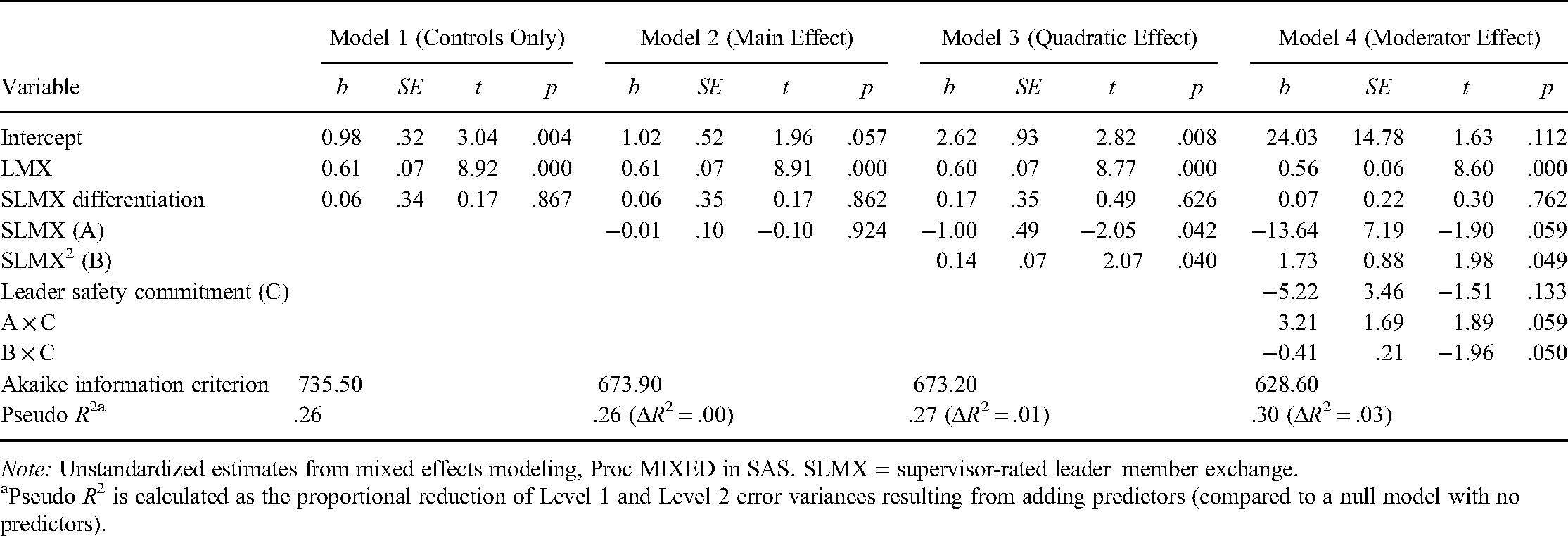
Table 3 presents descriptive statistics and bivariate correlations for all variables at both leader and subordinate levels. First, we tested Hypothesis 1a, represented by Equation (1) reported in Study 1. As shown in Table 4 (Model 2), the linear term of SLMX was not significantly related to safety enforcement, but as shown in Model 3, the quadratic term was positive and significant (b = .14, p < .05), which provided initial support for our hypothesis. To better understand the nature of the curvilinear relationship, we plotted it in Figure 1b, which shows a curvilinear, U-shaped relationship between SLMX and safety enforcement. We estimated the inflection point as 3.57 (−b1/2b2), which is again approximately two-thirds of a standard deviation below the mean of SLMX. These results fully replicate Study 1 in support of Hypothesis 1a.
Mixed Effects Modeling Results Predicting Safety Enforcement (Study 2)
Note: Unstandardized estimates from mixed effects modeling, Proc MIXED in SAS. SLMX = supervisor-rated leader–member exchange.
Pseudo R2 is calculated as the proportional reduction of Level 1 and Level 2 error variances resulting from adding predictors (compared to a null model with no predictors).
Next, we tested Hypothesis 1b to assess the relationship between enforcement and accidents. We used Mplus v8.4 to run a 1-1-2 model, which also allowed for an exploratory test of mediation, to examine if safety enforcement acted as a mediator of the effects of SLMX (and SLMX2) on accidents (Preacher, Zyphur, & Zhang, 2010). We modeled accidents at the between level and safety enforcement, SLMX, and SLMX2 at both between and within levels. We also included LMX as a control at the individual level since it was the only significant control in our models. First, we compared full versus partial mediation for both SLMX and SLMX2, and the partial mediation model was slightly better (full, χ2 = 7.03 [df = 2], root mean square error of approximation [RMSEA] = .13, standardized root mean square residual [SRMR] within = .003, SRMR between = .051; partial, χ2 = .000 [df = 0], RMSEA = .00, SRMR within = .000, SRMR between = .001). For partial mediation, we then compared models when SLMX2 was partially or fully mediated, and model fit was better when it was partially mediated (full, χ2 = 3.78 [df = 1], RMSEA = .10, SRMR within = .003, SRMR between = .028; partial, reported earlier). See Figure 2 for resulting model statistics (unstandardized estimates are presented). As expected, safety enforcement was negatively related to accidents, supporting Hypothesis 1b. Furthermore, both SLMX and SLMX2 were associated with accidents both directly and indirectly via safety enforcement (indirect effects: SLMX = .34, p = .057; SLMX2 = −.36, p = .077). These results suggest that safety enforcement may indeed mediate the effects of SLMX for both curvilinear and linear effects, although traditional significance cutoffs were not fully met (p < .05).
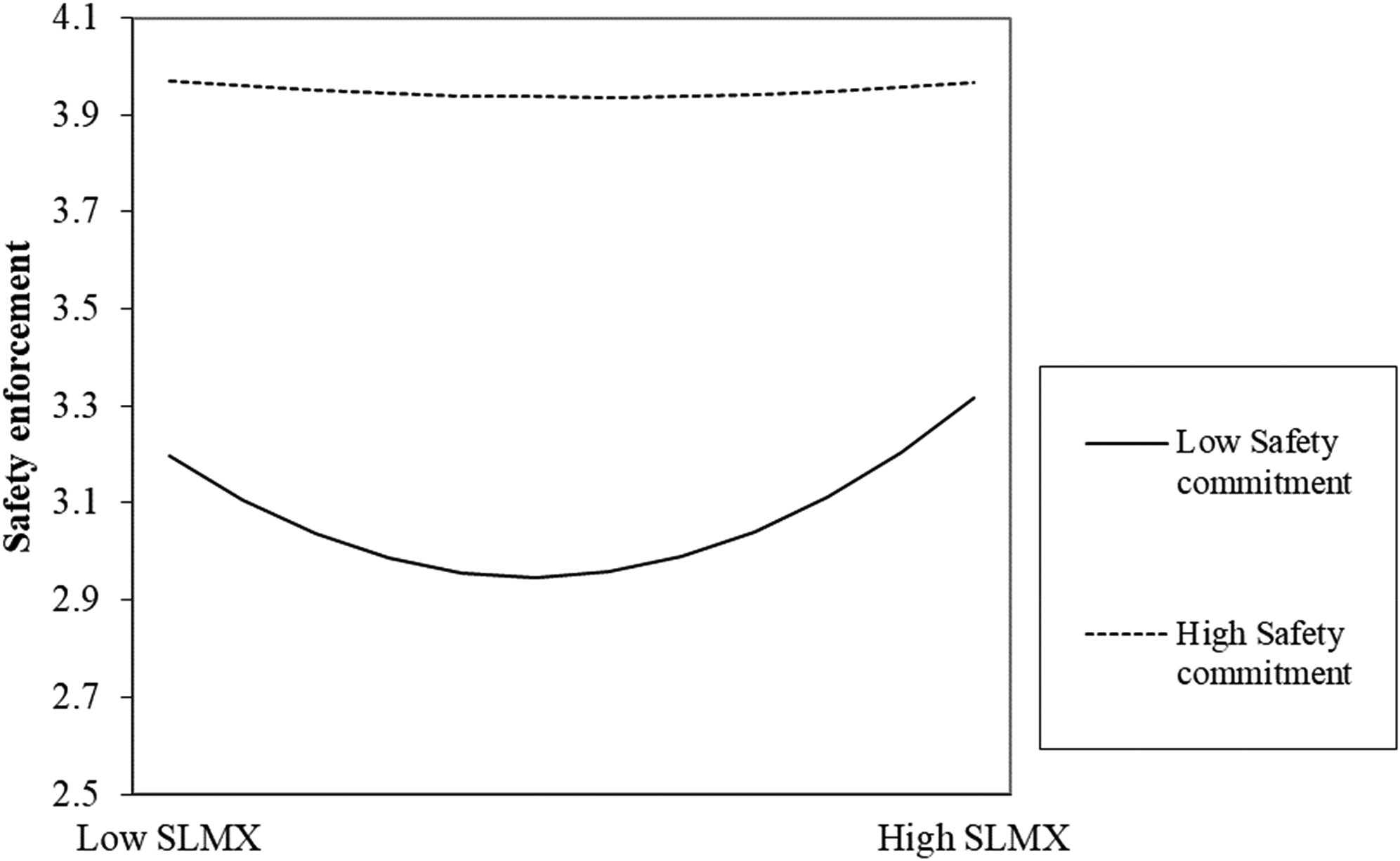
Leader Safety Commitment Moderating Curvilinear Relationship between SLMX and Safety Enforcement (Study 2)
Hypothesis 2 predicted that leader safety commitment would moderate the SLMX–safety enforcement relationship. To estimate this hypothesis, we followed the procedure advocated by Le et al. (2011) for estimating moderated curvilinear relationships, in which a moderated polynomial model may be represented with the following equation:
In Equation 2, Y represents our dependent variable, safety enforcement, B0 is the intercept, B1 is the linear term for SLMX, B2 is the quadratic term for SLMX, and Z denotes leader safety commitment as the moderator. To find support for Hypothesis 3, B4 and/or B5 had to be statistically significant. As shown in Model 4 in Table 4, both terms were significant at p = .05 and pseudo R2 increased to .30 (ΔR2 = .03). Combined, these results offered initial support for Hypothesis 3.
Figure 3 presents this relationship, plotted at ±1 standard deviation above and below the mean of leader safety commitment. It suggests that uniform enforcement, irrespective of SLMX, emerges only when a leader exhibits high commitment to safety. In contrast, when a leader is less committed to safety, that leader may be prone to enforce safety most for subordinates with whom they have a lower-quality relationship, giving the least attention to mid-SLMX subordinates. Additional analyses revealed that at lower levels of commitment, the relationship between the quadratic term of SLMX and safety enforcement was significant (B1[SLMX linear] = −2.46, p > .10; B2[SLMX^2] = .31, p < .05). At higher levels of leader safety commitment, the relationship between SLMX and safety enforcement failed to reach significance (B1[SLMX linear] = .10, p > .10; B2[SLMX^2] = −.02, p > .10). These results support Hypothesis 2 in that uniform enforcement of safety emerged at higher levels of leader safety commitment, whereas nonuniform enforcement emerged at lower levels of safety commitment. As predicted, those at moderate levels of SLMX received the least attention in terms of safety enforcement. 4
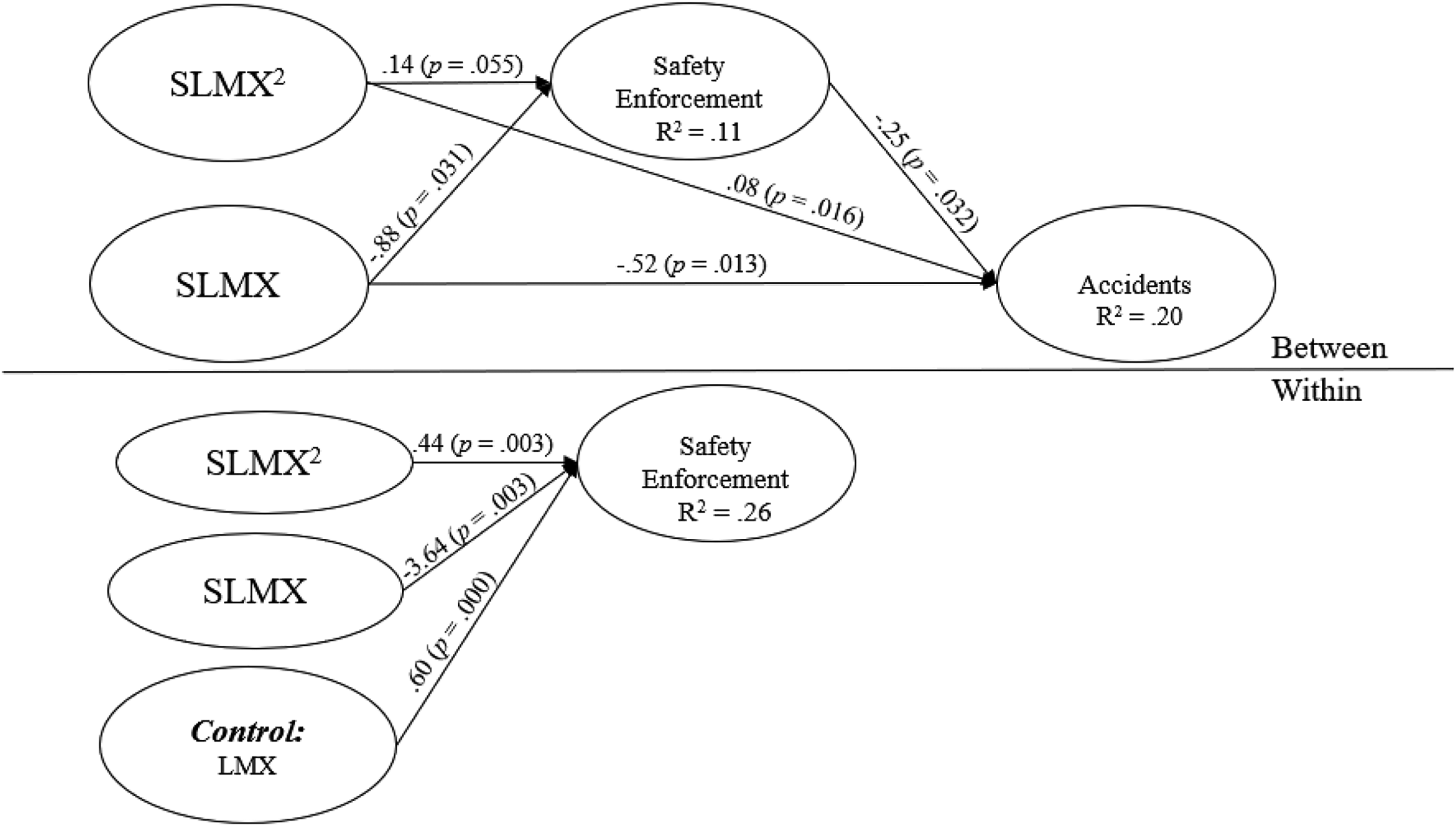
Multilevel Mediation Model Predicting Accidents (Study 2)
Study 3
Method
Procedure and Sample
Data for our third sample were obtained using a fully randomized experimental design. We invited business students from a university in the mid-Atlantic United States to participate in an online scenario-based experiment and survey. Students were members of the school subject pool, participating in research studies for course credit. The scenario was randomly assigned to participants and represented either low or high SLMX (see Appendix B for full details of scenario). In total, 228 people participated in our study (M age = 19.64; 54% male; 53% held at least a part-time job). Approximately 49% were randomized to the low-SLMX condition (n = 111) and 51% to the high-SLMX condition (n = 117).
Measures
Participants used a 5-point response scale (5 = strongly agree) for all survey items to maintain a standardized survey format mirroring Studies 1 and 2.
Manipulation check for SLMX
We used the LMX-7 measure (α = .92; Graen & Uhl-Bien, 1995; Matta et al., 2015) as a manipulation check for the low- and high-SLMX conditions in this experiment. We modified the instructions as follows: “As the manager in this scenario I . . .” and then presented the participants with seven items (see Appendix A).
Safety enforcement
We used Katz-Navon et al.'s (2005) seven-item scale to assess safety enforcement (α = .82) with the modified instructions, “During this large task, how likely would you be to . . .” (e.g., “. . . monitor this employee closely to ensure following of safety procedures?”).
Mediating mechanisms
We used McAllister’s (1995) six-item measure for cognitive distrust, which represents monitoring and defensive behavior based on lack of trust (α = .86; e.g., “I would need to work around this individual in order to get things done the way that I would like them to be done”). We used the three-item individual consideration subscale of the transformational leadership measure (α = .94; e.g., “I would see that this employee's interests are given due consideration”), as used in Lorinkova and Perry (2018). We used Liden et al.'s (1993) two-item measure of liking (α = .92; e.g., “I like this employee very much as a person”).
Statistical Analysis
We first ran confirmatory factor analyses in Mplus v8.4 to ensure the items in the distrust and safety enforcement constructs were distinct, given their shared focus on monitoring. The results supported a two-factor model (χ2 = 67.294 [df = 28], p = .000; comparative fit index [CFI] = .92; RMSEA = .11; Akaike information criterion [AIC] = 3114.478) over a one-factor model (χ2 = 113.126 [df = 28], p = .000; CFI = .83; RMSEA = .16; AIC = 3160.310). Indeed, distrust represents general task-related monitoring, whereas safety enforcement represents specific safety monitoring. We proceeded with testing our hypotheses as specified using Mplus with bootstrapping to assess the mediation effects in Hypothesis 3, following the recommendations of Preacher and Hayes (2008) for assessing a model with a multiple mediation design.
Results
Correlations and descriptive statistics for the study variables are presented in Table 5. First, we conducted a manipulation check using analysis of variance to compare means of SLMX across the two experimental conditions. In support, SLMX was significantly different across the conditions (F = 338.76, p < .01; low-SLMX condition, M = 2.61, SD = 0.74; high-SLMX condition, M = 4.20, SD = 0.56).
Descriptive Statistics and Intercorrelations of Study 3 Variables
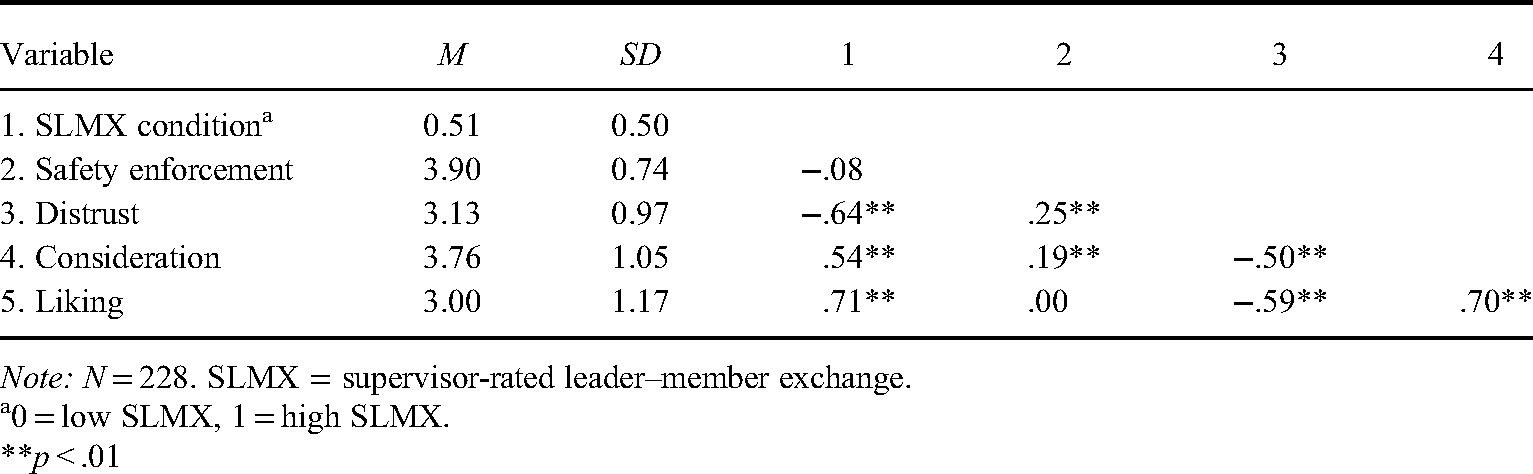
Note: N = 228. SLMX = supervisor-rated leader–member exchange.
0 = low SLMX, 1 = high SLMX.
**p < .01
Following the recommendations of Preacher and Hayes (2008), we tested a model with all three hypothesized mediators using the SLMX experimental condition as the independent variable (see top half of Table 6). Once the mediators were included, there was no direct relationship between SLMX condition and safety enforcement (b = .01, p > .10), and all mediators significantly predicted safety enforcement. In addition, SLMX was significantly associated with each mediator as follows: bdistrust = −1.22, p < .001; bconsideration = 1.19, p < .001; and bliking = 1.64, p < .001; bliking squared = 9.52, p < .001. Further, all indirect effects were significant, suggesting that the effect of SLMX on safety enforcement was mediated by distrust, consideration, and liking. Thus, Hypothesis 3 was supported.
Mediation of the Effect of SLMX on Safety Enforcement Through Distrust, Liking, and Consideration (Study 3)
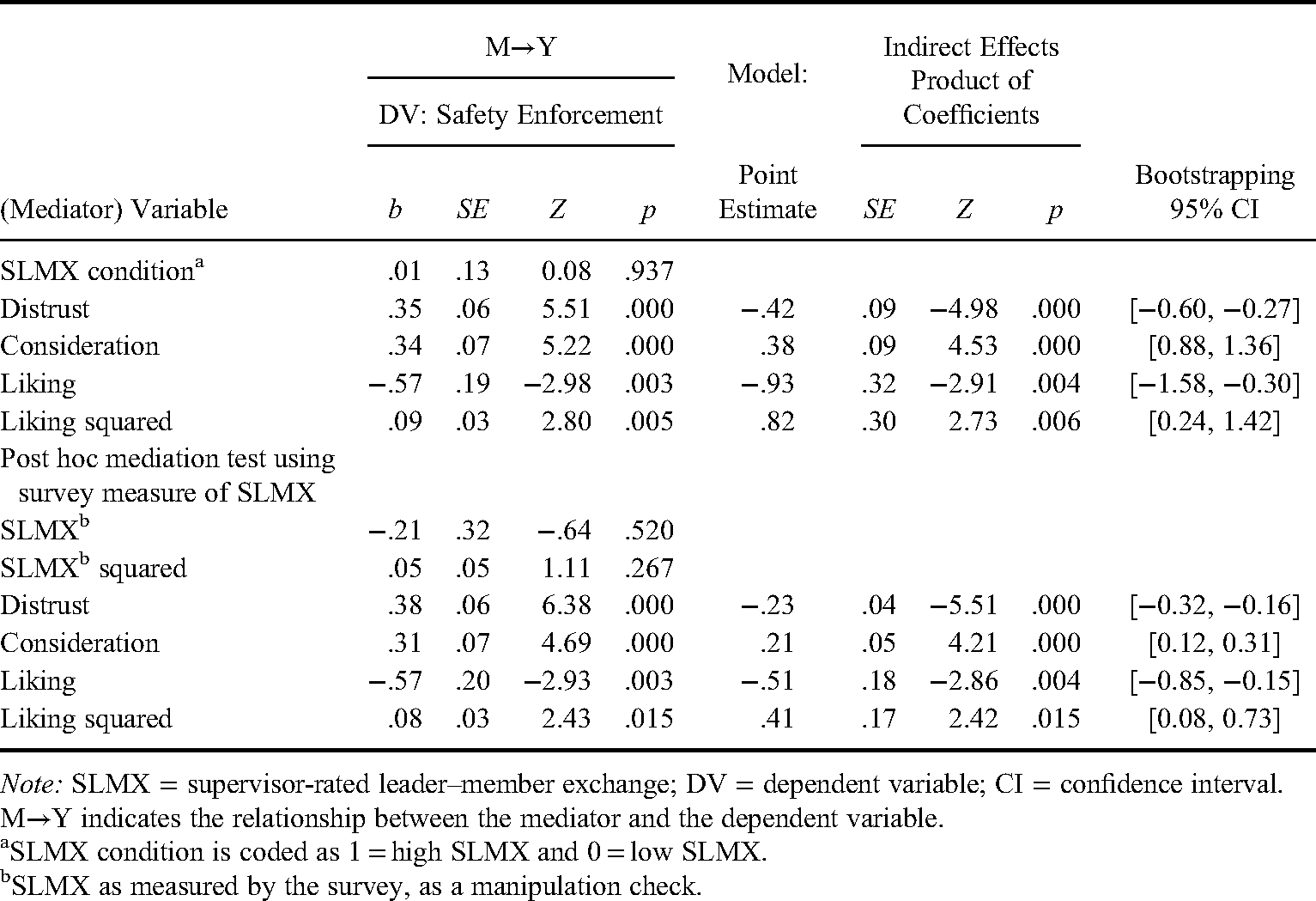
Note: SLMX = supervisor-rated leader–member exchange; DV = dependent variable; CI = confidence interval. M→Y indicates the relationship between the mediator and the dependent variable.
SLMX condition is coded as 1 = high SLMX and 0 = low SLMX.
SLMX as measured by the survey, as a manipulation check.
To further validate Hypothesis 3, we also conducted analyses with the continuous measure of SLMX. All mediators were significantly related to SLMX as follows: bdistrust = −.61, p < .001; bconsideration = .67, p < .001; bliking = .89, p < .001; bliking squared = 5.16, p < .001. In turn, controlling for the effect of SLMX and its squared term, all mediators were significantly related to safety enforcement with all indirect effects significant (see bottom half of Table 6). Thus, Hypothesis 3 received additional empirical validation.
Discussion
Our primary objective was to shed light on the neglected perspective of the leader in the context of LMX, applying relational leadership theory with AET to explain when and how a leader's relational quality with each subordinate affects differential safety enforcement behaviors targeted toward each subordinate, which in turn are negatively associated with workplace accidents. We tested a boundary condition of the relationship between SLMX and safety enforcement—leader safety commitment—as well as three mediating mechanisms between SLMX and safety enforcement—trust, consideration, and liking.
Despite being a core tenet of LMX theory, the association between relational quality as perceived by the leader and that leader's differentially targeted behavior toward each subordinate has rarely been directly examined. Relational leadership theory, an evolution of decades of LMX research (Brower et al., 2000; Day & Miscenko, 2015; Graen & Uhl-Bien, 1995; Wilson et al., 2010), provides a theoretical framework to explain why leaders may be more prone to pay attention to low- and high-SLMX subordinates, as these are the individuals who elicit the most salient negative and positive relational interactions with the leader, compared to those in the forgotten middle. We explicitly test how leader perceptions of relational quality affect the behavior of the leader toward each subordinate in the critical context of safety.
We found a curvilinear effect of SLMX in both Studies 1 and 2, suggesting that lower- and higher-SLMX subordinates may receive the most safety-related attention, overlooking midrange-SLMX employees. In Study 2, we supported a link between safety enforcement and accidents occurring in the team, as supported extensively in the safety literature (Christian et al., 2009; Clarke, 2013; Petitta et al., 2017; Probst, 2015). We also conducted an exploratory test of mediated effects of SLMX on accidents via enforcement and found preliminary support for partial mediation of both SLMX and SLMX2. We examined leader safety commitment as a boundary condition in Study 2 and found that only leaders who are highly committed to safety are likely to override the relational cues in each subordinate relationship to uniformly enforce safety across all SLMX levels.
The experiment in Study 3 provides further insights to three mechanisms of the effects of SLMX, revealing a similar U-shaped relationship between liking and safety enforcement as shown for SLMX and safety enforcement in Studies 1 and 2. The fact that only liking mirrors the overall curvilinear effect we found for SLMX may be evidence of the dominance of the affective components of attitudes, as described by Weiss and Cropanzano (1996). However, the positive linear relationships between safety enforcement and two other mechanisms—distrust and consideration—are also insightful in showing why leaders may choose to enforce safety more for certain subordinates. Consistent with our expectations, all three mechanisms mediated the effect of SLMX on safety enforcement (supporting Hypothesis 3). This indeed provides unique insights about leader reactions to SLMX and how these may influence leader decisions about interacting with individual subordinates.
Theoretical Implications
By focusing on the leader perspective and its influence on differentially targeted leader safety enforcement behaviors, our work answers calls in extant LMX research (Bernerth & Hirschfeld, 2016; Brower et al., 2000; Matta et al., 2015; Wilson et al., 2010; X. Zhou & Schriesheim, 2010) and extends applications of recent research investigating the nuances of mutual influence processes between leaders and followers (e.g., Katz-Navon et al., 2020; Martin et al., 2016; Uhl-Bien, Riggio, Lowe, & Carsten, 2014) to the safety literature. In doing so, we contribute to the leadership and safety bodies of literature in several ways.
First, we contribute to the safety literature as we build upon the traditional exchange perspective of LMX by applying relational leadership theory with AET to suggest relational cues in the leader–follower relationship may bias leaders in their decisions about how to enforce safety rules, which in turn impact safety performance. The curvilinear relationship of SLMX with safety enforcement targeted at each subordinate supports relational leadership theory in conjunction with AET, shedding light into the behavioral impact of negative and positive relational interactions within each dyad.
Our finding that the curvilinear relationship between SLMX and safety enforcement holds only for leaders with lower levels of safety commitment also offers insights for the leader decision-making literature and safety theory. It supports the notion that, primarily when leaders are less committed, they may rely on easily available relational cues (SLMX) to determine how to enforce safety and thus fail to maintain consistency across the workgroup (Katsikopoulos & Gigerenzer, 2008). If the implications of AET are extended to the safety and leadership literature, this nonuniform enforcement could be an affect-driven behavior, in contrast to the judgment-driven behavior of uniform safety enforcement. This idea is supported by the safety literature, which shows that highly committed leaders are most motivated to enforce safety and make it a priority (Christian et al., 2009). Thus, our work uses AET to extend this view to the context of the LMX dyad by outlining how less committed supervisors may rely most on relational cues to guide decision-making in safety enforcement. As predicted, those subordinates who have had the most salient socioemotional interactions with the leader (i.e., low or high SLMX) may receive the most attention, whereas subordinates with whom leaders have moderate-quality relationships may receive the least attention when leaders are not as committed to safety. Thus, considering safety commitment or similar constructs reflecting leader motivation as moderators can be insightful for leadership theory, revealing when SLMX may drive differential subordinate-targeted behavior. These results add insight to the safety commitment body of research by showing yet another reason why these are important factors to foster among leaders—to promote more uniform safety enforcement. These findings also have important implications for the safety literature because they position leader safety commitment as a moderator (boundary condition); by understanding how safety commitment may influence leader consistency in terms of safety enforcement, scholars can shed light on how to improve other safety outcomes.
Finally, we contribute to the work on relational leadership and AET by exploring three specific relational dynamics—trust, individual consideration, and liking. We view these relational elements as affective reactions to the ongoing sequence of relational events between the leader and each subordinate (SLMX), consistent with conceptualizations by Lazarus (1991) and Weiss and Cropanzano (1996). Over time, these interactions add up to significant effects on attitudes and behaviors of leaders, in this case, differential safety enforcement directed at each subordinate. Our finding that the overall SLMX effect on enforcement mirrored that of liking suggests that perhaps, as the most affective mechanism of the three we explored, liking may dominate decisions about leader enforcement behaviors, consistent with Weiss and Cropanzano’s (1996) suggestion that affective components of attitudes are stronger than cognitive components in predicting certain behaviors. Further work building on our efforts integrating LMX and AET using relational leadership as a lens will be helpful for further untangling the mechanisms of LMX to understand how and why these relational dynamics matter.
Practical Implications
Our work also suggests several important practical implications. Safety is an important issue in organizations, with safety enforcement linked to employee safety compliance and, ultimately, to fewer work-related injuries and accidents. Thus, it is desirable to understand how more uniform enforcement can be fostered. Leaders may strategically invest in subordinates based on perceptions of relationship quality and, even more precisely, based on trust, consideration, and liking. At a higher level, the most obvious targets—lower- or higher-SLMX subordinates—may receive the most attention, allowing employees with midlevel SLMX to essentially “fly under the radar.” The mere knowledge of this phenomenon is likely to help practicing managers in their safety enforcement decision-making. But organizations who find ways to help leaders form stronger relationships with more of their subordinates may also benefit; training or providing opportunities for more meaningful one-on-one interactions may be a starting point.
As another suggestion, we advise organizations to foster leader commitment to safety, as this appears to provide a basis upon which leaders are motivated to enforce safety more uniformly (regardless of relational quality). Organizations might enhance leader safety commitment by soliciting input from leaders about their desired rewards and realistic measures of safety-related success and then following through to design an effective incentive system. Asking leaders about their need for additional resources and providing those may also help enhance leader ability and motivation to uniformly enforce safety. Enforcement and communicated safety commitment from top management may foster an overall climate of safety, further enhancing leader commitment. Given the inherently limited capacities of leaders, these results also suggest the need for organizations to build in measures that ensure leaders are not the only line of safety enforcement (e.g., also using peer, institutional, and interdepartmental mechanisms). These efforts can save the organization money and build a favorable reputation for safety and security (Hofmann & Morgeson, 1999).
Strengths, Limitations, and Future Research
Notable strengths of this study include hypothesis tests conducted across three samples in two high-risk field settings and a fully randomized experimental setting. Our multisource models lend further credibility to the results by providing direct tests using both leader and employee perceptions. In particular, using subordinate reporting of leader safety enforcement and commitment adds a well-rounded view of how a leader is perceived, in conjunction with perceptions of the leader regarding the quality of relationship with each subordinate. Despite these strengths, several limitations should be acknowledged.
First, we did not test all relationships in one model but rather tested them in pieces across three studies. As with any field study, we were limited in the number of leaders and employees who participated as well as with the number of items included, which combined to limit our statistical power and the number of variables we could include. The next logical step would be to conduct a field study combining multiple sources of data from more employees and leaders to test the full model in a multilevel path model, including safety data at the workgroup and subordinate levels. Another weakness is the cross-sectional nature of the two field data sets, which prevents us from asserting causality in our conclusions. Our fully randomized experimental study provides some support for our assertions, as do the statistical methods we used in the field samples, but longitudinal research is always preferable. Further replication is also desirable since curvilinear effects can appear more dramatic when plotted (i.e., if they use extrapolation rather than actual data points).
We also acknowledge that the relational dynamics we studied could be considered antecedents, leading to the development of SLMX, but we explore them as outcomes, based on the AET framework positioning affective reactions evolving from relational events, such as SLMX. Both approaches have value, but Tse et al. (2018) highlight the need to consider LMX as an antecedent of such relational dynamics, in addition to ongoing efforts to examine them as antecedents of LMX development.
Furthermore, we acknowledge there may be some limitations associated with the response scales and items used for SLMX, such as double-barreled items and socially desirable responding by leaders who wish to manage impressions with top management (Bauer & Green, 1996; Greguras & Ford, 2006; Scandura et al., 1986). However, because our results for Hypothesis 1a (SLMX and safety enforcement) were replicated across two field samples, and evidence for the mediating mechanisms was provided by our third sample (Hypothesis 3), this increases credibility of our results.
The SLMX items we used also have well-known challenges in that they include items about how leaders view the subordinates and how the leaders believe subordinates view them (Brower et al., 2000). Research splitting out these perspectives and referents is valuable in better understanding nuances of LMX. Furthermore, the specific items used for SLMX may not appear to be affective in nature as we suggested in our use of AET. However, they all inherently include an affective foundation (Lazarus, 1991). For instance, “I understand his/her problems/needs” may seem cognitive in nature on the surface, but this item implies a deeper empathy for the employee that is rooted in affective dynamics. This is consistent with much work that asserts LMX develops over a series of socioemotional interactions between leader and subordinate (Tse & Troth, 2013). We also acknowledged the relational dynamics we studied contain cognitive and behavioral components, which is consistent with conceptualizations of any affective construct (Lazarus, 1991; Pinder, 2008; Weiss & Cropanzano, 1996). Still, it would be helpful to use more explicitly affective-focused SLMX items using AET, and it would be helpful to directly measure affective reactions (e.g., positive and negative affect) as outcomes. Perhaps even using an experiential sampling methodology to assess momentary reactions to leader–member interactions would be valuable in extending the model we tested here.
Other promising future research could consider additional contextual factors that influence the effects of SLMX and leader enforcement at both the individual and team levels, such as workgroup characteristics, subordinate individual differences, and performance (Henson & Beehr, 2018). Perceived legitimacy of differential treatment (which may be affected by upward relationships of the leader; Herdman, Yang, & Arthur, 2017) would also be interesting to assess. Our multilevel structural equation model suggested consistent patterns of effects at the individual and team levels for SLMX on safety enforcement, which in turn was negatively related to accidents (as safety enforcement in the workgroup increased, accidents decreased). This suggests that all individuals in the group may benefit from a high overall level of enforcement, even if less enforcement is experienced by some individuals. Future research should probe these team-level effects further to understand how and why certain leader enforcement behaviors may emerge across the workgroup and/or differently for certain subgroups within the workgroup. For instance, leaders who visibility enforce safety for the most-liked subordinates may set a positive example for everyone, even if some do not receive as much personal attention in enforcement. Overall, it may be best for organizations to promote high levels of safety commitment and enforcement, but when differential behaviors of leaders are considered in conjunction with overall workgroup outcomes, perhaps more insight can be revealed into the most strategic use of leader energy.
Leader perceptions of relationship quality may also have effects on choice of leadership style employed with subordinates (i.e., transformational, transactional, laissez-faire), which could affect subordinates in important and potentially nonlinear ways (Courtright, Colbert, & Choi, 2014; Katz-Navon et al., 2020). Additionally, subordinate outcomes are important to consider in conjunction with leader behaviors targeted at subordinates, such as subordinate engagement, perceptions about leader relationships, well-being, performance, and career success (Restubog et al., 2011). Coworkers and customers may also be important targets or motives for safety enforcement, but our model does not address these. We encourage future research that explores the efforts of leaders to enforce safety on behalf of other parties, such as customers, and the effects of safety enforcement on indirect parties, such as coworkers. These ideas could provide a more comprehensive picture of the role of leader participation in workplace relationships, toward the goal of building a safer workplace for all.
Footnotes
Appendix A
Appendix B
Acknowledgments
The first and second authors contributed equally. The authors thank Dr. Kelly Wilson and Dr. In-Sue Oh for their comments on earlier drafts of this work. We also thank Dr. Matthew Douglas for his valuable insights during our revisions.
Declaration of Conflicting Interests
The author(s) declared no potential conflicts of interest with respect to the research, authorship, and/or publication of this article.
Funding
The author(s) received no financial support for the research, authorship, and/or publication of this article.
