







Abstract
Peer developmental relationships—informal arrangements between pairs of individuals who take an active interest in and concerted action to advance one another's careers—offer a valuable alternative to formal mentorships. Despite recognition that peer developmental relationships have the potential to jointly provide career and psychosocial support (i.e., multiplexity) and that relationships embodying multiple support dimensions are indispensable, a paucity of work investigates what factors contribute to their dynamics and persistence over time. To address this issue, we integrate the microfoundations of network dynamics and mutuality perspectives to identify why and when social processes—specifically, reciprocity, trust, and trust asymmetry—operate to form, strengthen, or maintain multiplex peer developmental relationships. To test our hypotheses, we collected three waves of data over one-and-a-half years from a cohort of individuals participating in a leadership development program. Using variations of the Quadradic Assignment Procedure (QAP) to investigate dyad-level dynamics, our results generally suggest that (over and above demographics and network characteristics) the provision of psychosocial support relatively early in the peer-to-peer relationship is likely to evolve into a more complex, high-quality relationship comprised of both psychosocial support and career support (i.e., a multiplex peer developmental relationship). Perhaps more importantly, the social processes capturing mutuality further increased the likelihood that multiplex developmental relationships would develop and persist over time. Our results demonstrate that mutuality is both generative and resolute in nurturing multiplex developmental relationships.
Keywords
Traditionally, mentoring relationships have been considered formal, one-on-one interactions whereby a senior individual confers coaching, guidance, and visibility to less experienced junior colleagues (e.g., Allen, Eby, Poteet, Lentz, & Lima, 2004). As shifts in the employment contract have made work trajectories less secure, employees are seeking informal relationships to anchor their personal and professional identities. Similarly, as work transcends organizational boundaries, so too will sources from which individuals draw personal and professional support (Thomas & Higgins, 1996). Thus, scholars have reconceptualized the scope of mentoring to include developmental networks—the constellation of individuals’ relationships within and outside their organization who take an active interest in and action to advance their careers (Allen & Finkelstein, 2003; Higgins & Kram, 2001; Higgins & Thomas, 2001).
Research has shown that developmental networks offer a valuable alternative to formally managed mentoring programs (Chandler, Kram, & Yip, 2011; Murphy & Kram, 2014; Raabe & Beehr, 2003). Indeed, they are uniquely associated with a range of career outcomes, including promotion and career advancement (Singh, Ragins, & Tharenou, 2009), higher salaries (Kirchmeyer, 2005), work satisfaction (Higgins, 2000), intentions to remain in one's organization (Higgins & Thomas, 2001), career-related self-efficacy (Higgins, Dobrow, & Chandler, 2008), and professional identity development (Dobrow & Higgins, 2005; Higgins, Dobrow, & Roloff, 2010). However, despite the growth in this area over the past two decades, several areas could use further examination.
First, developmental networks are best characterized by an entrepreneurial approach to relationship building (Murphy & Kram, 2014). They are a mutual partnership where actors deliberately seek out relationships rooted in reciprocity, mutuality, interdependence, and responsiveness (Dobrow, Chandler, Murphy, & Kram, 2012; Higgins & Kram, 2001) and dissolve less favorable ones (Tasselli & Kilduff, 2021). Yet whereas research has identified predictors and outcomes of developmental relationships (see Dobrow et al., 2012 for a review), less is known about the mutual social processes that drive these dyadic relationships to form and persist over time (Tasselli & Kilduff, 2021). Along these lines, Dobrow and Higgins (2019) advocate that future research “thoughtfully consider the importance of the ‘beginnings’ of these networks … especially at pivotal career development junctures (e.g., starting one's career)” (p. 243) to identify “whether different connections come and go from one's network and if so, how” (p. 242). Indeed, social processes such as reciprocity and trust likely act as pressures for persistence and change in developmental networks (Ahuja, Soda, & Zaheer, 2012).
Second, scholars conclude that developmental relationships can serve the same key functions as traditional formal mentors (Dobrow & Higgins, 2005; Dobrow et al., 2012); namely, career support (aid that enhances career advancement, such as sponsorship and exposure) and psychosocial support (aid of a social and emotional nature, such as friendship; Cotton, Shen, & Livne-Tarandach, 2011). Because these functions are each valuable on their own (Kram & Isabella, 1985), they have largely been studied independently (Janssen, van Vuuren, & de Jong, 2016). But many dyadic relationships are multiplex, whereby multiple support functions coexist (Methot & Rosado-Solomon, 2020). For example, a multiplex developmental relationship simultaneously provides both career and psychosocial support (Cotton et al., 2011; Higgins, 2007; Yip & Kram, 2017). In fact, multiplex developmental relationships may have unique effects on career success and thus are “more indispensable, more critical to development” (Kram, 1985: 24) than their one-dimensional counterparts (Cotton et al., 2011). In considering how vital and irreplaceable multiplex developmental relationships are, Higgins (2007: 2013) goes so far as to label them “true mentors.” Paradoxically, despite their potential value, there is a paucity of empirical work on multiplex developmental relationships. Cotton et al.’s (2011) research on developmental networks of Baseball Hall of Fame Members remains the only study explicitly addressing the multifaceted nature of developmental relationships, and scholars have repeatedly called for more research on multiplexity in such relationships (Dobrow & Higgins, 2019; Dobrow et al., 2012; Janssen et al., 2016; Methot & Rosado-Solomon, 2020).
Third, research suggests that career-oriented support (e.g., advice) and psychosocial support (e.g., friendship) demonstrate distinct and potentially competing dynamics (Gibbons, 2004). On the one hand, friendship ties are stable, enduring, and more difficult to replace than are advice relations (Gibbons, 2004; Shah, 2000). On the other hand, because professional advice ties reinforce existing values while friendships challenge them, “friendship should act as a catalyst for change [whereas] forces in the advice network act toward inertia” (Gibbons, 2004: 243). Given that career and psychosocial support networks often coexist (Ibarra, 1992; Methot, LePine, Podsakoff, & Christian, 2016) but demonstrate competing pressures for dynamics, it remains unclear how their coexistence might impact social structures and dynamics over time.
Last, while formalized mentoring programs have long been a central topic for scholars and practitioners, “an unintended consequence is that peer relationships have fallen off the radar screen as an important resource” in the mentoring literature (Murphy & Kram, 2014: 152; emphasis added). This is unfortunate insofar as peer developmental relationships, especially those that are multiplex, are a uniquely accessible and valuable resource (Kram & Isabella, 1985; Raabe & Beehr, 2003). They enable individual growth and development through successive life and career stages, provide ancillary support when a formal mentor fails to meet critical developmental needs, and are likely better equipped and available to fulfill individuals’ day-to-day needs (Kahn, 1990; Kram & Isabella, 1985; May, Gilson, & Harter, 2004).
We thus integrate the microfoundations of network dynamics (Ahuja et al., 2012) with the mutuality perspective (Dobrow et al., 2012) to identify why and when social processes form and maintain multiplex peer developmental relationships at the dyad level. The microfoundations of social networks are the basic factors that shape (a) the content of ties in a network (i.e., career and psychosocial support) and (b) network dynamics (i.e., tie formation and persistence). We use this framework to theorize that mutuality—reciprocity, trust, and trust asymmetry—comprises the social processes (i.e., microfoundations) driving the co-evolution of career and psychosocial support (i.e., multiplexity) and their stability over time. We use a longitudinal sample of undergraduate business students (i.e., juniors and seniors) in a leadership development program 1 to better understand the nuances of developmental network change during an important life transition—that is, preparing to enter the workforce (Murphy & Kram, 2014).
Taken together, our research makes valuable theoretical and practical contributions to the mentoring and the social networks literatures. First, we provide a richer theoretical understanding of multiplex developmental relationship dynamics by unpacking the dyadic social processes that drive multiplex developmental networks to emerge, change, or remain stable over time. Thus, we respond to calls for understanding the “inner workings of developmental networks,” particularly “how and why specific ties come and go” and how various contents of developmental networks (i.e., career and psychosocial support) co-evolve over time (Dobrow & Higgins, 2019: 242). Next, our research questions target or “drill down” to the origins of multiplex relationship change at the dyad level (e.g., tie formation, tie persistence), which are important indicators of their long-term worth (Ahuja et al., 2012; Dahlander & McFarland, 2013). Such dynamics can be masked by common approaches examining global ego network structures, such as density (i.e., degree of connectedness among all actors in the network) and breadth (i.e., diversity of network contacts). For example, “whole” network-level characteristics may appear structurally stable because lost ties are replaced with new ties simultaneously (Ahuja et al., 2012; Sasovova, Mehra, Borgatti, & Schippers, 2010). From a practical perspective, to the extent our study pinpoints the roots of effective multiplex developmental relationships in a peer network (beyond the predictive role of demographics and network characteristics, which we control for in this study), our results should inform managers seeking to create opportunities for employees’ career development by helping to promote high-quality developmental relationships and avoid dysfunctional ones.
Microfoundations of Multiplex Peer Developmental Networks
Individuals can receive developmental support from many people at any point in time, including colleagues, peers, family, and community members (Higgins & Kram, 2001). Researchers conventionally adopt an egocentric network approach (i.e., a focal individual identifies key others) to study developmental networks (e.g., Dobrow & Higgins, 2005; Higgins, 2000; Higgins & Thomas, 2001). But at its core, a multiplex developmental relationship is a one-on-one connection between two partners (Bartol & Zhang, 2007). We thus adopt a dyadic approach to explore how the social processes of reciprocity, trust, and trust asymmetry drive the content and stability of peer developmental relationships. The dyad, or tie between two peers in a network, represents the existence or absence of a relationship (Ferris, Liden, Munyon, Summers, Basik, & Buckley, 2009) and is a fundamental building block of developmental networks (Allen, Eby, O’Brien, & Lentz, 2008).
We integrate two perspectives to understand why and when social processes influence dynamics of a multiplex peer developmental relationship. The microfoundations of network dynamics provide a scaffold for understanding the origins of change in a network. Ahuja and colleagues (2012) identify aspects of a network tie that can change, including the existence of a relationship (e.g., its formation or dissolution) and its content (e.g., the multifaceted nature of resources flowing through it). They articulate three network features driving these changes: (1) opportunity, whereby individuals form ties to those who are more accessible; (2) an agentic approach to relationship building guided by mutual benefits; and (3) inertial pressures, or factors influencing the stability of a dyadic tie over time. Whereas the microfoundations lens (Ahuja et al., 2012) provides a backdrop for understanding changes in a network, the mutuality lens sheds light on the theoretical mechanisms most likely to affect the evolution of multiplex peer developmental relationships (Dobrow et al., 2012). Mutuality implies that an exchange develops “along dimensions to which both parties can contribute and that are valued by both parties” (Dienesch & Liden, 1986: 624) and “captures the sense that both people in a connection are engaged and actively participating” (Dutton & Heaphy, 2003: 267). Specifically, a relationship embodies three characteristics: (1) reciprocity, where both individuals actively engage in the “give and take” of the support resources in the relationship (Dienesch & Liden, 1986); (2) a high level of trust, or willingness to be vulnerable to another (Mayer, Davis, & Schoorman, 1995); and (3) a low level of trust asymmetry, or disparate vulnerability (Kadushin, 2012; Miller & Stiver, 1997; Ragins & Verbos, 2007). Taken together, these lenses specify microfoundational social processes between peers that drive the formation and persistence of dyadic multiplex ties.
Connecting Mutuality Processes with the Microfoundations of Developmental Networks
The first network microfoundation, opportunity, refers to the availability of potential others with whom to form ties; in other words, forming or dissolving a relationship can be driven by accessibility (e.g., the presence of members of the same social group). Peer relationships have long been considered a valuable resource (Chandler et al., 2011; McManus & Russell, 2007), in part because they are the most accessible and approachable developers (Murphy & Kram, 2014; Schinoff, Ashforth & Corley, 2020). Indeed, Kram and Isabella (1985: 116) found “peers offer an important alternative to conventional mentoring relationships by providing a range of developmental supports for personal and professional growth.” While the support provided informally by peers may be similar to that formally provided by traditional mentors, peer relationships uniquely “offer a degree of mutuality that enables both individuals to experience being the giver as well as the receiver of these functions” (Kram & Isabella, 1985: 118). We reason that peers present a greater opportunity to build multiplex relationships with other peers (McCabe, 2016) because they are an accessible source of both career and psychosocial support and can both fully engage in the relationship (Allen, Day, & Lentz, 2005).
The second network microfoundation, agency, captures an individual's motivation and ability to shape relationships by building mutually beneficial ties or dissolving less valuable ones (Kleinbaum, 2018). Effective developmental networks are shaped by an entrepreneurial approach to relationship building (Murphy & Kram, 2014), whereby a beneficial peer relationship is mutually reinforcing (i.e., both parties actively engage in the give and take of the relationship; Allen et al., 2005). For example, in a developmental relationship characterized by mutuality, both parties enjoy “growth, learning and development within the career context” (Fletcher & Ragins, 2007: 374), benefit from and experience a higher quality of life, and reciprocate developmental support (Roberts, 2007). In turn, peers who are mutually committed to their relationship should be more likely to invest in maintaining the relationship over time (Dobrow & Higgins, 2019).
The third microfoundation, inertia, refers to pressures for stability or change in a network. It considers the durability of a relationship, as well as the content or social processes flowing through the tie that encourage persistence (Ahuja et al., 2012). A peer relationship characterized by the mutuality processes of reciprocity, trust, and trust asymmetry should shape how long the relationship will endure. As an example, peers that reciprocate developmental support have the potential to maintain multiplex ties, as each developmental function “tends to reinforce the other, thus strengthening the overall tie” (Cotton et al., 2011: 18). Further, a multiplex developmental tie provides access to the broadest scope of supportive interactions (Dutton & Heaphy, 2003; Ibarra, 1993; Methot et al., 2016), including reliable and candid feedback, emotional support, career strategizing, and confirmation of each other's competence and potential (Kram & Isabella, 1985), contributing to its durability. Thus, we advance new insights into the likely emergence and persistence of multiplex peer developmental relationships as they evolve over time.
Dynamics of Multiplex Peer Developmental Relationships
A Foundation of Psychosocial Support
Network ties often form and evolve from the confluence of opportunity and choice (e.g., Kleinbaum, Stuart, & Tushman, 2013). The microfoundations of opportunity and agency suggest that individuals prefer linking to others within their own social groups than with those outside them and that individuals deliberately seek to create relationships that favor themselves. With respect to the latter, scholars traditionally assumed this involved an instrumental motive—that individuals would pursue and sustain relationships based on the transactional value of the resources they can provide (Tasselli & Kilduff, 2021). Early research on the phases of formal mentoring relationships suggests the “initiation” phase is founded on the provision of career-related resources and support and that, as transactional expectations are met, the relationship is cultivated to include psychosocial support and closer emotional bonds (Kram, 1983). But as compared to formally prescribed mentoring relationships, we suggest that flexible, discretionary, and accessible peer relationships predicated on psychosocial support are more likely to lay the foundation for a multifaceted developmental relationship to evolve (Ferris et al., 2009).
Network dynamics are fundamentally driven by the underlying affect implicated in a relationship (Casciaro, 2020; Methot, Melwani, & Rothman, 2017). Along these lines, Casciaro and Lobo (2011: 3) theorize that affective ties (i.e., those rooted in emotions such as liking and friendship) and instrumental ties (i.e., those rooted in transactional interactions such as advice) co-evolve to shape and reinforce each other over time. They conclude that affective content in a relation is primal: Affective ties “occur at a more basic level than instrumental evaluations” and thus stimulate high-quality information exchanges. They suggest, therefore, that discretionary networks in organizations need to be “primed with positive affect to lubricate the functioning of task-based ties.” The primacy of positive affect is consistent with work suggesting the relational dimension “warmth” facilitates communication and absorption of ideas (Cuddy, Glick, & Beninger, 2011), such that people have a propensity to form advice ties based on the genuine care and concern they experience when interacting (Casciaro & Lobo, 2008; Levin & Cross, 2004).
For a relationship to become “strong” or “high-quality,” it has to involve some degree of self-disclosure (Gibson, 2018; Kram & Isabella, 1985), which is likely to occur between friends because they are more accessible to establish similarities (Dumas, Phillips, & Rothbard, 2013) and engage in novel and interesting activities with each other (Aron, Norman, Aron, McKenna, & Heyman, 2000), both in and outside of work (Sias & Cahill, 1998). For example, Oh, Chung, and Labianca (2004) found that informal socializing gave work group members greater opportunity to interact, which evolved into higher quality task-based relationships. It is reasonable to think that individuals “get to know” one another before providing professional or instrumental value (e.g., Kram, 1983; Methot et al., 2016). As Cuddy, Kohut, and Neffinger (2013: 56) explain, “prioritizing warmth helps you connect immediately with those around you, demonstrating that you hear them [and] understand them.” We expect, then, that the provision of psychosocial support in a relationship provides an anchor for the evolution from a unitary relationship to a multiplex developmental relationship.
Hypothesis 1: Peer relationships that confer psychosocial support at an earlier time period will evolve into multiplex developmental relationships at a consecutive time period.
Mutuality in Career and Psychosocial Support Relations
By integrating a mutuality perspective, we can move beyond the role of psychosocial support as a key factor in the formation of multiplex peer developmental relationships. “Born from mutual vulnerability and mutual responsiveness” (Dutton & Heaphy, 2003: 267), mutuality is marked by active engagement by both parties in a dyad, as well as mutual positive regard and trust (Ragins & Verbos, 2007; Roberts, 2007). Thus, the subjective experiences of reciprocity, trust, and trust asymmetry in a peer-to-peer relationship define the quality of the connection (Dutton & Heaphy, 2003) and can alter the nature of interactions (Gibson, 2018).
Mutuality implies, first, the extent to which relations are reciprocal; that is, that they involve a give and take between the two parties (Kadushin, 2012). For example, when one nominates a peer as someone who provides psychosocial support and the target makes a corresponding nomination, this evidences mutual esteem and acknowledgment (Lamertz & Aquino, 2004). Because reciprocity is a fundamental mechanism of interpersonal attraction (Kenny & La Voie, 1982), reciprocal relationships should lead to more frequent and rich exchange of information and feedback between the two parties and thus cultivate multiplex exchanges. For example, research suggests that when self-disclosure is reciprocal, sustained, and intimate (e.g., sharing stories about positive life events), the quality and complexity of the relationship is increased (Aron, Melinat, Aron, Vallone, & Bator, 1997; Gable & Reis, 2001; Sias & Gallagher, 2009). We thus expect the reciprocation of developmental support (career strategizing or psychosocial support) to prompt the formation of a multiplex tie.
Second, mutuality is captured by the extent to which the relationship involves trust—the willingness to be vulnerable to another party with the expectation they will behave in the focal individual's best interest (Mayer et al., 1995). Given the affective (i.e., feelings of benevolence) and cognitive (i.e., perceptions of competence-integrity) dimensions of trust (e.g., Mayer et al., 1995; McAllister, 1995), it is likely associated with the formation of multiplex relationships defined by the coexistence of psychosocial and career support. In fact, McEvily, Perrone, and Zaheer (2003: 95) argue that “trust creates multiplexity in ties by providing generative capacity, [whereby individuals] gradually increase the scope of their relationship to incorporate interactions involving more substantial investments in the tie.” Thus, we expect trust to inspire multiplexity through mutually engaging behaviors that combine formal respect for a peer with the benevolent concern for a friend (Methot et al., 2016), such as looking out for one another and being forthright in interactions (Mayer et al., 1995; McAllister, 1995). As a result, trust among peers is embodied by mutually beneficial interactions, which facilitate the development of high-quality and multifaceted bonds (e.g., Zagenczyk, Purvis, Shoss, Scott, & Cruz, 2015).
Last, mutuality is captured by the degree of asymmetry, or mutual vulnerability, in a relationship (Kadushin, 2012). With greater mutuality, there is less disparity in the extent to which parties are vulnerable to each other. If an individual is instrumentally or socially vulnerable to or dependent on their peer because the positive regard and exchange of resources is imbalanced (Bowler & Brass, 2006), then a multiplex relationship is less likely to form. In this case, the “trustee” is driven by his or her own self-interests and characteristically exercises control over the relationship by imposing his or her will on the “trustor” (Hall, 1985; Miller, Weiland, & Couch, 1978). This hinders the “trustor” from initiating coordinated actions that are mutuality beneficial, which prevents the relationship from broadening to include both career and psychosocial support. Thus, we predict that the three features of mutually beneficial relationships (i.e., reciprocity, trust, and trust symmetry) will generate qualities of a “true” mentor by yielding both high career support and high psychosocial support (Higgins & Thomas, 2001).
Hypothesis 2: Mutuality factors at an earlier time period will be positively associated with the formation of multiplex peer developmental relationships at a subsequent time period. Specifically, (a) reciprocated career and psychosocial support relationships and (b) Peer A's trust in Peer B will be positively associated, but (c) asymmetry in trust between Peer A and Peer B will be negatively associated with multiplexity.
Multiplex Developmental Relationship Persistence
Developmental relationship persistence involves “factors that guide people who are familiar with each other to repeat and extend their association” (Dahlander & McFarland, 2013: 70). At the dyad level, relationship persistence captures whether a connection remains in one's network over time (Cummings & Higgins, 2006; Dobrow & Higgins, 2019); a multiplex peer-to-peer relationship at one point in time does not necessarily imply it will continue into later time periods. Recent research suggests the persistence of multiplex relations is critical (Methot et al., 2016; Schinoff et al., 2020) because they provide access to a deep and useful pool of resources. For example, Casciaro and Lobo (2005: 4) note, “when you launch into a task with those you already know, you don’t waste a lot of time figuring out what to expect from them or explaining what you mean every time you say something.” Hence, it is important to develop a better understanding of how peers move in and out of developmental networks and to identify factors that promote multiplex developmental relationship persistence.
Developmental relationships may persist because of inertial forces—social processes that constrain actors’ actions (Ahuja et al., 2012), creating pressures toward continuity and durability of social structures (Coleman, 1988; Giddens, 1984). Once a relationship forms, people are likely to maintain it despite the availability of potentially better matches. Dahlander and McFarland (2013) suggest the inertial tendency to stick with established ties depends on whether the relationship is multiplex, such that the support contents reinforce and perpetuate each other. Multiplex relationships, once formed, are themselves inert as a result of the routines and norms that develop (Ballinger & Rockmann, 2010), such that the relationship “takes on a life of its own and sustains itself via its history” (Dahlander & McFarland, 2013: 71). Therefore, we expect that multiplex relationships at one point in time exhibit inertial forces to persist over time.
Hypothesis 3: The existence of a multiplex peer developmental relationship at an earlier time period will be positively associated with persistence of multiplex peer developmental relationships across time.
We also expect that developmental relationships characterized by greater reciprocity, trust, and shared perceptions of trust (less asymmetry) will promote stability in multiplex developmental relationships over time (Burt, 2000). Relationship persistence may be driven by reciprocity, which captures the constraining effects of prior patterns of relationships (Ahuja et al., 2012). Relationships characterized by reciprocity are often associated with fulfilled relational expectations over time. People learn about when and why their partner experiences them positively and “how they can generate such positive reactions in the future” (Roberts, 2007: 32). This allows reciprocal relationships to persist through positively reinforcing cycles. Moreover, reciprocal relationships can be further motivated by the “good faith” expectation that benefits will be conferred at some point in the future. Therefore, reciprocated relationships are likely to be more resilient and stable than unreciprocated relationships.
Relationships founded on trust embody a greater sense of understanding and security than those that are not. High-trust relationships should be more stable than low-trust relationships because of the vulnerability, intimacy, and interdependence involved (Berscheid, Snyder, & Omoto, 1989). It has also been demonstrated that relationships with more varied communication endure longer than those with less variety because repeated contact intensifies attachment (Seabright, Levinthal, & Fichman, 1992). Attachment evolves from the accumulation of shared experiences in a relationship and is likely to prompt multiplex relationship stability because partners interact more frequently and about a variety of topics and have more information about one another than “nonconnected” individuals (Seabright et al., 1992).
Multiplex relationships characterized by trust asymmetry will likely be unstable over time. Discrepancies in trust signal individuals’ relative standing in the social system. The trustor is reliant on the trustee, making them vulnerable and constrained by the relationship; if the trustee does not reciprocate, there is little reason to believe they would behave with the trustor's best interests in mind. Individuals are less motivated to maintain an imbalanced relationship, as it can foster ambivalence toward their partners. They may avoid their peer or emphasize one aspect of the relationship (e.g., career-related exchanges) while de-emphasizing the other (e.g., avoid sharing personal information; Ashforth, Rogers, Pratt, & Pradies, 2014). Those dissatisfied with partners who do not provide desired support will likely attempt to dissolve the undesirable relationship and change partners (Tasselli & Kilduff, 2021). Because a trust imbalance is a social liability and a threat to a multiplex relationship's livelihood, it is likely to deteriorate.
Hypothesis 4: Mutuality in multiplex developmental relationships at an earlier time period will be positively associated with developmental relationship persistence across time. In other words, relationships in which (a) Peer A and B reciprocate both career support and psychosocial support simultaneously (reciprocated multiplex tie), (b) Peer A trusts Peer B, and (c) there is low disparity in trust between Peer A and Peer B will persist over time.
Method
Sample and Procedure
We collected data from students in a 2-year lockstep undergraduate program designed for leader development. In the Next Generation Leadership Program (NGLP), sponsored by the business school of a private university in the Southern United States, students are placed in a cohort to encourage one another to learn, grow, and develop their leadership skills through shared learning. In addition to enrolling in a new leadership course each semester (four courses in total) designed for this program, NGLP students engaged in weekly experiential labs, attended on- and off-campus retreats, and attended networking dinners and social functions, affording them opportunities to interact and form discretionary relationships. This leadership program is a credential that students can include on their résumés but is independent from their designated majors, which include accounting, business information systems, entrepreneurship, finance, management, marketing, and supply chain. Thus, we could capture these relationships as they unfolded “during early career when individuals are most susceptible to the influence of significant others” (Dobrow & Higgins, 2019: 241, emphasis added). This is a fitting context, because emerging work acknowledges that aspiring leaders can tap their career and psychosocial networks to aid career and developmental success, facilitate visibility, and acquire coping capabilities. Leadership development is now being viewed as a social process, such that, for most leaders, career success is largely dependent on what they are able to achieve through their connections with others (Bartol & Zhang, 2007; Carter, DeChurch, Braun, & Contractor, 2015; Cullen & Yammarino, 2014).
The academic director of the NGLP coordinated recruitment and encouraged participation, describing the study as an examination of cohort members’ expectations and opinions about the program, including their peer-to-peer interactions. We collected three waves of data to observe relationships among the NGLP cohort as they evolved over time. Students enrolled in the NGLP program as they entered the business school; thus, most enrollees did not know one another before participating in the first leadership course (i.e., Fall 1 term). As such, Time 1 data were collected during the second leadership course (Spring 1 term), Time 2 data were collected during the third leadership course (Fall 2 term), and Time 3 data were collected during the fourth leadership course (Spring 2 term).
We invited all 33 members of the NGLP cohort to participate in the multiwave study. Of these 33 individuals, 31 elected to participate at Time 1 (93.9% response rate), 32 at Time 2 (97.0% response rate), and 29 at Time 3 (87.9% response rate). While the number of individual-level responses may appear low, it is consistent with existing network studies using multiple waves of data (e.g., Cummings & Higgins, 2006) with analyses conducted at the level of the dyad (e.g., Bowler & Brass, 2006; Lyons & Scott, 2012; Venkataramani & Dalal, 2007). Because we conducted our analyses at the dyad level (rather than at the between-person or individual level), we obtained data on 930 dyadic relations at Time 1, 992 dyadic relations at Time 2, and 812 dyadic relations at Time 3. On average, cohort members were 20.69 years old at the first wave of data collection (SD = .59), 53.1% were female, and 84.4% were Caucasian.
At each of the three time periods, participants received questionnaires with a roster of the 33 students and were instructed to respond to questions about each person they knew. The roster method is a common technique for collecting network data that aids in recall, improves reliability, and limits measurement error (Ferligoj & Hlebec, 1999; Marsden, 1990). Consistent with conventional network studies (Cross & Parker, 2004), each network variable was measured using a single item, described below. Though single-item measures are not as ideal for reliability as compared to multiple-item measures, they are routinely used in network studies because asking participants to respond to multiple items per measure about all other cohort members is extremely demanding, causing respondent fatigue and poor response rates (Marsden, 1990).
Measures
We measured three network variables: career support, psychosocial support, and trust. The few missing responses at each time period would have resulted in a nonsquare matrix (for example, 29 individuals at Time 3 responding about their relationship with 33 of their peers would have resulted in a 29 × 33 matrix). Because the quadratic assignment procedure (QAP; described below) requires square matrices, we added corresponding rows to create a 33 × 33 matrix to account for the full set of individuals that respondents could have nominated. Consistent with prior research (Venkataramani & Dalal, 2007), we adopted this approach to avoid losing valuable data reported by participants about nonrespondents. The other network-related variables (e.g., third-party ties, structural equivalence, reciprocity) were derived from the relational matrices detailed below, using UCINET 6.681 (Borgatti, Everett, & Freeman, 2002).
Career support relationships
We assessed career functions that are most relevant to peer developmental relationships (Kram & Isabella, 1985). Specifically, we posed a single network question that jointly captured the career functions of career strategizing (i.e., discussing career options and dilemmas to explore their own careers) and information sharing (i.e., providing advice and perspectives that help in completing work; Cotton et al., 2011: 28). At all three data-collection periods, participants indicated the extent to which each of their peers “provide[s] you with career advice, strategies, and/or information about career opportunities” (Kram & Isabella, 1985). Responses were valued, ranging from 0 = not at all to 5 = very often, and resulted in a 33 × 33 matrix at each time period in which each cell indicated the extent of career support received by the row person (A) from the column person (B). Given that the multiplexity routine in UCINET (see the section on multiplexity, below) requires dichotomous values, we transformed the valued data to represent the presence or absence of a tie (i.e., one or zero, respectively; Hanneman & Riddle, 2005), optimizing the cut-point, or threshold, to capture the nature of the relationship while minimizing information loss (Borgatti & Quintane, 2018). We used the value of “greater than 2” as the cut-point, treating responses of 0 (not at all), 1 (very infrequently), and 2 (infrequently) as a “0” (i.e., no tie) and the response values of 3 (sometimes), 4 (often), and 5 (very often) as a “1” (i.e., a tie exists). 2
Psychosocial support relationships
We assessed psychosocial support functions that are most relevant to peer developmental relationships (Cotton et al., 2011). Specifically, we posed a single network question that jointly captured the functions of friendship (i.e., encompassing concern and fun that extends beyond work), acceptance and confirmation (i.e., providing confirmation to each other by sharing values and beliefs related to their lives and work), and emotional support (e.g., listening, encouraging, actively supporting during periods of stress or accomplishment; Cotton et al., 2011, Table 4). At all three data-collection periods, participants indicated the extent to which they “are friends with this person, including seeing them socially outside of school, feeling comfortable expressing yourself to them, and/or receiving validation from them.” Responses ranged from 0 = not a friend to 5 = best friend. This resulted in a 33 × 33 matrix of psychosocial support at each time period. We used the value of “greater than 1” as the dichotomization threshold, such that responses of 0 (not a friend) and 1 (acquaintance) were assigned “0” (i.e., no tie) and the response values of 2 (friend), 3 (close friend), 4 (very close friend), and 5 (best friend) were assigned “1” (i.e., a tie exists). 3
Multiplexity
We created the multiplex developmental network at each time period by running the multiplex routine in UCINET (Grosser, Lopez-Kidwell, & Labianca, 2010; Methot et al., 2016). A tie was considered multiplex if an individual nominated a peer as both someone who provides career support and psychosocial support. This procedure isolates multiplex relations from those that only involve career support and those that only involve psychosocial support to pinpoint their unique effects. In other words, the routine produces three independent matrices for each data collection period: (1) multiplex relations, (2) career-only relations, and (3) psychosocial-only relations.
Reciprocity
We calculated reciprocity independently for career, psychosocial, and multiplex networks using UCINET for each of the three data-collection waves. Ties are reciprocated if Peer A nominates Peer B and Peer B nominates Peer A for the same construct (viz., career, psychosocial, and multiplex). The reciprocity routine produces a dichotomous matrix with a value of “1” if the tie is reciprocated and a “0” if the tie is not reciprocated.
Trust
At all three data-collection periods, participants indicated the extent to which they “confide in or discuss personal issues or dilemmas with this person,” using a response scale ranging from 0 = not at all to 5 = very often. We retained the original response values in the subsequent hypotheses testing. This resulted in a trust matrix for each time period between the row and column persons.
Trust asymmetry
Asymmetry in trust between Peer A and Peer B was computed by using the symmetrize routine in UCINET. Specifically, we employed the “difference” option, which characterizes the strength of the symmetric tie between Peers A and B as the absolute value of AB – BA. This means that relationships in which both parties indicate the same level of trust are assigned a value of zero (i.e., no disparity) and those relationships with greater asymmetry will have a greater value. Trust asymmetry scores were generated for each time period between the row and column persons.
Multiplex developmental relationship persistence
Ties were considered persistent if they were multiplex at T1 and T2, or at T2 and T3. Consistent with prior research (Borgatti, Everett, & Johnson, 2018; Burt, 2000; Cummings & Higgins, 2006), persistent ties (i.e., stable) were assigned a value of 2; multiplex ties added from one time period to the next (i.e., new) were assigned a value of 1; ties that were not multiplex at either set of time periods (absent) were assigned a value of 0; and ties that were multiplex at one time period but not at the next (i.e., lost, unstable) were assigned a −1. Very few multiplex ties (n = 8) were reported at Time 1 and 3 that were not reported at Times 1, 2, and 3, so this comparison is not reported (cf. Cummings & Higgins, 2006).
Control Variables
We statistically controlled for several individual and network characteristics. We accounted for respondents’ gender and race because research suggests these impact the quality of mentoring relationships (Allen & Eby, 2004; McKeen & Bujaki, 2007) and because minorities (women, non-Caucasian) may differ from majorities (men, Caucasian) in their composition of friendship and advice networks (Ibarra, 1993). We also controlled for homophily—that contact between similar people occurs at a higher rate than among dissimilar people (McPherson, Smith-Lovin, & Cook, 2001)—with similarity in gender, similarity in race, and similarity in academic major. We focused on these effects given the extensive literature demonstrating that people are more likely to associate when they share attributes of gender, education, and ethnicity (Lazarsfeld & Merton, 1954; McPherson & Smith-Lovin, 1987) and that mentoring relationships between similar partners are higher quality than those with dissimilar partners (e.g., Allen & Eby, 2003; Ensher & Murphy, 1997; Turban, Dougherty, & Lee, 2002). Finally, individuals experience advantages linked to popularity, such that popular individuals attract more advances from others to form ties (Bothner, Podolny, & Smith, 2011). In other words, individuals with larger networks at an earlier time period may be disproportionately more likely to add more ties at later time periods than their counterparts with fewer ties (i.e., cumulative advantage; Dahlander & McFarland, 2013). We controlled for this effect using UCINET's “preferential attachment” routine on career and psychosocial networks, which computes each target's in-degree centrality (i.e., number of incoming ties) and produces a matrix with those values in the columns for each participant using the formula cell(i,j) = indegree(j). For example, if the in-degree centrality for Peer A is high (many others nominate A as either providing career support or as a friend), this routine predicts that other actors will want to have a tie with A.
Beyond personal characteristics, we also controlled for two structural features because the likelihood that a developmental relationship will become multiplex depends upon the larger network in which it is embedded (Higgins & Kram, 2001). For example, an individual is more likely to form multiplex developmental relationships with his or her peers when they are easily accessible (i.e., structurally equivalent) and come via a referral (i.e., third-party ties; Burt, 1992). Structural equivalence measures the extent to which two people share the same network contacts and have the same pattern of ties with other actors (Burt, 1976; Lorrain & White, 1971). We used UCINET to calculate equivalence matrices in the career and psychosocial support networks, and the Pearson product correlation to illustrate similarity scores, as it provides information about the strength and direction of the association, rather than presence or absence. Similarity scores (i.e., correlations) range from −1.00 (i.e., two actors have exactly the opposite ties to each other actor) to zero (i.e., knowing one actor's tie to a third party does not provide information about the other actor's tie to the third party) to +1.00 (i.e., two actors have the exact same ties to other actors; Hanneman & Riddle, 2005). Third-party connections refer to “a friend of a friend” relations, such that individuals have a greater propensity to form ties with those with whom they share connections (Wasserman & Faust, 1994). To identify third-party relationships in the career- and psychosocial-only networks, we used UCINET to calculate the geodesic distance between dyads (i.e., the minimum number of ties needed to link two individuals). Directly connected individuals received a value of one, two-step connections (e.g., friend of a friend) received a two, and three-step connections (e.g., friend of a friend of a friend) received a three, and so on. All distances other than two were recoded as zero, and distances of two were recoded as one. This produced two dichotomous matrices (one for career-only and one for psychosocial-only) in which values of one indicated the presence of a third-party relationship.
Analytic Procedure
Because the dependent variable in Hypotheses 1 and 2 is binary, we used the Logistic Regression Quadratic Assignment Procedure (LRQAP) in UCINET 6.597 (Borgatti et al., 2002). We tested Hypotheses 3 and 4, which have a nonbinary dependent variable, with Multiple Regression Quadratic Assignment Procedure (MRQAP). Respectively, these two procedures allow for regressing a binary and nonbinary dependent network matrix on multiple independent network matrices. QAP methodology accounts for nonindependence in observations that arises when people provide multiple ratings of one another (Dekker, Krackhardt, & Snijders, 2007); these procedures are robust against autocorrelation in rows and columns of relational data. They apply a two-step process that first performs standard (logistic) regression across corresponding cells of dependent, independent, and control matrices; then generates random permutations of dependent matrix rows and columns; stores the coefficient; and recomputes the regression to produce R2 values and coefficients. For each variable, the procedure computes the proportion of coefficients generated from the random permutations that are as extreme as the coefficient generated in Step 1. Low proportions suggest the predicted relationship between matrices of interest is not a chance occurrence, so one can conclude a significant relationship exists (see Borgatti et al., 2018). For example, if 1% of the permutations yield a greater regression coefficient than what was observed, it is considered significant at the .01 level. Finally, following recommendations by Borgatti and colleagues (2018), we applied the LRQAP/MRQAP analyses with a lagged dependent variable to model patterns of change from one time period to another. In other words, given network relations at two points in time, we compare their adjacency matrices cell by cell to identify dyad-level changes in the formation and persistence in ties over time.
Results
Table 1 includes means, standard deviations, and intercorrelations between the study variables. Zero-order correlations between matrices were estimated using the QAP procedure in a similar manner as described in the Analytic Procedure.
Means, Standard Deviations, and Correlations a
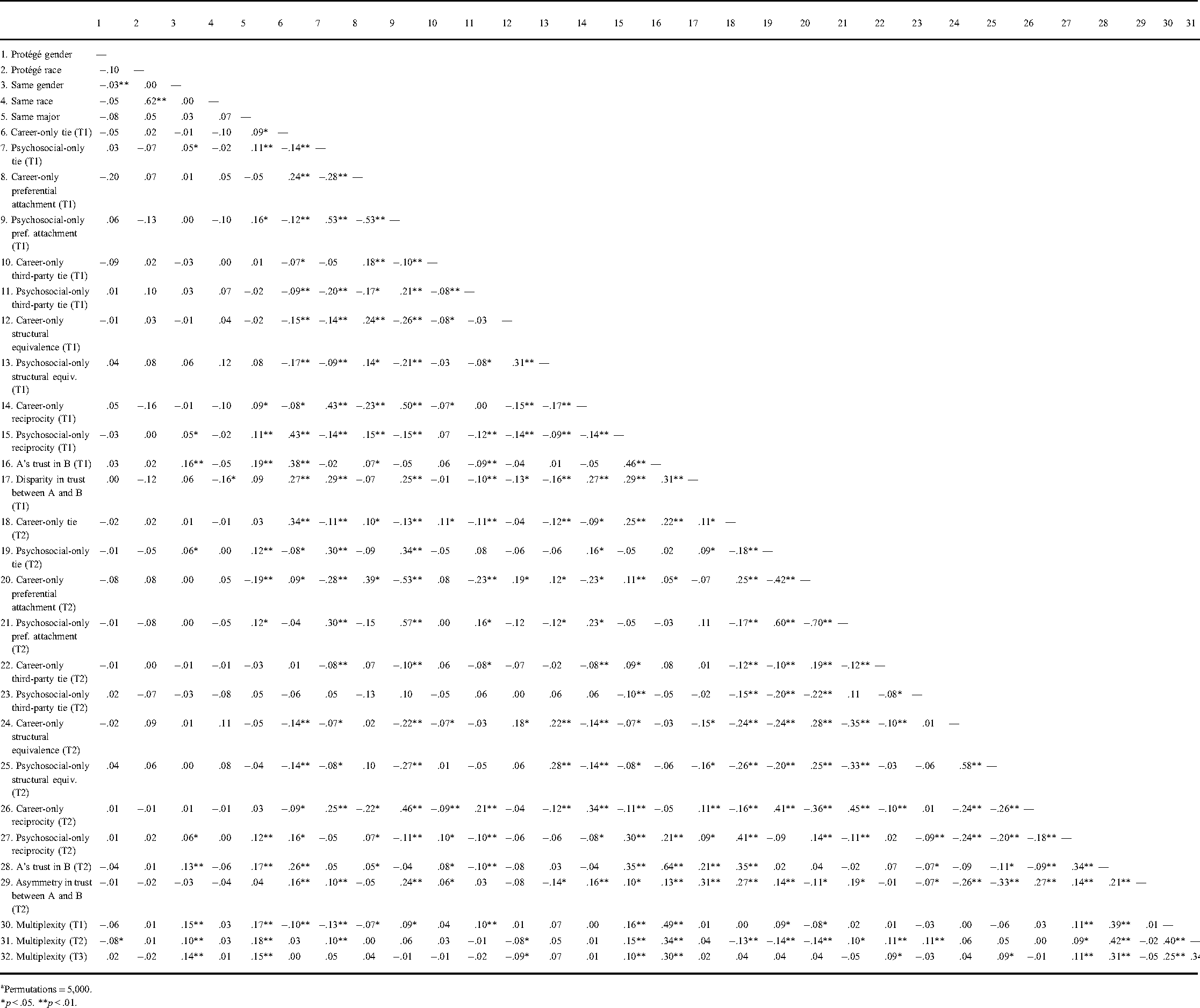
Permutations = 5,000.
*p < .05. **p < .01.
Hypothesis 1 predicted that relationships conferring psychosocial support at earlier time periods have a greater chance of evolving into multiplex relationships at later time periods. This hypothesis was supported. As shown in Table 2, a psychosocial support relation at Time 1 (Model 3) was positively associated with multiplexity at Time 2 (B = 1.26, OR = 3.51, p = .002), and psychosocial support at Time 2 (Model 6) was positively associated with multiplexity at Time 3 (B = .93, OR = 2.45, p = .021). This suggests that two individuals had a significantly greater chance (3.51 times greater and 2.45 times greater, respectively) of developing a multiplex tie when their relationship began with psychosocial support than when it did not.
Estimated Coefficients of Logistic Regression Quadratic Assignment Procedure Predicting Multiplex Developmental Relations a
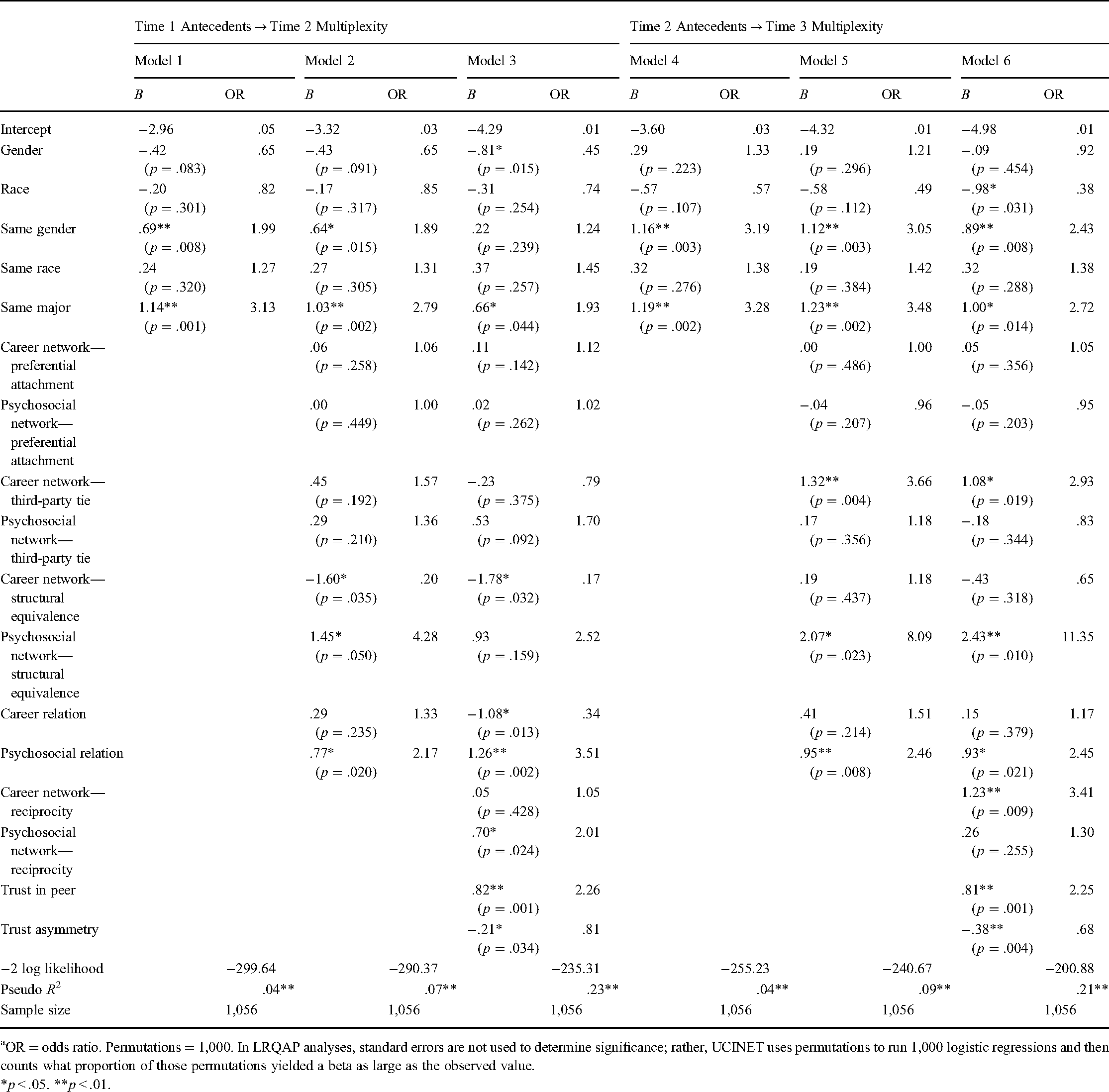
OR = odds ratio. Permutations = 1,000. In LRQAP analyses, standard errors are not used to determine significance; rather, UCINET uses permutations to run 1,000 logistic regressions and then counts what proportion of those permutations yielded a beta as large as the observed value.
*p < .05. **p < .01.
Hypothesis 2a predicted that reciprocated career and/or psychosocial support ties at earlier time periods will be positively associated with multiplex peer developmental relationships at later time periods. This expectation received partial support. As shown in Table 2, reciprocity in the career network at Time 1 was not significantly related to multiplexity at Time 2 (B = .05, OR = 1.05, ns) but was significant at Time 2 when predicting multiplexity at Time 3 (B = 1.23, OR = 3.41, p = .009), such that those who reciprocated career support at Time 2 were 3.41 times more likely to report a multiplex tie at Time 3. Conversely, reciprocity in the psychosocial support network at Time 1 was positively associated with multiplexity at Time 2 (B = .70, OR = 2.01, p = .024), but psychosocial support reciprocity at Time 2 did not predict multiplexity at Time 3 (B = .26, OR = 1.30, ns), such that individuals who reciprocated psychosocial support at Time 1 were two times more likely to report a multiplex tie at Time 2. This suggests that a reciprocal relationship is important when fostering multiplex relationships but that the nature of the resources exchanged may differ in importance, depending on the length of time individuals have been acquainted and the stage of their relationship. This result extends our findings from Hypothesis 1, whereby the primacy of reciprocated psychosocial support may be magnified at earlier time periods, when individuals are less familiar with each other. Yet this also suggests that reciprocity of career support becomes more salient as students approach graduation and entrance into the workforce. This could also be because the negative stigma around “networking” for instrumental or career-related purposes (Casciaro, Gino, & Kouchaki, 2014) decreases as individuals have been acquainted for longer periods of time, so a relationship grounded in the reciprocation of career support can sufficiently set the stage for a multiplex relationship later on.
Hypothesis 2b predicted that Peer A's trust in Peer B at earlier time periods will be positively associated with the formation of multiplex peer developmental relationships at later time periods. This hypothesis received full support. As shown in Table 2, trust at Time 1 significantly predicted multiplexity at Time 2 (B = .82, OR = 2.26, p = .001), and trust at Time 2 significantly predicted multiplexity at Time 3 (B = .81, OR = 2.25, p = .001). Therefore, when an individual feels as though they can rely on and be vulnerable to a partner at one point in time, there is a greater chance they will develop a relationship that involves the provision of a variety of career and psychosocial support functions at a later point in time.
Hypothesis 2c predicted that asymmetry in trust between Peer A and Peer B at earlier time periods will be negatively associated with the formation of multiplex peer developmental relationships at later time periods. This hypothesis was supported. Depicted in Table 2, trust asymmetry at Time 1 was negatively associated with multiplexity at Time 2 (B = −.21, OR = .81, p = .034), and trust asymmetry at Time 2 was negatively associated with multiplexity at Time 3 (B = −.38, OR = .68, p = .004). This suggests that when trust in a relationship is imbalanced, the chances of developing a strong relationship involving the exchange of both career and psychosocial support are lower. Taken together, the mutuality variables (reciprocity, trust, and trust asymmetry) explained an additional 16% of the variance in multiplexity at Time 2 and an additional 12% at Time 3, over and above the study controls (i.e., individual characteristics and network structural forces) as well as preexisting career and psychosocial support relationships, and the significance levels suggest the observed result is nonrandom. 4
Hypothesis 3 predicted that a multiplex peer developmental relationship at earlier time periods would be positively associated with their persistence across time. As shown in Table 3 (Models 3 and 6, respectively), this hypothesis was not supported. Multiplexity at Time 1 was not significantly associated with tie persistence from Time 1 to Time 2 (B = .11, ns), and multiplexity at Time 2 was not significantly associated with tie persistence from Time 2 to Time 3 (B = −.06, ns). This may be because once a relationship is multidimensional, all dimensions may not continue to be representative of the relationship over time; for example, an individual who indicates being connected to a peer who provides both career and psychosocial support at one point in time may later indicate that the career aspect of the relationship was not effective and now only provides friendship.
Estimated Coefficients of Multiple Regression Quadratic Assignment Procedure of T-1 Antecedents on Tie Persistence a
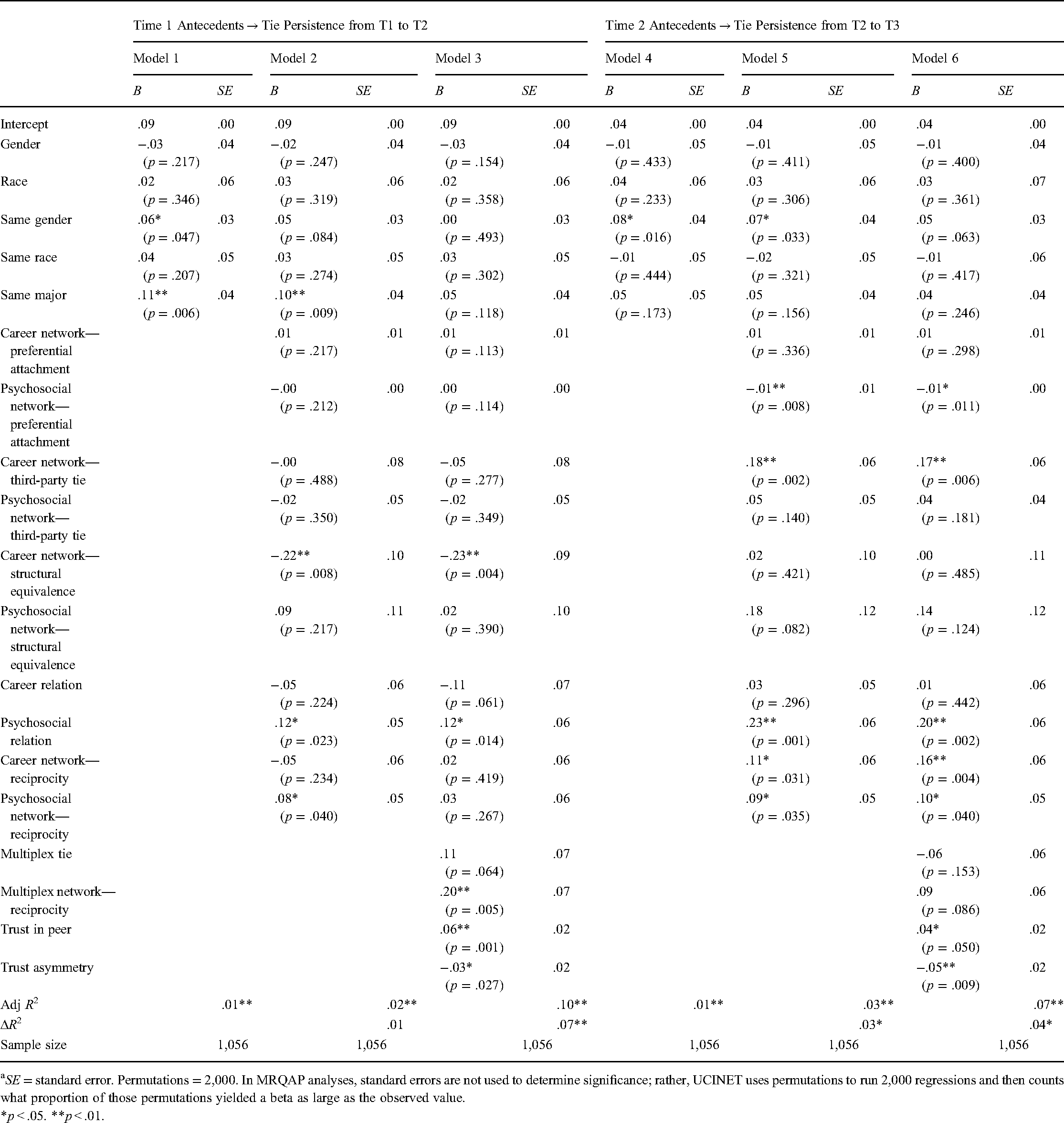
SE = standard error. Permutations = 2,000. In MRQAP analyses, standard errors are not used to determine significance; rather, UCINET uses permutations to run 2,000 regressions and then counts what proportion of those permutations yielded a beta as large as the observed value.
*p < .05. **p < .01.
Hypothesis 4a predicted multiplex relationships in which Peer A and Peer B reciprocate both career support and psychosocial support simultaneously would persist over time. This hypothesis was partially supported. As shown in Table 3, reciprocity of a multiplex relationship at Time 1 was positively associated with multiplex relationship persistence at Time 2 (B = .20, p = .005), but multiplex relationship reciprocity at Time 2 was not related to multiplex relationship persistence at Time 3 (B = .09, ns). This suggests a reciprocal interaction may be important in driving the arc of multiplexity in the early stages of the relationship but that individuals are less likely to evaluate the quality of a relationship based on the balance of costs and benefits as the relationship becomes more established. Hypothesis 4b predicted that multiplex relationships in which Peer A trusts Peer B would persist over time. This hypothesis was supported. As shown in Table 3, trust predicted multiplex relational persistence from Time 1 to Time 2 (B = .06, p = .001) and from Time 2 to Time 3 (B = .04, p = .05). This suggests a trusting relationship is likely to sustain a multiplex relationship for an extended period of time, as trust signals dependability, adaptability to change, and the ability to withstand challenges.
Hypothesis 4c predicted that multiplex relationships with a disparity in trust between Peer A and Peer B will be less likely to persist over time. This hypothesis was supported. As illustrated in Table 3, trust asymmetry at Time 1 was negatively associated with multiplex relationship stability at Time 2 (B = −.03, p = .027), and asymmetry at Time 2 was negatively associated with stability at Time 3 (B = −.05, p = .009). This suggests that an imbalance of trust in a relationship, whereby one party is more vulnerable to the other, is a threat to the livelihood of the multiplex developmental relationship. Taken together, multiplexity and mutuality variables (reciprocity, trust, and trust asymmetry) explained an additional 10% of the variance in multiplexity at Time 2, and an additional 7% at Time 3, over and above the study controls (i.e., individual characteristics and network structural forces) as well as preexisting career and psychosocial support relationships, and the significance levels suggest the observed result is nonrandom. 5
Discussion
Peer developmental relationships facilitate multidimensional exchanges that are mutually reinforcing. We shine a spotlight on the dynamics of multiplex relationships between two peers embedded in a broader peer developmental network. According to Rousseau and Ling (2007: 373), multiplex relationships “substantially multiply the potentialities” of developmental partners by allowing the simultaneous transfer of career and psychosocial support. Focusing on the dyad, rather than an individual's ego network, allows us to shed light on how these dyadic relationships form and are sustained. In their study of developmental ego network dynamics, Dobrow and Higgins (2019) assert, “although prior research has demonstrated the benefits of developmental networks, we know relatively little about how these networks change over time or the antecedents of developmental network dynamics” (p. 221) and conclude that the most pressing issue for future research is “to theorize about why such changes occur” (p. 242). Whereas existing studies identify the individual characteristics and network tendencies that drive developmental relationship formation, there has been “less attention to drivers rooted in personal and mutual benefit for the interacting parties” (Tasselli & Kilduff, 2021). To pinpoint the social processes that drive developmental network dynamics, we integrate the mutuality perspective with the microdynamics of social networks. Altogether, we identify a productive jumping-off point for peer multiplex developmental relationships to form and why they persist over time.
Theoretical Implications
We considered the microfoundations of networks and mutuality processes to explain the give and take of peer developmental relationships. In particular, we explored theoretical antecedents (while also controlling for individual factors, actor similarity, and structural network features) to better understand how and why mutuality between peers can stimulate dynamics in multiplex developmental relationships. In doing so, we advance scholarship on mentoring in several ways. First, we advance theory on the multidimensional nature of peer developmental relationships. According to mentor role theory (Kram, 1983, 1985) and frameworks of mentoring functions (e.g., Cotton et al., 2011; Higgins, 2007), while developmental relationships range in their provision of career support and psychosocial support, receiving both simultaneously fosters richer and higher quality exchanges. We contribute to this dialogue by identifying factors that generate multiplex developmental relationships. Our findings indicate that early in the peer-to-peer relationship (i.e., from the first time period to the second), peers were more likely to form multiplex developmental relationships with those with whom they initially exchanged psychosocial support. This may be because social support is a foundational element for the development of discretionary, high-quality relationships, especially when peers are unfamiliar with one another. Interestingly, our results (see Table 2) show that having a primarily career-focused relationship at Time 1 was negatively related to multiplexity at Time 2 (B = −1.08, p < .05), suggesting that a relationship based on instrumental exchanges during its early stages is less likely to become multiplex. While we did not a priori hypothesize a negative effect of career support on multiplex relationship formation, we suspect that prioritizing transactional exchanges may set the stage for a competitive relationship that constrains it from broadening in scope. Indeed, recent research on “networking” speaks to this finding; exploring the consequences of creating social relationships in support of task and professional goals, Casciaro and colleagues (2014) conclude that, as compared to networking in pursuit of emotional support or friendship, strategically building professional relationships can make people feel “dirty.”
Second, we view multiplex peer developmental relationships as mutual, involving shared benefit, influence, expectations, and understanding (Ragins & Verbos, 2007; Roberts, 2007). The dyad-level focus of our study, which relies on reports from both actors in the relationship, allows us to respond to calls to identify antecedents of multiplexity from both protégé and developer perspectives, as well as to incorporate research and theory on high-quality connections to capture mutually reinforcing social processes (Dobrow & Higgins, 2019; Dobrow et al., 2012). We found that relationships characterized by mutuality factors—namely, reciprocity, trust, and shared perceptions of trust (less trust asymmetry)—were more likely to evolve into multiplex relationships. These findings advance theories of mentoring and high-quality connections, bolstering the role of mutuality in generating developmental relationships beyond protégé factors (e.g., demographic variables), similarity (e.g., same gender), contextual factors (e.g., industry and organizational support), and structural features of one's network (e.g., structural equivalence, third-party connections). Accounting for the perspectives of both parties improves our understanding of the costs and benefits, as well as the dynamics, involved in these relationships. Relationships embodying mutuality provide occasions for individuals to express and reinforce valued identities (Kahn, 2007; Roberts, 2007), offer cues that improve perceptions of meaningfulness in their work (Wrzesniewski, Dutton, & Debebe, 2003), and increase the likelihood they will consider criticism or negative feedback as opportunities for learning and improvement rather than failure (Crocker & Park, 2004; Roberts, 2007). Our results demonstrate that “mutual” relationships are resource producing and have the power to propagate multidimensional exchanges that may not exist otherwise (Rousseau & Ling, 2007).
Last, we explore the dynamics associated with multiplex developmental relationships. Only a handful of studies have traced mentoring relationships over time (e.g., Dobrow & Higgins, 2005; Payne & Huffman, 2005), even fewer have focused on peer developmental relationships over time (e.g., Cummings & Higgins, 2006; Dobrow & Higgins, 2019), and fewer have emphasized multiplex developmental relationships (i.e., Cotton et al., 2011). Yet, over 30 years ago, Kram (1983: 609) urged, “in order to understand fully the nature and impact of [a] developmental relationship, it is necessary to examine how it changes over time.” Recently, Dobrow and Higgins (2019: 242) called for “theory to incorporate insights from related fields, such as social support, that has long distinguished between instrumental and expressive forms of help but has rarely considered these aspects over time,” while Burt and Merluzzi (2016) argued, “networks that persist in time have meaning, serve some purpose, and are real in their consequences.” Our study is unique in that we identify factors promoting the formation and persistence of multiplex peer developmental relationships over time to unpack the dynamic sequence in which these relationships evolve. Our results suggest that peers move in and out of developmental networks and that factors capturing mutuality—reciprocation of career and psychosocial support, trust, and shared trust—promote “stickiness” in multiplex relationships. Thus, mutuality is both generative and resolute, nurturing stability in multiplex relationships.
Practical Implications
Our study findings have implications for both individuals navigating their early careers and for organizations interested in creating and maintaining peer developmental networks as a viable alternative to formalized, hierarchical mentoring programs. The organizational landscape is dynamic, with an ever-increasing number of virtual businesses and flat structures that constrain opportunities for formal mentorships but increase individuals’ reliance on their peers for support (e.g., Dobrow & Higgins, 2019; Thomas & Higgins, 1996). It is critical for employees and organizations to recognize the role peers play in the developmental process.
Early-career employees are commonly thrust into leadership positions with little experience (Hargrove & Sitkin, 2011). In response, universities and organizations alike are dedicating substantial resources to designing specialized programs that arm their stakeholders with the necessary leadership skills. To maximize their return on investment, our findings suggest it might be worthwhile to share in such programs information on the value of peer developmental relationships and how they foster individual career achievement (e.g., Allen et al., 2004). These students and employees would also benefit from training on how to analyze their own developmental network structures and developmental relationship initiation skills (Higgins (2004); Higgins, Chandler, & Kram, 2007). Such training would identify gaps and include the social processes we identified as fostering the emergence of rich, multiplex developmental relationships known to promote extraordinary career performance. Another area of training for professionals charged with overseeing these developmental network initiatives includes raising individuals’ awareness that they are not only a potential developer of others’ developmental networks but also a protégé of their own developmental network.
We also believe individuals and organizations will benefit from understanding that multiplex developmental relationships can be expected to change and evolve over time. This implies that individuals should proactively and strategically cultivate and manage their peer developmental ties to have a hand in their own career development as opposed to simply assuming these beneficial ties will remain strong and stable (Dobrow & Higgins, 2019). At the same time, if managers overseeing these programs had the capability to recognize when changes occur in their stakeholders’ developmental networks, they could provide more tailored attention. Further, when developmental peer programs are offered, the organization should implement accountability processes and tools whereby all persons involved (i.e., individuals and managers or staff) feel comfortable voicing concerns and discussing opportunities for how to enhance their own developmental networks while also providing career and psychosocial support to others.
Limitations and Future Research
Our study has several limitations worth noting. First, our results may not be generalizable to some organizational settings. Although students preparing to enter the workforce likely have characteristics that differ from more “seasoned” working professionals, there are reasons why this is not a major concern in our study. First, our study approached conditions that individuals face when interacting with others in organizations. For example, in Kleinbaum’s (2018) study of tie formation and tie decay in MBA students’ networks, he showed that there were critical junctures throughout the program that mimicked “reorganizations,” which impacted whether students retained or dissolved ties to their peers. Those in our sample created, maintained, and dissolved discretionary ties over time and had social consequences for doing so; thus, our study possessed “both mundane and psychological realism” (Walter, Cole, van der Vegt, Rubin, & Bommer, 2012: 987). Second, most of our proposed relationships were empirically supported and consistent with our theorizing. Existing network research yields consistent results when testing hypotheses across student and employee samples (e.g., Zagenczyk, Scott, Gibney, Murrell, & Thatcher, 2010), providing additional confidence in our study's findings. Third, student samples are useful for research that strives to understand fundamental organizational phenomena (e.g., Dobbins, Lane, & Steiner, 1988; Locke, 1986). Greenberg (1987) observed that student samples are by no means more problematic than nonrepresentative field samples of employed adults. Research demonstrates that the correlation between effect sizes using nonfield and field settings typically exceed .70 (Anderson, Lindsay, & Bushman, 1999), further suggesting that our use of a student sample may not have adversely affected generalizability.
A related concern is the homogeneity within our sample of students, all of whom were engaged in a leadership development program. While this population may present a restricted view of peer relationships, the individuals in this sample were active participants in an applied program with organizational relevance, where developmental relationships are likely to form between peers. It has also been argued that scholarly research must study mentoring relationships at each stage of an individual's development, starting in academic settings with future business leaders (Allen, Russell, & Maetzke, 1997). Further, Klein, Conn, Smith, and Sorra (2001) found that demographic heterogeneity within a collective does not substantively influence individuals’ perceptions of their work environment. Nonetheless, despite the aforementioned evidence assuaging generalizability and homogeneity concerns, we acknowledge that future longitudinal research could provide greater confidence in our study's findings by replicating the present results using different subjects, settings, and durations of time between data waves.
Another potential limitation is the small number of students in our bounded network. Although one may view our individual-level sample size as less than optimal, we offer two observations to mitigate concerns. First, the bounded cohort of 33 individual peers are fairly representative of departmental sizes within many types of organizations. Second, longitudinal studies of developmental networks with multiple waves of network data trend toward small sample sizes (e.g., Cummings & Higgins, 2006; Dobrow & Higgins, 2019). This is because these studies’ research questions are more commonly focused at the dyad level of analysis as opposed to the whole or overall network. For example, at the dyad level, our sample sizes (T1 = 930 ties, T2 = 992 ties, and T3 = 812 ties) are comparable to the dyad-level sample sizes in prior research that used a similar analytic approach (e.g., Cummings & Higgins, 2006, n = 977 ties).
Beyond addressing limitations, the structure of the leadership development program the respondents participated in may present an opportunity for further theory development. For example, we found relationships predicated on psychosocial support were more influential in the formation of multiplex relationships at earlier time periods, an effect not observed at later time periods. By the last wave of data collection, our sample of students was nearing graduation, so it is possible their need for career support from peer students was limited, and they might have shifted to career counselors, formal mentors, or professors for guidance. However, the program cadence mirrors organizational life in many ways. Whether it is students approaching graduation, business professionals facing a reorganization, or myriad other disruptive events, the idea of tie decay “can be overcome by the active choices of individuals. Indeed, anyone who has ever had a friend knows that when the structural locus of interaction is reorganized away, people may actively choose to continue interacting with one another, at the cost of greater effort, to sustain the relationship” (Kleinbaum, 2018: 2220). Perhaps in certain contexts, peer developmental relationships are more likely to persist, while in others, external triggers may propel individuals to reorient their focus toward more formalized mentor-mentee relationships.
Also, part of the value of social network analysis is that we can expand beyond the dyad to consider the structural arrangement of actors. Whereas the dyad level of analysis was most appropriate for exploring the mutual social processes we theorized about, future research could consider the role of generalized reciprocity, which embodies the concepts of “paying it forward” by helping others in one's broader network. Integrating this perspective could aid in tracing how the dispersion of career or psychosocial support—or their combination—could build a broader climate of mutual engagement in a leadership development program or an organization.
Finally, we were surprised the results did not support our expectation that multiplex relationships would persist over time. Our theorizing implied inertia is specific to multiplexity stability because the support contents perpetuate each other. Though this is conceptually sound, research also finds that familiarity gives us insights into which relationships we want to retain or dissolve. Specifically, “when it comes to existing ties . . . people can better assess the benefits that another person brings them based on their own prior experience of interacting with that person. Consequently, they can make better informed decisions about which of their contacts they might want to retain in their networks and which ties to permit to decay” (Kleinbaum, 2018: 2221). Our pattern of results—that reciprocity leads to persistence at earlier time periods but not later ones—suggests individuals may have gathered enough information to identify which contacts they want to retain and which they would permit to dissolve or weaken. Indeed, as these ideas suggest, much work remains to be conducted to understand the inner workings of multiplex developmental relationships, and researchers can use our findings as a springboard.
Conclusion
Multiplex peer developmental relationships serve as a valuable alternative to traditional mentors, providing access to a broad scope of both career and psychosocial support. Our study highlights the multidimensional, mutual, and dynamic aspects of these relationships while also identifying essential social processes that promote the evolution and persistence of multiplex peer developmental relationships. Our results suggest features associated with mutuality, including reciprocity, trust, and trust asymmetry, play a generative role in multiplex relationship dynamics. By tracing peer developmental relationships over time, we conclude that the mutuality perspective is a key explanatory mechanism into the microfoundations of multiplex relationships.
Footnotes
Acknowledgments
We are grateful to Associate Editor Christopher Porter and two anonymous reviewers for their guidance and constructive suggestions throughout the review process. We would also like to thank the members of the LINKS Center for Social Network Analysis at the University of Kentucky for providing helpful comments on an earlier version of this manuscript.
Declaration of Conflicting Interests
The author(s) declared no potential conflicts of interest with respect to the research, authorship, and/or publication of this article.
Funding
The author(s) received no financial support for the research, authorship, and/or publication of this article.
